

IEC 62667:2017
(Main)Medical electrical equipment - Medical light ion beam equipment - Performance characteristics
General Information
- Abstract
IEC 62667:2017 applies to light ion beam ME equipment when used, for therapy purposes, in human medical practice.
This document applies to light ion beam ME equipment which delivers light ion beams with an energy per nucleon in the range 10 MeV/n to 500 MeV/n.
This document describes measurements and test procedures to be performed by the manufacturer of light ion beam ME equipment but does not specify acceptance tests.
This document specifies test procedures for the determination and disclosure of performance characteristics, knowledge of which is necessary for proper selection, application, and use of light ion beam ME equipment and which are to be declared in the accompanying documentation together with the greatest deviation or variation to be expected under specific conditions in normal use. A format for presentation of performance values is given in Annex A.
- Status
- Published
- Publication Date
- 22-Aug-2017
- Drafting Committee
- WG 1 - TC 62/SC 62C/WG 1
- Current Stage
- PPUB - Publication issued
- Start Date
- 23-Aug-2017
- Completion Date
- 16-Sep-2017
Overview
IEC 62667:2017 is an international standard developed by the International Electrotechnical Commission (IEC) that specifies the performance characteristics of medical electrical equipment utilizing medical light ion beam technology. This standard applies specifically to light ion beam medical electrical (ME) equipment used in therapeutic treatments in human medical practice. It covers equipment delivering light ion beams with energies ranging from 10 MeV/n to 500 MeV/n per nucleon.
The document outlines the necessary measurements and test procedures that manufacturers must perform to determine and declare the performance characteristics of light ion beam ME equipment. These declared characteristics enable healthcare providers to properly select, apply, and use the equipment in clinical environments. However, the standard does not specify acceptance testing protocols.
Key Topics
- Scope and Application: Defines the types of light ion beam equipment covered and the operational energy ranges relevant to medical therapy.
- Beam Delivery: Detailed descriptions of ion species, energy selection methods, beam gating, gantry types and configurations, beam applicators, adjustable beam limiting devices (BLDs), isocenter definitions, lateral spreading devices (LSDs), and scanning modes.
- Time Constraints: Specifies maximum irradiation time, switching times between irradiations, energies, and ion species, as well as start-up and shutdown times.
- Dose Monitoring System: Requirements and test procedures for dose monitoring systems including reproducibility, proportionality, off-axis response, angular dependency, and dose stability over different time frames.
- Depth Dose Characteristics: Performance evaluation of depth dose distributions, range modulation techniques, and stability of light ion beam range.
- Lateral Profiles: Assessment of lateral beam profiles including flatness, symmetry, and penumbra for both scattering and scanning beam systems.
- Energy and Fluence Modulation: Description of energy and fluence modulated portals including performance for low-dose delivery.
- Radiation Field Indication: Requirements for clear indication of radiation fields, positioning of beam limiting devices, and reference axis alignment.
- Environmental and Maintenance Conditions: Consideration of transport, storage, facility stability, and equipment maintenance for ensuring consistent performance.
- Presentation of Information: Guidelines for manufacturers on providing clear, standardized performance data and user instructions in accompanying documentation.
Applications
IEC 62667:2017 is crucial for medical device manufacturers, healthcare providers, and regulatory bodies involved in the production, evaluation, and use of medical light ion beam equipment. The standard ensures:
- Safety and Efficacy of Treatment: By defining test procedures to verify the accuracy and reliability of ion beam delivery, the standard supports effective and safe patient therapy.
- Device Performance Transparency: Manufacturers must declare key performance indicators, enhancing clinician confidence and facilitating informed decision-making regarding device selection and application.
- Regulatory Compliance: Acts as a benchmark for regulatory assessment processes for medical light ion beam equipment, aligning global safety and performance expectations.
- Clinical Operational Efficiency: Time constraints and equipment switching parameters help optimize clinical workflow without compromising treatment quality.
- Quality Assurance: Detailed measurement protocols enable consistent performance verification and support ongoing quality maintenance in medical facilities.
Related Standards
For comprehensive compliance and integration, IEC 62667:2017 is often used alongside other IEC and international standards for medical electrical equipment and radiation therapy, such as:
- IEC 60601 series: Essential standards for basic safety and essential performance of medical electrical equipment.
- IEC/TR 60976: Radiation therapy equipment including proton and ion beam therapy technical reports.
- ISO 13485: Quality management systems for medical device manufacturers.
- IEC 61784: Industrial communication networks standards relevant to equipment integration and monitoring.
- Regional Regulatory Guidelines: FDA (USA), EMA (Europe), and other national bodies' regulations on medical ionizing radiation devices.
Keywords: IEC 62667, medical light ion beam equipment, performance characteristics, medical electrical equipment, ion beam therapy, dose monitoring, beam delivery, radiation safety, medical device standards, ion therapy equipment testing, radiation therapy standards, gantry configurations.
Get Certified
Connect with accredited certification bodies for this standard

BSI Group
BSI (British Standards Institution) is the business standards company that helps organizations make excellence a habit.

TÜV Rheinland
TÜV Rheinland is a leading international provider of technical services.

TÜV SÜD
TÜV SÜD is a trusted partner of choice for safety, security and sustainability solutions.
Sponsored listings
Frequently Asked Questions
IEC 62667:2017 is a standard published by the International Electrotechnical Commission (IEC). Its full title is "Medical electrical equipment - Medical light ion beam equipment - Performance characteristics". This standard covers: IEC 62667:2017 applies to light ion beam ME equipment when used, for therapy purposes, in human medical practice. This document applies to light ion beam ME equipment which delivers light ion beams with an energy per nucleon in the range 10 MeV/n to 500 MeV/n. This document describes measurements and test procedures to be performed by the manufacturer of light ion beam ME equipment but does not specify acceptance tests. This document specifies test procedures for the determination and disclosure of performance characteristics, knowledge of which is necessary for proper selection, application, and use of light ion beam ME equipment and which are to be declared in the accompanying documentation together with the greatest deviation or variation to be expected under specific conditions in normal use. A format for presentation of performance values is given in Annex A.
IEC 62667:2017 applies to light ion beam ME equipment when used, for therapy purposes, in human medical practice. This document applies to light ion beam ME equipment which delivers light ion beams with an energy per nucleon in the range 10 MeV/n to 500 MeV/n. This document describes measurements and test procedures to be performed by the manufacturer of light ion beam ME equipment but does not specify acceptance tests. This document specifies test procedures for the determination and disclosure of performance characteristics, knowledge of which is necessary for proper selection, application, and use of light ion beam ME equipment and which are to be declared in the accompanying documentation together with the greatest deviation or variation to be expected under specific conditions in normal use. A format for presentation of performance values is given in Annex A.
IEC 62667:2017 is classified under the following ICS (International Classification for Standards) categories: 11.040.60 - Therapy equipment. The ICS classification helps identify the subject area and facilitates finding related standards.
IEC 62667:2017 is available in PDF format for immediate download after purchase. The document can be added to your cart and obtained through the secure checkout process. Digital delivery ensures instant access to the complete standard document.
Standards Content (Sample)
IEC 62667 ®
Edition 1.0 2017-08
INTERNATIONAL
STANDARD
NORME
INTERNATIONALE
colour
inside
Medical electrical equipment – Medical light ion beam equipment – Performance
characteristics
Appareils électromédicaux – Appareils médicaux par faisceau d'ions légers –
Caractéristiques de performances
All rights reserved. Unless otherwise specified, no part of this publication may be reproduced or utilized in any form
or by any means, electronic or mechanical, including photocopying and microfilm, without permission in writing from
either IEC or IEC's member National Committee in the country of the requester. If you have any questions about IEC
copyright or have an enquiry about obtaining additional rights to this publication, please contact the address below or
your local IEC member National Committee for further information.
Droits de reproduction réservés. Sauf indication contraire, aucune partie de cette publication ne peut être reproduite
ni utilisée sous quelque forme que ce soit et par aucun procédé, électronique ou mécanique, y compris la photocopie
et les microfilms, sans l'accord écrit de l'IEC ou du Comité national de l'IEC du pays du demandeur. Si vous avez des
questions sur le copyright de l'IEC ou si vous désirez obtenir des droits supplémentaires sur cette publication, utilisez
les coordonnées ci-après ou contactez le Comité national de l'IEC de votre pays de résidence.
IEC Central Office Tel.: +41 22 919 02 11
3, rue de Varembé Fax: +41 22 919 03 00
CH-1211 Geneva 20 info@iec.ch
Switzerland www.iec.ch
About the IEC
The International Electrotechnical Commission (IEC) is the leading global organization that prepares and publishes
International Standards for all electrical, electronic and related technologies.
About IEC publications
The technical content of IEC publications is kept under constant review by the IEC. Please make sure that you have the
latest edition, a corrigenda or an amendment might have been published.
IEC Catalogue - webstore.iec.ch/catalogue Electropedia - www.electropedia.org
The stand-alone application for consulting the entire The world's leading online dictionary of electronic and
bibliographical information on IEC International Standards, electrical terms containing 20 000 terms and definitions in
Technical Specifications, Technical Reports and other English and French, with equivalent terms in 16 additional
documents. Available for PC, Mac OS, Android Tablets and languages. Also known as the International Electrotechnical
iPad. Vocabulary (IEV) online.
IEC publications search - www.iec.ch/searchpub IEC Glossary - std.iec.ch/glossary
The advanced search enables to find IEC publications by a 65 000 electrotechnical terminology entries in English and
variety of criteria (reference number, text, technical French extracted from the Terms and Definitions clause of
committee,…). It also gives information on projects, replaced IEC publications issued since 2002. Some entries have been
and withdrawn publications. collected from earlier publications of IEC TC 37, 77, 86 and
CISPR.
IEC Just Published - webstore.iec.ch/justpublished
Stay up to date on all new IEC publications. Just Published IEC Customer Service Centre - webstore.iec.ch/csc
details all new publications released. Available online and If you wish to give us your feedback on this publication or
also once a month by email. need further assistance, please contact the Customer Service
Centre: csc@iec.ch.
A propos de l'IEC
La Commission Electrotechnique Internationale (IEC) est la première organisation mondiale qui élabore et publie des
Normes internationales pour tout ce qui a trait à l'électricité, à l'électronique et aux technologies apparentées.
A propos des publications IEC
Le contenu technique des publications IEC est constamment revu. Veuillez vous assurer que vous possédez l’édition la
plus récente, un corrigendum ou amendement peut avoir été publié.
Catalogue IEC - webstore.iec.ch/catalogue Electropedia - www.electropedia.org
Application autonome pour consulter tous les renseignements
Le premier dictionnaire en ligne de termes électroniques et
bibliographiques sur les Normes internationales,
électriques. Il contient 20 000 termes et définitions en anglais
Spécifications techniques, Rapports techniques et autres
et en français, ainsi que les termes équivalents dans 16
documents de l'IEC. Disponible pour PC, Mac OS, tablettes
langues additionnelles. Egalement appelé Vocabulaire
Android et iPad.
Electrotechnique International (IEV) en ligne.
Recherche de publications IEC - www.iec.ch/searchpub
Glossaire IEC - std.iec.ch/glossary
65 000 entrées terminologiques électrotechniques, en anglais
La recherche avancée permet de trouver des publications IEC
en utilisant différents critères (numéro de référence, texte, et en français, extraites des articles Termes et Définitions des
comité d’études,…). Elle donne aussi des informations sur les publications IEC parues depuis 2002. Plus certaines entrées
projets et les publications remplacées ou retirées. antérieures extraites des publications des CE 37, 77, 86 et
CISPR de l'IEC.
IEC Just Published - webstore.iec.ch/justpublished
Service Clients - webstore.iec.ch/csc
Restez informé sur les nouvelles publications IEC. Just
Published détaille les nouvelles publications parues. Si vous désirez nous donner des commentaires sur cette
Disponible en ligne et aussi une fois par mois par email. publication ou si vous avez des questions contactez-nous:
csc@iec.ch.
IEC 62667 ®
Edition 1.0 2017-08
INTERNATIONAL
STANDARD
NORME
INTERNATIONALE
colour
inside
Medical electrical equipment – Medical light ion beam equipment – Performance
characteristics
Appareils électromédicaux – Appareils médicaux par faisceau d'ions légers –
Caractéristiques de performances
INTERNATIONAL
ELECTROTECHNICAL
COMMISSION
COMMISSION
ELECTROTECHNIQUE
INTERNATIONALE
ICS 11.040.60 ISBN 978-2-8322-4734-1
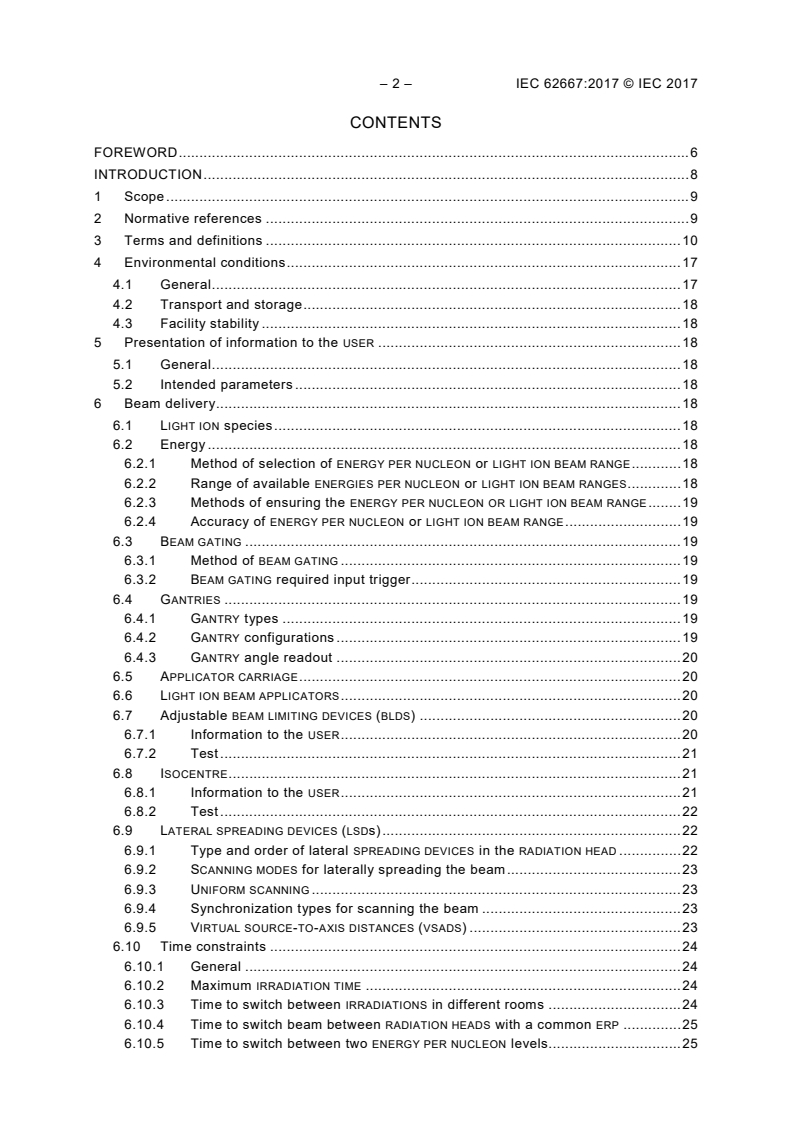
– 2 – IEC 62667:2017 © IEC 2017
CONTENTS
FOREWORD . 6
INTRODUCTION . 8
1 Scope . 9
2 Normative references . 9
3 Terms and definitions . 10
4 Environmental conditions . 17
4.1 General . 17
4.2 Transport and storage . 18
4.3 Facility stability . 18
5 Presentation of information to the USER . 18
5.1 General . 18
5.2 Intended parameters . 18
6 Beam delivery . 18
6.1 LIGHT ION species . 18
6.2 Energy . 18
6.2.1 Method of selection of ENERGY PER NUCLEON or LIGHT ION BEAM RANGE . 18
6.2.2 Range of available ENERGIES PER NUCLEON or LIGHT ION BEAM RANGES . 18
6.2.3 Methods of ensuring the ENERGY PER NUCLEON OR LIGHT ION BEAM RANGE . 19
6.2.4 Accuracy of ENERGY PER NUCLEON or LIGHT ION BEAM RANGE . 19
6.3 BEAM GATING . 19
6.3.1 Method of BEAM GATING . 19
6.3.2 BEAM GATING required input trigger . 19
6.4 GANTRIES . 19
6.4.1 GANTRY types . 19
6.4.2 GANTRY configurations . 19
6.4.3 GANTRY angle readout . 20
6.5 APPLICATOR CARRIAGE . 20
6.6 LIGHT ION BEAM APPLICATORS . 20
6.7 Adjustable BEAM LIMITING DEVICES (BLDS) . 20
6.7.1 Information to the USER . 20
6.7.2 Test . 21
6.8 ISOCENTRE . 21
6.8.1 Information to the USER . 21
6.8.2 Test . 22
6.9 LATERAL SPREADING DEVICES (LSDs) . 22
6.9.1 Type and order of lateral SPREADING DEVICES in the RADIATION HEAD . 22
6.9.2 SCANNING MODES for laterally spreading the beam . 23
6.9.3 UNIFORM SCANNING . 23
6.9.4 Synchronization types for scanning the beam . 23
6.9.5 VIRTUAL SOURCE-TO-AXIS DISTANCES (VSADS) . 23
6.10 Time constraints . 24
6.10.1 General . 24
6.10.2 Maximum IRRADIATION TIME . 24
6.10.3 Time to switch between IRRADIATIONS in different rooms . 24
6.10.4 Time to switch beam between RADIATION HEADS with a common ERP . 25
6.10.5 Time to switch between two ENERGY PER NUCLEON levels . 25
6.10.6 Time to switch between two LIGHT ION species . 25
6.10.7 Time to TERMINATE and INTERRUPT IRRADIATION . 26
6.10.8 Time to restart IRRADIATION . 26
6.10.9 Start-up time . 26
6.10.10 Time for shutdown . 26
6.11 Maintenance . 27
7 DOSE MONITORING SYSTEM . 27
7.1 General . 27
7.2 Standard test conditions for testing DOSE MONITORING SYSTEMS . 27
7.3 Reproducibility of MU delivery . 27
7.3.1 Information to the USER . 27
7.3.2 Test . 27
7.4 Proportionality of MU delivery . 28
7.4.1 Requirement . 28
7.4.2 Information to the USER . 29
7.4.3 Test . 29
7.5 Off-axis response of beam FLUX monitor for MODULATED SCANNING . 30
7.5.1 Information to the USER . 30
7.5.2 Test . 30
7.6 Dependence of MU delivery on angular position . 31
7.6.1 Information to the USER . 31
7.6.2 Test . 31
7.7 Stability of MU DELIVERY . 32
7.7.1 Stability of MU DELIVERY throughout the day . 32
7.7.2 Stability of MU DELIVERY throughout the week . 33
8 DEPTH DOSE characteristics . 34
8.1 DEPTH DOSE distributions for NON-RANGE MODULATED PORTALS . 34
8.1.1 Information to the USER . 34
8.1.2 Test . 34
8.2 Range modulating techniques . 35
8.2.1 Type and sequence of range MODULATION DEVICES in RADIATION HEAD . 35
8.2.2 Discrete RANGE MODULATION DEVICE . 35
8.2.3 Programmable RANGE MODULATION DEVICE . 35
8.3 RANGE MODULATED PORTAL DEPTH DOSE distributions . 36
8.3.1 Information to the USER . 36
8.3.2 Test . 36
8.4 Stability OF LIGHT ION BEAM RANGE . 37
8.4.1 Stability of LIGHT ION BEAM RANGE throughout an IRRADIATION . 37
8.4.2 Dependence of LIGHT ION BEAM RANGE on GANTRY rotation . 37
9 Lateral profiles of LIGHT ION PORTALS . 38
9.1 Lateral profiles of LIGHT ION PORTALS for systems that use scatterers or
UNIFORM SCANNING . 38
9.1.1 General . 38
9.1.2 Flatness of LIGHT ION PORTALS . 39
9.1.3 Symmetry of LIGHT ION PORTALS. 39
9.1.4 Lateral PENUMBRA . 40
9.2 Lateral profiles of LIGHT ION PORTALS for systems that use MODULATED
SCANNING . 40
– 4 – IEC 62667:2017 © IEC 2017
9.2.1 Information to the USER . 40
9.2.2 Test . 40
10 LIGHT ION PORTAL with energy and FLUENCE modulation (EFM) . 41
10.1 Information to the USER . 41
10.2 Beam characteristics and dosimetry system performance for small delivered
doses . 41
11 Time to irradiate SPECIFIED volumes . 41
11.1 Information to the USER . 41
11.2 Test . 42
12 Indication of RADIATION FIELDS . 42
12.1 APPLICATOR CARRIAGE extension indicator. 42
12.1.1 Information to the USER . 42
12.1.2 Test . 42
12.2 Multi-element BLD element position indications . 42
12.2.1 Information to the USER . 42
12.2.2 Test . 42
12.3 Indication of THE LIGHT ION REFERENCE AXIS . 43
12.3.1 General . 43
12.3.2 Indication on entry to the PATIENT . 43
12.3.3 Indication of the LIGHT ION REFERENCE AXIS on distal side of PATIENT . 44
12.4 LIGHT FIELD-indicator . 44
12.4.1 Information to USER . 44
12.4.2 Test . 44
13 PATIENT SUPPORTS . 45
13.1 General . 45
13.2 TABLE TOPS . 45
13.2.1 General . 45
13.2.2 Available TABLE TOPS . 45
13.2.3 Extent of movements of TABLE TOP relative to PATIENT SUPPORT . 45
13.2.4 Positional deviation of the TABLE TOP surface during longitudinal motion . 46
13.2.5 Positional deviation of the TABLE TOP surface during lateral motion . 47
13.3 Coordinate system . 48
13.4 Extent of movements for PATIENT SUPPORT . 48
13.4.1 Information to the USER . 48
13.4.2 ISOCENTRIC rotation of THE PATIENT SUPPORT . 48
13.4.3 Accuracy of PATIENT SUPPORT translational motions . 48
13.4.4 Accuracy of PATIENT SUPPORT rotational motions . 49
Annex A (informative) Format for presentation of performances values . 54
Bibliography . 115
Index of defined terms . 116
Figure 1 – Explanatory diagram for parameters associated with a non-range
modulated LIGHT ION BEAM . 50
Figure 2 – Explanatory diagram for parameters associated with a DEPTH DOSE
distribution of LIGHT ION BEAM RANGE MODULATED PORTALS (left − protons, right − carbon
ions) . 50
Figure 3 – The rotational GANTRY . 51
Figure 4 – Depths to measure lateral profiles . 52
Figure 5 – Example of profile of ABSORBED DOSE along the major axes . 52
Figure 6 – Flattened area . 53
Table 1 – Standard test conditions for testing reproducibility . 28
Table 2 – Conditions for testing proportionality of the DOSE MONITORING SYSTEM . 30
Table 3 – Conditions for testing off-axis response of the beam FLUX monitor for
MODULATED SCANNING . 31
Table 4 – Conditions for testing dependence of the DOSE MONITORING SYSTEM on
angular position . 32
Table 5 – Conditions for testing stability throughout the day of the DOSE MONITORING
SYSTEM. 33
Table 6 – Conditions for testing stability throughout the week of the DOSE MONITORING
SYSTEM. 34
Table 7 – Conditions for testing stability of LIGHT ION BEAM RANGE during an IRRADIATION . 37
Table 8 – Conditions for testing dependence of the LIGHT ION BEAM RANGE on GANTRY
angle . 38
Table 9 – Conditions for testing the indication on entry to the PATIENT . 43
Table 10 – Conditions for testing positional and pitch deviation of the TABLE TOP
surface during longitudinal motion relative to the PATIENT SUPPORT base . 46
Table 11 – Conditions for testing positional deviation of the TABLE TOP surface during
lateral motion relative to PATIENT SUPPORT base . 47
– 6 – IEC 62667:2017 © IEC 2017
INTERNATIONAL ELECTROTECHNICAL COMMISSION
____________
MEDICAL ELECTRICAL EQUIPMENT –
MEDICAL LIGHT ION BEAM EQUIPMENT –
PERFORMANCE CHARACTERISTICS
FOREWORD
1) The International Electrotechnical Commission (IEC) is a worldwide organization for standardization comprising
all national electrotechnical committees (IEC National Committees). The object of IEC is to promote
international co-operation on all questions concerning standardization in the electrical and electronic fields. To
this end and in addition to other activities, IEC publishes International Standards, Technical Specifications,
Technical Reports, Publicly Available Specifications (PAS) and Guides (hereafter referred to as “IEC
Publication(s)”). Their preparation is entrusted to technical committees; any IEC National Committee interested
in the subject dealt with may participate in this preparatory work. International, governmental and non-
governmental organizations liaising with the IEC also participate in this preparation. IEC collaborates closely
with the International Organization for Standardization (ISO) in accordance with conditions determined by
agreement between the two organizations.
2) The formal decisions or agreements of IEC on technical matters express, as nearly as possible, an international
consensus of opinion on the relevant subjects since each technical committee has representation from all
interested IEC National Committees.
3) IEC Publications have the form of recommendations for international use and are accepted by IEC National
Committees in that sense. While all reasonable efforts are made to ensure that the technical content of IEC
Publications is accurate, IEC cannot be held responsible for the way in which they are used or for any
misinterpretation by any end user.
4) In order to promote international uniformity, IEC National Committees undertake to apply IEC Publications
transparently to the maximum extent possible in their national and regional publications. Any divergence
between any IEC Publication and the corresponding national or regional publication shall be clearly indicated in
the latter.
5) IEC itself does not provide any attestation of conformity. Independent certification bodies provide conformity
assessment services and, in some areas, access to IEC marks of conformity. IEC is not responsible for any
services carried out by independent certification bodies.
6) All users should ensure that they have the latest edition of this publication.
7) No liability shall attach to IEC or its directors, employees, servants or agents including individual experts and
members of its technical committees and IEC National Committees for any personal injury, property damage or
other damage of any nature whatsoever, whether direct or indirect, or for costs (including legal fees) and
expenses arising out of the publication, use of, or reliance upon, this IEC Publication or any other IEC
Publications.
8) Attention is drawn to the Normative references cited in this publication. Use of the referenced publications is
indispensable for the correct application of this publication.
9) Attention is drawn to the possibility that some of the elements of this IEC Publication may be the subject of
patent rights. IEC shall not be held responsible for identifying any or all such patent rights.
International standard IEC 62667 has been prepared by subcommittee 62C: Equipment for
radiotherapy, nuclear medicine and radiation dosimetry, of IEC Technical Committee 62:
Electrical equipment in medical practice.
The text of this standard is based on the following documents:
FDIS Report on voting
62C/693/FDIS 62C/699/RVD
Full information on the voting for the approval of this standard can be found in the report on
voting indicated in the above table.
This publication has been drafted in accordance with the ISO/IEC Directives, Part 2.
In this standard, the following print types are used:
– requirements, compliance with which can be tested, and definitions: in roman type;
– explanations, advice, general statements, exceptions and notes: in small roman type;
– test specifications and headings of subclauses: in italic type;
– TERMS USED THROUGHOUT THIS STANDARD THAT HAVE BEEN LISTED IN THE INDEX OF DEFINED
TERMS AND DEFINED IN CLAUSE 3, OR IN OTHER STANDARDS: SMALL CAPITALS.
The committee has decided that the contents of this publication will remain unchanged until
the stability date indicated on the IEC website under "http://webstore.iec.ch" in the data
related to the specific publication. At this date, the publication will be
• reconfirmed,
• withdrawn,
• replaced by a revised edition, or
• amended.
IMPORTANT – The 'colour inside' logo on the cover page of this publication indicates
that it contains colours which are considered to be useful for the correct
understanding of its contents. Users should therefore print this document using a
colour printer.
– 8 – IEC 62667:2017 © IEC 2017
INTRODUCTION
Standards containing safety requirements for LIGHT ION BEAM ME EQUIPMENT have been
published separately by the IEC, details of which will be found in Clause 2.
This document specifies methods of testing and methods of disclosure of performance of
LIGHT ION BEAM ME EQUIPMENT intended for RADIOTHERAPY. It permits a direct comparison
between the performance data of equipment of different MANUFACTURERS.
This document was published subsequent to IEC 60601-2-64, Medical electrical equipment –
Part 2-64: Particular requirements for the basic safety and essential performance of light ion
beam medical electrical equipment. Many concepts useful to the reader of this document were
described in that standard.
Since this document does not contain safety requirements, it has not been numbered in the
IEC 60601 publication series. It describes aspects of performance of LIGHT ION BEAM ME
EQUIPMENT and the way in which they should be presented. It also includes test methods and
conditions suitable for TYPE TESTS. These test methods are suggested test methods and
alternative methods may be equally appropriate, but the SPECIFIED performance
LIGHT ION BEAM ME EQUIPMENT are related to these test methods and
characteristics of
conditions. Tests SPECIFIED in this document are not necessarily appropriate for ensuring that
any individual LIGHT ION BEAM ME EQUIPMENT conforms to the declared performance during the
course of its working lifetime. In recognition of the diversity of equipment produced by
MANUFACTURERS in each of these technologies, this edition has SPECIFIED performance
standards, methods of test, and methods of disclosure of performance, that are as basic and
ANUFACTURERS may add more detailed information and special tests of
generic as possible. M
performance characteristics to each performance category, in their ACCOMPANYING
DOCUMENTATION.
MEDICAL ELECTRICAL EQUIPMENT –
MEDICAL LIGHT ION BEAM EQUIPMENT –
PERFORMANCE CHARACTERISTICS
1 Scope
This document applies to LIGHT ION BEAM ME EQUIPMENT when used, for therapy purposes, in
human medical practice.
This document applies to LIGHT ION BEAM ME EQUIPMENT which delivers LIGHT ION BEAMS with an
ENERGY PER NUCLEON in the range 10 MeV/n to 500 MeV/n.
This document describes measurements and test procedures to be performed by the
MANUFACTURER of LIGHT ION BEAM ME EQUIPMENT but does not specify ACCEPTANCE TESTS.
This document specifies test procedures for the determination and disclosure of performance
characteristics, knowledge of which is necessary for proper selection, application, and use of
LIGHT ION BEAM ME EQUIPMENT and which are to be declared in the ACCOMPANYING
DOCUMENTATION together with the greatest deviation or variation to be expected under specific
conditions in NORMAL USE. A format for presentation of performance values is given in
Annex A.
It is recognized that inaccuracies in the test methods can occur when assessing performance.
However, it was felt preferable not to combine the errors into an overall performance
tolerance but rather to keep them separate in the expectation that more accurate test methods
will evolve.
It is not intended that this document in any way inhibit the future development of new designs
of equipment which may have operating modes and parameters different from those described
herein, provided that such equipment achieves equivalent or better levels of performance for
the TREATMENT of PATIENTS.
This document applies to both ISOCENTRIC and non-ISOCENTRIC GANTRIES but many of the tests
assume that the LIGHT ION BEAM ME EQUIPMENT has an ISOCENTRIC GANTRY. Where the
equipment is non-ISOCENTRIC, the description of performance and test methods may be
suitably adapted.
2 Normative references
The following documents are referred to in the text in such a way that some or all of their
content constitutes requirements of this document. For dated references, only the edition
cited applies. For undated references, the latest edition of the referenced document (including
any amendments) applies.
IEC 60580:2000, Medical electrical equipment – Dose area product meters
IEC 60601-1:2005, Medical electrical equipment – Part 1: General requirements for basic
safety and essential performance
IEC 60601-1:2005/AMD1:2012
IEC 60601-2-1:2009, Medical electrical equipment – Part 2-1: Particular requirements for the
basic safety and essential performance of electron accelerators in the range 1 MeV to 50 MeV
IEC 60601-2-1:2009/AMD1:2014
– 10 – IEC 62667:2017 © IEC 2017
IEC 60601-2-64:2014, Medical electrical equipment – Part 2-64: Particular requirements for
the basic safety and essential performance of light ion beam medical electrical equipment
IEC TR 60788:2004, Medical electrical equipment – Glossary of defined terms
IEC 61217:2011, Radiotherapy equipment – Coordinates, movements and scales
3 Terms and definitions
For the purposes of this document, the terms and definitions given in IEC 60580:2000,
IEC 60601-1:2005, IEC 60601-1:2005/AMD1:2012, IEC 60601-2-1:2009, IEC 60601-2-
1:2009/AMD1:2014, IEC 60601-2-64:2014, IEC TR 60788:2004, and the following, apply.
ISO and IEC maintain terminological databases for use in standardization at the following
addresses:
• IEC Electropedia: available at http://www.electropedia.org/
• ISO Online browsing platform: available at http://www.iso.org/obp.
3.1
ACCEPTANCE TEST
test carried out at a USER facility after new equipment has been installed, or major
modifications have been made to existing equipment, in order to verify compliance with
contractual specifications
Note 1 to entry: During or immediately after acceptance testing, reference data are collected to be used as a
standard for comparison with future routine tests.
[SOURCE: IEC TR 60788:2004, rm-70-01, modified – Addition of the words "at a USER
facility".]
3.2
ACCOMPANYING DOCUMENTATION
materials accompanying a MEDICAL DEVICE and containing information for the USER or those
accountable for the installation, use and maintenance of the MEDICAL DEVICE, particularly
regarding safe use
Note 1 to entry: The ACCOMPANYING DOCUMENTATION can consist of the INSTRUCTIONS FOR USE, technical
description, installation manual, quick reference guide, etc.
Note 2 to entry: ACCOMPANYING DOCUMENTATION could include auditory, visual, or tactile materials and multiple
media types.
Note 3 to entry: The performance characteristics provided by this document are intended to be disclosed to
potential customers to allow meaningful comparison of products prior to purchasing.
[SOURCE: IEC 62366-1:2015, 3.2, modified – Replacement of Notes to entry 2 and 3.]
3.3
APERTURE
PATIENT and RADIATION FIELD specific BEAM LIMITING DEVICE with a non-attenuating opening that
allows RADIATION to reach a PATIENT
3.4
APPLICATOR CARRIAGE
the most distal part of the RADIATION HEAD that cannot be removed without using tools to which
interchangeable LIGHT ION BEAM APPLICATORS are attached and which may extend toward and
retract away from the ISOCENTRE or ERP
Note 1 to entry: Colloquially the APPLICATOR CARRIAGE has sometimes been called a snout.
[SOURCE: IEC 60601-2-64:2014, 201.3.201]
3.5
DOSE MONITOR UNIT
parameter, reported by the DOSE MONITORING SYSTEM, from which, through a calibration
procedure and with additional information, the ABSORBED DOSE delivered can be calculated
[SOURCE: IEC 60601-2-64:2014, 201.3.207]
3.6
DOSE MONITOR UNIT RATE
DOSE MONITOR UNIT per unit time
[SOURCE: IEC 60601-2-64:2014, 201.3.208]
3.7
ELECTRONIC IMAGING DEVICE
EID
device consisting of one or more RADIATION DETECTORS and associated electronics, which
enables anatomical structures of a PATIENT to be viewed as a digital radiograph at a viewing
screen
[SOURCE: IEC 60976:2007, 3.5]
3.8
ENERGY PER NUCLEON
total kinetic energy of the ion divided by the number of nucleons in the nucleus at the point
where the ion enters the RADIATION HEAD before passing through any beam modifiers
[SOURCE: IEC 60601-2-64:2014, 201.3.211]
3.9
ENTRANCE-TO-PEAK DOSE RATIO
ratio of the ABSORBED DOSE on the LIGHT ION REFERENCE AXIS at the water-equivalent depth of
10 mm to the peak ABSORBED DOSE on the LIGHT ION REFERENCE AXIS both measured in a water
equivalent PHANTOM with its surface at a SPECIFIED distance from the ISOCENTRE or ERP for a
NON-RANGE MODULATED PORTAL
Note 1 to entry: An example method to measure the ABSORBED DOSE at a depth of 10 mm is to place a parallel
plate ionization chamber, RADIOGRAPHIC FILM, diode, etc. in a plastic PHANTOM.
Note 2 to entry: See Figure 1 for description of measurement points.
3.10
EQUIPMENT REFERENCE POINT
ERP
point in space used for referencing dimensions of equipment and performing dosimetry
measurements
Note 1 to entry: Typically the EQUIPMENT REFERENCE POINT is coincident with the ISOCENTRE. If the beam delivery
equipment is not ISOCENTRIC EQUIPMENT, then the centre of the PATIENT alignment system may be used.
Note 2 to entry: The corresponding note to entry in the French text indicates that the abbreviation "ERP" stands
for "EQUIPMENT REFERENCE POINT" in English.
[SOURCE: IEC 60601-2-64:2014, 201.3.212]
– 12 – IEC 62667:2017 © IEC 2017
3.11
FLUENCE
the quotient of dN by da, where dN is the number of particles incident on a sphere of cross-
sectional area da, thus
dN
Φ =
dA
Note 1 to entry: Definition from ICRU 85a.
3.12
FLUX
the quotient of dN by dt, where dN is the increment of the particle number in the time interval
dt, thus
dN
N =
dt
Note 1 to entry: Definition from ICRU 85a.
[SOURCE: IEC 60601-2-64:2014, 201.3.214, modified – New definition.]
3.13
GANTRY
part of the ME EQUIPMENT supporting the RADIATION HEAD
Note 1 to entry: Types of GANTRIES may include rotational ISOCENTRIC, rotational eccentric, stationary, multiple-
discrete angles (one RADIATION HEAD moved between two or more angles).
Note 2 to entry: The GANTRY is any mechanical device that supports the RADIATION HEAD regardless of movement
limitations.
[SOURCE: IEC 60601-2-1:2009/AMD1:2014, 201.3.206, modified – Addition of a new Note 1
to entry and new Note 2 to entry.]
3.14
INITIATION OF IRRADIATION
INITIATION
commencing IRRADIATION from the READY STATE when the READY STATE was attained by
carrying out the selection and confirmation of the operating conditions and not by
NTERRUPTION OF IRRADIATION
[SOURCE: IEC 60601-2-17:2013, 201.3.207]
3.15
INTERRUPTION OF IRRADIATION
TO INTERRUPT IRRADIATION
stopping of / to stop IRRADIATION and movements with the possibility of continuing without
reselecting operating conditions
[SOURCE: IEC 60601-2-1:2009, 201.3.210]
3.16
IRRADIATION
exposing of a living being or matter to RADIATION. In RADIOLOGY, exposing of a living being or
matter to IONIZING RADIATION
Note 1 to entry: Examples of ionizing RADIATION include: X-RAYS, GAMMA-RAYS, ELECTRONS, NEUTRONS, and LIGHT
IONS.
[SOURCE: IEC TR 60788:2004, rm-12-09 modified – moved examples of IONIZING RADIATION
to a note.]
3.17
IRRADIATION TIME
duration of an IRRADIATION determined according to specific methods, usually the time a rate
of a RADIATION quantity exceeds a SPECIFIED level
[SOURCE: IEC TR 60788:2004, rm-36-11]
3.18
ISOCENTRIC
when used in combination with radiological techniques or equipment, refers to the use or
presence of an ISOCENTRE
[SOURCE: IEC TR 60788:2004]
3.19
ISOCENTRIC EQUIPMENT
equipment for RADIOTHERAPY designed and constructed in such a manner that it has an
ISOCENTRE
[SOURCE: IEC 60976:2007, 3.11]
3.20
ISOCENTRIC TREATMENT
TREATMENT of a PATIENT in which the position of the TARGET VOLUME is
referred to the ISOCENTRE
[SOURCE: IEC 60976:2007, 3.12]
3.21
LATERAL SPREADING DEVICE
LSD
device used to increase the lateral (X , Y ) dimensions of a small diameter LIGHT ION BEAM
g g
produced by an accelerator
EXAMPLE Examples of spreading devices include a thin metal foil for scattering the ions or a magnet to defocus
the beam or to scan the beam laterally across the intended TARGET VOLUME.
Note 1 to entry: The definition was taken from IEC 60601-2-64:2014 but further review after publication of the
standard showed that the GANTRY frame of reference would be more appropriate.
[SOURCE: IEC 60601-2-64:2014, 201.3.217, modified – In the definition, "(X , Y )" has been
b b
replaced by "(X , Y )". The Note 1 to entry has been rephrased.]
g g
3.22
LEAF CARRIAGE
device for simultaneously translating all leaves of one side of a multi-element BEAM LIMITING
DEVICE
Note 1 to entry: A major purpose of a LEAF CARRIAGE is to enable TREATMENT of an effectively larger IRRADIATION
FIELD SIZE.
3.23
LIGHT ION
species of ion with an atomic number less than or equal to that of neon (Z ≤ 10) and SPECIFIED
by its number of protons, number of nucleons, and ionization state
– 14 – IEC 62667:2017 © IEC 2017
[SOURCE: IEC 60601-2-64:2014, 201.3.218]
3.24
LIGHT ION BEAM
collection of LIGHT IONS travelling in the same general direction
[SOURCE: IEC 60601-2-64:2014, 201.3.219]
3.25
LIGHT ION BEAM APPLICATOR
device for holding a BEAM LIMITING DEVICE or ACCESSORY close to the PATIENT'S skin during
delivery of LIGHT ION BEAM
Note 1 to entry: Several LIGHT ION BEAM APPLICATORS may be available to reduce the weight of APERTURES lifted
by the OPERATOR, decrease the APERTURE/ACCESSORY to skin distance, and reduce leakage RADIATION.
Note 2 to entry: ACCESSORIES that may be held by the LIGHT ION BEAM APPLICATOR include but are not limited to
range shifters, alignment cross-wires, ridge filters, mirror or camera for viewing the PATIENT, and a beam monitor.
[SOURCE: IEC 60601
...