

IEC TR 63183:2019
(Main)Guidance on error and warning messages for software used in radiotherapy
General Information
- Abstract
IEC TR 63183:2019 provides guidance on the usage and form of error or warning messages written for software used in RADIOTHERAPY. It does not replace any requirements existing in the safety standards but is meant to be used as a supplement to existing standards on usability by providing specific examples in the field of RADIOTHERAPY.
The two main goals of this document are
1) to present in a concise manner the best practices and design guidelines for good message dialogs, and
2) to illustrate these design guidelines with specific examples from the field of radiation oncology.
This document is intended to be read by the following MANUFACTURERS’ employees and representatives:
– engineering department members including: software engineers, RISK managers, quality assurance engineers, technical writers, etc.;
– usability and human factors engineers;
– marketing representatives (product marketing, product managers, business analysts).
Throughout this document, unless specifically called out, these guidelines apply to all categories of messages summarily called error or warning messages (e.g. critical error, warning, system status, informational, routine interlock messages).
- Status
- Published
- Publication Date
- 10-Dec-2019
- Current Stage
- PPUB - Publication issued
- Start Date
- 11-Dec-2019
- Completion Date
- 13-Jan-2020
Overview
IEC TR 63183:2019 - Guidance on error and warning messages for software used in radiotherapy - is a Technical Report published by the IEC that supplements existing safety and usability standards. It provides concise best practices and concrete examples for writing error, warning and informational message dialogs shown to clinical operators of radiotherapy systems. The report is not a replacement for mandatory safety requirements; instead it focuses on improving the usability, clarity and clinical relevance of on-screen messages to reduce misinterpretation and treatment delivery errors.
Key Topics and Requirements
The document addresses practical, operator-centered guidance on message design, including:
- Design to prevent errors: prefer system designs that avoid error conditions where possible.
- Message categorization: classify dialogs (critical error, warning, system status, informational, routine interlock).
- Consolidation: avoid message overload by consolidating reports and prioritizing critical information.
- Message structure and content:
- Use operator-centered language that explains what happened, why, and how to fix it.
- Emphasize clarity, conciseness, specificity and actionability.
- Avoid technical/engineering jargon and unfamiliar abbreviations.
- Use courteous tone and appropriate use of error codes for troubleshooting.
- Development and visual design: guidance for the software development process, visual layout of dialogs, checklists and many illustrative examples from radiation oncology.
- Includes informative annexes with examples and a checklist to support implementation and review.
Practical Applications
IEC TR 63183:2019 is intended for manufacturers and teams responsible for radiotherapy software and devices:
- Software engineers, QA and risk managers - to implement operator-focused messaging and integrate with product development processes.
- Usability and human factors engineers - to validate message dialogs against clinical workflows.
- Technical writers and product managers - to craft documentation and in-product text that reduces confusion.
- Clinical reviewers and marketing representatives - to ensure messages are clinically meaningful and market-appropriate.
Benefits include improved operator interpretation, reduced risk of errors due to misunderstood messages, and better alignment with usability engineering practices in radiation oncology.
Related Standards
- IEC 62366-1:2015 - Application of usability engineering to medical devices (complementary)
- IEC 60601-1 and amendments - General safety and essential performance for medical electrical equipment
- IEC TR 60788 - Glossary of defined terms
- IEC 60601-2-1 - Requirements for electron accelerators (referenced for radiotherapy context)
Keywords: IEC TR 63183:2019, radiotherapy software, error and warning messages, message dialogs, usability, human factors, radiation oncology.
Get Certified
Connect with accredited certification bodies for this standard

BSI Group
BSI (British Standards Institution) is the business standards company that helps organizations make excellence a habit.

TÜV Rheinland
TÜV Rheinland is a leading international provider of technical services.

TÜV SÜD
TÜV SÜD is a trusted partner of choice for safety, security and sustainability solutions.
Sponsored listings
Frequently Asked Questions
IEC TR 63183:2019 is a technical report published by the International Electrotechnical Commission (IEC). Its full title is "Guidance on error and warning messages for software used in radiotherapy". This standard covers: IEC TR 63183:2019 provides guidance on the usage and form of error or warning messages written for software used in RADIOTHERAPY. It does not replace any requirements existing in the safety standards but is meant to be used as a supplement to existing standards on usability by providing specific examples in the field of RADIOTHERAPY. The two main goals of this document are 1) to present in a concise manner the best practices and design guidelines for good message dialogs, and 2) to illustrate these design guidelines with specific examples from the field of radiation oncology. This document is intended to be read by the following MANUFACTURERS’ employees and representatives: – engineering department members including: software engineers, RISK managers, quality assurance engineers, technical writers, etc.; – usability and human factors engineers; – marketing representatives (product marketing, product managers, business analysts). Throughout this document, unless specifically called out, these guidelines apply to all categories of messages summarily called error or warning messages (e.g. critical error, warning, system status, informational, routine interlock messages).
IEC TR 63183:2019 provides guidance on the usage and form of error or warning messages written for software used in RADIOTHERAPY. It does not replace any requirements existing in the safety standards but is meant to be used as a supplement to existing standards on usability by providing specific examples in the field of RADIOTHERAPY. The two main goals of this document are 1) to present in a concise manner the best practices and design guidelines for good message dialogs, and 2) to illustrate these design guidelines with specific examples from the field of radiation oncology. This document is intended to be read by the following MANUFACTURERS’ employees and representatives: – engineering department members including: software engineers, RISK managers, quality assurance engineers, technical writers, etc.; – usability and human factors engineers; – marketing representatives (product marketing, product managers, business analysts). Throughout this document, unless specifically called out, these guidelines apply to all categories of messages summarily called error or warning messages (e.g. critical error, warning, system status, informational, routine interlock messages).
IEC TR 63183:2019 is classified under the following ICS (International Classification for Standards) categories: 11.040.60 - Therapy equipment. The ICS classification helps identify the subject area and facilitates finding related standards.
IEC TR 63183:2019 is available in PDF format for immediate download after purchase. The document can be added to your cart and obtained through the secure checkout process. Digital delivery ensures instant access to the complete standard document.
Standards Content (Sample)
IEC TR 63183 ®
Edition 1.0 2019-12
TECHNICAL
REPORT
colour
inside
Guidance on error and warning messages for software used in radiotherapy
All rights reserved. Unless otherwise specified, no part of this publication may be reproduced or utilized in any form
or by any means, electronic or mechanical, including photocopying and microfilm, without permission in writing from
either IEC or IEC's member National Committee in the country of the requester. If you have any questions about IEC
copyright or have an enquiry about obtaining additional rights to this publication, please contact the address below or
your local IEC member National Committee for further information.
IEC Central Office Tel.: +41 22 919 02 11
3, rue de Varembé info@iec.ch
CH-1211 Geneva 20 www.iec.ch
Switzerland
About the IEC
The International Electrotechnical Commission (IEC) is the leading global organization that prepares and publishes
International Standards for all electrical, electronic and related technologies.
About IEC publications
The technical content of IEC publications is kept under constant review by the IEC. Please make sure that you have the
latest edition, a corrigendum or an amendment might have been published.
IEC publications search - webstore.iec.ch/advsearchform Electropedia - www.electropedia.org
The advanced search enables to find IEC publications by a The world's leading online dictionary on electrotechnology,
variety of criteria (reference number, text, technical containing more than 22 000 terminological entries in English
committee,…). It also gives information on projects, replaced and French, with equivalent terms in 16 additional languages.
and withdrawn publications. Also known as the International Electrotechnical Vocabulary
(IEV) online.
IEC Just Published - webstore.iec.ch/justpublished
Stay up to date on all new IEC publications. Just Published IEC Glossary - std.iec.ch/glossary
details all new publications released. Available online and 67 000 electrotechnical terminology entries in English and
once a month by email. French extracted from the Terms and Definitions clause of
IEC publications issued since 2002. Some entries have been
IEC Customer Service Centre - webstore.iec.ch/csc collected from earlier publications of IEC TC 37, 77, 86 and
If you wish to give us your feedback on this publication or CISPR.
need further assistance, please contact the Customer Service
Centre: sales@iec.ch.
IEC TR 63183 ®
Edition 1.0 2019-12
TECHNICAL
REPORT
colour
inside
Guidance on error and warning messages for software used in radiotherapy
INTERNATIONAL
ELECTROTECHNICAL
COMMISSION
ICS 11.040.60 ISBN 978-2-8322-7715-7
– 2 – IEC TR 63183:2019 © IEC 2019
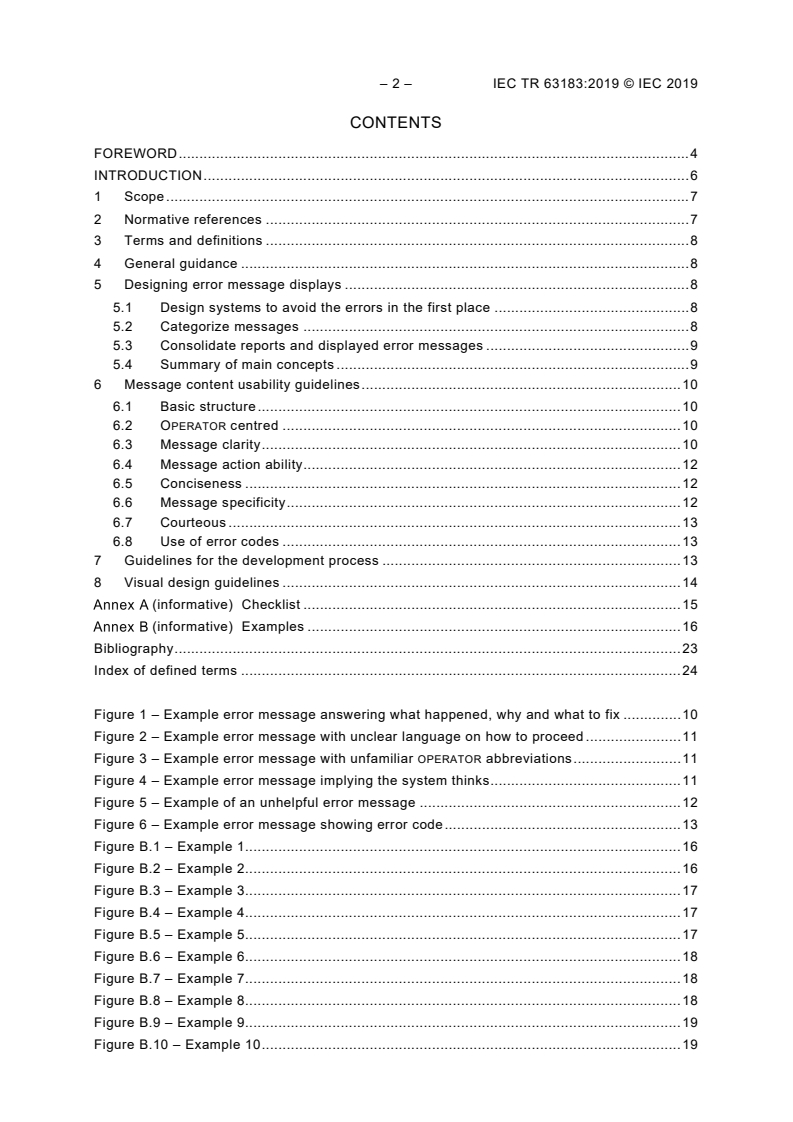
CONTENTS
FOREWORD . 4
INTRODUCTION . 6
1 Scope . 7
2 Normative references . 7
3 Terms and definitions . 8
4 General guidance . 8
5 Designing error message displays . 8
5.1 Design systems to avoid the errors in the first place . 8
5.2 Categorize messages . 8
5.3 Consolidate reports and displayed error messages . 9
5.4 Summary of main concepts . 9
6 Message content usability guidelines . 10
6.1 Basic structure . 10
6.2 OPERATOR centred . 10
6.3 Message clarity . 10
6.4 Message action ability . 12
6.5 Conciseness . 12
6.6 Message specificity . 12
6.7 Courteous . 13
6.8 Use of error codes . 13
7 Guidelines for the development process . 13
8 Visual design guidelines . 14
(informative) Checklist . 15
(informative) Examples . 16
Bibliography . 23
Index of defined terms . 24
Figure 1 – Example error message answering what happened, why and what to fix . 10
Figure 2 – Example error message with unclear language on how to proceed . 11
Figure 3 – Example error message with unfamiliar OPERATOR abbreviations . 11
Figure 4 – Example error message implying the system thinks . 11
Figure 5 – Example of an unhelpful error message . 12
Figure 6 – Example error message showing error code . 13
Figure B.1 – Example 1. 16
Figure B.2 – Example 2. 16
Figure B.3 – Example 3. 17
Figure B.4 – Example 4. 17
Figure B.5 – Example 5. 17
Figure B.6 – Example 6. 18
Figure B.7 – Example 7. 18
Figure B.8 – Example 8. 18
Figure B.9 – Example 9. 19
Figure B.10 – Example 10 . 19
Figure B.11 – Example 11 . 20
Figure B.12 – Example 12 . 20
Figure B.13 – Example 13 . 20
Figure B.14 – Example 14 . 21
Figure B.15 – Example 15 . 21
Figure B.16 – Example 16 . 22
Figure B.17 – Example 17 . 22
Figure B.18 – Example 18 . 22
Table 1 – Replacing engineering language with language understandable for
operators . 10
– 4 – IEC TR 63183:2019 © IEC 2019
INTERNATIONAL ELECTROTECHNICAL COMMISSION
____________
GUIDANCE ON ERROR AND WARNING MESSAGES
FOR SOFTWARE USED IN RADIOTHERAPY
FOREWORD
1) The International Electrotechnical Commission (IEC) is a worldwide organization for standardization comprising
all national electrotechnical committees (IEC National Committees). The object of IEC is to promote international
co-operation on all questions concerning standardization in the electrical and electronic fields. To this end and
in addition to other activities, IEC publishes International Standards, Technical Specifications, Technical Reports,
Publicly Available Specifications (PAS) and Guides (hereafter referred to as "IEC Publication(s)"). Their
preparation is entrusted to technical committees; any IEC National Committee interested in the subject dealt with
may participate in this preparatory work. International, governmental and non-governmental organizations liaising
with the IEC also participate in this preparation. IEC collaborates closely with the International Organization for
Standardization (ISO) in accordance with conditions determined by agreement between the two organizations.
2) The formal decisions or agreements of IEC on technical matters express, as nearly as possible, an international
consensus of opinion on the relevant subjects since each technical committee has representation from all
interested IEC National Committees.
3) IEC Publications have the form of recommendations for international use and are accepted by IEC National
Committees in that sense. While all reasonable efforts are made to ensure that the technical content of IEC
Publications is accurate, IEC cannot be held responsible for the way in which they are used or for any
misinterpretation by any end user.
4) In order to promote international uniformity, IEC National Committees undertake to apply IEC Publications
transparently to the maximum extent possible in their national and regional publications. Any divergence between
any IEC Publication and the corresponding national or regional publication shall be clearly indicated in the latter.
5) IEC itself does not provide any attestation of conformity. Independent certification bodies provide conformity
assessment services and, in some areas, access to IEC marks of conformity. IEC is not responsible for any
services carried out by independent certification bodies.
6) All users should ensure that they have the latest edition of this publication.
7) No liability shall attach to IEC or its directors, employees, servants or agents including individual experts and
members of its technical committees and IEC National Committees for any personal injury, property damage or
other damage of any nature whatsoever, whether direct or indirect, or for costs (including legal fees) and
expenses arising out of the publication, use of, or reliance upon, this IEC Publication or any other IEC Publications.
8) Attention is drawn to the Normative references cited in this publication. Use of the referenced publications is
indispensable for the correct application of this publication.
9) Attention is drawn to the possibility that some of the elements of this IEC Publication may be the subject of patent
rights. IEC shall not be held responsible for identifying any or all such patent rights.
The main task of IEC technical committees is to prepare International Standards. However, a
technical committee may propose the publication of a Technical Report when it has collected
data of a different kind from that which is normally published as an International Standard, for
example "state of the art".
IEC TR 63183, which is a Technical Report, has been prepared by subcommittee 62C:
Equipment for radiotherapy, nuclear medicine and radiation dosimetry, of IEC technical
committee 62: Electrical equipment in medical practice.
The text of this Technical Report is based on the following documents:
Draft TR Report on voting
62C/738/DTR 62C/741/RVDTR
Full information on the voting for the approval of this Technical Report can be found in the
report on voting indicated in the above table.
This document has been drafted in accordance with the ISO/IEC Directives, Part 2.
In this document, the following print types are used:
– requirements and definitions: roman type;
– test specifications: italic type;
informative material appearing outside of tables, such as notes, examples and references: in smaller type.
–
Normative text of tables is also in a smaller type;
– TERMS DEFINED IN CLAUSE 3 OF IEC 60601-1, IN THIS DOCUMENT OR AS NOTED: SMALL CAPITALS.
The committee has decided that the contents of this document will remain unchanged until the
stability date indicated on the IEC website under "http://webstore.iec.ch" in the data related to
the specific document. At this date, the document will be
• reconfirmed,
• withdrawn,
• replaced by a revised edition, or
• amended.
A bilingual version of this publication may be issued at a later date.
IMPORTANT – The 'colour inside' logo on the cover page of this publication indicates
that it contains colours which are considered to be useful for the correct understanding
of its contents. Users should therefore print this document using a colour printer.
– 6 – IEC TR 63183:2019 © IEC 2019
INTRODUCTION
This document is intended to be read by persons involved in software development for
RADIOTHERAPY and provides guidance on how to write relevant error messages shown to the
clinical OPERATORS. This document is meant to provide examples within the RADIOTHERAPY
domain and is not meant to replace IEC/ISO standards governing usability (for example,
IEC 62366-1:2015). With the advent of more RADIOTHERAPY equipment being computer
controlled, there has been a reported increase in the number of treatment delivery errors, some
serious, occurring due to misunderstanding of the various error and warning messages shown
to the OPERATOR during usage. Mistakes in interpretation are more likely to occur when error
messages are written in technical language or are presented to the user without an OPERATOR-
friendly explanation.
This problem is compounded by use of the following practices:
– message dialogs are designed from the program’s technical point of view and not from the
clinical OPERATOR’S point of view;
– message dialogs are optimized for engineering purposes with little input from end USERS;
– insufficient attention and resources are given to applying good practices for usability of
message dialogs and careful review by clinical representatives.
In addition, the frequency of messages displayed by the many pieces of RADIOTHERAPY
equipment to the OPERATOR can lead to "message overload". This increases the RISK that the
OPERATOR will ignore critical information.
This document provides guidance via examples of common mistakes made when writing error
messages to be displayed to the OPERATOR.
GUIDANCE ON ERROR AND WARNING MESSAGES
FOR SOFTWARE USED IN RADIOTHERAPY
1 Scope
This document, which is a Technical Report, provides guidance on the usage and form of error
or warning messages written for software used in RADIOTHERAPY. It does not replace any
requirements existing in the safety standards but is meant to be used as a supplement to
existing standards on usability by providing specific examples in the field of RADIOTHERAPY.
The two main goals of this document are
1) to present in a concise manner the best practices and design guidelines for good message
dialogs, and
2) to illustrate these design guidelines with specific examples from the field of radiation
oncology.
This document is intended to be read by the following MANUFACTURERS’ employees and
representatives:
– engineering department members including: software engineers, RISK managers, quality
assurance engineers, technical writers, etc.;
– usability and human factors engineers;
– marketing representatives (product marketing, product managers, business analysts).
Throughout this document, unless specifically called out, these guidelines apply to all
categories of messages summarily called error or warning messages (e.g. critical error, warning,
system status, informational, routine interlock messages).
2 Normative references
The following documents are referred to in the text in such a way that some or all of their content
constitutes requirements of this document. For dated references, only the edition cited applies.
For undated references, the latest edition of the referenced document (including any
amendments) applies.
IEC 60601-1:2005, Medical electrical equipment – Part 1: General requirements for basic safety
and essential performance
IEC 60601-1:2005/AMD1:2012
IEC 60601-2-1:—, Medical electrical equipment – Part 2-1: Particular requirements for the basic
safety and essential performance of electron accelerators in the range 1 MeV to 50 MeV
IEC TR 60788:2004, Medical electrical equipment – Glossary of defined terms
IEC 62366-1:2015, Medical devices – Part 1: Application of usability engineering to medical
devices
___________
Fourth edition under preparation. Stage at the time of publication: IEC/AFDIS 60601-2-1:2019.
– 8 – IEC TR 63183:2019 © IEC 2019
3 Terms and definitions
For the purposes of this document, the terms and definitions given in IEC 60601-1:2005 and
IEC 60601-1:2005/AMD1:2012, IEC TR 60788:2004 and IEC 60601-2-1:— apply.
ISO and IEC maintain terminological databases for use in standardization at the following
addresses:
• IEC Electropedia: available at http://www.electropedia.org/
• ISO Online browsing platform: available at http://www.iso.org/obp
4 General guidance
This document is meant to provide guidance to MANUFACTURERS of RA
...