


IEC 60565:2006
(Main)Underwater acoustics - Hydrophones - Calibration in the frequency range 0,01 Hz to 1 MHz
General Information
- Abstract
Specifies methods for calibration of hydrophones or reversible transducers when used as a hydrophone, particularly in the frequency range from 0,01 Hz to 1 MHz. Rules for the presentation of the calibration data are established.
- Status
- Replaced
- Publication Date
- 21-Nov-2006
- Technical Committee
- TC 87 - Ultrasonics
- Drafting Committee
- WG 15 - TC 87/WG 15
- Current Stage
- DELPUB - Deleted Publication
- Start Date
- 24-Apr-2020
- Completion Date
- 28-Aug-2026
Relations
- Effective Date
- 05-Sep-2023
- Effective Date
- 05-Sep-2023
Get Certified
Connect with accredited certification bodies for this standard

BSMI (Bureau of Standards, Metrology and Inspection)
Taiwan's standards and inspection authority.
Sponsored listings
Frequently Asked Questions
IEC 60565:2006 is a standard published by the International Electrotechnical Commission (IEC). Its full title is "Underwater acoustics - Hydrophones - Calibration in the frequency range 0,01 Hz to 1 MHz". This standard covers: Specifies methods for calibration of hydrophones or reversible transducers when used as a hydrophone, particularly in the frequency range from 0,01 Hz to 1 MHz. Rules for the presentation of the calibration data are established.
Specifies methods for calibration of hydrophones or reversible transducers when used as a hydrophone, particularly in the frequency range from 0,01 Hz to 1 MHz. Rules for the presentation of the calibration data are established.
IEC 60565:2006 is classified under the following ICS (International Classification for Standards) categories: 17.140.50 - Electroacoustics. The ICS classification helps identify the subject area and facilitates finding related standards.
IEC 60565:2006 has the following relationships with other standards: It is inter standard links to IEC 60565-2:2019, IEC 60565-1:2020. Understanding these relationships helps ensure you are using the most current and applicable version of the standard.
IEC 60565:2006 is available in PDF format for immediate download after purchase. The document can be added to your cart and obtained through the secure checkout process. Digital delivery ensures instant access to the complete standard document.
Standards Content (Sample)
NORME CEI
INTERNATIONALE
IEC
INTERNATIONAL
Deuxième édition
STANDARD
Second edition
2006-11
Acoustique sous-marine –
Hydrophones –
Étalonnage dans la bande de
fréquences de 0,01 Hz à 1 MHz
Underwater acoustics –
Hydrophones –
Calibration in the frequency
range 0,01 Hz to 1 MHz
Numéro de référence
Reference number
CEI/IEC 60565:2006
Numérotation des publications Publication numbering
Depuis le 1er janvier 1997, les publications de la CEI As from 1 January 1997 all IEC publications are
sont numérotées à partir de 60000. Ainsi, la CEI 34-1 issued with a designation in the 60000 series. For
devient la CEI 60034-1. example, IEC 34-1 is now referred to as IEC 60034-1.
Editions consolidées Consolidated editions
Les versions consolidées de certaines publications de la The IEC is now publishing consolidated versions of its
CEI incorporant les amendements sont disponibles. Par publications. For example, edition numbers 1.0, 1.1
exemple, les numéros d’édition 1.0, 1.1 et 1.2 indiquent and 1.2 refer, respectively, to the base publication,
respectivement la publication de base, la publication de the base publication incorporating amendment 1 and
base incorporant l’amendement 1, et la publication de the base publication incorporating amendments 1
base incorporant les amendements 1 et 2. and 2.
Informations supplémentaires Further information on IEC publications
sur les publications de la CEI
Le contenu technique des publications de la CEI est The technical content of IEC publications is kept
constamment revu par la CEI afin qu'il reflète l'état under constant review by the IEC, thus ensuring that
actuel de la technique. Des renseignements relatifs à the content reflects current technology. Information
cette publication, y compris sa validité, sont dispo- relating to this publication, including its validity, is
nibles dans le Catalogue des publications de la CEI available in the IEC Catalogue of publications
(voir ci-dessous) en plus des nouvelles éditions, (see below) in addition to new editions, amendments
amendements et corrigenda. Des informations sur les and corrigenda. Information on the subjects under
sujets à l’étude et l’avancement des travaux entrepris consideration and work in progress undertaken by the
par le comité d’études qui a élaboré cette publication, technical committee which has prepared this
ainsi que la liste des publications parues, sont publication, as well as the list of publications issued,
également disponibles par l’intermédiaire de: is also available from the following:
• Site web de la CEI (www.iec.ch) • IEC Web Site (www.iec.ch)
• Catalogue des publications de la CEI • Catalogue of IEC publications
Le catalogue en ligne sur le site web de la CEI The on-line catalogue on the IEC web site
(www.iec.ch/searchpub) vous permet de faire des (www.iec.ch/searchpub) enables you to search by a
recherches en utilisant de nombreux critères, variety of criteria including text searches,
comprenant des recherches textuelles, par comité technical committees and date of publication. On-
d’études ou date de publication. Des informations en line information is also available on recently
ligne sont également disponibles sur les nouvelles issued publications, withdrawn and replaced
publications, les publications remplacées ou retirées, publications, as well as corrigenda.
ainsi que sur les corrigenda.
• IEC Just Published • IEC Just Published
Ce résumé des dernières publications parues This summary of recently issued publications
(www.iec.ch/online_news/justpub) est aussi dispo- (www.iec.ch/online_news/justpub) is also available
nible par courrier électronique. Veuillez prendre by email. Please contact the Customer Service
contact avec le Service client (voir ci-dessous) Centre (see below) for further information.
pour plus d’informations.
• Service clients • Customer Service Centre
Si vous avez des questions au sujet de cette If you have any questions regarding this
publication ou avez besoin de renseignements publication or need further assistance, please
supplémentaires, prenez contact avec le Service contact the Customer Service Centre:
clients:
Email: custserv@iec.ch Email: custserv@iec.ch
Tél: +41 22 919 02 11 Tel: +41 22 919 02 11
Fax: +41 22 919 03 00 Fax: +41 22 919 03 00
.
NORME CEI
INTERNATIONALE
IEC
INTERNATIONAL
Deuxième édition
STANDARD
Second edition
2006-11
Acoustique sous-marine –
Hydrophones –
Étalonnage dans la bande de
fréquences de 0,01 Hz à 1 MHz
Underwater acoustics –
Hydrophones –
Calibration in the frequency
range 0,01 Hz to 1 MHz
© IEC 2006 Droits de reproduction réservés ⎯ Copyright - all rights reserved
Aucune partie de cette publication ne peut être reproduite ni No part of this publication may be reproduced or utilized in any
utilisée sous quelque forme que ce soit et par aucun procédé, form or by any means, electronic or mechanical, including
électronique ou mécanique, y compris la photocopie et les photocopying and microfilm, without permission in writing from
microfilms, sans l'accord écrit de l'éditeur. the publisher.
International Electrotechnical Commission, 3, rue de Varembé, PO Box 131, CH-1211 Geneva 20, Switzerland
Telephone: +41 22 919 02 11 Telefax: +41 22 919 03 00 E-mail: inmail@iec.ch Web: www.iec.ch
CODE PRIX
XC
PRICE CODE
Commission Electrotechnique Internationale
International Electrotechnical Commission
МеждународнаяЭлектротехническаяКомиссия
Pour prix, voir catalogue en vigueur
For price, see current catalogue
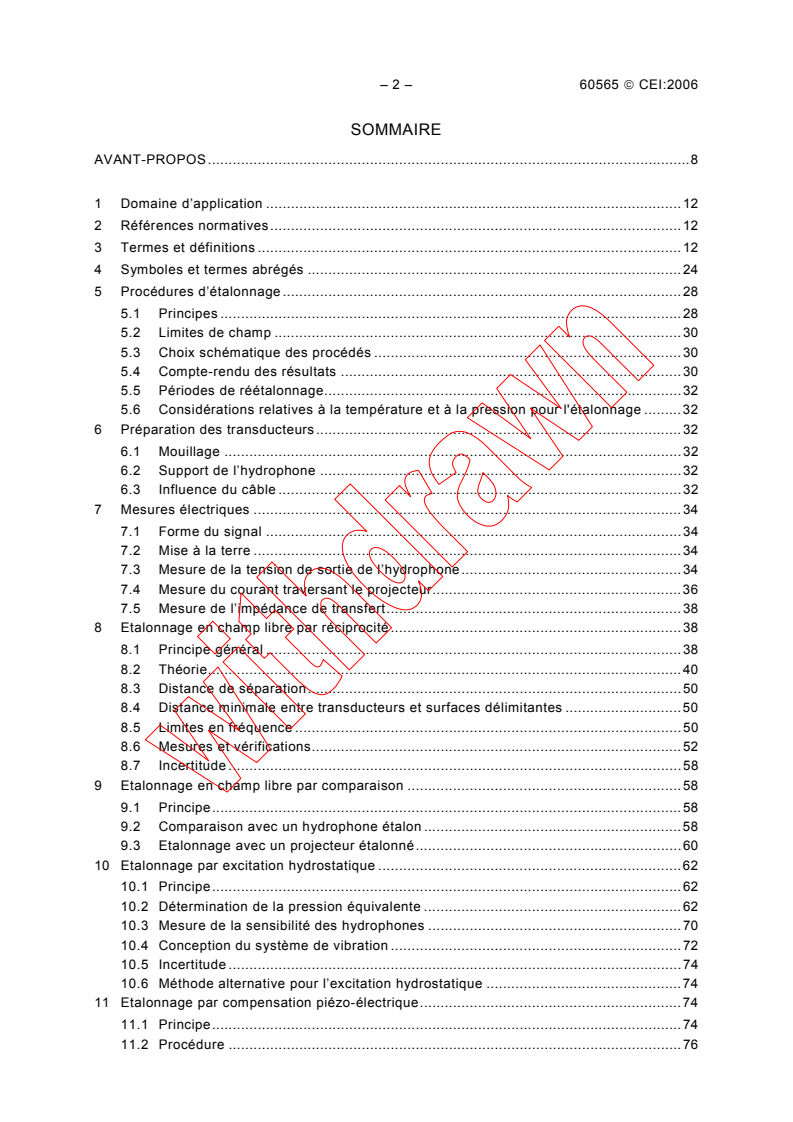
– 2 – 60565 © CEI:2006
SOMMAIRE
AVANT-PROPOS.8
1 Domaine d’application .12
2 Références normatives.12
3 Termes et définitions .12
4 Symboles et termes abrégés .24
5 Procédures d’étalonnage.28
5.1 Principes .28
5.2 Limites de champ .30
5.3 Choix schématique des procédés .30
5.4 Compte-rendu des résultats .30
5.5 Périodes de réétalonnage.32
5.6 Considérations relatives à la température et à la pression pour l'étalonnage .32
6 Préparation des transducteurs.32
6.1 Mouillage .32
6.2 Support de l’hydrophone .32
6.3 Influence du câble .32
7 Mesures électriques .34
7.1 Forme du signal .34
7.2 Mise à la terre .34
7.3 Mesure de la tension de sortie de l’hydrophone.34
7.4 Mesure du courant traversant le projecteur.36
7.5 Mesure de l’impédance de transfert.38
8 Etalonnage en champ libre par réciprocité.38
8.1 Principe général .38
8.2 Théorie.40
8.3 Distance de séparation.50
8.4 Distance minimale entre transducteurs et surfaces délimitantes .50
8.5 Limites en fréquence .50
8.6 Mesures et vérifications.52
8.7 Incertitude .58
9 Etalonnage en champ libre par comparaison .58
9.1 Principe.58
9.2 Comparaison avec un hydrophone étalon .58
9.3 Etalonnage avec un projecteur étalonné.60
10 Etalonnage par excitation hydrostatique .62
10.1 Principe.62
10.2 Détermination de la pression équivalente .62
10.3 Mesure de la sensibilité des hydrophones .70
10.4 Conception du système de vibration .72
10.5 Incertitude .74
10.6 Méthode alternative pour l’excitation hydrostatique .74
11 Etalonnage par compensation piézo-électrique.74
11.1 Principe.74
11.2 Procédure .76
60565 © IEC:2006 – 3 –
CONTENTS
FOREWORD.9
1 Scope.13
2 Normative references .13
3 Terms and definitions .13
4 Symbols and abbreviated terms.25
5 Procedures for calibrations.29
5.1 Principles .29
5.2 Field limitations .31
5.3 Schematic survey of procedures.31
5.4 Reporting of results .31
5.5 Recalibration periods.33
5.6 Temperature and pressure considerations for calibration.33
6 Preparation of transducers .33
6.1 Wetting.33
6.2 Hydrophone support .33
6.3 Influence of cable .33
7 Electrical measurements .35
7.1 Signal type .35
7.2 Earthing .35
7.3 Measurement of hydrophone output voltage .35
7.4 Measurement of projector current.37
7.5 Measurement of transfer impedance.39
8 Free-field reciprocity calibration.39
8.1 General principle .39
8.2 Theory.41
8.3 Separation distance.51
8.4 Minimum distance from transducers to boundary surface.51
8.5 Frequency limitation .51
8.6 Measurements and checks .53
8.7 Uncertainty.59
9 Free-field calibration by comparison .59
9.1 Principle.59
9.2 Comparison with a standard hydrophone.59
9.3 Calibration with a calibrated projector.61
10 Calibration by hydrostatic excitation .63
10.1 Principle.63
10.2 Determination of equivalent pressure .63
10.3 Measurement of the sensitivity of hydrophones .71
10.4 Design of vibration system .73
10.5 Uncertainty.75
10.6 Alternative method for hydrostatic excitation .75
11 Calibration by piezoelectric compensation .75
11.1 Principle.75
11.2 Procedure .77
– 4 – 60565 © CEI:2006
11.3 Conception de la chambre d’étalonnage .80
11.4 Limites pratiques de la méthode de compensation piézo-électrique.84
11.5 Incertitude .84
12 Etalonnage par réciprocité du coupleur acoustique.84
12.1 Principe.84
12.2 Procédure .84
12.3 Théorie.86
12.4 Elasticité acoustique .88
12.5 Limite de haute fréquence .88
12.6 Limite de basse fréquence.88
12.7 Mesure.88
12.8 Incertitude .90
12.9 Limites .90
12.10 Etalonnage du coupleur acoustique à l’aide d’un coupleur de référence avec
deux transducteurs réciproques et un coupleur auxiliaire avec les deux
mêmes transducteurs et un hydrophone à étalonner.90
12.11 Etalonnage du coupleur acoustique à l’aide d’un coupleur de référence avec
deux transducteurs réciproques et un coupleur auxiliaire avec les deux
mêmes transducteurs, un hydrophone à étalonner et une source sonore.94
12.12 Etalonnage du coupleur acoustique à l’aide d’un coupleur, d’un transducteur
réciproque, d’un projecteur, d’un hydrophone à étalonner, et d’un organe
subsidiaire d’élasticité connue.98
13 Etalonnage avec un pistonphone .102
13.1 Principe.102
13.2 Procédure .102
13.3 Limites .108
13.4 Incertitude .110
14 Etalonnage avec une colonne vibrante .110
14.1 Principe.110
14.2 Procédure .112
14.3 Expression pour la pression .114
14.4 Détermination de la sensibilité.114
14.5 Conditions de mesure.118
14.6 Incertitude .120
Annexe A (informative) Réponse directionnelle d’un hydrophone .122
Annexe B (informative) Corrections de la charge électrique .126
Annexe C (informative) Techniques par impulsions dans les étalonnages en champ
libre .130
Annexe D (informative) Evaluation de l’incertitude dans l’étalonnage des hydrophones .148
Annexe E (informative) Circuit équivalent du système d’excitation pour l’étalonnage
avec une colonne vibrante .156
Bibliographie.158
60565 © IEC:2006 – 5 –
11.3 Design of the calibration chamber .81
11.4 Practical limitations of the piezoelectric compensation method .85
11.5 Uncertainty.85
12 Acoustic coupler reciprocity calibration.85
12.1 Principle……….85
12.2 Procedure .85
12.3 Theory……….87
12.4 Acoustic compliance.89
12.5 High-frequency limit .89
12.6 Low-frequency limit .89
12.7 Measurement .89
12.8 Uncertainty.91
12.9 Limitations.91
12.10 Acoustic-coupler calibration using a reference coupler with two reciprocal
transducers and an auxiliary coupler with the same two transducers and a
hydrophone to be calibrated .91
12.11 Acoustic-coupler calibration using a reference coupler with two reciprocal
transducers and an auxiliary coupler with the same two transducers, a
hydrophone to be calibrated, and a sound source.95
12.12 Acoustic-coupler calibration using a coupler, a reciprocal transducer, a
projector, a hydrophone to be calibrated, and a subsidiary body of known
compliance.99
13 Calibration with a pistonphone.103
13.1 Principle……….103
13.2 Procedure .103
13.3 Limitations.109
13.4 Uncertainty.111
14 Calibration with a vibrating column .111
14.1 Principle……….111
14.2 Procedure .113
14.3 Expression for the pressure.115
14.4 Determination of the sensitivity.115
14.5 Conditions of measurement .119
14.6 Uncertainty.121
Annex A (informative) Directional response of a hydrophone .123
Annex B (informative) Electrical loading corrections.127
Annex C (informative) Pulsed techniques in free-field calibrations .131
Annex D (informative) Assessment of uncertainty in the calibration of hydrophones.149
Annex E (informative) Equivalent circuit of the excitation system for calibration with a
vibrating column .157
Bibliography.159
– 6 – 60565 © CEI:2006
Figure 1 – Système de coordonnées dans le sens des aiguilles d'une montre.14
Figure 2 – Cadre de mesure pour soutenir les trois transducteurs en ligne: un
projecteur P, un transducteur réciproque T, et un hydrophone H à étalonner. .48
Figure 3 – Schéma de la méthode de l’excitation hydrostatique .64
Figure 4 – Schéma du système de mesure.76
Figure 5 – Schéma de la chambre pour hautes fréquences .82
Figure 6 – Coupleur de réciprocité avec trois transducteurs; un projecteur P , un
transducteur réciproque T , et un hydrophone H à étalonner.86
Figure 7 – Coupleur de référence avec deux transducteurs: un projecteur P et un
transducteur réciproque T .92
Figure 8 – Coupleur auxiliaire avec trois transducteurs: un projecteur P , un
transducteur réciproque T , et un hydrophone H à étalonner.92
Figure 9 – Coupleur auxiliaire avec quatre transducteurs; un projecteur P , un
transducteur réciproque T , une source sonore S , et un hydrophone H à étalonner.96
Figure 10 – Schéma du système de mesure.102
Figure 11 – Pistonphone .110
Figure 12 – Colonne vibrante.112
Figure C.1 – Schéma d’un projecteur et d’un récepteur dans une cuve remplie d’eau
présentant les sources principales de réflexions .134
Figure C.2 – Instant d’arrivée de l’écho dans une cuve de 6 m × 6 m × 5 m avec des
transducteurs placés de façon optimale .136
Figure C.3 – Signaux d’hydrophones pour un couple de transducteurs sphériques
[projecteur: fréquence de résonance de 18 kHz, facteur Q de 3,5; hydrophone:
fréquence de résonance de 350 kHz; fréquence de fonctionnement: 2 kHz (gauche) et
18 kHz (droite)].138
Figure E.1 – Circuit équivalent simplifié de la colonne vibrante .156
60565 © IEC:2006 – 7 –
Figure 1 – Left-hand co-ordinate system .15
Figure 2 – Measurement framework for supporting in-line the three transducers: a
projector P, a reciprocal transducer T, and a hydrophone H to be calibrated.49
Figure 3 – Diagram of the method of hydrostatic excitation. .65
Figure 4 – Schematic drawing of the measuring system .77
Figure 5 – Diagram of the chamber for high-frequency.83
Figure 6 – Reciprocity coupler with three transducers; a projector P , a reciprocal
transducer T , and a hydrophone H to be calibrated.87
Figure 7 – Reference coupler with two transducers: a projector P and a reciprocal
transducer T .93
Figure 8 – Auxiliary coupler with three transducers: a projector P , a reciprocal
transducer T , and a hydrophone H to be calibrated.93
Figure 9 – Auxiliary coupler with four transducers; a projector P , a reciprocal
transducer T , a sound source S , and a hydrophone H to be calibrated.97
Figure 10 – Schematic drawing of the measuring system. .103
Figure 11 – Pistonphone .111
Figure 12 – Vibrating column .113
Figure C.1 – Schematic diagram of a projector and receiver in a water tank showing
the main sources of reflections .135
Figure C.2 – Echo arrival time in a 6 m × 6 m × 5 m tank with optimally placed
transducers.137
Figure C.3 – Hydrophone signals for a pair of spherical transducers [projector: 18 kHz
resonance frequency, Q factor of 3,5; hydrophone: 350 kHz resonance frequency;
drive frequency: 2 kHz (left) and 18 kHz (right)] .139
Figure E.1 – Simplified equivalent circuit of the vibrating column .157
– 8 – 60565 © CEI:2006
COMMISSION ÉLECTROTECHNIQUE INTERNATIONALE
____________
ACOUSTIQUE SOUS-MARINE – HYDROPHONES –
ETALONNAGE DANS LA BANDE DE FRÉQUENCES
DE 0,01 Hz À 1 MHz
AVANT-PROPOS
1) La Commission Electrotechnique Internationale (CEI) est une organisation mondiale de normalisation
composée de l'ensemble des comités électrotechniques nationaux (Comités nationaux de la CEI). La CEI a
pour objet de favoriser la coopération internationale pour toutes les questions de normalisation dans les
domaines de l'électricité et de l'électronique. A cet effet, la CEI – entre autres activités – publie des Normes
internationales, des Spécifications techniques, des Rapports techniques, des Spécifications accessibles au
public (PAS) et des Guides (ci-après dénommés "Publication(s) de la CEI"). Leur élaboration est confiée à des
comités d'études, aux travaux desquels tout Comité national intéressé par le sujet traité peut participer. Les
organisations internationales, gouvernementales et non gouvernementales, en liaison avec la CEI, participent
également aux travaux. La CEI collabore étroitement avec l'Organisation Internationale de Normalisation (ISO),
selon des conditions fixées par accord entre les deux organisations.
2) Les décisions ou accords officiels de la CEI concernant les questions techniques représentent, dans la mesure
du possible, un accord international sur les sujets étudiés, étant donné que les Comités nationaux de la CEI
intéressés sont représentés dans chaque comité d’études.
3) Les Publications de la CEI se présentent sous la forme de recommandations internationales et sont agréées
comme telles par les Comités nationaux de la CEI. Tous les efforts raisonnables sont entrepris afin que la CEI
s'assure de l'exactitude du contenu technique de ses publications; la CEI ne peut pas être tenue responsable
de l'éventuelle mauvaise utilisation ou interprétation qui en est faite par un quelconque utilisateur final.
4) Dans le but d'encourager l'uniformité internationale, les Comités nationaux de la CEI s'engagent, dans toute la
mesure possible, à appliquer de façon transparente les Publications de la CEI dans leurs publications
nationales et régionales. Toutes divergences entre toutes Publications de la CEI et toutes publications
nationales ou régionales correspondantes doivent être indiquées en termes clairs dans ces dernières.
5) La CEI n’a prévu aucune procédure de marquage valant indication d’approbation et n'engage pas sa
responsabilité pour les équipements déclarés conformes à une de ses Publications.
6) Tous les utilisateurs doivent s'assurer qu'ils sont en possession de la dernière édition de cette publication.
7) Aucune responsabilité ne doit être imputée à la CEI, à ses administrateurs, employés, auxiliaires ou
mandataires, y compris ses experts particuliers et les membres de ses comités d'études et des Comités
nationaux de la CEI, pour tout préjudice causé en cas de dommages corporels et matériels, ou de tout autre
dommage de quelque nature que ce soit, directe ou indirecte, ou pour supporter les coûts (y compris les frais
de justice) et les dépenses découlant de la publication ou de l'utilisation de cette Publication de la CEI ou de
toute autre Publication de la CEI, ou au crédit qui lui est accordé.
8) L'attention est attirée sur les références normatives citées dans cette publication. L'utilisation de publications
référencées est obligatoire pour une application correcte de la présente publication.
9) L’attention est attirée sur le fait que certains des éléments de la présente Publication de la CEI peuvent faire
l’objet de droits de propriété intellectuelle ou de droits analogues. La CEI ne saurait être tenue pour
responsable de ne pas avoir identifié de tels droits de propriété et de ne pas avoir signalé leur existence.
La Norme internationale CEI 60565 a été établie par le comité d’études 87 de la CEI:
Ultrasons.
Cette deuxième édition annule et remplace la première édition parue en 1977 et son premier
complément CEI 60565A (1980). Cette édition constitue une révision technique. Les
modifications techniques significatives par rapport à l'édition antérieure sont les suivantes:
– Mise à jour des procédures prenant en compte l’utilisation des techniques numériques
d’acquisition et de traitement des signaux, par opposition aux techniques analogiques
décrites dans la première édition;
– inclusion d’une information plus détaillée relative à la préparation des hydrophones pour la
mesure, et des influences des conditions environnementales sur l’étalonnage de
l’hydrophone;
– révision des procédures d’étalonnage de la réponse de l’hydrophone par réciprocité;
– inclusion des procédures d’étalonnage de phase dans la méthode par réciprocité;
60565 © IEC:2006 – 9 –
INTERNATIONAL ELECTROTECHNICAL COMMISSION
____________
UNDERWATER ACOUSTICS – HYDROPHONES –
CALIBRATION IN THE FREQUENCY RANGE
0,01 Hz TO 1 MHz
FOREWORD
1) The International Electrotechnical Commission (IEC) is a worldwide organization for standardization comprising
all national electrotechnical committees (IEC National Committees). The object of IEC is to promote
international co-operation on all questions concerning standardization in the electrical and electronic fields. To
this end and in addition to other activities, IEC publishes International Standards, Technical Specifications,
Technical Reports, Publicly Available Specifications (PAS) and Guides (hereafter referred to as “IEC
Publication(s)”). Their preparation is entrusted to technical committees; any IEC National Committee interested
in the subject dealt with may participate in this preparatory work. International, governmental and non-
governmental organizations liaising with the IEC also participate in this preparation. IEC collaborates closely
with the International Organization for Standardization (ISO) in accordance with conditions determined by
agreement between the two organizations.
2) The formal decisions or agreements of IEC on technical matters express, as nearly as possible, an international
consensus of opinion on the relevant subjects since each technical committee has representation from all
interested IEC National Committees.
3) IEC Publications have the form of recommendations for international use and are accepted by IEC National
Committees in that sense. While all reasonable efforts are made to ensure that the technical content of IEC
Publications is accurate, IEC cannot be held responsible for the way in which they are used or for any
misinterpretation by any end user.
4) In order to promote international uniformity, IEC National Committees undertake to apply IEC Publications
transparently to the maximum extent possible in their national and regional publications. Any divergence
between any IEC Publication and the corresponding national or regional publication shall be clearly indicated in
the latter.
5) IEC provides no marking procedure to indicate its approval and cannot be rendered responsible for any
equipment declared to be in conformity with an IEC Publication.
6) All users should ensure that they have the latest edition of this publication.
7) No liability shall attach to IEC or its directors, employees, servants or agents including individual experts and
members of its technical committees and IEC National Committees for any personal injury, property damage or
other damage of any nature whatsoever, whether direct or indirect, or for costs (including legal fees) and
expenses arising out of the publication, use of, or reliance upon, this IEC Publication or any other IEC
Publications.
8) Attention is drawn to the Normative references cited in this publication. Use of the referenced publications is
indispensable for the correct application of this publication.
9) Attention is drawn to the possibility that some of the elements of this IEC Publication may be the subject of
patent rights. IEC shall not be held responsible for identifying any or all such patent rights.
International Standard IEC 60565 has been prepared by IEC technical committee 87:
Ultrasonics.
This second edition cancels and replaces the first edition published in 1977 and its first
supplement IEC 60565A (1980). This edition constitutes a technical revision. The significant
technical changes with respect to the previous edition are as follows:
– updating of procedures to reflect the use of digital acquisition and signal processing
techniques as opposed to the analogue techniques described in the first edition;
– inclusion of more detailed information regarding the preparation of hydrophones for
measurement, and the influences of environmental conditions on hydrophone calibration;
– revision of procedures for magnitude calibration of hydrophone response by the method of
three-transducer spherical-wave reciprocity;
– inclusion of procedures for phase calibration into the method of three-transducer
spherical-wave reciprocity;
– 10 – 60565 © CEI:2006
– révision des procédures d’étalonnage des hydrophones par comparaison;
– inclusion des procédures d’étalonnage des hydrophone à basse fréquence par la méthode
d’excitation hydrostatique;
– révision des procédures d’étalonnage des hydrophone à basse fréquence par
compensation piézo-électrique;
– révision des procédures d’étalonnage des hydrophone à basse fréquence par réciprocité;
– révision des procédures d’étalonnage des hydrophone à basse fréquence avec un
pistonphone;
– révision des procédures d’étalonnage des hydrophone à basse fréquence avec une
colonne vibrante;
– suppression de l’Annexe A de la première édition (mesure du module de l’impédance de
transfert par la méthode de substitution) étant donné que cette méthode n’est plus utilisée;
– suppression de l’Annexe B de la première édition (mesure du module de l’impédance de
transfert par la méthode de lecture directe) étant donné que cette méthode n’est plus
utilisée;
– maintien de l’Annexe C de la première édition, mais mise à jour de façon substantielle;
– maintien de l’Annexe D de la première édition qui devient l’Annexe A de la présente
édition;
– ajout d’une nouvelle Annexe B comportant une description de la manière de prendre en
compte l'influence de la charge électrique;
– ajout d’une nouvelle Annexe D sur l’évaluation de l’incertitude dans l’étalonnage des
hydrophones;
– ajout d’une nouvelle Annexe E sur un circuit équivalent du système d’excitation
pour l’étalonnage avec une colonne vibrante.
Le texte de cette norme est issu des documents suivants:
FDIS Rapport de vote
87/357/FDIS 87/360/RVD
Le rapport de vote indiqué dans le tableau ci-dessus donne toute information sur le vote ayant
abouti à l'approbation de cette norme.
Cette publication a été rédigée selon les Directives ISO/CEI, Partie 2.
Le comité a décidé que le contenu de cette publication ne sera pas modifié avant la date de
maintenance indiquée sur le site web de la CEI sous "http://webstore.iec.ch" dans les
données relatives à la publication recherchée. A cette date, la publication sera
• reconduite,
• supprimée,
• remplacée par une édition révisée, ou
• amendée.
60565 © IEC:2006 – 11 –
– revision of procedures for calibration of hydrophones by the comparison methods;
– inclusion of procedures for low frequency hydrophone calibration utilising the method of
hydrostatic excitation;
– revision of the procedures for low frequency hydrophone calibration utilising the method of
piezoelectric compensation;
– inclusion of procedures for low frequency hydrophone calibration utilising the method of
coupler reciprocity;
– revision of the procedures for low frequency hydrophone calibration utilising the
pistonphone method;
– revision of procedures for low frequency hydrophone calibration utilising the method of
vibrating column (previously issued as a supplement to the standard);
– deletion of Appendix A of first edition (transfer impedance by substitution method) since
method no longer used;
– deletion of Appendix B of first edition (transfer impedance by direct read-out method)
since method no longer used;
– retention of Appendix C of first edition, but now substantially updated and included as
Annex C (informative);
– retention of Appendix D of first edition, now included as Annex A (informative);
– addition of new Annex B describing methods for accounting for electrical loading of
hydrophones by pre-amplifiers;
– addition of new Annex D describing the assessment of uncertainty in free-field hydrophone
calibrations;
– addition of new Annex E describing an equivalent electrical circuit of the excitation system
for calibration with a vibrating column.
The text of this standard is based on t
...