


IEC 61730-1:2004
(Main)Photovoltaic (PV) module safety qualification - Part 1: Requirements for construction
Photovoltaic (PV) module safety qualification - Part 1: Requirements for construction
Describes the fundamental construction requirements for photovoltaic modules in order to provide safe electrical and mechanical operation during their expected lifetime. Addresses the prevention of electrical shock, fire hazards, and personal injury due to mechanical and environmental stresses. Pertains to the particular requirements of construction and is to be used in conjunction with IEC 61215 or IEC 61646.
Qualification pour la sûreté de fonctionnement des modules photovoltaïques (PV) - Partie 1: Exigences pour la construction
Décrit les exigences fondamentales de construction pour les modules photovoltaïques afin de fournir un fonctionnement électrique et mécanique sûr au cours de leur durée de vie. Couvre la prévention contre les chocs électriques, les risques de feu et les accidents corporels dus à des contraintes mécaniques et environnementales. Se rapporte aux exigences particulières de construction et sera utilisée conjointement avec la CEI 61215 ou la CEI 61646.
General Information
- Status
- Published
- Publication Date
- 13-Oct-2004
- Technical Committee
- TC 82 - Solar photovoltaic energy systems
- Drafting Committee
- WG 2 - TC 82/WG 2
- Current Stage
- DELPUB - Deleted Publication
- Start Date
- 17-Aug-2016
- Completion Date
- 13-Feb-2026
Relations
- Effective Date
- 05-Sep-2023
- Effective Date
- 05-Sep-2023
- Effective Date
- 05-Sep-2023
Overview
IEC 61730-1:2004, titled Photovoltaic (PV) Module Safety Qualification – Part 1: Requirements for Construction, published by the International Electrotechnical Commission (IEC), sets the fundamental safety construction requirements for photovoltaic (PV) modules. This international standard focuses on ensuring safe electrical and mechanical operation of PV modules throughout their expected lifetime by addressing risks of electrical shock, fire hazards, and personal injury arising from mechanical stress and environmental factors.
As a cornerstone document in PV module safety qualification, IEC 61730-1 complements related standards such as IEC 61215 and IEC 61646 by providing essential construction guidelines that work in tandem with performance and testing requirements outlined in those documents. This standard is crucial for manufacturers, safety certifiers, and designers aiming to ensure photovoltaic modules meet internationally recognized safety and durability criteria.
Key Topics
- Safety Focus: The standard emphasizes prevention of electrical shock, fire, and injury through strict construction requirements.
- Application Classes: Defines different use categories (Class A, B, C), accommodating various risk levels based on access and voltage/power parameters.
- Materials Requirements: Provides detailed guidelines on the use of metals, polymers, and other components to ensure integrity under electrical and mechanical stresses.
- Internal Wiring and Connections: Specifies secure wiring practices, splices, connectors, lead cables, and strain relief to maintain electrical safety.
- Bonding and Grounding: Addresses grounding techniques to reduce hazards associated with electrical faults.
- Creepage and Clearance: Sets minimum distances for electrical insulation to prevent unintended current flow that could be hazardous.
- Field Wiring Compartments: Outlines construction and protection for accessible wiring compartments, including seals, gaskets, and safety against sharp edges.
- Marking and Documentation: Requires clear labeling and provision of documents to support proper use, maintenance, and safety compliance.
- Coordinated Testing: Designed to align with IEC 61730-2 (testing requirements) and performance standards IEC 61215 or IEC 61646, enabling comprehensive safety and reliability assessments.
Applications
IEC 61730-1 applies primarily to the construction of crystalline silicon and thin-film photovoltaic modules destined for various installations, including residential, commercial, and utility-scale solar power systems. Its guidelines ensure that modules are fabricated to minimize risks across diverse environments where PV systems operate. This includes precautions against harsh weather conditions, UV exposure, mechanical impact, and electrical hazards.
The standard supports:
- Manufacturers in designing PV modules that comply with international safety standards.
- Certification Bodies working to evaluate the safety of PV products for market approval.
- Installers and System Designers ensuring selection and use of modules that meet regulatory safety norms.
- Regulatory Authorities referencing consistent safety criteria for photovoltaic installations.
By securing the fundamental construction elements, IEC 61730-1 plays a critical role in advancing the reliability and public trust in solar photovoltaic technologies worldwide.
Related Standards
IEC 61730-1 should be used in conjunction with the following key standards for a holistic evaluation of photovoltaic modules:
IEC 61730-2: Photovoltaic (PV) Module Safety Qualification – Part 2: Requirements for Testing
Focuses on test methods to verify the safety features established by IEC 61730-1 construction requirements.IEC 61215: Crystalline Silicon Terrestrial Photovoltaic (PV) Modules – Design Qualification and Type Approval
Addresses design and performance testing ensuring module durability and efficiency.IEC 61646: Thin-Film Terrestrial Photovoltaic (PV) Modules – Design Qualification and Type Approval
Similar to IEC 61215 but specific to thin-film PV modules.IEC 60529: Degrees of Protection Provided by Enclosures (IP Code)
Details the environmental sealing standards to protect modules and wiring from dust and water ingress.IEC 60364-5-51: Electrical Installations of Buildings – Selection and Erection of Electrical Equipment
Provides guidelines applicable to the safe installation of PV modules and associated wiring.
These related standards collectively ensure that photovoltaic modules not only conform to durable construction and safety requirements but also meet rigorous testing and operational performance standards relevant in global markets.
By adhering to IEC 61730-1:2004, stakeholders in the solar industry can assure safer photovoltaic module construction, reducing hazards and enhancing long-term reliability, while fostering compliance with international electrical safety norms. This reinforces the sustainable deployment of solar energy solutions worldwide.
IEC 61730-1:2004 - Photovoltaic (PV) module safety qualification - Part 1: Requirements for construction Released:10/14/2004 Isbn:2831876788
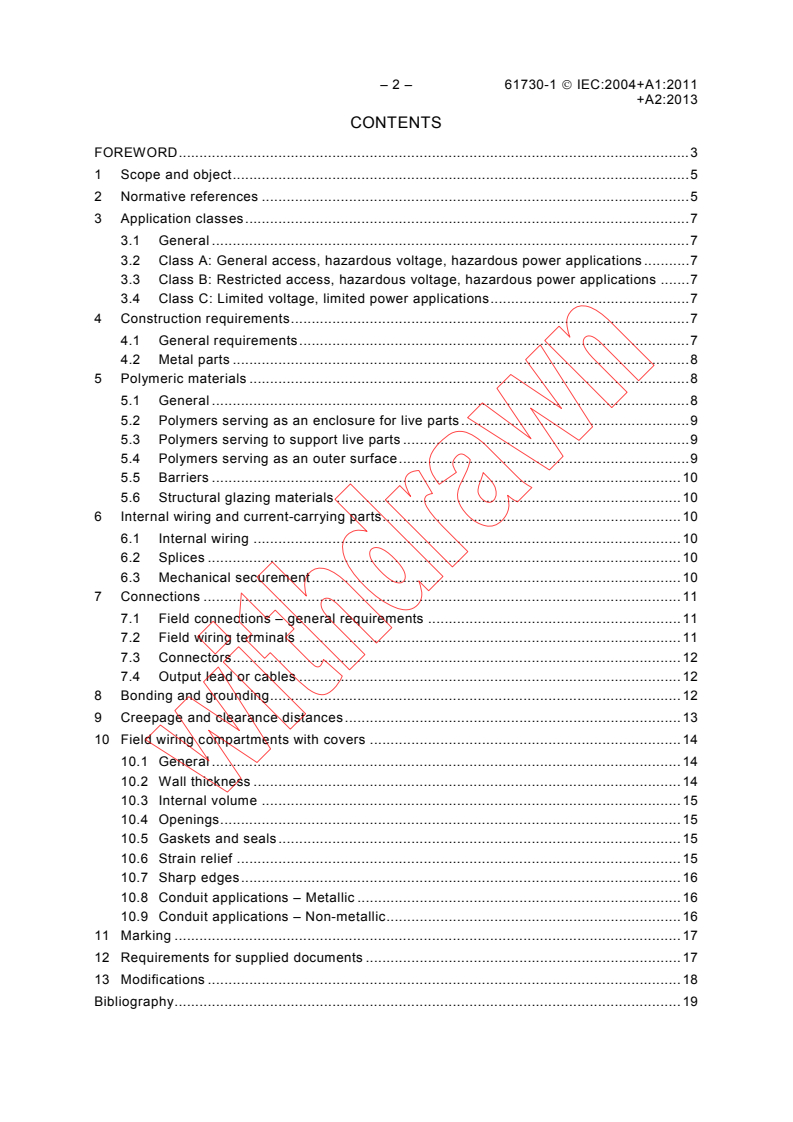
IEC 61730-1:2004+AMD1:2011+AMD2:2013 CSV - Photovoltaic (PV) module safety qualification - Part 1: Requirements for construction Released:3/14/2013 Isbn:9782889128815
Get Certified
Connect with accredited certification bodies for this standard

DNV
DNV is an independent assurance and risk management provider.

Lloyd's Register
Lloyd's Register is a global professional services organisation specialising in engineering and technology.
DNV Energy Systems
Energy and renewable energy certification.
Sponsored listings
Frequently Asked Questions
IEC 61730-1:2004 is a standard published by the International Electrotechnical Commission (IEC). Its full title is "Photovoltaic (PV) module safety qualification - Part 1: Requirements for construction". This standard covers: Describes the fundamental construction requirements for photovoltaic modules in order to provide safe electrical and mechanical operation during their expected lifetime. Addresses the prevention of electrical shock, fire hazards, and personal injury due to mechanical and environmental stresses. Pertains to the particular requirements of construction and is to be used in conjunction with IEC 61215 or IEC 61646.
Describes the fundamental construction requirements for photovoltaic modules in order to provide safe electrical and mechanical operation during their expected lifetime. Addresses the prevention of electrical shock, fire hazards, and personal injury due to mechanical and environmental stresses. Pertains to the particular requirements of construction and is to be used in conjunction with IEC 61215 or IEC 61646.
IEC 61730-1:2004 is classified under the following ICS (International Classification for Standards) categories: 27.160 - Solar energy engineering. The ICS classification helps identify the subject area and facilitates finding related standards.
IEC 61730-1:2004 has the following relationships with other standards: It is inter standard links to IEC 61730-1:2004/AMD2:2013, IEC 61730-1:2004/AMD1:2011, IEC 61730-1:2016. Understanding these relationships helps ensure you are using the most current and applicable version of the standard.
IEC 61730-1:2004 is available in PDF format for immediate download after purchase. The document can be added to your cart and obtained through the secure checkout process. Digital delivery ensures instant access to the complete standard document.
Standards Content (Sample)
IEC 61730-1
Edition 1.0 2004-10
INTERNATIONAL
STANDARD
NORME
INTERNATIONALE
Photovoltaic (PV) module safety qualification –
Part 1: Requirements for construction
Qualification pour la sûreté de fonctionnement des modules photovoltaïques (PV) –
Partie 1: Exigences pour la construction
All rights reserved. Unless otherwise specified, no part of this publication may be reproduced or utilized in any form or by
any means, electronic or mechanical, including photocopying and microfilm, without permission in writing from either IEC or
IEC's member National Committee in the country of the requester.
If you have any questions about IEC copyright or have an enquiry about obtaining additional rights to this publication,
please contact the address below or your local IEC member National Committee for further information.
Droits de reproduction réservés. Sauf indication contraire, aucune partie de cette publication ne peut être reproduite
ni utilisée sous quelque forme que ce soit et par aucun procédé, électronique ou mécanique, y compris la photocopie
et les microfilms, sans l'accord écrit de la CEI ou du Comité national de la CEI du pays du demandeur.
Si vous avez des questions sur le copyright de la CEI ou si vous désirez obtenir des droits supplémentaires sur cette
publication, utilisez les coordonnées ci-après ou contactez le Comité national de la CEI de votre pays de résidence.
IEC Central Office
3, rue de Varembé
CH-1211 Geneva 20
Switzerland
Email: inmail@iec.ch
Web: www.iec.ch
About the IEC
The International Electrotechnical Commission (IEC) is the leading global organization that prepares and publishes
International Standards for all electrical, electronic and related technologies.
About IEC publications
The technical content of IEC publications is kept under constant review by the IEC. Please make sure that you have the
latest edition, a corrigenda or an amendment might have been published.
ƒ Catalogue of IEC publications: www.iec.ch/searchpub
The IEC on-line Catalogue enables you to search by a variety of criteria (reference number, text, technical committee,…).
It also gives information on projects, withdrawn and replaced publications.
ƒ IEC Just Published: www.iec.ch/online_news/justpub
Stay up to date on all new IEC publications. Just Published details twice a month all new publications released. Available
on-line and also by email.
ƒ Electropedia: www.electropedia.org
The world's leading online dictionary of electronic and electrical terms containing more than 20 000 terms and definitions
in English and French, with equivalent terms in additional languages. Also known as the International Electrotechnical
Vocabulary online.
ƒ Customer Service Centre: www.iec.ch/webstore/custserv
If you wish to give us your feedback on this publication or need further assistance, please visit the Customer Service
Centre FAQ or contact us:
Email: csc@iec.ch
Tel.: +41 22 919 02 11
Fax: +41 22 919 03 00
A propos de la CEI
La Commission Electrotechnique Internationale (CEI) est la première organisation mondiale qui élabore et publie des
normes internationales pour tout ce qui a trait à l'électricité, à l'électronique et aux technologies apparentées.
A propos des publications CEI
Le contenu technique des publications de la CEI est constamment revu. Veuillez vous assurer que vous possédez
l’édition la plus récente, un corrigendum ou amendement peut avoir été publié.
ƒ Catalogue des publications de la CEI: www.iec.ch/searchpub/cur_fut-f.htm
Le Catalogue en-ligne de la CEI vous permet d’effectuer des recherches en utilisant différents critères (numéro de référence,
texte, comité d’études,…). Il donne aussi des informations sur les projets et les publications retirées ou remplacées.
ƒ Just Published CEI: www.iec.ch/online_news/justpub
Restez informé sur les nouvelles publications de la CEI. Just Published détaille deux fois par mois les nouvelles
publications parues. Disponible en-ligne et aussi par email.
ƒ Electropedia: www.electropedia.org
Le premier dictionnaire en ligne au monde de termes électroniques et électriques. Il contient plus de 20 000 termes et
définitions en anglais et en français, ainsi que les termes équivalents dans les langues additionnelles. Egalement appelé
Vocabulaire Electrotechnique International en ligne.
ƒ Service Clients: www.iec.ch/webstore/custserv/custserv_entry-f.htm
Si vous désirez nous donner des commentaires sur cette publication ou si vous avez des questions, visitez le FAQ du
Service clients ou contactez-nous:
Email: csc@iec.ch
Tél.: +41 22 919 02 11
Fax: +41 22 919 03 00
IEC 61730-1
Edition 1.0 2004-10
INTERNATIONAL
STANDARD
NORME
INTERNATIONALE
Photovoltaic (PV) module safety qualification –
Part 1: Requirements for construction
Qualification pour la sûreté de fonctionnement des modules photovoltaïques (PV) –
Partie 1: Exigences pour la construction
INTERNATIONAL
ELECTROTECHNICAL
COMMISSION
COMMISSION
ELECTROTECHNIQUE
PRICE CODE
INTERNATIONALE
R
CODE PRIX
ICS 27.160 ISBN 2-8318-7678-8
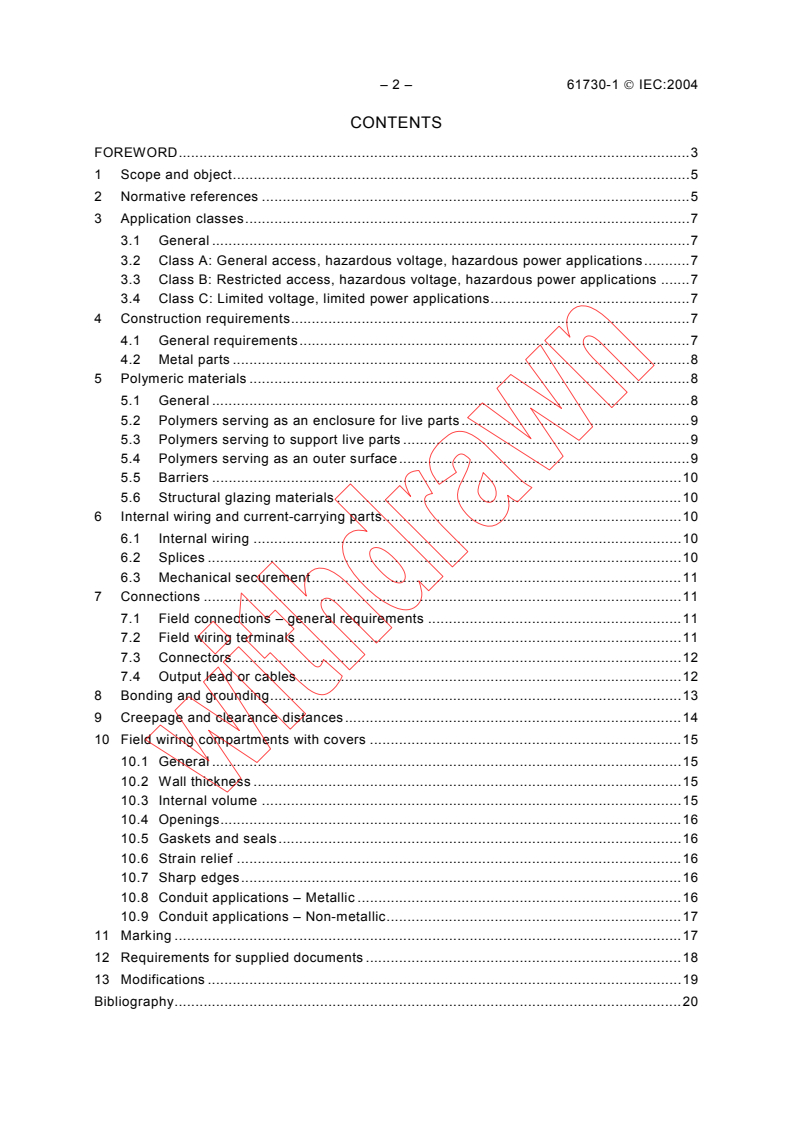
– 2 – 61730-1 © IEC:2004
CONTENTS
FOREWORD.3
1 Scope and object.5
2 Normative references .5
3 Application classes.7
3.1 General .7
3.2 Class A: General access, hazardous voltage, hazardous power applications.7
3.3 Class B: Restricted access, hazardous voltage, hazardous power applications .7
3.4 Class C: Limited voltage, limited power applications.7
4 Construction requirements.7
4.1 General requirements.7
4.2 Metal parts .8
5 Polymeric materials .8
5.1 General .8
5.2 Polymers serving as an enclosure for live parts.9
5.3 Polymers serving to support live parts .9
5.4 Polymers serving as an outer surface.9
5.5 Barriers .10
5.6 Structural glazing materials .10
6 Internal wiring and current-carrying parts.10
6.1 Internal wiring .10
6.2 Splices .10
6.3 Mechanical securement.11
7 Connections .11
7.1 Field connections – general requirements .11
7.2 Field wiring terminals .11
7.3 Connectors.12
7.4 Output lead or cables .12
8 Bonding and grounding.13
9 Creepage and clearance distances.14
10 Field wiring compartments with covers .15
10.1 General .15
10.2 Wall thickness .15
10.3 Internal volume .15
10.4 Openings.16
10.5 Gaskets and seals.16
10.6 Strain relief .16
10.7 Sharp edges.16
10.8 Conduit applications – Metallic .16
10.9 Conduit applications – Non-metallic.17
11 Marking .17
12 Requirements for supplied documents .18
13 Modifications .19
Bibliography.20
61730-1 © IEC:2004 – 3 –
INTERNATIONAL ELECTROTECHNICAL COMMISSION
___________
PHOTOVOLTAIC (PV) MODULE SAFETY QUALIFICATION –
Part 1: Requirements for construction
FOREWORD
1) The International Electrotechnical Commission (IEC) is a worldwide organization for standardization comprising
all national electrotechnical committees (IEC National Committees). The object of IEC is to promote
international co-operation on all questions concerning standardization in the electrical and electronic fields. To
this end and in addition to other activities, IEC publishes International Standards, Technical Specifications,
Technical Reports, Publicly Available Specifications (PAS) and Guides (hereafter referred to as “IEC
Publication(s)”). Their preparation is entrusted to technical committees; any IEC National Committee interested
in the subject dealt with may participate in this preparatory work. International, governmental and non-
governmental organizations liaising with the IEC also participate in this preparation. IEC collaborates closely
with the International Organization for Standardization (ISO) in accordance with conditions determined by
agreement between the two organizations.
2) The formal decisions or agreements of IEC on technical matters express, as nearly as possible, an international
consensus of opinion on the relevant subjects since each technical committee has representation from all
interested IEC National Committees.
3) IEC Publications have the form of recommendations for international use and are accepted by IEC National
Committees in that sense. While all reasonable efforts are made to ensure that the technical content of IEC
Publications is accurate, IEC cannot be held responsible for the way in which they are used or for any
misinterpretation by any end user.
4) In order to promote international uniformity, IEC National Committees undertake to apply IEC Publications
transparently to the maximum extent possible in their national and regional publications. Any divergence
between any IEC Publication and the corresponding national or regional publication shall be clearly indicated in
the latter.
5) IEC provides no marking procedure to indicate its approval and cannot be rendered responsible for any
equipment declared to be in conformity with an IEC Publication.
6) All users should ensure that they have the latest edition of this publication.
7) No liability shall attach to IEC or its directors, employees, servants or agents including individual experts and
members of its technical committees and IEC National Committees for any personal injury, property damage or
other damage of any nature whatsoever, whether direct or indirect, or for costs (including legal fees) and
expenses arising out of the publication, use of, or reliance upon, this IEC Publication or any other IEC
Publications.
8) Attention is drawn to the Normative references cited in this publication. Use of the referenced publications is
indispensable for the correct application of this publication.
9) Attention is drawn to the possibility that some of the elements of this IEC Publication may be the subject of
patent rights. IEC shall not be held responsible for identifying any or all such patent rights.
International Standard IEC 61730-1 has been prepared by IEC technical committee 82: Solar
photovoltaic energy systems.
The text of this standard is based on the following documents:
FDIS Report on voting
82/356/FDIS 82/365/RVD
Full information on the voting for the approval of this standard can be found in the report on
voting indicated in the above table.
This publication has been drafted in accordance with the ISO/IEC Directives, Part 2.
– 4 – 61730-1 © IEC:2004
IEC 61730 consists of the following parts, under the general title Photovoltaic (PV) module
safety qualification:
Part 1: Requirements for construction
Part 2: Requirements for testing
The committee has decided that the contents of this publication will remain unchanged until
the maintenance result date indicated on the IEC web site under "http://webstore.iec.ch" in
the data related to the specific publication. At this date, the publication will be
• reconfirmed;
• withdrawn;
• replaced by a revised edition, or
• amended.
61730-1 © IEC:2004 – 5 –
PHOTOVOLTAIC (PV) MODULE SAFETY QUALIFICATION –
Part 1: Requirements for construction
1 Scope and object
This part of IEC 61730 describes the fundamental construction requirements for photovoltaic
(PV) modules in order to provide safe electrical and mechanical operation during their
expected lifetime. Specific topics are provided to assess the prevention of electrical shock,
fire hazards, and personal injury due to mechanical and environmental stresses. This part of
IEC 61730 pertains to the particular requirements of construction. IEC 61730-2 outlines the
requirements of testing.
This standard attempts to define the basic requirements for various application classes of PV
modules, but it cannot be considered to encompass all national or regional building codes.
The specific requirements for marine and vehicle applications are not covered. This standard
is not applicable to modules with integrated AC inverters (AC modules).
This standard is designed so that its test sequence can coordinate with those of IEC 61215 or
IEC 61646, so that a single set of samples may be used to perform both the safety and
performance evaluation of a photovoltaic module design.
The object of this document is to provide basic guidance in certifying the fundamental
construction of photovoltaic modules presented for safety approval by testing under
IEC 61730-2. These requirements are intended to minimise the misapplication and misuse of
modules or the breakdown of internal components which would result in fire, electric shock
and personal injury. The standard defines the basic safety construction requirements and
additional tests that are a function of the module end-use applications.
Component requirements are intended to provide evidence of performance of that component
appropriate to its application in the module construction and environment.
NOTE The additional construction requirements outlined in relevant ISO standards, or the national or local codes
which govern the installation and use of these modules in their intended locations, should be considered in addition
to the requirements contained within this document.
2 Normative references
The following referenced documents are indispensable for the application of this document.
For dated references, only the edition cited applies. For undated references, the latest edition
of the referenced document (including any amendments) applies.
IEC 60112, Method for the determination of the proof and the comparative tracking indices of
solid insulating materials
IEC 60130 (all parts), Connectors for frequencies below 3 MHz
IEC 60189-2, Low-frequency cables and wires with PVC insulation and PVC sheath – Part 2:
Cables in pairs, triples, quads and quintuples for inside installations
– 6 – 61730-1 © IEC:2004
IEC 60216-1, Electrical insulating materials − Thermal endurance properties − Part 1: Ageing
procedures and evaluation of test results
IEC 60216-5, Electrical insulating materials − Thermal endurance properties − Part 5:
Determination of relative thermal endurance index (RTE) of an insulating material
IEC 60364-5-51, Electrical installations of buildings – Part 5-51: Selection and erection of
electrical equipment – Common rules
IEC 60417-DB:2002 , Graphical symbols for use on equipment
IEC 60529, Degrees of protection provided by enclosures (IP Code)
IEC 60695-1-1, Fire hazard testing − Part 1-1: Guidance for assessing the fire hazard of
electrotechnical products − General guidelines
IEC 60947-1, Low-voltage switchgear and controlgear – Part 1: General rules
IEC 61140:2001, Protection against electric shock – Common aspects for installation and
equipment
IEC 61215, Crystalline silicon terrestrial photovoltaic (PV) modules – Design qualification and
type approval
IEC 61646, Thin-film terrestrial photovoltaic (PV) modules – Design qualification and type
approval
IEC 61721, Susceptibility of a photovaltaic (PV) module to accidental impact damage
(resistance to impact test)
IEC 61730-2:2004, Photovaltaic (PV) module safety qualification – Part 2: Requirements for
testing
ISO 261, ISO general purpose metric screw threads – General plan
ISO 262, ISO general purpose metric screw threads – Selected sizes for screws, bolts, and
nuts
ANSI/UL 746C, Standard for Polymeric Materials – Use in Electrical Equipment Evaluation
ANSI Z97.1, American National Standard for Safety Glazing Materials Used in Buildings –
Safety Performance Specifications and Methods of Test
ASTM D2303-97, Standard Test Methods for Liquid-Contaminant, Inclined-Plane Tracking and
Erosion of Insulating Materials
ASTM E162-02a, Standard Test Method for Surface Flammability of Materials Using a Radiant
Heat Energy Source
___________
“DB” refers to the IEC on-line database.
61730-1 © IEC:2004 – 7 –
3 Application classes
3.1 General
Photovoltaic modules may be installed in many different applications. Therefore, it is
important to evaluate the potential hazards associated with those applications and to evaluate
the construction of the module accordingly.
Relevant safety requirements and necessary tests shall be performed to verify the
conformance to the requirements of that application class. This clause defines those
application classes and construction qualities required for each class.
Application classes for PV-modules are defined as follows:
3.2 Class A: General access, hazardous voltage, hazardous power applications
Modules rated for use in this application class may be used in systems operating at greater
than 50 V DC or 240 W, where general contact access is anticipated. Modules qualified for
safety through this part of IEC 61730 and IEC 61730-2 and within this application class are
considered to meet the requirements for safety class II.
3.3 Class B: Restricted access, hazardous voltage, hazardous power applications
Modules rated for use in this application class are restricted to systems protected from public
access by fences, location, etc. Modules evaluated within this application class provide
protection by basic insulation, are considered to meet the requirements for safety class 0.
3.4 Class C: Limited voltage, limited power applications
Modules rated for use in this application class are restricted to systems operating at less than
50 V DC and 240 W, where general contact access is anticipated. Modules qualified for safety
through this part of IEC 61730 and IEC 61730-2 within this application class are considered to
meet the requirements for safety class III.
NOTE Safety classes are defined within IEC 61140.
4 Construction requirements
4.1 General requirements
4.1.1 All modules shall be able to operate under environmental condition type AB8 according
to IEC 60364-5-51.
4.1.2 A module shall be completely assembled when shipped from the factory, or shall be
provided in subassemblies, provided assembly of the product does not involve any action that
is likely to affect compliance with the requirements of the IEC 61730 series.
4.1.3 An assembly part, such as a terminal compartment cover, need not be affixed to the
module at the factory. Incorporation of a module into the final assembly shall not require any
alteration of the module from its originally evaluated form, unless specific details describing
necessary modification(s) are provided in the installation instructions.
– 8 – 61730-1 © IEC:2004
4.1.4 If a module must bear a definite relationship to another module for the intended
installation and operation (for example, to allow connectors to mate), it shall be constructed to
permit incorporation into the final assembly without the need for alteration.
4.1.5 The construction of a module shall be such that ground continuity is not interrupted by
installation.
4.1.6 Parts shall be prevented from loosening or turning if such loosening or turning may
result in a risk of fire, electric shock, or injury to persons.
4.1.7 Friction between surfaces, such as simple spring pressure, is not acceptable as the
sole means to inhibit the turning or loosening of a part.
4.1.8 Any adjustable or movable structural part shall be provided with a locking device to
reduce the likelihood of unintentional movement, if any such movement may result in a risk of
fire, electric shock, or injury to persons.
4.2 Metal parts
4.2.1 Metals used in locations that are exposed to moisture shall not be employed alone or
in combinations that could result in deterioration, such that the product would not comply with
the requirements in this standard.
4.2.2 Iron or mild steel serving as a necessary part of the product but not exposed to the
weather shall be plated, painted, or enamelled for protection against corrosion.
4.2.3 Simple sheared or cut edges and punched holes are not required to be additionally
protected.
5 Polymeric materials
5.1 General
Polymers are classified into four operational categories:
– polymers serving as an enclosure for live metal parts (such as a junction box);
– polymers serving as a support of live metal parts (such as integrated terminals);
– polymers serving as the outer surface for the module (such as the superstrate or
substrate);
– barriers.
Exception: Encapsulation materials are not required to meet these requirements.
All polymeric materials shall have a minimum relative thermal index (electrical and mechanical
as defined by IEC 60216-5) of 20 °C above the maximum measured operating temperature of
said material in application, as measured during the temperature test (IEC 61730-2,
MST 21).
NOTE Polymers serving as a superstrate or substrate have additional requirements, as specified in 5.3. and 5.4.
61730-1 © IEC:2004 – 9 –
5.2 Polymers serving as an enclosure for live parts
A polymeric material serving as the enclosure of a part involving a risk of fire or electric shock
shall comply with the following requirements:
a) 5-V flammability rating, either by material test or testing in the end-product design
(IEC 60695-1-1);
b) 5-V flammability rating, after water immersion and exposure of the end-product
(IEC 60695-1-1);
c) ultraviolet radiation resistance (if exposed to direct sunlight in the application), as
determined in accordance with ANSI/UL 746C, and
d) a minimum resistance to hot wire ignition rating of 30 (IEC 60695-1-1).
5.3 Polymers serving to support live parts
A polymeric material serving as the support or insulation of a part involving a risk of fire or
electric shock shall:
a) have a flammability classification of HB, V-2, V-1, or V-0 and have a minimum high-current
arc ignition rating determined in accordance with IEC 60695-1-1, as shown in Table 1,
Table 1 − High arc ignition rating for given flammability classification
Flammability classification High-current arc ignition rating
HB 60
V-2 30
V-1 30
V-0 15
b) have a Comparative Tracking Index (CTI) of 250 V or more, if the system voltage rating is
600 V or less, as determined in accordance with IEC 60112,
c) have an inclined plane tracking rating of 1 h using the time to track method at
2,5 kV according to ASTM D2303, if the maximum system operating voltage rating is in the
601 V – 1 500 V range, and
d) comply with the requirements for exposure to ultraviolet light as determined in accordance
with the ANSI/UL 746C if exposed to direct sunlight during normal operation of the
product.
NOTE Polymeric materials that are exposed to direct sunlight but are protected by glass, or other transparent
medium, may be tested with an equivalent layer of that medium attenuating the ultraviolet light exposure during the
test.
5.4 Polymers serving as an outer surface
5.4.1 A polymeric substrate or superstrate shall have a thermal index, both electrical and
mechanical, as determined in accordance with IEC 60216-5 of at least 90°C. In addition, the
thermal index shall be at least 20 °C above the maximum measured operating temperature of
the material as measured during the temperature test given in IEC 61730-2, MST 21.
– 10 – 61730-1 © IEC:2004
5.4.2 Polymeric materials that serve as the outer enclosure for a module that (1) is intended
to be installed in a multi-module or -panel system or (2) has an exposed surface area greater
than 1 m or a single dimension larger than 2 m, shall have a maximum flame spread index of
100 as determined under ASTM E162-02a.
NOTE Materials that serve as the wiring enclosure for a module, in accordance with 6.1.1, need not comply.
5.4.3 If exposed to direct sunlight in the application, the polymeric material shall have been
evaluated for ultraviolet (UV) radiation resistance as determined in accordance with
ANSI/UL 746C.
5.4.4 Polymeric materials intended for use as a superstrate or substrate, without appropriate
IEC insulation pre-qualification, shall comply with the requirements of the partial discharge
test, IEC 61730-2, MST 15.
5.5 Barriers
A barrier of polymeric insulating material providing the sole insulation between a live part and
an accessible metal part or between uninsulated live parts not of the same potential shall be
of adequate thickness and of a material appropriate for the application, as defined by
IEC 61140. The barrier or liner shall be held in place and shall not be adversely affected to
the extent that its necessary properties fall below the minimum acceptable values for the
application.
5.6 Structural glazing materials
All structural glazing materials used as superstrates or substrates in the construction of
modules shall comply with the requirements for safety glazing as described in ANSI Z97.1-93
by material certification or by testing in accordance with MST 32.
6 Internal wiring and current-carrying parts
A current-carrying part and wiring shall have the mechanical strength and current-carrying
capacity necessary for its application.
6.1 Internal wiring
6.1.1 Wiring used within a module shall have an insulation rated for a minimum of 90°C, with
a gauge and voltage rating acceptable for the application as defined by the requirements of
IEC 60189-2, as applicable.
6.1.2 The wiring of a module shall be located so that after installation of the product in the
intended manner, the insulation will not be exposed to the degrading effects of direct sunlight.
Exception: The requirement does not apply to wiring with insulation rated “sunlight resistant”.
6.2 Splices
A splice shall be considered acceptable with insulation equivalent to that required for the
wiring involved.
61730-1 © IEC:2004 – 11 –
6.3 Mechanical securement
6.3.1 A joint or connection shall be mechanically secure and shall provide electrical contact
without strain on connections and terminals. Soldered connections between module
interconnections and cell metallizations are considered mechanically secure when held by
encapsulation systems.
6.3.2 An uninsulated live part, including a terminal, shall be secured to its supporting surface
so that it will be prevented from turning or shifting in position, if such motion may result in
reduction of spacings to less than required in Tables 3 and 4.
7 Connections
7.1 Field connections – general requirements
7.1.1 A module shall be provided with wiring terminals, connectors, or leads to
accommodate current-carrying conductors of the load circuit.
7.1.2 Field connections shall either be rated for exposure to direct sunlight as defined in
Clause 5 or so located that after installation they will not be exposed to the degrading effects
of direct sunlight.
7.2 Field wiring terminals
7.2.1 If the module contains a field wiring terminal block, it shall be rated for the appropriate
voltage and current for the application and constructed in compliance with the requirements of
IEC 60947-1.
7.2.2 If the module alternately contains wiring terminals integral to the construction of the
terminal enclosure, they shall comply with the following requirements:
7.2.2.1 Screws and nuts which clamp external conductors shall have a thread conforming
with ISO 261 or ISO 262, or a thread comparable in pitch and mechanical strength (e.g.
standard threads). The screws and nuts used for field wiring shall not serve to fix any other
component. These connections are also permitted to clamp internal conductors provided that
the internal conductors are so arranged that they will not be displaced when fitting the
external conductors.
7.2.2.2 Terminal screws shall have minimum sizes as shown in Table 2. Stud terminals shall
be provided with nuts and washers.
7.2.2.3 Terminals shall be so designed that they clamp the conductor between metal
surfaces with sufficient contact pressure and without damage to the conductor. Terminals
shall be so designed or located that the conductor cannot slip out when the clamping screws
or nuts are tightened. Terminals shall be so fixed that, when the means of clamping the
conductor is tightened or loosened:
a) the terminal itself does not work loose,
b) internal wiring is not subjected to stress,
c) creepage distances and clearances are not reduced below the values specified in
Clause 9.
– 12 – 61730-1 © IEC:2004
Table 2 – Sizes of terminals for supply conductors
Minimum nominal thread diameter
Rated current of equipment
mm
A
Pillar type or stud type Screw type
Up to and including 10 3,0 3,5
Over 10 up to and including 16 3,5 4,0
Over 16 up to and including 25 4,0 5,0
Over 25 up to and including 32 4,0 5,0
Over 32 up to and including 40 5,0 5,0
7.3 Connectors
7.3.1 A connector intended for use in the output circuit of a module shall be rated for the
appropriate voltage and current, as per the requirements of the IEC 60130 series. In addition,
the connector shall comply with the requirements of Clause 5, with respect to flammability,
comparative tracking index and relative thermal index for the support of live parts.
7.3.2 Unless a connector is appropriately evaluated for disconnect overload performance,
the connector shall be assumed to be suitable for assembly only and not reliable as a
disconnect means. See Clause 11.
7.3.3 A connector intended for exposure to the outdoor environment shall be enclosed by
material which complies with the following:
a) the requirements of Clause 5, with respect to UV resistance,
b) resistance to inclusion of water, as per IEC 60529, equivalent to IP55,
c) the steel ball impact test, per IEC 61721,
d) the requirements of the accessibility test, IEC 61730-2, MST 11.
7.3.4 Separable multi-pole connectors shall be polarised. If two or more separable
connectors are provided, they shall be configured or arranged so that the other and vice-versa
will not accept the mating connector for one, if it will result in an improper connection.
7.3.5 For a connector incorporating a grounding member, the grounding member shall be the
first to make and the last to break contact with the mating connector.
7.3.6 Connectors that can be separated without the use of a tool shall not have accessible
conductive parts, as determined by 10.2 of IEC 61730-2.
7.4 Output lead or cables
Leads extending from the module shall be rated for the appropriate system voltage, ampacity,
wet locations, temperature and sunlight resistance.
61730-1 © IEC:2004 – 13 –
8 Bonding and grounding
8.1 A module with accessible conductive parts which form a perimeter framing or mounting
system, or have a conductive surface area of greater that 10 cm accessible after installation
shall have provision for grounding.
8.2 Modules rated as safety class II may be provided with provisions for functional
grounding. Such grounding means shall be isolated from live parts by reinforced insulation
(7.3.2.2 of IEC 61140).
8.3 Each exposed conductive part of the module that is accessible during normal use shall
be bonded together, as verified by 10.4 of IEC 61730-2.
Exception: If conductive materials are used only as fasteners for installation and separated
from the conductive components of the module by both appropriate insulation and spacings,
they are not required to be bonded.
8.4 Routine maintenance of a module shall not involve breaking or disturbing the bonding
path. A bolt, screw, or other part used for bonding purposes within a module or panel shall not
be intended for securing the complete device to the supporting surface or frame.
8.5 Bonding shall be by a positive means, such as clamping, riveting, bolted or screwed
connections, or welding, soldering or brazing. The bonding connection shall penetrate all non-
conductive coatings, such as paint, anodised coatings or vitreous enamel.
8.6 All joints in the bonding path shall be mechanically secure, independently of any
soldering.
8.7 If the bonding connection depends upon screw threads, two or more screws or two full
threads of a single screw shall engage the metal.
8.8 The diameter of the grounding screw or bolt shall be sized appropriately to the gauge of
the bonding conductor, as per Table 2.
8.9 A ferrous metal part in the grounding path shall be protected against corrosion by
metallic or non-metallic coatings, such as painting, galvanising, or plating. Stainless steel is
acceptable without additional coating.
8.10 A metal-to-metal multiple-bearing pin-type hinge is considered to be an acceptable
means for bonding.
8.11 A wiring terminal or bonding location of a module intended to accommodate a field
installed equipment-grounding conductor shall be identified with the appropriate symbol
(IEC 60417-5019(DB:2002-10)) or shall have a green-coloured part. No other terminal or
location shall be identified in this manner.
8.12 If a marking is used to identify an equipment grounding terminal, it shall be located on
or adjacent to the terminal, or on a wiring diagram affixed to the module or panel near the
terminal.
– 14 – 61730-1 © IEC:2004
9 Creepage and clearance distances
9.1 The creepage and clearance distances between uninsulated live parts not of the same
potential and between a live part and an accessible metal part, shall not be less than the
values specified in Tables 3 and 4.
These spacing requirements do not apply to the inherent spacings of a component. Such
spacings shall comply with the requirements for the component in question. These distances
also do not apply to solid insulation materials. Those insulation properties can be assessed
through the tests outlined in IEC 61730-2.
9.2 Creepage and clearance distances at field wiring terminals are to be judged on module
open-circuit voltage (V ). If additional unmarked terminals exist in the terminal block, or if
oc
wiring terminals are marked specifically for grounding, the creepage and clearance distances
will be judged on the basis of the maximum system operating voltage.
Table 3 – Minimum acceptable creepage and clearance distances
between field wiring terminals
Voltage
mm
V
0 – 50 6,5
51 – 300 9,5
301 – 600 12,5
601 – 1 000 16
1 001 – 1 500 25
Table 4 – Minimum acceptable clearance distances between
internal current-carrying parts and accessible points
Maximum system Clearance
voltage mm
V Class C Class B Class A
0 – 50 2 2 2
51 – 300 3,2 6,4
301 – 600 3,2 6,4
601 – 1 000 4,2 8,4
1 001 – 1 500 8 11
NOTE The encapsulant materials used in PV construction cannot be considered totally non-hygroscopic and the
lamination process does not provide a truly sealed system. Therefore, creepage and clearance distances specified
are based on pollution degree 2, material grade IIIa & IIIb, also case A, impulse voltage 8 kV. Rounding was done
upward to promote conservative margins.
9.3 The spacings at a field-wiring terminal are to be measured with and without wire
connected to the terminal. The wire shall be connected as it would be in actual use. If the
terminal will properly accommodate it, and if the product is not marked to restrict its use, the
wire is to be one size larger than that required, otherwise, the wire is to be the size required.
9.4 Surfaces separated by a gap of 0,4 mm or less are considered to be in contact with each
other for the purpose of judging creepage distances.
61730-1 © IEC:2004 – 15 –
10 Field wiring compartments with covers
10.1 General
Modules designed for the application of a permanently attached wiring system by an installer
in the field shall be provided with an enclosed wiring compartment, which provides protection
of the conductors and connections from environmental stress, protection from accessibility to
live uninsulated parts and strain relief for the attached wiring system.
NOTE The considerations mentioned in Clause 5 apply to non-metallic wiring compartments.
10.2 Wall thickness
A wiring compartment intended for the attachment of a field-applied permanent wiring system
shall provide the minimum wall thickness, based on the material used, as specified in Table 5.
Table 5 − Minimum wall thickness for given material
a)
Material Minimum thickness
mm
Sheet steel, uncoated 1,35
Sheet steel, zinc coated 1,42
Sheet aluminium 1,59
Cast iron, aluminium, brass, or bronze 2,4
Polymeric materials 3
a)
If the wall thickness is less than the specified values, acceptability is to be determined from the results of the
impact test, the crushing resistance test, the conduit bending tests, and the end-product 5 V flammability tests. For
enclosure with conduit, see Table 6.
10.3 Internal volume
A minimum internal volume for each intended conductor, including integral conductors of the
module, shall be provided in a wiring compartment, within ±5 % as given in Table 6.
Table 6 − Minimum internal volume/conductor for given conductor size
Conductor size Minimum internal volume, each conductor
cm
1,5 mm 25
No. 14 AWG 33
2,5 mm 40
No. 12 AWG 36,9
4 mm 60
In the space comprising the minimum required volume, no enclosure dimension shall be less
than 20 mm.
– 16 – 61730-1 © IEC:2004
10.4 Openings
All openings shall be provided with appropriate coverings (such as knockouts, plugs, etc.),
whose functions comply with the requirements of 5.2.1, the wet leakage test of Subclause
10.20 of IEC 61646 and the accessibility test of Subclause 10.2 of IEC 61730-2, and should
only be able to be removed by the use of a tool.
10.5 Gaskets and seals
Gaskets and seals shall not deteriorate beyond limits during accelerated ageing, and shall not
be used where they may be subject to flexing during normal operation. See accelerated
ageing test, IEC 60216-1.
10.6 Strain relief
Strain relief shall be provided so that stress on a lead intended for field connection, or
otherwise likely to be handled in the field, including a flexible cord, is not transmitted to the
electrical connection inside the module. Mechanical securement means which comply with
10.14 of IEC 61215 meet this requirement.
10.7 Sharp edges
10.7.1 The enclosure shall be smooth and free from sharp edges, burrs, or the like that may
damage insulation or conductors.
Compliance shall be done by inspection.
10.7.2 This requirement also applies to the inner edges of conduit openings and knockouts.
10.8 Conduit applications – Metallic
10.8.1 A threaded hole in a metal wiring compartment intended for the connection of rigid
metal conduit shall be reinforced to provide metal not less than 6,4 mm (1/4 in.) thick, and
shall be tapered unless a conduit end stop is provided.
10.8.2 If threads for the connection of conduit are tapped all the way through a hole in a
compartment wall, or if an equivalent construction is employed, there shall not be less than
3,5 nor more than 5 threads in the metal and the construction shall be such that a conduit
bushing can be attached as intended.
10.8.3 If threads for the connection of conduit are not tapped all the way through a hole in a
compartment wall, there shall not be less than 5 full threads in the metal and there shall be a
smooth, rounded inlet hole for the conductors which shall afford protection to the conductors
equivalent to that provided by a standard conduit bushing.
10.8.4 For a non-threaded opening in a metal wiring compartment intended to accommodate
rigid metallic conduit, a flat surface of sufficient area shall be provided around the opening to
accept the bearing surfaces of the bushing and lock washer.
10.8.5 Conduit shall comply with the Conduit bending test described in Clause 11 of
IEC 61730-2, MST 33.
61730-1 © IEC:2004 – 17 –
10.9 Conduit applications – Non-metallic
10.9.1 The sides, end walls, and bottom of a non-metallic wiring enclosure specified for
conduit applications shall not have a thickness less than the values specified in Table 7.
Table 7 – Wall thickness of polymeric boxes intended for conduit
Trade size of conduit Minimum wall thickness
mm mm
13 to 25 3
26 to 50 4
51 to 100 5
10.9.2 A non-metallic wiring compartment intended to accommodate non-metallic conduit
shall have the following:
a) one or more unthreaded condui
...
IEC 61730-1 ®
Edition 1.2 2013-03
INTERNATIONAL
STANDARD
NORME
INTERNATIONALE
colour
inside
Photovoltaic (PV) module safety qualification –
Part 1: Requirements for construction
Qualification pour la sûreté de fonctionnement des modules photovoltaïques (PV) –
Partie 1: Exigences pour la construction
All rights reserved. Unless otherwise specified, no part of this publication may be reproduced or utilized in any form
or by any means, electronic or mechanical, including photocopying and microfilm, without permission in writing from
either IEC or IEC's member National Committee in the country of the requester.
If you have any questions about IEC copyright or have an enquiry about obtaining additional rights to this publication,
please contact the address below or your local IEC member National Committee for further information.
Droits de reproduction réservés. Sauf indication contraire, aucune partie de cette publication ne peut être reproduite ni
utilisée sous quelque forme que ce soit et par aucun procédé, électronique ou mécanique, y compris la photocopie et les
microfilms, sans l'accord écrit de la CEI ou du Comité national de la CEI du pays du demandeur.
Si vous avez des questions sur le copyright de la CEI ou si vous désirez obtenir des droits supplémentaires sur cette
publication, utilisez les coordonnées ci-après ou contactez le Comité national de la CEI de votre pays de résidence.
IEC Central Office Tel.: +41 22 919 02 11
3, rue de Varembé Fax: +41 22 919 03 00
CH-1211 Geneva 20 info@iec.ch
Switzerland www.iec.ch
About the IEC
The International Electrotechnical Commission (IEC) is the leading global organization that prepares and publishes
International Standards for all electrical, electronic and related technologies.
About IEC publications
The technical content of IEC publications is kept under constant review by the IEC. Please make sure that you have the
latest edition, a corrigenda or an amendment might have been published.
Useful links:
IEC publications search - www.iec.ch/searchpub Electropedia - www.electropedia.org
The advanced search enables you to find IEC publications The world's leading online dictionary of electronic and
by a variety of criteria (reference number, text, technical electrical terms containing more than 30 000 terms and
committee,…). definitions in English and French, with equivalent terms in
It also gives information on projects, replaced and additional languages. Also known as the International
withdrawn publications. Electrotechnical Vocabulary (IEV) on-line.
IEC Just Published - webstore.iec.ch/justpublished Customer Service Centre - webstore.iec.ch/csc
Stay up to date on all new IEC publications. Just Published If you wish to give us your feedback on this publication
details all new publications released. Available on-line and or need further assistance, please contact the
also once a month by email. Customer Service Centre: csc@iec.ch.
A propos de la CEI
La Commission Electrotechnique Internationale (CEI) est la première organisation mondiale qui élabore et publie des
Normes internationales pour tout ce qui a trait à l'électricité, à l'électronique et aux technologies apparentées.
A propos des publications CEI
Le contenu technique des publications de la CEI est constamment revu. Veuillez vous assurer que vous possédez
l’édition la plus récente, un corrigendum ou amendement peut avoir été publié.
Liens utiles:
Recherche de publications CEI - www.iec.ch/searchpub Electropedia - www.electropedia.org
La recherche avancée vous permet de trouver des Le premier dictionnaire en ligne au monde de termes
publications CEI en utilisant différents critères (numéro de électroniques et électriques. Il contient plus de 30 000
référence, texte, comité d’études,…). termes et définitions en anglais et en français, ainsi que
Elle donne aussi des informations sur les projets et les les termes équivalents dans les langues additionnelles.
publications remplacées ou retirées. Egalement appelé Vocabulaire Electrotechnique
International (VEI) en ligne.
Just Published CEI - webstore.iec.ch/justpublished
Service Clients - webstore.iec.ch/csc
Restez informé sur les nouvelles publications de la CEI.
Just Published détaille les nouvelles publications parues. Si vous désirez nous donner des commentaires sur
Disponible en ligne et aussi une fois par mois par email. cette publication ou si vous avez des questions
contactez-nous: csc@iec.ch.
IEC 61730-1 ®
Edition 1.2 2013-03
INTERNATIONAL
STANDARD
NORME
INTERNATIONALE
colour
inside
Photovoltaic (PV) module safety qualification –
Part 1: Requirements for construction
Qualification pour la sûreté de fonctionnement des modules photovoltaïques (PV) –
Partie 1: Exigences pour la construction
INTERNATIONAL
ELECTROTECHNICAL
COMMISSION
COMMISSION
ELECTROTECHNIQUE
INTERNATIONALE
ICS 27.160 ISBN 978-2-8891-2881-5
– 2 – 61730-1 IEC:2004+A1:2011
+A2:2013
CONTENTS
FOREWORD . 3
1 Scope and object . 5
2 Normative references . 5
3 Application classes . 7
3.1 General . 7
3.2 Class A: General access, hazardous voltage, hazardous power applications . 7
3.3 Class B: Restricted access, hazardous voltage, hazardous power applications . 7
3.4 Class C: Limited voltage, limited power applications . 7
4 Construction requirements . 7
4.1 General requirements . 7
4.2 Metal parts . 8
5 Polymeric materials . 8
5.1 General . 8
5.2 Polymers serving as an enclosure for live parts . 9
5.3 Polymers serving to support live parts . 9
5.4 Polymers serving as an outer surface . 9
5.5 Barriers . 10
5.6 Structural glazing materials . 10
6 Internal wiring and current-carrying parts. 10
6.1 Internal wiring . 10
6.2 Splices . 10
6.3 Mechanical securement . 10
7 Connections . 11
7.1 Field connections – general requirements . 11
7.2 Field wiring terminals . 11
7.3 Connectors . 12
7.4 Output lead or cables . 12
8 Bonding and grounding . 12
9 Creepage and clearance distances . 13
10 Field wiring compartments with covers . 14
10.1 General . 14
10.2 Wall thickness . 14
10.3 Internal volume . 15
10.4 Openings . 15
10.5 Gaskets and seals . 15
10.6 Strain relief . 15
10.7 Sharp edges . 16
10.8 Conduit applications – Metallic . 16
10.9 Conduit applications – Non-metallic . 16
11 Marking . 17
12 Requirements for supplied documents . 17
13 Modifications . 18
Bibliography . 19
61730-1 IEC:2004+A1:2011 – 3 –
A2:2013
INTERNATIONAL ELECTROTECHNICAL COMMISSION
___________
PHOTOVOLTAIC (PV) MODULE SAFETY QUALIFICATION –
Part 1: Requirements for construction
FOREWORD
1) The International Electrotechnical Commission (IEC) is a worldwide organization for standardization comprising
all national electrotechnical committees (IEC National Committees). The object of IEC is to promote
international co-operation on all questions concerning standardization in the electrical and electronic fields. To
this end and in addition to other activities, IEC publishes International Standards, Technical Specifications,
Technical Reports, Publicly Available Specifications (PAS) and Guides (hereafter referred to as “IEC
Publication(s)”). Their preparation is entrusted to technical committees; any IEC National Committee interested
in the subject dealt with may participate in this preparatory work. International, governmental and non-
governmental organizations liaising with the IEC also participate in this preparation. IEC collaborates closely
with the International Organization for Standardization (ISO) in accordance with conditions determined by
agreement between the two organizations.
2) The formal decisions or agreements of IEC on technical matters express, as nearly as possible, an international
consensus of opinion on the relevant subjects since each technical committee has representation from all
interested IEC National Committees.
3) IEC Publications have the form of recommendations for international use and are accepted by IEC National
Committees in that sense. While all reasonable efforts are made to ensure that the technical content of IEC
Publications is accurate, IEC cannot be held responsible for the way in which they are used or for any
misinterpretation by any end user.
4) In order to promote international uniformity, IEC National Committees undertake to apply IEC Publications
transparently to the maximum extent possible in their national and regional publications. Any divergence
between any IEC Publication and the corresponding national or regional publication shall be clearly indicated in
the latter.
5) IEC itself does not provide any attestation of conformity. Independent certification bodies provide conformity
assessment services and, in some areas, access to IEC marks of conformity. IEC is not responsible for any
services carried out by independent certification bodies.
6) All users should ensure that they have the latest edition of this publication.
7) No liability shall attach to IEC or its directors, employees, servants or agents including individual experts and
members of its technical committees and IEC National Committees for any personal injury, property damage or
other damage of any nature whatsoever, whether direct or indirect, or for costs (including legal fees) and
expenses arising out of the publication, use of, or reliance upon, this IEC Publication or any other IEC
Publications.
8) Attention is drawn to the Normative references cited in this publication. Use of the referenced publications is
indispensable for the correct application of this publication.
9) Attention is drawn to the possibility that some of the elements of this IEC Publication may be the subject of
patent rights. IEC shall not be held responsible for identifying any or all such patent rights.
This consolidated version of IEC 61730-1 consists of the first edition (2004) [documents
82/356/FDIS and 82/365/RVD], its amendment 1 (2011) [documents 82/659A/FDIS and
82/677/RVD] and its amendment 2 (2013) [documents 82/754/FDIS and 82/762/RVD]. It
bears the edition number 1.2.
The technical content is therefore identical to the base edition and its amendments and
has been prepared for user convenience. A vertical line in the margin shows where the
base publication has been modified by amendments 1 and 2. Additions and deletions
are displayed in red, with deletions being struck through.
– 4 – 61730-1 IEC:2004+A1:2011
+A2:2013
International Standard IEC 61730-1 has been prepared by IEC technical committee 82: Solar
photovoltaic energy systems.
This publication has been drafted in accordance with the ISO/IEC Directives, Part 2.
IEC 61730 consists of the following parts, under the general title Photovoltaic (PV) module
safety qualification:
Part 1: Requirements for construction
Part 2: Requirements for testing
The committee has decided that the contents of the base publication and its amendments will
remain unchanged until the stability date indicated on the IEC web site under
"http://webstore.iec.ch" in the data related to the specific publication. At this date, the
publication will be
• reconfirmed,
• withdrawn,
• replaced by a revised edition, or
• amended.
IMPORTANT – The “colour inside” logo on the cover page of this publication indicates
that it contains colours which are considered to be useful for the correct understanding
of its contents. Users should therefore print this publication using a colour printer.
61730-1 IEC:2004+A1:2011 – 5 –
A2:2013
PHOTOVOLTAIC (PV) MODULE SAFETY QUALIFICATION –
Part 1: Requirements for construction
1 Scope and object
This part of IEC 61730 describes the fundamental construction requirements for photovoltaic
(PV) modules in order to provide safe electrical and mechanical operation during their
expected lifetime. Specific topics are provided to assess the prevention of electrical shock,
fire hazards, and personal injury due to mechanical and environmental stresses. This part of
IEC 61730 pertains to the particular requirements of construction. IEC 61730-2 outlines the
requirements of testing.
This standard attempts to define the basic requirements for various application classes of PV
modules, but it cannot be considered to encompass all national or regional building codes.
The specific requirements for marine and vehicle applications are not covered. This standard
is not applicable to modules with integrated AC inverters (AC modules).
This standard is designed so that its test sequence can coordinate with those of IEC 61215 or
IEC 61646, so that a single set of samples may be used to perform both the safety and
performance evaluation of a photovoltaic module design.
The object of this document is to provide basic guidance in certifying the fundamental
construction of photovoltaic modules presented for safety approval by testing under
IEC 61730-2. These requirements are intended to minimise the misapplication and misuse of
modules or the breakdown of internal components which would result in fire, electric shock
and personal injury. The standard defines the basic safety construction requirements and
additional tests that are a function of the module end-use applications.
Component requirements are intended to provide evidence of performance of that component
appropriate to its application in the module construction and environment.
NOTE The additional construction requirements outlined in relevant ISO standards, or the national or local codes
which govern the installation and use of these modules in their intended locations, should be considered in addition
to the requirements contained within this document.
2 Normative references
The following referenced documents are indispensable for the application of this document.
For dated references, only the edition cited applies. For undated references, the latest edition
of the referenced document (including any amendments) applies.
IEC 60065, Audio, video and similar electronic apparatus – Safety requirements
IEC 60112, Method for the determination of the proof and the comparative tracking indices of
solid insulating materials
IEC 60130 (all parts), Connectors for frequencies below 3 MHz
IEC 60189-2, Low-frequency cables and wires with PVC insulation and PVC sheath – Part 2:
Cables in pairs, triples, quads and quintuples for inside installations
IEC 60216-1, Electrical insulating materials − Thermal endurance properties − Part 1: Ageing
procedures and evaluation of test results
IEC 60216-5, Electrical insulating materials − Thermal endurance properties − Part 5:
Determination of relative thermal endurance index (RTE) of an insulating material
– 6 – 61730-1 IEC:2004+A1:2011
+A2:2013
IEC 60364-5-51, Electrical installations of buildings – Part 5-51: Selection and erection of
electrical equipment – Common rules
IEC 60417-DB:2002 , Graphical symbols for use on equipment
IEC 60529, Degrees of protection provided by enclosures (IP Code)
IEC 60587, Electrical insulating materials used under severe ambient conditions – Test
methods for evaluating resistance to tracking and erosion
IEC 60695-1-1, Fire hazard testing − Part 1-1: Guidance for assessing the fire hazard of
electrotechnical products − General guidelines
IEC 60695-2-10, Fire hazard testing – Part 2-10: Glowing/hot-wire based test methods –
Glow-wire apparatus and common test procedure
IEC 60695-2-20, Fire hazard testing – Part 2-20: Glowing/hot wire based test methods – Hot-
wire coil ignitability – Apparatus, test method and guidance
IEC 60695-11-10, Fire hazard testing – Part 11-10: Test flames 50 W horizontal and vertical
flame test methods
IEC 60695-11-20, Fire hazard testing – Part 11-20: Test flames – 500 W flame test methods
IEC 60947-1, Low-voltage switchgear and controlgear – Part 1: General rules
IEC 61140:2001, Protection against electric shock – Common aspects for installation and
equipment
IEC 61215, Crystalline silicon terrestrial photovoltaic (PV) modules – Design qualification and
type approval
IEC 61646, Thin-film terrestrial photovoltaic (PV) modules – Design qualification and type
approval
IEC 61721, Susceptibility of a photovaltaic (PV) module to accidental impact damage
(resistance to impact test)
IEC 61730-2:2004, Photovaltaic (PV) module safety qualification – Part 2: Requirements for
testing
IEC 61984, Connectors – Safety requirements and tests
ISO 261, ISO general purpose metric screw threads – General plan
ISO 262, ISO general purpose metric screw threads – Selected sizes for screws, bolts, and
nuts
ANSI/UL 746C, Standard for Polymeric Materials – Use in Electrical Equipment Evaluation
ANSI Z97.1, American National Standard for Safety Glazing Materials Used in Buildings –
Safety Performance Specifications and Methods of Test
ASTM D2303-97, Standard Test Methods for Liquid-Contaminant, Inclined-Plane Tracking and
Erosion of Insulating Materials
ASTM E162-02a, Standard Test Method for Surface Flammability of Materials Using a Radiant
Heat Energy Source
___________
“DB” refers to the IEC on-line database.
The 2004 edition of this publication was withdrawn in 2007. A new edition is currently under consideration.
61730-1 IEC:2004+A1:2011 – 7 –
A2:2013
3 Application classes
3.1 General
Photovoltaic modules may be installed in many different applications. Therefore, it is
important to evaluate the potential hazards associated with those applications and to evaluate
the construction of the module accordingly.
Relevant safety requirements and necessary tests shall be performed to verify the
conformance to the requirements of that application class. This clause defines those
application classes and construction qualities required for each class.
Application classes for PV-modules are defined as follows:
3.2 Class A: General access, hazardous voltage, hazardous power applications
Modules rated for use in this application class may be used in systems operating at greater
than 50 V DC or 240 W, where general contact access is anticipated. Modules qualified for
safety through this part of IEC 61730 and IEC 61730-2 and within this application class are
considered to meet the requirements for safety class II.
3.3 Class B: Restricted access, hazardous voltage, hazardous power applications
Modules rated for use in this application class are restricted to systems protected from public
access by fences, location, etc. Modules evaluated within this application class provide
protection by basic insulation, are considered to meet the requirements for safety class 0.
3.4 Class C: Limited voltage, limited power applications
Modules rated for use in this application class are restricted to systems operating at less than
50 V DC and 240 W, where general contact access is anticipated. Modules qualified for safety
through this part of IEC 61730 and IEC 61730-2 within this application class are considered to
meet the requirements for safety class III.
NOTE Safety classes are defined within IEC 61140.
4 Construction requirements
4.1 General requirements
4.1.1 All modules shall be able to operate under environmental condition type AB8 according
to IEC 60364-5-51.
4.1.2 A module shall be completely assembled when shipped from the factory, or shall be
provided in subassemblies, provided assembly of the product does not involve any action that
is likely to affect compliance with the requirements of the IEC 61730 series.
4.1.3 An assembly part, such as a terminal compartment cover, need not be affixed to the
module at the factory. Incorporation of a module into the final assembly shall not require any
alteration of the module from its originally evaluated form, unless specific details describing
necessary modification(s) are provided in the installation instructions.
4.1.4 If a module must bear a definite relationship to another module for the intended
installation and operation (for example, to allow connectors to mate), it shall be constructed to
permit incorporation into the final assembly without the need for alteration.
4.1.5 The construction of a module shall be such that ground continuity is not interrupted by
installation.
– 8 – 61730-1 IEC:2004+A1:2011
+A2:2013
4.1.6 Parts shall be prevented from loosening or turning if such loosening or turning may
result in a risk of fire, electric shock, or injury to persons.
4.1.7 Friction between surfaces, such as simple spring pressure, is not acceptable as the
sole means to inhibit the turning or loosening of a part.
4.1.8 Any adjustable or movable structural part shall be provided with a locking device to
reduce the likelihood of unintentional movement, if any such movement may result in a risk of
fire, electric shock, or injury to persons.
4.2 Metal parts
4.2.1 Metals used in locations that are exposed to moisture shall not be employed alone or
in combinations that could result in deterioration, such that the product would not comply with
the requirements in this standard.
4.2.2 Iron or mild steel serving as a necessary part of the product but not exposed to the
weather shall be plated, painted, or enamelled for protection against corrosion.
4.2.3 Simple sheared or cut edges and punched holes are not required to be additionally
protected.
5 Polymeric materials
5.1 General
All polymeric materials shall have a minimum relative thermal endurance index (electrical and
mechanical as defined by IEC 60216-5) of 20 °C above the maximum measured operating
temperature of said material in application, as measured during the temperature test
(IEC 61730-2, MST 21).
NOTE Polymers serving as a superstrate or substrate have additional requirements, as specified in 5.3. and 5.4.
Polymers are classified into four five operational categories:
– polymers serving as an enclosure for live metal parts (such as a junction box) shall meet
requirements as specified in 5.2;
– polymers serving as a support of live metal parts (such as integrated terminals) shall meet
the requirements of 5.3;
polymers serving as the outer surface for the module (such as a frontsheet and
backsheet) which do not provide the major mechanical strength for the module shall meet
the requirements of 5.4;
polymers serving as the outer surface for the module (such as the a superstrate or a
substrate) which provide rigid reinforcement or serve as the carrier for the active cells;
• If the superstrate or substrate polymers are intended for contact with active cells they
shall meet requirements as specified in 5.3.
• If the superstrate or substrate polymers are intended for use as an outer surface they
shall meet requirements as specified in 5.4.
• If superstrate or substrate polymers are intended for both contact with active cells or
other circuit elements and for use as the outer surface they shall meet requirements
as specified in both 5.3 and 5.4.
– barriers shall meet the requirements of 5.5.
Exception: Encapsulation materials are not required to meet these requirements.
61730-1 IEC:2004+A1:2011 – 9 –
A2:2013
5.2 Polymers serving as an enclosure for live parts
A polymeric material serving as the enclosure of a part involving a risk of fire or electric shock
shall comply with the following requirements:
a) 5-V flammability rating (IEC 60695-11-20), either by material test or testing in the end-
product design component (IEC 60695-1-1);
b) 5-V flammability rating either by material test or testing the end-product design
(IEC 60695-11-20), after the water immersion and exposure testof the end-product
(IEC 60695-1-1);
c) ultraviolet radiation resistance (if exposed to direct sunlight in the application), as
determined in accordance with ANSI/UL 746C or ISO 4892-2. Test condition defined by
2 2
Xenon cycle 1 at 0,35 W/m /nm or 41 W/m (in the wavelength range from 300 nm to 400
nm), test duration 1 000 h; equivalent pass/fail-criteria as in UL 746C shall be applied, and
d) a minimum resistance to hot wire ignition rating of 30 (IEC 60695-1-1 60695-2-20).
5.3 Polymers serving to support live parts
A polymeric material serving as the support or insulation of a part involving a risk of fire or
electric shock shall:
a) have a flammability classification of HB, V-2, V-1, or V-0 in accordance with IEC 60695-11-10
and have a minimum high-current arc ignition rating determined in accordance with
IEC 60695-1-1 ANSI/UL 746C, as shown in Table 1,
Table 1 − High arc ignition rating for given flammability classification
Flammability classification High-current arc ignition rating
HB 60
V-2 30
V-1 30
V-0 15
b) have a Comparative Tracking Index (CTI) of 250 V or more, if the system voltage rating is
600 V or less, as determined in accordance with IEC 60112,
NOTE 1 Polymeric materials having a CTI of 250 or more are within material group IIIa of IEC 60664-1.
c) have an inclined plane tracking rating of 1 h using the time to track method at
2,5 kV according to ASTM D2303 IEC 60587, if the maximum system operating voltage
rating is in the 601 V – 1 500 V range, and
d) comply with the requirements for exposure to ultraviolet light as determined in accordance
with the ANSI/UL 746C or ISO 4892-2, if exposed to direct sunlight during normal
operation of the product. Test conditions defined by Xenon cycle 1 at 0,35 W/m /nm or
41 W/m (in the wavelength range from 300 nm to 400 nm), test duration 1 000 h;
equivalent pass/fail-criteria as in UL 746C shall be applied.
NOTE 2 Polymeric materials that are exposed to direct sunlight but are protected by glass, or other transparent
medium, may be tested with an equivalent layer of that medium attenuating the ultraviolet light exposure during the
test.
5.4 Polymers serving as an outer surface
5.4.1 A polymeric substrate or superstrate shall have a relative thermal endurance index,
both electrical and mechanical, as determined in accordance with IEC 60216-5 of at least
90°C. In addition, the relative thermal endurance index shall be at least 20 °C above the
maximum measured operating temperature of the material as measured during the
temperature test given in IEC 61730-2, MST 21.
– 10 – 61730-1 IEC:2004+A1:2011
+A2:2013
5.4.2 Polymeric materials that serve as the outer enclosure for a module that (1) is intended
to be installed in a multi-module or -panel system or (2) has an exposed surface area greater
than 1 m or a single dimension larger than 2 m, shall have a maximum flame spread index of
100 as determined under ASTM E162-02a.
NOTE Materials that serve as the wiring enclosure for a module, in accordance with 6.1.1, need not comply.
5.4.3 If exposed to direct sunlight in the application, the polymeric material shall have been
evaluated for ultraviolet (UV) radiation resistance as determined in accordance with
ANSI/UL 746C or ISO 4892-2. Test condition defined by Xenon cycle 1 at 0,35 W/m /nm or
41 W/m (in the wavelength range from 300 nm to 400 nm), test duration 1 000 h; equivalent
pass/fail-criteria as in UL 746C shall be applied.
5.4.4 Polymeric materials intended for use as a superstrate or substrate, without appropriate
IEC insulation pre-qualification, shall comply with the requirements of the partial discharge
test, IEC 61730-2, MST 15.
5.5 Barriers
A barrier of polymeric insulating material providing the sole insulation between a live part and
an accessible metal part or between uninsulated live parts not of the same potential shall be
of adequate thickness and of a material appropriate for the application, as defined by
IEC 61140. The barrier or liner shall be held in place and shall not be adversely affected to
the extent that its necessary properties fall below the minimum acceptable values for the
application.
5.6 Structural glazing materials
All structural glazing materials used as superstrates or substrates in the construction of
modules shall comply with the requirements for safety glazing as described in ANSI Z97.1-93
by material certification or by testing in accordance with MST 32.
6 Internal wiring and current-carrying parts
A current-carrying part and wiring shall have the mechanical strength and current-carrying
capacity necessary for its application.
6.1 Internal wiring
6.1.1 Wiring used within a module shall have an insulation rated for a minimum of 90°C, with
a gauge and voltage rating acceptable for the application as defined by the requirements of
IEC 60189-2, as applicable.
6.1.2 The wiring of a module shall be located so that after installation of the product in the
intended manner, the insulation will not be exposed to the degrading effects of direct sunlight.
Exception: The requirement does not apply to wiring with insulation rated “sunlight resistant”.
6.2 Splices
A splice shall be considered acceptable with insulation equivalent to that required for the
wiring involved.
6.3 Mechanical securement
61730-1 IEC:2004+A1:2011 – 11 –
A2:2013
6.3.1 A joint or connection shall be mechanically secure and shall provide electrical contact
without strain on connections and terminals. Soldered connections between module
interconnections and cell metallizations are considered mechanically secure when held by
encapsulation systems.
6.3.2 An uninsulated live part, including a terminal, shall be secured to its supporting surface
so that it will be prevented from turning or shifting in position, if such motion may result in
reduction of spacings to less than required in Tables 3 and 4.
7 Connections
7.1 Field connections – general requirements
7.1.1 A module shall be provided with wiring terminals, connectors, or leads to
accommodate current-carrying conductors of the load circuit.
7.1.2 Field connections shall either be rated for exposure to direct sunlight as defined in
Clause 5 or so located that after installation they will not be exposed to the degrading effects
of direct sunlight.
7.2 Field wiring terminals
7.2.1 If the module contains a field wiring terminal block, it shall be rated for the appropriate
voltage and current for the application and constructed in compliance with the requirements of
IEC 60947-1.
7.2.2 If the module alternately contains wiring terminals integral to the construction of the
terminal enclosure, they shall comply with the following requirements:
7.2.2.1 Screws and nuts which clamp external conductors shall have a thread conforming
with ISO 261 or ISO 262, or a thread comparable in pitch and mechanical strength (e.g.
standard threads). The screws and nuts used for field wiring shall not serve to fix any other
component. These connections are also permitted to clamp internal conductors provided that
the internal conductors are so arranged that they will not be displaced when fitting the
external conductors.
7.2.2.2 Terminal screws shall have minimum sizes as shown in Table 2. Stud terminals shall
be provided with nuts and washers.
7.2.2.3 Terminals shall be so designed that they clamp the conductor between metal
surfaces with sufficient contact pressure and without damage to the conductor. Terminals
shall be so designed or located that the conductor cannot slip out when the clamping screws
or nuts are tightened. Terminals shall be so fixed that, when the means of clamping the
conductor is tightened or loosened:
a) the terminal itself does not work loose,
b) internal wiring is not subjected to stress,
c) creepage distances and clearances are not reduced below the values specified in
Clause 9.
– 12 – 61730-1 IEC:2004+A1:2011
+A2:2013
Table 2 – Sizes of terminals for supply conductors
Minimum nominal thread diameter
Rated current of equipment mm
A
Pillar type or stud type Screw type
Up to and including 10 3,0 3,5
Over 10 up to and including 16 3,5 4,0
Over 16 up to and including 25 4,0 5,0
Over 25 up to and including 32 4,0 5,0
Over 32 up to and including 40 5,0 5,0
7.3 Connectors
7.3.1 A connector intended for use in the output circuit of a module shall be rated for the
appropriate voltage and current, as per the requirements of the IEC 60130 61984 series. In
addition, the connector shall comply with the requirements of Clause 5, with respect to
flammability, comparative tracking index and relative thermal index for the support of live
parts.
7.3.2 Unless a connector is appropriately evaluated for disconnect overload performance,
the connector shall be assumed to be suitable for assembly only and not reliable as a
disconnect means. See Clause 11.
7.3.3 A connector intended for exposure to the outdoor environment shall be enclosed by
material which complies with the following:
a) the requirements of Clause 5, with respect to UV resistance,
b) resistance to inclusion of water, as per IEC 60529, equivalent to IP55,
c) the steel ball impact test, per IEC 61721 60065, subclause 12.1.3 and Figure 8 with a
vertical drop distance of 1 m,
d) the requirements of the accessibility test, IEC 61730-2, MST 11.
7.3.4 Separable multi-pole connectors shall be polarised. If two or more separable
connectors are provided, they shall be configured or arranged so that the other and vice-versa
will not accept the mating connector for one, if it will result in an improper connection.
7.3.5 For a connector incorporating a grounding member, the grounding member shall be the
first to make and the last to break contact with the mating connector.
7.3.6 Connectors that can be separated without the use of a tool shall not have accessible
conductive parts, as determined by 10.2 of IEC 61730-2.
7.4 Output lead or cables
Leads extending from the module shall be rated for the appropriate system voltage, ampacity,
wet locations, temperature and sunlight resistance.
8 Bonding and grounding
8.1 A module with accessible conductive parts which form a perimeter framing or mounting
system, or have a conductive surface area of greater that 10 cm accessible after installation
shall have provision for grounding.
61730-1 IEC:2004+A1:2011 – 13 –
A2:2013
8.2 Modules rated as safety class II may be provided with provisions for functional
grounding. Such grounding means shall be isolated from live parts by reinforced insulation
(7.3.2.2 of IEC 61140).
8.3 Each exposed conductive part of the module that is accessible during normal use shall
be bonded together, as verified by 10.4 of IEC 61730-2.
Exception: If conductive materials are used only as fasteners for installation and separated
from the conductive components of the module by both appropriate insulation and spacings,
they are not required to be bonded.
8.4 Routine maintenance of a module shall not involve breaking or disturbing the bonding
path. A bolt, screw, or other part used for bonding purposes within a module or panel shall not
be intended for securing the complete device to the supporting surface or frame.
8.5 Bonding shall be by a positive means, such as clamping, riveting, bolted or screwed
connections, or welding, soldering or brazing. The bonding connection shall penetrate all non-
conductive coatings, such as paint, anodised coatings or vitreous enamel.
8.6 All joints in the bonding path shall be mechanically secure, independently of any
soldering.
8.7 If the bonding connection depends upon screw threads, two or more screws or two full
threads of a single screw shall engage the metal.
8.8 The diameter of the grounding screw or bolt shall be sized appropriately to the gauge of
the bonding conductor, as per Table 2.
8.9 A ferrous metal part in the grounding path shall be protected against corrosion by
metallic or non-metallic coatings, such as painting, galvanising, or plating. Stainless steel is
acceptable without additional coating.
8.10 A metal-to-metal multiple-bearing pin-type hinge is considered to be an acceptable
means for bonding.
8.11 A wiring terminal or bonding location of a module intended to accommodate a field
installed equipment-grounding conductor shall be identified with the appropriate symbol
(IEC 60417-5019(DB:2002-10)) or shall have a green-coloured part. No other terminal or
location shall be identified in this manner.
8.12 If a marking is used to identify an equipment grounding terminal, it shall be located on
or adjacent to the terminal, or on a wiring diagram affixed to the module or panel near the
terminal.
9 Creepage and clearance distances
9.1 The creepage and clearance distances between uninsulated live parts not of the same
potential and between a live part and an accessible metal part, shall not be less than the
values specified in Tables 3 and 4.
These spacing requirements do not apply to the inherent spacings of a component. Such
spacings shall comply with the requirements for the component in question. These distances
also do not apply to solid insulation materials. Those insulation properties can be assessed
through the tests outlined in IEC 61730-2.
– 14 – 61730-1 IEC:2004+A1:2011
+A2:2013
9.2 Creepage and clearance distances at field wiring terminals are to be judged on module
open-circuit voltage (V ). If additional unmarked terminals exist in the terminal block, or if
oc
wiring terminals are marked specifically for grounding, the creepage and clearance distances
will be judged on the basis of the maximum system operating voltage.
Table 3 – Minimum acceptable creepage and clearance distances
between field wiring terminals
Voltage
mm
V
0 – 50 6,5
51 – 300 9,5
301 – 600 12,5
601 – 1 000 16
1 001 – 1 500 25
Table 4 – Minimum acceptable clearance distances between
internal current-carrying parts and accessible points
Maximum system Clearance
voltage mm
V Class C Class B Class A
0 – 50 2 2 2
51 – 300 3,2 6,4
301 – 600 3,2 6,4
601 – 1 000 4,2 8,4
1 001 – 1 500 8 11
NOTE The encapsulant materials used in PV construction cannot be considered totally non-hygroscopic and the
lamination process does not provide a truly sealed system. Therefore, creepage and clearance distances specified
are based on pollution degree 2, material grade IIIa & IIIb, also case A, impulse voltage 8 kV. Rounding was done
upward to promote conservative margins.
9.3 The spacings at a field-wiring terminal are to be measured with and without wire
connected to the terminal. The wire shall be connected as it would be in actual use. If the
terminal will properly accommodate it, and if the product is not marked to restrict its use, the
wire is to be one size larger than that required, otherwise, the wire is to be the size required.
9.4 Surfaces separated by a gap of 0,4 mm or less are considered to be in contact with each
other for the purpose of judging creepage distances.
10 Field wiring compartments with covers
10.1 General
Modules designed for the application of a permanently attached wiring system by an installer
in the field shall be provided with an enclosed wiring compartment, which provides protection
of the conductors and connections from environmental stress, protection from accessibility to
live uninsulated parts and strain relief for the attached wiring system.
NOTE The considerations mentioned in Clause 5 apply to non-metallic wiring compartments.
10.2 Wall thickness
A wiring compartment intended for the attachment of a field-applied permanent wiring system
shall provide the minimum wall thickness, based on the material used, as specified in Table 5.
61730-1 I
...
Questions, Comments and Discussion
Ask us and Technical Secretary will try to provide an answer. You can facilitate discussion about the standard in here.
Loading comments...