


IEC 60137:2017
(Main)Insulated bushings for alternating voltages above 1000 V
Insulated bushings for alternating voltages above 1000 V
IEC 60137:2017 specifies the characteristics and tests for insulated bushings.
This standard is applicable to bushings, as defined in Clause 3, intended for use in electrical apparatus, machinery, transformers, switchgear and installations for three-phase alternating current systems, having highest voltage for equipment above 1 000 V and power frequencies of 15 Hz up to and including 60 Hz.
Subject to special agreement between purchaser and supplier, this standard may be applied, in part or as a whole, to the following:
- bushings used in other than three-phase systems;
- bushings for high-voltage direct current systems;
- bushings for testing transformers;
- bushings for capacitors.
Special requirements and tests for transformer bushings in this standard apply also to reactor bushings.
This standard is applicable to bushings made and sold separately. Bushings which are a part of an apparatus and which cannot be tested according to this standard should be tested with the apparatus of which they form part. This edition includes the following significant technical changes with respect to the previous edition:
- Resin-impregnated synthetic (RIS) bushings has been introduced.
- Bushings with Um ≤ 1,1 kV, Um = 1100 kV and Um = 1200 kV have been introduced.
- Temperature rise testing has been included for liquid-insulated bushings according to clause to 3.4.
- Introducing dry lightning impulse testing as a routine test for all transformer bushings with Um > 72,5 kV.
- The altitude correction procedure has been revised ( > 1 000 m).
- An explanation about Very Fast Transient (VFT) phenomenon and its impact on bushings has been included.
The contents of the corrigendum of May 2018 have been included in this copy.
Traversées isolées pour tensions alternatives supérieures à 1 000 V
L'IEC 60137:2017 spécifie les caractéristiques et les essais applicables aux traversées isolées.
La présente norme s'applique aux traversées, telles qu'elles sont définies à l’Article 3, destinées à être utilisées dans les dispositifs électriques, les machines, les transformateurs, les appareillages de connexion et les installations pour des systèmes à courant alternatif triphasé possédant une tension plus élevée pour le matériel dépassant 1 000 V et des fréquences industrielles comprises entre 15 Hz et 60 Hz (inclus).
Sous réserve d’un accord spécifique entre l’acheteur et le fournisseur, cette norme peut être appliquée, en partie ou en totalité, aux éléments suivants:
- traversées utilisées dans d’autres systèmes que ceux à courant alternatif triphasé;
- traversées pour les systèmes à courant continu haute tension;
- traversées pour les transformateurs d’essai;
- traversées pour les condensateurs.
Les exigences spéciales et les essais concernant les traversées de transformateurs spécifiées dans la présente norme s’appliquent également aux traversées pour bobines d'inductance. La présente norme s'applique aux traversées fabriquées et commercialisées séparément. Il convient que les traversées qui font partie intégrante d'un appareillage, et qui ne peuvent être soumises à l'essai selon la présente norme, soient soumises à l'essai avec l'appareillage dont elles font partie.
Cette édition inclut les modifications techniques majeures suivantes par rapport à l’édition précédente:
- Ajout de traversées en matière synthétique imprégnée de résine (RIS – resin-impregnated synthetics).
- Ajout de traversées dont Um ≤ 1,1 kV, Um = 1 100 kV et Um = 1 200 kV.
- Intégration de l'essai d'échauffement pour les traversées à isolation liquide selon 3.4.
- Ajout de l'essai de choc de foudre à sec en tant qu'essai individuel de série pour toutes les traversées de transformateurs dont Um > 72,5 kV.
- La procédure de correction d’altitude a été révisée ( > 1 000 m).
- Ajout d’une explication sur le phénomène des transitoires très rapides (VFT – Very Fast transient) et sur leur impact sur les traversées.
Le contenu du corrigendum de mai 2018 a été pris en considération dans cet exemplaire.
General Information
- Status
- Published
- Publication Date
- 21-Jun-2017
- Technical Committee
- SC 36A - Insulated bushings
- Drafting Committee
- MT 5 - TC 36/SC 36A/MT 5
- Current Stage
- PPUB - Publication issued
- Start Date
- 22-Jun-2017
- Completion Date
- 30-Jun-2017
Relations
- Corrected By
IEC 60137:2017/COR1:2018 - Corrigendum 1 - Insulated bushings for alternating voltages above 1 000 V - Effective Date
- 05-Sep-2023
- Effective Date
- 05-Sep-2023
Overview
IEC 60137:2017 - Insulated bushings for alternating voltages above 1 000 V - is the International Electrotechnical Commission standard that specifies characteristics, ratings and test requirements for insulated bushings intended for electrical apparatus (transformers, switchgear, machines and installations) in three‑phase AC systems with highest voltage for equipment above 1 000 V and power frequencies from 15 Hz to 60 Hz. This edition (7.0, including the May 2018 corrigendum) introduces technical updates such as the inclusion of resin‑impregnated synthetic (RIS) bushings, revised altitude correction, temperature‑rise testing for liquid‑insulated bushings, routine dry lightning impulse testing for transformer bushings (Um > 72.5 kV) and discussion of Very Fast Transient (VFT) effects.
Key topics and technical requirements
- Scope and ratings: definition of rated highest voltage (Um), rated current, thermal short‑time and dynamic currents, creepage distances and temperature limits.
- Test classification: clear separation of type tests, routine tests and special tests with acceptance criteria.
- Dielectric tests: dry/wet power‑frequency withstand, long‑duration (ACLD), switching and lightning impulse (BIL/SIL) tests.
- Thermal and mechanical tests: temperature‑rise testing, thermal stability, cantilever load and verification of short‑time thermal current withstand.
- Sealing and pressure tests: tightness and internal/external pressure tests for liquid‑filled, gas‑filled and compound bushings.
- Electrical integrity: partial discharge measurement, dissipation factor (tan δ) and EMC (emission/immunity) testing.
- New/updated elements: RIS materials, additional Um values (including Um ≤ 1,1 kV (1.1 kV) and higher Um values introduced in this edition), altitude correction (>1 000 m) and VFT guidance.
Practical applications
IEC 60137 provides the technical framework to:
- Design and qualify transformer bushings, reactor and switchgear bushings.
- Ensure factory acceptance and site testing for insulated bushings used in power transmission and distribution.
- Validate sealing, mechanical strength and dielectric performance for liquid‑, gas‑ and solid‑insulated bushings.
- Support procurement specifications and contractual agreements between suppliers and purchasers (special application cases such as DC systems, capacitor bushings or non‑three‑phase systems may be covered by agreement).
Who uses IEC 60137
- Bushing and transformer manufacturers
- Independent test laboratories and certification bodies
- Power utilities and transmission system operators
- Switchgear and substation equipment designers
- Procurement engineers and standards compliance officers
Related standards
IEC 60137 references other IEC normative documents covering materials, measurement methods and related test procedures. Users should consult the standard’s normative references for complementary standards on partial discharge, EMC and dielectric testing.
IEC 60137:2017 RLV - Insulated bushings for alternating voltages above 1000 V Released:6/22/2017 Isbn:9782832245170
IEC 60137:2017 - Insulated bushings for alternating voltages above 1000 V
Frequently Asked Questions
IEC 60137:2017 is a standard published by the International Electrotechnical Commission (IEC). Its full title is "Insulated bushings for alternating voltages above 1000 V". This standard covers: IEC 60137:2017 specifies the characteristics and tests for insulated bushings. This standard is applicable to bushings, as defined in Clause 3, intended for use in electrical apparatus, machinery, transformers, switchgear and installations for three-phase alternating current systems, having highest voltage for equipment above 1 000 V and power frequencies of 15 Hz up to and including 60 Hz. Subject to special agreement between purchaser and supplier, this standard may be applied, in part or as a whole, to the following: - bushings used in other than three-phase systems; - bushings for high-voltage direct current systems; - bushings for testing transformers; - bushings for capacitors. Special requirements and tests for transformer bushings in this standard apply also to reactor bushings. This standard is applicable to bushings made and sold separately. Bushings which are a part of an apparatus and which cannot be tested according to this standard should be tested with the apparatus of which they form part. This edition includes the following significant technical changes with respect to the previous edition: - Resin-impregnated synthetic (RIS) bushings has been introduced. - Bushings with Um ≤ 1,1 kV, Um = 1100 kV and Um = 1200 kV have been introduced. - Temperature rise testing has been included for liquid-insulated bushings according to clause to 3.4. - Introducing dry lightning impulse testing as a routine test for all transformer bushings with Um > 72,5 kV. - The altitude correction procedure has been revised ( > 1 000 m). - An explanation about Very Fast Transient (VFT) phenomenon and its impact on bushings has been included. The contents of the corrigendum of May 2018 have been included in this copy.
IEC 60137:2017 specifies the characteristics and tests for insulated bushings. This standard is applicable to bushings, as defined in Clause 3, intended for use in electrical apparatus, machinery, transformers, switchgear and installations for three-phase alternating current systems, having highest voltage for equipment above 1 000 V and power frequencies of 15 Hz up to and including 60 Hz. Subject to special agreement between purchaser and supplier, this standard may be applied, in part or as a whole, to the following: - bushings used in other than three-phase systems; - bushings for high-voltage direct current systems; - bushings for testing transformers; - bushings for capacitors. Special requirements and tests for transformer bushings in this standard apply also to reactor bushings. This standard is applicable to bushings made and sold separately. Bushings which are a part of an apparatus and which cannot be tested according to this standard should be tested with the apparatus of which they form part. This edition includes the following significant technical changes with respect to the previous edition: - Resin-impregnated synthetic (RIS) bushings has been introduced. - Bushings with Um ≤ 1,1 kV, Um = 1100 kV and Um = 1200 kV have been introduced. - Temperature rise testing has been included for liquid-insulated bushings according to clause to 3.4. - Introducing dry lightning impulse testing as a routine test for all transformer bushings with Um > 72,5 kV. - The altitude correction procedure has been revised ( > 1 000 m). - An explanation about Very Fast Transient (VFT) phenomenon and its impact on bushings has been included. The contents of the corrigendum of May 2018 have been included in this copy.
IEC 60137:2017 is classified under the following ICS (International Classification for Standards) categories: 29.080.20 - Bushings. The ICS classification helps identify the subject area and facilitates finding related standards.
IEC 60137:2017 has the following relationships with other standards: It is inter standard links to IEC 60137:2017/COR1:2018, IEC 60137:2008. Understanding these relationships helps ensure you are using the most current and applicable version of the standard.
You can purchase IEC 60137:2017 directly from iTeh Standards. The document is available in PDF format and is delivered instantly after payment. Add the standard to your cart and complete the secure checkout process. iTeh Standards is an authorized distributor of IEC standards.
Standards Content (Sample)
IEC 60137 ®
Edition 7.0 2017-06
REDLINE VERSION
INTERNATIONAL
STANDARD
colour
inside
Insulated bushings for alternating voltages above 1 000 V
All rights reserved. Unless otherwise specified, no part of this publication may be reproduced or utilized in any form
or by any means, electronic or mechanical, including photocopying and microfilm, without permission in writing from
either IEC or IEC's member National Committee in the country of the requester. If you have any questions about IEC
copyright or have an enquiry about obtaining additional rights to this publication, please contact the address below or
your local IEC member National Committee for further information.
IEC Central Office Tel.: +41 22 919 02 11
3, rue de Varembé Fax: +41 22 919 03 00
CH-1211 Geneva 20 info@iec.ch
Switzerland www.iec.ch
About the IEC
The International Electrotechnical Commission (IEC) is the leading global organization that prepares and publishes
International Standards for all electrical, electronic and related technologies.
About IEC publications
The technical content of IEC publications is kept under constant review by the IEC. Please make sure that you have the
latest edition, a corrigenda or an amendment might have been published.
IEC Catalogue - webstore.iec.ch/catalogue Electropedia - www.electropedia.org
The stand-alone application for consulting the entire The world's leading online dictionary of electronic and
bibliographical information on IEC International Standards, electrical terms containing 20 000 terms and definitions in
Technical Specifications, Technical Reports and other English and French, with equivalent terms in 16 additional
documents. Available for PC, Mac OS, Android Tablets and languages. Also known as the International Electrotechnical
iPad. Vocabulary (IEV) online.
IEC publications search - www.iec.ch/searchpub IEC Glossary - std.iec.ch/glossary
The advanced search enables to find IEC publications by a 65 000 electrotechnical terminology entries in English and
variety of criteria (reference number, text, technical French extracted from the Terms and Definitions clause of
committee,…). It also gives information on projects, replaced IEC publications issued since 2002. Some entries have been
and withdrawn publications. collected from earlier publications of IEC TC 37, 77, 86 and
CISPR.
IEC Just Published - webstore.iec.ch/justpublished
Stay up to date on all new IEC publications. Just Published IEC Customer Service Centre - webstore.iec.ch/csc
details all new publications released. Available online and If you wish to give us your feedback on this publication or
also once a month by email. need further assistance, please contact the Customer Service
Centre: csc@iec.ch.
IEC 60137 ®
Edition 7.0 2017-06
REDLINE VERSION
INTERNATIONAL
STANDARD
colour
inside
Insulated bushings for alternating voltages above 1 000 V
INTERNATIONAL
ELECTROTECHNICAL
COMMISSION
ICS 29.080.20 ISBN 978-2-8322-4517-0
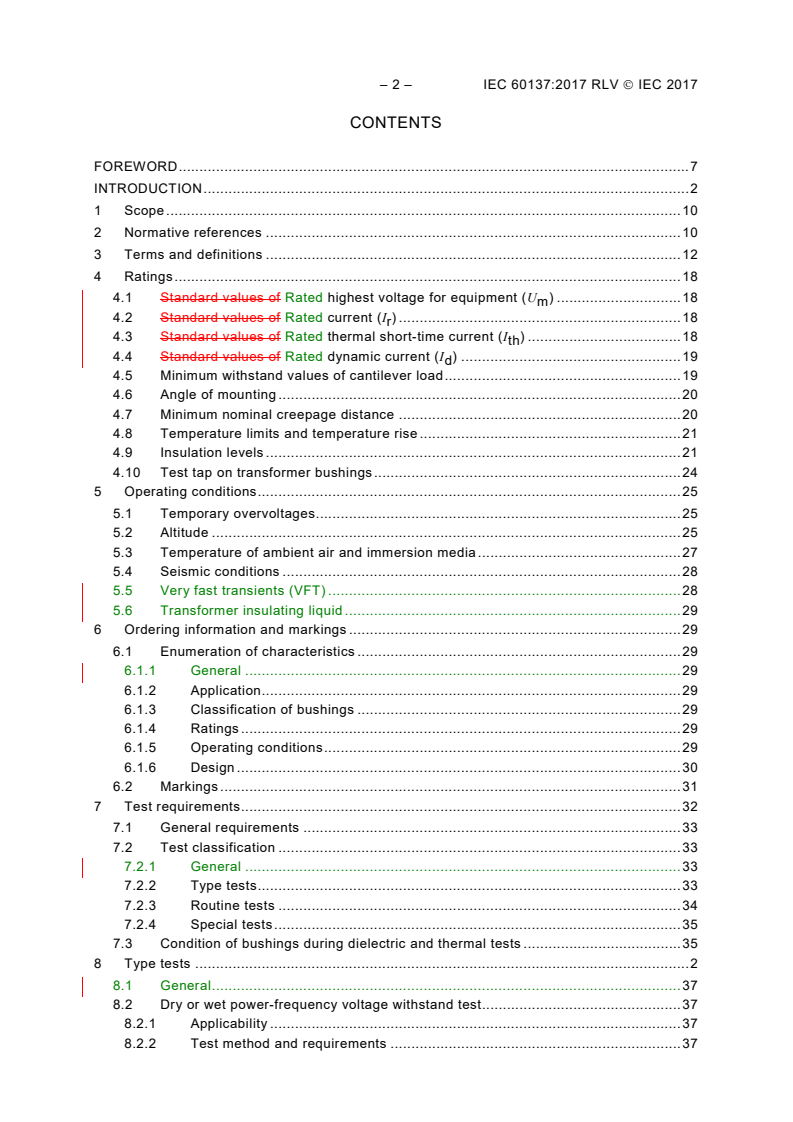
– 2 – IEC 60137:2017 RLV IEC 2017
CONTENTS
FOREWORD . 7
INTRODUCTION . 2
1 Scope . 10
2 Normative references . 10
3 Terms and definitions . 12
4 Ratings . 18
4.1 Standard values of Rated highest voltage for equipment (U ) . 18
m
4.2 Standard values of Rated current (I ) . 18
r
4.3 Standard values of Rated thermal short-time current (I ) . 18
th
4.4 Standard values of Rated dynamic current (I ) . 19
d
4.5 Minimum withstand values of cantilever load . 19
4.6 Angle of mounting . 20
4.7 Minimum nominal creepage distance . 20
4.8 Temperature limits and temperature rise . 21
4.9 Insulation levels . 21
4.10 Test tap on transformer bushings . 24
5 Operating conditions . 25
5.1 Temporary overvoltages. 25
5.2 Altitude . 25
5.3 Temperature of ambient air and immersion media . 27
5.4 Seismic conditions . 28
5.5 Very fast transients (VFT) . 28
5.6 Transformer insulating liquid . 29
6 Ordering information and markings . 29
6.1 Enumeration of characteristics . 29
6.1.1 General . 29
6.1.2 Application . 29
6.1.3 Classification of bushings . 29
6.1.4 Ratings . 29
6.1.5 Operating conditions . 29
6.1.6 Design . 30
6.2 Markings . 31
7 Test requirements . 32
7.1 General requirements . 33
7.2 Test classification . 33
7.2.1 General . 33
7.2.2 Type tests . 33
7.2.3 Routine tests . 34
7.2.4 Special tests . 35
7.3 Condition of bushings during dielectric and thermal tests . 35
8 Type tests . 2
8.1 General . 37
8.2 Dry or wet power-frequency voltage withstand test . 37
8.2.1 Applicability . 37
8.2.2 Test method and requirements . 37
8.2.3 Acceptance . 37
8.3 Long duration power-frequency voltage withstand test (ACLD) . 37
8.3.1 Applicability . 37
8.3.2 Test method and requirements . 37
8.3.3 Acceptance . 38
8.4 Dry lightning impulse voltage withstand test (BIL) . 38
8.4.1 Applicability . 38
8.4.2 Test method and requirements . 38
8.4.3 Acceptance . 39
8.5 Dry or wet switching impulse voltage withstand test (SIL) . 39
8.5.1 Applicability . 39
8.5.2 Test method and requirements . 39
8.5.3 Acceptance . 40
8.6 Thermal stability test . 41
8.6.1 Applicability . 41
8.6.2 Test method and requirements . 41
8.6.3 Acceptance . 41
8.7 Electromagnetic compatibility tests (EMC) . 42
8.7.1 Emission test . 42
8.7.2 Immunity test . 43
8.8 Temperature rise test . 43
8.8.1 Applicability . 43
8.8.2 Test method and requirements . 43
8.8.3 Acceptance . 44
8.9 Verification of thermal short-time current withstand . 44
8.9.1 Applicability . 44
8.9.2 Verification method and requirements . 44
8.9.3 Acceptance . 45
8.10 Cantilever load withstand test . 46
8.10.1 Applicability . 46
8.10.2 Test method and requirements . 46
8.10.3 Acceptance . 46
8.11 Tightness test on liquid-filled, compound-filled and liquid-insulated bushings . 47
8.11.1 Applicability . 47
8.11.2 Test method and requirements . 47
8.11.3 Acceptance . 47
8.12 Internal pressure test on gas-filled, gas-insulated and gas-impregnated
bushings . 47
8.12.1 Applicability . 47
8.12.2 Test method and requirements . 47
8.12.3 Acceptance . 47
8.13 External pressure test on partly or completely gas-immersed bushings . 47
8.13.1 Applicability . 47
8.13.2 Test method and requirements . 48
8.13.3 Acceptance . 48
8.14 Verification of dimensions . 48
8.14.1 Applicability . 48
8.14.2 Acceptance . 48
9 Routine tests . 48
– 4 – IEC 60137:2017 RLV IEC 2017
9.1 General . 48
9.2 Measurement of dielectric dissipation factor (tan δ) and capacitance at
ambient temperature . 48
9.2.1 Applicability . 48
9.2.2 Test method and requirements . 48
9.2.3 Acceptance . 49
9.3 Dry lightning impulse voltage withstand test (BIL) . 49
9.3.1 Applicability . 49
9.3.2 Test method and requirements . 49
9.3.3 Acceptance . 50
9.4 Dry power-frequency voltage withstand test . 50
9.4.1 Applicability . 50
9.4.2 Test method and requirements . 50
9.4.3 Acceptance . 50
9.5 Measurement of partial discharge quantity . 50
9.5.1 Applicability . 50
9.5.2 Test method and requirements . 50
9.5.3 Acceptance . 51
9.6 Tests of tap insulation . 52
9.6.1 Applicability and test requirements . 52
9.6.2 Acceptance . 52
9.7 Internal pressure test on gas-filled, gas-insulated and gas-impregnated
bushings . 52
9.7.1 Applicability . 52
9.7.2 Test method and requirements . 52
9.7.3 Acceptance . 52
9.8 Tightness test on liquid-filled, compound-filled and liquid-insulated bushings . 52
9.8.1 Applicability . 52
9.8.2 Test method and requirements . 52
9.8.3 Acceptance . 53
9.9 Tightness test on gas-filled, gas-insulated and gas-impregnated bushings . 53
9.9.1 Applicability . 53
9.9.2 Test method and requirements . 53
9.9.3 Acceptance . 53
9.10 Tightness test at the flange or other fixing device . 53
9.10.1 Applicability . 53
9.10.2 Test method and requirements . 54
9.10.3 Acceptance . 54
9.11 Visual inspection and dimensional check . 54
9.11.1 Applicability . 54
9.11.2 Acceptance . 54
10 Requirements and tests for non-capacitance graded bushings of rated highest
voltages for equipment equal to or less than up to and including 52 kV made of
ceramic, glass or inorganic materials, resin or combined insulation . 55
10.1 General . 55
10.2 Temperature requirements . 55
10.3 Level of immersion medium. 55
10.4 Markings . 55
10.5 Test requirements . 55
10.5.1 General . 55
10.5.2 Type tests . 55
10.5.3 Routine tests . 56
11 Recommendations for transport, storage, erection, operation and maintenance . 56
11.1 General . 56
11.2 Conditions during transport, storage and installation . 57
11.3 Installation . 57
11.4 Unpacking and lifting . 57
11.5 Assembly . 57
11.5.1 General . 57
11.5.2 Mounting . 57
11.5.3 Connections . 58
11.5.4 Final installation inspection . 58
11.6 Operation . 58
11.7 Maintenance . 59
11.7.1 General . 59
11.7.2 Recommendation for the manufacturer . 59
11.7.3 Recommendations for the user . 59
11.7.4 Failure report . 60
12 Safety . 61
12.1 General . 61
12.2 Electrical aspects . 61
12.3 Mechanical aspects . 61
12.4 Thermal aspects . 61
13 Environmental aspects . 61
Annex A (informative) Determination of the hottest spot in bushings with conductors
embedded in the insulation material . 63
Bibliography . 64
Figure 1 – Altitude correction factor .
Figure 1 – Factor m on the co-ordination switching impulse withstand voltage . 26
Figure 2 – Marking plate for bushings for rated highest voltage for equipment (U )
m
greater than 100 kV . 32
Figure 3 – Marking plate for bushings for rated highest voltage for equipment (U )
m
equal to or less than 100 kV, except for bushings for which Figure 4 is applicable . 32
Figure 4 – Marking plate for bushings for rated highest voltage for equipment (U )
m
equal to or less than 52 kV made of ceramic, glass or inorganic materials, resin or
combined insulation (see 10.3) . 32
Figure 5 – Voltage profile for long duration test (ACLD) . 38
Table 1 – Minimum values of cantilever withstand load (see 4.5 and 8.10) . 20
Table 2 – Maximum values of temperature and temperature rise above ambient air
(see 4.8) . 22
Table 3 – Insulation levels for highest voltage for equipment (U ) (see 4.9, 8.2, 8.4,
m
8.5, 9.3 and 9.4) . 23
Table 4 – Temperature of ambient air and immersion media . 28
Table 5 – Applicability of type tests (see 7.2.2, excluding bushings according to
Clause 10) . 34
– 6 – IEC 60137:2017 RLV IEC 2017
Table 6 – Applicability of routine tests (see 7.2.3, excluding bushings according to
Clause 10) . 35
Table 7 – Correction of test voltages (see 7.3) . 36
Table 8 – Maximum values of tan δ and tan δ increase (see 9.2) . 49
Table 9 – Maximum values of partial discharge quantity (see 8.3 and 9.5) . 51
Table 10 – Applicability of type tests for bushings according to Clause 10 (see 10.5.1). 56
Table 11 – Applicability of routine tests for bushings according to Clause 10
(see 10.5.3) . 56
INTERNATIONAL ELECTROTECHNICAL COMMISSION
____________
INSULATED BUSHINGS FOR ALTERNATING
VOLTAGES ABOVE 1 000 V
FOREWORD
1) The International Electrotechnical Commission (IEC) is a worldwide organization for standardization comprising
all national electrotechnical committees (IEC National Committees). The object of IEC is to promote
international co-operation on all questions concerning standardization in the electrical and electronic fields. To
this end and in addition to other activities, IEC publishes International Standards, Technical Specifications,
Technical Reports, Publicly Available Specifications (PAS) and Guides (hereafter referred to as “IEC
Publication(s)”). Their preparation is entrusted to technical committees; any IEC National Committee interested
in the subject dealt with may participate in this preparatory work. International, governmental and non-
governmental organizations liaising with the IEC also participate in this preparation. IEC collaborates closely
with the International Organization for Standardization (ISO) in accordance with conditions determined by
agreement between the two organizations.
2) The formal decisions or agreements of IEC on technical matters express, as nearly as possible, an international
consensus of opinion on the relevant subjects since each technical committee has representation from all
interested IEC National Committees.
3) IEC Publications have the form of recommendations for international use and are accepted by IEC National
Committees in that sense. While all reasonable efforts are made to ensure that the technical content of IEC
Publications is accurate, IEC cannot be held responsible for the way in which they are used or for any
misinterpretation by any end user.
4) In order to promote international uniformity, IEC National Committees undertake to apply IEC Publications
transparently to the maximum extent possible in their national and regional publications. Any divergence
between any IEC Publication and the corresponding national or regional publication shall be clearly indicated in
the latter.
5) IEC itself does not provide any attestation of conformity. Independent certification bodies provide conformity
assessment services and, in some areas, access to IEC marks of conformity. IEC is not responsible for any
services carried out by independent certification bodies.
6) All users should ensure that they have the latest edition of this publication.
7) No liability shall attach to IEC or its directors, employees, servants or agents including individual experts and
members of its technical committees and IEC National Committees for any personal injury, property damage or
other damage of any nature whatsoever, whether direct or indirect, or for costs (including legal fees) and
expenses arising out of the publication, use of, or reliance upon, this IEC Publication or any other IEC
Publications.
8) Attention is drawn to the Normative references cited in this publication. Use of the referenced publications is
indispensable for the correct application of this publication.
9) Attention is drawn to the possibility that some of the elements of this IEC Publication may be the subject of
patent rights. IEC shall not be held responsible for identifying any or all such patent rights.
This redline version of the official IEC Standard allows the user to identify the changes
made to the previous edition. A vertical bar appears in the margin wherever a change
has been made. Additions are in green text, deletions are in strikethrough red text.
– 8 – IEC 60137:2017 RLV © IEC 2017
International Standard IEC 60137 has been prepared by sub-committee 36A: Insulated
bushings, of IEC technical committee 36: Insulators.
This seventh edition cancels and replaces the sixth edition, published in 2008, and constitutes
a technical revision.
This edition includes the following significant technical changes with respect to the previous
edition:
• Resin-impregnated synthetic (RIS) bushings has been introduced.
• Bushings with U ≤ 1,1 kV, U = 1 100 kV and U = 1 200 kV have been introduced.
m m m
• Temperature rise testing has been included for liquid-insulated bushings according to
clause to 3.4.
• Introducing dry lightning impulse testing as a routine test for all transformer bushings with
U > 72,5 kV.
m
• The altitude correction procedure has been revised ( > 1 000 m).
• An explanation about Very Fast Transient (VFT) phenomenon and its impact on bushings
has been included.
The text of this International Standard is based on the following documents:
FDIS Report on voting
36A/187/FDIS 36A/189/RVD
Full information on the voting for the approval of this International Standard can be found in
the report on voting indicated in the above table.
This document has been drafted in accordance with the ISO/IEC Directives, Part 2.
The committee has decided that the contents of this document will remain unchanged until the
stability date indicated on the IEC website under "http://webstore.iec.ch" in the data related to
the specific document. At this date, the document will be
• reconfirmed,
• withdrawn,
• replaced by a revised edition, or
• amended.
The contents of the corrigendum of May 2018 have been included in this copy.
IMPORTANT – The “colour inside” logo on the cover page of this publication indicates
that it contains colours which are considered to be useful for the correct understanding
of its contents. Users should therefore print this publication using a colour printer.
INTRODUCTION
In the preparation of the current edition of this standard further consideration has been given
to the test requirements for power transformers as described in IEC 60076-3:2000 2013.
Extensions have been made to the requirements for lightning impulse type testing and an
additional test - long duration power-frequency withstand test - has been included.
In anticipation of changes in the creepage correction factors defined in IEC 60815 and
currently under review by TC 36, details of the correction method have been removed from
this standard.
– 10 – IEC 60137:2017 RLV IEC 2017
INSULATED BUSHINGS FOR ALTERNATING
VOLTAGES ABOVE 1 000 V
1 Scope
This International Standard specifies the characteristics and tests for insulated bushings.
This standard is applicable to bushings, as defined in Clause 3, intended for use in electrical
apparatus, machinery, transformers, switchgear and installations for three-phase alternating
current systems, having highest voltage for equipment above 1 000 V and power frequencies
of 15 Hz up to and including 60 Hz.
Subject to special agreement between purchaser and supplier, this standard may be applied,
in part or as a whole, to the following:
• bushings used in other than three-phase systems;
• bushings for high-voltage direct current systems;
• bushings for testing transformers;
• bushings for capacitors.
Special requirements and tests for transformer bushings in this standard apply also to reactor
bushings.
This standard is applicable to bushings made and sold separately. Bushings which are a part
of an apparatus and which cannot be tested according to this standard should be tested with
the apparatus of which they form part.
2 Normative references
The following documents are referred to in the text in such a way that some or all of their
content constitutes requirements of this document. For dated references, only the edition
cited applies. For undated references, the latest edition of the referenced document (including
any amendments) applies.
IEC 60038:1983, IEC standard voltages
Amendment 2 (1997)
IEC 60050-212:1990 2010, International Electrotechnical Vocabulary – Part 212: Electrical
insulating solids, liquids and gases
IEC 60059, IEC standard current ratings
IEC 60060-1, High-voltage test techniques – Part 1: General definitions and test requirements
IEC 60068-2-17:1994, Basic environmental testing procedures – Part 2-17: Tests – Test Q:
Sealing
IEC 60071-1, Insulation co-ordination – Part 1: Definitions, principles and rules
IEC 60076-5, Power transformers – Part 5: Ability to withstand short circuit
IEC 60076-7, Power transformers – Part 7: Loading guide for oil-immersed power
transformers
IEC 60216-2, Electrical insulating materials – Thermal endurance properties – Part 2:
Determination of thermal endurance properties of electrical insulating materials – Choice of
test criteria
IEC 60270, High-voltage test techniques – Partial discharge measurements
IEC 60296, Fluids for electrotechnical applications – Unused mineral insulating oils for
transformers and switchgear
IEC 60376, Specification of technical grade sulfur hexafluoride (SF ) for use in electrical
equipment
IEC 60422, Mineral insulating oils in electrical equipment – Supervision and maintenance
guidance
IEC 60480, Guidelines for the checking and treatment of sulfur hexafluoride (SF ) taken from
electrical equipment and specification for its re-use
IEC 60505, Evaluation and qualification of electrical insulation systems
IEC 60815, Guide for the selection of insulators in respect of polluted conditions
IEC TS 60815-1, Selection and dimensioning of high-voltage insulators intended for use in
polluted conditions – Part 1: Definitions, information and general principles
IEC TS 60815-2, Selection and dimensioning of high-voltage insulators intended for use in
polluted conditions – Part 2: Ceramic and glass insulators for a.c. systems
IEC TS 60815-3, Selection and dimensioning of high-voltage insulators intended for use in
polluted conditions – Part 3: Polymer insulators for a.c. systems
IEC 61099, Insulating liquids – Specifications for unused synthetic organic esters for electrical
purposes
IEC 61462, Composite hollow insulators – Hollow Pressurized and unpressurized insulators
for use in outdoor and indoor electrical equipment with rated voltage greater than 1 000 V –
Definitions, test methods, acceptance criteria and design recommendations
IEC TS 61463, Bushings – Seismic qualification
IEC 62155:2003, Hollow pressurized and unpressurized ceramic and glass insulators for use
in electrical equipment with rated voltages greater than 1 000 V
IEC 62217, Polymeric HV insulators for indoor and outdoor use with nominal voltage greater
than 1 000 V – General definitions, test methods and acceptance criteria
IEC 62271 (all parts), High-voltage switchgear and controlgear
IEC 62271-1, High-voltage switchgear and controlgear – Part 1: Common specifications
IEC Guide 109, Environmental aspects – Inclusion in electrotechnical product standards
– 12 – IEC 60137:2017 RLV IEC 2017
IEC Guide 111, Electrical high-voltage equipment in high-voltage substations – Common
recommendations for product standards
CISPR 16-1 (all parts), Specification for radio disturbance and immunity measuring apparatus
and methods
CISPR 18-2, Radio interference characteristics of overhead power lines and high-voltage
equipment – Parts 2: Methods of measurement and procedure for determining limits
3 Terms and definitions
For the purposes of this document, the following terms and definitions apply.
ISO and IEC maintain terminological databases for use in standardization at the following
addresses:
• IEC Electropedia: available at http://www.electropedia.org/
• ISO Online browsing platform: available at http://www.iso.org/obp
3.1
bushing
device that enables one or several conductors to pass through a partition such as a wall or a
tank, and insulates the conductors from it; the means of attachment (flange or fixing device) to
the partition forms part of the bushing
Note 1 to entry: The conductor may form an integral part of the bushing or be drawn into the central tube of the
bushing.
NOTE 2 The bushing may be of the types as described in 3.2 to 3.21.
[SOURCE: IEC 60050-471:2007, 471-02-01]
3.2
liquid-filled bushing
bushing in which the space between the inside surface of the insulating envelope and the
solid major insulation is filled with mineral oil or other insulating liquid
3.3
compound-filled bushing
bushing in which the space between the inside surface of the insulating envelope and the
solid major insulation is filled with an insulating compound
3.4
liquid-insulated bushing
bushing in which the major insulation consists of mineral oil or another insulating liquid,
enclosed by an insulating envelope
Note 1 to entry: These bushings are often of an open design which require proper processing after installation in
order to avoid trapped air and subsequent partial discharges during testing or in service.
3.5
gas-filled bushing
bushing in which the space between the inside surface of the insulating envelope and the
solid major insulation is filled with gas (other than ambient air) at atmospheric pressure or
higher
Note 1 to entry: This definition includes bushings which are intended to form an integral part of gas-insulated
equipment, the gas of the equipment being in communication with that of the bushing.
3.6
gas-insulated bushing
bushing in which the major insulation consists of gas (other than ambient air) at atmospheric
pressure or higher
Note 1 to entry: This definition includes bushings which are intended to form an integral part of gas-insulated
equipment, the gas of the equipment being in communication with that of the bushing.
Note 2 to entry: A bushing which contains solid insulating materials other than the envelope containing the gas
(e.g. support for conducting layers or insulating cylinder), is a combined insulation bushing (see 3.14).
Note 3 to entry: A bushing in which the desired voltage grading is obtained by an arrangement of conducting or
semi-conducting layers incorporated in an insulating material (e.g. plastic film) is referred to as a gas insulated
condenser capacitance graded bushing.
3.7
gas-impregnated bushing
bushing in which the major insulation consists of a core wound from paper or plastic film (GIF)
and subsequently treated and impregnated with gas (other than ambient air) at atmospheric
pressure or higher
Note 1 to entry: the core is contained in an insulating envelope. The space between the core and the insulating
envelope being filled with the same gas as used for the impregnation.
3.8
oil-impregnated paper bushing
OIP
bushing in which the major insulation consists of a core wound from paper and subsequently
treated and impregnated with an insulating liquid, generally transformer mineral oil
Note 1 to entry: The core is contained in an insulating envelope, the space between the core and the insulating
envelope being filled with the same insulating liquid as that used for impregnation.
3.9
resin-bonded paper bushing
RBP
bushing in which the major insulation consists of a core wound from resin-coated paper
Note 1 to entry: During the winding process, each paper layer is bonded to the previous layer by its resin coating
and the bonding achieved by curing the resin.
Note 2 to entry: A resin-bonded paper bushing can be provided with an insulating envelope, in which case the
intervening space can be filled with an insulating liquid or another insulating medium.
3.10
resin-impregnated paper bushing
RIP
bushing in which the major insulation consists of a core wound from untreated paper and
subsequently impregnated with a curable resin
Note 1 to entry: A resin-impregnated paper bushing can be provided with an insulating envelope, in which case
the intervening space can be filled with an insulating liquid or another insulating medium.
3.11
resin-impregnated synthetics bushing
RIS
bushing in which the major insulation consists of a core wound from synthetics subsequently
impregnated with a curable resin
Note 1 to entry: A resin-impregnated synthetics bushing can be provided with an insulating envelope, in which
case the intervening space can be filled with an insulating liquid or another insulating medium.
Note 2 to entry: If not otherwise stated by the manufacturer, bushings in accordance with 3.11 shall be
considered as RIP bushings according 3.10.
– 14 – IEC 60137:2017 RLV IEC 2017
3.12
ceramic, glass or analogous inorganic material bushing
bushing in which the major insulation consists of a ceramic, glass or analogous inorganic
material
3.13
cast or moulded resin-insulated bushing
bushing in which the major insulation consists of a cast or moulded organic material with or
without an inorganic filler
3.14
combined insulation bushing
bushing in which the major insulation consists of a combination of at least two different
insulating materials
3.15
capacitance graded bushing
bushing, in which a desired voltage grading is obtained by an arrangement of conducting or
semiconducting layers incorporated into the insulating material
[SOURCE: IEC 60050-471:2007, 471-02-03]
3.16
indoor bushing
bushing, both ends of which are intended to be in ambient air at atmospheric pressure, but
not exposed to outdoor atmospheric conditions
[SOURCE: IEC 60050-471:2007, 471-02-05]
3.17
outdoor bushing
bushing, both ends o
...
IEC 60137 ®
Edition 7.0 2017-06
INTERNATIONAL
STANDARD
NORME
INTERNATIONALE
Insulated bushings for alternating voltages above 1 000 V
Traversées isolées pour tensions alternatives supérieures à 1 000 V
All rights reserved. Unless otherwise specified, no part of this publication may be reproduced or utilized in any form
or by any means, electronic or mechanical, including photocopying and microfilm, without permission in writing from
either IEC or IEC's member National Committee in the country of the requester. If you have any questions about IEC
copyright or have an enquiry about obtaining additional rights to this publication, please contact the address below or
your local IEC member National Committee for further information.
Droits de reproduction réservés. Sauf indication contraire, aucune partie de cette publication ne peut être reproduite
ni utilisée sous quelque forme que ce soit et par aucun procédé, électronique ou mécanique, y compris la photocopie
et les microfilms, sans l'accord écrit de l'IEC ou du Comité national de l'IEC du pays du demandeur. Si vous avez des
questions sur le copyright de l'IEC ou si vous désirez obtenir des droits supplémentaires sur cette publication, utilisez
les coordonnées ci-après ou contactez le Comité national de l'IEC de votre pays de résidence.
IEC Central Office Tel.: +41 22 919 02 11
3, rue de Varembé Fax: +41 22 919 03 00
CH-1211 Geneva 20 info@iec.ch
Switzerland www.iec.ch
About the IEC
The International Electrotechnical Commission (IEC) is the leading global organization that prepares and publishes
International Standards for all electrical, electronic and related technologies.
About IEC publications
The technical content of IEC publications is kept under constant review by the IEC. Please make sure that you have the
latest edition, a corrigenda or an amendment might have been published.
IEC Catalogue - webstore.iec.ch/catalogue Electropedia - www.electropedia.org
The stand-alone application for consulting the entire The world's leading online dictionary of electronic and
bibliographical information on IEC International Standards, electrical terms containing 20 000 terms and definitions in
Technical Specifications, Technical Reports and other English and French, with equivalent terms in 16 additional
documents. Available for PC, Mac OS, Android Tablets and languages. Also known as the International Electrotechnical
iPad. Vocabulary (IEV) online.
IEC publications search - www.iec.ch/searchpub IEC Glossary - std.iec.ch/glossary
The advanced search enables to find IEC publications by a 65 000 electrotechnical terminology entries in English and
variety of criteria (reference number, text, technical French extracted from the Terms and Definitions clause of
committee,…). It also gives information on projects, replaced IEC publications issued since 2002. Some entries have been
and withdrawn publications. collected from earlier publications of IEC TC 37, 77, 86 and
CISPR.
IEC Just Published - webstore.iec.ch/justpublished
Stay up to date on all new IEC publications. Just Published IEC Customer Service Centre - webstore.iec.ch/csc
details all new publications released. Available online and If you wish to give us your feedback on this publication or
also once a month by email. need further assistance, please contact the Customer Service
Centre: csc@iec.ch.
A propos de l'IEC
La Commission Electrotechnique Internationale (IEC) est la première organisation mondiale qui élabore et publie des
Normes internationales pour tout ce qui a trait à l'électricité, à l'électronique et aux technologies apparentées.
A propos des publications IEC
Le contenu technique des publications IEC est constamment revu. Veuillez vous assurer que vous possédez l’édition la
plus récente, un corrigendum ou amendement peut avoir été publié.
Catalogue IEC - webstore.iec.ch/catalogue Electropedia - www.electropedia.org
Application autonome pour consulter tous les renseignements
Le premier dictionnaire en ligne de termes électroniques et
bibliographiques sur les Normes internationales,
électriques. Il contient 20 000 termes et définitions en anglais
Spécifications techniques, Rapports techniques et autres
et en français, ainsi que les termes équivalents dans 16
documents de l'IEC. Disponible pour PC, Mac OS, tablettes
langues additionnelles. Egalement appelé Vocabulaire
Android et iPad.
Electrotechnique International (IEV) en ligne.
Recherche de publications IEC - www.iec.ch/searchpub
Glossaire IEC - std.iec.ch/glossary
65 000 entrées terminologiques électrotechniques, en anglais
La recherche avancée permet de trouver des publications IEC
en utilisant différents critères (numéro de référence, texte, et en français, extraites des articles Termes et Définitions des
comité d’études,…). Elle donne aussi des informations sur les publications IEC parues depuis 2002. Plus certaines entrées
projets et les publications remplacées ou retirées. antérieures extraites des publications des CE 37, 77, 86 et
CISPR de l'IEC.
IEC Just Published - webstore.iec.ch/justpublished
Service Clients - webstore.iec.ch/csc
Restez informé sur les nouvelles publications IEC. Just
Published détaille les nouvelles publications parues. Si vous désirez nous donner des commentaires sur cette
Disponible en ligne et aussi une fois par mois par email. publication ou si vous avez des questions contactez-nous:
csc@iec.ch.
IEC 60137 ®
Edition 7.0 2017-06
INTERNATIONAL
STANDARD
NORME
INTERNATIONALE
Insulated bushings for alternating voltages above 1 000 V
Traversées isolées pour tensions alternatives supérieures à 1 000 V
INTERNATIONAL
ELECTROTECHNICAL
COMMISSION
COMMISSION
ELECTROTECHNIQUE
INTERNATIONALE
ICS 29.080.20 ISBN 978-2-8322-4417-3
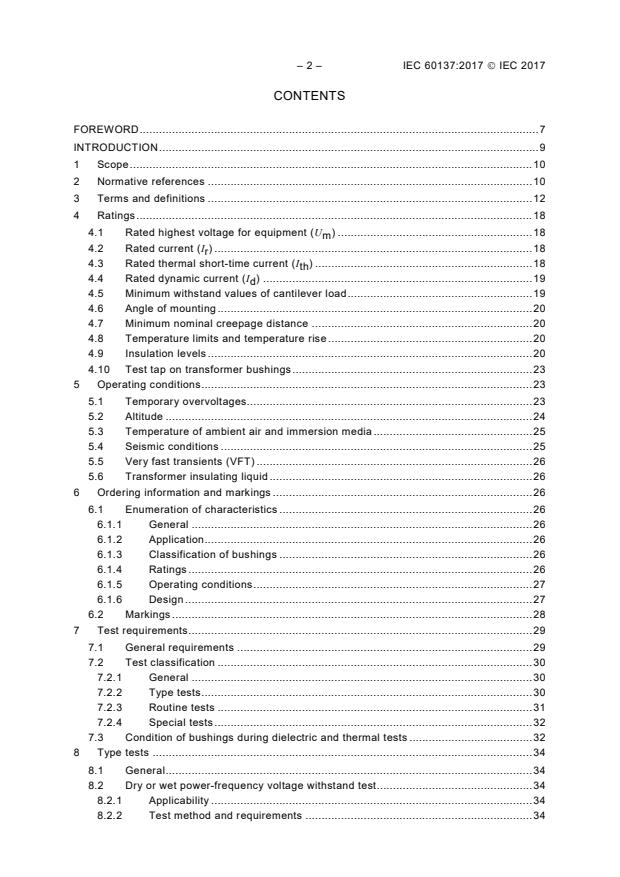
– 2 – IEC 60137:2017 IEC 2017
CONTENTS
FOREWORD . 7
INTRODUCTION . 9
1 Scope . 10
2 Normative references . 10
3 Terms and definitions . 12
4 Ratings . 18
4.1 Rated highest voltage for equipment (U ) . 18
m
4.2 Rated current (I ) . 18
r
4.3 Rated thermal short-time current (I ) . 18
th
4.4 Rated dynamic current (I ) . 19
d
4.5 Minimum withstand values of cantilever load . 19
4.6 Angle of mounting . 20
4.7 Minimum nominal creepage distance . 20
4.8 Temperature limits and temperature rise . 20
4.9 Insulation levels . 20
4.10 Test tap on transformer bushings . 23
5 Operating conditions . 23
5.1 Temporary overvoltages. 23
5.2 Altitude . 24
5.3 Temperature of ambient air and immersion media . 25
5.4 Seismic conditions . 25
5.5 Very fast transients (VFT) . 26
5.6 Transformer insulating liquid . 26
6 Ordering information and markings . 26
6.1 Enumeration of characteristics . 26
6.1.1 General . 26
6.1.2 Application . 26
6.1.3 Classification of bushings . 26
6.1.4 Ratings . 26
6.1.5 Operating conditions . 27
6.1.6 Design . 27
6.2 Markings . 28
7 Test requirements . 29
7.1 General requirements . 29
7.2 Test classification . 30
7.2.1 General . 30
7.2.2 Type tests . 30
7.2.3 Routine tests . 31
7.2.4 Special tests . 32
7.3 Condition of bushings during dielectric and thermal tests . 32
8 Type tests . 34
8.1 General . 34
8.2 Dry or wet power-frequency voltage withstand test . 34
8.2.1 Applicability . 34
8.2.2 Test method and requirements . 34
8.2.3 Acceptance . 34
8.3 Long duration power-frequency voltage withstand test (ACLD) . 34
8.3.1 Applicability . 34
8.3.2 Test method and requirements . 34
8.3.3 Acceptance . 35
8.4 Dry lightning impulse voltage withstand test . 35
8.4.1 Applicability . 35
8.4.2 Test method and requirements . 35
8.4.3 Acceptance . 36
8.5 Dry or wet switching impulse voltage withstand test . 36
8.5.1 Applicability . 36
8.5.2 Test method and requirements . 36
8.5.3 Acceptance . 37
8.6 Thermal stability test . 37
8.6.1 Applicability . 37
8.6.2 Test method and requirements . 38
8.6.3 Acceptance . 38
8.7 Electromagnetic compatibility tests (EMC) . 38
8.7.1 Emission test . 38
8.7.2 Immunity test . 40
8.8 Temperature rise test . 40
8.8.1 Applicability . 40
8.8.2 Test method and requirements . 40
8.8.3 Acceptance . 41
8.9 Verification of thermal short-time current withstand . 41
8.9.1 Applicability . 41
8.9.2 Verification method and requirements . 41
8.9.3 Acceptance . 42
8.10 Cantilever load withstand test . 42
8.10.1 Applicability . 42
8.10.2 Test method and requirements . 42
8.10.3 Acceptance . 43
8.11 Tightness test on liquid-filled, compound-filled and liquid-insulated bushings . 43
8.11.1 Applicability . 43
8.11.2 Test method and requirements . 43
8.11.3 Acceptance . 44
8.12 Internal pressure test on gas-filled, gas-insulated and gas-impregnated
bushings . 44
8.12.1 Applicability . 44
8.12.2 Test method and requirements . 44
8.12.3 Acceptance . 44
8.13 External pressure test on partly or completely gas-immersed bushings . 44
8.13.1 Applicability . 44
8.13.2 Test method and requirements . 44
8.13.3 Acceptance . 44
8.14 Verification of dimensions . 44
8.14.1 Applicability . 44
8.14.2 Acceptance . 45
9 Routine tests . 45
– 4 – IEC 60137:2017 IEC 2017
9.1 General . 45
9.2 Measurement of dielectric dissipation factor (tan δ) and capacitance at
ambient temperature . 45
9.2.1 Applicability . 45
9.2.2 Test method and requirements . 45
9.2.3 Acceptance . 45
9.3 Dry lightning impulse voltage withstand test . 46
9.3.1 Applicability . 46
9.3.2 Test method and requirements . 46
9.3.3 Acceptance . 46
9.4 Dry power-frequency voltage withstand test . 46
9.4.1 Applicability . 46
9.4.2 Test method and requirements . 47
9.4.3 Acceptance . 47
9.5 Measurement of partial discharge quantity . 47
9.5.1 Applicability . 47
9.5.2 Test method and requirements . 47
9.5.3 Acceptance . 47
9.6 Tests of tap insulation . 48
9.6.1 Applicability and test requirements . 48
9.6.2 Acceptance . 48
9.7 Internal pressure test on gas-filled, gas-insulated and gas-impregnated
bushings . 49
9.7.1 Applicability . 49
9.7.2 Test method and requirements . 49
9.7.3 Acceptance . 49
9.8 Tightness test on liquid-filled, compound-filled and liquid-insulated bushings . 49
9.8.1 Applicability . 49
9.8.2 Test method and requirements . 49
9.8.3 Acceptance . 49
9.9 Tightness test on gas-filled, gas-insulated and gas-impregnated bushings . 49
9.9.1 Applicability . 49
9.9.2 Test method and requirements . 50
9.9.3 Acceptance . 50
9.10 Tightness test at the flange or other fixing device . 50
9.10.1 Applicability . 50
9.10.2 Test method and requirements . 50
9.10.3 Acceptance . 51
9.11 Visual inspection and dimensional check . 51
9.11.1 Applicability . 51
9.11.2 Acceptance . 51
10 Requirements and tests for non-capacitance graded bushings of rated highest
voltages for equipment up to and including 52 kV . 51
10.1 General . 51
10.2 Temperature requirements . 51
10.3 Level of immersion medium. 51
10.4 Markings . 51
10.5 Test requirements . 52
10.5.1 General . 52
10.5.2 Type tests . 52
10.5.3 Routine tests . 52
11 Recommendations for transport, storage, erection, operation and maintenance . 53
11.1 General . 53
11.2 Conditions during transport, storage and installation . 53
11.3 Installation . 53
11.4 Unpacking and lifting . 53
11.5 Assembly . 54
11.5.1 General . 54
11.5.2 Mounting . 54
11.5.3 Connections . 54
11.5.4 Final installation inspection . 54
11.6 Operation . 55
11.7 Maintenance . 55
11.7.1 General . 55
11.7.2 Recommendation for the manufacturer . 55
11.7.3 Recommendations for the user . 56
11.7.4 Failure report . 56
12 Safety . 57
12.1 General . 57
12.2 Electrical aspects . 57
12.3 Mechanical aspects . 57
12.4 Thermal aspects . 58
13 Environmental aspects . 58
Annex A (informative) Determination of the hottest spot in bushings with conductors
embedded in the insulation material . 59
Bibliography . 60
m on the co-ordination switching impulse withstand voltage . 24
Figure 1 – Factor
Figure 2 – Marking plate for bushings for rated highest voltage for equipment (U )
m
greater than 100 kV . 29
Figure 3 – Marking plate for bushings for rated highest voltage for equipment (U )
m
equal to or less than 100 kV, except for bushings for which Figure 4 is applicable . 29
Figure 4 – Marking plate for bushings for rated highest voltage for equipment (U )
m
equal to or less than 52 kV made of ceramic, glass or inorganic materials, resin or
combined insulation (see 10.3) . 29
Figure 5 – Voltage profile for long duration test . 35
Table 1 – Minimum values of cantilever withstand load (see 4.5 and 8.10) . 19
Table 2 – Maximum values of temperature and temperature rise above ambient air
(see 4.8) . 21
Table 3 – Insulation levels for highest voltage for equipment (U ) (see 4.9, 8.2, 8.4,
m
8.5, 9.3 and 9.4) . 22
Table 4 – Temperature of ambient air and immersion media . 25
Table 5 – Applicability of type tests (see 7.2.2, excluding bushings according to
Clause 10) . 31
Table 6 – Applicability of routine tests (see 7.2.3, excluding bushings according to
Clause 10) . 32
– 6 – IEC 60137:2017 IEC 2017
Table 7 – Correction of test voltages (see 7.3) . 33
Table 8 – Maximum values of tan δ and tan δ increase (see 9.2) . 46
Table 9 – Maximum values of partial discharge quantity (see 8.3 and 9.5) . 48
Table 10 – Applicability of type tests for bushings according to Clause 10 (see 10.5.1). 52
Table 11 – Applicability of routine tests for bushings according to Clause 10 (see
10.5.3) . 53
INTERNATIONAL ELECTROTECHNICAL COMMISSION
____________
INSULATED BUSHINGS FOR ALTERNATING
VOLTAGES ABOVE 1 000 V
FOREWORD
1) The International Electrotechnical Commission (IEC) is a worldwide organization for standardization comprising
all national electrotechnical committees (IEC National Committees). The object of IEC is to promote
international co-operation on all questions concerning standardization in the electrical and electronic fields. To
this end and in addition to other activities, IEC publishes International Standards, Technical Specifications,
Technical Reports, Publicly Available Specifications (PAS) and Guides (hereafter referred to as “IEC
Publication(s)”). Their preparation is entrusted to technical committees; any IEC National Committee interested
in the subject dealt with may participate in this preparatory work. International, governmental and non-
governmental organizations liaising with the IEC also participate in this preparation. IEC collaborates closely
with the International Organization for Standardization (ISO) in accordance with conditions determined by
agreement between the two organizations.
2) The formal decisions or agreements of IEC on technical matters express, as nearly as possible, an international
consensus of opinion on the relevant subjects since each technical committee has representation from all
interested IEC National Committees.
3) IEC Publications have the form of recommendations for international use and are accepted by IEC National
Committees in that sense. While all reasonable efforts are made to ensure that the technical content of IEC
Publications is accurate, IEC cannot be held responsible for the way in which they are used or for any
misinterpretation by any end user.
4) In order to promote international uniformity, IEC National Committees undertake to apply IEC Publications
transparently to the maximum extent possible in their national and regional publications. Any divergence
between any IEC Publication and the corresponding national or regional publication shall be clearly indicated in
the latter.
5) IEC itself does not provide any attestation of conformity. Independent certification bodies provide conformity
assessment services and, in some areas, access to IEC marks of conformity. IEC is not responsible for any
services carried out by independent certification bodies.
6) All users should ensure that they have the latest edition of this publication.
7) No liability shall attach to IEC or its directors, employees, servants or agents including individual experts and
members of its technical committees and IEC National Committees for any personal injury, property damage or
other damage of any nature whatsoever, whether direct or indirect, or for costs (including legal fees) and
expenses arising out of the publication, use of, or reliance upon, this IEC Publication or any other IEC
Publications.
8) Attention is drawn to the Normative references cited in this publication. Use of the referenced publications is
indispensable for the correct application of this publication.
9) Attention is drawn to the possibility that some of the elements of this IEC Publication may be the subject of
patent rights. IEC shall not be held responsible for identifying any or all such patent rights.
International Standard IEC 60137 has been prepared by sub-committee 36A: Insulated
bushings, of IEC technical committee 36: Insulators.
This seventh edition cancels and replaces the sixth edition, published in 2008, and constitutes
a technical revision.
This edition includes the following significant technical changes with respect to the previous
edition:
• Resin-impregnated synthetic (RIS) bushings has been introduced.
≤ 1,1 kV, U = 1 100 kV and U = 1 200 kV have been introduced.
• Bushings with U
m m m
• Temperature rise testing has been included for liquid-insulated bushings according to
clause to 3.4.
• Introducing dry lightning impulse testing as a routine test for all transformer bushings with
U > 72,5 kV.
m
• The altitude correction procedure has been revised ( > 1 000 m).
– 8 – IEC 60137:2017 © IEC 2017
• An explanation about Very Fast Transient (VFT) phenomenon and its impact on bushings
has been included.
The text of this International Standard is based on the following documents:
FDIS Report on voting
36A/187/FDIS 36A/189/RVD
Full information on the voting for the approval of this International Standard can be found in
the report on voting indicated in the above table.
This document has been drafted in accordance with the ISO/IEC Directives, Part 2.
The committee has decided that the contents of this document will remain unchanged until the
stability date indicated on the IEC website under "http://webstore.iec.ch" in the data related to
the specific document. At this date, the document will be
• reconfirmed,
• withdrawn,
• replaced by a revised edition, or
• amended.
The contents of the corrigendum of May 2018 have been included in this copy.
INTRODUCTION
In the preparation of the current edition of this standard further consideration has been given
to the test requirements for power transformers as described in IEC 60076-3:2013.
– 10 – IEC 60137:2017 IEC 2017
INSULATED BUSHINGS FOR ALTERNATING
VOLTAGES ABOVE 1 000 V
1 Scope
This International Standard specifies the characteristics and tests for insulated bushings.
This standard is applicable to bushings, as defined in Clause 3, intended for use in electrical
apparatus, machinery, transformers, switchgear and installations for three-phase alternating
current systems, having highest voltage for equipment above 1 000 V and power frequencies
of 15 Hz up to and including 60 Hz.
Subject to special agreement between purchaser and supplier, this standard may be applied,
in part or as a whole, to the following:
• bushings used in other than three-phase systems;
• bushings for high-voltage direct current systems;
• bushings for testing transformers;
• bushings for capacitors.
Special requirements and tests for transformer bushings in this standard apply also to reactor
bushings.
This standard is applicable to bushings made and sold separately. Bushings which are a part
of an apparatus and which cannot be tested according to this standard should be tested with
the apparatus of which they form part.
2 Normative references
The following documents are referred to in the text in such a way that some or all of their
content constitutes requirements of this document. For dated references, only the edition
cited applies. For undated references, the latest edition of the referenced document (including
any amendments) applies.
IEC 60038, IEC standard voltages
IEC 60050-212:2010, International Electrotechnical Vocabulary – Part 212: Electrical
insulating solids, liquids and gases
IEC 60059, IEC standard current ratings
IEC 60060-1, High-voltage test techniques – Part 1: General definitions and test requirements
IEC 60068-2-17:1994, Basic environmental testing procedures – Part 2-17: Tests – Test Q:
Sealing
IEC 60071-1, Insulation co-ordination – Part 1: Definitions, principles and rules
IEC 60076-5, Power transformers – Part 5: Ability to withstand short circuit
IEC 60076-7, Power transformers – Part 7: Loading guide for oil-immersed power
transformers
IEC 60216-2, Electrical insulating materials – Thermal endurance properties – Part 2:
Determination of thermal endurance properties of electrical insulating materials – Choice of
test criteria
IEC 60270, High-voltage test techniques – Partial discharge measurements
IEC 60296, Fluids for electrotechnical applications – Unused mineral insulating oils for
transformers and switchgear
IEC 60376, Specification of technical grade sulfur hexafluoride (SF ) for use in electrical
equipment
IEC 60422, Mineral insulating oils in electrical equipment – Supervision and maintenance
guidance
IEC 60480, Guidelines for the checking and treatment of sulfur hexafluoride (SF ) taken from
electrical equipment and specification for its re-use
IEC 60505, Evaluation and qualification of electrical insulation systems
IEC TS 60815-1, Selection and dimensioning of high-voltage insulators intended for use in
polluted conditions – Part 1: Definitions, information and general principles
IEC TS 60815-2, Selection and dimensioning of high-voltage insulators intended for use in
polluted conditions – Part 2: Ceramic and glass insulators for a.c. systems
IEC TS 60815-3, Selection and dimensioning of high-voltage insulators intended for use in
polluted conditions – Part 3: Polymer insulators for a.c. systems
IEC 61099, Insulating liquids – Specifications for unused synthetic organic esters for electrical
purposes
IEC 61462, Composite hollow insulators – Pressurized and unpressurized insulators for use in
electrical equipment with rated voltage greater than 1 000 V – Definitions, test methods,
acceptance criteria and design recommendations
IEC TS 61463, Bushings – Seismic qualification
IEC 62155:2003, Hollow pressurized and unpressurized ceramic and glass insulators for use
in electrical equipment with rated voltages greater than 1 000 V
IEC 62217, Polymeric HV insulators for indoor and outdoor use – General definitions, test
methods and acceptance criteria
IEC 62271-1, High-voltage switchgear and controlgear – Part 1: Common specifications
IEC Guide 109, Environmental aspects – Inclusion in electrotechnical product standards
CISPR 16-1 (all parts), Specification for radio disturbance and immunity measuring apparatus
and methods
CISPR 18-2, Radio interference characteristics of overhead power lines and high-voltage
equipment – Parts 2: Methods of measurement and procedure for determining limits
– 12 – IEC 60137:2017 IEC 2017
3 Terms and definitions
For the purposes of this document, the following terms and definitions apply.
ISO and IEC maintain terminological databases for use in standardization at the following
addresses:
• IEC Electropedia: available at http://www.electropedia.org/
• ISO Online browsing platform: available at http://www.iso.org/obp
3.1
bushing
device that enables one or several conductors to pass through a partition such as a wall or a
tank, and insulates the conductors from it; the means of attachment (flange or fixing device) to
the partition forms part of the bushing
Note 1 to entry: The conductor may form an integral part of the bushing or be drawn into the central tube of the
bushing.
[SOURCE: IEC 60050-471:2007, 471-02-01]
3.2
liquid-filled bushing
bushing in which the space between the inside surface of the insulating envelope and the
solid major insulation is filled with mineral oil or other insulating liquid
3.3
compound-filled bushing
bushing in which the space between the inside surface of the insulating envelope and the
solid major insulation is filled with an insulating compound
3.4
liquid-insulated bushing
bushing in which the major insulation consists of mineral oil or another insulating liquid,
enclosed by an insulating envelope
Note 1 to entry: These bushings are often of an open design which require proper processing after installation in
order to avoid trapped air and subsequent partial discharges during testing or in service.
3.5
gas-filled bushing
bushing in which the space between the inside surface of the insulating envelope and the
solid major insulation is filled with gas (other than ambient air) at atmospheric pressure or
higher
Note 1 to entry: This definition includes bushings which are intended to form an integral part of gas-insulated
equipment, the gas of the equipment being in communication with that of the bushing.
3.6
gas-insulated bushing
bushing in which the major insulation consists of gas (other than ambient air) at atmospheric
pressure or higher
Note 1 to entry: This definition includes bushings which are intended to form an integral part of gas-insulated
equipment, the gas of the equipment being in communication with that of the bushing.
Note 2 to entry: A bushing which contains solid insulating materials other than the envelope containing the gas
(e.g. support for conducting layers or insulating cylinder), is a combined insulation bushing (see 3.14).
Note 3 to entry: A bushing in which the desired voltage grading is obtained by an arrangement of conducting or
semi-conducting layers incorporated in an insulating material (e.g. plastic film) is referred to as a gas insulated
capacitance graded bushing.
3.7
gas-impregnated bushing
bushing in which the major insulation consists of a core wound from paper or plastic film (GIF)
and subsequently treated and impregnated with gas (other than ambient air) at atmospheric
pressure or higher
Note 1 to entry: the core is contained in an insulating envelope. The space between the core and the insulating
envelope being filled with the same gas as used for the impregnation.
3.8
oil-impregnated paper bushing
OIP
bushing in which the major insulation consists of a core wound from paper and subsequently
treated and impregnated with an insulating liquid, generally mineral oil
Note 1 to entry: The core is contained in an insulating envelope, the space between the core and the insulating
envelope being filled with the same insulating liquid as that used for impregnation.
3.9
resin-bonded paper bushing
RBP
bushing in which the major insulation consists of a core wound from resin-coated paper
Note 1 to entry: During the winding process, each paper layer is bonded to the previous layer by its resin coating
and the bonding achieved by curing the resin.
Note 2 to entry: A resin-bonded paper bushing can be provided with an insulating envelope, in which case the
intervening space can be filled with an insulating liquid or another insulating medium.
3.10
resin-impregnated paper bushing
RIP
bushing in which the major insulation consists of a core wound from untreated paper and
subsequently impregnated with a curable resin
Note 1 to entry: A resin-impregnated paper bushing can be provided with an insulating envelope, in which case
the intervening space can be filled with an insulating liquid or another insulating medium.
3.11
resin-impregnated synthetics bushing
RIS
bushing in which the major insulation consists of a core wound from synthetics subsequently
impregnated with a curable resin
N
...
記事タイトル:IEC 60137:2017 - 1000V以上の交流電圧用の絶縁ブッシング 記事内容:IEC 60137:2017は、以前の版と比較して技術内容のすべての変更点を示す国際規格とそのレッドラインバージョンを含むIEC 60137:2017 RLVとして利用できるようになりました。 IEC 60137:2017は、絶縁ブッシングの特性と試験に関するものです。この規格は、電気機器、機械、トランスフォーマ、スイッチギア、および3相交流システムの設備用途に適用されるブッシングに対して適用され、最高装置電圧が1000V以上、周波数が15Hzから60Hzまでの電圧システムに対して適用されます。購入者と供給者の特別な合意により、以下についても一部または全体として適用することができます。 - 3相システム以外で使用されるブッシング - 高電圧直流システム用のブッシング - 試験用トランスフォーマ用ブッシング - コンデンサ用ブッシング この規格のトランスフォーマブッシングに対する特別な要件と試験は、リアクターブッシングにも適用されます。 この規格は、別売りのブッシングに適用されます。ブッシングが装置の一部であり、この規格に従ってテストすることができない場合は、ブッシングを構成する装置と一緒にテストする必要があります。この版には、以下の重要な技術的変更が前版と比較して含まれています: - 樹脂浸透合成(RIS)ブッシングが導入されました。 - Um ≤ 1.1 kV、Um = 1100 kV、Um = 1200 kVのブッシングが導入されました。 - 液体絶縁ブッシングに対する温度上昇試験が、3.4節に基づいて追加されました。 - Um > 72.5 kVのトランスフォーマブッシングに対して乾式雷パルス試験を定期的な試験として追加します。 - 高度補正手順が改訂されました(1000m以上)。 - ブッシングへの非常に高速な変動(VFT)現象とその影響に関する説明が含まれています。 2018年5月の訂正内容もこのコピーに含まれています。
기사 제목: IEC 60137:2017 - 1000V 이상 교류 전압용 절연된 부싱 기사 내용: IEC 60137:2017은 이전 판과 비교하여 기술 내용의 변경을 모두 보여주는 국제 표준과 레드라인 버전인 IEC 60137:2017 RLV로 제공됩니다. IEC 60137:2017은 절연된 부싱의 특성과 시험에 대해 명시합니다. 이 표준은 1,000V 이상의 최고 전압과 15Hz에서 60Hz의 전력 주파수를 가진 3상 교류 시스템을 위한 전기 기구, 기계, 변압기, 스위치기어 및 설치에 사용되는 부싱에 적용됩니다. 구매자와 공급자 간의 특별한 합의에 따라 다음과 같은 경우에 이 표준을 일부 또는 전체적으로 적용할 수 있습니다: - 3상 시스템이 아닌 다른 시스템에서 사용되는 부싱 - 고전압 직류 시스템용 부싱 - 테스트 변압기용 부싱 - 커패시터용 부싱 이 표준의 트랜스포머 부싱에 대한 특별 요구사항과 시험은 리액터 부싱에도 적용됩니다. 이 표준은 개별적으로 제조 및 판매되는 부싱에 적용됩니다. 이 표준에 따라 시험할 수 없는 부싱은 해당 부분을 구성하는 장치와 함께 테스트되어야 합니다. 이 판에는 이전 판과 비교하여 다음과 같은 중요한 기술적 변경 사항이 포함되어 있습니다: - 수지 함침 합성(RIS) 부싱의 도입 - Um ≤ 1.1kV, Um = 1100kV 및 Um = 1200kV의 부싱 도입 - 액체 절연 부싱의 온도 상승 테스트 도입 (절점 3.4에 따라) - Um > 72.5kV의 모든 트랜스포머 부싱에 대한 건조 번개 임펄스 테스트 도입 - 고도 보정 절차 개정 (1,000m 이상) - 매우 빠른 이상 전류(VFT) 현상과 부싱에 미치는 영향에 대한 설명 포함 2018년 5월에 발표된 정정 표지의 내용이 이 판에 포함되어 있습니다.
The article discusses the availability of the IEC 60137:2017 standard, which is now available as IEC 60137:2017 RLV. This new version includes the International Standard as well as a Redline version that shows all changes to the technical content compared to the previous edition. IEC 60137:2017 specifies the characteristics and tests for insulated bushings used in electrical apparatus, machinery, transformers, switchgear, and installations for three-phase alternating current systems with voltages above 1,000 V and power frequencies of 15 Hz to 60 Hz. However, with special agreement, this standard can also be applied to bushings used in other systems, high-voltage direct current systems, testing transformers, and capacitors. This standard also includes special requirements and tests for transformer and reactor bushings. It is applicable to bushings that are sold separately, whereas bushings that are part of an apparatus should be tested with the apparatus itself. IEC 60137:2017 RLV introduces several significant technical changes, such as the introduction of resin-impregnated synthetic (RIS) bushings and bushings with different voltage ratings. It also includes temperature rise testing for liquid-insulated bushings, dry lightning impulse testing for transformer bushings with high voltages, revisions to the altitude correction procedure for locations above 1,000 m, and an explanation of the Very Fast Transient (VFT) phenomenon and its impact on bushings. The article notes that this edition also includes the contents of the May 2018 corrigendum.
기사 제목: IEC 60137:2017 - 1000V 이상 교류 전압용 절연 부싱 기사 내용: IEC 60137:2017은 이제 이전 판과 기술 콘텐츠의 모든 변경 사항을 보여주는 국제 표준과 레드라인 버전을 포함한 IEC 60137:2017 RLV로서 제공됩니다. IEC 60137:2017은 절연 부싱의 특성과 실험을 규정합니다. 이 표준은 설비, 기계, 변압기, 스위치기어 및 3상 교류 시스템의 설치를 위해 사용되는 부싱에 적용되며, 최고 전압이 1,000V 이상이고 주파수가 15Hz에서 60Hz인 전압 시스템에 적용됩니다. 구매자와 공급자 간의 특별한 합의에 따라 다음과 같은 부분 또는 전체로 적용될 수 있습니다: - 3상 시스템이 아닌 시스템에서 사용되는 부싱 - 고전압 직류 시스템용 부싱 - 변압기 테스트용 부싱 - 커패시터용 부싱 이 표준에 따른 트랜스포머 부싱에 대한 특별 요구사항과 실험은 리액터 부싱에도 적용됩니다. 이 표준은 별도로 생산 및 판매되는 부싱에 적용됩니다. 이 표준에 따라 테스트할 수 없는 설비의 일부로 포함된 부싱은 해당 설비와 함께 테스트되어야 합니다. 이 판에서는 다음과 같은 주요 기술적 변경 사항이 이전 판과 비교하여 포함되어 있습니다: - 수지 침투된 합성(RIS) 부싱이 도입되었습니다. - Um ≤ 1.1 kV, Um = 1100 kV 및 Um = 1200 kV의 부싱이 도입되었습니다. - 3.4항에 따른 액체 절연 부싱의 온도 상승 실험이 포함되었습니다. - Um > 72.5 kV의 모든 트랜스포머 부싱에 대한 건식 번개 임파스 실험을 일반적인 테스트로 도입합니다. - 고도 보정 절차가 개정되었습니다(1000m 이상). - 부싱에 대한 매우 빠른 변동(VFT) 현상 및 해당 영향에 대한 설명이 포함되어 있습니다. 2018년 5월 개정 내용도 이 복사본에 포함되어 있습니다.
記事のタイトル:IEC 60137:2017 - 1000V以上の交流電圧用絶縁ブッシング 記事内容:IEC 60137:2017は、以前の版との技術内容の変更をすべて示す国際規格とその赤線バージョンであるIEC 60137:2017 RLVが利用可能になっています。 IEC 60137:2017は、絶縁ブッシングの特性と試験を指定しています。この規格は、最高電圧1,000V以上で周波数15Hzから60Hzの3相交流システムの電気機器、機械、トランス、スイッチギア、および設備に使用されるブッシングに適用されます。 購入者と供給者の間で特別な合意に基づき、以下の場合にはこの規格を一部または全体として適用することができます。 - 3相システム以外のシステムで使用されるブッシング - 高電圧直流システム用のブッシング - 試験用トランスのブッシング - コンデンサ用のブッシング この規格のトランスフォーマーブッシングに対する特別な要件と試験は、リアクターブッシングにも適用されます。 この規格は、個別に製造および販売されるブッシングに適用されます。 この規格には、この前の版と比較して以下の重要な技術的変更が含まれています: - レジン浸透型合成(RIS)ブッシングの導入 - Um ≤ 1.1kV、Um = 1100kV、Um = 1200kVのブッシングの導入 - 液体絶縁ブッシングの温度上昇試験の導入(セクション3.4による) - Um > 72.5kVのトランスフォーマーブッシングに対する乾燥雷インパルス試験の導入 - 高度補正手順の改訂(1,000m以上) - 非常に高速な過渡現象(VFT)とブッシングへの影響に関する説明の追加 2018年5月の訂正通知の内容もこの複写に含まれています。
IEC 60137:2017 is a standard that specifies the characteristics and tests for insulated bushings used in electrical apparatus, machinery, transformers, switchgear, and installations for three-phase alternating current systems with voltages above 1,000 V and frequencies between 15 Hz and 60 Hz. This standard can also be applied to bushings used in other systems, high-voltage direct current systems, testing transformers, and capacitors, with special agreements. The standard includes technical changes such as the introduction of resin-impregnated synthetic bushings, new voltage categories, temperature rise testing for liquid-insulated bushings, dry lightning impulse testing for transformer bushings, revised altitude correction procedure, and an explanation of the Very Fast Transient phenomenon. The article also mentions that the copy of the standard includes the contents of a corrigendum from May 2018.
Questions, Comments and Discussion
Ask us and Technical Secretary will try to provide an answer. You can facilitate discussion about the standard in here.
Loading comments...