

IEC 61196-1-212:2021
(Main)Coaxial communication cables - Part 1-212: Environmental test methods - UV stability
General Information
- Abstract
IEC 61196-1-212:2021 describes three methods to determine the UV resistance of sheath materials for electric and optical fibre cables. These tests apply for outdoor and indoor cable applications according to the product standard. The samples of sheath are taken from the finished cables. Although this test method is written principally for communication cables, it can be used for energy cables if called up by the relevant product standard.
- Status
- Published
- Publication Date
- 07-Jul-2021
- Technical Committee
- SC 46A - Coaxial cables
- Drafting Committee
- WG 3 - TC 46/SC 46A/WG 3
- Current Stage
- PPUB - Publication issued
- Start Date
- 08-Jul-2021
- Completion Date
- 09-Aug-2021
Overview
IEC 61196-1-212:2021 specifies accelerated test methods to assess UV stability of sheath materials used in coaxial communication cables. It defines three alternative laboratory exposure methods (xenon arc, fluorescent UV, mercury vapour) to determine how sheath materials from finished cables resist outdoor and indoor ultraviolet (UV) radiation. Although written for communication cables, the standard can be applied to energy cables when referenced by the relevant product standard.
Key topics and technical requirements
- Scope and samples
- Tests apply to sheath samples taken from the finished cable (minimum sample length given in the standard).
- Methods are intended for both outdoor and indoor cable applications as called up by product standards.
- Not intended for products protected by ≥ 2.0 % carbon black per IEC 60708 (excessive time to failure).
- Three UV exposure methods
- Method A - Xenon arc source: simulates natural daylight/UV; apparatus typically uses a rotating specimen holder or fixed holder with adequate air circulation. Example parameter: irradiance control targeting ~43 W/m² at 340 nm (see ISO 4892-2).
- Method B - Fluorescent UV lamps: uses UV-A and UV-B lamp types to simulate different UV bands.
- Method C - Mercury vapour lamp: historically used for telecommunication cables; Annex shows example mercury vapour apparatus and a water-immersion cycle option has been added.
- Outdoor vs indoor testing
- For outdoor application, Methods A and B include periodic water exposure (spray/immersion). Method C can be adapted with water cycles; round-robin results suggest applicability to outdoor conditions.
- Measurements and evaluation
- Assess loss in mechanical properties, change in appearance, and change in colour after exposure.
- Test duration, defined loss thresholds, measurement methods and test-reporting requirements are specified to support repeatable evaluation.
Practical applications and users
- Cable manufacturers use the standard for product development, material selection, and quality control to ensure sheath durability in UV-exposed environments.
- Independent test laboratories implement the prescribed apparatus and measurement protocols for compliance testing and comparative assessments.
- Specifiers and procurement teams reference IEC 61196-1-212 in product standards, tenders and acceptance criteria for outdoor/indoor cable installations.
- Standards writers and R&D groups apply the methods to support new formulations, aging studies, and lifetime assessments.
Related standards (select)
- ISO 4892-1 / ISO 4892-2 (laboratory light sources and xenon-arc guidance)
- IEC 60708 (carbon black requirements)
- IEC 60811 series (test methods for non-metallic cable materials)
- EN 16472 (mercury vapour lamp photoageing)
Keywords: IEC 61196-1-212, UV stability, coaxial communication cables, sheath materials, UV resistance, xenon arc, fluorescent UV lamp, mercury vapour, accelerated aging, outdoor cable testing.
Get Certified
Connect with accredited certification bodies for this standard

ANCE
Mexican certification and testing association.

Intertek Slovenia
Intertek testing, inspection, and certification services in Slovenia.

LNE (Laboratoire National de Métrologie et d'Essais)
French national laboratory for metrology and testing.
Sponsored listings
Frequently Asked Questions
IEC 61196-1-212:2021 is a standard published by the International Electrotechnical Commission (IEC). Its full title is "Coaxial communication cables - Part 1-212: Environmental test methods - UV stability". This standard covers: IEC 61196-1-212:2021 describes three methods to determine the UV resistance of sheath materials for electric and optical fibre cables. These tests apply for outdoor and indoor cable applications according to the product standard. The samples of sheath are taken from the finished cables. Although this test method is written principally for communication cables, it can be used for energy cables if called up by the relevant product standard.
IEC 61196-1-212:2021 describes three methods to determine the UV resistance of sheath materials for electric and optical fibre cables. These tests apply for outdoor and indoor cable applications according to the product standard. The samples of sheath are taken from the finished cables. Although this test method is written principally for communication cables, it can be used for energy cables if called up by the relevant product standard.
IEC 61196-1-212:2021 is classified under the following ICS (International Classification for Standards) categories: 33.120.10 - Coaxial cables. Waveguides. The ICS classification helps identify the subject area and facilitates finding related standards.
IEC 61196-1-212:2021 is available in PDF format for immediate download after purchase. The document can be added to your cart and obtained through the secure checkout process. Digital delivery ensures instant access to the complete standard document.
Standards Content (Sample)
IEC 61196-1-212 ®
Edition 1.0 2021-07
INTERNATIONAL
STANDARD
colour
inside
Coaxial communication cables –
Part 1-212: Environmental test methods – UV stability
All rights reserved. Unless otherwise specified, no part of this publication may be reproduced or utilized in any form
or by any means, electronic or mechanical, including photocopying and microfilm, without permission in writing from
either IEC or IEC's member National Committee in the country of the requester. If you have any questions about IEC
copyright or have an enquiry about obtaining additional rights to this publication, please contact the address below or
your local IEC member National Committee for further information.
IEC Central Office Tel.: +41 22 919 02 11
3, rue de Varembé info@iec.ch
CH-1211 Geneva 20 www.iec.ch
Switzerland
About the IEC
The International Electrotechnical Commission (IEC) is the leading global organization that prepares and publishes
International Standards for all electrical, electronic and related technologies.
About IEC publications
The technical content of IEC publications is kept under constant review by the IEC. Please make sure that you have the
latest edition, a corrigendum or an amendment might have been published.
IEC publications search - webstore.iec.ch/advsearchform IEC online collection - oc.iec.ch
The advanced search enables to find IEC publications by a Discover our powerful search engine and read freely all the
variety of criteria (reference number, text, technical publications previews. With a subscription you will always
committee, …). It also gives information on projects, replaced have access to up to date content tailored to your needs.
and withdrawn publications.
Electropedia - www.electropedia.org
IEC Just Published - webstore.iec.ch/justpublished
The world's leading online dictionary on electrotechnology,
Stay up to date on all new IEC publications. Just Published
containing more than 22 000 terminological entries in English
details all new publications released. Available online and
and French, with equivalent terms in 18 additional languages.
once a month by email.
Also known as the International Electrotechnical Vocabulary
(IEV) online.
IEC Customer Service Centre - webstore.iec.ch/csc
If you wish to give us your feedback on this publication or
need further assistance, please contact the Customer Service
Centre: sales@iec.ch.
IEC 61196-1-212 ®
Edition 1.0 2021-07
INTERNATIONAL
STANDARD
colour
inside
Coaxial communication cables –
Part 1-212: Environmental test methods – UV stability
INTERNATIONAL
ELECTROTECHNICAL
COMMISSION
ICS 33.120.10 ISBN 978-2-8322-9984-5
– 2 – IEC 61196-1-212:2021 © IEC 2021
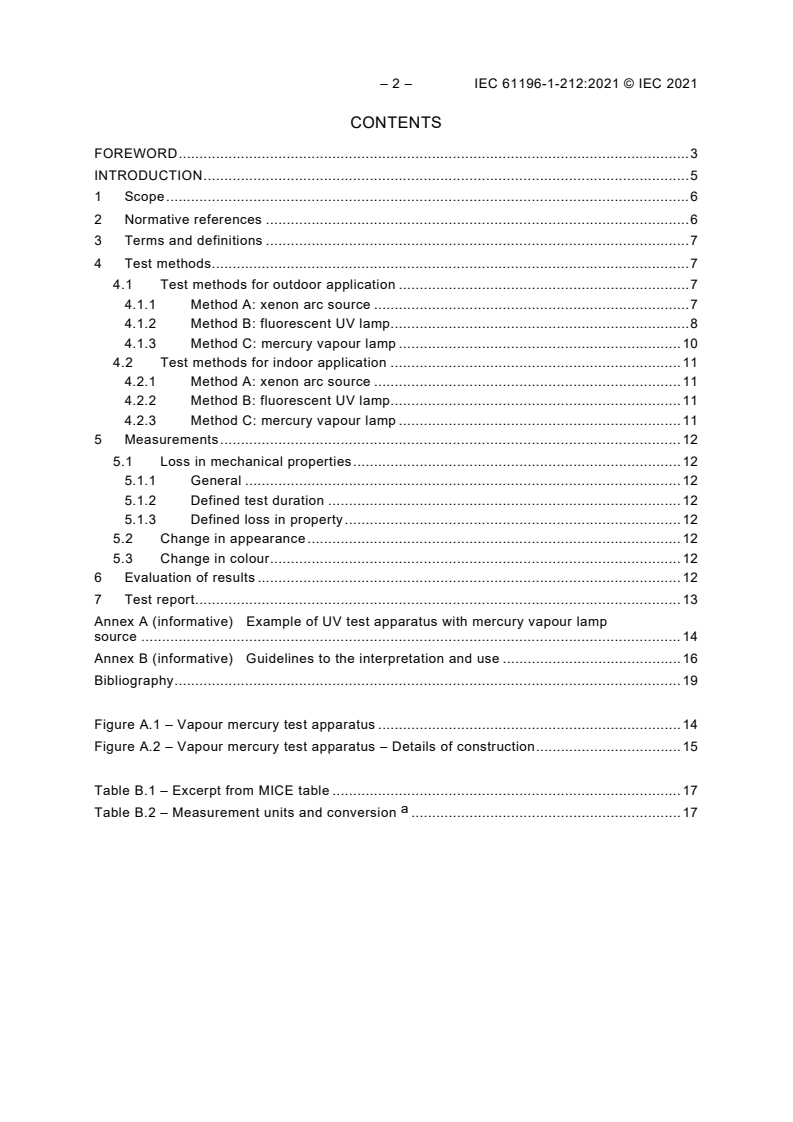
CONTENTS
FOREWORD . 3
INTRODUCTION . 5
1 Scope . 6
2 Normative references . 6
3 Terms and definitions . 7
4 Test methods . 7
4.1 Test methods for outdoor application . 7
4.1.1 Method A: xenon arc source . 7
4.1.2 Method B: fluorescent UV lamp. 8
4.1.3 Method C: mercury vapour lamp . 10
4.2 Test methods for indoor application . 11
4.2.1 Method A: xenon arc source . 11
4.2.2 Method B: fluorescent UV lamp. 11
4.2.3 Method C: mercury vapour lamp . 11
5 Measurements . 12
5.1 Loss in mechanical properties . 12
5.1.1 General . 12
5.1.2 Defined test duration . 12
5.1.3 Defined loss in property . 12
5.2 Change in appearance . 12
5.3 Change in colour . 12
6 Evaluation of results . 12
7 Test report . 13
Annex A (informative) Example of UV test apparatus with mercury vapour lamp
source . 14
Annex B (informative) Guidelines to the interpretation and use . 16
Bibliography . 19
Figure A.1 – Vapour mercury test apparatus . 14
Figure A.2 – Vapour mercury test apparatus – Details of construction . 15
Table B.1 – Excerpt from MICE table . 17
a
Table B.2 – Measurement units and conversion . 17
INTERNATIONAL ELECTROTECHNICAL COMMISSION
____________
COAXIAL COMMUNICATION CABLES –
Part 1-212: Environmental test methods – UV stability
FOREWORD
1) The International Electrotechnical Commission (IEC) is a worldwide organization for standardization comprising
all national electrotechnical committees (IEC National Committees). The object of IEC is to promote
international co-operation on all questions concerning standardization in the electrical and electronic fields. To
this end and in addition to other activities, IEC publishes International Standards, Technical Specifications,
Technical Reports, Publicly Available Specifications (PAS) and Guides (hereafter referred to as “IEC
Publication(s)”). Their preparation is entrusted to technical committees; any IEC National Committee interested
in the subject dealt with may participate in this preparatory work. International, governmental and non-
governmental organizations liaising with the IEC also participate in this preparation. IEC collaborates closely
with the International Organization for Standardization (ISO) in accordance with conditions determined by
agreement between the two organizations.
2) The formal decisions or agreements of IEC on technical matters express, as nearly as possible, an international
consensus of opinion on the relevant subjects since each technical committee has representation from all
interested IEC National Committees.
3) IEC Publications have the form of recommendations for international use and are accepted by IEC National
Committees in that sense. While all reasonable efforts are made to ensure that the technical content of IEC
Publications is accurate, IEC cannot be held responsible for the way in which they are used or for any
misinterpretation by any end user.
4) In order to promote international uniformity, IEC National Committees undertake to apply IEC Publications
transparently to the maximum extent possible in their national and regional publications. Any divergence
between any IEC Publication and the corresponding national or regional publication shall be clearly indicated in
the latter.
5) IEC itself does not provide any attestation of conformity. Independent certification bodies provide conformity
assessment services and, in some areas, access to IEC marks of conformity. IEC is not responsible for any
services carried out by independent certification bodies.
6) All users should ensure that they have the latest edition of this publication.
7) No liability shall attach to IEC or its directors, employees, servants or agents including individual experts and
members of its technical committees and IEC National Committees for any personal injury, property damage or
other damage of any nature whatsoever, whether direct or indirect, or for costs (including legal fees) and
expenses arising out of the publication, use of, or reliance upon, this IEC Publication or any other IEC
Publications.
8) Attention is drawn to the Normative references cited in this publication. Use of the referenced publications is
indispensable for the correct application of this publication.
9) Attention is drawn to the possibility that some of the elements of this IEC Publication may be the subject of
patent rights. IEC shall not be held responsible for identifying any or all such patent rights.
IEC 61196-1-212 has been prepared by subcommittee 46A: Coaxial cables, of IEC technical
committee 46: Cables, wires, waveguides, RF connectors, RF and microwave passive
components and accessories. It is an International Standard.
The text of this International Standard is based on the following documents:
Draft Report on voting
46A/1452/CDV 46A/1487/RVC
Full information on the voting for its approval can be found in the report on voting indicated in
the above table.
The language used for the development of this International Standard is English.
– 4 – IEC 61196-1-212:2021 © IEC 2021
This document was drafted in accordance with ISO/IEC Directives, Part 2, and developed in
accordance with ISO/IEC Directives, Part 1 and ISO/IEC Directives, IEC Supplement,
available at www.iec.ch/members_experts/refdocs. The main document types developed by
IEC are described in greater detail at www.iec.ch/standardsdev/publications.
A list of all parts in the IEC 61196 series, published under the general title Coaxial
communication cables, can be found on the IEC website.
The committee has decided that the contents of this document will remain unchanged until the
stability date indicated on the IEC website under webstore.iec.ch in the data related to the
specific document. At this date, the document will be
• reconfirmed,
• withdrawn,
• replaced by a revised edition, or
• amended.
IMPORTANT – The "colour inside" logo on the cover page of this document indicates
that it contains colours which are considered to be useful for the correct
understanding of its contents. Users should therefore print this document using a
colour printer.
INTRODUCTION
UV hazard assessment for synthetic compounds is possible using a number of UV sources.
For the purposes of this document, three alternative methods are given.
1) Method A uses a xenon arc source to simulate the UV effect on cable sheath. The effect is
measured by the variation of mechanical characteristics and/or change in colour after
exposure.
2) Method B uses a fluorescent lamp to simulate the UV effect on cable sheath. Two different
lamps may be used: type I (called UV-A lamps) and type II (called UV-B lamps). The effect
is measured, as for method A, by the variation of mechanical characteristics and/or
change in colour after exposure.
3) Method C uses a mercury vapour lamp to simulate the UV effect on cable sheath. As for
methods A and B, the effect is determined by the variation of mechanical characteristics
and/or change in colour after exposure. This test has been typically used for
telecommunication cables.
For outdoor cable application only, the test specimens are periodically subjected to water
attack, for methods A and B. A recent modification of method C now allows for a water
immersion cycle.
For method C, the round robin tests made without water (see Annex B) indicate the method
may be applicable to outdoor environments.
Other sources and determination methods are capable of detecting and analysing the UV
hazard for a cable sheath. Examples of such methods are metal halide lamps or sunshine
carbon arc lamps, in combination with proper filters in order to cut off most radiation having
wavelengths lower than 290 nm. Contracting parties may agree to use such other methods,
but such methods cannot claim conformity to this document. If used, it is recommended that
such methods have at least equivalent sensitivity and detection levels as those in this
document.
Informative Annex B gives guidelines for the use and interpretation of results.
NOTE It is useful to recall the introduction to ISO 4892-1:2016, which says, "The relative durability of materials in
actual-use exposures can be very different depending on the location of the exposure because of differences in UV
radiation, time of wetness, temperature, pollutants and other factors. Therefore, even if results from a specific
accelerated laboratory test are found to be useful for comparing the relative durability of materials exposed in a
particular outdoor location or in particular actual-use conditions, it cannot be assumed that they will be useful for
determining the relative durability of materials exposed in a different outdoor location or in different actual-use
conditions."
– 6 – IEC 61196-1-212:2021 © IEC 2021
COAXIAL COMMUNICATION CABLES –
Part 1-212: Environmental test methods – UV stability
1 Scope
This part of IEC 61196 describes three methods to determine the UV resistance of sheath
materials for electric and optical fibre cables. These tests apply for outdoor and indoor cable
applications according to the product standard. The samples of sheath are taken from the
finished cables.
Although this test method is written principally for communication cables, it can be used for
energy cables if called up by the relevant product standard.
Where a sheath is of cross-linked (thermosetting) material, it is recalled that the preparation
of moulded plaques is made before crosslinking.
Methods differ by the nature of the UV source.
Due to the excessive time to failure, the methods described are inappropriate to products
where UV resistance is conferred by ≥2,0 % carbon black content meeting the requirements
defined in IEC 60708.
2 Normative references
The following documents are referred to in the text in such a way that some or all of their
content constitutes requirements of this document. For dated references, only the edition
cited applies. For undated references, the latest edition of the referenced document (including
any amendments) applies.
IEC 60708, Low-frequency cables with polyolefin insulation and moisture barrier polyolefin
sheath
IEC 60811-202, Electric and optical fibre cables – Test methods for non-metallic materials –
Part 202: General tests – Measurement of thickness of non-metallic sheath
IEC 60811-501, Electric and optical fibre cables – Test methods for non-metallic materials –
Part 501: Mechanical tests – Tests for determining the mechanical properties of insulating and
sheathing compounds
ISO 4892-1:2016, Plastics – Methods of exposure to laboratory light sources – Part 1:
General guidance
ISO 4892-2, Plastics – Methods of exposure to laboratory light sources – Part 2: Xenon-arc
lamps
ISO 9370, Plastics – Instrumental determination of radiant exposure in weathering tests –
General guidance and basic test method
EN 16472, Plastics – Method for artificial accelerated photoageing using medium pressure
mercury vapour lamps
3 Terms and definitions
For the purposes of this document, the following terms and definitions apply.
ISO and IEC maintain terminological databases for use in standardization at the following
addresses:
• IEC Electropedia: available at http://www.electropedia.org/
• ISO Online browsing platform: available at http://www.iso.org/obp
3.1
median value
when several test results have been obtained and ordered in an increasing (or decreasing)
succession, middle value if the number of available values is odd, and mean of the two middle
values if the number is even
[SOURCE: IEC 60811-100:2012, 3.1]
4 Test methods
4.1 Test methods for outdoor application
4.1.1 Method A: xenon arc source
4.1.1.1 General
According to ISO 4892-1:2016, Clause C.2, the xenon arc lamp, when appropriately filtered,
produces radiations with a spectral power distribution that is a good simulation of average
daylight throughout the UV and visible region.
The exposure apparatus is typically constituted by a rotating specimen holder drum, which
rotates around the light source, as per ISO 4892-1:2016, Figure A.1.
Apparatus having a fixed specimen holder is also permitted. In this case, it is important that
air can circulate around the sample to allow a homogeneous repartition of temperature.
4.1.1.2 Apparatus
The testing apparatus is equipped with the following lamps and filters and is set with the
parameters prescribed below:
– a ray source consisting of a xenon arc lamp ("long arc" type) equipped with borosilicate
filters so that the typical irradiance should be 43 W/m (1 ± 15 %) with a spectrum
between 300 nm and 400 nm;
– a means to provide automatic control of temperature, humidity and cycles;
– a generator of deionised water with a conductivity not greater than 5 µS/cm (the pH should
be recorded); the water shall leave no observable stains or deposits and should therefore
contain less than 1 ppm of solids; the rate of flow should be sufficient to guarantee that all
the test specimens can be washed;
– a means to control the irradiance to produce (43,0 ± 0,2) W/m at 340 nm (if the apparatus
is not equipped with irradiance control, follow the device manufacturer's recommendations
to produce this irradiance).
More details are given in ISO 4892-2.
– 8 – IEC 61196-1-212:2021 © IEC 2021
4.1.1.3 Sample and test specimen preparation
A sample, at least 600 mm long, shall be taken of the finished cable or of the outer sheath
removed from the finished cable. It shall be used to prepare 12 test specimens. Test
specimens shall be prepared according to IEC 60811-202.
In case, for geometrical reasons, it is not possible to use the above samples (finished cable or
outer sheath), test specimens shall be cut from a finished cable, a moulded plaque prepared
from pieces of the cable sheath or a moulded plaque produced from granules of the same
material and colour of the cable sheath. The thickness of the test pieces shall be
(1,0 ± 0,1) mm.
4.1.1.4 Procedure
Six test specimens shall be suspended vertically so that the external surface is uniformly
exposed to the action of the actinic rays. During the test, the temperature indicated by the
black-panel or the black-standard thermometer shall remain in the range (60 ± 3) °C and the
relative humidity shall remain in the range of (50 ± 5) % (only in the dry period in the case of a
test for outdoor application). The rotating drum carrying the test specimens shall turn at a
speed of (1 ± 0,1) r/min. If a flat specimen plane is used, the minimum irradiance in any point
of the specimen exposure area shall be at least 90 % of maximum irradiance.
Test specimens are cycled through periods of UV exposure, followed by periods of no
radiation during which temperature changes occur.
The periods of each cycle, total time of 120 min, are the following:
– 102 min of dry UV exposure at a temperature of (60 ± 3) °C , followed by
– 18 min of deionised water exposure, without radiation, at a temperature of (50 ± 5) °C.
The overall duration of the test shall be as defined in the relevant product standard. In the
absence of such a definition, guidance is given in Annex B.
After the exposure, the exposed test specimens shall be removed from the equipment and
conditioned at ambient temperature for at least 16 h.
The six other test specimens shall be kept at ambient temperature and protected from any
light source during the UV treatment; they shall be tested at the same time as the exposed
test specimens.
4.1.2 Method B: fluorescent UV lamp
4.1.2.1 General
According to ISO 4892-3:2016 [6] , 4.1.1, there are different types of fluorescent UV lamps
that may be used as laboratory light sources:
– type I lamps (commonly called UV-A lamps), with the preferred option of the UV-A 340
lamp, having a spectral radiation that peaks at 340 nm;
– type II lamps (commonly called UV-B lamps), having a spectral radiation that peaks near
the 313 nm mercury line; these type II fluorescent UV lamps emit significant amount of
radiation below 300 nm, the nominal cut off wavelength for solar radiation, which may
result in ageing processes not completely equal to those occurring outdoors. The
method using UV-B lamps is however frequently used by agreement between the parties.
___________
1 Temperature indicated by the black-panel or the black-standard thermometer.
Numbers in square brackets refer to the Bibliography.
The exposure apparatus is typically constituted by a device where specimens are positioned
in a flat plane in front of an array of light sources, as per ISO 4892-1:2016, Figure A.2.
4.1.2.2 Apparatus
The testing apparatus is equipped as follows:
– a ray source consisting of type I or type II fluorescent UV lamps, having a typical
irradiance peak of at least 0,68 W/m at 340 nm for the UV-A 340 lamp, and at 313 nm for
the UV-B 313 lamp;
– an exposure chamber constructed from inert materi
...