

IEC TR 62131-4:2011
(Main)Environmental conditions - Vibration and shock of electrotechnical equipment - Part 4: Equipment transported in road vehicles
General Information
- Abstract
IEC/TR 62131-4:2011(E) reviews the available dynamic data relating to electrotechnical equipment transported by road vehicles. The intent is that from all the available data an environmental description will be generated and compared to that set out in IEC 60721. For each of the sources identified the quality of the data is reviewed and checked for self consistency. The process used to undertake this check of data quality and that used to intrinsically categorize the various data sources is set out in IEC/TR 62131-1.
- Status
- Published
- Publication Date
- 23-Feb-2011
- Technical Committee
- TC 104 - Environmental conditions, classification and methods of test
- Drafting Committee
- WG 15 - TC 104/WG 15
- Current Stage
- PPUB - Publication issued
- Start Date
- 24-Feb-2011
- Completion Date
- 15-Jun-2011
Overview
IEC TR 62131-4:2011 is a technical report that reviews available dynamic (vibration and shock) data for electrotechnical equipment transported in road vehicles. Its purpose is to generate an environmental description from measured road-transport data and compare that description to the classifications given in IEC 60721. The report evaluates multiple measurement sources, assesses data quality and consistency, identifies representative test severities, and issues recommendations for vibration and shock characterization of equipment subjected to road transport.
Key topics and technical coverage
- Data sources reviewed - SRETS road and test-track measurements; CEEES “round robin” 10-tonne truck tests; vehicle measurements by Hoppe & Gerock; Millbrook measurements on Land Rover, Ford Transit and Renault Magnum; plus supplementary and historical datasets.
- Data quality and categorization - Methodology for assessing measurement reliability and internal consistency (referencing categorization methods defined in IEC/TR 62131-1).
- Signal analyses and metrics - Power spectral density (PSD), shock response spectra (SRS), acceleration r.m.s., acceleration peak counts and amplitude probability distributions (APD). The report examines time histories, PSD envelopes, peak-hold spectra and shock occurrence statistics.
- Intra- and inter-source comparisons - Comparative analysis across vehicles, road categories and measurement campaigns to identify common transport vibration/shock signatures and outliers.
- Identified test severities & environmental description - Recommended severities and an environmental profile for equipment transported by road, intended to be mapped against IEC 60721 and IEC 60068 test procedures.
- Recommendations - Guidance for test definition, augmentation of vibration tests with representative shock events, and alignment with existing environmental classification standards.
Practical applications and users
IEC TR 62131-4 is useful for:
- Design engineers creating robust electronic and electromechanical assemblies for road transport.
- Test laboratories defining realistic vibration and shock test profiles (PSD/SRS) for transport qualification.
- Reliability and field-failure analysts investigating transport-induced damage modes.
- Product managers & specifiers writing transport and packaging requirements.
- Standards committees and regulators aligning test methods with field-measured transport environments.
Typical applications include qualification of automotive electronics, control cabinets, field instrumentation, packaged equipment, and components that must survive handling and long-distance road transport.
Related standards
- IEC 60721 (environmental conditions classification)
- IEC 60068 (environmental testing)
- IEC/TR 62131-1 (data quality and categorization methodology)
Keywords: vibration and shock, electrotechnical equipment, road transport, PSD, SRS, test severity, IEC 60721, transport qualification, environmental description.
Get Certified
Connect with accredited certification bodies for this standard

IMP NDT d.o.o.
Non-destructive testing services. Radiography, ultrasonic, magnetic particle, penetrant, visual inspection.
Inštitut za kovinske materiale in tehnologije
Institute of Metals and Technology. Materials testing, metallurgical analysis, NDT.
Q Techna d.o.o.
NDT and quality assurance specialist. 30+ years experience. NDT personnel certification per ISO 9712, nuclear and thermal power plant inspections, QA/
Sponsored listings
Frequently Asked Questions
IEC TR 62131-4:2011 is a technical report published by the International Electrotechnical Commission (IEC). Its full title is "Environmental conditions - Vibration and shock of electrotechnical equipment - Part 4: Equipment transported in road vehicles". This standard covers: IEC/TR 62131-4:2011(E) reviews the available dynamic data relating to electrotechnical equipment transported by road vehicles. The intent is that from all the available data an environmental description will be generated and compared to that set out in IEC 60721. For each of the sources identified the quality of the data is reviewed and checked for self consistency. The process used to undertake this check of data quality and that used to intrinsically categorize the various data sources is set out in IEC/TR 62131-1.
IEC/TR 62131-4:2011(E) reviews the available dynamic data relating to electrotechnical equipment transported by road vehicles. The intent is that from all the available data an environmental description will be generated and compared to that set out in IEC 60721. For each of the sources identified the quality of the data is reviewed and checked for self consistency. The process used to undertake this check of data quality and that used to intrinsically categorize the various data sources is set out in IEC/TR 62131-1.
IEC TR 62131-4:2011 is classified under the following ICS (International Classification for Standards) categories: 19.040 - Environmental testing. The ICS classification helps identify the subject area and facilitates finding related standards.
IEC TR 62131-4:2011 is available in PDF format for immediate download after purchase. The document can be added to your cart and obtained through the secure checkout process. Digital delivery ensures instant access to the complete standard document.
Standards Content (Sample)
IEC/TR 62131-4 ®
Edition 1.0 2011-02
TECHNICAL
REPORT
colour
inside
Environmental conditions – Vibration and shock of electrotechnical equipment –
Part 4: Equipment transported in road vehicles
IEC/TR 62131-4:2011(E)
All rights reserved. Unless otherwise specified, no part of this publication may be reproduced or utilized in any form or by
any means, electronic or mechanical, including photocopying and microfilm, without permission in writing from either IEC or
IEC's member National Committee in the country of the requester.
If you have any questions about IEC copyright or have an enquiry about obtaining additional rights to this publication,
please contact the address below or your local IEC member National Committee for further information.
Droits de reproduction réservés. Sauf indication contraire, aucune partie de cette publication ne peut être reproduite
ni utilisée sous quelque forme que ce soit et par aucun procédé, électronique ou mécanique, y compris la photocopie
et les microfilms, sans l'accord écrit de la CEI ou du Comité national de la CEI du pays du demandeur.
Si vous avez des questions sur le copyright de la CEI ou si vous désirez obtenir des droits supplémentaires sur cette
publication, utilisez les coordonnées ci-après ou contactez le Comité national de la CEI de votre pays de résidence.
IEC Central Office
3, rue de Varembé
CH-1211 Geneva 20
Switzerland
Email: inmail@iec.ch
Web: www.iec.ch
About IEC publications
The technical content of IEC publications is kept under constant review by the IEC. Please make sure that you have the
latest edition, a corrigenda or an amendment might have been published.
Catalogue of IEC publications: www.iec.ch/searchpub
The IEC on-line Catalogue enables you to search by a variety of criteria (reference number, text, technical committee,…).
It also gives information on projects, withdrawn and replaced publications.
IEC Just Published: www.iec.ch/online_news/justpub
Stay up to date on all new IEC publications. Just Published details twice a month all new publications released. Available
on-line and also by email.
Electropedia: www.electropedia.org
The world's leading online dictionary of electronic and electrical terms containing more than 20 000 terms and definitions
in English and French, with equivalent terms in additional languages. Also known as the International Electrotechnical
Vocabulary online.
Customer Service Centre: www.iec.ch/webstore/custserv
If you wish to give us your feedback on this publication or need further assistance, please visit the Customer Service
Centre FAQ or contact us:
Email: csc@iec.ch
Tel.: +41 22 919 02 11
Fax: +41 22 919 03 00
IEC/TR 62131-4 ®
Edition 1.0 2011-02
TECHNICAL
REPORT
colour
inside
Environmental conditions – Vibration and shock of electrotechnical equipment –
Part 4: Equipment transported in road vehicles
INTERNATIONAL
ELECTROTECHNICAL
COMMISSION
PRICE CODE
XB
ICS 19.040 ISBN 978-2-88912-389-6
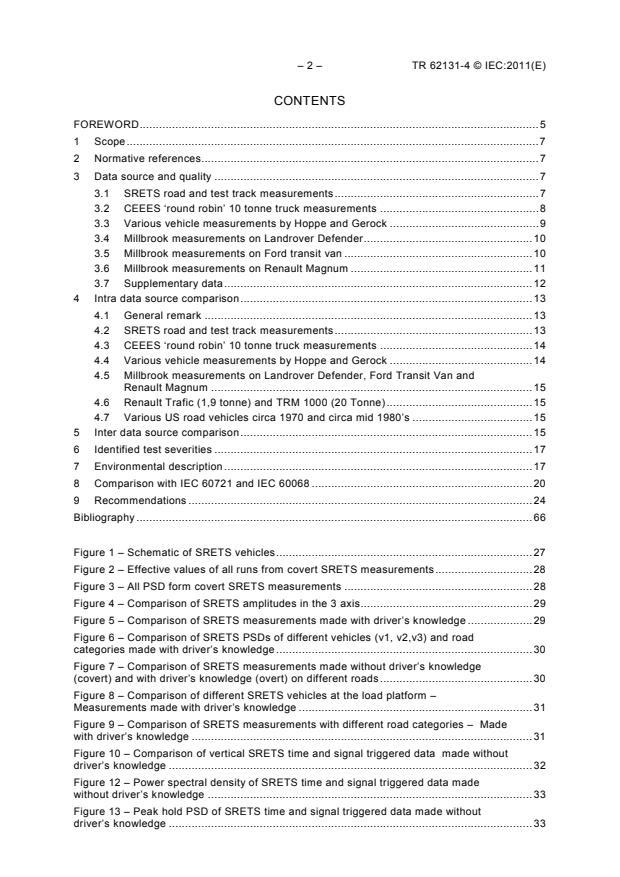
– 2 – TR 62131-4 © IEC:2011(E)
CONTENTS
FOREWORD . 5
1 Scope . 7
2 Normative references. 7
3 Data source and quality . 7
3.1 SRETS road and test track measurements . 7
3.2 CEEES ‘round robin’ 10 tonne truck measurements . 8
3.3 Various vehicle measurements by Hoppe and Gerock . 9
3.4 Millbrook measurements on Landrover Defender . 10
3.5 Millbrook measurements on Ford transit van . 10
3.6 Millbrook measurements on Renault Magnum . 11
3.7 Supplementary data . 12
4 Intra data source comparison . 13
4.1 General remark . 13
4.2 SRETS road and test track measurements . 13
4.3 CEEES ‘round robin’ 10 tonne truck measurements . 14
4.4 Various vehicle measurements by Hoppe and Gerock . 14
4.5 Millbrook measurements on Landrover Defender, Ford Transit Van and
Renault Magnum . 15
4.6 Renault Trafic (1,9 tonne) and TRM 1000 (20 Tonne) . 15
4.7 Various US road vehicles circa 1970 and circa mid 1980’s . 15
5 Inter data source comparison . 15
6 Identified test severities . 17
7 Environmental description . 17
8 Comparison with IEC 60721 and IEC 60068 . 20
9 Recommendations . 24
Bibliography . 66
Figure 1 – Schematic of SRETS vehicles . 27
Figure 2 – Effective values of all runs from covert SRETS measurements . 28
Figure 3 – All PSD form covert SRETS measurements . 28
Figure 4 – Comparison of SRETS amplitudes in the 3 axis . 29
Figure 5 – Comparison of SRETS measurements made with driver’s knowledge . 29
Figure 6 – Comparison of SRETS PSDs of different vehicles (v1, v2,v3) and road
categories made with driver’s knowledge . 30
Figure 7 – Comparison of SRETS measurements made without driver’s knowledge
(covert) and with driver’s knowledge (overt) on different roads . 30
Figure 8 – Comparison of different SRETS vehicles at the load platform –
Measurements made with driver’s knowledge . 31
Figure 9 – Comparison of SRETS measurements with different road categories – Made
with driver’s knowledge . 31
Figure 10 – Comparison of vertical SRETS time and signal triggered data made without
driver’s knowledge . 32
Figure 12 – Power spectral density of SRETS time and signal triggered data made
without driver’s knowledge . 33
Figure 13 – Peak hold PSD of SRETS time and signal triggered data made without
driver’s knowledge . 33
TR 62131-4 © IEC:2011(E) – 3 –
Figure 14 – APD of the SRETS measured data made without driver’s knowledge . 34
Figure 15 – Fitting of SRETS APD with multiple gaussian distributions . 34
Figure 16 – Vertical SRS of SRETS measured amplitudes greater than 5 g – Made
without driver’s knowledge . 35
Figure 17 – Lateral SRS of SRETS measured amplitudes greater than 5 g – Made
without driver’s knowledge . 35
Figure 18 Vibration r.m.s. against time for CEEES analysis. 36
Figure 19 – Vibration r.m.s. against vehicle velocity for CEEES analysis . 36
Figure 20 – Acceleration peaks against vehicle velocity for CEEES analysis . 37
Figure 21 – Vibration PSD analysis from CEEES ‘round robin’ exercise . 37
Figure 22 – Shock SRS analysis from CEEES ‘round robin’ exercise. 38
Figure 23 – Vibration test severities from CEEES ‘round robin’ exercise . 38
Figure 24 – Composite vibration PSD of CEEES measurements . 39
Figure 25 – Composite vibration APD from CEEES measurements . 39
Figure 26 – Vibration PSD from degraded roads on CEEES measurements . 40
Figure 27 – Shocks from CEEES measurements . 40
Figure 28 – Typical vibration PSD from Hoppe and Gerock measurements . 41
Figure 29 – Envelope of vibration PSD from Hoppe and Gerock measurements . 43
Figure 30 – Number of shocks per 100 km FROM Hoppe and Gerock measurements . 43
Figure 31 – Vibration r.m.s. from Millbrook measurements on landrover . 44
Figure 32 – Shock peaks from Millbrook measurements on landrover . 44
Figure 33 – Vibration PSD from Millbrook measurements on landrover . 45
Figure 34 – Vibration r.m.s. from Millbrook measurements on transit van . 45
Figure 35 – Maximum PSD values FROM Millbrook measurements on transit van . 46
Figure 36 – Shock amplitudes from Millbrook measurements on transit van . 46
Figure 37 – Vibration r.m.s. from Millbrook measurements on Renault Magnum . 47
Figure 38 – Maximum PSD values from Millbrook measurements on Renault Magnum . 47
Figure 39 – Shock amplitudes from Millbrook measurements on Renault Magnum . 48
Figure 40 – Maximum PSD values from Millbrook measurements on Renault Magnum . 48
Figure 41 – Vibration PSD from GAM EG 13 measurements on Renault Traffic . 49
Figure 42 – Vibration PSD from GAM EG 13 measurements on RVI TRM 1000 . 50
Figure 43 – Vibration severities from Mil Std 810 (Foley) . 51
Figure 44 – Vibration severities from Mil Std 810 (Connon) . 51
Figure 45 – Data from ASTM 4728-91 . 52
Figure 46 – Data from ASTM D4278-95 . 52
Figure 47 – Data from EXACT DK 1 – 237 . 53
Figure 48 – Data from reference 15 . 53
Figure 49 – Data from ASTM D 4728-95 . 54
Figure 50 – Data from reference 16 . 54
Figure 51 – SRETS test severity from PSD . 55
Figure 52 – SRETS test severity from PSD . 55
Figure 53 – SRETS test severity from r.m.s. (including shocks) . 57
Figure 54 – SRETS test severity from r.m.s. (including shocks) . 57
Figure 55 – Test severities from UK defence standard . 58
– 4 – TR 62131-4 © IEC:2011(E)
Figure 56 – Test severities from NATO STANAG . 58
Figure 57 – Test severities from ASTM D 4728-95 . 59
Figure 58 – Test severity from ETA . 59
Figure 59 – Test severities from CEN and ISO. 60
Figure 60 – Test severities from ETS. 60
Figure 61 – IEC 60721-2-2:1997 [26] – Random vibration severity . 61
Figure 62 – IEC 60721-4-2:1997 – Random vibration severity . 61
Figure 63 – IEC 60721-3-2:1997 – Sinusoidal vibration severity . 62
Figure 64 – IEC 60721-4-2:1997 – Sinusoidal vibration severity . 62
Figure 65 – IEC 60721-3-2:1997 – Shock severity . 63
Figure 66 – IEC 60721-4-2:1997 – Shock severity . 63
Figure 67 – IEC 60721-4-2:1997 – Recommended repeated shock severity . 64
Figure 68 – Comparison of the effects of IEC 60721-2-2:1997 – Random and sinusoidal
vibration severities . 64
Figure 69 – Comparison of the effects of IEC 607212-2:1997 – Random and sinusoidal
vibration severities . 65
Figure 70 – Comparison of the effects of IEC 60721-2-2:1997 – Random and sinusoidal
vibration severities . 65
Table 1 – Summary of SRETS journeys . 26
Table 2 – Summary of measurements made by Bosch using a number of vehicles and
under different test conditions . 26
Table 3 – Vehicles included in Hoppe and Gerock measurements . 41
Table 4 – Shock occurrences from Hoppe and Gerock measurements . 42
Table 5 – Probable” shock durations from Hoppe and Gerock measurements . 42
Table 6 – Vibration r.m.s. from GAM EG 13 measurements on Renault Traffic . 49
Table 7 – Vibration r.m.s. from GAM EG 13 measurements on RVI TRM 1000 . 50
Table 8 – SRETS shock test definition to augment vibration test from PSD . 56
TR 62131-4 © IEC:2011(E) – 5 –
INTERNATIONAL ELECTROTECHNICAL COMMISSION
____________
ENVIRONMENTAL CONDITIONS –
VIBRATION AND SHOCK OF ELECTROTECHNICAL EQUIPMENT –
Part 4: Equipment transported in road vehicles
FOREWORD
1) The International Electrotechnical Commission (IEC) is a worldwide organization for standardization comprising
all national electrotechnical committees (IEC National Committees). The object of IEC is to promote
international co-operation on all questions concerning standardization in the electrical and electronic fields. To
this end and in addition to other activities, IEC publishes International Standards, Technical Specifications,
Technical Reports, Publicly Available Specifications (PAS) and Guides (hereafter referred to as “IEC
Publication(s)”). Their preparation is entrusted to technical committees; any IEC National Committee interested
in the subject dealt with may participate in this preparatory work. International, governmental and non-
governmental organizations liaising with the IEC also participate in this preparation. IEC collaborates closely
with the International Organization for Standardization (ISO) in accordance with conditions determined by
agreement between the two organizations.
2) The formal decisions or agreements of IEC on technical matters express, as nearly as possible, an international
consensus of opinion on the relevant subjects since each technical committee has representation from all
interested IEC National Committees.
3) IEC Publications have the form of recommendations for international use and are accepted by IEC National
Committees in that sense. While all reasonable efforts are made to ensure that the technical content of IEC
Publications is accurate, IEC cannot be held responsible for the way in which they are used or for any
misinterpretation by any end user.
4) In order to promote international uniformity, IEC National Committees undertake to apply IEC Publications
transparently to the maximum extent possible in their national and regional publications. Any divergence
between any IEC Publication and the corresponding national or regional publication shall be clearly indicated in
the latter.
5) IEC itself does not provide any attestation of conformity. Independent certification bodies provide conformity
assessment services and, in some areas, access to IEC marks of conformity. IEC is not responsible for any
services carried out by independent certification bodies.
6) All users should ensure that they have the latest edition of this publication.
7) No liability shall attach to IEC or its directors, employees, servants or agents including individual experts and
members of its technical committees and IEC National Committees for any personal injury, property damage or
other damage of any nature whatsoever, whether direct or indirect, or for costs (including legal fees) and
expenses arising out of the publication, use of, or reliance upon, this IEC Publication or any other IEC
Publications.
8) Attention is drawn to the Normative references cited in this publication. Use of the referenced publications is
indispensable for the correct application of this publication.
9) Attention is drawn to the possibility that some of the elements of this IEC Publication may be the subject of
patent rights. IEC shall not be held responsible for identifying any or all such patent rights.
The main task of IEC technical committees is to prepare International Standards. However, a
technical committee may propose the publication of a technical report when it has collected
data of a different kind from that which is normally published as an International Standard, for
example "state of the art".
IEC/TR 62131-4, which is a technical report, has been prepared by IEC technical committee
104: Environmental conditions, classification and methods of test.
The text of this technical report is based on the following documents:
Enquiry draft Report on voting
104/509/DTR 104/538/RVC
Full information on the voting for the approval of this technical report can be found in the report
on voting indicated in the above table.
– 6 – TR 62131-4 © IEC:2011(E)
This publication has been drafted in accordance with the ISO/IEC Directives, Part 2. A list of all
the parts in the IEC 62131 series, under the general title Environmental conditions – Vibration
and shock of electrotechnical equipment, can be found on the IEC website.
This publication has been drafted in accordance with the ISO/IEC Directives, Part 2.
The committee has decided that the contents of this publication will remain unchanged until the
stability date indicated on the IEC web site under "http://webstore.iec.ch" in the data related to
the specific publication. At this date, the publication will be
• reconfirmed,
• withdrawn,
• replaced by a revised edition, or
• amended.
A bilingual version of this standard may be issued at a later date.
IMPORTANT – The 'colour inside' logo on the cover page of this publication indicates
that it contains colours which are considered to be useful for the correct understanding
of its contents. Users should therefore print this document using a colour printer.
TR 62131-4 © IEC:2011(E) – 7 –
ENVIRONMENTAL CONDITIONS –
VIBRATION AND SHOCK OF ELECTROTECHNICAL EQUIPMENT –
Part 4: Equipment transported in road vehicles
1 Scope
IEC/TR 62131-4, which is a technical report, reviews the available dynamic data relating to
electrotechnical equipment transported by road vehicles. The intent is that from all the
available data an environmental description will be generated and compared to that set out in
.
IEC 60721 [25]
For each of the sources identified the quality of the data is reviewed and checked for self
consistency. The process used to undertake this check of data quality and that used to
intrinsically categorize the various data sources is set out in IEC/TR 62131-1.
This technical report primarily addresses data extracted from a number of different sources for
which reasonable confidence exists as to the quality and validity. The report also presents data
for which the quality and validity cannot realistically be reviewed. These data are included to
facilitate validation of information from other sources. The report clearly indicates when utilizing
information in this latter category.
This technical report addresses data from a number of data gathering exercises. The quantity
and quality of data in these exercises varies considerably as does the range of road (and test
track) conditions covered. The vast majority of the road conditions are from Western Europe. It
is believed that one of the data sources considered is that used to set the current IEC 60721
severities. However, review of that data indicates the inclusion of some quite old vehicles.
Relatively little of the data reviewed were made available in electronic form. To permit
comparison to be made in this assessment, a quantity of the original (non-electronic) data have
been manually digitized.
2 Normative references
The following referenced documents are indispensable for the application of this document. For
dated references, only the edition cited applies. For undated references, the latest edition of
the referenced document (including any amendments) applies.
IEC 60721-3-2:1997, Classification of environmental conditions – Part 3: Classification of
groups of environmental parameters and their severities – Section 2: Transportation
3 Data source and quality
3.1 SRETS road and test track measurements
The Source Reduction by European Testing Schedules (SRETS) study ([1]), part-funded by the
European Union, was a collaborative venture undertaken by 10 European agencies and
companies. The purpose of the study was to establish new vibration and shock test severities
for equipment subject to road transportation. These test severities were destined for a new
___________
References in square brackets refer to the bibliography.
– 8 – TR 62131-4 © IEC:2011(E)
CEN and ISO test procedure for packaged equipment. The three year study was completed in
1999 and the final report (see ([1]) published by the EU.
The vibration and shock measurement phase of the work focused on two separate exercises
(see Table 1).
The first exercise, undertaken in the UK, was to establish the vibration and shock experienced
by typical goods in real road conditions. To that end, measurements were made without the
knowledge of the vehicle driver at the payload to vehicle interface during transportation of the
same goods over similar (550 km) routes on 19 separate occasions, using different vehicles of
a similar class (38 tonne articulated HGV’s). The vehicles (commercial haulers) and drivers
were supplied, the drivers being entirely unaware of the measurement exercise.
By contrast, in the second exercise, the measurements made with the full knowledge of the
vehicle driver, used two specific vehicles on controlled German test tracks employing
professional test track drivers. This second exercise was aimed at comparing vehicles, trailers,
payloads and road surfaces. The second set of measurements adopted two different trucks in
three configurations (one with trailer) at different speeds on different surfaces. Summary
information on the various vehicles and trailer is shown in Table 2. The measurement locations
utilized for the three vehicles are shown in Figure 1.
Both measurement exercises used solid state digital recorders. Whilst the second exercise
facilitated the use of continuous recording, the lengthy duration of the first exercise
necessitated the use of intermittent recording. The latter were undertaken in both “signal
triggered” mode (storing the 500 blocks of 2 048 points containing the largest amplitude
measurements) and “time triggered” mode (storing a block of 2 048 points every 3 min). The
recorder sample rate was 5 500 sps with a low pass butterworth filter set to 1 000 Hz. Each
block of data comprised 2 048 data points and represents an event duration of 0,372 s.
The first measurements adopted a single triaxial transducer located on the bottom of a pallet of
packaged, bottled whisky. The vehicle was loaded to full capacity with 16 similar pallets. As the
pallets were not stacked (one pallet height only) this payload filled the volume of the vehicle at
around 90 % of its maximum weight capacity. The use of measurements made without the
knowledge of the vehicle driver, has the advantage that it potentially reflects real world
conditions. However, it has the disadvantage that the validity of the data is difficult to verify.
The SRETS report specifically addresses this aspect comparing the data with itself (using the
19 separate runs) and with the test track work using several techniques such as comparing
group means and by use of “analysis of variance”.
The SRETS study adopted a variety of different data analysis procedures including power
spectral density (PSD), amplitude probability density (APD) and fatigue damage spectra (FDS).
In total, three different methods of establishing vibration and shock test severities were
adopted. The resultant test schedules were verified by using them to test four different
products and comparing the resultant damage with those experienced in the real world. These
exercises demonstrated that the tests induced similar damage to that occurring in practice at a
slightly accelerated rate. However, the rate of damage appeared more representative than
some existing tests. The SRETS study also addressed a number of practical testing limitations
and addressed some novel testing strategies.
The measurements from the SRETS are stored digitally; however, intellectual property rights
limit the extent this data can be circulated. Summary information is included here in Figure 2 to
Figure 17.
3.2 CEEES ‘round robin’ 10 tonne truck measurements
Although the CEEES ‘round robin’ exercise (see [2]) was not a measurement exercise, it did
subject the same piece of real world road transportation measurements to analysis by a
number of different methods and by a range of agencies. The vibration data used for the
CEEES work (Figure 18, Figure 19 and Figure 20) was some 55 min of continuously recorded
vibration measurements. These data were supplied to some 20 different agencies in Europe for
TR 62131-4 © IEC:2011(E) – 9 –
analysis. These participants made independent analysis of this data (Figure 21, Figure 22 and
Figure 23).
The data used in the CEEES exercise measurements were only part of a larger measurement
exercise, undertaken by Cranfield University, the major part of which involved continuously
recorded vibration measurements (see [3]) on a journey from central UK to central Germany
(Figure 24 and Figure 25). The exercise involved 12 channels of measurement (plus vehicle
velocity) on two payloads with a single triaxial measurement at the cargo bed. The vehicle used
was a 10 tonne vehicle, of early 1970’s design, able to operate on and off-road (it had 4 x 4
capability). Though it was a military vehicle it was based upon a commercial chassis and
included commercial modifications (an integral hydraulic hoist). In addition to the continuous
exercise, some measurements were made over degraded roads and obstacles (Figure 26 and
Figure 27) at the maximum speed the driver considered safe. The continuous and degraded
road measurements for the basis for environmental information contained in the UK defence
standard 00-35 Part 5 (see [17]) as well as contributing to the NATO document STANAG 4370.
The analysis undertaken on the measured data was in the form of PSD and APD, each of a 1 h
journey segment and combined for the complete journey. Additionally APD analysis was
undertaken of the vehicle velocity measurement to establish a realistic usage profile. Whilst
this is of some interest, it has limited application to this work as the upper speed limit of the
vehicle was somewhat less than that imposed of commercial vehicles.
Measurements were recorded on an analogue recorder with calibration equipment. The
measurement frequency range was up to 500 Hz. The PSD analysis was undertaken with a
frequency resolution of 1 Hz and the APD analysis with an amplitude resolution of 0,002 g. In
both cases, the analysis duration was typically in 1 h segments with the composite analysis
covering a period of over 7 h. As a consequence of the latter duration, the APD from the
composite measurement has good statistical accuracy down to very low levels of probability.
3.3 Various vehicle measurements by Hoppe and Gerock
Work by Hoppe and Gerock was under taken in the early 1970’s and the resultant data are
reproduced in a number of publications (see [4] and [5]). These data appear to be the basis for
the severities in a number of national standards and, as far as can be identified, are probably
the original basis for the severities in IEC 600721-3-2. Although the vibration data presented is
very limited, the scope of the shock data is sufficient to justify its inclusion here.
The work by Hoppe and Gerock involved some nine vehicle and trailers; these are detailed in
Table 3. The vehicles are mostly of leaf suspension designs, reflecting the vehicles’ ages
ranging between 1946 and 1970. All the test drives were made on dry roads on a closed
circular route of 25 km consisting of
– 70 % concrete and asphalt,
– 18 % damaged and repaired roads,
– 10 % rough unpaved roads,
– 2 % cobble stones.
In addition to the above, four level crossings were included in the route. Vehicle speeds varied
between 35 km/h and 45 km/h within town limits and up to 70 km/h on open roads. On rough
parts of the route, speeds were reduced to between 10 km/h and 20 km/h. The test drives were
made with the vehicles loaded to different degrees.
Little vibration data are presented in the reference, with information limited to a typical spectra
(Figure 28) and an envelope of the measurements (Figure 29) broken into trucks and semi-
trailer/pull trailers. However, the reference contains some useful shock data reproduced in
Table 4, Table 5 and Figure 30.
Triaxial acceleration measurements were made above the rear axle, vertically in the centre of
the load platform, vertically at the side of the platform at the rear and vertically at the front of
– 10 – TR 62131-4 © IEC:2011(E)
the platform in the centre. All six measurements were recorded simultaneously and
continuously on an analogue FM recorder. The frequency range covered was 1 Hz to 1250 Hz.
All PSD analysis was undertaken using a 3 Hz frequency resolution and a record duration of
32 s. The shocks were classified into eight amplitude levels and sixteen time increments.
3.4 Millbrook measurements on Landrover Defender
This 1998 measurement exercise (see [6]) was undertaken at the UK Millbrook test track by
Millbrook test engineers for Hunting Engineering Ltd. The measurements were made as part of
a proving exercise on electronic equipment installed in Landrover Defender model LR10 (SVIC
34 / C112) registration CD 70 AA. As implied by the registration, it was a military registered
vehicle but had only cosmetic modifications from the commercial variant.
The measurement configuration was 4 triaxial accelerometers and a optical tachometer to
determine vehicle velocity. All the measurements were recorded on a Millbrook supplied
analogue tape recorder using fully calibrated and traceable equipment. Three of the
measurement locations were on equipment shelves and on the rear floor of the cargo area.
Recordings were made on the following tracks at Millbrook:
– Test 1: high speed circuit at 48 km/h (30 mph) and record duration 130 s;
– Test 2: rough road test at 16 km/h (10 mph) and record duration 46 s;
– Test 3: pave at 40 km/h (25 mph) and record duration 266 s;
– Test 4: hill route at normal speeds and record duration 366 s;
– Test 5: random waves and record duration 56 s;
– Test 6: severe waves at 16 km/hr (10 mph) and record duration 30 s;
– Test 7: cross country at normal speed and record duration 673 s.
All the results are presented in [6]. All analysis was undertaken using the same analysis
software presenting data from each channel in a consistent way. Essential for each
measurement channel and track, a typical time history is presented along with an APD and
PSD. The sample rate was 1 024 sps producing a frequency resolution of approximatly 0,5 Hz.
The record durations varied according to track surface and are indicated in the list above. The
data is summarized here in terms of variations in vibration r.m.s. with road surface in Figure 31
and the variation in shock amplitude in Figure 32. The spectra for the vertical axis are shown in
Figure 33.
3.5 Millbrook measurements on Ford transit van
This 1996 measurement exercise (see [7]) was undertaken at the UK Millbrook test track by
Millbrook test engineers for Hunting Engineering Ltd. The measurements were made as part of
a proving exercise on a communication installation in a (new) Ford Transit Van registration
M639 BTL. The loading on the front axle was 1 248 kg, on the rear axle 969 Kg, giving a total
of 2 217 Kg.
The measurement configuration was 3 triaxial accelerometers, 3 uni-axial accelerometers and
a vehicle speed transducer. All the measurements were recorded on a Millbrook supplied
analogue tape recorder using fully calibrated and traceable equipment. Most of the
measurement locations were on equipment shelves but two triaxial measurements were in the
cargo area (one over the rear axle and one in the centre of cargo area). Recordings were made
on the following tracks at Millbrook:
a) Vibration
high speed circuit at 85 km/h and record duration 376 s;
gravel road test at 48 km/h (30 mph) and record duration 157 s;
B Class road (incl. level crossing) at 64 km/h (40 mph) and record duration 192 s;
b) Shocks
pot hole “A” and “B” at 16 km/h (10 mph);
TR 62131-4 © IEC:2011(E) – 11 –
Millbrook cat’s eyes at 48 km/h (30 mph);
railway level crossing at 32 km/h (20 mph).
Analysis was undertaken for each measurement channel and surface and a typical time history
presented along with an APD and PSD. The sample rate was 1 024 sps, producing a frequency
resolution of approximatly 0,5 Hz. The record durations varied according to track surface and
are indicated in the list above. The data is summarized here in terms of variations in vibration
r.m.s. with road surface in Figure 34, in terms of peak spectral value in Figure 35 and the
variation in shock amplitude in Figure 36. The spectra for the vertical axis are shown in
Figure 40.
3.6 Millbrook measurements on Renault Magnum
This 1996 measurement exercise (see [8]) was undertaken at the UK Millbrook test track by
Millbrook test engineers for Hunting Engineering Ltd. The measurements were made as part of
a proving exercise on a communication installation in a (new) Renault AE 385ti Magnum semi
trailer with a box trailer equipped as a command and communication centre. The loading on the
front axle was 5 764 kg, on the rear axle 8 985 Kg, giving a total of 14 749 Kg.
The measurement configuration was 1 triaxial accelerometer, 4 bi-axial accelerometers, 2 uni-
axial accelerometers and a vehicle speed transducer. All the measurements were recorded on
a Millbrook supplied analogue tape recorder using fully calibrated and traceable equipment.
Most of the measurement locations were on equipment shelves but some (2 bi-axial) were
directly mounted on the van sides of the trailer. All of the remainder had a very short
transmission path to the van sides of the trailer. Recordings were made on the following tracks
at Millbrook:
a) vibration;
b) high speed circuit at 85 km/h and record duration 347 s;
c) gravel road test at 32 and 48 km/h (20 and 30 mph) and record duration 197 s;
d) B class road at 48 and 64 km/h (30 and 40 mph) and record duration 254 s;
e) shocks;
f) Millbrook pot hole “A” and “B” at 16 km/h (10 mph) ;
g) Millbrook cat’s eyes at 48 km/h (30 mph);
h) Railway level crossing at 32 km/h (20 mph).
Analysis was undertaken for each measurement channel and surface, with a typical time
history presented along with an APD and PSD. The sample rate was 1 024 sps, producing a
frequency resolution of approximately 0,5 Hz. The record durations varied according to track
surface and are indicated in the list above. The data is summarized here in terms of variations
in vibration r.m.s. with road surface in Figure 37, in terms of peak spectral value in Figure 38
and the variation in shock amplitude in Figure 39. The spectra for the vertical axis are shown in
Figure 40.
– 12 – TR 62131-4 © IEC:2011(E)
3.7 Supplementary data
The data collection exercise which preceded this assessment identified several relevant sets of
information, which come from reputable sources, but for which the data quality could not be
adequately verified. Although, they are included here to facilitate validation of data from other
sources, care should be taken when utilizing information in this category.
Renault Trafic (1,9 tonne) and TRM 1000 (20 tonne). Information is contained within the
French military specification GAM EG 13 (see [9] from two different vehicles. The 4 x 2 Renault
Trafic was loaded to an all up mass of 1 950 Kg and triaxial acceleration measurements made
at two locations designated only as “central platform” and less specifically “longeron ArG”. The
triaxial acceleration measurements on the TRM 1000 were made on the chassis. The
measurements were made on a variety of real road conditions and specific surfaces (whether
these are real road surfaces or test tracks is not known). All the data are presented in the form
of PSD’s of 1 Hz (or better) frequency resolution. The duration of the records used for the
analysis is unknown and hence the analysis random error cannot be determined. A summary of
the r.m.s. variations with road surface and vehicle speed are presented in Table 6 and Table 7
for the Renault Trafic and TRM 1000 respectively. Overlaid spectra for the two vehicles are
also presented in Figure 41 and Figure 42.
Various US road vehicles circa 1970. As part of an exercise, in the early 1970’s, to
authenticate severities for the US military specification Mil Std 810, J.T. Foley (see [10]) at
Sandia National Laboratories in the US undertook an extensive exercise to establish
transportation requirements on a number of platforms including several road vehicles. As far as
can be determined, the vehicles used real US roads and conditions. The vehicles included
a) well used tractor – flatbed trailer with leaf springs suspension,
b) renewed tractor – flatbed trailer with leaf spring suspension,
c) well used tractor van trailer with air ride suspension,
d) new tractor – van trailer with air ride suspension,
e) carefully driven tractor – van trailer with leaf spring suspension,
f) 2,5 tonne flatbed truck of conventional commercial design,
g) 2,5 tonne van truck modified to carry explosives.
The measurements encompassed seven road vehicles but the process adopted does not allow
information from individual vehicles to be identified. Moreover, the analysis process Foley used
throughout his work is relatively unique and not immediately compatible with other information
presented in this assessment. Foley generated test spectra (Figure 43) which can be usefully
compared with those from other methods and sources.
Various US road vehicles circa mid 1980’s. As part of an exercise, in the mid 1980’s, to
authenticate test severities for the US military specification Mil Std 810, William Connon (see
[11]) at the US Army Aberdeen proving ground, undertook an extensive exercise to establish
severities on a number of platforms including several road vehicles. The measurements were
entirely made on the special test tracks at the Aberdeen proving ground. The (essentially
military) vehicles included
(1) M127 12 tonne semi-trailer,
(2) M813 5 tonne truck,
(3) M814 5 tonne truck,
(4) M36 2,5 tonne truck,
___________
Landrover Defender Model LR10 (SVIC 34 / C112) Registration CD 70 AA, Ford Transit Van Registration M639
BTL, Renault AE 385ti Magnum Semi Trailer, Renault Trafic (1,9 tonne), Renault TRM 1000 (20 tonne), as well
as various US Military road vehicles, are the trade names of products supplied by Renault, Ford and the US
Military, respectively. This information is given for the convenience of users of this technical report and does not
constitute an endorsement by IEC of the products named.
TR 62131-4 © IEC:2011(E) – 13 –
(5) CUCV M1009 1,5 tonne truck,
(6) HMMWV M998 1,25 tonne truck,
(7) HEMTT M985 10 tonne truck,
(8) M416 0,25 tonne 2 wheeled trailer,
(9) M105A2 1,5 tonne 2 wheeled trailer.
The measurements encompassed nine different vehicles but the process adopted does not
allow information from individual vehicles to be identified. Moreover, the analysis process used
throughout the work is relatively unique and not immediately compatible with other information
presented in this assessment. Connon generated test spectra (Figure 44) which can be usefully
compared with those from other methods and sources.
Miscellaneous data. During the course of the data search a number of possible data sources
were identified for which the data were not traceable to any reasonable extent. These are
included here for completeness because they may help support information from more
traceable sources. Most of these sources are courtesy of Dr Ulrich Braunmiller and the SRETS
work. Vertical responses from several road surfaces presented in ASTM D4728-91 (see [12])
are shown in Figure 45. Multi-axis responses from a trailer originating from ASTM D4728-95
(see [13]) are shown in Figure 46 and fo
...