

IEC 60870-6-702:2014
(Main)Telecontrol equipment and systems - Part 6-702: Telecontrol protocols compatible with ISO standards and ITU-T recommendations - Functional profile for providing the TASE.2 application service in end systems
General Information
- Abstract
IEC 60870-6-702:2014 is a functional profile (FP) and defines the provision of the TASE.2 communications services between two control centre end systems. It is supported by the transport services implemented in accordance with transport-profiles defined for the type of network that interconnects the control centre end systems. The main changes with respect to the previous edition are listed below:
- certain objects were moved from being normative to informative;
- certain TASE.2 conformance blocks have been made out-of-scope. These changes were made in order to remove TASE.2 blocks that were seldom used and whose capabilities are typically implemented by some other means besides TASE.2. This was done to promote interoperability of implementations from an application perspective.
- Status
- Published
- Publication Date
- 14-Jul-2014
- Technical Committee
- TC 57 - Power systems management and associated information exchange
- Drafting Committee
- WG 19 - TC 57/WG 19
- Current Stage
- PPUB - Publication issued
- Start Date
- 15-Jul-2014
- Completion Date
- 15-Jul-2014
Buy Documents
IEC 60870-6-702:2014 - Telecontrol equipment and systems - Part 6-702: Telecontrol protocols compatible with ISO standards and ITU-T recommendations - Functional profile for providing the TASE.2 application service in end systems Released:7/15/2014
Overview
IEC 60870-6-702:2014 is an international standard published by the International Electrotechnical Commission (IEC) that specifies the functional profile for telecontrol protocols providing the TASE.2 (Telecontrol Application Service Element 2) application service in end systems. This standard supports communication between control centre end systems and is compatible with ISO standards and ITU-T recommendations. IEC 60870-6-702:2014 defines how TASE.2 services are provided, relying on transport services tailored for different network types linking control centres.
This 2014 edition streamlines previous versions by removing less-used TASE.2 conformance blocks to improve interoperability from an application perspective. It is essential for organizations implementing telecontrol communication systems aimed at ensuring reliable and standardized data exchange in electrical and other utility systems.
Key Topics
TASE.2 Application Service
The standard details the implementation of TASE.2, which facilitates telecontrol data exchange, event reporting, and command issuance between two control centres over a network.Functional Profile Definition
It establishes the protocol stack guidelines and conformance requirements to ensure consistency in TASE.2 service provision across different implementations.Transport Layer Specifications
IEC 60870-6-702 relies on various transport profiles optimized for the specific networks interconnecting control centres, ensuring dependable protocol performance.Conformance and Interoperability
Key changes focus on removing rarely used protocol features and clarifying conformance blocks, encouraging interoperable implementations aligned with international ISO and ITU-T standards.Scope and Applicability
The standard applies primarily to end systems in telecontrol environments, detailing client/server capabilities, association management, data handling objects, and protocol versions.
Applications
IEC 60870-6-702:2014 is critical for industries requiring standardized telecontrol communication such as:
Electric Power Utilities
For SCADA systems used in monitoring and controlling substations, power generation plants, and grid management centers.Industrial Automation
Providing remote monitoring and control in complex industrial processes requiring secure and interoperable communication between control centers.Energy Management Systems
Facilitating data exchange and control functions within distributed energy resources and smart grid applications.Transport and Infrastructure Management
Enabling telecontrol of systems such as railway signaling, water management, and other critical infrastructure requiring reliable remote control.
Implementing this standard supports enhanced system integration, reliable remote operation, and streamlined communication protocols across diverse industries.
Related Standards
IEC 60870 Series
IEC 60870-6-702 complements other parts of the IEC 60870 family, each covering different telecontrol communication layers and protocols.ISO/IEC 9506 (MMS - Manufacturing Message Specification)
Provides messaging services that underlie the TASE.2 application service as referenced in this standard.ITU-T Recommendations
Especially those covering telecommunication protocol frameworks compatible with IEC 60870-6-702.IEC 60870-6-501
An earlier edition defining telecontrol protocols and services related to TASE.2.IEC 61850
For communication networks and systems in substations, often used in conjunction with IEC 60870-6 for comprehensive control environments.
By adhering to IEC 60870-6-702:2014, organizations can implement standardized, interoperable telecontrol communication systems for effective and secure control centre operations. This ensures compatibility with global telecontrol communication frameworks, supporting efficient utility and industrial process management worldwide.
Relations
- Effective Date
- 05-Sep-2023
Buy Documents
IEC 60870-6-702:2014 - Telecontrol equipment and systems - Part 6-702: Telecontrol protocols compatible with ISO standards and ITU-T recommendations - Functional profile for providing the TASE.2 application service in end systems Released:7/15/2014
Get Certified
Connect with accredited certification bodies for this standard

ANCE
Mexican certification and testing association.

Intertek Slovenia
Intertek testing, inspection, and certification services in Slovenia.

LNE (Laboratoire National de Métrologie et d'Essais)
French national laboratory for metrology and testing.
Sponsored listings
Frequently Asked Questions
IEC 60870-6-702:2014 is a standard published by the International Electrotechnical Commission (IEC). Its full title is "Telecontrol equipment and systems - Part 6-702: Telecontrol protocols compatible with ISO standards and ITU-T recommendations - Functional profile for providing the TASE.2 application service in end systems". This standard covers: IEC 60870-6-702:2014 is a functional profile (FP) and defines the provision of the TASE.2 communications services between two control centre end systems. It is supported by the transport services implemented in accordance with transport-profiles defined for the type of network that interconnects the control centre end systems. The main changes with respect to the previous edition are listed below: - certain objects were moved from being normative to informative; - certain TASE.2 conformance blocks have been made out-of-scope. These changes were made in order to remove TASE.2 blocks that were seldom used and whose capabilities are typically implemented by some other means besides TASE.2. This was done to promote interoperability of implementations from an application perspective.
IEC 60870-6-702:2014 is a functional profile (FP) and defines the provision of the TASE.2 communications services between two control centre end systems. It is supported by the transport services implemented in accordance with transport-profiles defined for the type of network that interconnects the control centre end systems. The main changes with respect to the previous edition are listed below: - certain objects were moved from being normative to informative; - certain TASE.2 conformance blocks have been made out-of-scope. These changes were made in order to remove TASE.2 blocks that were seldom used and whose capabilities are typically implemented by some other means besides TASE.2. This was done to promote interoperability of implementations from an application perspective.
IEC 60870-6-702:2014 is classified under the following ICS (International Classification for Standards) categories: 33.200 - Telecontrol. Telemetering. The ICS classification helps identify the subject area and facilitates finding related standards.
IEC 60870-6-702:2014 has the following relationships with other standards: It is inter standard links to IEC 60870-6-702:1998. Understanding these relationships helps ensure you are using the most current and applicable version of the standard.
IEC 60870-6-702:2014 is available in PDF format for immediate download after purchase. The document can be added to your cart and obtained through the secure checkout process. Digital delivery ensures instant access to the complete standard document.
Standards Content (Sample)
IEC 60870-6-702 ®
Edition 2.0 2014-07
INTERNATIONAL
STANDARD
NORME
INTERNATIONALE
Telecontrol equipment and systems –
Part 6-702: Telecontrol protocols compatible with ISO standards and ITU-T
recommendations – Functional profile for providing the TASE.2 application
service in end systems
Matériels et systèmes de téléconduite –
Partie 6-702: Protocoles de téléconduite compatibles avec les normes ISO
et les recommandations de l’UIT-T – Profil fonctionnel pour fournir le service
d'application TASE.2 dans les systèmes finals
All rights reserved. Unless otherwise specified, no part of this publication may be reproduced or utilized in any form
or by any means, electronic or mechanical, including photocopying and microfilm, without permission in writing from
either IEC or IEC's member National Committee in the country of the requester. If you have any questions about IEC
copyright or have an enquiry about obtaining additional rights to this publication, please contact the address below or
your local IEC member National Committee for further information.
Droits de reproduction réservés. Sauf indication contraire, aucune partie de cette publication ne peut être reproduite
ni utilisée sous quelque forme que ce soit et par aucun procédé, électronique ou mécanique, y compris la photocopie
et les microfilms, sans l'accord écrit de l'IEC ou du Comité national de l'IEC du pays du demandeur. Si vous avez des
questions sur le copyright de l'IEC ou si vous désirez obtenir des droits supplémentaires sur cette publication, utilisez
les coordonnées ci-après ou contactez le Comité national de l'IEC de votre pays de résidence.
IEC Central Office Tel.: +41 22 919 02 11
3, rue de Varembé Fax: +41 22 919 03 00
CH-1211 Geneva 20 info@iec.ch
Switzerland www.iec.ch
About the IEC
The International Electrotechnical Commission (IEC) is the leading global organization that prepares and publishes
International Standards for all electrical, electronic and related technologies.
About IEC publications
The technical content of IEC publications is kept under constant review by the IEC. Please make sure that you have the
latest edition, a corrigenda or an amendment might have been published.
IEC Catalogue - webstore.iec.ch/catalogue Electropedia - www.electropedia.org
The stand-alone application for consulting the entire The world's leading online dictionary of electronic and
bibliographical information on IEC International Standards, electrical terms containing more than 30 000 terms and
Technical Specifications, Technical Reports and other definitions in English and French, with equivalent terms in 14
documents. Available for PC, Mac OS, Android Tablets and additional languages. Also known as the International
iPad. Electrotechnical Vocabulary (IEV) online.
IEC publications search - www.iec.ch/searchpub IEC Glossary - std.iec.ch/glossary
The advanced search enables to find IEC publications by a More than 55 000 electrotechnical terminology entries in
variety of criteria (reference number, text, technical English and French extracted from the Terms and Definitions
committee,…). It also gives information on projects, replaced clause of IEC publications issued since 2002. Some entries
and withdrawn publications. have been collected from earlier publications of IEC TC 37,
77, 86 and CISPR.
IEC Just Published - webstore.iec.ch/justpublished
Stay up to date on all new IEC publications. Just Published IEC Customer Service Centre - webstore.iec.ch/csc
details all new publications released. Available online and If you wish to give us your feedback on this publication or
also once a month by email. need further assistance, please contact the Customer Service
Centre: csc@iec.ch.
A propos de l'IEC
La Commission Electrotechnique Internationale (IEC) est la première organisation mondiale qui élabore et publie des
Normes internationales pour tout ce qui a trait à l'électricité, à l'électronique et aux technologies apparentées.
A propos des publications IEC
Le contenu technique des publications IEC est constamment revu. Veuillez vous assurer que vous possédez l’édition la
plus récente, un corrigendum ou amendement peut avoir été publié.
Catalogue IEC - webstore.iec.ch/catalogue Electropedia - www.electropedia.org
Application autonome pour consulter tous les renseignements
Le premier dictionnaire en ligne de termes électroniques et
bibliographiques sur les Normes internationales,
électriques. Il contient plus de 30 000 termes et définitions en
Spécifications techniques, Rapports techniques et autres
anglais et en français, ainsi que les termes équivalents dans
documents de l'IEC. Disponible pour PC, Mac OS, tablettes
14 langues additionnelles. Egalement appelé Vocabulaire
Android et iPad.
Electrotechnique International (IEV) en ligne.
Recherche de publications IEC - www.iec.ch/searchpub
Glossaire IEC - std.iec.ch/glossary
Plus de 55 000 entrées terminologiques électrotechniques, en
La recherche avancée permet de trouver des publications IEC
en utilisant différents critères (numéro de référence, texte, anglais et en français, extraites des articles Termes et
comité d’études,…). Elle donne aussi des informations sur les Définitions des publications IEC parues depuis 2002. Plus
projets et les publications remplacées ou retirées. certaines entrées antérieures extraites des publications des
CE 37, 77, 86 et CISPR de l'IEC.
IEC Just Published - webstore.iec.ch/justpublished
Service Clients - webstore.iec.ch/csc
Restez informé sur les nouvelles publications IEC. Just
Published détaille les nouvelles publications parues. Si vous désirez nous donner des commentaires sur cette
Disponible en ligne et aussi une fois par mois par email. publication ou si vous avez des questions contactez-nous:
csc@iec.ch.
IEC 60870-6-702 ®
Edition 2.0 2014-07
INTERNATIONAL
STANDARD
NORME
INTERNATIONALE
Telecontrol equipment and systems –
Part 6-702: Telecontrol protocols compatible with ISO standards and ITU-T
recommendations – Functional profile for providing the TASE.2 application
service in end systems
Matériels et systèmes de téléconduite –
Partie 6-702: Protocoles de téléconduite compatibles avec les normes ISO
et les recommandations de l’UIT-T – Profil fonctionnel pour fournir le service
d'application TASE.2 dans les systèmes finals
INTERNATIONAL
ELECTROTECHNICAL
COMMISSION
COMMISSION
ELECTROTECHNIQUE
PRICE CODE
INTERNATIONALE
CODE PRIX W
ICS 33.200 ISBN 978-2-8322-1653-8
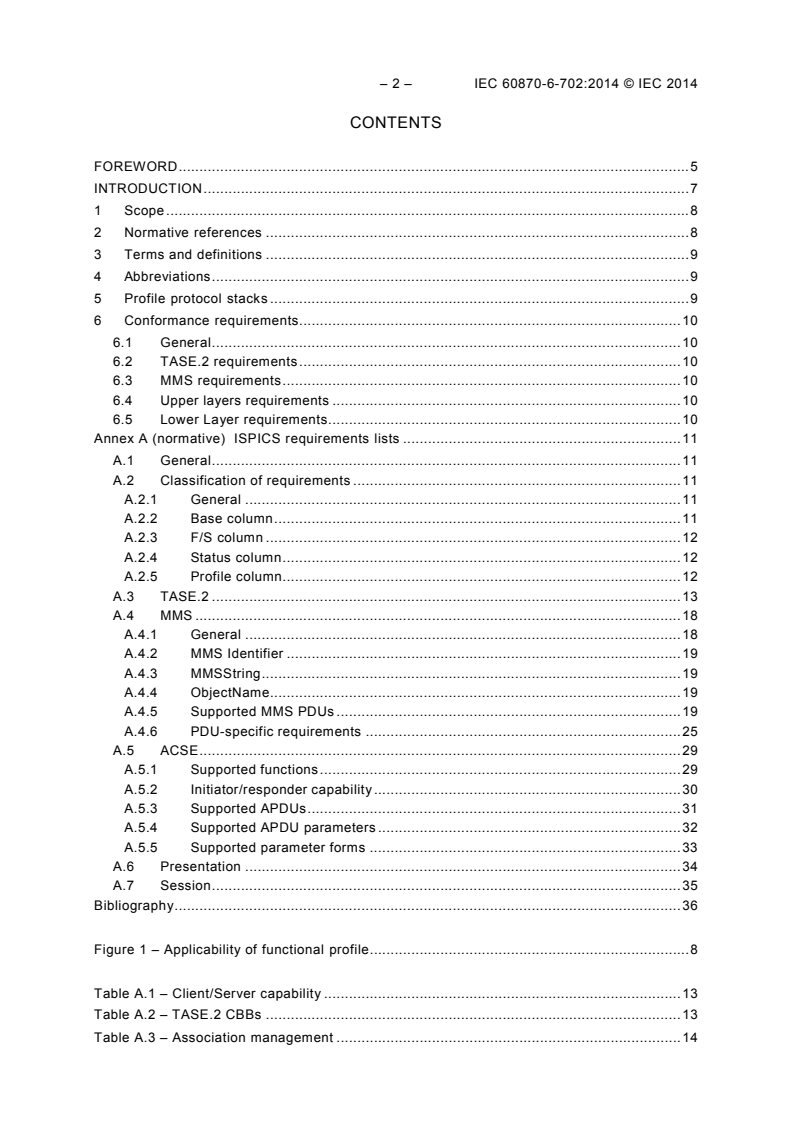
– 2 – IEC 60870-6-702:2014 © IEC 2014
CONTENTS
FOREWORD . 5
INTRODUCTION . 7
1 Scope . 8
2 Normative references . 8
3 Terms and definitions . 9
4 Abbreviations . 9
5 Profile protocol stacks . 9
6 Conformance requirements . 10
6.1 General . 10
6.2 TASE.2 requirements . 10
6.3 MMS requirements . 10
6.4 Upper layers requirements . 10
6.5 Lower Layer requirements . 10
Annex A (normative) ISPICS requirements lists . 11
A.1 General . 11
A.2 Classification of requirements . 11
A.2.1 General . 11
A.2.2 Base column . 11
A.2.3 F/S column . 12
A.2.4 Status column . 12
A.2.5 Profile column. 12
A.3 TASE.2 . 13
A.4 MMS . 18
A.4.1 General . 18
A.4.2 MMS Identifier . 19
A.4.3 MMSString . 19
A.4.4 ObjectName . 19
A.4.5 Supported MMS PDUs . 19
A.4.6 PDU-specific requirements . 25
A.5 ACSE . 29
A.5.1 Supported functions . 29
A.5.2 Initiator/responder capability . 30
A.5.3 Supported APDUs . 31
A.5.4 Supported APDU parameters . 32
A.5.5 Supported parameter forms . 33
A.6 Presentation . 34
A.7 Session . 35
Bibliography . 36
Figure 1 – Applicability of functional profile . 8
Table A.1 – Client/Server capability . 13
Table A.2 – TASE.2 CBBs . 13
Table A.3 – Association management . 14
Table A.4 – Data value . 14
Table A.5 – Data sets . 14
Table A.6 – Accounts . 15
Table A.7 – DS transfer sets . 15
Table A.8 – Time series transfer set objects . 16
Table A.9 – Transfer account transfer set objects . 16
Table A.10 – Information message objects . 16
Table A.11 – Special transfer set objects . 17
Table A.12 – SBO devices . 17
Table A.13 – Programs . 17
Table A.14 – Event enrollments . 18
Table A.15 – Event conditions. 18
Table A.16 – Object models . 18
Table A.17 – Environment and general management . 19
Table A.18 – MMS modifiers . 20
Table A.19 – Parameter CBBs . 21
Table A.20 – VMD support . 21
Table A.21 – Domain management . 22
Table A.22 – Program invocation management . 22
Table A.23 – Variable access. 23
Table A.24 – Semaphore management . 23
Table A.25 – Operator communication . 23
Table A.26 – Event management . 24
Table A.27 – Journal management . 24
Table A.28 – File access . 24
Table A.29 – File management . 25
Table A.30 – Data exchange management . 25
Table A.31 – AccessControl . 25
Table A.32 – Additional PDUs . 25
Table A.33 – GetNameList conformance statement . 26
Table A.34 – VariableAccessSpecification conformance statement . 26
Table A.35 – VariableSpecification conformance statement . 27
Table A.36 – Read conformance statement . 27
Table A.37 – Write conformance statement . 27
Table A.38 – InformationReport conformance statement . 28
Table A.39 – GetVariableAccessAttributes conformance statement . 28
Table A.40 – DefineNamedVariableList conformance statement . 28
Table A.41 – GetNamedVariableListAttributes conformance statement . 29
Table A.42 – DeleteNamedVariableList conformance statement . 29
Table A.43 – Protocol versions . 29
Table A.44 – Other protocol versions . 30
Table A.45 – Technical corrigenda implemented . 30
Table A.46 – Global statement of conformance . 30
– 4 – IEC 60870-6-702:2014 © IEC 2014
Table A.47 – Protocol mechanisms . 30
Table A.48 – Association establishment procedure . 30
Table A.49 – Normal release procedure . 31
Table A.50 – Abnormal release procedure . 31
Table A.51 – Functional units . 31
Table A.52 – ACSE Supported APDUs . 31
Table A.53 – A-associate-request APDU . 32
Table A.54 – A-associate-response APDU . 32
Table A.55 – A-release-request APDU . 32
Table A.56 – A-release-response APDU . 33
Table A.57 – Abort APDU . 33
Table A.58 – AE title syntax name-form . 33
Table A.59 – Authentication value form . 33
Table A.60 – Presentation PRL . 34
Table A.61 – Session PRL . 35
INTERNATIONAL ELECTROTECHNICAL COMMISSION
____________
TELECONTROL EQUIPMENT AND SYSTEMS –
Part 6-702: Telecontrol protocols compatible with
ISO standards and ITU-T recommendations –
Functional profile for providing the TASE.2
application service in end systems
FOREWORD
1) The International Electrotechnical Commission (IEC) is a worldwide organization for standardization comprising
all national electrotechnical committees (IEC National Committees). The object of IEC is to promote
international co-operation on all questions concerning standardization in the electrical and electronic fields. To
this end and in addition to other activities, IEC publishes International Standards, Technical Specifications,
Technical Reports, Publicly Available Specifications (PAS) and Guides (hereafter referred to as “IEC
Publication(s)”). Their preparation is entrusted to technical committees; any IEC National Committee interested
in the subject dealt with may participate in this preparatory work. International, governmental and non-
governmental organizations liaising with the IEC also participate in this preparation. IEC collaborates closely
with the International Organization for Standardization (ISO) in accordance with conditions determined by
agreement between the two organizations.
2) The formal decisions or agreements of IEC on technical matters express, as nearly as possible, an international
consensus of opinion on the relevant subjects since each technical committee has representation from all
interested IEC National Committees.
3) IEC Publications have the form of recommendations for international use and are accepted by IEC National
Committees in that sense. While all reasonable efforts are made to ensure that the technical content of IEC
Publications is accurate, IEC cannot be held responsible for the way in which they are used or for any
misinterpretation by any end user.
4) In order to promote international uniformity, IEC National Committees undertake to apply IEC Publications
transparently to the maximum extent possible in their national and regional publications. Any divergence
between any IEC Publication and the corresponding national or regional publication shall be clearly indicated in
the latter.
5) IEC itself does not provide any attestation of conformity. Independent certification bodies provide conformity
assessment services and, in some areas, access to IEC marks of conformity. IEC is not responsible for any
services carried out by independent certification bodies.
6) All users should ensure that they have the latest edition of this publication.
7) No liability shall attach to IEC or its directors, employees, servants or agents including individual experts and
members of its technical committees and IEC National Committees for any personal injury, property damage or
other damage of any nature whatsoever, whether direct or indirect, or for costs (including legal fees) and
expenses arising out of the publication, use of, or reliance upon, this IEC Publication or any other IEC
Publications.
8) Attention is drawn to the Normative references cited in this publication. Use of the referenced publications is
indispensable for the correct application of this publication.
9) Attention is drawn to the possibility that some of the elements of this IEC Publication may be the subject of
patent rights. IEC shall not be held responsible for identifying any or all such patent rights.
International Standard 60870-6-702 has been prepared by IEC technical committee 57:
Power systems management and associated information exchange.
This second edition cancels and replaces the first edition published in 1998 and constitutes a
technical revision.
The main changes with respect to the previous edition are listed below:
– Accounts, Programs, Event Enrollment, and Event Condition objects were moved from
being normative to informative. As a result, the conformance tables have been updated.
– The services associated with Accounts, Programs, Event Enrollment, and Event
Conditions are now out-of-scope.
– The TASE.2 conformance blocks 6, 7, 8, and 9 have been made out-of-scope.
– 6 – IEC 60870-6-702:2014 © IEC 2014
These changes were made in order to remove TASE.2 blocks that were seldom used and
whose capabilities are typically implemented by some other means besides TASE.2. This was
done to promote interoperability of implementations from an application perspective.
The text of this standard is based on the following documents:
FDIS Report on voting
57/1454/FDIS 57/1478/RVD
Full information on the voting for the approval of this standard can be found in the report on
voting indicated in the above table.
This publication has been drafted in accordance with the ISO/IEC Directives, Part 2.
A list of all parts in the IEC 60870 series, published under the general title Telecontrol
equipment and systems, can be found on the IEC website.
The committee has decided that the contents of this publication will remain unchanged until
the stability date indicated on the IEC web site under "http://webstore.iec.ch" in the data
related to the specific publication. At this date, the publication will be
• reconfirmed,
• withdrawn,
• replaced by a revised edition, or
• amended.
INTRODUCTION
This part of IEC 60870 is one of the IEC 60870-6 series defining functional profiles to be used
in telecommunication networks for electric power systems. It is largely based on existing
ISO/IEC International Standards and International Standardized Profiles (ISP).
The notion of functional profiles is fundamental in the organization of the IEC 60870-6 series.
A description of functional profiles, their classification scheme and the manner of defining
them are laid down in IEC 60870-6-1.
This profile for telecontrol application service element (TASE.2, also known as inter-control
centre communications protocol, ICCP) is an application-class profile (A-profile) providing
communications capabilities to control centre applications. The TASE.2 in the application
layer is specified in IEC 60870-6-503. The present standard refines the application layer
protocol to meet interoperability requirements and specifies requirements on the presentation
and session layers support for TASE.2. TASE.2 operates in a connection mode, so this A-
profile needs to interface to a transport-class profile of the T-profile variety.
Since the TASE.2 is an MMS-based protocol, this functional profile (FP) is based on MMS
profiles. In the OSI international standardized profile taxonomy there is a category for MMS A-
profiles. The present standard makes frequent use of the AMM11 profile.
– 8 – IEC 60870-6-702:2014 © IEC 2014
TELECONTROL EQUIPMENT AND SYSTEMS –
Part 6-702: Telecontrol protocols compatible with
ISO standards and ITU-T recommendations –
Functional profile for providing the TASE.2
application service in end systems
1 Scope
This part of IEC 60870 is a functional profile (FP) and defines the provision of the TASE.2
communications services between two control centre end systems. It is supported by the
transport services implemented in accordance with transport-profiles defined for the type of
network that interconnects the control centre end systems. This is demonstrated in Figure 1.
This FP also defines the provision of the OSI connection-mode presentation and session
services between the end systems.
ISO/ISP 14226 specifies the AMM11 profiles for MMS. The parts of ISO/ISP 14226 that cover
the profile that are used as a basis for this FP are ISO/ISP 14226-1 and ISO/ISP 14226-2.
This FP is in alignment with ISO/ISP 14226, as far as possible, and maintains this
compatibility by reference. There are TASE.2 requirements in addition to ISO/ISP 14226.
These requirements are specified in this FP.
Control Control
centre centre
applications applications
TASE.2/MMS
Application
Application
Presentation protocol
Presentation
Presentation
Session protocol
Session Session
4 4
3 3
2 2
1 1
IEC 2021/14
Figure 1 – Applicability of functional profile
2 Normative references
The following documents, in whole or in part, are normatively referenced in this document and
are indispensable for its application. For dated references, only the edition cited applies. For
undated references, the latest edition of the referenced document (including any
amendments) applies.
IEC 60870-6-503, Telecontrol equipment and systems – Part 6-503: Telecontrol protocols
compatible with ISO standards and ITU-T recommendations – TASE.2 Services and protocol
IEC/TS 62351-4, Power systems management and associated information exchange – Data
and communications security – Part 4: Profiles including MMS
ISO/IEC 8327-2, Information technology – Open Systems Interconnection – Connection-
oriented Session protocol: Protocol Implementation Conformance Statement (PICS) proforma
ISO/IEC 8650-2, Information technology – Open Systems Interconnection – Protocol
specification for the Association Control Service Element: Protocol Implementation
Conformance Statement (PICS) proforma
ISO/IEC 8823-2, Information technology – Open Systems Interconnection – Connection-
oriented presentation protocol: Protocol Implementation Conformance Statement (PICS)
proforma
ISO 9506-1:2003, Industrial automation systems – Manufacturing Message Specification –
Part 1: Service definition
ISO 9506-2:2003, Industrial automation systems – Manufacturing Message Specification –
Part 2: Protocol specification
ISO/ISP 14226-1:1996, Industrial automation systems – International Standardized Profile
AMM11: MMS General Applications Base Profile – Part 1: Specification of ACSE,
Presentation and Session protocols for the use by MMS
ISO/ISP 14226-2:1996, Industrial automation systems – International Standardized Profile
AMM11: MMS General Applications Base Profile – Part 2: Common MMS requirements
RFC 2126, ISO Transport Service on top of TCP (ITOT)
3 Terms and definitions
All the terms used in this standard are as defined in the normative references.
4 Abbreviations
All the abbreviations used in this standard are as defined in the normative references.
5 Profile protocol stacks
As shown in Figure 1, the TASE.2 profile includes the TASE.2, MMS and ACSE elements in
the TASE.2 protocol, the connection-mode presentation protocol, and the connection-mode
session protocol.
___________
This publication has been withdrawn from circulation.
– 10 – IEC 60870-6-702:2014 © IEC 2014
6 Conformance requirements
6.1 General
The TASE.2 application profile can be referred to as a TASE.2 MMS application profile. It
shall follow the same rules and regulations governing MMS ISPs. Requirements of the
TASE.2 MMS application profile to support TASE.2 are separated into upper layer
requirements, MMS requirements, and TASE.2 requirements.
The ISPICS requirements lists for TASE.2, MMS, ACSE, presentation and session are given
in Annex A. Annex A makes mandatory some features that were optional in ISO/ISP 14226-1
and ISO/ISP 14226-2.
For each implementation claiming conformance to this part of IEC 60870 an appropriate set of
PICSs shall be made available stating support or non-support of each option identified in this
part.
6.2 TASE.2 requirements
The TASE.2 conformance requirements can be found in A.3.
6.3 MMS requirements
The MMS conformance requirements can be found in A.4. A data structure nesting level
parameter value of greater than 1 shall be supported.
6.4 Upper layers requirements
Upper layer requirements for TASE.2 shall be as defined by ISO/ISP 14226-1 for the AMM11
profile. In addition, the presentation protocol shall be able to support the default context
negotiation, default context name and simply encoded data options.
The TASE.2 MMS application profile requires that there be a mechanism for the application
association performance/quality attributes to be conveyed to the transport (and thus network)
service. The mechanism employed is implementation-defined, but the TASE.2 and transport
profile implementations must be compatible.
When an association is requested, if there is a priority class agreed for it, the value agreed
between the control centres is given to the transport layer. Every data unit that is sent on this
association is treated according to the priority class in the transport service. If no priority
value is agreed, then none is expressed and a default value is assumed.
6.5 Lower Layer requirements
The lower layers shall be based upon TCP/IP and include RFC-2126.
The implementation of IPv4 is mandatory.
Annex A
(normative)
ISPICS requirements lists
A.1 General
This annex describes the TASE.2, ACSE, presentation and session requirements in terms of
tables which reference the base standard PICS proforma. The MMS requirements are also
described in terms of tables which were derived from the base standard. The tables are
intended to give a precise specification of requirements. In case of arbitration or dispute, this
annex takes precedence over Clause 6.
In the PICS proforma reference column of Tables A.1 to A.16 and A.43 to A.61, and in the
lists of conditional expressions underneath the tables, tables within the base standard PICS
proformas are referenced. The first letter identifies the specific PICS proforma:
I – TASE.2 – IEC 60870-6-503;
A – ACSE – ISO/IEC 8650-2;
P – Presentation – ISO/IEC 8823-2;
S – Session – ISO/IEC 8327-2.
The characters from the second character to the solidus (/) form a reference to the specific
subclause in annex A of that PICS proforma which contains the table in question. The number
after the solidus references the row number in the table.
Coupling between layers is accounted for in this standard. Optional "o" items can be chosen
without regard to the affect on another layer.
A.2 Classification of requirements
A.2.1 General
Throughout this annex, to specify the level of support for each feature, the following
classification is used.
Client-CR: Client conformance requirement
Server-CR: Server conformance requirement
A.2.2 Base column
The "Base" column reflects the definitions and specifications in the appropriate base
standard. Each entry in this column is chosen from the following list:
mandatory; m: this feature shall be supported, i.e. its syntax and procedures shall be
implemented as specified in the base standard. However, it is not a requirement that the
feature shall be used in all instances of communication, unless mandated by the base
standard;
optional; o: any feature denoted by "o" is left to the implementation as to whether that feature
is implemented or not. If a parameter is optionally supported, then the syntax shall be
implemented, but it is left to each implementation whether the procedures are implemented or
not.
– 12 – IEC 60870-6-702:2014 © IEC 2014
Where the base entry contains two classifications separated by a comma, these reference the
sending and receiving capabilities, respectively.
A.2.3 F/S column
The "F/S" column reflects the requirements of this Functional Standard. Each entry in this
column is chosen from the following terminology:
supported; m: any feature denoted by "m" is mandatory or optional in the base standard.
This feature shall be supported, i.e. its syntax and procedures shall be implemented as
specified in the base standard or in this ISP by all implementations claiming conformance to
this standard. However, it is not a requirement that the feature shall be used in all instances
of communication, unless mandated by the base standard or stated otherwise in this profile;
optionally supported; o: any feature denoted by "o" is left to the implementation as to
whether that feature is implemented or not. If a parameter is optionally supported, then the
syntax shall be implemented, but it is left to each implementation whether the procedures are
implemented or not;
conditionally supported; c: any feature denoted by "c" shall be supported under the
conditions specified in this standard. If these conditions are not met, the feature is outside the
scope of this standard;
excluded; x: any feature denoted by "x" is excluded in this profile, i.e. an implementation
shall behave as if the feature were not implemented;
outside of scope; i: any feature denoted by "i" is outside the scope of this standard, i.e. it
may be ignored, and will therefore not be subject to a profile conformance test. However, the
syntax of all parameters of supported PDUs shall be implemented, even if the procedures are
not (i.e. the receiver shall be able to decode the PDU);
not applicable; –: any feature denoted by "–" is not defined in the context where it is
mentioned, e.g. a parameter which is not part of the respective PDU. The occurrence of "not
applicable" features is mainly due to the format of the tables in the ISPICS requirements list.
Where the F/S entry contains two classifications separated by a comma, these reference the
sending and receiving capabilities, respectively.
A.2.4 Status column
The status column reflects the classification to be found in the base standard PICS proforma:
o: optional;
c: conditional;
o.n: optional with at least one of the marked items being selected.
The definitions of conditional items may be found in the respective PICS proformas.
Where the status entry contains two classifications separated by a comma, these reference
the sending and receiving capabilities, respectively.
A.2.5 Profile column
The profile column reflects the requirement of this profile. Each entry in this column is chosen
from the following list:
m: mandatory support;
c: conditional support;
o.n: optional with at least one of the marked items being selected;
i: outside the scope;
x: exclude from use. Shall not be supported/implemented .
–: not applicable.
Where the profile entry contains two classifications, separated by a comma, these reference
the sending and receiving capabilities, respectively.
A.3 TASE.2
Throughout this clause, the entry mn denotes that the item is mandatory for conformance to
block n.
Table A.1 – Client/Server capability
PICS Capability Base F/S
proforma
reference
I. /1 Client control centre o.1
I. /2 Server control centre o.1
Table A.2 – TASE.2 CBBs
PICS Conformance building block Base F/S
proforma
Client-CR Server-CR
reference
I. /1 Basic Services m m m
I. /2 Extended Conditions o o o
I. /3 Blocked Transfers o o o
I. /4 Information Message o o o
I. /5 SBO Device Control o o o
I. /6 Programs i i i
I. /7 Events i i i
I. /8 Accounts i i i
I. /9 Time Series i i i
___________
The exclusion of certain services is used to improve the overall security aspects of TASE.2. There have been
several assessments that indicated since ISO 9506 has 86+ services, that represents a potential security issue.
Therefore, the use of an “x” is intended to mandate that services not required to support TASE.2 shall be
disabled.
– 14 – IEC 60870-6-702:2014 © IEC 2014
Table A.3 – Association management
PICS Association management Base F/S
proforma
Client-CR Server-CR
reference
1 1 1
I. /1 Supported Features m m m
I. /2 QOS o o o
1 1 1
I. /3 Associate Operation m m m
1 1 1
I. /4 Conclude Operation m m m
1 1 1
I. /5 Abort Operation m m m
I. /6 Security per IEC/TS 62351-4 o o o
Table A.4 – Data value
PICS Data values Base F/S
proforma
Client-CR Server-CR
reference
1 1 1
I. /1 Data Value Model m m m
I. /2 VCC-specific scope (see note) o m o
I. /3 ICC-specific scope (see note) o m o
1 1
I. /4 Get Data Value Operation o, m o m
1 1
I. /5 Set Data Value Operation o, m o m
1 1
I. /6 Get Data Value Names Operation o, m o m
1 1
I. /7 Get Data Value Type Operation o, m o m
1 1 1 1
I. /8 IndicationPoint Object m , m m m
5 5 5 5
I. /9 ControlPoint Object m , m m m
I. /10 ProtectionEquipmentEvent Object o, o o o
Either VCC-specific or ICC-specific scope must be supported by servers for block 1.
Table A.5 – Data sets
PICS Data sets Base F/S
proforma
Client-CR Server-CR
reference
1 1 1
I. /1 Data Set Model m m m
I. /2 VCC-specific scope (see note) o m o
I. /3 ICC-specific scope (see note) o m o
I. /4 Create Data Set Operation o o o
I. /5 Delete Data Set Operation o o o
1 1
I. /6 Get Data Set Element Values Operation o, m o m
1 1
I. /7 Set Data Set Element Values Operation o, m o m
1 1
I. /8 Get Data Set Names Operation o, m o m
1 1
I. /9 Get Data Set Element Names Operation o, m o m
Either VCC-specific or ICC-specific scope must be supported by servers for block 1.
Table A.6 – Accounts
PICS Accounts Base F/S
proforma
Client-CR Server-CR
reference
8 8 8
I. /1 Account Model i i i
8 8 8
I. /2 Query Operation i i i
8 8 8
I. /3 TransferAccount Object i i i
8 8 8
I. /4 TransmissionSegment Object i i i
8 8 8
I. /5 ProfileValue Object i i i
I. /6 AccountRequest Object i i i
I. /7 DeviceOutage Object o o o
I. /8 AvailabilityReport Object i i i
I. /9 RealTimeStatus Object i i i
I. /10 ForecastSchedule Object i i i
I. /12 Curve Object i i i
I. /13 Power System Dynamic Objects i i i
Table A.7 – DS transfer sets
PICS DS transfer sets Base F/S
proforma
Client-CR Server-CR
reference
1 1 1
I. /1 Data Set Transfer Set Model m m m
1 1 1
I. /2 Start Transfer Operation m m m
1 1 1
I. /3 Stop Transfer Operation m m m
1 1 1
I. /4 Get Next DSTransfer Set Operation m m m
1 1
I. /5 IntervalTimeOut o, m o m
2 2
I. /6 ObjectChange o, m o m
1 1
I. /7 OperatorRequest (see note) o, m o m
2 2
I. /8 IntegrityTimeout o, m o m
1 1
I. /9 OtherExternalEvent (see note) o, m o m
1 1
I. /10 EventCodeRequested (see note) o, m o m
1 1 1
I. /11 Start Time m m m
1 1 1
I. /12 Interval m m m
2 2
I. /13 TLE o, m o m
2 2
I. /14 Buffer Time o, m o m
2 2
I. /15 Integrity Check o, m o m
1 1
I. /16 DSConditions Requested o, m o m
I. /17 Block Data o, m3 o m
2 2
I. /18 Critical o, m o m
2 2
I. /19 RBE o, m o m
Servers must support the processing of these parameters. This does not imply the presence of the application.
– 16 – IEC 60870-6-702:2014 © IEC 2014
Table A.8 – Time series transfer set objects
PICS Time series transfer set objects Base F/S
proforma
Client-CR Server-CR
reference
9 9 9
I. /1 Time Series Transfer Set Model i i i
9 9 9
I. /2 Get Next TSTransfer Set Operation i i i
9 9
I. /3 EndTimeArrived i i i
9 9
I. /4 ReportIntervalTimeOut i i i
9 9
I. /5 OperatorRequest i i i
Table A.9 – Transfer account transfer set objects
PICS Transfer account transfer set objects Base F/S
proforma
Client-CR Server-CR
reference
8 8 8
I. /1 Transfer Account Transfer Set Model i i i
8 8
I. /2 BeforeTheHour i i i
8 8
I. /3 DispatchUpdate i i i
8 8
I. /4 DuringTheHour i i i
8 8
I. /5 AfterTheHour i i i
8 8
I. /6 ActualDataUpdate i i i
8 8
I. /7 PastHours i i i
8 8
I. /8 ObjectChange i i i
8 8
I. /9 OperatorRequest i i i
Table A.10 – Information message objects
PICS Information message objects Base F/S
proforma
Client-CR Server-CR
reference
4 4 4
I. /1 Information Message Transfer Set Model I I I
4 4 4
I. /1 InformationBuffer Object I I I
Table A.11 – Special transfer set objects
PICS Special transfer set objects Base F/S
proforma
Client-CR Server-CR
reference
1 1
I. /1 Transfer Set Name o, m o m
I. /2 Next DSTransfer Set o o o
I. /3 Next TSTransfer Set i i i
1 1
I. /4 Event Code o, m o m
1 1
I. /5 DS ConditionsDetected o, m o m
1 1
I. /6 TS ConditionsDetected i i i
1 1
I. /7 TA ConditionsDetected i i i
1 1
I. /8 Transfer Set Time Stamp o, m o m
Table A.12 – SBO devices
PICS Devices Base F/S
proforma
Client-CR Server-CR
reference
5 5 5
I. /1 Device Model M M M
5 5 5
I. /2 Select Operation M M M
5 5 5
I. /3 Operate Operation M M M
I. /4 Get Tag o o o
I. /5 Set Tag o o o
7 7
I. /6 Timeout Action o, m o m
I. /7 Local Reset Action o o o
7 7
I. /8 Success Action o, m o m
...