

IEC 62670-2:2015
(Main)Photovoltaic concentrators (CPV) - Performance testing - Part 2: Energy measurement
General Information
- Abstract
IEC 62670-2:2015 specifies the minimum requirements for determining the energy output and performance ratio for CPV modules, arrays, assemblies and power plants using an on-sun, measurement based method. This International Standard is intended to define testing methods, to establish a standard energy measurement for CPV modules, arrays, assemblies and power plants, and to specify the minimum reporting information.
- Status
- Published
- Publication Date
- 06-May-2015
- Technical Committee
- TC 82 - Solar photovoltaic energy systems
- Drafting Committee
- WG 7 - TC 82/WG 7
- Current Stage
- PPUB - Publication issued
- Start Date
- 07-May-2015
- Completion Date
- 31-May-2015
Overview
IEC 62670-2:2015 is an international standard published by the International Electrotechnical Commission (IEC) that focuses on photovoltaic concentrators (CPV) and their performance testing, specifically in the context of energy measurement. This part of the IEC 62670 series defines minimum requirements and standardized testing methodologies for determining the energy output and performance ratio of CPV modules, arrays, assemblies, and full-scale power plants using an on-sun, measurement-based method.
The standard ensures a consistent approach to evaluating CPV system performance under realistic outdoor conditions by specifying mandatory measurements, data acquisition, processing methods, and key reporting parameters. IEC 62670-2:2015 complements earlier and forthcoming parts of the series to improve reliability, comparability, and transparency in CPV performance assessment.
Key Topics
- Scope and Application: Standardizes energy measurement techniques for CPV systems with a minimum geometric concentration ratio greater than 3×, requiring tracking systems.
- Measurement Methodology: Emphasizes on-sun testing leveraging direct normal irradiance (DNI), ambient conditions, and electrical power readings to calculate energy output.
- Mandatory Measurements:
- Direct normal irradiance
- Global plane of array irradiance
- Ambient air temperature
- Wind speed
- Electrical power or energy output
- Cold source temperature (for actively cooled CPV systems)
- Data Acquisition and Processing:
- Use of data acquisition systems (DAS) with specified sampling intervals.
- Integration of power measurements to calculate energy.
- Filtering and data validation practices to ensure accuracy.
- Performance Ratios: Defines calculation methods for both AC and DC performance ratios to assess system efficiency relative to theoretical energy production.
- Reporting: Establishes minimum reporting information to facilitate reproducibility and standard compliance verification.
- Annexes:
- Recommended data filtering techniques to remove erroneous data.
- Best practices for power plant energy measurement and reporting.
- Optionally derived parameters such as Energy Production Rate (EPR) and Capacity Factor (CF).
Applications
IEC 62670-2:2015 is essential for stakeholders involved in the design, installation, operation, and evaluation of CPV systems, including:
- CPV Module and Array Manufacturers: To provide standardized performance data and validate product efficiency claims.
- Power Plant Operators and Developers: For accurate on-site performance verification, operational optimization, and performance warranty assessment.
- Testing and Certification Laboratories: To conduct accredited energy measurements in compliance with international requirements.
- Researchers and System Designers: To benchmark and improve CPV technologies using reliable field data.
- Investors and Regulators: To assess the viability and expected yield of CPV projects based on standardized measurement data.
By employing this standard, the solar energy sector can ensure consistent energy output assessments, enabling better project comparisons, enhanced system reliability, and improved confidence in CPV energy performance metrics.
Related Standards
IEC 62670-1: Photovoltaic Concentrators (CPV) – Performance Testing – Part 1: Standard Conditions
Defines the reference conditions for rating CPV modules and assemblies, forming a foundation for performance comparison.IEC 62670-3 (Under Development): CPV Power Assessment Methods
Focuses on power testing indoors and outdoors under standard conditions, complementing energy measurement techniques.ISO/IEC 17025: General Requirements for the Competence of Testing and Calibration Laboratories
Provides guidelines for maintaining quality and technical validity during testing procedures.ISO 8601: Data Formats for Dates and Times
Ensures consistency in data recording and timestamping during energy measurements.ISO 9060: Solar Energy Instrument Specifications
Covers classification and calibration of solar radiation measuring instruments that are mandatory for energy output calculations in CPV testing.JCGM 100: Guide to the Expression of Uncertainty in Measurement
Supports accurate uncertainty estimation in energy output and performance ratio calculations.
Conclusion
IEC 62670-2:2015 is an authoritative standard providing detailed procedures and requirements to measure the energy output and assess the performance ratio of photovoltaic concentrators. It is a critical resource for ensuring accuracy, consistency, and reliability in CPV energy measurements, facilitating industry-wide acceptance and optimization of this advanced solar technology. For professionals in solar energy, adhering to this standard is fundamental to achieving transparent performance verification and fostering the growth of CPV power generation worldwide.
Get Certified
Connect with accredited certification bodies for this standard

DNV
DNV is an independent assurance and risk management provider.

Lloyd's Register
Lloyd's Register is a global professional services organisation specialising in engineering and technology.
DNV Energy Systems
Energy and renewable energy certification.
Sponsored listings
Frequently Asked Questions
IEC 62670-2:2015 is a standard published by the International Electrotechnical Commission (IEC). Its full title is "Photovoltaic concentrators (CPV) - Performance testing - Part 2: Energy measurement". This standard covers: IEC 62670-2:2015 specifies the minimum requirements for determining the energy output and performance ratio for CPV modules, arrays, assemblies and power plants using an on-sun, measurement based method. This International Standard is intended to define testing methods, to establish a standard energy measurement for CPV modules, arrays, assemblies and power plants, and to specify the minimum reporting information.
IEC 62670-2:2015 specifies the minimum requirements for determining the energy output and performance ratio for CPV modules, arrays, assemblies and power plants using an on-sun, measurement based method. This International Standard is intended to define testing methods, to establish a standard energy measurement for CPV modules, arrays, assemblies and power plants, and to specify the minimum reporting information.
IEC 62670-2:2015 is classified under the following ICS (International Classification for Standards) categories: 27.160 - Solar energy engineering. The ICS classification helps identify the subject area and facilitates finding related standards.
IEC 62670-2:2015 is available in PDF format for immediate download after purchase. The document can be added to your cart and obtained through the secure checkout process. Digital delivery ensures instant access to the complete standard document.
Standards Content (Sample)
IEC 62670-2 ®
Edition 1.0 2015-05
INTERNATIONAL
STANDARD
NORME
INTERNATIONALE
colour
inside
Photovoltaic concentrators (CPV) – Performance testing –
Part 2: Energy measurement
Concentrateurs photovoltaïques (CPV) – Essai de performances –
Partie 2: Mesure de l'énergie
All rights reserved. Unless otherwise specified, no part of this publication may be reproduced or utilized in any form
or by any means, electronic or mechanical, including photocopying and microfilm, without permission in writing from
either IEC or IEC's member National Committee in the country of the requester. If you have any questions about IEC
copyright or have an enquiry about obtaining additional rights to this publication, please contact the address below or
your local IEC member National Committee for further information.
Droits de reproduction réservés. Sauf indication contraire, aucune partie de cette publication ne peut être reproduite
ni utilisée sous quelque forme que ce soit et par aucun procédé, électronique ou mécanique, y compris la photocopie
et les microfilms, sans l'accord écrit de l'IEC ou du Comité national de l'IEC du pays du demandeur. Si vous avez des
questions sur le copyright de l'IEC ou si vous désirez obtenir des droits supplémentaires sur cette publication, utilisez
les coordonnées ci-après ou contactez le Comité national de l'IEC de votre pays de résidence.
IEC Central Office Tel.: +41 22 919 02 11
3, rue de Varembé Fax: +41 22 919 03 00
CH-1211 Geneva 20 info@iec.ch
Switzerland www.iec.ch
About the IEC
The International Electrotechnical Commission (IEC) is the leading global organization that prepares and publishes
International Standards for all electrical, electronic and related technologies.
About IEC publications
The technical content of IEC publications is kept under constant review by the IEC. Please make sure that you have the
latest edition, a corrigenda or an amendment might have been published.
IEC Catalogue - webstore.iec.ch/catalogue Electropedia - www.electropedia.org
The stand-alone application for consulting the entire The world's leading online dictionary of electronic and
bibliographical information on IEC International Standards, electrical terms containing more than 30 000 terms and
Technical Specifications, Technical Reports and other definitions in English and French, with equivalent terms in 15
documents. Available for PC, Mac OS, Android Tablets and additional languages. Also known as the International
iPad. Electrotechnical Vocabulary (IEV) online.
IEC publications search - www.iec.ch/searchpub IEC Glossary - std.iec.ch/glossary
The advanced search enables to find IEC publications by a More than 60 000 electrotechnical terminology entries in
variety of criteria (reference number, text, technical English and French extracted from the Terms and Definitions
committee,…). It also gives information on projects, replaced clause of IEC publications issued since 2002. Some entries
and withdrawn publications. have been collected from earlier publications of IEC TC 37,
77, 86 and CISPR.
IEC Just Published - webstore.iec.ch/justpublished
Stay up to date on all new IEC publications. Just Published IEC Customer Service Centre - webstore.iec.ch/csc
details all new publications released. Available online and If you wish to give us your feedback on this publication or
also once a month by email. need further assistance, please contact the Customer Service
Centre: csc@iec.ch.
A propos de l'IEC
La Commission Electrotechnique Internationale (IEC) est la première organisation mondiale qui élabore et publie des
Normes internationales pour tout ce qui a trait à l'électricité, à l'électronique et aux technologies apparentées.
A propos des publications IEC
Le contenu technique des publications IEC est constamment revu. Veuillez vous assurer que vous possédez l’édition la
plus récente, un corrigendum ou amendement peut avoir été publié.
Catalogue IEC - webstore.iec.ch/catalogue Electropedia - www.electropedia.org
Application autonome pour consulter tous les renseignements
Le premier dictionnaire en ligne de termes électroniques et
bibliographiques sur les Normes internationales,
électriques. Il contient plus de 30 000 termes et définitions en
Spécifications techniques, Rapports techniques et autres
anglais et en français, ainsi que les termes équivalents dans
documents de l'IEC. Disponible pour PC, Mac OS, tablettes
15 langues additionnelles. Egalement appelé Vocabulaire
Android et iPad.
Electrotechnique International (IEV) en ligne.
Recherche de publications IEC - www.iec.ch/searchpub
Glossaire IEC - std.iec.ch/glossary
Plus de 60 000 entrées terminologiques électrotechniques, en
La recherche avancée permet de trouver des publications IEC
en utilisant différents critères (numéro de référence, texte, anglais et en français, extraites des articles Termes et
comité d’études,…). Elle donne aussi des informations sur les Définitions des publications IEC parues depuis 2002. Plus
projets et les publications remplacées ou retirées. certaines entrées antérieures extraites des publications des
CE 37, 77, 86 et CISPR de l'IEC.
IEC Just Published - webstore.iec.ch/justpublished
Service Clients - webstore.iec.ch/csc
Restez informé sur les nouvelles publications IEC. Just
Published détaille les nouvelles publications parues. Si vous désirez nous donner des commentaires sur cette
Disponible en ligne et aussi une fois par mois par email. publication ou si vous avez des questions contactez-nous:
csc@iec.ch.
IEC 62670-2 ®
Edition 1.0 2015-05
INTERNATIONAL
STANDARD
NORME
INTERNATIONALE
colour
inside
Photovoltaic concentrators (CPV) – Performance testing –
Part 2: Energy measurement
Concentrateurs photovoltaïques (CPV) – Essai de performances –
Partie 2: Mesure de l'énergie
INTERNATIONAL
ELECTROTECHNICAL
COMMISSION
COMMISSION
ELECTROTECHNIQUE
INTERNATIONALE
ICS 27.160 ISBN 978-2-8322-2627-8
– 2 – IEC 62670-2:2015 © IEC 2015
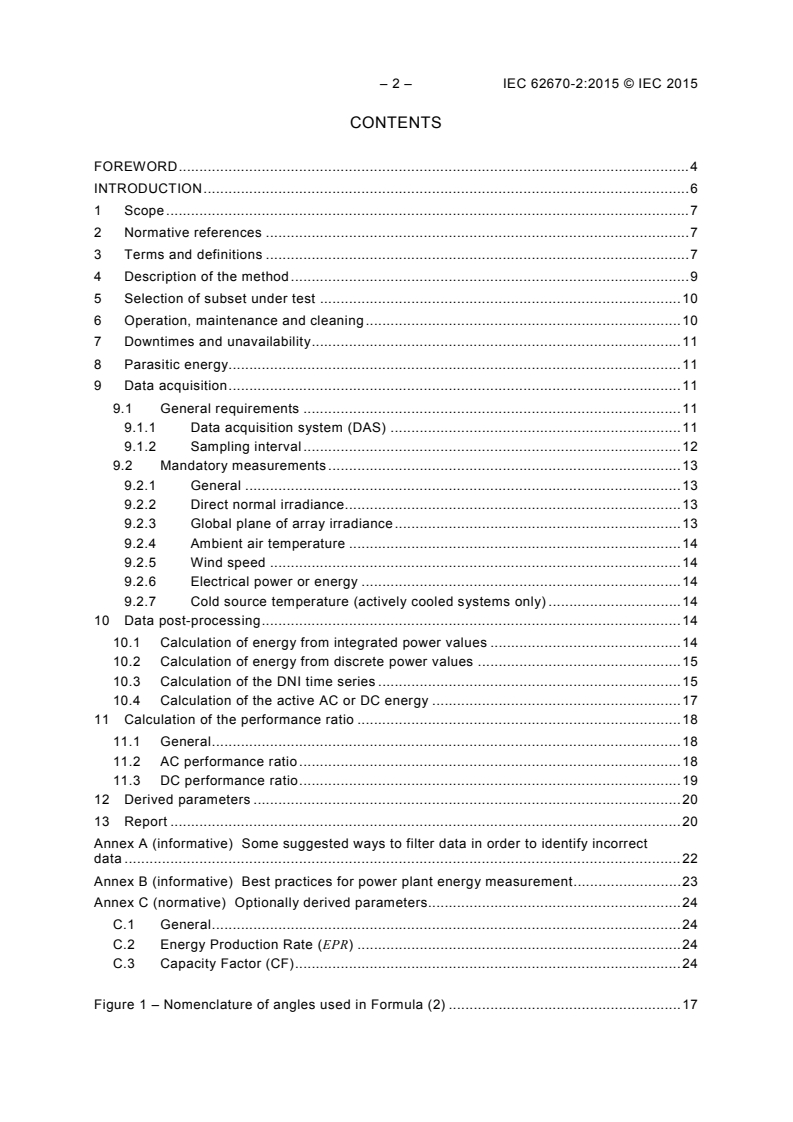
CONTENTS
FOREWORD . 4
INTRODUCTION . 6
1 Scope . 7
2 Normative references . 7
3 Terms and definitions . 7
4 Description of the method . 9
5 Selection of subset under test . 10
6 Operation, maintenance and cleaning . 10
7 Downtimes and unavailability . 11
8 Parasitic energy. 11
9 Data acquisition . 11
9.1 General requirements . 11
9.1.1 Data acquisition system (DAS) . 11
9.1.2 Sampling interval . 12
9.2 Mandatory measurements . 13
9.2.1 General . 13
9.2.2 Direct normal irradiance. 13
9.2.3 Global plane of array irradiance . 13
9.2.4 Ambient air temperature . 14
9.2.5 Wind speed . 14
9.2.6 Electrical power or energy . 14
9.2.7 Cold source temperature (actively cooled systems only) . 14
10 Data post-processing . 14
10.1 Calculation of energy from integrated power values . 14
10.2 Calculation of energy from discrete power values . 15
10.3 Calculation of the DNI time series . 15
10.4 Calculation of the active AC or DC energy . 17
11 Calculation of the performance ratio . 18
11.1 General . 18
11.2 AC performance ratio . 18
11.3 DC performance ratio . 19
12 Derived parameters . 20
13 Report . 20
Annex A (informative) Some suggested ways to filter data in order to identify incorrect
data . 22
Annex B (informative) Best practices for power plant energy measurement . 23
Annex C (normative) Optionally derived parameters. 24
C.1 General . 24
C.2 Energy Production Rate (EPR) . 24
C.3 Capacity Factor (CF) . 24
Figure 1 – Nomenclature of angles used in Formula (2) . 17
Table 1 – Steps of the energy measurement procedure . 10
Table 2 – Mandatory measurements. . 13
– 4 – IEC 62670-2:2015 © IEC 2015
INTERNATIONAL ELECTROTECHNICAL COMMISSION
____________
PHOTOVOLTAIC CONCENTRATORS (CPV) –
PERFORMANCE TESTING –
Part 2: Energy measurement
FOREWORD
1) The International Electrotechnical Commission (IEC) is a worldwide organization for standardization comprising
all national electrotechnical committees (IEC National Committees). The object of IEC is to promote
international co-operation on all questions concerning standardization in the electrical and electronic fields. To
this end and in addition to other activities, IEC publishes International Standards, Technical Specifications,
Technical Reports, Publicly Available Specifications (PAS) and Guides (hereafter referred to as “IEC
Publication(s)”). Their preparation is entrusted to technical committees; any IEC National Committee interested
in the subject dealt with may participate in this preparatory work. International, governmental and non-
governmental organizations liaising with the IEC also participate in this preparation. IEC collaborates closely
with the International Organization for Standardization (ISO) in accordance with conditions determined by
agreement between the two organizations.
2) The formal decisions or agreements of IEC on technical matters express, as nearly as possible, an international
consensus of opinion on the relevant subjects since each technical committee has representation from all
interested IEC National Committees.
3) IEC Publications have the form of recommendations for international use and are accepted by IEC National
Committees in that sense. While all reasonable efforts are made to ensure that the technical content of IEC
Publications is accurate, IEC cannot be held responsible for the way in which they are used or for any
misinterpretation by any end user.
4) In order to promote international uniformity, IEC National Committees undertake to apply IEC Publications
transparently to the maximum extent possible in their national and regional publications. Any divergence
between any IEC Publication and the corresponding national or regional publication shall be clearly indicated in
the latter.
5) IEC itself does not provide any attestation of conformity. Independent certification bodies provide conformity
assessment services and, in some areas, access to IEC marks of conformity. IEC is not responsible for any
services carried out by independent certification bodies.
6) All users should ensure that they have the latest edition of this publication.
7) No liability shall attach to IEC or its directors, employees, servants or agents including individual experts and
members of its technical committees and IEC National Committees for any personal injury, property damage or
other damage of any nature whatsoever, whether direct or indirect, or for costs (including legal fees) and
expenses arising out of the publication, use of, or reliance upon, this IEC Publication or any other IEC
Publications.
8) Attention is drawn to the Normative references cited in this publication. Use of the referenced publications is
indispensable for the correct application of this publication.
9) Attention is drawn to the possibility that some of the elements of this IEC Publication may be the subject of
patent rights. IEC shall not be held responsible for identifying any or all such patent rights.
International Standard IEC 62670-2 has been prepared by IEC technical committee 82: Solar
photovoltaic energy systems.
The text of this standard is based on the following documents:
FDIS Report on voting
82/940/FDIS 82/969/RVD
Full information on the voting for the approval of this standard can be found in the report on
voting indicated in the above table.
This publication has been drafted in accordance with the ISO/IEC Directives, Part 2.
A list of all parts in the IEC 62670 series, published under the general title Photovoltaic
Concentrators (CPV) – Performance testing, can be found on the IEC website.
The committee has decided that the contents of this publication will remain unchanged until
the stability date indicated on the IEC web site under "http://webstore.iec.ch" in the data
related to the specific publication. At this date, the publication will be
• reconfirmed,
• withdrawn,
• replaced by a revised edition, or
• amended.
IMPORTANT – The 'colour inside' logo on the cover page of this publication indicates
that it contains colours which are considered to be useful for the correct
understanding of its contents. Users should therefore print this document using a
colour printer.
– 6 – IEC 62670-2:2015 © IEC 2015
INTRODUCTION
IEC 62670 series establishes requirements for evaluating concentrator PV performance. It is
written to be applicable to all concentrator PV technologies that have a geometric
concentration ratio greater than 3× and require tracking.
Included in the IEC 62670 series of standards are definitions of the standard conditions and
methods to be used for assessing CPV performance.
IEC 62670-1 defines a standard set of conditions so that power ratings noted on data sheets
and nameplates have a standard basis.
IEC 62670-2 describes an on-sun, measurement based method for determining the energy
output and performance ratio for CPV arrays, assemblies and power plants.
IEC 62670-3 (under consideration) describes methods for providing a CPV power assessment
under a set of standard conditions, enabling assessments both indoors and outdoors.
IEC 62670-4 (under consideration) describes methods for calculating the prospective
electrical energy output of CPV modules, arrays, assemblies and power plants based on the
measurements carried out in IEC 62670-2.
PHOTOVOLTAIC CONCENTRATORS (CPV) –
PERFORMANCE TESTING –
Part 2: Energy measurement
1 Scope
This part of IEC 62670 specifies the minimum requirements for determining the energy output
and performance ratio for CPV modules, arrays, assemblies and power plants using an on-
sun, measurement based method.
The purpose of this International Standard is to define testing methods, to establish a
standard energy measurement for CPV modules, arrays, assemblies and power plants, and to
specify the minimum reporting information.
2 Normative references
The following documents, in whole or in part, are normatively referenced in this document and
are indispensable for its application. For dated references, only the edition cited applies. For
undated references, the latest edition of the referenced document (including any
amendments) applies.
IEC 62670-1, Photovoltaic concentrators (CPV) – Performance testing – Part 1: Standard
conditions
ISO/IEC 17025, General requirements for the competence of testing and calibration
laboratories
ISO 8601:2004, Data elements and interchange formats – Information interchange –
Representation of dates and times
ISO 9060, Solar energy – Specification and classification of instruments for measuring
hemispherical solar and direct solar radiation
ISO 9847, Solar energy – Calibration of field pyranometers by comparison to a reference
pyranometer
JCGM 100:2008, Evaluation of measurement data – Guide to the expression of uncertainty in
measurement
3 Terms and definitions
For the purposes of this document, the following terms and definitions apply:
3.1
active AC energy
real AC energy (excluding reactive energy)
– 8 – IEC 62670-2:2015 © IEC 2015
3.2
actively cooled
CPV system that requires some type of media (fluid, gas, etc.) to facilitate the transfer of
thermal energy from one body to another. This could be by means of force air, pumps,
thermo-electric cooler, gas transfer or any other means not covered by passive cooling.
3.3
concentrator
qualifies photovoltaic devices or systems that use concentrated sunlight
Note 1 to entry: Concentrator photovoltaic technology is usually designated as CPV.
3.4
concentrator optics
optical component that performs one or more of the following functions from its input to
output: increasing the light intensity, filtering the spectrum, modifying light intensity
distribution, or changing light direction
Note 1 to entry: Typically, it is a (refractive) lens or a (reflective) mirror. A primary optic receives un-concentrated
sunlight directly from the sun. A secondary optic receives concentrated or modified sunlight from a primary optic
and directs it to a cell or a tertiary optic.
3.5
coolant
fluid, gas or other media that is circulated through or around a CPV device and transfers the
thermal energy out of the device
3.6
CPV receiver
group of one or more solar cells and secondary optics (if present) that accepts concentrated
sunlight and incorporates the means for thermal and electric energy transfer
Note 1 to entry: A receiver can be made of several sub-receivers.
3.7
CPV module
group of receivers, optics, and other related components, such as interconnection and
mounting, that accepts un-concentrated sunlight
Note 1 to entry: All above components are usually prefabricated as one unit, and the focus point is not field-
adjustable.
3.8
CPV array
group of modules mounted on a tracking device and electrically interconnected
Note 1 to entry: Examples are illustrated in IEC 62108.
3.9
CPV assembly
group of receivers, optics, and other related components, such as interconnects and mounts,
that accepts un-concentrated sunlight
Note 1 to entry: All above components would usually be shipped separately and need some field installation, and
the focus point is field-adjustable.
3.10
CPV power plant
group of CPV assemblies or CPV arrays electrically interconnected to provide output power to
a load
3.11
data acquisition system
DAS
system that typically measures analog values, converts them to digital values and stores them
3.12
device under test
DUT
CPV module(s), array(s), assembly/assemblies or power plant(s) the procedure described in
this International Standard is applied to
3.13
direct normal irradiance
DNI
irradiance received from a small solid angle centered on the sun’s disc on a plane
perpendicular to the sun’s rays
3.14
direct plane of array irradiance
DPOAI
irradiance received from a small solid angle centered on the sun’s disc in the plane of the
CPV array
3.15
global plane of array irradiance
GPOAI
total irradiance received from the sun as a combination of direct normal irradiance and all
forms of diffuse light in the plane of the PV array
3.16
gross power/energy
is equal to the net power/energy plus the parasitic power/energy
3.17
net power/energy
is equal to the gross power/energy minus the parasitic power/energy
3.18
normal incidence pyrheliometer
NIP
radiometer designed for measuring the direct irradiance as described in ISO 9060
3.19
parasitic power/energy
power/energy used by the CPV power plant to operate including, but not restricted to, the
power and energy used for tracking, control, cooling, drying, measurement, and data
acquisition
3.20
passively cooled
cooling with a device that does not require an active energy supply
4 Description of the method
The method of energy measurement of a CPV system is shown in Table 1.
– 10 – IEC 62670-2:2015 © IEC 2015
Table 1 – Steps of the energy measurement procedure
Step Action
1 Select and describe DUT
2 Describe site, location, surroundings
3 Check calibration of DAS, install DAS
4 Start measurements
a b b b
Mandatory: Time, DNI, GPOAI , gross power/energy , parasitic power/energy , net power/energy ,
ambient temperature, wind speed
Optionally: Module/receiver temperature, voltage(s), current(s), coolant temperature, wind direction,
air humidity
5 Conduct and document operation and maintenance program, e.g. cleaning of modules and NIPs,
greasing, tightening of chains
Update logbook, e.g. on rainfall events or unscheduled maintenance events
6 Stop measurements
7 Recheck DAS
8 Inspect recorded measurements in order to identify incorrect data, determine DNI time series used to
calculate the DNI energy
9 Calculate the DNI energy, gross energy, net energy, uncertainty values, performance ratio, optionally
derived parameters
10 Create report
a
Mandatory for systems that have a geometric concentration ratio of less than 10×.
b
At least two of the three quantities need to be measured in order to calculate the third quantity.
5 Selection of subset under test
For the energy measurement of a CPV power plant, all components of the system that will be
installed with the modules shall be incorporated, so that all parasitic loads of the system are
present for the measurement. At times, it may be useful to apply the procedure to a subset of
a power plant. In this case, the report shall document the subset that was chosen and the
rationale for the choice.
6 Operation, maintenance and cleaning
The CPV modules, arrays, assemblies or power plant shall be operated as suggested by the
manufacturer. If the DUT is actively cooled, the flow rate of the coolant and the coolant
composition shall be set as suggested by the manufacturer. The flow rate and coolant
composition shall be recorded in the testing report.
The scheduled maintenance program as suggested by the manufacturer for all components of
the power plant shall be observed, including but not limited to cleaning, greasing, tightening of
chains and scheduled change of parts. In particular, cleaning of modules/concentrator optics
shall be done at the same frequency as suggested by the manufacturer. In the absence of a
suggested frequency, the cleaning of concentrator optics will be performed at a reasonable
frequency according to the site conditions.
All scheduled and unscheduled maintenance and cleaning activities shall be noted in the
report in detail including time and duration of each event. For each cleaning event it shall be
noted whether all of the modules/concentrator optics or only a part thereof were cleaned. In
case of a partial cleaning the cleaned part shall be specified unambiguously, e.g. by providing
the module or tracker identifiers of the cleaned part.
The NIPs should be cleaned ideally daily, but shall be cleaned at least once per week and
each cleaning event shall be noted including time and duration in the report.
7 Downtimes and unavailability
All periods of non-functionality of either the CPV modules, arrays, assemblies or power plant
or the sensors or the DAS shall be noted including time and duration and if possible the cause
in the report.
8 Parasitic energy
The measurement shall accurately include the parasitic energy consumed by the DUT.
Parasitic energy includes, but is not restricted to:
– Energy consumed by the tracking system, including the energy consumed for coming on
track, going to stow, and parking the CPV system at night.
– Energy consumed by the control system.
– Energy consumed by the drying system where relevant.
– Energy consumed by the cooling pumps and cooling fans, including the cooling of the
inverters, where relevant.
– Energy consumed by the electrical equipment such as inverters, transformers and switch
gear.
– Energy consumed by the air conditioning or cooling system in the control room and in the
inverter room of the power plant where relevant.
All energy consumed by monitoring and data acquisition equipment not essential for the
operation of the power plant shall be considered part of the load and shall not be considered
as parasitic energy. If only one or a few modules, arrays or assemblies within a power plant
are tested following this International Standard, the parasitic energy drawn by the complete
power plant will be divided by the total number of modules, arrays or assemblies in the power
plant and multiplied by the number of modules, arrays or assemblies under test.
In cases where parasitic energy is consumed intermittently, e.g. the energy used by the
tracking system, particular attention shall be paid to ensuring accurate measurement. When in
doubt, the maximum possible parasitic energy shall be used. Details of the calculation will be
included in the testing report.
9 Data acquisition
9.1 General requirements
9.1.1 Data acquisition system (DAS)
9.1.1.1 General
An automatic, microprocessor-based, DAS is required for this standard. The total uncertainty
of the DAS shall be determined using JCGM 100:2008 as guidance and by checks as laid out
below and detailed in the test report.
The DAS excluding sensors can be checked by applying the simulated input signals specified
below, or by other means agreed upon between the manufacturer and the customer. The
calibrations shall be checked at the beginning and the end of the test. If the check identifies
that the calibration has drifted outside of the specification, an assessment of the associated
uncertainty/error shall be completed and included in the report.
The channels of the DAS can be checked separately or at the same time.
– 12 – IEC 62670-2:2015 © IEC 2015
9.1.1.2 Types of input signals to be checked
– Direct Normal Irradiance power density
– Ambient air temperature
– Wind speed
– Gross power/energy
– Parasitic power/energy
– Net power/energy
– Coolant temperature; only mandatory for actively cooled systems. If optional
measurements are taken, the corresponding input signals shall be checked accordingly.
9.1.1.3 Check of linear response
This check is to be performed on analog input channels on which a linear scaling operation is
applied. A constant DC or AC (as appropriate) signal shall be applied to the input terminals.
The difference between the result measured by the DAS and the products of the input signal
value and scaling factor shall be less than ±1 % of the full scale of the DAS. This procedure
should be performed at input signals of 0 %, 20 %, 40 %, 60 %, 80 %, and 100 % of full scale.
If the inputs are specified for bipolar signals, negative signals shall also be applied in the
same way. If errors greater than 1 % of full scale are detected, then the scale factor should be
corrected by software or hardware and re-verified.
9.1.1.4 Check of stability
This check is to be performed on all analog input channels. A constant DC signal of 100 % of
full scale shall be applied to the input terminals for 6 h. The fluctuation of the measured value
of this signal shall be kept within ±1 % of full scale. Should the fluctuation of the input signal
exceed ±0,2 %, the results shall be compensated by using a voltmeter with uncertainty of less
than ±0,2 %.
9.1.1.5 Check of integration
This check is to be performed on input channels from which measurements are to be
processed using an averaging or integrating operation. An input signal of a rectangular wave
having an amplitude Z shall be applied to the channel and its measured values integrated
m
over time period τ (recommended to be at least 6 h). The amplitude Z for each channel is
d m
recommended to be the maximum input level expected from the sensor. The results obtained
shall be equal to Z × τ ± 1 %. The amplitude and time period shall be monitored by
m d
measuring instruments with a ±0,5 % precision.
9.1.1.6 Check of zero value integrals
This check is to be performed on input channels from which measurements are to be
processed using an averaging or integrating operation. The channel shall be short-circuited,
and its measured values integrated over time period τ of at least 6 h. The result shall be
d
±1 % of Z × τ where Z is defined in 9.1.1.5.
m d m
9.1.2 Sampling interval
The sampling interval for measurands that vary directly with DNI power density shall be 60 s
or less. For measurands which have larger time constants, a larger sampling may be selected
if necessary, but shall be 5 min or less. For each measured value the time and date shall be
recorded in the format defined in the ISO 8601 standard: YYYY-MM-DDThh:mm:ss.sTZD
(e.g. 1997-07-16T19:20:30.45+01:00)
Where:
YYYY = four-digit year
MM = two-digit month (01=January, etc.)
DD = two-digit day of month (01 through 31, UTC)
hh = two digits of hour (00 through 23, UTC) (am/pm NOT allowed)
mm = two digits of minute (00 through 59, UTC)
ss = two digits of second (00 through 59)
s = one or more digits representing a decimal fraction of a second
TZD = time zone designator (+hh:mm or -hh:mm offset from UTC for local winter time)
9.2 Mandatory measurements
9.2.1 General
The measurements to be taken with the DAS are given in Table 2.
Table 2 – Mandatory measurements.
Quantity Unit or format Comment
Date and time YYYY-MM-DDThh:mm:ss.sTZD As defined in ISO 8601
–2
Direct Normal Irradiance power W⋅m
density
–2
Global plane of array (GPOAI) W⋅m Only mandatory for systems that
power density have a geometric concentration
ratio of less than 10×
Ambient air temperature °C
–1
Wind speed
m⋅s
Gross power/energy W (power) or Wh (energy) At least two of these three
quantities need to be measured in
Parasitic power/energy W (power) or Wh (energy)
order to calculate the third quantity
Net power/energy W (power) or Wh (energy)
Additional measurements may be taken for diagnostic purposes.
9.2.2 Direct normal irradiance
The direct normal irradiance power density shall be measured with at least two calibrated
NIPs fulfilling at least the first class requirements according to ISO 9060. The total uncertainty
of the Direct Normal Irradiance power density measurements shall be determined. It shall be
below 3 %.
The two, or, preferably, more, NIPs shall be mounted in a way to reduce periods of shading to
a minimum, for example by mounting one NIP on the east side and the other on the west side.
The raw values of all NIPs shall be recorded for determination of the DNI time series in 10.3.
The angular range of the tracker(s) carrying the NIPs should allow for tracking the sun under
any elevation and azimuth angle occurring at the site. Any DNI energy not measured due to a
possibly limited angular range of the tracker(s) shall be assessed in the report.
9.2.3 Global plane of array irradiance
The global plane of array irradiance power density shall be measured with at least two
calibrated pyranometers fulfilling at least the first class requirements according to ISO 9847.
The total uncertainty of the global plane of array irradiance power density measurements shall
be determined. It shall be below 3 %. It is not necessary to obtain global plane of array
irradiance measurements if the geometric concentration ratio of the CPV system being
considered is more than 10×.
– 14 – IEC 62670-2:2015 © IEC 2015
The two, or, preferably, more, pyranometers shall be mounted directly into the plane of the
CPV array so that it shall not cause shading onto any CPV module.
If the global plane of array irradiance is measured on a 1-axis tracker that is not always
aligned with the sun, it shall be assessed whether it is acceptable to use the irradiance data
from the stopped tracker. The assessment shall be included in the report.
9.2.4 Ambient air temperature
The ambient air temperature shall be measured at 2 m height above ground with a sensor in
the shade or protected from radiation by a reflective shield. The uncertainty of the ambient
temperature shall be determined. It shall be ±1 °C or smaller.
9.2.5 Wind speed
Wind speed shall be measured at a height and location that is representative of the conditions
of the DUT. The total uncertainty of the wind speed measurements shall be determined. It
–1 –1
shall be 0,5 m⋅s or smaller for wind speed <5 m⋅s and 10 % of the reading or smaller for
–1
wind speeds greater than 5 m⋅s .
9.2.6 Electrical power or energy
At least two quantities of gross, net and parasitic power or energy need to be measured in
order to calculate the third quantity.
For the energy measurement the electrical DC energy or active AC energy produced by the
DUT needs to be determined. It shall either be measured directly using an energy meter or
indirectly by measuring the electrical power and conducting an integration to calculate the
electrical energy as described in 10.4. The total uncertainty of the power or energy
measurements shall be determined. It shall be below 2 %.
9.2.7 Cold source temperature (actively cooled systems only)
The cold source temperature shall be measured by means of one or more temperature
sensor(s) at a location that is representative of the array conditions. The uncertainty of the
cold source temperature shall be determined. It shall be ±1 °C or smaller. The cold source
temperature shall be recorded during the entire testing period. The cold source temperature to
be considered is either:
– the air ambient temperature in the shade if active cooling is used and if the final heat
exchange is with air, or
– the water temperature in the reservoir if active cooling is used with a large reservoir (e.g.
pond, tank, pool) of water.
If the temperature of the cold source is not accessible, the temperature of the coolant at its
coolest point shall be recorded.
10 Data post-processing
10.1 Calculation of energy from integrated power values
In the case that the DAS offers a built in integration routine, the energy E for the period from
t to t shall be calculated as shown in Formula (1).
0 n
E = E(t ) – E(t ) (1)
n 0
If power was generated and recorded by the built in integration routine during a time when
irradiance data is unavailable, this shall be documented in the report along with the method
that was used to either reduce the output energy or increase the estimated solar resource to
most accurately account for this time period.
10.2 Calculation of energy from discrete power values
In case that the DAS does not offer a built in integration routine, the energy E for the period
from t to t shall be calculated from the discrete power values using a numerical integration
0 n
algorithm that ensures a small integration error.
Special attention shall be paid to gaps in the power time series. A time interval larger than
150 % of the regular time interval between two data points has been proven as a reasonable
criterion for identifying the beginning and the end of a gap. The integration algorithm shall
recognize gaps and shall exclude them from the calculation. Gaps shall not be filled with
unreasonable values, which could potentially result, e.g. from a linear interpolation between
the boundaries of the gap.
For the calculation of the performance ratio as described in Clause 11 it is of high importance
to exclude all periods during a gap that occurred either in the DNI time series, or in the AC/DC
power time series, or in both, in order to avoid misleading results.
10.3 Calculation of the DNI time series
Before the DNI time series is calculated, all periods during which active AC or DC energy
measurements are not available (e.g. due to unavailability of the energy measurement
system, outage of the grid, or other event that does not represent failure of the system itself)
shall be removed in order to avoid an underestimation of the performance ratio. The effect of
the unavailability of the data shall be summarized in the report.
Afterwards, the DNI time series shall be calculated from the two, or, preferably, more, NIPs
mounted in a way to reduce periods of shading to a minimum as described in 9.2.2. Every
data set is different and the method of identifying problematic data may need to be adjusted.
Some strategies are suggested in Annex A. The exact algorithms used for
screening/analyzing the data shall be adjusted to attempt to address the following:
– All sensors shall be maintained in calibration. Inaccurate data shall be discarded.
Nighttime data shall also be reviewed for evidence of appropriate function of each sensor.
– Similarly, remove any sensor data that was impacted by events such as cleaning of the
sensor, tracker failure (if a tracker malfunctions, the loss of electricity production shall be
recorded, but the irradiance measurement shall not be reduced; instead, irradiance data
shall be taken from a tracker that was functioning correctly), shading, or other
maintenance events.
– To define the final irradiance data, either use data from a single sensor, or average all
data that has been determined to be uncompromised.
– In general, there will always be some data points that are difficult to identify as reflecting
cloud transients or other anomalies. As long as the fraction of data affected in this way is
<0,1 % of the total data, these do not need to be fully documented in the report. However,
the fraction of the data identified as suspicious shall be identified, and, if the fraction
exceeds 0,1 %, then the report shall describe the data that was flagged and possible
causes identified.
– Similarly, if 100 % of the irradiance sensors are shaded or not aligned correctly with the
sun for more than 15 min within sunrise and sunset, an estimate shall be made of the
uncertainty associated with this omission of data.
– Data discrepancies are handled in one of three ways:
• If the cause of incorrect data can be identified to be sensor malfunction (examples
include: loss of electrical connection, evidence of condensation or snow in or on
– 16 – IEC 62670-2:2015 © IEC 2015
sensor, or daytime shading) or daytime shading, such data is flagged for omission from
further calculations.
• Irradiance data that is a) flagged as a discrepancy, b) of unknown cause, and c)
deviates from the average by being lower than the average is also omitted from further
calculations.
• Irradiance data that is a) flagged as a discrepancy, b) of unknown cause, and c)
deviates from the average by being higher than the average is retained and included in
further calculations.
– If there are time steps for which all irradiance data has been flagged as shaded or as
incorrect, these time periods are omitted from the final calculations of both irradiance and
energy generated and are documented as such in the report.
The DNI energy density E shall be calculated according to 10.2 from the time series of (as
DNI
just described) DNI values.
For CPV products where the manufacturer specifies use of 1-axis trackers, the available
irradiance energy density E shall be calculated according to 10.2 from the time series of
DPOAI
). The time series of P is calculated from the
the Direct Plane of Array Irradiance (P
DPOAI DPOAI
with (see Figure 1):
measured DNI time series according to Formula (2)
θ = solar zenith angle
z
β = tilt angle of the array
γ = solar azimuth angle
s
γ = array azimuth angle
( )
P = P ⋅ cos AOI
DPOAI DNI
(2)
cos(AOI)= cos(θ )cos(β)+ sin(θ )sin(β)cos(γ −γ)
z z s
____________
See C.W. Hansen, J.S. Stein and A. Ellis, "Simulation of One-Minute Power Output from Utility-Scale
Photovoltaic Generation Systems", Sandia Report, SAND2011-5529.
Zenith
θ
z
α
s
N
W
β
γ
s
γ
S
E
IEC
Figure 1 – Nomenclature of angles used in Formula (2)
For systems that have a geometric concentration ratio of less than 10×, the total power
density for the available solar resource shall also include the amount of diffuse capture of the
CPV system as described in Formula (3), where f is the percentage of diffuse capture which
D
is to be determined by a method external to this standard. A future IEC standard or technical
specification will address how the diffuse capture percentage is to be determined
experimentally. For such systems the total available irradiance energy E shall be
TOTAL
calculated according to 10.2 from the time series of the P time series.
TOTAL
P = P + f ⋅(P − P ) [
...