

IEC 62236-4:2003
(Main)Railway applications - Electromagnetic compatibility - Part 4: Emission and immunity of the signalling and telecommunications apparatus
General Information
- Abstract
Specifies limits for electromagnetic emission and immunity for signalling and telecommunications apparatus.
- Status
- Published
- Publication Date
- 23-Apr-2003
- Technical Committee
- TC 9 - Electrical equipment and systems for railways
- Current Stage
- DELPUB - Deleted Publication
- Start Date
- 12-Dec-2008
- Completion Date
- 28-Aug-2026
Overview
IEC 62236-4:2003 is an internationally recognized standard developed by the International Electrotechnical Commission (IEC) focused on railway applications related to electromagnetic compatibility (EMC). Specifically, Part 4 addresses the emission and immunity requirements for signalling and telecommunications apparatus installed in railway environments. This standard aims to ensure that signalling and telecommunications devices operate reliably without causing or being affected by electromagnetic disturbances within railway systems.
Compliance with IEC 62236-4 helps railway operators and manufacturers maintain safe, reliable communication and signalling operations by defining essential EMC test methods and limits. It is part of the broader IEC 62236 series, which covers various facets of railway EMC including rolling stock and fixed power installations.
Key Topics
Scope and Purpose
IEC 62236-4 applies to signalling and telecommunications equipment installed in railway settings (except those mounted within trains which are covered by IEC 62236-3-2). It prescribes both emission limits and immunity criteria to minimize electromagnetic interference in the railway environment.Emission Limits
The standard defines maximum allowable electromagnetic emissions from signalling and telecom apparatus to prevent interference with other railway systems and external equipment. These limits align with related standards such as IEC 61000-6-4, ensuring emissions remain within safe bounds.Immunity Requirements
To ensure operational integrity, the standard specifies immunity test methods that equipment must pass. These tests simulate realistic electromagnetic disturbances expected in rail environments, such as power frequency interference, to verify device resilience.Testing and Compliance
Detailed tests are set for each interface or "port" of the apparatus. The standard emphasizes the importance of evaluating immunity and emissions based on actual railway electromagnetic disturbances rather than generic environments.Special Considerations
IEC 62236-4 notes that safety issues are outside its scope, and in exceptional scenarios with elevated disturbing sources (e.g., proximity to portable transmitters), additional mitigation measures should be applied.
Applications
Railway Signalling Systems
Ensuring reliable function of signalling apparatus by controlling electromagnetic emissions and guaranteeing immunity from external interference helps maintain safe train operations and prevents signalling faults.Telecommunication Equipment in Railways
Railway telecom devices such as communication consoles, data transmission units, and associated apparatus benefit from standardized EMC requirements to maintain clear and reliable communications.Rail Infrastructure Installations
Fixed installations in stations, control centres, and trackside equipment can be designed and tested per this standard to reduce electromagnetic disturbances in the railway environment.Interoperability and Compliance
Manufacturers and integrators can achieve international acceptance for their railway signalling and telecom equipment by conforming to IEC 62236-4, facilitating smoother deployment and regulatory compliance.
Related Standards
IEC 62236 Series
- Part 1: General principles of railway EMC
- Part 2: Emission from the entire railway system to the external environment
- Part 3-1: Rolling stock – complete trains and vehicles
- Part 3-2: Rolling stock – apparatus (including onboard devices)
- Part 5: Fixed power supply installations and associated apparatus
IEC 61000-6-4
Addresses industrial electromagnetic emission standards referenced within IEC 62236-4 as applicable emission limits.EN 50121-4
The European standard on railway EMC emission and immunity for signalling and telecom apparatus upon which IEC 62236-4 is based.
Practical Value
By adhering to IEC 62236-4:2003, railway operators and suppliers can:
- Reduce electromagnetic interference risks that could compromise signalling or telecom systems.
- Ensure equipment robustness against electromagnetic disturbances commonly found in railway environments.
- Obtain consistent and internationally harmonized testing criteria to demonstrate equipment performance.
- Enhance safety, reliability, and interoperability of railway signalling and communication systems.
This standard is a critical component in maintaining the integrity and safety of railway systems worldwide by controlling the electromagnetic environment in which crucial signalling and telecommunications apparatus operate.
Keywords: IEC 62236-4, electromagnetic compatibility, EMC, railway signalling apparatus, railway telecommunications, emission limits, immunity requirements, railway applications, IEC standards, railway EMC testing.
Relations
- Effective Date
- 05-Sep-2023
Get Certified
Connect with accredited certification bodies for this standard

IRIS Certification (UNIFE)
International Railway Industry Standard certification.

TÜV SÜD Rail GmbH
TÜV SÜD railway certification services.

ANCE
Mexican certification and testing association.
Sponsored listings
Frequently Asked Questions
IEC 62236-4:2003 is a standard published by the International Electrotechnical Commission (IEC). Its full title is "Railway applications - Electromagnetic compatibility - Part 4: Emission and immunity of the signalling and telecommunications apparatus". This standard covers: Specifies limits for electromagnetic emission and immunity for signalling and telecommunications apparatus.
Specifies limits for electromagnetic emission and immunity for signalling and telecommunications apparatus.
IEC 62236-4:2003 is classified under the following ICS (International Classification for Standards) categories: 33.100 - Electromagnetic compatibility (EMC); 45.060.01 - Railway rolling stock in general. The ICS classification helps identify the subject area and facilitates finding related standards.
IEC 62236-4:2003 has the following relationships with other standards: It is inter standard links to IEC 62236-4:2008. Understanding these relationships helps ensure you are using the most current and applicable version of the standard.
IEC 62236-4:2003 is available in PDF format for immediate download after purchase. The document can be added to your cart and obtained through the secure checkout process. Digital delivery ensures instant access to the complete standard document.
Standards Content (Sample)
NORME CEI
INTERNATIONALE IEC
62236-4
INTERNATIONAL
Première édition
STANDARD
First edition
2003-04
Applications ferroviaires –
Compatibilité électromagnétique –
Partie 4:
Emission et immunité des appareils
de signalisation et de télécommunication
Railway applications –
Electromagnetic compatibility –
Part 4:
Emission and immunity of the signalling
and telecommunications apparatus
Numéro de référence
Reference number
CEI/IEC 62236-4:2003
Numérotation des publications Publication numbering
Depuis le 1er janvier 1997, les publications de la CEI As from 1 January 1997 all IEC publications are
sont numérotées à partir de 60000. Ainsi, la CEI 34-1 issued with a designation in the 60000 series. For
devient la CEI 60034-1. example, IEC 34-1 is now referred to as IEC 60034-1.
Editions consolidées Consolidated editions
Les versions consolidées de certaines publications de la The IEC is now publishing consolidated versions of its
CEI incorporant les amendements sont disponibles. Par publications. For example, edition numbers 1.0, 1.1
exemple, les numéros d’édition 1.0, 1.1 et 1.2 indiquent and 1.2 refer, respectively, to the base publication,
respectivement la publication de base, la publication de the base publication incorporating amendment 1 and
base incorporant l’amendement 1, et la publication de the base publication incorporating amendments 1
base incorporant les amendements 1 et 2. and 2.
Informations supplémentaires Further information on IEC publications
sur les publications de la CEI
Le contenu technique des publications de la CEI est The technical content of IEC publications is kept
constamment revu par la CEI afin qu'il reflète l'état under constant review by the IEC, thus ensuring that
actuel de la technique. Des renseignements relatifs à the content reflects current technology. Information
cette publication, y compris sa validité, sont dispo- relating to this publication, including its validity, is
nibles dans le Catalogue des publications de la CEI available in the IEC Catalogue of publications
(voir ci-dessous) en plus des nouvelles éditions, (see below) in addition to new editions, amendments
amendements et corrigenda. Des informations sur les and corrigenda. Information on the subjects under
sujets à l’étude et l’avancement des travaux entrepris consideration and work in progress undertaken by the
par le comité d’études qui a élaboré cette publication, technical committee which has prepared this
ainsi que la liste des publications parues, sont publication, as well as the list of publications issued,
également disponibles par l’intermédiaire de: is also available from the following:
• Site web de la CEI (www.iec.ch) • IEC Web Site (www.iec.ch)
• Catalogue des publications de la CEI • Catalogue of IEC publications
Le catalogue en ligne sur le site web de la CEI The on-line catalogue on the IEC web site
(http://www.iec.ch/searchpub/cur_fut.htm) vous permet (http://www.iec.ch/searchpub/cur_fut.htm) enables
de faire des recherches en utilisant de nombreux you to search by a variety of criteria including text
critères, comprenant des recherches textuelles, par searches, technical committees and date of
comité d’études ou date de publication. Des publication. On-line information is also available
informations en ligne sont également disponibles sur on recently issued publications, withdrawn and
les nouvelles publications, les publications rempla- replaced publications, as well as corrigenda.
cées ou retirées, ainsi que sur les corrigenda.
• IEC Just Published • IEC Just Published
Ce résumé des dernières publications parues This summary of recently issued publications
(http://www.iec.ch/online_news/justpub/jp_entry.htm) (http://www.iec.ch/online_news/justpub/jp_entry.htm)
est aussi disponible par courrier électronique. is also available by email. Please contact the
Veuillez prendre contact avec le Service client Customer Service Centre (see below) for further
(voir ci-dessous) pour plus d’informations. information.
• Service clients • Customer Service Centre
Si vous avez des questions au sujet de cette If you have any questions regarding this
publication ou avez besoin de renseignements publication or need further assistance, please
supplémentaires, prenez contact avec le Service contact the Customer Service Centre:
clients:
Email: custserv@iec.ch Email: custserv@iec.ch
Tél: +41 22 919 02 11 Tel: +41 22 919 02 11
Fax: +41 22 919 03 00 Fax: +41 22 919 03 00
.
NORME CEI
INTERNATIONALE IEC
62236-4
INTERNATIONAL
Première édition
STANDARD
First edition
2003-04
Applications ferroviaires –
Compatibilité électromagnétique –
Partie 4:
Emission et immunité des appareils
de signalisation et de télécommunication
Railway applications –
Electromagnetic compatibility –
Part 4:
Emission and immunity of the signalling
and telecommunications apparatus
IEC 2003 Droits de reproduction réservés Copyright - all rights reserved
Aucune partie de cette publication ne peut être reproduite ni No part of this publication may be reproduced or utilized in any
utilisée sous quelque forme que ce soit et par aucun procédé, form or by any means, electronic or mechanical, including
électronique ou mécanique, y compris la photocopie et les photocopying and microfilm, without permission in writing from
microfilms, sans l'accord écrit de l'éditeur. the publisher.
International Electrotechnical Commission, 3, rue de Varembé, PO Box 131, CH-1211 Geneva 20, Switzerland
Telephone: +41 22 919 02 11 Telefax: +41 22 919 03 00 E-mail: inmail@iec.ch Web: www.iec.ch
CODE PRIX
S
Commission Electrotechnique Internationale PRICE CODE
International Electrotechnical Commission
Международная Электротехническая Комиссия
Pour prix, voir catalogue en vigueur
For price, see current catalogue
– 2 – 62236-4 CEI:2003
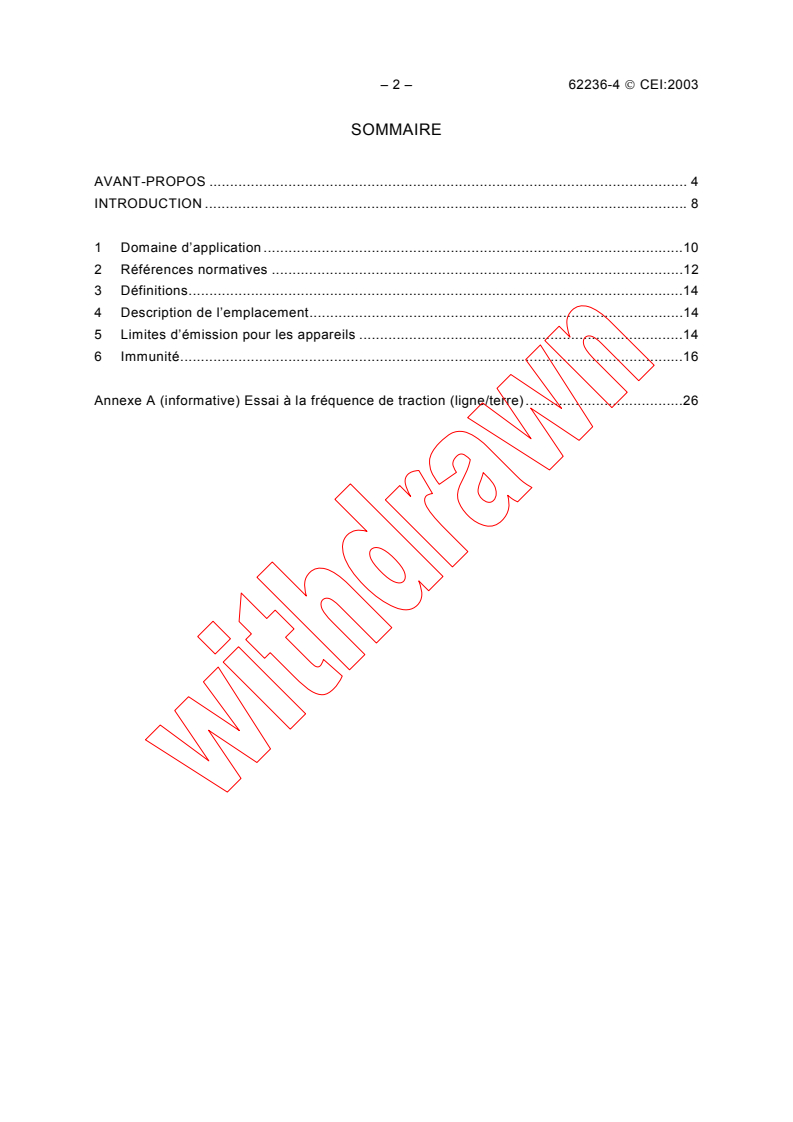
SOMMAIRE
AVANT-PROPOS . 4
INTRODUCTION .8
1 Domaine d’application .10
2 Références normatives .12
3 Définitions.14
4 Description de l’emplacement.14
5 Limites d’émission pour les appareils .14
6 Immunité.16
Annexe A (informative) Essai à la fréquence de traction (ligne/terre).26
62236-4 IEC:2003 – 3 –
CONTENTS
FOREWORD . 5
INTRODUCTION .9
1 Scope .11
2 Normative references.13
3 Definitions.15
4 Description of location.15
5 Emission limits for apparatus .15
6 Immunity.17
Annex A (informative) Traction frequency test (line to ground).27
– 4 – 62236-4 CEI:2003
COMMISSION ÉLECTROTECHNIQUE INTERNATIONALE
____________
APPLICATIONS FERROVIAIRES –
COMPATIBILITÉ ÉLECTROMAGNÉTIQUE –
Partie 4: Emission et immunité des appareils de signalisation
et de télécommunication
AVANT-PROPOS
1) La CEI (Commission Électrotechnique Internationale) est une organisation mondiale de normalisation composée
de l'ensemble des comités électrotechniques nationaux (Comités nationaux de la CEI). La CEI a pour objet de
favoriser la coopération internationale pour toutes les questions de normalisation dans les domaines de
l'électricité et de l'électronique. A cet effet, la CEI, entre autres activités, publie des Normes internationales.
Leur élaboration est confiée à des comités d'études, aux travaux desquels tout Comité national intéressé par le
sujet traité peut participer. Les organisations internationales, gouvernementales et non gouvernementales, en
liaison avec la CEI, participent également aux travaux. La CEI collabore étroitement avec l'Organisation
Internationale de Normalisation (ISO), selon des conditions fixées par accord entre les deux organisations.
2) Les décisions ou accords officiels de la CEI concernant les questions techniques représentent, dans la mesure
du possible, un accord international sur les sujets étudiés, étant donné que les Comités nationaux intéressés
sont représentés dans chaque comité d’études.
3) Les documents produits se présentent sous la forme de recommandations internationales. Ils sont publiés
comme normes, spécifications techniques, rapports techniques ou guides et agréés comme tels par les Comités
nationaux.
4) Dans le but d'encourager l'unification internationale, les Comités nationaux de la CEI s'engagent à appliquer de
façon transparente, dans toute la mesure possible, les Normes internationales de la CEI dans leurs normes
nationales et régionales. Toute divergence entre la norme de la CEI et la norme nationale ou régionale
correspondante doit être indiquée en termes clairs dans cette dernière.
5) La CEI n’a fixé aucune procédure concernant le marquage comme indication d’approbation et sa responsabilité
n’est pas engagée quand un matériel est déclaré conforme à l’une de ses normes.
6) L’attention est attirée sur le fait que certains des éléments de la présente Norme internationale peuvent faire
l’objet de droits de propriété intellectuelle ou de droits analogues. La CEI ne saurait être tenue pour
responsable de ne pas avoir identifié de tels droits de propriété et de ne pas avoir signalé leur existence.
La Norme internationale CEI 62236-4 a été établie par le comité d'études 9 de la CEI: Matériels
et systèmes électriques ferroviaires.
La présente Norme internationale est destinée à être utilisée conjointement avec la CEI 62236-1.
Elle a été soumise aux Comités nationaux pour vote suivant la procédure par voie express, par
les documents suivants:
FDIS Rapport de vote
9/733/FDIS 9/748/RVD
Le rapport de vote indiqué dans le tableau ci-dessus donne toute information sur le vote ayant
abouti à l'approbation de cette norme.
Cette norme est basée sur la norme EN 50121-4.
Cette norme ne suit pas les règles de structure des normes internationales comme le spécifie
la Partie 2 des Directives ISO/CEI.
62236-4 IEC:2003 – 5 –
INTERNATIONAL ELECTROTECHNICAL COMMISSION
____________
RAILWAY APPLICATIONS –
ELECTROMAGNETIC COMPATIBILITY –
Part 4: Emission and immunity of the signalling
and telecommunications apparatus
FOREWORD
1) The IEC (International Electrotechnical Commission) is a worldwide organization for standardization comprising
all national electrotechnical committees (IEC National Committees). The object of the IEC is to promote
international co-operation on all questions concerning standardization in the electrical and electronic fields. To
this end and in addition to other activities, the IEC publishes International Standards. Their preparation is
entrusted to technical committees; any IEC National Committee interested in the subject dealt with may
participate in this preparatory work. International, governmental and non-governmental organizations liaising
with the IEC also participate in this preparation. The IEC collaborates closely with the International Organization
for Standardization (ISO) in accordance with conditions determined by agreement between the two
organizations.
2) The formal decisions or agreements of the IEC on technical matters express, as nearly as possible, an
international consensus of opinion on the relevant subjects since each technical committee has representation
from all interested National Committees.
3) The documents produced have the form of recommendations for international use and are published in the form
of standards, technical specifications, technical reports or guides and they are accepted by the National
Committees in that sense.
4) In order to promote international unification, IEC National Committees undertake to apply IEC International
Standards transparently to the maximum extent possible in their national and regional standards. Any
divergence between the IEC Standard and the corresponding national or regional standard shall be clearly
indicated in the latter.
5) The IEC provides no marking procedure to indicate its approval and cannot be rendered responsible for any
equipment declared to be in conformity with one of its standards.
6) Attention is drawn to the possibility that some of the elements of this International Standard may be the subject
of patent rights. The IEC shall not be held responsible for identifying any or all such patent rights.
International Standard IEC 62236-4 has been prepared by IEC technical committee 9: Electrical
equipment and systems for railways.
This International Standard is to be read in conjunction with IEC 62236-1.
It was submitted to the National Committees for voting under the Fast Track Procedure as the
following documents:
FDIS Report on voting
9/733/FDIS 9/748/RVD
Full information on the voting for the approval of this standard can be found in the report on
voting indicated in the above table.
This standard is based on EN 60121-4.
This standard does not follow the rules for structuring International Standards as given in
Part 2 of the ISO/IEC Directives.
– 6 – 62236-4 CEI:2003
La présente norme est la Partie 4 de la série de Normes internationales CEI 62236, publiée
sous le titre général Applications ferroviaires – Compatibilité électromagnétique. Cette série est
composée de:
Partie 1: Généralités
Partie 2: Emission du système ferroviaire dans son ensemble vers le monde extérieur
Partie 3-1: Matériel roulant – Trains et véhicules complets
Partie 3-2: Matériel roulant – Appareils
Partie 4: Emission et immunité des appareils de signalisation et de télécommunication
Partie 5: Emission et immunité des installations fixes d'alimentation de puissance et
des équipements associés
Le comité a décidé que le contenu de cette publication ne sera pas modifié avant 2010. A cette
date, la publication sera
• reconduite;
• supprimée;
• remplacée par une édition révisée, ou
• amendée.
62236-4 IEC:2003 – 7 –
This standard forms part 4 of the International Standard series IEC 62236, published under the
general title Railway applications – Electromagnetic compatibility. The series consists of:
Part 1: General
Part 2: Emission of the whole railway system to the outside world
Part 3-1: Rolling stock – Train and complete vehicle
Part 3-2: Rolling stock – Apparatus
Part 4: Emission and immunity of the signalling and telecommunications apparatus
Part 5: Emission and immunity of fixed power supply installations and apparatus
The committee has decided that the contents of this publication will remain unchanged until
2010. At this date, the publication will be
• reconfirmed;
• withdrawn;
• replaced by a revised edition, or
• amended.
– 8 – 62236-4 CEI:2003
INTRODUCTION
Cette partie de la CEI 62236 a été établie sous la forme d’une norme de produits.
Elle définit les prescriptions d’essai d’immunité et d’émission pour les appareils définis dans le
domaine d’application en ce qui concerne les perturbations électromagnétiques susceptibles
d’apparaître dans le domaine ferroviaire. Les prescriptions d’essai représentent en particulier
les prescriptions d’immunité électromagnétique essentielles et ont été choisies pour assurer un
niveau approprié d’immunité pour les appareils installés dans les systèmes ferroviaires.
Les prescriptions d’essai sont spécifiées pour chaque accès étudié.
Les considérations de sécurité ne sont pas couvertes par cette norme.
Dans des situations spéciales où le niveau de perturbation peut dépasser les niveaux de
perturbation examinés dans cette norme, par exemple à un emplacement spécial ou lorsqu’un
émetteur portable est utilisé très près d’un appareil, des mesures spéciales de réduction
doivent être prises.
62236-4 IEC:2003 – 9 –
INTRODUCTION
This part of IEC 62236 has been prepared in the form of a product standard.
It defines the immunity and emission test requirements for apparatus defined in the scope in
relation to the electromagnetic disturbances likely to be experienced in the railway. In
particular, the test requirements represent the essential electromagnetic immunity
requirements and have been selected to ensure an adequate level of immunity for apparatus
installed in the railway locations.
Test requirements are specified for each port considered.
Safety considerations are not covered by this standard.
In special situations, where the level of disturbances may exceed the levels considered in this
standard, for example at a special location or where a hand-held transmitter is used in very
close proximity to an apparatus, special mitigation measures may have to be employed.
– 10 – 62236-4 CEI:2003
APPLICATIONS FERROVIAIRES –
COMPATIBILITÉ ÉLECTROMAGNÉTIQUE –
Partie 4: Emission et immunité des appareils de signalisation
et de télécommunication
1 Domaine d’application
Cette partie de la CEI 62236 s’applique aux appareils de signalisation et de télécommunication
qui sont installés dans l’environnement ferroviaire. Les appareils de signalisation et de
télécommunication montés dans les véhicules sont traités dans la CEI 62236-3-2.
Cette norme spécifie les limites d’émission et d’immunité et donne les critères d’aptitude à la
fonction pour les appareils de signalisation et de télécommunication (S&T) qui peuvent
perturber d’autres appareils dans l’environnement ferroviaire ou augmenter les émissions
totales pour l’environnement ferroviaire au-delà des limites définies dans la norme appropriée
et qui risquent ainsi d’être la cause d’un brouillage électromagnétique pour des appareils à
l’extérieur du système ferroviaire.
Les appareils qui satisfont aux niveaux d’émission de la CEI 61000-6-4 seront conformes aux
prescriptions d’émission de cette norme sous réserve que ces émissions provenant de tout
accès d’alimentation en c.c. soient dans les limites d’émission spécifiées pour les accès par
les bornes d’alimentation en c.a. Les niveaux d’immunité de la CEI 61000-6-2 seront
également appropriés, sauf pour le cas particulier des appareils installés à proximité des rails.
Cette norme donne les prescriptions d’immunité pour de tels appareils.
Les niveaux d’immunité donnés pour les appareils permettront dans la plupart des cas aux
appareils de fonctionner comme prévu dans l’environnement ferroviaire (voir note). Le niveau
d’immunité établit une référence commune pour l’évaluation de l’aptitude à la fonction des
appareils lorsqu’ils sont soumis aux perturbations qui résultent d’une exposition directe des
appareils et des câbles associés au champ à fréquence radioélectrique ou par couplage des
perturbations provenant d’une source distante.
Si un accès est destiné à émettre ou recevoir des communications radio (émetteurs
intentionnels de rayonnement, par exemple systèmes de balises), alors les limites d’émission
et d’immunité de cette norme à la fréquence de communication ne s’appliquent pas.
Cette norme ne spécifie pas de prescriptions fondamentales de sécurité du personnel pour les
appareils telles que la protection contre les chocs électriques, le fonctionnement non
sécuritaire, la coordination de l’isolement et les essais diélectriques correspondants. Ces
prescriptions ont été développées pour cet ensemble d’appareils et elles lui sont applicables
dans des conditions normales de fonctionnement. Les conditions de défaut des appareils n’ont
pas été prises en compte.
Les prescriptions et méthodes d’essai s’appliquent aussi aux lignes de transport de données
de télécommunication et de signalisation et d’alimentation connectées à l’équipement sous test
(EST).
Les limites de fréquences pour les prescriptions d’émission et d’immunité vont du courant
continu à 400 GHz. Actuellement, il n’a pas été défini d’essais pour les fréquences inférieures
à 150 kHz (sauf pour les fréquences fondamentales de traction) et supérieures à 2 GHz.
62236-4 IEC:2003 – 11 –
RAILWAY APPLICATIONS –
ELECTROMAGNETIC COMPATIBILITY –
Part 4: Emission and immunity of the signalling
and telecommunications apparatus
1 Scope
This part of IEC 62236 applies to signalling and telecommunication apparatus which is installed
in the railway environment. Signalling and telecommunication apparatus mounted in vehicles is
covered by IEC 62236-3-2.
This standard specifies limits for emission and immunity and provides performance criteria for
signalling and telecommunications (S&T) apparatus which may interfere with other apparatus in
the railway environment, or increase the total emissions for the railway environment beyond the
limits defined in the appropriate standard, and so risk causing ElectroMagnetic Interference
(EMI) to apparatus outside the railway system.
Apparatus which complies with the emission levels of IEC 61000-6-4 will meet the emission
requirements of this standard provided that emissions from any d.c. power port are within the
emissions limits specified for a.c. power ports. The immunity levels of IEC 61000-6-2 will also
be adequate except for the special case of apparatus installed close to the rails. This standard
provides the immunity requirements for such apparatus.
The immunity levels given for the apparatus will in most cases allow the apparatus to perform
as intended in the railway environment (see note). The immunity level establishes a common
reference for evaluating the performance of the apparatus when subject to interference
resulting from direct exposure of the apparatus and associated cables to a radio frequency
field, or by coupling of the interference from a remote source.
If a port is intended to transmit or receive for the purpose of radio communication (intentional
radiators. e.g. transponder systems) then the emission and immunity limits in this standard at
the communication frequency do not apply.
The standard does not specify basic personal safety requirements for apparatus such as
protection against electric shock, unsafe operation, insulation co-ordination and related
dielectric tests. The requirements were developed for and are applicable to this set of
apparatus when operating under normal conditions. Fault conditions of the apparatus have not
been taken into account.
The requirements and test methods also apply to telecommunications and signalling data and
power lines connected to the equipment under test (EUT).
The frequency limits for emission and immunity requirements are from d.c. to 400 GHz. At
present, testing is not defined for frequencies below 150 kHz (except for traction fundamental
frequencies) and above 2 GHz.
– 12 – 62236-4 CEI:2003
Pour les produits du domaine d’application de la CEI 61000-3-2 ou de la CEI 61000-3-3, les
prescriptions de ces normes s’appliquent.
Les méthodes d’essai sont données dans les normes fondamentales indiquées à l’article 2,
références normatives.
NOTE L’immunité et les niveaux d’émission ne garantissent pas à eux seuls que l’intégration des appareils sera
nécessairement satisfaisante. La norme ne peut pas couvrir toutes les configurations possibles des appareils mais
les niveaux d’essai sont suffisants pour obtenir une CEM satisfaisante dans la majorité des cas.
2 Références normatives
Les documents de référence suivants sont indispensables pour l'application du présent
document. Pour les références datées, seule l'édition citée s'applique. Pour les références non
datées, la dernière édition du document de référence s'applique (y compris les éventuels
amendements).
CEI 61000-3-2, Compatibilité électromagnétique (CEM) – Partie 3-2: Limites – Limites pour les
émissions de courant harmonique (courant appelé par les appareils ≤ 16 A par phase)
CEI 61000-3-3, Compatibilité électromagnétique (CEM) – Partie 3-3: Limites – Limitation des
variations de tension, des fluctuations de tension et du papillotement dans les réseaux publics
d'alimentation basse tension, pour les matériels ayant un courant assigné ≤ 16 A par phase et
non soumis à un raccordement conditionnel
CEI 61000-4-2, Compatibilité électromagnétique (CEM) – Partie 4-2: Techniques d’essai et de
mesure – Essai d’immunité aux décharges électrostatiques
CEI 61000-4-3, Compatibilité électromagnétique (CEM) – Partie 4-3: Techniques d’essai et de
mesure – Essai d’immunité aux champs électromagnétiques rayonnés aux fréquences radio
électriques
CEI 61000-4-4, Compatibilité électromagnétique (CEM) – Partie 4-4: Techniques d’essai et de
mesure – Essai d’immunité aux transitoires électriques rapides en salves. Publication
fondamentale en CEM
CEI 61000-4-5, Compatibilité électromagnétique (CEM) – Partie 4-5: Techniques d’essai et de
mesure – Essai d’immunité aux ondes de choc
CEI 61000-4-6, Compatibilité électromagnétique (CEM) – Partie 4-6: Techniques d’essai et de
mesure – Immunité aux perturbations conduites induites par les champs radioélectriques
CEI 61000-4-8, Compatibilité électromagnétique (CEM) – Partie 4-8: Techniques d’essai et de
mesure – Essai d’immunité au champ magnétique à la fréquence du réseau
CEI 61000-4-9, Compatibilité électromagnétique (CEM) – Partie 4-9: Techniques d’essai et de
mesure – Essai d’immunité au champ magnétique impulsionnel
CEI 61000-4-16, Compatibilité électromagnétique (CEM) – Partie 4-16: Techniques d’essai et
de mesure – Essai d’immunité aux perturbations conduites en mode commun dans la gamme
de fréquences de 0 Hz – 150 kHz
CEI 61000-6-2, Compatibilité électromagnétique (CEM) – Partie 6-2: Normes génériques –
Immunité pour les environnements industriels
CEI 61000-6-4, Compatibilité électromagnétique (CEM) – Partie 6: Normes génériques –
Section 4: Norme sur l'émission pour les environnements industriels
CEI 62236-1, Applications ferroviaires – Compatibilité électromagnétique – Partie 1:
Généralités
CEI 62236-3-2, Applications ferroviaires – Compatibilité électromagnétique – Partie 3-2:
Matériel roulant – Appareils
62236-4 IEC:2003 – 13 –
For products in the scope of IEC 61000-3-2 or IEC 61000-3-3, the requirements of those
standards apply.
Testing methods are given in the basic standards listed in clause 2, normative references.
NOTE The immunity and emission levels do not of themselves guarantee that the integration of apparatus will
necessarily be satisfactory. The standard cannot cover all the possible configurations of the apparatus, but the test
levels are sufficient to achieve satisfactory EMC in the majority of cases.
2 Normative references
The following referenced documents are indispensable for the application of this document. For
dated references, only the edition cited applies. For undated references, the latest edition of
the referenced document (including any amendments) applies.
IEC 61000-3-2, Electromagnetic compatibility (EMC) – Part 3: Limits – Section 2: Limits for
harmonic current emissions (equipment input current ≤ 16 A per phase)
IEC 61000-3-3, Electromagnetic compatibility (EMC) – Part 3: Limits – Section 3: Limitation of
voltage changes, voltage fluctuations and flicker in public low-voltage supply systems, for
equipment with rated current ≤ 16 A per phase and not subject to conditional connection
IEC 61000-4-2, Electromagnetic compatibility (EMC) – Part 4: Testing and measurement
techniques – Section 2: Electrostatic discharge immunity test
IEC 61000-4-3, Electromagnetic compatibility (EMC) – Part 4: Testing and measurement
techniques – Section 3: Radiated, radio-frequency, electromagnetic field immunity test
IEC 61000-4-4, Electromagnetic compatibility (EMC) – Part 4: Testing and measurement
techniques – Section 4: Electrical fast transient/burst immunity test. Basic EMC Publication
IEC 61000-4-5, Electromagnetic compatibility (EMC) – Part 4: Testing and measurement
techniques – Section 5: Surge immunity test
IEC 61000-4-6, Electromagnetic compatibility (EMC) – Part 4-6: Testing and measurement
techniques – Section 6: Immunity to conducted disturbances, induced by radio-frequency fields
IEC 61000-4-8, Electromagnetic compatibility (EMC) – Part 4: Testing and measurement
techniques – Section 8: Power frequency magnetic field immunity test
IEC 61000-4-9, Electromagnetic compatibility (EMC) – Part 4: Testing and measurement
techniques – Section 9: Pulse magnetic field immunity test
IEC 61000-4-16, Electromagnetic compatibility (EMC) – Part 4-16: Testing and measurement
techniques – Test for immunity to conducted, common mode disturbances in the frequency
range 0 Hz to 150 kHz
IEC 61000-6-2, Electromagnetic compatibility (EMC) – Part 6-2: Generic standards – Immunity
for industrial environments
IEC 61000-6-4, Electromagnetic compatibility (EMC) – Part 6: Generic standards – Section 4:
Emission standard for industrial environments
IEC 62236-1, Railway applications – Electromagnetic compatibility – Part 1: General
IEC 62236-3-2, Railway applications – Electromagnetic compatibility – Part 3-2: Rolling stock –
Apparatus
– 14 – 62236-4 CEI:2003
3 Définitions
Pour les besoins de la présente partie de la CEI 62236, les définitions suivantes s’appliquent.
3.1
accès
interface particulière de l’appareil spécifié avec l’environnement extérieur, par exemple accès
par les bornes d’alimentation c.a., accès par les bornes d’alimentation c.c., accès par E/S
(entrée/sortie), accès par la borne de terre
3.2
accès par l’enveloppe
frontière physique de l’appareil à travers laquelle les champs électromagnétiques peuvent
rayonner ou à laquelle ils peuvent se heurter
Accès par l’enveloppe
Accès par les bornes
d’alimentation c.a. Accès par les E/S
Accès par les bornes Accès par la borne
Appareil
d’alimentation c.c. de terre
IEC 907/03
Figure 1
4 Description de l’emplacement
Les caractéristiques de l’environnement ferroviaire sont décrites dans la CEI 62236-1. On
accorde une attention particulière dans cette norme aux appareils destinés à être installés
dans une zone de 3 m par rapport à la ligne centrale de la voie la plus proche.
NOTE Des essais spécifiques de compatibilité avec certains équipements de signalisation peuvent être
nécessaires.
5 Limites d’émission pour les appareils
On doit se conformer aux émissions maximales autorisées par la CEI 61000-6-4. Les limites
d’émissions conduites doivent s’appliquer à la fois aux accès par les bornes d’alimentation c.a.
et c.c. On peut utiliser une distance de mesure de 10 m avec des limites augmentées de 10 dB
pour les émissions rayonnées par l’enveloppe. Lorsque l’appareil est destiné à être utilisé dans
un environnement autre que l’environnement ferroviaire, les limites d’émission données dans
les normes appropriées doivent s’appliquer.
NOTE Si la mesure du champ à 10 m ou 30 m ne peut pas être faite à cause du niveau de bruit ambiant, ou pour
d’autres raisons, elle peut être réalisée à une distance plus proche, par exemple 3 m. Il convient qu’un facteur
inversement proportionnel de 20 dB par décade soit appliqué pour normaliser les résultats de mesure à la distance
spécifiée afin de déterminer la conformité. Il convient de faire attention aux mesures à 3 m d’EST de grandes
dimensions aux fréquences proches de 30 MHz, du fait des effets de champ proche.
62236-4 IEC:2003 – 15 –
3 Definitions
For the purpose of this part of IEC 62236, the following definitions apply.
3.1
port
the particular interface of the specified apparatus with the external environment, for example
a.c. power port, d.c. power port, I/O (input/output) port, earth port
3.2
enclosure port
the physical boundary of the apparatus through which electromagnetic fields may radiate or
impinge
Enclosure port
AC power port
I/O port
Apparatus
DC power port
Earth port
IEC 907/03
Figure 1
4 Description of location
The railway environment is characterized as described in IEC 62236-1. Special consideration is
given in this standard to apparatus intended to be installed within 3 m of the centre line of the
nearest track.
NOTE Tests covering compatibility with specific items of signalling equipment may be required.
5 Emission limits for apparatus
The maximum emissions permitted by IEC 61000-6-4 shall be complied with. The conducted
emission limits shall apply to both a.c. and d.c. power ports. A measurement distance of 10 m
may be used with the limits increased by 10 dB for the radiated emission of the enclosure port.
Where the apparatus is intended to be used in an environment other than the railway
environment then the emission limits given in the appropriate standards shall apply.
NOTE If the field-strength measurement at 10 m or 30 m cannot be made because of high ambient noise levels, or
for other reasons, measurements may be made at a closer distance, for example 3 m. An inverse proportionality
factor of 20 dB per decade should be used to normalize the measured data to the specified distance for determining
compliance. Care should be taken in the measurement of large EUTs at 3 m at frequencies near 30 MHz, due to the
near field effects.
– 16 – 62236-4 CEI:2003
6 Immunité
6.1 Critères d’aptitude à la fonction
Il est impossible de définir des critères précis pour l’évaluation des appareils du domaine
d’application de ce document, mais des critères d’aptitude à la fonction sont spécifiés dans la
CEI 62236-1, sauf spécification contraire.
6.2 Prescriptions d’essai
Les prescriptions d’immunité des appareils couverts par la présente norme sont données
accès par accès.
Les essais doivent être effectués selon une procédure bien définie et reproductible. Les essais
doivent être effectués successivement. L’ordre des essais n’est pas imposé. La description de
l’essai, les caractéristiques du générateur, les méthodes d’essai et l’installation d’essai sont
données dans les normes fondamentales mentionnées dans les Tableaux 1 à 5. Si les
appareils ont un grand nombre d’accès similaires avec des connexions similaires, alors un
nombre suffisant doit être choisi pour simuler les conditions réelles de fonctionnement et pour
assurer que tous les types différents de terminaisons sont couverts.
Le contenu des normes fondamentales n’est pas répété ici, cependant des informations
complémentaires pour l’application pratique des essais sont données aux endroits appropriés.
62236-4 IEC:2003 – 17 –
6 Immunity
6.1 Performance criteria
It is impossible to define precise criteria for the evaluation of the apparatus within the scope of
this document, but performance criteria are specified in IEC 62236-1, unless otherwise stated.
6.2 Test requirements
The immunity requirements for apparatus covered by this standard are given on a port by port
basis.
Tests shall be conducted in a well-defined and reproducible manner. The tests shall be carried
out as single tests in sequence. The sequence of testing is optional. The description of the
test, the test generator, the test methods and the test set-up are given in the basic standards
referred to in Tables 1 to 5. If the apparatus has a large number of similar ports with many
similar connections, then a sufficient number shall be selected to simulate actual operating
conditions and to ensure that all the different types of termination are covered.
The contents of the basic standards are not repeated here, however additional information
needed for the practical application of the tests is given where appropriate.
– 18 – 62236-4 CEI:2003
Tableau 1 – Immunité – Accès par l’enveloppe
Phénomène Spécification Norme Installation
Unités Remarques Critères d’aptitude
d’environnement d’essai fondamentale d’essai
1.1 Champ électromagnétique 80 – 1000 MHz CEI 61000-4-3 CEI 61000-4-3 A
rayonné
10 V/m (valeur efficace non
modulée)
80 % AM (1 kHz)
1.2 Champ électromagnétique 800 – 960 MHz CEI 61000-4-3 CEI 61000-4-3 Voir notes 1 et 4
A
rayonné par les téléphones 1 400 – 2 000 MHz
radio numériques
20 V/m (valeur efficace non
modulée)
80 % AM (1 kHz)
1.3 Champ magnétique à la 50/60 Hz CEI 61000-4-8 CEI 61000-4-8 Voir notes 1 et 2
A
fréquence du réseau
16,7 Hz Une perturbation est admise
pour les écrans à tube
0 Hz (c.c.)
cathodique au-dessus de
3 A/m valeur efficace
100 A/m (valeur efficace)
Toutes les fréquences
doivent être testées
1.4 Décharge électrostatique kV (décharge de contact) CEI 61000-4-2 CEI 61000-4-2 Voir note 1 et note 3
± 6 B
kV (décharge dans l’air)
± 8
1.5 Champ magnétique modulé 300 A/m CEI 61000-4-9 CEI 61000-4-9 Voir note 1 B
en impulsion
NOTE 1 Les essais indiqués ne s’appliquent qu’aux appareils situés dans la zone de 3 m. Pour les appareils situés hors de cette zone, mais situés dans l’environnement ferroviaire, ce sont
les prescriptions de la CEI 61000-6-2 qui s’appliquent.
NOTE 2 Les essais indiqués ne s’appliquent qu’aux appareils contenant des dispositifs sensibles aux champs magnétiques, par exemple éléments à effet Hall, microphones
électrodynamiques, etc.
NOTE 3 Essai non applicable aux appareils exposés aux conditions ambiantes extérieures. Si les appareils peuvent être placés à l’intérieur et à l’extérieur, c’est le niveau le plus sévère qui
s’applique.
NOTE 4 L’essai du paragraphe 5.2 de la CEI 61000-4-3 doit être appliqué aux fréquences des téléphones radio numériques en usage dans les pays dans lesquels le matériel est destiné à
fonctionner.
62236-4 IEC:2003 – 19 –
Table 1 – Immunity – Enclosure port
Environmental Test Performance
Units Basic standard Test set-up Remarks
phenomena specification criteria
1.1 Radiated electromagnetic 80 – 1000 MHz IEC 61000-4-3 IEC 61000-4-3 A
field
10 V/m (r.m.s. unmodulated)
80 % AM (1 kHz)
1.2 Radiated electromagnetic 800 – 960 MHz IEC 61000-4-3 IEC 61000-4-3 See notes 1 and 4 A
field from digital radio 1400 – 2000 MHz
telephones
20 V/m (r.m.s. unmodulated)
80 % AM (1 kHz)
1.3 Power-frequency 50/60 Hz IEC 61000-4-8 IEC 61000-4-8 See notes 1 and 2 A
magnetic field
16,7 Hz CRT display interference is
allowed above 3 A/m r.m.s.
0 Hz (d.c.)
All frequencies have to be
100 A/m (r.m.s.)
tested
1.4 Electrostatic discharge ± 6 kV (contact discharge) IEC 61000-4-2 IEC 61000-4-2 See note 1 and note 3 B
kV (air discharge)
± 8
1.5 Pulsed magnetic field 300 A/m IEC 61000-4-9 IEC 61000-4-9 See note 1 B
NOTE 1 The tests given apply only to apparatus inside 3 m – zone. For apparatus located outside this area, but within the railway environment, requirements of
IEC 61000-6-2 applies.
NOTE 2 Test only applies to apparatus containing devices sensitive to magnetic fields for, example Hall elements, electrodynamic microphones, etc.
NOTE 3 Test not applicable to apparatus exposed to outdoor ambient conditions. If the apparatus can be placed inside and outside, the more severe test level shall apply.
NOTE 4 The test in 5.2 of IEC 61000-4-3 shall be applied at the digital radio telephone frequencies in use in the countries in which the equipment is intended to be
operated.
– 20 – 62236-4 CEI:2003
Tableau 2 – Immunité – Accès par E/S
Phénomène Spécification Norme Installation
Unités Remarques Critères d’aptitude
d’environnement d’essai fondamentale d’essai
2.1 Fréquence radio 0,15 – 80 MHz CEI 61000-4-6 CEI 61000-4-6 Voir notes 1 et 2. Le niveau A
en mode commun d’essai est celui de la
10 V (en valeur efficace non
modulée en amplitude porteuse avant modulation
modulée)
% AM (1 kHz)
Impédance de source Ω
2.2 Transitoires rapides kV (crête) CEI 61000-4-4 CEI 61000-4-4 Voir note 1 A
± 2
(pince
Tr / Th ns
5/50
capacitive)
5 fréquence de rép. kHz
2.3 Tension de choc 1,2 / 50 µs CEI 61000-4-5 CEI 61000-4-5 Voir notes 1, 3 et 4 B
kV (mode commun)
± 2
kV (mode différentiel)
± 1
kV (mode différentiel en
± 2
réseau asymétrique)
NOTE 1 Cet essai s’applique aux accès E/S connectés au câble dans la limite de 3 m ou connectés à un câble de plus de 30 m dans la limite de 10 m.
Les accès E/S connectés à un câble autre que ceux mentionnés ci-dessus doivent satisfaire aux prescriptions de la CEI 61000-6-2 sauf que la note 2 du Tableau 3 de la CEI
61000-6-2 n’est pas applicable.
NOTE 2 Applicable uniquement aux accès ayant une interface avec des câbles dont la longueur totale selon les spécifications constructeur peut dépasser 3 m.
NOTE 3 Cet essai est destiné à donner une réplique du phénomène connu sous le terme de « couplage indirect »; on recommande une impédance de sortie de 42 Ω (40 Ω et
2 Ω générateur) et une capacité de couplage de 0,5 µF.
NOTE 4 Pour les accès de télécommunication et les autres accès destinés à une connexion avec des paires bien équilibrées, un essai en mode différentiel n’est pas
nécessaire.
62236-4 IEC:2003 – 21 –
Table 2 – Immunity – I/O port
Environmental Test Performance
Units Basic standard Test set-up Remarks
phenomena specification criteria
2.1 Radio frequency 0,15 – 80 MHz IEC 61000-4-6 IEC 61000-4-6 See notes 1 and 2. The test A
common mode level is prior to modulation
10 V (r.m.s. unmodulated)
amplitude modulated
80 % AM (1 kHz)
150 Source impedance Ω
2.2 Fast transient kV (peak) IEC 61000-4-4 IEC 61000-4-4 See note 1 A
± 2
(capacitive
Tr / Th ns
5/50
clamp)
5 Rep. frequency kHz
2.3 Surge voltage 1,2 / 50 µs IEC 61000-4-5 IEC 61000-4-5 See notes 1, 3 and 4 B
kV (common mode)
± 2
kV (differential mode)
± 1
kV (diff. mode in unbalanced
± 2
system)
NOTE 1 This test applies to I/O port connected to a cable inside a 3 m boundary or connected to a cable longer than 30 m within a 10 m boundary.
I/O ports connected to a cable other than the above shall comply with the requirements of IEC 61000-6-2:1999 except that note 2 of Table 3 of IEC 61000-6-2 is not
applicable.
NOTE 2 Applicable only to ports interfacing with cables whose total length according to the manufacturer’s specification may exceed 3 m.
NOTE 3 This test is intended to replicate the phenomenon known as indirect coupling; hence an output impedance of 42 Ω (40 Ω and 2 Ω generator) and a coupling
capacitance of 0,5 µF is recommended.
NOTE 4 For telecommunication ports and other ports intended for connection to highly balanced pairs, a differential mode test is not required.
--------------------
...