

IEC 62382:2012
(Main)Control systems in the process industry - Electrical and instrumentation loop check
General Information
- Abstract
IEC 62382:2012 describes the steps recommended to complete a loop check, which comprises the activities between the completion of the loop construction (including installation and point-to-point checks) and the start-up of cold commissioning. This standard is applicable for the construction of new plants and for expansion/retrofits (i.e. revamping) of E&I installations in existing plants (including PLC, BAS, DCS, panel-mounted and field instrumentation). This second edition cancels and replaces the first edition published in 2006 and constitutes a technical revision. The main changes with respect to the previous edition are: The definition of the documents mentioned in the standards is in accordance with IEC 62708: Documents for Electrical and Instrumentation Projects in the Process Industry. Subclause 6.3 has been revised.
- Status
- Published
- Publication Date
- 07-Nov-2012
- Technical Committee
- SC 65E - Devices and integration in enterprise systems
- Drafting Committee
- WG 3 - TC 65/SC 65E/WG 3
- Current Stage
- DELPUB - Deleted Publication
- Start Date
- 14-Aug-2024
- Completion Date
- 18-Jun-2021
IEC 62382:2012 Overview
IEC 62382:2012 is an international standard published by the International Electrotechnical Commission (IEC) focusing on control systems in the process industry. Specifically, it provides recommended steps to perform electrical and instrumentation loop checks. These checks are crucial activities conducted after loop construction-covering installation and point-to-point verification-but before cold commissioning start-up.
This standard applies broadly to the construction of new plants as well as expansions and retrofits of electrical and instrumentation (E&I) installations. It covers systems such as Programmable Logic Controllers (PLC), Building Automation Systems (BAS), Distributed Control Systems (DCS), panel-mounted devices, and field instrumentation. The second edition (2012) replaces the original 2006 publication with technical revisions, including updates aligned with IEC 62708 and revisions to key procedural subclauses.
Key Topics in IEC 62382:2012
Loop Check Definition & Scope
The process spans from loop construction completion to cold commissioning start-up. It ensures the integrity and functionality of instrumentation and control loops within process plants.Applicable Systems
Covers instrumentation and electrical loops related to control systems such as PLC, BAS, DCS, and field instrumentation in process industries.Procedural Steps
- Documentation verification according to IEC 62708 standards
- Visual inspection of equipment and connections
- Functional testing of sensors, actuators, motor loops, interlocks, and safety loops
- Additional quality and safety tests based on loop criticality
Project Phasing and Milestones
Highlights the place of loop checks in the wider project timeline with reference to mechanical completion, cold commissioning, and start-up phases.Quality Assurance and Safety
Provides guidelines for maintaining high-quality standards and ensuring personnel and equipment safety during loop checks.Documentation and Records
Specifies required input documents and test sheets, and outlines generation of loop check reports and records essential for project tracking and compliance.
Practical Applications
IEC 62382:2012 serves as a comprehensive guide for engineers, technicians, quality managers, and project supervisors involved in E&I installations within the process industry. Practical uses include:
- New Plant Construction: Ensuring proper installation and function of control loops prior to commissioning.
- Expansion and Retrofit Projects: Evaluating and verifying updated or added instrumentation loops in existing facilities.
- Regulatory Compliance: Providing a standardized methodology that aligns with regulatory expectations such as Good Automated Manufacturing Practice (GAMP) and pharmaceutical standards including FDA 21 CFR and European Medicines Agency guidelines.
- Risk Mitigation: Reducing downtime, errors, and safety hazards by verifying correct instrumentation and control system operation through systematic loop checks.
- Documentation Management: Facilitating project management and audits with standardized loop check reports that support traceability and continuous improvement.
Related Standards
For cohesive implementation, IEC 62382:2012 references and complements several related IEC standards:
- IEC 61131 (All Parts): Programmable controllers used within control systems.
- IEC 62337: Guidelines on commissioning of electrical, instrumentation, and control systems in process industries focusing on phases and milestones.
- IEC 62424: Pertains to representation and data exchange between process control engineering diagrams (P&ID) and engineering tools.
- IEC 62708: Defines documentation for electrical and instrumentation projects relevant to standardizing documentation check processes in IEC 62382.
Keywords
Control systems, process industry, electrical loop check, instrumentation loop check, IEC 62382, loop verification, precommissioning, cold commissioning, PLC, DCS, BAS, electrical and instrumentation (E&I), quality assurance, safety loops, process control, commissioning standards, IEC standards.
Relations
- Revised
IEC 62382:2024 - Control systems in the process industry - Electrical and instrumentation loop check - Effective Date
- 05-Sep-2023
- Effective Date
- 05-Sep-2023
Get Certified
Connect with accredited certification bodies for this standard

DVS-ZERT GmbH
German welding certification society.
CARES (UK Certification Authority for Reinforcing Steels)
UK certification for reinforcing steels and construction.
EWF/IIW (European/International Welding Federation)
International welding personnel certification.
Sponsored listings
Frequently Asked Questions
IEC 62382:2012 is a standard published by the International Electrotechnical Commission (IEC). Its full title is "Control systems in the process industry - Electrical and instrumentation loop check". This standard covers: IEC 62382:2012 describes the steps recommended to complete a loop check, which comprises the activities between the completion of the loop construction (including installation and point-to-point checks) and the start-up of cold commissioning. This standard is applicable for the construction of new plants and for expansion/retrofits (i.e. revamping) of E&I installations in existing plants (including PLC, BAS, DCS, panel-mounted and field instrumentation). This second edition cancels and replaces the first edition published in 2006 and constitutes a technical revision. The main changes with respect to the previous edition are: The definition of the documents mentioned in the standards is in accordance with IEC 62708: Documents for Electrical and Instrumentation Projects in the Process Industry. Subclause 6.3 has been revised.
IEC 62382:2012 describes the steps recommended to complete a loop check, which comprises the activities between the completion of the loop construction (including installation and point-to-point checks) and the start-up of cold commissioning. This standard is applicable for the construction of new plants and for expansion/retrofits (i.e. revamping) of E&I installations in existing plants (including PLC, BAS, DCS, panel-mounted and field instrumentation). This second edition cancels and replaces the first edition published in 2006 and constitutes a technical revision. The main changes with respect to the previous edition are: The definition of the documents mentioned in the standards is in accordance with IEC 62708: Documents for Electrical and Instrumentation Projects in the Process Industry. Subclause 6.3 has been revised.
IEC 62382:2012 is classified under the following ICS (International Classification for Standards) categories: 25.040.40 - Industrial process measurement and control. The ICS classification helps identify the subject area and facilitates finding related standards.
IEC 62382:2012 has the following relationships with other standards: It is inter standard links to IEC 62382:2024, IEC 62382:2006. Understanding these relationships helps ensure you are using the most current and applicable version of the standard.
IEC 62382:2012 is available in PDF format for immediate download after purchase. The document can be added to your cart and obtained through the secure checkout process. Digital delivery ensures instant access to the complete standard document.
Standards Content (Sample)
IEC 62382 ®
Edition 2.0 2012-11
INTERNATIONAL
STANDARD
NORME
INTERNATIONALE
colour
inside
Control systems in the process industry – Electrical and instrumentation loop
check
Systèmes de commande pour les procédés industriels – Contrôle de boucle des
circuits électriques et des appareillages
All rights reserved. Unless otherwise specified, no part of this publication may be reproduced or utilized in any form
or by any means, electronic or mechanical, including photocopying and microfilm, without permission in writing from
either IEC or IEC's member National Committee in the country of the requester.
If you have any questions about IEC copyright or have an enquiry about obtaining additional rights to this publication,
please contact the address below or your local IEC member National Committee for further information.
Droits de reproduction réservés. Sauf indication contraire, aucune partie de cette publication ne peut être reproduite ni
utilisée sous quelque forme que ce soit et par aucun procédé, électronique ou mécanique, y compris la photocopie et les
microfilms, sans l'accord écrit de la CEI ou du Comité national de la CEI du pays du demandeur.
Si vous avez des questions sur le copyright de la CEI ou si vous désirez obtenir des droits supplémentaires sur cette
publication, utilisez les coordonnées ci-après ou contactez le Comité national de la CEI de votre pays de résidence.
IEC Central Office Tel.: +41 22 919 02 11
3, rue de Varembé Fax: +41 22 919 03 00
CH-1211 Geneva 20 info@iec.ch
Switzerland www.iec.ch
About the IEC
The International Electrotechnical Commission (IEC) is the leading global organization that prepares and publishes
International Standards for all electrical, electronic and related technologies.
About IEC publications
The technical content of IEC publications is kept under constant review by the IEC. Please make sure that you have the
latest edition, a corrigenda or an amendment might have been published.
Useful links:
IEC publications search - www.iec.ch/searchpub Electropedia - www.electropedia.org
The advanced search enables you to find IEC publications The world's leading online dictionary of electronic and
by a variety of criteria (reference number, text, technical electrical terms containing more than 30 000 terms and
committee,…). definitions in English and French, with equivalent terms in
It also gives information on projects, replaced and additional languages. Also known as the International
withdrawn publications. Electrotechnical Vocabulary (IEV) on-line.
IEC Just Published - webstore.iec.ch/justpublished Customer Service Centre - webstore.iec.ch/csc
Stay up to date on all new IEC publications. Just Published If you wish to give us your feedback on this publication
details all new publications released. Available on-line and or need further assistance, please contact the
also once a month by email. Customer Service Centre: csc@iec.ch.
A propos de la CEI
La Commission Electrotechnique Internationale (CEI) est la première organisation mondiale qui élabore et publie des
Normes internationales pour tout ce qui a trait à l'électricité, à l'électronique et aux technologies apparentées.
A propos des publications CEI
Le contenu technique des publications de la CEI est constamment revu. Veuillez vous assurer que vous possédez
l’édition la plus récente, un corrigendum ou amendement peut avoir été publié.
Liens utiles:
Recherche de publications CEI - www.iec.ch/searchpub Electropedia - www.electropedia.org
La recherche avancée vous permet de trouver des Le premier dictionnaire en ligne au monde de termes
publications CEI en utilisant différents critères (numéro de électroniques et électriques. Il contient plus de 30 000
référence, texte, comité d’études,…). termes et définitions en anglais et en français, ainsi que
Elle donne aussi des informations sur les projets et les les termes équivalents dans les langues additionnelles.
publications remplacées ou retirées. Egalement appelé Vocabulaire Electrotechnique
International (VEI) en ligne.
Just Published CEI - webstore.iec.ch/justpublished
Service Clients - webstore.iec.ch/csc
Restez informé sur les nouvelles publications de la CEI.
Just Published détaille les nouvelles publications parues. Si vous désirez nous donner des commentaires sur
Disponible en ligne et aussi une fois par mois par email. cette publication ou si vous avez des questions
contactez-nous: csc@iec.ch.
IEC 62382 ®
Edition 2.0 2012-11
INTERNATIONAL
STANDARD
NORME
INTERNATIONALE
colour
inside
Control systems in the process industry – Electrical and instrumentation loop
check
Systèmes de commande pour les procédés industriels – Contrôle de boucle des
circuits électriques et des appareillages
INTERNATIONAL
ELECTROTECHNICAL
COMMISSION
COMMISSION
ELECTROTECHNIQUE
PRICE CODE
INTERNATIONALE
CODE PRIX S
ICS 25.040.40 ISBN 978-2-83220-480-1
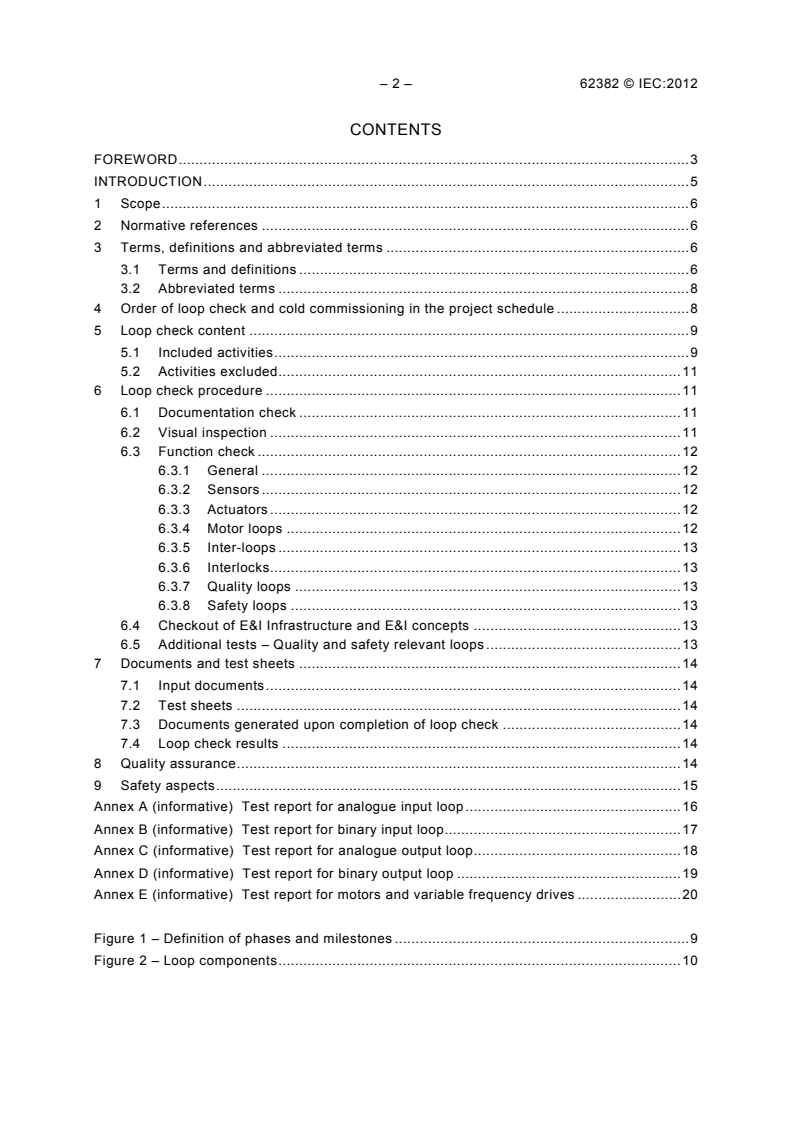
– 2 – 62382 © IEC:2012
CONTENTS
FOREWORD . 3
INTRODUCTION . 5
1 Scope . 6
2 Normative references . 6
3 Terms, definitions and abbreviated terms . 6
3.1 Terms and definitions . 6
3.2 Abbreviated terms . 8
4 Order of loop check and cold commissioning in the project schedule . 8
5 Loop check content . 9
5.1 Included activities . 9
5.2 Activities excluded . 11
6 Loop check procedure . 11
6.1 Documentation check . 11
6.2 Visual inspection . 11
6.3 Function check . 12
6.3.1 General . 12
6.3.2 Sensors . 12
6.3.3 Actuators . 12
6.3.4 Motor loops . 12
6.3.5 Inter-loops . 13
6.3.6 Interlocks . 13
6.3.7 Quality loops . 13
6.3.8 Safety loops . 13
6.4 Checkout of E&I Infrastructure and E&I concepts . 13
6.5 Additional tests – Quality and safety relevant loops . 13
7 Documents and test sheets . 14
7.1 Input documents . 14
7.2 Test sheets . 14
7.3 Documents generated upon completion of loop check . 14
7.4 Loop check results . 14
8 Quality assurance . 14
9 Safety aspects . 15
Annex A (informative) Test report for analogue input loop . 16
Annex B (informative) Test report for binary input loop . 17
Annex C (informative) Test report for analogue output loop . 18
Annex D (informative) Test report for binary output loop . 19
Annex E (informative) Test report for motors and variable frequency drives . 20
Figure 1 – Definition of phases and milestones . 9
Figure 2 – Loop components . 10
62382 © IEC:2012 – 3 –
INTERNATIONAL ELECTROTECHNICAL COMMISSION
____________
CONTROL SYSTEMS IN THE PROCESS INDUSTRY –
ELECTRICAL AND INSTRUMENTATION LOOP CHECK
FOREWORD
1) The International Electrotechnical Commission (IEC) is a worldwide organization for standardization comprising
all national electrotechnical committees (IEC National Committees). The object of IEC is to promote
international co-operation on all questions concerning standardization in the electrical and electronic fields. To
this end and in addition to other activities, IEC publishes International Standards, Technical Specifications,
Technical Reports, Publicly Available Specifications (PAS) and Guides (hereafter referred to as “IEC
Publication(s)”). Their preparation is entrusted to technical committees; any IEC National Committee interested
in the subject dealt with may participate in this preparatory work. International, governmental and non-
governmental organizations liaising with the IEC also participate in this preparation. IEC collaborates closely
with the International Organization for Standardization (ISO) in accordance with conditions determined by
agreement between the two organizations.
2) The formal decisions or agreements of IEC on technical matters express, as nearly as possible, an international
consensus of opinion on the relevant subjects since each technical committee has representation from all
interested IEC National Committees.
3) IEC Publications have the form of recommendations for international use and are accepted by IEC National
Committees in that sense. While all reasonable efforts are made to ensure that the technical content of IEC
Publications is accurate, IEC cannot be held responsible for the way in which they are used or for any
misinterpretation by any end user.
4) In order to promote international uniformity, IEC National Committees undertake to apply IEC Publications
transparently to the maximum extent possible in their national and regional publications. Any divergence
between any IEC Publication and the corresponding national or regional publication shall be clearly indicated in
the latter.
5) IEC itself does not provide any attestation of conformity. Independent certification bodies provide conformity
assessment services and, in some areas, access to IEC marks of conformity. IEC is not responsible for any
services carried out by independent certification bodies.
6) All users should ensure that they have the latest edition of this publication.
7) No liability shall attach to IEC or its directors, employees, servants or agents including individual experts and
members of its technical committees and IEC National Committees for any personal injury, property damage or
other damage of any nature whatsoever, whether direct or indirect, or for costs (including legal fees) and
expenses arising out of the publication, use of, or reliance upon, this IEC Publication or any other IEC
Publications.
8) Attention is drawn to the Normative references cited in this publication. Use of the referenced publications is
indispensable for the correct application of this publication.
9) Attention is drawn to the possibility that some of the elements of this IEC Publication may be the subject of
patent rights. IEC shall not be held responsible for identifying any or all such patent rights.
International Standard IEC 62382 has been prepared by subcommittee 65E: Devices and
integration in enterprise systems, of IEC technical committee 65: Industrial-process
measurement, control and automation.
This second edition cancels and replaces the first edition published in 2006. This edition
constitutes a technical revision.
The main changes with respect to the previous edition are listed below:
– The definition of the documents mentioned in the standards is in accordance with
IEC 62708: Documents for Electrical and Instrumentation Projects in the Process Industry.
– Subclause 6.3 has been revised.
The text of this standard is based on the following documents:
FDIS Report on voting
65E/271/FDIS 65E/282/RVD
– 4 – 62382 © IEC:2012
Full information on the voting for the approval of this standard can be found in the report on
voting indicated in the above table.
This publication has been drafted in accordance with the ISO/IEC Directives, Part 2.
The committee has decided that the contents of this publication will remain unchanged until
the stability date indicated on the IEC web site under "http://webstore.iec.ch" in the data
related to the specific publication. At this date, the publication will be
• reconfirmed,
• withdrawn,
• replaced by a revised edition, or
• amended.
IMPORTANT – The 'colour inside' logo on the cover page of this publication indicates
that it contains colours which are considered to be useful for the correct
understanding of its contents. Users should therefore print this document using a
colour printer.
62382 © IEC:2012 – 5 –
INTRODUCTION
The inspection and verification of the individual measurements and controls in conjunction
with the control systems used to monitor these devices (DCS, PLC, etc.) is referred to as loop
check. In industry, numerous methods and philosophies are used to check the instrumentation
and controls after mechanical installation within projects for modified or new facilities.
This standard was created to provide a better understanding of what loop check consists of
and also to provide a standard methodology for executing a loop check.
The annexes of this standard contain forms which may be used in the check procedures.
Buyers of this standard may copy these forms for their own purposes only in the required
amount.
– 6 – 62382 © IEC:2012
CONTROL SYSTEMS IN THE PROCESS INDUSTRY –
ELECTRICAL AND INSTRUMENTATION LOOP CHECK
1 Scope
This International Standard describes the steps recommended to complete a loop check,
which comprises the activities between the completion of the loop construction (including
installation and point-to-point checks) and the start-up of cold commissioning. This standard is
applicable for the construction of new plants and for expansion/retrofits (i.e. revamping) of
E&I installations in existing plants (including PLC, BAS, DCS, panel-mounted and field
instrumentation). It does not include a detailed checkout of power distribution systems, except
as they relate to the loops being checked (i.e. a motor starter or a power supply to a four-wire
transmitter).
For application in the pharmaceutical or other highly specialized industries, additional
guidelines (for example, Good Automated Manufacturing Practice (GAMP)), definitions and
stipulations should apply in accordance with existing standards, for example, for GMP
Compliance 21 CFR (FDA) and the Standard Operating Procedure of the European Medicines
Agency (SOP/INSP/2003).
2 Normative references
The following documents, in whole or in part, are normatively referenced in this document and
are indispensable for its application. For dated references, only the edition cited applies. For
undated references, the latest edition of the referenced document (including any
amendments) applies.
IEC 61131 (all parts), Programmable controllers
IEC 62337, Commissioning of electrical, instrumentation and control systems in the process
industry – Specific phases and milestones
IEC 62424,Representation of process control engineering – Requests in P&I diagrams and
data exchange between P&ID tools and PCE-CAE tools
IEC 62708, Documents for Electrical and Instrumentation Projects in the Process Industry
3 Terms, definitions and abbreviated terms
3.1 Terms and definitions
For the purposes of this document, the following terms and definitions apply.
3.1.1
precommissioning
phase, during which the activities of non-operating adjustments, cold alignment checks,
cleaning, and testing of machinery take place
EXAMPLE Please refer to the annexes.
___________
This standard is under consideration.
62382 © IEC:2012 – 7 –
3.1.2
mechanical completion
milestone, which is achieved when the plant, or any part thereof, has been erected and
tested in accordance with drawings, specifications, instructions, and applicable codes and
regulations to the extent necessary to permit cold commissioning
Note 1 to entry: This includes completion of all necessary electrical and instrumentation work. This is a milestone
marking the end of the precommissioning activities.
3.1.3
cold commissioning
phase, during which the activities associated with the testing and operation of equipment or
facilities using test media such as water or inert substances prior to introducing any chemical
in the system take place
3.1.4
start-up
milestone marking the end of cold commissioning
Note 1 to entry: At this stage, the operating range of every instrument loop is already adjusted to reflect the
actual working condition.
3.1.5
hot commissioning
phase, during which the activities associated with the testing and operation of equipment or
facilities using the actual chemical process prior to making an actual production run take
place
3.1.6
start of production
milestone marking the end of hot commissioning
Note 1 to entry: At this stage, the plant is ready for full and continuous operation.
3.1.7
performance test
milestone at which the production plant runs to its design capacity
Note 1 to entry: This test, carried out by the owner’s personnel with the help and supervision of the contractor,
should demonstrate the contractor’s process performance and consumption guarantees as specified in the
contract.
3.1.8
acceptance of plant
milestone at which the plant is formally turned over from the contractor to the owner
3.1.9
basic software
software which, at a minimum, contains the graphic faceplates, base-level alarms and switch
points, basic interlocking and analogue control. In the case of safety loops, any safety switch
point should be included if it is not in the basic database
3.1.10
loop list
tabulated list of all E&I tags with tagging, function and PID reference
3.1.11
loop diagram
representation of hardware and/or basic software functions of a control loop with graphical
symbols e.g. according to IEC 62424. It shows equipment in its topological order and wiring
including the terminals
– 8 – 62382 © IEC:2012
3.1.12
loop sheet
data sheet with all essential E&I data concerning tagging, function, description, measuring
range, location, process data, instrument data, etc
3.1.13
function diagram or logic diagram
description of the E&I functions according to IEC 61131. Use of this term/such a diagram is
limited to digital signal processing only.
3.1.14
cause and effect matrix
actuators and sensors assigned to coloums and rows according their function, including their
related switching and/or alarm function
3.1.15
user requirement specification
rough user specification in view of the customer to be detailed by the requirement
specification
3.1.16
requirement specification
complete description of all requirements for the realisation (e.g. of an automation system)
3.1.17
trip point list and configuration parameter list
tabulated list of all variable parameter for E&I equipment
3.2 Abbreviated terms
BAS Building automation systems
C&E Cause & effect matrix
DCS Distributed control system
E&I Electrical and instrumentation and control systems
ESD Emergency shut-down system
FAT Factory acceptance testing
FUP Functional or logic diagram
HMI Human machine interface
HW Hardware
MC Mechanical completion
MCC Motor control centre
PLC Programmable logic controller
SAT Site acceptance test
SIT Site integration test
SW Software
4 Order of loop check and cold commissioning in the project schedule
The loop checks will ideally occur in the precommissioning phase of the schedule shown in
Figure 1.
62382 © IEC:2012 – 9 –
However, normal occurrence is that the loop checks begin when any specific loop is
completed and turned over to the checkout crew even if it is during the "construction" phase.
The loop check could substantially overlap the "construction" phase.
Acceptance
of plant
Construction Precommissioning Commissioning Production
PHASES
Cold Hot
Completion of Mechanical St a rt- up Start of
MILESTONES
erection completion production Performance
test
IEC 2057/06
NOTE Construction and precommissioning activities could be overlapping.
Figure 1 – Definition of phases and milestones
The loop check has the following characteristics:
• it follows the E&I construction phase and FAT of the DCS in a project;
• it is the last systematic check before mechanical completion to ensure that:
• all E&I documents (loop sheets, etc.) are available and correspond to their latest revision;
• all instrumentation and equipment is delivered according to the design specifications if not
already verified during FAT or quality check during equipment receiving;
• installation has occurred in accordance to engineering documents, applicable codes and
local regulations;
• loop functionality is correct.
This provides that:
• in a project, the quality check for E&I engineering, and for the delivered instrumentation
and equipment and their installation;
• the base for the commissioning phase which consists of the following phases:
a) cold commissioning
phase during which functional testing of equipment and facilities, using test media
such as water or inert substances, takes place;
b) hot commissioning (chemical start-up)
phase during which activities associated with the testing and operation of equipment
using the actual process chemicals (initial start-up of process) are performed.
The main activities in the cold and hot commissioning phases are system verification
tuning of loops and instruments and control schemes.
5 Loop check content
5.1 Included activities
The loop check includes the following elements of a "single loop" (sensor and/or actuator).
• Hardware components:
– the installed instruments or components in the field or in their final destination;
– 10 – 62382 © IEC:2012
– the equipment in E&I rooms;
– hard wired functionality between sensor and actuator loops (if applicable);
– the input and output (if applicable) cards of process control systems.
• The basic software components (including the graphic faceplates, base level alarms and
switch points, basic interlocking and basic analogue control) to test the field devices. The
loop check uses the basic graphics/faceplates of the control system (see Figure 2). Note
that primary inputs and outputs may be connected not only to DCS but also to ESD, PLC,
unit controllers and other subsystems. They all are visualized on DCS.
The actual loop check involves the three following phases (see details in Clause 6):
a) Documentation checkout
Check for the completeness and consistency of loop documents, including any documents
from the installation or FAT.
b) Visual inspection of loop devices for correct installation and tagging.
c) Function check
A testing device is used to exercise all the components of the loop (including hardware,
wiring and software). It checks that all the components function correctly and that the DCS
or panel readouts are accurate.
IEC 2124/12
1)
Check of the operational configuration is completed during cold commissioning or hot commissioning.
Figure 2 – Loop components
During the loop check the following three types of deficiencies can be found:
d) Installation failures
Installation failures are discrepancies with the specified hardware or the method of
installation (wrong installation, wrong instruments, etc.). The construction contractor
should fix these problems.
e) Configuration failures
62382 © IEC:2012 – 11 –
Configuration failures are discrepancies with the original software specification. The
programming contractor or E&I engineering should fix these problems.
f) E&I engineering failures
Engineering failures are to be suspected when, despite good installation of the right
instruments, the desired functionality cannot be realized (for example, fault in wiring
diagram; etc.) These problems should be corrected by E&I engineering.
Additional deficiencies might be in the process design, but this can only be determined after
process start-up.
5.2 Activities excluded
The loop check does not consist of:
• test activities possible without construction being completed:
• software testing using simulation tools;
• other factory acceptance tests performed at the contractor or vendor’s factories;
• other software checkout activities (FAT,etc.);
• detailed construction and mechanical inspections performed during the construction
phase:
• cable testing during construction (Hipot, Meggering, etc.);
• point-to-point wiring checks;
• the testing of the internal workings of package units (i.e. process subunits, machinery,
complex analysers, etc.) is excluded; only the I/O testing of this equipment is included in
the loop check;
• activities belonging to the commissioning phase: tuning of loops, instruments and control
schemes (for example, calibrating of level transmitters by filling tanks; verification of
complex control schemes; tuning of continuous control schemes; etc.).
6 Loop check procedure
6.1 Documentation check
The documentation check consists of the following activities.
• The checkout of the loop should first establish that all documentation pertaining to that
loop is available, consistent and correctly labelled if the loop is a safety, quality or
environmental loop.
• The pertinent documentation shall, as a minimum, contain a loop diagram and a
specification containing all calibration and functional data necessary to verify the correct
operation of the loop (loop sheet).
6.2 Visual inspection
The visual inspection consists of the following activities.
• The installation should be visually checked against the documents to ensure that the
correct instruments were installed and that the installation is in accordance with the
hardware specifications and loop diagrams/circuit diagrams.
• Valves and flowmeters are checked for correct installation with the direction of flow.
• Can local instrumentation be easily read?
• Are all the elements of the loop available, accessible, labelled and installed in a clean and
neat manner (including junction boxes, panels, cabinets, racks)?
• Is the tagging clear and unambiguous (no danger of false interpretation)?
– 12 – 62382 © IEC:2012
• Are the field elements adequately protected from mechanical or environmental damage?
6.3 Function check
6.3.1 General
The function checks concerning field devices are ideally performed in well defined blocks
(related technical blocks like process units or related racks in E&I rooms). The actual method
and order of checkout should be defined by the project team prior to starting the loop check.
The purpose of the function check is to exercise all components of a loop during one test and
measure their accuracy. Checking out a loop in pieces does not qualify as a function check
and shall not substitute for the function check.
Detailed checks have to be done according following list. Simulations could be done in
different ways depending on the type of device (4 – 20 mA, HART or fieldbus).
6.3.2 Sensors
Functional checking of sensors is as follows.
• Checking of tag number and parameters.
• Simulation of transmitter signal in increments to full span to ensure that the DCS or panel
readout follows the input.
• Simulation of transmitter signal out of DCS range (high and low), checking of substitute
value and failure reaction in DCS.
• Simulation of a sensor failure to verify the correct failure reaction.
• Disconnection of the sensor, checking of the failure reaction in DCS.
• Reconnection of the sensor, checking if device is correctly and automatically initiated
(fieldbus); checking of behaviour of the live list (fieldbus).
6.3.3 Actuators
Functional checking of actuators is as follows.
• Checking of tag number and parameters.
• If the loop has an analogue output, the actuator should be observed to verify that it follows
the incremental output changes within a specified tolerance.
• Simulation of an actuator failure to verify the correct failure reaction.
• Simulation of a limit switch failure, checking of failure reaction in DCS.
• Disconnection of actuator, checking of the failsafe position and the failure reaction in DCS.
• Reconnection of actuator, checking if device is correctly and automatically initiated;
checking of behaviour of the live list (fieldbus).
• Disconnection of air supply and checking of failsafe behaviour.
6.3.4 Motor loops
Functional checking of motor loops is as follows.
• Checking of parameters in motor protection device, compare with motor data
• Simulation of motor protection device signals to verify correct readout in DCS.
• Simulation of motor protection device failure and checking of correct reaction in DCS.
• Checking of correct operation with motor protection device in test mode and removed
motor fuses
• Checking of correct function of local ON/OFF switches
62382 © IEC:2012 – 13 –
6.3.5 Inter-loops
The check of inter-loop functionality (like analogue control loops or interlock functions) is
preferably done for integrated units after a successful checkout of the separate sensor and
actuator loop. This is most effectively completed during cold commissioning.
IMPORTANT A recheck is required for E&I loops that have been modified or disconnected
after successful checkout has been completed.
6.3.6 Interlocks
Verification of interlocks according to logic diagrams is only based on static signals and not
on dynamic process information.
6.3.7 Quality loops
These loops should be checked similar to standard loops. However the accuracy of the field
device should be verified. This could be done by testing the device by the manufacturer, and
should be documented with a test certificate. The procedure of the initial and the periodical
checks has to be defined and documented.
6.3.8 Safety loops
In a first step these loops should be checked similar to standard loops. The additional
validation of safety loops is following a dedicated procedure, which is not described here.
6.4 Checkout of E&I Infrastructure and E&I concepts
Prior to, or during, loop checkout, E&I infrastructure should be checked for mechanical
completion and full functionality. This covers a checklist on the overall condition of E&I rooms,
field installations, energy supplies, grounding systems and cabinet equipment.
During the function check of loops, it is good practice to checkout E&I fundamentals and
concepts.
• Check of loop reaction during a failure or malfunction
• Check of the "fail-safe" action – does the loop go to a safe state when a component
malfunctions?
• What happens when the span limits are exceeded – do the readings and alarms conform
to manufacturers specifications or desired actions?
• If the DCS malfunctions, do the final element’s actions conform to the specifications?
• Check of the function of redundant controls or power supplies:
• Does the redundancy function works as specified during the failure of the primary
element? Does it switch back correctly?
The loop-related concept checkout results are to be recorded on the loop test report. Loop-
related concept checkout is performed for each loop typical and for all safety and quality
loops. For non-safety loops, these tests are performed only frequently enough so that each
concept is checked.
Results of infrastructure concept checkout are recorded on the E&I general infrastructure test
report.
6.5 Additional tests – Quality and safety relevant loops
All quality-relevant and safety-measure-relevant tags are to be rechecked after successful
completion of the loop check.
– 14 – 62382 © IEC:2012
For safety measures it is important that the functionality of the entire E&I measurement as a
whole is verified (sensor loop + binary control loop, or, interlock + actuator loop).
These specific additional checks are to be verified by a second E&I checkout crew or
specifically tested during cold commissioning.
7 Documents and test sheets
7.1 Input documents
The prepared documentation set according to the process unit contains the following:
a) loop list;
b) loop sheet;
c) loop diagram;
function or logic diagram
d) trip point list and configuration parameter list;
e) test reports;
f) calculation and documents (i.e., intrinsic safety);
g) certificates, if any (i.e., motor megger checks or point-to-point checks) from the
construction phase are available, should also be included as part of the documentation
package.
All project, safety, code, local regulations/law-related documents as required by the specific
project should be available.
7.2 Test sheets
The following annexes or PC tools (Excel files) contain examples of test reports per loop type.
• Test report for analogue input loop Annex A
• Test report for binary input loop Annex B
• Test report for analogue output loop (control valve) Annex C
• Test report for binary output loop (on/off valve) Annex D
• Test report for motors and variable frequency drives Annex E
7.3 Documents generated upon completion of loop check
The following documents shall be generated.
• Marked-up E&I documentation to reflect as-built condition.
• Loop test report: signed and completed with loop check results.
7.4 Loop check results
The results of the loop checks shall be indicated as follows:
P = Pass (correct when checked)
F = Fail (not passed when checked; shall include a clear problem description; may require
engineering involvement)
PR = Pass after repair (repair action by checkout/repair crew required)
8 Quality assurance
The test reports are drafted in such a way that all relevant items are covered at least once.
62382 © IEC:2012 – 15 –
Quality is guaranteed by the following measures:
• The loop check is always performed in the same manner (independent of the particular
tester).
• Test reports are updated with the latest information.
• The testers confirm with their signature that a complete loop check agrees with the test
procedures.
9 Safety aspects
For safety installations, extra checklists and working plans are set up in addition to the normal
loop-check procedure. These documents typically describe a very detailed check procedure
and are periodically repeated after production start-up.
– 16 – 62382 © IEC:2012
Annex A
(informative)
Test report for analogue input loop
Instrument type:
Results
1. Documentation check (Italics denote: normally not present)
Loop documentation complete? Cable test - point-to-point connection test complete
P PR F
Date
PCS specification HW present Wiring diagram present Name
Instrument certificates present Test sheet SW-FAT present
Signature
Release of construction present PCS Specification SW present
2. Visual inspection
Are the elements of the loop complete, coded, installed in a clean and neat manner? P PR F
Cable glands and connections tight? Construction/flow direction OK Date
All cards and nests installed and properly labeled?
Name
Do the instruments conform to the circuit diagrams (loop diagram) and specification sheets? Signature
Individual configuration of cards, transmitters, etc. complete (e.g. dip sw itches properly set)?
3. Function check
Function of PCS loop successful?
P PR F
Date
Fuses placed in system
Name
Cards, nests and instruments operational?
Signature
Accept. error of span %
Accept. error of meas. % 1.5 Span -30 200 °C
Calibration Value Accepted Indicator
device error Field /PU DCS Panel Rec./other Results
3,5 mA False measurement
4 mA -30 0.45
12 mA 85 1.5
20 mA 200 3
False measurement
22 mA
Open circuit
Span and units on read out OK?
SW/Spec: alarm and sw itch levels OK? No check due to operational reasons?
Loop brought back ready for commissioning?
Explanation:
Description of failure (use other side) P Pass
Remarks:
PR Pass after repair
F Fail
Status: Date
Issued to checkout crew
Issued to repair crew
Description of repair (use other side)
Issued to constr. for repair
Issued to progr. for repair
Issued to engineering
Loop filed and complete
Name Date Signature
62382 © IEC:2012 – 17 –
Annex B
(informative)
Test report for binary input loop
January 2002
Test report for binary input loop
Complex Process area Subprocess Techn. item Business unit Building xyz-coord
L0001
ANTPCS6 V401 TA10 KU 80 317 Tag-description
Function Purpose Phase Min. Level BA001
LSA Loop check after installation Precommissioning
Remark: This check is performed/documented after successful point-to-point wiring check and base software implementation.
Changes in installation or software functionality require recheck.
Irrelevant boxes are crossed out or filled in with N/A (not applicable).
Liquiphant
Instrument type:
Results
1. Documentation check (Italics denote: normally not present)
Loop documentation complete? Cable test - point to point connection test complete
P PR F
Date
PCS specification HW present Wiring diagram present Name
Instrument certificates present Test sheet SW-FAT present
Signature
Release of construction present PCS specification SW present
2. Visual inspection
Are the elements of the loop complete, coded, installed in a clean and neat manner?
P PR F
Cable glands and connections tight? Construction/flow direction OK
Date
All cards & nests installed and properly labeled? Name
Do the instruments conform to the circuit diagrams (loop diagram) and specification sheets?
Signature
Individual configuration of cards, transmitters, etc. complete (e.g. dip switches properly set)?
3. Function check
Function of PCS loop successful?
P PR F
Date
Fuses placed in system
Name
Cards, nests and instruments operational?
Signature
Calibration Value Indicator
device Field /PU DCS Panel Rec./other Result
0/0 V
1/24 V
Device alarm No check due to operational reasons?
Open circuit
Explanation:
SW/Spec: alarm and switch levels OK?
P Pass
PR Pass after repair
Loop brought back ready for commissioning? F Fail
DResemcarriptksion : of failure (use other side)
Status:
Date
Issued to checkout crew
Issued to repair crew
Issued to constr. for repair
Issued to progr. for repair
Description of repair (use other side)
Issued to engineering
Loop filed and complete
Name Date Signature
– 18 – 62382 © IEC:2012
Annex C
(informative)
Test report for analogue output loop
Janaury 2002
Test report for analogue output loop (control valve)
Complex Process area Subprocess Techn. item Business unit Building xyz-coord
Y0001
ANTPCS6 V401 TA10 KU 80 115.2 Tag-description
Function Purpose Phase Product out BA001
YCOS Loop check after installation Precommissioning
Remark: This check is performed/documented after successful point-to-point wiring check and base software implementation.
Changes in installation or software functionality require recheck.
Irrelevant boxes are crossed out or filled in with N/A (not applicable).
Instrument type: Control membranevalve CT
Results
1. Documentation check (Italics denote: normally not present)
Loop documentation complete? Cable test - point-to-point connection test complete
P PR F
Date
PCS specification HW present Wiring diagram present Name
Instrument certificates present PCS specification SW present
Signature
Release of construction present Test sheet SW-FAT present
2. Visual inspection
Are the elements of the loop complete, coded, installed in a clean and neat manner?
P PR F
Construction/flow direction OK
Cable glands and connections tight? Date
All cards and nests installed and properly labelled?
Name
Do the instruments conform to the circuit diagrams (loop diagram) and specification sheets?
Signature
Individual configuration of cards, transmitters, etc. complete (e.g. dip switches properly set)?
3. Function check
Function of PCS loop successful?
P PR F
Fuses placed in system Date
Instrument air open
Name
Cards, nests and instruments operational?
Signature
Indication limit switches
Setpoint Field /PU DCS Panel Recorder/other Results
OPEN
CLOSE
Analog output Indication analog output
Setpoint
device Air to open Air to close Field /PU DCS Panel Recorder/other Results
False value
3,5 mA
0% 4,0 mA 20,0 mA
10% 5,6 mA 18,4 mA
50% 12,0 mA 12,0 mA
100% 20,0 mA 4,0 mA
False value
22 mA
SW/Spec: control functions OK? SW/Spec: interlock functions OK?
Solenoid forced?
Valve operation as specified?
Air fail position CLOSE of valve OK? No check due to operational reasons?
DCS malfunctioning: action final element (valve) conform to specification?
Loop brought back ready for commissioning?
Description of failure (use other side) Explanation:
Remarks:
P Pass
PR Pass after repair
F Fail
Status:
Date
Issued to checkout crew
Description of repair (use other side)
Issued to repair crew
Issued to constr. for repair
Issued to progr. for repair
Issued to engineering
Loop filed and complete
Name Date Signature
62382 © IEC:2012 – 19 –
Annex D
(informative)
Test report for binary output loop
January 2002
Test report for binary output loop (On/off valve, .)
Complex Process area Subprocess Techn. item Business unit Building xyz-
...