

IEC 63082-2:2024
(Main)Intelligent device management – Part 2: Requirements and recommendations
General Information
- Abstract
IEC 63082-2:2024 specifies requirements and recommendations for establishing and maintaining intelligent device management (IDM) as outlined in IEC TR 63082-1 in an enterprise having one or more facilities.
The following topics are included in the scope of this document:
- optimizing functionality and performance of intelligent devices for their use;
- managing information related to IDM;
- integrating intelligent devices into industrial automation and control systems (IACS) in facilities;
- exchanging information between stakeholders that achieve and sustain IDM;
- coordinating multiple asynchronous IDM life cycles.
The following topics are outside the scope of this document:
- defining and determining the function and performance of intelligent devices;
- defining and specifying technologies and tools that provide, preserve and manage information related to IDM such as FDT, FDI, portable on-line and off-line tools, configuration tools, historians, and maintenance planning tools;
- defining and specifying technologies and tools that are used to design intelligent devices;
- defining and specifying communication network architecture, communication technologies, cybersecurity requirements, and network management requirements.
- Status
- Published
- Publication Date
- 12-Aug-2024
- Technical Committee
- SC 65E - Devices and integration in enterprise systems
- Drafting Committee
- WG 10 - TC 65/SC 65E/WG 10
- Current Stage
- PPUB - Publication issued
- Start Date
- 13-Aug-2024
- Completion Date
- 23-Aug-2024
Overview
IEC 63082-2:2024, titled Intelligent Device Management – Part 2: Requirements and Recommendations, is an international standard published by the International Electrotechnical Commission (IEC). It establishes comprehensive guidelines for implementing and maintaining Intelligent Device Management (IDM) within enterprises operating one or more facilities. This part of the IEC 63082 series focuses on practical steps to optimize device functionality, manage IDM-related information, and coordinate IDM life cycles across stakeholders.
The document supports enterprises in integrating intelligent devices into Industrial Automation and Control Systems (IACS), streamlining the exchange of relevant information, and coordinating asynchronous device life cycles for improved operational efficiency and reliability.
Key Topics
- Optimization of Intelligent Devices: Guidelines for maximizing the functional and performance capabilities of intelligent devices in industrial environments.
- Information Management: Specifications on handling data related to IDM to support lifecycle actions and decision-making.
- Integration with Industrial Automation: Recommendations for smoothly incorporating intelligent devices into existing IACS frameworks.
- Stakeholder Communication: Strategies for effective information exchange among suppliers, operators, and maintenance teams to sustain IDM.
- Coordination of IDM Life Cycles: Managing multiple asynchronous life cycles of intelligent devices to ensure consistency and reliability.
- Risk Management: Identification, assessment, and mitigation of risks related to IDM, including cybersecurity considerations.
- Enterprise-Level Program Management: Structures and resources needed for orchestrating IDM activities across all relevant organizational levels.
- Facility Life Cycle Management: Handling IDM through various facility phases such as design, construction, commissioning, operations, maintenance, and turnarounds.
- Supplier Coordination: Aligning supplier activities with enterprise IDM programs to ensure device lifecycle consistency and quality.
Note: This standard does not cover the definition of device functions or performance, specific tools and technologies related to IDM, or network architecture and cybersecurity requirements beyond risk management elements.
Applications
IEC 63082-2:2024 provides critical value to industries reliant on intelligent devices within automated control systems, including:
- Process Industries: Chemical plants, oil and gas, pharmaceuticals, and other sectors where precise device management improves safety and reliability.
- Manufacturing Facilities: Continuous and discrete manufacturing systems requiring optimized device performance and lifecycle oversight.
- Energy Utilities: Power generation and distribution operations integrating intelligent sensors and actuators.
- Facility Management: Large enterprises managing multiple facilities and looking to synchronize device management practices across locations.
- Maintenance and Asset Management Teams: Enhancing workflows through formal IDM processes aligned with lifecycle phases.
- Supplier and Vendor Coordination: Establishing clearer channels and responsibilities for device provisioning, calibration, and repair.
By implementing the requirements and recommendations of this standard, organizations achieve improved device uptime, enhanced decision-making based on timely information, reduced risks including cybersecurity threats, and more cost-effective asset management strategies.
Related Standards
Enterprises adopting IEC 63082-2:2024 may also consider these complementary IEC documents for a holistic approach:
- IEC TR 63082-1: Provides foundational concepts and overview of Intelligent Device Management, which IEC 63082-2 elaborates upon in requirements and recommendations.
- IEC 61508 / IEC 61511: Pertains to functional safety of electrical/electronic systems, often relevant in the context of intelligent device lifecycle management.
- IEC 62443 Series: Addresses cybersecurity for Industrial Automation and Control Systems, complementing risk management aspects of IDM.
- IEC 61804 (FDT Group standards) and IEC 62769 (FDI specifications): Standards related to technologies facilitating device interoperability and data management.
- ISO 55000 Series: Focuses on asset management systems that align with IDM practices for physical and intelligent devices.
Utilization of IEC 63082-2 alongside these standards helps organizations build robust, secure, and efficient intelligent device ecosystems within their operations.
Keywords: Intelligent Device Management, IEC 63082-2, industrial automation, control systems integration, device lifecycle management, risk management, IDM requirements, industrial standards, enterprise IDM, intelligent device optimization, facility management, supplier coordination, IEC standards 2024.
Get Certified
Connect with accredited certification bodies for this standard

DVS-ZERT GmbH
German welding certification society.
CARES (UK Certification Authority for Reinforcing Steels)
UK certification for reinforcing steels and construction.
EWF/IIW (European/International Welding Federation)
International welding personnel certification.
Sponsored listings
Frequently Asked Questions
IEC 63082-2:2024 is a standard published by the International Electrotechnical Commission (IEC). Its full title is "Intelligent device management – Part 2: Requirements and recommendations". This standard covers: IEC 63082-2:2024 specifies requirements and recommendations for establishing and maintaining intelligent device management (IDM) as outlined in IEC TR 63082-1 in an enterprise having one or more facilities. The following topics are included in the scope of this document: - optimizing functionality and performance of intelligent devices for their use; - managing information related to IDM; - integrating intelligent devices into industrial automation and control systems (IACS) in facilities; - exchanging information between stakeholders that achieve and sustain IDM; - coordinating multiple asynchronous IDM life cycles. The following topics are outside the scope of this document: - defining and determining the function and performance of intelligent devices; - defining and specifying technologies and tools that provide, preserve and manage information related to IDM such as FDT, FDI, portable on-line and off-line tools, configuration tools, historians, and maintenance planning tools; - defining and specifying technologies and tools that are used to design intelligent devices; - defining and specifying communication network architecture, communication technologies, cybersecurity requirements, and network management requirements.
IEC 63082-2:2024 specifies requirements and recommendations for establishing and maintaining intelligent device management (IDM) as outlined in IEC TR 63082-1 in an enterprise having one or more facilities. The following topics are included in the scope of this document: - optimizing functionality and performance of intelligent devices for their use; - managing information related to IDM; - integrating intelligent devices into industrial automation and control systems (IACS) in facilities; - exchanging information between stakeholders that achieve and sustain IDM; - coordinating multiple asynchronous IDM life cycles. The following topics are outside the scope of this document: - defining and determining the function and performance of intelligent devices; - defining and specifying technologies and tools that provide, preserve and manage information related to IDM such as FDT, FDI, portable on-line and off-line tools, configuration tools, historians, and maintenance planning tools; - defining and specifying technologies and tools that are used to design intelligent devices; - defining and specifying communication network architecture, communication technologies, cybersecurity requirements, and network management requirements.
IEC 63082-2:2024 is classified under the following ICS (International Classification for Standards) categories: 25.040.40 - Industrial process measurement and control. The ICS classification helps identify the subject area and facilitates finding related standards.
IEC 63082-2:2024 is available in PDF format for immediate download after purchase. The document can be added to your cart and obtained through the secure checkout process. Digital delivery ensures instant access to the complete standard document.
Standards Content (Sample)
IEC 63082-2 ®
Edition 1.0 2024-08
INTERNATIONAL
STANDARD
NORME
INTERNATIONALE
Intelligent device management –
Part 2: Requirements and recommendations
Gestion des appareils intelligents –
Partie 2: Exigences normatives et recommandations
All rights reserved. Unless otherwise specified, no part of this publication may be reproduced or utilized in any form
or by any means, electronic or mechanical, including photocopying and microfilm, without permission in writing from
either IEC or IEC's member National Committee in the country of the requester. If you have any questions about IEC
copyright or have an enquiry about obtaining additional rights to this publication, please contact the address below or
your local IEC member National Committee for further information.
Droits de reproduction réservés. Sauf indication contraire, aucune partie de cette publication ne peut être reproduite ni
utilisée sous quelque forme que ce soit et par aucun procédé, électronique ou mécanique, y compris la photocopie et
les microfilms, sans l'accord écrit de l'IEC ou du Comité national de l'IEC du pays du demandeur. Si vous avez des
questions sur le copyright de l'IEC ou si vous désirez obtenir des droits supplémentaires sur cette publication, utilisez
les coordonnées ci-après ou contactez le Comité national de l'IEC de votre pays de résidence.
IEC Secretariat Tel.: +41 22 919 02 11
3, rue de Varembé info@iec.ch
CH-1211 Geneva 20 www.iec.ch
Switzerland
About the IEC
The International Electrotechnical Commission (IEC) is the leading global organization that prepares and publishes
International Standards for all electrical, electronic and related technologies.
About IEC publications
The technical content of IEC publications is kept under constant review by the IEC. Please make sure that you have the
latest edition, a corrigendum or an amendment might have been published.
IEC publications search - webstore.iec.ch/advsearchform IEC Products & Services Portal - products.iec.ch
The advanced search enables to find IEC publications by a Discover our powerful search engine and read freely all the
variety of criteria (reference number, text, technical publications previews, graphical symbols and the glossary.
committee, …). It also gives information on projects, replaced With a subscription you will always have access to up to date
and withdrawn publications. content tailored to your needs.
IEC Just Published - webstore.iec.ch/justpublished
Electropedia - www.electropedia.org
Stay up to date on all new IEC publications. Just Published
The world's leading online dictionary on electrotechnology,
details all new publications released. Available online and once
containing more than 22 500 terminological entries in English
a month by email.
and French, with equivalent terms in 25 additional languages.
Also known as the International Electrotechnical Vocabulary
IEC Customer Service Centre - webstore.iec.ch/csc
(IEV) online.
If you wish to give us your feedback on this publication or need
further assistance, please contact the Customer Service
Centre: sales@iec.ch.
A propos de l'IEC
La Commission Electrotechnique Internationale (IEC) est la première organisation mondiale qui élabore et publie des
Normes internationales pour tout ce qui a trait à l'électricité, à l'électronique et aux technologies apparentées.
A propos des publications IEC
Le contenu technique des publications IEC est constamment revu. Veuillez vous assurer que vous possédez l’édition la
plus récente, un corrigendum ou amendement peut avoir été publié.
Recherche de publications IEC - IEC Products & Services Portal - products.iec.ch
webstore.iec.ch/advsearchform Découvrez notre puissant moteur de recherche et consultez
La recherche avancée permet de trouver des publications IEC gratuitement tous les aperçus des publications, symboles
en utilisant différents critères (numéro de référence, texte, graphiques et le glossaire. Avec un abonnement, vous aurez
comité d’études, …). Elle donne aussi des informations sur les toujours accès à un contenu à jour adapté à vos besoins.
projets et les publications remplacées ou retirées.
Electropedia - www.electropedia.org
IEC Just Published - webstore.iec.ch/justpublished
Le premier dictionnaire d'électrotechnologie en ligne au monde,
Restez informé sur les nouvelles publications IEC. Just
avec plus de 22 500 articles terminologiques en anglais et en
Published détaille les nouvelles publications parues.
français, ainsi que les termes équivalents dans 25 langues
Disponible en ligne et une fois par mois par email.
additionnelles. Egalement appelé Vocabulaire
Electrotechnique International (IEV) en ligne.
Service Clients - webstore.iec.ch/csc
Si vous désirez nous donner des commentaires sur cette
publication ou si vous avez des questions contactez-nous:
sales@iec.ch.
IEC 63082-2 ®
Edition 1.0 2024-08
INTERNATIONAL
STANDARD
NORME
INTERNATIONALE
Intelligent device management –
Part 2: Requirements and recommendations
Gestion des appareils intelligents –
Partie 2: Exigences normatives et recommandations
INTERNATIONAL
ELECTROTECHNICAL
COMMISSION
COMMISSION
ELECTROTECHNIQUE
INTERNATIONALE
ICS 25.040.40 ISBN 978-2-8322-9485-7
– 2 – IEC 63082-2:2024 © IEC 2024
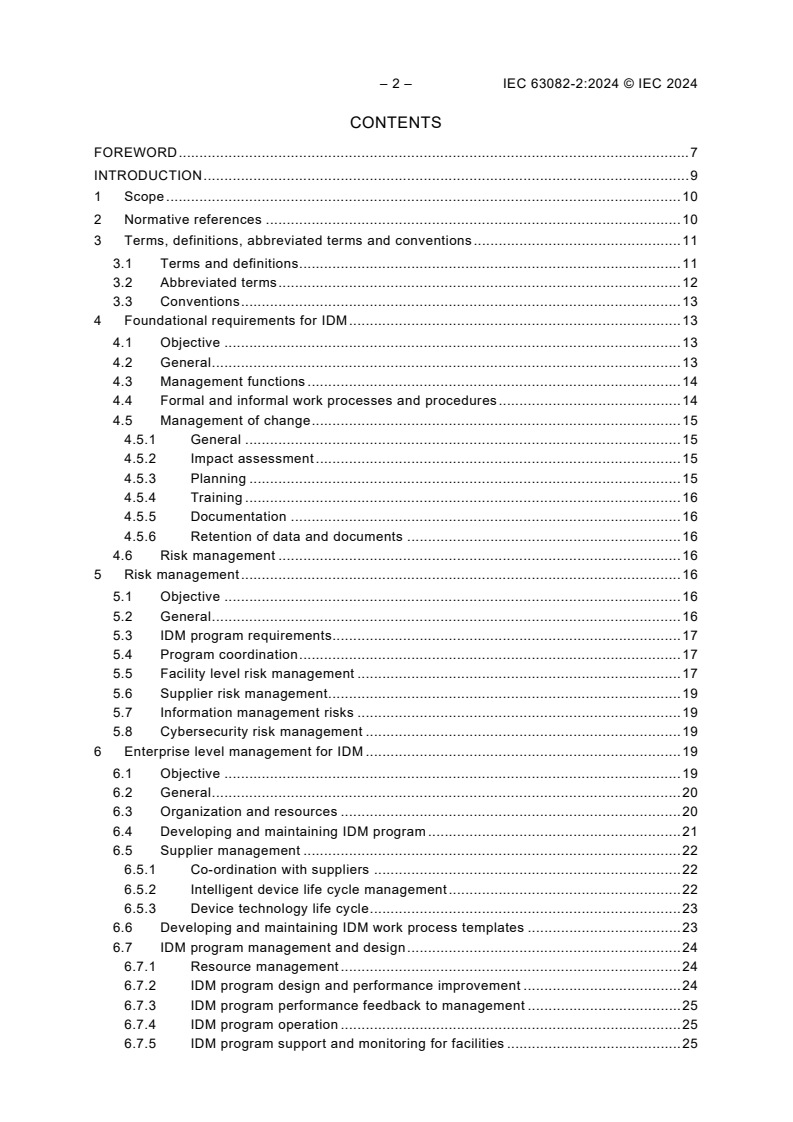
CONTENTS
FOREWORD . 7
INTRODUCTION . 9
1 Scope . 10
2 Normative references . 10
3 Terms, definitions, abbreviated terms and conventions . 11
3.1 Terms and definitions . 11
3.2 Abbreviated terms . 12
3.3 Conventions . 13
4 Foundational requirements for IDM . 13
4.1 Objective . 13
4.2 General . 13
4.3 Management functions . 14
4.4 Formal and informal work processes and procedures . 14
4.5 Management of change . 15
4.5.1 General . 15
4.5.2 Impact assessment . 15
4.5.3 Planning . 15
4.5.4 Training . 16
4.5.5 Documentation . 16
4.5.6 Retention of data and documents . 16
4.6 Risk management . 16
5 Risk management . 16
5.1 Objective . 16
5.2 General . 16
5.3 IDM program requirements . 17
5.4 Program coordination . 17
5.5 Facility level risk management . 17
5.6 Supplier risk management . 19
5.7 Information management risks . 19
5.8 Cybersecurity risk management . 19
6 Enterprise level management for IDM . 19
6.1 Objective . 19
6.2 General . 20
6.3 Organization and resources . 20
6.4 Developing and maintaining IDM program . 21
6.5 Supplier management . 22
6.5.1 Co-ordination with suppliers . 22
6.5.2 Intelligent device life cycle management . 22
6.5.3 Device technology life cycle . 23
6.6 Developing and maintaining IDM work process templates . 23
6.7 IDM program management and design . 24
6.7.1 Resource management . 24
6.7.2 IDM program design and performance improvement . 24
6.7.3 IDM program performance feedback to management . 25
6.7.4 IDM program operation . 25
6.7.5 IDM program support and monitoring for facilities . 25
7 Implementing coordination between enterprise, facilities, and suppliers . 25
7.1 Objective . 25
7.2 General . 26
7.3 Implementing IDM . 26
7.3.1 Common principles . 26
7.3.2 Implementing IDM in new facilities . 26
7.3.3 Implementing IDM in existing facilities . 27
7.3.4 Implementing IDM work processes in a facility . 27
7.4 Coordination for continuous improvement . 28
7.4.1 General . 28
7.4.2 Assessment and audits of IDM activities . 28
7.4.3 Resolving causes of program non-compliances . 28
7.5 Coordination with other enterprise programs . 29
7.5.1 General . 29
7.5.2 Life cycle coordination of program activities . 29
7.5.3 Applications . 29
7.5.4 Device/process information . 29
7.5.5 Systems, networks, and security . 29
7.5.6 Life cycle phases . 30
7.5.7 Application interfaces for coordination . 30
8 Facility life cycle phases . 30
8.1 Objective . 30
8.2 General . 30
8.3 Managing facility life cycle phases . 31
8.3.1 General . 31
8.3.2 Life cycle entry points . 31
8.3.3 Facility modifications . 31
8.4 Scope development . 32
8.4.1 General . 32
8.4.2 Objective . 33
8.4.3 Risk management . 33
8.4.4 Project type considerations . 34
8.4.5 Planning and design of the IDM implementation. 34
8.4.6 Defining facility long term support plans . 35
8.4.7 Handover plan to operations and maintenance . 35
8.4.8 Defining strategy for intelligent device cybersecurity . 36
8.4.9 Selecting design alternatives . 37
8.4.10 Preparing tools and their procedures . 38
8.4.11 Selecting suppliers . 39
8.4.12 Information management planning . 40
8.5 Design and engineering . 40
8.5.1 Objective . 40
8.5.2 General . 40
8.5.3 Device selection . 42
8.5.4 Procurement of intelligent device . 43
8.5.5 Configuration data preparation. 44
8.5.6 Implementing and integrating intelligent device functions with IACS . 49
8.5.7 System integration and testing requirements . 51
8.6 Construction and commissioning . 51
– 4 – IEC 63082-2:2024 © IEC 2024
8.6.1 General . 51
8.6.2 Site staging . 52
8.6.3 Installation . 53
8.6.4 Provisioning . 53
8.6.5 Configuration . 53
8.6.6 Loop-checking and commissioning . 54
8.6.7 Training and personnel competency . 55
8.6.8 Handover . 56
8.6.9 PSSR . 56
8.6.10 Startup . 56
8.7 Operations and maintenance . 56
8.7.1 General . 56
8.7.2 Intelligent device continuous monitoring, problem identification, problem
diagnosis processes . 57
8.7.3 Intelligent device calibration . 58
8.7.4 Repair processes . 59
8.7.5 Intelligent device replacement . 61
8.7.6 Intelligent device inventory management . 64
8.7.7 Post-repair processes . 65
8.8 Turnarounds . 66
8.8.1 General . 66
8.8.2 Preparation for turnaround . 67
8.8.3 Turnaround planning . 67
8.8.4 Turnaround execution . 67
8.8.5 Recommission and start-up . 68
8.9 Decommissioning . 68
8.9.1 General . 68
8.9.2 Archiving IDM data . 68
8.9.3 Removal of devices . 68
8.9.4 Refurbishment (for return to inventory) . 69
8.9.5 Disposal (non-salvage) . 69
9 Supplier requirements. 69
9.1 Objective . 69
9.2 General . 69
9.3 Products . 69
9.3.1 Devices . 69
9.3.2 IACS . 70
9.3.3 Software . 71
9.4 Services . 72
9.4.1 Engineering/project support . 72
9.4.2 Operations and maintenance support. 72
9.4.3 Personnel competency . 72
9.4.4 Cybersecurity . 73
9.5 Device support tools . 73
9.5.1 Intelligent device templates . 73
9.5.2 IDM toolkits . 73
9.5.3 Interoperability support of intelligent device management system . 74
9.5.4 Migration, configuration, and maintenance tools . 74
10 Information management . 74
10.1 Objective . 74
10.2 General . 75
10.3 Information collection, exchange, reconciliation, and storage . 75
10.3.1 Collection and reconciliation . 75
10.3.2 Cybersecurity . 76
10.3.3 Information storage and retention procedures . 76
10.3.4 Data management functions . 77
10.4 IDM information . 78
10.4.1 General . 78
10.4.2 Information: Maintenance and reliability records . 78
10.4.3 Information: Models and calculations . 79
10.4.4 Information: Documents and drawings . 79
10.4.5 Information: Identification of work processes and procedures . 79
10.4.6 Information: Worker role competency . 79
10.4.7 Information: Intelligent device configuration . 79
10.4.8 Information: Toolkits . 80
Annex A (informative) Clause explanation notes . 81
A.4 Foundational requirements for IDM . 81
A.4.1 Objective . 81
A.4.2 General . 81
A.4.3 Management functions . 81
A.4.4 Formal and informal work process and procedures . 81
A.4.5 Management of change . 81
A.5 Risk management . 81
A.5.1 Objective . 81
A.5.2 General . 81
A.5.3 IDM program requirements . 82
A.5.4 Program coordination . 82
A.5.5 Facility level risk management . 82
A.5.6 Supplier risk management . 82
A.5.7 Information management risks . 82
A.5.8 Cybersecurity risk management . 82
A.6 Enterprise level management for IDM . 82
A.6.1 Objective . 82
A.6.2 General . 82
A.6.3 Organization and resources . 83
A.6.4 Developing and maintaining IDM program . 83
A.6.5 Supplier management . 84
A.6.6 Developing and maintaining IDM work process templates . 84
A.6.7 IDM program management and design. 85
A.7 Implementing coordination between enterprise, facilities, and suppliers . 85
A.7.1 Objective . 85
A.7.2 General . 85
A.7.3 Implementing IDM . 85
A.7.4 Coordination for continuous improvement . 86
A.7.5 Coordination with other enterprise programs . 86
A.8 Facility life cycle phases . 87
A.8.1 Objective . 87
A.8.2 General . 87
– 6 – IEC 63082-2:2024 © IEC 2024
A.8.3 Managing facility life cycle phases . 87
A.8.4 Scope development . 88
A.8.5 Design and engineering . 90
A.8.6 Construction and commissioning . 91
A.8.7 Operations and maintenance . 93
A.8.8 Turnarounds . 96
A.8.9 Decommissioning . 97
A.9 Supplier requirements . 97
A.9.1 Objective . 97
A.9.2 General . 97
A.9.3 Products . 97
A.9.4 Services . 98
A.9.5 Device support tools . 98
A.10 Information management . 98
A.10.1 Objective . 98
A.10.2 General . 98
A.10.3 Information collection, exchange, reconciliation, and storage . 98
A.10.4 IDM information . 99
Bibliography . 100
Figure A.1 – Overview of loop repair process . 94
Figure A.2 – Overview of new design evaluation and intelligent device replacement . 95
Table A.1 – Installation guideline documents . 92
INTERNATIONAL ELECTROTECHNICAL COMMISSION
____________
INTELLIGENT DEVICE MANAGEMENT –
Part 2: Requirements and recommendations
FOREWORD
1) The International Electrotechnical Commission (IEC) is a worldwide organization for standardization comprising
all national electrotechnical committees (IEC National Committees). The object of IEC is to promote international
co-operation on all questions concerning standardization in the electrical and electronic fields. To this end and
in addition to other activities, IEC publishes International Standards, Technical Specifications, Technical Reports,
Publicly Available Specifications (PAS) and Guides (hereafter referred to as "IEC Publication(s)"). Their
preparation is entrusted to technical committees; any IEC National Committee interested in the subject dealt with
may participate in this preparatory work. International, governmental and non-governmental organizations liaising
with the IEC also participate in this preparation. IEC collaborates closely with the International Organization for
Standardization (ISO) in accordance with conditions determined by agreement between the two organizations.
2) The formal decisions or agreements of IEC on technical matters express, as nearly as possible, an international
consensus of opinion on the relevant subjects since each technical committee has representation from all
interested IEC National Committees.
3) IEC Publications have the form of recommendations for international use and are accepted by IEC National
Committees in that sense. While all reasonable efforts are made to ensure that the technical content of IEC
Publications is accurate, IEC cannot be held responsible for the way in which they are used or for any
misinterpretation by any end user.
4) In order to promote international uniformity, IEC National Committees undertake to apply IEC Publications
transparently to the maximum extent possible in their national and regional publications. Any divergence between
any IEC Publication and the corresponding national or regional publication shall be clearly indicated in the latter.
5) IEC itself does not provide any attestation of conformity. Independent certification bodies provide conformity
assessment services and, in some areas, access to IEC marks of conformity. IEC is not responsible for any
services carried out by independent certification bodies.
6) All users should ensure that they have the latest edition of this publication.
7) No liability shall attach to IEC or its directors, employees, servants or agents including individual experts and
members of its technical committees and IEC National Committees for any personal injury, property damage or
other damage of any nature whatsoever, whether direct or indirect, or for costs (including legal fees) and
expenses arising out of the publication, use of, or reliance upon, this IEC Publication or any other IEC
Publications.
8) Attention is drawn to the Normative references cited in this publication. Use of the referenced publications is
indispensable for the correct application of this publication.
9) IEC draws attention to the possibility that the implementation of this document may involve the use of (a)
patent(s). IEC takes no position concerning the evidence, validity or applicability of any claimed patent rights in
respect thereof. As of the date of publication of this document, IEC had not received notice of (a) patent(s), which
may be required to implement this document. However, implementers are cautioned that this may not represent
the latest information, which may be obtained from the patent database available at https://patents.iec.ch. IEC
shall not be held responsible for identifying any or all such patent rights.
IEC 63082-2 has been prepared by subcommittee 65E: Devices and integration in enterprise
systems, of IEC Technical Committee 65: Industrial-process measurement, control and
automation. It is an International Standard.
The text of this International Standard is based on the following documents:
Draft Report on voting
65E/1079/FDIS 65E/1112/RVD
Full information on the voting for its approval can be found in the report on voting indicated in
the above table.
The language used for the development of this International Standard is English.
– 8 – IEC 63082-2:2024 © IEC 2024
This document was drafted in accordance with ISO/IEC Directives, Part 2, and developed in
accordance with ISO/IEC Directives, Part 1 and ISO/IEC Directives, IEC Supplement, available
at www.iec.ch/members_experts/refdocs. The main document types developed by IEC are
described in greater detail at www.iec.ch/publications.
A list of all parts in the IEC 63082 series, published under the general title Intelligent device
management, can be found on the IEC website.
The committee has decided that the contents of this document will remain unchanged until the
stability date indicated on the IEC website under webstore.iec.ch in the data related to the
specific document. At this date, the document will be
• reconfirmed,
• withdrawn, or
• revised.
INTRODUCTION
The purpose of the IEC 63082 series is to define an environment that enables the effective use
of intelligent devices. The IEC 63082 series defines common concepts, terminology, and
management activities.
Intelligent device management (IDM) represents activities for managing intelligent devices
through the facility life cycle and does not imply a particular asset management tool or set of
those tools. Hardware and software tools are necessary to support work processes and
procedures, but specification of the tools is not a part of the IEC 63082 series. IDM is one of
many enterprise programs. IDM activities optimize the value from intelligent devices and
supports integration of data from the production level with business systems. IDM is consistent
with smart manufacturing initiatives.
Several stakeholders are responsible for delivering successful intelligent device management,
including engineering, procurement, and construction (EPC) business providers, system
integrators, suppliers and consultants.
The IEC 63082 series is not intended to replace or contradict other standards, for example
IEC 61511 series for safety instrumented systems and IEC 62443 series for cybersecurity.
IEC TR 63082-1 defines intelligent device management concepts and terminology necessary
for in-depth understanding and effective communication. It gives the basic concepts of how
intelligent devices can be managed and an overview of how this device management works
throughout the facility life cycle. IEC TR 63082-1 provides basic knowledge to understand the
concepts of intelligent device management necessary to implement an IDM program.
This document provides provisions (requirements and recommendations). Additional
information on why a requirement is given are provided in informative Annex A. The information
provided in IEC TR 63082-1 is intended to be useful as background material for better
understanding of provisions in this document.
– 10 – IEC 63082-2:2024 © IEC 2024
INTELLIGENT DEVICE MANAGEMENT –
Part 2: Requirements and recommendations
1 Scope
This part of IEC 63082 specifies requirements and recommendations for establishing and
maintaining intelligent device management (IDM) as outlined in IEC TR 63082-1 in an enterprise
having one or more facilities.
The following topics are included in the scope of this document:
• optimizing functionality and performance of intelligent devices for their use;
• managing information related to IDM;
• integrating intelligent devices into industrial automation and control systems (IACS) in
facilities;
• exchanging information between stakeholders that achieve and sustain IDM;
• coordinating multiple asynchronous IDM life cycles.
The following topics are outside the scope of this document:
• defining and determining the function and performance of intelligent devices;
• defining and specifying technologies and tools that provide, preserve and manage
information related to IDM such as FDT, FDI, portable online and offline tools, configuration
tools, historians, and maintenance planning tools;
• defining and specifying technologies and tools that are used to design intelligent devices;
• defining and specifying communication network architecture, communication technologies,
cybersecurity requirements, and network management requirements.
2 Normative references
The following documents are referred to in the text in such a way that some or all of their content
constitutes requirements of this document. For dated references, only the edition cited applies.
For undated references, the latest edition of the referenced document (including any
amendments) applies.
IEC 62381, Automation systems in the process industry – Factory acceptance test (FAT), site
acceptance test (SAT), and site integration test (SIT)
IEC 62382, Control systems in the process industry – Electrical and instrumentation loop check
IEC 62443 (all parts), Industrial communication networks – Network and system security
IEC TR 63082-1:2020, Intelligent device management – Part 1: Concepts and terminology
3 Terms, definitions, abbreviated terms and conventions
3.1 Terms and definitions
For the purposes of this document, the terms and definitions given in IEC TR 63082-1 and the
following apply.
ISO and IEC maintain terminology databases for use in standardization at the following
addresses:
• IEC Electropedia: available at https://www.electropedia.org/
• ISO Online browsing platform: available at https://www.iso.org/obp
3.1.1
certification
procedure by which a third party gives documented assurance that a product, process, or
service conforms to specified requirements
[SOURCE: IEC 61400-22:2010,3.4, modified – "written" was replaced with "documented" and
"also known as conformity assessment" was deleted.]
3.1.2
decommissioning
act of taking an engineered system or component out of service, render it inoperative, dismantle
and decontaminate it
[SOURCE: ISO 27914:2017, 3.13, modified – "decommission" was replaced with
"decommissioning", and "take" was replaced with "act of taking".]
3.1.3
device monitoring
functions and activities to track behaviour of a device, and for all calls associated with the
device
[SOURCE: ISO/IEC TR 18053:2000, 3.141, modified – "Device-Type Monitor" was replaced
with "device monitoring", "A monitor that tracks” was replaced with "functions and activities to
track", and "providing notification of events for the device" was removed.]
3.1.4
foundational requirement
requirement that serves as a basis for derivation of detailed requirements
EXAMPLE Management of risk, management of functionality and performance, management of change.
Note 1 to entry: It is possible that foundational requirements are not directly actionable, but their derived
requirements should be a basis for action.
3.1.5
organization
body that is based on the membership of other bodies or individuals and has an established
constitution and its own administration
[SOURCE: ISO/IEC Guide 2:2004, 4.2]
3.1.6
owner operator
enterprise or agency responsible for the day-to-day operation of a facility
Note 1 to entry: The owner operator can contractually delegate some or all these responsibilities.
– 12 – IEC 63082-2:2024 © IEC 2024
3.1.7
quality management system
QMS
organization framework whose structure provides the policies, processes, procedures, and
resources required to implement the quality management plan
Note 1 to entry: The typical project quality management plan should be compatible to the organization's quality
management system.
[SOURCE: ISO/IEC 30105-4:2016, 3.41, modified – "the" was deleted.]
3.1.8
requirement
expression, in the content of a document, that conveys objectively verifiable criteria to be
fulfilled and from which no deviation is permitted if conformance with the document is to be
claimed
Note 1 to entry: Requirements can describe an essential service, capability, feature or activity.
[SOURCE: ISO/IEC Directives Part 2:2021, 3.3.3]
3.1.9
supplier
party that produces, provides, or furnishes an item, system, or service
[SOURCE: ISO 28219:2017, 3.11, modified – "system" was added.]
3.1.10
tool
executable software program which interacts with the user to perform some function
EXAMPLE Link scheduling software (LSS).
[SOURCE: IEC 61158-4-2:2023, 3.4.73]
3.2 Abbreviated terms
AVL approved vendor list
CAE computer aided engineering
CMMS computerized maintenance management system
DIN Deutsches Institut für Normung (German Institute for Standardization)
DTM device type manager
EAM enterprise asset maintenance
EDD electronic device description file
EPC engineering, procurement, and construction
ERP enterprise resource pl
...