

IEC 61558-2-23:2010
(Main)Safety of transformers, reactors, power supply units and combinations thereof - Part 2-23: Particular requirements and tests for transformers and power supply units for construction sites
General Information
- Abstract
IEC 61558-2-23:2010 deals with the safety of transformers for construction sites and power supply units incorporating transformers for construction sites. Transformers incorporating electronic circuits are also covered by this standard. This second edition cancels and replaces the first edition published in 2000. It constitutes a technical revision. The main changes consist of updating this Part 2-23 in accordance with IEC 61558-1:2005. This part has the status of a group safety publication in accordance with IEC Guide 104: The preparation of safety publications and the use of basic safety publications and group safety publications. The attention of National Committees is drawn to the fact that equipment manufacturers and testing organizations may need a transitional period following publication of a new, amended or revised IEC publication in which to make products in accordance with the new requirements and to equip themselves for conducting new or revised tests. It is the recommendation of the committee that the content of this publication be adopted for implementation nationally not earlier than 12 months from the date of publication. In the meantime, the previous edition can still be ordered by contacting your local IEC member National Committee or the IEC Central Office.
- Status
- Published
- Publication Date
- 30-Aug-2010
- Technical Committee
- TC 96 - Transformers and reactors
- Drafting Committee
- MT 1 - TC 96/MT 1
- Current Stage
- DELPUB - Deleted Publication
- Start Date
- 07-Jun-2024
- Completion Date
- 01-Sep-2022
Buy Documents

IEC 61558-2-23:2010 - Safety of transformers, reactors, power supply units and combinations thereof - Part 2-23: Particular requirements and tests for transformers and power supply units for construction sites Released:8/31/2010
Overview
IEC 61558-2-23:2010 is an international standard published by the International Electrotechnical Commission (IEC) that specifies particular safety requirements and tests for transformers and power supply units used on construction sites. This standard covers dry-type isolating and safety isolating transformers, including those with electronic circuits, applicable to stationary or portable, single-phase or polyphase transformers with rated voltages up to 1,000 V AC and frequencies up to 500 Hz. It replaces the first edition from 2000 and aligns with the general safety requirements of IEC 61558-1:2005.
Key emphasis areas include electrical safety, thermal performance, and mechanical robustness tailored specifically for the challenging environments of construction sites, ensuring safe and reliable power supply for construction activities.
Key Topics
Scope and Application
The standard applies to transformers and power supply units designed for construction site use. It includes transformers with output ratings up to 25 kVA (single-phase) and 40 kVA (polyphase), although higher rated units can be covered based on agreement between manufacturer and purchaser. It excludes transformers intended for distribution networks.Safety Requirements
The standard outlines critical safety criteria covering electrical shock protection, insulation, dielectric strength, creeping distance, protective earth provisions, and protection against dust and moisture ingress.Mechanical and Thermal Tests
Construction site transformers must undergo rigorous mechanical strength and impact tests due to the harsh physical conditions. Thermal testing assures that transformers operate without overheating under normal and fault conditions.Testing Protocols
IEC 61558-2-23 prescribes detailed procedures for routine tests, including no-load voltage measurements, short-circuit and overload protections, and insulation resistance. Specific test conditions cater to construction environments.Marking and Information
Transformers and power supply units must be clearly marked with key operational and safety information, including rated voltage, frequency, power output, and protection class.Harmonization with IEC 61558-1
This part supplements the general safety requirements in IEC 61558-1, adapting them specifically for construction site scenarios. Where there is a conflict between standards, the stricter provisions apply.
Applications
IEC 61558-2-23:2010 serves as a vital reference for:
- Manufacturers designing transformers and power supplies tailored to construction site needs, ensuring compliance with international safety norms.
- Testing and Certification Bodies conducting conformance testing and safety certification for equipment used in construction environments.
- Construction and Electrical Contractors specifying safe, reliable power transformers for use in temporary and permanent installations on building sites.
- Regulatory Authorities adopting this standard to ensure legal compliance and occupational safety in electrical installations on construction sites.
Transformers conforming to this standard provide:
- Enhanced electrical shock protection to workers on site.
- Resistance against dust, moisture, and mechanical damage typical in construction environments.
- Reliable and safe power supply for construction tools and machinery with controlled output voltage ranges.
Related Standards
- IEC 61558-1:2005 – General safety requirements for transformers, reactors, and power supply units.
- IEC 60364-7-704 – Electrical installations of buildings – Safety requirements for construction site electrical supplies.
- IEC 61558-2-16 – Particular requirements for switch mode power supply units (SMPS), relevant when internal frequencies exceed 500 Hz.
- IEC Guide 104 – Guidelines for the preparation and classification of safety publications.
These complementary standards establish a comprehensive safety framework for electrical equipment used in industrial, commercial, and construction settings, facilitating harmonized global compliance.
For professionals involved in electrical equipment manufacturing, testing, or installation on construction sites, IEC 61558-2-23:2010 ensures transformers and power supplies meet stringent safety, performance, and durability standards tailored for demanding construction site conditions. Compliance with this standard enhances workplace safety and equipment reliability, essential for efficient and secure construction operations.
Relations
- Effective Date
- 05-Sep-2023
- Effective Date
- 05-Sep-2023
Buy Documents
IEC 61558-2-23:2010 - Safety of transformers, reactors, power supply units and combinations thereof - Part 2-23: Particular requirements and tests for transformers and power supply units for construction sites Released:8/31/2010
Get Certified
Connect with accredited certification bodies for this standard

IMQ S.p.A. (Certification)
Italian electrical product certification.

SLG Prüf- und Zertifizierungs GmbH
German testing and certification body.

UL Solutions
Global safety science company with testing, inspection and certification.
Sponsored listings
Frequently Asked Questions
IEC 61558-2-23:2010 is a standard published by the International Electrotechnical Commission (IEC). Its full title is "Safety of transformers, reactors, power supply units and combinations thereof - Part 2-23: Particular requirements and tests for transformers and power supply units for construction sites". This standard covers: IEC 61558-2-23:2010 deals with the safety of transformers for construction sites and power supply units incorporating transformers for construction sites. Transformers incorporating electronic circuits are also covered by this standard. This second edition cancels and replaces the first edition published in 2000. It constitutes a technical revision. The main changes consist of updating this Part 2-23 in accordance with IEC 61558-1:2005. This part has the status of a group safety publication in accordance with IEC Guide 104: The preparation of safety publications and the use of basic safety publications and group safety publications. The attention of National Committees is drawn to the fact that equipment manufacturers and testing organizations may need a transitional period following publication of a new, amended or revised IEC publication in which to make products in accordance with the new requirements and to equip themselves for conducting new or revised tests. It is the recommendation of the committee that the content of this publication be adopted for implementation nationally not earlier than 12 months from the date of publication. In the meantime, the previous edition can still be ordered by contacting your local IEC member National Committee or the IEC Central Office.
IEC 61558-2-23:2010 deals with the safety of transformers for construction sites and power supply units incorporating transformers for construction sites. Transformers incorporating electronic circuits are also covered by this standard. This second edition cancels and replaces the first edition published in 2000. It constitutes a technical revision. The main changes consist of updating this Part 2-23 in accordance with IEC 61558-1:2005. This part has the status of a group safety publication in accordance with IEC Guide 104: The preparation of safety publications and the use of basic safety publications and group safety publications. The attention of National Committees is drawn to the fact that equipment manufacturers and testing organizations may need a transitional period following publication of a new, amended or revised IEC publication in which to make products in accordance with the new requirements and to equip themselves for conducting new or revised tests. It is the recommendation of the committee that the content of this publication be adopted for implementation nationally not earlier than 12 months from the date of publication. In the meantime, the previous edition can still be ordered by contacting your local IEC member National Committee or the IEC Central Office.
IEC 61558-2-23:2010 is classified under the following ICS (International Classification for Standards) categories: 29.180 - Transformers. Reactors. The ICS classification helps identify the subject area and facilitates finding related standards.
IEC 61558-2-23:2010 has the following relationships with other standards: It is inter standard links to IEC 61558-2-23:2024, IEC 61558-2-23:2000. Understanding these relationships helps ensure you are using the most current and applicable version of the standard.
IEC 61558-2-23:2010 is available in PDF format for immediate download after purchase. The document can be added to your cart and obtained through the secure checkout process. Digital delivery ensures instant access to the complete standard document.
Standards Content (Sample)
IEC 61558-2-23 ®
Edition 2.0 2010-08
INTERNATIONAL
STANDARD
NORME
INTERNATIONALE
GROUP SAFETY PUBLICATION
PUBLICATION GROUPÉE DE SÉCURITÉ
Safety of transformers, reactors, power supply units and combinations thereof –
Part 2-23: Particular requirements and tests for transformers and power supply
units for construction sites
Sécurité des transformateurs, bobines d’inductance, blocs d'alimentation et des
combinaisons de ces élements –
Partie 2-23: Règles particulières et essais pour les transformateurs et les blocs
d'alimentation pour chantiers
All rights reserved. Unless otherwise specified, no part of this publication may be reproduced or utilized in any form or by
any means, electronic or mechanical, including photocopying and microfilm, without permission in writing from either IEC or
IEC's member National Committee in the country of the requester.
If you have any questions about IEC copyright or have an enquiry about obtaining additional rights to this publication,
please contact the address below or your local IEC member National Committee for further information.
Droits de reproduction réservés. Sauf indication contraire, aucune partie de cette publication ne peut être reproduite
ni utilisée sous quelque forme que ce soit et par aucun procédé, électronique ou mécanique, y compris la photocopie
et les microfilms, sans l'accord écrit de la CEI ou du Comité national de la CEI du pays du demandeur.
Si vous avez des questions sur le copyright de la CEI ou si vous désirez obtenir des droits supplémentaires sur cette
publication, utilisez les coordonnées ci-après ou contactez le Comité national de la CEI de votre pays de résidence.
IEC Central Office
3, rue de Varembé
CH-1211 Geneva 20
Switzerland
Email: inmail@iec.ch
Web: www.iec.ch
About the IEC
The International Electrotechnical Commission (IEC) is the leading global organization that prepares and publishes
International Standards for all electrical, electronic and related technologies.
About IEC publications
The technical content of IEC publications is kept under constant review by the IEC. Please make sure that you have the
latest edition, a corrigenda or an amendment might have been published.
ƒ Catalogue of IEC publications: www.iec.ch/searchpub
The IEC on-line Catalogue enables you to search by a variety of criteria (reference number, text, technical committee,…).
It also gives information on projects, withdrawn and replaced publications.
ƒ IEC Just Published: www.iec.ch/online_news/justpub
Stay up to date on all new IEC publications. Just Published details twice a month all new publications released. Available
on-line and also by email.
ƒ Electropedia: www.electropedia.org
The world's leading online dictionary of electronic and electrical terms containing more than 20 000 terms and definitions
in English and French, with equivalent terms in additional languages. Also known as the International Electrotechnical
Vocabulary online.
ƒ Customer Service Centre: www.iec.ch/webstore/custserv
If you wish to give us your feedback on this publication or need further assistance, please visit the Customer Service
Centre FAQ or contact us:
Email: csc@iec.ch
Tel.: +41 22 919 02 11
Fax: +41 22 919 03 00
A propos de la CEI
La Commission Electrotechnique Internationale (CEI) est la première organisation mondiale qui élabore et publie des
normes internationales pour tout ce qui a trait à l'électricité, à l'électronique et aux technologies apparentées.
A propos des publications CEI
Le contenu technique des publications de la CEI est constamment revu. Veuillez vous assurer que vous possédez
l’édition la plus récente, un corrigendum ou amendement peut avoir été publié.
ƒ Catalogue des publications de la CEI: www.iec.ch/searchpub/cur_fut-f.htm
Le Catalogue en-ligne de la CEI vous permet d’effectuer des recherches en utilisant différents critères (numéro de référence,
texte, comité d’études,…). Il donne aussi des informations sur les projets et les publications retirées ou remplacées.
ƒ Just Published CEI: www.iec.ch/online_news/justpub
Restez informé sur les nouvelles publications de la CEI. Just Published détaille deux fois par mois les nouvelles
publications parues. Disponible en-ligne et aussi par email.
ƒ Electropedia: www.electropedia.org
Le premier dictionnaire en ligne au monde de termes électroniques et électriques. Il contient plus de 20 000 termes et
définitions en anglais et en français, ainsi que les termes équivalents dans les langues additionnelles. Egalement appelé
Vocabulaire Electrotechnique International en ligne.
ƒ Service Clients: www.iec.ch/webstore/custserv/custserv_entry-f.htm
Si vous désirez nous donner des commentaires sur cette publication ou si vous avez des questions, visitez le FAQ du
Service clients ou contactez-nous:
Email: csc@iec.ch
Tél.: +41 22 919 02 11
Fax: +41 22 919 03 00
IEC 61558-2-23 ®
Edition 2.0 2010-08
INTERNATIONAL
STANDARD
NORME
INTERNATIONALE
GROUP SAFETY PUBLICATION
PUBLICATION GROUPÉE DE SÉCURITÉ
Safety of transformers, reactors, power supply units and combinations thereof –
Part 2-23: Particular requirements and tests for transformers and power supply
units for construction sites
Sécurité des transformateurs, bobines d’inductance, blocs d'alimentation et des
combinaisons de ces élements –
Partie 2-23: Règles particulières et essais pour les transformateurs et les blocs
d'alimentation pour chantiers
INTERNATIONAL
ELECTROTECHNICAL
COMMISSION
COMMISSION
ELECTROTECHNIQUE
PRICE CODE
INTERNATIONALE
S
CODE PRIX
ICS 29.180 ISBN 978-2-88912-162-5
– 2 – 61558-2-23 © IEC:2010
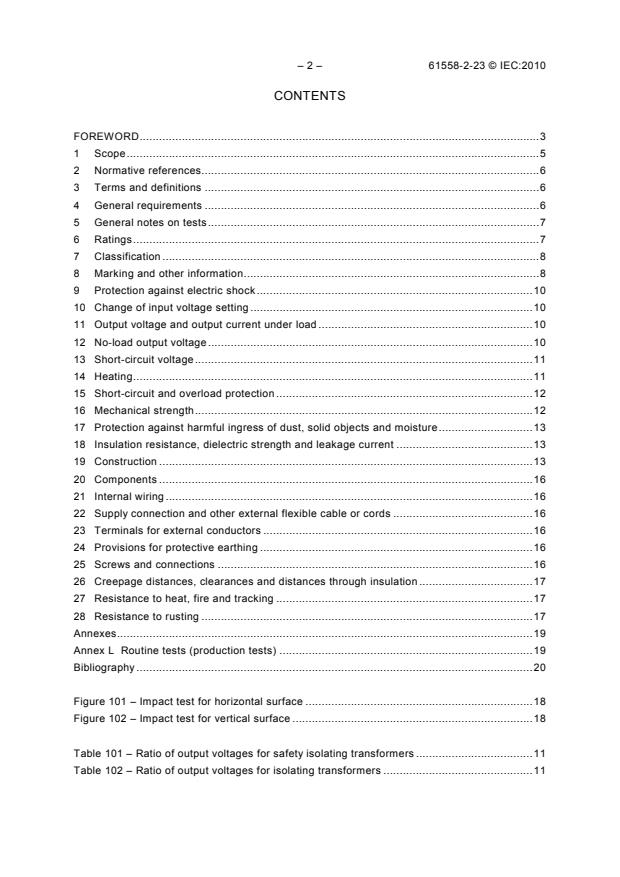
CONTENTS
FOREWORD.3
1 Scope.5
2 Normative references.6
3 Terms and definitions .6
4 General requirements .6
5 General notes on tests.7
6 Ratings.7
7 Classification .8
8 Marking and other information.8
9 Protection against electric shock.10
10 Change of input voltage setting .10
11 Output voltage and output current under load .10
12 No-load output voltage.10
13 Short-circuit voltage.11
14 Heating.11
15 Short-circuit and overload protection .12
16 Mechanical strength.12
17 Protection against harmful ingress of dust, solid objects and moisture.13
18 Insulation resistance, dielectric strength and leakage current .13
19 Construction .13
20 Components .16
21 Internal wiring .16
22 Supply connection and other external flexible cable or cords .16
23 Terminals for external conductors .16
24 Provisions for protective earthing .16
25 Screws and connections .16
26 Creepage distances, clearances and distances through insulation .17
27 Resistance to heat, fire and tracking .17
28 Resistance to rusting .17
Annexes.19
Annex L Routine tests (production tests) .19
Bibliography .20
Figure 101 – Impact test for horizontal surface .18
Figure 102 – Impact test for vertical surface .18
Table 101 – Ratio of output voltages for safety isolating transformers .11
Table 102 – Ratio of output voltages for isolating transformers .11
61558-2-23 © IEC:2010 – 3 –
INTERNATIONAL ELECTROTECHNICAL COMMISSION
_____________
SAFETY OF TRANSFORMERS, REACTORS,
POWER SUPPLY UNITS AND COMBINATIONS THEREOF –
Part 2-23: Particular requirements and tests for transformers
and power supply units for construction sites
FOREWORD
1) The International Electrotechnical Commission (IEC) is a worldwide organization for standardization comprising
all national electrotechnical committees (IEC National Committees). The object of IEC is to promote
international co-operation on all questions concerning standardization in the electrical and electronic fields. To
this end and in addition to other activities, IEC publishes International Standards, Technical Specifications,
Technical Reports, Publicly Available Specifications (PAS) and Guides (hereafter referred to as “IEC
Publication(s)”). Their preparation is entrusted to technical committees; any IEC National Committee interested
in the subject dealt with may participate in this preparatory work. International, governmental and non-
governmental organizations liaising with the IEC also participate in this preparation. IEC collaborates closely
with the International Organization for Standardization (ISO) in accordance with conditions determined by
agreement between the two organizations.
2) The formal decisions or agreements of IEC on technical matters express, as nearly as possible, an international
consensus of opinion on the relevant subjects since each technical committee has representation from all
interested IEC National Committees.
3) IEC Publications have the form of recommendations for international use and are accepted by IEC National
Committees in that sense. While all reasonable efforts are made to ensure that the technical content of IEC
Publications is accurate, IEC cannot be held responsible for the way in which they are used or for any
misinterpretation by any end user.
4) In order to promote international uniformity, IEC National Committees undertake to apply IEC Publications
transparently to the maximum extent possible in their national and regional publications. Any divergence
between any IEC Publication and the corresponding national or regional publication shall be clearly indicated in
the latter.
5) IEC itself does not provide any attestation of conformity. Independent certification bodies provide conformity
assessment services and, in some areas, access to IEC marks of conformity. IEC is not responsible for any
services carried out by independent certification bodies.
6) All users should ensure that they have the latest edition of this publication.
7) No liability shall attach to IEC or its directors, employees, servants or agents including individual experts and
members of its technical committees and IEC National Committees for any personal injury, property damage or
other damage of any nature whatsoever, whether direct or indirect, or for costs (including legal fees) and
expenses arising out of the publication, use of, or reliance upon, this IEC Publication or any other IEC
Publications.
8) Attention is drawn to the Normative references cited in this publication. Use of the referenced publications is
indispensable for the correct application of this publication.
9) Attention is drawn to the possibility that some of the elements of this IEC Publication may be the subject of
patent rights. IEC shall not be held responsible for identifying any or all such patent rights.
International Standard IEC 61558-2-23 has been prepared by IEC Technical Committee 96:
Transformers, reactors, power supply units, and combinations thereof.
This second edition cancels and replaces the first edition published in 2000. It constitutes a
technical revision. The main changes consist of updating this Part 2-23 in accordance with
IEC 61558-1:2005.
This part has the status of a group safety publication in accordance with IEC Guide 104: The
preparation of safety publications and the use of basic safety publications and group safety
publications.
– 4 – 61558-2-23 © IEC:2010
The text of this standard is based on the following documents:
FDIS Report on voting
96/359/FDIS 96/368/RVD
Full information on the voting for the approval of this standard can be found in the report on
voting indicated in the above table.
This publication has been drafted in accordance with the ISO/IEC Directives, Part 2.
This part is intended to be used in conjunction with the latest edition of IEC 61558-1 and its
amendments. It is based on the second edition (2005) of that standard.
This part supplements or modifies the corresponding clauses in IEC 61558-1, so as to convert
that publication into the IEC standard: Particular requirements and tests for transformers and
power supply units for construction sites.
A list of all parts of the IEC 61558 series, under the general title: Safety of transformers,
reactors, power supply units and combinations thereof, can be found on the IEC website.
Future standards in this series will carry the new general title as cited above. Titles of existing
standards in this series will be updated at the time of the next edition.
Where a particular subclause of Part 1 is not mentioned in this part, that subclause applies as
far as is reasonable. Where this part states "addition", "modification" or "replacement", the
relevant text of Part 1 is to be adapted accordingly.
In this part, the following print types are used:
– requirements proper: in roman type;
– test specifications: in italic type;
– explanatory matter: in smaller roman type.
In the text of this part, the words in bold are defined in Clause 3.
Subclauses, notes, figures and tables additional to those in Part 1 are numbered starting from
101; supplementary annexes are entitled AA, BB, etc.
The committee has decided that the contents of this publication will remain unchanged until the
stability date indicated on the IEC web site under "http://webstore.iec.ch" in the data related to
the specific publication. At this date, the publication will be
• reconfirmed,
• withdrawn,
• replaced by a revised edition, or
• amended.
NOTE The attention of National Committees is drawn to the fact that equipment manufacturers and testing
organizations may need a transitional period following publication of a new, amended or revised IEC publication in
which to make products in accordance with the new requirements and to equip themselves for conducting new or
revised tests.
It is the recommendation of the committee that the content of this publication be adopted for implementation
nationally not earlier than 12 months from the date of publication.
61558-2-23 © IEC:2010 – 5 –
SAFETY OF TRANSFORMERS, REACTORS,
POWER SUPPLY UNITS AND COMBINATIONS THEREOF –
Part 2-23: Particular requirements and tests for transformers
and power supply units for construction sites
1 Scope
Replacement:
This part of IEC 61558 deals with the safety of transformers for construction sites and
power supply units incorporating transformers for construction sites. Transformers
incorporating electronic circuits are also covered by this standard.
NOTE 1 Safety includes electrical, thermal and mechanical aspects.
Unless otherwise specified, from here onward, the term transformer covers transformers for
construction sites and power supply units incorporating transformers for construction
sites.
This part is applicable to stationary or portable, single-phase or polyphase, air-cooled (natural
or forced) independent or associated transformers, being isolating or safety isolating dry-
type transformers for the use on construction sites. The windings may be encapsulated or
non-encapsulated.
The rated supply voltage does not exceed 1 000 V a.c., and the rated supply frequency and
the internal operating frequencies do not exceed 500 Hz.
This standard used in combination with Part 2-16 for Switch mode power supply units
(SMPS) is also applicable to power supplies with internal operating frequencies higher than
500 Hz. Where the two requirements are in conflict the most severe take precedence
The rated output does not exceed:
– 25 kVA for single-phase transformers;
– 40 kVA for poly-phase transformers.
This part is applicable to transformers without limitation of the rated output subject to an
agreement between the purchaser and the manufacturer.
NOTE 2 Transformers intended to supply distribution networks are not included in the scope.
Isolating transformers and power supply units incorporating isolating transformers for
construction sites have a no-load output voltage and a rated output voltage exceeding 50
V a.c. and not exceeding 250 V a.c.
Safety isolating transformers and power supply units incorporating safety isolating
transformers for construction sites have a no-load output voltage and a rated output
voltage not exceeding 50 V a.c.
NOTE 3 This standard is applicable to transformers for the supply of electricity in locations as specified in
IEC 60364-7-704. The latter also specifies the protection by using an earthed midpoint or starpoint of the output
winding.
– 6 – 61558-2-23 © IEC:2010
Transformers and power supply units covered by this part are used in applications where it
is required by the installation rules or by the appliance specification for protection purposes.
When the transformers or power supply units are incorporated into low voltage switchgear
and controlgear assemblies for construction sites as specified in IEC 60439-4, the
additional requirements of IEC 60439-4 will apply to the assembly.
NOTE 4 For transformers filled with liquid dielectric or pulverised material, such as sand, additional requirements
are under consideration.
NOTE 5 Attention is drawn to the following:
– measures to protect the enclosure and the components inside the enclosure against external influences
like fungus, vermin, termites, solar-radiation and icing should also be considered;
– the different conditions for transportation, storage, and operation of the transformers and power supply
units should also be considered;
– additional requirements in accordance with other appropriate standards and national rules may be
applicable to transformers and power supply units intended for use in special environments such as
tropical environment.
NOTE 6 Future technological development of transformers may necessitate a need to increase the upper limit of
the frequencies, until then this standard may be used as a guidance document.
2 Normative references
This clause of Part 1 is applicable except as follows:
Addition:
IEC 60068-2-27, Environmental testing – Part 2-27: Tests – Test Ea and guidance: Shock
IEC 60439-4, Low-voltage switchgear and controlgear assemblies – Part 4: Particular
requirements for assemblies for construction sites (ACS)
IEC 61558-1:2005, Safety of power transformers, power supplies, reactors and similar products
– Part 1: General requirements and tests
3 Terms and definitions
This clause of Part 1 is applicable except as follows:
Addition:
3.101
low voltage switchgear and controlgear assembly for construction sites (ACS)
combination of one or several transforming or switching devices with associated control,
measuring, signalling, protective and regulating equipment complete with all their internal
electrical and mechanical connections and structural parts, designed and built for use on all
construction sites, indoors or outdoors.
4 General requirements
This clause of Part 1 is applicable.
61558-2-23 © IEC:2010 – 7 –
5 General notes on tests
This clause of Part 1 is applicable.
6 Ratings
This clause of part 1 is applicable except as follows:
Addition:
6.101 The rated output voltage shall not exceed:
– 250 V a.c. for isolating transformers with a non-earthed mid-point (single-phase) or a
non-earthed star-point (three-phase) or delta connection (three-phase) and for power
supply units incorporating such transformers;
– 110 V a.c. for isolating transformers with a mid-point (single-phase) earthed in the
construction or a star-point (three-phase) earthed in the construction and for power
supply units incorporating such transformers;
– 50 V a.c. for safety isolating transformers and for power supply units incorporating
safety isolating transformers.
The rated output voltage shall exceed:
– 50 V a.c. for isolating transformers and for power supply units incorporating isolating
transformers.
Preferred values for the rated output voltage are
– 110 V and 230 V for portable, single-phase isolating transformers;
– 72 V, 110 V and 230 V for other isolating transformers;
– 6 V, 12 V, 24 V, 42 V and 48 V for safety isolating transformers.
6.102 The rated output shall not exceed:
– 25 kVA for single-phase isolating and safety isolating transformers and power
supply units incorporating such transformers;
– 40 kVA for polyphase isolating and safety isolating transformers and power supply
units incorporating such transformers;
Preferred values for the rated output are
– 25 VA, 40 VA, 63 VA, 100 VA, 160 VA, 250 VA, 400 VA, 630 VA, 1 000 VA, 1 600 VA,
– 2 500 VA, 4 000 VA, 6 300 VA, 10 kVA, 16 kVA and 25 kVA for single-phase
transformers;
– 630 VA, 1 000 VA, 1 600 VA, 2 500 VA, 4 000 VA, 6 300 VA, 10 kVA, 16 kVA, 25 kVA
and 40 kVA for poly-phase transformers.
Intermittent duty cycle may be assigned only to portable transformers and power supply
units having a rated output not exceeding 6,3 kVA.
6.103 The rated supply frequency shall not exceed 500 Hz.
6.104 The rated supply voltage shall not exceed 1 000 V a.c.
6.105 Transformers with intermittent duty cycle shall be intended for a rated operating
time of 5 min "on" and a resting time of 15 min "off".
– 8 – 61558-2-23 © IEC:2010
6.106 The supply current is limited to a maximum of 125 A, and in the case of flexible cable
or socket outlet, to 63 A.
Compliance with 6.101 to 6.106 is checked by inspection of the marking.
7 Classification
This clause of Part 1 is applicable except as follows:
7.5 Replacement:
According to their duty type:
– continuous duty;
– intermittent duty cycle.
8 Marking and other information
This clause of Part 1 is applicable except as follows:
8.1 h) Replacement:
The transformers shall be marked with one of the graphical symbols shown in 8.11;
8.11 Addition:
Symbol or Explanation or title Identification
graphical symbol
Isolating transformer for construction site, fail-safe IEC 60417-
6010-1
Isolating transformer for construction site, fail- safe, IEC 60417-
safety 6010-2
Isolating transformer for construction site, fail-safe, IEC 60417-
mid-point or star-point earthed 6010-3
61558-2-23 © IEC:2010 – 9 –
Symbol or Explanation or title Identification
graphical symbol
Isolating transformer for construction sites, non-short- IEC 60417-
circuit proof 6010-4
Isolating transformer for construction sites, non-short- IEC 60417-
circuit proof, safety 6010-5
Isolating transformer for construction sites, non-short- IEC 60417-
circuit proof, mid-point or star-point earthed 6010-6
Isolating transformer for construction sites, short- IEC 60417-
circuit proof 6010-7
Isolating transformer for construction sites, short- IEC 60417-
circuit proof, safety 6010-8
Isolating transformer for construction sites, short- IEC 60417-
circuit proof, mid-point or star-point earthed 6010-9
– 10 – 61558-2-23 © IEC:2010
9 Protection against electric shock
This clause of Part 1 is applicable.
10 Change of input voltage setting
This clause of Part 1 is applicable.
11 Output voltage and output current under load
This clause of Part 1 is applicable.
12 No-load output voltage
This clause of Part 1 is applicable except as follows:
Addition:
12.101 The no-load output voltage shall not exceed:
– 250 V a.c. for isolating transformers with a non-earthed mid-point (single-phase) or a
non-earthed star-point (three-phase) or delta connection (three-phase) and for power
supply units incorporating such transformers;
– 116 V a.c. for isolating transformers with a mid-point (single-phase) earthed in the
construction or a star-point (three-phase) earthed in the construction and for power
supply units incorporating such transformers;
– 50 V a.c. for safety isolating transformers and for power supply units incorporating
safety isolating transformers.
For independent transformers, the no-load output voltage limitation applies even
when output windings, not intended for interconnection, are connected in series.
The no-load output voltage shall exceed:
– 50 V a.c. for isolating transformers and power supply units incorporating isolating
transformers.
12.102 The difference between the no-load output voltage and the output voltage under
load shall not be excessive.
Compliance with the requirements of 12.101 and 12.102 is checked by measuring the no-load
output voltage at the ambient temperature when the transformer is connected to the rated
supply voltage at the rated supply frequency.
The difference between the no-load output voltage measured in this clause and the output
voltage under load measured during the test of Clause 11, expressed as a percentage of the
latter voltage, shall not exceed the values shown in Table 101 or Table 102.
U – U
no-load
load
NOTE The ratio is defined as follows: × 100 %
U
load
61558-2-23 © IEC:2010 – 11 –
Table 101 – Ratio of output voltages for safety isolating transformers
Type of transformer Ratio between no-load output voltage and output
Rated output voltage under load
VA %
Inherently short-circuit proof transformers:
-up to and including 63 100
-over 63 up to and including 630 50
-over 630 20
Other transformers:
-up to and including 10 100
-over 10 up to and including 25 50
-over 25 up to and including 63 20
-over 63 up to and including 250 15
-over 250 up to and including 630 10
-over 630 5
Table 102 – Ratio of output voltages for isolating transformers
Rated output Ratio between no-load output voltage and output
voltage under load
VA %
All type of transformers:
-up to and including 63 20
-over 63 up to and including 250 15
-over 250 up to and including 630 10
-over 630 5
For single phase transformers with earthed midpoint, the voltage between any pole of the
no - load output voltage
⎛ ⎞
output circuit and earth shall not exceed the ± 2,5 %.
⎜ ⎟
⎝ ⎠
For three phase transformers with earthed star-point, the voltage between any pole of the
no - load output voltage
⎛ ⎞
output circuit and earth shall not exceed the ⎜ ⎟ ± 2,5 %.
⎝ ⎠
13 Short-circuit voltage
This clause of Part 1 is applicable.
14 Heating
This clause of Part 1 is applicable.
– 12 – 61558-2-23 © IEC:2010
15 Short-circuit and overload protection
This clause of Part 1 is applicable.
16 Mechanical strength
This clause of Part 1 is applicable except as follows:
16.1 Replacement:
Transformers and power supply units for construction sites shall have adequate
mechanical strength, and be so constructed as to withstand such rough handling and transport
as may be expected in normal use.
Compliance is checked by the tests of 16.2 for stationary transformers and power supply
units and by the tests of 16.2, 16.3 and 16.4 as appropriate, for portable transformers and
portable power supply units.
After the tests, the transformers or power supply units shall show no damage within the
meaning of this standard. In particular, hazardous live parts shall not become accessible,
when tested as described in 9.2. Insulating barriers shall not be damaged and handles, levers,
knobs and the like shall not move on their shafts.
NOTE 1 Damage to the finish, small dents which do not reduce creepage distances or clearances below the
values specified in Clause 26, and small chips which do not adversely affect the protection against electric shock or
moisture, are ignored.
NOTE 2 Cracks not visible with normal vision or corrected vision without magnification and surface cracks in fibre
reinforced mouldings and the like are ignored.
In addition, with respect to the test of 16.4, bending of the pins during the test is considered
acceptable.
16.2 Replacement:
16.2 Impact test and shock test
16.2.1 Impact test
NOTE This test simulates collisions between the transformer or power supply unit and mechanical handling
equipment for construction site.
The complete transformer or power supply unit, as applicable, shall be subjected to a series
of impacts of 6 J applied to the enclosure as follows:
The equipment to be tested shall be fixed on a support of adequate rigidity to restrict
movement of the transformers or power supply units to 0,1 mm under the effect of the
prescribed impact. Three successive impacts shall be applied to the most unfavourable point of
the enclosure by means of either:
a) a solid smooth steel sphere approximately 50 mm in diameter and with a mass of 500 g ± 25
g, falling freely from a rest position from a vertical height of 1,2 m onto the enclosure
surface held in a horizontal plane. The hardness of the sphere shall be not less than 50 HR
and not more than 58 HR (see Figure 101); or
b) a similar steel sphere, which shall be suspended by a cord and swung as a pendulum in
order to apply a horizontal impact, falling through a vertical distance of 1,2 m (see Figure
102).
61558-2-23 © IEC:2010 – 13 –
Sloping surfaces may be tested using the pendulum but if this is not convenient the surface will
be aligned in the horizontal plane by turning the transformers or the power supply units, as
applicable, on the support and the test a) is used. Before each test, an inspection of the sphere
shall be made to ensure that it is free of burrs and defects.
The test shall be so arranged that the impacts are applied at positions where the weaknesses
are most likely to be revealed. A minimum of 18 impacts shall be applied to the transformers
or power supply units, as applicable.
The test is not applicable to components such as socket-outlets, operating handles, illuminating
lights, push buttons, actuators, etc., when these components are mounted in recesses with
respect to the main surfaces, so that the distance between the most exposed parts of these
components and the said surfaces is at least 10 mm.
After the test, the enclosure shall continue to provide the degrees of protection specified in
19.16; any distortions or deformations of the enclosure and components shall neither be
detrimental to the proper functioning of the transformer, nor decrease creepage distances
and clearances to below the required values; actuators, handles, etc. shall still be operable.
Superficial damage, removed paint, broken cooling ribs or similar parts, small indentations,
cracks not visible with normal or corrected vision without further magnification, or surface
cracks shall not constitute test failures.
16.2.2 Shock test
NOTE This test simulates the shocks received by transformers and power supply units carried loose on board
vehicles on normal roads or on railway cars for long periods of time.
The complete transformers or power supply units, as applicable, in working order shall be
peak acceleration and duration
tested according to IEC 60068-2-27 with a severity of 500 m/s
of 11 ms.
After the test, the enclosure shall continue to provide the degrees of protection specified in
19.16; any distortions or deformations of the enclosure and components shall neither be
detrimental to the proper functioning of the transformer, nor decrease creepage distances
and clearances to below the required values; actuators, handles, etc. shall still be operable.
Superficial damage, removed paint, broken cooling ribs or similar parts, small indentations,
cracks not visible with normal or corrected vision without further magnification, or surface
cracks shall not constitute test failures.
17 Protection against harmful ingress of dust, solid objects and moisture
This clause of Part 1 is applicable.
18 Insulation resistance, dielectric strength and leakage current
This clause of Part 1 is applicable.
19 Construction
This clause of Part 1 is applicable except as follows:
Replace 19.1 of Part 1 by the following:
– 14 – 61558-2-23 © IEC:2010
19.1 The input and output circuits shall be electrically separated from each other, and the
construction shall be such that there is no possibility of any connection between these circuits,
either directly or indirectly, via other conductive parts, except by deliberate action.
Compliance is checked by inspection and measurements, taking Clauses 18 and 26 into
consideration.
19.1.1 The insulation between input and output winding(s) shall consist of double or
reinforced insulation (rated for the working voltage).
In addition, the following applies:
– for class I transformers not intended for connection to the mains supply by means of a
plug, the insulation between the input windings and the body connected to earth shall
consist of at least basic insulation rated for the input voltage. The insulation between
the output windings and the body connected to earth, shall consist of at least basic
insulation (rated for the output voltage);
– for class I transformers intended for connection to the mains supply by means of a
plug, the insulation between the input windings and the body shall consist of at least
basic insulation, and the insulation between the output windings and the body shall
consist of at least supplementary insulation (both basic and supplementary
insulations rated for the working voltage);
– for class II transformers, the insulation between the input windings and the body
shall consist of double or reinforced insulation (rated for the input voltage). The
insulation between the output windings and the body shall consist of double or
reinforced insulation (rated for the output voltage).
19.1.2 For transformers with intermediate conductive parts (e.g. the iron core) not
connected to the body and located between the input and output windings, the insulation
between the input windings and any intermediate conductive part shall consist of at least
basic insulation, and the insulation between the output windings and any intermediate
conductive part shall consist of at least supplementary insulation (both basic and
supplementary insulations rated for the working voltage).
NOTE 1 An intermediate conductive part not separated from the input or output windings or the body by at
least basic insulation is considered to be connected to the relevant part(s).
NOTE 2 Basic insulation and supplementary insulation are interchangeable.
In addition, the following applies:
– for class I transformers, the insulation between the input and output windings via the
intermediate conductive parts (even if they are connected to earth) shall consist of
double or reinforced insulation (rated for the working voltage);
– for class II transformers, the insulation between the input windings and the body,
and between the output windings and the body via the intermediate conductive
parts shall consist of double or reinforced insulation (rated for the input and output
voltage);
– for transformers different from independent (IP00), the insulation between the input
and output windings via the intermediate conductive parts shall consist of double or
reinforced insulation (rated for the working voltage).
NOTE 3 In this clause the possibility to consider the intermediate metal part connected to earth and consequently
to require basic insulation in both circuit (primary and secondary) is not allowed for the following reason:
− the intermediate metal part is normally the iron core made by laminated strips insulated from other by oxide
coatings. It is not assured that all laminations are correctly connected to earth.
− for transformer different from independent, it is not assured that in the final applications the iron core will be
connected to earth.
61558-2-23 © IEC:2010 – 15 –
19.1.3 For class I transformers not intended for connection to the mains supply by means of
a plug, the insulation between the input and output windings may consist of basic insulation
plus protective screening instead of double or reinforced insulation, provided the following
conditions are complied with:
– the insulation between the input winding and the protective screen shall comply with the
requirements for basic insulation (rated for the input voltage);
– the insulation between the protective screen and the output winding shall comply with
the requirements for basic insulation (rated for the output voltage);
– the protective screen shall, unless otherwise specified, consist of a metal foil or of a wire
wound screen extending at least the full width of the input winding and shall have no gaps
or holes;
– where the protective screen does not cover the entire width of the input winding,
additional adhesive tapes or equivalent insulation shall be used to ensure double
insulation in that area;
– if the protective screen is made of a foil, the turns shall be insulated from each other. In
case of only one turn, it shall have an isolated overlap of at least 3 mm;
– the wire of a wire wound screen and the lead out wire of the protective screen shall have a
cross-sectional area at least corresponding to the rated current of the overload device to
ensure that if a breakdown of insulation should occur, the overload protective device will
open the circuit before the lead-out wire is destroyed;
– the lead-out wire shall be soldered to the protective screen or secured in an equally
reliable manner.
NOTE For the purpose of this subclause, the term "windings" does not include internal circuits
Examples of construction of windings are given in Annex M of Part 1.
19.16 Addition:
Transformers and power supply units for construction sites shall conform to the protection
code of not less than IP 44 for fixed transformers and power supply units, and not less than
IP 54 for portable transformers and portable power supply units, except socket-outlet(s)
shall have a protection code not less than IP 44.
Addition:
19.101 There shall be no connections between the output circuit and the protective earth,
unless this is allowed by the relevant equipment standard for associated transformers and
power supply units.
19.102 There shall be no connections between the output circuit and the body, unless this
is allowed by the relevant equipment standard for associated transformers.
Compliance is checked by inspection.
19.103 The input and output terminals for the connection of external wiring shall be so located
that the distance measured between the points of introduction of the conductors into these
terminals is not less than 25 mm. If a barrier is used to obtain this distance, the measurement
shall be made over and around the barrier and it shall be of insulating material and be
permanently fixed to the transformer.
Compliance is checked by inspection and by measurement disregarding intermediate
conductive parts.
– 16 – 61558-2-23 © IEC:2010
19.104 Portable transformers having a rated output not exceeding 630 VA shall be class II.
19.105 to 19.110 Void
19.111 Output circuits shall provide protection against electric shock by one of the following
means:
– the socket-outlets are supplied by SELV;
– the socket-outlets are supplied by an output circuit not exceeding 110 V a.c. with the mid-
point or star-point earthed to provide a line to earth voltage not exceeding 55 V a.c. single
phase or 63,5 V a.c. three phase;
– the socket-outlets are supplied by output circuits not connected to earth and exceeding
50 V a.c.; each output circuit shall supply only one socket outlet.
NOTE The above methods of protection do not require an additional protection by means of an RCD (according to
704.410.3 of IEC 60364-7-704).
19.112 For transformers with mid-point or star-point at output windings intended to be
connected to earth, the connection to earth shall be made in the field. These transformers
shall not have the output winding tapped at any other point.
20 Components
This clause of Part 1 is applicable.
21 Internal wiring
This clause of Part 1 is applicable.
22 Supply connection and other external flexible cable or cords
This clause of Part 1 is applicable except as follows:
Replacement:
22.5 Transformers and power supply units for use on construction sites shall be
provided with at least heavy polychloroprene cords according to code designation 66 of
IEC 60245.
23 Terminals for external conductors
This clause of Part 1 is applicable.
24 Provisions for protective earthing
This clause of Part 1 is applicable.
25 Screws and connections
This clause of Part 1 is applicable.
61558-2-23 © IEC:2010 – 17 –
26 Creepage distances, clearances and distances through insulation
This clause of Part 1 is applicable.
27 Resistance to heat, fire and tracking
This clause of Part 1 is applicable.
28 Resistance to rusting
This clause of Part 1 is applicable.
– 18 – 61558-2-23 © IEC:2010
Figures
Striking element Striking element
start position start position
Striking element
impact position
Test Test
Striking element
sample sample
impact position
RiR
...