

IEC 61558-2-10:2024
(Main)Safety of transformers, reactors, power supply units and combinations thereof - Part 2-10: Particular requirements and tests for separating transformers with high insulation level and separating transformers with output voltages exceeding 1 000 V
General Information
- Abstract
IEC 61558-2-10:2024 deals with the safety of separating transformers with high insulation level and separating transformers with output voltages exceeding 1 000 V. Transformers incorporating electronic circuits are also covered by this document. This second edition cancels and replaces the first edition published in 2014. This edition constitutes a technical revision. This edition includes the following significant technical changes with respect to the previous edition:
a) adjustment of structure and references in accordance with IEC 61558-1:2017;
b) overvoltage categories I, II, III and IV for clearances and dielectric strength tests are included;
c) clearances for homogenous field conditions deleted.
It has the status of a group safety publication in accordance with IEC Guide 104.
- Status
- Published
- Publication Date
- 06-Jun-2024
- Technical Committee
- TC 96 - Transformers and reactors
- Drafting Committee
- MT 1 - TC 96/MT 1
- Current Stage
- PPUB - Publication issued
- Start Date
- 07-Jun-2024
- Completion Date
- 24-May-2024
Buy Documents
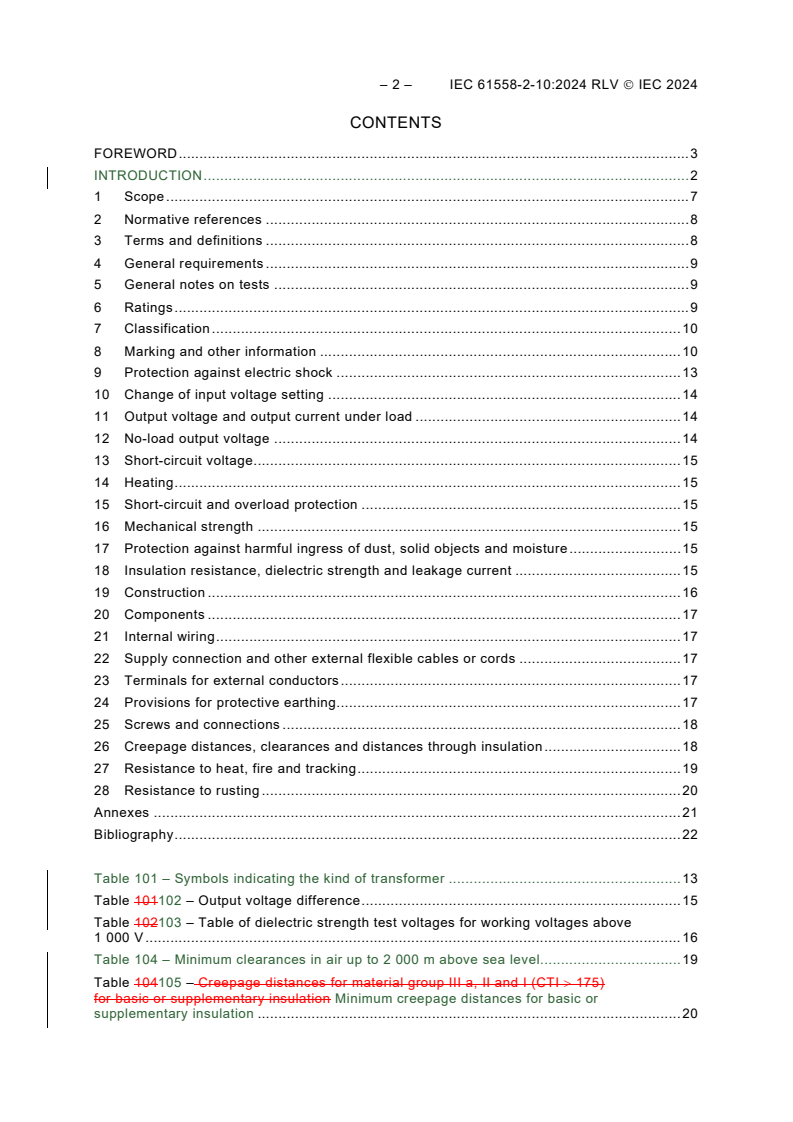
IEC 61558-2-10:2024 RLV - Safety of transformers, reactors, power supply units and combinations thereof - Part 2-10: Particular requirements and tests for separating transformers with high insulation level and separating transformers with output voltages exceeding 1 000 V
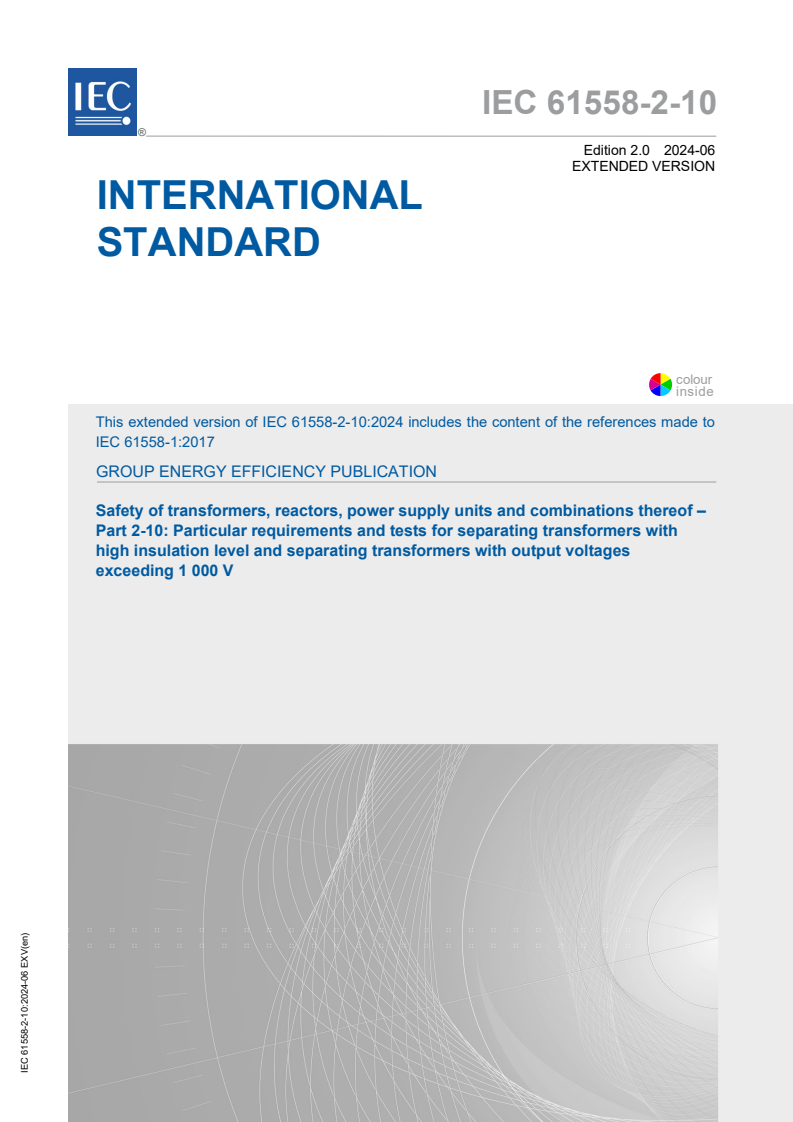
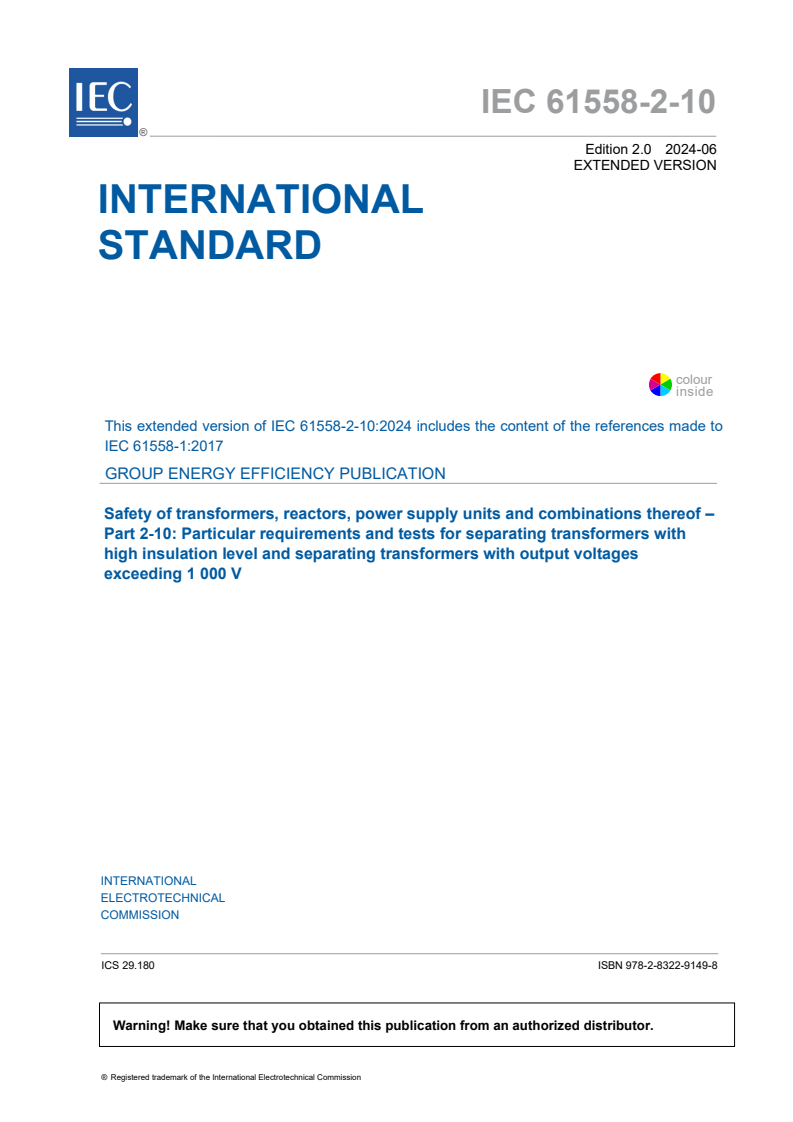
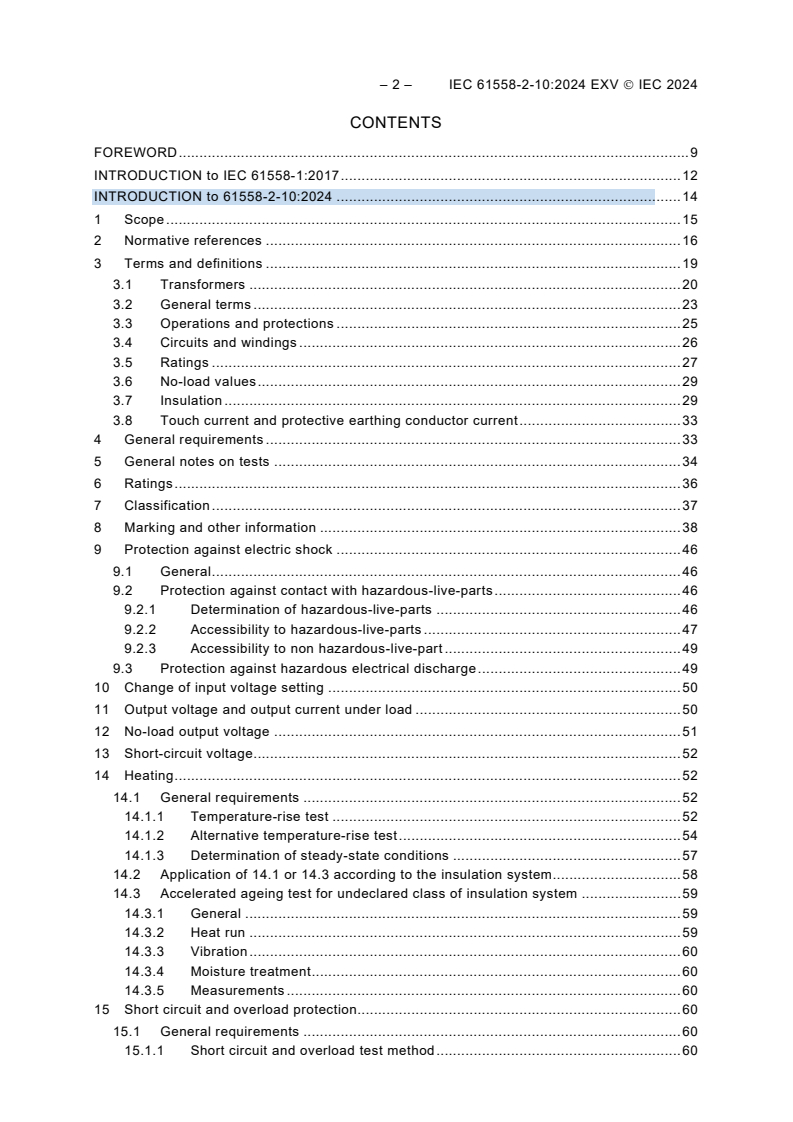
IEC 61558-2-10:2024 EXV - Safety of transformers, reactors, power supply units and combinations thereof - Part 2-10: Particular requirements and tests for separating transformers with high insulation level and separating transformers with output voltages exceeding 1 000 V
IEC 61558-2-10:2024 - Safety of transformers, reactors, power supply units and combinations thereof - Part 2-10: Particular requirements and tests for separating transformers with high insulation level and separating transformers with output voltages exceeding 1 000 V Released:6/7/2024
Overview - IEC 61558-2-10:2024 (Safety of separating transformers > 1 000 V)
IEC 61558-2-10:2024 is the second edition of the IEC particular requirements for separating transformers with high insulation level and for separating transformers whose output voltages exceed 1 000 V AC (or 1 500 V DC). It updates and supplements the general safety requirements of IEC 61558-1:2017 and applies to dry-type, air-cooled stationary or portable transformers (encapsulated or non‑encapsulated). The 2024 edition is a technical revision of the 2014 edition and is published as a group safety publication in accordance with IEC Guide 104.
Key updates in this edition include:
- Structural and reference alignment with IEC 61558-1:2017;
- Inclusion of overvoltage categories I–IV for clearances and dielectric strength testing;
- Removal of clearances for homogeneous field conditions.
Key technical topics and requirements
- Scope and ratings: Covers separating transformers with high insulation level and outputs > 1 000 V AC (1 500 V DC), including units incorporating electronic circuits. Rated supply voltage to the transformer primary does not exceed 1 000 V AC for the standard’s application.
- Dielectric strength and clearances: Test and design requirements for dielectric strength, insulation resistance, creepage distances and air clearances; now using overvoltage categories I–IV for test selection.
- Insulation and leakage: Requirements for insulation systems, leakage current limits and dielectric tests appropriate for high-output voltages.
- Thermal, mechanical and electrical safety: Heating limits, short‑circuit and overload protection, mechanical strength, terminal and wiring requirements, and protection against ingress of dust and moisture.
- Application to power supplies: Linear power supplies with internal frequencies ≤ 500 Hz are fully covered; switch‑mode power supplies are addressed in combination with IEC 61558-2-16 (SMPS requirements).
- Marking, documentation and classification: Information required for safe operation, symbols, and classification of transformer types.
Practical applications - who uses this standard
- Transformer, reactor and power supply design engineers producing high‑insulation or high‑voltage isolation transformers.
- Manufacturers and OEMs building industrial and specialised power conversion equipment.
- Test laboratories and certification bodies performing dielectric strength, clearance and safety testing.
- Compliance officers, procurement and safety engineers who must verify product conformity to international safety criteria.
- Engineering teams integrating transformers into machinery, instrumentation or power systems where isolation and high output voltages are required.
Related standards
- IEC 61558-1:2017 (general requirements for safety of transformers, reactors and power supply units)
- IEC 61558-2-16 (particular requirements for switch‑mode power supply units)
- IEC Guide 104 (group safety publications)
- Relevant installation and protection standards referenced in the standard (e.g., IEC 60364‑4‑41, IEC 61140, IEC 60204‑1) for protective measures against electric shock.
Keywords: IEC 61558-2-10:2024, separating transformers, high insulation level, dielectric strength tests, clearances, overvoltage categories, transformer safety, IEC 61558.
Relations
- Effective Date
- 05-Sep-2023
Buy Documents
IEC 61558-2-10:2024 RLV - Safety of transformers, reactors, power supply units and combinations thereof - Part 2-10: Particular requirements and tests for separating transformers with high insulation level and separating transformers with output voltages exceeding 1 000 V
IEC 61558-2-10:2024 EXV - Safety of transformers, reactors, power supply units and combinations thereof - Part 2-10: Particular requirements and tests for separating transformers with high insulation level and separating transformers with output voltages exceeding 1 000 V
IEC 61558-2-10:2024 - Safety of transformers, reactors, power supply units and combinations thereof - Part 2-10: Particular requirements and tests for separating transformers with high insulation level and separating transformers with output voltages exceeding 1 000 V Released:6/7/2024
Get Certified
Connect with accredited certification bodies for this standard

IMQ S.p.A. (Certification)
Italian electrical product certification.

SLG Prüf- und Zertifizierungs GmbH
German testing and certification body.

UL Solutions
Global safety science company with testing, inspection and certification.
Sponsored listings
Frequently Asked Questions
IEC 61558-2-10:2024 is a standard published by the International Electrotechnical Commission (IEC). Its full title is "Safety of transformers, reactors, power supply units and combinations thereof - Part 2-10: Particular requirements and tests for separating transformers with high insulation level and separating transformers with output voltages exceeding 1 000 V". This standard covers: IEC 61558-2-10:2024 deals with the safety of separating transformers with high insulation level and separating transformers with output voltages exceeding 1 000 V. Transformers incorporating electronic circuits are also covered by this document. This second edition cancels and replaces the first edition published in 2014. This edition constitutes a technical revision. This edition includes the following significant technical changes with respect to the previous edition: a) adjustment of structure and references in accordance with IEC 61558-1:2017; b) overvoltage categories I, II, III and IV for clearances and dielectric strength tests are included; c) clearances for homogenous field conditions deleted. It has the status of a group safety publication in accordance with IEC Guide 104.
IEC 61558-2-10:2024 deals with the safety of separating transformers with high insulation level and separating transformers with output voltages exceeding 1 000 V. Transformers incorporating electronic circuits are also covered by this document. This second edition cancels and replaces the first edition published in 2014. This edition constitutes a technical revision. This edition includes the following significant technical changes with respect to the previous edition: a) adjustment of structure and references in accordance with IEC 61558-1:2017; b) overvoltage categories I, II, III and IV for clearances and dielectric strength tests are included; c) clearances for homogenous field conditions deleted. It has the status of a group safety publication in accordance with IEC Guide 104.
IEC 61558-2-10:2024 is classified under the following ICS (International Classification for Standards) categories: 29.180 - Transformers. Reactors. The ICS classification helps identify the subject area and facilitates finding related standards.
IEC 61558-2-10:2024 has the following relationships with other standards: It is inter standard links to IEC 61558-2-10:2014. Understanding these relationships helps ensure you are using the most current and applicable version of the standard.
IEC 61558-2-10:2024 is available in PDF format for immediate download after purchase. The document can be added to your cart and obtained through the secure checkout process. Digital delivery ensures instant access to the complete standard document.
Standards Content (Sample)
IEC 61558-2-10 ®
Edition 2.0 2024-06
REDLINE VERSION
INTERNATIONAL
STANDARD
colour
inside
GROUP ENERGY EFFICIENCY PUBLICATION
Safety of transformers, reactors, power supply units and combinations thereof –
Part 2-10: Particular requirements and tests for separating transformers with
high insulation level and separating transformers with output voltages
exceeding 1 000 V
All rights reserved. Unless otherwise specified, no part of this publication may be reproduced or utilized in any form
or by any means, electronic or mechanical, including photocopying and microfilm, without permission in writing from
either IEC or IEC's member National Committee in the country of the requester. If you have any questions about IEC
copyright or have an enquiry about obtaining additional rights to this publication, please contact the address below or
your local IEC member National Committee for further information.
IEC Secretariat Tel.: +41 22 919 02 11
3, rue de Varembé info@iec.ch
CH-1211 Geneva 20 www.iec.ch
Switzerland
About the IEC
The International Electrotechnical Commission (IEC) is the leading global organization that prepares and publishes
International Standards for all electrical, electronic and related technologies.
About IEC publications
The technical content of IEC publications is kept under constant review by the IEC. Please make sure that you have the
latest edition, a corrigendum or an amendment might have been published.
IEC publications search - webstore.iec.ch/advsearchform IEC Products & Services Portal - products.iec.ch
The advanced search enables to find IEC publications by a Discover our powerful search engine and read freely all the
variety of criteria (reference number, text, technical publications previews, graphical symbols and the glossary.
committee, …). It also gives information on projects, replaced With a subscription you will always have access to up to date
and withdrawn publications. content tailored to your needs.
IEC Just Published - webstore.iec.ch/justpublished
Electropedia - www.electropedia.org
Stay up to date on all new IEC publications. Just Published
The world's leading online dictionary on electrotechnology,
details all new publications released. Available online and once
containing more than 22 500 terminological entries in English
a month by email.
and French, with equivalent terms in 25 additional languages.
Also known as the International Electrotechnical Vocabulary
IEC Customer Service Centre - webstore.iec.ch/csc
(IEV) online.
If you wish to give us your feedback on this publication or need
further assistance, please contact the Customer Service
Centre: sales@iec.ch.
IEC 61558-2-10 ®
Edition 2.0 2024-06
REDLINE VERSION
INTERNATIONAL
STANDARD
colour
inside
GROUP ENERGY EFFICIENCY PUBLICATION
Safety of transformers, reactors, power supply units and combinations thereof –
Part 2-10: Particular requirements and tests for separating transformers with
high insulation level and separating transformers with output voltages
exceeding 1 000 V
INTERNATIONAL
ELECTROTECHNICAL
COMMISSION
ICS 29.180 ISBN 978-2-8322-9131-3
– 2 – IEC 61558-2-10:2024 RLV IEC 2024
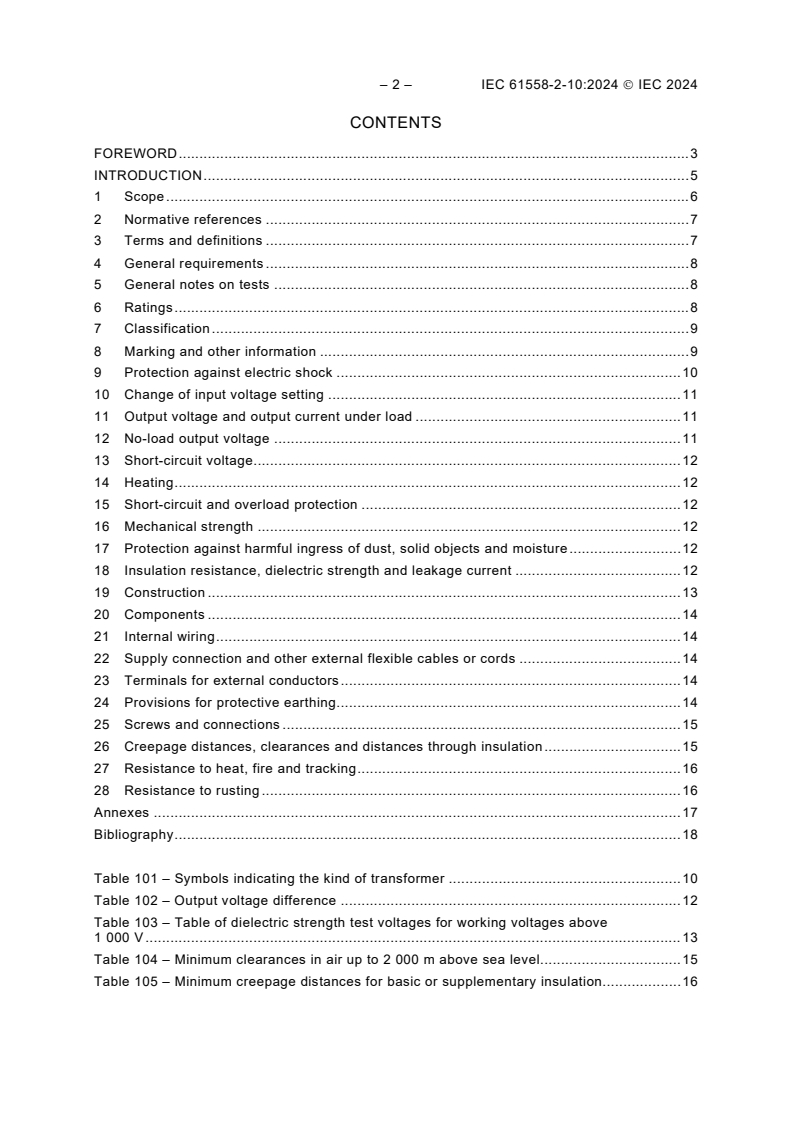
CONTENTS
FOREWORD . 3
INTRODUCTION . 2
1 Scope . 7
2 Normative references . 8
3 Terms and definitions . 8
4 General requirements . 9
5 General notes on tests . 9
6 Ratings . 9
7 Classification . 10
8 Marking and other information . 10
9 Protection against electric shock . 13
10 Change of input voltage setting . 14
11 Output voltage and output current under load . 14
12 No-load output voltage . 14
13 Short-circuit voltage . 15
14 Heating . 15
15 Short-circuit and overload protection . 15
16 Mechanical strength . 15
17 Protection against harmful ingress of dust, solid objects and moisture . 15
18 Insulation resistance, dielectric strength and leakage current . 15
19 Construction . 16
20 Components . 17
21 Internal wiring . 17
22 Supply connection and other external flexible cables or cords . 17
23 Terminals for external conductors . 17
24 Provisions for protective earthing. 17
25 Screws and connections . 18
26 Creepage distances, clearances and distances through insulation . 18
27 Resistance to heat, fire and tracking . 19
28 Resistance to rusting . 20
Annexes . 21
Bibliography . 22
Table 101 – Symbols indicating the kind of transformer . 13
Table 101102 – Output voltage difference . 15
Table 102103 – Table of dielectric strength test voltages for working voltages above
1 000 V . 16
Table 104 – Minimum clearances in air up to 2 000 m above sea level. 19
Table 104105 – Creepage distances for material group III a, II and I (CTI > 175)
for basic or supplementary insulation Minimum creepage distances for basic or
supplementary insulation . 20
INTERNATIONAL ELECTROTECHNICAL COMMISSION
____________
SAFETY OF TRANSFORMERS, REACTORS,
POWER SUPPLY UNITS AND COMBINATIONS THEREOF –
Part 2-10: Particular requirements and tests for separating
transformers with high insulation level and separating
transformers with output voltages exceeding 1 000 V
FOREWORD
1) The International Electrotechnical Commission (IEC) is a worldwide organization for standardization comprising
all national electrotechnical committees (IEC National Committees). The object of IEC is to promote international
co-operation on all questions concerning standardization in the electrical and electronic fields. To this end and
in addition to other activities, IEC publishes International Standards, Technical Specifications, Technical Reports,
Publicly Available Specifications (PAS) and Guides (hereafter referred to as “IEC Publication(s)”). Their
preparation is entrusted to technical committees; any IEC National Committee interested in the subject dealt with
may participate in this preparatory work. International, governmental and non-governmental organizations liaising
with the IEC also participate in this preparation. IEC collaborates closely with the International Organization for
Standardization (ISO) in accordance with conditions determined by agreement between the two organizations.
2) The formal decisions or agreements of IEC on technical matters express, as nearly as possible, an international
consensus of opinion on the relevant subjects since each technical committee has representation from all
interested IEC National Committees.
3) IEC Publications have the form of recommendations for international use and are accepted by IEC National
Committees in that sense. While all reasonable efforts are made to ensure that the technical content of IEC
Publications is accurate, IEC cannot be held responsible for the way in which they are used or for any
misinterpretation by any end user.
4) In order to promote international uniformity, IEC National Committees undertake to apply IEC Publications
transparently to the maximum extent possible in their national and regional publications. Any divergence between
any IEC Publication and the corresponding national or regional publication shall be clearly indicated in the latter.
5) IEC itself does not provide any attestation of conformity. Independent certification bodies provide conformity
assessment services and, in some areas, access to IEC marks of conformity. IEC is not responsible for any
services carried out by independent certification bodies.
6) All users should ensure that they have the latest edition of this publication.
7) No liability shall attach to IEC or its directors, employees, servants or agents including individual experts and
members of its technical committees and IEC National Committees for any personal injury, property damage or
other damage of any nature whatsoever, whether direct or indirect, or for costs (including legal fees) and
expenses arising out of the publication, use of, or reliance upon, this IEC Publication or any other IEC
Publications.
8) Attention is drawn to the Normative references cited in this publication. Use of the referenced publications is
indispensable for the correct application of this publication.
9) IEC draws attention to the possibility that the implementation of this document may involve the use of (a)
patent(s). IEC takes no position concerning the evidence, validity or applicability of any claimed patent rights in
respect thereof. As of the date of publication of this document, IEC had not received notice of (a) patent(s), which
may be required to implement this document. However, implementers are cautioned that this may not represent
the latest information, which may be obtained from the patent database available at https://patents.iec.ch. IEC
shall not be held responsible for identifying any or all such patent rights.
This redline version of the official IEC Standard allows the user to identify the changes
made to the previous edition IEC 61558-2-10:2014. A vertical bar appears in the margin
wherever a change has been made. Additions are in green text, deletions are in
strikethrough red text.
– 4 – IEC 61558-2-10:2024 RLV IEC 2024
IEC 61558-2-10 has been prepared by IEC technical committee 96: Transformers, reactors,
power supply units and combinations thereof. It is an International Standard.
This second edition cancels and replaces the first edition published in 2014. This edition
constitutes a technical revision.
This edition includes the following significant technical changes with respect to the previous
edition:
a) adjustment of structure and references in accordance with IEC 61558-1:2017;
b) overvoltage categories I, II, III and IV for clearances and dielectric strength tests are
included;
c) clearances for homogenous field conditions deleted.
The text of this International Standard is based on the following documents:
Draft Report on voting
96/589/FDIS 96/595/RVD
Full information on the voting for its approval can be found in the report on voting indicated in
the above table.
The language used for the development of this International Standard is English.
This document was drafted in accordance with ISO/IEC Directives, Part 2, and developed in
accordance with ISO/IEC Directives, Part 1 and ISO/IEC Directives, IEC Supplement, available
at www.iec.ch/members_experts/refdocs. The main document types developed by IEC are
described in greater detail at www.iec.ch/standardsdev/publications.
It has the status of a group safety publication in accordance with IEC Guide 104.
This International Standard is to be used in conjunction with IEC 61558-1:2017.
This document supplements or modifies the corresponding clauses in IEC 61558-1:2017, so as
to convert that publication into the IEC standard: Particular requirements and tests for
separating transformers with high insulation level and separating transformers with output
voltages exceeding 1 000 V.
A list of all parts in the IEC 61558 series published under the general title Safety of transformers,
reactors, power supply units and combinations thereof, can be found on the IEC website.
Future standards in this series will carry the new general title as cited above. Titles of existing
standards in this series will be updated at the time of the next edition.
Where this document states "addition", "modification" or "replacement", the relevant text of
IEC 61558-1:2017 is to be adapted accordingly.
In this document, the following print types are used:
– requirements proper: in roman type;
– test specifications: in italic type;
– explanatory matter: in smaller roman type.
In the text of this document, the words in bold are defined in Clause 3.
Subclauses, notes, figures and tables additional to those in IEC 61558-1:2017 are numbered
starting from 101; supplementary annexes are entitled AA, BB, etc.
The committee has decided that the contents of this document will remain unchanged until the
stability date indicated on the IEC website under webstore.iec.ch in the data related to the
specific document. At this date, the document will be
• reconfirmed,
• withdrawn, or
• revised.
IMPORTANT – The "colour inside" logo on the cover page of this document indicates
that it contains colours which are considered to be useful for the correct understanding
of its contents. Users should therefore print this document using a colour printer.
– 6 – IEC 61558-2-10:2024 RLV IEC 2024
INTRODUCTION
IEC TC 96 has a group safety function in accordance with IEC Guide 104 for transformers other
than those intended to supply distribution networks, in particular transformers and power
supply units intended to allow the application of protective measures against electric shock as
defined by TC 64, which is about electrical installations and protection against electric shock,
but in certain cases including the limitation of voltage and horizontal safety function for SELV,
in accordance with IEC 60364-4-41.
The group safety function (GSF) is used because of responsibility for safety extra-low voltage
(SELV) in accordance with IEC 61140:2016, 5.2.6 and IEC 60364-4-41:2005, 414.3.1 or control
circuits in accordance with IEC 60204-1:2016, 7.2.4.
The group safety function is used for each part of IEC 61558-2 because different standards of
the IEC 61558 series can be combined in one construction but in certain cases with no limitation
of rated output power.
For example an auto-transformer in accordance with IEC 61558-2-13 can be designed with a
separate SELV-circuit in accordance with the particular requirements for IEC 61558-2-6
relating to the general requirements of IEC 61558-1.
SAFETY OF TRANSFORMERS, REACTORS,
POWER SUPPLY UNITS AND COMBINATIONS THEREOF –
Part 2-10: Particular requirements and tests for separating
transformers with high insulation level and separating
transformers with output voltages exceeding 1 000 V
1 Scope
Replacement:
This part of IEC 61558 deals with the safety of separating transformers with high insulation
level and separating transformers with output voltages exceeding 1 000 V. Transformers
incorporating electronic circuits are also covered by this document.
NOTE 1 Safety includes electrical, thermal and mechanical aspects.
Unless otherwise specified, from here onward, the term transformer covers separating
transformers with high insulation level and separating transformers with output voltages
exceeding 1 000 V AC or 1 500 V DC.
This document is applicable to stationary or portable, single-phase or polyphase, air-cooled
(natural or forced) independent or associated dry-type transformers. The windings may can
be encapsulated or non-encapsulated.
This standard is applicable to transformers and power supply (linear) with internal
operational frequencies not exceeding 500 Hz.
This standard used in combination with Part 2-16 for switch mode power supply units (SMPS)
is also applicable to power supplies with internal operational frequencies higher than 500 Hz.
Where the two requirements are in conflict the most severe take precedence.
For power supply units (linear) this document is applicable. For switch mode power supply
units, IEC 61558-2-16 is applicable together with this document. Where two requirements are
in conflict, the most severe takes precedence.
The rated supply voltage does not exceed 1 000 V AC, and the rated supply frequency and
the internal operating frequencies do not exceed 500 Hz.
The rated output does not exceed:
– 25 kVA for single-phase transformers;
– 40 kVA for polyphase transformers.
This document is applicable to transformers without limitation of the rated output subject to
an agreement between the purchaser and the manufacturer.
Where applicable the no-load output voltage or the rated output voltage:
– does not exceed 1 000 V AC or 1 500 V DC for separating transformers with high
insulation level;
– does exceed 1 000 V AC or 1 500 V DC and does not exceed 15 000 V AC or 15 000 V
DC for separating transformers with output voltage exceeding 1 000 V.
– 8 – IEC 61558-2-10:2024 RLV IEC 2024
This document does not apply to:
– transformers covered by IEC 60076-11;
– neon transformers covered by IEC 61050; and
– power supplies and converters for use with or in products according to IEC 61347-2-10.
This document is not applicable to external circuits and their components intended to be
connected to the input terminals and output terminals of the transformers.
NOTE 2 Transformers covered by this document are used only in applications where double or reinforced
insulation between circuits is not required by the installation rules or by the end product standard.
NOTE 2 3 Normally, the transformers are intended to be used with equipment to provide voltages different from
the supply voltage for the functional requirements of the equipment. The protection against electric shock can be
provided (or completed) by other features of the equipment, such as the body. Parts of output circuits can be
connected to the input circuits or to protective earthing.
This document is applicable to transformers associated with specific equipment, to the extent
decided upon by the relevant IEC technical committees.
NOTE 3 Attention is drawn to the following if necessary:
– for transformers intended to be used in vehicles, on board ships, and aircraft, additional
requirements (from other applicable standards, national rules, etc.) can be necessary;
– measures to protect the enclosure and the components inside the enclosure against
external influences such as fungus, vermin, termites, solar-radiation, and icing can also
be considered;
– the different conditions for transportation, storage, and operation of the transformers
can also be considered;
– additional requirements in accordance with other appropriate standards and national
rules can be applicable to transformers intended for use in special environments, such
as tropical environment.
NOTE 4 It is possible that future technological development of transformers can necessitate a
need to will require an increase in the upper limit of the frequencies. Until then this document
can be used as a guidance document.
This group safety publication focusing on safety guidance is primarily intended to be used as a
product safety standard for the products mentioned in the scope, but is also intended to be used
by technical committees in the preparation of publications for products similar to those
mentioned in the scope of this group safety publication, in accordance with the principles laid
down in IEC Guide 104 and lSO/lEC Guide 51.
One of the responsibilities of a technical committee is, wherever applicable, to make use of
basic safety publications and/or group safety publications in the preparation of its publications.
2 Normative references
IEC 61558-1:2017, Clause 2 is applicable, except as follows:
Addition:
IEC 61558-1:2005, Safety of power transformers, power supplies, reactors and similar products
– Part 1: General requirements and tests
Amendment 1:2009
IEC 61558-2-16, Safety of transformers, reactors, power supply units and similar products for
supply voltages up to 1 100 V – Part 2-16: Particular requirements and tests for switch mode
power supply units and transformers for switch mode power supply units
IEC 61558-1:2017, Safety of transformers, reactors, power supply units and combinations
thereof – Part 1: General requirements and tests
3 Terms and definitions
This clause of Part 1 is applicable except as follows:
The third paragraph is not applicable.
For the purposes of this document, the terms and definitions given in IEC 61558-1 apply.
ISO and IEC maintain terminological databases for use in standardization at the following
addresses:
• IEC Electropedia: available at http://www.electropedia.org/
• ISO Online browsing platform: available at http://www.iso.org/obp
3.1 Transformers
Addition:
3.1.101
separating transformer with high insulation level
separating transformer where the output voltage does not exceed 1 000 V AC or 1 500 V DC
and does exceed 50 V AC or DC for independent transformers, the output winding(s) is
(are) isolated from both, input winding(s) and body for a working voltage exceeding
1 000 V AC or 1 500 V DC but not exceeding 15 000 V AC or 15 000 V DC
Note 1 to entry: The output winding(s) are isolated from both, input winding(s) and body for a working voltage
exceeding 1 000 V. a.c or 1 500 V d.c but not exceeding 15 000 V a.c or 15 000 V d.c.
3.1.102
separating transformer with output voltages exceeding 1 000 V
separating transformer where the output circuits of which are designed to give voltages
exceeding 1 000 V AC or 1 500 V DC and not exceeding 15 000 V AC or 15 000 V DC
4 General requirements
IEC 61558-1:2017, Clause 4 is applicable.
5 General notes on tests
IEC 61558-1:2017, Clause 5 is applicable.
6 Ratings
This clause of Part 1 is not applicable.
Replacement:
IEC 61558-1:2017, Clause 6 is applicable except as follows.
– 10 – IEC 61558-2-10:2024 RLV IEC 2024
Addition:
6.101 The rated output voltage is limited as follows.
For separating transformers with high insulation level:
– the no-load output voltage or the rated output voltage shall not exceed 1 000 V AC or
1 500 V DC;
– for independent transformers the rated output voltage shall exceed 50 V AC or 50 V DC
and this output voltage applies even when output windings, not intended for
interconnection, are connected in series.
For separating transformers with no load output voltages exceeding 1 000 V:
– the rated output voltage shall exceed 1 000 V AC or 1 500 V DC and shall not exceed
15 000 V AC or 15 000 V DC;
– for independent transformers these output voltage limitations apply even when output
windings, not intended for interconnection, are connected in series.
6.102 The rated output shall not exceed:
– 25 kVA for single-phase transformers;
– 40 kVA for polyphase transformers.
Transformers without limitation of the rated output shall be subject to agreement between the
purchaser and the manufacturer.
6.103 The rated supply frequency and the internal operating frequencies shall not exceed
500 Hz.
6.104 The rated supply voltage shall not exceed 1 000 V AC.
Compliance with the requirements of 6.101 to 6.104 is checked by inspection of the marking.
7 Classification
IEC 61558-1:2017, Clause 7 is applicable.
8 Marking and other information
IEC 61558-1:2017, Clause 8 is applicable, except as follows:
8.1 h)
Replacement:
Replace the first sentence by the following: relevant graphical symbols shown in 8.11 indicating
the kind of transformer;
Replacement of the content up to the first semi-colon with the following:
relevant graphical symbols shown in Table 101 that indicate the kind of transformer
The voltage of the insulation level, expressed in kV is not a part of the symbol.
8.11
Addition:
The symbol for linear power supply units shall be used in conjunction with the symbol
indicating the kind of transformer.
Symbol or graphical symbol Explanation or title Identification
Separating transformer, high insulation IEC 60417-6063
level, general
To identify the separating transformer with
high insulation level, where the letter "F"
may be used adjacent to the symbol to
indicate a fail-safe function.
The voltage of the insulation level,
expressed in kV, may be added adjacent to
the symbol.
Separating transformer, high insulation IEC 60417-6064
level, non-short-circuit-proof
To identify the non-short-circuit-proof
separating transformer with high insulation
level.
The voltage of the insulation level,
expressed in kV, may be added adjacent to
the symbol
Separating transformer, high insulation IEC 60417-6065
level, short-circuit-proof
To identify the short-circuit-proof (inherently
or non-inherently) separating transformer
with high insulation level.
The voltage of the insulation level,
expressed in kV, may be added adjacent to
the symbol.
– 12 – IEC 61558-2-10:2024 RLV IEC 2024
Symbol or graphical symbol Explanation or title Identification
Separating transformer, output voltages IEC 60417-6066
exceeding 1 kV, general
To identify the separating transformer with
output voltages exceeding 1 000 V and not
exceeding 15 000 V, where the letter "F"
may be used adjacent to the symbol to
indicate a fail-safe function.
Separating transformer, output voltages IEC 60417-6067
exceeding 1 kV, non-short-circuit-proof
To identify the non-short-circuit-proof
separating transformer with output voltages
exceeding 1 000 V and not exceeding
15 000 V.
Separating transformer, output voltages IEC 60417-6068
exceeding 1 kV, short-circuit-proof
To identify the short-circuit-proof (inherently
or non-inherently) separating transformer
with output voltages exceeding 1 000 V and
not exceeding 15 000 V.
Table 101 – Symbols indicating the kind of transformer
Symbol or
graphical Explanation or title Identification
symbol
Fail-safe separating transformers with high insulation level IEC 60417-6063:2011-05
The voltage of the insulation level, expressed in kV, shall be marked
adjacent to the symbol.
Non-short-circuit proof separating transformer with high IEC 60417-6064:2011-05
insulation level
The voltage of the insulation level, expressed in kV, shall be marked
adjacent to the symbol.
Short-circuit-proof separating transformer with high insulation IEC 60417-6065:2011-05
level (inherently or non-inherently)
The voltage of the insulation level, expressed in kV, shall be marked
adjacent to the symbol.
Fail-safe separating transformers with output voltages
IEC 60417-6066:2011-06
exceeding 1 000 V
Non-short-circuit-proof separating transformer with output IEC 60417-6067:2011-06
voltages exceeding 1 000 V
Short-circuit-proof separating transformer with output voltages IEC 60417-6068:2011-06
exceeding 1 000 V (inherently or non-inherently)
Power supply unit, linear IEC 60417-6210:2013-10
L
Addition:
8.101 Separating transformers with high insulation level shall be marked with the voltage
of the insulation level, expressed in kV on the right side of the symbol.
9 Protection against electric shock
IEC 61558-1:2017, Clause 9 is applicable.
– 14 – IEC 61558-2-10:2024 RLV IEC 2024
10 Change of input voltage setting
IEC 61558-1:2017, Clause 10 is applicable.
11 Output voltage and output current under load
IEC 61558-1:2017, Clause 11 is applicable.
12 No-load output voltage
IEC 61558-1:2017, Clause 12 is applicable except as follows:
Addition:
The no-load voltage is measured when the transformer is connected to the rated supply
voltage at the rated supply frequency at ambient temperature.
12.101 For separating transformers with high insulation level:
– the no load output voltage shall not exceed 1 000 V AC or 1 500 V DC. For independent
transformers the no-load output voltage shall exceed 50 V AC or 50 V DC. This limitation
applies even when independent output windings, not intended for interconnection, are
connected in series.
12.102 For separating transformers with output voltages exceeding 1 000 V:
– the no-load output voltage shall exceed 1 000 V AC or 1 500 V DC and shall not exceed
15 000 V AC or DC. For independent transformers this limitation applies even when
independent output windings, not intended for interconnection, are connected in series.
12.103 The difference between the no-load output voltage and the output voltage under
load shall not be excessive.
The ratio between the no-load output voltage measured in Clause 12 and the output voltage
under load measured during the test of Clause 11, expressed as a percentage of the latter
voltage, shall not exceed the values shown in Table 102.
The difference is expressed as a percentage of the latter voltage calculated according to the
following ratio is determined by Formula (1):
UU−
no-load load
×100 (%)
(1)
U
load
where
U is the no-load output voltage, expressed in V;
no-load
U is the output voltage under load, expressed in V. The difference shall not exceed the
load
values shown in Table 101.
Table 101 102 – Output voltage difference
Type of transformer Difference between no-load output voltage and
Rated output output voltage under load
VA %
Inherently short-circuit-proof transformers:
− up to and including 63 100
− over 63 up to and including 630 50
− over 630 20
Other transformers:
− up to and including 630
− over 630
Compliance with the requirements of 12.101, 12.102 and 12.103 shall be checked by measuring
the no-load output voltage at ambient temperature when the transformer is connected to
the rated supply voltage at the rated supply frequency.
13 Short-circuit voltage
IEC 61558-1:2017, Clause 13 is applicable.
14 Heating
IEC 61558-1:2017, Clause 14 is applicable.
15 Short-circuit and overload protection
IEC 61558-1:2017, Clause 15 is applicable.
16 Mechanical strength
IEC 61558-1:2017, Clause 16 is applicable.
17 Protection against harmful ingress of dust, solid objects and moisture
IEC 61558-1:2017, Clause 17 is applicable.
18 Insulation resistance, dielectric strength and leakage current
IEC 61558-1:2017, Clause 18 is applicable except as follows:
18.3 Dielectric strength test
Replacement:
Immediately after the test of 18.2 the insulation is subjected for 1 min to a dielectric strength
voltage of substantially sinusoidal wave form at 50 Hz or 60 Hz. The value of the dielectric
strength test voltage and the points of application are given in Table 102 Table 103.
Resistors, capacitors and other components are disconnected before carrying out the test.
– 16 – IEC 61558-2-10:2024 RLV IEC 2024
For working voltages up to and including 1 000 V the dielectric strength voltage shall not be
less than the values shown in Table 14 of IEC 61558-1:2017.
Table 102 103 – Table of dielectric strength test voltages for working voltages above
1 000 V
Application of dielectric strength test voltage Working voltage
over 1 000 V, up to
and including 15 000 V
Additional value for the corresponding transients of the different overvoltage U = 500 V
OVC I
categories
U = 750 V
OVC II
U = 1 000 V
OVC III
U = 1 250 V
OVC IV
1) Between live parts of input circuits and live parts of output circuits 2 × working voltage
basic insulation + 1 000 V + U
OVC
2) Over basic insulation or supplementary insulation between:
a) live parts of different polarity. Test is not applicable within the same
winding
b) lifelive parts and the body, if intended to be connected to the
protective earthearthing
2 × working voltage
c) accessible conductive parts and a metal rod of the same diameter as
+ 1 000 V + U
OVC
the flexible cable or cord (or metallic foil wrapped round the cord)
inserted inside inlet bushing, cord guards and anchorage, and the like
d) live parts and an intermediate conductive part
e) conductive parts and the body
f) each input circuit and all other input circuits connected together
Dielectric strength test voltages for double or reinforced insulation (e.g. for a class II transformer insulation)
shall be twice the values for basic insulation.
19 Construction
IEC 61558-1:2017, Clause 19 is applicable except as follows:
19.1 General construction
Replacement:
The input and output circuits shall be electrically separated from each other, and the
construction shall be such that there is no possibility of any connection between these circuits,
either directly or indirectly, through other conductive parts, except by deliberate action.
Compliance is checked by inspection and measurements, taking Clause 18 and Clause 26 into
consideration.
Addition:
19.1.101 The insulation between input and output winding(s) shall consist of at least basic
insulation (rated for the working voltage).
In addition, the following applies:
– for class I transformers, the insulation between the input windings and the body, and
between the output windings and the body, shall consist of basic insulation (both basic
insulations rated for the working voltage);
– for class II transformers, the insulation between the input windings and the body, and
between the output windings and the body, shall consist of double or reinforced
insulation (both double or reinforced insulations rated for the working voltage).
19.1.102 For transformers with intermediate conductive parts (e.g. the iron core) not
connected to the body and located between the input and output windings, the insulation
between the intermediate conductive parts and the input windings, and between the
intermediate conductive parts and the output windings shall consist of basic insulation
(rated for the working voltage).
NOTE An intermediate conductive part not separated from the input or output windings or the body by at least
basic insulation is considered to be connected to the relevant part(s).
In addition, the following applies:
– for class I transformers, the insulation between the input and output windings via the
intermediate conductive parts shall consist of at least basic insulation (rated for the
working voltage);
– for class II transformers, the insulation between the input windings and the body, and
between the output windings and the body via the intermediate conductive parts shall
consist of double or reinforced insulation (rated for the input and output voltage).
Addition:
19.101 Parts of output circuits may can be connected to protective earthing.
19.102 There shall be no connection between the output circuits and the body, unless – for
associated transformers – allowed by the relevant equipment standard.
Compliance is checked by inspection.
20 Components
IEC 61558-1:2017, Clause 20 is applicable.
21 Internal wiring
IEC 61558-1:2017, Clause 21 is applicable.
22 Supply connection and other external flexible cables or cords
IEC 61558-1:2017, Clause 22 is applicable.
23 Terminals for external conductors
IEC 61558-1:2017, Clause 23 is applicable.
24 Provisions for protective earthing
IEC 61558-1:2017, Clause 24 is applicable.
– 18 – IEC 61558-2-10:2024 RLV IEC 2024
25 Screws and connections
IEC 61558-1:2017, Clause 25 is applicable.
26 Creepage distances, clearances and distances through insulation
IEC 61558-1:2017, Clause 26 is applicable except as follows:
Replacement:
26.1 General
Replacement of the first and second paragraph by together with the note with the following:
For working voltages up to and including 1 000 V the creepage distances, clearances and
distances through insulation shall not be less than the values shown in Table 13 for insulating
materials of group III a (see IEC 60664-1).
For working voltages over 1 000 V, up to and including 15 000 V the creepage distances,
clearances and distances through insulation shall not be less than the values shown in
Table 103 for insulating materials of at least group III a (see IEC 60664-1)
Compliance is checked by measurements under the provisions of 26.2 and 26.3
NOTE 1
– For working voltages up to and including 1 000 V: For materials of groups I and II , see Tables C.1 and D.1.
– For working voltages exceeding 1 000 V and up to and including 15 000 V: For material groups II and I see
Table 103.
NOTE 2 Table 13, Table C.1 and Table D.1 and Table 102 are applicable only for frequencies up to and including
30 kHz.
Replacement of NOTE 7 by the following:
NOTE 7 Table 13, Table C.1 and Table D.1 take into consideration over voltage category II for basic insulation
and over voltage category III for double or reinforced insulation.
For working voltages up to and including 1 000 V the clearances, creepage distances and
distances through insulation shall not be less than the values shown in Table 20, Table 21 and
Table 22 of IEC 61558-1:2017.
For working voltages above 1 000 V, up to and including 15 000 V the clearances and
creepage distances shall not be less than the values shown in Table 104 and Table 105.
Compliance is checked by measurements in accordance with the provisions of 26.2 and 26.3.
NOTE 1 Table 20, Table 21 and Table 22 of IEC 61558-1:2017, and Table 104 and Table 105 of this document are
applicable only for frequencies up to and including 30 kHz.
26.2 Creepage distances and clearances
Addition:
26.2.101
Table 103 – Clearances distances
for homogenous fields and inhomogeneous fields
Minimum clearances in air up to 2 000 m above sea level
Working voltage Inhomogeneous field Homogeneous field
V
1 000 8,0 3,0
1 500 11,5 4,0
3 000 21,0 6,5
6 000 47,0 14,0
10 000 78,0 23,0
15 000 117,0 35,0
NOTE 1 The values from EN 50178 and IEC 62103 are also applicable.
NOTE 2 Interpolation is allowed.
Creepage distances, clearances and distances through insulation shall not be less than the
values shown in Table 104.
Table 104 – Minimum clearances in air up to 2 000 m above sea level
Overvoltage category
Working voltage
V OVC I OVC II OVC III OVC IV
1 000 3,0 5,5 8,0 14,0
1 500 5,5 8,0 11,0 18,0
3 000 8,0 11,0 18,0 25,0
6 000 25,0 33,0 40,0 60,0
10 000 40,0 60,0 75,0 90,0
15 000 75,0 90,0 130,0 170,0
The values from EN 50178 and IEC 62477-1 are also applicable.
Clearances for double or reinforced insulation (e.g. for a class II transformer insulation)
shall be the next higher overvoltage category. If no higher overvoltage category exists use
the next higher working voltage or 160 % of the clearance for basic insulation.
– 20 – IEC 61558-2-10:2024 RLV IEC 2024
Table 104 105 – Creepage distances for material group III a, II and I (CTI > 175)
for basic or supplementary insulation Minimum creepage distances for basic or
supplementary insulation
Minimum creepage distance
Pollution degree
Working 1 2 3
voltage
All material Material Material Material Material Material Material
groups group I group II group IIIa group I group II group IIIa
V mm mm mm mm mm mm mm
1 000 3,2 5,0 7,1 10,0 12,5 14,0 16,0
1 250 4,2 6,3 9,0 12,5 16,0 18,0 20,0
1 600 5,6 8,0 11,0 16,0 20,0 22,0 25,0
2 000 7,5 10,0 14,0 20,0 25,0 28,0 32,0
2 500 10,0 12,5 18,0 25,0 32,0 36,0 40,0
3 200 12,5 16,0 22,0 32,0 40,0 45,0 50,0
4 000 16,0 20,0 28,0 40,0 50,0 56,0 63,0
5 000 20,0 25,0 36,0 50,0 63,0 71,0 80,0
6 300 25,0 32,0 45,0 63,0 80,0 90,0 100,0
8 000 32,0 40,0 56,0 80,0 100,0 110,0 125,0
10 000 40,0 50,0 71,0 100,0 125,0 140,0 160,0
12 500 50,0 63,0 90,0 125,0 155,0 180,0 200,0
15 000 5960,0 75,0 103,2105,0 150,0 200,0 230,0 240,0
NOTE 1 P1 = pollution degree 1; P2 = pollution degree 2; P3 = pollution degree 3.
NOTE 2 When a numeric figure is replaced with a dash in a column of the table, it means that no value is given.
NOTE 3 The minimum values of clearance in this table are applicable in air up to 2 000 m above sea level.
NOTE 4 Material group IIIb is not allowed.
NOTE 5 Interpolation is allowed.
NOTE 6 The values of IEC 60664-1:20072020, Table F4F.5 are also applicable.
NOTE 7 Creepage distance for double or reinforced insulation is shall be twice the creepage distance for basic
insulation from this tables.
27 Resistance to heat, fire and tracking
This clause of Part 1 is applicable.
27.1 IEC 61558-1:2017, 27.1 is applicable.
28 Resistance to rusting
IEC 61558-1:2017, Clause 28 is applicable.
Annexes
The annexes of IEC 61558-1:2017 are applicable.
– 22 – IEC 61558-2-10:2024 RLV IEC 2024
Bibliography
The Bibliography of IEC 61558-1:2017 is applicable, except as follows.
Addition:
IEC 60076-11:2018, Power
...
IEC 61558-2-10 ®
Edition 2.0 2024-06
EXTENDED VERSION
INTERNATIONAL
STANDARD
colour
inside
This extended version of IEC 61558-2-10:2024 includes the content of the references made to
IEC 61558-1:2017
GROUP ENERGY EFFICIENCY PUBLICATION
Safety of transformers, reactors, power supply units and combinations thereof –
Part 2-10: Particular requirements and tests for separating transformers with
high insulation level and separating transformers with output voltages
exceeding 1 000 V
All rights reserved. Unless otherwise specified, no part of this publication may be reproduced or utilized in any form
or by any means, electronic or mechanical, including photocopying and microfilm, without permission in writing from
either IEC or IEC's member National Committee in the country of the requester. If you have any questions about IEC
copyright or have an enquiry about obtaining additional rights to this publication, please contact the address below or
your local IEC member National Committee for further information.
IEC Secretariat Tel.: +41 22 919 02 11
3, rue de Varembé info@iec.ch
CH-1211 Geneva 20 www.iec.ch
Switzerland
About the IEC
The International Electrotechnical Commission (IEC) is the leading global organization that prepares and publishes
International Standards for all electrical, electronic and related technologies.
About IEC publications
The technical content of IEC publications is kept under constant review by the IEC. Please make sure that you have the
latest edition, a corrigendum or an amendment might have been published.
IEC publications search - webstore.iec.ch/advsearchform IEC Products & Services Portal - products.iec.ch
The advanced search enables to find IEC publications by a Discover our powerful search engine and read freely all the
variety of criteria (reference number, text, technical publications previews, graphical symbols and the glossary.
committee, …). It also gives information on projects, replaced With a subscription you will always have access to up to date
and withdrawn publications. content tailored to your needs.
IEC Just Published - webstore.iec.ch/justpublished
Electropedia - www.electropedia.org
Stay up to date on all new IEC publications. Just Published
The world's leading online dictionary on electrotechnology,
details all new publications released. Available online and once
containing more than 22 500 terminological entries in English
a month by email.
and French, with equivalent terms in 25 additional languages.
Also known as the International Electrotechnical Vocabulary
IEC Customer Service Centre - webstore.iec.ch/csc
(IEV) online.
If you wish to give us your feedback on this publication or need
further assistance, please contact the Customer Service
Centre: sales@iec.ch.
IEC 61558-2-10 ®
Edition 2.0 2024-06
EXTENDED VERSION
INTERNATIONAL
STANDARD
colour
inside
This extended version of IEC 61558-2-10:2024 includes the content of the references made to
IEC 61558-1:2017
GROUP ENERGY EFFICIENCY PUBLICATION
Safety of transformers, reactors, power supply units and combinations thereof –
Part 2-10: Particular requirements and tests for separating transformers with
high insulation level and separating transformers with output voltages
exceeding 1 000 V
INTERNATIONAL
ELECTROTECHNICAL
COMMISSION
ICS 29.180 ISBN 978-2-8322-9149-8
– 2 – IEC 61558-2-10:2024 EXV IEC 2024
CONTENTS
FOREWORD . 9
INTRODUCTION to IEC 61558-1:2017 . 12
INTRODUCTION to 61558-2-10:2024 . 14
1 Scope . 15
2 Normative references . 16
3 Terms and definitions . 19
3.1 Transformers . 20
3.2 General terms . 23
3.3 Operations and protections . 25
3.4 Circuits and windings . 26
3.5 Ratings . 27
3.6 No-load values . 29
3.7 Insulation . 29
3.8 Touch current and protective earthing conductor current . 33
4 General requirements . 33
5 General notes on tests . 34
6 Ratings . 36
7 Classification . 37
8 Marking and other information . 38
9 Protection against electric shock . 46
9.1 General . 46
9.2 Protection against contact with hazardous-live-parts . 46
9.2.1 Determination of hazardous-live-parts . 46
9.2.2 Accessibility to hazardous-live-parts . 47
9.2.3 Accessibility to non hazardous-live-part . 49
9.3 Protection against hazardous electrical discharge . 49
10 Change of input voltage setting . 50
11 Output voltage and output current under load . 50
12 No-load output voltage . 51
13 Short-circuit voltage . 52
14 Heating . 52
14.1 General requirements . 52
14.1.1 Temperature-rise test . 52
14.1.2 Alternative temperature-rise test . 54
14.1.3 Determination of steady-state conditions . 57
14.2 Application of 14.1 or 14.3 according to the insulation system. 58
14.3 Accelerated ageing test for undeclared class of insulation system . 59
14.3.1 General . 59
14.3.2 Heat run . 59
14.3.3 Vibration . 60
14.3.4 Moisture treatment . 60
14.3.5 Measurements . 60
15 Short circuit and overload protection. 60
15.1 General requirements . 60
15.1.1 Short circuit and overload test method . 60
15.1.2 Alternative short circuit and overload test method . 63
15.2 Inherently short-circuit proof transformers . 63
15.3 Non-inherently short-circuit proof transformers. 63
15.4 Non-short-circuit proof transformers . 64
15.5 Fail-safe transformers . 64
16 Mechanical strength . 65
16.1 General . 65
16.2 Stationary transformers . 65
16.3 Portable transformers (except portable transformers with integral pins for
introduction in socket-outlet in the fixed wiring) . 66
16.4 Portable transformers provided with integral pins for introduction in socket-
outlets of the fixed wiring . 66
16.4.1 General requirements . 66
16.4.2 Portable transformers provided with integral pins according to EN
50075 (IEC plug type C) for introduction in socket-outlets of the fixed
wiring . 67
16.5 Additional requirements for transformers to be used in vehicles and railway
applications . 68
16.5.1 Transformers to be used in vehicles and railway applications . 68
16.5.2 Test requirements for the transportation of transformers . 69
17 Protection against harmful ingress of dust, solid objects and moisture . 70
17.1 Degrees of protection provided by enclosures (IP code) . 70
17.1.1 General requirements . 70
17.1.2 Tests on transformers with enclosure . 71
17.2 Humidity treatment . 73
18 Insulation resistance, dielectric strength and leakage current . 74
18.1 General . 74
18.2 Insulation resistance . 74
18.3 Dielectric strength test . 75
18.4 Insulation between and within windings . 76
18.5 Touch current and protective earthing conductor current . 76
18.5.1 General . 76
18.5.2 Touch current . 77
18.5.3 Protective earthing conductor current . 77
19 Construction . 78
19.1 General construction . 78
19.2 Flammability of materials . 79
19.3 Short-circuit characteristics of portable transformers . 79
19.4 Class II transformer contact prevention of accessible conductive parts . 79
19.5 Class II transformer insulation reassembling after service . 79
19.6 Loosening of wires, screws or similar parts . 80
19.7 Resistor or capacitor connection with accessible conductive parts . 80
19.8 Bridging of separated conductive parts by resistors or capacitors . 80
19.9 Insulating material separating input and output windings . 81
19.10 Accidental contact protection against hazardous-live-parts provided by
isolating coating . 81
19.11 Insulating material of handles, operating levers, knobs and similar parts. 82
19.12 Winding construction . 82
19.13 Fixing of handles, operating levers and similar parts . 86
19.14 Fixing of covers providing protection against electric shock . 86
– 4 – IEC 61558-2-10:2024 EXV IEC 2024
19.15 Strain on fixed socket-outlets caused by pin-transformers connection . 87
19.16 Portable transformers for use in irregular or harsh conditions . 87
19.17 Drain hole of transformers protected against ingress of water . 87
19.18 Plug connected transformers protected against ingress of water . 87
19.19 Flexible cable or flexible cord connection for class I portable transformers . 87
19.20 SELV- and PELV-circuit separation of live parts . 88
19.21 Protection against contact for FELV-circuit. 88
19.22 Protective earthing regarding class II transformers . 88
19.23 Protective earthing regarding class III transformers . 89
20 Components . 89
21 Internal wiring . 94
22 Supply connection and other external flexible cables or cords . 95
23 Terminals for external conductors . 101
24 Provisions for protective earthing. 103
25 Screws and connections . 104
26 Creepage distances, clearances and distances through insulation . 107
26.1 General . 107
26.2 Creepage distances and clearances . 108
26.2.1 General . 108
26.2.2 Windings covered with adhesive tape . 108
26.2.3 Uncemented insulationing parts . 108
26.2.4 Cemented insulating parts . 108
26.2.5 Enclosed parts (e.g. by impregnation or potting) . 109
26.3 Distance through insulation . 111
27 Resistance to heat, fire and tracking . 122
27.1 General . 122
27.2 Resistance to heat . 122
27.2.1 General . 122
27.2.2 External accessible parts . 122
27.2.3 Internal parts . 123
27.3 Resistance to abnormal heat under fault conditions . 123
27.4 Resistance to fire . 124
27.4.1 General . 124
27.4.2 External accessible parts . 125
27.4.3 Internal parts . 125
27.5 Resistance to tracking . 126
28 Resistance to rusting . 126
Annex A (normative) Measurement of creepage distances and clearances. 127
Annex B (normative) Testing a series of transformers . 131
B.1 General . 131
B.2 Requirements . 131
B.3 Constructional inspection . 132
Annex C (void) . 133
Annex D (void) . 134
Annex E (normative) Glow-wire test . 135
E.1 General . 135
E.2 Severity . 135
E.3 Conditioning . 135
E.4 Test procedure . 135
Annex F (normative) Requirements for manually operated switches which are parts of
transformers assembly . 136
F.1 General . 136
F.2 Switches tested as a separate component . 136
F.3 Switches tested as part of the transformer . 136
Annex G (normative) Tracking test . 139
G.1 General . 139
G.2 Test specimen . 139
G.3 Test apparatus . 139
G.4 Procedure . 139
Annex H (normative) Electronic circuits . 140
H.1 General . 140
H.2 General notes on tests (addition to Clause 5). 140
H.3 Short circuit and overload protection (addition to Clause 15) . 140
H.4 Creepage distances, clearances and distances through insulation (addition
to Clause 26) . 142
Annex I (informative) Dimensions for rectangular cross-section connectors of
transformers, basic dimensions and coordination . 144
Annex J (normative) Measuring network for touch-currents . 146
Annex K (normative) Insulated winding wires . 147
K.1 General . 147
K.2 Type tests . 147
K.2.1 General . 147
K.2.2 Dielectric strength test . 147
K.2.3 Flexibility and adherence . 147
K.2.4 Heat shock . 148
K.2.5 Retention of dielectric strength after bending . 148
K.3 Testing during manufacturing . 149
K.3.1 General . 149
K.3.2 Routine test . 149
K.3.3 Sampling test . 149
Annex L (normative) Routine tests (production tests) . 150
L.1 General . 150
L.2 Protective earthing continuity test . 150
L.3 Checking of no-load output voltage . 150
L.4 Dielectric strength test . 150
L.5 Checking of protective devices mounting . 151
L.6 Visual inspection . 151
L.7 Repetition test after routine dielectric strength test . 151
Annex M (informative) Examples to be used as a guide for 19.1 . 152
M.1 General . 152
M.2 Coil-former . 152
M.2.1 Concentric type . 152
M.2.2 Side-by-side type . 153
M.3 Windings . 153
M.3.1 Without screen . 153
– 6 – IEC 61558-2-10:2024 EXV IEC 2024
M.3.2 With screen . 154
Annex N (informative) Examples for checking points of dielectric strength test voltages . 155
Annex O (void) . 157
Annex P (informative) Examples for measurement points of creepage distances and
clearances . 158
Annex Q (informative) Explanation of IP numbers for degrees of protection . 161
Q.1 General . 161
Q.2 Degrees of protection against access to hazardous parts and against solid
foreign objects . 161
Q.3 Degrees of protection against ingress of water . 163
Annex R (normative) Explanations of the application of 6.1.2.2.1 of IEC 60664-1:2007 . 164
R.1 Impulse dielectric test . 164
R.2 Example. 164
Annex S (void) . 166
Annex T (void) . 167
Annex U (void) . 168
Annex V (informative) Symbols to be used for thermal cut-outs . 169
V.1 General . 169
V.2 Non-self-resetting thermal cut-out (see 3.3.4) . 169
V.3 Self-resetting thermal cut-out (see 3.3.3) . 169
Annex W (normative) Coated printed circuit boards . 170
W.1 Preamble . 170
W.2 General . 170
W.3 Cold . 170
W.4 Rapid change of temperature . 170
W.5 Additional tests . 170
Bibliography . 171
Index of defined terms . 174
Figure 1 – IEC 61558 principle . 13
Figure 2 – Mounting box for flush-type transformer . 36
Figure 3 – Test pin (see IEC 61032, test probe 13) . 47
Figure 4 – Standard test finger (see IEC 61032, test probe B) . 49
Figure 5 – Example of back-to-back method – Single phase . 56
Figure 6 – Example of back-to-back method – Three phase . 56
Figure 7 – Amplitude spectrum density for random testing . 69
Figure 8 – Normalised spectrum of shock . 70
Figure 10 – Test configuration: single-phase equipment on star TN or TT system . 77
Figure 11 – Abrasion resistance test for insulating coated layers . 82
Figure 12 – Flexing test apparatus . 99
Figure 13 – Test arrangement for checking mechanical withstanding of insulating
materials in thin sheet layers . 114
Figure 14 – Ball-pressure apparatus . 122
Figure A.1 – Example 1. 127
Figure A.2 – Example 2. 128
Figure A.3 – Example 3. 128
Figure A.4 – Example 4. 128
Figure A.5 – Example 5. 129
Figure A.6 – Example 6. 129
Figure A.7 – Example 7. 130
Figure A.8 – Example 8. 130
Figure H.1 – Example of an electronic circuit with low-power points . 143
Figure J.1 – Measuring network for touch-current . 146
Figure M.1 – Examples for concentric type constructions . 152
Figure M.2 – Examples for side-by-side type constructions . 153
Figure M.3 – Examples for winding constructions without screen . 153
Figure M.4 – Examples for wrapped winding constructions . 154
Figure M.5 – Examples for winding constructions with screen . 154
Figure N.1 – Transformer of class I construction with metal enclosure . 155
Figure N.2 – Transformer of class II construction with metal enclosure . 156
Figure N.3 – Transformer of class II construction with enclosure of insulating material . 156
Figure P.1 – Transformer of class I construction . 158
Figure P.2 – Transformer of class I construction with earthed metal screen . 159
Figure P.3 – Transformer of class II construction with metal enclosure . 159
Figure P.4 – Transformer of class II construction with enclosure of insulating material . 160
Figure V.1 – Restored by manual operation . 169
Figure V.2 – Restored by disconnection of the supply . 169
Figure V.3 – Thermal link (see 3.3.5) . 169
Figure V.4 – Self-resetting thermal cut-out . 169
Table 1 – Symbols used on equipment or in instructions . 42
Table 101 – Symbols indicating the kind of transformer . 44
Table 102 – Output voltage difference . 52
Table 2 – Values of maximum temperatures in normal use . 57
Table 3 – Explanation of the maximum winding temperatures required in Table 2 . 58
Table 4 – Test temperature and testing time (in days) per cycle . 59
Table 5 – Maximum values of temperatures under short-circuit or overload conditions . 62
Table 6 – Values of T and k for fuses . 63
Table 7 – Pull force on pins . 67
Table 8 – Conditions for vibration testing (random) . 68
Table 9 – Amplitude spectrum density ASD values for accelerated life testing . 68
Table 10 – Frequency values depending on the weight of the specimen . 69
Table 11 – Excitation values for vibration testing . 69
Table 12 – Solid-object-proof transformer test . 72
Table 13 – Values of insulation resistance . 75
Table 103 – Table of dielectric strength test voltages for working voltages above
1 000 V . 75
Table 15 – Limits for currents . 78
Table 16 – Nominal cross-sectional areas of external flexible cables or cords . 96
– 8 – IEC 61558-2-10:2024 EXV IEC 2024
Table 17 – Pull and torque to be applied to external flexible cables or cords fixed to
stationary and portable transformers . 100
Table 18 – Torque to be applied to screws and connections . 105
Table 19 – Torque test on glands . 107
Table 104 – Minimum clearances in air up to 2 000 m above sea level. 110
Table 105 – Minimum creepage distances for basic or supplementary insulation. 111
Table 20 – Clearances in mm . 115
Table 21 – Creepage distances in mm . 116
Table 22 – Distance through insulation in mm . 117
Table 23 – Creepage distances and clearance between terminals for external
connection . 118
Table 24 – Values of FIW wires with minimum overall diameter and minimum test
voltages according to the total enamel increase . 120
Table A.1 – Width of groove values depending on the pollution degree . 127
Table F.1 – Peak surge current of additional loads. 137
Table I.1 – Dimensions of rectangular copper connectors . 144
Table K.1 – Mandrel diameter . 148
Table K.2 – Oven temperature . 148
Table Q.1 – Degrees of protection against access to hazardous parts indicated by the
first characteristic numeral . 162
Table Q.2 – Degrees of protection against solid foreign objects indicated by the first
characteristic numeral . 162
Table Q.3 – Degrees of protection indicated by the second characteristic numeral . 163
Table R.1 – Impulse test voltage according to 6.1.2.2.1 of IEC 60664-1:2007 . 164
INTERNATIONAL ELECTROTECHNICAL COMMISSION
____________
SAFETY OF TRANSFORMERS, REACTORS,
POWER SUPPLY UNITS AND COMBINATIONS THEREOF –
Part 2-10: Particular requirements and tests for separating
transformers with high insulation level and separating
transformers with output voltages exceeding 1 000 V
FOREWORD
1) The International Electrotechnical Commission (IEC) is a worldwide organization for standardization comprising
all national electrotechnical committees (IEC National Committees). The object of IEC is to promote
international co-operation on all questions concerning standardization in the electrical and electronic fields. To
this end and in addition to other activities, IEC publishes International Standards, Technical Specifications,
Technical Reports, Publicly Available Specifications (PAS) and Guides (hereafter referred to as “IEC
Publication(s)”). Their preparation is entrusted to technical committees; any IEC National Committee interested
in the subject dealt with may participate in this preparatory work. International, governmental and non-
governmental organizations liaising with the IEC also participate in this preparation. IEC collaborates closely
with the International Organization for Standardization (ISO) in accordance with conditions determined by
agreement between the two organizations.
2) The formal decisions or agreements of IEC on technical matters express, as nearly as possible, an international
consensus of opinion on the relevant subjects since each technical committee has representation from all
interested IEC National Committees.
3) IEC Publications have the form of recommendations for international use and are accepted by IEC National
Committees in that sense. While all reasonable efforts are made to ensure that the technical content of IEC
Publications is accurate, IEC cannot be held responsible for the way in which they are used or for any
misinterpretation by any end user.
4) In order to promote international uniformity, IEC National Committees undertake to apply IEC Publications
transparently to the maximum extent possible in their national and regional publications. Any divergence
between any IEC Publication and the corresponding national or regional publication shall be clearly indicated in
the latter.
5) IEC itself does not provide any attestation of conformity. Independent certification bodies provide conformity
assessment services and, in some areas, access to IEC marks of conformity. IEC is not responsible for any
services carried out by independent certification bodies.
6) All users should ensure that they have the latest edition of this publication.
7) No liability shall attach to IEC or its directors, employees, servants or agents including individual experts and
members of its technical committees and IEC National Committees for any personal injury, property damage or
other damage of any nature whatsoever, whether direct or indirect, or for costs (including legal fees) and
expenses arising out of the publication, use of, or reliance upon, this IEC Publication or any other IEC
Publications.
8) Attention is drawn to the Normative references cited in this publication. Use of the referenced publications is
indispensable for the correct application of this publication.
9) IEC draws attention to the possibility that the implementation of this document may involve the use of (a)
patent(s). IEC takes no position concerning the evidence, validity or applicability of any claimed patent rights in
respect thereof. As of the date of publication of this document, IEC had not received notice of (a) patent(s),
which may be required to implement this document. However, implementers are cautioned that this may not
represent the latest information, which may be obtained from the patent database available at
https://patents.iec.ch. IEC shall not be held responsible for identifying any or all such patent rights.
This extended version (EXV) of the official IEC Standard provides the user with the
comprehensive content of the Standard.
made to IEC 61558-1:2017.
The specific content of IEC 61558-2-10:2024 is displayed on a blue background.
– 10 – IEC 61558-2-10:2024 EXV IEC 2024
IEC 61558-2-10 has been prepared by IEC technical committee 96: Transformers, reactors,
power supply units and combinations thereof. It is an International Standard.
This second edition cancels and replaces the first edition published in 2014. This edition
constitutes a technical revision.
This edition includes the following significant technical changes with respect to the previous
edition:
a) adjustment of structure and references in accordance with IEC 61558-1:2017;
b) overvoltage categories I, II, III and IV for clearances and dielectric strength tests are
included;
c) clearances for homogenous field conditions deleted.
The text of this International Standard is based on the following documents:
Draft Report on voting
96/589/FDIS 96/595/RVD
Full information on the voting for its
...
IEC 61558-2-10 ®
Edition 2.0 2024-06
INTERNATIONAL
STANDARD
NORME
INTERNATIONALE
GROUP ENERGY EFFICIENCY PUBLICATION
PUBLICATION GROUPÉE SUR L'EFFICACITÉ ÉNERGÉTIQUE
Safety of transformers, reactors, power supply units and combinations thereof –
Part 2-10: Particular requirements and tests for separating transformers with
high insulation level and separating transformers with output voltages
exceeding 1 000 V
Sécurité des transformateurs, bobines d'inductance, blocs d'alimentation et des
combinaisons de ces éléments –
Partie 2-10 : Exigences particulières et essais pour les transformateurs
d'isolement à enroulements séparés à niveau d'isolement élevé et pour les
transformateurs d'isolement à enroulements séparés à tensions secondaires
supérieures à 1 000 V
All rights reserved. Unless otherwise specified, no part of this publication may be reproduced or utilized in any form
or by any means, electronic or mechanical, including photocopying and microfilm, without permission in writing from
either IEC or IEC's member National Committee in the country of the requester. If you have any questions about IEC
copyright or have an enquiry about obtaining additional rights to this publication, please contact the address below or
your local IEC member National Committee for further information.
Droits de reproduction réservés. Sauf indication contraire, aucune partie de cette publication ne peut être reproduite ni
utilisée sous quelque forme que ce soit et par aucun procédé, électronique ou mécanique, y compris la photocopie et
les microfilms, sans l'accord écrit de l'IEC ou du Comité national de l'IEC du pays du demandeur. Si vous avez des
questions sur le copyright de l'IEC ou si vous désirez obtenir des droits supplémentaires sur cette publication, utilisez
les coordonnées ci-après ou contactez le Comité national de l'IEC de votre pays de résidence.
IEC Secretariat Tel.: +41 22 919 02 11
3, rue de Varembé info@iec.ch
CH-1211 Geneva 20 www.iec.ch
Switzerland
About the IEC
The International Electrotechnical Commission (IEC) is the leading global organization that prepares and publishes
International Standards for all electrical, electronic and related technologies.
About IEC publications
The technical content of IEC publications is kept under constant review by the IEC. Please make sure that you have the
latest edition, a corrigendum or an amendment might have been published.
IEC publications search - webstore.iec.ch/advsearchform IEC Products & Services Portal - products.iec.ch
The advanced search enables to find IEC publications by a Discover our powerful search engine and read freely all the
variety of criteria (reference number, text, technical publications previews, graphical symbols and the glossary.
committee, …). It also gives information on projects, replaced With a subscription you will always have access to up to date
and withdrawn publications. content tailored to your needs.
IEC Just Published - webstore.iec.ch/justpublished
Electropedia - www.electropedia.org
Stay up to date on all new IEC publications. Just Published
The world's leading online dictionary on electrotechnology,
details all new publications released. Available online and once
containing more than 22 500 terminological entries in English
a month by email.
and French, with equivalent terms in 25 additional languages.
Also known as the International Electrotechnical Vocabulary
IEC Customer Service Centre - webstore.iec.ch/csc
(IEV) online.
If you wish to give us your feedback on this publication or need
further assistance, please contact the Customer Service
Centre: sales@iec.ch.
A propos de l'IEC
La Commission Electrotechnique Internationale (IEC) est la première organisation mondiale qui élabore et publie des
Normes internationales pour tout ce qui a trait à l'électricité, à l'électronique et aux technologies apparentées.
A propos des publications IEC
Le contenu technique des publications IEC est constamment revu. Veuillez vous assurer que vous possédez l’édition la
plus récente, un corrigendum ou amendement peut avoir été publié.
Recherche de publications IEC - IEC Products & Services Portal - products.iec.ch
webstore.iec.ch/advsearchform Découvrez notre puissant moteur de recherche et consultez
La recherche avancée permet de trouver des publications IEC gratuitement tous les aperçus des publications, symboles
en utilisant différents critères (numéro de référence, texte, graphiques et le glossaire. Avec un abonnement, vous aurez
comité d’études, …). Elle donne aussi des informations sur les toujours accès à un contenu à jour adapté à vos besoins.
projets et les publications remplacées ou retirées.
Electropedia - www.electropedia.org
IEC Just Published - webstore.iec.ch/justpublished
Le premier dictionnaire d'électrotechnologie en ligne au monde,
Restez informé sur les nouvelles publications IEC. Just
avec plus de 22 500 articles terminologiques en anglais et en
Published détaille les nouvelles publications parues.
français, ainsi que les termes équivalents dans 25 langues
Disponible en ligne et une fois par mois par email.
additionnelles. Egalement appelé Vocabulaire
Electrotechnique International (IEV) en ligne.
Service Clients - webstore.iec.ch/csc
Si vous désirez nous donner des commentaires sur cette
publication ou si vous avez des questions contactez-nous:
sales@iec.ch.
IEC 61558-2-10 ®
Edition 2.0 2024-06
INTERNATIONAL
STANDARD
NORME
INTERNATIONALE
GROUP ENERGY EFFICIENCY PUBLICATION
PUBLICATION GROUPÉE SUR L'EFFICACITÉ ÉNERGÉTIQUE
Safety of transformers, reactors, power supply units and combinations thereof –
Part 2-10: Particular requirements and tests for separating transformers with
high insulation level and separating transformers with output voltages
exceeding 1 000 V
Sécurité des transformateurs, bobines d'inductance, blocs d'alimentation et des
combinaisons de ces éléments –
Partie 2-10 : Exigences particulières et essais pour les transformateurs
d'isolement à enroulements séparés à niveau d'isolement élevé et pour les
transformateurs d'isolement à enroulements séparés à tensions secondaires
supérieures à 1 000 V
INTERNATIONAL
ELECTROTECHNICAL
COMMISSION
COMMISSION
ELECTROTECHNIQUE
INTERNATIONALE
ICS 29.180 ISBN 978-2-8322-8863-4
– 2 – IEC 61558-2-10:2024 IEC 2024
CONTENTS
FOREWORD . 3
INTRODUCTION . 5
1 Scope . 6
2 Normative references . 7
3 Terms and definitions . 7
4 General requirements . 8
5 General notes on tests . 8
6 Ratings . 8
7 Classification . 9
8 Marking and other information . 9
9 Protection against electric shock . 10
10 Change of input voltage setting . 11
11 Output voltage and output current under load . 11
12 No-load output voltage . 11
13 Short-circuit voltage . 12
14 Heating . 12
15 Short-circuit and overload protection . 12
16 Mechanical strength . 12
17 Protection against harmful ingress of dust, solid objects and moisture . 12
18 Insulation resistance, dielectric strength and leakage current . 12
19 Construction . 13
20 Components . 14
21 Internal wiring . 14
22 Supply connection and other external flexible cables or cords . 14
23 Terminals for external conductors . 14
24 Provisions for protective earthing. 14
25 Screws and connections . 15
26 Creepage distances, clearances and distances through insulation . 15
27 Resistance to heat, fire and tracking . 16
28 Resistance to rusting . 16
Annexes . 17
Bibliography . 18
Table 101 – Symbols indicating the kind of transformer . 10
Table 102 – Output voltage difference . 12
Table 103 – Table of dielectric strength test voltages for working voltages above
1 000 V . 13
Table 104 – Minimum clearances in air up to 2 000 m above sea level. 15
Table 105 – Minimum creepage distances for basic or supplementary insulation. 16
INTERNATIONAL ELECTROTECHNICAL COMMISSION
____________
SAFETY OF TRANSFORMERS, REACTORS,
POWER SUPPLY UNITS AND COMBINATIONS THEREOF –
Part 2-10: Particular requirements and tests for separating
transformers with high insulation level and separating
transformers with output voltages exceeding 1 000 V
FOREWORD
1) The International Electrotechnical Commission (IEC) is a worldwide organization for standardization comprising
all national electrotechnical committees (IEC National Committees). The object of IEC is to promote international
co-operation on all questions concerning standardization in the electrical and electronic fields. To this end and
in addition to other activities, IEC publishes International Standards, Technical Specifications, Technical Reports,
Publicly Available Specifications (PAS) and Guides (hereafter referred to as “IEC Publication(s)”). Their
preparation is entrusted to technical committees; any IEC National Committee interested in the subject dealt with
may participate in this preparatory work. International, governmental and non-governmental organizations liaising
with the IEC also participate in this preparation. IEC collaborates closely with the International Organization for
Standardization (ISO) in accordance with conditions determined by agreement between the two organizations.
2) The formal decisions or agreements of IEC on technical matters express, as nearly as possible, an international
consensus of opinion on the relevant subjects since each technical committee has representation from all
interested IEC National Committees.
3) IEC Publications have the form of recommendations for international use and are accepted by IEC National
Committees in that sense. While all reasonable efforts are made to ensure that the technical content of IEC
Publications is accurate, IEC cannot be held responsible for the way in which they are used or for any
misinterpretation by any end user.
4) In order to promote international uniformity, IEC National Committees undertake to apply IEC Publications
transparently to the maximum extent possible in their national and regional publications. Any divergence between
any IEC Publication and the corresponding national or regional publication shall be clearly indicated in the latter.
5) IEC itself does not provide any attestation of conformity. Independent certification bodies provide conformity
assessment services and, in some areas, access to IEC marks of conformity. IEC is not responsible for any
services carried out by independent certification bodies.
6) All users should ensure that they have the latest edition of this publication.
7) No liability shall attach to IEC or its directors, employees, servants or agents including individual experts and
members of its technical committees and IEC National Committees for any personal injury, property damage or
other damage of any nature whatsoever, whether direct or indirect, or for costs (including legal fees) and
expenses arising out of the publication, use of, or reliance upon, this IEC Publication or any other IEC
Publications.
8) Attention is drawn to the Normative references cited in this publication. Use of the referenced publications is
indispensable for the correct application of this publication.
9) IEC draws attention to the possibility that the implementation of this document may involve the use of (a)
patent(s). IEC takes no position concerning the evidence, validity or applicability of any claimed patent rights in
respect thereof. As of the date of publication of this document, IEC had not received notice of (a) patent(s), which
may be required to implement this document. However, implementers are cautioned that this may not represent
the latest information, which may be obtained from the patent database available at https://patents.iec.ch. IEC
shall not be held responsible for identifying any or all such patent rights.
IEC 61558-2-10 has been prepared by IEC technical committee 96: Transformers, reactors,
power supply units and combinations thereof. It is an International Standard.
This second edition cancels and replaces the first edition published in 2014. This edition
constitutes a technical revision.
This edition includes the following significant technical changes with respect to the previous
edition:
a) adjustment of structure and references in accordance with IEC 61558-1:2017;
b) overvoltage categories I, II, III and IV for clearances and dielectric strength tests are
included;
– 4 – IEC 61558-2-10:2024 IEC 2024
c) clearances for homogenous field conditions deleted.
The text of this International Standard is based on the following documents:
Draft Report on voting
96/589/FDIS 96/595/RVD
Full information on the voting for its approval can be found in the report on voting indicated in
the above table.
The language used for the development of this International Standard is English.
This document was drafted in accordance with ISO/IEC Directives, Part 2, and developed in
accordance with ISO/IEC Directives, Part 1 and ISO/IEC Directives, IEC Supplement, available
at www.iec.ch/members_experts/refdocs. The main document types developed by IEC are
described in greater detail at www.iec.ch/standardsdev/publications.
It has the status of a group safety publication in accordance with IEC Guide 104.
This International Standard is to be used in conjunction with IEC 61558-1:2017.
This document supplements or modifies the corresponding clauses in IEC 61558-1:2017, so as
to convert that publication into the IEC standard: Particular requirements and tests for
separating transformers with high insulation level and separating transformers with output
voltages exceeding 1 000 V.
A list of all parts in the IEC 61558 series published under the general title Safety of transformers,
reactors, power supply units and combinations thereof, can be found on the IEC website.
Future standards in this series will carry the new general title as cited above. Titles of existing
standards in this series will be updated at the time of the next edition.
Where this document states "addition", "modification" or "replacement", the relevant text of
IEC 61558-1:2017 is to be adapted accordingly.
In this document, the following print types are used:
– requirements proper: in roman type;
– test specifications: in italic type;
– explanatory matter: in smaller roman type.
In the text of this document, the words in bold are defined in Clause 3.
Subclauses, notes, figures and tables additional to those in IEC 61558-1:2017 are numbered
starting from 101; supplementary annexes are entitled AA, BB, etc.
The committee has decided that the contents of this document will remain unchanged until the
stability date indicated on the IEC website under webstore.iec.ch in the data related to the
specific document. At this date, the document will be
• reconfirmed,
• withdrawn, or
• revised.
INTRODUCTION
IEC TC 96 has a group safety function in accordance with IEC Guide 104 for transformers other
than those intended to supply distribution networks, in particular transformers and power
supply units intended to allow the application of protective measures against electric shock as
defined by TC 64, which is about electrical installations and protection against electric shock,
but in certain cases including the limitation of voltage and horizontal safety function for SELV,
in accordance with IEC 60364-4-41.
The group safety function (GSF) is used because of responsibility for safety extra-low voltage
(SELV) in accordance with IEC 61140:2016, 5.2.6 and IEC 60364-4-41:2005, 414.3.1 or control
circuits in accordance with IEC 60204-1:2016, 7.2.4.
The group safety function is used for each part of IEC 61558-2 because different standards of
the IEC 61558 series can be combined in one construction but in certain cases with no limitation
of rated output power.
For example an auto-transformer in accordance with IEC 61558-2-13 can be designed with a
separate SELV-circuit in accordance with the particular requirements for IEC 61558-2-6
relating to the general requirements of IEC 61558-1.
– 6 – IEC 61558-2-10:2024 IEC 2024
SAFETY OF TRANSFORMERS, REACTORS,
POWER SUPPLY UNITS AND COMBINATIONS THEREOF –
Part 2-10: Particular requirements and tests for separating
transformers with high insulation level and separating
transformers with output voltages exceeding 1 000 V
1 Scope
Replacement:
This part of IEC 61558 deals with the safety of separating transformers with high insulation
level and separating transformers with output voltages exceeding 1 000 V. Transformers
incorporating electronic circuits are also covered by this document.
NOTE 1 Safety includes electrical, thermal and mechanical aspects.
Unless otherwise specified, from here onward, the term transformer covers separating
transformers with high insulation level and separating transformers with output voltages
exceeding 1 000 V AC or 1 500 V DC.
This document is applicable to stationary or portable, single-phase or polyphase, air-cooled
(natural or forced) independent or associated dry-type transformers. The windings can be
encapsulated or non-encapsulated.
For power supply units (linear) this document is applicable. For switch mode power supply
units, IEC 61558-2-16 is applicable together with this document. Where two requirements are
in conflict, the most severe takes precedence.
The rated supply voltage does not exceed 1 000 V AC, and the rated supply frequency and
the internal operating frequencies do not exceed 500 Hz.
The rated output does not exceed:
– 25 kVA for single-phase transformers;
– 40 kVA for polyphase transformers.
This document is applicable to transformers without limitation of the rated output subject to
an agreement between the purchaser and the manufacturer.
Where applicable the no-load output voltage or the rated output voltage:
– does not exceed 1 000 V AC or 1 500 V DC for separating transformers with high
insulation level;
– does exceed 1 000 V AC or 1 500 V DC and does not exceed 15 000 V AC or 15 000 V
DC for separating transformers with output voltage exceeding 1 000 V.
This document does not apply to:
– transformers covered by IEC 60076-11;
– neon transformers covered by IEC 61050; and
– power supplies and converters for use with or in products according to IEC 61347-2-10.
This document is not applicable to external circuits and their components intended to be
connected to the input terminals and output terminals of the transformers.
NOTE 2 Transformers covered by this document are used only in applications where double or reinforced
insulation between circuits is not required by the installation rules or by the end product standard.
NOTE 3 Normally, the transformers are intended to be used with equipment to provide voltages different from the
supply voltage for the functional requirements of the equipment. The protection against electric shock can be
provided (or completed) by other features of the equipment, such as the body. Parts of output circuits can be
connected to the input circuits or to protective earthing.
This document is applicable to transformers associated with specific equipment, to the extent
decided upon by the relevant IEC technical committees.
Attention is drawn to the following if necessary:
– for transformers intended to be used in vehicles, on board ships, and aircraft, additional
requirements (from other applicable standards, national rules, etc.);
– measures to protect the enclosure and the components inside the enclosure against
external influences such as fungus, vermin, termites, solar-radiation, and icing;
– the different conditions for transportation, storage, and operation of the transformers;
– additional requirements in accordance with other appropriate standards and national
rules can be applicable to transformers intended for use in special environments.
It is possible that future technological development of transformers will require an increase in
the upper limit of the frequencies. Until then this document can be used as a guidance document.
This group safety publication focusing on safety guidance is primarily intended to be used as a
product safety standard for the products mentioned in the scope, but is also intended to be used
by technical committees in the preparation of publications for products similar to those
mentioned in the scope of this group safety publication, in accordance with the principles laid
down in IEC Guide 104 and lSO/lEC Guide 51.
One of the responsibilities of a technical committee is, wherever applicable, to make use of
basic safety publications and/or group safety publications in the preparation of its publications.
2 Normative references
IEC 61558-1:2017, Clause 2 is applicable, except as follows:
Addition:
IEC 61558-1:2017, Safety of transformers, reactors, power supply units and combinations
thereof – Part 1: General requirements and tests
3 Terms and definitions
For the purposes of this document, the terms and definitions given in IEC 61558-1 apply.
ISO and IEC maintain terminological databases for use in standardization at the following
addresses:
• IEC Electropedia: available at http://www.electropedia.org/
• ISO Online browsing platform: available at http://www.iso.org/obp
– 8 – IEC 61558-2-10:2024 IEC 2024
3.1 Transformers
Addition:
3.1.101
separating transformer with high insulation level
separating transformer where the output voltage does not exceed 1 000 V AC or 1 500 V DC
and does exceed 50 V AC or DC for independent transformers, the output winding(s) is
(are) isolated from both, input winding(s) and body for a working voltage exceeding
1 000 V AC or 1 500 V DC but not exceeding 15 000 V AC or 15 000 V DC
3.1.102
separating transformer with output voltages exceeding 1 000 V
separating transformer where the output circuits of which are designed to give voltages
exceeding 1 000 V AC or 1 500 V DC and not exceeding 15 000 V AC or 15 000 V DC
4 General requirements
IEC 61558-1:2017, Clause 4 is applicable.
5 General notes on tests
IEC 61558-1:2017, Clause 5 is applicable.
6 Ratings
IEC 61558-1:2017, Clause 6 is applicable except as follows.
Addition:
6.101 The rated output voltage is limited as follows.
For separating transformers with high insulation level:
– the no-load output voltage or the rated output voltage shall not exceed 1 000 V AC or
1 500 V DC;
– for independent transformers the rated output voltage shall exceed 50 V AC or 50 V DC
and this output voltage applies even when output windings, not intended for
interconnection, are connected in series.
For separating transformers with no load output voltages exceeding 1 000 V:
– the rated output voltage shall exceed 1 000 V AC or 1 500 V DC and shall not exceed
15 000 V AC or 15 000 V DC;
– for independent transformers these output voltage limitations apply even when output
windings, not intended for interconnection, are connected in series.
6.102 The rated output shall not exceed:
– 25 kVA for single-phase transformers;
– 40 kVA for polyphase transformers.
Transformers without limitation of the rated output shall be subject to agreement between the
purchaser and the manufacturer.
6.103 The rated supply frequency and the internal operating frequencies shall not exceed
500 Hz.
6.104 The rated supply voltage shall not exceed 1 000 V AC.
Compliance with the requirements of 6.101 to 6.104 is checked by inspection of the marking.
7 Classification
IEC 61558-1:2017, Clause 7 is applicable.
8 Marking and other information
IEC 61558-1:2017, Clause 8 is applicable, except as follows:
8.1 h)
Replacement of the content up to the first semi-colon with the following:
relevant graphical symbols shown in Table 101 that indicate the kind of transformer
The voltage of the insulation level, expressed in kV is not a part of the symbol.
8.11
Addition:
The symbol for linear power supply units shall be used in conjunction with the symbol
indicating the kind of transformer.
– 10 – IEC 61558-2-10:2024 IEC 2024
Table 101 – Symbols indicating the kind of transformer
Symbol or
graphical Explanation or title Identification
symbol
Fail-safe separating transformers with high insulation level IEC 60417-6063:2011-05
The voltage of the insulation level, expressed in kV, shall be marked
adjacent to the symbol.
Non-short-circuit proof separating transformer with high IEC 60417-6064:2011-05
insulation level
The voltage of the insulation level, expressed in kV, shall be marked
adjacent to the symbol.
Short-circuit-proof separating transformer with high insulation IEC 60417-6065:2011-05
level (inherently or non-inherently)
The voltage of the insulation level, expressed in kV, shall be marked
adjacent to the symbol.
Fail-safe separating transformers with output voltages IEC 60417-6066:2011-06
exceeding 1 000 V
Non-short-circuit-proof separating transformer with output IEC 60417-6067:2011-06
voltages exceeding 1 000 V
Short-circuit-proof separating transformer with output voltages IEC 60417-6068:2011-06
exceeding 1 000 V (inherently or non-inherently)
Power supply unit, linear IEC 60417-6210:2013-10
L
Addition:
8.101 Separating transformers with high insulation level shall be marked with the voltage
of the insulation level, expressed in kV on the right side of the symbol.
9 Protection against electric shock
IEC 61558-1:2017, Clause 9 is applicable.
10 Change of input voltage setting
IEC 61558-1:2017, Clause 10 is applicable.
11 Output voltage and output current under load
IEC 61558-1:2017, Clause 11 is applicable.
12 No-load output voltage
IEC 61558-1:2017, Clause 12 is applicable except as follows:
Addition:
The no-load voltage is measured when the transformer is connected to the rated supply
voltage at the rated supply frequency at ambient temperature.
12.101 For separating transformers with high insulation level:
– the no load output voltage shall not exceed 1 000 V AC or 1 500 V DC. For independent
transformers the no-load output voltage shall exceed 50 V AC or 50 V DC. This limitation
applies even when independent output windings, not intended for interconnection, are
connected in series.
12.102 For separating transformers with output voltages exceeding 1 000 V:
– the no-load output voltage shall exceed 1 000 V AC or 1 500 V DC and shall not exceed
15 000 V AC or DC. For independent transformers this limitation applies even when
independent output windings, not intended for interconnection, are connected in series.
12.103 The difference between the no-load output voltage and the output voltage under
load shall not be excessive.
The ratio between the no-load output voltage measured in Clause 12 and the output voltage
under load measured during the test of Clause 11, expressed as a percentage of the latter
voltage, shall not exceed the values shown in Table 102.
The ratio is determined by Formula (1):
UU−
no-load load
×100 %
( )
(1)
U
load
where
U is the no-load output voltage, expressed in V;
no-load
U is the output voltage under load, expressed in V.
load
– 12 – IEC 61558-2-10:2024 IEC 2024
Table 102 – Output voltage difference
Type of transformer Difference between no-load output voltage and
Rated output output voltage under load
VA %
Inherently short-circuit-proof transformers:
− up to and including 63 100
− over 63 up to and including 630 50
− over 630
Other transformers:
− up to and including 630
− over 630 15
Compliance with the requirements of 12.101, 12.102 and 12.103 shall be checked by measuring
the no-load output voltage at ambient temperature when the transformer is connected to
the rated supply voltage at the rated supply frequency.
13 Short-circuit voltage
IEC 61558-1:2017, Clause 13 is applicable.
14 Heating
IEC 61558-1:2017, Clause 14 is applicable.
15 Short-circuit and overload protection
IEC 61558-1:2017, Clause 15 is applicable.
16 Mechanical strength
IEC 61558-1:2017, Clause 16 is applicable.
17 Protection against harmful ingress of dust, solid objects and moisture
IEC 61558-1:2017, Clause 17 is applicable.
18 Insulation resistance, dielectric strength and leakage current
IEC 61558-1:2017, Clause 18 is applicable except as follows:
18.3 Dielectric strength test
Replacement:
Immediately after the test of 18.2 the insulation is subjected for 1 min to a dielectric strength
voltage of substantially sinusoidal wave form at 50 Hz or 60 Hz. The value of the dielectric
strength test voltage and the points of application are given in Table 103.
Resistors, capacitors and other components are disconnected before carrying out the test.
For working voltages up to and including 1 000 V the dielectric strength voltage shall not be
less than the values shown in Table 14 of IEC 61558-1:2017.
Table 103 – Table of dielectric strength test voltages for working voltages above 1 000 V
Application of dielectric strength test voltage Working voltage
over 1 000 V, up to
and including 15 000 V
Additional value for the corresponding transients of the different overvoltage U = 500 V
OVC I
categories
U = 750 V
OVC II
U = 1 000 V
OVC III
U = 1 250 V
OVC IV
1) Between live parts of input circuits and live parts of output circuits
2 × working voltage + U
OVC
basic insulation
2) Over basic insulation or supplementary insulation between:
a) live parts of different polarity. Test is not applicable within the same
winding
b) live parts and the body, if intended to be connected to the protective
earthing
2 × working voltage + U
c) accessible conductive parts and a metal rod of the same diameter as
OVC
the flexible cable or cord (or metallic foil wrapped round the cord)
inserted inside inlet bushing, cord guards and anchorage, and the like
d) live parts and an intermediate conductive part
e) conductive parts and the body
f) each input circuit and all other input circuits connected together
Dielectric strength test voltages for double or reinforced insulation (e.g. for a class II transformer insulation)
shall be twice the values for basic insulation.
19 Construction
IEC 61558-1:2017, Clause 19 is applicable except as follows:
19.1 General construction
Replacement:
The input and output circuits shall be electrically separated from each other, and the
construction shall be such that there is no possibility of any connection between these circuits,
either directly or indirectly, through other conductive parts, except by deliberate action.
Compliance is checked by inspection and measurements, taking Clause 18 and Clause 26 into
consideration.
Addition:
19.1.101 The insulation between input and output winding(s) shall consist of at least basic
insulation (rated for the working voltage).
In addition, the following applies:
– for class I transformers, the insulation between the input windings and the body, and
between the output windings and the body, shall consist of basic insulation (both basic
insulations rated for the working voltage);
– 14 – IEC 61558-2-10:2024 IEC 2024
– for class II transformers, the insulation between the input windings and the body, and
between the output windings and the body, shall consist of double or reinforced
insulation (both double or reinforced insulations rated for the working voltage).
19.1.102 For transformers with intermediate conductive parts (e.g. the iron core) not
connected to the body and located between the input and output windings, the insulation
between the intermediate conductive parts and the input windings, and between the
intermediate conductive parts and the output windings shall consist of basic insulation
(rated for the working voltage).
NOTE An intermediate conductive part not separated from the input or output windings or the body by at least
basic insulation is considered to be connected to the relevant part(s).
In addition, the following applies:
– for class I transformers, the insulation between the input and output windings via the
intermediate conductive parts shall consist of at least basic insulation (rated for the
working voltage);
– for class II transformers, the insulation between the input windings and the body, and
between the output windings and the body via the intermediate conductive parts shall
consist of double or reinforced insulation (rated for the input and output voltage).
Addition:
19.101 Parts of output circuits can be connected to protective earthing.
19.102 There shall be no connection between the output circuits and the body, unless – for
associated transformers – allowed by the relevant equipment standard.
Compliance is checked by inspection.
20 Components
IEC 61558-1:2017, Clause 20 is applicable.
21 Internal wiring
IEC 61558-1:2017, Clause 21 is applicable.
22 Supply connection and other external flexible cables or cords
IEC 61558-1:2017, Clause 22 is applicable.
23 Terminals for external conductors
IEC 61558-1:2017, Clause 23 is applicable.
24 Provisions for protective earthing
IEC 61558-1:2017, Clause 24 is applicable.
25 Screws and connections
IEC 61558-1:2017, Clause 25 is applicable.
26 Creepage distances, clearances and distances through insulation
IEC 61558-1:2017, Clause 26 is applicable except as follows:
Replacement:
26.1 General
Replacement of the first and second paragraph together with the note with the following:
For working voltages up to and including 1 000 V the clearances, creepage distances and
distances through insulation shall not be less than the values shown in Table 20, Table 21 and
Table 22 of IEC 61558-1:2017.
For working voltages above 1 000 V, up to and including 15 000 V the clearances and
creepage distances shall not be less than the values shown in Table 104 and Table 105.
Compliance is checked by measurements in accordance with the provisions of 26.2 and 26.3.
NOTE 1 Table 20, Table 21 and Table 22 of IEC 61558-1:2017, and Table 104 and Table 105 of this document are
applicable only for frequencies up to and including 30 kHz.
26.2 Creepage distances and clearances
Addition:
26.2.101
Table 104 – Minimum clearances in air up to 2 000 m above sea level
Overvoltage category
Working voltage
V OVC I OVC II OVC III OVC IV
1 000 3,0 5,5 8,0 14,0
1 500 5,5 8,0 11,0 18,0
3 000 8,0 11,0 18,0 25,0
6 000 25,0 33,0 40,0 60,0
10 000 40,0 60,0 75,0 90,0
15 000 75,0 90,0 130,0 170,0
The values from EN 50178 and IEC 62477-1 are also applicable.
Clearances for double or reinforced insulation (e.g. for a class II transformer insulation)
shall be the next higher overvoltage category. If no higher overvoltage category exists use
the next higher working voltage or 160 % of the clearance for basic insulation.
– 16 – IEC 61558-2-10:2024 IEC 2024
Table 105 – Minimum creepage distances for basic or supplementary insulation
Pollution degree
Working
1 2 3
voltage
All material Material Material Material Material Material Material
groups group I group II group IIIa group I group II group IIIa
V mm mm mm mm mm mm mm
1 000 3,2 5,0 7,1 10,0 12,5 14,0 16,0
1 250 4,2 6,3 9,0 12,5 16,0 18,0 20,0
1 600 5,6 8,0 11,0 16,0 20,0 22,0 25,0
2 000 7,5 10,0 14,0 20,0 25,0 28,0 32,0
2 500 10,0 12,5 18,0 25,0 32,0 36,0 40,0
3 200 12,5 16,0 22,0 32,0 40,0 45,0 50,0
4 000 16,0 20,0 28,0 40,0 50,0 56,0 63,0
5 000 20,0 25,0 36,0 50,0 63,0 71,0 80,0
6 300 25,0 32,0 45,0 63,0 80,0 90,0 100,0
8 000 32,0 40,0 56,0 80,0 100,0 110,0 125,0
10 000 40,0 50,0 71,0 100,0 125,0 140,0 160,0
12 500 50,0 63,0 90,0 125,0 155,0 180,0 200,0
15 000 60,0 75,0 105,0 150,0 200,0 230,0 240,0
NOTE P1 = pollution degree 1; P2 = pollution degree 2; P3 = pollution degree 3.
The minimum values of clearance in this table are applicable in air up to 2 000 m above sea level.
Material group IIIb is not allowed.
Interpolation is allowed.
The values of IEC 60664-1:2020, Table F.5 are also applicable.
Creepage distance for double or reinforced insulation shall be twice the creepage distance for basic insulation
from this tables.
27 Resistance to heat, fire and tracking
27.1 IEC 61558-1:2017, 27.1 is applicable.
28 Resistance to rusting
IEC 61558-1:2017, Clause 28 is applicable.
Annexes
The annexes of IEC 61558-1:2017 are applicable.
– 18 – IEC 61558-2-10:2024 IEC 2024
Bibliography
The Bibliography of IEC 61558-1:2017 is applicable, except as follows.
Addition:
IEC 60076-11:2018, Power transformers – Part 11: Dry-type transformers
IEC 60204-1:2016, Safety of machinery – Electrical equipment of machines – Part 1: General
requirements
IEC 60204-1:2016/AMD1:2021
IEC 61050:1991, Transformers for tubular discharge lamps having a no-load output voltage
exceeding 1000 V (generally called neon-transformers) – General and safety requirements
IEC 61050:1991/AMD1:1994
IEC 61347-2-10:2000, Lamp controlgear – Part 2-10: Particular requirements for electronic
invertors and convertors for high-frequency operation of cold start tubular discharge lamps
(neon tubes)
IEC 61347-2-10:2000/AMD1:2008
IEC 61558 (all parts), Safety of transformers, reactors, power supply units and combinations
thereof
IEC 61558-2-16:2021, Safety of transformers, reactors, power supply units and combinations
thereof – Part 2-16: Particular requirements and tests for switch mode power supply units and
transformers for switch mode power supply units for general applications
IEC 62103 :2003, Electronic equipment for use in power installations
IEC 62477-1:2022, Safety requirements for power electronic converter systems and equipment
– Part 1: General
IEC Guide 104, The preparation of safety publications and the use of basic safety publications
and group safety publications
ISO/IEC Guide 51:2014, Safety aspects – Guidelines for their inclusion in standards
EN 50178:1997, Electronic equipment for use in power installations
____________
___________
1 This publication was withdrawn and replaced with IEC 62477-1:2022.
– 20 – IEC 61558-2-10:2024 IEC 2024
SOMMAIRE
AVANT-PROPOS . 21
INTRODUCTION . 24
1 Domaine d'application . 25
2 Références normatives . 27
3 Termes et définitions . 27
4 Exigences générales . 27
5 Généralités sur les essais. 27
6 Caractéristiques assignées . 28
7 Classification . 28
8 Marquage et indications . 29
9 Protection contre les chocs électriques . 31
10 Changement de la tension primaire d'alimentation . 31
...