

IEC TR 61850-80-5:2026
(Main)Communication networks and systems for power utility automation - Part 80-5: Guideline for mapping information between IEC 61850 and IEC 61158-15
General Information
- Abstract
IEC 61850-80-5:2026, which is a Technical Report, specifies the mapping framework for building and configuring a system using both IEC 61850 and IEC 61158-6-15 (Industrial communication networks – Fieldbus specification, CPF Type 15, Modbus) protocols by utilizing gateways between IEC 61850 and IEC 61158-6-15 IEDs / subsystems. The objective is to enable operational run-time data exchange among these IEDs / subsystems, and to automate the configuration of a gateway as much as possible.
Please note that for the purposes of this document, "Modbus" is used to represent both serial Modbus (Modbus RTU) and IEC 61158-6-15 (Modbus TCP).
Within the capability of each protocol, some configuration attributes (IEC 61850-7-3:2010 and IEC 61850-7-3:2010/AMD1:2020 attributes with functional constraint CF) are also mapped in addition to the operational real-time data.
The frameworks specified in this document are based on the published standards and do not make any proposed changes to IEC 61850 or 61158-6-15. This standard does not specify any framework for an IEC 61850 IED to directly communicate with a Modbus IED and vice versa, except through a gateway.
This document does not mandate which data items that a particular IED will be supporting, regardless of whether the implementation uses Modbus or IEC 61850. Instead, this document provides a framework specifying how a gateway maps any given data item from Modbus into an IEC 61850 substation, including the control direction.
Similarly, this document does not mandate which mapping framework a given gateway will be supporting. When this document is republished as a Technical Specification, conformance requirements will be identified.
This document recognizes that there will be situations in which a user will require that a gateway perform non-standard protocol mappings. Non-standard mappings are outside the scope of this document.
This document also recognizes that gateways typically manipulate the data passing through them in a variety of ways. Some of these functions include alarm trigger grouping, data suppression, interlocking and command blocking. Conformance to this document does not preclude a gateway from performing such functions, even though this document primarily specifies "straight through" mapping of Modbus data to IEC 61850-7-3:2010 and IEC 61850-7-3:2010/AMD1:2020 data. Subclause 7.5 of this document describes how some of these functions can be specified to a gateway by a mapping tool using XML representations of conversion functions.
The mapping architecture for the exchange of the run-time information consists of four parts:
a) Conceptual architecture of a gateway and associated use case
b) Mapping of the information model (Assign semantic to the Modbus data)
c) Mapping of the data (which is in fact part of the information model)
d) Mapping of the services (out of scope for this document)
This second edition cancels and replaces the first edition published in 2024. This edition constitutes a technical revision.
This edition includes the following significant technical changes with respect to the previous edition:
a) deficiencies / missing text in Edition 1 corrected.
- Status
- Published
- Publication Date
- 01-Apr-2026
- Technical Committee
- TC 57 - Power systems management and associated information exchange
- Drafting Committee
- WG 10 - TC 57/WG 10
- Current Stage
- PPUB - Publication issued
- Start Date
- 02-Apr-2026
- Completion Date
- 13-Mar-2026
Buy Documents
iectr61850-80-5{ed2.0}en - IEC TR 61850-80-5:2026 - Communication networks and systems for power utility automation - Part 80-5: Guideline for mapping information between IEC 61850 and IEC 61158-15
Overview
IEC TR 61850-80-5:2026 is a Technical Report published by the International Electrotechnical Commission (IEC) that addresses the mapping of information between two widely adopted industrial communication protocols: IEC 61850 (for power utility automation) and IEC 61158-6-15 (commonly recognized as Modbus, covering both Modbus RTU and Modbus TCP). This standard defines a unified mapping framework, utilizing gateways to enable seamless, operational, real-time data exchange between intelligent electronic devices (IEDs) or subsystems using these protocols.
By providing practical guidance on gateway configuration and data model mapping, IEC TR 61850-80-5 aims to enhance system integration, interoperability, and automation efficiency in settings where both IEC 61850 and Modbus are implemented. This document is particularly valuable in the electric utility sector, but its principles may be adopted in other industrial automation contexts that use both standards.
Key Topics
Gateway Architecture:
Focuses on the conceptual design and typical use cases of gateways that bridge IEC 61850-based systems with Modbus (IEC 61158-6-15) subsystems, primarily configurations where Modbus devices communicate with IEC 61850 clients.Data Model and Attribute Mapping:
Provides a mapping framework to assign semantics and match data objects from Modbus to IEC 61850 according to standardized data models (IEC 61850-7-3 and its amendments), including real-time operational data and certain configuration attributes.Engineering Workflow:
Describes systematic steps for configuring and automating gateway setups, including use of System Configuration Language (SCL) extensions and Modbus Configuration Descriptions (.mcd files), to streamline the process.Quality and Status Handling:
Outlines practices for maintaining accurate status, measurands, and quality indicators during normal operation and communication interruptions between the gateway and IEDs.Conversion Functions:
Accommodates configurable conversion between different data representations, including scaling, units management, alarm grouping, suppression, and other processing functions within the gateway.Interoperability Guidelines:
Ensures that both manufacturers and system integrators have a common reference for implementing solutions that guarantee interoperability at the gateway level, not requiring direct communication between native IEC 61850 and Modbus devices.
Applications
Electric Power Substations:
Enables integration of Modbus-based devices, such as sensors or actuators, into modern IEC 61850 substation automation systems, allowing seamless data monitoring, control, and reporting.Distributed Energy Resources:
Supports wind, solar, and other distributed energy sites where equipment may communicate using different protocols, thus aiding in unified data management and control.Facility and Industrial Automation:
While designed with utilities in mind, the document can be leveraged in water, gas, and other automated infrastructure systems that use both IEC 61850 and Modbus protocols.Vendor Product Development:
Provides technical guidance for vendors developing gateway and integration products, aiding them in achieving higher interoperability and easier deployment within multi-vendor, heterogeneous automation environments.System Integration and Testing:
System integrators and engineers benefit from clear methods for integrating equipment, automating configuration, and verifying compliance with mapping standards.
Related Standards
When implementing or referencing IEC TR 61850-80-5:2026, consider the following related standards:
IEC 61850 Series:
Communication networks and systems for power utility automation, including:- IEC 61850-7-3:2010 and IEC 61850-7-3:2010/AMD1:2020 (data models and attributes)
- IEC 61850-6 (System Configuration Language)
IEC 61158 Series:
Industrial communication networks – Fieldbus specifications, with IEC 61158-6-15 defining CPF Type 15 (Modbus TCP).SCL (Substation Configuration Language):
Used to describe and configure communication and data mappings across systems.Other Emerging Technical Reports:
Such as IEC 61850-90 series, which also address profile and protocol extensions.
By utilizing IEC TR 61850-80-5:2026, organizations can achieve robust, standardized, and automated integration between IEC 61850 and Modbus environments, optimizing operational data flows while ensuring future-proof and interoperable solutions throughout the energy automation sector.
Relations
- Effective Date
- 26-Oct-2025
Buy Documents
iectr61850-80-5{ed2.0}en - IEC TR 61850-80-5:2026 - Communication networks and systems for power utility automation - Part 80-5: Guideline for mapping information between IEC 61850 and IEC 61158-15
Get Certified
Connect with accredited certification bodies for this standard

ANCE
Mexican certification and testing association.

Intertek Slovenia
Intertek testing, inspection, and certification services in Slovenia.

LNE (Laboratoire National de Métrologie et d'Essais)
French national laboratory for metrology and testing.
Sponsored listings
Frequently Asked Questions
IEC TR 61850-80-5:2026 is a technical report published by the International Electrotechnical Commission (IEC). Its full title is "Communication networks and systems for power utility automation - Part 80-5: Guideline for mapping information between IEC 61850 and IEC 61158-15". This standard covers: IEC 61850-80-5:2026, which is a Technical Report, specifies the mapping framework for building and configuring a system using both IEC 61850 and IEC 61158-6-15 (Industrial communication networks – Fieldbus specification, CPF Type 15, Modbus) protocols by utilizing gateways between IEC 61850 and IEC 61158-6-15 IEDs / subsystems. The objective is to enable operational run-time data exchange among these IEDs / subsystems, and to automate the configuration of a gateway as much as possible. Please note that for the purposes of this document, "Modbus" is used to represent both serial Modbus (Modbus RTU) and IEC 61158-6-15 (Modbus TCP). Within the capability of each protocol, some configuration attributes (IEC 61850-7-3:2010 and IEC 61850-7-3:2010/AMD1:2020 attributes with functional constraint CF) are also mapped in addition to the operational real-time data. The frameworks specified in this document are based on the published standards and do not make any proposed changes to IEC 61850 or 61158-6-15. This standard does not specify any framework for an IEC 61850 IED to directly communicate with a Modbus IED and vice versa, except through a gateway. This document does not mandate which data items that a particular IED will be supporting, regardless of whether the implementation uses Modbus or IEC 61850. Instead, this document provides a framework specifying how a gateway maps any given data item from Modbus into an IEC 61850 substation, including the control direction. Similarly, this document does not mandate which mapping framework a given gateway will be supporting. When this document is republished as a Technical Specification, conformance requirements will be identified. This document recognizes that there will be situations in which a user will require that a gateway perform non-standard protocol mappings. Non-standard mappings are outside the scope of this document. This document also recognizes that gateways typically manipulate the data passing through them in a variety of ways. Some of these functions include alarm trigger grouping, data suppression, interlocking and command blocking. Conformance to this document does not preclude a gateway from performing such functions, even though this document primarily specifies "straight through" mapping of Modbus data to IEC 61850-7-3:2010 and IEC 61850-7-3:2010/AMD1:2020 data. Subclause 7.5 of this document describes how some of these functions can be specified to a gateway by a mapping tool using XML representations of conversion functions. The mapping architecture for the exchange of the run-time information consists of four parts: a) Conceptual architecture of a gateway and associated use case b) Mapping of the information model (Assign semantic to the Modbus data) c) Mapping of the data (which is in fact part of the information model) d) Mapping of the services (out of scope for this document) This second edition cancels and replaces the first edition published in 2024. This edition constitutes a technical revision. This edition includes the following significant technical changes with respect to the previous edition: a) deficiencies / missing text in Edition 1 corrected.
IEC 61850-80-5:2026, which is a Technical Report, specifies the mapping framework for building and configuring a system using both IEC 61850 and IEC 61158-6-15 (Industrial communication networks – Fieldbus specification, CPF Type 15, Modbus) protocols by utilizing gateways between IEC 61850 and IEC 61158-6-15 IEDs / subsystems. The objective is to enable operational run-time data exchange among these IEDs / subsystems, and to automate the configuration of a gateway as much as possible. Please note that for the purposes of this document, "Modbus" is used to represent both serial Modbus (Modbus RTU) and IEC 61158-6-15 (Modbus TCP). Within the capability of each protocol, some configuration attributes (IEC 61850-7-3:2010 and IEC 61850-7-3:2010/AMD1:2020 attributes with functional constraint CF) are also mapped in addition to the operational real-time data. The frameworks specified in this document are based on the published standards and do not make any proposed changes to IEC 61850 or 61158-6-15. This standard does not specify any framework for an IEC 61850 IED to directly communicate with a Modbus IED and vice versa, except through a gateway. This document does not mandate which data items that a particular IED will be supporting, regardless of whether the implementation uses Modbus or IEC 61850. Instead, this document provides a framework specifying how a gateway maps any given data item from Modbus into an IEC 61850 substation, including the control direction. Similarly, this document does not mandate which mapping framework a given gateway will be supporting. When this document is republished as a Technical Specification, conformance requirements will be identified. This document recognizes that there will be situations in which a user will require that a gateway perform non-standard protocol mappings. Non-standard mappings are outside the scope of this document. This document also recognizes that gateways typically manipulate the data passing through them in a variety of ways. Some of these functions include alarm trigger grouping, data suppression, interlocking and command blocking. Conformance to this document does not preclude a gateway from performing such functions, even though this document primarily specifies "straight through" mapping of Modbus data to IEC 61850-7-3:2010 and IEC 61850-7-3:2010/AMD1:2020 data. Subclause 7.5 of this document describes how some of these functions can be specified to a gateway by a mapping tool using XML representations of conversion functions. The mapping architecture for the exchange of the run-time information consists of four parts: a) Conceptual architecture of a gateway and associated use case b) Mapping of the information model (Assign semantic to the Modbus data) c) Mapping of the data (which is in fact part of the information model) d) Mapping of the services (out of scope for this document) This second edition cancels and replaces the first edition published in 2024. This edition constitutes a technical revision. This edition includes the following significant technical changes with respect to the previous edition: a) deficiencies / missing text in Edition 1 corrected.
IEC TR 61850-80-5:2026 is classified under the following ICS (International Classification for Standards) categories: 33.200 - Telecontrol. Telemetering. The ICS classification helps identify the subject area and facilitates finding related standards.
IEC TR 61850-80-5:2026 has the following relationships with other standards: It is inter standard links to IEC TR 61850-80-5:2024. Understanding these relationships helps ensure you are using the most current and applicable version of the standard.
IEC TR 61850-80-5:2026 is available in PDF format for immediate download after purchase. The document can be added to your cart and obtained through the secure checkout process. Digital delivery ensures instant access to the complete standard document.
Standards Content (Sample)
IEC TR 61850-80-5 ®
Edition 2.0 2026-04
TECHNICAL
REPORT
Communication networks and systems for power utility automation -
Part 80-5: Guideline for mapping information between IEC 61850 and IEC 61158-15
ICS 33.200 ISBN 978-2-8327-1064-7
All rights reserved. Unless otherwise specified, no part of this publication may be reproduced or utilized in any form or
by any means, electronic or mechanical, including photocopying and microfilm, without permission in writing from either
IEC or IEC's member National Committee in the country of the requester. If you have any questions about IEC copyright
or have an enquiry about obtaining additional rights to this publication, please contact the address below or your local
IEC member National Committee for further information.
IEC Secretariat Tel.: +41 22 919 02 11
3, rue de Varembé info@iec.ch
CH-1211 Geneva 20 www.iec.ch
Switzerland
About the IEC
The International Electrotechnical Commission (IEC) is the leading global organization that prepares and publishes
International Standards for all electrical, electronic and related technologies.
About IEC publications
The technical content of IEC publications is kept under constant review by the IEC. Please make sure that you have the
latest edition, a corrigendum or an amendment might have been published.
IEC publications search - IEC Products & Services Portal - products.iec.ch
webstore.iec.ch/advsearchform Discover our powerful search engine and read freely all the
The advanced search enables to find IEC publications by a
publications previews, graphical symbols and the glossary.
variety of criteria (reference number, text, technical With a subscription you will always have access to up to date
committee, …). It also gives information on projects, content tailored to your needs.
replaced and withdrawn publications.
Electropedia - www.electropedia.org
IEC Just Published - webstore.iec.ch/justpublished The world's leading online dictionary on electrotechnology,
Stay up to date on all new IEC publications. Just Published containing more than 22 500 terminological entries in English
details all new publications released. Available online and and French, with equivalent terms in 25 additional languages.
once a month by email. Also known as the International Electrotechnical Vocabulary
(IEV) online.
IEC Customer Service Centre - webstore.iec.ch/csc
If you wish to give us your feedback on this publication or
need further assistance, please contact the Customer
Service Centre: sales@iec.ch.
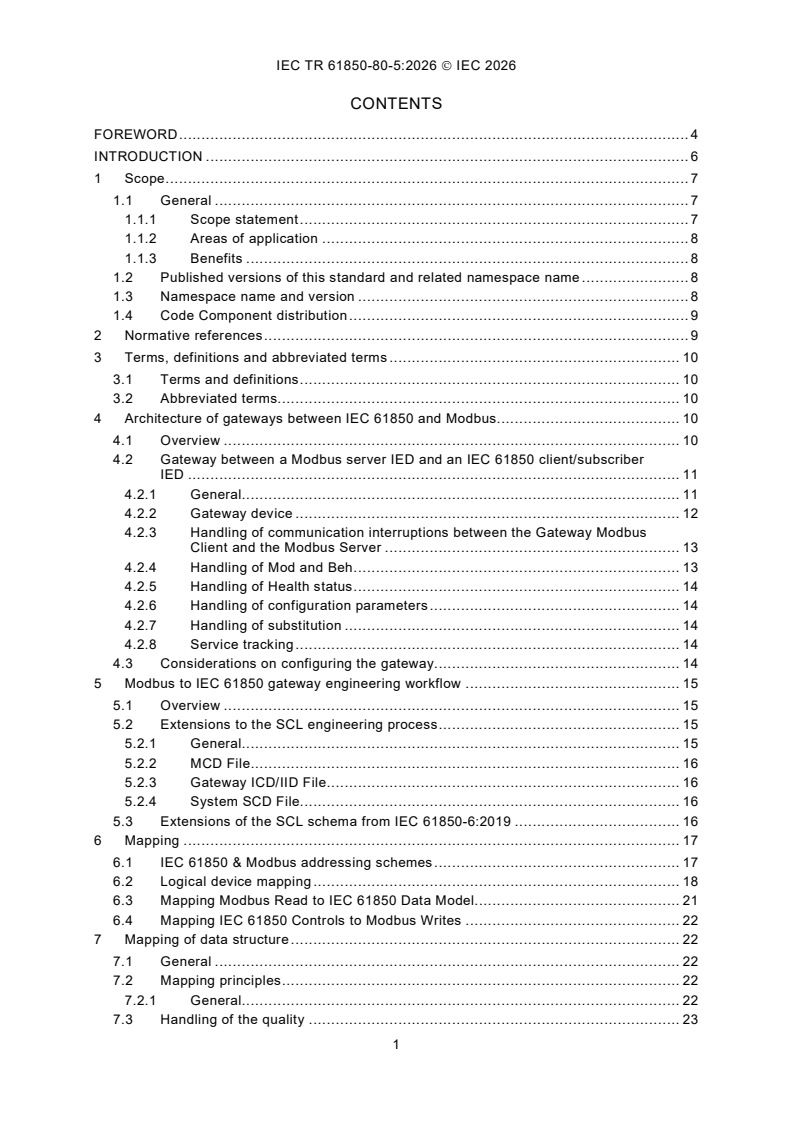
CONTENTS
FOREWORD . 4
INTRODUCTION . 6
1 Scope . 7
1.1 General . 7
1.1.1 Scope statement . 7
1.1.2 Areas of application . 8
1.1.3 Benefits . 8
1.2 Published versions of this standard and related namespace name . 8
1.3 Namespace name and version . 8
1.4 Code Component distribution . 9
2 Normative references . 9
3 Terms, definitions and abbreviated terms . 10
3.1 Terms and definitions . 10
3.2 Abbreviated terms. 10
4 Architecture of gateways between IEC 61850 and Modbus . 10
4.1 Overview . 10
4.2 Gateway between a Modbus server IED and an IEC 61850 client/subscriber
IED . 11
4.2.1 General. 11
4.2.2 Gateway device . 12
4.2.3 Handling of communication interruptions between the Gateway Modbus
Client and the Modbus Server . 13
4.2.4 Handling of Mod and Beh . 13
4.2.5 Handling of Health status . 14
4.2.6 Handling of configuration parameters . 14
4.2.7 Handling of substitution . 14
4.2.8 Service tracking . 14
4.3 Considerations on configuring the gateway. 14
5 Modbus to IEC 61850 gateway engineering workflow . 15
5.1 Overview . 15
5.2 Extensions to the SCL engineering process . 15
5.2.1 General. 15
5.2.2 MCD File . 16
5.2.3 Gateway ICD/IID File . 16
5.2.4 System SCD File. 16
5.3 Extensions of the SCL schema from IEC 61850-6:2019 . 16
6 Mapping . 17
6.1 IEC 61850 & Modbus addressing schemes . 17
6.2 Logical device mapping . 18
6.3 Mapping Modbus Read to IEC 61850 Data Model. 21
6.4 Mapping IEC 61850 Controls to Modbus Writes . 22
7 Mapping of data structure . 22
7.1 General . 22
7.2 Mapping principles . 22
7.2.1 General. 22
7.3 Handling of the quality . 23
7.4 Handling of Timestamp . 24
7.5 Basic conversion functions . 25
7.5.1 Overview . 25
7.5.2 Mapping Parameters . 25
7.5.3 Examples . 33
7.5.4 General conversion behaviour . 41
7.5.5 Literals . 41
7.5.6 Unit conversions . 41
7.5.7 Modbus Coil . 42
7.5.8 Modbus Holding Register . 43
8 Time and time synchronization model . 43
9 File transfer . 44
10 Mapping of services . 44
Annex A (informative) Use of SCL (substation configuration language) to include
Modbus information . 45
A.1 General . 45
A.2 SCL schema . 45
A.2.1 Code components . 45
A.2.2 General. 46
Annex B (informative) Example SCL File . 47
Bibliography . 48
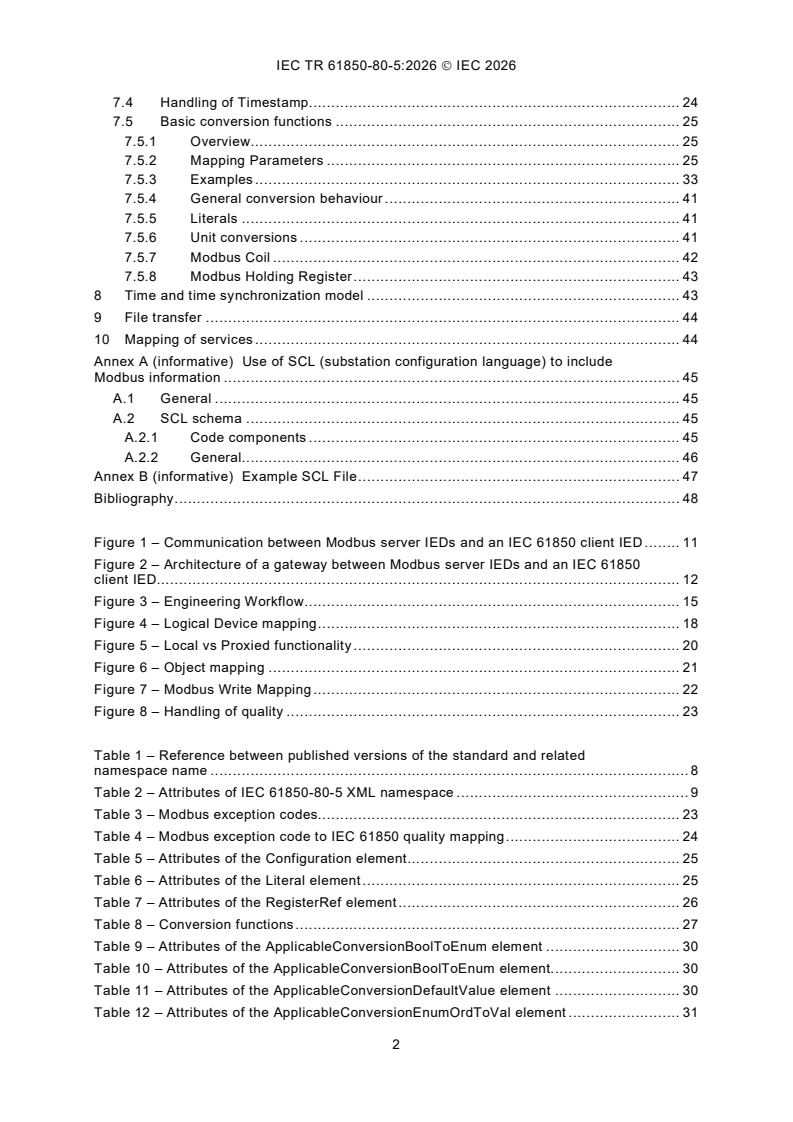
Figure 1 – Communication between Modbus server IEDs and an IEC 61850 client IED . 11
Figure 2 – Architecture of a gateway between Modbus server IEDs and an IEC 61850
client IED. 12
Figure 3 – Engineering Workflow . 15
Figure 4 – Logical Device mapping . 18
Figure 5 – Local vs Proxied functionality . 20
Figure 6 – Object mapping . 21
Figure 7 – Modbus Write Mapping . 22
Figure 8 – Handling of quality . 23
Table 1 – Reference between published versions of the standard and related
namespace name . 8
Table 2 – Attributes of IEC 61850-80-5 XML namespace . 9
Table 3 – Modbus exception codes. 23
Table 4 – Modbus exception code to IEC 61850 quality mapping . 24
Table 5 – Attributes of the Configuration element . 25
Table 6 – Attributes of the Literal element . 25
Table 7 – Attributes of the RegisterRef element . 26
Table 8 – Conversion functions . 27
Table 9 – Attributes of the ApplicableConversionBoolToEnum element . 30
Table 10 – Attributes of the ApplicableConversionBoolToEnum element. 30
Table 11 – Attributes of the ApplicableConversionDefaultValue element . 30
Table 12 – Attributes of the ApplicableConversionEnumOrdToVal element . 31
Table 13 – Attributes of the ApplicableConversionGeneric element . 31
Table 14 – Attributes of the ApplicableConversionBitMask element. 32
INTERNATIONAL ELECTROTECHNICAL COMMISSION
____________
Communication networks and systems for power utility automation -
Part 80-5: Guideline for mapping information
between IEC 61850 and IEC 61158-15
FOREWORD
1) The International Electrotechnical Commission (IEC) is a worldwide organization for standardization comprising
all national electrotechnical committees (IEC National Committees). The object of IEC is to promote international
co-operation on all questions concerning standardization in the electrical and electronic fields. To this end and
in addition to other activities, IEC publishes International Standards, Technical Specifications, Technical Reports,
Publicly Available Specifications (PAS) and Guides (hereafter referred to as "IEC Publication(s)"). Their
preparation is entrusted to technical committees; any IEC National Committee interested in the subject dealt with
may participate in this preparatory work. International, governmental and non-governmental organizations liaising
with the IEC also participate in this preparation. IEC collaborates closely with the International Organization for
Standardization (ISO) in accordance with conditions determined by agreement between the two organizations.
2) The formal decisions or agreements of IEC on technical matters express, as nearly as possible, an international
consensus of opinion on the relevant subjects since each technical committee has representation from all
interested IEC National Committees.
3) IEC Publications have the form of recommendations for international use and are accepted by IEC National
Committees in that sense. While all reasonable efforts are made to ensure that the technical content of IEC
Publications is accurate, IEC cannot be held responsible for the way in which they are used or for any
misinterpretation by any end user.
4) In order to promote international uniformity, IEC National Committees undertake to apply IEC Publications
transparently to the maximum extent possible in their national and regional publications. Any divergence between
any IEC Publication and the corresponding national or regional publication shall be clearly indicated in the latter.
5) IEC itself does not provide any attestation of conformity. Independent certification bodies provide conformity
assessment services and, in some areas, access to IEC marks of conformity. IEC is not responsible for any
services carried out by independent certification bodies.
6) All users should ensure that they have the latest edition of this publication.
7) No liability shall attach to IEC or its directors, employees, servants or agents including individual experts and
members of its technical committees and IEC National Committees for any personal injury, property damage or
other damage of any nature whatsoever, whether direct or indirect, or for costs (including legal fees) and
expenses arising out of the publication, use of, or reliance upon, this IEC Publication or any other IEC
Publications.
8) Attention is drawn to the Normative references cited in this publication. Use of the referenced publications is
indispensable for the correct application of this publication.
9) IEC draws attention to the possibility that the implementation of this document may involve the use of (a)
patent(s). IEC takes no position concerning the evidence, validity or applicability of any claimed patent rights in
respect thereof. As of the date of publication of this document, IEC had not received notice of (a) patent(s), which
may be required to implement this document. However, implementers are cautioned that this may not represent
the latest information, which may be obtained from the patent database available at https://patents.iec.ch. IEC
shall not be held responsible for identifying any or all such patent rights.
IEC TR 61850-80-5 has been prepared by IEC technical committee 57: Power systems
management and associated information exchange. It is a Technical Report.
This second edition cancels and replaces the first edition published in 2024. This edition
constitutes a technical revision.
This edition includes the following significant technical changes with respect to the previous
edition:
a) deficiencies / missing text in Edition 1 corrected.
The text of this Technical Report is based on the following documents:
Draft Report on voting
57/2858/DTR 57/2891/RVDTR
Full information on the voting for its approval can be found in the report on voting indicated in
the above table.
The language used for the development of this Technical Report is English.
This document was drafted in accordance with ISO/IEC Directives, Part 2, and developed in
accordance with ISO/IEC Directives, Part 1 and ISO/IEC Directives, IEC Supplement, available
at www.iec.ch/members_experts/refdocs. The main document types developed by IEC are
described in greater detail at www.iec.ch/standardsdev/publications.
A list of all parts in the IEC 61850 series, published under the general title Communication
networks and systems for power utility automation, can be found on the IEC website.
NOTE The following print types are used:
– specific element names from the SCL extension: in italic type.
This IEC standard includes Code Components i.e. components that are intended to be directly
processed by a computer. Such content is any text found between the markers
BEGINS> and , or otherwise is clearly labeled in this standard as a Code
Component.
The purchase of this IEC standard carries a copyright license for the purchaser to sell software
containing Code Components from this standard directly to end users and to end users via
distributors, subject to IEC software licensing conditions, which can be found at:
http://www.iec.ch/CCv1.
The committee has decided that the contents of this document will remain unchanged until the
stability date indicated on the IEC website under webstore.iec.ch in the data related to the
specific document. At this date, the document will be
– reconfirmed,
– withdrawn, or
– revised.
INTRODUCTION
This part of IEC 61850, which is a Technical Report, provides a guideline to exchanging
information between IEC 61850 and IEC 61158-6-15 (Modbus TCP). Today, industrial fields,
such as distributed energy resource (wind and solar energy, etc.) and condition monitoring,
have been successfully exchanging information from Modbus to IEC 61850. Although many
manufacturers have already implemented the Modbus to IEC 61850 conversion device or
system, these devices do not guarantee interoperability. Therefore, a consistent and unified
information exchange scheme between IEC 61850 and IEC 61158-6-15 is required.
Modbus over serial line (Modbus RTU) is not part of IEC 61158-6-15 but is also considered in
this technical report.
It was first foreseen to prepare this document as a Technical Specification. However, as there
is a lack of feedback from practical experience, it was decided to first publish a Technical Report
with a limited scope (see 57/2506/Q and 57/2553/RQ).
This is now the second edition of a Technical Report with the scope including the mapping of a
Modbus device's command from an IEC 61850 model.
1 Scope
1.1 General
1.1.1 Scope statement
This part of IEC 61850, which is a Technical Report, specifies the mapping framework for
building and configuring a system using both IEC 61850 and IEC 61158-6-15 (Industrial
communication networks – Fieldbus specification, CPF Type 15, Modbus) protocols by utilizing
gateways between IEC 61850 and IEC 61158-6-15 IEDs / subsystems. The objective is to
enable operational run-time data exchange among these IEDs / subsystems, and to automate
the configuration of a gateway as much as possible.
Please note that for the purposes of this document, "Modbus" is used to represent both serial
Modbus (Modbus RTU) and IEC 61158-6-15 (Modbus TCP).
Within the capability of each protocol, some configuration attributes (IEC 61850-7-3:2010 and
IEC 61850-7-3:2010/AMD1:2020 attributes with functional constraint CF) are also mapped in
addition to the operational real-time data.
The frameworks specified in this document are based on the published standards and do not
make any proposed changes to IEC 61850 or 61158-6-15. This standard does not specify any
framework for an IEC 61850 IED to directly communicate with a Modbus IED and vice versa,
except through a gateway.
This document does not mandate which data items that a particular IED will be supporting,
regardless of whether the implementation uses Modbus or IEC 61850. Instead, this document
provides a framework specifying how a gateway maps any given data item from Modbus into
an IEC 61850 substation, including the control direction.
Similarly, this document does not mandate which mapping framework a given gateway will be
supporting. When this document is republished as a Technical Specification, conformance
requirements will be identified.
This document recognizes that there will be situations in which a user will require that a gateway
perform non-standard protocol mappings. Non-standard mappings are outside the scope of this
document.
This document also recognizes that gateways typically manipulate the data passing through
them in a variety of ways. Some of these functions include alarm trigger grouping, data
suppression, interlocking and command blocking. Conformance to this document does not
preclude a gateway from performing such functions, even though this document primarily
specifies "straight through" mapping of Modbus data to IEC 61850-7-3:2010 and
IEC 61850-7-3:2010/AMD1:2020 data. Subclause 7.5 of this document describes how some of
these functions can be specified to a gateway by a mapping tool using XML representations of
conversion functions.
The mapping architecture for the exchange of the run-time information consists of four parts:
a) Conceptual architecture of a gateway and associated use case
b) Mapping of the information model (Assign semantic to the Modbus data)
c) Mapping of the data (which is in fact part of the information model)
d) Mapping of the services (out of scope for this document)
1.1.2 Areas of application
While a primary focus of this document is for electric utility industry, other industries that deliver
energy and water could also use this document if they also plan to use both Modbus and
IEC 61850 in their systems.
Vendors can use this document to implement and test their gateway products and be assured
of their interoperability to this mapping standard. Users can use this document to specify their
respective systems. System integrators can use this standard to assist in system integration
and testing of user systems utilizing both protocols and gateways.
Modbus device vendors can use this document to express, in a non-ambiguous manner, the
semantics of each of the data points exposed over the Modbus interface.
1.1.3 Benefits
This document specifies an SCL extension, using a Modbus specific XML namespace, to add
syntax for describing the mapping of Modbus data into the IEC 61850 data model (see Annex A
for use of SCL to include Modbus information). By using this specification, Modbus devices can
benefit from the full IEC 61850 ecosystem (engineering tools, engineering process, functional
naming, …).
This version of the document describes the mapping of data from a Modbus server to be
exposed in an IEC 61850 server access point of the gateway. This is intended to enable
automated gateway configuration.
1.2 Published versions of this standard and related namespace name
Table 1 provides an overview of the references between the published versions of this standard
and the related namespace name.
Table 1 – Reference between published versions of the standard
and related namespace name
Edition Publication Webstore Namespace
date
Edition 1.0 2024-02 IEC TR 61850-80-5:2024 IEC 61850-80-5:2020A2
Edition 2.0 2025-xx IEC TR 61850-80-5:2025 IEC 61850-80-5:2020A4
1.3 Namespace name and version
The namespace associated with this document is an XML schema (XSD) for an extension to
the System Configuration Language (SCL) as defined in IEC 61850-6. The parameters which
are identifying the namespace are provided in Table 2.
Table 2 – Attributes of IEC 61850-80-5 XML namespace
Attribute Content
Namespace nameplate
Namespace Identifier (xmlns) http://www.iec.ch/61850/2020/SCL/80-5
Version 2020
Revision A
Release 4
XSD version header attribute 2020A4
Recommended reference name eIEC61850-80-5
CodeComponentName IEC_61850-80-5.SCL.2020A4.Full
Namespace dependencies
includes http://www.iec.ch/61850/2003/SCL version :2007 revision :B release :4
1.4 Code Component distribution
Each Code Component is a ZIP package containing at least the electronic representation of the
Code Component itself and a file describing the content of the package (IECManifest.xml).
The life cycle of a code component is not restricted to the life cycle of the related publication.
The publication life cycle goes through two stages, Version (corresponding to an edition) and
Revision (corresponding to an amendment). A third publication stage (Release) allows
publication of Code Component in case of urgent fixes of InterOp Tissues, thus without need to
publish an amendment.
Consequently, new release(s) of the Code Component might be released, which supersede(s)
the previous release, and will be distributed through the IEC TC57 web site at:
http://www.iec.ch/tc57/supportdocuments.
The latest version/release of the document will be found by selecting the file for the code
component with the highest value for VersionStateInfo, e.g.
IEC_TR_61850-80-5.SCL.{VersionStateInfo}.full.zip.
The code component associated to this document is an XML schema file (XSD). It is available
as a full version only. It is freely accessible on the IEC website for download at
http://www.iec.ch/tc57/supportdocuments but the usage remains under the licensing conditions.
In case of any differences between the downloadable code component and the IEC pdf
published content, the downloadable code component is the valid one; it can be subject to
updates. See included history files.
2 Normative references
There are no normative references in this document.
3 Terms, definitions and abbreviated terms
3.1 Terms and definitions
For the purposes of this document, the following terms and definitions apply.
ISO and IEC maintain terminological databases for use in standardization at the following
addresses:
– IEC Electropedia: available at http://www.electropedia.org/
– ISO Online browsing platform: available at http://www.iso.org/obp
3.1.1
Modbus Client
interface which allows the user application to explicitly control information exchange with a
remote device
Note 1 to entry: The Modbus Client builds a Modbus request from parameter contained in a demand sent by the
user application to the Modbus Client Interface. The Modbus Client uses a Modbus transaction whose management
includes waiting for and processing of a Modbus confirmation.
3.1.2
Modbus Server
module which, on reception of a Modbus request, activates a local action to read, to write or to
achieve some other actions
Note 1 to entry: The processing of these actions is done totally transparently for the application programmer. The
main Modbus server functions are to wait for a Modbus request on 502 TCP port, to treat this request and then to
build a Modbus response depending on device context.
3.2 Abbreviated terms
For the purposes of this document, the abbreviated terms given in IEC TS 61850-2,
IEC 61850-7-2:2010 and IEC 61850-7-3:2010/AMD1:2020 as well as the following apply.
ICT IED Configuration Tool
MCD Modbus Configuration Description
MCT Modbus Configuration Tool
4 Architecture of gateways between IEC 61850 and Modbus
4.1 Overview
This clause describes the conceptual architecture of gateways between IEC 61850 and
Modbus. There are two basic types of gateways to be considered:
– Gateway between an IEC 61850 server IED and a Modbus client IED. This can be the case
where the substation with IEC 61850 is connected to the network control center via Modbus
communication.
– Gateway between a Modbus server IED and an IEC 61850 client IED. This is the case where
a Modbus IED must be connected to a substation using IEC 61850.
This document will focus on the second case, because it is more common. The first case might
be treated in a later edition of this document. Nevertheless, the basic principle of both gateway
types is described in 4.2 to 4.3.
4.2 Gateway between a Modbus server IED and an IEC 61850 client/subscriber IED
4.2.1 General
The generalized configuration is shown in Figure 1. It consists of several Modbus server
devices, a gateway device, and an IEC 61850 client device. One side of the gateway has a
Modbus client interface to communicate with the Modbus server devices and the other side of
the gateway has an IEC 61850 server interface for communication with the IEC 61850
client/subscriber device. The IEC 61850 communications provided by the gateway are out of
scope of this document.
Figure 1 – Communication between Modbus server IEDs and an IEC 61850 client IED
4.2.2 Gateway device
The conceptual architecture of the gateway device is shown in Figure 2. The gateway device is
decoupling the IEC 61850 communication and the Modbus communication via a "Gateway
function". The Gateway function can implement an IEC 61850 process data image. The
advantage of this approach is that a real-time pass-through is not necessarily required for all
messages. The following principles are used for the information exchanges between IEC 61850
and Modbus:
– Run-time operational information (status information, measurements) that is usually
transmitted event driven is exchanged through the process data image. Data retrieval on
the two networks is independent and can take place at different rates.
– Services for the control model interaction are converted and directly forwarded by the
gateway. Therefore, these services are supported by the gateway function.
– Run-time access to other information of the data model (parameters, configuration and
description information, substitution) is converted and directly forwarded to the Modbus IED
by the gateway. Therefore, these services are supported by the gateway function.
– Runtime configuration and substitution information of the data model that are implemented
by the IEC 61850 gateway server are not converted nor forwarded to the Modbus IED.
This document defines the way data structures are mapped. The way to map the services is not
defined because various implementations of a Modbus service exist in the field. Note that the
implementation of the process data image is a local issue. It could be a database, or it could
be something else. Internal operations performed by the gateway on the data in the process
data image are permitted but are out of the scope of this document.
Figure 2 – Architecture of a gateway between Modbus server IEDs
and an IEC 61850 client IED
NOTE The term process data image has already been used in IEC 61850-90-2 for the same purpose and is used
here for consistency with other parts of IEC 61850.
4.2.3 Handling of communication interruptions between the Gateway Modbus Client
and the Modbus Server
4.2.3.1 General
The communication between a Modbus Server IED and the Gateway Modbus Client can be
disturbed for various reasons. This will also influence the communication between the Gateway
IEC 61850 server and the IEC 61850 Client. Subclauses 4.2.3.2 to 4.2.3.7 define the behaviour
of the Gateway IEC 61850 Server.
4.2.3.2 Status and Measurands
If the Gateway maintains a local process data image, the quality of status information and
measurands will follow the specifications given in IEC 61850-7-2:2010, Annex D and
IEC 61850-7-3:2010/AMD1:2020, Annex D. A GetDataValues request will return the last value
received from the Modbus Server IED with the updated status information. A SetDataValues
request will result in a ServiceError.
4.2.3.3 Control
When a Modbus Server IED is disconnected from the Gateway Modbus Client, the Gateway
IEC 61850 server will respond with a temporarily-unavailable ServiceError to all attempts to
control one of the values.
4.2.3.4 Setting Group Control
Setting Group Control is not supported with this edition of the document.
4.2.3.5 Report Control
Reporting, buffered and unbuffered, requires a local process data image. When the
communication between the Modbus Server IED and the Gateway Modbus Client is disturbed,
the quality of the related data in the local process data image will be changed (see 4.2.3.2). If
the trigger option TrgOpt = qchg (quality-change) is set, reports with the updated values will be
send to the IEC 61850 client.
The reporting function itself is not influenced by the communication interruption between the
Modbus Server IED and the Gateway Modbus Client, because the reports for the IEC 61850
client are created in the Gateway IEC 61850 server.
4.2.3.6 Substitution
Substitution within the Modbus IED is not supported with this edition of the document.
4.2.3.7 File Transfer
File Transfer is not supported with this edition of the document.
4.2.4 Handling of Mod and Beh
IEC 61850 supports the possibility of changing the mode of logical devices or logical nodes by
using the data object Mod that might be present in any logical node including in LLN0. Changing
any Mod in the Gateway IEC 61850 server follows the specifications for operations in the control
direction. All changes of the logical node mode effects only the behaviour of the IEC 61850
server of the Gateway.
This edition of the document does not define any framework how a change of the mode affects
the communication between the Gateway Modbus Client and the Modbus Server of the Modbus
IED.
4.2.5 Handling of Health status
The data object Health of the logical nodes reflecting the Modbus IED data is available in the
Gateway IEC 61850 object model.
The data object Health of LLN0 of the logical devices whose modelling follows the framework
defined in 6.2, represents, as IEC 61850-7-4:2010 and IEC 61850-7-3:2010/AMD1:2020
defines it, the worst "health" of the logical nodes that are part of the logical device associated
with LLN0.
4.2.6 Handling of configuration parameters
The Gateway can support changes of measurement value configurations according to
IEC 61850-7-2:2010 and IEC 61850-7-3:2010/AMD1:2020, such as e.g. scaling or dead band
parameters.
Whether the configuration parameters are applied locally or are forwarded to the Modbus Server
IED depends on the implementation of the Gateway and the capabilities of the Modbus Server
IED. The PIXIT of the Gateway contains the information how configuration parameters are
handled.
4.2.7 Handling of substitution
If supported by the Gateway IEC 61850 server implementation substitution from the IEC 61850
client will take place in the Gateway IEC 61850 server.
Substitution of values in the Modbus Server is not supported by this edition of the document.
4.2.8 Service tracking
Tracking of services is local to the Gateway IEC 61850 server for all services that are handled
by the Gateway IEC 61850 server.
4.3 Considerations on configuring the gateway
The following items are to be considered when configuring the gateway.
– Scan cycles
– Bandwidth usage / optimization
– Performance related techniques
– Dealing with units
– Scaling
– Multi-byte handling
– Signed / Unsigned integer handling
– Overflow handling
– "Modbus authentication", verify the IED is the IED it is supposed to be
– Handling/Detection of Communication interruptions on Modbus side
– Error handling of gateway functions and access
5 Modbus to IEC 61850 gateway engineering workflow
5.1 Overview
The configuration of the Modbus to IEC 61850 Gateway involves two main tasks. Each of these
tasks can be split up into several steps.
The first major step is to create a semantically defined IEC 61850 data object model, using the
Modbus Configuration Tool (MCT) to create the Modbus Configuration Description (.mcd) file
type (See Annex B), for each Modbus device (based on IEC 61850-7-3, IEC 61850-7-4, etc.)
which includes:
– Find the semantically matching IEC 61850 data object for the Modbus information
– Identify the required data attributes of the CDC for the selected IEC 61850 information
– Define the links between the data attributes and the respective Modbus information
– Define the required conversion functions between the Modbus information and the
IEC 61850 data attributes
When the IEC 61850 data models for all Modbus devices have been created, the Modbus to
IEC 61850 Gateway can be configured using the IED Configuration Description (.icd) file format
(See Annex B):
– Create the object model of the IEC 61850 server out of the data models for the Modbus
devices
– Define the supported IEC 61850 communication services and the communication
parameters of the server
Subclause 5.2 describe the engineering steps in more detail.
Figure 3 – Engineering Workflow
5.2 Extensions to the SCL engineering process
5.2.1 General
The SCL engineering process will remain same for Modbus devices providing the description
of their data model using SCL files based on mapping extension is defined by this document.
The objective is to provide the capability to have an integrated engineering process for Modbus
devices, by means of the same process and the same semantic.
SCL files will be enhanced to contain Modbus mapping associated to IEC 61850 data. Then the
communication part will be extended to integrate the engineering of the Modbus device
communication.
5.2.2 MCD File
The MCD file provides the instructions for mapping Modbus data into a gateway using the
functionality described in 5.3. This file also contains the specific communications parameters
for the Modbus devices. The MCD file is created by an MCT. The MCD is consumed by the ICT
of the gateway in order to configure the gateway and to produce the ICD/IID file of the
IEC 61850 server representing the modbus data. See Annex B for the Example.mcd file.
5.2.3 Gateway ICD/IID File
The gateway's ICT uses the MCD file(s) of each Modbus device to configure its Modbus Client.
Upon completion of mapping the Modbus data in the gateway, the gateway's ICT can produce
the gateway's IEC 61850 ICD/IID file. This file contains the Modbus IEDs as Logical Devices
within the gateway, including the Private eIEC61850-80-5 information. The Modbus IED's
communications parameters are not included in this file. The communications parameters of
the Gateway can be included in this file. See Annex B for the Gateway.icd file.
5.2.4 System SCD File
Upon completion of the gateway's ICD/IID file, this file is used in the IEC 61850 system
engineering process, just like any other IEC 61850 IED. Thanks to the Gateway concept of
IEC 61850, a Modbus system could be integrated into an IEC 61850 system with a seamless
process by sharing the same semantic and the same file format. Optionally, the Modbus devices
can be documented in the System SCD file attached to a dedicated Modbus SCL subnetwork
within the Communication section. See Annex B for the System.scd file.
5.3 Extensions of the SCL schema from IEC 61850-6:2019
A schema is attached to IEC 61850-80-5 to define how the Modbus specific data will be added
to an existing SCL.
A dedicated namespace has been created to identify this new schema:
"http://www.iec.ch/61850/2020/SCL/80-5" and will be referred into the SCL file with an
additional versioning attribute of the extension:
xmlns:eIEC61850-80-5SCL="http://www.iec.ch/61850/2020/SCL/80-5"
xmlns:xsd="http://www.w3.org/2001/XMLSchema"
xmlns:xsi="http://www.w3.org/2001/XMLSchema-instance"
xsi:schemaLocation="http://www.iec.ch/61850/2003/SCL SCL.xsd
http://www.iec.ch/61850/2020/SCL/80-5 IEC61850-80-5.xsd"
version="2007" revision="B" release="4"
eIEC61850-80-5:version="2020" eIEC61850-80-5:revision="A"
eIEC61850-80-5:release="4">
The IEC 61850-80-5 Modbus extension will have to be added under dedicated Private elements
with type "eIEC61850-80-5". These privates will be added at DAI level to attach Modbus
mapping information to the attribute. See the example below:
The private element could be then added at instance level (DAI).
The Modbus mapping information has four kinds of elements:
– RegisterRef to indicate a mapping address
– ConvFunctRef to indicate transformation method between IEC 61850 data and Modbus data
– Literal to define a literal value for use in conversion functions
– Configuration to configure handling of special cases when mapping Modbus data
The RegisterRef does not include the Modbus server address. Each Modbus address is
modeled as separate IED. See full schema for details.
It is possible that it will be necessary for the system integrator to use one or more of the
Conversion Functions defined in 7.5.1 to convert the data between the IEC 61850 and Modbus
representations.
Some Modbus devices use special values to indicate overflow conditions. The Configuration
element, and its overflowValue, are included in the IEC61850-80-5 namespace. When the
overflowValue is set to "true", the Modbus devices use these special values to indicate overflow.
When it is set to "false", those values are not special. The Configuration element must be
located as the first child element of an IED element. See the example below.
originalSclRevision="B" originalSclVersion="2007">
Then the schema will extended the communication section. Configuration of the Modbus
communication will be done with an SCL communication section
...