


IEC 60519-10:2013
(Main)Safety in electroheating installations - Part 10: Particular requirements for electrical resistance trace heating systems for industrial and commercial applications
General Information
- Abstract
IEC 60519-10:2013 provides safety requirements for electrical resistance trace heating systems used in industrial and commercial applications for piping, vessels, roofs, concrete slab heating and other similar applications. This second edition cancels and replaces the first edition published in 2005. This edition constitutes a technical revision. This edition includes the following significant technical changes with respect to the previous edition:
- The structure has been amended and adjusted to IEC 60519-1:2010;
- References to IEC 62395-1 and IEC 62395-2 have been completed.
This publication is to be read in conjunction with IEC 60519-1:2010.
- Status
- Withdrawn
- Publication Date
- 21-Feb-2013
- Withdrawal Date
- 27-Apr-2023
- Technical Committee
- TC 27 - Industrial electroheating and electromagnetic processing
- Drafting Committee
- MT 17 - TC 27/MT 17
- Current Stage
- WPUB - Publication withdrawn
- Start Date
- 28-Apr-2023
- Completion Date
- 28-Apr-2023
Buy Documents
IEC 60519-10:2013 - Safety in electroheating installations - Part 10: Particular requirements for electrical resistance trace heating systems for industrial and commercial applications
IEC 60519-10:2013 - Safety in electroheating installations - Part 10: Particular requirements for electrical resistance trace heating systems for industrial and commercial applications
Relations
- Effective Date
- 05-Sep-2023
Buy Documents
IEC 60519-10:2013 - Safety in electroheating installations - Part 10: Particular requirements for electrical resistance trace heating systems for industrial and commercial applications
IEC 60519-10:2013 - Safety in electroheating installations - Part 10: Particular requirements for electrical resistance trace heating systems for industrial and commercial applications
Get Certified
Connect with accredited certification bodies for this standard

DVS-ZERT GmbH
German welding certification society.
CARES (UK Certification Authority for Reinforcing Steels)
UK certification for reinforcing steels and construction.
EWF/IIW (European/International Welding Federation)
International welding personnel certification.
Sponsored listings
Frequently Asked Questions
IEC 60519-10:2013 is a standard published by the International Electrotechnical Commission (IEC). Its full title is "Safety in electroheating installations - Part 10: Particular requirements for electrical resistance trace heating systems for industrial and commercial applications". This standard covers: IEC 60519-10:2013 provides safety requirements for electrical resistance trace heating systems used in industrial and commercial applications for piping, vessels, roofs, concrete slab heating and other similar applications. This second edition cancels and replaces the first edition published in 2005. This edition constitutes a technical revision. This edition includes the following significant technical changes with respect to the previous edition: - The structure has been amended and adjusted to IEC 60519-1:2010; - References to IEC 62395-1 and IEC 62395-2 have been completed. This publication is to be read in conjunction with IEC 60519-1:2010.
IEC 60519-10:2013 provides safety requirements for electrical resistance trace heating systems used in industrial and commercial applications for piping, vessels, roofs, concrete slab heating and other similar applications. This second edition cancels and replaces the first edition published in 2005. This edition constitutes a technical revision. This edition includes the following significant technical changes with respect to the previous edition: - The structure has been amended and adjusted to IEC 60519-1:2010; - References to IEC 62395-1 and IEC 62395-2 have been completed. This publication is to be read in conjunction with IEC 60519-1:2010.
IEC 60519-10:2013 is classified under the following ICS (International Classification for Standards) categories: 25.180.10 - Electric furnaces. The ICS classification helps identify the subject area and facilitates finding related standards.
IEC 60519-10:2013 has the following relationships with other standards: It is inter standard links to IEC 60519-10:2005. Understanding these relationships helps ensure you are using the most current and applicable version of the standard.
IEC 60519-10:2013 is available in PDF format for immediate download after purchase. The document can be added to your cart and obtained through the secure checkout process. Digital delivery ensures instant access to the complete standard document.
Standards Content (Sample)
IEC 60519-10 ®
Edition 2.0 2013-02
INTERNATIONAL
STANDARD
NORME
INTERNATIONALE
Safety in electroheating installations –
Part 10: Particular requirements for electrical resistance trace heating systems
for industrial and commercial applications
Sécurité dans les installations électrothermiques –
Partie 10: Exigences particulières pour les systèmes de chauffage par traçage à
résistance électrique pour applications industrielles et commerciales
All rights reserved. Unless otherwise specified, no part of this publication may be reproduced or utilized in any form
or by any means, electronic or mechanical, including photocopying and microfilm, without permission in writing from
either IEC or IEC's member National Committee in the country of the requester.
If you have any questions about IEC copyright or have an enquiry about obtaining additional rights to this publication,
please contact the address below or your local IEC member National Committee for further information.
Droits de reproduction réservés. Sauf indication contraire, aucune partie de cette publication ne peut être reproduite ni
utilisée sous quelque forme que ce soit et par aucun procédé, électronique ou mécanique, y compris la photocopie et les
microfilms, sans l'accord écrit de la CEI ou du Comité national de la CEI du pays du demandeur.
Si vous avez des questions sur le copyright de la CEI ou si vous désirez obtenir des droits supplémentaires sur cette
publication, utilisez les coordonnées ci-après ou contactez le Comité national de la CEI de votre pays de résidence.
IEC Central Office Tel.: +41 22 919 02 11
3, rue de Varembé Fax: +41 22 919 03 00
CH-1211 Geneva 20 info@iec.ch
Switzerland www.iec.ch
About the IEC
The International Electrotechnical Commission (IEC) is the leading global organization that prepares and publishes
International Standards for all electrical, electronic and related technologies.
About IEC publications
The technical content of IEC publications is kept under constant review by the IEC. Please make sure that you have the
latest edition, a corrigenda or an amendment might have been published.
Useful links:
IEC publications search - www.iec.ch/searchpub Electropedia - www.electropedia.org
The advanced search enables you to find IEC publications The world's leading online dictionary of electronic and
by a variety of criteria (reference number, text, technical electrical terms containing more than 30 000 terms and
committee,…). definitions in English and French, with equivalent terms in
It also gives information on projects, replaced and additional languages. Also known as the International
withdrawn publications. Electrotechnical Vocabulary (IEV) on-line.
IEC Just Published - webstore.iec.ch/justpublished Customer Service Centre - webstore.iec.ch/csc
Stay up to date on all new IEC publications. Just Published If you wish to give us your feedback on this publication
details all new publications released. Available on-line and or need further assistance, please contact the
also once a month by email. Customer Service Centre: csc@iec.ch.
A propos de la CEI
La Commission Electrotechnique Internationale (CEI) est la première organisation mondiale qui élabore et publie des
Normes internationales pour tout ce qui a trait à l'électricité, à l'électronique et aux technologies apparentées.
A propos des publications CEI
Le contenu technique des publications de la CEI est constamment revu. Veuillez vous assurer que vous possédez
l’édition la plus récente, un corrigendum ou amendement peut avoir été publié.
Liens utiles:
Recherche de publications CEI - www.iec.ch/searchpub Electropedia - www.electropedia.org
La recherche avancée vous permet de trouver des Le premier dictionnaire en ligne au monde de termes
publications CEI en utilisant différents critères (numéro de électroniques et électriques. Il contient plus de 30 000
référence, texte, comité d’études,…). termes et définitions en anglais et en français, ainsi que
Elle donne aussi des informations sur les projets et les les termes équivalents dans les langues additionnelles.
publications remplacées ou retirées. Egalement appelé Vocabulaire Electrotechnique
International (VEI) en ligne.
Just Published CEI - webstore.iec.ch/justpublished
Service Clients - webstore.iec.ch/csc
Restez informé sur les nouvelles publications de la CEI.
Just Published détaille les nouvelles publications parues. Si vous désirez nous donner des commentaires sur
Disponible en ligne et aussi une fois par mois par email. cette publication ou si vous avez des questions
contactez-nous: csc@iec.ch.
IEC 60519-10 ®
Edition 2.0 2013-02
INTERNATIONAL
STANDARD
NORME
INTERNATIONALE
Safety in electroheating installations –
Part 10: Particular requirements for electrical resistance trace heating systems
for industrial and commercial applications
Sécurité dans les installations électrothermiques –
Partie 10: Exigences particulières pour les systèmes de chauffage par traçage à
résistance électrique pour applications industrielles et commerciales
INTERNATIONAL
ELECTROTECHNICAL
COMMISSION
COMMISSION
ELECTROTECHNIQUE
PRICE CODE
INTERNATIONALE
CODE PRIX Q
ICS 25.180.10 ISBN 978-2-83220-672-0
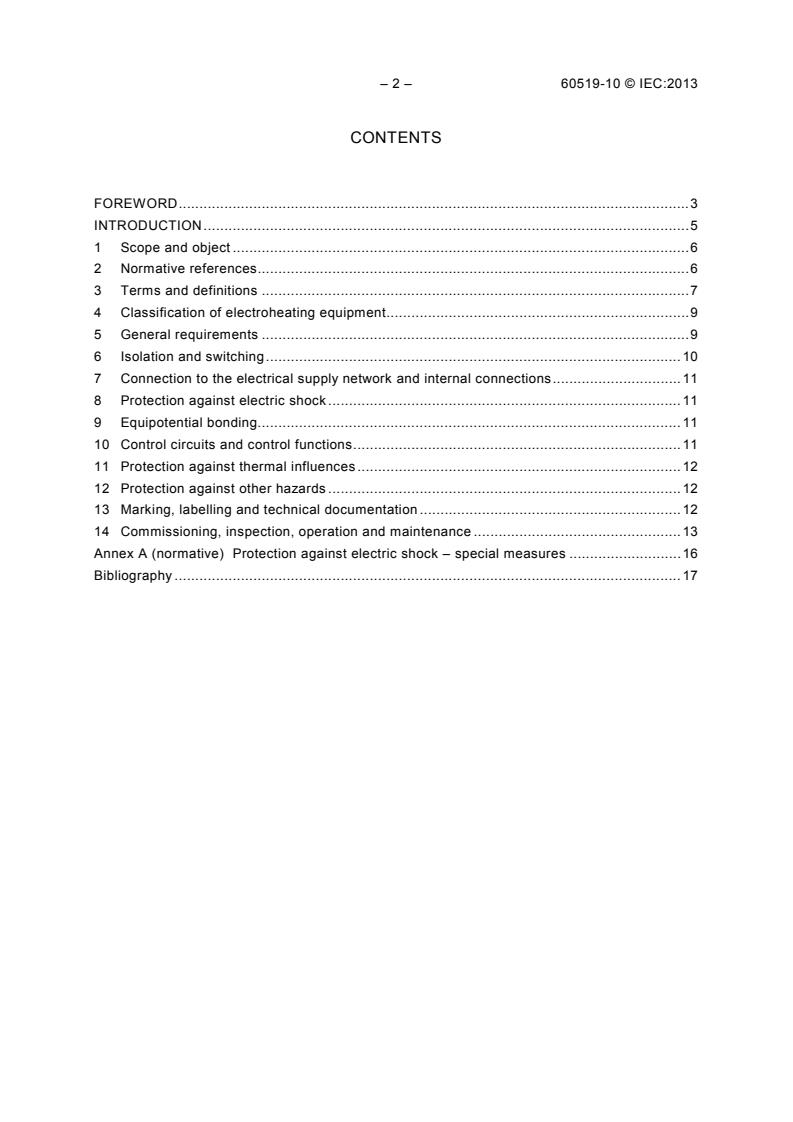
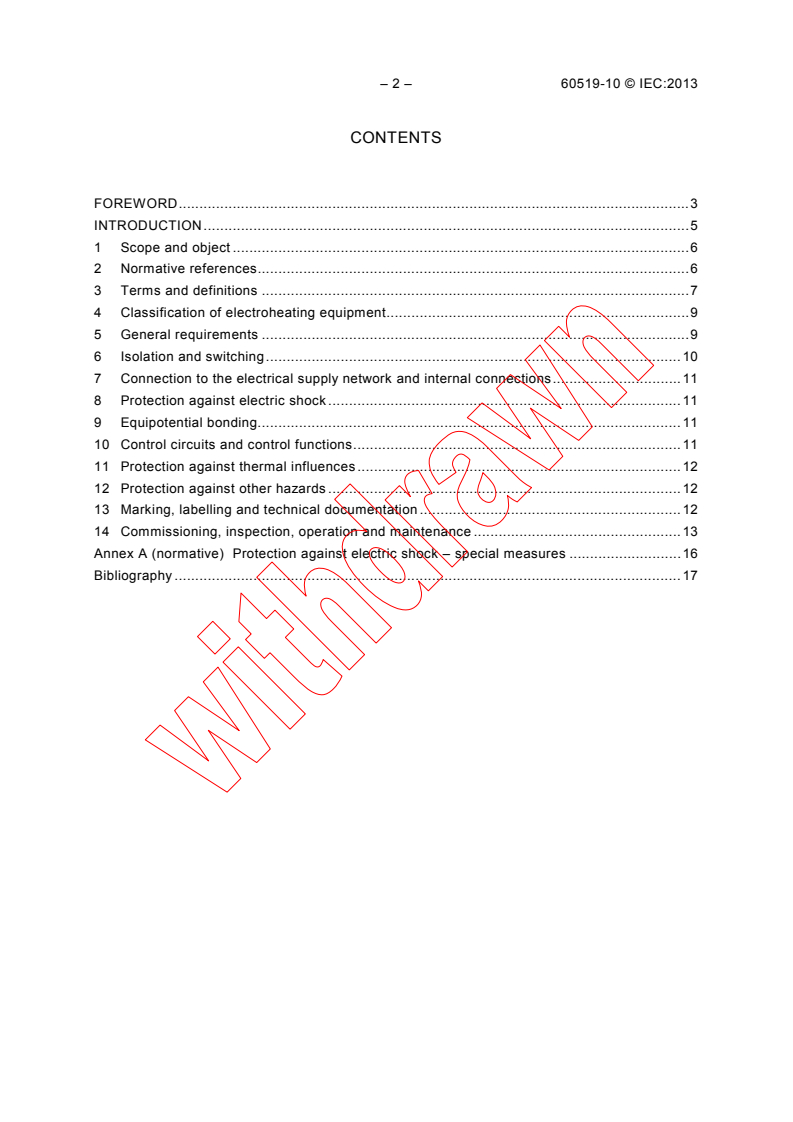
– 2 – 60519-10 © IEC:2013
CONTENTS
FOREWORD . 3
INTRODUCTION . 5
1 Scope and object . 6
2 Normative references . 6
3 Terms and definitions . 7
4 Classification of electroheating equipment . 9
5 General requirements . 9
6 Isolation and switching . 10
7 Connection to the electrical supply network and internal connections . 11
8 Protection against electric shock . 11
9 Equipotential bonding. 11
10 Control circuits and control functions . 11
11 Protection against thermal influences . 12
12 Protection against other hazards . 12
13 Marking, labelling and technical documentation . 12
14 Commissioning, inspection, operation and maintenance . 13
Annex A (normative) Protection against electric shock – special measures . 16
Bibliography . 17
60519-10 © IEC:2013 – 3 –
INTERNATIONAL ELECTROTECHNICAL COMMISSION
____________
SAFETY IN ELECTROHEATING INSTALLATIONS –
Part 10: Particular requirements for electrical resistance trace
heating systems for industrial and commercial applications
FOREWORD
1) The International Electrotechnical Commission (IEC) is a worldwide organization for standardization comprising
all national electrotechnical committees (IEC National Committees). The object of IEC is to promote
international co-operation on all questions concerning standardization in the electrical and electronic fields. To
this end and in addition to other activities, IEC publishes International Standards, Technical Specifications,
Technical Reports, Publicly Available Specifications (PAS) and Guides (hereafter referred to as “IEC
Publication(s)”). Their preparation is entrusted to technical committees; any IEC National Committee interested
in the subject dealt with may participate in this preparatory work. International, governmental and non-
governmental organizations liaising with the IEC also participate in this preparation. IEC collaborates closely
with the International Organization for Standardization (ISO) in accordance with conditions determined by
agreement between the two organizations.
2) The formal decisions or agreements of IEC on technical matters express, as nearly as possible, an international
consensus of opinion on the relevant subjects since each technical committee has representation from all
interested IEC National Committees.
3) IEC Publications have the form of recommendations for international use and are accepted by IEC National
Committees in that sense. While all reasonable efforts are made to ensure that the technical content of IEC
Publications is accurate, IEC cannot be held responsible for the way in which they are used or for any
misinterpretation by any end user.
4) In order to promote international uniformity, IEC National Committees undertake to apply IEC Publications
transparently to the maximum extent possible in their national and regional publications. Any divergence
between any IEC Publication and the corresponding national or regional publication shall be clearly indicated in
the latter.
5) IEC itself does not provide any attestation of conformity. Independent certification bodies provide conformity
assessment services and, in some areas, access to IEC marks of conformity. IEC is not responsible for any
services carried out by independent certification bodies.
6) All users should ensure that they have the latest edition of this publication.
7) No liability shall attach to IEC or its directors, employees, servants or agents including individual experts and
members of its technical committees and IEC National Committees for any personal injury, property damage or
other damage of any nature whatsoever, whether direct or indirect, or for costs (including legal fees) and
expenses arising out of the publication, use of, or reliance upon, this IEC Publication or any other IEC
Publications.
8) Attention is drawn to the Normative references cited in this publication. Use of the referenced publications is
indispensable for the correct application of this publication.
9) Attention is drawn to the possibility that some of the elements of this IEC Publication may be the subject of
patent rights. IEC shall not be held responsible for identifying any or all such patent rights.
International Standard IEC 60519-10 has been prepared by IEC technical committee 27:
Industrial electroheating and electromagnetic processing.
This second edition cancels and replaces the first edition published in 2005. This edition
constitutes a technical revision.
This edition includes the following significant technical changes with respect to the previous
edition:
– The structure has been amended and adjusted to IEC 60519-1:2010;
1 2
– References to IEC 62395-1 and IEC 62395-2 have been completed.
———————
1 Second edition to be published.
2 First edition (replacing IEC/TS 62395-2:2008) to be published.
– 4 – 60519-10 © IEC:2013
The text of this standard is based on the following documents:
CDV Report on voting
27/853/CDV 27/873/RVC
Full information on the voting for the approval of this standard can be found in the report on
voting indicated in the above table.
This publication has been drafted in accordance with the ISO/IEC Directives, Part 2.
A list of all parts in the IEC 60519 series, published under the general title Safety in
electroheating installations, can be found on the IEC website.
The clauses of parts of the IEC 60519 series (hereinafter called Particular requirements)
supplement or modify the corresponding clauses of IEC 60519-1:2010 (General requirements
hereinafter called Part 1).
This part of IEC 60519 is to be read in conjunction with Part 1. It supplements or modifies the
corresponding clauses of Part 1. Where the text indicates an "addition" to or a "replacement" of
the relevant provision of Part 1, these changes are made to the relevant text of Part 1. Where
no change is necessary, the words "This clause of Part 1 is applicable" are used. When a
particular subclause of Part 1 is not mentioned in this part, that subclause applies as far as is
reasonable.
Additional specific provisions to those in Part 1, given as individual clauses or subclauses, are
numbered starting from 101.
NOTE The following numbering system is used:
– subclauses, tables and figures that are numbered starting from 101 are additional to those in Part 1;
– unless notes are in a new subclause or involve notes in Part 1, they are numbered starting from 101, including
those in a replaced clause or subclause;
– additional annexes are lettered AA, BB, etc.
The committee has decided that the contents of this publication will remain unchanged until the
stability date indicated on the IEC web site under "http://webstore.iec.ch" in the data related to
the specific publication. At this date, the publication will be
• reconfirmed,
• withdrawn,
• replaced by a revised edition, or
• amended.
60519-10 © IEC:2013 – 5 –
INTRODUCTION
It is the objective of this standard that, when in accordance with the standard, electrical trace
heating systems operate safely under their normal defined conditions of use, by
a) employing heaters of the appropriate construction and meeting the test criteria detailed in
IEC 62395-1;
b) operating at safe temperatures when designed, installed, and maintained in accordance
with IEC 62395-2;
c) having at least the minimum levels of overcurrent and ground-fault protection, and an
evenly distributed electrically conductive metallic braid, sheath or other equivalent
electrically conductive material, as specified in IEC 62395-1 and IEC 62395-2.
– 6 – 60519-10 © IEC:2013
SAFETY IN ELECTROHEATING INSTALLATIONS –
Part 10: Particular requirements for electrical resistance trace
heating systems for industrial and commercial applications
1 Scope and object
This clause of Part 1 is replaced by the following.
Replacement:
This part of IEC 60519 provides safety requirements for electrical resistance trace heating
systems used in industrial and commercial applications for piping, vessels, roofs, concrete slab
heating and other similar applications.
This standard pertains to trace heating systems that may comprise either factory fabricated or
field (work-site) assembled units, and which may be series heater cables, parallel heater
cables, heater pads or heater panels that have been assembled and/or terminated in
accordance with manufacturer’s instructions.
Typical applications include but are not limited to
• the freeze protection of pipes, tanks and vessels, including fire water systems;
• maintaining required temperatures of equipment, including pipes, tanks and vessels;
• earth thermal storage;
• hot water temperature maintenance;
• snow melting of surfaces;
• de-icing of roofs and gutters.
This standard does not include or provide for any requirements in potentially explosive
atmospheres.
This part of IEC 60519 does not cover induction, impedance or skin effect heating.
NOTE Specific requirements and test criteria for electrical resistance trace heating systems and design,
installation, and maintenance requirements for these systems are detailed in IEC 62395-1 and IEC 62395-2.
This standard provides general safety requirements for the installation, operation, maintenance
and repair of systems and individual circuits and for trace heating systems designs. These
safety considerations concern the protection of persons and the environment against dangers
of electrical origin and also against certain dangers of non-electrical origin, common to all
types of equipment and installations.
2 Normative references
This clause of Part 1 is applicable, except as follows.
Additions:
IEC 60519-1:2010, Safety in electroheating installations – Part 1: General requirements
60519-10 © IEC:2013 – 7 –
IEC 62395-1 , Electrical resistance trace heating systems for industrial and commercial
applications – Part 1: General and testing requirements
IEC 62395-2 , Electrical resistance trace heating systems for industrial and commercial
applications – Part 2: Application guide for system design, installation and maintenance
3 Terms and definitions
This clause of Part 1 is applicable with the following additions.
Additions:
3.101
ambient temperature
average temperature of air or another medium in the vicinity of the equipment
Note 1 to entry: Where electrical trace heaters are enclosed in thermal insulation, the ambient temperature is the
temperature exterior to such thermal insulation.
[SOURCE: IEC 60050-826:2004, 826-10-03, modified – The content of the note has been
modified]
3.102
branch circuit
portion of the wiring installation between the overcurrent device protecting the circuit and the
trace heater(s)
3.103
end termination
termination, which may be heat producing, applied to a trace heater at the end opposite to that
where the power is supplied
[SOURCE: IEC 60050-426:2008, 426-20-04]
3.104
factory fabricated unit
trace heater cable, tape or device, including the necessary terminations and connections,
assembled by the manufacturer
3.105
field assembled unit
trace heaters supplied in bulk with terminating components to be assembled at the work site
3.106
heat loss
energy flow from a pipe, vessel or equipment to its surroundings
3.107
heater pad
trace heater comprising series or parallel connected elements having sufficient flexibility to
conform to the shape of the surface to be heated
———————
Second edition to be published.
First edition (replacing IEC/TS 62395-2:2008) to be published.
– 8 – 60519-10 © IEC:2013
3.108
heater panel
non-flexible trace heater comprising series or parallel connected elements fabricated to
conform to the general shape of the surface to be heated
3.109
integral component
component such as a heat shrink termination, a cold lead connection, a moulded end seal or a
splice, which conforms to the general shape of the trace heater or surface heater and is
exposed to the same environment as the trace heater or surface heater, which may be factory-
fabricated or field-assembled, and which is not intended to be re-used in the event of a repair
or modification
3.110
minimum ambient temperature
lowest ambient temperature specified at which the trace heater is operable and performs
according to specified requirements
3.111
sheath
uniform and continuous metallic or non-metallic outer covering enclosing the trace heater, used
to provide protection for the cable against influence from the surroundings (corrosion,
moisture, etc.)
3.112
sheath temperature
temperature of the outermost continuous covering that may be exposed to the surrounding
atmosphere
3.113
temperature sensor
temperature sensing element
device designed to respond to temperature providing an electrical signal or mechanical
operation
3.114
thermal insulation
material having air- or gas-filled pockets, void spaces, or heat reflecting surfaces that, when
properly applied, retards the transfer of heat
3.115
trace heater
device designed for the purpose of producing heat on the principle of electrical resistance and
typically composed of one or more metallic conductors or an electrically conductive material,
suitably electrically insulated and protected
Note 1 to entry: This can be in the form of a trace heater cable, heater panel or heater pad.
3.116
trace heater cable
circular or flattened cable shaped construction with one or more discrete or continuous
electrically insulated heating elements
3.117
trace heater unit
series trace heater cable, parallel trace heater cable, heater pad or heater panel suitably
terminated in conformity with the manufacturer’s instructions
60519-10 © IEC:2013 – 9 –
3.118
trace heating
utilisation of electric trace heater cables, pads, panels and support components, for the
purpose of raising or maintaining temperatures
3.119
weather barrier
material that, when installed on the outer surface of thermal insulation, protects the thermal
insulation from water or other liquids, from physical damage caused by sleet, wind or
mechanical abuse, and deterioration caused by solar radiation or atmospheric contamination
3.120
workpiece
object to which a trace heater is applied
4 Classification of electroheating equipment
This clause of Part 1 is applicable, except as follows.
Addition:
NOTE The majority of trace heaters are mains frequency equipment.
5 General requirements
This clause of Part 1 is applicable, except as follows.
Additions:
5.101 Trace heating system
Electrical resistance trace heating systems shall be operated and maintained to ensure safe
operation. This includes the requirement for metallic sheath, braid, screen, or equivalent
conductive material, overcurrent and ground fault equipment protection for each branch circuit,
and control and temperature requirements.
Specific requirements for the electrical, thermal and mechanical properties of trace heating
systems shall apply according to IEC 62395-1 and IEC 62395-2.
All parts of a trace heater unit intended for use in contact with potable water shall be
constructed of materials that meet the relevant toxicity requirement.
5.102 Typical applications
Trace heating systems can be grouped into four different types of installations. These are
characterized by different requirements for testing, and trace heating systems are usually
certified for a specific type of installation or application. Typical applications for the different
types of installation are as follows:
a) installations of trace heating on pipes, vessels and associated equipment – applications
include:
– freeze protection and temperature maintenance,
– hot water lines,
– oil and chemical lines,
– sprinkler systems;
– 10 – 60519-10 © IEC:2013
b) outdoor exposed area installations of trace heating – applications include:
– roof de-icing,
– gutter and downspout de-icing,
– catch basins and drains,
– rail heating;
c) installation with embedded trace heating – applications include:
– snow melting,
– frost heave protection,
– floor warming,
– energy storage systems,
– door frames;
d) installations with trace heating inside conduit or piping – applications include:
– snow melting – in conduit,
– frost heave protection – in conduit,
– floor warming – in conduit,
– energy storage systems – in conduit,
– internal trace heating of potable water lines,
– enclosed drains and culverts.
5.103 Use of certified equipment
Trace heaters shall be certified for use in specific installations or applications and meet the
applicable requirements.
Connections and end terminations are either integral components or separate components.
Integral components, whether intended to be factory fabricated or field assembled, shall be
subjected to the same certification requirements as the trace heater. System components,
other than integral components, shall be evaluated in accordance with standards relevant to
their construction and use.
It is acceptable to substitute components of a trace heating system in accordance with the
following:
a) components specifically listed in the manufacturer's installation or maintenance instructions
shall not be replaced with similar parts unless authorized by the trace heating system
manufacturer;
b) generic components specified in the manufacturer's installation or maintenance instructions
may be replaced with any suitably rated and certified (if applicable) component;
c) components that are part of a wiring system that supplies power to the trace heater may be
replaced with suitable components acceptable to the local regulating authority.
6 Isolation and switching
This clause of Part 1 is applicable as related to the following required items:
a) a means of isolating all line conductors from the supply;
b) overcurrent protection;
c) ground fault equipment protection.
60519-10 © IEC:2013 – 11 –
7 Connection to the electrical supply network and internal connections
This clause of Part 1 is applicable.
8 Protection against electric shock
This clause of Part 1 is applicable.
9 Equipotential bonding
This clause of Part 1 is applicable.
10 Control circuits and control functions
The provisions of Part 1 are applicable, except where not applicable to trace heating systems,
or except where modified by the following.
Additions:
10.101 General
When specified, a control and monitoring system shall be used that meets the minimum
requirements for the application type and the temperature accuracy required.
Such control and monitoring equipment typically provides overcurrent protection, residual
current protection and isolation and temperature limitations.
10.102 Mechanical controllers
Mechanical controllers, such as thermostats, utilise two alternative principles: a bimetallic
element or the expansion of a fluid confined within a bulb or a bulb and capillary. Changes in
temperature result in positional displacement actuating electrical contacts that open or close.
These are used to sense the ambient temperature or the temperature of the workpiece,
depending on the system specifications.
Mechanical controllers shall be contained in a housing appropriate for the installation.
Selection of the temperature sensor used with a mechanical controller shall take account of the
maximum temperature rating of the sensor and its component parts.
10.103 Electronic controllers
Electronic controllers typically use resistance temperature detectors (RTD, also known as
platinum resistance thermometers PRT), thermistors, thermocouples (TC) or other temperature
sensing devices. The controllers can be located at significant distances from the electric trace
heating circuits. These are often panel-mounted such that the panels can be located to allow
for ease of operator and maintenance access.
These controllers electronically process the sensor signal in order to switch electro-mechanical
relays or solid-state devices for on-off or phase control.
The sensors shall be installed and positioned in accordance with the instructions provided by
the manufacturer of the device and by the trace heating system manufacturer.
– 12 – 60519-10 © IEC:2013
10.104 Verification of thermostat/controller settings
Control equipment set-points and functionality shall be checked to the manufacturer's
specifications and the values recorded in the commissioning log and the maintenance log.
Any changes to the controller settings shall be recorded together with reasons for the change.
Changes shall not impair the safety of the system.
10.105 Ground fault equipment protection
Each trace heater branch circuit or each trace heater shall have ground fault equipment
protection capable of interrupting high-impedance ground faults. This shall be accomplished by
a ground-fault equipment protective device with typically a nominal 30 mA trip rating or a
controller with ground-fault interruption capability for use in conjunction with suitable circuit
overcurrent protection. For higher leakage current circuits, the trip level for adjustable devices
is typically set at 30 mA above any inherent capacitive leakage characteristic of the heater as
specified by the manufacturer. Where conditions of maintenance and supervision ensure that
only qualified persons will service the installed systems and continued circuit operation is
necessary for the safe operation of the equipment or processes, ground-fault detection without
interruption is acceptable if alarmed in a manner to assure an acknowledged response.
11 Protection against thermal influences
This clause of Part 1 is applicable.
12 Protection against other hazards
This clause of Part 1 is applicable.
13 Marking, labelling and technical documentation
This clause of Part 1 is replaced by the following.
Replacement:
Marking and labelling according to IEC 62395-1 shall apply. The technical documentation shall
contain design information which includes some or all of the following:
a) design parameters such as the maintenance temperature of the workpiece, the maximum
temperature rating of the workpiece, the environmental conditions, and the characteristics
of the insulation system, if applicable;
b) application inputs related to the calculation of system heat loss, such as wind conditions,
minimum ambient temperature, and the size and character of the workpiece;
c) electrical supply characteristics such as voltage supply and circuit-breaker limitations;
d) performance level classification, if applicable;
e) calculation of system heat loss;
f) trace heater characteristics, such as power output level, maximum allowable sheath
temperature, current draw on start-up and during operation, and the type and suitability of
the electrical connection components;
g) application characteristics specific to the type of installation;
h) calculation of maximum sheath temperature during normal operation and during worst-case
conditions.
60519-10 © IEC:2013 – 13 –
When applicable, a permanent record shall be maintained of the trace heating system
commencing with the “as built” specifications, documentation and drawings. This document
shall also contain all records of modifications to the system and shall be made accessible.
Particular care shall be taken to follow instructions provided by the trace heating system
manufacturer.
14 Commissioning, inspection, operation and maintenance
The provisions of this clause of Part 1 are applicable, except where supplemented, modified, or
excluded by the following.
Additions:
14.101 General installation information
The guidelines in this clause are of a general nature. Specific requirements and guidelines are
detailed in IEC 62395-1 and IEC 62395-2.
It is recommended that pre-commissioning and commissioning records be compiled and stored
for later reference during maintenance cycles.
All persons responsible for the installation and testing of electroheat installations and systems
shall be suitably trained in any special techniques required, as well as in general electrical
work. Trained supervisors shall monitor all work as required.
14.102 Preparation for installation
The following list provides points that are specifically relevant prior to installation.
a) Factory fabricated units shall be checked for correct circuit number, catalogue type, power
rating, voltage rating and length.
b) For field assembled units, the components shall be verified that they are recommended for
and designed for the specific trace heaters, and that the correct type and quantity of units
are on hand. Materials shall be checked to verify catalogue type, power rating, voltage
rating and quantity.
c) Materials shall be stored in clean and dry areas.
d) The mounting surface shall be inspected for sharp edges, and deburred if necessary.
Surfaces shall be clean and free of debris.
14.103 During installation
The following list provides points that are specifically relevant during installation.
a) The trace heater installation shall be routed as indicated on the manufacturer's drawings.
b) During installation sufficient trace heater length allowance shall be made in order to
facilitate the maintenance and replacement of associated equipment without removal of the
complete trace heater installation.
c) The trace heating system shall be installed as per the manufacturer’s instructions or
guidelines.
d) Care shall be taken to insure that the trace heater circuits and control sensors are not
embedded in the thermal insulation, if applicable.
e) Trace heating materials shall not be substituted unless supplied or specified by the trace
heating system manufacturer.
– 14 – 60519-10 © IEC:2013
14.104 After trace heater installation
The following list provides points that are specifically relevant after installation.
a) When the trace heater installation is complete, an insulation resistance test shall be
conducted with a test voltage no less than 500 V d.c. Further, it is recommended that a test
voltage of at least 1 000 V d.c. be used for mineral insulated trace heater cables, and a test
voltage of at least 2 500 V d.c. be used for polymer insulated trace heating cables. The
measured value shall be not less than 20 MΩ.
b) If applicable, the thermal insulation systems shall be inspected for sources of water entry
and proper sealing.
c) Mounting components such as weather barrier shields shall be inspected to verify that no
sharp edges are contacting the heater.
d) Depending on the type of installation, decals may need to be applied indicating the
presence of trace heating.
14.105 Maintenance and repair – Qualified individuals
All persons responsible for the maintenance and repair of trace heating installations and
systems shall be suitably trained in the techniques required in the equipment installation
documentation, as well as in general electrical work. Trained supervisors shall monitor all work
as required.
14.106 Systematic inspections
Systematic inspections are recommended at regular intervals and shall occur at least once a
year. For applications classified as critical, inspections at more frequent intervals are
recommended. All observations and measured values shall be recorded on maintenance log
sheets and any abnormal changes shall be notified to the responsible person.
Inspections shall be carried out with the equipment de-energized and isolated with the
appropriate lock-out/tag-out equipment, unless otherwise noted.
The basic checklist shall consist of at least the following:
a) weather barrier and thermal insulation systems shall be inspected for evidence of water
ingress. Potential problem locations shall be noted on maintenance log sheets. Damage to
the system from outside effects, such as weather related effects or damage caused during
the repair or maintenance of other systems, shall also be noted on the log sheets;
b) junction boxes shall be inspected for water or evidence of previous water ingress. If
moisture is or has been present, the enclosure shall be dried and the cause of ingress
identified and repaired. In the case of removable covers, all the gaskets shall remain in
good condition or be replaced;
c) control equipment set points and functionality shall be checked per the manufacturer's
specifications and the commissioning and maintenance logs;
d) the insulation resistance of each circuit shall be measured and recorded;
e) the trace heating performance shall be verified by measuring and recording the current
draw for each circuit at 5 min after being energized. If possible, the workpiece temperature
shall also be recorded at the same time;
f) deviations in insulation resistance or trace heater current from the manufacturer’s
information or from previous readings shall be resolved;
g) ground leakage current shall be measured and recorded. The source for any significant
changes shall be identified and resolved.
14.107 Maintenance guidelines
The following points are relevant to procedures during maintenance of trace heating systems:
60519-10 © IEC:2013 – 15 –
a) maintenance work on the trace heating equipment shall be carried out with the equipment
de-energized and isolated with the appropriate lock-out/tag-out equipment. As applicable,
authorization to work shall be controlled (e.g. by a “permit to work”);
b) for maintenance work on the non-electrical parts of the system, when it is necessary that
the electrical equipment remains energized, special care shall be taken to avoid contact
with any of the electrical equipment;
c) specialised methods of fault location are usually necessary to isolate damaged areas in
trace heating systems. Guidelines regarding the types of faults and the methods for
locating each type are typically available from the trace heating system manufacturer.
14.108 Repair guidelines
The end user shall follow the trace heating system manufacturer's repair guidelines and
methods.
Repair logs shall be filled out with appropriate references made back to the original
commissioning logs.
– 16 – 60519-10 © IEC:2013
Annex A
(normative)
Protection against electric shock – special measures
This annex is not applicable.
60519-10 © IEC:2013 – 17 –
Bibliography
The Bibliography of Part 1 is applicable with the following addition.
IEC 60050-426:2008, International Electrotechnical Vocabulary – Part 426: Equipment for
explosive atmospheres
_____________
– 18 – 60519-10 © CEI:2013
SOMMAIRE
AVANT-PROPOS . 19
INTRODUCTION . 21
1 Domaine d'application et objet . 22
2 Références normatives . 23
3 Termes et définitions . 23
4 Classification de l’équipement électrothermique . 25
5 Exigences générales . 25
6 Sectionnement et coupure . 27
7 Raccordement au réseau électrique et raccordements internes . 27
8 Protection contre les chocs électriques . 27
9 Liaisons équipotentielles . 27
10 Circuits de commande et fonctions de commande . 27
11 Protection contre les effets thermiques . 28
12 Protection contre d’autres dangers . 29
13 Marquage, étiquetage et documentation technique . 29
14 Mise en service, inspection, exploitation et maintenance . 29
Annexe A (normative) Protection contre les chocs électriques – mesures particulières . 33
Bibliographie . 34
60519-10 © CEI:2013 – 19 –
COMMISSION ÉLECTROTECHNIQUE INTERNATIONALE
____________
SÉCURITÉ DANS LES INSTALLATIONS ÉLECTROTHERMIQUES –
Partie 10: Exigences particulières pour les systèmes de chauffage
par traçage à résistance électrique pour applications industrielles
et commerciales
AVANT-PROPOS
1) La Commission Electrotechnique Internationale (CEI) est une organisation mondiale de normalisation composée
de l'ensemble des comités électrotechniques nationaux (Comités nationaux de la CEI). La CEI a pour objet de
favoriser la coopération internationale pour toutes les questions de normalisation dans les domaines de
l'électricité et de l'électronique. A cet effet, la CEI – entre autres activités – publie des Normes internationales,
des Spécifications techniques, des Rapports techniques, des Spécifications accessibles au public (PAS) et des
Guides (ci-après dénommés "Publication(s) de la CEI"). Leur élaboration est confiée à des comités d'études,
aux travaux desquels tout Comité national intéressé par le sujet traité peut participer. Les organisations
internationales, gouvernementales et non gouvernementales, en liaison avec la CEI, participent également aux
travaux. La CEI collabore étroitement avec l'Organisation Internationale de Normalisation (ISO), selon des
conditions fixées par accord entre les deux organisations.
2) Les décisions ou accords officiels de la CEI concernant les questions techniques représentent, dans la mesure
du possible, un accord international sur les sujets étudiés, étant donné que les Comités nationaux de la CEI
intéressés sont représentés dans chaque comité d’études.
3) Les Publications de la CEI se présentent sous la forme de recommandations internationales et sont agréées
comme telles par les Comités nationaux de la CEI. Tous les efforts raisonnables sont entrepris afin que la CEI
s'assure de l'exactitude du contenu technique de ses publications; la CEI ne peut pas être tenue responsable de
l'éventuelle mauvaise utilisation ou interprétation qui en est faite par un quelconque utilisateur final.
4) Dans le but d'encourager l'uniformité internationale, les Comités nationaux de la CEI s'engagent, dans toute la
mesure possible, à appliquer de façon transparente les Publications de la CEI dans leurs publications
nationales et régionales. Toutes divergences entre toutes Publications de la CEI et toutes publications
nationales ou régionales correspondantes doivent être indiquées en termes clairs dans ces dernières.
5) La CEI elle-même ne fournit aucune attestation de conformité. Des organismes de certification indépendants
fournissent des services d'évaluation de conformité et, dans certains secteurs, accèdent aux marques de
conformité de la CEI. La CEI n'est responsable d'aucun des services effectués par les organismes de
certification indépendants.
6) Tous les utilisateurs doivent s'assurer qu'ils sont en possession de la dernière édition de cette publication.
7) Aucune responsabilité ne doit être imputée à la CEI, à ses administrateurs, employés, auxiliaires ou
mandataires, y compris ses experts particuliers et les membres de ses comités d'études et des Comités
nationaux de la CEI, pour tout préjudice causé en cas de dommages corporels et matériels, ou de tout autre
dommage de quelque nature que ce soit, directe ou indirecte, ou pour supporter les coûts (y compris les frais
de justice) et les dépenses découlant de la publication ou de l'utilisation de cette Publication de la CEI ou de
toute autre Publication de la CEI, ou au crédit qui lui est accordé.
8) L'attention est attirée sur les références normatives citées
...
IEC 60519-10 ®
Edition 2.0 2013-02
INTERNATIONAL
STANDARD
NORME
INTERNATIONALE
Safety in electroheating installations –
Part 10: Particular requirements for electrical resistance trace heating systems
for industrial and commercial applications
Sécurité dans les installations électrothermiques –
Partie 10: Exigences particulières pour les systèmes de chauffage par traçage à
résistance électrique pour applications industrielles et commerciales
All rights reserved. Unless otherwise specified, no part of this publication may be reproduced or utilized in any form
or by any means, electronic or mechanical, including photocopying and microfilm, without permission in writing from
either IEC or IEC's member National Committee in the country of the requester.
If you have any questions about IEC copyright or have an enquiry about obtaining additional rights to this publication,
please contact the address below or your local IEC member National Committee for further information.
Droits de reproduction réservés. Sauf indication contraire, aucune partie de cette publication ne peut être reproduite ni
utilisée sous quelque forme que ce soit et par aucun procédé, électronique ou mécanique, y compris la photocopie et les
microfilms, sans l'accord écrit de la CEI ou du Comité national de la CEI du pays du demandeur.
Si vous avez des questions sur le copyright de la CEI ou si vous désirez obtenir des droits supplémentaires sur cette
publication, utilisez les coordonnées ci-après ou contactez le Comité national de la CEI de votre pays de résidence.
IEC Central Office Tel.: +41 22 919 02 11
3, rue de Varembé Fax: +41 22 919 03 00
CH-1211 Geneva 20 info@iec.ch
Switzerland www.iec.ch
About the IEC
The International Electrotechnical Commission (IEC) is the leading global organization that prepares and publishes
International Standards for all electrical, electronic and related technologies.
About IEC publications
The technical content of IEC publications is kept under constant review by the IEC. Please make sure that you have the
latest edition, a corrigenda or an amendment might have been published.
Useful links:
IEC publications search - www.iec.ch/searchpub Electropedia - www.electropedia.org
The advanced search enables you to find IEC publications The world's leading online dictionary of electronic and
by a variety of criteria (reference number, text, technical electrical terms containing more than 30 000 terms and
committee,…). definitions in English and French, with equivalent terms in
It also gives information on projects, replaced and additional languages. Also known as the International
withdrawn publications. Electrotechnical Vocabulary (IEV) on-line.
IEC Just Published - webstore.iec.ch/justpublished Customer Service Centre - webstore.iec.ch/csc
Stay up to date on all new IEC publications. Just Published If you wish to give us your feedback on this publication
details all new publications released. Available on-line and or need further assistance, please contact the
also once a month by email. Customer Service Centre: csc@iec.ch.
A propos de la CEI
La Commission Electrotechnique Internationale (CEI) est la première organisation mondiale qui élabore et publie des
Normes internationales pour tout ce qui a trait à l'électricité, à l'électronique et aux technologies apparentées.
A propos des publications CEI
Le contenu technique des publications de la CEI est constamment revu. Veuillez vous assurer que vous possédez
l’édition la plus récente, un corrigendum ou amendement peut avoir été publié.
Liens utiles:
Recherche de publications CEI - www.iec.ch/searchpub Electropedia - www.electropedia.org
La recherche avancée vous permet de trouver des Le premier dictionnaire en ligne au monde de termes
publications CEI en utilisant différents critères (numéro de électroniques et électriques. Il contient plus de 30 000
référence, texte, comité d’études,…). termes et définitions en anglais et en français, ainsi que
Elle donne aussi des informations sur les projets et les les termes équivalents dans les langues additionnelles.
publications remplacées ou retirées. Egalement appelé Vocabulaire Electrotechnique
International (VEI) en ligne.
Just Published CEI - webstore.iec.ch/justpublished
Service Clients - webstore.iec.ch/csc
Restez informé sur les nouvelles publications de la CEI.
Just Published détaille les nouvelles publications parues. Si vous désirez nous donner des commentaires sur
Disponible en ligne et aussi une fois par mois par email. cette publication ou si vous avez des questions
contactez-nous: csc@iec.ch.
IEC 60519-10 ®
Edition 2.0 2013-02
INTERNATIONAL
STANDARD
NORME
INTERNATIONALE
Safety in electroheating installations –
Part 10: Particular requirements for electrical resistance trace heating systems
for industrial and commercial applications
Sécurité dans les installations électrothermiques –
Partie 10: Exigences particulières pour les systèmes de chauffage par traçage à
résistance électrique pour applications industrielles et commerciales
INTERNATIONAL
ELECTROTECHNICAL
COMMISSION
COMMISSION
ELECTROTECHNIQUE
PRICE CODE
INTERNATIONALE
CODE PRIX Q
ICS 25.180.10 ISBN 978-2-83220-672-0
– 2 – 60519-10 © IEC:2013
CONTENTS
FOREWORD . 3
INTRODUCTION . 5
1 Scope and object . 6
2 Normative references . 6
3 Terms and definitions . 7
4 Classification of electroheating equipment . 9
5 General requirements . 9
6 Isolation and switching . 10
7 Connection to the electrical supply network and internal connections . 11
8 Protection against electric shock . 11
9 Equipotential bonding. 11
10 Control circuits and control functions . 11
11 Protection against thermal influences . 12
12 Protection against other hazards . 12
13 Marking, labelling and technical documentation . 12
14 Commissioning, inspection, operation and maintenance . 13
Annex A (normative) Protection against electric shock – special measures . 16
Bibliography . 17
60519-10 © IEC:2013 – 3 –
INTERNATIONAL ELECTROTECHNICAL COMMISSION
____________
SAFETY IN ELECTROHEATING INSTALLATIONS –
Part 10: Particular requirements for electrical resistance trace
heating systems for industrial and commercial applications
FOREWORD
1) The International Electrotechnical Commission (IEC) is a worldwide organization for standardization comprising
all national electrotechnical committees (IEC National Committees). The object of IEC is to promote
international co-operation on all questions concerning standardization in the electrical and electronic fields. To
this end and in addition to other activities, IEC publishes International Standards, Technical Specifications,
Technical Reports, Publicly Available Specifications (PAS) and Guides (hereafter referred to as “IEC
Publication(s)”). Their preparation is entrusted to technical committees; any IEC National Committee interested
in the subject dealt with may participate in this preparatory work. International, governmental and non-
governmental organizations liaising with the IEC also participate in this preparation. IEC collaborates closely
with the International Organization for Standardization (ISO) in accordance with conditions determined by
agreement between the two organizations.
2) The formal decisions or agreements of IEC on technical matters express, as nearly as possible, an international
consensus of opinion on the relevant subjects since each technical committee has representation from all
interested IEC National Committees.
3) IEC Publications have the form of recommendations for international use and are accepted by IEC National
Committees in that sense. While all reasonable efforts are made to ensure that the technical content of IEC
Publications is accurate, IEC cannot be held responsible for the way in which they are used or for any
misinterpretation by any end user.
4) In order to promote international uniformity, IEC National Committees undertake to apply IEC Publications
transparently to the maximum extent possible in their national and regional publications. Any divergence
between any IEC Publication and the corresponding national or regional publication shall be clearly indicated in
the latter.
5) IEC itself does not provide any attestation of conformity. Independent certification bodies provide conformity
assessment services and, in some areas, access to IEC marks of conformity. IEC is not responsible for any
services carried out by independent certification bodies.
6) All users should ensure that they have the latest edition of this publication.
7) No liability shall attach to IEC or its directors, employees, servants or agents including individual experts and
members of its technical committees and IEC National Committees for any personal injury, property damage or
other damage of any nature whatsoever, whether direct or indirect, or for costs (including legal fees) and
expenses arising out of the publication, use of, or reliance upon, this IEC Publication or any other IEC
Publications.
8) Attention is drawn to the Normative references cited in this publication. Use of the referenced publications is
indispensable for the correct application of this publication.
9) Attention is drawn to the possibility that some of the elements of this IEC Publication may be the subject of
patent rights. IEC shall not be held responsible for identifying any or all such patent rights.
International Standard IEC 60519-10 has been prepared by IEC technical committee 27:
Industrial electroheating and electromagnetic processing.
This second edition cancels and replaces the first edition published in 2005. This edition
constitutes a technical revision.
This edition includes the following significant technical changes with respect to the previous
edition:
– The structure has been amended and adjusted to IEC 60519-1:2010;
1 2
– References to IEC 62395-1 and IEC 62395-2 have been completed.
———————
1 Second edition to be published.
2 First edition (replacing IEC/TS 62395-2:2008) to be published.
– 4 – 60519-10 © IEC:2013
The text of this standard is based on the following documents:
CDV Report on voting
27/853/CDV 27/873/RVC
Full information on the voting for the approval of this standard can be found in the report on
voting indicated in the above table.
This publication has been drafted in accordance with the ISO/IEC Directives, Part 2.
A list of all parts in the IEC 60519 series, published under the general title Safety in
electroheating installations, can be found on the IEC website.
The clauses of parts of the IEC 60519 series (hereinafter called Particular requirements)
supplement or modify the corresponding clauses of IEC 60519-1:2010 (General requirements
hereinafter called Part 1).
This part of IEC 60519 is to be read in conjunction with Part 1. It supplements or modifies the
corresponding clauses of Part 1. Where the text indicates an "addition" to or a "replacement" of
the relevant provision of Part 1, these changes are made to the relevant text of Part 1. Where
no change is necessary, the words "This clause of Part 1 is applicable" are used. When a
particular subclause of Part 1 is not mentioned in this part, that subclause applies as far as is
reasonable.
Additional specific provisions to those in Part 1, given as individual clauses or subclauses, are
numbered starting from 101.
NOTE The following numbering system is used:
– subclauses, tables and figures that are numbered starting from 101 are additional to those in Part 1;
– unless notes are in a new subclause or involve notes in Part 1, they are numbered starting from 101, including
those in a replaced clause or subclause;
– additional annexes are lettered AA, BB, etc.
The committee has decided that the contents of this publication will remain unchanged until the
stability date indicated on the IEC web site under "http://webstore.iec.ch" in the data related to
the specific publication. At this date, the publication will be
• reconfirmed,
• withdrawn,
• replaced by a revised edition, or
• amended.
60519-10 © IEC:2013 – 5 –
INTRODUCTION
It is the objective of this standard that, when in accordance with the standard, electrical trace
heating systems operate safely under their normal defined conditions of use, by
a) employing heaters of the appropriate construction and meeting the test criteria detailed in
IEC 62395-1;
b) operating at safe temperatures when designed, installed, and maintained in accordance
with IEC 62395-2;
c) having at least the minimum levels of overcurrent and ground-fault protection, and an
evenly distributed electrically conductive metallic braid, sheath or other equivalent
electrically conductive material, as specified in IEC 62395-1 and IEC 62395-2.
– 6 – 60519-10 © IEC:2013
SAFETY IN ELECTROHEATING INSTALLATIONS –
Part 10: Particular requirements for electrical resistance trace
heating systems for industrial and commercial applications
1 Scope and object
This clause of Part 1 is replaced by the following.
Replacement:
This part of IEC 60519 provides safety requirements for electrical resistance trace heating
systems used in industrial and commercial applications for piping, vessels, roofs, concrete slab
heating and other similar applications.
This standard pertains to trace heating systems that may comprise either factory fabricated or
field (work-site) assembled units, and which may be series heater cables, parallel heater
cables, heater pads or heater panels that have been assembled and/or terminated in
accordance with manufacturer’s instructions.
Typical applications include but are not limited to
• the freeze protection of pipes, tanks and vessels, including fire water systems;
• maintaining required temperatures of equipment, including pipes, tanks and vessels;
• earth thermal storage;
• hot water temperature maintenance;
• snow melting of surfaces;
• de-icing of roofs and gutters.
This standard does not include or provide for any requirements in potentially explosive
atmospheres.
This part of IEC 60519 does not cover induction, impedance or skin effect heating.
NOTE Specific requirements and test criteria for electrical resistance trace heating systems and design,
installation, and maintenance requirements for these systems are detailed in IEC 62395-1 and IEC 62395-2.
This standard provides general safety requirements for the installation, operation, maintenance
and repair of systems and individual circuits and for trace heating systems designs. These
safety considerations concern the protection of persons and the environment against dangers
of electrical origin and also against certain dangers of non-electrical origin, common to all
types of equipment and installations.
2 Normative references
This clause of Part 1 is applicable, except as follows.
Additions:
IEC 60519-1:2010, Safety in electroheating installations – Part 1: General requirements
60519-10 © IEC:2013 – 7 –
IEC 62395-1 , Electrical resistance trace heating systems for industrial and commercial
applications – Part 1: General and testing requirements
IEC 62395-2 , Electrical resistance trace heating systems for industrial and commercial
applications – Part 2: Application guide for system design, installation and maintenance
3 Terms and definitions
This clause of Part 1 is applicable with the following additions.
Additions:
3.101
ambient temperature
average temperature of air or another medium in the vicinity of the equipment
Note 1 to entry: Where electrical trace heaters are enclosed in thermal insulation, the ambient temperature is the
temperature exterior to such thermal insulation.
[SOURCE: IEC 60050-826:2004, 826-10-03, modified – The content of the note has been
modified]
3.102
branch circuit
portion of the wiring installation between the overcurrent device protecting the circuit and the
trace heater(s)
3.103
end termination
termination, which may be heat producing, applied to a trace heater at the end opposite to that
where the power is supplied
[SOURCE: IEC 60050-426:2008, 426-20-04]
3.104
factory fabricated unit
trace heater cable, tape or device, including the necessary terminations and connections,
assembled by the manufacturer
3.105
field assembled unit
trace heaters supplied in bulk with terminating components to be assembled at the work site
3.106
heat loss
energy flow from a pipe, vessel or equipment to its surroundings
3.107
heater pad
trace heater comprising series or parallel connected elements having sufficient flexibility to
conform to the shape of the surface to be heated
———————
Second edition to be published.
First edition (replacing IEC/TS 62395-2:2008) to be published.
– 8 – 60519-10 © IEC:2013
3.108
heater panel
non-flexible trace heater comprising series or parallel connected elements fabricated to
conform to the general shape of the surface to be heated
3.109
integral component
component such as a heat shrink termination, a cold lead connection, a moulded end seal or a
splice, which conforms to the general shape of the trace heater or surface heater and is
exposed to the same environment as the trace heater or surface heater, which may be factory-
fabricated or field-assembled, and which is not intended to be re-used in the event of a repair
or modification
3.110
minimum ambient temperature
lowest ambient temperature specified at which the trace heater is operable and performs
according to specified requirements
3.111
sheath
uniform and continuous metallic or non-metallic outer covering enclosing the trace heater, used
to provide protection for the cable against influence from the surroundings (corrosion,
moisture, etc.)
3.112
sheath temperature
temperature of the outermost continuous covering that may be exposed to the surrounding
atmosphere
3.113
temperature sensor
temperature sensing element
device designed to respond to temperature providing an electrical signal or mechanical
operation
3.114
thermal insulation
material having air- or gas-filled pockets, void spaces, or heat reflecting surfaces that, when
properly applied, retards the transfer of heat
3.115
trace heater
device designed for the purpose of producing heat on the principle of electrical resistance and
typically composed of one or more metallic conductors or an electrically conductive material,
suitably electrically insulated and protected
Note 1 to entry: This can be in the form of a trace heater cable, heater panel or heater pad.
3.116
trace heater cable
circular or flattened cable shaped construction with one or more discrete or continuous
electrically insulated heating elements
3.117
trace heater unit
series trace heater cable, parallel trace heater cable, heater pad or heater panel suitably
terminated in conformity with the manufacturer’s instructions
60519-10 © IEC:2013 – 9 –
3.118
trace heating
utilisation of electric trace heater cables, pads, panels and support components, for the
purpose of raising or maintaining temperatures
3.119
weather barrier
material that, when installed on the outer surface of thermal insulation, protects the thermal
insulation from water or other liquids, from physical damage caused by sleet, wind or
mechanical abuse, and deterioration caused by solar radiation or atmospheric contamination
3.120
workpiece
object to which a trace heater is applied
4 Classification of electroheating equipment
This clause of Part 1 is applicable, except as follows.
Addition:
NOTE The majority of trace heaters are mains frequency equipment.
5 General requirements
This clause of Part 1 is applicable, except as follows.
Additions:
5.101 Trace heating system
Electrical resistance trace heating systems shall be operated and maintained to ensure safe
operation. This includes the requirement for metallic sheath, braid, screen, or equivalent
conductive material, overcurrent and ground fault equipment protection for each branch circuit,
and control and temperature requirements.
Specific requirements for the electrical, thermal and mechanical properties of trace heating
systems shall apply according to IEC 62395-1 and IEC 62395-2.
All parts of a trace heater unit intended for use in contact with potable water shall be
constructed of materials that meet the relevant toxicity requirement.
5.102 Typical applications
Trace heating systems can be grouped into four different types of installations. These are
characterized by different requirements for testing, and trace heating systems are usually
certified for a specific type of installation or application. Typical applications for the different
types of installation are as follows:
a) installations of trace heating on pipes, vessels and associated equipment – applications
include:
– freeze protection and temperature maintenance,
– hot water lines,
– oil and chemical lines,
– sprinkler systems;
– 10 – 60519-10 © IEC:2013
b) outdoor exposed area installations of trace heating – applications include:
– roof de-icing,
– gutter and downspout de-icing,
– catch basins and drains,
– rail heating;
c) installation with embedded trace heating – applications include:
– snow melting,
– frost heave protection,
– floor warming,
– energy storage systems,
– door frames;
d) installations with trace heating inside conduit or piping – applications include:
– snow melting – in conduit,
– frost heave protection – in conduit,
– floor warming – in conduit,
– energy storage systems – in conduit,
– internal trace heating of potable water lines,
– enclosed drains and culverts.
5.103 Use of certified equipment
Trace heaters shall be certified for use in specific installations or applications and meet the
applicable requirements.
Connections and end terminations are either integral components or separate components.
Integral components, whether intended to be factory fabricated or field assembled, shall be
subjected to the same certification requirements as the trace heater. System components,
other than integral components, shall be evaluated in accordance with standards relevant to
their construction and use.
It is acceptable to substitute components of a trace heating system in accordance with the
following:
a) components specifically listed in the manufacturer's installation or maintenance instructions
shall not be replaced with similar parts unless authorized by the trace heating system
manufacturer;
b) generic components specified in the manufacturer's installation or maintenance instructions
may be replaced with any suitably rated and certified (if applicable) component;
c) components that are part of a wiring system that supplies power to the trace heater may be
replaced with suitable components acceptable to the local regulating authority.
6 Isolation and switching
This clause of Part 1 is applicable as related to the following required items:
a) a means of isolating all line conductors from the supply;
b) overcurrent protection;
c) ground fault equipment protection.
60519-10 © IEC:2013 – 11 –
7 Connection to the electrical supply network and internal connections
This clause of Part 1 is applicable.
8 Protection against electric shock
This clause of Part 1 is applicable.
9 Equipotential bonding
This clause of Part 1 is applicable.
10 Control circuits and control functions
The provisions of Part 1 are applicable, except where not applicable to trace heating systems,
or except where modified by the following.
Additions:
10.101 General
When specified, a control and monitoring system shall be used that meets the minimum
requirements for the application type and the temperature accuracy required.
Such control and monitoring equipment typically provides overcurrent protection, residual
current protection and isolation and temperature limitations.
10.102 Mechanical controllers
Mechanical controllers, such as thermostats, utilise two alternative principles: a bimetallic
element or the expansion of a fluid confined within a bulb or a bulb and capillary. Changes in
temperature result in positional displacement actuating electrical contacts that open or close.
These are used to sense the ambient temperature or the temperature of the workpiece,
depending on the system specifications.
Mechanical controllers shall be contained in a housing appropriate for the installation.
Selection of the temperature sensor used with a mechanical controller shall take account of the
maximum temperature rating of the sensor and its component parts.
10.103 Electronic controllers
Electronic controllers typically use resistance temperature detectors (RTD, also known as
platinum resistance thermometers PRT), thermistors, thermocouples (TC) or other temperature
sensing devices. The controllers can be located at significant distances from the electric trace
heating circuits. These are often panel-mounted such that the panels can be located to allow
for ease of operator and maintenance access.
These controllers electronically process the sensor signal in order to switch electro-mechanical
relays or solid-state devices for on-off or phase control.
The sensors shall be installed and positioned in accordance with the instructions provided by
the manufacturer of the device and by the trace heating system manufacturer.
– 12 – 60519-10 © IEC:2013
10.104 Verification of thermostat/controller settings
Control equipment set-points and functionality shall be checked to the manufacturer's
specifications and the values recorded in the commissioning log and the maintenance log.
Any changes to the controller settings shall be recorded together with reasons for the change.
Changes shall not impair the safety of the system.
10.105 Ground fault equipment protection
Each trace heater branch circuit or each trace heater shall have ground fault equipment
protection capable of interrupting high-impedance ground faults. This shall be accomplished by
a ground-fault equipment protective device with typically a nominal 30 mA trip rating or a
controller with ground-fault interruption capability for use in conjunction with suitable circuit
overcurrent protection. For higher leakage current circuits, the trip level for adjustable devices
is typically set at 30 mA above any inherent capacitive leakage characteristic of the heater as
specified by the manufacturer. Where conditions of maintenance and supervision ensure that
only qualified persons will service the installed systems and continued circuit operation is
necessary for the safe operation of the equipment or processes, ground-fault detection without
interruption is acceptable if alarmed in a manner to assure an acknowledged response.
11 Protection against thermal influences
This clause of Part 1 is applicable.
12 Protection against other hazards
This clause of Part 1 is applicable.
13 Marking, labelling and technical documentation
This clause of Part 1 is replaced by the following.
Replacement:
Marking and labelling according to IEC 62395-1 shall apply. The technical documentation shall
contain design information which includes some or all of the following:
a) design parameters such as the maintenance temperature of the workpiece, the maximum
temperature rating of the workpiece, the environmental conditions, and the characteristics
of the insulation system, if applicable;
b) application inputs related to the calculation of system heat loss, such as wind conditions,
minimum ambient temperature, and the size and character of the workpiece;
c) electrical supply characteristics such as voltage supply and circuit-breaker limitations;
d) performance level classification, if applicable;
e) calculation of system heat loss;
f) trace heater characteristics, such as power output level, maximum allowable sheath
temperature, current draw on start-up and during operation, and the type and suitability of
the electrical connection components;
g) application characteristics specific to the type of installation;
h) calculation of maximum sheath temperature during normal operation and during worst-case
conditions.
60519-10 © IEC:2013 – 13 –
When applicable, a permanent record shall be maintained of the trace heating system
commencing with the “as built” specifications, documentation and drawings. This document
shall also contain all records of modifications to the system and shall be made accessible.
Particular care shall be taken to follow instructions provided by the trace heating system
manufacturer.
14 Commissioning, inspection, operation and maintenance
The provisions of this clause of Part 1 are applicable, except where supplemented, modified, or
excluded by the following.
Additions:
14.101 General installation information
The guidelines in this clause are of a general nature. Specific requirements and guidelines are
detailed in IEC 62395-1 and IEC 62395-2.
It is recommended that pre-commissioning and commissioning records be compiled and stored
for later reference during maintenance cycles.
All persons responsible for the installation and testing of electroheat installations and systems
shall be suitably trained in any special techniques required, as well as in general electrical
work. Trained supervisors shall monitor all work as required.
14.102 Preparation for installation
The following list provides points that are specifically relevant prior to installation.
a) Factory fabricated units shall be checked for correct circuit number, catalogue type, power
rating, voltage rating and length.
b) For field assembled units, the components shall be verified that they are recommended for
and designed for the specific trace heaters, and that the correct type and quantity of units
are on hand. Materials shall be checked to verify catalogue type, power rating, voltage
rating and quantity.
c) Materials shall be stored in clean and dry areas.
d) The mounting surface shall be inspected for sharp edges, and deburred if necessary.
Surfaces shall be clean and free of debris.
14.103 During installation
The following list provides points that are specifically relevant during installation.
a) The trace heater installation shall be routed as indicated on the manufacturer's drawings.
b) During installation sufficient trace heater length allowance shall be made in order to
facilitate the maintenance and replacement of associated equipment without removal of the
complete trace heater installation.
c) The trace heating system shall be installed as per the manufacturer’s instructions or
guidelines.
d) Care shall be taken to insure that the trace heater circuits and control sensors are not
embedded in the thermal insulation, if applicable.
e) Trace heating materials shall not be substituted unless supplied or specified by the trace
heating system manufacturer.
– 14 – 60519-10 © IEC:2013
14.104 After trace heater installation
The following list provides points that are specifically relevant after installation.
a) When the trace heater installation is complete, an insulation resistance test shall be
conducted with a test voltage no less than 500 V d.c. Further, it is recommended that a test
voltage of at least 1 000 V d.c. be used for mineral insulated trace heater cables, and a test
voltage of at least 2 500 V d.c. be used for polymer insulated trace heating cables. The
measured value shall be not less than 20 MΩ.
b) If applicable, the thermal insulation systems shall be inspected for sources of water entry
and proper sealing.
c) Mounting components such as weather barrier shields shall be inspected to verify that no
sharp edges are contacting the heater.
d) Depending on the type of installation, decals may need to be applied indicating the
presence of trace heating.
14.105 Maintenance and repair – Qualified individuals
All persons responsible for the maintenance and repair of trace heating installations and
systems shall be suitably trained in the techniques required in the equipment installation
documentation, as well as in general electrical work. Trained supervisors shall monitor all work
as required.
14.106 Systematic inspections
Systematic inspections are recommended at regular intervals and shall occur at least once a
year. For applications classified as critical, inspections at more frequent intervals are
recommended. All observations and measured values shall be recorded on maintenance log
sheets and any abnormal changes shall be notified to the responsible person.
Inspections shall be carried out with the equipment de-energized and isolated with the
appropriate lock-out/tag-out equipment, unless otherwise noted.
The basic checklist shall consist of at least the following:
a) weather barrier and thermal insulation systems shall be inspected for evidence of water
ingress. Potential problem locations shall be noted on maintenance log sheets. Damage to
the system from outside effects, such as weather related effects or damage caused during
the repair or maintenance of other systems, shall also be noted on the log sheets;
b) junction boxes shall be inspected for water or evidence of previous water ingress. If
moisture is or has been present, the enclosure shall be dried and the cause of ingress
identified and repaired. In the case of removable covers, all the gaskets shall remain in
good condition or be replaced;
c) control equipment set points and functionality shall be checked per the manufacturer's
specifications and the commissioning and maintenance logs;
d) the insulation resistance of each circuit shall be measured and recorded;
e) the trace heating performance shall be verified by measuring and recording the current
draw for each circuit at 5 min after being energized. If possible, the workpiece temperature
shall also be recorded at the same time;
f) deviations in insulation resistance or trace heater current from the manufacturer’s
information or from previous readings shall be resolved;
g) ground leakage current shall be measured and recorded. The source for any significant
changes shall be identified and resolved.
14.107 Maintenance guidelines
The following points are relevant to procedures during maintenance of trace heating systems:
60519-10 © IEC:2013 – 15 –
a) maintenance work on the trace heating equipment shall be carried out with the equipment
de-energized and isolated with the appropriate lock-out/tag-out equipment. As applicable,
authorization to work shall be controlled (e.g. by a “permit to work”);
b) for maintenance work on the non-electrical parts of the system, when it is necessary that
the electrical equipment remains energized, special care shall be taken to avoid contact
with any of the electrical equipment;
c) specialised methods of fault location are usually necessary to isolate damaged areas in
trace heating systems. Guidelines regarding the types of faults and the methods for
locating each type are typically available from the trace heating system manufacturer.
14.108 Repair guidelines
The end user shall follow the trace heating system manufacturer's repair guidelines and
methods.
Repair logs shall be filled out with appropriate references made back to the original
commissioning logs.
– 16 – 60519-10 © IEC:2013
Annex A
(normative)
Protection against electric shock – special measures
This annex is not applicable.
60519-10 © IEC:2013 – 17 –
Bibliography
The Bibliography of Part 1 is applicable with the following addition.
IEC 60050-426:2008, International Electrotechnical Vocabulary – Part 426: Equipment for
explosive atmospheres
_____________
– 18 – 60519-10 © CEI:2013
SOMMAIRE
AVANT-PROPOS . 19
INTRODUCTION . 21
1 Domaine d'application et objet . 22
2 Références normatives . 23
3 Termes et définitions . 23
4 Classification de l’équipement électrothermique . 25
5 Exigences générales . 25
6 Sectionnement et coupure . 27
7 Raccordement au réseau électrique et raccordements internes . 27
8 Protection contre les chocs électriques . 27
9 Liaisons équipotentielles . 27
10 Circuits de commande et fonctions de commande . 27
11 Protection contre les effets thermiques . 28
12 Protection contre d’autres dangers . 29
13 Marquage, étiquetage et documentation technique . 29
14 Mise en service, inspection, exploitation et maintenance . 29
Annexe A (normative) Protection contre les chocs électriques – mesures particulières . 33
Bibliographie . 34
60519-10 © CEI:2013 – 19 –
COMMISSION ÉLECTROTECHNIQUE INTERNATIONALE
____________
SÉCURITÉ DANS LES INSTALLATIONS ÉLECTROTHERMIQUES –
Partie 10: Exigences particulières pour les systèmes de chauffage
par traçage à résistance électrique pour applications industrielles
et commerciales
AVANT-PROPOS
1) La Commission Electrotechnique Internationale (CEI) est une organisation mondiale de normalisation composée
de l'ensemble des comités électrotechniques nationaux (Comités nationaux de la CEI). La CEI a pour objet de
favoriser la coopération internationale pour toutes les questions de normalisation dans les domaines de
l'électricité et de l'électronique. A cet effet, la CEI – entre autres activités – publie des Normes internationales,
des Spécifications techniques, des Rapports techniques, des Spécifications accessibles au public (PAS) et des
Guides (ci-après dénommés "Publication(s) de la CEI"). Leur élaboration est confiée à des comités d'études,
aux travaux desquels tout Comité national intéressé par le sujet traité peut participer. Les organisations
internationales, gouvernementales et non gouvernementales, en liaison avec la CEI, participent également aux
travaux. La CEI collabore étroitement avec l'Organisation Internationale de Normalisation (ISO), selon des
conditions fixées par accord entre les deux organisations.
2) Les décisions ou accords officiels de la CEI concernant les questions techniques représentent, dans la mesure
du possible, un accord international sur les sujets étudiés, étant donné que les Comités nationaux de la CEI
intéressés sont représentés dans chaque comité d’études.
3) Les Publications de la CEI se présentent sous la forme de recommandations internationales et sont agréées
comme telles par les Comités nationaux de la CEI. Tous les efforts raisonnables sont entrepris afin que la CEI
s'assure de l'exactitude du contenu technique de ses publications; la CEI ne peut pas être tenue responsable de
l'éventuelle mauvaise utilisation ou interprétation qui en est faite par un quelconque utilisateur final.
4) Dans le but d'encourager l'uniformité internationale, les Comités nationaux de la CEI s'engagent, dans toute la
mesure possible, à appliquer de façon transparente les Publications de la CEI dans leurs publications
nationales et régionales. Toutes divergences entre toutes Publications de la CEI et toutes publications
nationales ou régionales correspondantes doivent être indiquées en termes clairs dans ces dernières.
5) La CEI elle-même ne fournit aucune attestation de conformité. Des organismes de certification indépendants
fournissent des services d'évaluation de conformité et, dans certains secteurs, accèdent aux marques de
conformité de la CEI. La CEI n'est responsable d'aucun des services effectués par les organismes de
certification indépendants.
6) Tous les utilisateurs doivent s'assurer qu'ils sont en possession de la dernière édition de cette publication.
7) Aucune responsabilité ne doit être imputée à la CEI, à ses administrateurs, employés, auxiliaires ou
mandataires, y compris ses experts part
...