


IEC 60947-5-2:2007
(Main)Low-voltage switchgear and controlgear - Part 5-2: Control circuit devices and switching elements - Proximity switches
General Information
- Abstract
This part of IEC 60947 applies to inductive and capacitive proximity switches that sense the presence of metallic and/or non-metallic objects, ultrasonic proximity switches that sense the presence of sound reflecting objects, photoelectric proximity switches that sense the presence of objects and non-mechanical magnetic proximity switches that sense the presence of objects with a magnetic field. These proximity switches are self-contained, have semiconductor switching elements(s) and are intended to be connected to circuits, the rated voltage of which does not exceed 250 V 50 Hz/60 Hz a.c. or 300 V d.c. This Standard is not intended to cover proximity switches with analogue outputs. The main changes with respect to the previous edition are as follows:-modification of Table 3;-modifications of voltage dips and voltage interruptions immunity tests, in Table 8;-modification of status of Annex A, now informative.
- Status
- Published
- Publication Date
- 26-Sep-2012
- Technical Committee
- SC 121A - Low-voltage switchgear and controlgear
- Drafting Committee
- WG 3 - TC 121/SC 121A/WG 3
- Current Stage
- DELPUB - Deleted Publication
- Start Date
- 18-Oct-2019
- Completion Date
- 28-Aug-2026
Buy Documents

IEC 60947-5-2:2007+AMD1:2012 CSV - Low-voltage switchgear and controlgear - Part 5-2: Control circuitdevices and switching elements - Proximity switches Released:9/27/2012
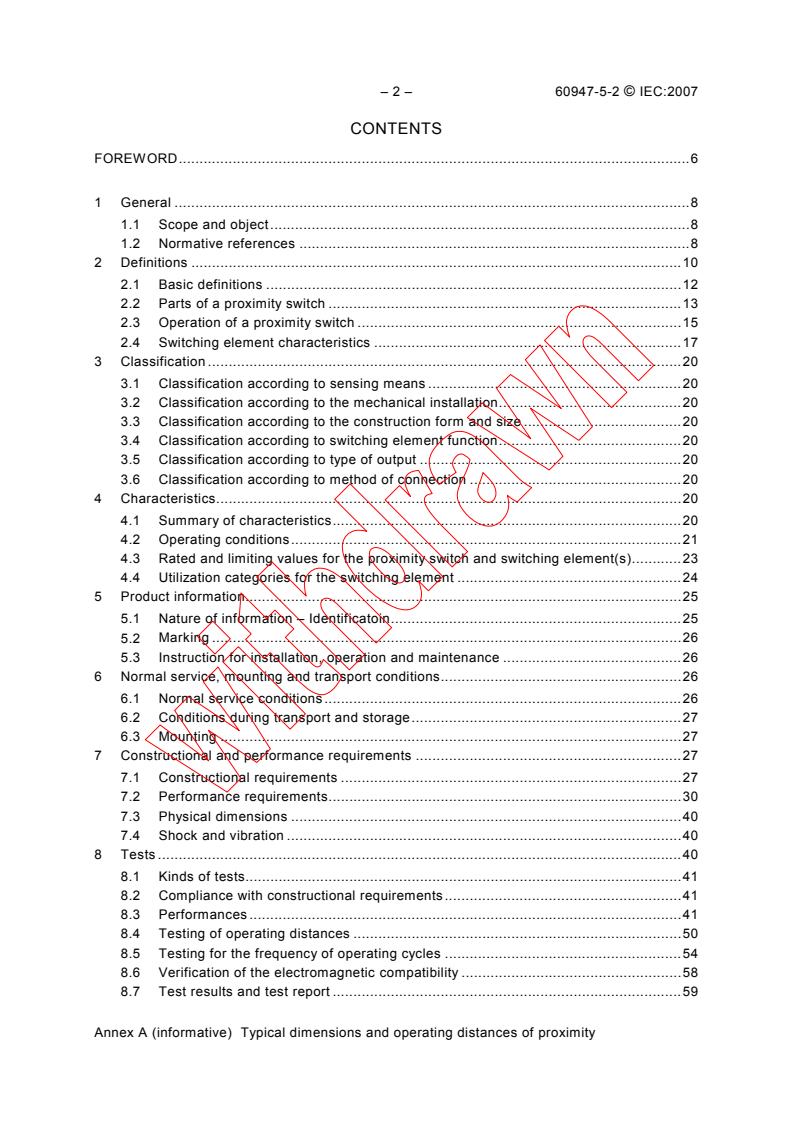
IEC 60947-5-2:2007 - Low-voltage switchgear and controlgear - Part 5-2: Control circuit devices and switching elements - Proximity switches Released:10/9/2007
Overview
IEC 60947-5-2:2007 is an international standard from the International Electrotechnical Commission (IEC) that specifies requirements for proximity switches used as control circuit devices and switching elements in low-voltage switchgear and controlgear systems. This standard applies to various types of proximity switches-inductive, capacitive, magnetic, ultrasonic, and photoelectric-that are designed to detect the presence of metallic, non-metallic, or magnetic objects without physical contact. These devices are meant for circuits with rated voltages up to 250 V AC (50/60 Hz) or 300 V DC and utilize semiconductor switching elements.
IEC 60947-5-2:2007 focuses on functional requirements, classification, operating conditions, product information, and performance criteria for proximity switches, promoting safety, compatibility, and reliability in industrial automation and process control.
Key Topics
Types of Proximity Switches:
- Inductive: Detects metallic objects via electromagnetic fields.
- Capacitive: Senses metallic and non-metallic targets by changes in capacitance.
- Ultrasonic: Uses sound waves to detect sound-reflecting objects.
- Photoelectric: Employs light (visible or infrared) to sense object presence.
- Non-mechanical magnetic: Detects objects with a magnetic field.
Device Characteristics:
- Only proximity switches with binary (ON/OFF) outputs are covered; analogue output devices are excluded.
- Self-contained sensors with solid-state (semiconductor) switching elements.
- Requirements for rated and limiting values regarding voltage and current.
Performance and Testing:
- Electromagnetic compatibility (EMC) requirements and immunity tests for voltage dips, interruptions, and environmental stress.
- Mechanical stress testing such as vibration, shock, and temperature variations.
- Detailed testing for operation distances, reliability, and functional safety.
Classification and Construction:
- Devices are classified by sensing principle, installation method (embeddable/non-embeddable), construction form, type of output, and connection method.
- Constructional and performance requirements for safe and reliable integration into control circuits.
Applications
IEC 60947-5-2 proximity switches are crucial in many industrial automation and manufacturing settings, where non-contact object detection enhances both safety and process efficiency. Common applications include:
- Position Sensing: Detecting the location of machine parts, material flow, or presence/absence of objects on conveyor systems.
- Safety Interlocking: Serving as part of safety circuits to prevent machine operation if doors or guards are open.
- Process Control: Triggering process steps by sensing containers, parts, or packages in automated production lines.
- Robotics: Facilitating accurate and non-intrusive object detection and movement control within robotic work cells.
- Elevators and Access Control: Ensuring proper alignment and presence of doors or passengers.
By meeting IEC 60947-5-2 requirements, proximity switches ensure compatibility within low-voltage controlgear assemblies, delivering reliable and durable performance under industrial conditions.
Related Standards
To ensure comprehensive compliance and safety in low-voltage switchgear and controlgear systems, consider these related IEC standards:
- IEC 60947-1: General rules for low-voltage switchgear and controlgear
- IEC 60068 Series: Environmental testing for vibration, temperature changes, and damp heat
- IEC 61000 Series: Electromagnetic compatibility (EMC) requirements
- IEC 60364: Low-voltage electrical installations
- IEC 60446: Identification of conductors by colors or numerals
Referencing these related standards alongside IEC 60947-5-2 will ensure harmonized and safe integration of proximity switches into diverse low-voltage control systems in industrial and commercial environments.
Keywords: IEC 60947-5-2, proximity switches, low-voltage switchgear, controlgear, industrial automation, inductive, capacitive, photoelectric, ultrasonic sensor, non-contact sensing, IEC standards, control circuits, process control.
Relations
- Effective Date
- 05-Sep-2023
- Effective Date
- 05-Sep-2023
- Effective Date
- 05-Sep-2023
- Effective Date
- 05-Sep-2023
- Effective Date
- 05-Sep-2023
Buy Documents
IEC 60947-5-2:2007+AMD1:2012 CSV - Low-voltage switchgear and controlgear - Part 5-2: Control circuitdevices and switching elements - Proximity switches Released:9/27/2012
IEC 60947-5-2:2007 - Low-voltage switchgear and controlgear - Part 5-2: Control circuit devices and switching elements - Proximity switches Released:10/9/2007
Get Certified
Connect with accredited certification bodies for this standard

IMQ S.p.A. (Certification)
Italian electrical product certification.

SLG Prüf- und Zertifizierungs GmbH
German testing and certification body.

UL Solutions
Global safety science company with testing, inspection and certification.
Sponsored listings
Frequently Asked Questions
IEC 60947-5-2:2007 is a standard published by the International Electrotechnical Commission (IEC). Its full title is "Low-voltage switchgear and controlgear - Part 5-2: Control circuit devices and switching elements - Proximity switches". This standard covers: This part of IEC 60947 applies to inductive and capacitive proximity switches that sense the presence of metallic and/or non-metallic objects, ultrasonic proximity switches that sense the presence of sound reflecting objects, photoelectric proximity switches that sense the presence of objects and non-mechanical magnetic proximity switches that sense the presence of objects with a magnetic field. These proximity switches are self-contained, have semiconductor switching elements(s) and are intended to be connected to circuits, the rated voltage of which does not exceed 250 V 50 Hz/60 Hz a.c. or 300 V d.c. This Standard is not intended to cover proximity switches with analogue outputs. The main changes with respect to the previous edition are as follows:-modification of Table 3;-modifications of voltage dips and voltage interruptions immunity tests, in Table 8;-modification of status of Annex A, now informative.
This part of IEC 60947 applies to inductive and capacitive proximity switches that sense the presence of metallic and/or non-metallic objects, ultrasonic proximity switches that sense the presence of sound reflecting objects, photoelectric proximity switches that sense the presence of objects and non-mechanical magnetic proximity switches that sense the presence of objects with a magnetic field. These proximity switches are self-contained, have semiconductor switching elements(s) and are intended to be connected to circuits, the rated voltage of which does not exceed 250 V 50 Hz/60 Hz a.c. or 300 V d.c. This Standard is not intended to cover proximity switches with analogue outputs. The main changes with respect to the previous edition are as follows:-modification of Table 3;-modifications of voltage dips and voltage interruptions immunity tests, in Table 8;-modification of status of Annex A, now informative.
IEC 60947-5-2:2007 is classified under the following ICS (International Classification for Standards) categories: 29.120.40 - Switches; 29.130.20 - Low voltage switchgear and controlgear. The ICS classification helps identify the subject area and facilitates finding related standards.
IEC 60947-5-2:2007 has the following relationships with other standards: It is inter standard links to IEC 60947-5-2:2007/AMD1:2012, IEC 60947-5-2:1997, IEC 60947-5-2:1997/AMD2:2003, IEC 60947-5-2:1997/AMD1:1999, IEC 60947-5-2:2019. Understanding these relationships helps ensure you are using the most current and applicable version of the standard.
IEC 60947-5-2:2007 is available in PDF format for immediate download after purchase. The document can be added to your cart and obtained through the secure checkout process. Digital delivery ensures instant access to the complete standard document.
Standards Content (Sample)
IEC 60947-5-2 ®
Edition 3.1 2012-09
INTERNATIONAL
STANDARD
NORME
INTERNATIONALE
colour
inside
Low-voltage switchgear and controlgear –
Part 5-2: Control circuit devices and switching elements – Proximity switches
Appareillage à basse tension –
Partie 5-2: Appareils et éléments de commutation pour circuits de commande –
Détecteurs de proximité
All rights reserved. Unless otherwise specified, no part of this publication may be reproduced or utilized in any form
or by any means, electronic or mechanical, including photocopying and microfilm, without permission in writing from
either IEC or IEC's member National Committee in the country of the requester.
If you have any questions about IEC copyright or have an enquiry about obtaining additional rights to this publication,
please contact the address below or your local IEC member National Committee for further information.
Droits de reproduction réservés. Sauf indication contraire, aucune partie de cette publication ne peut être reproduite ni
utilisée sous quelque forme que ce soit et par aucun procédé, électronique ou mécanique, y compris la photocopie et les
microfilms, sans l'accord écrit de la CEI ou du Comité national de la CEI du pays du demandeur.
Si vous avez des questions sur le copyright de la CEI ou si vous désirez obtenir des droits supplémentaires sur cette
publication, utilisez les coordonnées ci-après ou contactez le Comité national de la CEI de votre pays de résidence.
IEC Central Office Tel.: +41 22 919 02 11
3, rue de Varembé Fax: +41 22 919 03 00
CH-1211 Geneva 20 info@iec.ch
Switzerland www.iec.ch
About the IEC
The International Electrotechnical Commission (IEC) is the leading global organization that prepares and publishes
International Standards for all electrical, electronic and related technologies.
About IEC publications
The technical content of IEC publications is kept under constant review by the IEC. Please make sure that you have the
latest edition, a corrigenda or an amendment might have been published.
Useful links:
IEC publications search - www.iec.ch/searchpub Electropedia - www.electropedia.org
The advanced search enables you to find IEC publications The world's leading online dictionary of electronic and
by a variety of criteria (reference number, text, technical electrical terms containing more than 30 000 terms and
committee,…). definitions in English and French, with equivalent terms in
It also gives information on projects, replaced and additional languages. Also known as the International
withdrawn publications. Electrotechnical Vocabulary (IEV) on-line.
IEC Just Published - webstore.iec.ch/justpublished Customer Service Centre - webstore.iec.ch/csc
Stay up to date on all new IEC publications. Just Published If you wish to give us your feedback on this publication
details all new publications released. Available on-line and or need further assistance, please contact the
also once a month by email. Customer Service Centre: csc@iec.ch.
A propos de la CEI
La Commission Electrotechnique Internationale (CEI) est la première organisation mondiale qui élabore et publie des
Normes internationales pour tout ce qui a trait à l'électricité, à l'électronique et aux technologies apparentées.
A propos des publications CEI
Le contenu technique des publications de la CEI est constamment revu. Veuillez vous assurer que vous possédez
l’édition la plus récente, un corrigendum ou amendement peut avoir été publié.
Liens utiles:
Recherche de publications CEI - www.iec.ch/searchpub Electropedia - www.electropedia.org
La recherche avancée vous permet de trouver des Le premier dictionnaire en ligne au monde de termes
publications CEI en utilisant différents critères (numéro de électroniques et électriques. Il contient plus de 30 000
référence, texte, comité d’études,…). termes et définitions en anglais et en français, ainsi que
Elle donne aussi des informations sur les projets et les les termes équivalents dans les langues additionnelles.
publications remplacées ou retirées. Egalement appelé Vocabulaire Electrotechnique
International (VEI) en ligne.
Just Published CEI - webstore.iec.ch/justpublished
Service Clients - webstore.iec.ch/csc
Restez informé sur les nouvelles publications de la CEI.
Just Published détaille les nouvelles publications parues. Si vous désirez nous donner des commentaires sur
Disponible en ligne et aussi une fois par mois par email. cette publication ou si vous avez des questions
contactez-nous: csc@iec.ch.
IEC 60947-5-2 ®
Edition 3.1 2012-09
INTERNATIONAL
STANDARD
NORME
INTERNATIONALE
colour
inside
Low-voltage switchgear and controlgear –
Part 5-2: Control circuit devices and switching elements – Proximity switches
Appareillage à basse tension –
Partie 5-2: Appareils et éléments de commutation pour circuits de commande –
Détecteurs de proximité
INTERNATIONAL
ELECTROTECHNICAL
COMMISSION
COMMISSION
ELECTROTECHNIQUE
PRICE CODE
INTERNATIONALE
CODE PRIX CR
ICS 29.120.40; 29.130.20 ISBN 978-2-8322-0408-5
– 2 – 60947-5-2 © IEC:2007+A1:2012
CONTENTS
FOREWORD . 6
1 General . 8
1.1 Scope and object . 8
1.2 Normative references . 8
2 Definitions . 10
2.1 Basic definitions . 12
2.2 Parts of a proximity switch . 13
2.3 Operation of a proximity switch . 15
2.4 Switching element characteristics . 17
3 Classification . 20
3.1 Classification according to sensing means . 20
3.2 Classification according to the mechanical installation . 20
3.3 Classification according to the construction form and size . 20
3.4 Classification according to switching element function . 20
3.5 Classification according to type of output . 20
3.6 Classification according to method of connection . 20
4 Characteristics . 20
4.1 Summary of characteristics . 20
4.2 Operating conditions . 21
4.3 Rated and limiting values for the proximity switch and switching element(s) . 23
4.4 Utilization categories for the switching element . 24
5 Product information. 25
5.1 Nature of information – Identificatoin . 25
5.2 Marking . 26
5.3 Instructions for installation, operation and maintenance . 26
6 Normal service, mounting and transport conditions . 26
6.1 Normal service conditions . 26
6.2 Conditions during transport and storage . 27
6.3 Mounting . 27
7 Constructional and performance requirements . 27
7.1 Constructional requirements . 27
7.2 Performance requirements . 31
7.3 Physical dimensions . 40
7.4 Shock and vibration . 40
8 Tests . 41
8.1 Kinds of tests. 41
8.2 Compliance with constructional requirements . 41
8.3 Performances . 42
8.4 Testing of operating distances . 50
8.5 Testing for the frequency of operating cycles . 54
8.6 Verification of the electromagnetic compatibility . 58
8.7 Test results and test report . 59
60947-5-2 © IEC:2007+A1:2012 – 3 –
Annex A (informative) Typical dimensions and operating distances of proximity
switches . 60
Annex B (normative) Class II proximity switches insulated by encapsulation –
Requirements and tests . 86
Annex C (normative) Additional requirements for proximity switches with integrally
connected cables . 90
Annex D (normative) Integral connectors for plug-in proximity switches . 93
Annex E (normative) Additional requirements for proximity switches suitable for use in
strong magnetic fields . 98
Annex F (informative) Symbols for proximity switches . 103
Figure 1 – Sensing range and operating range of photoelectric proximity switches (see
7.2.1.3 and 8.4) . 16
Figure 2 – Ultrasonic proximity switch operating distances . 18
Figure 3 – Relationship between operating distances of inductive and capacitive
proximity switches (see 4.2.1, 7.2.1.3 and 8.4.1) . 22
Figure 4 – Relationship between operating distances of ultrasonic proximity switches
(see 4.2.2, 7.2.1.3 and 8.4.1) . 22
Figure 5 – Method of measuring the operating distance (8.3.2.1 and 8.4.1) . 43
Figure 6 – Test circuit for the verification of time delay before availability (see 7.2.1.7
and 8.3.3.2.1). 45
Figure 7 – Signal output across load in Figure 6 (see 8.3.3.2.1) . 45
Figure 8 – Test circuit for the verification of minimum operational current OFF-state
current, voltage drop and independent snap action (see 8.3.3.2.2, 8.3.3.2.3, 8.3.3.2.4
and 8.3.3.2.5). 46
Figure 9 – Test circuit for the verification of making and breaking capability (see 8.3.3.5) . 49
Figure 10 – Short-circuit testing (see 8.3.4.2) . 50
Figure 11 – Testing of the sensing range (see 8.4) . 53
Figure 12 – Methods for measuring the operating frequency of inductive, capacitive and
non-mechanical magnetic proximity switches (if applicable) . 54
Figure 13 – Methods for measuring the operating frequency f, ultrasonic proximity
switch . 55
Figure 14 – Output signal of direct current proximity switch during the measurement of
operating frequency f . 55
Figure 15 − Measurement means for turn-on time t and turn-off time t . 56
on off
Figure 16 − Turn-on time t measurement . 57
on
Figure 17 – Turn-off time t measurement . 57
off
Figure A.1 (IA) – Dimensions . 60
Figure A.2 (IA) – Installation (mounting) . 62
Figure A.1 (IB) – Dimensions . 63
Figure A.2 (IB) – Installation in damping material . 64
Figure A.1 (IC) – Dimensions in millimetres . 65
Figure A.1.2 (IC) – Dimensions in millimetres . 66
Figure A.1.3 (IC) – Dimensions in millimetres . 66
Figure A.1.4 (IC) – Dimensions in millimetres . 67
Figure A.2 (IC) – Installation of a I1C proximity switch in damping material . 68
Figure A.3 (IC) – Installation of I2C35 in damping material . 69
– 4 – 60947-5-2 © IEC:2007+A1:2012
Figure A.1 (ID) – Dimensions . 70
Figure A.2 (ID) – Installation of I2D in damping material . 71
Figure A.1 (CA) – Dimensions . 72
Figure A.2 (CA) – Installation (mounting) . 73
Figure A.1 (CC) a – Dimensions, type C30 in millimetres . 75
Figure A.1 (CC) b – Dimensions, type C40 in millimetres . 76
Figure A.2 (CC) – Installation (mounting) . 77
Figure A.1 (CD) – Dimensions in millimetres . 78
Figure A.2 (CD) – Installation (mounting) . 79
Figure A.1 (UA) – Dimensions . 80
Figure A.1 (UC) – Dimensions of type U3C40 . 82
Figure A.1 (UD) – Dimensions of type U3D80 in millimetres . 84
Figure B.1 – Encapsulated device . 87
Figure B.2 – Test device . 89
Figure D.1 – M12 Ø thread 3-pin integral connector for a.c. proximity switches . 93
Figure D.2 – M12 Ø thread 5-pin integral connector for d.c. proximity switches . 94
Figure D.3 – 8 mm Ø thread 3-pin integral connector for d.c. proximity switches . 94
Figure D.4 – 8 mm Ø thread 4-pin integral connector for d.c. proximity switches . 95
Figure D.5 − M12 ∅ thread 4-pin integral connector for a.c. proximity switches . 95
Figure D.6 – M12 ∅ thread 5-pin integral connector for a.c. proximity switches . 96
Figure D.7 – M12 ∅ thread 6-pin integral connector for a.c. proximity switches . 96
Figure D.8 – M5 thread 4-pin/3-pin integral connector for d.c. proximity switches . 97
Figure E.1 – Examples of test configuration for verification of the immunity to an
alternating field . 101
Figure E.2 – Example of test configuration for verification of the immunity in a constant
magnetic field . 102
Figure F.1 − Examples of symbols for proximity switches . 103
Table 1 – Classification of proximity switches . 19
Table 2 – Utilization categories for switching elements . 25
Table 3 – Connection and wiring identification . 29
Table 4 – Verification of making and breaking capacities of switching elements under
a
normal conditions corresponding to the utilization categories . 35
Table 5 – Verification of making and breaking capacities of switching elements under
a
abnormal conditions corresponding to the utilization categories . 36
Table 7 − Acceptance criteria . 37
Table 8 – Immunity tests . 38
Table 6 – Test voltages . 48
Table A.1 (IA) – Dimensions in millimetres . 61
Table A.2 (IA) – Rated operating distances in millimetres . 61
Table A.1 (IB) – Dimensions in millimetres . 63
Table A.2 (IB) – Rated operating distance in millimetres . 64
Table A.2 (IC) – Rated operating distance in millimetres . 67
Table A.1 (ID) – Dimensions in millimetres . 70
60947-5-2 © IEC:2007+A1:2012 – 5 –
Table A.2 (ID) – Rated operating distances in millimetres . 71
Table A.1 (CA) – Dimensions in millimetres . 72
Table A.2 (CA) – Rated operating distances in millimetres . 73
Table A.2 (CC) – Rated operational distance in millimetres . 76
Table A.1 (UA) – Dimensions in millimetres . 80
Table A.2 (UA) – Requirements for sensing range in millimetres . 81
Table A.1 (UC) – Requirements for sensing range in millimetres . 82
Table A.2 (UD) – Requirements for sensing range in millimetres . 85
– 6 – 60947-5-2 © IEC:2007+A1:2012
INTERNATIONAL ELECTROTECHNICAL COMMISSION
___________
LOW-VOLTAGE SWITCHGEAR AND CONTROLGEAR –
Part 5-2: Control circuit devices and switching elements –
Proximity switches
FOREWORD
1) The International Electrotechnical Commission (IEC) is a worldwide organization for standardization comprising
all national electrotechnical committees (IEC National Committees). The object of IEC is to promote
international co-operation on all questions concerning standardization in the electrical and electronic fields. To
this end and in addition to other activities, IEC publishes International Standards, Technical Specifications,
Technical Reports, Publicly Available Specifications (PAS) and Guides (hereafter referred to as “IEC
Publication(s)”). Their preparation is entrusted to technical committees; any IEC National Committee interested
in the subject dealt with may participate in this preparatory work. International, governmental and non-
governmental organizations liaising with the IEC also participate in this preparation. IEC collaborates closely
with the International Organization for Standardization (ISO) in accordance with conditions determined by
agreement between the two organizations.
2) The formal decisions or agreements of IEC on technical matters express, as nearly as possible, an international
consensus of opinion on the relevant subjects since each technical committee has representation from all
interested IEC National Committees.
3) IEC Publications have the form of recommendations for international use and are accepted by IEC National
Committees in that sense. While all reasonable efforts are made to ensure that the technical content of IEC
Publications is accurate, IEC cannot be held responsible for the way in which they are used or for any
misinterpretation by any end user.
4) In order to promote international uniformity, IEC National Committees undertake to apply IEC Publications
transparently to the maximum extent possible in their national and regional publications. Any divergence
between any IEC Publication and the corresponding national or regional publication shall be clearly indicated in
the latter.
5) IEC itself does not provide any attestation of conformity. Independent certification bodies provide conformity
assessment services and, in some areas, access to IEC marks of conformity. IEC is not responsible for any
services carried out by independent certification bodies.
6) All users should ensure that they have the latest edition of this publication.
7) No liability shall attach to IEC or its directors, employees, servants or agents including individual experts and
members of its technical committees and IEC National Committees for any personal injury, property damage or
other damage of any nature whatsoever, whether direct or indirect, or for costs (including legal fees) and
expenses arising out of the publication, use of, or reliance upon, this IEC Publication or any other IEC
Publications.
8) Attention is drawn to the Normative references cited in this publication. Use of the referenced publications is
indispensable for the correct application of this publication.
9) Attention is drawn to the possibility that some of the elements of this IEC Publication may be the subject of
patent rights. IEC shall not be held responsible for identifying any or all such patent rights.
This consolidated version of IEC 60947-5-2 consists of the third edition (2007)
[documents 17B/1570/FDIS and 17B/1576/RVD] and its amendment 1 (2012) [documents
17B/1733/CDV and 17B/1774/RVC]. It bears the edition number 3.1.
The technical content is therefore identical to the base edition and its amendment and
has been prepared for user convenience. A vertical line in the margin shows where the
base publication has been modified by amendment 1. Additions and deletions are
displayed in red, with deletions being struck through.
60947-5-2 © IEC:2007+A1:2012 – 7 –
International Standard IEC 60947-5-2 has been prepared by subcommittee 17B: Low-voltage
switchgear and controlgear, of IEC technical committee 17: Switchgear and controlgear.
The document 17B/1570/FDIS, circulated to the National Committees as Amendment 3, led to
the publication of the new edition.
The main changes with respect to the previous edition are as follows:
– modification of Table 3;
– modifications of voltage dips and voltage interruptions immunity tests, in Table 8;
– modification of status of Annex A, now informative.
This publication has been drafted in accordance with the ISO/IEC Directives, Part 2.
A list of all the parts in the IEC 60947 series, under the general title Low-voltage switchgear
and controlgear, can be found on the IEC website.
The committee has decided that the contents of the base publication and its amendments will
remain unchanged until the stability date indicated on the IEC web site under
"http://webstore.iec.ch" in the data related to the specific publication. At this date, the
publication will be
• reconfirmed,
• withdrawn,
• replaced by a revised edition, or
• amended.
IMPORTANT – The “colour inside” logo on the cover page of this publication indicates
that it contains colours which are considered to be useful for the correct understanding
of its contents. Users should therefore print this publication using a colour printer.
– 8 – 60947-5-2 © IEC:2007+A1:2012
LOW-VOLTAGE SWITCHGEAR AND CONTROLGEAR –
Part 5-2: Control circuit devices and switching elements –
Proximity switches
1 General
The provisions of the general rules in IEC 60947-1 are applicable to this standard, where
specifically called for. General rules clauses and subclauses thus applicable, as well as tables,
figures and annexes, are identified by references to IEC 60947-1, e.g. subclause 7.1.9.3 of
IEC 60947-1 or Annex C of IEC 60947-1.
Clauses 1 to 8 contain the general requirements. Specific requirements for the various types of
proximity switches are given in Annex A.
1.1 Scope and object
This part of IEC 60947 applies to inductive and capacitive proximity switches that sense the presence
of metallic and/or non-metallic objects, ultrasonic proximity switches that sense the presence of
sound reflecting objects, photoelectric proximity switches that sense the presence of objects
and non-mechanical magnetic proximity switches that sense the presence of objects with a
magnetic field.
These proximity switches are self-contained, have semiconductor switching elements(s) and
are intended to be connected to circuits, the rated voltage of which does not exceed 250 V
50 Hz/60 Hz a.c. or 300 V d.c. This Standard is not intended to cover proximity switches with
analogue outputs.
The object of this standard is to state for proximity switches:
– definitions;
– classification;
– characteristics;
– product information;
– normal service, mounting and transport conditions;
– constructional and performance requirements;
– tests to verify rated characteristics.
1.2 Normative references
The following referenced documents are indispensable for the application of this document. For
dated references, only the edition cited applies. For undated references, the latest edition of
the referenced document (including any amendments) applies.
IEC 60050(441):1984, International Electrotechnical Vocabulary (IEV) – Chapter 441:
Switchgear, controlgear and fuses
Amendment 1 (2000)
IEC 60068-2-6:1995 2007, Environmental testing – Part 2-6: Tests – Test Fc: Vibration
(sinusoidal)
IEC 60068-2-14:1984 2009, Environmental testing – Part 2-14: Tests – Test N: Change of
temperature
Amendment 1 (1986)
60947-5-2 © IEC:2007+A1:2012 – 9 –
IEC 60068-2-27:1987 2008, Environmental testing – Part 2-27: Tests – Test Ea and guidance:
Shock
IEC 60068-2-30:2005, Environmental testing – Part 2-30: Tests – Test Db: Damp heat, cyclic
(12 h + 12 h cycle)
IEC 60364 (all parts), Low-voltage electrical installations
IEC 60445:2010, Basic and safety principles for man-machine interface, marking and
identification – Identification of equipment terminals, conductor terminations and conductors
IEC 60446:2007, Basic and safety principles for man-machine interface, marking and
identification – Identification of conductors by colours or numerals
IEC 60947-1:2007, Low-voltage switchgear and controlgear – Part 1: General rules
Amendment 1:2010
IEC 61000-3-2:2005, Electromagnetic compatibility (EMC) – Part 3-2: Limits – Limits for
harmonic current emissions (equipment input current ≤ 16 A per phase)
Amendment 1:2008
Amendment 2:2009
IEC 61000-3-3:1994, Electromagnetic compatibility (EMC) – Part 3-3: Limitation of voltage
fluctuations and flicker in low-voltage supply systems for equipment with rated current ≤ 16 A
Amendment 1 (2001)
Amendment 2 (2005)
IEC 61000-3-3:2008, Electromagnetic compatibility (EMC) – Part 3-3: Limits – Limitation of
voltage changes, voltage fluctuations and flicker in public low-voltage supply systems, for
equipment with rated current ≤ 16 A per phase and not subject to conditional connection
IEC 61000-4-2:1995 2008, Electromagnetic compatibility (EMC) – Part 4-2: Testing and
measurement techniques – Electrostatic discharge immunity test
Amendment 1 (1998)
Amendment 2 (2000)
IEC 61000-4-3:2006, Electromagnetic compatibility (EMC) – Part 4-3: Testing and
measurement techniques – Radiated, radio-frequency, electromagnetic field immunity test
Amendment 1:2007
Amendment 2:2010
IEC 61000-4-4:2004, Electromagnetic compatibility (EMC) – Part 4-4: Testing and
measurement techniques – Electrical fast transient/burst immunity test
IEC 61000-4-6:2003 2008, Electromagnetic compatibility (EMC) – Part 4-6: Testing and
measurement techniques – Immunity to conducted disturbances, induced by radio-frequency
fields
Amendment 1 (2004)
Amendment 2 (2006)
IEC 61000-4-8:1993 2009, Electromagnetic compatibility (EMC) – Part 4-8: Testing and
measurement techniques – Power frequency magnetic field immunity test
Amendment 1 (2000)
IEC 61000-4-11:2004, Electromagnetic compatibility (EMC) – Part 4-11: Testing and
measurement techniques – Voltage dips, short interruptions and voltage variations immunity
tests
IEC 61000-4-13:2002, Electromagnetic compatibility (EMC) – Part 4-13: Testing and
measurement techniques – Harmonics and interharmonics including mains signalling at a.c.
power port, low-frequency immunity tests
Amendment 1:2009
– 10 – 60947-5-2 © IEC:2007+A1:2012
IEC 61076-2 (all parts), Connectors for electronic equipment – Product requirements – Part 2:
Circular connectors
IEC 61140:2001, Protection against electric shock – Common aspects for installation and
equipment
Amendment 1 (2004)
CISPR 11:2003 2009, Industrial, scientific and medical (ISM) radio-frequency equipment –
Electromagnetic Radio-frequency disturbance characteristics – Limits and methods of
measurement
Amendment 1 (2004)
Amendment 2 (2006)
Amendment 1:2010
ISO 630:1995, Structural steels – Plates, wide flats, bars, sections and profiles
Amendment 1 (2003)
ISO 630 (all parts), Structural steels
2 Definitions
Clause 2 of IEC 60947-1 applies with the following additions:
Alphabetical index of definitions References
A
Adjuster of a proximity switch . 2.2.15
Adjuster of a capacitive proximity switch . 2.2.15.1
Adjuster of an ultrasonic proximity switch . 2.2.15.2
Ambient light for a photoelectric proximity switch . 2.4.7
Assured operating distance (s ) . 2.3.1.7
a
Axial approach . 2.3.3
B
Blind zone . 2.3.1.3
Break function . 2.4.1.2
C
Capacitive proximity switch . 2.1.1.2
Currents (I) . 2.4.5
D
Damping material . 2.2.5
Differential travel (H) . 2.3.5
Direct operated proximity switch . 2.1.1.6
E
Effective operating distance (s ) . 2.3.1.5
r
Embeddable proximity switch . 2.2.9
Emitter . 2.2.12
Excess gain for a photoelectric proximity switch . 2.4.6
F
Free zone . 2.2.4
Frequency of operating cycle (f) . 2.4.3
I
Independent (snap) action . 2.4.2
Indirect operated proximity switch . 2.1.1.7
Inductive proximity switch . 2.1.1.1
60947-5-2 © IEC:2007+A1:2012 – 11 –
L
Lateral approach . 2.3.2
M
Make function . 2.4.1.1
Make-break, or changeover function . 2.4.1.3
Maximum operating distance . 2.3.1.2.2
Minimum operating distance . 2.3.1.2.1
Minimum operational current (I ) . 2.4.5.2
m
N
Neutral density filters . 2.1.1.8
No-load supply current (I ) . 2.4.5.3
o
Non-damping material . 2.2.6
Non-embeddable proximity switch . 2.2.10
Non-mechanical magnetic proximity switch . 2.1.1.5
O
OFF-state current (I ) . 2.4.5.1
r
Operating distances (s) . 2.3.1
Operating range (r ) . 2.3.1.8
o
Operation of a proximity switch . 2.3
P
Parts of proximity switches . 2.2
Photoelectric proximity switch . 2.1.1.4
Photoelectric proximity switch - type D . 2.1.1.4.1
Photoelectric proximity switch - type R . 2.1.1.4.2
Photoelectric proximity switch - type T . 2.1.1.4.3
Proximity switch (IEV 441-14-51) . 2.1.1
R
Rated operating distance (s ) . 2.3.1.1
n
Receiver . 2.2.13
Reference axis . 2.2.2
Reflector . 2.2.14
Repeat accuracy (R) . 2.3.4
Response time proximity switch . 2.4.1.4
S
Semiconductor switching element . 2.2.1
Sensing face . 2.2.11
Sensing range (s ) . 2.3.1.2
d
Sound absorbing material . 2.2.8
Sound reflecting material . 2.2.7
Standard target . 2.2.3
Switching element characteristics . 2.4
Switching element function . 2.4.1
T
) . 2.4.4
Time delay before availability (t
v
Total beam angle . 2.3.1.4
Turn off time for a photoelectric proximity switch . 2.4.1.6
Turn on time for a photoelectric proximity switch. 2.4.1.5
U
Ultrasonic proximity switch . 2.1.1.3
Usable operating distance (s ) . 2.3.1.6
u
– 12 – 60947-5-2 © IEC:2007+A1:2012
2.1 Basic definitions
2.1.1
proximity switch
a position switch which is operated without mechanical contact with the moving part
[IEV 441-14-51]
2.1.1.1
inductive proximity switch
a proximity switch producing an electromagnetic field within a sensing zone and having a
semiconductor switching element
2.1.1.2
capacitive proximity switch
a proximity switch producing an electric field within a sensing zone and having a semiconductor
switching element
2.1.1.3
ultrasonic proximity switch (see Figure 2)
a proximity switch transmitting and receiving ultrasound waves within a sensing zone and
having a semiconductor switching element
2.1.1.4
photoelectric proximity switch (see Figure 1)
a proximity switch which senses objects that either reflect or interrupt visible or invisible light
and having a semiconductor switching element
2.1.1.4.1
type D
diffuse reflective photoelectric proximity switch which is directly operated through lateral or
axial approach to its reference axis by a defined object
2.1.1.4.2
type R
retroreflective photoelectric proximity switch which is indirectly operated through lateral
approach to its reference axis between emitter-receiver and reflector by a defined object
2.1.1.4.3
type T
through beam photoelectric proximity switch which is indirectly operated through lateral
approach of its reference axis between emitter and receiver by a defined object
2.1.1.5
non-mechanical magnetic proximity switch
proximity switch which senses the presence of a magnetic field and has a semiconductor
switching element and no moving parts in the sensing element
2.1.1.6
direct operated proximity switch
proximity switch which detects its target without the use of an external means, e.g. a reflector
___________
See IEC 60050(441).
60947-5-2 © IEC:2007+A1:2012 – 13 –
2.1.1.7
indirect operated proximity switch
proximity switch which detects its target with the use of an external means, e.g. a reflector
2.1.1.8
neutral density filters
filters which uniformly attenuate the intensity of light over a broad spectral range
NOTE Attenuation is accomplished by using either a light-absorbing glass or a thin-film metal coating that
combines absorption and reflection.
2.2 Parts of a proximity switch
2.2.1
semiconductor switching element
an element designed to switch the current of an electric circuit by controlling conductivity of a
semiconductor
2.2.2
Reference axis
2.2.2.1
reference axis for inductive, capacitive, non-mechanical magn
...
IEC 60947-5-2
Edition 3.0 2007-10
INTERNATIONAL
STANDARD
NORME
INTERNATIONALE
Low-voltage switchgear and controlgear –
Part 5-2: Control circuit devices and switching elements – Proximity switches
Appareillage à basse tension –
Partie 5-2: Appareils et éléments de commutation pour circuits de commande –
Détecteurs de proximité
All rights reserved. Unless otherwise specified, no part of this publication may be reproduced or utilized in any form or by
any means, electronic or mechanical, including photocopying and microfilm, without permission in writing from either IEC or
IEC's member National Committee in the country of the requester.
If you have any questions about IEC copyright or have an enquiry about obtaining additional rights to this publication,
please contact the address below or your local IEC member National Committee for further information.
Droits de reproduction réservés. Sauf indication contraire, aucune partie de cette publication ne peut être reproduite
ni utilisée sous quelque forme que ce soit et par aucun procédé, électronique ou mécanique, y compris la photocopie
et les microfilms, sans l'accord écrit de la CEI ou du Comité national de la CEI du pays du demandeur.
Si vous avez des questions sur le copyright de la CEI ou si vous désirez obtenir des droits supplémentaires sur cette
publication, utilisez les coordonnées ci-après ou contactez le Comité national de la CEI de votre pays de résidence.
IEC Central Office
3, rue de Varembé
CH-1211 Geneva 20
Switzerland
Email: inmail@iec.ch
Web: www.iec.ch
About the IEC
The International Electrotechnical Commission (IEC) is the leading global organization that prepares and publishes
International Standards for all electrical, electronic and related technologies.
About IEC publications
The technical content of IEC publications is kept under constant review by the IEC. Please make sure that you have the
latest edition, a corrigenda or an amendment might have been published.
ƒ Catalogue of IEC publications: www.iec.ch/searchpub
The IEC on-line Catalogue enables you to search by a variety of criteria (reference number, text, technical committee,…).
It also gives information on projects, withdrawn and replaced publications.
ƒ IEC Just Published: www.iec.ch/online_news/justpub
Stay up to date on all new IEC publications. Just Published details twice a month all new publications released. Available
on-line and also by email.
ƒ Electropedia: www.electropedia.org
The world's leading online dictionary of electronic and electrical terms containing more than 20 000 terms and definitions
in English and French, with equivalent terms in additional languages. Also known as the International Electrotechnical
Vocabulary online.
ƒ Customer Service Centre: www.iec.ch/webstore/custserv
If you wish to give us your feedback on this publication or need further assistance, please visit the Customer Service
Centre FAQ or contact us:
Email: csc@iec.ch
Tel.: +41 22 919 02 11
Fax: +41 22 919 03 00
A propos de la CEI
La Commission Electrotechnique Internationale (CEI) est la première organisation mondiale qui élabore et publie des
normes internationales pour tout ce qui a trait à l'électricité, à l'électronique et aux technologies apparentées.
A propos des publications CEI
Le contenu technique des publications de la CEI est constamment revu. Veuillez vous assurer que vous possédez
l’édition la plus récente, un corrigendum ou amendement peut avoir été publié.
ƒ Catalogue des publications de la CEI: www.iec.ch/searchpub/cur_fut-f.htm
Le Catalogue en-ligne de la CEI vous permet d’effectuer des recherches en utilisant différents critères (numéro de référence,
texte, comité d’études,…). Il donne aussi des informations sur les projets et les publications retirées ou remplacées.
ƒ Just Published CEI: www.iec.ch/online_news/justpub
Restez informé sur les nouvelles publications de la CEI. Just Published détaille deux fois par mois les nouvelles
publications parues. Disponible en-ligne et aussi par email.
ƒ Electropedia: www.electropedia.org
Le premier dictionnaire en ligne au monde de termes électroniques et électriques. Il contient plus de 20 000 termes et
définitions en anglais et en français, ainsi que les termes équivalents dans les langues additionnelles. Egalement appelé
Vocabulaire Electrotechnique International en ligne.
ƒ Service Clients: www.iec.ch/webstore/custserv/custserv_entry-f.htm
Si vous désirez nous donner des commentaires sur cette publication ou si vous avez des questions, visitez le FAQ du
Service clients ou contactez-nous:
Email: csc@iec.ch
Tél.: +41 22 919 02 11
Fax: +41 22 919 03 00
IEC 60947-5-2
Edition 3.0 2007-10
INTERNATIONAL
STANDARD
NORME
INTERNATIONALE
Low-voltage switchgear and controlgear –
Part 5-2: Control circuit devices and switching elements – Proximity switches
Appareillage à basse tension –
Partie 5-2: Appareils et éléments de commutation pour circuits de commande –
Détecteurs de proximité
INTERNATIONAL
ELECTROTECHNICAL
COMMISSION
COMMISSION
ELECTROTECHNIQUE
PRICE CODE
INTERNATIONALE
XD
CODE PRIX
ICS 29.120.40; 29.130.20 ISBN 2-8318-9318-6
– 2 – 60947-5-2 © IEC:2007
CONTENTS
FOREWORD.6
1 General .8
1.1 Scope and object.8
1.2 Normative references .8
2 Definitions .10
2.1 Basic definitions .12
2.2 Parts of a proximity switch .13
2.3 Operation of a proximity switch .15
2.4 Switching element characteristics .17
3 Classification .20
3.1 Classification according to sensing means .20
3.2 Classification according to the mechanical installation.20
3.3 Classification according to the construction form and size .20
3.4 Classification according to switching element function.20
3.5 Classification according to type of output .20
3.6 Classification according to method of connection .20
4 Characteristics.20
4.1 Summary of characteristics.20
4.2 Operating conditions.21
4.3 Rated and limiting values for the proximity switch and switching element(s).23
4.4 Utilization categories for the switching element .24
5 Product information.25
5.1 Nature of information – Identificatoin.25
5.2 Marking .26
5.3 Instruction for installation, operation and maintenance .26
6 Normal service, mounting and transport conditions.26
6.1 Normal service conditions.26
6.2 Conditions during transport and storage.27
6.3 Mounting .27
7 Constructional and performance requirements .27
7.1 Constructional requirements .27
7.2 Performance requirements.30
7.3 Physical dimensions .40
7.4 Shock and vibration .40
8 Tests .40
8.1 Kinds of tests.41
8.2 Compliance with constructional requirements.41
8.3 Performances .41
8.4 Testing of operating distances .50
8.5 Testing for the frequency of operating cycles .54
8.6 Verification of the electromagnetic compatibility .58
8.7 Test results and test report .59
Annex A (informative) Typical dimensions and operating distances of proximity
60947-5-2 © IEC:2007 – 3 –
switches.
Annex B (normative) Class II proximity switches insulated by encapsulation –
Requirements and tests .86
Annex C (normative) Additional requirements for proximity switches with integrally
connected cables .90
Annex D (normative) Integral connectors for plug-in proximity switches.93
Annex E (normative) Additional requirements for proximity switches suitable for use in
strong magnetic fields .97
Annex F (informative) Symbols for proximity switches. 102
Figure 1 – Sensing range and operating range of photoelectric proximity switches (see
7.2.1.3 and 8.4).16
Figure 2 – Ultrasonic proximity switch operating distances.18
Figure 3 – Relationship between operating distances of inductive and capacitive
proximity switches (see 4.2.1, 7.2.1.3 and 8.4.1) .22
Figure 4 – Relationship between operating distances of ultrasonic proximity switches
(see 4.2.2, 7.2.1.3 and 8.4.1) .22
Figure 5 – Method of measuring the operating distance (8.3.2.1 and 8.4.1) .43
Figure 6 – Test circuit for the verification of time delay before availability (see 7.2.1.7
and 8.3.3.2.1).44
Figure 7 – Signal output across load in Figure 6 (see 8.3.3.2.1) .45
Figure 8 – Test circuit for the verification of minimum operational current OFF-state
current, voltage drop and independent snap action (see 8.3.3.2.2, 8.3.3.2.3, 8.3.3.2.4
and 8.3.3.2.5).46
Figure 9 – Test circuit for the verification of making and breaking capability (see 8.3.3.5) .49
Figure 10 – Short-circuit testing (see 8.3.4.2) .50
Figure 11 – Testing of the sensing range (see 8.4) .53
Figure 12 – Methods for measuring the operating frequency of inductive, capacitive and
non-mechanical magnetic proximity switches (if applicable) .54
Figure 13 – Methods for measuring the operating frequency f, ultrasonic proximity
switch .55
Figure 14 – Output signal of direct current proximity switch during the measurement of
operating frequency f .55
Figure 15 − Measurement means for turn-on time t and turn-off time t .56
on off
Figure 16 − Turn-on time t measurement.57
on
Figure 17 – Turn-off time t measurement .57
off
Figure A.1 (IA) – Dimensions.60
Figure A.2 (IA) – Installation (mounting) .62
Figure A.1 (IB) – Dimensions.63
Figure A.2 (IB) – Installation in damping material.64
Figure A.1 (IC) – Dimensions in millimetres .65
Figure A.1.2 (IC) – Dimensions in millimetres .66
Figure A.1.3 (IC) – Dimensions in millimetres .66
Figure A.1.4 (IC) – Dimensions in millimetres .67
Figure A.2 (IC) – Installation of a I1C proximity switch in damping material .68
Figure A.3 (IC) – Installation of I2C35 in damping material.69
Figure A.1 (ID) – Dimensions .70
– 4 – 60947-5-2 © IEC:2007
Figure A.2 (ID) – Installation of I2D in damping material .71
Figure A.1 (CA) – Dimensions .72
Figure A.2 (CA) – Installation (mounting) .73
Figure A.1 (CC) a – Dimensions, type C30 in millimetres .75
Figure A.1 (CC) b – Dimensions, type C40 in millimetres .76
Figure A.2 (CC) – Installation (mounting).77
Figure A.1 (CD) – Dimensions in millimetres.78
Figure A.2 (CD) – Installation (mounting).79
Figure A.1 (UA) – Dimensions .80
Figure A.1 (UC) – Dimensions of type U3C40 .82
Figure A.1 (UD) – Dimensions of type U3D80 in millimetres.84
Figure B.1 – Encapsulated device .87
Figure B.2 – Test device .89
Figure D.1 – M12 Ø 3-pin integral connector for a.c. proximity switches .93
Figure D.2 – M12 Ø 5-pin integral connector for d.c. proximity switches .94
Figure D.3 – 8 mm Ø 3-pin integral connector for d.c. proximity switches .94
Figure D.4 – 8 mm Ø 4-pin integral connector for d.c. proximity switches .95
Figure D.5 − M12 ∅ 4-pin integral connector for a.c. proximity switches .95
Figure D.6 – M12 ∅ 5-pin integral connector for a.c. proximity switches .96
Figure D.7 – M12 ∅ 6-pin integral connector for a.c. proximity switches .96
Figure E.1 – Examples of test configuration for verification of the immunity to an
alternating field . 100
Figure E.2 – Example of test configuration for verification of the immunity in a constant
magnetic field . 101
Figure F.1 − Examples of symbols for proximity switches . 102
Table 1 – Classification of proximity switches .19
Table 2 – Utilization categories for switching elements .25
Table 3 – Connection and wiring identification .29
Table 4 – Verification of making and breaking capacities of switching elements under
a
normal conditions corresponding to the utilization categories .35
Table 5 – Verification of making and breaking capacities of switching elements under
a
abnormal conditions corresponding to the utilization categories .36
Table 7 − Acceptance criteria .37
Table 8 – Immunity tests .38
Table 6 – Test voltages .48
Table A.1 (IA) – Dimensions in millimetres .61
Table A.2 (IA) – Rated operating distances in millimetres .61
Table A.1 (IB) – Dimensions in millimetres .63
Table A.2 (IB) – Rated operating distance in millimetres .64
Table A.2 (IC) – Rated operating distance in millimetres .67
Table A.1 (ID) – Dimensions in millimetres .70
Table A.2 (ID) – Rated operating distances in millimetres .71
Table A.1 (CA) – Dimensions in millimetres .72
60947-5-2 © IEC:2007 – 5 –
Table A.2 (CA) – Rated operating distances in millimetres .
Table A.2 (CC) – Rated operational distance in millimetres.76
Table A.1 (UA) – Dimensions in millimetres .80
Table A.2 (UA) – Requirements for sensing range in millimetres .81
Table A.1 (UC) – Requirements for sensing range in millimetres.82
Table A.2 (UD) – Requirements for sensing range in millimetres.85
– 6 – 60947-5-2 © IEC:2007
INTERNATIONAL ELECTROTECHNICAL COMMISSION
___________
LOW-VOLTAGE SWITCHGEAR AND CONTROLGEAR –
Part 5-2: Control circuit devices and switching elements –
Proximity switches
FOREWORD
1) The International Electrotechnical Commission (IEC) is a worldwide organization for standardization comprising
all national electrotechnical committees (IEC National Committees). The object of IEC is to promote
international co-operation on all questions concerning standardization in the electrical and electronic fields. To
this end and in addition to other activities, IEC publishes International Standards, Technical Specifications,
Technical Reports, Publicly Available Specifications (PAS) and Guides (hereafter referred to as “IEC
Publication(s)”). Their preparation is entrusted to technical committees; any IEC National Committee interested
in the subject dealt with may participate in this preparatory work. International, governmental and non-
governmental organizations liaising with the IEC also participate in this preparation. IEC collaborates closely
with the International Organization for Standardization (ISO) in accordance with conditions determined by
agreement between the two organizations.
2) The formal decisions or agreements of IEC on technical matters express, as nearly as possible, an international
consensus of opinion on the relevant subjects since each technical committee has representation from all
interested IEC National Committees.
3) IEC Publications have the form of recommendations for international use and are accepted by IEC National
Committees in that sense. While all reasonable efforts are made to ensure that the technical content of IEC
Publications is accurate, IEC cannot be held responsible for the way in which they are used or for any
misinterpretation by any end user.
4) In order to promote international uniformity, IEC National Committees undertake to apply IEC Publications
transparently to the maximum extent possible in their national and regional publications. Any divergence
between any IEC Publication and the corresponding national or regional publication shall be clearly indicated in
the latter.
5) IEC provides no marking procedure to indicate its approval and cannot be rendered responsible for any
equipment declared to be in conformity with an IEC Publication.
6) All users should ensure that they have the latest edition of this publication.
7) No liability shall attach to IEC or its directors, employees, servants or agents including individual experts and
members of its technical committees and IEC National Committees for any personal injury, property damage or
other damage of any nature whatsoever, whether direct or indirect, or for costs (including legal fees) and
expenses arising out of the publication, use of, or reliance upon, this IEC Publication or any other IEC
Publications.
8) Attention is drawn to the Normative references cited in this publication. Use of the referenced publications is
indispensable for the correct application of this publication.
9) Attention is drawn to the possibility that some of the elements of this IEC Publication may be the subject of
patent rights. IEC shall not be held responsible for identifying any or all such patent rights.
International Standard IEC 60947-5-2 has been prepared by subcommittee 17B: Low-voltage
switchgear and controlgear, of IEC technical committee 17: Switchgear and controlgear.
This third edition cancels and replaces the second edition published in 1997, amendment 1
(1999) and amendment 2 (2003).
The document 17B/1570/FDIS, circulated to the National Committees as Amendment 3, led to
the publication of the new edition.
The text of this standard is based on the second edition, its amendment 1, amendment 2 and
on the following documents:
FDIS Report on voting
17B/1570/FDIS 17B/1576/RVD
Full information on the voting for the approval of this standard can be found in the report on
voting indicated in the above table.
60947-5-2 © IEC:2007 – 7 –
The main changes with respect to the previous edition are as follows:
– modification of Table 3;
– modifications of voltage dips and voltage interruptions immunity tests, in Table 8;
– modification of status of Annex A, now informative.
This publication has been drafted in accordance with the ISO/IEC Directives, Part 2.
A list of all the parts in the IEC 60947 series, under the general title Low-voltage switchgear
and controlgear, can be found on the IEC website.
The committee has decided that the contents of this publication will remain unchanged until the
maintenance result date indicated on the IEC web site under “http://webstore.iec.ch” in the data
related to the specific publication. At this date, the publication will be
• reconfirmed;
• withdrawn;
• replaced by a revised edition, or
• amended.
– 8 – 60947-5-2 © IEC:2007
LOW-VOLTAGE SWITCHGEAR AND CONTROLGEAR –
Part 5-2: Control circuit devices and switching elements –
Proximity switches
1 General
The provisions of the general rules in IEC 60947-1 are applicable to this standard, where
specifically called for. General rules clauses and subclauses thus applicable, as well as tables,
figures and annexes, are identified by references to IEC 60947-1, e.g. subclause 7.1.9.3 of
IEC 60947-1 or Annex C of IEC 60947-1.
Clauses 1 to 8 contain the general requirements. Specific requirements for the various types of
proximity switches are given in Annex A.
1.1 Scope and object
This part of IEC 60947 applies to inductive and capacitive proximity switches that sense the presence
of metallic and/or non-metallic objects, ultrasonic proximity switches that sense the presence of
sound reflecting objects, photoelectric proximity switches that sense the presence of objects
and non-mechanical magnetic proximity switches that sense the presence of objects with a
magnetic field.
These proximity switches are self-contained, have semiconductor switching elements(s) and
are intended to be connected to circuits, the rated voltage of which does not exceed 250 V
50 Hz/60 Hz a.c. or 300 V d.c. This Standard is not intended to cover proximity switches with
analogue outputs.
The object of this standard is to state for proximity switches:
– definitions;
– classification;
– characteristics;
– product information;
– normal service, mounting and transport conditions;
– constructional and performance requirements;
– tests to verify rated characteristics.
1.2 Normative references
The following referenced documents are indispensable for the application of this document. For
dated references, only the edition cited applies. For undated references, the latest edition of
the referenced document (including any amendments) applies.
IEC 60050(441):1984, International Electrotechnical Vocabulary (IEV) – Chapter 441:
Switchgear, controlgear and fuses
Amendment 1 (2000)
IEC 60068-2-6:1995, Environmental testing – Part 2: Tests – Test Fc: Vibration (sinusoidal)
IEC 60068-2-14:1984, Environmental testing – Part 2: Tests – Test N: Change of temperature
60947-5-2 © IEC:2007 – 9 –
Amendment 1 (1986)
IEC 60068-2-27:1987, Environmental testing – Part 2: Tests – Test Ea and guidance: Shock
IEC 60068-2-30:2005, Environmental testing – Part 2-30: Tests – Test Db: Damp heat, cyclic
(12 h + 12 h cycle)
IEC 60364 (all parts), Low-voltage electrical installations
IEC 60446:2007, Basic and safety principles for man-machine interface, marking and
identification – Identification of conductors by colours or numerals
IEC 60947-1:2007, Low-voltage switchgear and controlgear – Part 1: General rules
IEC 61000-3-2:2005, Electromagnetic compatibility (EMC) – Part 3-2: Limits – Limits for
harmonic current emissions (equipment input current ≤ 16 A per phase)
IEC 61000-3-3:1994, Electromagnetic compatibility (EMC) – Part 3-3: Limitation of voltage
fluctuations and flicker in low-voltage supply systems for equipment with rated current ≤ 16 A
Amendment 1 (2001)
Amendment 2 (2005)
IEC 61000-4-2:1995, Electromagnetic compatibility (EMC) – Part 4-2: Testing and
measurement techniques – Electrostatic discharge immunity test
Amendment 1 (1998)
Amendment 2 (2000)
IEC 61000-4-3:2006, Electromagnetic compatibility (EMC) – Part 4-3: Testing and
measurement techniques – Radiated, radio-frequency, electromagnetic field immunity test
IEC 61000-4-4:2004, Electromagnetic compatibility (EMC) – Part 4-4: Testing and
measurement techniques – Electrical fast transient/burst immunity test
IEC 61000-4-6:2003, Electromagnetic compatibility (EMC) – Part 4-6: Testing and
measurement techniques – Immunity to conducted disturbances, induced by radio-frequency
fields
Amendment 1 (2004)
Amendment 2 (2006)
IEC 61000-4-8:1993, Electromagnetic compatibility (EMC) – Part 4-8: Testing and
measurement techniques – Power frequency magnetic field immunity test
Amendment 1 (2000)
IEC 61000-4-11:2004, Electromagnetic compatibility (EMC) – Part 4-11: Testing and
measurement techniques – Voltage dips, short interruptions and voltage variations immunity
tests
IEC 61000-4-13:2002, Electromagnetic compatibility (EMC) – Part 4-13: Testing and
measurement techniques – Harmonics and interharmonics including mains signalling at a.c.
power port, low-frequency immunity tests
IEC 61140:2001, Protection against electric shock – Common aspects for installation and
equipment
Amendment 1 (2004)
CISPR 11:2003, Industrial, scientific and medical (ISM) radio-frequency equipment –
– 10 – 60947-5-2 © IEC:2007
Electromagnetic disturbance characteristics – Limits and methods of measurement
Amendment 1 (2004)
Amendment 2 (2006)
ISO 630:1995, Structural steels – Plates, wide flats, bars, sections and profiles
Amendment 1 (2003)
2 Definitions
Clause 2 of IEC 60947-1 applies with the following additions:
Alphabetical index of definitions References
A
Adjuster of a proximity switch . 2.2.15
Adjuster of a capacitive proximity switch. 2.2.15.1
Adjuster of an ultrasonic proximity switch . 2.2.15.2
Ambient light for a photoelectric proximity switch. 2.4.7
Assured operating distance (s). 2.3.1.7
a
Axial approach. 2.3.3
B
Blind zone. 2.3.1.3
Break function. 2.4.1.2
C
Capacitive proximity switch. 2.1.1.2
Currents (I). 2.4.5
D
Damping material. 2.2.5
Differential travel (H). 2.3.5
Direct operated proximity switch . 2.1.1.6
E
Effective operating distance (s). 2.3.1.5
r
Embeddable proximity switch. 2.2.9
Emitter. 2.2.12
Excess gain for a photoelectric proximity switch. 2.4.6
F
Free zone . 2.2.4
Frequency of operating cycle (f). 2.4.3
I
Independent (snap) action. 2.4.2
Indirect operated proximity switch. 2.1.1.7
Inductive proximity switch. 2.1.1.1
L
Lateral approach . 2.3.2
M
Make function. 2.4.1.1
Make-break, or changeover function. 2.4.1.3
Maximum operating distance. 2.3.1.2.2
Minimum operating distance. 2.3.1.2.1
60947-5-2 © IEC:2007 – 11 –
). 2.4.5.2
Minimum operational current (I
m
N
Neutral density filters. 2.1.1.8
No-load supply current (I). 2.4.5.3
o
Non-damping material . 2.2.6
Non-embeddable proximity switch . 2.2.10
Non-mechanical magnetic proximity switch. 2.1.1.5
O
OFF-state current (I). 2.4.5.1
r
Operating distances (s). 2.3.1
Operating range (r). 2.3.1.8
o
Operation of a proximity switch. 2.3
P
Parts of proximity switches . 2.2
Photoelectric proximity switch. 2.1.1.4
Photoelectric proximity switch - type D. 2.1.1.4.1
Photoelectric proximity switch - type R. 2.1.1.4.2
Photoelectric proximity switch - type T . 2.1.1.4.3
Proximity switch (IEV 441-14-51). 2.1.1
R
Rated operating distance (s). 2.3.1.1
n
Receiver. 2.2.13
Reference axis. 2.2.2
Reflector. 2.2.14
Repeat accuracy (R). 2.3.4
Response time proximity switch. 2.4.1.4
S
Semiconductor switching element. 2.2.1
Sensing face. 2.2.11
Sensing range (s). 2.3.1.2
d
Sound absorbing material. 2.2.8
Sound reflecting material. 2.2.7
Standard target. 2.2.3
Switching element characteristics. 2.4
Switching element function. 2.4.1
T
Time delay before availability (t). 2.4.4
v
Total beam angle . 2.3.1.4
Turn off time for a photoelectric proximity switch. 2.4.1.6
Turn on time for a photoelectric proximity switch. 2.4.1.5
U
Ultrasonic proximity switch. 2.1.1.3
Usable operating distance (s). 2.3.1.6
u
– 12 – 60947-5-2 © IEC:2007
2.1 Basic definitions
2.1.1
proximity switch
a position switch which is operated without mechanical contact with the moving part
[IEV 441-14-51]
2.1.1.1
inductive proximity switch
a proximity switch producing an electromagnetic field within a sensing zone and having a
semiconductor switching element
2.1.1.2
capacitive proximity switch
a proximity switch producing an electric field within a sensing zone and having a semiconductor
switching element
2.1.1.3
ultrasonic proximity switch (see Figure 2)
a proximity switch transmitting and receiving ultrasound waves within a sensing zone and
having a semiconductor switching element
2.1.1.4
photoelectric proximity switch (see Figure 1)
a proximity switch which senses objects that either reflect or interrupt visible or invisible light
and having a semiconductor switching element
2.1.1.4.1
type D
diffuse reflective photoelectric proximity switch which is directly operated through lateral or
axial approach to its reference axis by a defined object
2.1.1.4.2
type R
retroreflective photoelectric proximity switch which is indirectly operated through lateral
approach to its reference axis between emitter-receiver and reflector by a defined object
2.1.1.4.3
type T
through beam photoelectric proximity switch which is indirectly operated through lateral
approach of its reference axis between emitter and receiver by a defined object
2.1.1.5
non-mechanical magnetic proximity switch
proximity switch which senses the presence of a magnetic field and has a semiconductor
switching element and no moving parts in the sensing element
2.1.1.6
direct operated proximity switch
proximity switch which detects its target without the use of an external means, e.g. a reflector
___________
See IEC 60050(441).
60947-5-2 © IEC:2007 – 13 –
2.1.1.7
indirect operated proximity switch
proximity switch which detects its target with the use of an external means, e.g. a reflector
2.1.1.8
neutral density filters
filters which uniformly attenuate the intensity of light over a broad spectral range
NOTE Attenuation is accomplished by using either a light-absorbing glass or a thin-film metal coating that
combines absorption and reflection.
2.2 Parts of a proximity switch
2.2.1
semiconductor switching element
an element designed to switch the current of an electric circuit by controlling conductivity of a
semiconductor
2.2.2
Reference axis
2.2.2.1
reference axis for inductive, capacitive, non-mechanical magnetic and ultrasonic
proximity switches
an axis perpendicular to the sensing face and passing through its centre
2.2.2.2
reference axis for types R and D photoelectric proximity switches
an axis located midway between the optical axis of the emitter and this of receiver elements or
lenses (see Figure 1)
2.2.2.3
reference axis for type T photoelectric proximity switches
an axis perpendicular to the centre of the emitter
2.2.3
standard target
a specified object used for making comparative measurements of the operating distances and
sensing distances
2.2.4
free zone
a volume around the proximity switch which is kept free from any material capable of affecting
the characteristics of the proximity switch
2.2.5
damping material
a material which has an influence on the characteristics of a proximity switch
2.2.6
non-damping material
a material which has negligible influence on the characteristics of a proximity switch
2.2.7
sound-reflecting material
a material which reflects the ultrasound waves and gives detectable echoes
– 14 – 60947-5-2 © IEC:2007
2.2.8
sound-absorbing material
a material with negligible reflecting characteristics for ultrasound waves which gives no
detectable echo
2.2.9
embeddable proximity switch
a proximity switch is "embeddable" when any damping material can be placed around the
sensing face plane without influencing its characteristics
2.2.10
non-embeddable proximity switch
a proximity switch is "non-embeddable" when a specified free zone around its sensing face is
necessary in order to maintain its characteristics
2.2.11
Sensing face
2.2.11.1
sensing face of an inductive proximity switch
a surface of the proximity switch through which the electromagnetic field emerges
2.2.11.2
sensing face of a capacitive proximity switch
a surface of the proximity switch through which the electric field emerges
2.2.11.3
sensing face of an ultrasonic proximity switch
a surface of the proximity switch where ultrasound is transmitted and received
2.
...