

IEC 62526:2007
(Main)Standard for Extensions to Standard Test Interface Language (STIL) for Semiconductor Design Environments
General Information
- Abstract
Provides an interface between digital test generation tools and test equipment. A test description language is defined that:(a) facilitates the transfer of digital test vector data from CAE to ATE environments;(b) specifies patten, format, and timing information sufficant to define the application of digital test vectors to a DUT;and (c) supports the volume of test vector data generated from structured tests.
- Status
- Published
- Publication Date
- 06-Nov-2007
- Technical Committee
- TC 91 - Electronics assembly technology
- Drafting Committee
- WG 15 - TC 91/WG 15
- Current Stage
- PPUB - Publication issued
- Start Date
- 07-Nov-2007
- Completion Date
- 15-Nov-2007
Overview
IEC 62526:2007 (published in parallel as IEEE 1450.1-2005) defines extensions to the Standard Test Interface Language (STIL) for semiconductor design environments. The standard provides a formal test description language and interface between digital test-generation tools (CAE / EDA) and automated test equipment (ATE). It specifies how digital test vectors, pattern formats, timing and waveform information are represented so they can be reliably transferred and applied to a device under test (DUT), including support for the high volumes of vector data produced by structured testing.
Key Topics
- STIL syntax and language structure: grammar, reserved words, name spaces and statement organization (variables, signals, patterns).
- Expressions and data types: integer, real, boolean, time, logic and signal-variable expressions used within patterns and procedures.
- Pattern and PatternBurst handling: definitions for pattern blocks, tiling/synchronization, loop and conditional constructs to support algorithmic and large-scale vector data.
- Timing and WaveformTable: representations for precise timing, compare/substitute operations and waveform tables needed for ATE timing control.
- ScanStructures and scan support: scan cell/group syntax and scoping to map scan chains from design to test equipment.
- SignalGroups and mapping: grouping and mapping of signals between CAE and ATE, including name mapping and compact mapping features.
- Pattern data operations: vector data readback, mapping (\m), joining (\j), event data and constraints for robust DUT stimulation and capture.
- Environment, Pragma and diagnostic reporting: configuration blocks, implementation directives and pattern-fail reporting for production and debug.
- Informative annexes: examples, glossary and application notes providing practical guidance for tool and test program implementers.
Applications
IEC 62526 / STIL extensions are used wherever digital test vectors must move from design/test generation environments to physical test hardware:
- Converting EDA-generated test patterns into ATE-ready programs for wafer probe, final test, burn-in and reliability tests.
- DFT (Design for Test) and test engineering workflows that require deterministic timing, waveform control and scan-chain mapping.
- EDA and ATE vendors implementing translators, test-program generators and pattern compilers that must support large structured test sets.
- Manufacturing test, validation, and debug teams needing consistent, repeatable test descriptions across toolchains.
Who Should Use It
- IC design and DFT engineers
- Test program developers and manufacturing test engineers
- EDA/CAE tool vendors and ATE manufacturers
- Test automation and quality assurance teams
Related Standards
- IEEE 1450.1-2005 (equivalent publication)
- STIL (Standard Test Interface Language) family and other semiconductor test interface standards used in ATE and EDA toolchains
Keywords: IEC 62526, STIL, Standard Test Interface Language, IEEE 1450.1, semiconductor test, ATE, CAE, test vectors, DUT, pattern data, waveform table, scan structures.
Get Certified
Connect with accredited certification bodies for this standard

DVS-ZERT GmbH
German welding certification society.
CARES (UK Certification Authority for Reinforcing Steels)
UK certification for reinforcing steels and construction.
EWF/IIW (European/International Welding Federation)
International welding personnel certification.
Sponsored listings
Frequently Asked Questions
IEC 62526:2007 is a standard published by the International Electrotechnical Commission (IEC). Its full title is "Standard for Extensions to Standard Test Interface Language (STIL) for Semiconductor Design Environments". This standard covers: Provides an interface between digital test generation tools and test equipment. A test description language is defined that:(a) facilitates the transfer of digital test vector data from CAE to ATE environments;(b) specifies patten, format, and timing information sufficant to define the application of digital test vectors to a DUT;and (c) supports the volume of test vector data generated from structured tests.
Provides an interface between digital test generation tools and test equipment. A test description language is defined that:(a) facilitates the transfer of digital test vector data from CAE to ATE environments;(b) specifies patten, format, and timing information sufficant to define the application of digital test vectors to a DUT;and (c) supports the volume of test vector data generated from structured tests.
IEC 62526:2007 is classified under the following ICS (International Classification for Standards) categories: 25.040.01 - Industrial automation systems in general. The ICS classification helps identify the subject area and facilitates finding related standards.
IEC 62526:2007 is available in PDF format for immediate download after purchase. The document can be added to your cart and obtained through the secure checkout process. Digital delivery ensures instant access to the complete standard document.
Standards Content (Sample)
IEC 62526
Edition 1.0 2007-11
™
IEEE 1450.1
INTERNATIONAL
STANDARD
Standard for Extensions to Standard Test Interface Language (STIL) for
Semiconductor Design Environments
All rights reserved. IEEE is a registered trademark in the U.S. Patent & Trademark Office, owned by the Institute of
Electrical and Electronics Engineers, Inc.
Unless otherwise specified, no part of this publication may be reproduced or utilized in any form or by any means,
electronic or mechanical, including photocopying and microfilm, without permission in writing from the IEC Central Office.
Any questions about IEEE copyright should be addressed to the IEEE. Enquiries about obtaining additional rights
to this publication and other information requests should be addressed to the IEC or your local IEC member National
Committee.
IEC Central Office The Institute of Electrical and Electronics Engineers, Inc
3, rue de Varembé 3 Park Avenue
CH-1211 Geneva 20 US-New York, NY10016-5997
Switzerland USA
Email: inmail@iec.ch Email: stds-info@ieee.org
Web: www.iec.ch Web: www.ieee.org
About the IEC
The International Electrotechnical Commission (IEC) is the leading global organization that prepares and publishes
International Standards for all electrical, electronic and related technologies.
About IEC publications
The technical content of IEC publications is kept under constant review by the IEC. Please make sure that you have the
latest edition, a corrigenda or an amendment might have been published.
ƒ Catalogue of IEC publications: www.iec.ch/searchpub
The IEC on-line Catalogue enables you to search by a variety of criteria (reference number, text, technical committee,…).
It also gives information on projects, withdrawn and replaced publications.
ƒ IEC Just Published: www.iec.ch/online_news/justpub
Stay up to date on all new IEC publications. Just Published details twice a month all new publications released. Available
on-line and also by email.
ƒ Electropedia: www.electropedia.org
The world's leading online dictionary of electronic and electrical terms containing more than 20 000 terms and definitions
in English and French, with equivalent terms in additional languages. Also known as the International Electrotechnical
Vocabulary online.
ƒ Customer Service Centre: www.iec.ch/webstore/custserv
If you wish to give us your feedback on this publication or need further assistance, please visit the Customer Service
Centre FAQ or contact us:
Email: csc@iec.ch
Tel.: +41 22 919 02 11
Fax: +41 22 919 03 00
IEC 62526
Edition 1.0 2007-11
™
IEEE 1450.1
INTERNATIONAL
STANDARD
Standard for Extensions to Standard Test Interface Language (STIL) for
Semiconductor Design Environments
INTERNATIONAL
ELECTROTECHNICAL
COMMISSION
PRICE CODE
XF
ICS 25.040 ISBN 2-8318-9348-8
– 2 – IEC 62526:2007(E)
IEEE 1450.1-2005(E)
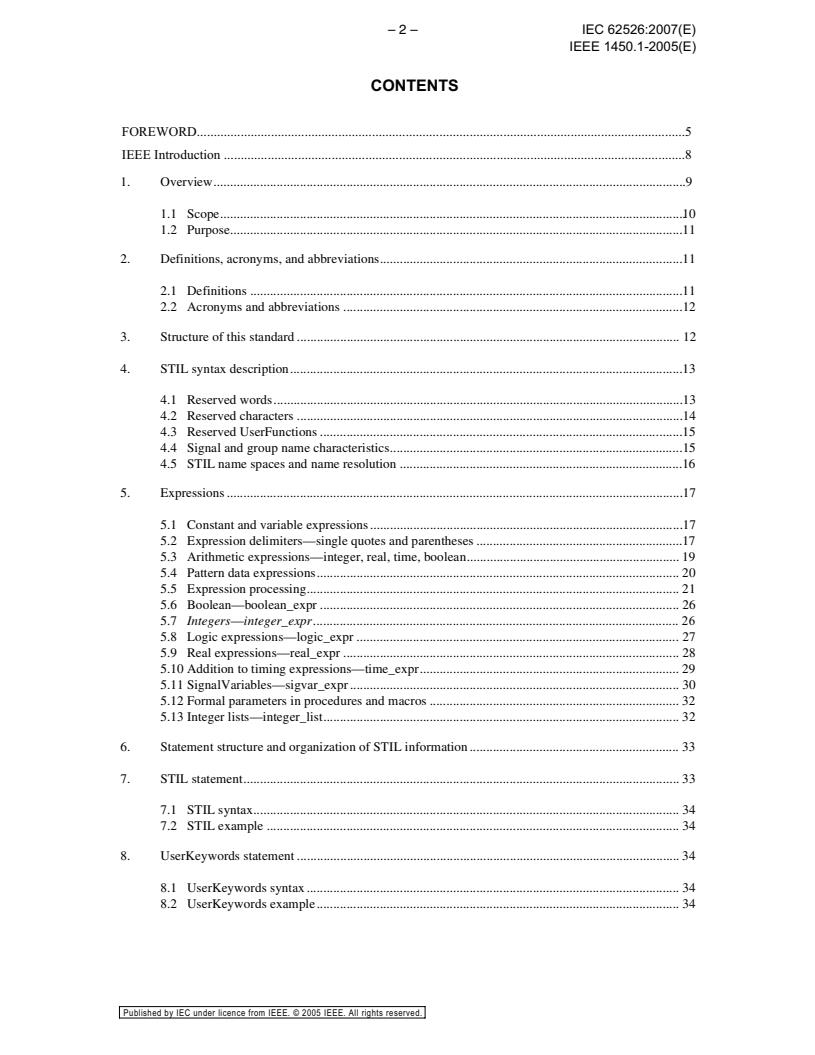
CONTENTS
FOREWORD.5
IEEE Introduction .8
1. Overview.9
1.1 Scope.10
1.2 Purpose.11
2. Definitions, acronyms, and abbreviations.11
2.1 Definitions .11
2.2 Acronyms and abbreviations .12
3. Structure of this standard . 12
4. STIL syntax description.13
4.1 Reserved words.13
4.2 Reserved characters .14
4.3 Reserved UserFunctions .15
4.4 Signal and group name characteristics.15
4.5 STIL name spaces and name resolution .16
5. Expressions .17
5.1 Constant and variable expressions.17
5.2 Expression delimiters—single quotes and parentheses .17
5.3 Arithmetic expressions—integer, real, time, boolean. 19
5.4 Pattern data expressions. 20
5.5 Expression processing. 21
5.6 Boolean—boolean_expr . 26
5.7 Integers—integer_expr . 26
5.8 Logic expressions—logic_expr .27
5.9 Real expressions—real_expr . 28
5.10 Addition to timing expressions—time_expr. 29
5.11 SignalVariables—sigvar_expr . 30
5.12 Formal parameters in procedures and macros . 32
5.13 Integer lists—integer_list. 32
6. Statement structure and organization of STIL information . 33
7. STIL statement. 33
7.1 STIL syntax. 34
7.2 STIL example . 34
8. UserKeywords statement . 34
8.1 UserKeywords syntax . 34
8.2 UserKeywords example. 34
Published by IEC under licence from IEEE. © 2005 IEEE. All rights reserved.
IEEE 1450.1-2005(E)
9. Variables block . 35
9.1 Variables block syntax. 35
9.2 Variables example. 37
9.3 Variables scoping. 37
9.4 Variables synchronizing . 39
10. Signals block. 40
10.1 Signals block syntax . 40
10.2 Signals example . 40
10.3 Bracketed signal notation enhancement . 40
11. SignalGroups block. 43
11.1 SignalGroups syntax . 43
11.2 SignalGroups, WFCMap, and Variables example. 43
11.3 Default WFCMap attribute value . 44
11.4 Defining indexed signal groups .44
12. PatternBurst block. 45
12.1 PatternBurst syntax . 45
12.2 PatternBurst example. 47
12.3 Tiling and synchronization of patterns . 48
12.4 If and While statements . 50
13. Timing block and WaveformTable block . 51
13.1 Additional domain specification. 51
13.2 CompareSubstitute operation—s, S. 51
14. ScanStructures block. 52
14.1 ScanStructures syntax . 52
14.2 Scan cell naming—cell_ref, chain_ref, cell_group, chain_group . 55
14.3 Scoping rules for ScanStructure blocks . 56
14.4 Example indexed list of scan cells. 57
14.5 Example of ScanChainGroups and ActiveScanChain . 57
14.6 Scan chain segments and cell groups. 59
15. Pattern data . 60
15.1 Data content read back—\C, \D, \E, \S, \U, \W . 61
15.2 Vector data mapping and joining—\m, \j . 63
15.3 Specifying event data in a pattern—\e. 65
15.4 Using expressions within pattern data . 66
16. Pattern statements . 67
16.1 Additional Pattern syntax. 68
16.2 Vector data constraints—F, E. 69
16.3 Shift and LoopData statements .70
16.4 Loop statement using an integer expression . 72
16.5 MergedScan function. 73
Published by IEC under licence from IEEE. © 2005 IEEE. All rights reserved.
– 4 – IEC 62526:2007(E)
IEEE 1450.1-2005(E)
17. Procedure and macro data substitution . 73
17.1 Nested procedure and macro cells . 73
17.2 Passing parameters to variables . 74
17.3 Default value of formal parameters . 75
17.4 Data substitution using WFCConstant and SignalVariable. 75
18. Environment block. 77
18.1 Environment syntax . 77
18.2 MAP_STRING syntax. 79
18.3 NameMaps example . 79
18.4 Compact scan-cell mapping using InheritNameMap. 81
19. Pragma block . 82
19.1 Pragma syntax. 82
20. PatternFailReport . 82
20.1 PatternFailReport syntax. 83
20.2 PatternFailReport example . 84
Annex A (informative) Glossary . 84
Annex B (informative) Signal mapping using SignalVariables. 87
Annex C (informative) Using logic expression with signals . 91
Annex D (informative) Using boolean expressions in patterns. 92
Annex E (informative) Variables and expressions in algorithmic patterns. 93
Annex F (informative) Using AllowInterleave. 95
Annex G (informative) Vector data mapping using \m. 98
Annex H (informative) Vector data joining using \j .101
Annex I (informative) Block data collection .104
Annex J (informative) Using Fixed and Equivalent statements .106
Annex K (informative) Independent parallel patterns . 108
Annex L (informative) Applications using new ScanStructures syntax. 110
Annex M (informative) BreakPoints using MergedScan() function. 114
Annex N (informative) Labels and X statements for diagnostic feedback. 117
Annex O (informative) Use of STIL.1 for specific applications . 120
Annex P (informative) Bibliography . 122
Annex Q (informative) List of participants . 123
Published by IEC under licence from IEEE. © 2005 IEEE. All rights reserved.
IEEE 1450.1-2005(E)
INTERNATIONAL ELECTROTECHNICAL COMMISSION
___________
STANDARD FOR EXTENSIONS TO
STANDARD TEST INTERFACE LANGUAGE (STIL)
FOR SEMICONDUCTOR DESIGN ENVIRONMENTS
FOREWORD
1) The International Electrotechnical Commission (IEC) is a worldwide organization for standardization
comprising all national electrotechnical committees (IEC National Committees). The object of IEC is to
promote international co-operation on all questions concerning standardization in the electrical and
electronic fields. To this end and in addition to other activities, IEC publishes International Standards,
Technical Specifications, Technical Reports, Publicly Available Specifications (PAS) and Guides (hereafter
referred to as “IEC Publication(s)”). Their preparation is entrusted to technical committees; any IEC National
Committee interested in the subject dealt with may participate in this preparatory work. International,
governmental and non-governmental organizations liaising with the IEC also participate in this preparation.
IEC collaborates closely with the International Organization for Standardization (ISO) in accordance with
conditions determined by agreement between the two organizations.
2) The formal decisions or agreements of IEC on technical matters express, as nearly as possible, an
international consensus of opinion on the relevant subjects since each technical committee has
representation from all interested IEC National Committees.
3) IEC Publications have the form of recommendations for international use and are accepted by IEC National
Committees in that sense. While all reasonable efforts are made to ensure that the technical content of IEC
Publications is accurate, IEC cannot be held responsible for the way in which they are used or for any
misinterpretation by any end user.
4) In order to promote international uniformity, IEC National Committees undertake to apply IEC Publications
transparently to the maximum extent possible in their national and regional publications. Any divergence
between any IEC Publication and the corresponding national or regional publication shall be clearly
indicated in the latter.
5) IEC provides no marking procedure to indicate its approval and cannot be rendered responsible for any
equipment declared to be in conformity with an IEC Publication.
6) Attention is drawn to the possibility that some of the elements of this IEC Publication may be the subject of
patent rights. IEC shall not be held responsible for identifying any or all such patent rights.
International Standard IEC/IEEE 62526 has been processed through Technical Committee
93: Design automation.
The text of this standard is based on the following documents:
IEEE Std FDIS Report on voting
1450.1(2005) 93/248/FDIS 93/259/RVD
Full information on the voting for the approval of this standard can be found in the report on
voting indicated in the above table.
The committee has decided that the contents of this publication will remain unchanged until
the maintenance result date indicated on the IEC web site under "http://webstore.iec.ch" in
the data related to the specific publication. At this date, the publication will be
• reconfirmed,
• withdrawn,
• replaced by a revised edition, or
• amended.
Published by IEC under licence from IEEE. © 2005 IEEE. All rights reserved.
– 6 – IEC 62526:2007(E)
IEEE 1450.1-2005(E)
IEC/IEEE Dual Logo International Standards
This Dual Logo International Standard is the result of an agreement between the IEC and the Institute of
Electrical and Electronics Engineers, Inc. (IEEE). The original IEEE Standard was submitted to the IEC for
consideration under the agreement, and the resulting IEC/IEEE Dual Logo International Standard has been
published in accordance with the ISO/IEC Directives.
IEEE Standards documents are developed within the IEEE Societies and the Standards Coordinating
Committees of the IEEE Standards Association (IEEE-SA) Standards Board. The IEEE develops its standards
through a consensus development process, approved by the American National Standards Institute, which
brings together volunteers representing varied viewpoints and interests to achieve the final product. Volunteers
are not necessarily members of the Institute and serve without compensation. While the IEEE administers the
process and establishes rules to promote fairness in the consensus development process, the IEEE does not
independently evaluate, test, or verify the accuracy of any of the information contained in its standards.
Use of an IEC/IEEE Dual Logo International Standard is wholly voluntary. The IEC and IEEE disclaim liability for
any personal injury, property or other damage, of any nature whatsoever, whether special, indirect,
consequential, or compensatory, directly or indirectly resulting from the publication, use of, or reliance upon
this, or any other IEC or IEEE Standard document.
The IEC and IEEE do not warrant or represent the accuracy or content of the material contained herein, and
expressly disclaim any express or implied warranty, including any implied warranty of merchantability or fitness
for a specific purpose, or that the use of the material contained herein is free from patent infringement.
IEC/IEEE Dual Logo International Standards documents are supplied “AS IS”.
The existence of an IEC/IEEE Dual Logo International Standard does not imply that there are no other ways to
produce, test, measure, purchase, market, or provide other goods and services related to the scope of the
IEC/IEEE Dual Logo International Standard. Furthermore, the viewpoint expressed at the time a standard is
approved and issued is subject to change brought about through developments in the state of the art and
comments received from users of the standard.
Every IEEE Standard is subjected to review at least every five years for revision or reaffirmation. When a
document is more than five years old and has not been reaffirmed, it is reasonable to conclude that its contents,
although still of some value, do not wholly reflect the present state of the art. Users are cautioned to check to
determine that they have the latest edition of any IEEE Standard.
In publishing and making this document available, the IEC and IEEE are not suggesting or rendering
professional or other services for, or on behalf of, any person or entity. Neither the IEC nor IEEE is undertaking
to perform any duty owed by any other person or entity to another. Any person utilizing this, and any other
IEC/IEEE Dual Logo International Standards or IEEE Standards document, should rely upon the advice of a
competent professional in determining the exercise of reasonable care in any given circumstances.
Interpretations – Occasionally questions may arise regarding the meaning of portions of standards as they relate
to specific applications. When the need for interpretations is brought to the attention of IEEE, the Institute will
initiate action to prepare appropriate responses. Since IEEE Standards represent a consensus of concerned
interests, it is important to ensure that any interpretation has also received the concurrence of a balance of
interests. For this reason, IEEE and the members of its societies and Standards Coordinating Committees are
not able to provide an instant response to interpretation requests except in those cases where the matter has
previously received formal consideration.
Comments for revision of IEC/IEEE Dual Logo International Standards are welcome from any interested party,
regardless of membership affiliation with the IEC or IEEE. Suggestions for changes in documents should be in
the form of a proposed change of text, together with appropriate supporting comments. Comments on standards
and requests for interpretations should be addressed to:
Secretary, IEEE-SA Standards Board, 445 Hoes Lane, P.O. Box 1331, Piscataway, NJ 08855-1331, USA and/or
General Secretary, IEC, 3, rue de Varembé, PO Box 131, 1211 Geneva 20, Switzerland.
Authorization to photocopy portions of any individual standard for internal or personal use is granted by the
Institute of Electrical and Electronics Engineers, Inc., provided that the appropriate fee is paid to Copyright
Clearance Center. To arrange for payment of licensing fee, please contact Copyright Clearance Center,
Customer Service, 222 Rosewood Drive, Danvers, MA 01923 USA; +1 978 750 8400. Permission to photocopy
portions of any individual standard for educational classroom use can also be obtained through the Copyright
Clearance Center.
NOTE – Attention is called to the possibility that implementation of this standard may require use of subject
matter covered by patent rights. By publication of this standard, no position is taken with respect to the
existence or validity of any patent rights in connection therewith. The IEEE shall not be responsible for
identifying patents for which a license may be required by an IEEE standard or for conducting inquiries into the
legal validity or scope of those patents that are brought to its attention.
Published by IEC under licence from IEEE. © 2005 IEEE. All rights reserved.
IEEE 1450.1-2005(E)
IEEE Standard for Extensions to
Standard Test Interface Language (STIL)
TM
(IEEE Std 1450 -1999) for Semiconductor
Design Environments
Sponsor
Test Technology Standards Committee
of the
IEEE Computer Society
Approved 9 June 2005
IEEE-SA Standards Board
Abstract: Standard Test Interface Language (STIL) provides an interface between digital test
generation tools and test equipment. Extensions to the test interface language (contained in this
standard) are defined that (1) facilitate the use of the language in the design environment and
(2) facilitate the use of the language for large designs encompassing subdesigns with reusable
patterns.
Keywords: advanced scan architecture, core, environment, fail feedback, lockstep, parallel
patterns, parameterized data, pattern tiling, pragma, signal variable, system on chip (SoC), test
protocol
Published by IEC under licence from IEEE. © 2005 IEEE. All rights reserved.
– 8 – IEC 62526:2007(E)
IEEE 1450.1-2005(E)
IEEE Introduction
The Standard Test Interface Language (STIL) was initially developed by an ad hoc consortium of automatic
test equipment vendors (ATE), electronic design automation vendors (EDA), and integrated circuit (IC)
manufacturers to address the lack of a common solution for transferring digital test data from the generation
environment to the test equipment.
The scope of the initial STIL standard was limited to satisfy the basic needs of pattern definition. Additional
capabilities are developed as separate projects resulting in separate (dot) extensions to the initial STIL
standard. The scope of this extension is defined in 1.1 and is primarily to address design needs.
Whereas the initial STIL standard was developed by reviewing many languages already in existence in the
industry, this standard has been developed by inventing new capabilities in support of new device designs.
The new language constructs have been added such that they do not alter in any way the initial definition of
STIL, yet are syntactically compatible with the initial STIL language.
Much of the work to develop and validate these extensions has been done by prototyping on the part of the
contributing companies.
Notice to users
Errata
Errata, if any, for this and all other standards can be accessed at the following URL: http://
standards.ieee.org/reading/ieee/updates/errata/index.html. Users are encouraged to check this URL for
errata periodically.
Interpretations
Current interpretations can be accessed at the following URL: http://standards.ieee.org/reading/ieee/interp/
index.html.
Patents
Attention is called to the possibility that implementation of this standard may require use of subject matter
covered by patent rights. By publication of this standard, no position is taken with respect to the existence or
validity of any patent rights in connection therewith. The IEEE shall not be responsible for identifying
patents or patent applications for which a license may be required to implement an IEEE standard or for
conducting inquiries into the legal validity or scope of those patents that are brought to its attention.
Published by IEC under licence from IEEE. © 2005 IEEE. All rights reserved.
IEEE 1450.1-2005(E)
STANDARD FOR EXTENSIONS TO
STANDARD TEST INTERFACE LANGUAGE (STIL)
TM
(IEEE Std 1450 -1999) FOR SEMICONDUCTOR
DESIGN ENVIRONMENTS
1. Overview
STIL is an evolving standard being developed in support of various needs for interfacing between test
generation tools and test equipment. IEEE Std 1450-1999 (STIL.0) [B3] forms the basis for this evolution.
New “dot” standards (like this one) are being developed to address specific needs beyond STIL.0.
This (STIL.1) standard addresses design-related aspects of digital test data. This standard can also be viewed
as the addition of advanced features to the STIL.0 baseline to allow for the usage of STIL in more complex
applications, while leaving the basic standard unchanged as a vehicle for transmitting basic test data. The
following is a brief overview of the new features in STIL.1 to support advanced applications such as
2 3
(1) embedded cores, (2) families of test patterns, (3) mapping to automated test equipment (ATE) systems,
(4) mapping to simulation, and (5) devices with advanced design for test (DFT). Please see Annex O for a
list of specific statements for each of these features.
Environment mapping: Data for a device exist in many forms and in many other software environments.
Examples include (1) simulation environment, (2) static analysis environment, (3) specific ATE system
environment. The STIL Environment block is a new mechanism to relate STIL data to these other
environments. No assumptions, expectations, or limitations are imposed on the other environments. It is just
a way of relating one to the other.
Parameterized data: Much of STIL data are declarative in nature (i.e., it defines various static attributes of a
device or pattern set). The addition of constant declarations, IntegerConstant and WFCConstant, allows a
data set to be created that applies to a family of devices.
Complex test protocol definition: Test protocol definitions are usually contained in STIL procedures or
MacroDefs and are used to specify the application of a series of data values to a device. STIL.0 supports
scan chain data passing and simple WaveformCharacter (WFC) data passing via the # and % characters.
STIL.1 enhances this capability by allowing the use of data substitution from SignalVariables and integer-
The numbers in brackets correspond to those of the bibliography in Annex P.
TM
This standard contains syntax in support of embedded cores. See IEEE Std 1450.6 -2005 (Core Test Language) [B5]
for the complete specification.
TM
This standard contains syntax in support of ATE systems. See IEEE P1450.3 (Test Resource Constraints) [B4] for the
complete specification.
Published by IEC under licence from IEEE. © 2005 IEEE. All rights reserved.
– 10 – IEC 62526:2007(E)
IEEE 1450.1-2005(E)
Complex test protocol definition: Test protocol definitions are usually contained in STIL procedures or
MacroDefs and are used to specify the application of a series of data values to a device. STIL.0 supports
scan chain data passing and simple WaveformCharacter (WFC) data passing via the # and % characters.
STIL.1 enhances this capability by allowing the use of data substitution from SignalVariables and integer-
expressions. STIL.1 also enhances the functionality of Loops and Vectors and adds If/While decisions on
pattern statements. These capabilities are needed for BIST, embedded cores, and various test access
mechanisms.
Advanced scan architecture: Advanced DFT techniques require additional capabilities beyond what is
defined in STIL.0, which includes multistate scan cells, reconfigurable scan-chains, and scan-chain
indexing.
Run-time pattern decisions: The If, Else, While, and LoopData are new STIL.1 constructs that have been
added for specification of pattern activity. These statements are needed in the specification of patterns to be
run in the simulation environment. Although there is no standardization among ATE systems on run-time
instructions for pattern execution, it is anticipated that restricted versions of these statements will be
incorporated into ATE test patterns.
Pattern burst options: New variations on the PatternBurst have been added to allow for patterns running in
parallel, patterns running in LockStep, and patterns that can be reordered. For parallel pattern execution, the
specification for how the patterns fit together can be specified with the Fixed and Extend statements.
Enhanced user extensibility: The UserKeyword extensibility defined in STIL.0 has been extended to allow
keywords to be defined on a per-block-type basis.
Signal relationships: Additional syntax is provided to allow the specification of relationships between
signals. This process is preformed via \m to map WFCs to another WFC, \j to join WFCs, Extend to define
behavior of signals beyond the bounds of a given pattern, and Fixed to restrict any further changes to signals
within a pattern.
Fail feedback: Three new features are added to facilitate the processing of failure data from an ATE system
back to design tools. The first is the X or cross-reference statement that allows the specification of where in
a pattern/vector sequence a failure occurs. The second is the FailFeedback block for reporting fails. The
third is the S/s timing event that allows for the specification of a data capture protocol for the purpose of
capturing bulk fail data for processing.
1.1 Scope
Structures are defined in STIL to support usage as semiconductor simulation stimulus, including
(1) mapping signal names to equivalent design references, (2) interface between scan and built-in self test
(BIST) and the logic simulation, (3) data types to represent unresolved states in a pattern, (4) parallel or
asynchronous pattern execution on different design blocks, and (5) expression-based conditional execution
of pattern constructs.
Structures are defined in STIL to support the definition of test patterns for sub-blocks of a design
(i.e., embedded cores) such that these tests can be incorporated into a complete higher level device test.
Structures are defined in STIL to relate fail information from device testing environments back to original
stimulus and design data elements.
Syntax in this document that is used in the definition of patterns for sub-blocks is summarized in Annex O.
Published by IEC under licence from IEEE. © 2005 IEEE. All rights reserved.
IEEE 1450.1-2005(E)
1.2 Purpose
The STIL language definition is enhanced to support the usage of STIL in the design environment, which
includes extending the execution concept to support STIL as a stimulus language, to allow STIL to be used
as an intermediate form of data, and to allow STIL to capture design information needed to port simulation
data to device test environments.
In addition, define extensions to support the definition of subelement tests and to define the mechanisms to
integrate those tests into a complete device test. This effort is to be performed in conjunction with
TM
IEEE Std 1500 -2005 [B6] and IEEE P1450.6 [B5], which are defining standards for the definition and
integration of embedded cores.
Finally, define the constructs necessary to correlate test failure information back to the design environment,
to allow debug and diagnosis operations to be performed based on failure information in STIL format.
2. Definitions, acronyms, and abbreviations
2.1 Definitions
For the purposes of this standard, the following terms and definitions apply. Additional terminology specific
to this standard is found in Annex A. The Authoritative Dictionary of IEEE Standards Terms [B1] should be
referenced for terms not defined in this clause.
2.1.1 automated test equipment (ATE): It refers to a tester that is capable of interfacing to a
semiconductor device and executing test pattern data that is imported from a STIL file/stream.
2.1.2 built-in self-test (BIST): A design practice in which test logic is incorporated into the circuitry of a
semiconductor device. This circuitry may provide completely autonomous testing of a device (i.e., without
any requirement of a tester). It may be such that stimulation by an external tester is required; however, the
STIL file may be substantially different from a device without this circuitry incorporated.
2.1.3 core: A component or module that contains separately developed functionality, integrated into a chip
to provide additional overall functionality. See also: System on Chip.
2.1.4 electronic design automation (EDA): The set of software tools that are used for the design and
creation of semiconductor chips. It includes the software tools that create the test patterns for the chips,
which are often referred to as automated test pattern generators (ATPGs).
2.1.5 Standard Test Interface Language (STIL): The set of IEEE standards, including IEEE Std 1450-1999,
and all dotted extensions, including this one.
2.1.6 System on Chip (SoC): An integrated circuit containing modules that are designed/integrated such
that they can be tested independently and have associated test patterns for each module.
2.1.7 WaveformCharacter (WFC): A symbol used for referencing waveforms.
NOTE—See Annex A.
Notes in text, tables, and figures are given for information only, and do not contain requirements needed to implement
the standard.
Published by IEC under licence from IEEE. © 2005 IEEE. All rights reserved.
– 12 – IEC 62526:2007(E)
IEEE 1450.1-2005(E)
2.1.8 WaveformTable (WFT): An STIL block statement used to define waveforms across multiple signals
and WFCs.
NOTE—See Annex A.
2.1.9 WaveformGenerationLanguage (WGL): A proprietary standard that was, in part, used as the basis
for STIL.0.
2.2 Acronyms and abbreviations
ATE automated test equipment
BIST built-in self-test
DFT design for test
DUT device under test
EDA electronic design automation
STIL Standard Test Interface Language
STIL.0 IEEE Std 1450-1999 [B3]
STIL.1 this standard
WFC WaveformCharacter
WFT WaveformTable
WGL WaveformGenerationLanguage
3. Structure of this standard
This standard is an adjunct to STIL.0. The conventions established and defined in STIL.0 are used in this
standard and are included verbatim.
Many clauses in this standard add additional constructs to existing clauses in STIL.0 and are so identified in
the title. The Environment block is a new construct introduced in this standard. All clauses in this standard
are normative. Example code is provided within each clause. More complete examples are provided in the
annexes, which are informative.
The following is a copy of the conventions as defined in STIL.0 and adhered to in this standard.
Different fonts are used as follows:
— SMALL CAP TEXT indicates user data.
— Courier text indicates code examples.
In the syntax definitions
a) SMALL CAP TEXT indicates user data.
b) Bold text indicates keywords.
c) Italic text references metatypes.
d) () indicates optional syntax that may be used zero or one time.
e) ()+ indicates syntax that may be used one or more times.
f) ()* indicates optional syntax that may be used zero or more times.
g) <> indicates multiple-choice arguments or syntax.
Published by IEC under licence from IEEE. © 2005 IEEE. All rights reserved.
IEEE 1450.1-2005(E)
In the syntax explanations, the verb “shall” indicates mandatory requirements. The meaning of a mandatory
requirement varies for different readers of the standard:
— To developers of tools that process STIL (readers), “shall” denotes a requirement that the standard
imposes. The resulting implementation is required to enforce this requirement and issue an error if
the requirement is not met by the input.
— To developers of STIL (writers), “shall” denotes mandatory characteristics of the language. The
resulting output must conform to these characteristics.
— To the users of STIL, “shall” denotes mandatory characteristics of the language. Users may depend
on these characteristics for interpretation of the STIL source.
The language definition clauses contain statements that use the phrase “it is an error” and “it may be
ambiguous.” These phrases indicate improperly defined STIL information. The interpretation of these
phrases will differ for the different readers of this standard in the same way that “shall” differs, as identified
here in the dashed list.
4. STIL syntax description
This clause defines extensions to STIL.0, Clause 6.
All constructs and restrictions for STIL.0, Clause 6 are in effect here, with the following additions:
— Additional STIL reserved words are defined (see Table 1) for the top-level blocks specified within
this standard.
— Additional STIL reserved characters are defined (see Table 2) for the new characters specified within
this standard.
— Additional definition of signal and group naming, as well as name space resolution, is provided in
this clause.
— Extensions to the expression environment are defined in this standard. Expression definitions (which
are part of Clause 5 in STIL.0) are now specified in a separate clause (Clause 6 in this standard).
4.1 Reserved words
Table 1 lists all STIL reserved words defined by this standard. Only top-level block names that are defined
in this standard are added to the STIL reserved word list. New keywords that appear inside of top-level
blocks are not restricted from usage in other contexts outside of the definition of that keyword. No change to
reserved words a
...