

IEC 62271-207:2007
(Main)High-voltage switchgear and controlgear - Part 207: Seismic qualification for gas-insulated switchgear assemblies for rated voltages above 52 kV
General Information
- Abstract
This International Standard applies to switchgear assemblies for alternating current of rated voltages above 52 kV for indoor and outdoor installations, including their supporting structure rigidly connected to the ground, and does not cover the seismic qualification of live tank circuit breakers. Switchgear assemblies do have typically low centers of gravity, e.g. gas-insulated switchgear (GIS). This first edition of IEC 62271-207 cancels and replaces the first edition of IEC 62271-2 and constitutes a technical revision. The change from IEC 62271-2 is as follows: -the minimum voltage rating was changed from 72,5 kV to above 52 kV
- Status
- Published
- Publication Date
- 22-Aug-2007
- Technical Committee
- SC 17C - Assemblies
- Current Stage
- DELPUB - Deleted Publication
- Start Date
- 27-Apr-2012
- Completion Date
- 28-Aug-2026
Overview
IEC 62271-207:2007 specifies the requirements and procedures for the seismic qualification of gas-insulated switchgear (GIS) assemblies designed for rated voltages above 52 kV. Published by the International Electrotechnical Commission (IEC), this standard addresses both indoor and outdoor installations where switchgear assemblies are rigidly connected to the ground. It outlines methods for validating the structural and functional integrity of GIS assemblies under seismic stress, ensuring reliable operation during and after seismic events. The standard covers auxiliary and control equipment as part of the qualification process but does not apply to live tank circuit breakers.
This edition updates and replaces IEC 62271-2, lowering the minimum voltage threshold from 72.5 kV to above 52 kV.
Key Topics
Scope of Application
IEC 62271-207 applies to all ground-mounted, gas-insulated high-voltage switchgear for AC systems above 52 kV, including supporting structures that are rigidly mounted.Seismic Qualification Procedures
The standard specifies two primary qualification approaches:- Qualification by physical testing, as per referenced IEC guidelines
- Qualification by combined testing and numerical analysis, allowing flexibility for large or complex installations
Severity Levels
The standard defines seismic severity levels with associated response spectra and zero period acceleration values, ensuring clarity in qualification requirements.Functional Performance and Integrity
GIS assemblies must demonstrate:- Operational readiness after seismic events
- No critical damage or loss of function
- Structural stability, with minor permanent deformation permissible if functionality remains intact
Documentation
Rigorous reporting and documentation are required for seismic qualification, including aggregation of test data, analysis results, and configuration details.
Applications
IEC 62271-207 is a critical reference for:
- Electric Utilities and Power Grid Operators: Ensuring high-voltage GIS and associated controlgear remain safe and operable after seismic activity.
- Switchgear Manufacturers and System Integrators: Developing products and projects that must comply with international seismic standards, improving market acceptance and reliability.
- Engineering and Design Firms: Incorporating seismic qualification requirements into substations and power infrastructure design.
- Regulatory Agencies and Inspectors: Verifying compliance of installations in seismic-prone regions, ensuring safety and reliability of critical power infrastructure.
Typical applications include:
- Substations in regions with moderate to high seismic risk
- Urban and industrial power distribution hubs
- Essential infrastructure facilities such as hospitals, data centers, or emergency response centers reliant on uninterruptible electric power
Related Standards
For comprehensive compliance, IEC 62271-207 should be considered with these related international standards:
- IEC 60068-2-47: Environmental testing - Mounting of specimens for vibration, impact, and dynamic tests
- IEC 60068-2-57: Environmental testing - Vibration testing using the time-history method
- IEC 60068-3-3: Environmental testing - Guidance on seismic test methods for equipment
- IEC 62271-203: Gas-insulated metal-enclosed switchgear for rated voltages above 52 kV
- IEC 60694: Common specifications for high-voltage switchgear and controlgear standards
By implementing IEC 62271-207, organizations ensure the seismic resilience and operational continuity of their high-voltage switchgear in line with recognized international best practices. This supports both infrastructure safety and regulatory compliance for critical power systems.
Relations
- Effective Date
- 05-Sep-2023
- Effective Date
- 05-Sep-2023
Get Certified
Connect with accredited certification bodies for this standard

IMQ S.p.A. (Certification)
Italian electrical product certification.

SLG Prüf- und Zertifizierungs GmbH
German testing and certification body.

UL Solutions
Global safety science company with testing, inspection and certification.
Sponsored listings
Frequently Asked Questions
IEC 62271-207:2007 is a standard published by the International Electrotechnical Commission (IEC). Its full title is "High-voltage switchgear and controlgear - Part 207: Seismic qualification for gas-insulated switchgear assemblies for rated voltages above 52 kV". This standard covers: This International Standard applies to switchgear assemblies for alternating current of rated voltages above 52 kV for indoor and outdoor installations, including their supporting structure rigidly connected to the ground, and does not cover the seismic qualification of live tank circuit breakers. Switchgear assemblies do have typically low centers of gravity, e.g. gas-insulated switchgear (GIS). This first edition of IEC 62271-207 cancels and replaces the first edition of IEC 62271-2 and constitutes a technical revision. The change from IEC 62271-2 is as follows: -the minimum voltage rating was changed from 72,5 kV to above 52 kV
This International Standard applies to switchgear assemblies for alternating current of rated voltages above 52 kV for indoor and outdoor installations, including their supporting structure rigidly connected to the ground, and does not cover the seismic qualification of live tank circuit breakers. Switchgear assemblies do have typically low centers of gravity, e.g. gas-insulated switchgear (GIS). This first edition of IEC 62271-207 cancels and replaces the first edition of IEC 62271-2 and constitutes a technical revision. The change from IEC 62271-2 is as follows: -the minimum voltage rating was changed from 72,5 kV to above 52 kV
IEC 62271-207:2007 is classified under the following ICS (International Classification for Standards) categories: 29.130.10 - High voltage switchgear and controlgear. The ICS classification helps identify the subject area and facilitates finding related standards.
IEC 62271-207:2007 has the following relationships with other standards: It is inter standard links to IEC 62271-2:2003, IEC 62271-207:2012. Understanding these relationships helps ensure you are using the most current and applicable version of the standard.
IEC 62271-207:2007 is available in PDF format for immediate download after purchase. The document can be added to your cart and obtained through the secure checkout process. Digital delivery ensures instant access to the complete standard document.
Standards Content (Sample)
IEC 62271-207
Edition 1.0 2007-08
INTERNATIONAL
STANDARD
NORME
INTERNATIONALE
High-voltage switchgear and controlgear –
Part 207: Seismic qualification for gas-insulated switchgear assemblies for rated
voltages above 52 kV
Appareillage à haute tension –
Partie 207: Qualification sismique pour ensembles d'appareillages à isolation
gazeuse pour des niveaux de tension assignée supérieurs à 52 kV
All rights reserved. Unless otherwise specified, no part of this publication may be reproduced or utilized in any form or by
any means, electronic or mechanical, including photocopying and microfilm, without permission in writing from either IEC or
IEC's member National Committee in the country of the requester.
If you have any questions about IEC copyright or have an enquiry about obtaining additional rights to this publication,
please contact the address below or your local IEC member National Committee for further information.
Droits de reproduction réservés. Sauf indication contraire, aucune partie de cette publication ne peut être reproduite
ni utilisée sous quelque forme que ce soit et par aucun procédé, électronique ou mécanique, y compris la photocopie
et les microfilms, sans l'accord écrit de la CEI ou du Comité national de la CEI du pays du demandeur.
Si vous avez des questions sur le copyright de la CEI ou si vous désirez obtenir des droits supplémentaires sur cette
publication, utilisez les coordonnées ci-après ou contactez le Comité national de la CEI de votre pays de résidence.
IEC Central Office
3, rue de Varembé
CH-1211 Geneva 20
Switzerland
Email: inmail@iec.ch
Web: www.iec.ch
About the IEC
The International Electrotechnical Commission (IEC) is the leading global organization that prepares and publishes
International Standards for all electrical, electronic and related technologies.
About IEC publications
The technical content of IEC publications is kept under constant review by the IEC. Please make sure that you have the
latest edition, a corrigenda or an amendment might have been published.
ƒ Catalogue of IEC publications: www.iec.ch/searchpub
The IEC on-line Catalogue enables you to search by a variety of criteria (reference number, text, technical committee,…).
It also gives information on projects, withdrawn and replaced publications.
ƒ IEC Just Published: www.iec.ch/online_news/justpub
Stay up to date on all new IEC publications. Just Published details twice a month all new publications released. Available
on-line and also by email.
ƒ Electropedia: www.electropedia.org
The world's leading online dictionary of electronic and electrical terms containing more than 20 000 terms and definitions
in English and French, with equivalent terms in additional languages. Also known as the International Electrotechnical
Vocabulary online.
ƒ Customer Service Centre: www.iec.ch/webstore/custserv
If you wish to give us your feedback on this publication or need further assistance, please visit the Customer Service
Centre FAQ or contact us:
Email: csc@iec.ch
Tel.: +41 22 919 02 11
Fax: +41 22 919 03 00
A propos de la CEI
La Commission Electrotechnique Internationale (CEI) est la première organisation mondiale qui élabore et publie des
normes internationales pour tout ce qui a trait à l'électricité, à l'électronique et aux technologies apparentées.
A propos des publications CEI
Le contenu technique des publications de la CEI est constamment revu. Veuillez vous assurer que vous possédez
l’édition la plus récente, un corrigendum ou amendement peut avoir été publié.
ƒ Catalogue des publications de la CEI: www.iec.ch/searchpub/cur_fut-f.htm
Le Catalogue en-ligne de la CEI vous permet d’effectuer des recherches en utilisant différents critères (numéro de référence,
texte, comité d’études,…). Il donne aussi des informations sur les projets et les publications retirées ou remplacées.
ƒ Just Published CEI: www.iec.ch/online_news/justpub
Restez informé sur les nouvelles publications de la CEI. Just Published détaille deux fois par mois les nouvelles
publications parues. Disponible en-ligne et aussi par email.
ƒ Electropedia: www.electropedia.org
Le premier dictionnaire en ligne au monde de termes électroniques et électriques. Il contient plus de 20 000 termes et
définitions en anglais et en français, ainsi que les termes équivalents dans les langues additionnelles. Egalement appelé
Vocabulaire Electrotechnique International en ligne.
ƒ Service Clients: www.iec.ch/webstore/custserv/custserv_entry-f.htm
Si vous désirez nous donner des commentaires sur cette publication ou si vous avez des questions, visitez le FAQ du
Service clients ou contactez-nous:
Email: csc@iec.ch
Tél.: +41 22 919 02 11
Fax: +41 22 919 03 00
IEC 62271-207
Edition 1.0 2007-08
INTERNATIONAL
STANDARD
NORME
INTERNATIONALE
High-voltage switchgear and controlgear –
Part 207: Seismic qualification for gas-insulated switchgear assemblies for
rated voltages above 52 kV
Appareillage à haute tension –
Partie 207: Qualification sismique pour ensembles d'appareillages à isolation
gazeuse pour des niveaux de tension assignée supérieurs à 52 kV
INTERNATIONAL
ELECTROTECHNICAL
COMMISSION
COMMISSION
ELECTROTECHNIQUE
PRICE CODE
INTERNATIONALE
T
CODE PRIX
ICS 29.130.10 ISBN 2-8318-9282-1
– 2 – 62271-207 © IEC:2007
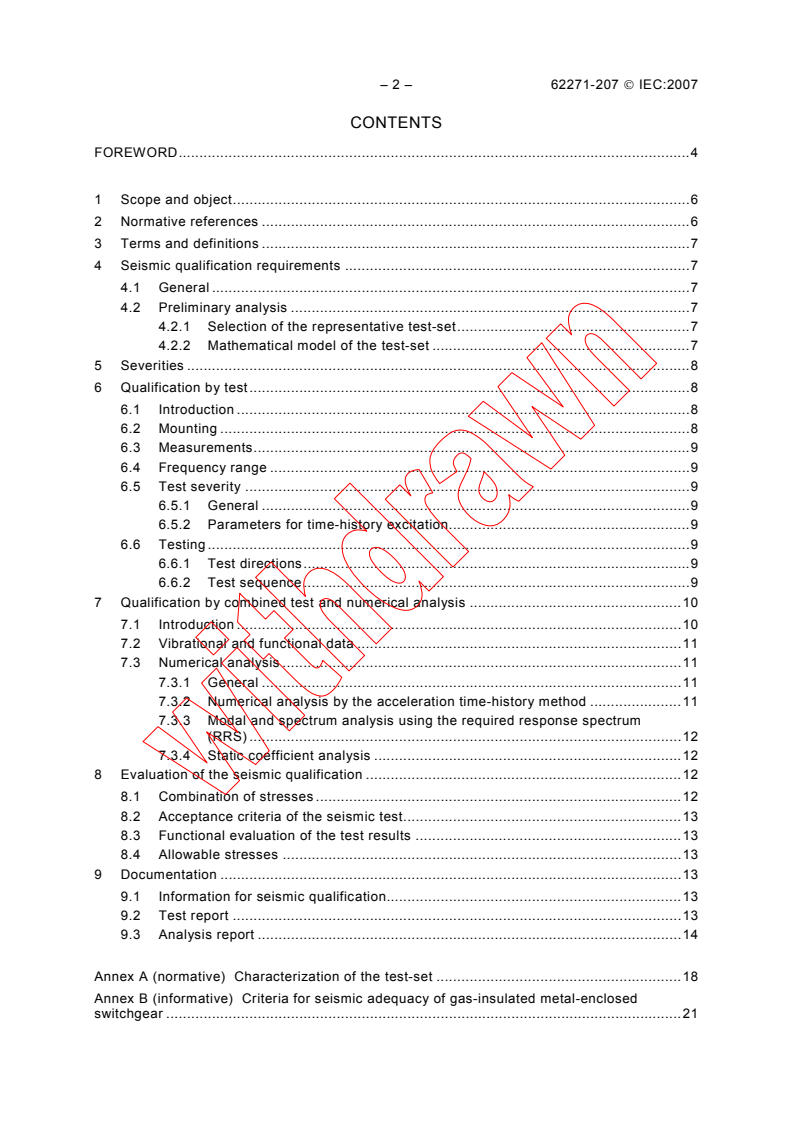
CONTENTS
FOREWORD.4
1 Scope and object.6
2 Normative references .6
3 Terms and definitions .7
4 Seismic qualification requirements .7
4.1 General .7
4.2 Preliminary analysis .7
4.2.1 Selection of the representative test-set.7
4.2.2 Mathematical model of the test-set .7
5 Severities .8
6 Qualification by test.8
6.1 Introduction .8
6.2 Mounting .8
6.3 Measurements.9
6.4 Frequency range .9
6.5 Test severity .9
6.5.1 General .9
6.5.2 Parameters for time-history excitation.9
6.6 Testing .9
6.6.1 Test directions.9
6.6.2 Test sequence.9
7 Qualification by combined test and numerical analysis .10
7.1 Introduction .10
7.2 Vibrational and functional data .11
7.3 Numerical analysis .11
7.3.1 General .11
7.3.2 Numerical analysis by the acceleration time-history method .11
7.3.3 Modal and spectrum analysis using the required response spectrum
(RRS) .12
7.3.4 Static coefficient analysis .12
8 Evaluation of the seismic qualification .12
8.1 Combination of stresses .12
8.2 Acceptance criteria of the seismic test.13
8.3 Functional evaluation of the test results .13
8.4 Allowable stresses .13
9 Documentation .13
9.1 Information for seismic qualification.13
9.2 Test report .13
9.3 Analysis report .14
Annex A (normative) Characterization of the test-set .18
Annex B (informative) Criteria for seismic adequacy of gas-insulated metal-enclosed
switchgear .21
62271-207 © IEC:2007 – 3 –
Bibliography.24
Figure 1 – RRS for ground-mounted switchgear assemblies – Qualification level: AF5;
ZPA = 5 m/s (0,5 g).15
Figure 2 – RRS for ground-mounted switchgear assemblies – Qualification level: AF3;
ZPA = 3 m/s (0,3 g).16
Figure 3 – RRS for ground-mounted switchgear assemblies – Qualification level: AF2;
ZPA = 2 m/s (0,2 g).17
Figure A.1 – Monogram for the determination of equivalent damping ratio .20
Table 1 – Seismic qualification levels for switchgear assemblies – Horizontal severities .8
– 4 – 62271-207 © IEC:2007
INTERNATIONAL ELECTROTECHNICAL COMMISSION
____________
HIGH-VOLTAGE SWITCHGEAR AND CONTROLGEAR –
Part 207: Seismic qualification for gas-insulated
switchgear assemblies for rated voltages above 52 kV
FOREWORD
1) The International Electrotechnical Commission (IEC) is a worldwide organization for standardization comprising
all national electrotechnical committees (IEC National Committees). The object of IEC is to promote
international co-operation on all questions concerning standardization in the electrical and electronic fields. To
this end and in addition to other activities, IEC publishes International Standards, Technical Specifications,
Technical Reports, Publicly Available Specifications (PAS) and Guides (hereafter referred to as “IEC
Publication(s)”). Their preparation is entrusted to technical committees; any IEC National Committee interested
in the subject dealt with may participate in this preparatory work. International, governmental and non-
governmental organizations liaising with the IEC also participate in this preparation. IEC collaborates closely
with the International Organization for Standardization (ISO) in accordance with conditions determined by
agreement between the two organizations.
2) The formal decisions or agreements of IEC on technical matters express, as nearly as possible, an international
consensus of opinion on the relevant subjects since each technical committee has representation from all
interested IEC National Committees.
3) IEC Publications have the form of recommendations for international use and are accepted by IEC National
Committees in that sense. While all reasonable efforts are made to ensure that the technical content of IEC
Publications is accurate, IEC cannot be held responsible for the way in which they are used or for any
misinterpretation by any end user.
4) In order to promote international uniformity, IEC National Committees undertake to apply IEC Publications
transparently to the maximum extent possible in their national and regional publications. Any divergence
between any IEC Publication and the corresponding national or regional publication shall be clearly indicated in
the latter.
5) IEC provides no marking procedure to indicate its approval and cannot be rendered responsible for any
equipment declared to be in conformity with an IEC Publication.
6) All users should ensure that they have the latest edition of this publication.
7) No liability shall attach to IEC or its directors, employees, servants or agents including individual experts and
members of its technical committees and IEC National Committees for any personal injury, property damage or
other damage of any nature whatsoever, whether direct or indirect, or for costs (including legal fees) and
expenses arising out of the publication, use of, or reliance upon, this IEC Publication or any other IEC
Publications.
8) Attention is drawn to the Normative references cited in this publication. Use of the referenced publications is
indispensable for the correct application of this publication.
9) Attention is drawn to the possibility that some of the elements of this IEC Publication may be the subject of
patent rights. IEC shall not be held responsible for identifying any or all such patent rights.
International Standard IEC 62271-207 has been prepared by subcommittee 17C: High-voltage
switchgear and controlgear assemblies, of IEC technical committee 17: Switchgear and
controlgear.
The text of this standard is based on the following documents:
FDIS Report on voting
17C/407/FDIS 17C/415/RVD
Full information on the voting for the approval of this standard can be found in the report on
voting indicated in the above table.
This first edition of IEC 62271-207 cancels and replaces the first edition of IEC 62271-2 and
constitutes a technical revision.
62271-207 © IEC:2007 – 5 –
The change from IEC 62271-2 is as follows:
– the minimum voltage rating was changed from 72,5 kV to above 52 kV;
This publication has been drafted in accordance with the ISO/IEC Directives, Part 2.
A list of all the parts in the IEC 62271 series, under the general title High-voltage switchgear
and controlgear, can be found on the IEC website.
The committee has decided that the contents of this publication will remain unchanged until
the maintenance result date indicated on the IEC web site under "http://webstore.iec.ch" in
the data related to the specific publication. At this date, the publication will be
• reconfirmed;
• withdrawn;
• replaced by a revised edition, or
• amended.
– 6 – 62271-207 © IEC:2007
HIGH-VOLTAGE SWITCHGEAR AND CONTROLGEAR –
Part 207: Seismic qualification for gas-insulated
switchgear assemblies for rated voltages above 52 kV
1 Scope and object
This International Standard applies to switchgear assemblies for alternating current of rated
voltages above 52 kV for indoor and outdoor installations, including their supporting structure
rigidly connected to the ground, and does not cover the seismic qualification of live tank
circuit breakers. Switchgear assemblies do have typically low centers of gravity, e.g. gas-
insulated switchgear (GIS).
For switchgear with higher gravity levels, e.g. live tank circuit breakers, the IEC 62271-300 is
applicable.
Where switchgear assemblies are not ground-mounted, e.g. in a building, conditions for
applications are subject to agreement between users and manufacturers.
The seismic qualification of the switchgear assemblies takes into account any auxiliary and
control equipment either directly mounted or as a separate structure.
This standard provides procedures to seismically qualify ground-mounted switchgear
assemblies for rated voltages above 52 kV.
The seismic qualification of the switchgear assemblies is only performed upon request.
This standard specifies seismic severity levels and gives a choice of methods that may be
applied to demonstrate the performance of high-voltage switchgear assemblies for which
seismic qualification is required.
The final seismic analysis shall be performed by assuming that the switchgear is installed on
firm ground.
2 Normative references
The following referenced documents are indispensable for the application of this document.
For dated references, only the edition cited applies. For undated references, the latest edition
of the referenced document (including any amendments) applies.
IEC 60068-2-47, Environmental testing – Part 2-47: Test – Mounting of specimens for
vibration, impact and similar dynamic tests
IEC 60068-2-57, Environmental testing – Part 2-57: Tests – Test Ff: Vibration – Time-history
method
IEC 60068-3-3:1991, Environmental testing – Part 3: Guidance – Seismic test methods for
equipments
62271-207 © IEC:2007 – 7 –
IEC 62271-203, High-voltage switchgear and controlgear – Part 203: Gas-insulated metal-
enclosed switchgear for rated voltages above 52 kV
IEC 60694, Common specifications for high-voltage switchgear and controlgear standards
3 Terms and definitions
For the purposes of this document, the terms and definitions in IEC 60068-3-3,
IEC 62271-203 and IEC 60694 apply.
4 Seismic qualification requirements
4.1 General
The seismic qualification shall demonstrate the ability of the switchgear assemblies to
withstand seismic stress.
No failure on the main circuits, the control and auxiliary circuit, including the relevant
mounting structures, shall occur.
Permanent deformations are acceptable provided that they do not impair the functionality of
the equipment. The equipment shall properly operate after the seismic event as defined in 8.2
and 8.3.
NOTE In the USA the evaluation of the seismic qualifications is conducted according to IEEE 693.
4.2 Preliminary analysis
4.2.1 Selection of the representative test-set
Due to practical reasons concerned with the available experimental facilities, the seismic
qualification of switchgear assemblies can require the definition and the choice of different
sub-sets which still meaningfully represent the whole system for the purpose of structural and
functional checks.
Such test-sets shall include the switching devices with their relevant operating mechanism
and control equipment, and their electrical and mechanical interfaces.
It is recommended
– to test generic components; to test the worst case components, such as those with the
highest load and center of gravity.
– to identify the dynamic behaviour of the plant (natural frequencies and damping ratios)
through the experimental activities of Annex A.
4.2.2 Mathematical model of the test-set
On the basis of technical information concerning the design characteristics of the substation,
a three-dimensional model of the test-set shall be created. Such a model shall take into
consideration the presence of actual compartments and of their supporting structures, and
shall have sufficient sensitivity to describe the dynamic behaviour of the test-set in the
frequency range being studied.
– 8 – 62271-207 © IEC:2007
5 Severities
The severity levels shall be chosen from Table 1.
Table 1 – Seismic qualification levels for switchgear assemblies –
Horizontal severities
Qualification Required response Zero period acceleration
level spectrum (RRS) (ZPA)
m/s
AF5 Figure 1 5
AF3 Figure 2 3
AF2 Figure 3 2
For vertical severities the direction factor is 0,5 (see IEC 60068-3-3).
NOTE 1 The required response spectrum of qualification level AF5 covers partly, in the range of predominant
seismic frequency of 1 Hz to 35 Hz, the following response spectra: Endesa, Edelca, USA/NRC RG 1.60, Newmark
2 2
Design Response Spectra (scaled to 5 m/s ), Nema (5 m/s maximum foundation acceleration), Dept. of Water &
Power Los Angeles, San Diego SDG & E Imperial Substation.
NOTE 2 Information on the correlation between seismic qualification levels and different seismic scales is given in
IEC 60068-3-3.
6 Qualification by test
6.1 Introduction
The test procedure for qualification of a test-set shall be in accordance with IEC 60068-3-3.
The qualification shall be carried out on representative test sets, as described in 4.2.1.
If the auxiliary and control equipment or other parts of the equipment are dynamically
uncoupled, they may be qualified independently.
If a test-set cannot be tested with its supporting structure (e.g., due to its size), the dynamic
contribution of the structure shall be determined by analysis and accounted for in the test.
The time-history test method is to be preferred, since it more closely simulates actual
conditions, particularly if the behaviour of the test-set is not linear. The test method shall be in
accordance with IEC 60068-2-57.
6.2 Mounting
The test-set shall be mounted as in service including dampers (if any).
The horizontal orientation of the test-set shall be in the direction of excitation acting along its
two main orthogonal axes.
Any fixtures or connections required only for testing shall not affect the dynamic behaviour of
the test-set.
62271-207 © IEC:2007 – 9 –
The method of mounting of the test-set shall be documented and shall include a description of
any interposing fixtures and connections (see IEC 60068-2-47).
6.3 Measurements
Measurements shall be performed in accordance with IEC 60068-3-3 and shall include
– vibration motion of components where maximum deflections and significant relative
displacements are expected;
– strains on critical elements (e.g. bushings, flanges, enclosures and support structures).
6.4 Frequency range
The frequency range shall be 0,5 Hz to 35 Hz. The frequency range is applied to the resonant
frequency search test and the generation of artificial earthquake wave.
6.5 Test severity
6.5.1 General
The test severity shall be chosen in accordance with Clause 5.
The recommended required response spectra are given in Figures 1 to 3 for the different
seismic qualification levels. The curves relate to 2 %, 5 %, 10 % and 20 % or more damping
ratio of the switchgear assemblies. If damping factor is unknown, 2 % damping is applied.
Spectra for different damping values may be obtained by linear interpolation.
6.5.2 Parameters for time-history excitation
The total duration of the time-history shall be about 30 s, of which the strong part shall be not
less than 6 s. The strong part is the section of the time history with the highest accelerations.
6.6 Testing
6.6.1 Test directions
The test directions shall be chosen according to IEC 60068-3-3.
In some cases, the effect of the vertical acceleration results in negligible stresses and the
vertical excitation may be omitted. In such cases justification for the omission of the vertical
component shall be provided.
6.6.2 Test sequence
6.6.2.1 General
The test sequence shall be as follows:
– functional checks before testing;
– vibration response investigation (required to determine critical frequencies and damping
ratios and/or for analysis);
– seismic qualification test;
– 10 – 62271-207 © IEC:2007
– functional checks after testing.
6.6.2.2 Functional checks
Before and after the tests, the following operating characteristics or settings shall be recorded
or evaluated (when applicable) at the rated supply voltage and operating pressure:
a) closing time;
b) opening time;
c) time spread between units of one pole;
d) time spread between poles (if multipole tested);
e) gas and/or liquid tightness;
f) resistance measurement of the main current path.
6.6.2.3 Vibration response investigation
The resonant frequency search test, damping measurement test shall be carried out
according to IEC 60068-3-3 over the frequency range stated in 6.5.
6.6.2.4 Seismic qualification test
The test shall be performed by applying one of the procedures stated in the flow charts of
Appendix A of IEC 60068-3-3, depending on the test facilities.
The test shall be performed once at the level chosen in Clause 5.
During the seismic test the following parameters shall be recorded:
– strains on critical elements (e.g. bushings, flanges, enclosures and support structures);
– deflection of components where significant displacements are expected;
– electrical continuity of the main circuit (if applicable);
– electrical continuity of the auxiliary and control circuit at the rated voltage;
– acceleration.
7 Qualification by combined test and numerical analysis
7.1 Introduction
The method may be used
– to qualify switchgear assemblies already tested under different seismic conditions;
– to qualify switchgear assemblies similar to assemblies already tested but which include
modifications influencing the dynamic behaviour (e.g. change in the arrangement of the
assemblies, or in the mass of components);
– to qualify switchgear assemblies if their vibrational and functional data are known;
– to qualify switchgear assemblies which cannot be qualified by testing alone (e.g. because
of their size and/or complexity).
62271-207 © IEC:2007 – 11 –
7.2 Vibrational and functional data
Vibrational data (damping ratios, critical frequencies, stresses of critical elements as a
function of input acceleration) for analysis shall be obtained by one of the following:
a) a dynamic test of a similar test-set;
b) a dynamic test at reduced test levels;
c) determination of critical frequencies and damping ratios by other tests such as free
oscillation tests or low level excitation (see Annex A).
Functional data may be obtained from a previous test performed on a similar test-set.
7.3 Numerical analysis
7.3.1 General
The general procedure is as follows:
a) to establish, using experimental data stated in 7.2, a mathematical model of switchgear
assemblies in order to assess their dynamic characteristics. Considering the modularity of
switchgear assemblies, the mathematical model implemented and calibrated for the test-
set may be extended to a complete substation, provided that the right adaptations, related
to the structural differences existing for the different modules, are considered;
b) to calibrate the mathematical model by taking into account the non-linearities of the
dynamic response of the test-set assessed during the experimental activity described in
Annex A;
c) to determine the response, in the frequency range stated in 6.5, using either of the
methods described in the following subclauses, but other methods may be used if they are
properly justified.
7.3.2 Numerical analysis by the acceleration time-history method
When the seismic analysis is carried out by the time-history method, the ground motion
acceleration time-histories shall comply with the RRS (see Table 1). Two types of
superimposition may generally be applied depending on the complexity of the analysis:
a) separate calculation of the maximum responses due to each of the three components (x
and y in the horizontal, and z in the vertical direction) of the earthquake motion. The
effects of each single horizontal direction and the vertical direction shall be combined by
2 2 1/2 2 2 1/2
taking the square root of the sum of the squares, i.e. (x + z ) and (y +z ) . The
greater of these two values is used for dimensioning the switchgear assemblies;
b) simultaneous calculation of the maximum responses assuming one of the seismic
horizontal directions and the vertical direction (x with z) and thereafter calculation with the
other horizontal direction and the vertical direction (y with z). This means that after each
time step of the calculation all values (forces, stresses) are superimposed algebraically.
The greater of these two values is used for dimensioning the switchgear assemblies.
– 12 – 62271-207 © IEC:2007
7.3.3 Modal and spectrum analysis using the required response spectrum (RRS)
When the response spectra method is used for seismic analysis, the procedure of combining
the stresses shall be hereinafter described for an orthogonal system of coordinates in the
main axes of the switchgear assemblies and with x and y in the horizontal and z in the vertical
direction. The maximum values of stresses in the switchgear assemblies for each of the three
directions x, y and z are obtained by superimposing the stresses calculated for the various
modal frequencies in each of these directions by taking the square root of the sum of the
squares. The maximum values in the x and z direction, and in the y and z direction, are
combined by taking the square root of the sum of the squares. The greater value of these two
cases (x, z) or (y, z) is the dimensioning factor for the switchgear assemblies.
7.3.4 Static coefficient analysis
For rigid equipment static analysis shall be applied (the lowest resonant frequency of
equipment is greater than 35 Hz.) It may also be used for flexible equipment, as an
alternative method of analysis; this allows a simpler technique in return for added
conservatism. No determination of natural frequencies is made but, rather, the response
spectrum of the switchgear assemblies is assumed to be the peak of the required response
spectrum at a conservative and justifiable value of damping. The coefficient 1.5 shall only be
applied to static coefficient analysis.
The seismic forces on each part of the switchgear assemblies are obtained by multiplying the
values of the mass, concentrated at its centre of gravity, and the acceleration.
The resulting force shall be distributed proportionally to the mass distribution.
The stress analysis may then be completed as stated in 8.1.
8 Evaluation of the seismic qualification
8.1 Combination of stresses
The seismic stresses determined by test or analysis shall be combined algebraically with
other service loads to determine the total withstand capability of the switchgear assemblies.
The probability of an earthquake of the recommended seismic qualification level occurring
during the life-time of the switchgear assemblies is low, whilst the maximum seismic load in a
natural earthquake would only occur if the switchgear assemblies were excited at their critical
frequencies with maximum acceleration. As this will last only a few seconds, a combination of
the utmost electrical and environmental service loads leads to unrealistic conservatism.
The following loads may be considered to occur additionally, if not otherwise specified:
– rated internal pressure;
– permanent loads (dead loads);
– thermal effects.
The combination of loads shall be effected by static analysis, applying the forces in the
direction they occur.
62271-207 © IEC:2007 – 13 –
8.2 Acceptance criteria of the seismic test
The seismic simulation waveform shall produce a test response spectrum which envelopes
the required response spectrum (calculated at the same damping ratio) and have a peak
acceleration equal to or greater than the zero period acceleration. Details on the acceptance
criteria for the seismic tests are given in IEC 60068-2-57.
8.3 Functional evaluation of the test results
Functional results are normally obtained only by dynamic tests. These results may be
extrapolated to obtain qualification by combination of tests and analysis. In particular,
a) the main contacts shall remain in open or closed position during the seismic test;
b) chatter of relays shall not cause the switching devices to operate;
c) chatter of relays shall not provide wrong information of the status of the switchgear
assemblies (position, alarm signals);
NOTE Normally, chatter of relays lasting less than 5 ms is considered to be acceptable.
d) resetting of monitoring equipment is considered to be acceptable if the overall
performance of the switchgear assemblies is not affected;
e) no significant change shall occur in functional check recordings at the end of the test
sequence compared with the initial ones (see 6.6.2.2);
f) no cracking or buckling shall be found on the equipment and equipment supports.
8.4 Allowable stresses
Seismic verification of mechanical and electrical equipment, as well as the design of their
supporting structures, shall be done on the basis of allowable stresses or extreme limits
verification concept depending on local rules.
The total stresses of components made of material with verifiable yield point, due to the
combination loads as described in 8.1, shall not exceed 100 % of yield strength of the
material.
NOTE 1 The limit values are depending on the used materials and defined in national and regional (e.g.
Eurocode) regulation.
NOTE 2 If the values resulting from the analysis show safety margins lower than the reference ones, an additional
analysis performed by considering the effects of the ground on the dynamic behaviour of the substation may be
carried out.
9 Documentation
9.1 Information for seismic qualification
The following information is required for either analysis or testing of the switchgear
assemblies:
a) severity (see Clause 5);
b) details of structure and mounting (see 6.1 and 6.2);
c) number and relative position of testing axes (see 6.2).
9.2 Test report
The test report shall contain the following items:
– 14 – 62271-207 © IEC:2007
a) switchgear assemblies identification file including structure and mounting details;
b) information for seismic qualification;
c) test facility
1) location,
2) test equipment description and calibration;
d) test method and procedures;
e) test data including functional data (see 6.6.2.2, and 7.2);
f) results and conclusions;
g) approved signature and date.
9.3 Analysis report
Analysis, which is included as a proof of performance, shall have a step-by-step presentation.
62271-207 © IEC:2007 – 15 –
2 % damping 5 % damping 10 % damping 20 % and more damping
1,6
1,4
1,2
0,8
0,6
0,4
0,2
0,1 1 10 100
Frequency (Hz)
IEC 1654/07
Acceleration
amplitude
Frequency m/s
Damping
Damping Damping Damping 20 %
Hz 2 % 5 % 10 % and more
0,5 4,3 2,9 2,1 1,8
1,0 8,5 5,2 4,3 3,2
2,4 14,0 8,7 6,4 5,2
9,0 14,0 8,7 7,3 6,1
20,0 7,5 7,0 6,4 5,2
25,0 5,0 5,0 5,0 5,0
NOTE 1 According to IEC 60068-3-3, the value of g is rounded up to the nearest unity, that is 10 m/s .
NOTE 2 According to IEC 60068-2-57, RRS are represented in the recommended shape of generalized form.
Figure 1 – RRS for ground-mounted switchgear assemblies –
Qualification level: AF5; ZPA = 5 m/s (0,5 g)
Acceleration amplitude (g)
– 16 – 62271-207 © IEC:2007
2 % damping 5 % damping 10 % damping 20 % and more damping
0,9
0,8
0,7
0,6
0,5
0.4
0,3
0,2
0,1
0,1 1 10 100
Frequency (Hz)
IEC 1655/07
Acceleration
amplitude
Frequency m/s
Damping
Damping Damping Damping 20 %
Hz 2 % 5 % 10 % and more
0,5 2,6 1,8 1,4 0,8
1,0 5,1 3,2 2,3 1,6
2,4 8,5 5,1 3,8 2,9
9,0 8,5 5,1 4,2 3,6
20,0 4,5 4,1 3,8 3,1
25,0 3,0 3,0 3,0 3,0
NOTE 1 According to IEC 60068-3-3, the value of g is rounded up to the nearest unity, that is 10 m/s .
NOTE 2 According to IEC 60068-2-57, RRS are represented in the recommended shape of generalized form.
Figure 2 – RRS for ground-mounted switchgear assemblies –
Qualification level: AF3; ZPA = 3 m/s (0,3 g)
Acceleration amplitude (g)
62271-207 © IEC:2007 – 17 –
2 % damping 5 % damping 10 % damping 20 % and more damping
0,6
0,5
0,4
0,3
0,2
0,1
0,1 1 10 100
Frequency (Hz)
IEC 1656/07
Acceleration
amplitude
Frequency m/s
Damping
Damping Damping Damping 20 %
Hz 2 % 5 % 10 % and more
0,5 1,7 1,2 0,8 0,6
1,0 3,4 2,2 1,7 1,2
2,4 5,6 3,4 2,6 2,0
9,0 5,6 3,4 2,8 2,4
20,0 3,0 2,8 2,6 2,1
25,0 2,0 2,0 2,0 2,0
NOTE 1 According to IEC 60068-3-3, the value of g is rounded up to the nearest unity, that is 10 m/s .
NOTE 2 According to IEC 60068-2-57, RRS are represented in the recommended shape of generalized form.
Figure 3 – RRS for ground-mounted switchgear assemblies –
Qualification level: AF2; ZPA = 2 m/s (0,2 g)
Acceleration amplitude (g)
– 18 – 62271-207 © IEC:2007
Annex A
(normative)
Characterization of the test-set
A.1 Low-level excitation
A.1.1 General
The method exploits the application of a low-level excitation of the test-set for the
determination of its natural response.
A.1.2 Test method
When portable exciter is used, experimenters must pay attention to the influence of the weight
of portable exciters. With the test-set mounted to simulate the recommended service
mounting conditions, a number of portable exciters are attached at the points on the test-set
which will best excite its various modes of vibration.
The data obtained from the monitoring instruments placed on the test-set may be used to
analyse its dynamic performance.
A.1.3 Analysis
The frequency responses obtained from the test are used to determine the modal frequencies
and damping ratios which shall be used in the dynamic analysis of the test-set stated in
Clause 7. This method provides a greater degree of certainty in analysis since the analytical
model is refined to reflect the measured natural frequencies and experimental damping ratios.
A.2 Free oscillation test
A.2.1 General
Free oscillation tests may be used for the identification of the dynamic behaviour of a test-set
that can be modelled as a single degree of freedom system (e.g. the bushings).
A.2.2 Natural frequency determination
To determine the natural frequency (first vibration mode) the test-set, fully arranged for
service, shall be fixed to a rigid foundation by the recommended means.
The arbitrary force magnitude shall be used when sufficient measuring deformation is
obtained.
The arbitrary force shall be applied at the vicinity of gravity centre or at any place where the
sufficient measuring deformation is obtained (such as free end of equipment).
62271-207 © IEC:2007 – 19 –
A.2.3 Damping ratio determination
To determine the damping ratio of the test-set, the same test may be used but, in this case,
the recording of the oscillations shall be made with suitable sensitivity and accuracy to
determine the logarithmic decrement of the oscillations as a function of time. The equivalent
damping ratio is determined using the monogram of Figure A.1, taken from the sequence of
peaks in the recorded wave in that range of the record in which the logarithmic decrement
appears most clear.
A.2.4 Special cases in the natural frequency and damping ratio determination
As the test-set consists of different elements, each one susceptible to vibration, the tests in
A.2.2 and A.2.3 shall be made by applying tensile force around the centre of gravity of each of
the several masses subject to vibration and simultaneously recording the oscillation of those
points corresponding to the greatest amplitude, while attempting to detect the modes of
oscillation in the arrangement. In such cases, it is possible that the record of oscillations in
one element is influenced by the oscillations of some other element with a similar frequency,
in which case the determination shall be made as described in the sketch shown at the top of
Figure A.1.
– 20 – 62271-207 © IEC:2007
Y
Y
n + 1
Centre line of the beats
n = 7
Case of free oscillations with beats
n = 0,5
n = 1
n = 1,5
n = 2
n = 2,5
n = 3
n = 3,5
n = 4
n = 5
n = 6
n = 7
n = 10
0,9
0,8
n = 15
0,7
Y
Y
0,6 n + 1
n = 24
0,5
0,4
n = 7
0,3
Typical case of free oscillations
n designs the number of cycles
0,2
Y /Y values
n + 1 1
0,1
1 0,9 0,8 0,7 0,6 0,5 0,4 0,3 0,2 0,1
IEC 3239/02
Figure A.1 – Monogram for the determination of equivalent damping ratio
Dampling %
62271-207 © IEC:2007 – 21 –
Annex B
(informative)
Criteria for seismic adequacy of gas-insulated
metal-enclosed switchgear
B.1 General
B.1.1 Soil and building structure interaction
Soil and building structure interaction may be described if it is desirable to calculate the effect
of their presence. Measures that may be taken to minimize soil and building structure
interaction are as follows:
a) lower centre of gravity of equipment;
b) lightweight equipment;
c) use of monolithic foundations or buildings meeting seismic requirements.
B.1.2 Displacement limitations
Considerations that impose displacement limitations on equipment may be described as
follows:
a) alignment of moving parts;
b) leakage of insulating gas;
c) impact with adjacent equipment;
d) reduction of dielectric spacing and damage to insulation;
e) interconnection to equipment on adjoining foundations.
B.2 Recommended installation provisions and practices
B.2.1 Foundations
It is recommended that, as far as possible, all interconnected equipment be placed on a
monolithic foundation to reduce differential movements due to the design earthquake. When
interconnected equipment is not located on the same foundation, then the expected
differential motions between equipment due to foundation motion shall be provided.
Consideration may be given to soil interaction on underground conduits entering and leaving
through the foundations. If equipment is rigidly coupled to structural elements, such as walls
or adjacent floors, the element response and relative motion may be taken into account.
B.2.2 Methods for anchoring equipment to foundations
It is strongly recommended that large equipment and equipment with large dimensions
between anchor locations be anchored to steel members imbedded in and firmly attached to
structural elements in the concrete. Location and type of fixings may be shown on the
manufacturer’s drawing. All fixings shall be adequate for forces coming from a design
earthquake. Exposed fixings may have a protective coating.
– 22 – 62271-207 © IEC:2007
If bolts are used to anchor equipment, they shall be either cast in fresh concrete or fixed by
means of well-tested chemical anchors for drilled holes in hardened concrete. The use of
bolts or anchors that are placed in holes drilled in hardened concrete is not recommended.
Bolts of mild, ductile steel are preferred.
Consideration may
...