

IEC 60737:2010
(Main)Nuclear power plants - Instrumentation important to safety - Temperature sensors (in-core and primary coolant circuit) - Characteristics and test methods
- Abstract
IEC 60737:2010 deals with specific requirements for nuclear applications of temperature sensors. It provides guidance which will help to ensure that the reactor conditions do not damage the temperature sensors; it ensures that the in-core temperature measuring system and the sensor installation do not prejudice the safe operation and the availability of the reactor. Is applicable to general aspects of system and component design, manufacturing and test methods for temperature sensors used in-core and for the primary coolant circuit in nuclear power reactors. The main changes with respect to the previous edition are the following additions:
- descriptions of the comparative performance of thermocouples and resistance temperature detectors;
- discussion of the temperature measuring system requirements for reactors.
- Status
- Published
- Publication Date
- 27-Jun-2010
- Technical Committee
- SC 45A - Instrumentation, control and electrical power systems of nuclear facilities
- Drafting Committee
- WG 2 - Sensors and measurement techniques
- Current Stage
- PPUB - Publication issued - 60 Publication
- Start Date
- 28-Jun-2010
- Due Date
- 15-Jul-2010
- Completion Date
- 15-Jul-2010
Buy Documents


IEC 60737:2010 - Nuclear power plants - Instrumentation important to safety - Temperature sensors (in-core and primary coolant circuit) - Characteristics and test methods Released:6/28/2010
Overview
IEC 60737:2010 is an international standard developed by the International Electrotechnical Commission (IEC) focusing on temperature sensors used in nuclear power plants, specifically those important to safety functions. The standard covers both in-core and primary coolant circuit temperature sensors, including thermocouples and resistance temperature detectors (RTDs). IEC 60737:2010 establishes requirements for the design, manufacturing, characteristics, installation, and testing of these sensors to ensure the dependable and safe monitoring of reactor conditions. The unique demands of the nuclear environment-such as high radiation, temperature extremes, and pressure-are emphasized to guide safe and reliable sensor operation in nuclear applications.
Key Topics
IEC 60737:2010 addresses several critical aspects of temperature sensors in nuclear power plants:
- Sensor Types: Provides comparison and performance considerations for thermocouples and RTDs, the two main sensor types used for reactor core and coolant monitoring.
- Design Requirements: Outlines general and nuclear-specific design considerations, emphasizing material selection to withstand high radiation, temperature, and pressure.
- System Integration: Discusses temperature measurement system requirements, including installation practices and integration into reactor instrumentation and control systems.
- Testing and Qualification: Details procedures for pre-production, production, on-site, and qualification testing to ensure reliability under nuclear conditions.
- Safety Functions: Explains the role of temperature measurement in supporting reactor protection, control, and accident monitoring systems, vital for nuclear plant safety.
- Environmental Conditions: Addresses impact of harsh nuclear environments-including radiation effects, temperature cycling, and pressure-on sensor performance and lifespan.
- Sensor Installation: Highlights importance of proper installation, including use of thermowells, cables, and connectors to maintain safety and measurement accuracy.
- Maintenance and Reliability: Emphasizes high reliability and requirements for ongoing performance in environments where access for maintenance is limited.
Applications
Temperature sensors standardized by IEC 60737:2010 are integral in a broad range of safety and operational applications in nuclear power plants:
- Core Temperature Monitoring: Ensures safe and efficient reactor operation by providing real-time measurements within the reactor core, preventing overheating and potential core damage.
- Primary Coolant Circuit Monitoring: Monitors the temperature of the coolant that removes heat from the reactor core, a critical safety and operational parameter.
- Reactor Protection Systems: Supports automatic shutdown and other protective responses to abnormal temperature conditions, enhancing nuclear plant safety.
- Accident Monitoring: Enables post-accident temperature measurement in severe conditions, contributing crucial data for emergency procedures and recovery actions.
- Fuel Performance Assessment: Provides data on fuel temperature, helping optimize fuel use and minimize risks of fuel failure or melting.
- Instrumentation and Control System Integration: Ensures interoperability and reliability of temperature sensing within comprehensive reactor control and monitoring systems.
By adhering to this standard, utilities, designers, and system evaluators can ensure consistent sensor performance, enhance safety, and support regulatory compliance in nuclear facilities.
Related Standards
IEC 60737:2010 references and works in conjunction with several other important international standards, ensuring comprehensive safety and reliability:
- IEC 60584 Series: Thermocouples - specifies reference tables, tolerances, and cables.
- IEC 60751: Industrial platinum resistance thermometers and platinum temperature sensors.
- IEC 60780 & IEC 60980: Qualification and seismic qualification of electrical equipment in nuclear installations.
- IEC 61226: Classification of instrumentation and control functions important to safety.
- IEC 61513: General requirements for I&C systems important to safety in nuclear power plants.
- IEC 62397: Specific guidelines for resistance temperature detectors in nuclear environments.
These related standards provide a comprehensive framework for the deployment, maintenance, and qualification of temperature sensors and associated instrumentation in nuclear power applications, supporting consistent international best practices for nuclear safety.
Buy Documents
IEC 60737:2010 - Nuclear power plants - Instrumentation important to safety - Temperature sensors (in-core and primary coolant circuit) - Characteristics and test methods Released:6/28/2010
Get Certified
Connect with accredited certification bodies for this standard

DNV
DNV is an independent assurance and risk management provider.

Lloyd's Register
Lloyd's Register is a global professional services organisation specialising in engineering and technology.
DNV Energy Systems
Energy and renewable energy certification.
Sponsored listings
Frequently Asked Questions
IEC 60737:2010 is a standard published by the International Electrotechnical Commission (IEC). Its full title is "Nuclear power plants - Instrumentation important to safety - Temperature sensors (in-core and primary coolant circuit) - Characteristics and test methods". This standard covers: IEC 60737:2010 deals with specific requirements for nuclear applications of temperature sensors. It provides guidance which will help to ensure that the reactor conditions do not damage the temperature sensors; it ensures that the in-core temperature measuring system and the sensor installation do not prejudice the safe operation and the availability of the reactor. Is applicable to general aspects of system and component design, manufacturing and test methods for temperature sensors used in-core and for the primary coolant circuit in nuclear power reactors. The main changes with respect to the previous edition are the following additions: - descriptions of the comparative performance of thermocouples and resistance temperature detectors; - discussion of the temperature measuring system requirements for reactors.
IEC 60737:2010 deals with specific requirements for nuclear applications of temperature sensors. It provides guidance which will help to ensure that the reactor conditions do not damage the temperature sensors; it ensures that the in-core temperature measuring system and the sensor installation do not prejudice the safe operation and the availability of the reactor. Is applicable to general aspects of system and component design, manufacturing and test methods for temperature sensors used in-core and for the primary coolant circuit in nuclear power reactors. The main changes with respect to the previous edition are the following additions: - descriptions of the comparative performance of thermocouples and resistance temperature detectors; - discussion of the temperature measuring system requirements for reactors.
IEC 60737:2010 is classified under the following ICS (International Classification for Standards) categories: 27.120.20 - Nuclear power plants. Safety. The ICS classification helps identify the subject area and facilitates finding related standards.
IEC 60737:2010 is available in PDF format for immediate download after purchase. The document can be added to your cart and obtained through the secure checkout process. Digital delivery ensures instant access to the complete standard document.
Standards Content (Sample)
IEC 60737 ®
Edition 2.0 2010-06
INTERNATIONAL
STANDARD
NORME
INTERNATIONALE
Nuclear power plants – Instrumentation important to safety – Temperature
sensors (in-core and primary coolant circuit) – Characteristics and test methods
Centrales nucléaires de puissance – Instrumentation importante pour la sûreté –
Capteurs de température (dans le cœur et le circuit primaire) – Caractéristiques
et méthodes d’essai
All rights reserved. Unless otherwise specified, no part of this publication may be reproduced or utilized in any form or by
any means, electronic or mechanical, including photocopying and microfilm, without permission in writing from either IEC or
IEC's member National Committee in the country of the requester.
If you have any questions about IEC copyright or have an enquiry about obtaining additional rights to this publication,
please contact the address below or your local IEC member National Committee for further information.
Droits de reproduction réservés. Sauf indication contraire, aucune partie de cette publication ne peut être reproduite
ni utilisée sous quelque forme que ce soit et par aucun procédé, électronique ou mécanique, y compris la photocopie
et les microfilms, sans l'accord écrit de la CEI ou du Comité national de la CEI du pays du demandeur.
Si vous avez des questions sur le copyright de la CEI ou si vous désirez obtenir des droits supplémentaires sur cette
publication, utilisez les coordonnées ci-après ou contactez le Comité national de la CEI de votre pays de résidence.
IEC Central Office
3, rue de Varembé
CH-1211 Geneva 20
Switzerland
Email: inmail@iec.ch
Web: www.iec.ch
About the IEC
The International Electrotechnical Commission (IEC) is the leading global organization that prepares and publishes
International Standards for all electrical, electronic and related technologies.
About IEC publications
The technical content of IEC publications is kept under constant review by the IEC. Please make sure that you have the
latest edition, a corrigenda or an amendment might have been published.
ƒ Catalogue of IEC publications: www.iec.ch/searchpub
The IEC on-line Catalogue enables you to search by a variety of criteria (reference number, text, technical committee,…).
It also gives information on projects, withdrawn and replaced publications.
ƒ IEC Just Published: www.iec.ch/online_news/justpub
Stay up to date on all new IEC publications. Just Published details twice a month all new publications released. Available
on-line and also by email.
ƒ Electropedia: www.electropedia.org
The world's leading online dictionary of electronic and electrical terms containing more than 20 000 terms and definitions
in English and French, with equivalent terms in additional languages. Also known as the International Electrotechnical
Vocabulary online.
ƒ Customer Service Centre: www.iec.ch/webstore/custserv
If you wish to give us your feedback on this publication or need further assistance, please visit the Customer Service
Centre FAQ or contact us:
Email: csc@iec.ch
Tel.: +41 22 919 02 11
Fax: +41 22 919 03 00
A propos de la CEI
La Commission Electrotechnique Internationale (CEI) est la première organisation mondiale qui élabore et publie des
normes internationales pour tout ce qui a trait à l'électricité, à l'électronique et aux technologies apparentées.
A propos des publications CEI
Le contenu technique des publications de la CEI est constamment revu. Veuillez vous assurer que vous possédez
l’édition la plus récente, un corrigendum ou amendement peut avoir été publié.
ƒ Catalogue des publications de la CEI: www.iec.ch/searchpub/cur_fut-f.htm
Le Catalogue en-ligne de la CEI vous permet d’effectuer des recherches en utilisant différents critères (numéro de référence,
texte, comité d’études,…). Il donne aussi des informations sur les projets et les publications retirées ou remplacées.
ƒ Just Published CEI: www.iec.ch/online_news/justpub
Restez informé sur les nouvelles publications de la CEI. Just Published détaille deux fois par mois les nouvelles
publications parues. Disponible en-ligne et aussi par email.
ƒ Electropedia: www.electropedia.org
Le premier dictionnaire en ligne au monde de termes électroniques et électriques. Il contient plus de 20 000 termes et
définitions en anglais et en français, ainsi que les termes équivalents dans les langues additionnelles. Egalement appelé
Vocabulaire Electrotechnique International en ligne.
ƒ Service Clients: www.iec.ch/webstore/custserv/custserv_entry-f.htm
Si vous désirez nous donner des commentaires sur cette publication ou si vous avez des questions, visitez le FAQ du
Service clients ou contactez-nous:
Email: csc@iec.ch
Tél.: +41 22 919 02 11
Fax: +41 22 919 03 00
IEC 60737 ®
Edition 2.0 2010-06
INTERNATIONAL
STANDARD
NORME
INTERNATIONALE
Nuclear power plants – Instrumentation important to safety – Temperature
sensors (in-core and primary coolant circuit) – Characteristics and test methods
Centrales nucléaires de puissance – Instrumentation importante pour la sûreté –
Capteurs de température (dans le cœur et le circuit primaire) – Caractéristiques
et méthodes d’essai
INTERNATIONAL
ELECTROTECHNICAL
COMMISSION
COMMISSION
ELECTROTECHNIQUE
PRICE CODE
INTERNATIONALE
U
CODE PRIX
ICS 27.120.20 ISBN 978-2-88912-020-8
– 2 – 60737 © IEC:2010
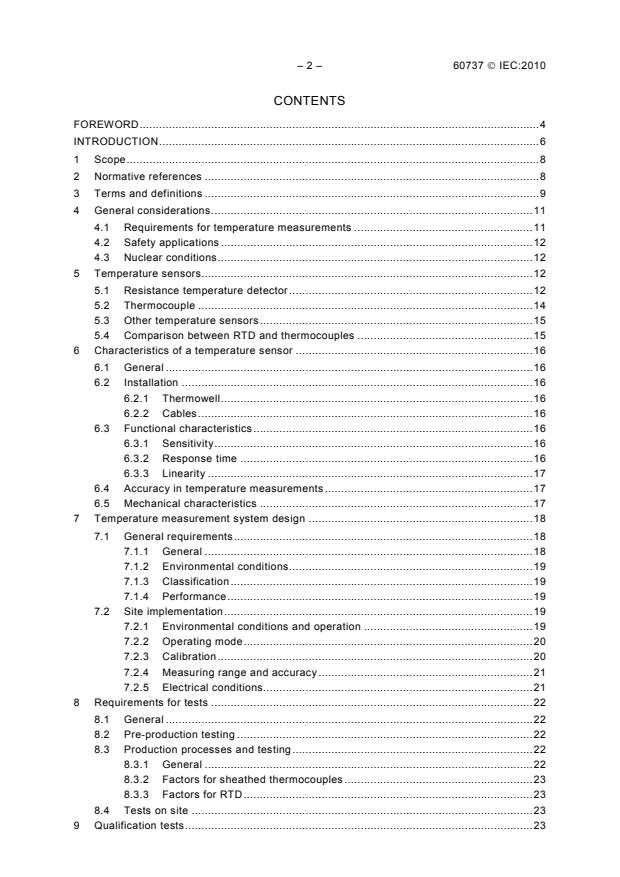
CONTENTS
FOREWORD.4
INTRODUCTION.6
1 Scope.8
2 Normative references .8
3 Terms and definitions .9
4 General considerations.11
4.1 Requirements for temperature measurements .11
4.2 Safety applications .12
4.3 Nuclear conditions.12
5 Temperature sensors.12
5.1 Resistance temperature detector.12
5.2 Thermocouple .14
5.3 Other temperature sensors.15
5.4 Comparison between RTD and thermocouples .15
6 Characteristics of a temperature sensor .16
6.1 General .16
6.2 Installation .16
6.2.1 Thermowell.16
6.2.2 Cables.16
6.3 Functional characteristics.16
6.3.1 Sensitivity.16
6.3.2 Response time .16
6.3.3 Linearity .17
6.4 Accuracy in temperature measurements .17
6.5 Mechanical characteristics .17
7 Temperature measurement system design .18
7.1 General requirements.18
7.1.1 General .18
7.1.2 Environmental conditions.19
7.1.3 Classification.19
7.1.4 Performance.19
7.2 Site implementation.19
7.2.1 Environmental conditions and operation .19
7.2.2 Operating mode.20
7.2.3 Calibration.20
7.2.4 Measuring range and accuracy.21
7.2.5 Electrical conditions.21
8 Requirements for tests .22
8.1 General .22
8.2 Pre-production testing .22
8.3 Production processes and testing.22
8.3.1 General .22
8.3.2 Factors for sheathed thermocouples .23
8.3.3 Factors for RTD.23
8.4 Tests on site .23
9 Qualification tests.23
60737 © IEC:2010 – 3 –
9.1 Principles .23
9.2 Test sequence on a sensor .24
9.3 Test for environmental conditions .24
9.3.1 Temperature test .24
9.3.2 Pressure test .24
9.3.3 Other tests .24
9.4 Seismic tests.24
Bibliography.25
Table 1 – RTD and thermocouple characteristic comparison .15
– 4 – 60737 © IEC:2010
INTERNATIONAL ELECTROTECHNICAL COMMISSION
____________
NUCLEAR POWER PLANTS –
INSTRUMENTATION IMPORTANT TO SAFETY –
TEMPERATURE SENSORS (IN-CORE
AND PRIMARY COOLANT CIRCUIT) –
CHARACTERISTICS AND TEST METHODS
FOREWORD
1) The International Electrotechnical Commission (IEC) is a worldwide organization for standardization comprising
all national electrotechnical committees (IEC National Committees). The object of IEC is to promote
international co-operation on all questions concerning standardization in the electrical and electronic fields. To
this end and in addition to other activities, IEC publishes International Standards, Technical Specifications,
Technical Reports, Publicly Available Specifications (PAS) and Guides (hereafter referred to as “IEC
Publication(s)”). Their preparation is entrusted to technical committees; any IEC National Committee interested
in the subject dealt with may participate in this preparatory work. International, governmental and non-
governmental organizations liaising with the IEC also participate in this preparation. IEC collaborates closely
with the International Organization for Standardization (ISO) in accordance with conditions determined by
agreement between the two organizations.
2) The formal decisions or agreements of IEC on technical matters express, as nearly as possible, an international
consensus of opinion on the relevant subjects since each technical committee has representation from all
interested IEC National Committees.
3) IEC Publications have the form of recommendations for international use and are accepted by IEC National
Committees in that sense. While all reasonable efforts are made to ensure that the technical content of IEC
Publications is accurate, IEC cannot be held responsible for the way in which they are used or for any
misinterpretation by any end user.
4) In order to promote international uniformity, IEC National Committees undertake to apply IEC Publications
transparently to the maximum extent possible in their national and regional publications. Any divergence
between any IEC Publication and the corresponding national or regional publication shall be clearly indicated in
the latter.
5) IEC itself does not provide any attestation of conformity. Independent certification bodies provide conformity
assessment services and, in some areas, access to IEC marks of conformity. IEC is not responsible for any
services carried out by independent certification bodies.
6) All users should ensure that they have the latest edition of this publication.
7) No liability shall attach to IEC or its directors, employees, servants or agents including individual experts and
members of its technical committees and IEC National Committees for any personal injury, property damage or
other damage of any nature whatsoever, whether direct or indirect, or for costs (including legal fees) and
expenses arising out of the publication, use of, or reliance upon, this IEC Publication or any other IEC
Publications.
8) Attention is drawn to the Normative references cited in this publication. Use of the referenced publications is
indispensable for the correct application of this publication.
9) Attention is drawn to the possibility that some of the elements of this IEC Publication may be the subject of
patent rights. IEC shall not be held responsible for identifying any or all such patent rights.
International Standard IEC 60737 has been prepared by subcommittee 45A: Instrumentation
and control of nuclear facilities, of IEC technical committee 45: Nuclear instrumentation.
This second edition cancels and replaces the first edition published in 1982. This edition
constitutes a technical revision.
The main changes with respect to the previous edition are listed below:
• to up-date the references to standards published or revised since the issue of the first
edition of the current standard, including IEC 61513 and IEC 61226;
• to include descriptions of the comparative performance of thermocouples and resistance
temperature detectors;
• to include a discussion of the temperature measuring system requirements for reactors;
• to adapt the definitions;
60737 © IEC:2010 – 5 –
• to update the format to align with the current ISO/IEC Directives on style of standards.
The text of this standard is based on the following documents:
FDIS Report on voting
45A/800/FDIS 45A/806/RVD
Full information on the voting for the approval of this standard can be found in the report on
voting indicated in the above table.
This publication has been drafted in accordance with the ISO/IEC Directives, Part 2.
The committee has decided that the contents of this publication will remain unchanged until
the stability date indicated on the IEC web site under "http://webstore.iec.ch" in the data
related to the specific publication. At this date, the publication will be
• reconfirmed,
• withdrawn,
• replaced by a revised edition, or
• amended.
– 6 – 60737 © IEC:2010
INTRODUCTION
a) Technical background, main issues and organisation of the Standard
This International Standard addresses the issues specific to temperature detectors used
mainly for in-core and primary coolant circuit instrumentation systems. It describes the
principles, the characteristics and the test methods for temperature detectors including: RTDs
and thermocouples.
It is organized into clauses giving:
• the definitions;
• description of the different types of temperature sensors;
• system design;
• analysis of the factors of influence;
• the operational conditions for sensors;
• the factory tests;
• the qualification tests.
It is intended that the Standard be used by operators of NPPs (utilities), nuclear plant
designers and constructors, systems evaluators and by licensors.
b) Situation of the current Standard in the structure of the IEC SC 45A standard series
IEC 60737 is the third level IEC SC 45A document tackling the specific issue of
characteristics and test methods related to temperature detectors used in power reactors.
For more details on the structure of the IEC SC 45A standard series, see the paragraph d) of
this introduction.
c) Recommendations and limitations regarding the application of the Standard
There are no special recommendations or limitations regarding the application of this
standard.
d) Description of the structure of the IEC SC 45A standard series and relationships
with other IEC documents and other bodies documents (IAEA, ISO)
The top-level document of the IEC SC 45A standard series is IEC 61513. It provides general
requirements for I&C systems and equipment that are used to perform functions important to
safety in NPPs. IEC 61513 structures the IEC SC 45A standard series.
IEC 61513 refers directly to other IEC SC 45A standards for general topics related to
categorization of functions and classification of systems, qualification, separation of systems,
defence against common cause failure, software aspects of computer-based systems,
hardware aspects of computer-based systems, and control room design. The standards
referenced directly at this second level should be considered together with IEC 61513 as a
consistent document set.
At a third level, IEC SC 45A standards not directly referenced by IEC 61513 are standards
related to specific equipment, technical methods, or specific activities. Usually these
documents, which make reference to second-level documents for general topics, can be used
on their own.
60737 © IEC:2010 – 7 –
A fourth level extending the IEC SC 45A standard series, corresponds to the Technical
Reports which are not normative.
IEC 61513 has adopted a presentation format similar to the basic safety publication
IEC 61508 with an overall safety life-cycle framework and a system life-cycle framework and
provides an interpretation of the general requirements of IEC 61508-1, IEC 61508-2 and
IEC 61508-4, for the nuclear application sector. Compliance with IEC 61513 will facilitate
consistency with the requirements of IEC 61508 as they have been interpreted for the nuclear
industry. In this framework IEC 60880 and IEC 62138 correspond to IEC 61508-3 for the
nuclear application sector.
IEC 61513 refers to ISO as well as to IAEA GS-R-3 for topics related to quality assurance
(QA).
The IEC SC 45A standards series consistently implements and details the principles and
basic safety aspects provided in the IAEA code on the safety of NPPs and in the IAEA safety
series, in particular the Requirements NS-R-1, establishing safety requirements related to the
design of Nuclear Power Plants, and the Safety Guide NS-G-1.3 dealing with instrumentation
and control systems important to safety in Nuclear Power Plants. The terminology and
definitions used by SC 45A standards are consistent with those used by the IAEA.
– 8 – 60737 © IEC:2010
NUCLEAR POWER PLANTS –
INSTRUMENTATION IMPORTANT TO SAFETY –
TEMPERATURE SENSORS (IN-CORE
AND PRIMARY COOLANT CIRCUIT) –
CHARACTERISTICS AND TEST METHODS
1 Scope
This International Standard is applicable to general aspects of system and component design,
manufacturing and test methods for temperature sensors used in-core and for the primary
coolant circuit in nuclear power reactors.
These sensors include thermocouples and RTDs (Resistance Temperature Detector–RTD).
Emphasis is placed on the features specific to the nuclear application and recommendations
concerning components and sensors are made only when they relate to the containment of
such components within the reactor primary envelope and/or in high radiation fields.
The conditions imposed by reactor use are often different from those which occur in non-
nuclear applications. Parts of the in-core system may be located in very severe environments.
Exposure to high neutron and gamma radiations is liable to cause error due to nuclear
transformations, heating and structural changes, and to affect the mechanical and electrical
properties of the equipment so that extra care has to be taken in the standards adopted for
installations and in the choice of materials.
Furthermore, design consideration needs to be given to the effects of high environmental
pressure, high temperature, temperature gradients and temperature cycling as well as to the
way in which the temperature measuring system could influence the safety or economic
performance of the reactor.
The consequences of nuclear conditions for temperature sensors lead to strong requirements
regarding qualification.
This standard deals with specific requirements for nuclear applications of temperature
sensors. It has two purposes:
a) to provide a guide which will help to ensure that the reactor conditions do not damage the
temperature sensors;
b) to ensure that the in-core temperature measuring system and the sensor installation do
not prejudice the safe operation and the availability of the reactor.
Statements of general applicability are made but detailed consideration is restricted to
thermocouples and RTDs.
2 Normative references
The following referenced documents are indispensable for the application of this document.
For dated references, only the edition cited applies. For undated references, the latest edition
of the referenced document (including any amendments) applies.
IEC 60584-1, Thermocouples – Part 1: Reference tables
IEC 60584-2, Thermocouples – Part 2: Tolerances
60737 © IEC:2010 – 9 –
IEC 60584-3, Thermocouples – Part 3: Extension and compensating cables – Tolerances and
identification system
IEC 60709, Nuclear power plants – Instrumentation and control systems important to safety –
Separation
IEC 60751, Industrial platinum resistance thermometers and platinum temperature sensors
IEC 60780, Nuclear power plants – Electrical equipment of the safety system – Qualification
IEC 60980, Recommended practices for seismic qualification of electrical equipment of the
safety system for nuclear generating stations
IEC 61226, Nuclear power plants – Instrumentation and control important to safety –
Classification of instrumentation and control functions
IEC 61513, Nuclear power plants – Instrumentation and control for systems important to
safety – General requirements for systems
IEC 61515, Mineral insulated thermocouple cables and thermocouples
IEC 62342, Nuclear power plants – Instrumentation and control systems important to safety –
Management of ageing
IEC 62385, Nuclear power plants – Instrumentation and control important to safety – Methods
for assessing the performance of safety system instrument channels
IEC 62397, Nuclear power plants – Instrumentation and control important to safety –
Resistance temperature detectors
IEC 62460, Temperature – Electromotive force (EMF) tables for pure-element thermocouple
combinations
3 Terms and definitions
For the purposes of this document, the terms and definitions given in IAEA Safety Glossary
edition 2007, IEC 60050-393 and IEC 60050-394 apply as well as the following:
3.1
accuracy of measurement
closeness of the agreement between the result of a measurement and the conventionally true
value of the measurand
[IEV 394-40-35]
NOTE 1 “Accuracy” is a qualitative concept.
NOTE 2 The term “precision” should not be used for “accuracy”.
3.2
electrical shunting
effect of the shunting of the source impedance of the sensing device by the input impedance
of the measuring device and the earth leakage impedance of the sensor
– 10 – 60737 © IEC:2010
3.3
post-accident temperature sensor
temperature sensor designed to withstand and measure very high temperatures, which may
be above 1 100 °C, that can occur if the fuel elements are not sufficiently cooled
3.4
resistance temperature detector (RTD)
detector generally made up of a stainless steel cylindrical barrel protecting a platinum resistor
whose resistance varies with temperature. This detector is placed in the piping containing the
fluid whose temperature is measured in this way. It can be directly immersed in the fluid or
protected by an intermediate casing called the thermowell
NOTE 1 Mounting means or connection heads may be included. The temperature-sensing resistor can be made of
platinum, nickel tungsten, copper, or other metals. However, a platinum sensor is commonly used in the RTD in an
NPP; therefore, a platinum resistance thermometer is referred to in this standard.
NOTE 2 In this standard, the term “sensor” describes the RTD unit with all its associated protection, for example,
barrel or thermowell. For most applications of measuring process fluid temperature in an NPP, the platinum resistor
sensor is installed inside a stainless steel thermowell. For air temperature measurement, a direct sensor may
be used.
[IEC 62397, 3.5]
3.5
sensitivity
for a given value of the measured quantity, ratio of the variation of the observed variable to
the corresponding variation of the measured quantity
[IEV 394-39-07, modified]
3.6
service life
the period from initial operation to final withdrawal from service of a structure, system or
component
[IAEA Safety Glossary, edition 2007]
NOTE The service life for a sensor corresponds to the operational life under irradiation and environmental
conditions restricted within specified limits, after which the sensor characteristics exceed specified tolerances. It
can be expressed in terms of incident particle fluence, time of operation, etc.
3.7
sheathed thermocouple
thermocouple embedded in a mineral insulation within a gas-tight, metal protecting tube as a
sheath, with the two leads brought out for measurement through a moisture-proof seal
3.8
temperature measuring sensor
device, fixed or movable, designed to provide a signal for the measurement of temperature at
a defined point in the core of the reactor or on the primary coolant circuit
NOTE Examples are Resistance Temperature Detectors and thermocouples such as sheathed thermocouples,
insulated junction thermocouples and non-insulated junction thermocouples.
3.9
temperature measuring system
system, using in-core temperature measuring sensors, designed for the measurement of
primary coolant, fuel, moderator and reactor structure temperatures
NOTE This system may be either independent of or a part of the general in-core monitoring system which
provides the information necessary for normal reactor operation. A temperature measurement system includes all
the components necessary to produce information or a signal representing the temperature at the sensor location.
The components are: the temperature sensor itself, the thermowell, the cables, the connectors, the electronic
system.
60737 © IEC:2010 – 11 –
3.10
thermocouple
temperature measuring device based on the use of two conductors of different metals welded
together at their two ends to form two junctions
NOTE One junction is at the temperature site of interest, the other at a reference stable cold temperature. The
signal of a thermocouple arises from the Seebeck effect which generates a voltage that varies with the temperature
difference between the junctions.
3.11
thermowell
protective jacket for RTDs, thermocouples, and other temperature sensors. The thermowell is
also used to facilitate replacement of the temperature sensor
[IEC 62385, 3.19]
4 General considerations
4.1 Requirements for temperature measurements
Temperature is a fundamental parameter related to the nuclear process in a reactor. It can be
measured with specific sensors to perform the following main safety functions:
– to monitor the temperature of the cooling system and to follow the operating conditions
with regard to the design parameters;
– to measure the thermal power of the reactor when the temperature measurement is
combined with the coolant flow rate measurement;
– to monitor the temperature of the fuel elements in order to avoid a boiling incident or
melting of the fuel element itself.
Temperature measurements are required from the fuel, moderator, coolant or structural
members supporting the core. They are used for control purposes, for the protection system,
for shut-down and accident monitoring or for the provision of more general information about
the reactor or its components.
In a power reactor with a core which has large physical dimensions, it may be important to
monitor not only mean temperatures but also spatial temperature distributions. Measurements
at particular positions may be used for the control of specific parts of the reactor core to
ensure adequate safety margins for protection system parameters or to provide for optimum
fuel utilization.
Some in-core measurements may also be necessary for reasons such as protecting the fuel
from damage caused by local disturbances in coolant flow or by transients in local power
density. In most cases, temperature sensors are used to measure temperature directly, but
applications do arise in which information is derived from fluctuations in temperature. An
example of the latter is the derivation of coolant flow by correlation of the fluctuations
obtained from a spaced pair of sensors.
The measurement of in-core temperature for water reactors is important for reactor efficiency
and fuel burn up, and may be achieved through probes inserted into specific channels of the
reactor, or by permanently installed detectors. The measurements of these sensors are
normally taken at routine intervals, followed by calculations to assess the conditions at each
monitored fuel channel.
In all these applications, the environment is demanding and the performance of the
temperature measurement system is either important to safety or to operation.
The temperature signals may be measured in a continuous or discontinuous manner
depending on the application. This will not usually affect the design of the in-core installation.
– 12 – 60737 © IEC:2010
4.2 Safety applications
Temperature sensors used in a system performing safety functions classified according to
IEC 61226 shall follow the associated safety requirements determined by the safety class of
the functions. If the measurements are important to safety, the cable routes shall also satisfy
separation requirements to meet relevant single failure criteria and to avoid common cause
failures, see IEC 60709.
After an accident, the cooling of fuel elements may decrease and the temperature inside the
fuel may increase dramatically. A fuel element melt may occur and, when the coolant is water,
a chemical reaction between the cladding and water produces a large quantity of hydrogen.
The post accident conditions should be monitored by using temperature measurements
capable of withstanding very high temperatures (for example, higher than
1 100 °C for light water reactors). The maximum temperature to be measured and the
locations of the temperature sensors shall be specified by the designer of the reactor.
4.3 Nuclear conditions
The nuclear conditions related to the coolant circuit or inside the reactor vessel are very
specific and different from general industry conditions. These conditions are characterized by
the following:
– High radiation dose rates induced by gamma and neutrons, noting that:
• high gamma dose rates damage organic materials by changing the molecular links;
• fast neutrons damage organic and mineral materials by changing the atomic structure.
This phenomenon can cause a change in characteristics;
• thermal neutrons induce activation.
– Because the sensors are usually not easily accessible, they shall have a very high
reliability, and the electronic components should be located far away from the radioactive
zone.
– A reactor operates continuously with harsh conditions for a long time.
A temperature sensor specific for nuclear applications differs from normal industrial sensors
by the following:
– qualification to normal conditions and nuclear conditions;
– quality assurance in accordance with nuclear standards, depending on the requirements.
5 Temperature sensors
5.1 Resistance temperature detector
A resistance temperature detector (RTD) is a temperature sensor whose resistance increases
with temperature. An RTD consists of a wired coil or deposited film of pure metal. RTDs can
be made of different metals (Pt, Cu, Ni.) and have different resistances, but the most
common RTD is platinum and has a nominal resistance of 100 Ω at 0 °C. For nuclear
applications on water cooled reactors the use of only one type of RTD gives better
consistency of the measurement and easier maintenance.
The following two standards give some clarification on RTDs:
• IEC 60751:2008;
• IEC 62397:2007.
The relationship between the resistance and the temperature is given by the Callendar-Van
Dusen formula:
60737 © IEC:2010 – 13 –
R = R()1+AT +BT
where
T = is the temperature in °C – in the range 0 °C to 1300 °C;
R = is the resistance (Ω) at temperature T;
R = is the resistance at 0 °C (reference);
A and B are coefficients.
–7 –2
The coefficient B is relatively small (about 6 × 10 °C ) so that the resistance varies almost
linearly with temperature, and it is taken to be linear for the rest of this standard.
RTDs can be difficult to measure because they have a relatively low resistance that changes
only slightly with temperature (less than 0,4 Ω/°C). To measure these small changes in
resistance accurately, special connection configurations should be used that minimize errors
from lead wire resistance.
Typically, an RTD can be used with three different wiring configurations: 2, 3 or 4 wires. The
wiring configuration has a direct impact on accuracy. The 4 wires configuration offers the best
accuracy.
The sensitive element of an RTD is a metallic wire or a metallic coating on an insulating
material. Due to the principle of measurement, the sensitive element shall be protected in a
sheath filled with a mineral insulating material.
Because an RTD is a passive resistive device, a current has to be passed through the
sensitive element to produce a measurable voltage. This current causes the RTD to internally
heat, which appears as an error. Self heating is typically specified as the amount of power
that will raise the RTD temperature by 1 °C, usually expressed in mW/°C.
The self heating can be minimized by using the smallest possible excitation current. The
amount of self heating also depends on the medium in which the RTD is immersed.
RTDs are constructed in a number of forms and offer greater stability, accuracy and
repeatability in some cases than thermocouples.
RTDs have a resistance varying linearly with temperature. They are characterized by
• an excellent accuracy;
• a wide range of operation, up to 600 °C;
• a low drift.
IEC 60751 defines two performance classes for RTDs, Class A and Class B. These
performance classes define tolerances on ice point and temperature accuracy.
• Class A: highest RTD element tolerance and accuracy;
• Class B: most common RTD element tolerance and accuracy.
RTDs require the same precautions that apply to thermocouples, including using shields and
twisted-pair wire, proper sheathing, avoiding mechanical stress and steep temperature
gradients, and using large diameter extension wire.
– 14 – 60737 © IEC:2010
A measurement problem with RTDs is that the mass of the RTD assembly itself can affect the
response to temperature changes, due to the thermal conduction time. This is a greater
concern for RTDs than for thermocouples because the mass of the RTD is generally much
larger. This phenomenon is known as “thermal shunting”, it affects the temperature
measurement by thermal conduction, and more specifically by thermal conduction inside the
sensor itself.
RTDs are preferably used for temperature below 400 °C.
5.2 Thermocouple
Thermocouples are temperature sensitive elements that convert thermal difference into
electric voltage.
The principle is that two dissimilar metals have a contact potential between them, and this
contact potential changes as the temperature changes. Thermocouples measure the
temperature difference between two points, and not absolute temperature. In typical
applications, one of the junctions - the cold junction - is maintained at a known reference
temperature, while the other end is attached to a probe.
IEC 60584, IEC 61515 and IEC 62460 give general requirements for thermocouple
application.
Thermocouple temperature measurement systems use an artificial cold junction whose
temperature is measured using some other thermally sensitive device, such as a thermistor or
a diode. The voltage from a known cold junction allows the appropriate correction to be
applied. This is known as cold junction compensation.
In practice, however, only a few thermocouple types have become standard because their
temperature coefficients are highly repeatable, they are rugged, and they generate relatively
large output voltages. The most common industrial thermocouple types are called J, K, N, R,
T, S, B, E. The junction temperature differences can be deduced from the voltage differences
and the corresponding values can be obtained from standard tables (IEC 60584 series). For
nuclear applications on water cooled reactors, types K and N are preferred. The use of one
type of thermocouple gives better consistency of the measurement and easier maintenance.
Thermocouples are generally divided into two groups:
• noble metal thermocouple types S, R, B. These thermocouples can be used for operating
temperatures up to 1 700 °C;
• base metal thermocouple types E, J, K, N, T. These thermocouples can be used for
operating temperatures below 1 100 °C, the range of temperature of each type is specific.
The sensitive element of a thermocouple is the junction between two different metallic wires.
It is possible to fix the junction directly on the body of the object of which the temperature is
measured, but it is better to protect the wires in a sheath. The sheath is a thin metallic tube
filled with a mineral insulating material.
The sensitive junction can be either:
• fixed on the metallic tube, for a non-insulated sheathed thermocouple; or,
• isolated from the metallic tube, for an insulated sheathed thermocouple
For temperature measurement on the primary circuit, insulated types are recommended
because they tend to be less susceptible to reduction in accuracy and to spurious signals
produced by fault conditions and to electromagnetic disturbances.
60737 © IEC:2010 – 15 –
Thermocouples can measure a wide range of temperatures, up to 1 700 °C. Their main
limitation is accuracy.
The IEC 60584 series address the general requirements for thermocouples and their cables.
5.3 Other temperature sensors
Other sensors to measure temperature exist, as examples:
• bi-metallic strips convert a temperature change into mechanical displacement;
• optical fibers can be used as sensors to measure temperature by modulating the
characteristics of light in the fiber;
• thermistors are similar to RTDs in that they also change resistance with a change in
temperature. However, they can be made with either a positive or negative temperature
coefficient. The main characteristics of a thermistor are a good sensitivity but a limited
range of operation, non compatible with nuclear conditions.
In practice, these sensors are not used in a NPP nuclear environment, they are not
considered in this standard.
5.4 Comparison between RTD and thermocouples
This subclause gives a comparison between characteristics of RTD and thermocouples in
order to help the selection for nuclear applications.
Table 1 – RTD and thermocouple characteristic comparison
Characteristic RTD Thermocouple
Range of operation 0 °C to 600 °C 0 °C to 1 100 °C (base metal)
recommended below 400 °C
0 °C to 1 700 °C (noble metal)
Accuracy Excellent Medium
Stability Excellent Fair
Repeatibility Excellent Good
Linearity Good Fair
Response time
Slow Medium to fast
Sensitivity Good Low
Self heating Low None
Cabling Three or four wires configuration Two wires
Extension and compensation cable
are specific
Compensation Not required Cold junction
In nuclear conditions, RTDs have better characteristics than thermocouples, except the range
of temperature which is wider with thermocouples than RTDs.
For fuel element temperature measurement or post-accident temperature monitoring,
thermocouples are preferred.
– 16 – 60737 © IEC:2010
6 Characteristics of a temperature sensor
6.1 General
This clause considers only the characteristics which are important to the in-core application of
temperature sensors. The sensors under consideration may be either sheathed
thermocouples or RTDs.
The selection of a type of temperature sensor shall be made according to its characteristics
compared with the conditions of operation and requirements. To select a type of temperature
sensor for a particular temperature range consult the basic standards:
• IEC 60751 for RTD;
• IEC 60584 series for thermocouples.
6.2 Installation
6.2.1 Thermowell
A temperature sensor, RTD or thermocouple can be used either in direct contact with the
material of which the temperature is measured or inside a thermowell to be protected from the
environmental conditions.
Generally, for nuclear applications the temperature sensors are installed inside a thermowell
for mechanical protection. The consequences are:
• a higher thermal ine
...