


IEC 60947-5-4:2002
(Main)Low-voltage switchgear and controlgear - Part 5-4: Control circuit devices and switching elements - Method of assessing the performance of low-energy contacts - Special tests
General Information
- Abstract
IEC 60947-5-4:2002 applies to separable contacts used in the utilization area considered, such as switching elements for control circuits. This standard takes into consideration two rated voltage areas:
a) above (and including) 10 V (typically 24 V) where contacts are used for switching loads with possible electrical erosion, such as programmable controller inputs;
b) below 10 V (typically 5 V) with negligible electrical erosion, such as electronic circuits.
This second edition cancels and replaces the first edition which was issued as a technical report in 1996. It now has the status of an International Standard.
- Status
- Published
- Publication Date
- 21-May-2019
- Technical Committee
- SC 121A - Low-voltage switchgear and controlgear
- Drafting Committee
- WG 3 - TC 121/SC 121A/WG 3
- Current Stage
- PPUB - Publication issued
- Start Date
- 15-Oct-2002
- Completion Date
- 30-Nov-2002
Buy Documents
IEC 60947-5-4:2002 - Low-voltage switchgear and controlgear - Part 5-4: Control circuit devices and switching elements - Method of assessing the performance of low-energy contacts - Special tests Released:10/15/2002

IEC 60947-5-4:2002+AMD1:2019 CSV - Low-voltage switchgear and controlgear - Part 5-4: Control circuit devices and switching elements - Method of assessing the performance of low-energy contacts - Special tests Released:5/22/2019
Overview
IEC 60947-5-4:2002 is an international standard developed by the International Electrotechnical Commission (IEC) focusing on low-voltage switchgear and controlgear, specifically Part 5-4 which deals with control circuit devices and switching elements. This standard defines a method for assessing the performance of low-energy contacts, including special tests designed to evaluate their reliability and functional integrity. The standard applies primarily to separable contacts used in control circuits across two voltage categories:
- Above (and including) 10 V (typically 24 V), where contacts may switch loads with possible electrical erosion, such as programmable controller inputs.
- Below 10 V (typically 5 V), where electrical erosion is negligible, such as contacts in electronic circuits.
IEC 60947-5-4 addresses the critical need for precise testing methodologies for modern electronic and programmable control systems that rely heavily on low-energy contact performance.
Key Topics
Performance Assessment of Low-Energy Contacts
- Provides clear definitions and principles for testing low-energy contacts used in control circuits.
- Focuses on the monitoring and recording of contact behavior during operations to identify performance and failures.
- Establishes functional bases for test equipment and preferred test values to standardize testing.
Special Tests and Conditions
- Describes specialized testing conditions to simulate real-world application environments.
- Covers preconditioning, ambient condition parameters, and particular tests for contacts intended for specific uses like programmable controller inputs.
- Includes sequences of operations and measurement methods critical for reliable contact performance evaluation.
Data Reporting and Failure Criteria
- Details requirements for information to be included in test reports to support transparency and traceability.
- Defines failure criteria and methods for reporting failure rates, enabling manufacturers and users to assess contact durability and reliability objectively.
Scope Limitations
- Does not apply to functional safety contacts, which are covered under IEC 60947-5-1:2016 Annex N.
- Excludes very low energy measurement contacts such as sensors and thermocouple systems.
Applications
IEC 60947-5-4 is essential for industries using low-voltage switchgear and controlgear with control circuits, including but not limited to:
- Industrial automation: Ensures the reliability of programmable logic controller (PLC) inputs and control circuit contacts.
- Electronic control systems: Provides benchmarks for contacts at very low voltage and current levels.
- Manufacturing processes: Helps maintain consistent testing standards for control devices in production environments.
- Electrical equipment design: Guides manufacturers to design low-energy contacts with predictable and reliable performance in control circuits.
By following the testing methodologies, manufacturers, testers, and users can ensure the operational safety and longevity of control circuit contacts used in various low-voltage applications, avoiding unexpected failures and optimizing overall system efficiency.
Related Standards
- IEC 60947-5-1: Low-voltage switchgear and controlgear - Part 5-1: Control circuit devices and switching elements - Electromechanical control circuit devices. This standard complements IEC 60947-5-4 by covering safety and functional aspects for control devices.
- IEC 60068 Series: Environmental testing standards providing general guidance on conditions and procedures relevant for testing electrical equipment like low-energy contacts.
- IEC 60605-6: Equipment reliability testing methods for validating failure rates, supporting the reliability assessment framework in IEC 60947-5-4.
- Applicable national and regional standards may also reference IEC 60947-5-4 for harmonized performance evaluation of low-energy control contacts.
Keywords: IEC 60947-5-4, low-voltage switchgear, controlgear, low-energy contacts, performance assessment, control circuit devices, switching elements, programmable controllers, contact testing, special tests, electrical erosion, low voltage contacts, industrial automation standards
Relations
- Effective Date
- 05-Sep-2023
Buy Documents
IEC 60947-5-4:2002 - Low-voltage switchgear and controlgear - Part 5-4: Control circuit devices and switching elements - Method of assessing the performance of low-energy contacts - Special tests Released:10/15/2002
IEC 60947-5-4:2002+AMD1:2019 CSV - Low-voltage switchgear and controlgear - Part 5-4: Control circuit devices and switching elements - Method of assessing the performance of low-energy contacts - Special tests Released:5/22/2019
Get Certified
Connect with accredited certification bodies for this standard

IMQ S.p.A. (Certification)
Italian electrical product certification.

SLG Prüf- und Zertifizierungs GmbH
German testing and certification body.

UL Solutions
Global safety science company with testing, inspection and certification.
Sponsored listings
Frequently Asked Questions
IEC 60947-5-4:2002 is a standard published by the International Electrotechnical Commission (IEC). Its full title is "Low-voltage switchgear and controlgear - Part 5-4: Control circuit devices and switching elements - Method of assessing the performance of low-energy contacts - Special tests". This standard covers: IEC 60947-5-4:2002 applies to separable contacts used in the utilization area considered, such as switching elements for control circuits. This standard takes into consideration two rated voltage areas: a) above (and including) 10 V (typically 24 V) where contacts are used for switching loads with possible electrical erosion, such as programmable controller inputs; b) below 10 V (typically 5 V) with negligible electrical erosion, such as electronic circuits. This second edition cancels and replaces the first edition which was issued as a technical report in 1996. It now has the status of an International Standard.
IEC 60947-5-4:2002 applies to separable contacts used in the utilization area considered, such as switching elements for control circuits. This standard takes into consideration two rated voltage areas: a) above (and including) 10 V (typically 24 V) where contacts are used for switching loads with possible electrical erosion, such as programmable controller inputs; b) below 10 V (typically 5 V) with negligible electrical erosion, such as electronic circuits. This second edition cancels and replaces the first edition which was issued as a technical report in 1996. It now has the status of an International Standard.
IEC 60947-5-4:2002 is classified under the following ICS (International Classification for Standards) categories: 29.130.20 - Low voltage switchgear and controlgear. The ICS classification helps identify the subject area and facilitates finding related standards.
IEC 60947-5-4:2002 has the following relationships with other standards: It is inter standard links to IEC 60947-5-4:2002/AMD1:2019. Understanding these relationships helps ensure you are using the most current and applicable version of the standard.
IEC 60947-5-4:2002 is available in PDF format for immediate download after purchase. The document can be added to your cart and obtained through the secure checkout process. Digital delivery ensures instant access to the complete standard document.
Standards Content (Sample)
NORME CEI
INTERNATIONALE IEC
60947-5-4
INTERNATIONAL
Deuxième édition
STANDARD
Second edition
2002-10
Appareillage à basse tension –
Partie 5-4:
Appareils et éléments de commutation
pour circuits de commande –
Méthode d'évaluation des performances
des contacts à basse énergie –
Essais spéciaux
Low-voltage switchgear and controlgear –
Part 5-4:
Control circuit devices and switching elements –
Method of assessing the performance of
low-energy contacts – Special tests
Numéro de référence
Reference number
CEI/IEC 60947-5-4:2002
Numérotation des publications Publication numbering
Depuis le 1er janvier 1997, les publications de la CEI As from 1 January 1997 all IEC publications are
sont numérotées à partir de 60000. Ainsi, la CEI 34-1 issued with a designation in the 60000 series. For
devient la CEI 60034-1. example, IEC 34-1 is now referred to as IEC 60034-1.
Editions consolidées Consolidated editions
Les versions consolidées de certaines publications de la The IEC is now publishing consolidated versions of its
CEI incorporant les amendements sont disponibles. Par publications. For example, edition numbers 1.0, 1.1
exemple, les numéros d’édition 1.0, 1.1 et 1.2 indiquent and 1.2 refer, respectively, to the base publication,
respectivement la publication de base, la publication de the base publication incorporating amendment 1 and
base incorporant l’amendement 1, et la publication de the base publication incorporating amendments 1
base incorporant les amendements 1 et 2. and 2.
Informations supplémentaires Further information on IEC publications
sur les publications de la CEI
Le contenu technique des publications de la CEI est The technical content of IEC publications is kept
constamment revu par la CEI afin qu'il reflète l'état under constant review by the IEC, thus ensuring that
actuel de la technique. Des renseignements relatifs à the content reflects current technology. Information
cette publication, y compris sa validité, sont dispo- relating to this publication, including its validity, is
nibles dans le Catalogue des publications de la CEI available in the IEC Catalogue of publications
(voir ci-dessous) en plus des nouvelles éditions, (see below) in addition to new editions, amendments
amendements et corrigenda. Des informations sur les and corrigenda. Information on the subjects under
sujets à l’étude et l’avancement des travaux entrepris consideration and work in progress undertaken by the
par le comité d’études qui a élaboré cette publication, technical committee which has prepared this
ainsi que la liste des publications parues, sont publication, as well as the list of publications issued,
également disponibles par l’intermédiaire de: is also available from the following:
• Site web de la CEI (www.iec.ch) • IEC Web Site (www.iec.ch)
• Catalogue des publications de la CEI • Catalogue of IEC publications
Le catalogue en ligne sur le site web de la CEI The on-line catalogue on the IEC web site
(http://www.iec.ch/searchpub/cur_fut.htm) vous permet (http://www.iec.ch/searchpub/cur_fut.htm) enables
de faire des recherches en utilisant de nombreux you to search by a variety of criteria including text
critères, comprenant des recherches textuelles, par searches, technical committees and date of
comité d’études ou date de publication. Des publication. On-line information is also available
informations en ligne sont également disponibles sur on recently issued publications, withdrawn and
les nouvelles publications, les publications rempla- replaced publications, as well as corrigenda.
cées ou retirées, ainsi que sur les corrigenda.
• IEC Just Published • IEC Just Published
Ce résumé des dernières publications parues This summary of recently issued publications
(http://www.iec.ch/online_news/justpub/jp_entry.htm) (http://www.iec.ch/online_news/justpub/jp_entry.htm)
est aussi disponible par courrier électronique. is also available by email. Please contact the
Veuillez prendre contact avec le Service client Customer Service Centre (see below) for further
(voir ci-dessous) pour plus d’informations. information.
• Service clients • Customer Service Centre
Si vous avez des questions au sujet de cette If you have any questions regarding this
publication ou avez besoin de renseignements publication or need further assistance, please
supplémentaires, prenez contact avec le Service contact the Customer Service Centre:
clients:
Email: custserv@iec.ch Email: custserv@iec.ch
Tél: +41 22 919 02 11 Tel: +41 22 919 02 11
Fax: +41 22 919 03 00 Fax: +41 22 919 03 00
.
NORME CEI
INTERNATIONALE IEC
60947-5-4
INTERNATIONAL
Deuxième édition
STANDARD
Second edition
2002-10
Appareillage à basse tension –
Partie 5-4:
Appareils et éléments de commutation
pour circuits de commande –
Méthode d'évaluation des performances
des contacts à basse énergie –
Essais spéciaux
Low-voltage switchgear and controlgear –
Part 5-4:
Control circuit devices and switching elements –
Method of assessing the performance of
low-energy contacts – Special tests
IEC 2002 Droits de reproduction réservés Copyright - all rights reserved
Aucune partie de cette publication ne peut être reproduite ni No part of this publication may be reproduced or utilized in any
utilisée sous quelque forme que ce soit et par aucun procédé, form or by any means, electronic or mechanical, including
électronique ou mécanique, y compris la photocopie et les photocopying and microfilm, without permission in writing from
microfilms, sans l'accord écrit de l'éditeur. the publisher.
International Electrotechnical Commission, 3, rue de Varembé, PO Box 131, CH-1211 Geneva 20, Switzerland
Telephone: +41 22 919 02 11 Telefax: +41 22 919 03 00 E-mail: inmail@iec.ch Web: www.iec.ch
CODE PRIX
T
Commission Electrotechnique Internationale PRICE CODE
International Electrotechnical Commission
Международная Электротехническая Комиссия
Pour prix, voir catalogue en vigueur
For price, see current catalogue
– 2 – 60947-5-4 CEI:2002
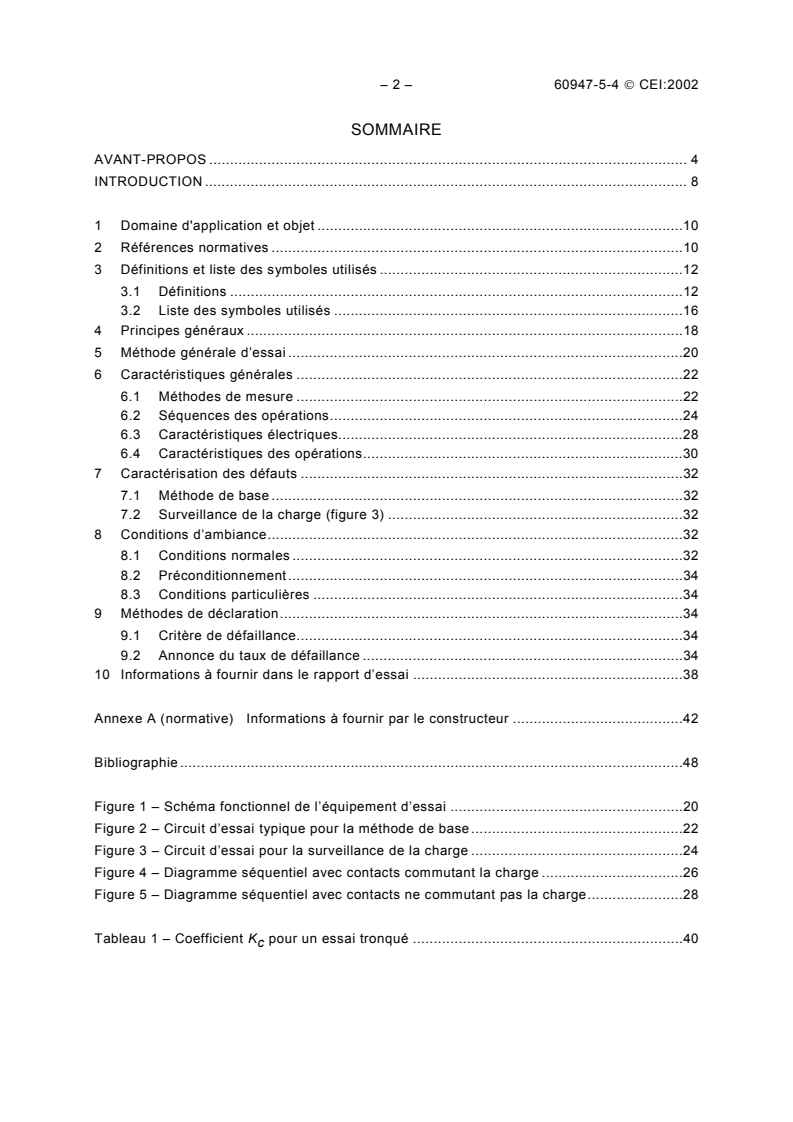
SOMMAIRE
AVANT-PROPOS . 4
INTRODUCTION .8
1 Domaine d'application et objet .10
2 Références normatives .10
3 Définitions et liste des symboles utilisés .12
3.1 Définitions .12
3.2 Liste des symboles utilisés .16
4 Principes généraux .18
5 Méthode générale d’essai .20
6 Caractéristiques générales .22
6.1 Méthodes de mesure .22
6.2 Séquences des opérations.24
6.3 Caractéristiques électriques.28
6.4 Caractéristiques des opérations.30
7 Caractérisation des défauts .32
7.1 Méthode de base .32
7.2 Surveillance de la charge (figure 3) .32
8 Conditions d’ambiance.32
8.1 Conditions normales .32
8.2 Préconditionnement.34
8.3 Conditions particulières .34
9 Méthodes de déclaration.34
9.1 Critère de défaillance.34
9.2 Annonce du taux de défaillance .34
10 Informations à fournir dans le rapport d’essai .38
Annexe A (normative) Informations à fournir par le constructeur .42
Bibliographie .48
Figure 1 – Schéma fonctionnel de l’équipement d’essai .20
Figure 2 – Circuit d’essai typique pour la méthode de base.22
Figure 3 – Circuit d’essai pour la surveillance de la charge .24
Figure 4 – Diagramme séquentiel avec contacts commutant la charge .26
Figure 5 – Diagramme séquentiel avec contacts ne commutant pas la charge.28
Tableau 1 – Coefficient K pour un essai tronqué .40
c
60947-5-4 IEC:2002 – 3 –
CONTENTS
FOREWORD . 5
INTRODUCTION .9
1 Scope and object .11
2 Normative references.11
3 Definitions and list of symbols used .13
3.1 Definitions .13
3.2 List of symbols used .17
4 General principles.19
5 General test method .21
6 General characteristics .23
6.1 Measurement methods .23
6.2 Sequences of operations .25
6.3 Electrical characteristics .29
6.4 Characteristics of operation .31
7 Characterization of defects .33
7.1 Basic method.33
7.2 Monitoring the load (figure 3).33
8 Ambient conditions .33
8.1 Normal conditions.33
8.2 Preconditioning.35
8.3 Particular conditions .35
9 Methods of reporting.35
9.1 Failure criterion .35
9.2 Reporting the failure rate .35
10 Information to be provided in the test report.39
Annex A (normative) Information to be supplied by the manufacturer .43
Bibliography.49
Figure 1 – Functional diagram of the testing equipment.21
Figure 2 – Typical test circuit for the basic method.23
Figure 3 – Test circuit for monitoring a load .25
Figure 4 – Sequential diagram with load-switching contacts .27
Figure 5 – Sequential diagram without load-switching contacts .29
Table 1 – Coefficient K for a time-terminated test .41
c
– 4 – 60947-5-4 CEI:2002
COMMISSION ÉLECTROTECHNIQUE INTERNATIONALE
____________
APPAREILLAGE À BASSE TENSION –
Partie 5-4: Appareils et éléments de commutation
pour circuits de commande –
Méthode d'évaluation des performances des contacts à basse énergie –
Essais spéciaux
AVANT-PROPOS
1) La CEI (Commission Électrotechnique Internationale) est une organisation mondiale de normalisation
composée de l'ensemble des comités électrotechniques nationaux (Comités nationaux de la CEI). La CEI a
pour objet de favoriser la coopération internationale pour toutes les questions de normalisation dans les
domaines de l'électricité et de l'électronique. A cet effet, la CEI, entre autres activités, publie des Normes
internationales. Leur élaboration est confiée à des comités d'études, aux travaux desquels tout Comité national
intéressé par le sujet traité peut participer. Les organisations internationales, gouvernementales et non
gouvernementales, en liaison avec la CEI, participent également aux travaux. La CEI collabore étroitement
avec l'Organisation Internationale de Normalisation (ISO), selon des conditions fixées par accord entre les
deux organisations.
2) Les décisions ou accords officiels de la CEI concernant les questions techniques représentent, dans la mesure
du possible, un accord international sur les sujets étudiés, étant donné que les Comités nationaux intéressés
sont représentés dans chaque comité d’études.
3) Les documents produits se présentent sous la forme de recommandations internationales. Ils sont publiés
comme normes, spécifications techniques, rapports techniques ou guides et agréés comme tels par les
Comités nationaux.
4) Dans le but d'encourager l'unification internationale, les Comités nationaux de la CEI s'engagent à appliquer de
façon transparente, dans toute la mesure possible, les Normes internationales de la CEI dans leurs normes
nationales et régionales. Toute divergence entre la norme de la CEI et la norme nationale ou régionale
correspondante doit être indiquée en termes clairs dans cette dernière.
5) La CEI n’a fixé aucune procédure concernant le marquage comme indication d’approbation et sa responsabilité
n’est pas engagée quand un matériel est déclaré conforme à l’une de ses normes.
6) L’attention est attirée sur le fait que certains des éléments de la présente Norme internationale peuvent faire
l’objet de droits de propriété intellectuelle ou de droits analogues. La CEI ne saurait être tenue pour
responsable de ne pas avoir identifié de tels droits de propriété et de ne pas avoir signalé leur existence.
La Norme internationale CEI 60947-5-4 a été établie par le sous-comité 17B: Appareillage à
basse tension, du comité d'études 17 de la CEI: Appareillage.
Cette deuxième édition annule et remplace la première édition parue comme rapport
technique en 1996. Elle a désormais le statut de norme internationale.
Le texte de cette norme est issu des documents suivants:
FDIS Rapport de vote
17B/1228/FDIS 17B/1254/RVD
Le rapport de vote indiqué dans le tableau ci-dessus donne toute information sur le vote ayant
abouti à l'approbation de cette norme.
Cette publication a été rédigée selon les Directives ISO/CEI, Partie 2.
Quelques légères modifications, principalement de nature éditoriale, ont été introduites par
rapport à la première édition.
60947-5-4 IEC:2002 – 5 –
INTERNATIONAL ELECTROTECHNICAL COMMISSION
____________
LOW-VOLTAGE SWITCHGEAR AND CONTROLGEAR –
Part 5-4: Control circuit devices and switching elements –
Method of assessing the performance of low-energy contacts –
Special tests
FOREWORD
1) The IEC (International Electrotechnical Commission) is a worldwide organization for standardization comprising
all national electrotechnical committees (IEC National Committees). The object of the IEC is to promote
international co-operation on all questions concerning standardization in the electrical and electronic fields. To
this end and in addition to other activities, the IEC publishes International Standards. Their preparation is
entrusted to technical committees; any IEC National Committee interested in the subject dealt with may
participate in this preparatory work. International, governmental and non-governmental organizations liaising
with the IEC also participate in this preparation. The IEC collaborates closely with the International
Organization for Standardization (ISO) in accordance with conditions determined by agreement between the
two organizations.
2) The formal decisions or agreements of the IEC on technical matters express, as nearly as possible, an
international consensus of opinion on the relevant subjects since each technical committee has representation
from all interested National Committees.
3) The documents produced have the form of recommendations for international use and are published in the form
of standards, technical specifications, technical reports or guides and they are accepted by the National
Committees in that sense.
4) In order to promote international unification, IEC National Committees undertake to apply IEC International
Standards transparently to the maximum extent possible in their national and regional standards. Any
divergence between the IEC Standard and the corresponding national or regional standard shall be clearly
indicated in the latter.
5) The IEC provides no marking procedure to indicate its approval and cannot be rendered responsible for any
equipment declared to be in conformity with one of its standards.
6) Attention is drawn to the possibility that some of the elements of this International Standard may be the subject
of patent rights. The IEC shall not be held responsible for identifying any or all such patent rights.
International Standard IEC 60947-5-4 has been prepared by subcommittee 17B: Low-voltage
switchgear and controlgear, of IEC technical committee 17: Switchgear and controlgear.
This second edition cancels and replaces the first edition which was issued as a technical
report in 1996. It now has the status of an International Standard.
The text of this standard is based on the following documents:
FDIS Report on voting
17B/1228/FDIS 17B/1254/RVD
Full information on the voting for the approval of this standard can be found in the report on
voting indicated in the above table.
This publication has been drafted in accordance with the ISO/IEC Directives, Part 2.
Some slight modifications, mainly of an editorial nature, have been introduced since the first
edition.
– 6 – 60947-5-4 CEI:2002
Le comité a décidé que le contenu de cette publication ne sera pas modifié avant 2006.
A cette date, la publication sera
• reconduite;
• supprimée;
• remplacée par une édition révisée, ou
• amendée.
60947-5-4 IEC:2002 – 7 –
The committee has decided that the contents of this publication will remain unchanged until
2006. At this date, the publication will be
• reconfirmed;
• withdrawn;
• replaced by a revised edition, or
• amended.
– 8 – 60947-5-4 CEI:2002
INTRODUCTION
Les auxiliaires de commande peuvent ne pas être appropriés pour une utilisation à de très
basses tensions et il est donc recommandé de demander l’avis du constructeur pour toute
utilisation à une faible valeur de la tension d’emploi, par exemple en dessous de 100 V
courant alternatif ou courant continu (voir CEI 60947-5-1, note 2 de 4.3.1.1).
Cependant, le développement des systèmes électroniques et des automates programmables
dans les processus industriels entraîne une augmentation de l’utilisation des éléments de
commutation dans des circuits de commande à basse tension.
Aussi est-il nécessaire de définir de quelle manière il convient d’établir le comportement
prévisionnel des contacts utilisés dans ce domaine (avec un niveau de confiance suffisant),
en utilisant des méthodes d’essais conventionnelles précises, jusqu’à des valeurs minimales
spécifiées (par exemple 24 V, 1 mA; 5 V, 10 mA).
60947-5-4 IEC:2002 – 9 –
INTRODUCTION
Control switches may not be suitable for use at very low voltages and therefore it is
recommended to seek the advice of the manufacturer concerning any application with a low
value of operational voltage, for example, below 100 V a.c. or d.c. (see IEC 60947-5-1, note 2
of 4.3.1.1).
However, the development of electronic systems and programmable controllers in industrial
processes increases the use of switching elements in low-voltage circuit control.
It is thus necessary to define how predictional behaviour of contacts in this area should be
established (with an acceptable confidence level), by using precise conventional testing
methods, down to specified values (such as 24 V, 1 mA; 5 V, 10 mA).
– 10 – 60947-5-4 CEI:2002
APPAREILLAGE À BASSE TENSION –
Partie 5-4: Appareils et éléments de commutation
pour circuits de commande –
Méthode d'évaluation des performances des contacts à basse énergie –
Essais spéciaux
1 Domaine d'application et objet
La présente partie de la CEI 60947 s’applique aux contacts séparables utilisés dans le
domaine d’emploi considéré, tels que les éléments de commutation pour les circuits de
commande.
La présente norme prend en compte deux domaines de tensions assignées:
a) tensions supérieures (et égales) à 10 V (typiquement 24 V) pour lesquelles les contacts
sont utilisés pour commuter des charges avec possibilité d’érosion électrique, par exemple
les entrées d’automates programmables;
b) les tensions inférieures à 10 V (typiquement 5 V) pour lesquelles l’érosion électrique des
contacts est négligeable, par exemple dans les circuits électroniques.
La présente norme ne s’applique pas aux contacts utilisés dans le domaine de la mesure à
très basse énergie, par exemple aux contacts associés à des capteurs ou des thermocouples.
La présente norme a pour objet de proposer une méthode pour évaluer les performances de
contacts utilisés à basse énergie en fournissant
– les définitions nécessaires;
– les principes généraux des méthodes d’essai que sont la surveillance et l’enregistrement
du comportement des contacts à chaque manœuvre;
– les principes fonctionnels d’un équipement d’essai pour des applications générales;
– les valeurs d’essai préférentielles;
– les modalités particulières d’essai pour des contacts destinés à des applications
spécifiques (par exemple la commutation d’entrées d’automate programmable);
– les informations à fournir dans le rapport d’essai;
– l’interprétation et la présentation des résultats d’essai.
2 Références normatives
Les documents de référence suivants sont indispensables pour l'application du présent
document. Pour les références datées, seule l'édition citée s'applique. Pour les références
non datées, la dernière édition du document de référence s'applique (y compris les éventuels
amendements).
CEI 60068-1:1988, Essais d’environnement – Partie 1: Généralités et guide
Amendement 1 (1992)
CEI 60068-2 (toutes les parties), Essais d’environnement – Partie 2: Essais
CEI 60605-6:1997, Essais de fiabilité des équipements – Partie 6: Tests de validité des
hypothèses du taux de défaillance constant ou de l'intensité de défaillance constante
60947-5-4 IEC:2002 – 11 –
LOW-VOLTAGE SWITCHGEAR AND CONTROLGEAR –
Part 5-4: Control circuit devices and switching elements –
Method of assessing the performance of low-energy contacts –
Special tests
1 Scope and object
This part of IEC 60947 applies to separable contacts used in the utilization area considered,
such as switching elements for control circuits.
This standard takes into consideration two rated voltage areas:
a) above (and including) 10 V (typically 24 V) where contacts are used for switching loads
with possible electrical erosion, such as programmable controller inputs;
b) below 10 V (typically 5 V) with negligible electrical erosion, such as electronic circuits.
This standard does not apply to contacts used in the very low energy area of measurement,
for example, sensor or thermocouple systems.
The object of this standard is to propose a method of assessing the performances of low
energy contacts giving
– useful definitions;
– general principles of test methods which are to monitor and record the behaviour of
contacts at each operation;
– functional bases for the definition of a general testing equipment;
– preferred test values;
– particular conditions for testing contacts intended for specific applications (such as
switching of PC inputs);
– information to be given in the test report;
– interpretation and presentation of the rest results.
2 Normative references
The following referenced documents are indispensable for the application of this document.
For dated references, only the edition cited applies. For undated references, the latest edition
of the referenced document (including any amendments) applies.
IEC 60068-1:1988, Environmental testing – Part 1: General and guidance
Amendment 1 (1992)
IEC 60068-2 (all parts), Environmental testing – Part 2: Tests
IEC 60605-6:1997, Equipment reliability testing – Part 6: Tests for the validity of the constant
failure rate or constant failure intensity assumptions
– 12 – 60947-5-4 CEI:2002
CEI 60947-1:1999, Appareillage à basse tension – Partie 1: Règles générales
Amendement 1 (2000)
Amendement 2 (2001)
CEI 60947-5-1:1997, Appareillage à basse tension – Partie 5-1: Appareils et éléments de
commutation pour circuits de commande – Appareils électromécaniques pour circuits de
commande
Amendement 1 (1999)
Amendement 2 (1999)
CEI 61131-2:1992, Automates programmables – Partie 2: Spécifications et essais des équipements
3 Définitions et liste des symboles utilisés
3.1 Définitions
Pour les besoins de la présente partie de la CEI 60947, les définitions suivantes sont
applicables.
Dans la présente norme, le terme «durée» peut être exprimé en «nombre de cycles de
manœuvres», selon les définitions.
3.1.1
fiabilité
probabilité pour qu’une entité puisse accomplir une fonction requise, dans des conditions
données, pendant un intervalle de temps donné (t , t )
1 2
NOTE 1 On suppose en général que l’entité est en état d’accomplir la fonction requise au début de l’intervalle de
temps.
NOTE 2 Le terme «fiabilité» est aussi employé pour désigner l’aptitude caractérisée par cette probabilité (voir
VEI 191-02-06).
[VEI 191-12-01]
3.1.2
fiabilité de contact
probabilité pour qu’un contact puisse accomplir une fonction requise, dans des conditions
données, pendant un nombre donné de cycles de manœuvres
3.1.3
défaillance
cessation de l’aptitude d’une entité à accomplir une fonction requise
NOTE 1 Après défaillance d’une entité, cette entité est en état de panne.
NOTE 2 Une défaillance est un passage d’un état à un autre, par opposition à une panne, qui est un état.
NOTE 3 La notion de défaillance, telle qu’elle est définie, ne s’applique pas à une entité constituée seulement de
logiciel.
[VEI 191-04-01]
———————
Il existe une version consolidée de cette norme.
Il existe une version consolidée de cette norme.
60947-5-4 IEC:2002 – 13 –
IEC 60947-1:1999, Low-voltage switchgear and controlgear – Part 1: General rules
Amendment 1 (2000)
Amendment 2 (2001)
IEC 60947-5-1:1997, Low-voltage switchgear and controlgear – Part 5-1: Control circuit
devices and switching elements – Electromechanical control-circuit devices
Amendment 1 (1999)
Amendment 2 (1999)
IEC 61131-2:1992, Programmable controllers – Part 2: Equipment requirements and tests
3 Definitions and list of symbols used
3.1 Definitions
For the purpose of this part of IEC 60947, the following definitions apply.
In this standard the term “time interval” is expressed as the “number of operating cycles”, as
appropriate in definitions.
3.1.1
reliability
probability that an item can perform a required function, under given conditions, for a given
time interval (t , t )
1 2
NOTE 1 It is generally assumed that the item is in a state to perform this required function at the beginning of
the time interval.
NOTE 2 The term “reliability” is also used to denote the reliability performance quantified by this probability (see
IEV 191-02-06).
[IEV 191-12-01]
3.1.2
contact reliability
probability that a contact can perform a required function, under given conditions, for a given
number of operating cycles
3.1.3
failure
termination of the ability of an item to perform a required function
NOTE 1 After a failure the item has a fault.
NOTE 2 “Failure” is an event, as distinguished from “fault”, which is a state.
NOTE 3 This concept as defined does not apply to items consisting of software only.
[IEV 191-04-01]
———————
A consolidated version of this standard exists.
A consolidated version of this standard exists.
– 14 – 60947-5-4 CEI:2002
3.1.4
défaut
non-satisfaction à une exigence prévue ou à ce qu’on attend d’une entité, y compris en ce qui
concerne la sécurité
NOTE Il convient que l’exigence ou ce que l’on attend de l’entité soit raisonnable dans les circonstances
présentes.
3.1.5
taux de défaillance observé λλ
λλ
ob
pour une période donnée de la vie d’une entité, rapport du nombre total de défaillances dans
un échantillon au nombre de cycles cumulé observé sur cet échantillon. Il faut que le taux de
défaillance observé soit associé à des nombres donnés de cycles de manœuvres (ou des
sommes de nombres de cycles de manœuvres) particuliers de la vie des entités ainsi qu’à
des conditions spécifiées
3.1.6
taux de défaillance estimé λλλλ
c
taux de défaillance d’une entité, déterminé par la ou les valeurs limites, ou les valeurs limites
de l’intervalle de confiance associé à un niveau de confiance donné, et basé sur les mêmes
données que le taux de défaillance observé d’entités nominalement identiques
NOTE 1 Il convient que la source des données soit précisée.
NOTE 2 Les résultats ne peuvent être cumulés (combinés) que lorsque toutes les conditions sont semblables.
NOTE 3 Il convient que la distribution sous-jacente admise pour les défaillances en fonction du temps soit
donnée.
NOTE 4 Il convient de préciser si l’intervalle utilisé est borné ou non.
NOTE 5 Lorsqu’une seule valeur limite est donnée, il s’agit généralement de la limite supérieure.
3.1.7
période de taux constant de défaillance
période éventuelle dans la vie d’une entité non réparée pendant laquelle le taux instantané de
défaillance est approximativement constant
[VEI 191-10-09]
NOTE Dans la mise en œuvre des techniques de fiabilité, on admet fréquemment que le taux de défaillance λ est
constant, c’est-à-dire que les temps jusqu’à défaillance sont distribués selon une loi exponentielle.
3.1.8
système de commande
dispositif générant des ordres pour effectuer une séquence d’essai spécifiée, en assurant le
contrôle de la synchronisation et la transmission des ordres (par exemple départs, mesures,
arrêts)
3.1.9
état stable (du contact après fermeture)
état du contact après stabilisation mécanique (après les rebondissements dus à la
manœuvre)
3.1.10
charge
appareil commandé par le contact en essai
3.1.11
facteur de marche
rapport, calculé sur un intervalle de temps donné, de la durée de fonctionnement en charge à
la durée totale
[VEI 151-04-13]
60947-5-4 IEC:2002 – 15 –
3.1.4
defect
non-fulfilment of an intended requirement or an expectation for an entity, including one
concerned with safety
NOTE The requirement or expectation should be reasonable under the existing circumstances.
3.1.5
observed failure rate λλλλ
ob
for a stated period in the life of an item, ratio of the total number of failures in a sample to
cumulated observed number of cycles on that sample. The observed failure rate is to be
associated with particular and stated numbers of operating cycles (or summation of operating
cycles) in the life of the item and with stated conditions
3.1.6
assessed failure rate λλλλ
c
failure rate of an item determined by a limiting value or values of the confidence interval
associated with a stated confidence level, based on the same data as the observed failure
rate of nominally identical items
NOTE 1 The source of the data should be stated.
NOTE 2 Results can be accumulated (combined) only when all conditions are similar.
NOTE 3 The assumed underlaying distribution of failures against time should be stated.
NOTE 4 It should be stated whether a one-side or a two-side interval is being used.
NOTE 5 Where only one limiting value is given, this is usually the upper limit.
3.1.7
constant failure rate period
that period, if any, in the life of a non-repaired item during which the failure rate is approx-
imately constant
[IEV 191-10-09]
NOTE In reliability engineering, it is often assumed that the failure rate λ is constant, that is that the times to
failure are distributed exponentially.
3.1.8
controlling unit
equipment generating commands to run a specified test sequence controlling synchronization
and the flow of orders (such as starts, measurements, stops)
3.1.9
steady state (of the contacts after closing)
state of the contact after mechanical stabilization (after operation bounces)
3.1.10
load
device which is to be controlled by the contact under test
3.1.11
duty ratio
ratio, for a given time interval, of the on-load duration to the total time
[IEV 151-04-13]
– 16 – 60947-5-4 CEI:2002
3.1.12
chute de tension au contact U
k
tension entre les éléments de contact à l’état stable
3.1.13
chute de tension au contact de défaut U
kd
valeur de la chute de tension pour laquelle un défaut est enregistré si elle est dépassée
pendant une durée supérieure à t
d
3.1.14
temps de défaut t
d
intervalle de temps minimal pour qu’une chute de tension au contact supérieure à U soit
kd
considérée comme un défaut
3.1.15
tension d’activation U
ON
tension minimale nécessaire pour faire passer la charge de l’état désactivé à l’état activé
3.1.16
temps d’activation t
ON
durée minimale correspondante pour que l’application de la tension U fasse passer la
ON
charge de l’état désactivé à l’état activé
3.1.17
tension de désactivation U
OFF
tension maximale nécessaire pour faire passer la charge de l’état activé à l’état désactivé
3.1.18
temps de désactivation t
OFF
durée minimale correspondante pour faire passer la charge de l’état activé à l’état désactivé
lorsque la tension retombe à U ou en dessous
OFF
3.2 Liste des symboles utilisés
AX contact auxiliaire (voir figure 2)
B coefficient utilisé pour l’analyse statistique (voir tableau 1)
c niveau de confiance
C contact en essai (voir figure 2)
I courant d’essai
m nombre moyen constant estimé de cycles de manœuvres avant défaillance (limite
c
inférieure) au niveau de confiance c (m = 1/λ )
c c
M mesure de la chute de tension ou contrôle de la charge (voir figure 4)
n nombre d’individus en essai au début de l’essai (voir 9.2.2)
N nombre de cycles de manœuvres (voir 9.2.2)
N nombre de cycles de manœuvres effectués par l’individu i (voir 9.2.2)
i
N* nombre cumulé de cycles de manœuvres (voir 9.2.2)
r nombre de défaillances (voir 9.2.2)
t durée nécessaire pour atteindre les conditions d’état stable (voir figure 4)
b
t temps de défaut (voir 3.1.14)
d
t période finale sans surveillance avant la coupure du courant (voir figure 4)
c
t intervalle de temps entre l’ouverture de AX et celle de C (voir figure 5)
e
60947-5-4 IEC:2002 – 17 –
3.1.12
contact voltage drop U
k
voltage between the contact members in the steady state
3.1.13
defect contact voltage drop U
kd
value of the voltage drop for which a defect is registered if it is exceeded for a time more
than t
d
3.1.14
defect time t
d
minimum time during which a contact voltage drop greater than U is considered as a defect
kd
3.1.15
ON voltage U
ON
minimum voltage necessary for activating the load from the OFF to the ON state
3.1.16
ON time t
ON
corresponding minimum duration of the application of voltage U for activating the load from
ON
the OFF to the ON state
3.1.17
OFF voltage U
OFF
maximum voltage necessary for deactivating the load from the ON to the OFF state
3.1.18
OFF time t
OFF
corresponding minimum time to change from the ON to the OFF state when the voltage drops
to U or below
OFF
3.2 List of symbols used
AX auxiliary contact (see figure 2)
B coefficient used for statistical analysis (see table 1)
c confidence level
C contact under test (see figure 2)
I test current
m statistical assessed constant mean number of operating cycles to failure (lower limit) at
c
confidence level c (m = 1/λ )
c c
M measurement of voltage drop or monitoring the load (see figure 4)
n number of tested items at the commencement of the test (see 9.2.2)
N number of operating cycles (see 9.2.2)
N number of operating cycles for item i (see 9.2.2)
i
N* cumulative number of operating cycles (see 9.2.2)
r number of failures (see 9.2.2)
t time to reach steady-state conditions (see figure 4)
b
t defect time (see 3.1.14)
d
t final time without surveillance before breaking current (see figure 4)
c
t time interval between the opening of AX and C (see figure 5)
e
– 18 – 60947-5-4 CEI:2002
t période initiale sans surveillance au début du passage du courant (voir figure 4)
i
t durée de mesure de la chute de tension au contact U ou de contrôle de la charge
m k
(voir figure 4)
t temps de désactivation (voir 3.1.18)
OFF
t temps d’activation (voir 3.1.16)
ON
t durée de passage du courant (voir figure 4)
p
t période d’état stable du contact en essai (voir 3.1.9 et figure 4)
s
U tension d’alimentation du circuit d’essai
U chute de tension au contact (voir 3.1.12)
k
U chute de tension au contact de défaut (voir 3.1.13)
kd
U tension aux bornes de la charge (voir figure 3)
L
U tension de désactivation (voir 3.1.17)
OFF
U tension d’activation (voir 3.1.15)
ON
T période du cycle d’essai (voir figure 4)
λ valeur vraie du taux de défaillance constant
λ taux de défaillance estimé (limite supérieure) au niveau de confiance c
c
λ taux de défaillance observé (calculé d’après les essais) (voir 3.1.5)
ob
4 Principes généraux
Au moyen d’essais spéciaux, une méthode est proposée pour évaluer les performances des
contacts utilisés à basse énergie. Etant donné que les défauts de tels contacts sont de nature
aléatoire, cette méthode est basée sur une surveillance continue des contacts en essai.
Pour la méthode de base (voir 6.1.1), la chute de tension entre les bornes du contact fermé (à
l’état stable – voir 3.1.9) est mesurée à chaque manœuvre et comparée à un seuil spécifié.
Dans la méthode alternative, c’est le comportement de la charge qui est surveillé à chaque
cycle de manœuvres.
La mesure est faite sous tension constante U (voir figures 2 et 3). Le ou les contacts en essai
sont montés et raccordés comme en service normal et dans les conditions d’ambiance
définies à l’article 8. La mesure de la chute de tension est faite directement aux bornes de
raccordement du ou des contacts ou aux bornes de raccordement de la charge (voir 6.1.2).
Aussi bien dans la méthode de base que dans la méthode alternative recommandées ici
(voir 6.1.1 et 6.1.2), les contacts en essai commutent la charge (établissent et coupent le
courant).
Pour des essais sans commutation de la charge, il est possible d’utiliser le même équipement
pour l’analyse. Il convient alors que l’équipement d’essai soit prévu pour cet usage.
Il est possible d’essayer le ou les contacts dans des environnements particuliers (chaleur
sèche, poussière, chaleur humide, H S, etc.). De tels environnements doivent faire l’objet
d’un accord entre le constructeur et l’utilisateur, et doivent être choisis parmi ceux définis
dans la série CEI 60068-2 (voir article 8).
Dans la méthode de base, les essais sont effectués en courant continu. Des précautions
inhérentes à la mesure de faibles tensions doivent être prises (par exemple utilisation de
câbles blindés).
60947-5-4 IEC:2002 – 19 –
t initial time without surveillance after initiation of current (see figure 4)
i
t time of measurement of contact voltage drop U or monitoring the load (see figure 4)
m k
t OFF time (see 3.1.18)
OFF
t ON time (see 3.1.16)
ON
t time of current flowing (see figure 4)
p
t time of steady state of the test contact (see 3.1.9 and figure 4)
s
U supply voltage of the test circuit
U contact voltage drop (see 3.1.12)
k
U defect contact voltage drop (see 3.1.13)
kd
U voltage across the load (see figure 3)
L
U OFF voltage (see 3.1.17)
OFF
U ON voltage (see 3.1.15)
ON
T period of the test cycle (see figure 4)
λ true constant failure rate
λ assessed failure rate (upper limit) at confidence level c
c
λ observed failure rate (calculated from test) (see 3.1.5)
ob
4 General principles
A method of assessing the performances of low-energy contacts by special tests is proposed.
As the failures of such contacts are of a random nature, the method is based on a continuous
monitoring of the contacts under test.
For the basic method (see 6.1.1), the voltage drop between the terminals of the closed
contact (steady state – see 3.1.9) is measured for each operation and compared to a
specified threshold.
In the alternative method, the behaviour of the load is monitored at each operating cycle.
The measurement is performed under constant voltage U (see figures 2 and 3). The contact(s)
under test is (are) mounted and connected as in normal service and under ambient conditions
as defined in clause 8. The measurement of the voltage drop is made directly on the
connecting terminals of the contact(s) or on the connecting terminals of the load (see 6.1.2).
In the basic and alternative methods recommended here (see 6.1.1 and 6.1.2), the contacts
under test switch (make and break) the load.
For tests without switching the load, the analysis may be performed on the same equipment.
The testing equipment for this purpose should, therefore, be designed accordingly.
It may be possible to test the contact(s) in particular environments (dry heat, dust, damp heat,
H S, etc.). Such environments shall be agreed between the user and the manufacturer, and
shall be chosen from those defined in the IEC 60068-2 series (se
...
IEC 60947-5-4 ®
Edition 2.1 2019-05
CONSOLIDATED VERSION
INTERNATIONAL
STANDARD
NORME
INTERNATIONALE
colour
inside
Low-voltage switchgear and controlgear –
Part 5-4: Control circuit devices and switching elements – Method of assessing
the performance of low-energy contacts – Special tests
Appareillage à basse tension –
Partie 5-4: Appareils et éléments de commutation pour circuits de commande –
Méthode d'évaluation des performances des contacts à basse énergie – Essais
spéciaux
All rights reserved. Unless otherwise specified, no part of this publication may be reproduced or utilized in any form
or by any means, electronic or mechanical, including photocopying and microfilm, without permission in writing from
either IEC or IEC's member National Committee in the country of the requester. If you have any questions about IEC
copyright or have an enquiry about obtaining additional rights to this publication, please contact the address below or
your local IEC member National Committee for further information.
Droits de reproduction réservés. Sauf indication contraire, aucune partie de cette publication ne peut être reproduite
ni utilisée sous quelque forme que ce soit et par aucun procédé, électronique ou mécanique, y compris la photocopie
et les microfilms, sans l'accord écrit de l'IEC ou du Comité national de l'IEC du pays du demandeur. Si vous avez des
questions sur le copyright de l'IEC ou si vous désirez obtenir des droits supplémentaires sur cette publication, utilisez
les coordonnées ci-après ou contactez le Comité national de l'IEC de votre pays de résidence.
IEC Central Office Tel.: +41 22 919 02 11
3, rue de Varembé info@iec.ch
CH-1211 Geneva 20 www.iec.ch
Switzerland
About the IEC
The International Electrotechnical Commission (IEC) is the leading global organization that prepares and publishes
International Standards for all electrical, electronic and related technologies.
About IEC publications
The technical content of IEC publications is kept under constant review by the IEC. Please make sure that you have the
latest edition, a corrigendum or an amendment might have been published.
IEC publications search - webstore.iec.ch/advsearchform Electropedia - www.electropedia.org
The advanced search enables to find IEC publications by a The world's leading online dictionary on electrotechnology,
variety of criteria (reference number, text, technical containing more than 22 000 terminological entries in English
committee,…). It also gives information on projects, replaced and French, with equivalent terms in 16 additional languages.
and withdrawn publications. Also known as the International Electrotechnical Vocabulary
(IEV) online.
IEC Just Published - webstore.iec.ch/justpublished
Stay up to date on all new IEC publications. Just Published IEC Glossary - std.iec.ch/glossary
details all new publications released. Available online and 67 000 electrotechnical terminology entries in English and
once a month by email. French extracted from the Terms and Definitions clause of
IEC publications issued since 2002. Some entries have been
IEC Customer Service Centre - webstore.iec.ch/csc collected from earlier publications of IEC TC 37, 77, 86 and
If you wish to give us your feedback on this publication or CISPR.
need further assistance, please contact the Customer Service
Centre: sales@iec.ch.
A propos de l'IEC
La Commission Electrotechnique Internationale (IEC) est la première organisation mondiale qui élabore et publie des
Normes internationales pour tout ce qui a trait à l'électricité, à l'électronique et aux technologies apparentées.
A propos des publications IEC
Le contenu technique des publications IEC est constamment revu. Veuillez vous assurer que vous possédez l’édition la
plus récente, un corrigendum ou amendement peut avoir été publié.
Recherche de publications IEC - Electropedia - www.electropedia.org
webstore.iec.ch/advsearchform Le premier dictionnaire d'électrotechnologie en ligne au
La recherche avancée permet de trouver des publications IEC monde, avec plus de 22 000 articles terminologiques en
en utilisant différents critères (numéro de référence, texte, anglais et en français, ainsi que les termes équivalents dans
comité d’études,…). Elle donne aussi des informations sur les 16 langues additionnelles. Egalement appelé Vocabulaire
projets et les publications remplacées ou retirées. Electrotechnique International (IEV) en ligne.
IEC Just Published - webstore.iec.ch/justpublished Glossaire IEC - std.iec.ch/glossary
Restez informé sur les nouvelles publications IEC. Just 67 000 entrées terminologiques électrotechniques, en anglais
Published détaille les nouvelles publications parues. et en français, extraites des articles Termes et Définitions des
Disponible en ligne et une fois par mois par email. publications IEC parues depuis 2002. Plus certaines entrées
antérieures extraites des publications des CE 37, 77, 86 et
Service Clients - webstore.iec.ch/csc CISPR de l'IEC.
Si vous désirez nous donner des commentaires sur cette
publication ou si vous avez des questions contactez-nous:
sales@iec.ch.
IEC 60947-5-4 ®
Edition 2.1 2019-05
CONSOLIDATED VERSION
INTERNATIONAL
STANDARD
NORME
INTERNATIONALE
colour
inside
Low-voltage switchgear and controlgear –
Part 5-4: Control circuit devices and switching elements – Method of assessing
the performance of low-energy contacts – Special tests
Appareillage à basse tension –
Partie 5-4: Appareils et éléments de commutation pour circuits de commande –
Méthode d'évaluation des performances des contacts à basse énergie – Essais
spéciaux
INTERNATIONAL
ELECTROTECHNICAL
COMMISSION
COMMISSION
ELECTROTECHNIQUE
INTERNATIONALE
ICS 29.130.20 ISBN 978-2-8322-6998-5
IEC 60947-5-4 ®
Edition 2.1 2019-05
CONSOLIDATED VERSION
REDLINE VERSION
VERSION REDLINE
colour
inside
Low-voltage switchgear and controlgear –
Part 5-4: Control circuit devices and switching elements – Method of assessing
the performance of low-energy contacts – Special tests
Appareillage à basse tension –
Partie 5-4: Appareils et éléments de commutation pour circuits de commande –
Méthode d'évaluation des performances des contacts à basse énergie – Essais
spéciaux
– 2 – IEC 60947-5-4:2002+AMD1:2019 CSV
IEC 2019
CONTENTS
FOREWORD . 3
INTRODUCTION . 5
1 Scope and object . 6
2 Normative references . 6
3 Definitions and list of symbols used . 7
3.1 Definitions . 7
3.2 List of symbols used . 9
4 General principles . 10
5 General test method . 10
6 General characteristics . 11
6.1 Measurement methods . 11
6.2 Sequences of operations . 13
6.3 Electrical characteristics . 15
6.4 Characteristics of operation . 16
7 Characterization of defects . 17
7.1 Basic method . 17
7.2 Monitoring the load (figure 3) . 17
8 Ambient conditions . 17
8.1 Normal conditions . 17
8.2 Preconditioning . 18
8.3 Particular conditions . 18
9 Methods of reporting . 18
9.1 Failure criterion . 18
9.2 Reporting the failure rate . 18
10 Information to be provided in the test report . 20
Annex A (normative) Information to be supplied by the manufacturer . 22
Bibliography . 25
Figure 1 – Functional diagram of the testing equipment . 11
Figure 2 – Typical test circuit for the basic method . 12
Figure 3 – Test circuit for monitoring a load . 13
Figure 4 – Sequential diagram with load-switching contacts . 14
Figure 5 – Sequential diagram without load-switching contacts . 15
Table 1 – Coefficient K for a time-terminated test . 21
c
IEC 2019
INTERNATIONAL ELECTROTECHNICAL COMMISSION
____________
LOW-VOLTAGE SWITCHGEAR AND CONTROLGEAR –
Part 5-4: Control circuit devices and switching elements –
Method of assessing the performance of low-energy contacts –
Special tests
FOREWORD
1) The International Electrotechnical Commission (IEC) is a worldwide organization for standardization comprising
all national electrotechnical committees (IEC National Committees). The object of IEC is to promote
international co-operation on all questions concerning standardization in the electrical and electronic fields. To
this end and in addition to other activities, IEC publishes International Standards, Technical Specifications,
Technical Reports, Publicly Available Specifications (PAS) and Guides (hereafter referred to as “IEC
Publication(s)”). Their preparation is entrusted to technical committees; any IEC National Committee interested
in the subject dealt with may participate in this preparatory work. International, governmental and non-
governmental organizations liaising with the IEC also participate in this preparation. IEC collaborates closely
with the International Organization for Standardization (ISO) in accordance with conditions determined by
agreement between the two organizations.
2) The formal decisions or agreements of IEC on technical matters express, as nearly as possible, an international
consensus of opinion on the relevant subjects since each technical committee has representation from all
interested IEC National Committees.
3) IEC Publications have the form of recommendations for international use and are accepted by IEC National
Committees in that sense. While all reasonable efforts are made to ensure that the technical content of IEC
Publications is accurate, IEC cannot be held responsible for the way in which they are used or for any
misinterpretation by any end user.
4) In order to promote international uniformity, IEC National Committees undertake to apply IEC Publications
transparently to the maximum extent possible in their national and regional publications. Any divergence
between any IEC Publication and the corresponding national or regional publication shall be clearly indicated in
the latter.
5) IEC itself does not provide any attestation of conformity. Independent certification bodies provide conformity
assessment services and, in some areas, access to IEC marks of conformity. IEC is not responsible for any
services carried out by independent certification bodies.
6) All users should ensure that they have the latest edition of this publication.
7) No liability shall attach to IEC or its directors, employees, servants or agents including individual experts and
members of its technical committees and IEC National Committees for any personal injury, property damage or
other damage of any nature whatsoever, whether direct or indirect, or for costs (including legal fees) and
expenses arising out of the publication, use of, or reliance upon, this IEC Publication or any other IEC
Publications.
8) Attention is drawn to the Normative references cited in this publication. Use of the referenced publications is
indispensable for the correct application of this publication.
9) Attention is drawn to the possibility that some of the elements of this IEC Publication may be the subject of
patent rights. IEC shall not be held responsible for identifying any or all such patent rights.
This consolidated version of the official IEC Standard and its amendment has been
prepared for user convenience.
IEC 60947-5-4 edition 2.1 contains the second edition (2002-10) [documents 17B/1228/
FDIS and 17B/1254/RVD] and its amendment 1 (2019-05) [documents 121A/284/FDIS and
121A/301/RVD].
In this Redline version, a vertical line in the margin shows where the technical content
is modified by amendment 1. Additions are in green text, deletions are in strikethrough
red text. A separate Final version with all changes accepted is available in this
publication.
– 4 – IEC 60947-5-4:2002+AMD1:2019 CSV
IEC 2019
International Standard IEC 60947-5-4 has been prepared by subcommittee 17B: Low-voltage
switchgear and controlgear, of IEC technical committee 17: Switchgear and controlgear.
This second edition has the status of an International Standard.
This publication has been drafted in accordance with the ISO/IEC Directives, Part 2.
Some slight modifications, mainly of an editorial nature, have been introduced since the first
edition.
The committee has decided that the contents of the base publication and its amendment will
remain unchanged until the stability date indicated on the IEC web site under
"http://webstore.iec.ch" in the data related to the specific publication. At this date, the
publication will be
• reconfirmed,
• withdrawn,
• replaced by a revised edition, or
• amended.
IMPORTANT – The 'colour inside' logo on the cover page of this publication indicates
that it contains colours which are considered to be useful for the correct
understanding of its contents. Users should therefore print this document using a
colour printer.
IEC 2019
INTRODUCTION
General usage of control switches may not be suitable for use at very low voltages and
therefore it is recommended to seek the advice of the manufacturer concerning any
application with a low value of operational voltage, for example, below 100 V a.c. or d.c. (see
IEC 60947-5-1:2016, note 2 of 4.3.1.1 4.3.2.2).
However, the development of electronic systems and programmable controllers in industrial
processes increases the use of switching elements in low-voltage circuit control.
It is thus necessary to define how predictional behaviour of contacts in this area should be
established (with an acceptable confidence level), by using precise conventional testing
methods, down to specified values (such as 24 V, 1 mA; 5 V, 10 mA).
The objective of this document is to ensure the availability of contacts used in this area,
including normally-open contacts.
This document shall be used as a complement of IEC 60947-5-1 for low-energy contacts
applications.
– 6 – IEC 60947-5-4:2002+AMD1:2019 CSV
IEC 2019
LOW-VOLTAGE SWITCHGEAR AND CONTROLGEAR –
Part 5-4: Control circuit devices and switching elements –
Method of assessing the performance of low-energy contacts –
Special tests
1 Scope and object
This part of IEC 60947 applies to separable contacts used in the utilization area considered,
such as switching elements for control circuits.
This standard takes into consideration two typical rated voltage areas:
a) above (and including) 10 V (typically 24 V) where contacts are used for switching loads
with possible electrical erosion, such as programmable controller inputs;
b) below 10 V (typically 5 V) with negligible electrical erosion, such as electronic circuits.
This standard does not apply to contacts used in:
– functional safety area. In case of contacts used in functional safety area, Annex N of
IEC 60947-5-1:2016 applies;
– the very low energy area of measurement, for example, sensor or thermocouple systems.
The object of this standard is to propose a method of assessing the performances of low
energy contacts giving
– useful definitions;
– general principles of test methods which are to monitor and record the behaviour of
contacts at each operation;
– functional bases for the definition of a general testing equipment;
– preferred test values;
– particular conditions for testing contacts intended for specific applications (such as
switching of PC inputs);
– information to be given in the test report;
– interpretation and presentation of the rest results.
2 Normative references
The following referenced documents are indispensable for the application of this document.
For dated references, only the edition cited applies. For undated references, the latest edition
of the referenced document (including any amendments) applies.
IEC 60068-1:19882013, Environmental testing – Part 1: General and guidance
Amendment 1 (1992)
IEC 60068-2 (all parts), Environmental testing – Part 2: Tests
IEC 60605-6:19972007, Equipment reliability testing – Part 6: Tests for the validity and
estimation of the constant failure rate or and constant failure intensity assumptions
IEC 2019
IEC 60947-1:19992007, Low-voltage switchgear and controlgear – Part 1: General rules
Amendment 1 (20002010)
Amendment 2 (20012014)
IEC 60947-5-1:19972016, Low-voltage switchgear and controlgear – Part 5-1: Control circuit
devices and switching elements – Electromechanical control circuit devices
Amendment 1 (1999)
Amendment 2 (1999)
IEC 61131-2:1992, Programmable controllers – Part 2: Equipment requirements and tests
3 Definitions and list of symbols used
3.1 Definitions
For the purpose of this part of IEC 60947, the following definitions apply.
In this standard the term “time interval” is expressed as the “number of operating cycles”, as
appropriate in definitions.
3.1.1
reliability
probability that an item can perform a required function, under given conditions, for a given
time interval (t , t )
1 2
NOTE 1 It is generally assumed that the item is in a state to perform this required function at the beginning of
the time interval.
NOTE 2 The term “reliability” is also used to denote the reliability performance quantified by this probability (see
IEV 191-02-06).
[IEV 191-12-01]
3.1.2
contact reliability
probability that a contact can perform a required function, under given conditions, for a given
number of operating cycles
3.1.3
failure
termination of the ability of an item to perform a required function
NOTE 1 After a failure the item has a fault.
NOTE 2 “Failure” is an event, as distinguished from “fault”, which is a state.
NOTE 3 This concept as defined does not apply to items consisting of software only.
[IEV 191-04-01]
3.1.4
defect
non-fulfilment of an intended requirement or an expectation for an entity, including one
concerned with safety
NOTE The requirement or expectation should be reasonable under the existing circumstances.
———————
A consolidated version of this standard exists.
A consolidated version of this standard exists.
– 8 – IEC 60947-5-4:2002+AMD1:2019 CSV
IEC 2019
3.1.5
observed failure rate λ
ob
for a stated period in the life of an item, ratio of the total number of failures in a sample to
cumulated observed number of cycles on that sample. The observed failure rate is to be
associated with particular and stated numbers of operating cycles (or summation of operating
cycles) in the life of the item and with stated conditions
3.1.6
assessed failure rate λ
c
failure rate of an item determined by a limiting value or values of the confidence interval
associated with a stated confidence level, based on the same data as the observed failure
rate of nominally identical items
NOTE 1 The source of the data should be stated.
NOTE 2 Results can be accumulated (combined) only when all conditions are similar.
NOTE 3 The assumed underlaying distribution of failures against time should be stated.
NOTE 4 It should be stated whether a one-side or a two-side interval is being used.
NOTE 5 Where only one limiting value is given, this is usually the upper limit.
3.1.7
constant failure rate period
that period, if any, in the life of a non-repaired item during which the failure rate is approx-
imately constant
[IEV 191-10-09]
NOTE In reliability engineering, it is often assumed that the failure rate λ is constant, that is that the times to
failure are distributed exponentially.
3.1.8
controlling unit
equipment generating commands to run a specified test sequence controlling synchronization
and the flow of orders (such as starts, measurements, stops)
3.1.9
steady state (of the contacts after closing)
state of the contact after mechanical stabilization (after operation bounces)
3.1.10
load
device which is to be controlled by the contact under test
3.1.11
duty ratio
ratio, for a given time interval, of the on-load duration to the total time
[IEV 151-04-13]
3.1.12
contact voltage drop U
k
voltage between the contact members in the steady state
3.1.13
defect contact voltage drop U
kd
value of the voltage drop for which a defect is registered if it is exceeded for a time more
than t
d
3.1.14
defect time t
d
minimum time during which a contact voltage drop greater than U is considered as a defect
kd
IEC 2019
3.1.15
ON voltage U
ON
minimum voltage necessary for activating the load from the OFF to the ON state
3.1.16
ON time t
ON
for activating the load from
corresponding minimum duration of the application of voltage U
ON
the OFF to the ON state
3.1.17
OFF voltage U
OFF
maximum voltage necessary for deactivating the load from the ON to the OFF state
3.1.18
OFF time t
OFF
corresponding minimum time to change from the ON to the OFF state when the voltage drops
to U or below
OFF
3.2 List of symbols used
AX auxiliary contact (see figure 2)
B coefficient used for statistical analysis (see table 1)
c confidence level
C contact under test (see figure 2)
I test current
m statistical assessed constant mean number of operating cycles to failure (lower limit) at
c
confidence level c (m = 1/λ )
c c
M measurement of voltage drop or monitoring the load (see figure 4)
n number of tested items at the commencement of the test (see 9.2.2)
N number of operating cycles (see 9.2.2)
N number of operating cycles for item i (see 9.2.2)
i
N* cumulative number of operating cycles (see 9.2.2)
r number of failures (see 9.2.2)
t time to reach steady-state conditions (see figure 4)
b
t defect time (see 3.1.14)
d
t final time without surveillance before breaking current (see figure 4)
c
t time interval between the opening of AX and C (see figure 5)
e
t initial time without surveillance after initiation of current (see figure 4)
i
t time of measurement of contact voltage drop U or monitoring the load (see figure 4)
m k
t OFF time (see 3.1.18)
OFF
t ON time (see 3.1.16)
ON
t time of current flowing (see figure 4)
p
t time of steady state of the test contact (see 3.1.9 and figure 4)
s
U supply voltage of the test circuit
U contact voltage drop (see 3.1.12)
k
U defect contact voltage drop (see 3.1.13)
kd
U voltage across the load (see figure 3)
L
U OFF voltage (see 3.1.17)
OFF
– 10 – IEC 60947-5-4:2002+AMD1:2019 CSV
IEC 2019
U ON voltage (see 3.1.15)
ON
T period of the test cycle (see figure 4)
λ true constant failure rate
λ assessed failure rate (upper limit) at confidence level c
c
λ observed failure rate (calculated from test) (see 3.1.5)
ob
4 General principles
A method of assessing the performances of low-energy contacts by special tests is proposed.
As the failures of such contacts are of a random nature, the method is based on a continuous
monitoring of the contacts under test.
For the basic method (see 6.1.1), the voltage drop between the terminals of the closed
contact (steady state – see 3.1.9) is measured for each operation and compared to a
specified threshold.
In the alternative method, the behaviour of the load is monitored at each operating cycle.
The measurement is performed under constant voltage U (see figures 2 and 3). The contact(s)
under test is (are) mounted and connected as in normal service and under ambient conditions
as defined in clause 8. The measurement of the voltage drop is made directly on the
connecting terminals of the contact(s) or on the connecting terminals of the load (see 6.1.2).
In the basic and alternative methods recommended here (see 6.1.1 and 6.1.2), the contacts
under test switch (make and break) the load.
For tests without switching the load, the analysis may be performed on the same equipment.
The testing equipment for this purpose should, therefore, be designed accordingly.
It may be possible to test the contact(s) in particular environments (dry heat, dust, damp heat,
H S, etc.). Such environments shall be agreed between the user and the manufacturer, and
shall be chosen from those defined in the IEC 60068-2 series (see clause 8).
In the basic method, tests are made with direct current. Precautions concerning measurement
of low voltage shall be taken (for example, the use of shielded cables).
When the test is performed on a load, care must be taken to avoid voltage drops other than
contact voltage drop (use of stabilized power supply).
Any external influence liable to affect the results (such as vibrations) shall be avoided.
5 General test method
The equipment used for the test (see figure 1) controls
– the operation of contacts under test;
– the electrical supply for contact circuits;
– the measurement of contact voltage drop for the basic method or the monitoring of the
state of the load for the alternative method;
– the detection and recording of defects and failures for each of the contacts under test.
IEC 2019
CNU
C1
VM
SNR
DD
Cn
RC
IEC 2432/02
Key
C1,., Cn Contacts under test CNU Controlling unit
SNR Scanner VM Voltage measuring device
DD Detection of defects RC Recording of results
Figure 1 – Functional diagram of the testing equipment
To ensure an adequate statistical estimate of the failure rate, eight or more contacts of the
type to be tested shall be tested.
NOTE Where applicable, both make and break contacts should be tested.
The number of operating cycles of the test shall be at least 25 %, and not more than 100 %,
of the durability with the number of operating cycles at low energy stated by the manufacturer.
Unless otherwise stated, this stated number is the mechanical durability.
Means of verification of the operating sequence, with special attention to the state of the contacts
under test, and calibration of measuring devices shall be included in the test equipment.
6 General characteristics
6.1 Measurement methods
6.1.1 Measurement on the contact (basic method)
The measurement (detection of contact voltage drop) is made directly on the contact
terminals according to figure 2.
– 12 – IEC 60947-5-4:2002+AMD1:2019 CSV
IEC 2019
VM
a
AX
C R
AT
U
IEC 2433/02
Key
C Contact under test AX Auxiliary contact used for making and
breaking current when not switching
U Supply voltage d.c.
the load by the contact under test
R Resistive load
AT Actuation function of contact under
test
VM Voltage measuring device
a
AX shall be chosen with low mechanical bounce and stable contact voltage drop.
Figure 2 – Typical test circuit for the basic method
6.1.2 Monitoring the load (alternative method)
In this method the contact is tested by monitoring the behaviour of the load according to
figure 3.
This method corresponds to normal service conditions and gives results which depend on the
load characteristics. The results can only be compared if the tests are performed on loads
with identical characteristics.
The behaviour of the supply voltage has a direct influence on the performance of the load.
Therefore it is necessary to use a stable (better than ±1 %) uninterruptible power supply
(see 6.3.1 for maximum ripple content of supply).
IEC 2019
U
L
a
C AX
Load
AT
U
IEC 2434/02
Key
C Contact under test AT Actuation function of contact under test
U Supply voltage (d.c. or a.c.) AX Auxiliary contact
U Voltage across the load
L
NOTE One AX contact may be used for more contacts under test, as long as the AX contact rating is not
exceeded, each contact being monitored including an individual resistance load R.
a
AX shall be chosen with low mechanical bounce and stable contact voltage drop.
Figure 3 – Test circuit for monitoring a load
6.2 Sequences of operations
For these recommended tests (basic method or alternative method), the contact under test
switches the load and AX (see figures 2 and 3) is permanently closed during the test. The
sequential diagram is given in figure 4.
For specific applications, the contact under test does not switch the load. An example of a
sequential diagram is given in figure 5.
In these diagrams, the represented functions (C, I, etc.) are those indicated in figures 2 and 3.
The function M is actually the measurement of the contact voltage drop for the basic method.
It can also be the monitoring or the recording of the state of the load in the alternative method.
– 14 – IEC 60947-5-4:2002+AMD1:2019 CSV
IEC 2019
T/2 T/2
A X
C
t t
b s
I
t
p
M
t t t
i m c
IEC 2435/02
Key
C Contact under test t Initial time without surveillance after initiation of
i
current t ≤ 40 % of t and at least 10 ms
i p
I Test current
t Time of measurement of contact voltage drop (U ),
m k
M Measurement of voltage drop or monitoring
or monitoring of the load
of the load
t Time of current flowing
p
T Period of the test cycle
t Time of steady state of the tested contact
s
AX Auxiliary contact
t Time to reach steady-state conditions (bouncing
b
has ceased) and at least 10 ms
t Final time without surveillance before breaking
c
current (for example, t = 10 % of t )
c p
Figure 4 – Sequential diagram with load-switching contacts
IEC 2019
T/2 T/2
A X
t
e
C
t
t
s
b
I
t
p
M
t t
t
m c
i
IEC 2436/02
Key
C Contact under test t Time interval between the opening of AX and C
e
I Test current t Initial time without surveillance after initiation of
i
current t ≤ 40 % of t and at least 10 ms
i p
M Measurement of voltage drop or monitoring
of the load t Time of measurement of contact voltage drop (U ),
m k
or monitoring of the load
T Period of the test cycle
t Time of current flowing
p
AX Auxiliary contact
t Time of steady state of the tested contact
s
t Time to reach steady-state conditions (bouncing
b
has ceased) and at least 10 ms
t Final time without surveillance before breaking
c
current (for example, t = 10 % of t )
c p
Figure 5 – Sequential diagram without load-switching contacts
6.3 Electrical characteristics
6.3.1 Characteristics of the supply for basic method
6.3.1.1 Supply voltage
The supply voltage for test circuits (see figure 2) shall be
− d.c. 24 V ± 5 % (ripple included), or
− d.c. 5 V ± 5 % (ripple included).
NOTE When testing contacts, it is recommended to reverse the direction of the current through the contacts at
regular intervals during the test. This should be recorded in the test report.
6.3.1.2 Current
For the basic method with negligible contact resistance (short-circuited terminals), the
prospective current for test shall be chosen from the following values: 1 mA, 5 mA, 10 mA,
100 mA; 10 mA is the preferred value.
The current shall not exceed the rating of the contacts under the stated test conditions.
– 16 – IEC 60947-5-4:2002+AMD1:2019 CSV
IEC 2019
The tolerance is ±5 % of the nominal value (when setting at the actual voltage U).
6.3.2 Supply for alternative method
The supply depends on the load requirements. In every case, the stability shall be better than
±1 % of the adjusted voltage (see figure 3).
6.3.3 Characteristics of active load
6.3.3.1 General
The load is characterized by the following values:
ON voltage: U ON delay: t
ON ON
OFF delay: t
OFF voltage: U
OFF OFF
The load will be activated (ON state) when U ≥ U for a time t ≥ t and will return to OFF
L ON ON
state when U ≤ U for a time t ≥ t .
L OFF OFF
6.3.3.2 Digital input of programmable controller (PC system as defined in IEC 61131-
2 as defined in S.3.2.2.3 of IEC 60947-1:2007)
Manufacturer's name and type designation of the PC system used for the test shall be
recorded in the test report.
6.3.3.3 Contactor or relay
As the test corresponds to a practical application, the power supply can be a.c. or d.c. as
appropriate.
The load shall be used as recommended by the manufacturer. If a suppressor is used, it shall
be mentioned in the test report. The type of suppressor used (diode, varistor, RC link, etc.)
shall also be mentioned.
The load, in this case being an electromechanical device, is subject to mechanical wear.
Consequently, the load (contactor or relay) shall be replaced before reaching its stated
mechanical life.
The manufacturer's name and type designation of the load shall be recorded in the test report.
6.4 Characteristics of operation
The operating cycle shall be chosen following 4.3.4.3 of IEC 60947-1:2007, appropriate to the
device and load under test.
Duty ratio for the contacts under test: 50 %.
In some cases, an operating machine is necessary for actuating the tested contacts.
Operating conditions of the machine shall be as defined in 8.3.2.1 of IEC 60947-5-1:2016.
IEC 2019
7 Characterization of defects
7.1 Basic method
7.1.1 General
The test equipment shall be adequate to detect contact voltage drops greater than U
kd
persisting for a time t ≥ t . The value of t required depends on the application and shall be
d d
recorded in the test report; preferred values of t are 1 ms and 5 ms.
d
The value for U depends on the application. Preferred values are: 1 %, 10 %, 25 % of U.
kd
For a defective operation only one defect shall be counted, even if several defects of
conduction (intermittent contact) occur during t .
m
NOTE The characterization of a defect given in this standard is conventional. In practice, it might be possible that
such a defect never causes a malfunction.
7.1.2 Calibration of the detection threshold
For fixed values of U and I, a calibration resistor replaces the contact to be tested and is
adjusted to obtain U . The detector (or the recorder) is adjusted to operate within the
kd
specified tolerances of measurement.
7.1.3 Monitoring (during t )
m
– By analogue measurement: for the measuring time t , see figures 4 and 5.
m
– By sampling at high frequency: the measuring time t shall be as shown in figures 4 and 5,
m
and the time between two samplings shall be less than t /2.
d
7.2 Monitoring the load (figure 3)
7.2.1 Voltage drop measurement
The first method of monitoring can use the same principle as in 7.1: analogue or sampling
measurement of U . In this case, there is a defect when U < U for a time t ≥ t
L L ON OFF
(see 6.3.3).
7.2.2 Analysis of the state of the load
This is made by counting the number of operations of the output. In this case, the number of
defects to be considered is the difference between the number of contact operations and the
number of output changes.
8 Ambient conditions
8.1 Normal conditions
These are defined in 5.3 of IEC 60068-1, for temperature (15 °C to 35 °C), relative humidity
(25 % to 75 %), and pressure (86 kPa to 106 kPa).
They are defined in Table 2 of IEC 60068-1:2013.
– 18 – IEC 60947-5-4:2002+AMD1:2019 CSV
IEC 2019
8.2 Preconditioning
The contacts to be tested should be exposed to the environmental testing conditions, stated in
8.1, for 24 h. If, however, the preconditioning is different from the above, it shall be mentioned
in the test report, and a description of the preconditioning procedure shall be added.
8.3 Particular conditions
For particular applications, special tests may be required in controlled environments. Such
environments should be chosen from IEC 60068-2 series.
9 Methods of reporting
9.1 Failure criterion
A failure of a contact is considered to have occurred after three defects.
The failure of a contact and the number of operating cycles at the occurrence of the failure for
that contact are registered.
The time-terminated test is recommended.
After one failure (three defects), the contact shall not be considered for further statistical
evaluation. It may be removed from test and replaced by a new contact whose performance is
taken into consideration in the statistical analysis (see 9.2, test with replaced failed item).
9.2 Reporting the failure rate
9.2.1 General
In the case where it can be assumed that the failure rate is constant during the test
(see IEC 60605-6), the confidence limits which give the assessed values may be derived
from the χ² distribution.
For the one-sided interval, at confidence level c, the upper limit of the failure rate is λ for the
c
assessed failure rate, with
0 < λ < λ
c
The assessed number of operating cycles to failure is: m = 1/λ
c c
The failure rate is expressed by using the value λ at a given confidence level, c.
c
The preferred values of the confidence level c are 60 % and 90 %.
For a time-terminated test, the way of estimating λ or m is given below:
c c
– for non-replaced failed items;
– for replaced failed items.
IEC 2019
9.2.2 Estimation of λ when failed items are not replaced
c
λ = (number of failed items)/(total number of operating cycles)
ob
λ = r/N*
ob
where
N* = N + N + . N + (n – r)N
1 2 r
N , N , . N are the operating cycles of items failed during the test
1 2 r
λ = K /N*
c c
Even when no failure arises during the test, an upper value of the failure rate λ can be
c
estimated when using a time-terminated test.
EXAMPLE
– 20 contacts under test (n = 20)
– test duration: N = (5 × 10 ) operating cycles (time-terminated test)
– contact No. 1 failed at 100 000 operating cycles
– contact No. 2 failed at 400 000 operating cycles
– contact No. 3 failed at (1,5 × 10 ) operating cycles
) operating cycles
– contact No. 4 failed at (2,5 × 10
– contacts No. 5 and No. 6 failed at (4 × 10 ) operating cycles
– contact numbers 7 to 20 completed (5 ×10 ) operating cycles without failure.
n = 20
r = 6
5 6 6 6 6 6
N* = 10 + (0,4 × 10 ) + (1,5 ×10 ) + (2,5 × 10 ) + [2 × (4 × 10 )] + [14 × (5 × 10 )]
= 82,5 × 10
6 –7
λ = 6/82,5 × 10 = 0,7 × 10 failure/operating cycles
ob
At the confidence level of 90 %, K = 10,55 (from table 1)
c
6 –7
λ = 10,55 / (82,5 × 10 ) = 1,3 × 10 failure/operating
⇒
c
cycles
or
m = 7,7 × 10 operating cycles
c
9.2.3 Estimation of λ when failed items are replaced
c
When an item fails, it is replaced by a new one. All the failures which appear during the test
are counted.
λ = r / N*
ob
where
r = total number of failures
N* = n × N
λ = K / N*
c c
EXAMPLE
Same conditions as in the previous example, that is:
– 20 – IEC 60947-5-4:2002+AMD1:2019 CSV
IEC 2019
– 20 contacts under test and spare contacts available for replacing any failed
(n = 20)
– test duration: N = (5 × 10 ) operating cycles (time-terminated test)
– contact No. 1 failed at (0,1 × 10 ) operating cycles. It was replaced by a new one which
ran until the end of the test without failure.
– contact No. 2 failed at (0,4 × 10 ) operating cycles. It was replaced by a new one which
ran until the end of the test without failure.
– contact No. 3 failed at (1,5 × 10 ) operating cycles. It was replaced by a new one which
6 6 th
failed after (3 × 10 ) operating cycles (that is at the (4,5 × 10 ) operating cycle). It was
then replaced by a new contact which ran until the end of the test without failure.
) operating cycles. It was replaced by a new one which
– contact No. 4 failed at (2,5 × 10
ran until the end of the test without failure.
– contacts No. 5 and No. 6 failed at (4 × 10 ) operating cycles. They were each replaced by
a new one which ran until the end of the test without failure.
– contact numbers 7 to 20 completed (5 × 10 ) operating cycles without failure.
N = 20
R = 7
6 8
N* = 20 × (5 × 10 ) = 10
8 –7
λ = 7 / 10 λ = 0,7 × 10 failure/operating cycles
ob ob
At the confidence level of 90 %, K = 11,75 (from table 1)
c
8 –7
⇒ λ = 11,75 / 10 = 1,2 × 10 failure/operating cycles
c
or
m = 8,3 × 10 operating cycles
c
10 Information to be provided in the test report
The test report shall indicate
– chosen normative characteristics for the basic method: U, I, U , t ;
kd d
– characteristics of loads when studying on active load: U , U , t , t , etc;
ON OFF ON OFF
– wiring and mounting conditions;
– operating conditions: frequency of operations; mean velocity of actuating device if any;
number of significant interruptions and their duration (and state of contact, open or closed,
during these interruptions
...