


IEC PAS 60793-1-49:2002
(Main)Optical fibres - Part 1-49 : Measurement methods and test procedures - Differential mode delay
General Information
- Abstract
This technical specification describes a method for characterizing the modal structure of a graded-index multimode (category A1) fibre. It is useful for assessing the bandwidth performance of a fibre used with laser sources. A probe spot is scanned across the fibre endface and the optical pulse delay is determined at specified offset positions. The difference in optical pulse delay time between fastest and slowest modes is the Differential Mode Delay.
- Status
- Replaced
- Publication Date
- 23-May-2002
- Technical Committee
- SC 86A - Fibres and cables
- Current Stage
- DELPUB - Deleted Publication
- Start Date
- 31-Mar-2003
- Completion Date
- 28-Aug-2026

Relations
- Effective Date
- 05-Sep-2023
- Effective Date
- 05-Sep-2023
Get Certified
Connect with accredited certification bodies for this standard

ANCE
Mexican certification and testing association.

Intertek Slovenia
Intertek testing, inspection, and certification services in Slovenia.

LNE (Laboratoire National de Métrologie et d'Essais)
French national laboratory for metrology and testing.
Sponsored listings
Frequently Asked Questions
IEC PAS 60793-1-49:2002 is a technical specification published by the International Electrotechnical Commission (IEC). Its full title is "Optical fibres - Part 1-49 : Measurement methods and test procedures - Differential mode delay". This standard covers: This technical specification describes a method for characterizing the modal structure of a graded-index multimode (category A1) fibre. It is useful for assessing the bandwidth performance of a fibre used with laser sources. A probe spot is scanned across the fibre endface and the optical pulse delay is determined at specified offset positions. The difference in optical pulse delay time between fastest and slowest modes is the Differential Mode Delay.
This technical specification describes a method for characterizing the modal structure of a graded-index multimode (category A1) fibre. It is useful for assessing the bandwidth performance of a fibre used with laser sources. A probe spot is scanned across the fibre endface and the optical pulse delay is determined at specified offset positions. The difference in optical pulse delay time between fastest and slowest modes is the Differential Mode Delay.
IEC PAS 60793-1-49:2002 is classified under the following ICS (International Classification for Standards) categories: 33.180.10 - Fibres and cables. The ICS classification helps identify the subject area and facilitates finding related standards.
IEC PAS 60793-1-49:2002 has the following relationships with other standards: It is inter standard links to IEC 60793-1-49:2003, IEC 60793-1-49:2003/COR1:2005. Understanding these relationships helps ensure you are using the most current and applicable version of the standard.
IEC PAS 60793-1-49:2002 is available in PDF format for immediate download after purchase. The document can be added to your cart and obtained through the secure checkout process. Digital delivery ensures instant access to the complete standard document.
Standards Content (Sample)
IEC/PAS 60793-1-49
Edition 1.0
2002-05
PRE-STANDARD
Optical fibres –
Part 1-49:
Measurement methods and test procedures –
Differential mode delay
PUBLI C LY AVAI LABLE SPECI F I CATI O N
IN TER N A TION AL Reference number
E L E C T R OT E CHNI CA L
IEC/PAS 60793-1-49
C O MMI S S I O N
IEC/PAS 60793-1-49
Edition 1.0
2002-05
PRE-STANDARD
Optical fibres –
Part 1-49:
Measurement methods and test procedures –
Differential mode delay
PUBLI C LY AVAI LABLE SPECI F I CATI O N
IN TER N A TION AL Reference number
E L E C T R OT E CHNI CA L
IEC/PAS 60793-1-49
C O MMI S S I O N
– 2 – Copyright © 2002, IEC
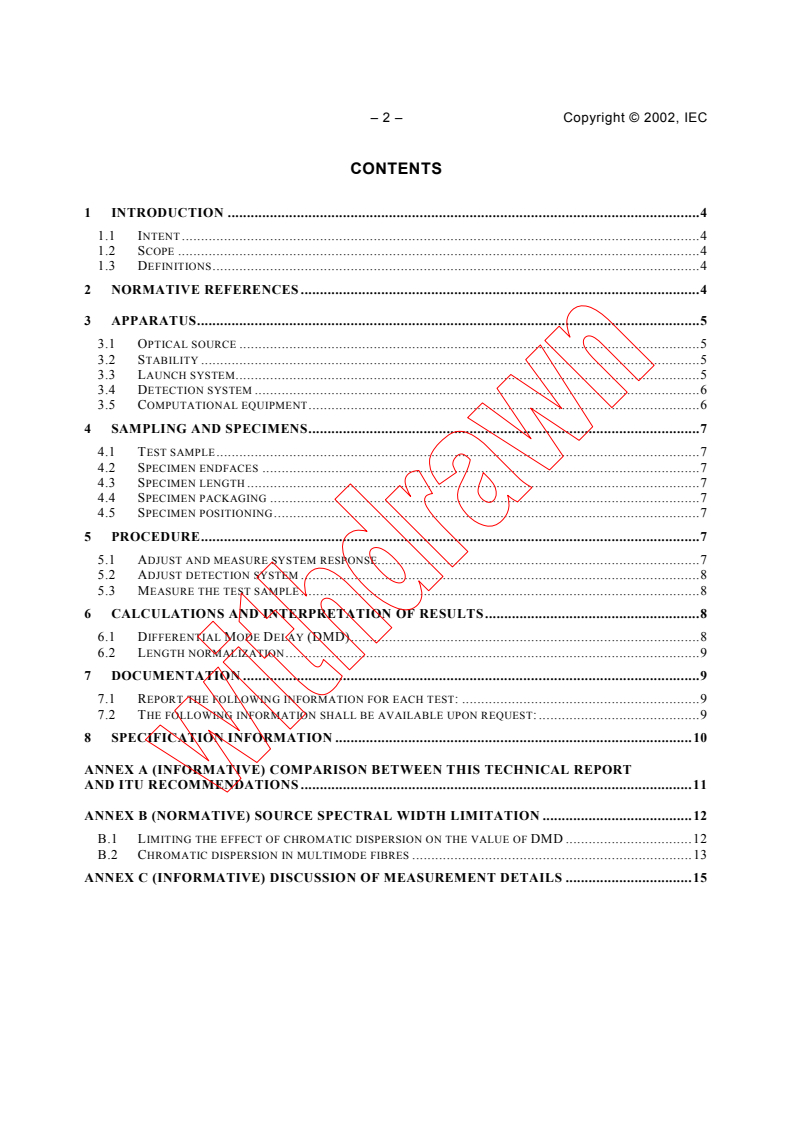
CONTENTS
1 INTRODUCTION .4
1.1 INTENT .4
1.2 SCOPE .4
1.3 DEFINITIONS.4
2 NORMATIVE REFERENCES .4
3 APPARATUS.5
3.1 OPTICAL SOURCE .5
3.2 STABILITY .5
3.3 LAUNCH SYSTEM.5
3.4 DETECTION SYSTEM .6
3.5 COMPUTATIONAL EQUIPMENT.6
4 SAMPLING AND SPECIMENS.7
4.1 TEST SAMPLE.7
4.2 SPECIMEN ENDFACES .7
4.3 SPECIMEN LENGTH .7
4.4 SPECIMEN PACKAGING .7
4.5 SPECIMEN POSITIONING.7
5 PROCEDURE.7
5.1 ADJUST AND MEASURE SYSTEM RESPONSE.7
5.2 ADJUST DETECTION SYSTEM .8
5.3 MEASURE THE TEST SAMPLE.8
6 CALCULATIONS AND INTERPRETATION OF RESULTS.8
6.1 DIFFERENTIAL MODE DELAY (DMD).8
6.2 LENGTH NORMALIZATION.9
7 DOCUMENTATION .9
7.1 REPORT THE FOLLOWING INFORMATION FOR EACH TEST: .9
7.2 THE FOLLOWING INFORMATION SHALL BE AVAILABLE UPON REQUEST: .9
8 SPECIFICATION INFORMATION .10
ANNEX A (INFORMATIVE) COMPARISON BETWEEN THIS TECHNICAL REPORT
AND ITU RECOMMENDATIONS .11
ANNEX B (NORMATIVE) SOURCE SPECTRAL WIDTH LIMITATION .12
B.1 LIMITING THE EFFECT OF CHROMATIC DISPERSION ON THE VALUE OF DMD .12
B.2 CHROMATIC DISPERSION IN MULTIMODE FIBRES .13
ANNEX C (INFORMATIVE) DISCUSSION OF MEASUREMENT DETAILS .15
– 3 – Copyright © 2002, IEC
INTERNATIONAL ELECTROTECHNICAL COMMISSION
____________
OPTICAL FIBRES −−−−
Part 1-49: Measurement methods and test procedures −−
−−
Differential mode delay
FOREWORD
A PAS is a technical specification not fulfilling the requirements for a standard, but made available to the
public.
IEC-PAS 60793-1-49 has been processed by subcommittee 86A: Fibres and cables, of IEC technical
committee 86: Fibre Optics.
The text of this PAS is based on the This PAS was approved for
following document: publication by the P-members of the
committee concerned as indicated in
the following document:
Draft PAS Report on voting
86A/767/PAS 86A/786/RVD
Following publication of this PAS, the technical committee or subcommittee concerned will investigate the
possibility of transforming the PAS into an International Standard.
1) The IEC (International Electrotechnical Commission) is a worldwide organization for standardization comprising all
national electrotechnical committees (IEC National Committees). The object of the IEC is to promote international
co-operation on all questions concerning standardization in the electrical and electronic fields. To this end and in
addition to other activities, the IEC publishes International Standards. Their preparation is entrusted to technical
committees; any IEC National Committee interested in the subject dealt with may participate in this preparatory
work. International, governmental and non-governmental organizations liaising with the IEC also participate in this
preparation. The IEC collaborates closely with the International Organization for Standardization (ISO) in
accordance with conditions determined by agreement between the two organizations.
2) The formal decisions or agreements of the IEC on technical matters express, as nearly as possible, an international
consensus of opinion on the relevant subjects since each technical committee has representation from all
interested National Committees.
3) The documents produced have the form of recommendations for international use and are published in the form of
standards, technical specifications, technical reports or guides and they are accepted by the National Committees
in that sense.
4) In order to promote international unification, IEC National Committees undertake to apply IEC International
Standards transparently to the maximum extent possible in their national and regional standards. Any divergence
between the IEC Standard and the corresponding national or regional standard shall be clearly indicated in the
latter.
5) The IEC provides no marking procedure to indicate its approval and cannot be rendered responsible for any
equipment declared to be in conformity with one of its standards.
6) Attention is drawn to the possibility that some of the elements of this Specification may be the subject of patent
rights. The IEC shall not be held responsible for identifying any or all such patent rights.
– 4 – Copyright © 2002, IEC
OPTICAL FIBRES –
Part 1-49 : Measurement methods and test procedures –
Differential mode delay
1 Introduction
1.1 Intent
This technical specification describes a method for characterizing the modal structure of a
graded-index multimode fibre. This information is useful for assessing the bandwidth
performance of a fibre when used with laser sources.
With this method, the output from a fibre that is single-mode at the test wavelength excites the
multimode fibre under test. The probe spot is scanned across the endface of the fibre under
test, and the optical pulse delay is determined at specified offset positions. The difference in
optical pulse delay time between the fastest and slowest modes of the fibre under test is
determined. The user specifies the upper and lower limits of radial offset positions over which
the probe fibre is scanned in order to specify desired limits of modal structure.
1.2 Scope
This technical specification applies only to multimode, graded-index glass-core (category A1)
fibres. The test method is commonly used in production and research facilities, but is not easily
accomplished in the field.
1.3 Definitions
The user of this standard specifies the inner (R ) and outer (R ) limits of radial offset
INNER OUTER
positions on the endface of the fibre under test over which the probe spot is scanned. The
estimated difference in optical pulse delay time between the fastest and slowest modes excited
for all radial offset positions between and including R and R will be called Differential
INNER OUTER
Mode Delay (DMD).
2 Normative References
The following normative documents contain provisions, which, through reference in this text,
constitute provisions of this technical specification. For dated references, subsequent
amendments to, or revisions of, any of these publications do not apply. However, parties to
agreements based on this technical specification are encouraged to investigate the possibility of
applying the most recent editions of the normative documents indicated below. For undated
references, the latest edition of the normative document referred to applies. Members of IEC and
ISO maintain registers of currently valid International Standards.
IEC 60825-1: Safety of laser products − Part 1: Equipment classification, requirements and
user's guide.
IEC 60825-2: Safety of laser products − Part 2: Safety of optical fibre communication systems.
IEC 60793-1-1: Optical fibres − Part 1: Generic specification − Section 1: General
IEC 60793-1-22: Optical fibres − Part 1-22: Measurement methods and test procedures – Length
measurement
IEC 60793-1-42: Optical fibres − Part 1-42: Measurement methods and test procedures −
Chromatic dispersion
IEC 60793-1-45: Optical fibres − Part 1-45: Measurement methods and test procedures – Mode
field diameter
– 5 – Copyright © 2002, IEC
3 Apparatus
3.1 Optical source
Use an optical source that introduces short duration, narrow spectral width pulses into the probe fiber.
The temporal duration of the optical pulse shall be short enough to measure the intended differential
delay time. The maximum duration allowed for the optical pulse, characterized as full width at 25% of
maximum amplitude, will depend both on the value of DMD to be determined and the sample length. For
example, if the desired DMD limit is 0.20 ps/m over a sample of length 500 m, the DMD to be measured is
100 ps, and a pulse of duration less than ~110 ps is needed. Testing to the same DMD limit in a
10 000 m length of fiber requires measuring a DMD of 2000 ps, and a pulse a wide as ~2200 ps may be
used. Detailed limits are given in section 6.1, and may depend on the source spectral width.
Chromatic dispersion induced broadening resulting from source spectral width shall be within the limits
indicated in Annex B. The requirement on spectral width may be met either by using a spectrally narrow
source, or alternatively by the use of appropriate optical filtering at either the source or detection end.
The centre wavelength shall be within ± 10 nm of the nominal specified wavelength.
A mode locked Titanium-Sapphire laser is an example of a source usable for this application.
3.2 Stability
Devices shall be available to position the input and output ends of the test specimen with
sufficient stability and reproducibility to meet the conditions of sections 3.3.3 to 3.3.6 and
section 3.4.1.
3.3 Launch system
3.3.1 The probe fibre between the light source and test sample shall propagate only a single
mode at the measurement wavelength. The mode field diameter of the probe fibre at λ
shall be (8.7λ -2.39) ± 0.5 μm, where λ is the measurement wavelength in micrometers,
and the mode field diameter is determined using IEC 60793-1-45. This equation
produces a mode field diameter of 5 μm at 850 nm and 9 μm at 1310 nm, which
corresponds to commercially available single-mode fibres.
3.3.2 Ensure that the output of the probe fibre is single-mode. One method to do this is to strip
higher order modes by wrapping the probe fibre three turns around a 25-mm diameter
mandrel.
3.3.3 The output spot of the probe fibre shall be scanned across the endface of the test sample
with a positional accuracy less than or equal to ± 0.5 μm.
3.3.4 The output beam from the probe fibre shall be perpendicular to the endface of the test
sample to within an angular tolerance of less than 1.0 degree.
3.3.5 The launch system shall be capable of reproducibly centring the output spot of the probe
fibre to within ±1.0 μm.
3.3.6 If directly coupled to the test sample, the gap between the output end of the probe fibre
and the endface of the test sample shall be no more than 10 μm.
– 6 – Copyright © 2002, IEC
3.3.7 A free space optics system of lenses or mirrors may be used to image the output spot of
the probe fibre onto the endface of the test sample. When using this type of launch
system, care should be taken to ensure that substantially the same modes are excited in
the test fibre as would be if the beam were coupled directly from the output of the single-
mode probe fibre. For example, a free space optics launch system shall not vignette the
beam, shall preserve the size of the probe spot on the fibre under test, and shall
preserve the wavefront coherence of the beam from the probe fibre.
3.3.8 Provide means to remove cladding light from the test sample. Often the fibre coating is
sufficient to perform this function. Otherwise, use cladding mode strippers near both ends
of the test sample. If the fibre is retained on the cladding mode stripper(s) with small
weights, care shall be taken to avoid microbending at these sites.
3.4 Detection system
3.4.1 Use an optical detection apparatus suitable for the test wavelength. The detection
apparatus shall couple all of the guided modes from the test sample onto the detector's
active area, such that the detection sensitivity is not significantly mode dependent. The
detector, along with any signal preamplifier, shall respond linearly (within ± 5%) over the
range of power detected.
If an optical attenuator is used to control the optical intensity on the detector, the
attenuator shall not be significantly mode dependent. Additionally, the temporal response
of the detection apparatus shall not be significantly mode dependent.
A specific test for mode dependence is given in section 5.1.4.3. Alternatively, the
detector’s temporal response may be a function of offset as long as it is stable over the
course of the measurement (i.e. ΔT (r) shall fulfil the ± 5% requirement of sections
PULSE
5.1.4.1 and 5.1.4.2).
3.4.2 Ringing of the detector system shall be limited such that maximum overshoot or
undershoot shall be less than 5% of the peak amplitude of the detected optical signal as
measured on the reference.
3.4.3 The waveform of the detected optical signal shall be recorded and displayed on a
suitable instrument, such as a high-speed sampling oscilloscope with calibrated time
sweep. The recording system should be capable of averaging the detected waveform for
multiple optical pulses.
3.4.4 Use a delay device, such as a digital delay generator, to provide a means of triggering
the detection electronics at the correct time. The delay device may trigger the optical
source, or be triggered by it. The delay device may be internal or external to the
recording instrument.
3.4.5 The combined effect of timing jitter and noise in the detection system shall be small
enough that the difference between successive measurements of optical delay times for
any fixed launch used in the measurement shall be less than 5% of the measured value
of DMD. Averaging the detected waveform for multiple optical pulses may be used to
reduce the effects of timing jitter and noise. If averaging is used, the same number of
averages shall be used in recording all waveforms. The system shall maintain this level
of stability over the course of the measurement.
3.5 Computational equipment
This test method generally requires a computer to store the intermediate data and calculate the
test results.
– 7 – Copyright © 2002, IEC
4 Sampling and specimens
4.1 Test sample
The test sample shall be graded-index glass-core (category A1) multimode fibre.
4.2 Specimen endfaces
Prepare flat endfaces at the input and output ends of the specimen.
4.3 Specimen length
The length of the fibre shall be measured using a suitably accurate method such as IEC 60793-
1-22
...