

IEC 61196-5:2022
(Main)Coaxial communication cables - Part 5: Sectional specification for CATV trunk and distribution cables
General Information
- Abstract
IEC 61196-5:2022, which is a sectional specification, applies to coaxial cables for analogue and digital one- and two-way signal transmission, for example for cable networks for television signals, sound signals and interactive services in accordance with IEC 60728-1, IEC 60728-1-1, IEC 60728-101, IEC 60728-10, ISO/IEC 11801-1 and ISO/IEC 11801-4. This includes also the transmission of BCT signals provided by a CATV, MATV or SMATV cable networks.
This document specifies the test procedures and requirements for trunk and distribution cables for temperatures between −40 °C and +65 °C and in the frequency range of 5 MHz to 2 000 MHz.
This fourth edition cancels and replaces the third edition published in 2018. This edition includes the following significant technical changes with respect to the previous edition:
a. complete revision; b. cable identification and marking has been added; c. Table B.1, cable types have been added.
- Status
- Published
- Publication Date
- 15-Dec-2022
- Technical Committee
- SC 46A - Coaxial cables
- Drafting Committee
- WG 3 - TC 46/SC 46A/WG 3
- Current Stage
- PPUB - Publication issued
- Start Date
- 16-Dec-2022
- Completion Date
- 06-Jan-2023
Buy Documents
IEC 61196-5:2022 - Coaxial communication cables - Part 5: Sectional specification for CATV trunk and distribution cables Released:12/16/2022
REDLINE IEC 61196-5:2022 CMV - Coaxial communication cables - Part 5: Sectional specification for CATV trunk and distribution cables Released:12/16/2022
Overview
IEC 61196-5:2022 is the fourth edition sectional specification for coaxial communication cables used in CATV trunk and distribution networks. It applies to coaxial cables for analogue and digital one- and two-way signal transmission - including CATV, MATV and SMATV systems - in the frequency range 5 MHz to 2000 MHz and for operating temperatures from −40 °C to +65 °C. This edition updates and replaces the 2018 edition and adds formal cable identification and marking rules plus a table of preferred cable types.
Key topics and requirements
The standard focuses on construction, testing and quality for trunk and distribution coaxial cables:
- Cable construction and materials: inner conductor, dielectric, outer conductor/screen, sheaths, moisture barriers, fillers, metallic protection, and optional messenger wires.
- Identification and marking: required type names, variants, screening classes and sheath marking (new in 2022).
- Electrical tests: low-frequency/DC measurements and high-frequency transmission tests (return loss, characteristic impedance, attenuation, delay) as referenced to IEC 61196‑1 series test methods.
- Environmental tests: climatic, thermal cycling, water penetration, UV stability and damp heat per referenced IEC methods.
- Mechanical tests: ovality, eccentricity, tensile, torsion, bending, crush and maximum pulling force requirements.
- Fire performance and quality assessment: specified fire requirements and guidance for factory testing, delivery and storage.
- Annexes: Annex A on cable identification/marking (normative) and Annex B with preferred nominal dimensions and cable types (informative).
Applications and who uses it
IEC 61196-5:2022 is essential for:
- Cable manufacturers specifying and verifying CATV trunk and distribution products.
- Network operators and system integrators designing and deploying cable-TV, broadband and two-way interactive services.
- Test laboratories and conformity assessors performing electrical, environmental and mechanical tests.
- Procurement, installation and maintenance teams ensuring installed cable meets performance and marking requirements.
Practical benefits include consistent product performance across the 5 MHz–2000 MHz band, reliable two‑way signal transport, predictable environmental durability (−40 °C to +65 °C), and traceable cable identification for network lifecycle management.
Related standards
IEC 61196-5 references and aligns with other standards for system and test methods, including:
- IEC 61196‑1 series (generic coaxial cable test methods)
- IEC 60728 series (cable networks for television and interactive services)
- ISO/IEC 11801‑1 and 11801‑4 (structured cabling interfaces)
Keywords: IEC 61196-5:2022, coaxial communication cables, CATV trunk and distribution cables, cable testing, cable identification and marking, 5 MHz–2000 MHz, −40 °C to +65 °C.
Relations
- Effective Date
- 05-Sep-2023
Buy Documents
IEC 61196-5:2022 - Coaxial communication cables - Part 5: Sectional specification for CATV trunk and distribution cables Released:12/16/2022
REDLINE IEC 61196-5:2022 CMV - Coaxial communication cables - Part 5: Sectional specification for CATV trunk and distribution cables Released:12/16/2022
Get Certified
Connect with accredited certification bodies for this standard

ANCE
Mexican certification and testing association.

Intertek Slovenia
Intertek testing, inspection, and certification services in Slovenia.

LNE (Laboratoire National de Métrologie et d'Essais)
French national laboratory for metrology and testing.
Sponsored listings
Frequently Asked Questions
IEC 61196-5:2022 is a standard published by the International Electrotechnical Commission (IEC). Its full title is "Coaxial communication cables - Part 5: Sectional specification for CATV trunk and distribution cables". This standard covers: IEC 61196-5:2022, which is a sectional specification, applies to coaxial cables for analogue and digital one- and two-way signal transmission, for example for cable networks for television signals, sound signals and interactive services in accordance with IEC 60728-1, IEC 60728-1-1, IEC 60728-101, IEC 60728-10, ISO/IEC 11801-1 and ISO/IEC 11801-4. This includes also the transmission of BCT signals provided by a CATV, MATV or SMATV cable networks. This document specifies the test procedures and requirements for trunk and distribution cables for temperatures between −40 °C and +65 °C and in the frequency range of 5 MHz to 2 000 MHz. This fourth edition cancels and replaces the third edition published in 2018. This edition includes the following significant technical changes with respect to the previous edition: a. complete revision; b. cable identification and marking has been added; c. Table B.1, cable types have been added.
IEC 61196-5:2022, which is a sectional specification, applies to coaxial cables for analogue and digital one- and two-way signal transmission, for example for cable networks for television signals, sound signals and interactive services in accordance with IEC 60728-1, IEC 60728-1-1, IEC 60728-101, IEC 60728-10, ISO/IEC 11801-1 and ISO/IEC 11801-4. This includes also the transmission of BCT signals provided by a CATV, MATV or SMATV cable networks. This document specifies the test procedures and requirements for trunk and distribution cables for temperatures between −40 °C and +65 °C and in the frequency range of 5 MHz to 2 000 MHz. This fourth edition cancels and replaces the third edition published in 2018. This edition includes the following significant technical changes with respect to the previous edition: a. complete revision; b. cable identification and marking has been added; c. Table B.1, cable types have been added.
IEC 61196-5:2022 is classified under the following ICS (International Classification for Standards) categories: 33.120.10 - Coaxial cables. Waveguides. The ICS classification helps identify the subject area and facilitates finding related standards.
IEC 61196-5:2022 has the following relationships with other standards: It is inter standard links to IEC 61196-5:2018. Understanding these relationships helps ensure you are using the most current and applicable version of the standard.
IEC 61196-5:2022 is available in PDF format for immediate download after purchase. The document can be added to your cart and obtained through the secure checkout process. Digital delivery ensures instant access to the complete standard document.
Standards Content (Sample)
IEC 61196-5 ®
Edition 4.0 2022-12
INTERNATIONAL
STANDARD
Coaxial communication cables –
Part 5: Sectional specification for CATV trunk and distribution cables
All rights reserved. Unless otherwise specified, no part of this publication may be reproduced or utilized in any form
or by any means, electronic or mechanical, including photocopying and microfilm, without permission in writing from
either IEC or IEC's member National Committee in the country of the requester. If you have any questions about IEC
copyright or have an enquiry about obtaining additional rights to this publication, please contact the address below or
your local IEC member National Committee for further information.
IEC Secretariat Tel.: +41 22 919 02 11
3, rue de Varembé info@iec.ch
CH-1211 Geneva 20 www.iec.ch
Switzerland
About the IEC
The International Electrotechnical Commission (IEC) is the leading global organization that prepares and publishes
International Standards for all electrical, electronic and related technologies.
About IEC publications
The technical content of IEC publications is kept under constant review by the IEC. Please make sure that you have the
latest edition, a corrigendum or an amendment might have been published.
IEC publications search - webstore.iec.ch/advsearchform IEC Products & Services Portal - products.iec.ch
The advanced search enables to find IEC publications by a Discover our powerful search engine and read freely all the
variety of criteria (reference number, text, technical publications previews. With a subscription you will always
committee, …). It also gives information on projects, replaced have access to up to date content tailored to your needs.
and withdrawn publications.
Electropedia - www.electropedia.org
IEC Just Published - webstore.iec.ch/justpublished
The world's leading online dictionary on electrotechnology,
Stay up to date on all new IEC publications. Just Published
containing more than 22 300 terminological entries in English
details all new publications released. Available online and
and French, with equivalent terms in 19 additional languages.
once a month by email.
Also known as the International Electrotechnical Vocabulary
(IEV) online.
IEC Customer Service Centre - webstore.iec.ch/csc
If you wish to give us your feedback on this publication or
need further assistance, please contact the Customer Service
Centre: sales@iec.ch.
IEC 61196-5 ®
Edition 4.0 2022-12
INTERNATIONAL
STANDARD
Coaxial communication cables –
Part 5: Sectional specification for CATV trunk and distribution cables
INTERNATIONAL
ELECTROTECHNICAL
COMMISSION
ICS 33.120.10 ISBN 978-2-8322-6147-7
– 2 – IEC 61196-5:2022 © IEC 2022
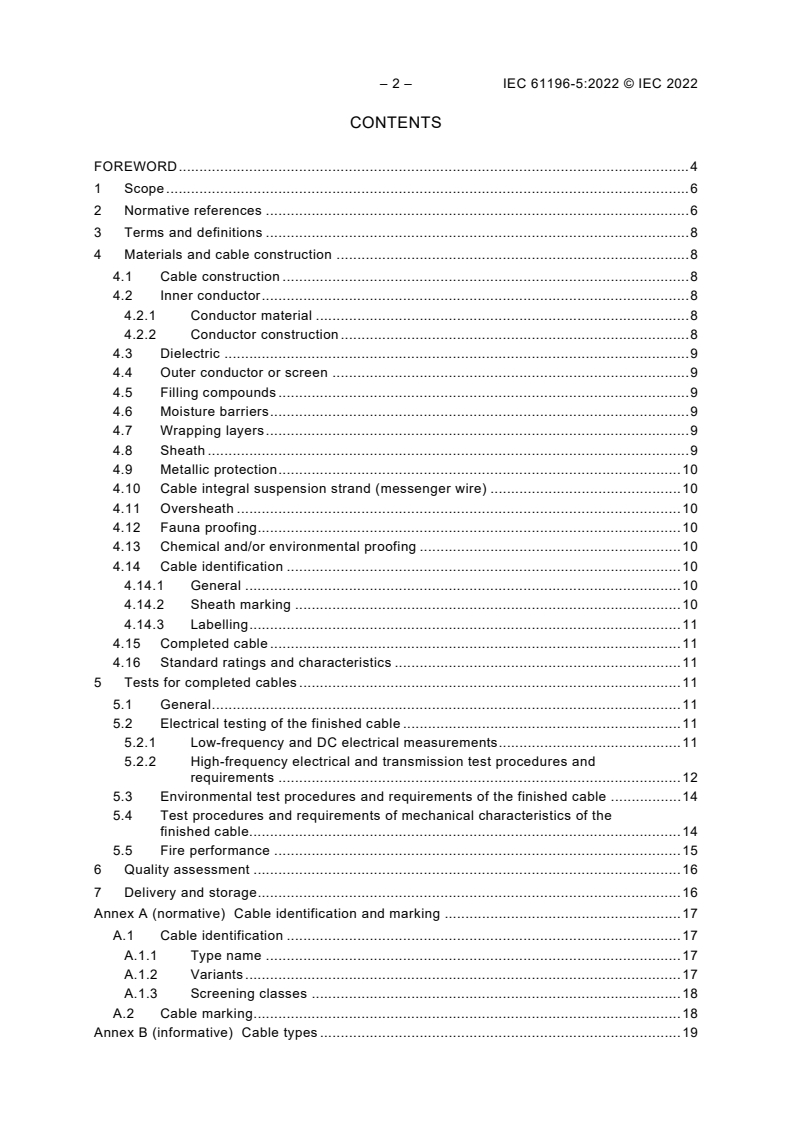
CONTENTS
FOREWORD . 4
1 Scope . 6
2 Normative references . 6
3 Terms and definitions . 8
4 Materials and cable construction . 8
4.1 Cable construction . 8
4.2 Inner conductor . 8
4.2.1 Conductor material . 8
4.2.2 Conductor construction . 8
4.3 Dielectric . 9
4.4 Outer conductor or screen . 9
4.5 Filling compounds . 9
4.6 Moisture barriers . 9
4.7 Wrapping layers . 9
4.8 Sheath . 9
4.9 Metallic protection . 10
4.10 Cable integral suspension strand (messenger wire) . 10
4.11 Oversheath . 10
4.12 Fauna proofing . 10
4.13 Chemical and/or environmental proofing . 10
4.14 Cable identification . 10
4.14.1 General . 10
4.14.2 Sheath marking . 10
4.14.3 Labelling . 11
4.15 Completed cable . 11
4.16 Standard ratings and characteristics . 11
5 Tests for completed cables . 11
5.1 General . 11
5.2 Electrical testing of the finished cable . 11
5.2.1 Low-frequency and DC electrical measurements . 11
5.2.2 High-frequency electrical and transmission test procedures and
requirements . 12
5.3 Environmental test procedures and requirements of the finished cable . 14
5.4 Test procedures and requirements of mechanical characteristics of the
finished cable. 14
5.5 Fire performance . 15
6 Quality assessment . 16
7 Delivery and storage . 16
Annex A (normative) Cable identification and marking . 17
A.1 Cable identification . 17
A.1.1 Type name . 17
A.1.2 Variants . 17
A.1.3 Screening classes . 18
A.2 Cable marking . 18
Annex B (informative) Cable types . 19
Table 1 – Low-frequency and DC test procedures and requirements . 12
Table 2 – High-frequency electrical and transmission test procedures and requirements . 13
Table 3 – Environmental test procedures and requirements of the finished cable . 14
Table 4 – Test procedures and requirements of mechanical characteristics of the
finished cable . 15
Table 5 – Fire performance requirements . 16
Table B.1 – Distribution and trunk cables – Preferred nominal dimensions and ratings . 19
– 4 – IEC 61196-5:2022 © IEC 2022
INTERNATIONAL ELECTROTECHNICAL COMMISSION
____________
COAXIAL COMMUNICATION CABLES –
Part 5: Sectional specification for CATV trunk
and distribution cables
FOREWORD
1) The International Electrotechnical Commission (IEC) is a worldwide organization for standardization comprising
all national electrotechnical committees (IEC National Committees). The object of IEC is to promote international
co-operation on all questions concerning standardization in the electrical and electronic fields. To this end and
in addition to other activities, IEC publishes International Standards, Technical Specifications, Technical Reports,
Publicly Available Specifications (PAS) and Guides (hereafter referred to as “IEC Publication(s)”). Their
preparation is entrusted to technical committees; any IEC National Committee interested in the subject dealt with
may participate in this preparatory work. International, governmental and non-governmental organizations liaising
with the IEC also participate in this preparation. IEC collaborates closely with the International Organization for
Standardization (ISO) in accordance with conditions determined by agreement between the two organizations.
2) The formal decisions or agreements of IEC on technical matters express, as nearly as possible, an international
consensus of opinion on the relevant subjects since each technical committee has representation from all
interested IEC National Committees.
3) IEC Publications have the form of recommendations for international use and are accepted by IEC National
Committees in that sense. While all reasonable efforts are made to ensure that the technical content of IEC
Publications is accurate, IEC cannot be held responsible for the way in which they are used or for any
misinterpretation by any end user.
4) In order to promote international uniformity, IEC National Committees undertake to apply IEC Publications
transparently to the maximum extent possible in their national and regional publications. Any divergence between
any IEC Publication and the corresponding national or regional publication shall be clearly indicated in the latter.
5) IEC itself does not provide any attestation of conformity. Independent certification bodies provide conformity
assessment services and, in some areas, access to IEC marks of conformity. IEC is not responsible for any
services carried out by independent certification bodies.
6) All users should ensure that they have the latest edition of this publication.
7) No liability shall attach to IEC or its directors, employees, servants or agents including individual experts and
members of its technical committees and IEC National Committees for any personal injury, property damage or
other damage of any nature whatsoever, whether direct or indirect, or for costs (including legal fees) and
expenses arising out of the publication, use of, or reliance upon, this IEC Publication or any other IEC
Publications.
8) Attention is drawn to the Normative references cited in this publication. Use of the referenced publications is
indispensable for the correct application of this publication.
9) Attention is drawn to the possibility that some of the elements of this IEC Publication may be the subject of patent
rights. IEC shall not be held responsible for identifying any or all such patent rights.
IEC 61196-5 has been prepared by subcommittee 46A: Coaxial cables, of IEC technical
committee 46: Cables, wires, waveguides, RF connectors, RF and microwave passive
components and accessories. It is an International Standard.
This fourth edition cancels and replaces the third edition published in 2018. This edition
constitutes a technical revision.
This edition includes the following significant technical changes with respect to the previous
edition:
a) Clause 4: complete revision;
b) Annex A: cable identification and marking has been added;
c) Annex B: Table B.1, cable types have been added.
The text of this International Standard is based on the following documents:
Draft Report on voting
46A/1605/FDIS 46A/1610/RVD
Full information on the voting for its approval can be found in the report on voting indicated in
the above table.
The language used for the development of this International Standard is English.
A list of all parts in the IEC 61196 series, published under the general title Coaxial
communication cables, can be found on the IEC website.
This document was drafted in accordance with ISO/IEC Directives, Part 2, and developed in
accordance with ISO/IEC Directives, Part 1 and ISO/IEC Directives, IEC Supplement, available
at www.iec.ch/members_experts/refdocs. The main document types developed by IEC are
described in greater detail at www.iec.ch/publications.
The committee has decided that the contents of this document will remain unchanged until the
stability date indicated on the IEC website under webstore.iec.ch in the data related to the
specific document. At this date, the document will be
• reconfirmed,
• withdrawn,
• replaced by a revised edition, or
• amended.
– 6 – IEC 61196-5:2022 © IEC 2022
COAXIAL COMMUNICATION CABLES –
Part 5: Sectional specification for CATV trunk
and distribution cables
1 Scope
This part of IEC 61196, which is a sectional specification, applies to coaxial cables for analogue
and digital one- and two-way signal transmission, for example for cable networks for television
signals, sound signals and interactive services in accordance with IEC 60728-1, IEC 60728-1-1,
IEC 60728-101, IEC 60728-10, ISO/IEC 11801-1 and ISO/IEC 11801-4. This includes also the
transmission of BCT signals provided by a CATV, MATV or SMATV cable networks.
This document specifies the test procedures and requirements for trunk and distribution cables
for temperatures between −40 °C and +65 °C and in the frequency range of 5 MHz to
2 000 MHz.
2 Normative references
The following documents are referred to in the text in such a way that some or all of their content
constitutes requirements of this document. For dated references, only the edition cited applies.
For undated references, the latest edition of the referenced document (including any
amendments) applies.
IEC 60068-1:2012, Environmental testing – Part 1: General and guidance
IEC 60068-2-78, Environmental testing – Part 2-78: Tests – Test Cab: Damp heat, steady state
IEC 60096-0-1, Radio Frequency cables – Part 0-1: Guide to the design of detail specifications
– Coaxial cables
IEC 60728-1, Cable networks for television signals, sound signals and interactive services –
Part 1: System performance of forward paths
IEC 60811-410, Electric and optical fibre cables – Test methods for non-metallic materials –
Part 410: Miscellaneous tests – Test method for copper-catalyzed oxidative degradation of
polyolefin insulated conductors
IEC 60811-605, Electric and optical fibre cables – Test methods for non-metallic materials –
Part 605: Physical tests – Measurement of carbon black and/or mineral filler in polyethylene
compounds
IEC 61196-1:2005, Coaxial communication cables – Part 1: Generic specification – General,
definitions and requirements
IEC 61196-1-1, Coaxial communication cables – Part 1-1: Capability approval for coaxial cables
IEC 61196-1-101, Coaxial communication cables – Part 1-101: Electrical test methods – Test
for conductor d.c. resistance of cable
IEC 61196-1-102, Coaxial communication cables – Part 1-102: Electrical test methods – Test
for insulation resistance of cable dielectric
IEC 61196-1-105, Coaxial communication cables – Part 1-105: Electrical test methods – Test
for withstand voltage of cable dielectric
IEC 61196-1-106, Coaxial communication cables – Part 1-106: Electrical test methods – Test
for withstand voltage of cable sheath
IEC 61196-1-108, Coaxial communication cables – Part 1-108: Electrical test methods – Test
for characteristic impedance, phase and group delay, electrical length and propagation velocity
IEC 61196-1-112, Coaxial communication cables – Part 1-112: Electrical test methods – Test
for return loss (uniformity of impedance)
IEC 61196-1-113, Coaxial communication cables – Part 1-113: Electrical test methods – Test
for attenuation constant
IEC 61196-1-115, Coaxial communication cables – Part 1-115: Electrical test methods – Test
for regularity of impedance (pulse/step function return loss)
IEC 61196-1-201, Coaxial communication cables – Part 1-201: Environmental test methods –
Test for cold bend performance of cable
IEC 61196-1-203, Coaxial communication cables – Part 1-203: Environmental test methods –
Test for water penetration of cable
IEC 61196-1-206, Coaxial communication cables – Part 1-206: Environmental test methods –
Climatic sequence
IEC 61196-1-209, Coaxial communication cables – Part 1-209: Environmental test methods –
Thermal cycling
IEC 61196-1-212, Coaxial communication cables – Part 1-212: Environmental test methods –
UV stability
IEC 61196-1-301, Coaxial communication cables – Part 1-301: Mechanical test methods – Test
for ovality
IEC 61196-1-302, Coaxial communication cables – Part 1-302: Mechanical test methods – Test
for eccentricity
IEC 61196-1-308, Coaxial communication cables – Part 1-308: Mechanical test methods – Test
for tensile strength and elongation for copper-clad metals
IEC 61196-1-310, Coaxial communication cables – Part 1-310: Mechanical test methods – Test
for torsion characteristics of copper-clad metals
IEC 61196-1-313, Coaxial communication cables – Part 1-313: Mechanical test methods –
Adhesion of dielectric and sheath
IEC 61196-1-314, Coaxial communication cables – Part 1-314: Mechanical test methods – Test
for bending
IEC 61196-1-316, Coaxial communication cables – Part 1-316: Mechanical test methods – Test
of maximum pulling force of cable
IEC 61196-1-317, Coaxial communication cables – Part 1-317: Mechanical test methods – Test
for crush resistance of cable
– 8 – IEC 61196-5:2022 © IEC 2022
IEC 61196-1-324, Coaxial communication cables – Part 1-324: Mechanical test methods – Test
for abrasion resistance of cable
IEC 62153-1-1, Metallic communication cables test methods – Part 1-1: Electrical –
Measurement of the pulse/step return loss in the frequency domain using the Inverse Discrete
Fourier Transformation (IDFT)
IEC 62153-4-3, Metallic communication cable test methods – Part 4-3: Electromagnetic
compatibility (EMC) – Surface transfer impedance – Triaxial method
IEC 62153-4-4, Metallic communication cable test methods – Part 4-4: Electromagnetic
compatibility (EMC) – Test method for measuring of the screening attenuation as up to and
above 3 GHz, triaxial method
3 Terms and definitions
For the purposes of this do
...
IEC 61196-5 ®
Edition 4.0 2022-12
COMMENTED VERSION
INTERNATIONAL
STANDARD
colour
inside
Coaxial communication cables –
Part 5: Sectional specification for CATV trunk and distribution cables
All rights reserved. Unless otherwise specified, no part of this publication may be reproduced or utilized in any form
or by any means, electronic or mechanical, including photocopying and microfilm, without permission in writing from
either IEC or IEC's member National Committee in the country of the requester. If you have any questions about IEC
copyright or have an enquiry about obtaining additional rights to this publication, please contact the address below or
your local IEC member National Committee for further information.
IEC Secretariat Tel.: +41 22 919 02 11
3, rue de Varembé info@iec.ch
CH-1211 Geneva 20 www.iec.ch
Switzerland
About the IEC
The International Electrotechnical Commission (IEC) is the leading global organization that prepares and publishes
International Standards for all electrical, electronic and related technologies.
About IEC publications
The technical content of IEC publications is kept under constant review by the IEC. Please make sure that you have the
latest edition, a corrigendum or an amendment might have been published.
IEC publications search - webstore.iec.ch/advsearchform IEC Products & Services Portal - products.iec.ch
The advanced search enables to find IEC publications by a
Discover our powerful search engine and read freely all the
variety of criteria (reference number, text, technical publications previews. With a subscription you will always
committee, …). It also gives information on projects, replaced have access to up to date content tailored to your needs.
and withdrawn publications.
Electropedia - www.electropedia.org
IEC Just Published - webstore.iec.ch/justpublished
The world's leading online dictionary on electrotechnology,
Stay up to date on all new IEC publications. Just Published
containing more than 22 300 terminological entries in English
details all new publications released. Available online and
and French, with equivalent terms in 19 additional languages.
once a month by email.
Also known as the International Electrotechnical Vocabulary
(IEV) online.
IEC Customer Service Centre - webstore.iec.ch/csc
If you wish to give us your feedback on this publication or
need further assistance, please contact the Customer Service
Centre: sales@iec.ch.
IEC 61196-5 ®
Edition 4.0 2022-12
COMMENTED VERSION
INTERNATIONAL
STANDARD
colour
inside
Coaxial communication cables –
Part 5: Sectional specification for CATV trunk and distribution cables
INTERNATIONAL
ELECTROTECHNICAL
COMMISSION
ICS 33.120.10 ISBN 978-2-8322-6309-9
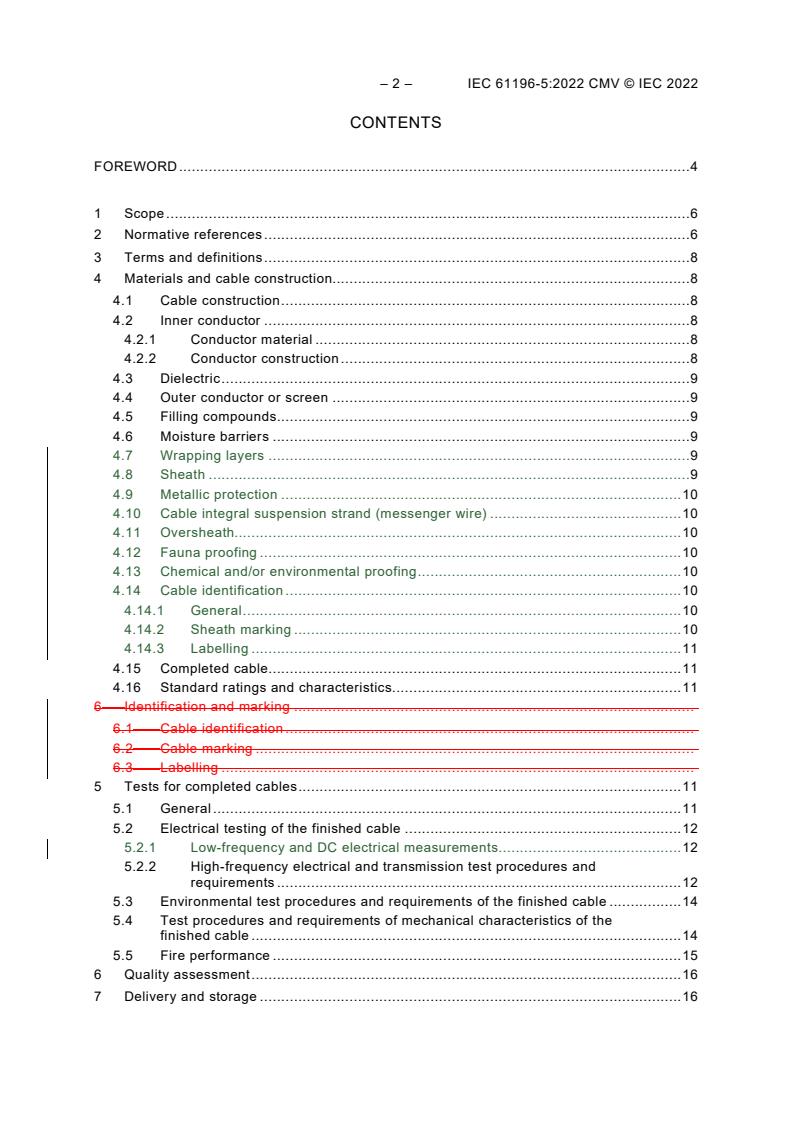
– 2 – IEC 61196-5:2022 CMV © IEC 2022
CONTENTS
FOREWORD .4
1 Scope .6
2 Normative references .6
3 Terms and definitions .8
4 Materials and cable construction.8
4.1 Cable construction .8
4.2 Inner conductor .8
4.2.1 Conductor material .8
4.2.2 Conductor construction .8
4.3 Dielectric .9
4.4 Outer conductor or screen .9
4.5 Filling compounds .9
4.6 Moisture barriers .9
4.7 Wrapping layers .9
4.8 Sheath .9
4.9 Metallic protection . 10
4.10 Cable integral suspension strand (messenger wire) . 10
4.11 Oversheath. 10
4.12 Fauna proofing . 10
4.13 Chemical and/or environmental proofing . 10
4.14 Cable identification . 10
4.14.1 General . 10
4.14.2 Sheath marking . 10
4.14.3 Labelling . 11
4.15 Completed cable . 11
4.16 Standard ratings and characteristics. 11
6 Identification and marking .
6.1 Cable identification .
6.2 Cable marking .
6.3 Labelling .
5 Tests for completed cables . 11
5.1 General . 11
5.2 Electrical testing of the finished cable . 12
5.2.1 Low-frequency and DC electrical measurements . 12
5.2.2 High-frequency electrical and transmission test procedures and
requirements . 12
5.3 Environmental test procedures and requirements of the finished cable . 14
5.4 Test procedures and requirements of mechanical characteristics of the
finished cable . 14
5.5 Fire performance . 15
6 Quality assessment . 16
7 Delivery and storage . 16
Annex A (normative) Cable identification and marking . 17
A.1 Cable identification . 17
A.1.1 Type name . 17
A.1.2 Variants . 17
A.1.3 Screening classes . 18
A.2 Cable marking . 18
Annex B (informative) Cable types . 19
List of comments . 20
Table 1 – Low-frequency and DC test procedures and requirements . 12
Table 2 – High-frequency electrical and transmission test procedures and requirements . 13
Table 3 – Environmental test procedures and requirements of the finished cable. 14
Table 4 – Test procedures and requirements of mechanical characteristics of the
finished cable. 15
Table 5 – Fire performance requirements . 16
Table B.1 – Distribution and trunk cables – Preferred nominal dimensions and ratings . 19
– 4 – IEC 61196-5:2022 CMV © IEC 2022
INTERNATIONAL ELECTROTECHNICAL COMMISSION
____________
COAXIAL COMMUNICATION CABLES –
Part 5: Sectional specification for CATV trunk
and distribution cables
FOREWORD
1) The International Electrotechnical Commission (IEC) is a worldwide organization for standardization comprising
all national electrotechnical committees (IEC National Committees). The object of IEC is to promote international
co-operation on all questions concerning standardization in the electrical and electronic fields. To this end and
in addition to other activities, IEC publishes International Standards, Technical Specifications, Technical Reports,
Publicly Available Specifications (PAS) and Guides (hereafter referred to as “IEC Publication(s)”). Their
preparation is entrusted to technical committees; any IEC National Committee interested in the subject dealt with
may participate in this preparatory work. International, governmental and non-governmental organizations liaising
with the IEC also participate in this preparation. IEC collaborates closely with the International Organization for
Standardization (ISO) in accordance with conditions determined by agreement between the two organizations.
2) The formal decisions or agreements of IEC on technical matters express, as nearly as possible, an international
consensus of opinion on the relevant subjects since each technical committee has representation from all
interested IEC National Committees.
3) IEC Publications have the form of recommendations for international use and are accepted by IEC National
Committees in that sense. While all reasonable efforts are made to ensure that the technical content of IEC
Publications is accurate, IEC cannot be held responsible for the way in which they are used or for any
misinterpretation by any end user.
4) In order to promote international uniformity, IEC National Committees undertake to apply IEC Publications
transparently to the maximum extent possible in their national and regional publications. Any divergence between
any IEC Publication and the corresponding national or regional publication shall be clearly indicated in the latter.
5) IEC itself does not provide any attestation of conformity. Independent certification bodies provide conformity
assessment services and, in some areas, access to IEC marks of conformity. IEC is not responsible for any
services carried out by independent certification bodies.
6) All users should ensure that they have the latest edition of this publication.
7) No liability shall attach to IEC or its directors, employees, servants or agents including individual experts and
members of its technical committees and IEC National Committees for any personal injury, property damage or
other damage of any nature whatsoever, whether direct or indirect, or for costs (including legal fees) and
expenses arising out of the publication, use of, or reliance upon, this IEC Publication or any other IEC
Publications.
8) Attention is drawn to the Normative references cited in this publication. Use of the referenced publications is
indispensable for the correct application of this publication.
9) Attention is drawn to the possibility that some of the elements of this IEC Publication may be the subject of patent
rights. IEC shall not be held responsible for identifying any or all such patent rights.
This commented version (CMV) of the official standard IEC 61196-5:2022 edition 4.0
allows the user to identify the changes made to the previous IEC 61196-5:2018 edition
3.0. Furthermore, comments from IEC SC 46A experts are provided to explain the reasons
of the most relevant changes, or to clarify any part of the content.
A vertical bar appears in the margin wherever a change has been made. Additions are in
green text, deletions are in strikethrough red text. Experts' comments are identified by a
blue-background number. Mouse over a number to display a pop-up note with the
comment.
This publication contains the CMV and the official standard. The full list of comments is
available at the end of the CMV.
IEC 61196-5 has been prepared by subcommittee 46A: Coaxial cables, of IEC technical
committee 46: Cables, wires, waveguides, RF connectors, RF and microwave passive
components and accessories. It is an International Standard.
This fourth edition cancels and replaces the third edition published in 2018. This edition
constitutes a technical revision.
This edition includes the following significant technical changes with respect to the previous
edition:
a) Clause 4: complete revision;
b) Annex A: cable identification and marking has been added;
c) Annex B: Table B.1, cable types have been added.
The text of this International Standard is based on the following documents:
Draft Report on voting
46A/1605/FDIS 46A/1610/RVD
Full information on the voting for its approval can be found in the report on voting indicated in
the above table.
The language used for the development of this International Standard is English.
A list of all parts in the IEC 61196 series, published under the general title Coaxial
communication cables, can be found on the IEC website.
This document was drafted in accordance with ISO/IEC Directives, Part 2, and developed in
accordance with ISO/IEC Directives, Part 1 and ISO/IEC Directives, IEC Supplement, available
at www.iec.ch/members_experts/refdocs. The main document types developed by IEC are
described in greater detail at www.iec.ch/publications.
The committee has decided that the contents of this document will remain unchanged until the
stability date indicated on the IEC website under webstore.iec.ch in the data related to the
specific document. At this date, the document will be
• reconfirmed,
• withdrawn,
• replaced by a revised edition, or
• amended.
IMPORTANT – The "colour inside" logo on the cover page of this document indicates that it
contains colours which are considered to be useful for the correct understanding of its
contents. Users should therefore print this document using a colour printer.
– 6 – IEC 61196-5:2022 CMV © IEC 2022
COAXIAL COMMUNICATION CABLES –
Part 5: Sectional specification for CATV trunk
and distribution cables
1 Scope
This part of IEC 61196, which is a sectional specification, applies to coaxial cables for analogue
and digital one- and two-way signal transmission, for example for cable networks for television
signals, sound signals and interactive services in accordance with IEC 60728-1, IEC 60728-1-1,
IEC 60728-101, IEC 60728-10, ISO/IEC 11801-1 and ISO/IEC 11801-4. This includes also the
transmission of BCT signals provided by a CATV, MATV or SMATV cable networks.
This document specifies the test procedures and requirements for trunk and distribution cables
for temperatures between −40 °C and +65 °C and in the frequency range of 5 MHz to
2 000 MHz.
2 Normative references
The following documents are referred to in the text in such a way that some or all of their content
constitutes requirements of this document. For dated references, only the edition cited applies.
For undated references, the latest edition of the referenced document (including any
amendments) applies.
IEC 60068-1:20132012, Environmental testing – Part 1: General and guidance
IEC 60068-2-78, Environmental testing – Part 2-78: Tests – Test Cab: Damp heat, steady state
IEC 60096-0-1, Radio Frequency cables – Part 0-1: Guide to the design of detail specifications
– Coaxial cables
IEC 60728-1, Cable networks for television signals, sound signals and interactive services –
Part 1: System performance of forward paths
IEC 60811-410, Electric and optical fibre cables – Test methods for non-metallic materials –
Part 410: Miscellaneous tests – Test method for copper-catalyzed oxidative degradation of
polyolefin insulated conductors
IEC 60811-605, Electric and optical fibre cables – Test methods for non-metallic materials –
Part 605: Physical tests – Measurement of carbon black and/or mineral filler in polyethylene
compounds
IEC 61196-1:2005, Coaxial communication cables – Part 1: Generic specification – General,
definitions and requirements
IEC 61196-1-1, Coaxial communication cables – Part 1-1: Capability approval for coaxial cables
IEC 61196-1-101, Coaxial communication cables – Part 1-101: Electrical test methods – Test
for conductor d.c. resistance of cable
IEC 61196-1-102, Coaxial communication cables – Part 1-102: Electrical test methods – Test
for insulation resistance of cable dielectric
IEC 61196-1-105, Coaxial communication cables – Part 1-105: Electrical test methods – Test
for withstand voltage of cable dielectric
IEC 61196-1-106, Coaxial communication cables – Part 1-106: Electrical test methods – Test
for withstand voltage of cable sheath
IEC 61196-1-108, Coaxial communication cables – Part 1-108: Electrical test methods – Test
for characteristic impedance, phase and group delay, electrical length and propagation velocity
IEC 61196-1-112, Coaxial communication cables – Part 1-112: Electrical test methods – Test
for return loss (uniformity of impedance)
IEC 61196-1-113, Coaxial communication cables – Part 1-113: Electrical test methods – Test
for attenuation constant
IEC 61196-1-115, Coaxial communication cables – Part 1-115: Electrical test methods – Test
for regularity of impedance (pulse/step function return loss)
IEC 61196-1-201, Coaxial communication cables – Part 1-201: Environmental test methods –
Test for cold bend performance of cable
IEC 61196-1-203, Coaxial communication cables – Part 1-203: Environmental test methods –
Test for water penetration of cable
IEC 61196-1-206, Coaxial communication cables – Part 1-206: Environmental test methods –
Climatic sequence
IEC 61196-1-209, Coaxial communication cables – Part 1-209: Environmental test methods –
Thermal ageing cycling
IEC 61196-1-212, Coaxial communication cables – Part 1-212: Environmental test methods –
UV stability
IEC 61196-1-301, Coaxial communication cables – Part 1-301: Mechanical test methods – Test
for ovality
IEC 61196-1-302, Coaxial communication cables – Part 1-302: Mechanical test methods – Test
for eccentricity
IEC 61196-1-308, Coaxial communication cables – Part 1-308: Mechanical test methods – Test
for tensile strength and elongation for copper-clad metals
IEC 61196-1-310, Coaxial communication cables – Part 1-310: Mechanical test methods – Test
for torsion characteristics of copper-clad metals
IEC 61196-1-313, Coaxial communication cables – Part 1-313: Mechanical test methods –
Adhesion of dielectric and sheath
IEC 61196-1-314, Coaxial communication cables – Part 1-314: Mechanical test methods – Test
for bending
IEC 61196-1-316, Coaxial communication cables – Part 1-316: Mechanical test methods – Test
of maximum pulling force of cable
IEC 61196-1-317, Coaxial communication cables – Part 1-317: Mechanical test methods – Test
for crush resistance of cable
– 8 – IEC 61196-5:2022 CMV © IEC 2022
IEC 61196-1-324, Coaxial communication cables – Part 1-324: Mechanical test methods – Test
for abrasion resistance of cable
IEC 62153-1-1, Metallic communication cables test methods – Part 1-1: Electrical –
Measurement of the pulse/step return loss in the frequency domain using the Inverse Discrete
Fourier Transformation (IDFT)
IEC 62153-4-3, Metallic communication cable test methods – Part 4-3: Electromagnetic
compatibility (EMC) – Surface transfer impedance – Triaxial method
IEC 62153-4-4, Metallic communication cable test methods – Part 4-4: Electromagnetic
compatibility (EMC) – Test method for measuring of the screening attenuation as up to and
above 3 GHz, triaxial method
EN 50289-4-17, Communication cables – Specifications for test methods – Part 4-17: Test
methods for UV resistance evaluation of the sheath of electrical and optical fibre cable 1
3 Terms and definitions
For the purposes of this document, the terms and definitions given in IEC 61196-1 and
IEC 60728-1 apply.
ISO and IEC maintain terminological databases for use in standardization at the following
addresses:
• IEC Electropedia: available at http://www.electropedia.org/
• ISO Online browsing platform: available at http://www.iso.org/obp
4 Materials and cable construction
4.1 Cable construction
The cable construction shall be in accordance with 4.2 to 4.6 of this document and the
requirements stated in the relevant detail specification.
Table B.1 (Annex B) indicates typical cables and properties, for informative purposes, with
copper conductors. 2
4.2 Inner conductor
4.2.1 Conductor material
IEC 61196-1:2005, 4.4.1 applies. The conductor material shall be as stated in the relevant cable
detail specification.
4.2.2 Conductor construction
The conductor shall consist of a single strand or tube.
In addition, IEC 61196-1:2005, 4.4.1 applies.
The centre conductor diameter shall be stated in the relevant detail specification. The tolerance
on the centre conductor shall be ± 0,03 mm for conductors with a diameter ≤ 4 mm. For
An IEC test procedure for UV stability is under consideration.
conductors with a diameter above 4 mm, the tolerance shall be as stated in the detail
specification.
4.3 Dielectric
The construction of the dielectric shall be one of the following:
– solid dielectric,
– air-spaced dielectric,
– semi air-spaced dielectric,
– gas-injected cellular polymer dielectric.
Life expectancy of the dielectric is proved by an oxidative induction time (OIT) test before and
after ageing in accordance with IEC 60811-410.
4.4 Outer conductor or screen
The type, material, nominal thickness and diameter of the outer conductor or screen shall be
specified in the relevant detail specification. The tolerance of the outer conductor shall be
± 0,05 mm for constructions in accordance with IEC 61196-1:2005, 4.6.1 c), excluding
corrugated designs. The tolerance for all other constructions, including corrugated designs,
shall be ± 0,3 mm in accordance with all other designs noted in IEC 61196-1:2005, 4.6.1.
The construction and material of the outer conductor or screen shall be as stated in the relevant
detail specification. The construction shall be in accordance with IEC 61196-1:2005, 4.6.1 c),
or IEC 61196-1:2005, 4.6.1 f) or IEC 61196-1:2005, 4.6.1 g).
For constructions with metal foil and/or braid, the braid angle shall be between 15° and 45°.
Coverage factor shall be as specified in the detail specification.
4.5 Filling compounds
When required by the relevant specification, a layer between the outer conductor or screen and
the cable sheath shall be filled continuously with a compound suitable to prevent water
penetration within the cable.
Longitudinal water tightness may be achieved also by other solutions such as swelling powder,
yarns, or tapes. 3
4.6 Moisture barriers
To minimize moisture permeation through the sheath, a longitudinal overlapped metallic tape
may be used that is bonded to the inner surface of an extruded plastic sheath. 4
4.7 Wrapping layers
Not applicable. 5
4.8 Sheath
IEC 61196-1:2005, 4.7 applies with the following amendments and additions:
Cables without an outer sheath shall not be subject to 4.5 of this document. 6
The outer sheath of the cable shall be a thermoplastic material as specified in the relevant detail
specification.
The nominal sheath thickness shall be as stated in the relevant detail specification.
– 10 – IEC 61196-5:2022 CMV © IEC 2022
The nominal diameter of the sheath shall be as stated in the relevant detail specification.
The maximum allowable tolerance of the diameter shall be as stated in the relevant detail
specification.
The maximum allowable values for ovality and eccentricity are given in Table 4 of this
document.
For aerial cables or cables for outdoor use with a black polyethylene sheath, the carbon black
content shall be as specified in Table 4.
For other sheath material and colours of cables for outdoor use, the cable shall pass the UV
stability test according to EN 50289-4-17 in accordance with IEC 61196-1-212. 7
The messenger type shall be specified in the relevant detail specification and shall include as
a minimum the following criteria: type and material, tensile strength, corrosion properties and
elongation.
4.9 Metallic protection 8
When applicable, metallic protection shall meet the requirements of the relevant detail
specification
4.10 Cable integral suspension strand (messenger wire)
When applicable, messenger wires shall meet the requirements of the relevant detail
specification.
4.11 Oversheath
When applicable, oversheaths shall meet the requirements of the relevant detail specification
4.12 Fauna proofing
When applicable, fauna proofing shall meet the requirements of the relevant detail specification.
4.13 Chemical and/or environmental proofing
Not applicable. 9
4.14 Cable identification 10
4.14.1 General
IEC 61196-1:2005, 6.1 applies
4.14.2 Sheath marking
Unless otherwise specified in the detail specification, sheath marking shall be achieved as a
non-degradable print containing the minimum information:
– a number giving the nominal characteristic impedance of the cable in ohms, for example
"75",
– a number that corresponds to the approximate dielectric outer diameter in mm, for example,
the nominal dielectric diameter 3,66 mm shall be expressed by "4",
– a letter that corresponds to the different outer conductor construction types,
– a letter that corresponds to the different inner conductor types,
– a letter that corresponds to the different outer conductor construction types,
– letters that correspond to the different outer conductor materials,
– a number that corresponds to the different screening classes,
– the number of the IEC standard (61196-7),
– the name of the supplier,
– the length of cable.
EXAMPLE: 75-4T-BC-ALT/BC/ALT-A – – IEC 61196-5
More detailed information is given in Annex A.
4.14.3 Labelling
Unless otherwise specified in the detail specification, drums or coils shall be provided with a
label with non-degradable print containing the minimum information given in A.1.1.
4.15 Completed cable
The nominal dimensions and tolerances shall be stated in the detail specification. Preferred
nominal dimensions and ratings are given in Annex A, Table A.1.
4.16 Standard ratings and characteristics
The ratings and characteristics applicable to each cable shall be specified herein or in the
relevant detail specification.
6 Identification and marking 11
6.1 Cable identification
Subclause 6.1 of IEC 61196-1:2005 applies.
6.2 Cable marking
The cable marking shall be applied to the sheath or to the outer conductor when a sheath is not
present. The marking shall consist of the IEC cable type number as given in 6.1.1 of IEC 61196-
1:2005 and/or the manufacturer’s designated markings when specified in the relevant cable
specification.
6.3 Labelling
Labelling shall be provided in accordance with 6.3 of IEC 61196-1:2005 and the relevant detail
specification.
5 Tests for completed cables
5.1 General
When tested in accordance with the IEC 61196-1 series, the requirements of 5.2 to 5.5 shall
apply.
Unless otherwise specified, all measurements shall be carried out under standard atmospheric
conditions for testing in accordance with IEC 60068-1:20132012, Clause 5.
Applicable test methods shall be in accordance with the IEC 61196-1-100 series, the
IEC 61196-1-200 series, the IEC 61196-1-300 series, and the IEC 62153 series.
– 12 – IEC 61196-5:2022 CMV © IEC 2022
5.2 Electrical testing of the finished cable
5.2.1 Low-frequency and DC electrical measurements
Low-frequency and DC electrical test procedures and requirements are given in Table 1.
Table 1 – Low-frequency and DC test procedures and requirements
No. IEC test Parameter Requirements/remarks
procedure
5.2.1.1 61196-1-101 Inner conductor Applicable, value in accordance with the detail
resistance specification
5.2.1.2 61196-1-101 Outer conductor ≤ 15 mΩ/m
resistance
5.2.1.3 61196-1-102 Insulation resistance ≥ 104 MΩ × km
5.2.1.4 61196-1-105 Withstand voltage of 2 kV d.c. or 1,5 kV a.c. for 1 min, unless otherwise
dielectric specified in the relevant detail specification
5.2.1.5 61196-1-106 Withstand voltage of Unless otherwise specified in the relevant detail
sheath (RMS) specification,
Sheath thickness up to and including 0,5 mm = 1 kV
Sheath thickness over 0,5 mm and up to and including
0,8 mm = 2 kV
Sheath thickness over 0,8 mm and up to and including
1,0 mm= 3 kV
Sheath thickness over 1,0 mm = 5 kV
5.2.1.6 60096-0-1 Current carrying Value in accordance with the detail specification
capacity
5.2.2 High-frequency electrical and transmission test procedures and requirements
High-frequency electrical and transmission test procedures and requirements are given in
Table 2.
Table 2 – High-frequency electrical and transmission
test procedures and requirements
No. IEC test Parameter Requirements/remarks
procedure
5.2.2.1 61196-1-108 Characteristic 75 Ω ± 2 Ω, unless the tolerance is otherwise specified in
impedance the relevant detail specification
5.2.2.2 61196-1-108 Relative propagation May be specified for information purposes only in the
velocity (velocity detail specification
ratio)
5.2.2.3 61196-1-112 Return loss RL ≥ 26 dB from 5 MHz to 470 MHz,
RL ≥ 23 dB from 470 MHz to 1 000 MHz
RL ≥ 20 dB from 1 000 MHz to 2 000 MHz
The measurement inaccuracy ∆a shall be < 1 dB
r,f
5.2.2.4 61196-1-113 Attenuation constant The maximum value at any frequency shall not be greater
than calculated with the following formula:
α = 10 × lg(P / P ) × 100 / l (in dB/100 m).
1 2
where
α is the attenuation constant in dB/100 m (frequency
dependent);
P is the output power of a source where the load
impedance and the source impedance are equal and
of the same value as the nominal value of the
specimen;
P is the output power measured when the specimen is
inserted into the test system, where the load
impedance and the source impedance are equal and
of the same value as the nominal value of the
specimen.
l is the physical length of the specimen in metres (m).
5.2.2.5 61196-1-115 Regularity of Perform on both ends of tested cable
impedance
Regularity ≥ 40 dB respectively ≤ 1 %
Test procedure: IEC 61196-1-115 (time domain) or
IEC 62153-1-1 (transformation from frequency domain into
time domain by IDFT)
5.2.2.6 62153-4-3 Transfer impedance Class A: ≤ 5 mΩ/m from 5 MHz to 30 MHz
After multiple Class A+: ≤ 2,5 mΩ/m from 5 MHz to 30 MHz
bending: see 7.3.9
Class A++: ≤ 0,9 mΩ/m from 5 MHz to 30 MHz
Test procedure in accordance with IEC 62153-4-3, triaxial
method, after completion of the flexure bending test in
accordance with 5.4.8, values according to the relevant
detail specification. 12
5.2.2.7 62153-4-4 Screening Class A: ≥ 85 dB from 30 MHz to 1 000 MHz
attenuation
≥ 75 dB from 1 000 MHz to 2 000 MHz
After multiple
Class A+: ≥ 95 dB from 30 MHz to 1 000 MHz
bending: see 7.3.9
≥ 85 dB from 1 000 MHz to 2 000 MHz
Class A++: ≥ 105 dB from 30 MHz to 1 000 MHz
≥ 95 dB from 1 000 MHz to 2 000 MHz
Test procedure in accordance with IEC 62153-4-4, triaxial
method, after completion of the flexure bending test in
accordance with 5.4.8, values according to the relevant
detail specification. 13
– 14 – IEC 61196-5:2022 CMV © IEC 2022
5.3 Environmental test procedures and requirements of the finished cable
Environmental test procedures and requirements are given in Table 3.
Table 3 – Environmental test procedures and
requirements of the finished cable
No. IEC test Parameter Requirements/remarks
procedure
5.3.1 61196-1-201 Cold bend Test method A, B, or C as specified in the relevant detail
performance specification.
The test temperature shall be stated in the relevant detail
specification.
No physical damages of conductors, dielectric and sheath.
5.3.2 61196-1-203 Water penetration When required, in accordance with the relevant detail
specification.
5.3.3 61196-1-206 Climatic sequence T = −40 °C; T = +65 °C; t = 24 h, unless otherwise
A B 1
specified in the detail specification.
Number of cycles: 3
Influenced mechanical and electrical characteristics shall
be tested and defined in the relevant detail specification.
5.3.4 60068-2-78 Damp heat (steady Influenced mechanical and electrical characteristics shall
state) be tested and defined in the relevant detail specification.
1) Test temperature:
2) Percentage relative humidity:
3) Test duration:
5.3.5 EN 50289-4- Ultraviolet stability All cables for outdoor or other applications that are
a
of the sheath or subjected to UV radiation shall meet the following
jacket requirements.
61196-1-212
No visual cracks
– change in elongation ± 20 % max. after 720 h
– change in tensile strength ± 20 % max. after 720 h
5.3.6 61196-1-209 Thermal ageing Transmission characteristics shall remain within the
specified limits as defined in the relevant detail
specification
5.3.7 60811-410 Oxidative Induction Requirements for OIT – Initial: 20 min minimum, after
time (OIT) aging: 70 % of initial value
a)
5.3.8 60811-605 Carbon black
Only for cables with black PE; ≥ 2,0 %
content
a)
In some regions, a value of carbon black content of 2,5 % ± 0,5 % of the sheath is required. In this case, UV
stability test is not necessary.
5.4 Test procedures and requirements of mechanical characteristics of the finished
cable
Test procedures and requirements for mechanical characteristics of the finished cable are given
in Table 4.
Table 4 – Test procedures and requirements of mechanical
characteristics of the finished cable
No. IEC test Parameter Requirements/remarks
procedure
5.4.1 61196-1-301 Ovality of outer ≤ 7 %
conductor or screen
5.4.2 61196-1-301 Ovality of the sheath ≤ 7 %
5.4.3 61196-1-302 Eccentricity of ≤ 10 %
dielectric
5.4.4 61196-1-302 Eccentricity of the ≤ 10 %
sheath
5.4.5 61196-1-308 Tensile strength and Shall be in accordance with IEC 61196-1:2005, 4.4.1
elongation of the
copper or copper-
clad inner conductor
5.4.6 61196-1-310 Torsion test for The surface shall not reveal any irregular seams, pits or
copper-clad metals slivers of sufficient magnitude or inherent defects.
5.4.7 61196-1-313 Adhesion testing Inner conductor to dielectric, sample length = 50 mm
Pressure force F required to remove dielectric shall be
a
a) b)
0,1 MPa ≤ F ≤ 1,0 MPa.
a
5.4.8 61196-1-314 Bending Single bending: according to the detail specification
characteristics
Multiple bending: test method to be performed as per
8.3.2, procedure 1
Radius of mandrel: as specified by the manufacturer
ned in row 7.3.10 of Table 4 according to
Tension: as defi
the detail specification 14
Speed: ≤ 1 m/s
Number of cycles: 3
5.4.9 61196-1-316 Tensile strength of According to the detail specification
cable (longitudinal
pull)
5.4.10 61196-1-317 Crush resistance of Load = according to the detail specification, applied for
cable 2 min
After a 2 min recovery time, the maximum impedance
irregularity shall be ≤ 1 %, when measured in accordance
with IEC 61196-1-115.
No physical damage of the sheath or jacket
5.4.11 61196-1-324 Abrasion resistance According to the detail specification
a)
The adhesion of the dielectric to the inner conductor, F , is given in MPa by the following formula:
a
F
F =
a
π⋅⋅dl
where F is the force, d is the diameter of inner conductor, l is the length of the sample.
b)
Other values may can be required if special tools for preparing connector mountings are used (see relevant
detail specification). Limits should be given in the detail specification.
5.5 Fire performance
When intended to be installed in buildings, these cables may fall under the requirements of
local, regional or governmental fire and safety standards as outlined in Table 5.
– 16 – IEC 61196-5:2022 CMV © IEC 2022
Table 5 – Fire performance requirements
No. Test Parameter Requirements/remarks – according to the relevant
method/standard detail specification
5.5.1 Flame propagation
5.5.2 Acid gas emission
5.5.3 Smoke generation
5.5.4 Toxic gas emission
5.5.5 To be defined (as
required)
6 Quality assessment
When specified in the sectional or detail specifications, quality procedures shall be in
accordance with IEC 61196-1-1.
7 Delivery and storage
Delivery of cables shall be in accordance with IEC 61196-1:2005, Clause 9.
Annex A 15
(normative)
Cable identification and marking
A.1 Cable identification
A.1.1 Type name
Cable type shall be identified by the following:
– a number giving the nominal characteristic impedance of the cable in ohms, for example
"75",
– a number that corresponds to the approximate dielectric outer diameter in mm, for example,
the nominal dielectric diameter 3,66 mm shall be expressed by "4",
– a letter that corresponds to the different outer conductor construction types, see A.1.2,
– letters that correspond to the different inner conductor types, see A.1.2,
– letters that correspond to the different outer conductor construction types, see A.1.2,
– letters that correspond to the different outer conductor materials, see A.1.2,
– a designation of the different screening classes, see A.1.2,
– the name of the supplier,
– the number of the IEC standard (61196-5).
A.1.2 Variants
The variant of cables should be identified by the following:
1) type name (75),
2) approximate dielectric outer diameter (4),
3) outer conductor construction distinguishing letters:
S – standard shield outer conductor (tape,overlapped or welded, /foil and braid),
T – tri-shield shield outer conductor (foil/braid/foil),
Q – quad-shield shield outer conductor (foil/braid/foil/braid).
4) inner conductor material:
BC – bare copper, tube or solid,
CCS – copper clad steel,
CCA – copper clad aluminium.
5) outer conductor material:
a) ALT– aluminium-polymeric laminated tape,
b) AL – aluminium alloy wire,
c) CuT – copper tape,
d) TC – tinned copper wire,
e.g. CuT or ALT/TC/ALT
6) screening class (same class for transfer impedance and screening attenuation):
a) A++, A+, A.
– 18 – IEC 61196-5:2022 CMV © IEC 2022
A.1.3 Screening classes 16
Screening classes of transfer impedance and screening attenuation shall be consistent. The
lower class determines the screening class of the overall cable: e.g. if the transfer impedance
fulfils the requirement of screening class B and the screening attenuation fulfils the requirement
of screening class A, then the overall screening class of the cable is screening class B, not
class A.
A.2 Cable marking 17
Cable marking consists of variants and the IEC standard number, for example:
EXAMPLE: 75-4T-BC-ALT/BC/ALT-A – – IEC 61196-5 – 03/04 543 m
Annex B 18
(informative)
Cable types
Table B.1 indicates typical cables and properties, for informative purposes, with copper
conductors. Values are rounded.
Alternative conductor materials, dimensions and characteristics may can be defined in the detail
specification.
Table B.1 – Distribution and trunk cables – Preferred nominal dimensions and ratings
a
13 10 9 6,1 3
Type
A/A+/A++ A/A+/A++ A/A+/A++ A/A+/A++ A/A+/A++
Characteristic
Nominal diameter [mm]
over dielectric 7,2 7,3 6,9 9 8,8 13,5 19,5 20
outer diameter 10,5 10,5 12,5 17,5 25
Attenuation max.
[dB/100 m]
at 200 MHz 6 4,8 4,5 3 2
at 800 MHz 13 10 9 6 4,1
at 2 400 MHz 24 17 16 11 7,4
b
Attenuation coefficient
a 0,39 0,31 0,29 0,18 0,12
b 0,001 8 0,000 7 0,000 7 0,000 7 0,000 6
c 0,25 0,15 0,15 0,10 0,10
Screening class A/A+/A++ A/A+/A++ A/A+/A++ A/A+/A++ A/A+/A++
c
13 14,5 20 30 66
Max. DC current [A]
d
65 V AC 65 V AC 65 V AC 65 V AC 65 V AC
Max voltage
120 V DC 120 V DC 120 V DC 120 V DC 120 V DC
a
Type designation is given by: IEC Standard No., attenuation at 800 MHz (rounded to an integer) and screening
class, e.g. 61196-5-1 – 9 – A+.
b
Attenuation vs. frequency: [dB/100 m] for copper conductors. In the case of copper-clad
af()= a⋅ f+⋅b f+ c
conductors, a term shall be added: , d according to the relevant detail
d / f a ⋅ f +⋅bf + c + d / f
specification. Coefficients a, b, c and d can be determined from the fitted attenuation curve, using the least
squares method.
c
Calculated value for free-air installation at room temperature.
d
Unless otherwise specified by the manufacturer.
– 20 – IEC 61196-5:2022 CMV © IEC 2022
List of comments
1 Replaced by IEC 61196-1-212:2021, Coaxial communication cables - Part 1-212: Environmental
test methods - UV stability.
2 The former Annex A, Cable types, is moved to Annex B.
3 Subclause 4.5, Filling compounds, is introduced to describe construction details to prevent water
penetration within the cable.
4 Subclause 4.6, Moisture barriers, is introduced to describe construction details to minimize moisture
permeation through the screen.
5 Wrapping layers, wrapped over the outer conductor or screen are not applicable for cables covered
by this standard.
6 Cables without an outer sheath can not contain filling compounds.
7 See Clause 2, Normative references.
8 Subclauses 4.9 to 4.12 are introduced to allow more detailed constructions for different specific
applications for cables covered by this standard.
9 Chemical and/or environmental proofing is not required for cables cove
...