


IEC TS 62257-9-5:2013
(Main)Recommendations for small renewable energy and hybrid systems for rural electrification - Part 9-5: Integrated system - Selection of stand-alone lighting kits for rural electrification
Recommendations for small renewable energy and hybrid systems for rural electrification - Part 9-5: Integrated system - Selection of stand-alone lighting kits for rural electrification
IEC/TS 62257-9-5:2013(E) applies to stand-alone rechargeable electric lighting appliances or kits that can be installed by a typical user without employing a technician. This technical specification presents a quality assurance framework that includes product specifications (a framework for interpreting test results), test methods, and standardized specifications sheets (templates for communicating test results). The intended users of this technical specification are:
- market support programmes;
- manufacturers and distributors;
- bulk procurement programmes;
- trade regulators. The main changes with respect to the first edition are:
- overall, shifted from narrow focus on the needs of bulk procurement programmes to a wider framework for structuring quality assurance using appropriate methods for a range of stakeholders including governments, manufacturers, buyers, and others;
- revised structure of document with modular methods (located in annexes) that are applied using four distinct test regimes;
- added a framework for categorizing products based on the arrangement of components.
This publication is to be read in conjunction with IEC/TS 62257-1:2003, IEC 62257-2:2004, IEC 62257-3:2004, IEC 62257-4:2005, IEC 62257-5:2005 and IEC 62257-6:2005
General Information
- Status
- Published
- Publication Date
- 02-Apr-2013
- Technical Committee
- TC 82 - Solar photovoltaic energy systems
- Drafting Committee
- JWG 1 - TC 82/JWG 1
- Current Stage
- DELPUB - Deleted Publication
- Start Date
- 30-Jun-2016
- Completion Date
- 14-Feb-2026
Relations
- Effective Date
- 05-Sep-2023
- Effective Date
- 05-Sep-2023
Overview
IEC TS 62257-9-5:2013 provides a quality assurance framework for stand-alone rechargeable electric lighting appliances and kits intended for rural electrification. Focused on products that a typical user can install without a technician, this Technical Specification covers product specifications (including templates to communicate test results), test methods, and standardized specification sheets. It is Edition 2.0 (2013) and is part of the IEC 62257 series on small renewable and hybrid systems for rural electrification.
Keywords: IEC TS 62257-9-5, stand-alone lighting kits, rural electrification, off-grid lighting, quality assurance, solar lighting.
Key Topics and Requirements
- Scope and product categories: Defines system boundaries and categorizes products by component arrangement (fixed/portable, integrated/separate).
- Quality assurance framework: Templates and guidance for interpreting test results, setting tolerances, and defining warranty/performance criteria.
- Modular test methods: A revised modular structure groups testing into four distinct regimes for laboratory, market, initial and field screening (see annexes).
- Comprehensive test coverage (annexes include):
- Light output and lumen maintenance (Annex I, J, T)
- Battery performance, durability and testing procedures (Annex K, L, BB)
- Full-battery run-time and charge tests (Annex M, N, O, P, R, S)
- Solar module I–V characteristics and charge tests (Annex Q, R)
- Mechanical durability, water ingress protection and physical tests (Annex U, V, W)
- Sampling, visual screening and field methods (Annex E, F, AA)
- Standardized Specification Sheets (SSS): Templates and guidance for communicating verified product data to buyers and procurement programs.
- Target users: Market support programmes, manufacturers, distributors, bulk procurement programmes, and trade regulators.
Practical Applications
- Procurement qualification: Governments, NGOs and donor-funded programs can use the standard to define acceptance criteria and tender specifications for off-grid lighting procurements.
- Product development and QA: Manufacturers adopt the test methods and SSS to design, verify, and market reliable solar lighting and battery products.
- Market surveillance and regulation: Regulators and market support programmes apply screening and market-check methods to detect non-compliant or low-quality products.
- Buyer guidance: Bulk buyers and distributors use the specification framework to compare models and ensure warranty and performance expectations are met.
Keywords for SEO: off-grid lighting standards, solar home system testing, battery testing for rural electrification, IEC lighting kit standard.
Related Standards
Read in conjunction with other IEC 62257 publications: IEC/TS 62257-1:2003, IEC 62257-2:2004, IEC 62257-3:2004, IEC 62257-4:2005, IEC 62257-5:2005, IEC 62257-6:2005. These provide broader guidance on system sizing, components and rural electrification best practices.
Buy Documents
IEC TS 62257-9-5:2013 - Recommendations for small renewable energy and hybrid systems for rural electrification - Part 9-5: Integrated system - Selection of stand-alone lighting kits for rural electrification Released:4/3/2013
Get Certified
Connect with accredited certification bodies for this standard

DNV
DNV is an independent assurance and risk management provider.

Lloyd's Register
Lloyd's Register is a global professional services organisation specialising in engineering and technology.
DNV Energy Systems
Energy and renewable energy certification.
Sponsored listings
Frequently Asked Questions
IEC TS 62257-9-5:2013 is a technical specification published by the International Electrotechnical Commission (IEC). Its full title is "Recommendations for small renewable energy and hybrid systems for rural electrification - Part 9-5: Integrated system - Selection of stand-alone lighting kits for rural electrification". This standard covers: IEC/TS 62257-9-5:2013(E) applies to stand-alone rechargeable electric lighting appliances or kits that can be installed by a typical user without employing a technician. This technical specification presents a quality assurance framework that includes product specifications (a framework for interpreting test results), test methods, and standardized specifications sheets (templates for communicating test results). The intended users of this technical specification are: - market support programmes; - manufacturers and distributors; - bulk procurement programmes; - trade regulators. The main changes with respect to the first edition are: - overall, shifted from narrow focus on the needs of bulk procurement programmes to a wider framework for structuring quality assurance using appropriate methods for a range of stakeholders including governments, manufacturers, buyers, and others; - revised structure of document with modular methods (located in annexes) that are applied using four distinct test regimes; - added a framework for categorizing products based on the arrangement of components. This publication is to be read in conjunction with IEC/TS 62257-1:2003, IEC 62257-2:2004, IEC 62257-3:2004, IEC 62257-4:2005, IEC 62257-5:2005 and IEC 62257-6:2005
IEC/TS 62257-9-5:2013(E) applies to stand-alone rechargeable electric lighting appliances or kits that can be installed by a typical user without employing a technician. This technical specification presents a quality assurance framework that includes product specifications (a framework for interpreting test results), test methods, and standardized specifications sheets (templates for communicating test results). The intended users of this technical specification are: - market support programmes; - manufacturers and distributors; - bulk procurement programmes; - trade regulators. The main changes with respect to the first edition are: - overall, shifted from narrow focus on the needs of bulk procurement programmes to a wider framework for structuring quality assurance using appropriate methods for a range of stakeholders including governments, manufacturers, buyers, and others; - revised structure of document with modular methods (located in annexes) that are applied using four distinct test regimes; - added a framework for categorizing products based on the arrangement of components. This publication is to be read in conjunction with IEC/TS 62257-1:2003, IEC 62257-2:2004, IEC 62257-3:2004, IEC 62257-4:2005, IEC 62257-5:2005 and IEC 62257-6:2005
IEC TS 62257-9-5:2013 is classified under the following ICS (International Classification for Standards) categories: 27.160 - Solar energy engineering. The ICS classification helps identify the subject area and facilitates finding related standards.
IEC TS 62257-9-5:2013 has the following relationships with other standards: It is inter standard links to IEC TS 62257-9-5:2016, IEC TS 62257-9-5:2007. Understanding these relationships helps ensure you are using the most current and applicable version of the standard.
IEC TS 62257-9-5:2013 is available in PDF format for immediate download after purchase. The document can be added to your cart and obtained through the secure checkout process. Digital delivery ensures instant access to the complete standard document.
Standards Content (Sample)
IEC/TS 62257-9-5 ®
Edition 2.0 2013-04
TECHNICAL
SPECIFICATION
colour
inside
Recommendations for small renewable energy and hybrid systems for rural
electrification –
Part 9-5: Integrated system – Selection of stand-alone lighting kits for rural
electrification
IEC/TS 62257-9-5:2013(E)
All rights reserved. Unless otherwise specified, no part of this publication may be reproduced or utilized in any form
or by any means, electronic or mechanical, including photocopying and microfilm, without permission in writing from
either IEC or IEC's member National Committee in the country of the requester.
If you have any questions about IEC copyright or have an enquiry about obtaining additional rights to this publication,
please contact the address below or your local IEC member National Committee for further information.
IEC Central Office Tel.: +41 22 919 02 11
3, rue de Varembé Fax: +41 22 919 03 00
CH-1211 Geneva 20 info@iec.ch
Switzerland www.iec.ch
About the IEC
The International Electrotechnical Commission (IEC) is the leading global organization that prepares and publishes
International Standards for all electrical, electronic and related technologies.
About IEC publications
The technical content of IEC publications is kept under constant review by the IEC. Please make sure that you have the
latest edition, a corrigenda or an amendment might have been published.
Useful links:
IEC publications search - www.iec.ch/searchpub Electropedia - www.electropedia.org
The advanced search enables you to find IEC publications The world's leading online dictionary of electronic and
by a variety of criteria (reference number, text, technical electrical terms containing more than 30 000 terms and
committee,…). definitions in English and French, with equivalent terms in
It also gives information on projects, replaced and additional languages. Also known as the International
withdrawn publications. Electrotechnical Vocabulary (IEV) on-line.
IEC Just Published - webstore.iec.ch/justpublished Customer Service Centre - webstore.iec.ch/csc
Stay up to date on all new IEC publications. Just Published If you wish to give us your feedback on this publication
details all new publications released. Available on-line and or need further assistance, please contact the
also once a month by email. Customer Service Centre: csc@iec.ch.
IEC/TS 62257-9-5 ®
Edition 2.0 2013-04
TECHNICAL
SPECIFICATION
colour
inside
Recommendations for small renewable energy and hybrid systems for rural
electrification –
Part 9-5: Integrated system – Selection of stand-alone lighting kits for rural
electrification
INTERNATIONAL
ELECTROTECHNICAL
COMMISSION
PRICE CODE
XH
ICS 27.160 ISBN 978-2-83220-733-8
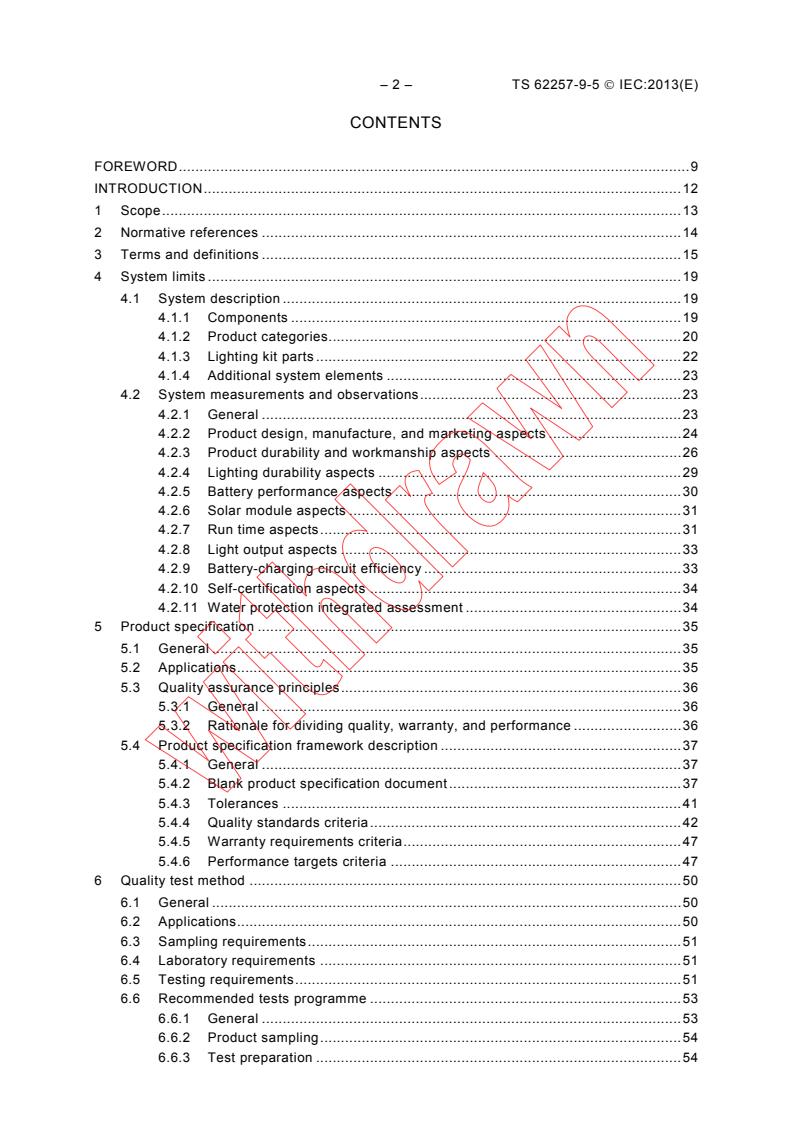
– 2 – TS 62257-9-5 IEC:2013(E)
CONTENTS
FOREWORD . 9
INTRODUCTION . 12
1 Scope . 13
2 Normative references . 14
3 Terms and definitions . 15
4 System limits . 19
4.1 System description . 19
4.1.1 Components . 19
4.1.2 Product categories. 20
4.1.3 Lighting kit parts . 22
4.1.4 Additional system elements . 23
4.2 System measurements and observations . 23
4.2.1 General . 23
4.2.2 Product design, manufacture, and marketing aspects . 24
4.2.3 Product durability and workmanship aspects . 26
4.2.4 Lighting durability aspects . 29
4.2.5 Battery performance aspects . 30
4.2.6 Solar module aspects . 31
4.2.7 Run time aspects . 31
4.2.8 Light output aspects . 33
4.2.9 Battery-charging circuit efficiency . 33
4.2.10 Self-certification aspects . 34
4.2.11 Water protection integrated assessment . 34
5 Product specification . 35
5.1 General . 35
5.2 Applications . 35
5.3 Quality assurance principles . 36
5.3.1 General . 36
5.3.2 Rationale for dividing quality, warranty, and performance . 36
5.4 Product specification framework description . 37
5.4.1 General . 37
5.4.2 Blank product specification document . 37
5.4.3 Tolerances . 41
5.4.4 Quality standards criteria . 42
5.4.5 Warranty requirements criteria . 47
5.4.6 Performance targets criteria . 47
6 Quality test method . 50
6.1 General . 50
6.2 Applications . 50
6.3 Sampling requirements . 51
6.4 Laboratory requirements . 51
6.5 Testing requirements . 51
6.6 Recommended tests programme . 53
6.6.1 General . 53
6.6.2 Product sampling . 54
6.6.3 Test preparation . 54
TS 62257-9-5 IEC:2013(E) – 3 –
6.6.4 Batch A tests . 55
6.6.5 Batch B tests . 56
6.6.6 Batch C / potentially destructive tests . 56
6.6.7 Report preparation. 57
6.7 Reporting . 57
7 Market check method . 57
7.1 General . 57
7.2 Applications . 58
7.3 Sampling requirements . 58
7.4 Laboratory requirements . 58
7.5 Testing requirements . 58
7.6 Recommended tests programme . 60
7.7 Report requirements . 60
8 Initial screening method . 60
8.1 General . 60
8.2 Applications . 60
8.3 Sampling requirements . 60
8.4 Laboratory requirements . 61
8.5 Testing requirements . 61
8.6 Recommended tests programme . 63
8.7 Reporting . 63
9 Field screening method . 64
9.1 General . 64
9.2 Applications . 64
9.3 Sampling requirements . 64
9.4 Laboratory requirements . 64
9.5 Testing requirements . 64
9.6 Recommended tests programme . 66
9.6.1 General . 66
9.6.2 Product sampling . 66
9.6.3 Test sample preparation . 67
9.6.4 Manufacturer information request . 67
9.6.5 Visual screening . 67
9.6.6 Light output . 67
9.6.7 Full-battery run time . 67
9.6.8 Solar-day run time . 67
9.6.9 Water protection assessment . 67
9.6.10 Durability testing . 67
9.6.11 Results check and report generation . 67
10 Standardized specifications sheets . 67
10.1 General . 68
10.2 Applications . 68
10.2.1 General . 68
10.2.2 Guidance . 68
10.2.3 Framework for SSS guidelines document . 68
Annex A (informative) Recommended quality standards and performance targets for
off-grid lighting market support programme qualification . 73
– 4 – TS 62257-9-5 IEC:2013(E)
Annex B (informative) Example quality standards, warranty requirements, and
performance targets for bulk procurement qualification (“sample tender”) . 77
Annex C (informative) Recommended SSS guidelines . 82
Annex D (normative) Manufacturer self-reported information . 91
Annex E (normative) Product sampling . 95
Annex F (normative) Visual screening . 98
Annex G (normative) Sample preparation . 107
Annex H (normative) Power supply setup procedure . 109
Annex I (normative) Light output test . 113
Annex J (normative) Lumen maintenance test . 118
Annex K (normative) Battery test . 126
Annex L (informative) Battery testing recommended practices . 133
Annex M (normative) Full-battery run time test . 136
Annex N (normative) Full discharge preparation . 144
Annex O (normative) Grid charge test . 147
Annex P (normative) Electromechanical charge test. 150
Annex Q (normative) Outdoor photovoltaic module I-V characteristics test . 153
Annex R (normative) Solar charge test . 160
Annex S (normative) Charge controller behaviour test . 174
Annex T (normative) Light distribution test . 185
Annex U (normative) Physical and water ingress protection test . 197
Annex V (normative) Level of water protection . 201
Annex W (normative) Mechanical durability test . 208
Annex X (informative) Example test report templates . 216
Annex Y (informative) Photometer box for relative luminous flux measurements . 244
Annex Z (informative) Photometer tube for relative luminous flux measurements . 249
Annex AA (normative) Field testing methods . 250
Annex BB (informative) Battery durability test . 256
Figure 1 – Fixed Separate (fixed indoors) system—example arrangement of
components . 20
Figure 2 – Portable Separate system—example arrangement of components . 21
Figure 3 – Portable integrated system—example arrangement of components . 21
Figure 4 – Fixed integrated (fixed outdoors) system-example arrangement of
components . 22
Figure 5 – Division of a lighting kit into subsystems—illustrative example . 23
Figure 6 – Recommended sequence of testing for QTM . 54
Figure 7 – Recommended sequence of testing for FSM . 66
Figure 8 – First portion of example SSS . 71
Figure H.1 – 4-wire test configuration with input filter capacitors . 110
Figure I.1 – Conceptual schematic of the light output test setup, including the 11 × 11
grid, Cartesian coordinate axes for rotation reference, and the DUT . 115
Figure J.1 – Schematic of a photometer tube . 120
Figure J.2 – Example lumen maintenance plot . 125
TS 62257-9-5 IEC:2013(E) – 5 –
Figure L.1 – Battery testing flowchart for the battery test (Annex K) . 134
Figure M.1 – Interior view of photometer box with suspended light . 138
Figure M.2 – Plot of example results from the full-battery run time test . 140
Figure Q.1 – PV module I-V curve testing rack . 156
Figure R.1 – Schematic of the power supply and DUT connection for the solar charge
efficiency test . 162
Figure R.2 – Example “true” and simulated I-V curves plotted with the deviation ratio . 164
Figure R.3 – Example time series plot of the solar charging cycle showing the
maximum power available from the PV simulator, actual power supplied by the PV
simulator, and power delivered to the batteries . 172
Figure R.4 – Example time series plot of the solar charging cycle showing the
instantaneous battery-charging circuit efficiency and solar operation efficiency . 173
Figure S.1 – Schematic of the DC power supply-DUT connection using a series
protection resistor . 177
Figure T.1 – Schematic of a task light suspended 0,75 m above a photometer . 189
Figure T.2 – Schematic of “rotary disk” setup, with the DUT shown . 191
Figure T.3 –Side view of desktop light measuring setup . 192
Figure T.4 – Example plot of usable area as a function of minimum illuminance . 194
Figure T.5 – Example of resulting surface plot of light distribution from the brightest
“face” of the multi-plane method or illuminance on a plane method . 195
Figure T.6 – Example of resulting polar plot of illuminance from the multi-plane or
rotating disk method . 196
Figure W.1 – Three-dimensional Cartesian coordinate system for drop test reference . 211
Figure W.2 – Cable strain angle (γ) schematics for a PV module junction box (left) and
a separate light point (right) . 213
Figure Y.1 – Interior view of completed photometer box . 244
Figure Y.2 – Exterior view of completed photometer box . 245
Figure Y.3 – Photometer box dimensions (in cm) . 246
Figure Y.4 – Photometer box assembly pieces and list of materials (dimensions in cm) . 247
Figure Z.1 – Completed photometer tube . 249
Table 1 – Applications of product specifications . 36
Table 2 – Qualification as separate PV module . 38
Table 3 – Truth-in-advertising tolerance . 38
Table 4 – Safety and durability standards . 39
Table 5 – End-user support standards . 40
Table 6 – End-user support requirements . 40
Table 7 – Run time criteria for performance targets . 40
Table 8 – Lighting service criteria for performance targets . 40
Table 9 – Additional features criteria for performance targets . 41
Table 10 – Truth-in-advertising criteria for quality standards . 43
Table 11 – Notes on common truth-in-advertising aspects . 44
Table 12 – Safety and durability criteria for quality standards . 45
Table 13 – Recommended level of water protection by product category . 46
Table 14 – End-user support criteria for quality standards . 47
– 6 – TS 62257-9-5 IEC:2013(E)
Table 15 – Criteria for warranty standards . 47
Table 16 – Run time criteria for performance targets . 48
Table 17 – Run time benchmarks . 48
Table 18 – Lighting service criteria for performance targets . 49
Table 19 – Lighting service benchmarks . 49
Table 20 – Additional function criteria for performance targets . 50
Table 21 – Applications of product specifications . 50
Table 22 – QTM testing requirements . 52
Table 23 – Applications of product specifications . 58
Table 24 – Typical MCM testing guidelines . 59
Table 25 – Applications of product specifications . 60
Table 26 – ISM testing requirements . 62
Table 27 – Applications of product specifications . 64
Table 28 – FSM testing requirements . 65
Table 29 – Applications of product specifications . 68
Table 30 – Recommended precision requirements for metrics on a continuous scale . 70
Table A.1 – Qualification as separate PV module . 73
Table A.2 – Truth-in-advertising tolerance . 74
Table A.3 – Safety and durability standards . 75
Table A.4 – End-user support requirements . 76
Table A.5 – Run time criteria for performance targets . 76
Table A.6 – Lighting service criteria for performance targets . 76
Table B.1 – Product classes qualified for bulk procurement . 77
Table B.2 – Qualification as separate PV module . 77
Table B.3 – Truth-in-advertising tolerance . 78
Table B.4 – Safety and durability standards . 79
Table B.5 – End-user support requirements . 80
Table B.6 – Run time criteria for performance targets . 80
Table B.7 – Lighting service criteria for performance targets . 80
Table B.8 – Run time criteria for performance targets . 80
Table B.9 – Lighting service criteria for performance targets . 80
Table B.10 – Additional features criteria for performance targets . 81
Table C.1 – Requirements for retesting to update SSS . 82
Table C.2 – Recommended precision requirements for metrics on a continuous scale . 83
Table C.3 – Elements in the header / overall performance SSS section . 84
Table C.4 – Elements in the general information SSS section . 86
Table C.5 – Elements in the performance details section . 87
Table C.6 – Elements in the light output SSS section . 88
Table C.7 – Elements in the special features SSS section . 88
Table C.8 – Elements in the durability SSS section . 88
Table C.9 – Elements in the solar module details SSS section . 89
Table C.10 – Elements in the battery details SSS section . 89
Table C.11 – Elements in the marks and certifications SSS section . 89
TS 62257-9-5 IEC:2013(E) – 7 –
Table C.12 – Elements in the SSS information section . 90
Table D.1 – Manufacturer self-reported information outcomes. 91
Table E.1 – Product sampling outcomes . 95
Table F.1 – Visual screening test outcomes . 98
Table H.1 – Standard operating voltage for several common battery types . 111
Table H.2 – Voltage and current reporting requirements . 112
Table I.1 – Light output test outcomes . 113
Table J.1 – Lumen maintenance test outcomes . 118
Table J.2 – Lumen maintenance test minimum frequency of measurement for full
screening test . 121
Table J.3 – Lumen maintenance test minimum frequency of measurement for Initial
screening test . 124
Table K.1 – Battery test outcomes . 126
Table K.2 – Recommended battery testing specifications according to battery
chemistry . 127
Table L.1 – Recommended battery deep discharge protection voltage specifications
according to battery chemistry . 135
Table L.2 – Recommended battery overcharge protection voltage specifications
according to battery chemistry . 135
Table M.1 – Full-battery run time test outcomes . 137
Table O.1 – Grid charge test outcomes . 147
Table P.1 – Mechanical charge test outcomes . 150
Table Q.1 – Outdoor photovoltaic module I-V characteristics test outcomes . 154
Table R.1 – Solar charge test outcome . 160
Table R.2 – Simulated solar day power supply settings . 165
Table S.1 – Charge controller behaviour test outcomes . 175
Table T.1 – Light distribution test outcomes . 186
Table T.2 – Summary of testing options for characterizing lamp distributions . 186
Table T.3 – Table of example illuminance measurements on the brightest “face” of the
1 m grid and usable area as a function of minimum illuminance . 194
Table U.1 – Water exposure and physical ingress protection test outcomes . 197
Table V.1 – Water exposure and physical ingress protection test outcomes . 202
Table V.2 – Enclosure-only level of water protection requirements . 203
Table V.3 – Technical level of water protection requirements . 203
Table V.4 – Example detailed assessment supporting technical level of water
protection . 205
Table V.5 – Overall level of water protection requirements . 206
Table W.1 – Mechanical durability test outcomes . 209
Table X.1 – Manufacturer self-reported information test report template . 217
Table X.2 – Product sampling information test report template . 219
Table X.3 – Visual screening results test report template . 219
Table X.4 – Light output test report template. 226
Table X.5 – Lumen maintenance test report template . 227
Table X.6 – Battery test report template . 228
Table X.7 – Full-battery run time test report template . 228
– 8 – TS 62257-9-5 IEC:2013(E)
Table X.8 – Grid charge test report template . 230
Table X.9 – Electromechanical charge test report template . 231
Table X.10 – Outdoor photovoltaic module I-V characteristics test report template . 232
Table X.11 – Solar charge test report template . 234
Table X.12 – Charge controller behaviour test report template . 235
Table X.13 – Light distribution test report template . 236
Table X.14 – Physical and water ingress protection test report template . 237
Table X.15 – Mechanical durability test report template . 238
Table X.16 – Summary test report template . 241
Table AA.1 – Field test outcomes. 250
Table AA.2 – Example run time test datasheet . 252
Table BB.1 – Battery durability test outcomes . 256
TS 62257-9-5 IEC:2013(E) – 9 –
INTERNATIONAL ELECTROTECHNICAL COMMISSION
____________
RECOMMENDATIONS FOR SMALL RENEWABLE ENERGY
AND HYBRID SYSTEMS FOR RURAL ELECTRIFICATION –
Part 9-5: Integrated system –
Selection of stand-alone lighting kits for rural electrification
FOREWORD
1) The International Electrotechnical Commission (IEC) is a worldwide organization for standardization comprising
all national electrotechnical committees (IEC National Committees). The object of IEC is to promote
international co-operation on all questions concerning standardization in the electrical and electronic fields. To
this end and in addition to other activities, IEC publishes International Standards, Technical Specifications,
Technical Reports, Publicly Available Specifications (PAS) and Guides (hereafter referred to as “IEC
Publication(s)”). Their preparation is entrusted to technical committees; any IEC National Committee interested
in the subject dealt with may participate in this preparatory work. International, governmental and non-
governmental organizations liaising with the IEC also participate in this preparation. IEC collaborates closely
with the International Organization for Standardization (ISO) in accordance with conditions determined by
agreement between the two organizations.
2) The formal decisions or agreements of IEC on technical matters express, as nearly as possible, an international
consensus of opinion on the relevant subjects since each technical committee has representation from all
interested IEC National Committees.
3) IEC Publications have the form of recommendations for international use and are accepted by IEC National
Committees in that sense. While all reasonable efforts are made to ensure that the technical content of IEC
Publications is accurate, IEC cannot be held responsible for the way in which they are used or for any
misinterpretation by any end user.
4) In order to promote international uniformity, IEC National Committees undertake to apply IEC Publications
transparently to the maximum extent possible in their national and regional publications. Any divergence
between any IEC Publication and the corresponding national or regional publication shall be clearly indicated in
the latter.
5) IEC itself does not provide any attestation of conformity. Independent certification bodies provide conformity
assessment services and, in some areas, access to IEC marks of conformity. IEC is not responsible for any
services carried out by independent certification bodies.
6) All users should ensure that they have the latest edition of this publication.
7) No liability shall attach to IEC or its directors, employees, servants or agents including individual experts and
members of its technical committees and IEC National Committees for any personal injury, property damage or
other damage of any nature whatsoever, whether direct or indirect, or for costs (including legal fees) and
expenses arising out of the publication, use of, or reliance upon, this IEC Publication or any other IEC
Publications.
8) Attention is drawn to the Normative references cited in this publication. Use of the referenced publications is
indispensable for the correct application of this publication.
9) Attention is drawn to the possibility that some of the elements of this IEC Publication may be the subject of
patent rights. IEC shall not be held responsible for identifying any or all such patent rights.
The main task of IEC technical committees is to prepare International Standards. In
exceptional circumstances, a technical committee may propose the publication of a technical
specification when
• the required support cannot be obtained for the publication of an International Standard,
despite repeated efforts, or
• the subject is still under technical development or where, for any other reason, there is the
future but no immediate possibility of an agreement on an International Standard.
Technical specifications are subject to review within three years of publication to decide
whether they can be transformed into International Standards.
IEC 62257-9-5, which is a technical specification, has been prepared by IEC technical
committee 82: Solar photovoltaic energy systems.
– 10 – TS 62257-9-5 IEC:2013(E)
This second edition cancels and replaces the first edition issued in 2007. It constitutes a
technical revision.
The main technical changes with regard to the previous edition are as follows:
• Overall, shifted from narrow focus on the needs of bulk procurement programmes to a
wider framework for structuring quality assurance using appropriate methods for a range
of stakeholders including governments, manufacturers, buyers, and others.
• Revised structure of document with modular methods (located in annexes) that are applied
using four distinct test regimes.
• Added normative references and definitions to support new document structure.
• Added a framework for categorizing products based on the arrangement of components.
• Expanded the range of aspects that are considered and formalized a framework for
product specification that can be customized based on stakeholder needs, with example,
informative product specifications in the annexes.
• Added a “Quality test method” that prescribes a set of rigorous laboratory tests using
randomly-selected samples. The description includes a comprehensive list of tests and
guidance for test labs on staging.
• Added a “Market check method” that is a targeted set of tests to confirm results.
• Added an “Initial screening method” that provides rapid laboratory feedback on product
quality and performance.
• Updated and strengthened the previously defined test programme using the “Field
screening method” that can be achieved at low cost without laboratory facilities.
• Added a description for “Standardized specifications sheets” that can be used to
disseminate test results to the market.
• Created or modified several key test procedures:
– Full battery run time
– Durability
– Water protection assessment
– Solar run time
– Light output, distribution, and maintenance
– Visual screening
– Random product sampling
This technical specification shall be used in conjunction with:
– IEC 62257-1:Recommendations for small renewable energy and hybrid systems for rural
electrification – Part 1: General introduction to rural electrification
– IEC 62257-2:Recommendations for small renewable energy and hybrid systems for rural
electrification – Part 2: From requirements to a range of electrification systems
– IEC 62257-3: Recommendations for small renewable energy and hybrid systems for rural
electrification – Part 3: Project development and management
– IEC 62257-4: Recommendations for small renewable energy and hybrid systems for rural
electrification – Part 4: System selection and design
– IEC 62257-5: Recommendations for small renewable energy and hybrid systems for rural
electrification – Part 5: Protection against electrical hazards
– IEC 62257-6: Recommendations for small renewable energy and hybrid systems for rural
electrification – Part 6: Acceptance, operation, maintenance and replacement
It is also to be used with future parts of this series as and when they are published.
TS 62257-9-5 IEC:2013(E) – 11 –
The text of this technical specification is based on the following documents:
Enquiry draft Report on voting
82/731/DTS 82/759/RVC
Full information on the voting for the approval of this technical specification can be found in
the report on voting indicated in the above table.
This publication has been drafted in accordance with the ISO/IEC Directives, Part 2.
The committee has decided that the contents of this publication will remain unchanged until
the stability date indicated on the IEC web site under "http://webstore.iec.ch" in the data
related to the specific publication. At this date, the publication will be
• transformed into an International standard,
• reconfirmed,
• withdrawn,
• replaced by a revised edition, or
• amended.
A bilingual version of this publication may be issued at a later date.
IMPORTANT – The 'colour inside' logo on the cover page of this publication
indicates that it contains colours which are considered to be useful for the correct
understanding of its contents. Users should therefore print this document using a
colour printer.
– 12 – TS 62257-9-5 IEC:2013(E)
INTRODUCTION
The IEC 62257 series intends to provide to different players involved in rural electrification
p
...
Questions, Comments and Discussion
Ask us and Technical Secretary will try to provide an answer. You can facilitate discussion about the standard in here.
Loading comments...