

IEC 62236-1:2003
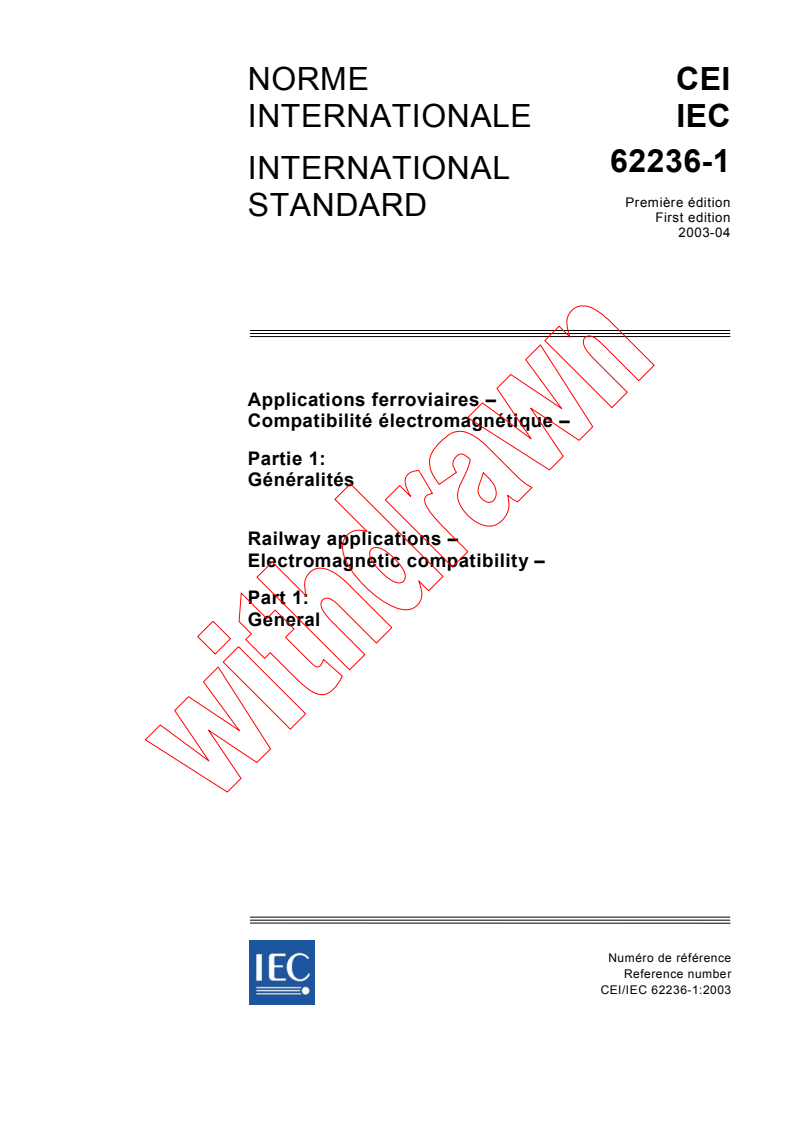
(Main)Railway applications - Electromagnetic compatibility - Part 1: General
General Information
- Abstract
This series specifies the limits for the electromagnetic (EM) emission of the railway as a whole to the outside world and of the EM emission and immunity for equipment operating within the railway. Part 1 gives a description of the electromagnetic behaviour of a railway and specifies the performance criteria for the whole set. Provides a management process to achieve EMC at the interface between the railway infrastructure and trains.
- Status
- Published
- Publication Date
- 23-Apr-2003
- Technical Committee
- TC 9 - Electrical equipment and systems for railways
- Current Stage
- DELPUB - Deleted Publication
- Start Date
- 12-Dec-2008
- Completion Date
- 28-Aug-2026
Overview
IEC 62236-1:2003, titled "Railway applications - Electromagnetic compatibility - Part 1: General", is an international standard developed by the International Electrotechnical Commission (IEC). It addresses electromagnetic compatibility (EMC) within the railway sector, focusing on the whole railway system’s electromagnetic emissions and immunity requirements. This standard provides a foundational framework for managing EMC at the interface between railway infrastructure and trains, ensuring operational safety and performance.
The scope of IEC 62236-1:2003 includes defining limits for electromagnetic emissions from railways to the external environment and establishing performance criteria for equipment operating inside the railway system. Covering frequencies from DC up to 400 GHz, the standard supports harmonization to prevent electromagnetic disturbances that can affect railway operations and external systems.
Key Topics
- EMC Limits for Railways: Specifies emission limits that railway systems must comply with to reduce electromagnetic pollution affecting neighboring equipment and infrastructure.
- Performance Criteria: Defines the essential electromagnetic behavior and immunity performance requirements for railway equipment to sustain operation within the defined EMC environment.
- Management Process for EMC: Offers a structured approach to identify, assess, and mitigate electromagnetic interference risks at the railway infrastructure-train interface.
- Coupling Mechanisms and Phenomena: Describes general electromagnetic coupling mechanisms and principal phenomena affecting both emission and immunity in railway environments.
- Electric Traction Systems: Details the components and electrical characteristics of traction systems that contribute to internal electromagnetic noise sources.
- Risk Evaluation: Provides guidelines for assessing failure risks due to EMC issues, emphasizing preventive measures.
Applications
IEC 62236-1 is critical for railway engineers, system integrators, and infrastructure planners working on:
- Design and deployment of railway infrastructure and electrification systems.
- Development of rolling stock (trains) requiring compliance with standardized EMC criteria.
- Maintenance of electromagnetic compatibility in complex railway environments.
- Evaluating and managing electromagnetic interference to protect signaling, communication, and control systems.
- Implementing structured EMC management processes to ensure safety and reliability across railway operations.
This standard helps stakeholders achieve interoperability between railway components, reduce costly electromagnetic disturbances, and comply with international regulations. It serves as a reference to align national norms with a globally recognized EMC framework for railways.
Related Standards
IEC 62236-1 is part of a broader series addressing electromagnetic compatibility for railway applications, closely aligned with:
- EN 50121-1: A European standard on EMC for railways providing essential requirements for rolling stock and infrastructure.
- Other parts of the IEC 62236 series, which may include specific emission limits, immunity tests, and detailed measurement methods.
- CISPR standards applicable to radio disturbance and immunity measurements.
- ISO/IEC directives guiding standard structuring and management processes.
These related standards work together to provide comprehensive guidance on EMC challenges in rail transport systems worldwide.
Keywords: IEC 62236-1, railway electromagnetic compatibility, EMC standards railways, railway EMC emission limits, railway systems immunity, IEC railway standards, railway infrastructure EMC, electromagnetic interference railways, electric traction systems, railway EMC management
Relations
- Effective Date
- 05-Sep-2023
Get Certified
Connect with accredited certification bodies for this standard

IRIS Certification (UNIFE)
International Railway Industry Standard certification.

TÜV SÜD Rail GmbH
TÜV SÜD railway certification services.

ANCE
Mexican certification and testing association.
Sponsored listings
Frequently Asked Questions
IEC 62236-1:2003 is a standard published by the International Electrotechnical Commission (IEC). Its full title is "Railway applications - Electromagnetic compatibility - Part 1: General". This standard covers: This series specifies the limits for the electromagnetic (EM) emission of the railway as a whole to the outside world and of the EM emission and immunity for equipment operating within the railway. Part 1 gives a description of the electromagnetic behaviour of a railway and specifies the performance criteria for the whole set. Provides a management process to achieve EMC at the interface between the railway infrastructure and trains.
This series specifies the limits for the electromagnetic (EM) emission of the railway as a whole to the outside world and of the EM emission and immunity for equipment operating within the railway. Part 1 gives a description of the electromagnetic behaviour of a railway and specifies the performance criteria for the whole set. Provides a management process to achieve EMC at the interface between the railway infrastructure and trains.
IEC 62236-1:2003 is classified under the following ICS (International Classification for Standards) categories: 33.100 - Electromagnetic compatibility (EMC); 45.060.01 - Railway rolling stock in general. The ICS classification helps identify the subject area and facilitates finding related standards.
IEC 62236-1:2003 has the following relationships with other standards: It is inter standard links to IEC 62236-1:2008. Understanding these relationships helps ensure you are using the most current and applicable version of the standard.
IEC 62236-1:2003 is available in PDF format for immediate download after purchase. The document can be added to your cart and obtained through the secure checkout process. Digital delivery ensures instant access to the complete standard document.
Standards Content (Sample)
NORME CEI
INTERNATIONALE IEC
62236-1
INTERNATIONAL
Première édition
STANDARD
First edition
2003-04
Applications ferroviaires –
Compatibilité électromagnétique –
Partie 1:
Généralités
Railway applications –
Electromagnetic compatibility –
Part 1:
General
Numéro de référence
Reference number
CEI/IEC 62236-1:2003
Numérotation des publications Publication numbering
Depuis le 1er janvier 1997, les publications de la CEI As from 1 January 1997 all IEC publications are
sont numérotées à partir de 60000. Ainsi, la CEI 34-1 issued with a designation in the 60000 series. For
devient la CEI 60034-1. example, IEC 34-1 is now referred to as IEC 60034-1.
Editions consolidées Consolidated editions
Les versions consolidées de certaines publications de la The IEC is now publishing consolidated versions of its
CEI incorporant les amendements sont disponibles. Par publications. For example, edition numbers 1.0, 1.1
exemple, les numéros d’édition 1.0, 1.1 et 1.2 indiquent and 1.2 refer, respectively, to the base publication,
respectivement la publication de base, la publication de the base publication incorporating amendment 1 and
base incorporant l’amendement 1, et la publication de the base publication incorporating amendments 1
base incorporant les amendements 1 et 2. and 2.
Informations supplémentaires Further information on IEC publications
sur les publications de la CEI
Le contenu technique des publications de la CEI est The technical content of IEC publications is kept
constamment revu par la CEI afin qu'il reflète l'état under constant review by the IEC, thus ensuring that
actuel de la technique. Des renseignements relatifs à the content reflects current technology. Information
cette publication, y compris sa validité, sont dispo- relating to this publication, including its validity, is
nibles dans le Catalogue des publications de la CEI available in the IEC Catalogue of publications
(voir ci-dessous) en plus des nouvelles éditions, (see below) in addition to new editions, amendments
amendements et corrigenda. Des informations sur les and corrigenda. Information on the subjects under
sujets à l’étude et l’avancement des travaux entrepris consideration and work in progress undertaken by the
par le comité d’études qui a élaboré cette publication, technical committee which has prepared this
ainsi que la liste des publications parues, sont publication, as well as the list of publications issued,
également disponibles par l’intermédiaire de: is also available from the following:
• Site web de la CEI (www.iec.ch) • IEC Web Site (www.iec.ch)
• Catalogue des publications de la CEI • Catalogue of IEC publications
Le catalogue en ligne sur le site web de la CEI The on-line catalogue on the IEC web site
(http://www.iec.ch/searchpub/cur_fut.htm) vous permet (http://www.iec.ch/searchpub/cur_fut.htm) enables
de faire des recherches en utilisant de nombreux you to search by a variety of criteria including text
critères, comprenant des recherches textuelles, par searches, technical committees and date of
comité d’études ou date de publication. Des publication. On-line information is also available
informations en ligne sont également disponibles sur on recently issued publications, withdrawn and
les nouvelles publications, les publications rempla- replaced publications, as well as corrigenda.
cées ou retirées, ainsi que sur les corrigenda.
• IEC Just Published • IEC Just Published
Ce résumé des dernières publications parues This summary of recently issued publications
(http://www.iec.ch/online_news/justpub/jp_entry.htm) (http://www.iec.ch/online_news/justpub/jp_entry.htm)
est aussi disponible par courrier électronique. is also available by email. Please contact the
Veuillez prendre contact avec le Service client Customer Service Centre (see below) for further
(voir ci-dessous) pour plus d’informations. information.
• Service clients • Customer Service Centre
Si vous avez des questions au sujet de cette If you have any questions regarding this
publication ou avez besoin de renseignements publication or need further assistance, please
supplémentaires, prenez contact avec le Service contact the Customer Service Centre:
clients:
Email: custserv@iec.ch Email: custserv@iec.ch
Tél: +41 22 919 02 11 Tel: +41 22 919 02 11
Fax: +41 22 919 03 00 Fax: +41 22 919 03 00
.
NORME CEI
INTERNATIONALE IEC
62236-1
INTERNATIONAL
Première édition
STANDARD
First edition
2003-04
Applications ferroviaires –
Compatibilité électromagnétique –
Partie 1:
Généralités
Railway applications –
Electromagnetic compatibility –
Part 1:
General
IEC 2003 Droits de reproduction réservés Copyright - all rights reserved
Aucune partie de cette publication ne peut être reproduite ni No part of this publication may be reproduced or utilized in any
utilisée sous quelque forme que ce soit et par aucun procédé, form or by any means, electronic or mechanical, including
électronique ou mécanique, y compris la photocopie et les photocopying and microfilm, without permission in writing from
microfilms, sans l'accord écrit de l'éditeur. the publisher.
International Electrotechnical Commission, 3, rue de Varembé, PO Box 131, CH-1211 Geneva 20, Switzerland
Telephone: +41 22 919 02 11 Telefax: +41 22 919 03 00 E-mail: inmail@iec.ch Web: www.iec.ch
CODE PRIX
P
Commission Electrotechnique Internationale PRICE CODE
International Electrotechnical Commission
Международная Электротехническая Комиссия
Pour prix, voir catalogue en vigueur
For price, see current catalogue
– 2 – 62236-1 CEI:2003
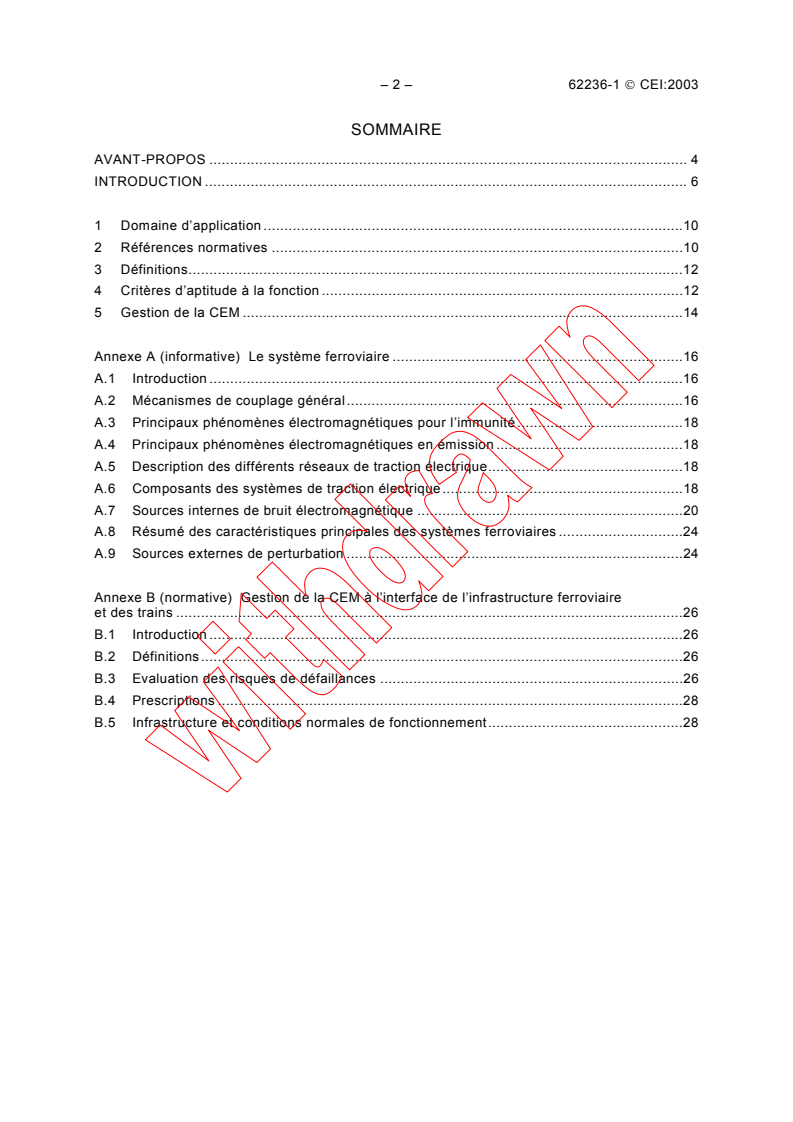
SOMMAIRE
AVANT-PROPOS . 4
INTRODUCTION .6
1 Domaine d’application .10
2 Références normatives .10
3 Définitions.12
4 Critères d’aptitude à la fonction .12
5 Gestion de la CEM .14
Annexe A (informative) Le système ferroviaire .16
A.1 Introduction .16
A.2 Mécanismes de couplage général.16
A.3 Principaux phénomènes électromagnétiques pour l’immunité .18
A.4 Principaux phénomènes électromagnétiques en émission .18
A.5 Description des différents réseaux de traction électrique.18
A.6 Composants des systèmes de traction électrique.18
A.7 Sources internes de bruit électromagnétique .20
A.8 Résumé des caractéristiques principales des systèmes ferroviaires .24
A.9 Sources externes de perturbation .24
Annexe B (normative) Gestion de la CEM à l’interface de l’infrastructure ferroviaire
et des trains .26
B.1 Introduction .26
B.2 Définitions.26
B.3 Evaluation des risques de défaillances .26
B.4 Prescriptions .28
B.5 Infrastructure et conditions normales de fonctionnement.28
62236-1 IEC:2003 – 3 –
CONTENTS
FOREWORD . 5
INTRODUCTION .7
1 Scope .11
2 Normative references.11
3 Definitions.13
4 Performance criteria.13
5 Management of EMC.15
Annex A (informative) The railway system.17
A.1 Introduction .17
A.2 General coupling mechanisms.17
A.3 Principal electromagnetic phenomena for immunity.19
A.4 Principal electromagnetic phenomena for emission.19
A.5 Description of the different electric traction systems.19
A.6 Components of electric traction systems.19
A.7 Internal sources of electromagnetic noise .21
A.8 Summary of main characteristics of railways.25
A.9 External sources of disturbance.25
Annex B (normative) Management of EMC at the interface between railway
infrastructure and trains.27
B.1 Introduction .27
B.2 Definitions.27
B.3 Assessment of risks of failures .27
B.4 Requirements.29
B.5 Infrastructure and normal operating conditions.29
– 4 – 62236-1 CEI:2003
COMMISSION ÉLECTROTECHNIQUE INTERNATIONALE
____________
APPLICATIONS FERROVIAIRES –
COMPATIBILITÉ ÉLECTROMAGNÉTIQUE –
Partie 1: Généralités
AVANT-PROPOS
1) La CEI (Commission Électrotechnique Internationale) est une organisation mondiale de normalisation composée
de l'ensemble des comités électrotechniques nationaux (Comités nationaux de la CEI). La CEI a pour objet de
favoriser la coopération internationale pour toutes les questions de normalisation dans les domaines de
l'électricité et de l'électronique. A cet effet, la CEI, entre autres activités, publie des Normes internationales.
Leur élaboration est confiée à des comités d'études, aux travaux desquels tout Comité national intéressé par le
sujet traité peut participer. Les organisations internationales, gouvernementales et non gouvernementales, en
liaison avec la CEI, participent également aux travaux. La CEI collabore étroitement avec l'Organisation
Internationale de Normalisation (ISO), selon des conditions fixées par accord entre les deux organisations.
2) Les décisions ou accords officiels de la CEI concernant les questions techniques représentent, dans la mesure
du possible, un accord international sur les sujets étudiés, étant donné que les Comités nationaux intéressés
sont représentés dans chaque comité d’études.
3) Les documents produits se présentent sous la forme de recommandations internationales. Ils sont publiés
comme normes, spécifications techniques, rapports techniques ou guides et agréés comme tels par les Comités
nationaux.
4) Dans le but d'encourager l'unification internationale, les Comités nationaux de la CEI s'engagent à appliquer de
façon transparente, dans toute la mesure possible, les Normes internationales de la CEI dans leurs normes
nationales et régionales. Toute divergence entre la norme de la CEI et la norme nationale ou régionale
correspondante doit être indiquée en termes clairs dans cette dernière.
5) La CEI n’a fixé aucune procédure concernant le marquage comme indication d’approbation et sa responsabilité
n’est pas engagée quand un matériel est déclaré conforme à l’une de ses normes.
6) L’attention est attirée sur le fait que certains des éléments de la présente Norme internationale peuvent faire
l’objet de droits de propriété intellectuelle ou de droits analogues. La CEI ne saurait être tenue pour
responsable de ne pas avoir identifié de tels droits de propriété et de ne pas avoir signalé leur existence.
La Norme internationale CEI 62236-1 a été établie par le comité d'études 9 de la CEI: Matériels
et systèmes électriques ferroviaires, en collaboration étroite avec le CISPR.
Elle a été soumise aux Comités nationaux pour vote suivant la procédure par voie express, par
les documents suivants:
FDIS Rapport de vote
9/729/FDIS 9/744/RVD
Le rapport de vote indiqué dans le tableau ci-dessus donne toute information sur le vote ayant
abouti à l'approbation de cette norme.
Cette norme est basée sur la norme EN 50121-1.
Cette norme ne suit pas les règles de structure des normes internationales comme le spécifie
la Partie 2 des Directives ISO/CEI.
Le comité a décidé que le contenu de cette publication ne sera pas modifié avant 2010. A cette
date, la publication sera
• reconduite;
• supprimée;
• remplacée par une édition révisée, ou
• amendée.
62236-1 IEC:2003 – 5 –
INTERNATIONAL ELECTROTECHNICAL COMMISSION
___________
RAILWAY APPLICATIONS –
ELECTROMAGNETIC COMPATIBILITY –
Part 1: General
FOREWORD
1) The IEC (International Electrotechnical Commission) is a worldwide organization for standardization comprising
all national electrotechnical committees (IEC National Committees). The object of the IEC is to promote
international co-operation on all questions concerning standardization in the electrical and electronic fields. To
this end and in addition to other activities, the IEC publishes International Standards. Their preparation is
entrusted to technical committees; any IEC National Committee interested in the subject dealt with may
participate in this preparatory work. International, governmental and non-governmental organizations liaising
with the IEC also participate in this preparation. The IEC collaborates closely with the International Organization
for Standardization (ISO) in accordance with conditions determined by agreement between the two
organizations.
2) The formal decisions or agreements of the IEC on technical matters express, as nearly as possible, an
international consensus of opinion on the relevant subjects since each technical committee has representation
from all interested National Committees.
3) The documents produced have the form of recommendations for international use and are published in the form
of standards, technical specifications, technical reports or guides and they are accepted by the National
Committees in that sense.
4) In order to promote international unification, IEC National Committees undertake to apply IEC International
Standards transparently to the maximum extent possible in their national and regional standards. Any
divergence between the IEC Standard and the corresponding national or regional standard shall be clearly
indicated in the latter.
5) The IEC provides no marking procedure to indicate its approval and cannot be rendered responsible for any
equipment declared to be in conformity with one of its standards.
6) Attention is drawn to the possibility that some of the elements of this International Standard may be the subject
of patent rights. The IEC shall not be held responsible for identifying any or all such patent rights.
International Standard IEC 62236-1 has been prepared by IEC Technical Committee 9:
Electrical equipment and systems for railways, in close collaboration with CISPR.
It was submitted to the National Committees for voting under the Fast Track Procedure as the
following documents:
FDIS Report on voting
9/729/FDIS 9/744/RVD
Full information on the voting for the approval of this standard can be found in the report on
voting indicated in the above table.
This standard is based on EN 50121-1.
This standard does not follow the rules for structuring International Standards as given in
Part 2 of the ISO/IEC Directives.
The committee has decided that the contents of this publication will remain unchanged
until 2010. At this date, the publication will be
• reconfirmed;
• withdrawn;
• replaced by a revised edition, or
• amended.
– 6 – 62236-1 CEI:2003
INTRODUCTION
Cette série de Normes internationales de produits qui s’applique à la CEM dans le domaine
ferroviaire comprend cinq parties qui sont décrites à la fin de cette introduction.
Cette série de normes spécifie les limites d’émission électromagnétique (EM) du système
ferroviaire dans son ensemble vers le monde extérieur et des émissions électromagnétiques et
de l’immunité des équipements qui fonctionnent dans le système ferroviaire, mais qui doivent
être compatibles avec les limites d’émission définies pour le système ferroviaire dans son
ensemble. La fréquence couverte par ces normes va du courant continu à 400 GHz. A l’heure
actuelle, il n’a pas été défini d’essais pour les fréquences supérieures à 2 GHz. Les limites
pour les phénomènes de CEM sont fixées de manière à obtenir la compatibilité électro-
magnétique entre le système ferroviaire pris dans son ensemble et le monde extérieur, et entre
les différents éléments du système ferroviaire. Dans cette série de normes, les niveaux
d’immunité sont choisis pour assurer un niveau raisonnable de CEM avec d’autres appareils
dans l’environnement ferroviaire local et avec les émissions qui pénètrent le système
ferroviaire et qui proviennent du monde extérieur. Sont également fixées des limites pour les
émissions EM produites par les systèmes ferroviaires et affectant le monde extérieur.
Les niveaux d’immunité et d’émission ne garantissent pas par eux-mêmes que l’intégration des
appareils sera nécessairement satisfaisante. Cette norme ne peut pas couvrir toutes les
configurations possibles d’appareils, mais les niveaux d’essai sont suffisants pour obtenir une
CEM satisfaisante dans la majorité des cas. Dans des circonstances exceptionnelles, par
exemple à proximité d’un «emplacement spécial» qui a des niveaux anormalement élevés de
brouillage électromagnétique, il est possible qu’il faille prendre des mesures complémentaires
pour assurer le fonctionnement correct du système. Une telle décision doit faire l’objet d’une
discussion entre le fournisseur de l’équipement et le chef de projet, le responsable
d’infrastructure ou une personne de responsabilité équivalente.
Les appareils ferroviaires sont assemblés dans de grands systèmes et installations, tels que
les trains et les centres de commande de la signalisation. Des informations plus précises sont
données à l’Annexe A. Il n’est donc pas possible d’établir des essais et des limites d’immunité
pour ces ensembles de grande taille. Les niveaux d’immunité pour les appareils assureront
normalement un fonctionnement fiable, mais il est nécessaire de préparer un plan de gestion
de la CEM pour traiter les circonstances particulières. Par exemple, le passage d’une ligne de
chemin de fer à proximité d’un émetteur radiofréquence de grande puissance qui produit des
champs anormalement élevés. Il peut être nécessaire d’appliquer des conditions spéciales
pour les équipements ferroviaires qui doivent fonctionner à proximité d’un tel émetteur et
celles-ci seront acceptées comme Conditions Nationales pour la spécification.
La série des normes CEI 62236, Applications ferroviaires – Compatibilité électromagnétique,
se compose des parties suivantes:
Partie 1: Généralités
Cette partie donne une description du comportement électromagnétique du système
ferroviaire; elle spécifie les critères d’aptitude à la fonction pour l’ensemble de la série. Elle
donne un processus de gestion pour obtenir la compatibilité électromagnétique à l’interface
de l’infrastructure ferroviaire et des trains.
Partie 2: Emission du système ferroviaire dans son ensemble vers le monde extérieur
Cette partie définit les limites d’émission du système ferroviaire vers le monde extérieur
aux radiofréquences. Elle définit les méthodes d’essai appliquées et donne des
informations sur les valeurs typiques des champs aux fréquences de traction et en
radiofréquence (cartographie).
62236-1 IEC:2003 – 7 –
INTRODUCTION
The railway EMC set of product-specific International Standards consists of five parts
described at the end of this introduction.
The set of standards specifies the limits for the electromagnetic (EM) emission of the railway
as a whole to the outside world and of the EM emission and immunity for equipment operating
within the railway but which must be compatible with the emission limits set for the railway as a
whole. The frequency covered by the standards is in the range of d.c. to 400 GHz. At present,
testing is not defined for frequencies exceeding 2 GHz. The limits for EMC phenomena are set
so that the railway as a whole achieves electromagnetic compatibility with the outside world,
and between the various parts of the railway. Throughout the set of the standards, the immunity
levels are chosen to ensure a reasonable level of EMC with other apparatus within the local
railway environment and with emissions which enter the railway from the outside world. Limits
are also placed on EM emission by railways into the outside world.
The immunity and emission levels do not of themselves guarantee that integration of the
apparatus will necessarily be satisfactory. The standard cannot cover all the possible
configurations of apparatus, but the test levels are sufficient to achieve satisfactory EMC in the
majority of cases. In exceptional circumstances, for instance near a “special location” which
has unusually high levels of EM interference, the system may require additional measures to
be taken to ensure proper operation. The resolution of this is a matter for discussion between
the equipment supplier and the project manager, infrastructure controller or equivalent.
The railway apparatus is assembled into large systems and installations, such as trains and
signalling control centres. Details are given in Annex A. It is not, therefore, possible to
establish immunity tests and limits for these large assemblies. The immunity levels for the
apparatus will normally ensure reliable operation, but it is necessary to prepare an EMC
management plan, to deal with specific circumstances. For example, the passage of the
railway line close to a higher power radio transmitter which produces abnormally high field
strengths. Special conditions may have to be applied for railway equipment which has to work
near such a transmitter and these will be accepted as National Conditions for the specification.
The series of standards IEC 62236, Railway applications – Electromagnetic compatibility,
contains the following parts:
Part 1: General
This part gives a description of the electromagnetic behaviour of a railway; it specifies
the performance criteria for the whole set. A management process to achieve EMC at the
interface between the railway infrastructure and trains is provided.
Part 2: Emission of the whole railway system to the outside world
This part sets the emission limits from the railway to the outside world at radio frequencies.
It defines the applied test methods and gives information on typical field strength values at
traction and radio frequency (cartography).
– 8 – 62236-1 CEI:2003
Partie 3-1: Matériel roulant – Trains et véhicules complets
Cette partie spécifie les prescriptions d’émission et d’immunité pour tous les types de maté-
riel roulant. Elle couvre le matériel de traction et les rames, ainsi que le matériel tracté.
Le domaine d’application de cette partie de la norme s’arrête à l’interface du matériel et de
ses entrées et sorties d’énergie respectives.
Partie 3-2: Matériel roulant – Appareils
Cette partie s’applique aux aspects émission et immunité de la CEM pour les appareils
électriques et électroniques destinés à être utilisés à bord du matériel roulant ferroviaire.
Partie 4: Emission et immunité des appareils de signalisation et de télécommunication
Cette partie spécifie les limites d’émission électromagnétique et d’immunité pour les
appareils de signalisation et de télécommunications.
Partie 5: Emission et immunité des installations fixes d’alimentation de puissance et des
équipements associés
Cette partie s’applique aux aspects d’émission et d’immunité de la CEM pour les appareils
et les composants électriques et électroniques destinés à être utilisés dans les installations
ferroviaires fixes associées à l’alimentation.
62236-1 IEC:2003 – 9 –
Part 3-1: Rolling stock – Train and complete vehicle
This part specifies the emission and immunity requirements for all types of rolling stock.
It covers traction stock and trainsets, as well as independent hauled stock.
The scope of this part of the standard ends at the interface of the stock with its respective
energy inputs and outputs.
Part 3-2: Rolling stock – Apparatus
This part applies to emission and immunity aspects of EMC for electrical and electronic
apparatus intended for use on railway rolling stock.
Part 4: Emission and immunity of the signalling and telecommunications apparatus
This part specifies limits for electromagnetic emission and immunity for signalling and
telecommunications apparatus.
Part 5: Emission and immunity of fixed power supply installations and apparatus
This part applies to emission and immunity aspects of EMC for electrical and electronic
apparatus and components intended for use in railway fixed installations associated with
power supply.
– 10 – 62236-1 CEI:2003
APPLICATIONS FERROVIAIRES –
COMPATIBILITÉ ÉLECTROMAGNÉTIQUE –
Partie 1: Généralités
1 Domaine d’application
1.1 La présente Partie 1 de la série de Normes internationales CEI 62236 donne la structure
et le contenu de l’ensemble de la série.
L’annexe A décrit les caractéristiques du système ferroviaire qui affectent la compatibilité
électromagnétique (CEM). L’annexe B spécifie un processus de gestion pour atteindre la CEM
à l’interface de l’infrastructure ferroviaire et des trains.
Cette série de normes a pour objectif de spécifier les prescriptions d’émission et d’immunité
EM pour les produits ferroviaires et pour le système ferroviaire en tant qu’installation.
Les phénomènes exclus de cette série de normes sont l’impulsion électromagnétique
nucléaire, les conditions anormales de fonctionnement et les effets d’induction dus à un choc
direct de la foudre.
Les limites d’émission à la limite du système ferroviaire ne s’appliquent pas aux émetteurs
intentionnels dans les limites du système ferroviaire.
Les aspects relatifs à la sécurité ne sont pas couverts par cette série de normes.
Les effets biologiques des rayonnements non ionisants ainsi que les appareils d’assistance
médicale, tels que les stimulateurs cardiaques, ne sont pas traités dans cette série.
1.2 La présente Norme internationale est complétée par les normes spécifiques suivantes:
CEI 62236-2, Applications ferroviaires – Compatibilité électromagnétique – Partie 2: Emission
du système ferroviaire dans son ensemble vers le monde extérieur
CEI 62236-3-1, Applications ferroviaires – Compatibilité électromagnétique – Partie 3-1:
Matériel roulant – Trains et véhicules complets
CEI 62236-3-2, Applications ferroviaires – Compatibilité électromagnétique – Partie 3-2:
Matériel roulant – Appareils
CEI 62236-4, Applications ferroviaires – Compatibilité électromagnétique – Partie 4: Emission
et immunité des appareils de signalisation et de télécommunication
CEI 62236-5, Applications ferroviaires – Compatibilité électromagnétique – Partie 5: Emission
et immunité des installations fixes d’alimentation de puissance et des équipements associés
2 Références normatives
Les documents de référence suivants sont indispensables pour l'application du présent
document. Pour les références datées, seule l'édition citée s'applique. Pour les références non
datées, la dernière édition du document de référence s'applique (y compris les éventuels
amendements).
62236-1 IEC:2003 – 11 –
RAILWAY APPLICATIONS –
ELECTROMAGNETIC COMPATIBILITY –
Part 1: General
1 Scope
1.1 This Part 1 of the International Standards series IEC 62236 outlines the structure and
the content of the whole series.
Annex A describes the characteristics of the railway system which affect electromagnetic
compatibility (EMC) behaviour. Annex B specifies a management process for achieving EMC at
the interface between the railway infrastructure and trains.
The objective of the whole series of standards is to specify the EM emission and immunity
requirements for railway products, and for the railway as an installation.
Phenomena excluded from the series are nuclear EM pulse, abnormal operating conditions and
the induction effects of direct lightning strike.
Emission limits at the railway boundary do not apply to intentional transmitters within the
railway boundaries.
Safety considerations are not covered by this series of standards.
The biological effects of non-ionizing radiation as well as apparatus for medical assistance,
such as pacemakers, are not considered here.
1.2 This International Standard is supplemented by the following specific standards:
IEC 62236-2, Railway applications – Electromagnetic compatibility – Part 2: Emission of the
whole railway system to the outside world
IEC 62236-3-1, Railway applications – Electromagnetic compatibility – Part 3-1: Rolling stock –
Train and complete vehicle
IEC 62236-3-2, Railway applications – Electromagnetic compatibility – Part 3-2: Rolling stock –
Apparatus
IEC 62236-4, Railway applications – Electromagnetic compatibility – Part 4: Emission and
immunity of the signalling and telecommunications apparatus
IEC 62236-5, Railway applications – Electromagnetic compatibility – Part 5: Emission and
immunity of fixed power supply installations and apparatus
2 Normative references
The following referenced documents are indispensable for the application of this document. For
dated references, only the edition cited applies. For undated references, the latest edition of
the referenced document (including any amendments) applies.
– 12 – 62236-1 CEI:2003
CEI 60050(161), Vocabulaire Electrotechnique International (VEI) – Chapitre 161: Compatibilité
électromagnétique
CEI 61000-6-2, Compatibilité électromagnétique (CEM) – Partie 6-2: Normes génériques –
Immunité pour les environnements industriels
3 Définitions
Pour les besoins de la présente partie de la CEI 62236, on peut trouver les définitions
concernant la CEM et les phénomènes correspondants dans la CEI 60050(161).
Les autres parties de cette Norme internationale peuvent contenir des définitions spécifiques.
4 Critères d’aptitude à la fonction
NOTE Cet article est fondé sur la CEI 61000-6-2.
La variété et la diversité des appareils couverts par le domaine d’application de la présente
série de normes rendent difficile la définition de critères précis pour l’évaluation des résultats
des essais d’immunité.
Si l’appareil devient dangereux ou non sûr suite à l’application des essais définis dans la
présente série de normes, il doit être considéré comme n’ayant pas satisfait à l’essai.
Une description fonctionnelle et une définition des critères d’aptitude à la fonction, pendant ou
suite aux essais de CEM, doivent être fournies par le fabricant et notées dans le rapport
d’essai sur la base des critères d’aptitude à la fonction suivants:
– Critère d’aptitude A
L’appareil doit continuer à fonctionner comme prévu pendant et après l’essai. Aucune
dégradation du fonctionnement ou perte de fonction n’est autorisée au-dessous du niveau
d’aptitude spécifié par le fabricant lorsque l’appareil est utilisé comme prévu. Le niveau
d’aptitude peut être remplacé par une perte d’aptitude admissible. Si le niveau minimal
d’aptitude ou la perte d’aptitude admissible ne sont pas spécifiés par le fabricant, ils
peuvent être déduits de la description et de la documentation du produit et de ce que
l’utilisateur est raisonnablement en droit d’attendre de l’appareil si celui-ci est utilisé
comme prévu.
– Critère d’aptitude B
L’appareil doit continuer à fonctionner comme prévu après l’essai. Aucune dégradation du
fonctionnement ou perte de fonction n’est autorisée au-dessous du niveau d’aptitude
spécifié par le fabricant lorsque l’appareil est utilisé comme prévu. Le niveau d’aptitude
peut être remplacé par une perte d’aptitude admissible. Pendant l’essai, une dégradation
de fonctionnement est toutefois autorisée. Aucune modification du mode de fonctionnement
en cours ou des données mémorisées n’est autorisée. Si le niveau minimal d’aptitude ou la
perte d’aptitude admissible ne sont pas spécifiés par le fabricant, ils peuvent être déduits
de la description et de la documentation du produit et de ce que l’utilisateur est
raisonnablement en droit d’attendre de l’appareil si celui-ci est utilisé comme prévu.
– Critère d’aptitude C
Une perte de fonction temporaire est admise, pourvu que cette fonction soit
autorécupérable ou puisse être rétablie par une intervention sur les commandes.
62236-1 IEC:2003 – 13 –
IEC 60050(161), International Electrotechnical Vocabulary (IEV) – Chapter 161: Electro-
magnetic compatibility
IEC 61000-6-2, Electromagnetic compatibility (EMC) – Part 6-2: Generic standards – Immunity
for industrial environments
3 Definitions
For the purpose of this part of IEC 62236, definitions related to EMC and to relevant
phenomena may be found in IEC 60050(161).
Other parts of this International Standard may contain specific definitions.
4 Performance criteria
NOTE This clause is based on IEC 61000-6-2.
The variety and the diversity of the apparatus within the scope of this series of standards make
it difficult to define precise criteria for the evaluation of the immunity test results.
If, as a result of the application of the tests defined in this series of standards, the apparatus
becomes dangerous or unsafe, the apparatus shall be deemed to have failed the test.
A functional description and a definition of performance criteria, during or as a consequence of
the EMC testing, shall be provided by the manufacturer and noted in the test report, based on
the following criteria:
– Performance criterion A
The apparatus shall continue to operate as intended during and after the test. No
degradation of performance or loss of function is allowed below a performance level
specified by the manufacturer, when the apparatus is used as intended. The
performance level may be replaced by a permissible loss of performance. If the
minimum performance level or the permissible performance loss is not specified
by the manufacturer, either of these may be derived from the product description or
documentation, and, subsequently,what the user may reasonably expect from the
apparatus if used as intended.
– Performance criterion B
The apparatus shall continue to operate as intended after the test. No degradation of
performance or loss of function is allowed below a performance level specified by the
manufacturer, when the apparatus is used as intended. The performance level may be
replaced by a permissible loss of performance. During the test, degradation of performance
is however allowed. No change of actual operating state or stored data is allowed. If the
minimum performance level or the permissible performance loss is not specified by
the manufacturer, either of these may be derived from the product description or
documentation, and from what the user may reasonably expect from the apparatus if used
as intended.
– Performance criterion C
Temporary loss of function is allowed, provided the function is self-recoverable or can be
restored by the operation of the controls.
– 14 – 62236-1 CEI:2003
5 Gestion de la CEM
Le système ferroviaire est une installation complexe avec des sources mobiles d’énergie
électromagnétique et l’application des normes sur la CEM de la série CEI 62236 n’est pas une
garantie d’aptitude satisfaisante à la fonction. Il peut y avoir des cas où les appareils doivent
être placés dans des espaces restreints ou ajoutés à des ensembles existants ce qui peut
créer des environnements de sévérité inhabituelle. Tous les cas doivent être pris en compte
pour un plan formel de gestion de la CEM. Il convient d’établir ce plan à un stade aussi
précoce que possible du projet et l’Annexe B donne des précisions sur un tel plan.
NOTE L’Annexe B est normative avec un domaine d’application limité; cependant, en cas de fonctionnement dans
des conditions n’entrant pas dans le domaine d’application, il convient de voir si l’utilisation du plan de gestion
pourrait être bénéfique.
62236-1 IEC:2003 – 15 –
5 Management of EMC
The railway is a complex installation with moving sources of electromagnetic energy and the
application of the EMC standards in the IEC 62236 series is not a guarantee of satisfactory
performance. There may be cases where apparatus has to be positioned in restricted spaces
or added to an existing assembly, with the possible creation of environments of unusual
severity. All cases shall be considered with respect to a formal plan for the management of
EMC. This plan should be established at as early a stage of the project as is possible and
Annex B gives details of such a management plan.
NOTE Annex B is normative with a limited scope; however, operation outwith the scope should consider whether
the use of the management plan could be beneficial.
– 16 – 62236-1 CEI:2003
Annexe A
(informative)
Le système ferroviaire
A.1 Introduction
Pour fonctionner, les systèmes ferroviaires utilisent des réseaux électriques nécessitant des
puissances très élevées (jusqu’à plusieurs MVA) et des systèmes électroniques de puissance
qui sont caractérisés par leur non-linéarité (produisant des harmoniques).
Dans un réseau ferroviaire électrique, les locomotives qui se déplacent avec les trains doivent
être alimentées par des contacts glissants à partir d’une ligne d’alimentation, appelée caténaire
ou ligne aérienne de contact ou un rail de contact qui est installé le long de la voie. En général,
le courant retourne à la sous-station d’alimentation par les rails, un conducteur de retour
séparé ou la terre. Un système ferroviaire est un système intégré dans lequel l’électricité est
utilisée pour de nombreuses autres applications en plus de la propulsion du train et qui
comprennent:
– le chauffage, la climatisation, la restauration et l’éclairage des voitures pour voyageurs
avec des convertisseurs à bord du véhicule. Cette alimentation est assurée dans le train
par des conducteurs séparés;
– les systèmes de signalisation et de télécommunication le long de la voie et entre les
centres de commande en charge des mouvements des trains;
– les installations informatiques des centres de commande, reliées par des cheminements le
long des voies;
– les systèmes d’informations des voyageurs dans les véhicules, les gares et les dépôts;
– la traction dans les locomotives diesel-électriques et les unités multiples;
– les véhicules à accumulateurs électriques.
Ainsi, les problèmes liés à la CEM n’apparaissent pas seulement dans la locomotive et le
système d’alimentation, mais aussi dans les systèmes associés. Les systèmes de traction non
électriques comme la traction diesel électrique peuvent également être sources de bruit EM.
Le fonctionnement normal ou perturbé de ces systèmes peut être source de bruit électro-
magnétique qui peut affecter les autres systèmes.
A.2 Mécanismes de couplage général
Le couplage entre systèmes s’effectue selon les phénomènes physiques bien connus et les
limites sont exprimées par rapport à ces phénomènes.
On distingue cinq modes de couplage:
– le couplage électrostatique dans lequel un corps chargé est déchargé vers un circuit
victime;
– le couplage capacitif dans lequel la tension qui varie dans un circuit produit des variations
de tension dans un circuit victime par capacité mutuelle;
– le couplage inductif dans lequel un champ magnétique variable produit par un courant dans
un circuit se couple à un circuit victime en y induisant une tension par inductance mutuelle;
– le couplage par conduction dans lequel les circuits source et victime partagent un chemin
de conduction commun;
– le rayonnement électrique (E) et magnétique (H) dans lequel les structures de circuit
agissent comme des antennes émettant et recevant de l’énergie.
62236-1 IEC:2003 – 17 –
Annex A
(informative)
The railway system
A.1 Introduction
For operating purposes railways use electrical systems that require very high outputs (up to
several MVA) and power electronic systems that are characterized by their non-linearity
(producing harmonics).
In an electric railway, the locomotives which move with the trains have to be supplied via
sliding contacts from a supply line, called the catenary or overhead, or a trackside conductor
rail, which is installed along the track. The current generally returns to the substation via the
rails, a separate return conductor or via the earth. The railway is an integrated system in which
electricity has many uses in addition to train propulsion including:
– heating, air conditioning, catering and lighting of passengers coaches with converters on
the vehicles. This power is fed along the train by separate conductors;
– signalling and telecommunication systems along the track and between control centres,
concerned with the movement of trains;
– computer installations in control centres, linked via trackside routes;
– passenger information systems on vehicles, stations and depots;
– traction within diesel-electric locomotives and multiple units;
– battery traction vehicles.
Hence, problems of EMC arise not only within the locomotive and the power supply but also in
these associated systems. Non-electrified traction such as diesel electric traction may also
be a source of EM noise.
The normal and disturbed working of these systems may be
...