

IEC TS 62239-2:2017
(Main)Process management for avionics - Management plan - Part 2: Preparation and maintenance of an electronic COTS assembly management plan
General Information
- Abstract
IEC TS 62239-2:2017(E) applies to the development of COTS assembly management plans for the integration and management of electronic COTS assemblies in electronic systems used in the ADHP markets where reliability is generally critical. Depending on program or product line requirements and/or the technical characteristics of the electronic COTS assemblies and in agreement with the customer, the electronic COTS assembly management plans could consider tailoring the requirements of this document. Although developed for the avionics industry, this document can be applied by other high performance and high reliability industries at their discretion.
- Status
- Published
- Publication Date
- 20-Feb-2017
- Technical Committee
- TC 107 - Process management for avionics
- Drafting Committee
- WG 5 - TC 107/WG 5
- Current Stage
- PPUB - Publication issued
- Start Date
- 21-Feb-2017
- Completion Date
- 16-Feb-2017
Overview
IEC TS 62239-2:2017 - Process management for avionics, Part 2 - provides guidance for preparing and maintaining an electronic COTS assembly management plan (CAMP). The technical specification applies to the selection, integration and life‑cycle management of electronic commercial off‑the‑shelf (COTS) assemblies used in avionics and other aerospace, defence and high‑performance (ADHP) electronic systems where reliability is critical. It defines objectives and plan content to assure customers that electronic COTS assemblies are selected and managed under controlled processes.
Key topics and technical requirements
The standard organizes technical requirements and plan administration around practical topics. Major areas covered include:
- COTS assembly selection
- Design assurance, suitability and tailoring of requirements based on program needs.
- COTS assembly application
- Functional compatibility, materials, heat dissipation, integrity and reliability analysis.
- Useful life, storage life, failure modes and effects analysis (FMEA).
- Maintainability, testability, markings and safety considerations.
- Manufacturer and supplier selection
- Manufacturer quality systems, franchised distributor controls, component selection and qualification.
- Manufacturing, handling and documentation requirements.
- Qualification, acceptance and configuration management
- Qualification/characterization, final acceptance criteria, documentation and plan owner approvals.
- Risk and life‑cycle management
- Derating and stress analysis, availability risk management, substitution/alternative sourcing, corrective action and change notices.
- Plan administration
- Plan content, scope/applicability, focal point, references, implementation and acceptance.
- Informative annexes
- Tailoring templates, cross‑references (e.g., SAE EIA‑933B), design guidelines, manufacturer risk assessment and mitigation techniques.
Practical applications
IEC TS 62239-2 is used to:
- Create a documented CAMP that demonstrates controlled integration of electronic COTS assemblies into systems.
- Support procurement, qualification and acceptance decisions for COTS parts in high‑reliability products.
- Define contractually agreed tailoring and requirements between plan owners and customers/suppliers.
- Drive supplier audits, risk assessments and life‑cycle planning to mitigate obsolescence and availability risks.
Who should use this standard
- OEMs (original equipment manufacturers) and system integrators in avionics and ADHP industries.
- Quality, reliability and procurement engineers responsible for COTS selection and supplier control.
- Program managers who need to demonstrate controlled processes for COTS integration and risk mitigation.
- Other high‑performance industries seeking avionics‑grade COTS management practices.
Related standards and keywords
- Part of the IEC 62239 series (Process management for avionics - Management plan).
- Cross‑referenced with industry documents such as SAE EIA‑933B (see annex B).
- SEO keywords: IEC TS 62239-2:2017, electronic COTS assembly management plan, CAMP, COTS management, avionics COTS, ADHP, reliability, qualification, configuration management, risk assessment.
Get Certified
Connect with accredited certification bodies for this standard

BSI Group
BSI (British Standards Institution) is the business standards company that helps organizations make excellence a habit.

Bureau Veritas
Bureau Veritas is a world leader in laboratory testing, inspection and certification services.

DNV
DNV is an independent assurance and risk management provider.
Sponsored listings
Frequently Asked Questions
IEC TS 62239-2:2017 is a technical specification published by the International Electrotechnical Commission (IEC). Its full title is "Process management for avionics - Management plan - Part 2: Preparation and maintenance of an electronic COTS assembly management plan". This standard covers: IEC TS 62239-2:2017(E) applies to the development of COTS assembly management plans for the integration and management of electronic COTS assemblies in electronic systems used in the ADHP markets where reliability is generally critical. Depending on program or product line requirements and/or the technical characteristics of the electronic COTS assemblies and in agreement with the customer, the electronic COTS assembly management plans could consider tailoring the requirements of this document. Although developed for the avionics industry, this document can be applied by other high performance and high reliability industries at their discretion.
IEC TS 62239-2:2017(E) applies to the development of COTS assembly management plans for the integration and management of electronic COTS assemblies in electronic systems used in the ADHP markets where reliability is generally critical. Depending on program or product line requirements and/or the technical characteristics of the electronic COTS assemblies and in agreement with the customer, the electronic COTS assembly management plans could consider tailoring the requirements of this document. Although developed for the avionics industry, this document can be applied by other high performance and high reliability industries at their discretion.
IEC TS 62239-2:2017 is classified under the following ICS (International Classification for Standards) categories: 03.100.50 - Production. Production management; 31.020 - Electronic components in general; 49.060 - Aerospace electric equipment and systems. The ICS classification helps identify the subject area and facilitates finding related standards.
IEC TS 62239-2:2017 is available in PDF format for immediate download after purchase. The document can be added to your cart and obtained through the secure checkout process. Digital delivery ensures instant access to the complete standard document.
Standards Content (Sample)
IEC TS 62239-2 ®
Edition 1.0 2017-02
TECHNICAL
SPECIFICATION
Process management for avionics – Management plan –
Part 2: Preparation and maintenance of an electronic COTS assembly
management plan
All rights reserved. Unless otherwise specified, no part of this publication may be reproduced or utilized in any form
or by any means, electronic or mechanical, including photocopying and microfilm, without permission in writing from
either IEC or IEC's member National Committee in the country of the requester. If you have any questions about IEC
copyright or have an enquiry about obtaining additional rights to this publication, please contact the address below or
your local IEC member National Committee for further information.
IEC Central Office Tel.: +41 22 919 02 11
3, rue de Varembé Fax: +41 22 919 03 00
CH-1211 Geneva 20 info@iec.ch
Switzerland www.iec.ch
About the IEC
The International Electrotechnical Commission (IEC) is the leading global organization that prepares and publishes
International Standards for all electrical, electronic and related technologies.
About IEC publications
The technical content of IEC publications is kept under constant review by the IEC. Please make sure that you have the
latest edition, a corrigenda or an amendment might have been published.
IEC Catalogue - webstore.iec.ch/catalogue Electropedia - www.electropedia.org
The stand-alone application for consulting the entire The world's leading online dictionary of electronic and
bibliographical information on IEC International Standards, electrical terms containing 20 000 terms and definitions in
Technical Specifications, Technical Reports and other English and French, with equivalent terms in 16 additional
documents. Available for PC, Mac OS, Android Tablets and languages. Also known as the International Electrotechnical
iPad. Vocabulary (IEV) online.
IEC publications search - www.iec.ch/searchpub IEC Glossary - std.iec.ch/glossary
The advanced search enables to find IEC publications by a 65 000 electrotechnical terminology entries in English and
variety of criteria (reference number, text, technical French extracted from the Terms and Definitions clause of
committee,…). It also gives information on projects, replaced IEC publications issued since 2002. Some entries have been
and withdrawn publications. collected from earlier publications of IEC TC 37, 77, 86 and
CISPR.
IEC Just Published - webstore.iec.ch/justpublished
Stay up to date on all new IEC publications. Just Published IEC Customer Service Centre - webstore.iec.ch/csc
details all new publications released. Available online and If you wish to give us your feedback on this publication or
also once a month by email. need further assistance, please contact the Customer Service
Centre: csc@iec.ch.
IEC TS 62239-2 ®
Edition 1.0 2017-02
TECHNICAL
SPECIFICATION
Process management for avionics – Management plan –
Part 2: Preparation and maintenance of an electronic COTS assembly
management plan
INTERNATIONAL
ELECTROTECHNICAL
COMMISSION
ICS 03.100.50; 31.020; 49.060 ISBN 978-2-8322-3905-6
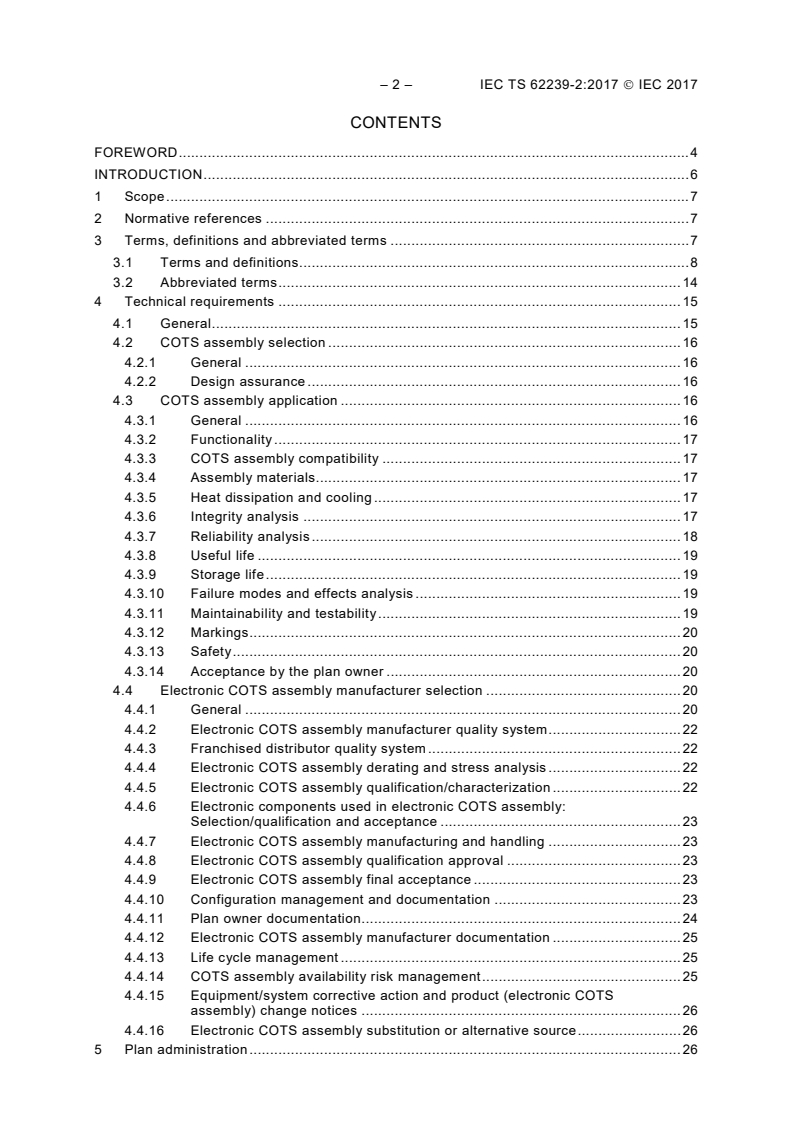
– 2 – IEC TS 62239-2:2017 IEC 2017
CONTENTS
FOREWORD . 4
INTRODUCTION . 6
1 Scope . 7
2 Normative references . 7
3 Terms, definitions and abbreviated terms . 7
3.1 Terms and definitions. 8
3.2 Abbreviated terms . 14
4 Technical requirements . 15
4.1 General . 15
4.2 COTS assembly selection . 16
4.2.1 General . 16
4.2.2 Design assurance . 16
4.3 COTS assembly application . 16
4.3.1 General . 16
4.3.2 Functionality . 17
4.3.3 COTS assembly compatibility . 17
4.3.4 Assembly materials. 17
4.3.5 Heat dissipation and cooling . 17
4.3.6 Integrity analysis . 17
4.3.7 Reliability analysis . 18
4.3.8 Useful life . 19
4.3.9 Storage life . 19
4.3.10 Failure modes and effects analysis . 19
4.3.11 Maintainability and testability . 19
4.3.12 Markings . 20
4.3.13 Safety . 20
4.3.14 Acceptance by the plan owner . 20
4.4 Electronic COTS assembly manufacturer selection . 20
4.4.1 General . 20
4.4.2 Electronic COTS assembly manufacturer quality system . 22
4.4.3 Franchised distributor quality system . 22
4.4.4 Electronic COTS assembly derating and stress analysis . 22
4.4.5 Electronic COTS assembly qualification/characterization . 22
4.4.6 Electronic components used in electronic COTS assembly:
Selection/qualification and acceptance . 23
4.4.7 Electronic COTS assembly manufacturing and handling . 23
4.4.8 Electronic COTS assembly qualification approval . 23
4.4.9 Electronic COTS assembly final acceptance . 23
4.4.10 Configuration management and documentation . 23
4.4.11 Plan owner documentation . 24
4.4.12 Electronic COTS assembly manufacturer documentation . 25
4.4.13 Life cycle management . 25
4.4.14 COTS assembly availability risk management . 25
4.4.15 Equipment/system corrective action and product (electronic COTS
assembly) change notices . 26
4.4.16 Electronic COTS assembly substitution or alternative source . 26
5 Plan administration . 26
5.1 Plan content and organization . 26
5.2 Plan terms, definitions and abbreviated terms . 27
5.3 Plan focal point . 27
5.4 Plan references . 27
5.5 Plan applicability . 27
5.6 Plan implementation . 27
5.7 Plan acceptance . 27
Annex A (informative) Template for tailoring the requirements of IEC TS 62239-2 . 28
Annex B (informative) Cross-reference between IEC TS 62239-2 and SAE EIA-933B . 29
Annex C (informative) Electronic COTS assembly design guidelines and COTS
assembly manufacturer’s risk assessment . 31
C.1 COTS assembly design guidelines . 31
C.1.1 Open system architecture . 31
C.1.2 Risk assessment and performance . 31
C.1.3 Assembly criticality . 31
C.2 COTS assembly manufacturer’s risk assessment . 31
Annex D (informative) Typical electronic COTS assembly mitigation methods and
techniques . 46
Annex E (informative) Requirements matrix for IEC TS 62239-2 . 54
Bibliography . 61
Table 1 – Electronic COTS assembly manufacturer selection recommendations . 21
Table A.1 – Template for tailoring requirements of IEC TS 62239-2 . 28
Table B.1 – Cross-reference between IEC TS 62239-2 and SAE EIA-933B
requirements . 29
Table C.1 – Template for electronic COTS assembly manufacturer’s risk assessment . 33
Table C.2 – Template for the plan owner’s mitigation and risk assessment of the
electronic COTS assembly manufacturer analysed in Table C.1 . 39
Table D.1 – Typical electronics COTS assembly mitigation methods and techniques . 46
Table E.1 – Requirements matrix for IEC TS 62239-2 . 54
– 4 – IEC TS 62239-2:2017 IEC 2017
INTERNATIONAL ELECTROTECHNICAL COMMISSION
____________
PROCESS MANAGEMENT FOR AVIONICS – MANAGEMENT PLAN –
Part 2: Preparation and maintenance of an electronic
COTS assembly management plan
FOREWORD
1) The International Electrotechnical Commission (IEC) is a worldwide organization for standardization comprising
all national electrotechnical committees (IEC National Committees). The object of IEC is to promote
international co-operation on all questions concerning standardization in the electrical and electronic fields. To
this end and in addition to other activities, IEC publishes International Standards, Technical Specifications,
Technical Reports, Publicly Available Specifications (PAS) and Guides (hereafter referred to as “IEC
Publication(s)”). Their preparation is entrusted to technical committees; any IEC National Committee interested
in the subject dealt with may participate in this preparatory work. International, governmental and non-
governmental organizations liaising with the IEC also participate in this preparation. IEC collaborates closely
with the International Organization for Standardization (ISO) in accordance with conditions determined by
agreement between the two organizations.
2) The formal decisions or agreements of IEC on technical matters express, as nearly as possible, an international
consensus of opinion on the relevant subjects since each technical committee has representation from all
interested IEC National Committees.
3) IEC Publications have the form of recommendations for international use and are accepted by IEC National
Committees in that sense. While all reasonable efforts are made to ensure that the technical content of IEC
Publications is accurate, IEC cannot be held responsible for the way in which they are used or for any
misinterpretation by any end user.
4) In order to promote international uniformity, IEC National Committees undertake to apply IEC Publications
transparently to the maximum extent possible in their national and regional publications. Any divergence
between any IEC Publication and the corresponding national or regional publication shall be clearly indicated in
the latter.
5) IEC itself does not provide any attestation of conformity. Independent certification bodies provide conformity
assessment services and, in some areas, access to IEC marks of conformity. IEC is not responsible for any
services carried out by independent certification bodies.
6) All users should ensure that they have the latest edition of this publication.
7) No liability shall attach to IEC or its directors, employees, servants or agents including individual experts and
members of its technical committees and IEC National Committees for any personal injury, property damage or
other damage of any nature whatsoever, whether direct or indirect, or for costs (including legal fees) and
expenses arising out of the publication, use of, or reliance upon, this IEC Publication or any other IEC
Publications.
8) Attention is drawn to the Normative references cited in this publication. Use of the referenced publications is
indispensable for the correct application of this publication.
9) Attention is drawn to the possibility that some of the elements of this IEC Publication may be the subject of
patent rights. IEC shall not be held responsible for identifying any or all such patent rights.
The main task of IEC technical committees is to prepare International Standards. In
exceptional circumstances, a technical committee may propose the publication of a technical
specification when
• the required support cannot be obtained for the publication of an International Standard,
despite repeated efforts, or
• the subject is still under technical development or where, for any other reason, there is the
future but no immediate possibility of an agreement on an International Standard.
Technical specifications are subject to review within three years of publication to decide
whether they can be transformed into International Standards.
IEC TS 62239-2, which is a technical specification, has been prepared by IEC Technical
Committee 107: Process management for avionics.
The text of this technical specification is based on the following documents:
Enquiry draft Report on voting
107/288/DTS 107/293/RVDTS
Full information on the voting for the approval of this technical specification can be found in
the report on voting indicated in the above table.
This document has been drafted in accordance with the ISO/IEC Directives, Part 2.
A list of all parts in the IEC 62239 series, published under the general title Process
management for avionics – Management plan, can be found on the IEC website.
The committee has decided that the contents of this document will remain unchanged until the
stability date indicated on the IEC website under "http://webstore.iec.ch" in the data related to
the specific document. At this date, the document will be
• reconfirmed,
• withdrawn,
• replaced by a revised edition, or
• amended.
A bilingual version of this publication may be issued at a later date.
– 6 – IEC TS 62239-2:2017 IEC 2017
INTRODUCTION
The purpose of this document is to define the requirements for developing an electronic
commercial off the shelf (COTS) assembly management plan (CAMP), hereinafter also called
the plan, to assure customers that all of the electronic COTS assemblies in the equipment of
the plan owner are selected and applied in controlled processes, and that the technical
requirements detailed in this document are accomplished. In general the owners of an
electronic COTS assembly management plan are original (electronic) equipment
manufacturers (OEMs) and system integrators for the aerospace, defence and high
performance (ADHP) electronics industry.
The objective is to define and document, as necessary, processes to assure the adequacy of
electronic COTS assemblies selected for use in electronic systems. This document states
objectives to be accomplished; it does not specify how tasks are performed, specific data
collected or reports issued. Those who prepare plans in compliance with this document are
encouraged to document processes that are the most effective and efficient for them in
accomplishing the objectives of this document. In order to allow flexibility in implementing and
updating the documented processes, plan authors are encouraged to refer to their own
internal process documents instead of including detailed process documentation within their
plans.
Organizations that prepare such plans are called the plan owners and may prepare a single
plan, and use it for all relevant products supplied by the organization, or may prepare a
separate plan for each relevant product or customer.
PROCESS MANAGEMENT FOR AVIONICS – MANAGEMENT PLAN –
Part 2: Preparation and maintenance of an electronic
COTS assembly management plan
1 Scope
This part of IEC 62239, which is a technical specification, applies to the development of
COTS assembly management plans (CAMPs) for the integration and management of
electronic COTS assemblies (see 3.1.13 and 3.1.20) in electronic systems used in the ADHP
markets where reliability is generally critical.
NOTE 1 Best practices for managing the electronic components within the electronic assemblies are described in
IEC TS 62239-1 and SAE EIA-STD-4899 which describe the electronic component management program (ECMP).
In cases where the electronic components can be identified and managed at the component level, ECMP can be
considered as an option to manage the components.
NOTE 2 The distinction between an electronic component and an electronic assembly is provided by the
definitions in Clause 3. This distinction between an electronic component and an electronic assembly is not always
recognized by industry: for example, filters, contactors, power supply modules, relays, magnetic assemblies, etc.,
can be considered as either components or assemblies. In each application it is considered a best practice for the
user of this document to clarify this distinction.
Depending on program or product line requirements and/or the technical characteristics of the
electronic COTS assemblies and in agreement with the customer, the electronic COTS
assembly management plans (CAMPs) could consider tailoring the requirements of this
document. See Annex A.
Although developed for the avionics industry, this document can be applied by other high
performance and high reliability industries at their discretion.
2 Normative references
The following documents are referred to in the text in such a way that some or all of their
content constitutes requirements of this document. For dated references, only the edition
cited applies. For undated references, the latest edition of the referenced document (including
any amendments) applies.
There are no normative references in this document.
3 Terms, definitions and abbreviated terms
For the purposes of this document, the following terms, definitions and abbreviated terms
apply.
ISO and IEC maintain terminological databases for use in standardization at the following
addresses:
• IEC Electropedia: available at http://www.electropedia.org/
• ISO Online browsing platform: available at http://www.iso.org/obp
– 8 – IEC TS 62239-2:2017 IEC 2017
3.1 Terms and definitions
3.1.1
analysis
utilization of data, reference materials, actions, or test results previously obtained that can be
utilized for comparison to verify that a requirement, a characteristic, a parameter or a criteria
has been met
Note 1 to entry: Test results and associated data can be part of the analysis.
3.1.2
assembly characterization
process of testing and/or analysis of assembly capability when configuration control of the
assembly's internal details is inadequate to support traditional qualification
Note 1 to entry MIL-STD-1521 provides information on qualification purposes.
3.1.3
assembly manufacturer
organization responsible for the assembly specification and its production
3.1.4
assembly obsolescence management
range of management and engineering actions taken to avoid or resolve the effects of
assemblies not being procurable due to the manufacturer(s) ceasing production
3.1.5
assembly qualification
process used to demonstrate that the assembly is capable of meeting specified requirements
for all required conditions and environments
Note 1 to entry: This may include qualification beyond the assembly manufacturer’s limits for the assembly.
3.1.6
assembly quality assurance
all activities and processes providing adequate confidence that each individual assembly
meets specified requirements
3.1.7
assurance
result of planned and systematic actions necessary to provide adequate confidence and
evidence that a product or process satisfies given requirements
3.1.8
component
piece part
electrical, optical, electro/optical-mechanical or electronic device that is not subject to
disassembly without destruction or impairment of design use
Note 1 to entry: Resistors, capacitors, diodes, integrated circuits, hybrids, busbars, circuit cards/modules,
printers, laptop computers, disk drives, application specific integrated circuits, wound components and relays, etc.
are examples of component.
3.1.9
configuration
performance, functional, and physical attributes of an existing or planned product or a
combination of products
Note 1 to entry: Generally each variation of a product leads to a configuration change.
3.1.10
configuration change management
configuration control
systematic process which ensures that changes to released configuration documentation are
properly identified, documented, evaluated for effect, approved by an appropriate level of
authority, incorporated and verified
Note 1 to entry: Generally configuration management activity concerns systematic proposal, justification,
evaluation, coordination, and disposition of proposed changes, and implementation of all approved and released
changes into
• applicable configurations of a product,
• associated product information, and
• supporting and interfacing products and their associated product information.
3.1.11
configuration documentation
technical information whose purpose is to identify and define a product’s performance
functional and physical attributes (for example specifications, drawings)
3.1.12
configuration verification
action verifying that the product has achieved its required attributes (for example performance
requirements, functional constraints) and the product’s design is accurately documented
3.1.13
COTS product
commercial off-the-shelf product
one or more components, assembled and developed for multiple commercial consumers,
whose design and/or configuration is controlled by the manufacturer’s specification or industry
standard
Note 1 to entry: COTS products can include electronic components, subassemblies or assemblies, or top level
assemblies. Electronic COTS subassemblies or assemblies include circuit card assemblies, power supplies, hard
drives, and memory modules. Top-level COTS assemblies include a fully integrated rack of equipment such as raid
arrays, file servers to individual switches, routers, personal computers, or similar equipment.
[SOURCE: IEC TS 62668-1:2016, 3.1.3]
3.1.14
COTS assembly management plan
CAMP
document that defines the processes and practices for integrating and managing assemblies
in an equipment or system
Note 1 to entry: Generally, it addresses all relevant aspects of managing assemblies during system design,
development, production, and post-production support.
3.1.15
COTS assembly manufacturer
organization responsible for the specification and the production of the COTS assembly
Note 1 to entry: Generally the COTS assembly manufacturer controls the design and the configuration (even if
subcontracted), but it is not a rule in this market segment which is not fully dedicated to avionics, and the COTS
assembly manufacturer ensures generally also the sale of the product to the commercial market.
3.1.16
dependability
measure of consistency in meeting reliability, availability and obsolescence expectations,
using logistical support methods
– 10 – IEC TS 62239-2:2017 IEC 2017
3.1.17
derating
design method which increases the operational margins of items by imposing modified item
usage limitations which are more restrictive than the usual or manufacturer’s item operational
ratings
3.1.18
design process
process of creating an item, equipment or system from a set of requirements
Note 1 to entry: In general, the design process follows a set of sub-processes such as requirements capture,
conceptual design, detailed design, implementation and production transition. Functional and physical verification,
as well as qualification, can be part of the design process which may be called in some organizations “development
process”.
3.1.19
durability analysis
structured analysis of the assembly’s response to the stresses resulting from operation,
maintenance, shipping, storage, and other activities throughout its specified life in order to
estimate its expected life
3.1.20
electronic assembly
electrical or electronic device that is not subject to disassembly without destruction or
impairment of design use
EXAMPLE Electronic circuit cards or modules, displays, storage devices, printers, laptop computer, electro/optical
devices, etc.
3.1.21
electronic equipment
functioning electronic device produced by the plan owner, which incorporates electronic
components
Note 1 to entry: End items, sub-assemblies, line-replaceable units and shop-replaceable units are examples of
electronic equipment.
[SOURCE: IEC TS 62239-1:2015, 3.1.20]
3.1.22
failure
inability of an item to perform a required function within specified limits
Note 1 to entry: A failure may be produced when a fault is encountered.
3.1.23
form
shape, size, dimensions, and other physically measurable parameters that uniquely
characterize a product
3.1.24
franchised distributor or agent
individual or corporate organization that is legally independent from the franchiser (in this
case the electronic component manufacturer or OCM) and agrees under contract to distribute
products using the franchiser’s name and sales network
Note 1 to entry: Distribution activities are carried out in accordance with standards set and controlled by the
franchiser. Shipments against orders placed can be despatched either direct from the OCM or the franchised
distributor or agent. In other words, the franchised distributor enters into contractual agreements with one or more
electronic component manufacturers to distribute and sell the said components. Distribution agreements may be
stipulated according to the following criteria: geographical area, type of clientele (avionics for example), maximum
manufacturing lot size. Components sourced through this route are protected by the OCM’s warranty and supplied
with full traceability.
[SOURCE: IEC TS 62668-1:2016, 3.1.9]
3.1.25
function
action or actions that a product is designed to perform
3.1.26
guidance
advice or counselling for complying with requirements
3.1.27
hardware
products made of material and their components (mechanical, electrical, electronic, optical,
hydraulic, pneumatic)
Note 1 to entry: Computer software and technical documentation are excluded.
3.1.28
implementation
action of generating a physical reality from a specification
3.1.29
integrity
state where the performance, technical characteristics, accuracy and consistency of an item
are maintained and assured over its entire life cycle
Note 1 to entry: Integrity applies to item like electronic components, electronic circuit cards, equipment, systems,
data, etc., and is a critical aspect to their design, implementation and usage conditions.
Note 2 to entry: Environmental conditions can affect physical, electrical and functional performances, for example
electromechanical faults, electromagnetic compatibility (EMC) perturbation (for example emission, immunity),
design flaws, material fatigue, corrosion, power outages, natural radiation disturbance, etc.
3.1.30
life cycle
generic period of time relating to the entire period of conception, definition, build, distribution,
operation, and disposal of a product
3.1.31
open system architecture
collection of interacting assemblies that has the following attributes as required to satisfy
stated needs such as:
• scalable,
• evolvable,
• robust (for example with regard to environmental constraints (thermal, vibrations, etc.)),
• controlled coupling among system elements,
• guaranteed timing and real time execution,
• graceful degradation,
• information assurance and protection,
• systems of systems interoperability,
• technology independence and obsolescence mitigation
Note 1 to entry: The interface specifications of assemblies are generally fully defined, available to the public and
maintained according to group consensus.
– 12 – IEC TS 62239-2:2017 IEC 2017
3.1.32
plan owner
COTS assembly integrator
original design authority responsible for all aspects of the design, functionality and reliability
of the delivered equipment in the intended application and responsible for writing and
maintaining their specific CAMP
Note 1 to entry: The plan owner, or COTS assembly integrator, typically integrates the electronic COTS assembly
into the ADHP electronic system and is the owner of the COTS assembly management plan (CAMP).
3.1.33
reliability
probability that an item will perform its intended function for a specified interval under stated
conditions
3.1.34
requirements
specified essential attributes
3.1.35
risk
measure of the potential inability to achieve overall program objectives within defined cost,
schedule, and technical constraints
[SOURCE: IEC TS 62239-1:2015, 3.1.28]
3.1.36
risk management
act or practice of dealing with risk that includes planning for risk, assessing (identifying and
analysing) risk areas, developing risk handling options, monitoring risks to determine how
risks have changed, and documenting the overall risk management program
[SOURCE: IEC TS 62239-1:2015, 3.1.29]
3.1.37
safety
state in which risk is lower than the boundary risk
Note 1 to entry: The boundary risk is the upper limit of the acceptable risk. It is specific for a technical process or
state. The risk is defined by the rate or probability or occurrence and the expected damage or injury.
3.1.38
safety analysis
disciplined approach to identifying hazards and their causes, and to assessing their risks
3.1.39
similarity analysis
structured comparison of the elements of the assembly being assessed with those of
predecessor assemblies for which test or in-service reliability data are available
3.1.40
single event effect
SEE
response of a component caused by the impact of a single particle (for example galactic
cosmic rays, solar energetic particles, energetic neutrons and protons)
Note 1 to entry: The range of responses can include both non-destructive (for example upset) and destructive (for
example latch-up or gate rupture) phenomena.
[SOURCE: IEC 62396-1:2016, 3.53]
3.1.41
specification
document that explicitly states essential technical attributes and/or requirements for a product
Note 1 to entry: A specification can include procedures to determine that the product’s performance meets its
requirements or attributes.
3.1.42
subcontractor
person or entity to which the holder of obligations under a contract has delegated part or all of
such obligations
[SOURCE: IEC TS 62239-1:2015, 3.1.32]
3.1.43
substitute assembly
assembly used as a replacement in equipment or system after the equipment or system
design has been approved
Note 1 to entry: In some contexts, the term “alternate assembly” is used to describe a substitute assembly that is
“equal to or better than” the original assembly.
3.1.44
system safety assessment
SSA
ongoing systematic, comprehensive evaluation of the proposed system to show that relevant
safety requirements are satisfied
3.1.45
test
verification actions, assessment and/or trials conducted and specific data obtained, analyzed,
corrected eventually to standard conditions, and compared to acceptance criteria to verify
performance requirements
Note 1 to entry: Test can apply to functional or environmental (for example thermal, vibrations, etc.) verification.
Note 2 to entry: Where “test” is the designated verification method, it is understood that some degree of analysis
is inherent in the verification process and need not be so identified.
3.1.46
testability
ability to test an item sufficiently to guarantee that all possible states of the item perform to its
specification
Note 1 to entry: This includes the ease with which an item can be tested to provide evidence of compliance with
its requirements.
3.1.47
traceability
ability to have for an electronic component its full trace back to the original component
manufacturer
Note 1 to entry: This traceability means that every supplier in the supply chain is prepared to legally declare in
writing that they know and can identify their source of supply, which goes back to the original manufacturer and
can confirm that the electronic components are brand new and were handled with appropriate ESD and MSL
handling precautions. This authenticates that the electronic components being supplied are unused, brand new
components with no ESD, MSL or other damage. This ensures that the electronic components are protected by any
manufacturer’s warranties, have all of their useful life remaining and function according to the manufacturer’s
published datasheet, exhibiting the expected component life in the application for the OEM’s reliability predictions
and product warranty.
[SOURCE: IEC TS 62668-1:2016, 3.1.22]
– 14 – IEC TS 62239-2:2017 IEC 2017
3.1.48
useful life
period of time from delivery of a product to the usage activity until its identity is destroyed by
classifying it as salvage
Note 1 to entry: Sometimes “useful life” is referred to as “life cycle”.
3.1.49
validation
method of qualifying components at the plan owner, when no in-service data from prior use is
available and there is no manufacturer’s qualification data to analyse
[SOURCE: IEC TS 62239-1: 2015, 3.1.35]
3.1.50
verification
determination, at each design stage, that the design meets requirements
3.2 Abbreviated terms
ADHP aerospace, defence and high performance
ARP Aerospace Recommended Practice
ASIC application-specific integrated circuit
BGA ball grid array
BIT built-in-test
BoM bill of material
CAMP COTS assembly management plan
COTS commercial off-the-shelf
DMS diminishing manufacturing sources
DMSMS diminishing manufacturing sources and material shortages
ECMP electronic components management plan
EMC electromagnetic compatibility
EMI electromagnetic interference
EOP end of production
EOS end of support
ESD electrostatic discharge
ESS environmental stress screening
FCA functional configuration audit
FMEA failure modes and effects analysis
FMECA failure modes, effects and criticality analysis
FOD foreign object debris
FPGA field-programmable gate array
GIDEP Government-Industry Data Exchange Program
HAST highly accelerated stress test
IBIT initiated bit
LBO last buy order
LCC leadless chip carrier
LFCP lead-free control plan
LRU line replaceable unit
LTB last time buy
LTS last time shipment
MCM multichip module
MEMS micro-electro-mechanical systems
MSL moisture sensitive level
MTBF mean time between failure
MTTF mean time to failure
OEM original equipment manufacturer
PCA physical configuration audit
PCB printed circuit board
PCN product change notice
PBIT performance bit
PDN product discontinuance notification
PCA physical configuration audit
PEM plastic electronic microcircuit
RFI request for information
RoHS Restriction of the use of certain Hazardous Substances (European Union
directive)
REACh Registration, Evaluation, Authorisation and Restriction of Chemicals (European
Union directive)
RTV room temperature vulcanization
SBIT start-up bit
SEE single event effects
SEL single event latch-up
SEU single event upset
SMT surface mount technology
SOW statement of work
T junction temperature (highest operating temperature of semiconductor in an
j
electronic component)
TOC total ownership cost
TVS transient voltage suppressor
UAV unmanned aerial vehicle
4 Technical requirements
4.1 General
The plan owner shall have an electronic COTS assembly management plan (CAMP)
addressing each requirement of this document, based on its existing quality management
system where applicable, to assure customers that electronic COTS assemblies are selected
and applied in the plan owner’s equipment using controlled processes (see 5.7).
The plan may be specific to one electronic COTS assembly, a range of electronic COTS
assemblies or to all electronic COTS assemblies.
The following annexes are informative for guidance and support purposes only:
• Annex A – Template for tailoring the requirements of IEC TS 62239-2;
– 16 – IEC TS 62239-2:2017 IEC 2017
• Annex B – Cross-reference between IEC TS 62239-2 and SAE EIA-933B;
• Annex C – Electronic COTS assembly design guidelines and COTS assembly
manufacturer’s risk assessment; Annex C provides risk considerations and guidance on
selecting electronic COTS assembly manufacturers and electronic COTS assemblies for
supporting the accomplishment of the requirements of Clause 4;
• Annex D – Typical electronic COTS assembly mitigation methods and techniques; Annex
D provides typical mitigation methods or techniques that can be considered as necessary
by the plan owner according to their application;
• Annex E – Requirements matrix for IEC TS 62239-2.
NOTE 1 The requirements of Clause 4 can be substituted by the requirements of SAE EIA-933B (see Annex B)
where applicable, to enable the plan owner to harmonise its plan for both specifications and Annex A for potential
tailoring.
NOTE 2 It is appropriate to have a good working relationship with the electronic COTS assembly manufacturer,
preferably using non-disclosure agreements or other types of legal instruments in order to facilitate sharing of
technical data sufficiently to meet the requirements of Clause 4. Where this is not possible, the plan owner could
consider carefully the potential risks (see Annex C) regarding the electronic COTS assembly manufacturer selection and the
consideration of the requirement of this document.
NOTE 3 Many electronic manufacturers that would previously have sold custom assemblies into the avionics
market are now willing to work with original equipment manufacturers (OEMs) to produce electronics COTS
assemblies. Such electronic manufacturers are typically the best type of electronic COTS assembly manufacturer,
as they are familiar with avionics requirements, will share data probably more easily and will be more prone to work
with the OEMs to comply with the requirements of this document. However, there are many other more commercial
electronic COTS assembly manufacturers that only support a few avionics requirements and will present higher
risks to the application.
NOTE 4 The plan owner is responsible for the cross-reference matrix identifying the clauses waived when SAE
EIA-933B is revised.
4.2 COTS assembly selection
4.2.1 General
The plan owner should consider the following and use the guidelines of Annex C.
4.2.2 Design assurance
The processes documented in the plan shall:
• provide design assurance for all applicable assemblies;
• assure that requirements for each assembly are identified and evaluated against the
manufacturer’s electronic COTS assembly specification and/or datasheet and any
additional relevant data to ensure suitability in the end application;
• assure that if additional performance is required (for example up-screening, uprating,
additional parameters defined) then the electronic COTS assembly shall be considered as
a specific one and shall be uniquely identified (see 4.3.6 and 4.4.8).The documented
process shall assure that these evaluations are documented (see 4.4.10);
• assure that availability and level of obsolescence risk are considered as major assembly
selection criteria (see 4.4.14).
NOTE 1 RTCA DO-254 / EUROCAE ED-80 and EASA CM – SWCEH – 001 provide guidance on design assurance
for airborne electronic hardware and are relevant practices for meeting the objectives of this document for
designing in particular specific components such as ASICs and FPGAs.
NOTE 2 Relevant data can include the electronic COTS assembly manufacturer’s request for information (RFI)
response, as well as the results of plan owner’s analyses, characterization testing, qualification testing, etc.
4.3 COTS assembly application
4.3.1 General
The following is to be considered by the plan owner:
4.3.2 Functionality
The documented processes shall:
• verify that the allocated equipment/system's electrical and functional requirements for
each e
...