

IEC TS 62565-5-2:2022
(Main)Nanomanufacturing - Material specifications - Part 5-2: Nano-enabled electrodes of electrochemical capacitors - Blank detail specification
General Information
- Abstract
IEC 62565-5-2:2022(E) which is a Technical Specification, establishes a blank detail specification that lists the relevant key control characteristics (KCC) including chemical, physical, structural, and electrochemical characteristics of nano-enabled electrode for electrochemical capacitors. Electrodes of both electric double layer capacitors and pseudo capacitors with nano/ nanostructured materials such as nanoporous activated carbon, graphene, carbon nanotube, carbon black, carbon aerogel, carbon nanomaterial coating collector, etc., are included. For other electrodes, this document can be used for reference.
In addition, this document enables the customer to specify requirements in a standardized manner and to verify through standardized methods that the nano-enabled electrode of the electrochemical capacitors meets the required properties.
- Status
- Published
- Publication Date
- 20-Apr-2022
- Technical Committee
- TC 113 - Nanotechnology for electrotechnical products and systems
- Drafting Committee
- WG 11 - TC 113/WG 11
- Current Stage
- PPUB - Publication issued
- Start Date
- 21-Apr-2022
- Completion Date
- 13-May-2022
Buy Documents
IEC TS 62565-5-2:2022 - Nanomanufacturing - Material specifications - Part 5-2: Nano-enabled electrodes of electrochemical capacitors - Blank detail specification Released:4/21/2022
Overview
IEC TS 62565-5-2:2022 - Nanomanufacturing – Material specifications – Part 5-2: Nano-enabled electrodes of electrochemical capacitors – Blank detail specification provides a standardized blank detail specification for nano-enabled electrodes used in electrochemical capacitors. This Technical Specification lists the relevant key control characteristics (KCC) - chemical, physical, structural and electrochemical - for electrodes of both electric double-layer capacitors (EDLCs) and pseudocapacitors using nano/nanostructured materials (for example: nanoporous activated carbon, graphene, carbon nanotubes, carbon black, carbon aerogel, and nanomaterial coatings). It enables customers and suppliers to specify requirements consistently and to verify properties using referenced measurement methods.
Key topics and requirements
The document focuses on clear, auditable specification and testability of nano-enabled electrode materials. Major technical topics include:
- General procurement information and product description format for bilateral contracts.
- Chemical KCCs: moisture (Karl Fischer), ash content (incineration, TGA), magnetic impurities (ICP‑MS/OES/ASS), etc.
- Physical KCCs: thickness, surface and rolling density, resistivity, surface roughness.
- Structural KCCs: specific surface area, pore volume, morphological descriptors for nanoporous and nanostructured carbons.
- Electrochemical KCCs: specific capacitance (CCC, CCD), voltage maintenance, leakage current, DC resistance, cycling endurance and temperature endurance.
- Measurement methods: Annex A provides documented procedures or references for many tests (e.g., Karl Fischer titration, TGA, ICP methods, BET surface area, contact angle, capacitance and leakage test protocols).
The specification format includes tables for KCC reporting and an overview table of measurement methods to support reproducible verification.
Applications and users
This Technical Specification is valuable for:
- Manufacturers and material suppliers defining product datasheets for nano-enabled electrodes.
- OEMs and system integrators (EVs, high-speed transport, aerospace, grid storage, renewable-energy inverters) sourcing electrochemical capacitors.
- Procurement and quality teams seeking standardized acceptance criteria.
- Test laboratories and R&D groups developing or validating electrode materials and cell performance.
- Regulatory and conformity assessment bodies referencing standardized KCCs for material evaluation.
Use cases include supplier-customer contracts, incoming material inspection, product development comparisons, and qualification testing for capacitor manufacturing.
Related standards
- Part of the IEC 62565 series (Nanomanufacturing – Material specifications); consult the IEC webstore for other parts and for normative references used throughout this Technical Specification.
- The document is a Technical Specification (Edition 1.0, 2022-04) and complements existing electrochemical and materials test standards cited in its normative references.
Keywords: IEC TS 62565-5-2, nanomanufacturing, nano-enabled electrodes, electrochemical capacitors, key control characteristics, nanoporous activated carbon, graphene, carbon nanotube, measurement methods, material specification.
Buy Documents
IEC TS 62565-5-2:2022 - Nanomanufacturing - Material specifications - Part 5-2: Nano-enabled electrodes of electrochemical capacitors - Blank detail specification Released:4/21/2022
Frequently Asked Questions
IEC TS 62565-5-2:2022 is a technical specification published by the International Electrotechnical Commission (IEC). Its full title is "Nanomanufacturing - Material specifications - Part 5-2: Nano-enabled electrodes of electrochemical capacitors - Blank detail specification". This standard covers: IEC 62565-5-2:2022(E) which is a Technical Specification, establishes a blank detail specification that lists the relevant key control characteristics (KCC) including chemical, physical, structural, and electrochemical characteristics of nano-enabled electrode for electrochemical capacitors. Electrodes of both electric double layer capacitors and pseudo capacitors with nano/ nanostructured materials such as nanoporous activated carbon, graphene, carbon nanotube, carbon black, carbon aerogel, carbon nanomaterial coating collector, etc., are included. For other electrodes, this document can be used for reference. In addition, this document enables the customer to specify requirements in a standardized manner and to verify through standardized methods that the nano-enabled electrode of the electrochemical capacitors meets the required properties.
IEC 62565-5-2:2022(E) which is a Technical Specification, establishes a blank detail specification that lists the relevant key control characteristics (KCC) including chemical, physical, structural, and electrochemical characteristics of nano-enabled electrode for electrochemical capacitors. Electrodes of both electric double layer capacitors and pseudo capacitors with nano/ nanostructured materials such as nanoporous activated carbon, graphene, carbon nanotube, carbon black, carbon aerogel, carbon nanomaterial coating collector, etc., are included. For other electrodes, this document can be used for reference. In addition, this document enables the customer to specify requirements in a standardized manner and to verify through standardized methods that the nano-enabled electrode of the electrochemical capacitors meets the required properties.
IEC TS 62565-5-2:2022 is classified under the following ICS (International Classification for Standards) categories: 07.120 - Nanotechnologies. The ICS classification helps identify the subject area and facilitates finding related standards.
IEC TS 62565-5-2:2022 is available in PDF format for immediate download after purchase. The document can be added to your cart and obtained through the secure checkout process. Digital delivery ensures instant access to the complete standard document.
Standards Content (Sample)
IEC TS 62565-5-2 ®
Edition 1.0 2022-04
TECHNICAL
SPECIFICATION
Nanomanufacturing – Material specifications –
Part 5-2: Nano-enabled electrodes of electrochemical capacitors – Blank detail
specification
All rights reserved. Unless otherwise specified, no part of this publication may be reproduced or utilized in any form
or by any means, electronic or mechanical, including photocopying and microfilm, without permission in writing from
either IEC or IEC's member National Committee in the country of the requester. If you have any questions about IEC
copyright or have an enquiry about obtaining additional rights to this publication, please contact the address below or
your local IEC member National Committee for further information.
IEC Secretariat Tel.: +41 22 919 02 11
3, rue de Varembé info@iec.ch
CH-1211 Geneva 20 www.iec.ch
Switzerland
About the IEC
The International Electrotechnical Commission (IEC) is the leading global organization that prepares and publishes
International Standards for all electrical, electronic and related technologies.
About IEC publications
The technical content of IEC publications is kept under constant review by the IEC. Please make sure that you have the
latest edition, a corrigendum or an amendment might have been published.
IEC publications search - webstore.iec.ch/advsearchform IEC Products & Services Portal - products.iec.ch
The advanced search enables to find IEC publications by a Discover our powerful search engine and read freely all the
variety of criteria (reference number, text, technical publications previews. With a subscription you will always have
committee, …). It also gives information on projects, replaced access to up to date content tailored to your needs.
and withdrawn publications.
Electropedia - www.electropedia.org
IEC Just Published - webstore.iec.ch/justpublished
The world's leading online dictionary on electrotechnology,
Stay up to date on all new IEC publications. Just Published
containing more than 22 300 terminological entries in English
details all new publications released. Available online and once
and French, with equivalent terms in 19 additional languages.
a month by email.
Also known as the International Electrotechnical Vocabulary
(IEV) online.
IEC Customer Service Centre - webstore.iec.ch/csc
If you wish to give us your feedback on this publication or need
further assistance, please contact the Customer Service
Centre: sales@iec.ch.
IEC TS 62565-5-2 ®
Edition 1.0 2022-04
TECHNICAL
SPECIFICATION
Nanomanufacturing – Material specifications –
Part 5-2: Nano-enabled electrodes of electrochemical capacitors – Blank detail
specification
INTERNATIONAL
ELECTROTECHNICAL
COMMISSION
ICS 07.120 ISBN 978-2-8322-1099-1
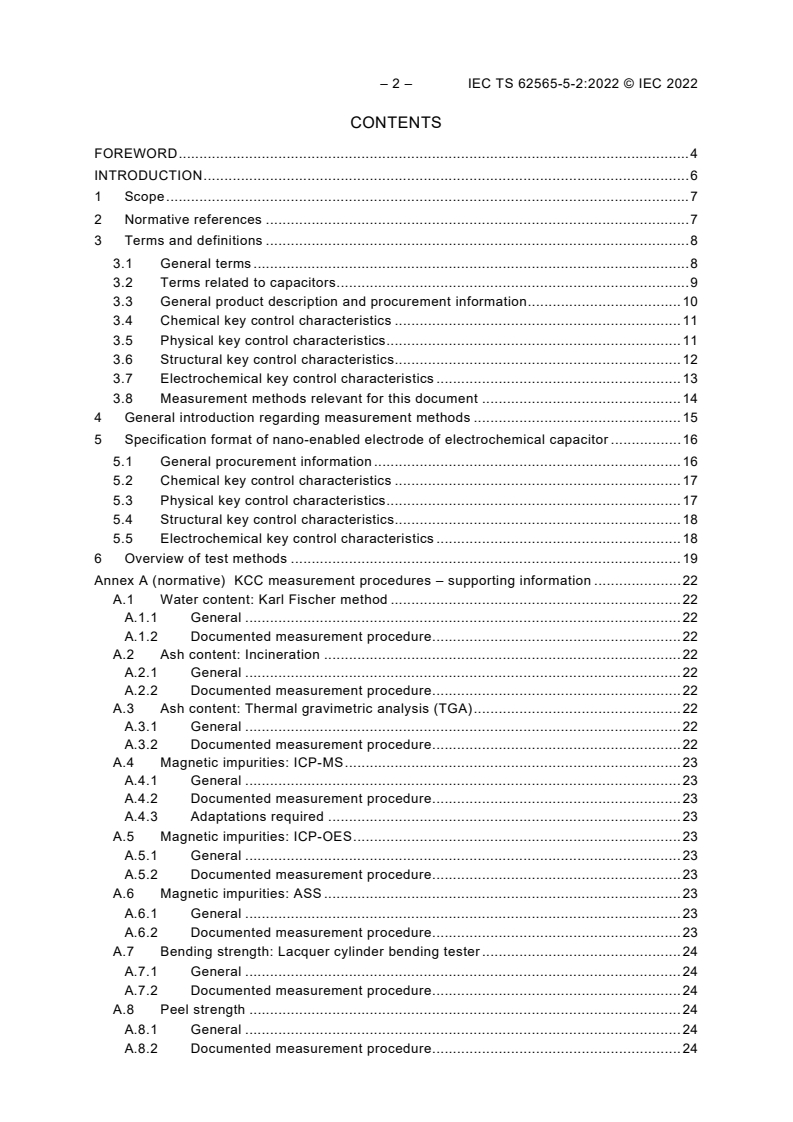
– 2 – IEC TS 62565-5-2:2022 © IEC 2022
CONTENTS
FOREWORD . 4
INTRODUCTION . 6
1 Scope . 7
2 Normative references . 7
3 Terms and definitions . 8
3.1 General terms . 8
3.2 Terms related to capacitors . 9
3.3 General product description and procurement information . 10
3.4 Chemical key control characteristics . 11
3.5 Physical key control characteristics . 11
3.6 Structural key control characteristics. 12
3.7 Electrochemical key control characteristics . 13
3.8 Measurement methods relevant for this document . 14
4 General introduction regarding measurement methods . 15
5 Specification format of nano-enabled electrode of electrochemical capacitor . 16
5.1 General procurement information . 16
5.2 Chemical key control characteristics . 17
5.3 Physical key control characteristics . 17
5.4 Structural key control characteristics. 18
5.5 Electrochemical key control characteristics . 18
6 Overview of test methods . 19
Annex A (normative) KCC measurement procedures – supporting information . 22
A.1 Water content: Karl Fischer method . 22
A.1.1 General . 22
A.1.2 Documented measurement procedure. 22
A.2 Ash content: Incineration . 22
A.2.1 General . 22
A.2.2 Documented measurement procedure. 22
A.3 Ash content: Thermal gravimetric analysis (TGA) . 22
A.3.1 General . 22
A.3.2 Documented measurement procedure. 22
A.4 Magnetic impurities: ICP-MS . 23
A.4.1 General . 23
A.4.2 Documented measurement procedure. 23
A.4.3 Adaptations required . 23
A.5 Magnetic impurities: ICP-OES . 23
A.5.1 General . 23
A.5.2 Documented measurement procedure. 23
A.6 Magnetic impurities: ASS . 23
A.6.1 General . 23
A.6.2 Documented measurement procedure. 23
A.7 Bending strength: Lacquer cylinder bending tester . 24
A.7.1 General . 24
A.7.2 Documented measurement procedure. 24
A.8 Peel strength . 24
A.8.1 General . 24
A.8.2 Documented measurement procedure. 24
A.9 Rebound rate . 24
A.9.1 General . 24
A.9.2 Documented measurement procedure. 24
A.10 Electrolyte adsorption capacity . 24
A.10.1 General . 24
A.10.2 Documented measurement procedure. 25
A.11 Contact angle . 25
A.11.1 General . 25
A.11.2 Documented measurement procedure. 25
A.12 Resistivity . 25
A.12.1 General . 25
A.12.2 Documented measurement procedure. 25
A.12.3 Adaptations required . 25
A.13 Thickness . 25
A.14 Surface and rolling density . 25
A.14.1 General . 25
A.14.2 Documented measurement procedure. 26
A.14.3 Adaptations required . 26
A.15 Specific surface area and pore volume . 26
A.15.1 General . 26
A.15.2 Documented measurement procedure. 26
A.16 Surface roughness . 26
A.17 Specific capacitance: CCC, CCD . 26
A.17.1 General . 26
A.17.2 Documented measurement procedure. 27
A.18 Voltage maintenance rate . 27
A.18.1 General . 27
A.18.2 Documented measurement procedure. 27
A.19 Leakage current: CCC, CCD, CVD . 27
A.19.1 General . 27
A.19.2 Documented measurement procedure. 27
A.20 Endurance in cycling . 27
A.20.1 General . 27
A.20.2 Documented measurement procedure. 28
A.21 Temperature endurance . 28
A.21.1 General . 28
A.21.2 Documented measurement procedure. 28
A.22 DC resistance: CCC, CCD . 28
A.22.1 General . 28
A.22.2 Documented measurement procedure. 28
Bibliography . 29
Table 1 – Format for general product description and procurement information . 16
Table 2 – Format for chemical key control characteristics . 17
Table 3 – Format for physical key control characteristics . 17
Table 4 – Format for structural key control characteristics . 18
Table 5 – Format for electrochemical key control characteristics . 18
Table 6 – Overview of measurement methods . 20
– 4 – IEC TS 62565-5-2:2022 © IEC 2022
INTERNATIONAL ELECTROTECHNICAL COMMISSION
____________
NANOMANUFACTURING – MATERIAL SPECIFICATIONS –
Part 5-2: Nano-enabled electrodes of electrochemical capacitor –
Blank detail specification
FOREWORD
1) The International Electrotechnical Commission (IEC) is a worldwide organization for standardization comprising
all national electrotechnical committees (IEC National Committees). The object of IEC is to promote international
co-operation on all questions concerning standardization in the electrical and electronic fields. To this end and
in addition to other activities, IEC publishes International Standards, Technical Specifications, Technical Reports,
Publicly Available Specifications (PAS) and Guides (hereafter referred to as "IEC Publication(s)"). Their
preparation is entrusted to technical committees; any IEC National Committee interested in the subject dealt with
may participate in this preparatory work. International, governmental and non-governmental organizations liaising
with the IEC also participate in this preparation. IEC collaborates closely with the International Organization for
Standardization (ISO) in accordance with conditions determined by agreement between the two organizations.
2) The formal decisions or agreements of IEC on technical matters express, as nearly as possible, an international
consensus of opinion on the relevant subjects since each technical committee has representation from all
interested IEC National Committees.
3) IEC Publications have the form of recommendations for international use and are accepted by IEC National
Committees in that sense. While all reasonable efforts are made to ensure that the technical content of IEC
Publications is accurate, IEC cannot be held responsible for the way in which they are used or for any
misinterpretation by any end user.
4) In order to promote international uniformity, IEC National Committees undertake to apply IEC Publications
transparently to the maximum extent possible in their national and regional publications. Any divergence between
any IEC Publication and the corresponding national or regional publication shall be clearly indicated in the latter.
5) IEC itself does not provide any attestation of conformity. Independent certification bodies provide conformity
assessment services and, in some areas, access to IEC marks of conformity. IEC is not responsible for any
services carried out by independent certification bodies.
6) All users should ensure that they have the latest edition of this publication.
7) No liability shall attach to IEC or its directors, employees, servants or agents including individual experts and
members of its technical committees and IEC National Committees for any personal injury, property damage or
other damage of any nature whatsoever, whether direct or indirect, or for costs (including legal fees) and
expenses arising out of the publication, use of, or reliance upon, this IEC Publication or any other IEC
Publications.
8) Attention is drawn to the Normative references cited in this publication. Use of the referenced publications is
indispensable for the correct application of this publication.
9) Attention is drawn to the possibility that some of the elements of this IEC Publication may be the subject of patent
rights. IEC shall not be held responsible for identifying any or all such patent rights.
IEC TS 62565-5-2 has been prepared by IEC technical committee 113: Nanotechnology for
electrotechnical products and systems. It is a Technical Specification.
The text of this Technical Specification is based on the following documents:
Draft Report on voting
113/628/DTS 113/643/RVDTS
Full information on the voting for its approval can be found in the report on voting indicated in
the above table.
The language used for the development of this Technical Specification is English.
This document was drafted in accordance with ISO/IEC Directives, Part 2, and developed in
accordance with ISO/IEC Directives, Part 1 and ISO/IEC Directives, IEC Supplement, available
at www.iec.ch/members_experts/refdocs. The main document types developed by IEC are
described in greater detail at www.iec.ch/standardsdev/publications.
A list of all parts in the IEC 62565 series, published under the general title Nanomanufacturing –
Material specifications, can be found on the IEC website.
The committee has decided that the contents of this document will remain unchanged until the
stability date indicated on the IEC website under webstore.iec.ch in the data related to the
specific document. At this date, the document will be
• reconfirmed,
• withdrawn,
• replaced by a revised edition, or
• amended.
– 6 – IEC TS 62565-5-2:2022 © IEC 2022
INTRODUCTION
This Technical Specification specifies how to report the various characteristics of electrodes for
industrial use in electrotechnical products, and how to incorporate these into a bilateral detail
specification between vendor and user.
Electrochemical capacitors are widely used in the fields of electric vehicles, high speed trains,
aircraft, photovoltaic, wind power and electronics, due to their ultra-fast charge/discharge
capability, long cycle life, wide working temperature range, high security reliability and low
maintenance cost [1] . In the manufacture process of electrochemical capacitor, the electrode
is a bridge between raw material and device. Therefore, the performance of the electrode is
very critical in the whole electrochemical capacitor industry chain because the properties of
electrodes not only reflect the performance of upstream raw material but also determine the
performance of electrochemical capacitor [2][3][4][5][6][7][8][9].
For the purposes of development and commercialization of raw nanomaterials for electrodes
and the electrochemical capacitor and assembly produced therefrom, the product
characteristics and characterization methods need to be specified in a standardized way. This
blank detail specification will benefit different stakeholders as follows: for material suppliers, it
provides necessary feedback from the manufacturers to guide the design and production of raw
materials; for the end-product manufacturers, it provides a toolbox for evaluating product quality
so as to manage and improve process control, yield of products; for commercialization and
trade, it provides a guidance on referred test methods for electrode classification; in addition,
it will strengthen the links between material manufacture and down-stream user.
In this blank detail specification, the key chemical, physical, structural and electrochemical
characteristics that will significantly influence the performance of electrochemical capacitors
and their measurement methods are listed. These characteristics and characterization methods
are not limited only to nano-enabled electrodes but also can be reference for other electrodes
which are constructed by coating electrode materials on a current collector.
_____________
Numbers in square brackets refer to the Bibliography.
NANOMANUFACTURING – MATERIAL SPECIFICATIONS –
Part 5-2: Nano-enabled electrodes of electrochemical capacitor –
Blank detail specification
1 Scope
This part of IEC 62565, which is a Technical Specification, establishes a blank detail
specification that lists the relevant key control characteristics (KCC) including chemical,
physical, structural, and electrochemical characteristics of nano-enabled electrode for
electrochemical capacitors. Electrodes of both electric double layer capacitors and pseudo
capacitors with nano/ nanostructured materials such as nanoporous activated carbon, graphene,
carbon nanotube, carbon black, carbon aerogel, carbon nanomaterial coating collector, etc.,
are included. For other electrodes, this document can be used for reference.
In addition, this document enables the customer to specify requirements in a standardized
manner and to verify through standardized methods that the nano-enabled electrode of the
electrochemical capacitors meets the required properties.
Numeric values to be specified for the characteristics in this document are intentionally left
blank and are determined by agreement between customer and electrochemical capacitor
supplier. Properties and characteristics deemed by the customer or supplier as not relevant to
a specific application are classified as "not applicable" or "not specified".
2 Normative references
The following documents are referred to in the text in such a way that some or all of their content
constitutes requirements of this document. For dated references, only the edition cited applies.
For undated references, the latest edition of the referenced document (including any
amendments) applies.
IEC TS 62607-4-2, Nanomanufacturing – Key control characteristics – Part 4-2: Nano-enabled
electrical energy storage – Physical characterization of cathode nanomaterials, density
measurement
IEC TS 62607-4-3, Nanomanufacturing – Key control characteristics – Part 4-3: Nano-enabled
electrical energy storage – Contact and coating resistivity measurements for nanomaterials
IEC TS 62607-4-8, Nanomanufacturing – Key control characteristics – Part 4-8: Nano-enabled
electrical energy storage – Determination of water content in electrode nanomaterials, Karl
Fischer method
IEC TS 62607-6-20, Nanomanufacturing – Key control characteristics – Part 6-20: Graphene-
based material – Metallic impurity content: ICP-MS
ISO 9277, Determination of the specific surface area of solids by gas adsorption – BET method
ISO 15901-2, Pore size distribution and porosity of solid materials by mercury porosimetry and
gas adsorption – Part 2: Analysis of nanopores by gas adsorption
_____________
Under preparation. Stage at the time of publication: IEC DTS 62607-6-20:2021.
– 8 – IEC TS 62565-5-2:2022 © IEC 2022
ISO 25178 (all parts), Geometrical product specifications (GPS) – Surface texture: Areal
3 Terms and definitions
For the purposes of this document, the following terms and definitions apply.
ISO and IEC maintain terminological databases for use in standardization at the following
addresses:
• IEC Electropedia: available at http://www.electropedia.org/
• ISO Online browsing platform: available at http://www.iso.org/obp
3.1 General terms
3.1.1
nanomaterial
material with any external dimension in the nanoscale or having internal structure or surface
structure in the nanoscale
[SOURCE: ISO/TS 80004-1:2015, 2.4, modified – The two notes have been removed.]
3.1.2
nanostructured material
material having internal nanostructure or surface nanostructure
Note 1 to entry: This definition does not exclude the possibility for a nano-object to have internal structure or surface
structure. If external dimension(s) are in the nanoscale, the term nano-object is recommended.
[SOURCE: ISO/TS 80004-1:2015, 2.7]
3.1.3
nano-enabled device
device in which the material elements or assembly of such elements exhibit performance or
function only possible with nanotechnology
Note 1 to entry: The material element is a nanomaterial.
Note 2 to entry: The performance or function exhibited is measurable and significant for the application of the nano-
enabled device.
Note 3 to entry: Applications of nano-enabled devices can include, but are not limited to, energy storage devices
(capacitors, materials for lithium ion battery, fuel cell membrane, etc.), photovoltaic, organic electronics, and electro-
optical devices.
[SOURCE: IEC 80004-9:2017, 3.1.5, modified – Notes 1 and 2 have been modified.]
3.1.4
key control characteristic
KCC
key performance indicator
material property or intermediate product characteristic which can affect safety or compliance
with regulations, fit, function, performance, quality, reliability or subsequent processing of the
final product
Note 1 to entry: The measurement of a key control characteristic is described in a standardized measurement
procedure with known accuracy and precision.
Note 2 to entry: It is possible to define more than one measurement method for a key control characteristic if the
correlation of the results is well-defined and known.
3.1.5
blank detail specification
BDS
structured generic specification of the set of key control characteristics which are needed to
describe a specific nano-enabled product without assigning specific values and/or attributes
Note 1 to entry: The templates defined in a blank detail specification list the key control characteristics for the nano-
enabled material or product without assigning specific values to it.
Note 2 to entry: Examples of nano-enabled products are: nanomaterials, nanocomposites and nano-subassemblies.
Note 3 to entry: Blank detail specifications are intended to be used by industrial users to prepare their detail
specifications used in bilateral procurement contracts. A blank detail specification facilitates the comparison and
benchmarking of different materials. Furthermore, a standardized format makes procurement more efficient and more
error robust.
3.2 Terms related to capacitors
3.2.1
electrochemical capacitor
supercapacitor
device that stores electrical energy using a double layer in an electrochemical cell
Note 1 to entry: The electrochemical capacitor is not to be confused with electrolytic capacitors.
[SOURCE: IEC 60050-114:2014, 114-03-03]
3.2.2
electrode
conductive part in electric contact with a medium of lower conductivity and intended to perform
one or more of the functions of emitting charge carriers to or receiving charge carriers from that
medium or to establish an electric field in that medium
[SOURCE: IEC 60050-151:2001, 151-13-01]
3.2.3
electrode type
classification of the electrode of an electrochemical capacitor according to the charge-storage
mechanism
Note 1 to entry: There are two electrochemical capacitor types: electric double layer capacitor and pseudo
capacitor.
3.2.4
electric double layer capacitor
EDLC
device for electrostatic storage of electrical energy achieved by separation of charge in a double
layer
[SOURCE: ISO 18300:2016, 3.8]
3.2.5
pseudo capacitor
Faraday capacitor
device for storage of electrical energy achieved by rapid oxidation-reduction reaction near the
surface of electrode
– 10 – IEC TS 62565-5-2:2022 © IEC 2022
3.3 General product description and procurement information
3.3.1
active material
material that can be used to store energy by electrochemical double-layer or pseudo
capacitance effect
Note 1 to entry: Typically, nonreactive carbon materials are electric double-layer capacitance active material,
including activated carbon, pure carbon nanotube and pure graphene.
Note 2 to entry: Typically, carbon composites and carbons embedded with heteroatoms are pseudo capacitance
active material.
3.3.2
additive
material added in small quantities to a liquid or granular material to produce some desired
modification to its characteristics
[SOURCE: ISO 6707-1:2020, 3.4.4.1]
3.3.3
nano-additive
additive that is nanomaterial or nano-structured material
3.3.4
graphene
graphene layer
single-layer graphene
monolayer graphene
1LG
single layer of carbon atoms with each atom bound to three neighbours in a honeycomb
structure
Note 1 to entry: It is an important building block of many carbon nano-objects.
Note 2 to entry: As graphene is a single layer, it is also sometimes called monolayer graphene or single-layer
graphene and abbreviated as 1LG to distinguish it from bilayer graphene (2LG) and few-layered graphene (FLG).
Note 3 to entry: Graphene has edges and can have defects and grain boundaries where the bonding is disrupted.
[SOURCE: ISO/TS 80004-13:2017, 3.1.2.1]
3.3.5
nanofibre
nano-object with two similar external dimensions in the nanoscale and the third dimension
significantly larger
Note 1 to entry: The largest external dimension is not necessarily in the nanoscale.
Note 2 to entry: The terms nanofibril and nanofilament can also be used.
[SOURCE: ISO/TS 80004-2:2015, 4.5]
3.3.6
nanotube
hollow nanofibre
[SOURCE: ISO/TS 80004-2:2015, 4.8]
3.3.7
carbon nanotube
nanotube composed of carbon
[SOURCE: ISO/TS 80004-3:2020, 3.3.3, modified – Note 1 has been removed.]
3.3.8
carbon black
compounding ingredient consisting essentially of more than 95 % elemental carbon in the form
of near-spherical particles with major diameters less than 1 µm, generally coalesced into
aggregates
[SOURCE: ISO 1382:2020, 3.75, modified – Note 1 has been removed.]
3.3.9
current collector
conductive material in a fuel cell that collects electrons from the anode side or conducts
electrons to the cathode side
[SOURCE: IEC 60050-485:2020, 485-06-07]
3.3.10
aluminium foil
sheet of aluminium metal, usually less than 150 μm thick, that may be laminated to other
materials such as kraft paper or polyethylene
[SOURCE: ISO 9229:2020, 3.5.7]
3.3.11
carbonaceous coating aluminium foil
aluminium foil coated with carbon nanomaterial
3.4 Chemical key control characteristics
3.4.1
water content
ratio, expressed in percent, between the mass of water contained in the material as received
and the corresponding dry residue of the material
[SOURCE: ISO/TS 21268-2:2019, 3.6]
3.4.2
ash content
percent by mass of carbon-free residue on combustion and pyrolysis
[SOURCE: ISO 1998-2:1998, 2.10.120]
3.4.3
metallic impurities
metallic elements, such as Fe, Co, Ni, present but not intentionally added to a material, and the
minimum content of which is not controlled
3.5 Physical key control characteristics
3.5.1
bending strength
maximum bending radius of the device or assembly at which the coating layer of electrode
begins to crack or exfoliate from the current collector after applying the electrode to a film-
bending tester
– 12 – IEC TS 62565-5-2:2022 © IEC 2022
3.5.2
peel strength
force per unit effective width required to separate the electrode materials from the substrate
current collector under the specified conditions of test
3.5.3
rebound rate
after calendaring, thickness change ratio of the electrode at different time points
3.5.4
volume resistivity
ρ
v
measured volume resistance calculated to apply to a cube of unit side
Note 1 to entry: It is expressed in ohm metres (Ω·m).
[SOURCE: ISO 14309:2019, 3.3]
3.5.5
electrolyte adsorption capacity
ability of electrode to adsorb electrolyte, which can be determined by the time when a certain
amount of electrolyte is absorbed by electrode with a certain area.
3.6 Structural key control characteristics
3.6.1
thickness
shortest distance between two surfaces limiting a layer, when this distance can be considered
to be a constant over a region of a finite size
[SOURCE IEC 60050-113:2011, 113-01-24]
3.6.2
surface density
areic mass
surface mass density
at a given point on a two-dimensional domain of quasi-infinitesimal area dA, scalar quantity
equal to the mass dm within the domain divided by the area dA, thus ρ = dm/dA
A
[SOURCE: IEC 60050-113:2011, 113-03-10, modified – The note has been removed.]
3.6.3
rolling density
ratio of the mass of the rolled active material to its volume after being coated on a substrate
[SOURCE: IEC TS 62607-4-2, 3.1.3]
3.6.4
specific surface area
absolute surface area of the sample divided by sample mass
[SOURCE: ISO/TS 11931:2012, 3.3]
3.6.5
pore volume
volume of open pores unless otherwise stated
[SOURCE: ISO 15901-1:2016, 3.14]
3.6.6
surface roughness
surface topology of an area of surface, qualified in the International Standards by reference to
various resolution determinants and methods of calculation
[SOURCE ISO/IEC 10373-2:2015, 3.7]
3.7 Electrochemical key control characteristics
3.7.1
capacitance
ability of a capacitor to store electrical charge
Note 1 to entry: Unit: farad (F).
[SOURCE: IEC 62576:2018, 3.5]
3.7.2
specific capacitance of electrode
capacitance of capacitor divided by the mass or volume of electrode
Note 1 to entry: Unit: farad per gram (F/g) or farad per cubic centimetre (F/cm ).
3.7.3
leakage current
value of the current that flows through a capacitor after a charge for a fixed period of time
Note 1 to entry: Leakage current is given in amperes (A).
Note 2 to entry: Leakage current is caused by an unwanted conductive path other than a short circuit.
[SOURCE: IEC 62391-1:2015, 3.28, modified – Note 2 to entry has been added.]
3.7.4
voltage maintenance rate
ratio of voltage maintenance
ratio of the voltage at the open-ended terminals to the charge voltage after a specified time
period subsequent to the charging of a capacitor
[SOURCE: IEC 62576:2018, 3.25]
3.7.5
endurance in cycling
number of charge and discharge cycles when the measured capacitance or internal resistance
value reaches a specified degree of its initial value under a certain temperature and a certain
rate of charge current
3.7.6
temperature endurance
ratio of the capacitance or internal resistance to its initial value after a specified charging time
at constant voltage under a specific temperature
3.7.7
internal resistance
combined resistance of constituent material specific resistance and inside connection
resistance of a capacitor
– 14 – IEC TS 62565-5-2:2022 © IEC 2022
Note 1 to entry: Unit: ohm (Ω).
[SOURCE: IEC 62576:2018, 3.15]
3.8 Measurement methods relevant for this document
3.8.1
inductively coupled plasma mass spectroscopy
ICP-MS
analytical method for qualitative determination and quantitative evaluation of element
concentrations by measuring the ions produced by a radiofrequency inductively coupled plasma
Note 1 to entry: In the mass spectrometer the ions are separated and the elements identified according to their
mass-to-charge ratio m/z, while the concentration of the elements is proportional to the numbers of ions.
[SOURCE: ISO 7086-1:2019, 3.5]
3.8.2
inductively coupled plasma optical emission spectroscopy
ICP-OES
trace-level, elemental analysis technique that uses the emission spectra of a sample to identify
and quantify the elements present
[SOURCE: ISO 7086-1:2019, 3.6]
3.8.3
atomic absorption spectrometry
AAS
spectroanalytical method for qualitative determination and quantitative evaluation of element
concentrations wherein the technique determines these concentrations by measuring the
atomic absorption of free atoms
[ISO 7086-1:2019, 3.2]
3.8.4
thermal gravimetric analysis
TGA
method in which the change in the mass of a sample is measured as a function of temperature
while the sample is subjected to a controlled temperature programme
[SOURCE: ISO/TS 80004-6:2021, 6.1.2]
3.8.5
constant current discharge
CCD
discharge during which the electric current is maintained at a constant value regardless of the
battery voltage or temperature
3.8.6
constant current charge
CCC
charge during which the electric current is maintained at a constant value regardless of the
battery voltage or temperature
[SOURCE: IEC 60050-482:2004, 482-05-38]
3.8.7
constant voltage charge
CVC
charge during which the voltage is maintained at a constant value regardless of charge current
or temperature
[SOURCE: IEC 60050-482:2004, 482-05-49]
4 General introduction regarding measurement methods
For reasons of practicality for industrial use in manufacturing of nano-enabled electrotechnical
products, this document recommends appropriate measurement methods for each material
parameter. The specification of some KCCs of nano-enabled electrodes of electrochemical
capacitors refer to measurement procedures for which
– no standards currently exist, or
– standards are under development but have not yet been published, or
– standards were developed for other use cases but can be adopted with modifications.
In other cases, industrial users of this document shall fall back to methods which are used in
the scientific community. As they are not established as documented measurement procedures,
users of this document shall agree bilaterally on it. For the KCCs in this document, Clause 6
provides a general overview.
To fulfil the requirements of quality assessment management strategies this requires careful
documentation of the measurement procedure. The document describing the method used shall
have an identification number and include the following topics:
a) Measurement principle:
– basic scientific background;
– measurement configuration if there are different experimental setups available which
perform from a physical point of view the same measurement;
– measurement mode if there are measurement modes possible with the experimental
setup which deliver different kinds of information.
b) Measurement system:
– measurement equipment / apparatus;
– materials;
– calibration standards;
– ambient conditions;
– sample preparation method.
c) Measurement procedure:
– calibration of measurement equipment;
– detailed protocol of the measurement procedure;
– measurement accuracy.
d) Data analysis / interpretation of results:
– description of the method to derive the key control characteristics out of the
measurement data including the used key formulas.
e) Results to be reported:
– description of the test sample including a sketch, drawing or photograph;
– identification of the test sample, e.g. batch or serial number;
– quantitative description of the accuracy of the measurement;
– 16 – IEC TS 62565-5-2:2022 © IEC 2022
– measured key control characteristics listed in tables, plotted in figures, maps created by
scanning methods.
As this document is intended to be updated regularly, there will be a standardized method for
each KCC in the future, including supplementing, revising and replacing the reference
standards. Nevertheless, for special applications supplier and customer may deviate from the
recommendations and agree on other than the recommended standards or define a specific
method for their application.
5 Specification format of nano-enabled electrode of electrochemical capacitor
5.1 General procurement information
General procurement information about nano-enabled electrode for electrochemical capacitors
as well as a supplier-neutral technical description to classify the product should be provided by
the manufacturer or product supplier according to Table 1.
Table 1 – Format for general product description and procurement information
Item No ITEM INFORMATION
1.1 Supplier
1.2 Product
1.3 Trade name
1.4 Electrode type
1.5 Active material
1.6 ID number
Description of the No
1.7 manufacturing process
Yes Reference
available
Mass [kg]
1.8 Typical batch quantity
Volume [l]
Batch number
Serial number
Traceability
1.9 Others, specify
requirements
………………………….
Manufacturing date
Number
1.10 Specification Revision level
Date of issue
1.11 Packaging requirements
No
Material Safety Data
1.12
Sheet (MSDS) available
Yes Reference
NOTE Nanotechnology-based manufacturing processes are sometimes not mature enough that it can be excluded
that there are hidden parameters with significant influence on the product performance. Therefore, a detailed
description of the manufacturing process will help to control those parameters.
5.2 Chemical key control characteristics
Chemical characteristics as detailed in Table 2 shall be agreed between manufacturer and user.
Characteristics not of relevance for the application may be classified as not applicable or not
specified.
Table 2 – Format for chemical key control characteristics
ITEM MEASUREMENT MEASUREMENT
KCC SPECIFICATION
NO. METHOD PROCEDURE
IEC TS 62607-4-8
2.1 Water content Less than [ ] % Karl Fischer method
(Clause A.1)
Not available
Incineration
(Clause A.2)
2.2 Ash content Less than [ ] %
Not available
Thermal gravimetric
analysis (TGA)
(Clause A.3)
IEC TS 62607-6-20
ICP-MS
(Clause A.4)
Fe: Less than [ ] ppm
Not available
Magnetic impurities
2.3 Co: Less than [ ] ppm ICP-OES
content
(Clause A.5)
Ni: Less than [ ] ppm
Not available
AAS
(Clause A.6)
5.3 Physical key control characteristics
Physical characteristics as detailed in Table 3 shall be agreed between manufacturer and user.
Characteristics not of relevance for the application may be classified as not applicable or not
specified.
Table 3 – Format for physical key control characteristics
ITEM MEASUREMENT
MEASUREMENT
KCC SPECIFICATION
PROCEDURE
METHOD
NO.
Not available
Nominal [ ] ± Tolerance [ ]
3.1 Bending strength Film bending tester
mm
(Clause A.7)
Not available
Nominal [ ] ± Tolerance [ ]
3.2 Peel strength Peel method
N/m
(Clause A.8)
Not available
Nominal [ ] ± Tolerance [ ]
3.3 Rebound rate Thickness variation
mm
(Clause A.9)
Not available
Electrolyte adsorption Nominal [ ] ± Tolerance [ ]
3.5 Time measurement
capacity S/mL
(Clause A.10)
Not available
3.6 Contact angle Nominal [ ] ± Tolerance [ ] ° Image method
(Clause A.11)
IEC TS 62607-4-3
Nominal [ ] ± Tolerance [ ] Four-point probe
3.7 Resistivity
Ω∙cm resistivity tester
(Clause A.12)
---
...