


IEC TS 62257-9-3:2016
(Main)Recommendations for renewable energy and hybrid systems for rural electrification - Part 9-3: Integrated systems - User interface
Recommendations for renewable energy and hybrid systems for rural electrification - Part 9-3: Integrated systems - User interface
IEC TS 62257-9-3:2016(E) specifies the general requirements for the design and the implementation of the interface equipment within the user's installation which connects to a microgrid or the generating part of a standalone system. It applies to simplified user's interfaces (distribution board) in electrical installations with maximum power of 500 VA in decentralized rural electrification systems. The main technical changes with regard to the previous edition are as follows: changing the voltage range covered by the technical specification to AC nominal voltage below 1 000 V and DC nominal voltage below 1 500 V.
This publication is to be read in conjunction with IEC 62257 series.
General Information
- Status
- Published
- Publication Date
- 26-Sep-2016
- Technical Committee
- TC 82 - Solar photovoltaic energy systems
- Drafting Committee
- JWG 1 - TC 82/JWG 1
- Current Stage
- PPUB - Publication issued
- Start Date
- 27-Sep-2016
- Completion Date
- 15-Nov-2016
Relations
- Effective Date
- 05-Sep-2023
Overview
IEC TS 62257-9-3:2016 provides recommendations for the design and implementation of the user interface (simplified distribution board) that connects a household or small user installation to a microgrid or the generating part of a standalone renewable/hybrid system in decentralized rural electrification systems. It applies to user interfaces with a maximum rated power of 500 VA and covers systems with AC nominal voltage below 1 000 V and DC nominal voltage below 1 500 V. This Technical Specification is part of the IEC 62257 series for rural electrification.
Key topics and technical requirements
The standard sets out general requirements and practical design rules including:
- Scope and applicability
- Interfaces for user installations tied to a.c. microgrids or to a.c./d.c. generating parts of standalone systems up to 500 VA.
- Electrical characteristics and system voltages
- Defines acceptable AC/DC nominal voltage ranges and related constraints.
- Functional description
- Core interface functions: connection to sources, isolation, protection, distribution and earthing.
- Design and erection requirements
- System earthing and equipotential bonding.
- Segregation between AC and DC circuits within housings.
- Insulation levels and selection of electrical equipment compliant with low‑voltage practices.
- Accessibility and placement requirements (e.g., overcurrent protection devices must be accessible).
- Protection and safety
- Protection against direct and indirect contact, overcurrents and fraudulent use.
- Clear requirements for isolation and switching functions.
- Information, verification and commissioning
- Labelling/marking, documentation to be provided, inspection and commissioning tests.
- Illustrative material
- Includes configuration diagrams and a function table to guide practical implementation.
Applications and users
IEC TS 62257-9-3:2016 is intended for stakeholders involved in small-scale rural electrification and off‑grid projects, such as:
- System designers and electrical engineers specifying user distribution interfaces
- Installers, contractors and field technicians implementing household distribution boards
- Project implementers, NGOs and local utilities deploying decentralized renewable energy and hybrid systems
- Asset owners and community managers of microgrids or standalone systems
- Test and certification bodies verifying compliance with IEC 62257 recommendations
Typical practical uses include design and installation guidance for simplified distribution boards in solar home systems, community electrification points and small hybrid power installations where safety, isolation and basic distribution must be assured.
Related standards
- IEC 62257 series (all parts) - Recommendations for renewable energy and hybrid systems for rural electrification
- IEC 61439-3 - Distribution boards intended to be operated by ordinary persons (DBO)
- IEC TS 62257-5 - Protection against electrical hazards
- IEC TS 62257-9-2 and IEC TS 62257-9-4 - Other parts addressing microgrids and user installations
Keywords: IEC TS 62257-9-3:2016, user interface, rural electrification, microgrid, distribution board, decentralized rural electrification systems, renewable energy, hybrid systems, 500 VA, AC nominal voltage, DC nominal voltage.
Get Certified
Connect with accredited certification bodies for this standard

DNV
DNV is an independent assurance and risk management provider.

Lloyd's Register
Lloyd's Register is a global professional services organisation specialising in engineering and technology.
DNV Energy Systems
Energy and renewable energy certification.
Sponsored listings
Frequently Asked Questions
IEC TS 62257-9-3:2016 is a technical specification published by the International Electrotechnical Commission (IEC). Its full title is "Recommendations for renewable energy and hybrid systems for rural electrification - Part 9-3: Integrated systems - User interface". This standard covers: IEC TS 62257-9-3:2016(E) specifies the general requirements for the design and the implementation of the interface equipment within the user's installation which connects to a microgrid or the generating part of a standalone system. It applies to simplified user's interfaces (distribution board) in electrical installations with maximum power of 500 VA in decentralized rural electrification systems. The main technical changes with regard to the previous edition are as follows: changing the voltage range covered by the technical specification to AC nominal voltage below 1 000 V and DC nominal voltage below 1 500 V. This publication is to be read in conjunction with IEC 62257 series.
IEC TS 62257-9-3:2016(E) specifies the general requirements for the design and the implementation of the interface equipment within the user's installation which connects to a microgrid or the generating part of a standalone system. It applies to simplified user's interfaces (distribution board) in electrical installations with maximum power of 500 VA in decentralized rural electrification systems. The main technical changes with regard to the previous edition are as follows: changing the voltage range covered by the technical specification to AC nominal voltage below 1 000 V and DC nominal voltage below 1 500 V. This publication is to be read in conjunction with IEC 62257 series.
IEC TS 62257-9-3:2016 is classified under the following ICS (International Classification for Standards) categories: 27.160 - Solar energy engineering. The ICS classification helps identify the subject area and facilitates finding related standards.
IEC TS 62257-9-3:2016 has the following relationships with other standards: It is inter standard links to IEC TS 62257-9-3:2006. Understanding these relationships helps ensure you are using the most current and applicable version of the standard.
IEC TS 62257-9-3:2016 is available in PDF format for immediate download after purchase. The document can be added to your cart and obtained through the secure checkout process. Digital delivery ensures instant access to the complete standard document.
Standards Content (Sample)
IEC TS 62257-9-3 ®
Edition 2.0 2016-09
TECHNICAL
SPECIFICATION
colour
inside
Recommendations for renewable energy and hybrid systems for rural
electrification –
Part 9-3: Integrated systems – User interface
All rights reserved. Unless otherwise specified, no part of this publication may be reproduced or utilized in any form
or by any means, electronic or mechanical, including photocopying and microfilm, without permission in writing from
either IEC or IEC's member National Committee in the country of the requester. If you have any questions about IEC
copyright or have an enquiry about obtaining additional rights to this publication, please contact the address below or
your local IEC member National Committee for further information.
IEC Central Office Tel.: +41 22 919 02 11
3, rue de Varembé Fax: +41 22 919 03 00
CH-1211 Geneva 20 info@iec.ch
Switzerland www.iec.ch
About the IEC
The International Electrotechnical Commission (IEC) is the leading global organization that prepares and publishes
International Standards for all electrical, electronic and related technologies.
About IEC publications
The technical content of IEC publications is kept under constant review by the IEC. Please make sure that you have the
latest edition, a corrigenda or an amendment might have been published.
IEC Catalogue - webstore.iec.ch/catalogue Electropedia - www.electropedia.org
The stand-alone application for consulting the entire The world's leading online dictionary of electronic and
bibliographical information on IEC International Standards, electrical terms containing 20 000 terms and definitions in
Technical Specifications, Technical Reports and other English and French, with equivalent terms in 15 additional
documents. Available for PC, Mac OS, Android Tablets and languages. Also known as the International Electrotechnical
iPad. Vocabulary (IEV) online.
IEC publications search - www.iec.ch/searchpub IEC Glossary - std.iec.ch/glossary
The advanced search enables to find IEC publications by a 65 000 electrotechnical terminology entries in English and
variety of criteria (reference number, text, technical French extracted from the Terms and Definitions clause of
committee,…). It also gives information on projects, replaced IEC publications issued since 2002. Some entries have been
and withdrawn publications. collected from earlier publications of IEC TC 37, 77, 86 and
CISPR.
IEC Just Published - webstore.iec.ch/justpublished
Stay up to date on all new IEC publications. Just Published IEC Customer Service Centre - webstore.iec.ch/csc
details all new publications released. Available online and If you wish to give us your feedback on this publication or
also once a month by email. need further assistance, please contact the Customer Service
Centre: csc@iec.ch.
IEC TS 62257-9-3 ®
Edition 2.0 2016-09
TECHNICAL
SPECIFICATION
colour
inside
Recommendations for renewable energy and hybrid systems for rural
electrification –
Part 9-3: Integrated systems – User interface
INTERNATIONAL
ELECTROTECHNICAL
COMMISSION
ICS 27.160 ISBN 978-2-8322-3587-4
– 2 – IEC TS 62257-9-3:2016 © IEC 2016
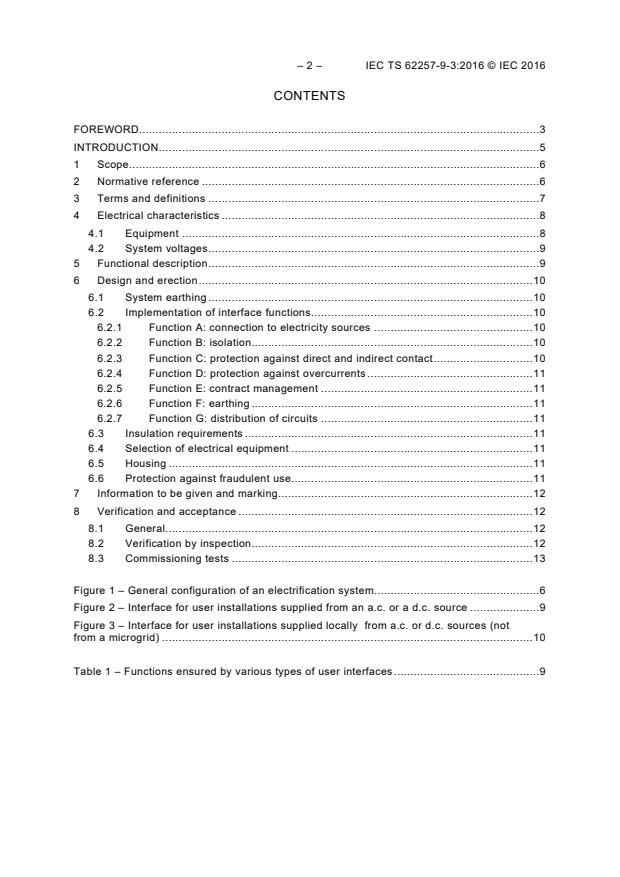
CONTENTS
FOREWORD . 3
INTRODUCTION . 5
1 Scope . 6
2 Normative reference . 6
3 Terms and definitions . 7
4 Electrical characteristics . 8
4.1 Equipment . 8
4.2 System voltages . 9
5 Functional description . 9
6 Design and erection . 10
6.1 System earthing . 10
6.2 Implementation of interface functions . 10
6.2.1 Function A: connection to electricity sources . 10
6.2.2 Function B: isolation . 10
6.2.3 Function C: protection against direct and indirect contact . 10
6.2.4 Function D: protection against overcurrents . 11
6.2.5 Function E: contract management . 11
6.2.6 Function F: earthing . 11
6.2.7 Function G: distribution of circuits . 11
6.3 Insulation requirements . 11
6.4 Selection of electrical equipment . 11
6.5 Housing . 11
6.6 Protection against fraudulent use. 11
7 Information to be given and marking . 12
8 Verification and acceptance . 12
8.1 General . 12
8.2 Verification by inspection . 12
8.3 Commissioning tests . 13
Figure 1 – General configuration of an electrification system . 6
Figure 2 – Interface for user installations supplied from an a.c. or a d.c. source . 9
Figure 3 – Interface for user installations supplied locally from a.c. or d.c. sources (not
from a microgrid) . 10
Table 1 – Functions ensured by various types of user interfaces . 9
INTERNATIONAL ELECTROTECHNICAL COMMISSION
____________
RECOMMENDATIONS FOR RENEWABLE ENERGY
AND HYBRID SYSTEMS FOR RURAL ELECTRIFICATION –
Part 9-3: Integrated systems – User interface
FOREWORD
1) The International Electrotechnical Commission (IEC) is a worldwide organization for standardization comprising
all national electrotechnical committees (IEC National Committees). The object of IEC is to promote
international co-operation on all questions concerning standardization in the electrical and electronic fields. To
this end and in addition to other activities, IEC publishes International Standards, Technical Specifications,
Technical Reports, Publicly Available Specifications (PAS) and Guides (hereafter referred to as “IEC
Publication(s)”). Their preparation is entrusted to technical committees; any IEC National Committee interested
in the subject dealt with may participate in this preparatory work. International, governmental and non-
governmental organizations liaising with the IEC also participate in this preparation. IEC collaborates closely
with the International Organization for Standardization (ISO) in accordance with conditions determined by
agreement between the two organizations.
2) The formal decisions or agreements of IEC on technical matters express, as nearly as possible, an international
consensus of opinion on the relevant subjects since each technical committee has representation from all
interested IEC National Committees.
3) IEC Publications have the form of recommendations for international use and are accepted by IEC National
Committees in that sense. While all reasonable efforts are made to ensure that the technical content of IEC
Publications is accurate, IEC cannot be held responsible for the way in which they are used or for any
misinterpretation by any end user.
4) In order to promote international uniformity, IEC National Committees undertake to apply IEC Publications
transparently to the maximum extent possible in their national and regional publications. Any divergence
between any IEC Publication and the corresponding national or regional publication shall be clearly indicated in
the latter.
5) IEC itself does not provide any attestation of conformity. Independent certification bodies provide conformity
assessment services and, in some areas, access to IEC marks of conformity. IEC is not responsible for any
services carried out by independent certification bodies.
6) All users should ensure that they have the latest edition of this publication.
7) No liability shall attach to IEC or its directors, employees, servants or agents including individual experts and
members of its technical committees and IEC National Committees for any personal injury, property damage or
other damage of any nature whatsoever, whether direct or indirect, or for costs (including legal fees) and
expenses arising out of the publication, use of, or reliance upon, this IEC Publication or any other IEC
Publications.
8) Attention is drawn to the Normative references cited in this publication. Use of the referenced publications is
indispensable for the correct application of this publication.
9) Attention is drawn to the possibility that some of the elements of this IEC Publication may be the subject of
patent rights. IEC shall not be held responsible for identifying any or all such patent rights.
The main task of IEC technical committees is to prepare International Standards. In
exceptional circumstances, a technical committee may propose the publication of a technical
specification when
• the required support cannot be obtained for the publication of an International Standard,
despite repeated efforts, or
• the subject is still under technical development or where, for any other reason, there is the
future but no immediate possibility of an agreement on an International Standard.
Technical specifications are subject to review within three years of publication to decide
whether they can be transformed into International Standards.
IEC 62257-9-3, which is a technical specification, has been prepared by IEC technical
committee 82: Solar photovoltaic energy systems.
– 4 – IEC TS 62257-9-3:2016 © IEC 2016
This second edition cancels and replaces the first edition issued in 2006. It constitutes a
technical revision.
The main technical changes with regard to the previous edition are as follows:
• Changing the voltage range covered by the technical specification to a.c. nominal voltage
below 1 000 V and d.c. nominal voltage below 1 500 V (introduction).
• Deleted below 100 kVA from upper limit.
• Including 240 V and 220 V 1-Ø in the voltage levels (scope).
• Deleted the terms microgrid and micropowerplants from terms and definitions.
• Stated the requirement for segregation between a.c. and d.c circuits in housing (6.5).
• Stated that the protection devices for overcurrent are always accessible (6.6).
The text of this technical specification is based on the following documents:
Enquiry draft Report on voting
82/1030/DTS 82/1089/RVC
Full information on the voting for the approval of this technical specification can be found in
the report on voting indicated in the above table.
This part of IEC 62257-9 is to be used in conjunction with the IEC 62257 series.
This document has been drafted in accordance with the ISO/IEC Directives, Part 2.
A list of all parts in the IEC 62257 series, published under the general title Recommendations
for renewable energy and hybrid systems for rural electrification, can be found on the IEC
website.
Future standards in this series will carry the new general title as cited above. Titles of existing
standards in this series will be updated at the time of the next edition.
The committee has decided that the contents of this publication will remain unchanged until
the stability date indicated on the IEC website under "http://webstore.iec.ch" in the data
related to the specific publication. At this date, the publication will be
• transformed into an International standard,
• reconfirmed,
• withdrawn,
• replaced by a revised edition, or
• amended.
A bilingual version of this publication may be issued at a later date.
IMPORTANT – The 'colour inside' logo on the cover page of this publication indicates
that it contains colours which are considered to be useful for the correct
understanding of its contents. Users should therefore print this document using a
colour printer.
INTRODUCTION
The IEC 62257 series intends to provide to different players involved in rural electrification
projects (such as project implementers, project contractors, project supervisors, installers,
etc.) documents for the setting up of renewable energy and hybrid systems with a.c. nominal
voltage below 1 000 V and d.c. nominal voltage below 1 500 V.
These documents are recommendations:
• to choose the right system for the right place,
• to design the system,
• to operate and maintain the system.
These documents are focused only on rural electrification concentrating on but not specific to
developing countries. They should not be considered as all inclusive to rural electrification.
The documents try to promote the use of renewable energies in rural electrification; they do
not deal with clean mechanisms developments at this time (CO emission, carbon credit, etc.).
Further developments in this field could be introduced in future steps.
This consistent set of documents is best considered as a whole with different parts
...
Questions, Comments and Discussion
Ask us and Technical Secretary will try to provide an answer. You can facilitate discussion about the standard in here.
Loading comments...