

IEC 61726:2022
(Main)Cable assemblies, cables, connectors and passive microwave components - Screening attenuation measurement by the reverberation chamber method
General Information
- Abstract
IEC 61726:2022 describes the measurement of screening attenuation by the reverberation chamber measurement method, also called mode stirred chamber method.
This document is applicable to screening attenuation measurements of cable assemblies, cables, connectors, and passive microwave components, such as waveguides, phase shifters, diplexers/multiplexers, power dividers/combiners, etc.
This fourth edition cancels and replaces the third edition published in 2015. This edition includes the following significant technical changes with respect to the previous edition:
a. reworded Clause 1 "Scope";
b. replaced IEC TS 62153-4-1 by IEC 62153 (all parts) in Clause 2;
c. added the definition of screening attenuation in 3.1;
d. added Clause 4 "Principle of screening attenuation measurement";
e. added the descriptions of some test set-ups, such as frequency synthesizer, spectrum analyser, stepper motor, linking devices and the sampling system, etc. in Clause 5;
f. added Clause 6 "DUT";
g. reworded Clause 7 "Measurement procedure";
h. added Clause 8 "Caution notes";
i. added Clause 9 "Acceptance criterion";
j. added Clause 10 "Information to be given in the relevant specification".
- Status
- Published
- Publication Date
- 17-Jul-2022
- Technical Committee
- TC 46 - Cables, wires, waveguides, RF connectors, RF and microwave passive components and accessories
- Drafting Committee
- WG 5 - TC 46/WG 5
- Current Stage
- PPUB - Publication issued
- Start Date
- 18-Jul-2022
- Completion Date
- 12-Aug-2022
Overview
IEC 61726:2022 is the latest international standard established by the International Electrotechnical Commission (IEC) for measuring the screening attenuation of cable assemblies, cables, connectors, and passive microwave components. The standard specifies the use of the reverberation chamber method-also known as the mode stirred chamber method-to quantitatively assess how effectively these components block or attenuate electromagnetic interference signals.
This fourth edition replaces the 2015 version and incorporates significant updates such as expanded scope definitions, enhanced measurement principles, and detailed procedures for accurate and repeatable screening attenuation assessment. IEC 61726:2022 is essential for manufacturers, test laboratories, and quality assurance professionals engaged in evaluating electromagnetic compatibility and signal integrity of high-frequency components.
Key Topics
Screening Attenuation Measurement Principle
The standard introduces a clear methodology based on the reverberation chamber method, which involves placing the Device Under Test (DUT) inside a mode-stirred chamber to create statistically uniform electromagnetic fields. This setup enables precise attenuation measurement across a broad frequency range.Applicable Components
The standard covers a wide range of items including:- Cable assemblies
- Cables
- Connectors
- Passive microwave components such as waveguides, phase shifters, diplexers, multiplexers, power dividers, and combiners
Measurement Equipment and Setup
IEC 61726:2022 details the required instrumentation and test setups, including:- Frequency synthesizers and spectrum analyzers for signal generation and analysis
- The reverberation chamber and mode stirrers for creating uniform field distributions
- Input and reference antennas designed for accurate coupling
- Stepper motors, linking devices, and sampling systems to automate and optimize data collection
Emphasis is given on equipment calibration, return loss, and dynamic range to ensure measurement accuracy.
Device Under Test (DUT) Preparation and Installation
Guidelines are provided for properly preparing and mounting cables, connectors, and other passive components, minimizing measurement variability and errors.Measurement Procedures
The document outlines step-by-step protocols including frequency sweep configurations, sampling positions, and data normalization to calculate screening attenuation accurately.Caution and Safety Notes
Important considerations such as controlling mode stirrer speed, managing lossy devices, avoiding oscillations and resonances, and safely handling high power levels are addressed to ensure reliable results and operator safety.Acceptance Criteria and Reporting
IEC 61726:2022 defines acceptance criteria that help determine compliance with screening requirements and specifies detailed reporting requirements for documentation and traceability.
Applications
The reverberation chamber method outlined in IEC 61726:2022 is highly valuable in various practical scenarios, including:
Electromagnetic Compatibility (EMC) Testing
Assessing screening effectiveness of components that must meet strict EMC regulations in automotive, aerospace, telecommunications, and defense sectors.Quality Assurance and Product Development
Ensuring cable assemblies and microwave components deliver consistent performance with verified attenuation levels before mass production or deployment.Troubleshooting and Failure Analysis
Identifying shielding weaknesses or defects in passive components to prevent signal degradation or interference in high-frequency systems.Research and Standardization
Supporting manufacturers and laboratories in developing new cable and connector designs that require validated test methods for screening attenuation.
Related Standards
IEC 61726:2022 refers to and complements several important standards for electromagnetic and microwave testing:
IEC 62153 Series
Provides test methods for screening attenuation at lower frequencies and standard-shaped components. IEC 61726 extends measurement capabilities to higher frequencies and complex shapes through the reverberation chamber method.ISO/IEC Directives
Ensures that the document complies with internationally recognized processes for standard development, facilitating global harmonization.Electropedia and IEC Vocabulary (IEV)
For consistent terminology and definitions in electromagnetic compatibility and electrotechnology.
By adhering to IEC 61726:2022, industries benefit from standardized, reproducible, and reliable screening attenuation measurements, improving component performance and compliance with international electromagnetic compatibility requirements.
Relations
- Effective Date
- 05-Sep-2023
Get Certified
Connect with accredited certification bodies for this standard

ANCE
Mexican certification and testing association.

Intertek Slovenia
Intertek testing, inspection, and certification services in Slovenia.

LNE (Laboratoire National de Métrologie et d'Essais)
French national laboratory for metrology and testing.
Sponsored listings
Frequently Asked Questions
IEC 61726:2022 is a standard published by the International Electrotechnical Commission (IEC). Its full title is "Cable assemblies, cables, connectors and passive microwave components - Screening attenuation measurement by the reverberation chamber method". This standard covers: IEC 61726:2022 describes the measurement of screening attenuation by the reverberation chamber measurement method, also called mode stirred chamber method. This document is applicable to screening attenuation measurements of cable assemblies, cables, connectors, and passive microwave components, such as waveguides, phase shifters, diplexers/multiplexers, power dividers/combiners, etc. This fourth edition cancels and replaces the third edition published in 2015. This edition includes the following significant technical changes with respect to the previous edition: a. reworded Clause 1 "Scope"; b. replaced IEC TS 62153-4-1 by IEC 62153 (all parts) in Clause 2; c. added the definition of screening attenuation in 3.1; d. added Clause 4 "Principle of screening attenuation measurement"; e. added the descriptions of some test set-ups, such as frequency synthesizer, spectrum analyser, stepper motor, linking devices and the sampling system, etc. in Clause 5; f. added Clause 6 "DUT"; g. reworded Clause 7 "Measurement procedure"; h. added Clause 8 "Caution notes"; i. added Clause 9 "Acceptance criterion"; j. added Clause 10 "Information to be given in the relevant specification".
IEC 61726:2022 describes the measurement of screening attenuation by the reverberation chamber measurement method, also called mode stirred chamber method. This document is applicable to screening attenuation measurements of cable assemblies, cables, connectors, and passive microwave components, such as waveguides, phase shifters, diplexers/multiplexers, power dividers/combiners, etc. This fourth edition cancels and replaces the third edition published in 2015. This edition includes the following significant technical changes with respect to the previous edition: a. reworded Clause 1 "Scope"; b. replaced IEC TS 62153-4-1 by IEC 62153 (all parts) in Clause 2; c. added the definition of screening attenuation in 3.1; d. added Clause 4 "Principle of screening attenuation measurement"; e. added the descriptions of some test set-ups, such as frequency synthesizer, spectrum analyser, stepper motor, linking devices and the sampling system, etc. in Clause 5; f. added Clause 6 "DUT"; g. reworded Clause 7 "Measurement procedure"; h. added Clause 8 "Caution notes"; i. added Clause 9 "Acceptance criterion"; j. added Clause 10 "Information to be given in the relevant specification".
IEC 61726:2022 is classified under the following ICS (International Classification for Standards) categories: 33.120.01 - Components and accessories in general. The ICS classification helps identify the subject area and facilitates finding related standards.
IEC 61726:2022 has the following relationships with other standards: It is inter standard links to IEC 61726:2015. Understanding these relationships helps ensure you are using the most current and applicable version of the standard.
IEC 61726:2022 is available in PDF format for immediate download after purchase. The document can be added to your cart and obtained through the secure checkout process. Digital delivery ensures instant access to the complete standard document.
Standards Content (Sample)
IEC 61726 ®
Edition 4.0 2022-07
INTERNATIONAL
STANDARD
NORME
INTERNATIONALE
colour
inside
Cable assemblies, cables, connectors and passive microwave components –
Screening attenuation measurement by the reverberation chamber method
Cordons, câbles, connecteurs et composants hyperfréquence passifs –
Mesurage de l'affaiblissement d’écran par la méthode de la chambre
réverbérante
All rights reserved. Unless otherwise specified, no part of this publication may be reproduced or utilized in any form
or by any means, electronic or mechanical, including photocopying and microfilm, without permission in writing from
either IEC or IEC's member National Committee in the country of the requester. If you have any questions about IEC
copyright or have an enquiry about obtaining additional rights to this publication, please contact the address below or
your local IEC member National Committee for further information.
Droits de reproduction réservés. Sauf indication contraire, aucune partie de cette publication ne peut être reproduite ni
utilisée sous quelque forme que ce soit et par aucun procédé, électronique ou mécanique, y compris la photocopie et
les microfilms, sans l'accord écrit de l'IEC ou du Comité national de l'IEC du pays du demandeur. Si vous avez des
questions sur le copyright de l'IEC ou si vous désirez obtenir des droits supplémentaires sur cette publication, utilisez
les coordonnées ci-après ou contactez le Comité national de l'IEC de votre pays de résidence.
IEC Secretariat Tel.: +41 22 919 02 11
3, rue de Varembé info@iec.ch
CH-1211 Geneva 20 www.iec.ch
Switzerland
About the IEC
The International Electrotechnical Commission (IEC) is the leading global organization that prepares and publishes
International Standards for all electrical, electronic and related technologies.
About IEC publications
The technical content of IEC publications is kept under constant review by the IEC. Please make sure that you have the
latest edition, a corrigendum or an amendment might have been published.
IEC publications search - webstore.iec.ch/advsearchform IEC Products & Services Portal - products.iec.ch
The advanced search enables to find IEC publications by a Discover our powerful search engine and read freely all the
variety of criteria (reference number, text, technical publications previews. With a subscription you will always have
committee, …). It also gives information on projects, replaced access to up to date content tailored to your needs.
and withdrawn publications.
Electropedia - www.electropedia.org
IEC Just Published - webstore.iec.ch/justpublished
The world's leading online dictionary on electrotechnology,
Stay up to date on all new IEC publications. Just Published
containing more than 22 300 terminological entries in English
details all new publications released. Available online and once
and French, with equivalent terms in 19 additional languages.
a month by email.
Also known as the International Electrotechnical Vocabulary
(IEV) online.
IEC Customer Service Centre - webstore.iec.ch/csc
If you wish to give us your feedback on this publication or need
further assistance, please contact the Customer Service
Centre: sales@iec.ch.
A propos de l'IEC
La Commission Electrotechnique Internationale (IEC) est la première organisation mondiale qui élabore et publie des
Normes internationales pour tout ce qui a trait à l'électricité, à l'électronique et aux technologies apparentées.
A propos des publications IEC
Le contenu technique des publications IEC est constamment revu. Veuillez vous assurer que vous possédez l’édition la
plus récente, un corrigendum ou amendement peut avoir été publié.
Recherche de publications IEC - Découvrez notre puissant moteur de recherche et consultez
webstore.iec.ch/advsearchform gratuitement tous les aperçus des publications. Avec un
La recherche avancée permet de trouver des publications IEC abonnement, vous aurez toujours accès à un contenu à jour
en utilisant différents critères (numéro de référence, texte, adapté à vos besoins.
comité d’études, …). Elle donne aussi des informations sur les
projets et les publications remplacées ou retirées. Electropedia - www.electropedia.org
Le premier dictionnaire d'électrotechnologie en ligne au monde,
IEC Just Published - webstore.iec.ch/justpublished
avec plus de 22 300 articles terminologiques en anglais et en
Restez informé sur les nouvelles publications IEC. Just
français, ainsi que les termes équivalents dans 19 langues
Published détaille les nouvelles publications parues.
additionnelles. Egalement appelé Vocabulaire
Disponible en ligne et une fois par mois par email.
Electrotechnique International (IEV) en ligne.
Service Clients - webstore.iec.ch/csc
Si vous désirez nous donner des commentaires sur cette
publication ou si vous avez des questions contactez-nous:
sales@iec.ch.
IEC Products & Services Portal - products.iec.ch
IEC 61726 ®
Edition 4.0 2022-07
INTERNATIONAL
STANDARD
NORME
INTERNATIONALE
colour
inside
Cable assemblies, cables, connectors and passive microwave components –
Screening attenuation measurement by the reverberation chamber method
Cordons, câbles, connecteurs et composants hyperfréquence passifs –
Mesurage de l'affaiblissement d’écran par la méthode de la chambre
réverbérante
INTERNATIONAL
ELECTROTECHNICAL
COMMISSION
COMMISSION
ELECTROTECHNIQUE
INTERNATIONALE
ICS 33.120.01 ISBN 978-2-8322-3966-7
– 2 – IEC 61726:2022 © IEC 2022
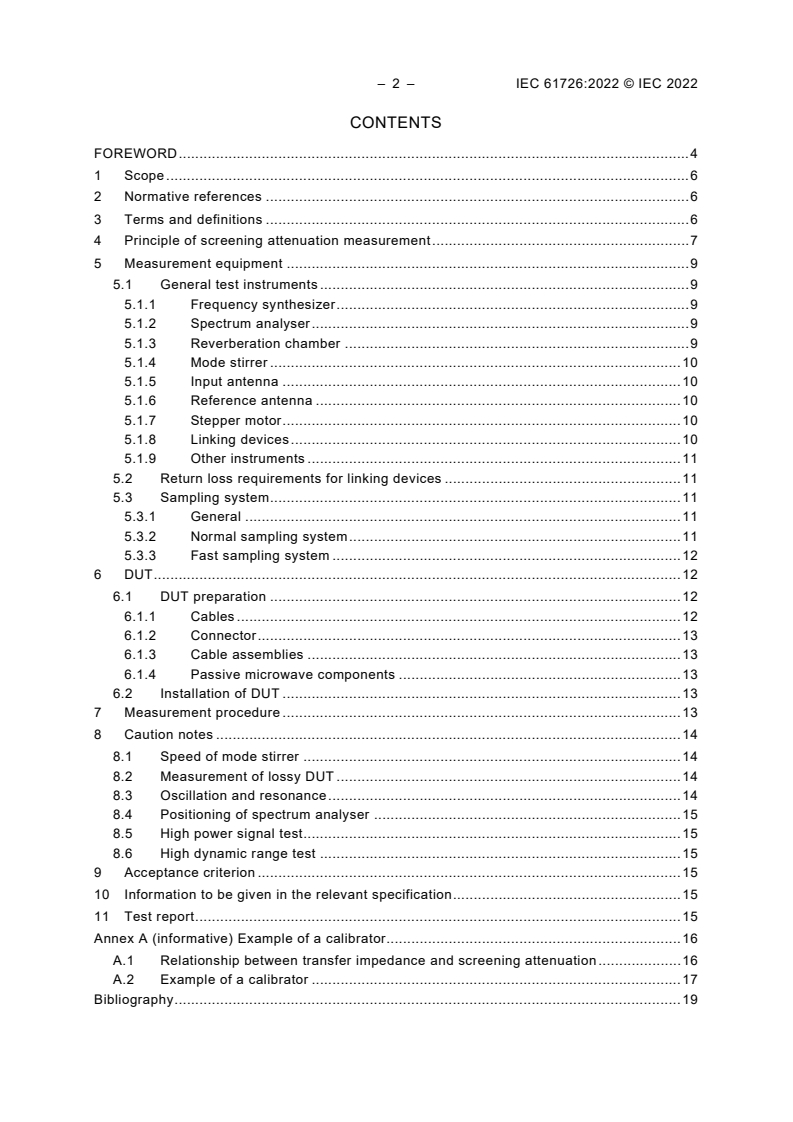
CONTENTS
FOREWORD . 4
1 Scope . 6
2 Normative references . 6
3 Terms and definitions . 6
4 Principle of screening attenuation measurement . 7
5 Measurement equipment . 9
5.1 General test instruments . 9
5.1.1 Frequency synthesizer . 9
5.1.2 Spectrum analyser . 9
5.1.3 Reverberation chamber . 9
5.1.4 Mode stirrer . 10
5.1.5 Input antenna . 10
5.1.6 Reference antenna . 10
5.1.7 Stepper motor . 10
5.1.8 Linking devices . 10
5.1.9 Other instruments . 11
5.2 Return loss requirements for linking devices . 11
5.3 Sampling system . 11
5.3.1 General . 11
5.3.2 Normal sampling system . 11
5.3.3 Fast sampling system . 12
6 DUT . 12
6.1 DUT preparation . 12
6.1.1 Cables . 12
6.1.2 Connector . 13
6.1.3 Cable assemblies . 13
6.1.4 Passive microwave components . 13
6.2 Installation of DUT . 13
7 Measurement procedure . 13
8 Caution notes . 14
8.1 Speed of mode stirrer . 14
8.2 Measurement of lossy DUT . 14
8.3 Oscillation and resonance . 14
8.4 Positioning of spectrum analyser . 15
8.5 High power signal test . 15
8.6 High dynamic range test . 15
9 Acceptance criterion . 15
10 Information to be given in the relevant specification . 15
11 Test report . 15
Annex A (informative) Example of a calibrator . 16
A.1 Relationship between transfer impedance and screening attenuation . 16
A.2 Example of a calibrator . 17
Bibliography . 19
Figure 1 – System configuration example of screening attenuation by reverberation
chamber . 7
Figure 2 – System configuration example of screening attenuation by reverberation
chamber with only one spectrum analyser . 9
Figure A.1 – Basic construction details . 17
Table 1 – Recommended antennas . 10
Table 2 – Number of sampling positions recommended for calibration and test . 12
– 4 – IEC 61726:2022 © IEC 2022
INTERNATIONAL ELECTROTECHNICAL COMMISSION
____________
CABLE ASSEMBLIES, CABLES, CONNECTORS AND PASSIVE
MICROWAVE COMPONENTS – SCREENING ATTENUATION
MEASUREMENT BY THE REVERBERATION CHAMBER METHOD
FOREWORD
1) The International Electrotechnical Commission (IEC) is a worldwide organization for standardization comprising
all national electrotechnical committees (IEC National Committees). The object of IEC is to promote international
co-operation on all questions concerning standardization in the electrical and electronic fields. To this end and
in addition to other activities, IEC publishes International Standards, Technical Specifications, Technical Reports,
Publicly Available Specifications (PAS) and Guides (hereafter referred to as “IEC Publication(s)”). Their
preparation is entrusted to technical committees; any IEC National Committee interested in the subject dealt with
may participate in this preparatory work. International, governmental and non-governmental organizations liaising
with the IEC also participate in this preparation. IEC collaborates closely with the International Organization for
Standardization (ISO) in accordance with conditions determined by agreement between the two organizations.
2) The formal decisions or agreements of IEC on technical matters express, as nearly as possible, an international
consensus of opinion on the relevant subjects since each technical committee has representation from all
interested IEC National Committees.
3) IEC Publications have the form of recommendations for international use and are accepted by IEC National
Committees in that sense. While all reasonable efforts are made to ensure that the technical content of IEC
Publications is accurate, IEC cannot be held responsible for the way in which they are used or for any
misinterpretation by any end user.
4) In order to promote international uniformity, IEC National Committees undertake to apply IEC Publications
transparently to the maximum extent possible in their national and regional publications. Any divergence between
any IEC Publication and the corresponding national or regional publication shall be clearly indicated in the latter.
5) IEC itself does not provide any attestation of conformity. Independent certification bodies provide conformity
assessment services and, in some areas, access to IEC marks of conformity. IEC is not responsible for any
services carried out by independent certification bodies.
6) All users should ensure that they have the latest edition of this publication.
7) No liability shall attach to IEC or its directors, employees, servants or agents including individual experts and
members of its technical committees and IEC National Committees for any personal injury, property damage or
other damage of any nature whatsoever, whether direct or indirect, or for costs (including legal fees) and
expenses arising out of the publication, use of, or reliance upon, this IEC Publication or any other IEC
Publications.
8) Attention is drawn to the Normative references cited in this publication. Use of the referenced publications is
indispensable for the correct application of this publication.
9) Attention is drawn to the possibility that some of the elements of this IEC Publication may be the subject of patent
rights. IEC shall not be held responsible for identifying any or all such patent rights.
IEC 61726 has been prepared by IEC technical committee 46: Cables, wires, waveguides, RF
connectors, RF and microwave passive components and accessories. It is an International
Standard.
This fourth edition cancels and replaces the third edition published in 2015. This edition
constitutes a technical revision.
This edition includes the following significant technical changes with respect to the previous
edition:
a) reworded Clause 1 "Scope";
b) replaced IEC TS 62153-4-1 by IEC 62153 (all parts) in Clause 2;
c) added the definition of screening attenuation in 3.1;
d) added Clause 4 "Principle of screening attenuation measurement";
e) added the descriptions of some test set-ups, such as frequency synthesizer, spectrum
analyser, stepper motor, linking devices and the sampling system, etc. in Clause 5;
f) added Clause 6 "DUT";
g) reworded Clause 7 "Measurement procedure";
h) added Clause 8 "Caution notes";
i) added Clause 9 "Acceptance criterion";
j) added Clause 10 "Information to be given in the relevant specification".
The text of this International Standard is based on the following documents:
Draft Report on voting
46/847/CDV 46/877/RVC
Full information on the voting for its approval can be found in the report on voting indicated in
the above table.
The language used for the development of this International Standard is English.
This document was drafted in accordance with ISO/IEC Directives, Part 2, and developed in
accordance with ISO/IEC Directives, Part 1 and ISO/IEC Directives, IEC Supplement, available
at www.iec.ch/members_experts/refdocs. The main document types developed by IEC are
described in greater detail at www.iec.ch/publications.
The committee has decided that the contents of this document will remain unchanged until the
stability date indicated on the IEC website under webstore.iec.ch in the data related to the
specific document. At this date, the document will be
• reconfirmed,
• withdrawn,
• replaced by a revised edition, or
• amended.
IMPORTANT – The "colour inside" logo on the cover page of this document indicates that it
contains colours which are considered to be useful for the correct understanding of its
contents. Users should therefore print this document using a colour printer.
– 6 – IEC 61726:2022 © IEC 2022
CABLE ASSEMBLIES, CABLES, CONNECTORS AND PASSIVE
MICROWAVE COMPONENTS – SCREENING ATTENUATION
MEASUREMENT BY THE REVERBERATION CHAMBER METHOD
1 Scope
This document describes the measurement of screening attenuation by the reverberation
chamber measurement method, also called mode stirred chamber method.
This document is applicable to screening attenuation measurements of cable assemblies,
cables, connectors, and passive microwave components, such as waveguides, phase shifters,
diplexers/multiplexers, power dividers/combiners, etc.
Modern electronic equipment has shown a demand for methods for testing screening
attenuation performance of microwave components over their whole frequency range.
Convenient measurement methods have existed for lower frequencies and components of
regular shape. These measurement methods are described in the IEC 62153 series. For much
higher frequencies and for components of irregular shape, the reverberation chamber method
can be used. Theoretically, the reverberation chamber method has no upper limit of the
measurement frequency, but it is limited by the quality and sensitivity of the measurement
system, and the lower limit of the measurement frequency is restricted by the size of the
reverberation chamber.
2 Normative references
The following documents are referred to in the text in such a way that some or all of their content
constitutes requirements of this document. For dated references, only the edition cited applies.
For undated references, the latest edition of the referenced document (including any
amendments) applies.
IEC 61000-4-21:2011, Electromagnetic compatibility (EMC) – Part 4-21: Testing and
measurement techniques – Reverberation chamber test methods
IEC 61196-1, Coaxial communication cables – Part 1: Generic specification – General,
definitions and requirements
IEC 62153 (all parts), Metallic communication cable test methods
3 Terms and definitions
For the purposes of this document, the terms and definitions given in IEC 61196-1,
IEC 61000-4-21 and the following apply.
ISO and IEC maintain terminology databases for use in standardization at the following
addresses:
• IEC Electropedia: available at https://www.electropedia.org/
• ISO Online browsing platform: available at https://www.iso.org/obp
3.1
screening attenuation
ratio of the electromagnetic field power coupled to the reference antenna to the electromagnetic
field power coupled to the device under test (DUT), expressed by a in Formula (1):
s
P
REF
a = 10 log
(1)
s 10
P
DUT
where
a is the screening attenuation of DUT, in dB;
s
P is the power coupled to the reference antenna, in W;
REF
P is the power coupled to the DUT, in W.
DUT
4 Principle of screening attenuation measurement
The reverberation chamber is an electrically large screening cavity with high quality factor,
which is equipped with mode stirrer(s), input antenna and reference antenna. A system
configuration example of screening attenuation measurement by reverberation chamber method
is shown in Figure 1.
Figure 1 – System configuration example of screening
attenuation by reverberation chamber
The electromagnetic wave power P emitted by the frequency synthesizer is transmitted to the
INJ
reverberation chamber through the input antenna in the cavity. The electromagnetic wave will
excite the multi-mode electromagnetic field in the reverberation chamber. The boundary
conditions of these electromagnetic fields change with the rotation and stirring of the mode
stirrer, and the electromagnetic field distribution in the cavity is nearly uniform, isotropic and
randomly polarized in the sense of statistical average. When the DUT is placed in the
reverberation chamber, the approximately uniformly distributed electromagnetic power P in
REF
the reverberation chamber received by the reference antenna is equivalent to the external input
power of the DUT, and the electromagnetic power P coupled into the DUT can be obtained
DUT
by the spectrum analyser outside the reverberation chamber.
– 8 – IEC 61726:2022 © IEC 2022
According to the definition Formula (1), the screening attenuation of DUT can be calculated
from Formula (2):
P
REF
a = 10 log
s 10
P
DUT
P P
INJ REF
10 log ×
PP
DUT INJ
(2)
P P
INJ INJ
10 log −10log
10 10
PP
DUT REF
P
INJ
10 log − Δ
10 ins
P
DUT
where
a is the screening attenuation of DUT, in dB;
s
P is the power coupled to the reference antenna, in W;
REF
P is the power coupled to the DUT, in W;
DUT
P is the power injected into the chamber, in W;
INJ
Δ is the insertion loss of the chamber, in decibels (dB).
ins
In Formula (2), the first term represents the total screening attenuation of the system which
can be obtained by measuring the power of DUT connected with a load by spectrum analyser
1. The second term represents the insertion loss of the reverberation chamber which can be
obtained by measuring the power of the reference antenna by spectrum analyser 2.
Measurements of the total screening attenuation and the insertion loss can be carried out
simultaneously.
When only one spectrum analyser is configured, the DUT and reference antenna can be
connected to the spectrum analyser separately by using a switch, and the total screening
attenuation of the system and the insertion loss of the reverberation chamber can be measured
separately (also known as time-division measurement), as shown in Figure 2.
=
=
=
Figure 2 – System configuration example of screening attenuation
by reverberation chamber with only one spectrum analyser
5 Measurement equipment
5.1 General test instruments
5.1.1 Frequency synthesizer
Frequency synthesizer or other frequency source shall be used, and its output power, frequency
range and transmission bandwidth shall meet the measurement requirements. In order to
ensure the repeatability of measurement, the frequency stability of frequency synthesizer or
−6
other frequency source should be better than 10 .
5.1.2 Spectrum analyser
The frequency range, resolution bandwidth and sensitivity of the spectrum analyser should meet
the measurement requirements. Other equipment that offers the same function, such as EMI
test receiver, can also be used.
5.1.3 Reverberation chamber
The reverberation chamber shall comply with IEC 61000-4-21.
In general, the reverberation chamber is a shielded enclosure having any shape; however, a
perfect cubic shape should be avoided for optimum performance at lower frequencies. It shall
be made of conductive materials (copper, aluminium or steel) and shall not contain lossy
materials.
The upper frequency limit depends on the quality of the shielded enclosure and cables.
Furthermore, the sensitivity of the used measurement instruments also limits the maximum
frequency. There is no upper limit theoretically for the measurement frequency of the
reverberation chamber when its quality is disregarded.
In general, the reverberation chamber is required to work with sufficient modes, and the working
frequency should be greater than the cavity mode frequency as calculated from Formula (3):
– 10 – IEC 61726:2022 © IEC 2022
2 22
c
mn p
(3)
ff>= ++
mnp
2 l wh
where l, w and h are the length, width and height of reverberation chamber respectively, m, n
and p are integers, and the value range is up to the number of modes of reverberation chamber.
It can be drawn from Formula (3) that the lowest usable frequency (LUF) of the reverberation
chamber is limited by the size of the reverberation chamber. The larger the volume is, the lower
LUF is; and the number of modes of the reverberation chamber is directly proportional to the
measurement frequency and the size of the reverberation chamber. Increasing the size of the
reverberation chamber and raising the test frequency can both expand the number of modes of
the reverberation chamber. Therefore, the size of reverberation chamber should be large
enough to meet the requirements for mode frequency and mode number when measuring at
lower frequencies.
For more detailed requirements and instructions for reverberation chambers, reference to
IEC 61000-4-21.
5.1.4 Mode stirrer
The mode stirrer shall be large with respect to wavelength and be at an angle to the walls of
the chamber. The mode stirrer shall be at least two wavelengths at the lowest measurement
frequency from tip to tip. When needed, more than one mode stirrer can be provided.
5.1.5 Input antenna
The input antenna shall be a broadband antenna capable of covering the operating frequency
range, and its transmitting direction shall be towards the corner of the reverberation chamber
or the mode stirrer to avoid direct exposure to the reference antenna. The antenna should
exhibit limited resonances in the frequency range and not introduce losses.
The recommended antennas for different frequency bands are given in Table 1.
Table 1 – Recommended antennas
Frequency range Antenna type
≤1 GHz Dipole antenna
≥1 GHz Horn antenna
5.1.6 Reference antenna
The reference antenna shall be of the same type as the input antenna, and its polarization
direction shall be orthogonal to that of the input antenna.
5.1.7 Stepper motor
The stepper motor should be driven with enough torque to control the angle and speed.
5.1.8 Linking devices
Low loss semi-rigid coaxial cables with good screening attenuation shall be used as the test
cables to connect the spectrum analyser to the DUT. To avoid resonances, the DUT is inserted
into a test cable loop having a length of more than four wavelengths at minimum frequency.
The cable connecting the spectrum analyser to the reference antenna should be consistent with
the length and quality of the test cable connecting the spectrum analyser to the DUT. It is
required that the test cables, related connectors, adapters, loads, etc. having a screening
attenuation at least 10 dB better than the DUT, so as to ensure that the measured leakage is
caused by DUT.
5.1.9 Other instruments
In order to improve the performance of the measurement system, the power meter, directional
coupler, power amplifier and other control equipment can be used. These instruments should
meet the measurement requirements.
5.2 Return loss requirements for linking devices
The individual components of the measurement system should be of good quality, with an input
and output return loss of 15 dB or better. This applies especially to all components, cables and
instrumentation in the signal paths between the reference antenna and the spectrum analyser,
as well as between the DUT and the spectrum analyser, they shall meet this requirement.
This requirement can be difficult to achieve for some DUTs. In this case, a graph of return loss
against frequency shall be included in the documentation.
5.3 Sampling system
5.3.1 General
The sampling system shall acquire the power values of the signals from the reference antenna
and the DUT on one revolution of the mode stirrer. The receiver can be connected with the
computer through the control interface, and the samples can be acquired and processed by
software.
Different approaches are acceptable depending on the performance of the equipment:
• discrete tuning (step positioning of the mode stirrer);
• continuous tuning (constant rotation of the stirrer);
• peak power acquisition on one revolution of the mode stirrer;
• averaged power calculation on one rotation of the mode stirrer.
When choosing a measurement mode, it shall be recognized that:
• discrete tuning is slow and requires a large number of sample measurements to be taken
per revolution of the mode stirrer. This does, however, result in the acquisition of more
accurate measurements;
• continuous tuning can continuously rotate and stir to acquire data, and is very economical
in time, but requires a modern and stable receiver.
Therefore, the following two data sampling methods can be used to complete the signal power
sampling:
a) normal sampling system;
b) fast sampling system.
5.3.2 Normal sampling system
The normal sampling system offers a high dynamic range, especially if power controlled
amplifiers are used at the output of the generator.
The mode stirrer rotates to different positions (e.g. 50) per a fixed step size. The number of the
positions depends on the LUF of the chamber, as recommended in IEC 61000-4-21 and shown
in Table 2. The spectrum analyser samples the signals separately, and then stores each power
– 12 – IEC 61726:2022 © IEC 2022
data in the computer for further processing. The system controls rotation of the mode stirrer by
controlling the stepper motor.
Table 2 – Number of sampling positions
recommended for calibration and test
Frequency range f ~3f 3f ~6f 6f ~10f >10f
L L L L L L L
Number of positions 50 18 12 12
NOTE f is the lowest usable frequency (LUF) of the chamber.
L
The sampling process is as follows:
a) The frequency synthesizer is set to deliver a constant power at a fixed frequency, and the
stirrer is set to rotate to a position (for example, 50 positions for one cycle);
b) The spectrum analyser is connected to the output of the reference antenna or DUT. Its
resolution filter is centred on the emitting frequency of the synthesizer and is fixed (SPAN 0:
demodulator mode).
c) The spot scans and samples at each position during a period. After the stirrer has been
rotated for a complete cycle, the maximum power or average power is recorded as P or
REF
P .
DUT
5.3.3 Fast sampling system
The fast sampling system rotates the mode stirrer continuously at a moderate speed, and at
the same time, the computer controls the spectrum analyser to sample the signal power, so as
to quickly obtain the signal power on one rotation, which shortens the measurement time. For
a faster sampling system, a spectrum analyser with synchronized tracking synthesizer is used
[1] . The resolution bandwidth is set according to the requirements for dynamic range.
Furthermore, if peak power acquisition is used, the "peak hold" function shall be used.
a) The frequency synthesizer is set to deliver a constant power at a fixed frequency, and the
stirrer is set to rotate continuously (for example, 1 revolution every 5 s).
b) For a higher dynamic range, the resolution bandwidth shall be reduced. It shall be kept in
mind that this might prolong the measurement significantly because a reduced measurement
bandwidth is involved with an prolonged sweep time.
c) In order to ensure that enough independent samples are recorded, the scanning time of the
receiver and the rotation period of the stirrer shall not be equal or integer multiple.
d) After a sufficient number of independent samples have been recorded, the maximum power
or average power is recorded as P or P .
REF DUT
6 DUT
6.1 DUT preparation
6.1.1 Cables
The cable under test needs to be connected with a matching connector with good screening
attenuation to make up a cable assembly for measurement, and the matching connector shall
be selected that can be directly connected with the system to reduce the effect of the connection
link. The screening attenuation of the matching connector is at least 10 dB better than the
required value of the cable under test.
___________
Numbers in square brackets refer to the Bibliography.
6.1.2 Connector
Cable connector: the connector under test needs to be connected with semi-rigid cable with
good screening attenuation performance to make up assemblies for test. The semi-rigid cable
should match the connector under test, and its screening attenuation should be at least 10 dB
better than the required value of the cable under test.
Microstrip connector: it should be connected to the measurement system by using appropriate
test fixture.
Adapter: it should be directly connected to the measurement system or connected to the system
by using other adapters.
6.1.3 Cable assemblies
The cable assemblies can be directly connected to the system or connected by using adapters
to the measurement system.
6.1.4 Passive microwave components
The passive microwave components under test can be connected to the system directly or by
using appropriate test fixture or adapters.
6.2 Installation of DUT
In order to avoid resonance and improve the accuracy of the measurement, the DUT should be
placed as follows:
1) The DUT shall be connected to the test end of the test cable.
2) Place the DUT in the centre of the reverberation chamber without touching the reverberation
chamber wall. The DUT needs to keep at least one wavelength distance from the wall of the
reverberation chamber corresponding to the lowest measurement frequency.
3) The cable under test shall be bent according to the relevant standard or as specified by the
manufacturer, if needed.
4) During the measurement, necessary measures, such as wrapping with tin foil, should be
taken to shield the linking devices.
7 Measurement procedure
The measurement procedure is as follows:
1) Setting of test parameters
The test parameters include test frequency, input power, resolution bandwidth of spectrum
analyser, rotation speed and direction of stepper motor.
The reverberation chamber method exhibits significant changes in measured screening
attenuation for close frequencies (±3 dB). This is due to real wave impedance at the
maximum coupling position of the mode stirrer (the averaged wave impedance is 377 Ω, but
the real wave impedance can vary widely [2]). To maintain accuracy, an adequate number
of test frequency points should be taken.
The test frequencies shall be selected as follows:
a) The test frequencies need to cover two ends of the test band. For the narrow-band
measurement it should measure at least 10 interval frequencies, and for the wideband
measurement it should cover at least 20 interval frequencies. The frequencies should
be discretized sufficiently.
b) The number of frequency points required to acquire for each frequency (200 is a typical
value up to 20 GHz) is specified in A.4.2 of IEC 61000-4-21:2011.
– 14 – IEC 61726:2022 © IEC 2022
2) Selection of measurement mode
According to the equipment conditions and dynamic range requirement, normal sampling
test or fast sampling test can be selected (see 5.3).
3) Calibration of measurement system
A calibrator is a device with stable screening attenuation. An example of the calibrator is
shown in Annex A.
Connect the standard DUT into the system and compare the measurement results with
previous measurement data. If the measurement errors are within the specified range, the
measurement system is available.
4) Reference measurement
Connect the spectrum analyser to the reference antenna for reference measurement.
5) DUT measurement:
a) Connect the DUT to the system, as stated in 6.1. To measure the total screening
attenuation of the DUT, the settings of stirrer speed and resolution bandwidth of
spectrum analyser should be consistent with those of reference measurement.
NOTE The reference measurement in item 4) and DUT measurement in item 5) can be carried out
simultaneously if two spectrum analysers are provided.
b) According to Formula (2) , the screening attenuations of the DUT at specified
frequencies are calculated by the computer.
8 Caution notes
8.1 Speed of mode stirrer
The rotating speed of stirrer has two effects on the test results:
• broadening of the signal frequency spectrum delivered by the synthesized generator;
• levelling of power peaks and nulls.
Due to these effects, the same revolution speed and the same bandwidth of the analysis filter
of the spectrum analyser should be used for both DUT and insertion loss measurements. If this
is not done, a systematic error up to 10 dB could appear at higher frequencies.
In practice, one revolution every 5 s is a good compromise between accuracy, measurement
dynamic range and time saving.
8.2 Measurement of lossy DUT
Some inaccuracy can occur when measuring a lossy DUT, due to insufficient number of modes
of the reverberation chamber. This can be checked by verifying that during one revolution of
the mode stirrer, the ratio of the maximum power to the minimum power at the output of the
reference antenna exceeds 20 dB.
8.3 Oscillation and resonance
The ideal curve is not smooth when the screening attenuation of DUT is measured by the
reverberation chamber method. No matter what the frequency steps are set, the measured value
will oscillate around a mean curve with the order of magnitude of ± 3 dB. The true screening
attenuation plotted at 377 Ω is the mean curve. Be careful not to confuse normal oscillations
with DUT resonances.
It can be distinguished whether it is resonance or not, by subdividing the frequency step. In this
case, the normal oscillation will still exhibit the same waveform; however, the resonance peak
will be clearly apparent.
8.4 Positioning of spectrum analyser
During the measurement, the spectrum analyser should be far away from the radiation
equipment such as frequency synthesizer, so as to avoid being disturbed and further influencing
the measurement results.
8.5 High power signal test
A double female type connector without injection moulded hole is needed in high power signal
test, otherwise the leakage and attenuation of injection moulded hole will affect the work of the
system.
8.6 High dynamic range test
To test the screening attenuation in a high dynamic range, the spectrum analyser and the
frequency synthesizer should be based on the same clock reference, otherwise peak value will
not be captured for the narrow-band RBW test.
9 Acceptance criterion
The screening attenuation in the specified frequency shall be in accordance with the relevant
standards.
10 Information to be given in the relevant specification
The following information shall be given in the relevant specification:
a) test method;
b) test conditions;
c) test frequency and power;
d) bandwidth or period (when required);
e) test time;
f) deviation from this test method.
11 Test report
Test report should include information as the following:
a) test method;
b) test conditions;
c) test frequency and power;
d) bandwidth or period (when required);
e) test time;
f) test equipment;
g) the number of samples;
h) test results;
i) name of operator and date of test.
– 16 – IEC 61726:2022 © IEC 2022
Annex A
(informative)
Example of a calibrator
A.1 Relationship between transfer impedance and screening attenuation
For a single hole leakage, the proposed relationship between the transfer impedance and the
screening attenuation is expressed by Formula (A.1):
22 −a /10
s
(A.1)
Z+ Z= 2ZZ××10
t f 12
where
Z is the surface transfer impedance, in Ω;
t
is the capacitive coupling impedance, in Ω;
Z
f
Z is the characteristic impedance of the internal system (usually 50 Ω);
Z is equal to 377 Ω;
a is the screening attenuation.
s
For distributed leakages (ideal cables, for example), this relation becomes:
−+a SD( /λ) /10
s
2××ZZ ×10
(A.2)
ZZ+=
tf
D
where
S(D/λ) is a summing function;
D is the length of the coupling zone;
λ is the free space wavelength, in m.
(λ ≡ c / f)
πD
sin cos− ε
π ( )
1 λ
(A.3)
SD /λd= 10 log
( )
10 ∫
πD
π
0 cos− ε
( )
λ
where
ϕ is the angle coordinate in a cylindrical coordination system to be integrated from 0° to 180°.
ε is the relative permittivity of the cable.
Measurement experience shows that these formulae are accurate up to 5 GHz. For higher
frequencies, they shall be used with caution and the correct value for comparison should then
be regarded as the screening attenuation.
NOTE 1 This method does not allow Z and Z to be calculated separately. However, this is not usually a problem
t f
since Z is often equal to 0.
f
NOTE 2 For electrically long cables (more than 0,1 λ at lowest test frequency), the screening attenuation can be
assumed to be nearly constant versus frequency and length of the DUT when its surface transfer impedance
increases by 20 dB/decade. This behaviour can be explained with the summing function, as seen in
IEC TS 62153-4-1 [3].
A.2 Example of a calibrator
The centre part of the calibrator is a 50 Ω airline. End connectors are of a highly screened type
such as SMA. Two holes diametrically opposed are drilled in the outer screen of the airline, as
shown in Figure A.1.
−3
D = 4,1 × 10 m
−3
d = t = 2,15 × 10 m
Figure A.1 – Basic construction details
As d = t, Z is negligible. Z can be computed using the following formulae (see [4] and [5]):
f t
3 −−7 2 3,68
Z 8d 10 / 3D×fe×
(A.4)
t ( )
where f is the frequency (Hz).
−3,68t
vμd ×f
d
(A.5)
Ze×
t
3πD
or
−3,68t
−73
4××10 dv
d
(A.6)
Z ××fe
t
3D
The predicted screening attenuation in a reverberation chamber is
Z
t
a =−20 log
(A.7)
s 10
2ZZ×
if Z = 50 Ω and Z = 377 Ω
1 2
then
=
=
=
– 18 – IEC 61726:2022 © IEC 2022
aZ=−20 log / Ω+ 46 (dB)
(A.8)
s 10 t
where in Formulae (A.4) to (A.8):
Z is the surface transfer impedance (Ω);
t
Z is the capacitive coupling impedance (Ω);
f
Z is the characteristic impedance of the internal system (usually 50 Ω);
Z is equal to 377 Ω;
a is the screening attenuation;
s
v is the number of holes (in this application v = 2);
−7
µ is 4π × 10 (Vs/Am);
f is the frequency in hertz (Hz).
With the values listed above, as at 1 GHz is typically +94 dB with the
...