

IEC TR 61439-0:2010
(Main)Low-voltage switchgear and controlgear assemblies - Part 0: Guide to specifying assemblies
General Information
- Abstract
IEC/TR 61439-0:2010(E) Within the IEC 61439 series of standards for low-voltage switchgear and controlgear assemblies (ASSEMBLIES), there are system and application details that need to be specified by the user to enable the manufacturer to produce an ASSEMBLY that meets the needs and expectations of the user. IEC/TR 61439-0:2010(E) identifies, from the user's perspective, those functions and characteristics that should be defined when specifying ASSEMBLIES. It provides:
- an explanation of the ASSEMBLY characteristics and options within the IEC 61439 series;
- a guidance on how to select the appropriate option and to define characteristics so as to meet specific application needs, using a functional approach; and
- an assistance in the specification of ASSEMBLIES.
- Status
- Published
- Publication Date
- 04-Oct-2010
- Technical Committee
- SC 121B - Low-voltage switchgear and controlgear assemblies
- Current Stage
- DELPUB - Deleted Publication
- Start Date
- 29-Apr-2013
- Completion Date
- 28-Aug-2026
Overview
IEC TR 61439-0:2010 is a Technical Report from the IEC that provides guidance for specifying low-voltage switchgear and controlgear assemblies (ASSEMBLIES). It sits within the IEC 61439 series and is written from the user's perspective to identify the functions, characteristics and options that must be defined so manufacturers can deliver an ASSEMBLY that meets project and operational needs. The report explains assembly characteristics, offers a functional approach to selecting options, and assists in preparing clear specifications.
Key topics and technical requirements
IEC TR 61439-0 organizes the specification process around practical engineering and contractual items, including:
- Electrical system requirements: earthing arrangements, nominal voltage, overvoltage categories and rated frequency.
- Short-circuit performance: guidance on specifying prospective short-circuit currents, short-circuit protective devices (SCPDs) and coordination with external protection.
- Protection of persons: basic and fault protection measures (direct/indirect contact, disconnection, electrical separation).
- Installation environment: ingress protection, mechanical impact (IK), corrosion and UV resistance, EMC environment, temperature, humidity, pollution degree and altitude considerations.
- Installation and physical data: assembly type, portability, overall dimensions/weight, external conductor types, terminations and conductor cross-sections.
- Operational, maintenance and upgrade requirements: access for operation and maintenance, isolation of functional units, removable functional units and gangway access.
- Design and verification: recommended design verification and routine verification processes, record-keeping and testing guidance.
- Current carrying capability: rated currents, rated diversity factors, and neutral/phase conductor sizing.
- Informative annexes: examples and forms of internal separation, items subject to user–manufacturer agreement, and specification guidance for future parts of IEC 61439.
Practical applications
This technical report is a practical aid to:
- Preparing procurement specifications and tender documents for LV switchgear and controlgear assemblies.
- Defining site-specific service conditions and installation interfaces for manufacturers.
- Ensuring compatibility between system protection, short-circuit performance and equipment selection.
- Reducing ambiguity in manufacturer–user contracts and simplifying factory and on-site verification planning.
Who should use this standard
- Electrical designers and system engineers specifying LV switchgear assemblies
- Procurement teams and project managers preparing tender requirements
- Manufacturers and test laboratories interpreting user requirements
- Installation contractors, maintenance engineers and safety officers
Related standards
- IEC 61439 series (other parts): provides detailed requirements and verification methods for specific assembly types and applications.
- Local electrical codes and EMC/earthing standards that apply to installation and operation.
Keywords: IEC TR 61439-0, low-voltage switchgear, controlgear assemblies, ASSEMBLIES, specification guidance, short-circuit withstand, earthing, protection against electric shock, installation environment, design verification.
Relations
- Effective Date
- 05-Sep-2023
Get Certified
Connect with accredited certification bodies for this standard

IMQ S.p.A. (Certification)
Italian electrical product certification.

SLG Prüf- und Zertifizierungs GmbH
German testing and certification body.

UL Solutions
Global safety science company with testing, inspection and certification.
Sponsored listings
Frequently Asked Questions
IEC TR 61439-0:2010 is a technical report published by the International Electrotechnical Commission (IEC). Its full title is "Low-voltage switchgear and controlgear assemblies - Part 0: Guide to specifying assemblies". This standard covers: IEC/TR 61439-0:2010(E) Within the IEC 61439 series of standards for low-voltage switchgear and controlgear assemblies (ASSEMBLIES), there are system and application details that need to be specified by the user to enable the manufacturer to produce an ASSEMBLY that meets the needs and expectations of the user. IEC/TR 61439-0:2010(E) identifies, from the user's perspective, those functions and characteristics that should be defined when specifying ASSEMBLIES. It provides: - an explanation of the ASSEMBLY characteristics and options within the IEC 61439 series; - a guidance on how to select the appropriate option and to define characteristics so as to meet specific application needs, using a functional approach; and - an assistance in the specification of ASSEMBLIES.
IEC/TR 61439-0:2010(E) Within the IEC 61439 series of standards for low-voltage switchgear and controlgear assemblies (ASSEMBLIES), there are system and application details that need to be specified by the user to enable the manufacturer to produce an ASSEMBLY that meets the needs and expectations of the user. IEC/TR 61439-0:2010(E) identifies, from the user's perspective, those functions and characteristics that should be defined when specifying ASSEMBLIES. It provides: - an explanation of the ASSEMBLY characteristics and options within the IEC 61439 series; - a guidance on how to select the appropriate option and to define characteristics so as to meet specific application needs, using a functional approach; and - an assistance in the specification of ASSEMBLIES.
IEC TR 61439-0:2010 is classified under the following ICS (International Classification for Standards) categories: 29.130.20 - Low voltage switchgear and controlgear. The ICS classification helps identify the subject area and facilitates finding related standards.
IEC TR 61439-0:2010 has the following relationships with other standards: It is inter standard links to IEC TR 61439-0:2013. Understanding these relationships helps ensure you are using the most current and applicable version of the standard.
IEC TR 61439-0:2010 is available in PDF format for immediate download after purchase. The document can be added to your cart and obtained through the secure checkout process. Digital delivery ensures instant access to the complete standard document.
Standards Content (Sample)
IEC/TR 61439-0 ®
Edition 1.0 2010-10
TECHNICAL
REPORT
Low-voltage switchgear and controlgear assemblies –
Part 0: Guidance to specifying assemblies
IEC/TR 61439-0:2010(E)
All rights reserved. Unless otherwise specified, no part of this publication may be reproduced or utilized in any form or by
any means, electronic or mechanical, including photocopying and microfilm, without permission in writing from either IEC or
IEC's member National Committee in the country of the requester.
If you have any questions about IEC copyright or have an enquiry about obtaining additional rights to this publication,
please contact the address below or your local IEC member National Committee for further information.
Droits de reproduction réservés. Sauf indication contraire, aucune partie de cette publication ne peut être reproduite
ni utilisée sous quelque forme que ce soit et par aucun procédé, électronique ou mécanique, y compris la photocopie
et les microfilms, sans l'accord écrit de la CEI ou du Comité national de la CEI du pays du demandeur.
Si vous avez des questions sur le copyright de la CEI ou si vous désirez obtenir des droits supplémentaires sur cette
publication, utilisez les coordonnées ci-après ou contactez le Comité national de la CEI de votre pays de résidence.
IEC Central Office
3, rue de Varembé
CH-1211 Geneva 20
Switzerland
Email: inmail@iec.ch
Web: www.iec.ch
About IEC publications
The technical content of IEC publications is kept under constant review by the IEC. Please make sure that you have the
latest edition, a corrigenda or an amendment might have been published.
ƒ Catalogue of IEC publications: www.iec.ch/searchpub
The IEC on-line Catalogue enables you to search by a variety of criteria (reference number, text, technical committee,…).
It also gives information on projects, withdrawn and replaced publications.
ƒ IEC Just Published: www.iec.ch/online_news/justpub
Stay up to date on all new IEC publications. Just Published details twice a month all new publications released. Available
on-line and also by email.
ƒ Electropedia: www.electropedia.org
The world's leading online dictionary of electronic and electrical terms containing more than 20 000 terms and definitions
in English and French, with equivalent terms in additional languages. Also known as the International Electrotechnical
Vocabulary online.
ƒ Customer Service Centre: www.iec.ch/webstore/custserv
If you wish to give us your feedback on this publication or need further assistance, please visit the Customer Service
Centre FAQ or contact us:
Email: csc@iec.ch
Tel.: +41 22 919 02 11
Fax: +41 22 919 03 00
IEC/TR 61439-0 ®
Edition 1.0 2010-10
TECHNICAL
REPORT
Low-voltage switchgear and controlgear assemblies –
Part 0: Guidance to specifying assemblies
INTERNATIONAL
ELECTROTECHNICAL
COMMISSION
PRICE CODE
XA
ICS 29.130.20 ISBN 978-2-88912-209-7
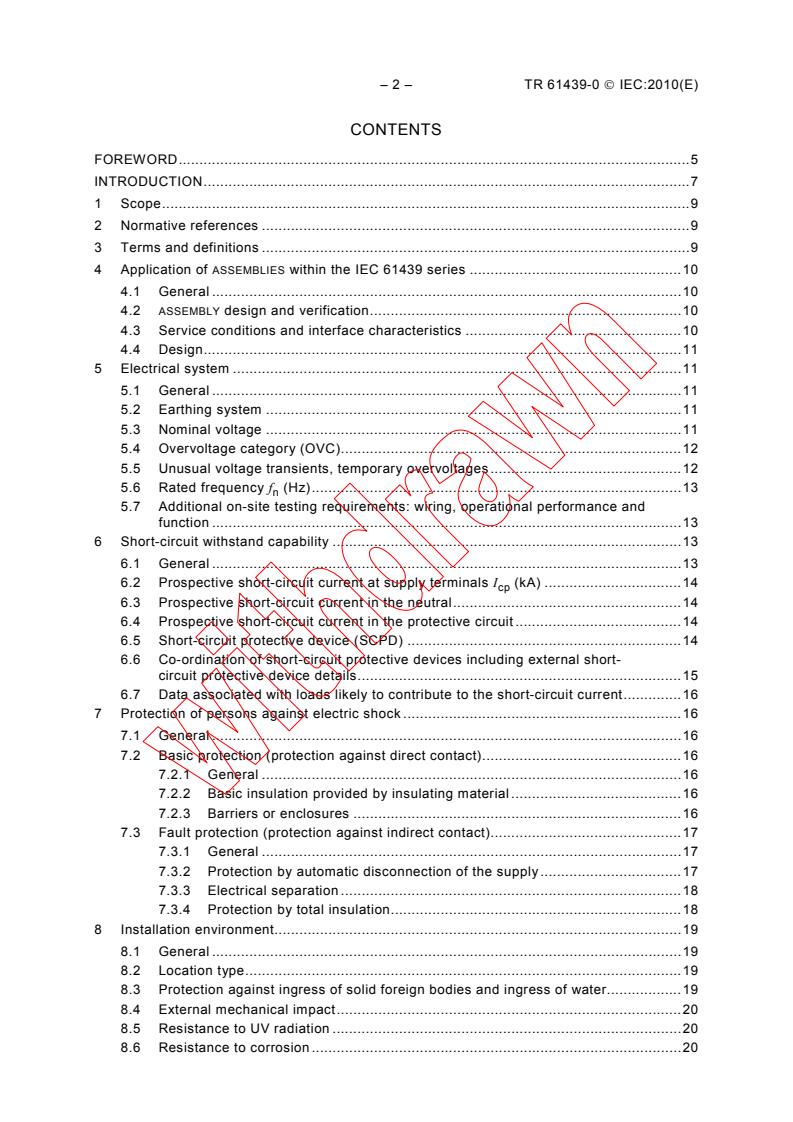
– 2 – TR 61439-0 © IEC:2010(E)
CONTENTS
FOREWORD.5
INTRODUCTION.7
1 Scope.9
2 Normative references .9
3 Terms and definitions .9
4 Application of ASSEMBLIES within the IEC 61439 series .10
4.1 General .10
4.2 ASSEMBLY design and verification.10
4.3 Service conditions and interface characteristics .10
4.4 Design.11
5 Electrical system .11
5.1 General .11
5.2 Earthing system .11
5.3 Nominal voltage .11
5.4 Overvoltage category (OVC).12
5.5 Unusual voltage transients, temporary overvoltages.12
5.6 Rated frequency f (Hz).13
n
5.7 Additional on-site testing requirements: wiring, operational performance and
function .13
6 Short-circuit withstand capability .13
6.1 General .13
6.2 Prospective short-circuit current at supply terminals I (kA) .14
cp
6.3 Prospective short-circuit current in the neutral.14
6.4 Prospective short-circuit current in the protective circuit .14
6.5 Short-circuit protective device (SCPD) .14
6.6 Co-ordination of short-circuit protective devices including external short-
circuit protective device details.15
6.7 Data associated with loads likely to contribute to the short-circuit current.16
7 Protection of persons against electric shock .16
7.1 General .16
7.2 Basic protection (protection against direct contact).16
7.2.1 General .16
7.2.2 Basic insulation provided by insulating material .16
7.2.3 Barriers or enclosures .16
7.3 Fault protection (protection against indirect contact).17
7.3.1 General .17
7.3.2 Protection by automatic disconnection of the supply.17
7.3.3 Electrical separation .18
7.3.4 Protection by total insulation.18
8 Installation environment.19
8.1 General .19
8.2 Location type.19
8.3 Protection against ingress of solid foreign bodies and ingress of water.19
8.4 External mechanical impact.20
8.5 Resistance to UV radiation .20
8.6 Resistance to corrosion .20
TR 61439-0 © IEC:2010(E) – 3 –
8.7 Ambient air temperature .20
8.8 Maximum relative humidity .21
8.9 Pollution degree .21
8.10 Altitude.22
8.11 EMC environment.22
8.12 Special service conditions .23
8.12.1 General .23
8.12.2 Climatic conditions .23
8.12.3 Protection against ingress of solid foreign bodies and ingress of
water .23
8.12.4 Shock, vibration, and external mechanical impact (IK) .23
8.12.5 Fire and explosion hazards.24
8.12.6 Exceptional overvoltages.24
8.12.7 EMC environment .24
9 Installation method .24
9.1 General .24
9.2 Assembly type.24
9.3 Portability.25
9.4 Maximum overall dimensions and weight.25
9.5 External conductor type(s).25
9.6 Direction(s) of external conductors .25
9.7 External conductor material.26
9.8 External phase conductor, cross-sections, and terminations.26
9.9 External PE, N, PEN conductors cross-sections, and terminations .26
9.10 Special terminal identification requirements.27
10 Storage and handling .27
10.1 General .27
10.2 Maximum dimensions and weight of transport units .27
10.3 Methods of transport (e.g. forklift, crane).27
10.4 Environmental conditions different from the service conditions .27
10.5 Packing details.27
11 Operating arrangements.28
11.1 General .28
11.2 Access to manually operated devices .28
11.3 Isolation of functional units for maintenance or service.28
12 Maintenance and upgrade capabilities .29
12.1 General .29
12.2 Requirements related to accessibility for inspection and similar operations .29
12.3 Requirements related to accessibility in service by authorized persons .29
12.4 Requirements related to extension under voltage .30
12.5 Protection against direct contact with hazardous live internal parts during
maintenance or upgrade.30
12.6 Removable functional units – methods of connection.30
12.7 Operating and maintenance gangways within an ASSEMBLY .31
12.8 Internal separation .31
13 Current carrying capability.31
13.1 General .31
13.2 Rated current I (A) (maximum current allowable) .32
nA
13.3 Rated current of circuits I (A) .32
nc
– 4 – TR 61439-0 © IEC:2010(E)
13.4 Rated diversity factor (RDF) .32
13.5 Ratio of cross-section of the neutral conductor to phase conductors.32
13.5.1 General .32
13.5.2 Phase conductors up to and including 16 mm .33
13.5.3 Phase conductors above 16 mm .33
14 ASSEMBLY design and routine verification processes .33
14.1 Design verification.33
14.1.1 Object .33
14.1.2 Methods .33
14.1.3 Records.33
14.2 Routine verification.34
14.2.1 General .34
14.2.2 Records.34
Annex A (informative) Cross-section of copper conductors suitable for connection to
terminals for external conductors .36
Annex B (informative) Forms of internal separation (see 12.8) .37
Annex C (informative) Items subject to agreement between the ASSEMBLY
manufacturer and the user for IEC 61439-2 ASSEMBLIES.41
Annex D (informative) Specification guidance for future IEC 61439-3.47
Annex E (informative) Specification guidance for future IEC 61439-4.48
Annex F (informative) Specification guidance for future IEC 61439-5 .49
Annex G (informative) Specification guidance for future IEC 61439-6 .50
Bibliography.51
Figure 1 – Required rated impulse withstand voltage .35
Figure B.1 – Symbols used in Figures B.2 and B.3.38
Figure B.2 – Forms 1 and 2 .39
Figure B.3 – Forms 3 and 4 .40
Table A.1 – Cross-section of copper conductors suitable for connection to terminals
for external conductors .36
Table B.1 – Forms of internal separation .37
Table C.1 – Items subject to agreement between the ASSEMBLY manufacturer and the
user .41
Table C.2 – Examples of optional items subject to agreement between the ASSEMBLY
manufacturer and the user .45
TR 61439-0 © IEC:2010(E) – 5 –
INTERNATIONAL ELECTROTECHNICAL COMMISSION
____________
LOW-VOLTAGE SWITCHGEAR AND CONTROLGEAR ASSEMBLIES –
Part 0: Guidance to specifying assemblies
FOREWORD
1) The International Electrotechnical Commission (IEC) is a worldwide organization for standardization comprising
all national electrotechnical committees (IEC National Committees). The object of IEC is to promote
international co-operation on all questions concerning standardization in the electrical and electronic fields. To
this end and in addition to other activities, IEC publishes International Standards, Technical Specifications,
Technical Reports, Publicly Available Specifications (PAS) and Guides (hereafter referred to as “IEC
Publication(s)”). Their preparation is entrusted to technical committees; any IEC National Committee interested
in the subject dealt with may participate in this preparatory work. International, governmental and non-
governmental organizations liaising with the IEC also participate in this preparation. IEC collaborates closely
with the International Organization for Standardization (ISO) in accordance with conditions determined by
agreement between the two organizations.
2) The formal decisions or agreements of IEC on technical matters express, as nearly as possible, an international
consensus of opinion on the relevant subjects since each technical committee has representation from all
interested IEC National Committees.
3) IEC Publications have the form of recommendations for international use and are accepted by IEC National
Committees in that sense. While all reasonable efforts are made to ensure that the technical content of IEC
Publications is accurate, IEC cannot be held responsible for the way in which they are used or for any
misinterpretation by any end user.
4) In order to promote international uniformity, IEC National Committees undertake to apply IEC Publications
transparently to the maximum extent possible in their national and regional publications. Any divergence
between any IEC Publication and the corresponding national or regional publication shall be clearly indicated in
the latter.
5) IEC itself does not provide any attestation of conformity. Independent certification bodies provide conformity
assessment services and, in some areas, access to IEC marks of conformity. IEC is not responsible for any
services carried out by independent certification bodies.
6) All users should ensure that they have the latest edition of this publication.
7) No liability shall attach to IEC or its directors, employees, servants or agents including individual experts and
members of its technical committees and IEC National Committees for any personal injury, property damage or
other damage of any nature whatsoever, whether direct or indirect, or for costs (including legal fees) and
expenses arising out of the publication, use of, or reliance upon, this IEC Publication or any other IEC
Publications.
8) Attention is drawn to the Normative references cited in this publication. Use of the referenced publications is
indispensable for the correct application of this publication.
9) Attention is drawn to the possibility that some of the elements of this IEC Publication may be the subject of
patent rights. IEC shall not be held responsible for identifying any or all such patent rights.
The main task of IEC technical committees is to prepare International Standards. However, a
technical committee may propose the publication of a technical report when it has collected
data of a different kind from that which is normally published as an International Standard, for
example "state of the art".
IEC/TR 61439-0, which is a technical report, has been prepared by subcommittee 17D: Low-
voltage switchgear and controlgear assemblies, of IEC technical committee 17: Switchgear
and controlgear.
The text of this technical report is based on the following documents:
Enquiry draft Report on voting
17D/402/DTR 17D/421/RVC
Full information on the voting for the approval of this technical report can be found in the
report on voting indicated in the above table.
– 6 – TR 61439-0 © IEC:2010(E)
This publication has been drafted in accordance with the ISO/IEC Directives, Part 2.
A list of all parts of the IEC 61439 series, under the general title Low-voltage switchgear and
controlgear assemblies, can be found on the IEC web site.
The committee has decided that the contents of this publication will remain unchanged until
the stability date indicated on the IEC web site under "http://webstore.iec.ch" in the data
related to the specific publication. At this date, the publication will be
• reconfirmed,
• withdrawn,
• replaced by a revised edition, or
• amended.
A bilingual version of this publication may be issued at a later date.
TR 61439-0 © IEC:2010(E) – 7 –
INTRODUCTION
For the purposes of this technical report, the user is the party who specifies or selects the
ASSEMBLY characteristics. The user may be the same party as the one who will use and
operate the ASSEMBLY, or someone acting on their behalf. The aim of this technical report is to
provide the user with guidance on the specification that should be provided in order to
achieve the desired design of an assembly. Throughout this technical report, the term
ASSEMBLY is used for a low-voltage switchgear and controlgear assembly. The term
“manufacturer” refers to the ASSEMBLY manufacturer unless specifically noted otherwise.
The purpose of the IEC 61439 series of standards is to harmonize as far as practicable, all
the general rules and requirements that apply to ASSEMBLIES. The series further seeks, in
order to obtain uniformity of requirements for ASSEMBLIES, consistency in the verification of
ASSEMBLIES and to avoid the need for verification to other standards.
All those requirements for the various ASSEMBLIES that can be considered as general, together
with specific subjects of wide interest and application, e.g. temperature rise, dielectric
properties, have therefore been gathered in Part 1 of IEC 61439 as general rules. For each
type of ASSEMBLY only two main standards are necessary to determine all requirements and
the corresponding methods of verification:
1) the standard giving the general rules and designated “Part 1”, and
2) the specific ASSEMBLY standard, hereinafter referred to as the relevant ASSEMBLY
standard.
The IEC 61439 series of standards encompasses ASSEMBLIES for a wide variety of uses, some
of which have specific needs as dictated by their particular application. In order to define
clearly these specific needs, relevant ASSEMBLY standards focussed on a particular type of
application have been (or are being) developed. These are identified as IEC 61439-2 to
IEC 61439-6, inclusive (see list below). Each relevant ASSEMBLY standard with reference to
IEC 61439-1, the general rules, as appropriate, specifies the characteristics and performance
required by an ASSEMBLY within its defined scope of application. Each relevant ASSEMBLY
standard includes, as an annex, a template for “items subject to agreement between the
ASSEMBLY manufacturer and the user” to facilitate the specifying of an ASSEMBLY. These are
reproduced and explained in this technical report.
Within this technical report, reference to IEC 61439 means the series of ASSEMBLY standards,
including:
• IEC 61439-1(2009), Low-voltage switchgear and controlgear assemblies – Part
1:General rules
• IEC 61439-2(2009), Low-voltage switchgear and controlgear assemblies – Part
2:Power switchgear and controlgear assemblies
• IEC 61439-3 (in preparation), Low-voltage switchgear and controlgear assemblies
– Part 3: Distribution boards intended to be operated by ordinary persons (DBO)
(to supersede IEC 60439-3)
• IEC 61439-4 (in consideration), Low-voltage switchgear and controlgear
assemblies – Part 4: Assemblies for construction sites (to supersede IEC 60439-4)
• IEC 61439-5 (to be published), Low-voltage switchgear and controlgear
assemblies – Part 5:Assemblies for power distribution in public networks (to
supersede IEC 60439-5)
• IEC 61439-6 (in preparation), Low-voltage switchgear and controlgear assemblies
– Part 6:Busbar trunking systems (busways) (to supersede IEC 60439-2)
A reference to “general rules” means a reference to IEC 61439-1(2009).
– 8 – TR 61439-0 © IEC:2010(E)
A reference to “ASSEMBLY standard” means the relevant part of the IEC 61439 series (e.g. Part
2, 3, etc.).
A reference to “product standard” means the relevant part or parts of the IEC standard for the
components used in the ASSEMBLY (e.g. IEC 60947-2 for circuit breakers).
TR 61439-0 © IEC:2010(E) – 9 –
LOW-VOLTAGE SWITCHGEAR AND CONTROLGEAR ASSEMBLIES –
Part 0: Guidance to specifying assemblies
1 Scope
Within the IEC 61439 series of standards for low-voltage switchgear and controlgear
assemblies (ASSEMBLIES), there are system and application details that need to be specified
by the user to enable the manufacturer to produce an ASSEMBLY that meets the needs and
expectations of the user. This technical report identifies, from the user’s perspective, those
functions and characteristics that should be defined when specifying ASSEMBLIES. It provides:
– an explanation of the ASSEMBLY characteristics and options within the IEC 61439 series;
– a guidance on how to select the appropriate option and to define characteristics so as to
meet specific application needs, using a functional approach; and
– an assistance in the specification of ASSEMBLIES.
References within this technical report to the interface characteristics of an ASSEMBLY and the
requirements with which they will comply assume that the ASSEMBLY is designed,
manufactured, and verified in accordance with the relevant IEC 61439 standard.
2 Normative references
The following referenced documents are indispensable for the application of this document.
For dated references, only the edition cited applies. For undated references, the latest edition
of the referenced document (including any amendments) applies.
CISPR 11, Industrial, scientific and medical equipment – Radio-frequency disturbance
characteristics – Limits and methods of measurement
IEC 60364-4-41, Low-voltage electrical installations – Part 4-41: Protection for safety –
Protection against electric shock
IEC 60364-6, Low-voltage electrical installations – Part 6: Verification
IEC 60445, Basic and safety principles for man-machine interface, marking and identification
– Identification of equipment terminals, conductor terminations and conductors
IEC 60529, Degrees of protection provided by enclosures (IP Code)
IEC 61439-1:2009, Low-voltage switchgear and controlgear assemblies – Part 1: General
rules
IEC 62262, Degrees of protection provided by enclosures for electrical equipment against
external mechanical impacts (IK code)
3 Terms and definitions
For the purposes of this document, the terms and definitions given in the relevant ASSEMBLY
standard apply (e.g. IEC 61439-2).
– 10 – TR 61439-0 © IEC:2010(E)
4 Application of ASSEMBLIES within the IEC 61439 series
4.1 General
ASSEMBLIES manufactured in accordance with the relevant ASSEMBLY standard of the
IEC 61439 series of standards are suitable for installation in the majority of operating
environments. Many of the characteristics of ASSEMBLIES are fully defined within the standard
and do not require further consideration by the user. In some instances there may be a default
condition specified within the standard and a range of other identified alternative options, from
which the user may choose to suit the application. For other characteristics, the user may be
required to choose from a list of options within the standard.
Where special and exceptionally onerous conditions exist, the user should identify these in
their specification. Examples of these onerous conditions include: high UV radiation
applications, conditions of high particulates/pollutants, more stringent short circuit conditions,
special fault protection, special protection due to risk of fire, explosions, burns, etc.
In some instances, the user may wish to seek the advice of experts in order to identify their
requirements correctly, e.g. with regard to system harmonics.
The annexes from Annex C onward provide specification templates that the user should
complete when defining the interface characteristics and application requirements for an
ASSEMBLY in accordance with the relevant ASSEMBLY standard. An explanation of each
interface characteristic is given in the subsequent clauses.
4.2 ASSEMBLY design and verification
An ASSEMBLY is intended to be used within an electrical installation of defined characteristics.
The ASSEMBLY may be designed and verified with a specific set of application criteria, to suit a
particular use, or more usually, it may be designed and verified to meet typical application
criteria that make it usable in a range of common applications.
The configuration for a particular user application of an ASSEMBLY usually requires four main
steps:
a) definition or selection of service conditions and interface characteristics. The user
should specify these characteristics;
b) design of the ASSEMBLY by the manufacturer to meet the arrangements,
characteristics, and functions particular to the application. The design will generally be
based on previously developed standard ASSEMBLY arrangements, characteristics, and
functions;
c) for ASSEMBLIES or parts of ASSEMBLIES where the design is not previously proven,
design verification carried out by the manufacturer;
d) routine verification, carried out on each ASSEMBLY by the manufacturer.
For further information on the design and routine verification carried out by the manufacturer,
see Clause 14.
4.3 Service conditions and interface characteristics
The characteristics of the ASSEMBLY should be compatible with the ratings of the circuits to
which it is connected and the installation conditions.
Where no user specification is provided, information given in the manufacturer's
documentation may take the place of an agreement between the manufacturer and the user.
TR 61439-0 © IEC:2010(E) – 11 –
It is assumed that the user will provide an electrical single line diagram, or equivalent, to
define the incoming and outgoing circuit arrangements, loads, external conductors, and
selected interface characteristics that are required for the application of a specific ASSEMBLY.
4.4 Design
Once the user has specified any arrangements, characteristics, or functions particular to the
application, the manufacturer is responsible for the design of the ASSEMBLY and ensuring it
complies with the relevant ASSEMBLY standard in the IEC 61439 series. From the information
provided by the user, the manufacturer will derive additional ASSEMBLY characteristics in order
to provide an ASSEMBLY that fulfils the user’s stated application requirements.
5 Electrical system
5.1 General
The electrical system includes all of the elements of the electrical network within which the
ASSEMBLY is intended to operate. The electrical system determines the characteristics
(capabilities) an ASSEMBLY should possess in order to perform its required duty safely. The
characteristics of the ASSEMBLY should at all times be at least equal to the needs of the
application and, where essential, they may exceed those offered in the standard options
detailed in the IEC 61439 series.
The user should provide an electrical single line diagram and/or any other information
necessary to define their requirements for the ASSEMBLY, as detailed in 5.2 to 5.6 below.
5.2 Earthing system
The means of earthing a low-voltage network, when, how and where, differs from application
to application. For a particular network, the earthing system used may be dictated by local
regulation, the supply authority, legacy requirements, or the benefits of one system relative to
others.
The standard configurations of earthing system are TT, TN-C, TN-C-S, IT, TN-S. Specific
systems require and/or permit different solutions. For example, during the isolation of a
supply for maintenance:
• in TN-C systems, the PEN conductor is not permitted to be isolated or switched, but,
• in TN-S systems and TN-C-S systems the neutral conductors may or may not be isolated
or switched (see IEC 60364-5-53, 536.1.2).
The design of the auxiliary circuits should take into account the supply earthing system to
ensure that an earth-fault does not cause unintentional operation.
It is therefore essential that users specify the earthing system.
5.3 Nominal voltage
The nominal voltage of the electrical system determines a number of the ASSEMBLY
characteristics.
The user should specify the nominal voltage of the system.
When provided with the nominal voltage, the manufacturer will determine the appropriate
values for other voltages including:
• the rated operational voltage U (of a circuit of an ASSEMBLY)
e
– 12 – TR 61439-0 © IEC:2010(E)
This is the voltage at which all the devices in a circuit, or a group of circuits, are
capable of performing a specified function, for example switching a particular load a
given number of times. In all cases, the rated operational voltage will be at least equal
to the rated voltage of the ASSEMBLY.
• the rated insulation voltage U
i
Like U , the rated insulation voltage also applies to a circuit or group of circuits of the
e
ASSEMBLY. It is the long-term voltage withstand capability of the insulation and is never
less than the rated operational voltage. Generally an insulation voltage equal to the
operational voltage is sufficient, but where particularly arduous conditions apply, a
higher insulation voltage may be appropriate.
5.4 Overvoltage category (OVC)
All networks experience occasional transient overvoltages caused by switching, lightning, etc.
Generally, within a low-voltage network, the magnitude of the overvoltages is reduced as the
distance from the source of supply is increased. It is therefore possible to have ASSEMBLIES
suitable for different levels of overvoltage as determined by their location in the electrical
network.
Various levels of overvoltage category are defined using a series of roman numbers.
The overvoltage category (OVC) options are:
• Category I: Specially protected level (internal to equipment, not normally applicable to an
ASSEMBLY)
• Category II: Load level (appliance, equipment, not normally applicable to an ASSEMBLY)
• Category III: Distribution circuit level (typical industrial applications)
Examples: Equipment which is part of the fixed electrical installation and other equipment where a high degree
of availability is expected, e.g. distribution boards, motor control centres.
• Category IV: Origin of installation level (service entrance)
Examples: Equipment to be used at or in the proximity of the origin of the electrical installation upstream of the
main distribution board, e.g. electricity meter, primary overcurrent protective device.
The manufacturer will determine the likely overvoltage category from the electrical system,
single line diagram. Where exceptional overvoltage conditions apply, the user should
specify the required overvoltage category option for his application.
From the overvoltage category, the nominal voltage and the type of electrical supply system
the manufacturer will determine the appropriate values for the rated impulse withstand voltage
(U ). This relationship is illustrated for information in Figure 1.
imp
The rated impulse withstand voltage U is a measure of the ASSEMBLY’s tolerance to
imp
transient overvoltages. In normal networks, it will be equal to or higher than the transient
overvoltages occurring in the system(s) to which the circuit is designed to be connected.
5.5 Unusual voltage transients, temporary overvoltages
The ASSEMBLY will be capable of withstanding:
• transient overvoltage – short duration overvoltage of a few milliseconds or less, oscillatory
or non-oscillatory, usually highly damped, and
• temporary overvoltage – overvoltage at power frequency of relatively long duration
(several seconds).
The rated impulse withstand voltage (U ) defines the transient overvoltage to be withstood,
imp
ranging from 0,33 kV to 12 kV.
The rated insulation voltage (U ) defines the level of temporary overvoltage to be withstood.
i
TR 61439-0 © IEC:2010(E) – 13 –
If unusual voltage transients or temporary overvoltages are anticipated, the user should
specify the conditions to be met. Where such unusual conditions apply, it is important that
they are identified in order that the appropriate ASSEMBLY can be provided. (Guidance is
provided e.g. in IEC 61643-12 for transient overvoltages.)
5.6 Rated frequency f (Hz)
n
ASSEMBLIES are designed to operate at a particular (rated) frequency or over a range of
frequencies. Connecting a circuit of an ASSEMBLY to a supply with a frequency outside its
intended range can result in devices not operating correctly, altered interrupting capacity and
in the case of higher current, the current carrying ability may be affected. Standard
frequencies are 50 Hz, and 60 Hz.
Unless otherwise stated, the manufacturer of the ASSEMBLY will assume it is suitable for a
frequency within the limits of 98 % to 102 % of the rated frequency.
The user should specify the nominal frequency of the system as the required rated frequency
of the ASSEMBLY. If any of the circuits within the ASSEMBLY are required to operate at different
frequencies, this should be identified accordingly by the user in the specification.
5.7 Additional on-site testing requirements: wiring, operational performance and
function
The routine verification is intended to detect faults in materials and workmanship, to confirm
an ASSEMBLY has been manufactured in accordance with the design specification and to
ascertain proper functioning of the complete ASSEMBLY. It is made on each ASSEMBLY normally
at the manufacturer’s premises.
ASSEMBLIES do not require any on-site testing to re-confirm the integrity of the ASSEMBLY. In
cases where the ASSEMBLIES are delivered in sections, the manufacturer may recommend
tests to confirm the ASSEMBLY has been correctly coupled on site.
IEC 60364-6 defines on-site verification to check the correct integration of the ASSEMBLY into
the electrical system. Where additional on-site testing by the manufacturer is required, the
user should specify these tests.
6 Short-circuit withstand capability
6.1 General
Short-circuits within correctly designed and managed networks are a very rare occurrence,
but when they occur, they place abnormal demands on ASSEMBLIES. Short-circuit currents and
short-circuit current breaking may cause different kinds of stresses:
• extremely high forces between conductors,
• very high temperature rise in a very short time,
• air ionisation due to arc breaking, resulting in lower air insulation,
• overpressure due to arc breaking, resulting in high forces applied to the enclosure.
ASSEMBLIES should be capable of withstanding the thermal and dynamic stresses resulting
from short-circuit currents emanating from the supplies to which they are connected.
Unless otherwise specified in the manufacturer’s operating and maintenance instructions,
ASSEMBLIES that have been subjected to a short-circuit should be subject to inspection and/or
maintenance by skilled personnel to determine the suitability of the ASSEMBLY for further
service.
– 14 – TR 61439-0 © IEC:2010(E)
6.2 Prospective short-circuit current at supply terminals I (kA)
cp
The prospective short-circuit current is the current that would flow if the supply conductors to
the ASSEMBLY were short-circuited with negligible impedance at the supply terminals of the
ASSEMBLY. In most cases, faults occurring in practise have an impedance that results in a
lower fault current compared to the prospective short-circuit current. Therefore, the selection
of an ASSEMBLY which is designed and verified for the prospective fault current usually
includes some safety margin.
The prospective short-circuit current is usually expressed as an r.m.s. short time current for a
specified duration, e.g. 0,2 s, 1 s or 3 s, or a conditional short-circuit current, which is a
reduced let through current limited by the operation of the upstream protective device.
From this current, an ASSEMBLY is assigned a short-circuit rating by the ASSEMBLY
manufacturer, defined in terms of the maximum prospective short-circuit current applicable at
the point of connection to the system. When the assigned short-circuit rating is based on a
conditional short-circuit current, the ASSEMBLY manufacturer will provide details of the required
upstream protective device.
The terminology to define the short-circuit rating of an ASSEMBLY is summarised as follows:
• the rated peak withstand current (I );
pk
• the rated short-time withstand current (I );
cw
• the rated conditional short-circuit current of an ASSEMBLY (I ).
cc
ASSEMBLIES are protected against short-circuit currents by means of, for example, circuit
breakers, fuses, or combinations of both upstream of the ASSEMBLY. Frequently the incoming
functional unit of an ASSEMBLY is a short-circuit protective device (SCPD), which may further
reduce the short-circuit requirements of the ASSEMBLY. Where a user has a preference for a
particular form of device as the incoming functional unit, this should be specified (see 6.5).
The user should specify the prospective short-circuit current (I ) applicable at the incoming
cp
terminals of the ASSEMBLY.
6.3 Prospective short-circuit current in the neutral
In three-phase circuits, the neutral fault current is reduced, relative to the three-phase short-
circuit current, by the impedance in the neutral circuit. In a typical network the neutral short-
circuit
...