

IEC 60794-1-216:2025
(Main)Optical fibre cables - Part 1-216: Generic specification - Basic optical cable test procedures - Environmental test methods - Compound flow (drip), Method F16
General Information
- Abstract
IEC 60794-1-216:2025 defines test procedures to ensure the filling and flooding compounds will not flow from a filled or flooded fibre optic cable, at stated temperatures. NOTE The environmental testing of optical cable would be valuable for some applications. Useful information about suitable test methods can be found in the optical fibre standards IEC 60794-1-2.
This document partially cancels and replaces the second edition of IEC 60794-1-22:2017. This edition constitutes a technical revision. This edition includes the following significant technical changes with respect to IEC 60794-1-22:2017:
a) Addition of new Clause 10.
- Status
- Published
- Publication Date
- 22-Apr-2025
- Technical Committee
- SC 86A - Fibres and cables
- Current Stage
- PPUB - Publication issued
- Start Date
- 23-Apr-2025
- Completion Date
- 09-May-2025
Buy Documents
IEC 60794-1-216:2025 - Optical fibre cables - Part 1-216: Generic specification - Basic optical cable test procedures - Environmental test methods - Compound flow (drip), Method F16 Released:4/23/2025
Overview
IEC 60794-1-216:2025 is an international standard published by the International Electrotechnical Commission (IEC) that defines test procedures for evaluating the environmental resistance of fibre optic cables, specifically focusing on the compound flow (drip) behavior of filling and flooding materials within the cables. This standard ensures that these compounds remain stable and do not flow or drip from a filled or flooded optical fibre cable when exposed to specified temperatures.
This document represents a technical revision and partial replacement of the earlier IEC 60794-1-22:2017 standard. It introduces updated environmental test methods under the Method F16 classification, now treated as an independent test method under the newer IEC 60794-1-2xx series.
Key Topics
Scope of Compound Flow Testing
The standard provides methodologies that assess whether filling and flooding compounds used inside optical fibre cables maintain integrity without undesirable flow or dripping under thermal stress.Sample Preparation and Specifications
Preparing representative cable samples involves:- Using two cable samples per evaluation.
- Cutting 200 mm ±5 mm length from the cable.
- Carefully removing outer sheathing and non-intrinsic elements to expose buffer tubes while maintaining filling compounds.
- Securing cable components that might move during testing.
Test Apparatus Requirements
The test requires:- A temperature-controlled chamber capable of maintaining specified temperatures within ±3 °C.
- Equipment for suspending cable samples vertically inside the chamber, preventing direct airflow on the specimens.
Testing Procedure
Samples are exposed to the test temperature, and observations are made to verify the absence of compound dripping or flow away from the cable structure.Reporting and Specification Details
The standard highlights the need to specify test parameters clearly and document detailed results to ensure reproducibility and conformance to quality control requirements.Normative References and Terminology
IEC 60794-1-2 serves as the key normative reference, guiding general testing principles and terminology consistent with optical fibre cable standards.
Applications
Quality Assurance for Fibre Optic Cable Manufacturing
This standard supports manufacturers in verifying the environmental stability of their cable designs, ensuring that compounds used for water blocking or filling remain effective during temperature variations.Environmental Robustness Testing
Operators deploying fibre optic infrastructure can depend on these tests to confirm that cables will maintain their protective qualities in harsh climatic conditions involving temperature fluctuations.Product Certification and Compliance
Compliance with IEC 60794-1-216:2025 assists manufacturers and suppliers in meeting international quality and performance benchmarks, facilitating market acceptance and regulatory approvals.Research and Development Optimization
R&D teams can use the test methods to improve compound formulations and cable designs by assessing compound flow performance under controlled environmental stresses.
Related Standards
IEC 60794-1-2: Generic Specification – Basic Optical Cable Test Procedures – General Guidance
Provides foundational principles and definitions applied across environmental and mechanical test methods for optical fibre cables.IEC 60794 Series
Encompasses comprehensive standards addressing various test procedures and specifications for optical fibre cables, including mechanical, environmental, and optical performance testing.ISO/IEC Directives
Governs the preparation, formatting, and publication of international standards, ensuring the technical robustness and international consensus embedded in IEC 60794-1-216.
Keywords: IEC 60794-1-216, optical fibre cable testing, compound flow test, environmental test methods, filling material stability, fibre optic cable standards, IEC optical fibre testing, cable compound drip test, fibre optic cable quality, temperature resistance testing.
Relations
- Effective Date
- 05-Sep-2023
Buy Documents
IEC 60794-1-216:2025 - Optical fibre cables - Part 1-216: Generic specification - Basic optical cable test procedures - Environmental test methods - Compound flow (drip), Method F16 Released:4/23/2025
Get Certified
Connect with accredited certification bodies for this standard

ANCE
Mexican certification and testing association.

Intertek Slovenia
Intertek testing, inspection, and certification services in Slovenia.

LNE (Laboratoire National de Métrologie et d'Essais)
French national laboratory for metrology and testing.
Sponsored listings
Frequently Asked Questions
IEC 60794-1-216:2025 is a standard published by the International Electrotechnical Commission (IEC). Its full title is "Optical fibre cables - Part 1-216: Generic specification - Basic optical cable test procedures - Environmental test methods - Compound flow (drip), Method F16". This standard covers: IEC 60794-1-216:2025 defines test procedures to ensure the filling and flooding compounds will not flow from a filled or flooded fibre optic cable, at stated temperatures. NOTE The environmental testing of optical cable would be valuable for some applications. Useful information about suitable test methods can be found in the optical fibre standards IEC 60794-1-2. This document partially cancels and replaces the second edition of IEC 60794-1-22:2017. This edition constitutes a technical revision. This edition includes the following significant technical changes with respect to IEC 60794-1-22:2017: a) Addition of new Clause 10.
IEC 60794-1-216:2025 defines test procedures to ensure the filling and flooding compounds will not flow from a filled or flooded fibre optic cable, at stated temperatures. NOTE The environmental testing of optical cable would be valuable for some applications. Useful information about suitable test methods can be found in the optical fibre standards IEC 60794-1-2. This document partially cancels and replaces the second edition of IEC 60794-1-22:2017. This edition constitutes a technical revision. This edition includes the following significant technical changes with respect to IEC 60794-1-22:2017: a) Addition of new Clause 10.
IEC 60794-1-216:2025 is classified under the following ICS (International Classification for Standards) categories: 33.180.10 - Fibres and cables. The ICS classification helps identify the subject area and facilitates finding related standards.
IEC 60794-1-216:2025 has the following relationships with other standards: It is inter standard links to IEC 60794-1-22:2017. Understanding these relationships helps ensure you are using the most current and applicable version of the standard.
IEC 60794-1-216:2025 is available in PDF format for immediate download after purchase. The document can be added to your cart and obtained through the secure checkout process. Digital delivery ensures instant access to the complete standard document.
Standards Content (Sample)
IEC 60794-1-216 ®
Edition 1.0 2025-04
INTERNATIONAL
STANDARD
NORME
INTERNATIONALE
Optical fibre cables –
Part 1-216: Generic specification – Basic optical cable test procedures –
Environmental test methods – Compound flow (drip), Method F16
Câbles à fibres optiques –
Partie 1-216: Spécification générique – Procédures fondamentales d’essais des
câbles optiques – Méthodes d’essais d’environnement – Écoulement
(égouttement) des matériaux de remplissage, méthode F16
All rights reserved. Unless otherwise specified, no part of this publication may be reproduced or utilized in any form
or by any means, electronic or mechanical, including photocopying and microfilm, without permission in writing from
either IEC or IEC's member National Committee in the country of the requester. If you have any questions about IEC
copyright or have an enquiry about obtaining additional rights to this publication, please contact the address below or
your local IEC member National Committee for further information.
Droits de reproduction réservés. Sauf indication contraire, aucune partie de cette publication ne peut être reproduite ni
utilisée sous quelque forme que ce soit et par aucun procédé, électronique ou mécanique, y compris la photocopie et
les microfilms, sans l'accord écrit de l'IEC ou du Comité national de l'IEC du pays du demandeur. Si vous avez des
questions sur le copyright de l'IEC ou si vous désirez obtenir des droits supplémentaires sur cette publication, utilisez
les coordonnées ci-après ou contactez le Comité national de l'IEC de votre pays de résidence.
IEC Secretariat Tel.: +41 22 919 02 11
3, rue de Varembé info@iec.ch
CH-1211 Geneva 20 www.iec.ch
Switzerland
About the IEC
The International Electrotechnical Commission (IEC) is the leading global organization that prepares and publishes
International Standards for all electrical, electronic and related technologies.
About IEC publications
The technical content of IEC publications is kept under constant review by the IEC. Please make sure that you have the
latest edition, a corrigendum or an amendment might have been published.
IEC publications search - webstore.iec.ch/advsearchform
IEC Products & Services Portal - products.iec.ch
The advanced search enables to find IEC publications by a Discover our powerful search engine and read freely all the
variety of criteria (reference number, text, technical publications previews, graphical symbols and the glossary.
committee, …). It also gives information on projects, replaced With a subscription you will always have access to up to date
and withdrawn publications. content tailored to your needs.
IEC Just Published - webstore.iec.ch/justpublished
Electropedia - www.electropedia.org
Stay up to date on all new IEC publications. Just Published
The world's leading online dictionary on electrotechnology,
details all new publications released. Available online and once
containing more than 22 500 terminological entries in English
a month by email.
and French, with equivalent terms in 25 additional languages.
Also known as the International Electrotechnical Vocabulary
IEC Customer Service Centre - webstore.iec.ch/csc
(IEV) online.
If you wish to give us your feedback on this publication or need
further assistance, please contact the Customer Service
Centre: sales@iec.ch.
A propos de l'IEC
La Commission Electrotechnique Internationale (IEC) est la première organisation mondiale qui élabore et publie des
Normes internationales pour tout ce qui a trait à l'électricité, à l'électronique et aux technologies apparentées.
A propos des publications IEC
Le contenu technique des publications IEC est constamment revu. Veuillez vous assurer que vous possédez l’édition la
plus récente, un corrigendum ou amendement peut avoir été publié.
Recherche de publications IEC - IEC Products & Services Portal - products.iec.ch
webstore.iec.ch/advsearchform Découvrez notre puissant moteur de recherche et consultez
La recherche avancée permet de trouver des publications IEC gratuitement tous les aperçus des publications, symboles
en utilisant différents critères (numéro de référence, texte, graphiques et le glossaire. Avec un abonnement, vous aurez
comité d’études, …). Elle donne aussi des informations sur les toujours accès à un contenu à jour adapté à vos besoins.
projets et les publications remplacées ou retirées.
Electropedia - www.electropedia.org
IEC Just Published - webstore.iec.ch/justpublished
Le premier dictionnaire d'électrotechnologie en ligne au monde,
Restez informé sur les nouvelles publications IEC. Just
avec plus de 22 500 articles terminologiques en anglais et en
Published détaille les nouvelles publications parues.
français, ainsi que les termes équivalents dans 25 langues
Disponible en ligne et une fois par mois par email.
additionnelles. Egalement appelé Vocabulaire
Electrotechnique International (IEV) en ligne.
Service Clients - webstore.iec.ch/csc
Si vous désirez nous donner des commentaires sur cette
publication ou si vous avez des questions contactez-nous:
sales@iec.ch.
IEC 60794-1-216 ®
Edition 1.0 2025-04
INTERNATIONAL
STANDARD
NORME
INTERNATIONALE
Optical fibre cables –
Part 1-216: Generic specification – Basic optical cable test procedures –
Environmental test methods – Compound flow (drip), Method F16
Câbles à fibres optiques –
Partie 1-216: Spécification générique – Procédures fondamentales d’essais des
câbles optiques – Méthodes d’essais d’environnement – Écoulement
(égouttement) des matériaux de remplissage, méthode F16
INTERNATIONAL
ELECTROTECHNICAL
COMMISSION
COMMISSION
ELECTROTECHNIQUE
INTERNATIONALE
ICS 33.180.10 ISBN 978-2-8327-0371-7
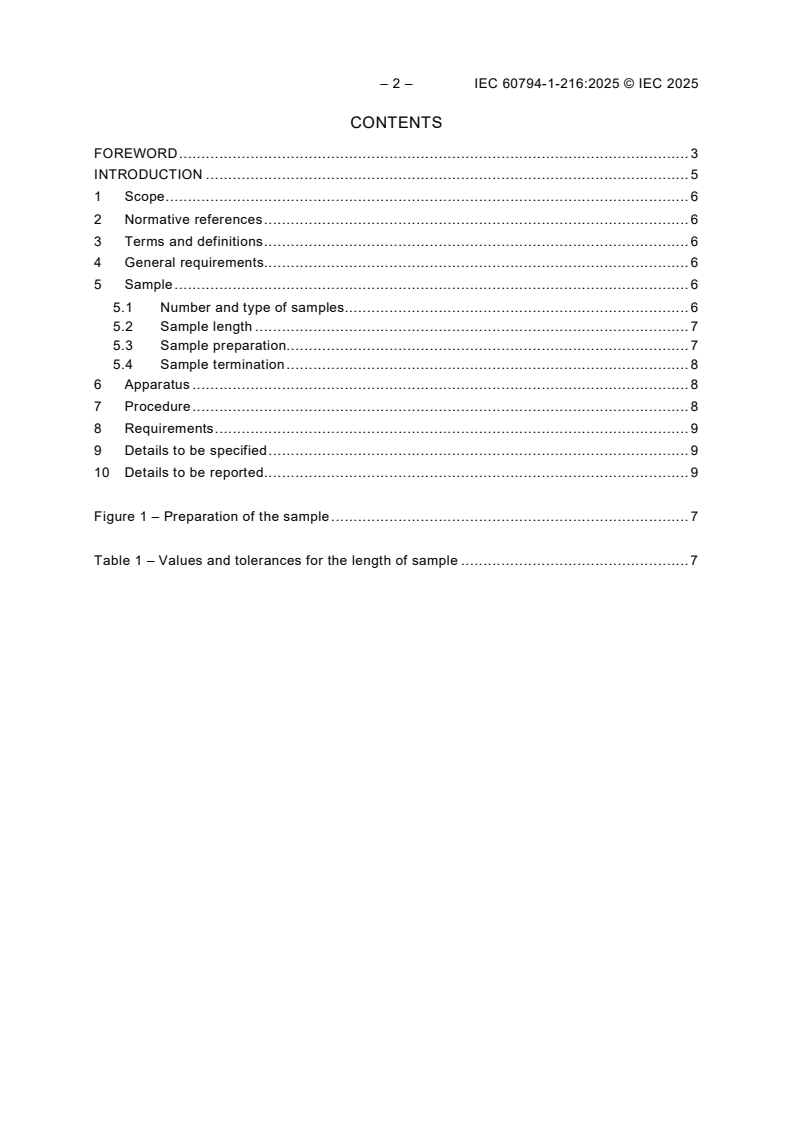
– 2 – IEC 60794-1-216:2025 © IEC 2025
CONTENTS
FOREWORD . 3
INTRODUCTION . 5
1 Scope . 6
2 Normative references . 6
3 Terms and definitions . 6
4 General requirements. 6
5 Sample . 6
5.1 Number and type of samples. 6
5.2 Sample length . 7
5.3 Sample preparation. 7
5.4 Sample termination . 8
6 Apparatus . 8
7 Procedure . 8
8 Requirements . 9
9 Details to be specified . 9
10 Details to be reported . 9
Figure 1 – Preparation of the sample . 7
Table 1 – Values and tolerances for the length of sample . 7
INTERNATIONAL ELECTROTECHNICAL COMMISSION
____________
OPTICAL FIBRE CABLES –
Part 1-216: Generic specification – Basic optical cable test procedures –
Environmental test methods – Compound flow (drip), Method F16
FOREWORD
1) The International Electrotechnical Commission (IEC) is a worldwide organization for standardization comprising
all national electrotechnical committees (IEC National Committees). The object of IEC is to promote international
co-operation on all questions concerning standardization in the electrical and electronic fields. To this end and
in addition to other activities, IEC publishes International Standards, Technical Specifications, Technical Reports,
Publicly Available Specifications (PAS) and Guides (hereafter referred to as "IEC Publication(s)"). Their
preparation is entrusted to technical committees; any IEC National Committee interested in the subject dealt with
may participate in this preparatory work. International, governmental and non-governmental organizations liaising
with the IEC also participate in this preparation. IEC collaborates closely with the International Organization for
Standardization (ISO) in accordance with conditions determined by agreement between the two organizations.
2) The formal decisions or agreements of IEC on technical matters express, as nearly as possible, an international
consensus of opinion on the relevant subjects since each technical committee has representation from all
interested IEC National Committees.
3) IEC Publications have the form of recommendations for international use and are accepted by IEC National
Committees in that sense. While all reasonable efforts are made to ensure that the technical content of IEC
Publications is accurate, IEC cannot be held responsible for the way in which they are used or for any
misinterpretation by any end user.
4) In order to promote international uniformity, IEC National Committees undertake to apply IEC Publications
transparently to the maximum extent possible in their national and regional publications. Any divergence between
any IEC Publication and the corresponding national or regional publication shall be clearly indicated in the latter.
5) IEC itself does not provide any attestation of conformity. Independent certification bodies provide conformity
assessment services and, in some areas, access to IEC marks of conformity. IEC is not responsible for any
services carried out by independent certification bodies.
6) All users should ensure that they have the latest edition of this publication.
7) No liability shall attach to IEC or its directors, employees, servants or agents including individual experts and
members of its technical committees and IEC National Committees for any personal injury, property damage or
other damage of any nature whatsoever, whether direct or indirect, or for costs (including legal fees) and
expenses arising out of the publication, use of, or reliance upon, this IEC Publication or any other IEC
Publications.
8) Attention is drawn to the Normative references cited in this publication. Use of the referenced publications is
indispensable for the correct application of this publication.
9) IEC draws attention to the possibility that the implementation of this document may involve the use of (a)
patent(s). IEC takes no position concerning the evidence, validity or applicability of any claimed patent rights in
respect thereof. As of the date of publication of this document, IEC had not received notice of (a) patent(s), which
may be required to implement this document. However, implementers are cautioned that this may not represent
the latest information, which may be obtained from the patent database available at https://patents.iec.ch. IEC
shall not be held responsible for identifying any or all such patent rights.
IEC 60794-1-216 has been prepared by subcommittee 86A: Fibres and cables, of IEC technical
committee 86: Fibre optics. It is an International Standard.
This document partially cancels and replaces the second edition of IEC 60794-1-22:2017. This
edition constitutes a technical revision.
This edition includes the following significant technical changes with respect to IEC 60794-1-
22:2017:
a) Addition of new Clause 10.
– 4 – IEC 60794-1-216:2025 © IEC 2025
The text of this International Standard is based on the following documents:
Draft Report on voting
86A/2544/FDIS 86A/2555/RVD
Full information on the voting for its approval can be found in the report on voting indicated in
the above table.
The language used for the development of this International Standard is English.
This document was drafted in accordance with ISO/IEC Directives, Part 2, and developed in
accordance with ISO/IEC Directives, Part 1 and ISO/IEC Directives, IEC Supplement, available
at www.iec.ch/members_experts/refdocs. The main document types developed by IEC are
described in greater detail at www.iec.ch/publications.
A list of all parts in the IEC 60794 series, published under the general title Optical fibre cables,
can be found on the IEC website.
The committee has decided that the contents of this document will remain unchanged until the
stability date indicated on the IEC website under webstore.iec.ch in the data related to the
specific document. At this date, the document will be
• reconfirmed,
• withdrawn, or
• revised.
INTRODUCTION
This document cancels and replaces Method F16 of IEC 60794-1-22:2017, which will be
withdrawn. It includes an editorial revision, based on the new structure and numbering system
for optical fibre cable test methods. Additionally, technical changes were implemented. The
environmental tests contained in IEC 60794-1-22:2017 will be individually numbered in the
IEC 60794-1-2xx series. Each test method is now considered to be an individual document
rather than part of a multi-test method compendium. Full cross-reference details are given in
IEC 60794-1-2.
The numbering of this test method continues the F-series numbering sequence of
IEC 60794-1-22:2017.
– 6 – IEC 60794-1-216:2025 © IEC 2025
OPTICAL FIBRE CABLES –
Part 1-216: Generic specification – Basic optical cable test procedures –
Environmental test methods – Compound flow (drip), Method F16
1 Scope
This part of IEC 60794 defines test procedures to ensure the filling and flooding compounds
will not flow from a filled or flooded fibre optic cable, at stated temperatures.
NOTE The environmental testing of optical cable would be valuable for some applications. Useful information about
suitable test methods can be found in the optical fibre standards IEC 60794-1-2.
2 Normative references
The following documents are referred to in the text in such a way that some or all of their content
constitutes requirements of this document. For dated references, only the edition cited applies.
For undated references, the latest edition of the referenced document (including any
amendments) applies.
IEC 60794-1-2, Optical fibre cables – Part 1-2: Generic specification – Basic optical cable test
procedures – General guidance
3 Terms and definitions
For the purposes of this document, the terms and definitions given in 60794-1-2 apply.
ISO and IEC maintain terminology databases for use in standardization at the following
addresses:
• IEC Electropedia: available at https://www.electropedia.org/
• ISO Online browsing platform: available at https://www.iso.org/obp
4 General requirements
IEC 60794-1-2 is the reference guide to test methods of all types.
5 Sample
5.1 Number and type of samples
Unless otherwise specified in the detail specification, prepare two cable samples for testing
from each cable sample to be evaluated. Each cable sample shall be representative of the cable
type specified by the detail specification.
5.2 Sample length
Unless otherwise specified in the detail specification, each sample shall be 200 mm ± 5 mm in
length.
5.3 Sample preparation
Prepare each cable sample as follows, making any modifications as required in 5.4.
a) Remove a 100 mm ± 2,5 mm section of the outer sheathing material from one end.
b) Remove all cable elements (e.g. armour, screens, inner sheaths, helically applied strength
elements, water blocking tapes, other core wraps, etc.), leaving only the buffer tubes and
fillers used to maintain cable roundness for a length of 80 mm ± 2,5 mm from the same
cable end. Do not disturb the remainder of the cable (e.g. the final buffer tubes which contain
the optical fibres or fillers used for roundness). Unless otherwise stated, the sample should
be prepared as shown in Figure 1 and Table 1
Key
l remove outer sheathing material
l remove all remaining non-intrinsic cable elements
l sample length
Figure 1 – Preparation of the sample
Table 1 – Values and tolerances for the length of sample
l l l
1 2 3
Length
100 80 200
(mm)
Tolerance
±2,5 ±2,5 ±5
(mm)
c) Remove loosely adhered quantities of filling or flooding material disturbed in 5.3 a) or 5.3
b) but ensure that the sample remains essentially coated by the filling or flooding material
(i.e. do not wipe clean).
d) For cable designs containing components such as fibre bundles or ribbons which might
move under their own weight during the test, secure such components at the unprepared
end of the sample in a manner which does not disturb the remainder of the sample. Such
components can be secured by clamps, epoxy plugs or other means meeting the objectives
of the procedure.
e) When permitted by the detail specification, the upper ends of buffer tubes or loose tubes
may be sealed to simulate long length cable sections.
– 8 – IEC 60794-1-216:2025 © IEC 2025
5.4 Sample termination
If allowed by the detail specification, terminate the lower end of the cable sample according to
the manufacturer's recommendations for terminating the cable in actual use. Parts of item 5.3
procedure can be affected by this termination, but the objective of item 5.3 is to be followed.
6 Apparatus
The following apparatus and equipment are required to perform this test.
a) Chamber
A temperature chamber large enough to hold the samples in a vertical position, with
sufficient thermal capacity to maintain the specified temperatures for the duration of the
test. If the temperature chamber is of a circulating air type, the air shall not blow directly on
the test samples. The chamber shall be capable of operating to within ±3 °C of the specified
test temperature. It is necessary to install arrangements inside the chamber to hang the
sample. In order to avoid the concentration of thermal energy at the point of connection to
the sample, it is necessary to use clamps that are designed to not cause thermal
concentration.
b) Container
A non-hygroscopic container to catch dripping material.
c) Analytical balance
7 Procedure
The following steps shall be taken.
a) Preheat the chamber to the temperature specified in the detail specification.
b) Hang each prepared sample in the chamber, which is suspended in a vertical position with
the prepared end down. Place a pre-weighed clean collection container directly under (but
not contacting) the suspended sample.
c) If permitted by the detail specification, preconditioning may be performed as defined in c)
1) to c) 3); otherwise, continue with d).
1) Stabilize the chamber temperature and, unless otherwise specified in the detail
specification, precondition each sample for a period of 1 h.
2) At the end of the specified preconditioning time, replace the collection container with
another pre-weighed clean collection container. Weigh the preconditioning collection
container to measure the quantity of filling or flooding compound which can have dripped
out of the cable during the preconditioning. A measured quantity greater than the
specified preconditioning limit shall constitute a failure. Unless otherwise specified in
the detail specification, the preconditioning limit shall be 0,5 % of the total cable sample
weight or 0,5 g, whichever is the smaller.
3) Continue testing for 23 h, unless otherwise specified in the detail specification, and
con
...