

IEC 60794-1-117:2026
(Main)Optical fibre cables - Part 1-117: Generic specification - Basic optical cable test procedures - Mechanical test methods - Bending stiffness, method E17
General Information
- Abstract
IEC 60794-1-117:2026 defines the test procedures used to establish uniform requirements for bending stiffness performance. It applies to optical fibre cables for use with telecommunication equipment and devices employing similar techniques, and to cables having a combination of both optical fibres and electrical conductors.
This edition includes the following significant technical changes with respect to the previous edition:
a) addition of "6.6 Details to be reported";
b) addition of "7.6 Details to be reported";
c) addition of "8.6 Details to be reported".
- Status
- Published
- Publication Date
- 19-May-2026
- Technical Committee
- SC 86A - Fibres and cables
- Current Stage
- PPUB - Publication issued
- Start Date
- 20-May-2026
- Completion Date
- 19-Jun-2026
Buy Documents
IEC 60794-1-117:2026 - Câbles a fibres optiques - Partie 1-117: Spécification générique - Procédures fondamentales d'essais des câbles optiques - Méthodes d'essais mécaniques - Raideur, méthode E17
iec60794-1-117{ed1.0}en - Optical fibre cables - Part 1-117: Generic specification - Basic optical cable test procedures - Mechanical test methods - Bending stiffness, method E17
Overview
IEC 60794-1-117:2026 is an international standard developed by the International Electrotechnical Commission (IEC) that outlines uniform procedures for measuring the bending stiffness of optical fibre cables. This standard is essential for manufacturers, suppliers, and testing laboratories working with optical fibre cables for telecommunications and related applications. It covers cables comprising optical fibres, as well as hybrid cables containing both optical fibres and electrical conductors. Its structured approach helps ensure accurate, consistent evaluation of mechanical properties, supporting reliable installation and long-term cable performance.
Key Topics
- Bending stiffness test procedures: The standard specifies three main mechanical test methods for assessing bending stiffness, designated as Method E17A (three-point bend), Method E17B (cantilever bend), and Method E17C (buckling bend).
- Applicability: These test methods are suitable for various cable types, including large outdoor cables, small jumper cables, microduct fibre units, and hybrid cables with electrical conductors.
- Sample and apparatus requirements: Clear guidelines are provided for preparing cable samples, setting up test apparatus, applying force, and measuring displacement or force during the test.
- Reporting and documentation: The latest edition introduces enhanced requirements for reporting test details, emphasizing the inclusion of relevant cable specifications, precise measurements, and any deviations from prescribed methods.
- Standardization of results: By establishing common test methods and reporting formats, IEC 60794-1-117:2026 ensures that results can be compared across manufacturers and laboratories globally.
Applications
IEC 60794-1-117:2026 is highly relevant in numerous practical applications in the fibre optic cable industry, such as:
- Product design and qualification: Manufacturers use these tests to confirm cable designs meet necessary mechanical performance requirements before market launch.
- Quality assurance: Regular testing in accordance with this standard supports quality control during production, minimizing variability and defects.
- Installation assurance: Bending stiffness measurements facilitate the selection of cables tailored to specific installation techniques, whether for duct installations, conduit pulling, or indoor wiring.
- Hybrid cable development: For cables containing both optical fibres and electrical conductors, the standard provides unified procedures to evaluate mechanical durability in diverse use cases.
- Research and development: R&D teams employ these methods to investigate material suitability and novel cable constructions, ensuring robust mechanical performance during innovation processes.
Related Standards
For comprehensive quality management and compatibility, users of IEC 60794-1-117:2026 should also reference the following related standards:
- IEC 60794-1-1: Generic specification for optical fibres, offering general requirements and definitions.
- IEC 60794-1-2: Provides broader guidance on basic optical cable test procedures and is considered the reference document for all test methods within this domain.
- Standards in the IEC 60794 series: Cover a wide range of optical fibre cable requirements, specifications, and testing methodologies, supporting integrated product conformity.
Adherence to these standards ensures that optical fibre cables and hybrid cables are tested consistently worldwide, enhancing the reliability and interoperability of network infrastructures.
This standard is crucial for stakeholders aiming for international compliance, quality assurance, and reliable cable installation in telecommunications and other high-demand environments. By implementing IEC 60794-1-117:2026, organizations ensure their products meet global benchmarks for performance, safety, and durability.
Relations
- Effective Date
- 09-Feb-2024
Buy Documents
IEC 60794-1-117:2026 - Câbles a fibres optiques - Partie 1-117: Spécification générique - Procédures fondamentales d'essais des câbles optiques - Méthodes d'essais mécaniques - Raideur, méthode E17
iec60794-1-117{ed1.0}en - Optical fibre cables - Part 1-117: Generic specification - Basic optical cable test procedures - Mechanical test methods - Bending stiffness, method E17
Get Certified
Connect with accredited certification bodies for this standard

ANCE
Mexican certification and testing association.

Intertek Slovenia
Intertek testing, inspection, and certification services in Slovenia.

LNE (Laboratoire National de Métrologie et d'Essais)
French national laboratory for metrology and testing.
Sponsored listings
Frequently Asked Questions
IEC 60794-1-117:2026 is a standard published by the International Electrotechnical Commission (IEC). Its full title is "Optical fibre cables - Part 1-117: Generic specification - Basic optical cable test procedures - Mechanical test methods - Bending stiffness, method E17". This standard covers: IEC 60794-1-117:2026 defines the test procedures used to establish uniform requirements for bending stiffness performance. It applies to optical fibre cables for use with telecommunication equipment and devices employing similar techniques, and to cables having a combination of both optical fibres and electrical conductors. This edition includes the following significant technical changes with respect to the previous edition: a) addition of "6.6 Details to be reported"; b) addition of "7.6 Details to be reported"; c) addition of "8.6 Details to be reported".
IEC 60794-1-117:2026 defines the test procedures used to establish uniform requirements for bending stiffness performance. It applies to optical fibre cables for use with telecommunication equipment and devices employing similar techniques, and to cables having a combination of both optical fibres and electrical conductors. This edition includes the following significant technical changes with respect to the previous edition: a) addition of "6.6 Details to be reported"; b) addition of "7.6 Details to be reported"; c) addition of "8.6 Details to be reported".
IEC 60794-1-117:2026 is classified under the following ICS (International Classification for Standards) categories: 33.180.10 - Fibres and cables. The ICS classification helps identify the subject area and facilitates finding related standards.
IEC 60794-1-117:2026 has the following relationships with other standards: It is inter standard links to IEC 60794-1-21:2015. Understanding these relationships helps ensure you are using the most current and applicable version of the standard.
IEC 60794-1-117:2026 is available in PDF format for immediate download after purchase. The document can be added to your cart and obtained through the secure checkout process. Digital delivery ensures instant access to the complete standard document.
Standards Content (Sample)
IEC 60794-1-117 ®
Edition 1.0 2026-05
NORME
INTERNATIONALE
Câbles à fibres optiques -
Partie 1-117: Spécification générique - Procédures fondamentales d’essais des
câbles optiques - Méthodes d’essais mécaniques - Raideur, méthode E17
ICS 33.180.10 ISBN 978-2-8327-1249-8
Droits de reproduction réservés. Sauf indication contraire, aucune partie de cette publication ne peut être reproduite ni
utilisée sous quelque forme que ce soit et par aucun procédé, électronique ou mécanique, y compris la photocopie et
les microfilms, sans l'accord écrit de l'IEC ou du Comité national de l'IEC du pays du demandeur. Si vous avez des
questions sur le copyright de l'IEC ou si vous désirez obtenir des droits supplémentaires sur cette publication, utilisez
les coordonnées ci-après ou contactez le Comité national de l'IEC de votre pays de résidence.
IEC Secretariat Tel.: +41 22 919 02 11
3, rue de Varembé info@iec.ch
CH-1211 Geneva 20 www.iec.ch
Switzerland
A propos de l'IEC
La Commission Electrotechnique Internationale (IEC) est la première organisation mondiale qui élabore et publie des
Normes internationales pour tout ce qui a trait à l'électricité, à l'électronique et aux technologies apparentées.
A propos des publications IEC
Le contenu technique des publications IEC est constamment revu. Veuillez vous assurer que vous possédez l’édition la
plus récente, un corrigendum ou amendement peut avoir été publié.
Recherche de publications IEC - IEC Products & Services Portal - products.iec.ch
webstore.iec.ch/advsearchform Découvrez notre puissant moteur de recherche et consultez
La recherche avancée permet de trouver des publications gratuitement tous les aperçus des publications, symboles
IEC en utilisant différents critères (numéro de référence, graphiques et le glossaire. Avec un abonnement, vous aurez
texte, comité d’études, …). Elle donne aussi des toujours accès à un contenu à jour adapté à vos besoins.
informations sur les projets et les publications remplacées
ou retirées. Electropedia - www.electropedia.org
Le premier dictionnaire d'électrotechnologie en ligne au
IEC Just Published - webstore.iec.ch/justpublished monde, avec plus de 22 500 articles terminologiques en
Restez informé sur les nouvelles publications IEC. Just anglais et en français, ainsi que les termes équivalents
Published détaille les nouvelles publications parues. dans 25 langues additionnelles. Egalement appelé
Disponible en ligne et une fois par mois par email. Vocabulaire Electrotechnique International (IEV) en ligne.
Service Clients - webstore.iec.ch/csc
Si vous désirez nous donner des commentaires sur cette
publication ou si vous avez des questions contactez-
nous: sales@iec.ch.
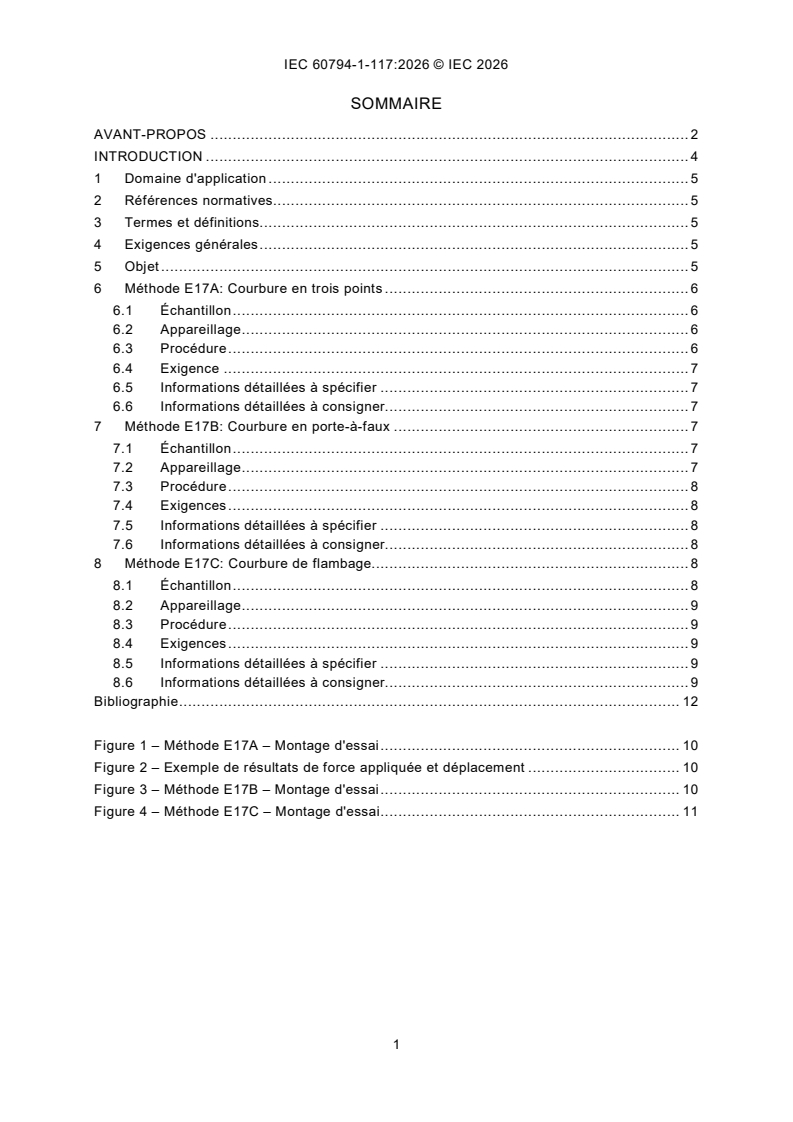
SOMMAIRE
AVANT-PROPOS . 2
INTRODUCTION . 4
1 Domaine d'application . 5
2 Références normatives . 5
3 Termes et définitions. 5
4 Exigences générales . 5
5 Objet . 5
6 Méthode E17A: Courbure en trois points . 6
6.1 Échantillon . 6
6.2 Appareillage . 6
6.3 Procédure . 6
6.4 Exigence . 7
6.5 Informations détaillées à spécifier . 7
6.6 Informations détaillées à consigner. 7
7 Méthode E17B: Courbure en porte-à-faux . 7
7.1 Échantillon . 7
7.2 Appareillage . 7
7.3 Procédure . 8
7.4 Exigences . 8
7.5 Informations détaillées à spécifier . 8
7.6 Informations détaillées à consigner. 8
8 Méthode E17C: Courbure de flambage. 8
8.1 Échantillon . 8
8.2 Appareillage . 9
8.3 Procédure . 9
8.4 Exigences . 9
8.5 Informations détaillées à spécifier . 9
8.6 Informations détaillées à consigner. 9
Bibliographie . 12
Figure 1 – Méthode E17A – Montage d'essai . 10
Figure 2 – Exemple de résultats de force appliquée et déplacement . 10
Figure 3 – Méthode E17B – Montage d'essai . 10
Figure 4 – Méthode E17C – Montage d'essai . 11
COMMISSION ÉLECTROTECHNIQUE INTERNATIONALE
____________
Câbles à fibres optiques -
Partie 1-117: Spécification générique - Procédures fondamentales
d'essais des câbles optiques - Méthodes d'essais mécaniques - Raideur,
méthode E17
AVANT-PROPOS
1) La Commission Électrotechnique Internationale (IEC) est une organisation mondiale de normalisation composée
de l'ensemble des comités électrotechniques nationaux (Comités nationaux de l'IEC). L'IEC a pour objet de
favoriser la coopération internationale pour toutes les questions de normalisation dans les domaines de
l'électricité et de l'électronique. À cet effet, l'IEC – entre autres activités – publie des Normes internationales,
des Spécifications techniques, des Rapports techniques, des Spécifications accessibles au public (PAS) et des
Guides (ci-après dénommés "Publication(s) de l'IEC"). Leur élaboration est confiée à des comités d'études, aux
travaux desquels tout Comité national intéressé par le sujet traité peut participer. Les organisations
internationales, gouvernementales et non gouvernementales, en liaison avec l'IEC, participent également aux
travaux. L'IEC collabore étroitement avec l'Organisation Internationale de Normalisation (ISO), selon des
conditions fixées par accord entre les deux organisations.
2) Les décisions ou accords officiels de l'IEC concernant les questions techniques représentent, dans la mesure du
possible, un accord international sur les sujets étudiés, étant donné que les Comités nationaux de l'IEC intéressés
sont représentés dans chaque comité d'études.
3) Les Publications de l'IEC se présentent sous la forme de recommandations internationales et sont agréées
comme telles par les Comités nationaux de l'IEC. Tous les efforts raisonnables sont entrepris afin que l'IEC
s'assure de l'exactitude du contenu technique de ses publications; l'IEC ne peut pas être tenue responsable de
l'éventuelle mauvaise utilisation ou interprétation qui en est faite par un quelconque utilisateur final.
4) Dans le but d'encourager l'uniformité internationale, les Comités nationaux de l'IEC s'engagent, dans toute la
mesure possible, à appliquer de façon transparente les Publications de l'IEC dans leurs publications nationales
et régionales. Toutes divergences entre toutes Publications de l'IEC et toutes publications nationales ou
régionales correspondantes doivent être indiquées en termes clairs dans ces dernières.
5) L'IEC elle-même ne fournit aucune attestation de conformité. Des organismes de certification indépendants
fournissent des services d'évaluation de conformité et, dans certains secteurs, accèdent aux marques de
conformité de l'IEC. L'IEC n'est responsable d'aucun des services effectués par les organismes de certification
indépendants.
6) Tous les utilisateurs doivent s'assurer qu'ils sont en possession de la dernière édition de cette publication.
7) Aucune responsabilité ne doit être imputée à l'IEC, à ses administrateurs, employés, auxiliaires ou mandataires,
y compris ses experts particuliers et les membres de ses comités d'études et des Comités nationaux de l'IEC,
pour tout préjudice causé en cas de dommages corporels et matériels, ou de tout autre dommage de quelque
nature que ce soit, directe ou indirecte, ou pour supporter les coûts (y compris les frais de justice) et les dépenses
découlant de la publication ou de l'utilisation de cette Publication de l'IEC ou de toute autre Publication de l'IEC,
ou au crédit qui lui est accordé.
8) L'attention est attirée sur les références normatives citées dans cette publication. L'utilisation de publications
référencées est obligatoire pour une application correcte de la présente publication.
9) L'IEC attire l'attention sur le fait que la mise en application du présent document peut entraîner l'utilisation d'un
ou de plusieurs brevets. L'IEC ne prend pas position quant à la preuve, à la validité et à l'applicabilité de tout
droit de brevet revendiqué à cet égard. À la date de publication du présent document, l'IEC n'a pas reçu
notification qu'un ou plusieurs brevets pouvaient être nécessaires à sa mise en application. Toutefois, il y a lieu
d'avertir les responsables de la mise en application du présent document que des informations plus récentes
sont susceptibles de figurer dans la base de données de brevets, disponible à l'adresse https://patents.iec.ch.
L'IEC ne saurait être tenue pour responsable de ne pas avoir identifié de tels droits de brevets.
L'IEC 60794-1-117 a été établie par le sous-comité 86A: Fibres et câbles, du comité d'études
86 de l'IEC: Fibronique. Il s'agit d'une Norme internationale.
Cette première édition annule et remplace la Méthode E17 de la première édition de
l'IEC 60794-1-21 parue en 2015. Cette édition constitue une révision technique.
Cette édition inclut les modifications techniques significatives suivantes par rapport à l'édition
précédente:
a) ajout du "6.6 Informations détaillées à consigner";
b) ajout du "7.6 Informations détaillées à consigner";
c) ajout du "8.6 Informations détaillées à consigner".
Le texte de cette Norme internationale est issu des documents suivants:
Projet Rapport de vote
86A/2685/FDIS 86A/2696/RVD
Le rapport de vote indiqué dans le tableau ci-dessus donne toute information sur le vote ayant
abouti à son approbation.
La langue employée pour l'élaboration de cette Norme internationale est l'anglais.
Une liste de toutes les parties de la série IEC 60794, publiées sous le titre général Câbles à
fibres optiques, se trouve sur le site web de l'IEC.
Ce document a été rédigé selon les Directives ISO/IEC, Partie 2, il a été développé selon les
Directives ISO/IEC, Partie 1 et les Directives ISO/IEC, Supplément IEC, disponibles sous
www.iec.ch/members_experts/refdocs. Les principaux types de documents développés par
l'IEC sont décrits plus en détail sous www.iec.ch/publications.
Le comité a décidé que le contenu de ce document ne sera pas modifié avant la date de stabilité
indiquée sur le site web de l'IEC sous webstore.iec.ch dans les données relatives au document
recherché. À cette date, le document sera
– reconduit,
– supprimé, ou
– révisé.
INTRODUCTION
Le présent document contient la méthode E17 de l'IEC 60794-1-21:2015
...
IEC 60794-1-117 ®
Edition 1.0 2026-05
INTERNATIONAL
STANDARD
Optical fibre cables -
Part 1-117: Generic specification - Basic optical cable test procedures -
Mechanical tests methods - Bending stiffness, method E17
ICS 33.180.10 ISBN 978-2-8327-1249-8
All rights reserved. Unless otherwise specified, no part of this publication may be reproduced or utilized in any form or
by any means, electronic or mechanical, including photocopying and microfilm, without permission in writing from either
IEC or IEC's member National Committee in the country of the requester. If you have any questions about IEC copyright
or have an enquiry about obtaining additional rights to this publication, please contact the address below or your local
IEC member National Committee for further information.
IEC Secretariat Tel.: +41 22 919 02 11
3, rue de Varembé info@iec.ch
CH-1211 Geneva 20 www.iec.ch
Switzerland
About the IEC
The International Electrotechnical Commission (IEC) is the leading global organization that prepares and publishes
International Standards for all electrical, electronic and related technologies.
About IEC publications
The technical content of IEC publications is kept under constant review by the IEC. Please make sure that you have the
latest edition, a corrigendum or an amendment might have been published.
IEC publications search - IEC Products & Services Portal - products.iec.ch
webstore.iec.ch/advsearchform Discover our powerful search engine and read freely all the
The advanced search enables to find IEC publications by a
publications previews, graphical symbols and the glossary.
variety of criteria (reference number, text, technical With a subscription you will always have access to up to date
committee, …). It also gives information on projects, content tailored to your needs.
replaced and withdrawn publications.
Electropedia - www.electropedia.org
IEC Just Published - webstore.iec.ch/justpublished The world's leading online dictionary on electrotechnology,
Stay up to date on all new IEC publications. Just Published containing more than 22 500 terminological entries in English
details all new publications released. Available online and and French, with equivalent terms in 25 additional languages.
once a month by email. Also known as the International Electrotechnical Vocabulary
(IEV) online.
IEC Customer Service Centre - webstore.iec.ch/csc
If you wish to give us your feedback on this publication or
need further assistance, please contact the Customer
Service Centre: sales@iec.ch.
CONTENTS
FOREWORD . 2
INTRODUCTION . 4
1 Scope . 5
2 Normative references . 5
3 Terms and definitions . 5
4 General requirements. 5
5 Object . 5
6 Method E17A: Three-point bend . 6
6.1 Sample . 6
6.2 Apparatus . 6
6.3 Procedure . 6
6.4 Requirement . 7
6.5 Details to be specified . 7
6.6 Details to be reported . 7
7 Method E17B: Cantilever bend . 7
7.1 Sample . 7
7.2 Apparatus . 7
7.3 Procedure . 8
7.4 Requirements . 8
7.5 Details to be specified . 8
7.6 Details to be reported . 8
8 Method E17C: Buckling bend . 8
8.1 Sample . 8
8.2 Apparatus . 8
8.3 Procedure . 9
8.4 Requirements . 9
8.5 Details to be specified . 9
8.6 Details to be reported . 9
Bibliography . 12
Figure 1 – Method E17A – Test set-up . 10
Figure 2 – Example of results of applied force and displacement . 10
Figure 3 – Method E17B – Test set-up . 10
Figure 4 – Method E17C – Test set-up. 11
INTERNATIONAL ELECTROTECHNICAL COMMISSION
____________
Optical fibre cables -
Part 1-117: Generic specification - Basic optical cable test procedures -
Mechanical test methods - Bending stiffness, method E17
FOREWORD
1) The International Electrotechnical Commission (IEC) is a worldwide organization for standardization comprising
all national electrotechnical committees (IEC National Committees). The object of IEC is to promote international
co-operation on all questions concerning standardization in the electrical and electronic fields. To this end and
in addition to other activities, IEC publishes International Standards, Technical Specifications, Technical Reports,
Publicly Available Specifications (PAS) and Guides (hereafter referred to as "IEC Publication(s)"). Their
preparation is entrusted to technical committees; any IEC National Committee interested in the subject dealt with
may participate in this preparatory work. International, governmental and non-governmental organizations liaising
with the IEC also participate in this preparation. IEC collaborates closely with the International Organization for
Standardization (ISO) in accordance with conditions determined by agreement between the two organizations.
2) The formal decisions or agreements of IEC on technical matters express, as nearly as possible, an international
consensus of opinion on the relevant subjects since each technical committee has representation from all
interested IEC National Committees.
3) IEC Publications have the form of recommendations for international use and are accepted by IEC National
Committees in that sense. While all reasonable efforts are made to ensure that the technical content of IEC
Publications is accurate, IEC cannot be held responsible for the way in which they are used or for any
misinterpretation by any end user.
4) In order to promote international uniformity, IEC National Committees undertake to apply IEC Publications
transparently to the maximum extent possible in their national and regional publications. Any divergence between
any IEC Publication and the corresponding national or regional publication shall be clearly indicated in the latter.
5) IEC itself does not provide any attestation of conformity. Independent certification bodies provide conformity
assessment services and, in some areas, access to IEC marks of conformity. IEC is not responsible for any
services carried out by independent certification bodies.
6) All users should ensure that they have the latest edition of this publication.
7) No liability shall attach to IEC or its directors, employees, servants or agents including individual experts and
members of its technical committees and IEC National Committees for any personal injury, property damage or
other damage of any nature whatsoever, whether direct or indirect, or for costs (including legal fees) and
expenses arising out of the publication, use of, or reliance upon, this IEC Publication or any other IEC
Publications.
8) Attention is drawn to the Normative references cited in this publication. Use of the referenced publications is
indispensable for the correct application of this publication.
9) IEC draws attention to the possibility that the implementation of this document may involve the use of (a)
patent(s). IEC takes no position concerning the evidence, validity or applicability of any claimed patent rights in
respect thereof. As of the date of publication of this document, IEC had not received notice of (a) patent(s), which
may be required to implement this document. However, implementers are cautioned that this may not represent
the latest information, which may be obtained from the patent database available at https://patents.iec.ch. IEC
shall not be held responsible for identifying any or all such patent rights.
IEC 60794-1-117 has been prepared by subcommittee 86A: Fibres and cables, of IEC technical
committee 86: Fibre optics. It is an International Standard.
This first edition cancels and replaces Method E17 of the first edition of IEC 60794-1-21
published in 2015. This edition constitutes a technical revision.
This edition includes the following significant technical changes with respect to the previous
edition:
a) addition of "6.6 Details to be reported";
b) addition of "7.6 Details to be reported";
c) addition of "8.6 Details to be reported".
The text of this International Standard is based on the following documents:
Draft Report on voting
86A/2685/FDIS 86A/2696/RVD
Full information on the voting for its approval can be found in the report on voting indicated in
the above table.
The language used for the development of this International Standard is English.
A list of all parts in the IEC 60794 series, published under the general title Optical fibre cables,
can be found on the IEC website.
This document was drafted in accordance with ISO/IEC Directives, Part 2, and developed in
accordance with ISO/IEC Directives, Part 1 and ISO/IEC Directives,
...