

IEC 61131-7:2000
(Main)Programmable controllers - Part 7: Fuzzy control programming
General Information
- Abstract
Defines a language for the programming of Fuzzy Control applications used by programmable controllers.
- Status
- Published
- Publication Date
- 09-Aug-2000
- Technical Committee
- SC 65B - Measurement and control devices
- Drafting Committee
- WG 7 - TC 65/SC 65B/WG 7
- Current Stage
- PPUB - Publication issued
- Start Date
- 10-Aug-2000
- Completion Date
- 15-Sep-2000
Overview
IEC 61131-7:2000 is an international standard issued by the International Electrotechnical Commission (IEC) that defines a dedicated programming language for fuzzy control applications implemented within programmable controllers. This part 7 of the IEC 61131 series provides a comprehensive framework for designing, coding, and exchanging fuzzy control programs, facilitating the integration of fuzzy logic into industrial automation systems. The standard ensures consistent and reliable programming methods for fuzzy controllers, promoting interoperability and optimization of control processes where traditional binary logic may be inadequate.
Key Topics
Scope and Purpose
IEC 61131-7:2000 focuses on the programming language specifically designed for fuzzy control within programmable controllers, enabling the development of adaptive and intelligent control systems.Fuzzy Control Language (FCL)
The standard introduces Fuzzy Control Language (FCL), outlining rules and structures for creating fuzzy control programs. It details program elements such as fuzzy sets, linguistic variables, membership functions, inference mechanisms, and defuzzification methods.Language Elements and Syntax
Key components include the description of fuzzy variables, rule blocks, terms like ramp and singleton membership functions, and control structures using production rules with defined keywords.Integration Guidelines
The standard provides instructions on how fuzzy control programs can be integrated into existing programmable controllers, supporting the exchange of fuzzy control programs among systems.Compliance and Conformance Classes
IEC 61131-7:2000 defines levels of language conformance and provides a checklist to verify program compliance, ensuring reliability and standard adherence in fuzzy control implementations.Informative Annexes
- Theory of fuzzy logic and control including fundamentals, inference, fuzzification, defuzzification, and performance considerations.
- Practical examples and industrial applications illustrating fuzzy control programming.
- Symbol definitions, abbreviations, and usage guidance.
Applications
Industrial Automation
The standard is especially valuable for industries requiring flexible, adaptive controllers that handle uncertain or imprecise information, such as manufacturing, process control, and robotics.Process Control
Fuzzy control programming helps in managing nonlinear, complex processes where traditional PID controllers may not be sufficient, enhancing control precision and stability.Adaptive Systems
Systems implementing this standard can dynamically adjust control parameters, offering better response to varying environmental or operational conditions.Container Crane Control Example
An industrial application example included in the standard shows how fuzzy control optimizes the operation of container cranes by managing variables like distance, angle, and power, improving safety and efficiency.PID Parameter Adaptation
Fuzzy logic can be applied to adapt parameters of conventional PID controllers, blending traditional control strategies with intelligent fuzzy methods.
Related Standards
IEC 61131 Series
This fuzzy control programming language is part of the broader IEC 61131 series that addresses programming languages and software aspects of programmable controllers, ensuring uniformity across automation software development.IEC 60050 (International Electrotechnical Vocabulary)
For understanding terminology related to fuzzy logic and programmable controllers, IEC 60050 offers authoritative definitions.IEC 60027 and IEC 60417
These standards cover letter symbols and graphical symbols relevant to control systems and electrical technology, supporting consistent symbol usage in fuzzy control programming.IEC 60617
Provides graphical symbols for diagrams, useful for representing fuzzy logic function blocks and system schematics.
IEC 61131-7:2000 enables engineers and developers to harness the power of fuzzy logic within programmable controllers, advancing the capabilities of automation systems to better handle uncertain, imprecise, or complex control challenges. Its comprehensive framework for fuzzy control programming promotes standardized implementation, interchangeability of fuzzy programs, and improved system adaptability, ultimately enhancing industrial process efficiency and reliability.
Get Certified
Connect with accredited certification bodies for this standard

BSI Group
BSI (British Standards Institution) is the business standards company that helps organizations make excellence a habit.

DVS-ZERT GmbH
German welding certification society.
CARES (UK Certification Authority for Reinforcing Steels)
UK certification for reinforcing steels and construction.
Sponsored listings
Frequently Asked Questions
IEC 61131-7:2000 is a standard published by the International Electrotechnical Commission (IEC). Its full title is "Programmable controllers - Part 7: Fuzzy control programming". This standard covers: Defines a language for the programming of Fuzzy Control applications used by programmable controllers.
Defines a language for the programming of Fuzzy Control applications used by programmable controllers.
IEC 61131-7:2000 is classified under the following ICS (International Classification for Standards) categories: 25.040.40 - Industrial process measurement and control; 35.240.50 - IT applications in industry. The ICS classification helps identify the subject area and facilitates finding related standards.
IEC 61131-7:2000 is available in PDF format for immediate download after purchase. The document can be added to your cart and obtained through the secure checkout process. Digital delivery ensures instant access to the complete standard document.
Standards Content (Sample)
NORME CEI
INTERNATIONALE IEC
61131-7
INTERNATIONAL
Première édition
STANDARD
First edition
2000-08
Automates programmables –
Partie 7:
Programmation en logique floue
Programmable controllers –
Part 7:
Fuzzy control programming
Numéro de référence
Reference number
CEI/IEC 61131-7:2000
Numéros des publications Numbering
Depuis le 1er janvier 1997, les publications de la CEI As from 1 January 1997 all IEC publications are
sont numérotées à partir de 60000. issued with a designation in the 60000 series.
Publications consolidées Consolidated publications
Les versions consolidées de certaines publications de Consolidated versions of some IEC publications
la CEI incorporant les amendements sont disponibles. including amendments are available. For example,
Par exemple, les numéros d’édition 1.0, 1.1 et 1.2 edition numbers 1.0, 1.1 and 1.2 refer, respectively, to
indiquent respectivement la publication de base, la the base publication, the base publication incor-
publication de base incorporant l’amendement 1, et la porating amendment 1 and the base publication
publication de base incorporant les amendements 1 incorporating amendments 1 and 2.
et 2.
Validité de la présente publication Validity of this publication
Le contenu technique des publications de la CEI est The technical content of IEC publications is kept
constamment revu par la CEI afin qu'il reflète l'état under constant review by the IEC, thus ensuring that
actuel de la technique. the content reflects current technology.
Des renseignements relatifs à la date de reconfir- Information relating to the date of the reconfirmation
mation de la publication sont disponibles dans le of the publication is available in the IEC catalogue.
Catalogue de la CEI.
Les renseignements relatifs à des questions à l’étude et Information on the subjects under consideration and
des travaux en cours entrepris par le comité technique work in progress undertaken by the technical
qui a établi cette publication, ainsi que la liste des committee which has prepared this publication, as well
publications établies, se trouvent dans les documents ci- as the list of publications issued, is to be found at the
dessous: following IEC sources:
• «Site web» de la CEI* • IEC web site*
• Catalogue des publications de la CEI • Catalogue of IEC publications
Publié annuellement et mis à jour Published yearly with regular updates
régulièrement (On-line catalogue)*
(Catalogue en ligne)*
• Bulletin de la CEI
• IEC Bulletin
Disponible à la fois au «site web» de la CEI*
Available both at the IEC web site* and
et comme périodique imprimé
as a printed periodical
Terminologie, symboles graphiques
Terminology, graphical and letter
et littéraux
symbols
En ce qui concerne la terminologie générale, le lecteur
For general terminology, readers are referred to
se reportera à la CEI 60050: Vocabulaire Electro-
IEC 60050: International Electrotechnical Vocabulary
technique International (VEI).
(IEV).
Pour les symboles graphiques, les symboles littéraux
For graphical symbols, and letter symbols and signs
et les signes d'usage général approuvés par la CEI, le
approved by the IEC for general use, readers are
lecteur consultera la CEI 60027: Symboles littéraux à
referred to publications IEC 60027: Letter symbols to
utiliser en électrotechnique, la CEI 60417: Symboles
be used in electrical technology, IEC 60417: Graphical
graphiques utilisables sur le matériel. Index, relevé et
symbols for use on equipment. Index, survey and
compilation des feuilles individuelles, et la CEI 60617:
compilation of the single sheets and IEC 60617:
Symboles graphiques pour schémas.
Graphical symbols for diagrams.
* Voir adresse «site web» sur la page de titre.
* See web site address on title page.
NORME CEI
INTERNATIONALE IEC
61131-7
INTERNATIONAL
Première édition
STANDARD
First edition
2000-08
Automates programmables –
Partie 7:
Programmation en logique floue
Programmable controllers –
Part 7:
Fuzzy control programming
IEC 2000 Droits de reproduction réservés Copyright - all rights reserved
Aucune partie de cette publication ne peut être reproduite ni No part of this publication may be reproduced or utilized in
utilisée sous quelque forme que ce soit et par aucun procédé, any form or by any means, electronic or mechanical,
électronique ou mécanique, y compris la photocopie et les including photocopying and microfilm, without permission in
microfilms, sans l'accord écrit de l'éditeur. writing from the publisher.
International Electrotechnical Commission 3, rue de Varembé Geneva, Switzerland
Telefax: +41 22 919 0300 e-mail: inmail@iec.ch IEC web site http://www.iec.ch
CODE PRIX
Commission Electrotechnique Internationale
XA
PRICE CODE
International Electrotechnical Commission
Pour prix, voir catalogue en vigueur
For price, see current catalogue
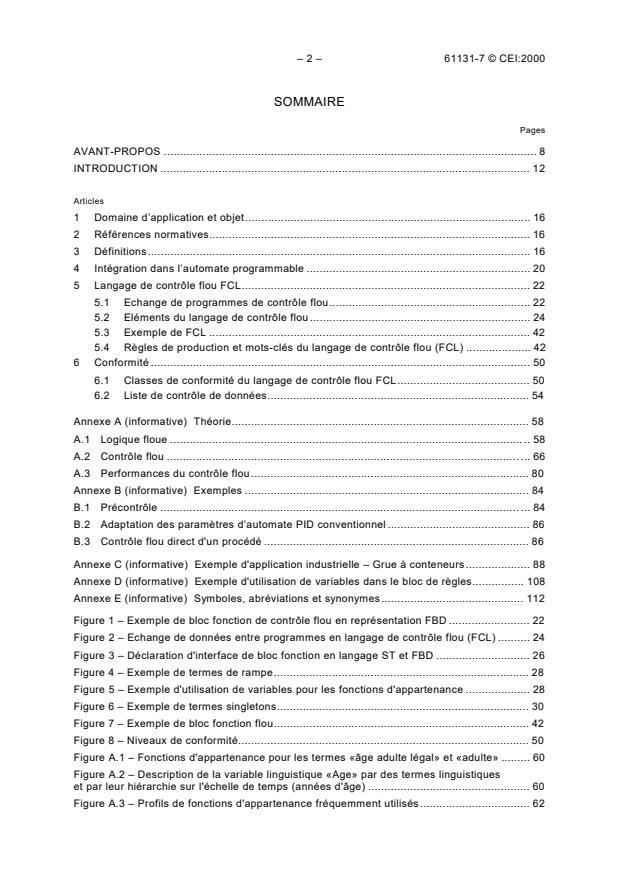
– 2 – 61131-7 © CEI:2000
SOMMAIRE
Pages
AVANT-PROPOS . 8
INTRODUCTION . 12
Articles
1 Domaine d’application et objet. 16
2 Références normatives. 16
3 Définitions. 16
4 Intégration dans l’automate programmable . 20
5 Langage de contrôle flou FCL. 22
5.1 Echange de programmes de contrôle flou. 22
5.2 Eléments du langage de contrôle flou . 24
5.3 Exemple de FCL . 42
5.4 Règles de production et mots-clés du langage de contrôle flou (FCL) . 42
6 Conformité .50
6.1 Classes de conformité du langage de contrôle flou FCL. 50
6.2 Liste de contrôle de données. 54
Annexe A (informative) Théorie. 58
A.1 Logique floue . . 58
A.2 Contrôle flou . . 66
A.3 Performances du contrôle flou. 80
Annexe B (informative) Exemples . 84
B.1 Précontrôle . . 84
B.2 Adaptation des paramètres d’automate PID conventionnel . 86
B.3 Contrôle flou direct d'un procédé . 86
Annexe C (informative) Exemple d'application industrielle – Grue à conteneurs. 88
Annexe D (informative) Exemple d'utilisation de variables dans le bloc de règles. 108
Annexe E (informative) Symboles, abréviations et synonymes. 112
Figure 1 – Exemple de bloc fonction de contrôle flou en représentation FBD . 22
Figure 2 – Echange de données entre programmes en langage de contrôle flou (FCL) . 24
Figure 3 – Déclaration d'interface de bloc fonction en langage ST et FBD . 26
Figure 4 – Exemple de termes de rampe. 28
Figure 5 – Exemple d'utilisation de variables pour les fonctions d'appartenance . 28
Figure 6 – Exemple de termes singletons. 30
Figure 7 – Exemple de bloc fonction flou. 42
Figure 8 – Niveaux de conformité. 50
Figure A.1 – Fonctions d'appartenance pour les termes «âge adulte légal» et «adulte» . 60
Figure A.2 – Description de la variable linguistique «Age» par des termes linguistiques
et par leur hiérarchie sur l'échelle de temps (années d'âge) . 60
Figure A.3 – Profils de fonctions d'appartenance fréquemment utilisés. 62
61131-7 © IEC:2000 – 3 –
CONTENTS
Page
FOREWORD . 9
INTRODUCTION . 13
Clause
1 Scope and object . 17
2 Normative references . 17
3 Definitions. 17
4 Integration into the programmable controller . 21
5 Fuzzy Control Language FCL . 23
5.1 Exchange of fuzzy control programs . 23
5.2 Fuzzy Control Language elements. 25
5.3 FCL example.43
5.4 Production rules and keywords of the Fuzzy Control Language (FCL) . 43
6 Compliance. 51
6.1 Conformance classes of Fuzzy Control Language FCL . 51
6.2 Data check list . 55
Annex A (informative) Theory. 59
A.1 Fuzzy Logic . 59
A.2 Fuzzy Control . 67
A.3 Performance of Fuzzy control . 81
Annex B (informative) Examples . 85
B.1 Pre-control . 85
B.2 Parameter adaptation of conventional PID controllers . 87
B.3 Direct fuzzy control of a process. 87
Annex C (informative) Industrial example – Container crane. 89
Annex D (informative) Example for using variables in the rule block . 109
Annex E (informative) Symbols, abbreviations and synonyms. 113
Figure 1 – Example of a fuzzy control Function Block in FBD representation . 23
Figure 2 – Data exchange of Programs in Fuzzy Control Language (FCL). 25
Figure 3 – Example of a Function Block interface declaration in ST and FBD languages. 27
Figure 4 – Example of ramp terms . 29
Figure 5 – Example of usage of variables for membership functions. 29
Figure 6 – Example of singleton terms . 31
Figure 7 – Example for fuzzy function block . 43
Figure 8 – Levels of conformance . 51
Figure A.1 – Membership functions of the terms "full legal age" and "adult" . 61
Figure A.2 – Description of the linguistic variable "Age" by linguistic terms
and their hierarchy on the time scale (age in years). 61
Figure A.3 – Commonly used shapes of membership functions . 63
– 4 – 61131-7 © CEI:2000
Pages
Figure A.4 – Algorithmes pour l'implémentation d'opérations entre deux fonctions
d'appartenance. . 66
Figure A.5 – Structure et éléments fonctionnels du contrôle flou. 68
Figure A.6 – Principe de fuzzification (exemple) . 68
Figure A.7 – Représentation de la base de connaissance sous forme linguistique . 70
Figure A.8 – Représentation de deux variables sous forme de matrice . 70
Figure A.9 – Eléments d'une inférence. 72
Figure A.10a – Exemple montrant les principes d'agrégation. 74
Figure A.10b – Principes d'activation (exemple) . 74
Figure A.10c – Principes d'accumulation (exemple). 76
Figure A.11a – Méthodes de défuzzification . 76
Figure A.11b – Comparaison entre maximum le plus à gauche et maximum le plus à droite . 78
Figure A.11c: Comparaison entre Centre de surface et Centre de gravité . 78
Figure A.11d – Méthodes de défuzzification . 80
Figure A.12 – Exemples de courbes de caractéristiques de contrôle flou . 82
Figure A.13a – Automate à base de logique floue: structure fondamentale . 82
Figure A.13b – Exemple d’automate à base de logique floue . 82
Figure B.1 – Exemple de précontrôle . 84
Figure B.2 – Exemple d'adaptation d'un paramètre. 86
Figure B.3 – Exemple de contrôle flou direct . 86
Figure C.1 – Exemple d'application industrielle – Grue à conteneurs . 88
Figure C.2 – Variable linguistique «Distance» entre tête de grue et position finale . 90
Figure C.3 – Variable linguistique «Angle» entre conteneur et tête de grue. 90
Figure C.4 – Variable linguistique «Puissance» . 90
Figure C.5 – Base de règles . 92
Figure C.6 – Fuzzification de la variable linguistique «Distance» . 92
Figure C.7 – Fuzzification de la variable linguistique «Angle» . 94
Figure C.8 – Sous-ensemble de trois règles. 94
Figure C.9 – Eléments d'agrégation . 94
Figure C.10 – Principes d'agrégation . 96
Figure C.11 – Eléments d'activation . 96
Figure C.12 – Principes d'activation . 98
Figure C.13 – Eléments d'accumulation . 98
Figure C.14 – Principes d'accumulation . 100
Figure C.15 – Défuzzification . 102
Figure C.16 – Exemple en FCL . 104
Figure D.1 – Principe du système contrôlé . 108
Figure D.2 – Principe de contrôle flou d'un four. 108
Figure D.3 – Bloc de règles. 108
Figure D.4 – Exemple en FCL. 110
61131-7 © IEC:2000 – 5 –
Page
Figure A.4 – Algorithms for implementing operations between two membership functions . 67
Figure A.5 – Structure and functional elements of fuzzy control . 69
Figure A.6 – The principle of fuzzification (as an example) . 69
Figure A.7 – Representation of the knowledge base in linguistic form . 71
Figure A.8 – Matrix representation of two variables . 71
Figure A.9 – Elements of inference . 73
Figure A.10a – An example showing the principles of aggregation. 75
Figure A.10b – The principles of activation (as an example) . 75
Figure A.10c – The principles of accumulation (as an example). 77
Figure A.11a – Methods of defuzzification . 77
Figure A.11b – Difference between Left Most Maximum and Right Most Maximum . 79
Figure A.11c – Difference between Centre of Area and Centre of Gravity . 79
Figure A.11d – Methods of defuzzification . 81
Figure A.12 – Examples of fuzzy control characteristic curves . 83
Figure A.13a – Fuzzy-based controller: Fundamental structure. 83
Figure A.13b – Example of a Fuzzy-based controller . 83
Figure B.1 – Example of a pre-control. 85
Figure B.2 – Example of a parameter adaptation. 87
Figure B.3 – Example of a direct fuzzy control. 87
Figure C.1 – Industrial example – Container crane . 89
Figure C.2 – Linguistic variable "Distance" between crane head and target position. 91
Figure C.3 – Linguistic variable "Angle" of the container to the crane head . 91
Figure C.4 – Linguistic variable "Power". 91
Figure C.5 – Rule base . 93
Figure C.6 – Fuzzification of the linguistic variable "distance". 93
Figure C.7 – Fuzzification of the linguistic variable "angle" . 95
Figure C.8 – Subset of three rules . 95
Figure C.9 – Elements of aggregation . 95
Figure C.10 – Principles of aggregation . 97
Figure C.11 – Elements of activation. 97
Figure C.12 – Principles of activation . 99
Figure C.13 – Elements of accumulation . 99
Figure C.14 – Principles of accumulation . 101
Figure C.15 – Defuzzification . 103
Figure C.16 – Example in SCL . 105
Figure D.1 – Principle of the controlled system. 109
Figure D.2 – Principle of the fuzzy based control of the oven. 109
Figure D.3 – Rule block . 10 9
Figure D.4 – Example in FCL . 111
– 6 – 61131-7 © CEI:2000
Pages
Tableau 1 – Méthodes de défuzzification. 30
Tableau 2 – Formules des différentes méthodes de défuzzification . 32
Tableau 3 – Algorithmes appariés. 34
Tableau 4 – Méthodes d'activation . 34
Tableau 5 – Méthodes d'accumulation . 36
Tableau 6 – Priorité des opérateurs . 36
Tableau 7 – Mots-clés réservés pour le FCL . 48
Tableau 8 – Eléments de langage de contrôle flou FCL Niveau Base (obligatoires). 52
Tableau 9 – Eléments de langage de contrôle flou FCL Niveau Extension (facultatifs) . 54
Tableau 10 – Exemple de liste d'éléments de langage Niveau Ouvert. 54
Tableau 11 – Liste de contrôle de données . 56
Tableau A.1 – Etapes d'inférence et algorithmes couramment utilisés . 74
Tableau C.1 – Etapes d'inférence et opérateurs correspondants . 92
Tableau E.1 – Symboles et Abréviations . 112
Tableau E.2 – Synonymes . 112
61131-7 © IEC:2000 – 7 –
Page
Table 1 – Defuzzification methods . 31
Table 2 – Formulae for defuzzification methods . 33
Table 3 – Paired algorithms . 35
Table 4 – Activation methods. 35
Table 5 – Accumulation methods . 37
Table 6 – Priority of operators. 37
Table 7 – Reserved keywords for FCL . 49
Table 8 – FCL Basic Level language elements (mandatory). 53
Table 9 – FCL Extension Level language elements (optional) . 55
Table 10 – Examples of a list with Open Level language elements . 55
Table 11 – Data check list . 57
Table A.1 – Inference steps and commonly used algorithms. 75
Table C.1 – Inference steps and assigned operator. 93
Table E.1 – Symbols and abbreviations. 113
Table E.2 – Synonyms . 113
– 8 – 61131-7 © CEI:2000
COMMISSION ÉLECTROTECHNIQUE INTERNATIONALE
____________
AUTOMATES PROGRAMMABLES –
Partie 7: Programmation en logique floue
AVANT-PROPOS
1) La CEI (Commission Électrotechnique Internationale) est une organisation mondiale de normalisation composée
de l'ensemble des comités électrotechniques nationaux (Comités nationaux de la CEI). La CEI a pour objet de
favoriser la coopération internationale pour toutes les questions de normalisation dans les domaines de
l'électricité et de l'électronique. A cet effet, la CEI, entre autres activités, publie des Normes internationales.
Leur élaboration est confiée à des comités d'études, aux travaux desquels tout Comité national intéressé par le
sujet traité peut participer. Les organisations internationales, gouvernementales et non gouvernementales, en
liaison avec la CEI, participent également aux travaux. La CEI collabore étroitement avec l'Organisation
Internationale de Normalisation (ISO), selon des conditions fixées par accord entre les deux organisations.
2) Les décisions ou accords officiels de la CEI concernant les questions techniques représentent, dans la mesure
du possible, un accord international sur les sujets étudiés, étant donné que les Comités nationaux intéressés
sont représentés dans chaque comité d’études.
3) Les documents produits se présentent sous la forme de recommandations internationales. Ils sont publiés
comme normes, spécifications techniques, rapports techniques ou guides et agréés comme tels par les Comités
nationaux.
4) Dans le but d'encourager l'unification internationale, les Comités nationaux de la CEI s'engagent à appliquer de
façon transparente, dans toute la mesure possible, les Normes internationales de la CEI dans leurs normes
nationales et régionales. Toute divergence entre la norme de la CEI et la norme nationale ou régionale
correspondante doit être indiquée en termes clairs dans cette dernière.
5) La CEI n’a fixé aucune procédure concernant le marquage comme indication d’approbation et sa responsabilité
n’est pas engagée quand un matériel est déclaré conforme à l’une de ses normes.
6) L’attention est attirée sur le fait que certains des éléments de la présente Norme internationale peuvent faire
l’objet de droits de propriété intellectuelle ou de droits analogues. La CEI ne saurait être tenue pour
responsable de ne pas avoir identifié de tels droits de propriété et de ne pas avoir signalé leur existence.
La Norme internationale CEI 61131-7 a été établie par le sous-comité 65B: Dispositifs, du
comité d'études 65 de la CEI: Mesure et commande dans les processus industriels.
Le texte de cette norme est issu des documents suivants:
FDIS Rapport de vote
65B/406/FDIS 65B/413/RVD
Le rapport de vote indiqué au tableau ci-dessus donne toute information sur le vote ayant
abouti à l'approbation de cette norme.
Cette publication a été rédigée selon les Directives ISO/CEI, Partie 3.
Les annexes A à E sont données uniquement à titre d'information.
La CEI 61131 comprend les parties suivantes, présentées sous le titre général Automates
programmables:
Partie 1:1992, Informations générales
Partie 2:1992, Spécifications et essais des équipements
Partie 3:1993, Langages de programmation
61131-7 © IEC:2000 – 9 –
INTERNATIONAL ELECTROTECHNICAL COMMISSION
____________
PROGRAMMABLE CONTROLLERS –
Part 7: Fuzzy control programming
FOREWORD
1) The IEC (International Electrotechnical Commission) is a worldwide organization for standardization comprising
all national electrotechnical committees (IEC National Committees). The object of the IEC is to promote
international co-operation on all questions concerning standardization in the electrical and electronic fields. To
this end and in addition to other activities, the IEC publishes International Standards. Their preparation is
entrusted to technical committees; any IEC National Committee interested in the subject dealt with may
participate in this preparatory work. International, governmental and non-governmental organizations liaising
with the IEC also participate in this preparation. The IEC collaborates closely with the International Organization
for Standardization (ISO) in accordance with conditions determined by agreement between the two
organizations.
2) The formal decisions or agreements of the IEC on technical matters express, as nearly as possible, an
international consensus of opinion on the relevant subjects since each technical committee has representation
from all interested National Committees.
3) The documents produced have the form of recommendations for international use and are published in the form
of standards, technical specifications, technical reports or guides and they are accepted by the National
Committees in that sense.
4) In order to promote international unification, IEC National Committees undertake to apply IEC International
Standards transparently to the maximum extent possible in their national and regional standards. Any
divergence between the IEC Standard and the corresponding national or regional standard shall be clearly
indicated in the latter.
5) The IEC provides no marking procedure to indicate its approval and cannot be rendered responsible for any
equipment declared to be in conformity with one of its standards.
6) Attention is drawn to the possibility that some of the elements of this International Standard may be the subject
of patent rights. The IEC shall not be held responsible for identifying any or all such patent rights.
International Standard IEC 61131-7 has been prepared by subcommittee 65B: Devices, of IEC
technical committee 65: Industrial-process measurement and control.
The text of this standard is based on the following documents:
FDIS Report on voting
65B/406/FDIS 65B/413/RVD
Full information on the voting for the approval of this standard can be found in the report on
voting indicated in the above table.
This publication has been drafted in accordance with the ISO/IEC Directives, Part 3.
Annexes A to E are for information only.
Programmable controllers
IEC 61131 consists of the following parts under the general title :
Part 1:1992, General information
Part 2:1992, Equipment requirements and tests
Part 3:1993, Programming languages
– 10 – 61131-7 © CEI:2000
Partie 4:1995, Guide pour l’utilisateur
Partie 5: Communication (à publier)
Partie 6: Communications pour automates programmables par le bus de terrain (à l'étude)
Partie 7: Programmation en logique floue
Le comité a décidé que le contenu de cette publication ne sera pas modifié avant 2005. A cette
date, la publication sera
• reconduite;
• supprimée;
• remplacée par une édition révisée, ou
• amendée.
61131-7 © IEC:2000 – 11 –
Part 4:1995, User guidelines
Part 5: Communications (to be published)
Part 6: Programmable controller communications via fieldbus (under study)
Part 7: Fuzzy control programming
The committee has decided that the contents of this publication will remain unchanged
until 2005. At this date, the publication will be
• reconfirmed;
• withdrawn;
• replaced by a revised edition, or
• amended.
– 12 – 61131-7 © CEI:2000
INTRODUCTION
La logique floue appliquée au contrôle est connue sous le nom de «contrôle flou». Le contrôle
flou se présente comme une technologie capable d'augmenter les capacités des automatismes
de contrôle industriel, et est adaptée aux tâches de niveau de contrôle généralement prises en
charge par des automates programmables.
Le contrôle flou se base sur une connaissance pratique représentée par des bases de règles
linguistiques, et non par des modèles analytiques (empiriques ou théoriques). Son utilisation
est possible lorsqu’un savoir-faire est transcriptible dans sa formalisation. Il permet alors
d'exploiter les connaissances acquises sur le terrain pour améliorer les processus et exécuter
différentes tâches, comme par exemple
– contrôle (boucle fermée ou ouverte, à une variable ou plusieurs variables, pour systèmes
linéaires ou non linéaires),
– réglage en ligne ou hors-ligne de paramètres de systèmes de contrôle,
– classification et reconnaissance des formes,
– prise de décision en temps réel (produit envoyé vers machine A ou B ?),
– aide à l'opérateur humain pour la prise de décision ou le réglage de paramètres,
– détection et diagnostic de défaillances de systèmes.
Un éventail d'applications très variées et une approche naturelle inspirée de l'expérience
humaine ont fait du contrôle flou un outil essentiel, destiné à devenir un standard accessible à
l'ensemble des utilisateurs d’automates programmables.
Il est également possible de combiner le contrôle flou à des méthodes de contrôle classiques,
et ce sans difficulté particulière.
L'application du contrôle flou est avantageuse dans les cas où aucun modèle explicite du
processus n'est disponible, ou lorsque le modèle analytique est trop difficile à évaluer ou trop
compliqué pour être évalué en temps réel.
Le contrôle flou présente également l'avantage d'incorporer l'expérience humaine de manière
simple et directe. Par ailleurs, le contrôle flou ne nécessite qu'une modélisation partielle de
l’automate: parfois par simple interpolation entre plusieurs modèles localement linéaires ou par
adaptation dynamique des paramètres d'un «automate linéaire», le rendant ainsi non linéaire,
ou bien sur un automate existant, en agissant sur une fonctionnalité spécifique pour
l'améliorer.
Le contrôle flou est un contrôle à valeurs multiples; la proposition de contrôle n'est donc plus
limitée aux deux valeurs «vrai» ou «faux». Cette caractéristique du contrôle flou le rend
particulièrement utile pour modéliser le savoir-faire empirique et spécifier les actions de
contrôle à prendre sur un ensemble donné de valeurs d'entrées.
Sur la théorie existante et les systèmes déjà réalisés en contrôle flou, on observe des écarts
importants en matière de terminologie (définitions), de caractéristiques (fonctionnalités) et de
mise en œuvre (outils).
Le contrôle flou se retrouve dans des applications simples et modestes tout comme sur des
projets hautement sophistiqués et complexes. Pour assurer une grande variété d'applications à
la présente partie de la CEI 61131, les caractéristiques d'un système de contrôle flou conforme
sont réparties en différentes classes de conformité.
La classe de base définit l'ensemble de caractéristiques minimal que tout système conforme
doit avoir. Cette exigence facilite l'échange de programmes de contrôle flou.
61131-7 © IEC:2000 – 13 –
INTRODUCTION
The theory of fuzzy logic in the application of control is named fuzzy control. Fuzzy control is
emerging as a technology that can enhance the capabilities of industrial automation, and is
suitable for control level tasks generally performed in Programmable Controllers (PC).
Fuzzy control is based upon practical application knowledge represented by so-called linguistic
rule bases, rather than by analytical (either empirical or theoretical) models. Fuzzy control can
be used when there is an expertise that can be expressed in its formalism. That allows to take
available knowledge to improve processes and perform a variety of tasks, for instance
– control (closed or open loop, single or multi-variable, for linear or non-linear systems),
– on-line or off-line setting of control systems’ parameters,
– classification and pattern recognition,
– real-time decision making (send this product to machine A or B ?),
– helping operators to make decisions or tune parameters,
– detection and diagnosis of faults in systems.
Its wide range of applications and natural approach based on human experience makes fuzzy
control a basic tool that should be made available to programmable controller users as a
standard.
Fuzzy control can also, in a straightforward way, be combined with classical control methods.
The application of fuzzy control can be of advantage in such cases where there is no explicit
process model available, or in which the analytical model is too difficult to evaluate or when the
model is too complicated to evaluate in real time.
Another advantageous feature of fuzzy control is that human experience can be incorporated in
a straightforward way. Also, it is not necessary to model the whole controller with fuzzy control:
sometimes fuzzy control just interpolates between a series of locally linear models, or
dynamically adapts the parameters of a "linear controller", thereby rendering it non-linear, or
alternatively just "zoom in" onto a certain feature of an existing controller that needs to be
improved.
Fuzzy control is a multi-valued control, no longer restricting the values of a control proposition
to "true" or "false". This makes fuzzy control particularly useful to model empirical expertise,
stating which control actions have to be taken under a given set of inputs.
The existing theory and systems already realized in the area of fuzzy control differ widely in
terms of terminology (definitions), features (functionalities) and implementation (tools).
Fuzzy control is used from small and simple applications up to highly sophisticated and
complex projects. To cover all kinds of usage in this part of IEC 61131, the features of a
compliant fuzzy control system are mapped into defined conformance classes.
The basic class defines a minimum set of features which has to be achieved by all compliant
systems. This facilitates the exchange of fuzzy control programs.
– 14 – 61131-7 © CEI:2000
Des caractéristiques facultatives de la norme sont définies dans la classe d'extension. Les
programmes de contrôle flou qui appliquent ces caractéristiques ne sont entièrement portés
qu'entre des systèmes basés sur le même ensemble de caractéristiques; la portabilité n'est
que partielle dans les autres cas. La présente Norme n'oblige pas chaque système conforme à
présenter toutes les caractéristiques de la classe d'extension, mais elle prévoit la possibilité de
portabilité (partielle) et décourage l'utilisation de caractéristiques non standard. Par
conséquent, il convient qu'un système conforme n'offre pas de caractéristiques non standard
pouvant être correctement réalisées à partir des caractéristiques standard de la classe de base
et de la classe d'extension.
Pour éviter que les systèmes eux-mêmes pourvus de caractéristiques hautement sophistiquées
ne puissent répondre aux exigences de la présente partie de la CEI 61131 et pour ne pas
gêner le progrès des évolutions à venir, cette norme permet également d'intégrer des
caractéristiques non standard supplémentaires qui ne sont couvertes ni par la classe de base
ni par la classe d'extension. Cependant, une présentation standard de ces caractéristiques est
nécessaire afin de facilement les identifier comme des caractéristiques non standard.
La portabilité des applications de contrôle flou varie suivant les différents systèmes de
programmation, et dépend également des caractéristiques des systèmes de contrôle. Ces
dépendances sont couvertes par la liste de contrôle de données qui doit être fournie par le
fabricant.
61131-7 © IEC:2000 – 15 –
Optional standard features are defined in the extension class. Fuzzy control programs applying
these features can only be fully ported among systems using the same set of features,
otherwise a partial exchange may be possible only. This standard does not force all compliant
systems to realize all features in the extension class, but it supports the possibility of (partial)
portability and the avoidance of the usage of non-standard features. Therefore, a compliant
system should not offer non-standard features which can be meaningfully realized by using
standard features of the basic class and the extension class.
In order not to exclude systems using their own highly sophisticated features from complying
with this part of IEC 61131 and not to hinder the progress of future development, this standard
permits also additional non-standard features which are not covered by the basic class and the
extension class. However, these features need to be listed in a standard way to ensure that
they are easily recognised as non-standard features.
The portability of fuzzy control applications depends on the different programming systems and
also the charcteristics of the control systems. These dependencies are covered by the data
check list to be delivered by the manufacturer.
– 16 – 61131-7 © CEI:2000
AUTOMATES PROGRAMMABLES –
Partie 7: Programmation en logique floue
1 Domaine d’application et objet
La présente partie de la CEI 61131 définit un langage permettant de programmer des appli-
cations de contrôle flou pour automates programmables.
L’objet de cette partie de la CEI 61131 est de fournir aux fabricants et aux utilisateurs
une définition commune et précise des principales méthodes d’intégration des applications
de contrôle flou dans les langages d’automates programmables, selon la CEI 61131-3, et de
permettre une portabilité des programmes de contrôle flou entre différents systèmes de
programmation.
Dans cette optique, l’annexe A présente une introduction aux théories de contrôle flou, brève
mais suffisante pour aider à mieux comprendre la présente partie de la CEI 61131. Les
lecteurs de cette partie de la CEI 61131 non familiarisés avec la théorie de contrôle flou sont
invités à commencer par l’annexe A.
2 Références normatives
Les documents normatifs suivants contiennent des dispositions qui, par suite de la référence
qui y est faite, constituent des dispositions valables pour la présente partie de la CEI 61131.
Pour les références da
...