

IEC 60318-6:2007
(Main)Electroacoustics - Simulators of human head and ear - Part 6: Mechanical coupler for the measurement on bone vibrators
General Information
- Abstract
Describes a mechanical coupler for the measurement of the output force of bone vibrators. The mechanical impedance of the coupler is specified in the frequency range 125 Hz to 8 000 Hz. The coupler is intended for calibration of audiometers using bone vibrators having a plane circular tip area of 175 mm² ± 25 mm² and for determining the performance of bone conduction hearing aids. The vibratory force developed by a bone vibrator is not, in general, the same on the coupler as on a person's mastoid. However, the IEC recommends its use as a means for the calibration of specified vibrators used in audiometry and for the exchange of specifications and of data on bone conduction hearing aids. This standard cancels and replaces IEC 60373 published in 1990. This first edition constitutes a technical revision.
- Status
- Published
- Publication Date
- 26-Nov-2007
- Technical Committee
- TC 29 - Electroacoustics
- Drafting Committee
- WG 21 - TC 29/WG 21
- Current Stage
- PPUB - Publication issued
- Start Date
- 27-Nov-2007
- Completion Date
- 31-Mar-2008
Overview
IEC 60318-6:2007 is an international standard published by the International Electrotechnical Commission (IEC) that specifies a mechanical coupler for the measurement of bone vibrators. This standard is part of the IEC 60318 series focused on electroacoustics and simulators of the human head and ear. It specifically addresses the mechanical coupler used for calibrating bone conduction audiometric equipment.
The coupler is designed to provide a standardized mechanical impedance over the frequency range of 125 Hz to 8,000 Hz, allowing the accurate measurement of output force from bone vibrators. These vibrators transmit sound through bone conduction mechanisms, typically used in audiometers and bone conduction hearing aids. IEC 60318-6 ensures consistent calibration methodology, enabling reliable performance testing and specification exchange.
This edition cancels and replaces IEC 60373 (1990), constituting a technical revision to improve measurement precision and uniformity in audiological applications.
Key Topics
Mechanical Coupler Design
The mechanical coupler consists of a rigid mass (~3.5 kg) that houses a force-sensing transducer topped with visco-elastic material. It presents a defined mechanical impedance when subjected to vibration, mimicking the mechanical load of the human mastoid.Mechanical Impedance Specifications
Mechanical impedance is characterized by its level and phase angle within the specified frequency band. The standard defines exact impedance levels and tolerances at key audiometric frequencies (e.g., 125 Hz, 1000 Hz, up to 8000 Hz), ensuring the coupler provides a consistent load to the bone vibrator during calibration.Calibration Procedures
IEC 60318-6 outlines calibration steps including the application of a static force (~5.4 N) to the coupler, environmental conditions (e.g., 23 °C temperature), and measurement uncertainty limitations to ensure accurate and reproducible results.Force Sensitivity and Measurement
The force sensitivity of the mechanical coupler-that is, its response voltage relative to the applied mechanical force-is a key measurement parameter included in the standard. This ensures the output force from bone vibrators can be quantified precisely.Usage Notes & Limitations
The standard notes that the vibratory force on the coupler does not exactly replicate the force on a human mastoid due to anatomical differences; however, the coupler provides a practical, reproducible reference for calibration and comparisons across devices.
Applications
Audiometer Calibration
The standard coupler is essential for calibrating audiometers that incorporate bone vibrators, facilitating consistent auditory threshold measurements across clinics and regions.Bone Conduction Hearing Aid Testing
Manufacturers and test labs use the standardized coupler to evaluate and specify the output force characteristics of bone conduction hearing aids, improving quality control and product performance.Research and Development
Researchers working on bone conduction transducers utilize the coupler for precise measurement of vibratory output, enabling innovation in hearing technologies and electroacoustic devices.Inter-laboratory Comparisons
By using a common mechanical coupler standard, different laboratories achieve comparable measurement results, promoting international harmonization and regulatory compliance.
Related Standards
IEC 60318 Series
This part 6 standard belongs to the broader series IEC 60318, relating to simulators of the human head and ear for electroacoustic measurements.ISO 266 - Preferred Frequencies for Acoustics
The standard references frequencies used in audiometry consistent with the ISO 266 preferred series for acoustical measurements.GUM - Guide to the Expression of Uncertainty in Measurement (BIPM, IEC, ISO, et al.)
The calibration methodology aligns with principles described in the Guide to the Expression of Uncertainty in Measurement to quantify measurement confidence.IEC 60373 (1990)
This superseded standard on bone vibrator measurement methods was replaced by IEC 60318-6 to provide an updated technical framework.
Adopting IEC 60318-6:2007 enhances the accuracy, reliability, and standardization of bone vibrator calibration practices, benefiting audiological diagnostics and hearing aid development worldwide. Its well-defined mechanical impedance characteristics and calibration procedures ensure that professionals can achieve consistent, repeatable measurements for bone conduction hearing devices.
Relations
- Effective Date
- 25-Aug-2026
- Effective Date
- 25-Aug-2026
- Effective Date
- 25-Aug-2026
Get Certified
Connect with accredited certification bodies for this standard

BSMI (Bureau of Standards, Metrology and Inspection)
Taiwan's standards and inspection authority.
Sponsored listings
Frequently Asked Questions
IEC 60318-6:2007 is a standard published by the International Electrotechnical Commission (IEC). Its full title is "Electroacoustics - Simulators of human head and ear - Part 6: Mechanical coupler for the measurement on bone vibrators". This standard covers: Describes a mechanical coupler for the measurement of the output force of bone vibrators. The mechanical impedance of the coupler is specified in the frequency range 125 Hz to 8 000 Hz. The coupler is intended for calibration of audiometers using bone vibrators having a plane circular tip area of 175 mm² ± 25 mm² and for determining the performance of bone conduction hearing aids. The vibratory force developed by a bone vibrator is not, in general, the same on the coupler as on a person's mastoid. However, the IEC recommends its use as a means for the calibration of specified vibrators used in audiometry and for the exchange of specifications and of data on bone conduction hearing aids. This standard cancels and replaces IEC 60373 published in 1990. This first edition constitutes a technical revision.
Describes a mechanical coupler for the measurement of the output force of bone vibrators. The mechanical impedance of the coupler is specified in the frequency range 125 Hz to 8 000 Hz. The coupler is intended for calibration of audiometers using bone vibrators having a plane circular tip area of 175 mm² ± 25 mm² and for determining the performance of bone conduction hearing aids. The vibratory force developed by a bone vibrator is not, in general, the same on the coupler as on a person's mastoid. However, the IEC recommends its use as a means for the calibration of specified vibrators used in audiometry and for the exchange of specifications and of data on bone conduction hearing aids. This standard cancels and replaces IEC 60373 published in 1990. This first edition constitutes a technical revision.
IEC 60318-6:2007 is classified under the following ICS (International Classification for Standards) categories: 17.140.50 - Electroacoustics. The ICS classification helps identify the subject area and facilitates finding related standards.
IEC 60318-6:2007 has the following relationships with other standards: It is inter standard links to EN ISO 389-3:2016, EN ISO 389-9:2009, EN ISO 389-6:2007. Understanding these relationships helps ensure you are using the most current and applicable version of the standard.
IEC 60318-6:2007 is available in PDF format for immediate download after purchase. The document can be added to your cart and obtained through the secure checkout process. Digital delivery ensures instant access to the complete standard document.
Standards Content (Sample)
IEC 60318-6
Edition 1.0 2007-11
INTERNATIONAL
STANDARD
NORME
INTERNATIONALE
Electroacoustics – Simulators of human head and ear –
Part 6: Mechanical coupler for the measurement of bone vibrators
Electroacoustique – Simulateurs de tête et d'oreille humaines –
Partie 6: Coupleur mécanique destiné à la mesure des ossivibrateurs
All rights reserved. Unless otherwise specified, no part of this publication may be reproduced or utilized in any form or by
any means, electronic or mechanical, including photocopying and microfilm, without permission in writing from either IEC or
IEC's member National Committee in the country of the requester.
If you have any questions about IEC copyright or have an enquiry about obtaining additional rights to this publication,
please contact the address below or your local IEC member National Committee for further information.
Droits de reproduction réservés. Sauf indication contraire, aucune partie de cette publication ne peut être reproduite
ni utilisée sous quelque forme que ce soit et par aucun procédé, électronique ou mécanique, y compris la photocopie
et les microfilms, sans l'accord écrit de la CEI ou du Comité national de la CEI du pays du demandeur.
Si vous avez des questions sur le copyright de la CEI ou si vous désirez obtenir des droits supplémentaires sur cette
publication, utilisez les coordonnées ci-après ou contactez le Comité national de la CEI de votre pays de résidence.
IEC Central Office
3, rue de Varembé
CH-1211 Geneva 20
Switzerland
Email: inmail@iec.ch
Web: www.iec.ch
About the IEC
The International Electrotechnical Commission (IEC) is the leading global organization that prepares and publishes
International Standards for all electrical, electronic and related technologies.
About IEC publications
The technical content of IEC publications is kept under constant review by the IEC. Please make sure that you have the
latest edition, a corrigenda or an amendment might have been published.
ƒ Catalogue of IEC publications: www.iec.ch/searchpub
The IEC on-line Catalogue enables you to search by a variety of criteria (reference number, text, technical committee,…).
It also gives information on projects, withdrawn and replaced publications.
ƒ IEC Just Published: www.iec.ch/online_news/justpub
Stay up to date on all new IEC publications. Just Published details twice a month all new publications released. Available
on-line and also by email.
ƒ Electropedia: www.electropedia.org
The world's leading online dictionary of electronic and electrical terms containing more than 20 000 terms and definitions
in English and French, with equivalent terms in additional languages. Also known as the International Electrotechnical
Vocabulary online.
ƒ Customer Service Centre: www.iec.ch/webstore/custserv
If you wish to give us your feedback on this publication or need further assistance, please visit the Customer Service
Centre FAQ or contact us:
Email: csc@iec.ch
Tel.: +41 22 919 02 11
Fax: +41 22 919 03 00
A propos de la CEI
La Commission Electrotechnique Internationale (CEI) est la première organisation mondiale qui élabore et publie des
normes internationales pour tout ce qui a trait à l'électricité, à l'électronique et aux technologies apparentées.
A propos des publications CEI
Le contenu technique des publications de la CEI est constamment revu. Veuillez vous assurer que vous possédez
l’édition la plus récente, un corrigendum ou amendement peut avoir été publié.
ƒ Catalogue des publications de la CEI: www.iec.ch/searchpub/cur_fut-f.htm
Le Catalogue en-ligne de la CEI vous permet d’effectuer des recherches en utilisant différents critères (numéro de référence,
texte, comité d’études,…). Il donne aussi des informations sur les projets et les publications retirées ou remplacées.
ƒ Just Published CEI: www.iec.ch/online_news/justpub
Restez informé sur les nouvelles publications de la CEI. Just Published détaille deux fois par mois les nouvelles
publications parues. Disponible en-ligne et aussi par email.
ƒ Electropedia: www.electropedia.org
Le premier dictionnaire en ligne au monde de termes électroniques et électriques. Il contient plus de 20 000 termes et
définitions en anglais et en français, ainsi que les termes équivalents dans les langues additionnelles. Egalement appelé
Vocabulaire Electrotechnique International en ligne.
ƒ Service Clients: www.iec.ch/webstore/custserv/custserv_entry-f.htm
Si vous désirez nous donner des commentaires sur cette publication ou si vous avez des questions, visitez le FAQ du
Service clients ou contactez-nous:
Email: csc@iec.ch
Tél.: +41 22 919 02 11
Fax: +41 22 919 03 00
IEC 60318-6
Edition 1.0 2007-11
INTERNATIONAL
STANDARD
NORME
INTERNATIONALE
Electroacoustics – Simulators of human head and ear –
Part 6: Mechanical coupler for the measurement of bone vibrators
Electroacoustique – Simulateurs de tête et d'oreille humaines –
Partie 6: Coupleur mécanique destiné à la mesure des ossivibrateurs
INTERNATIONAL
ELECTROTECHNICAL
COMMISSION
COMMISSION
ELECTROTECHNIQUE
PRICE CODE
INTERNATIONALE
P
CODE PRIX
ICS 17.140.50 ISBN 2-8318-9470-0
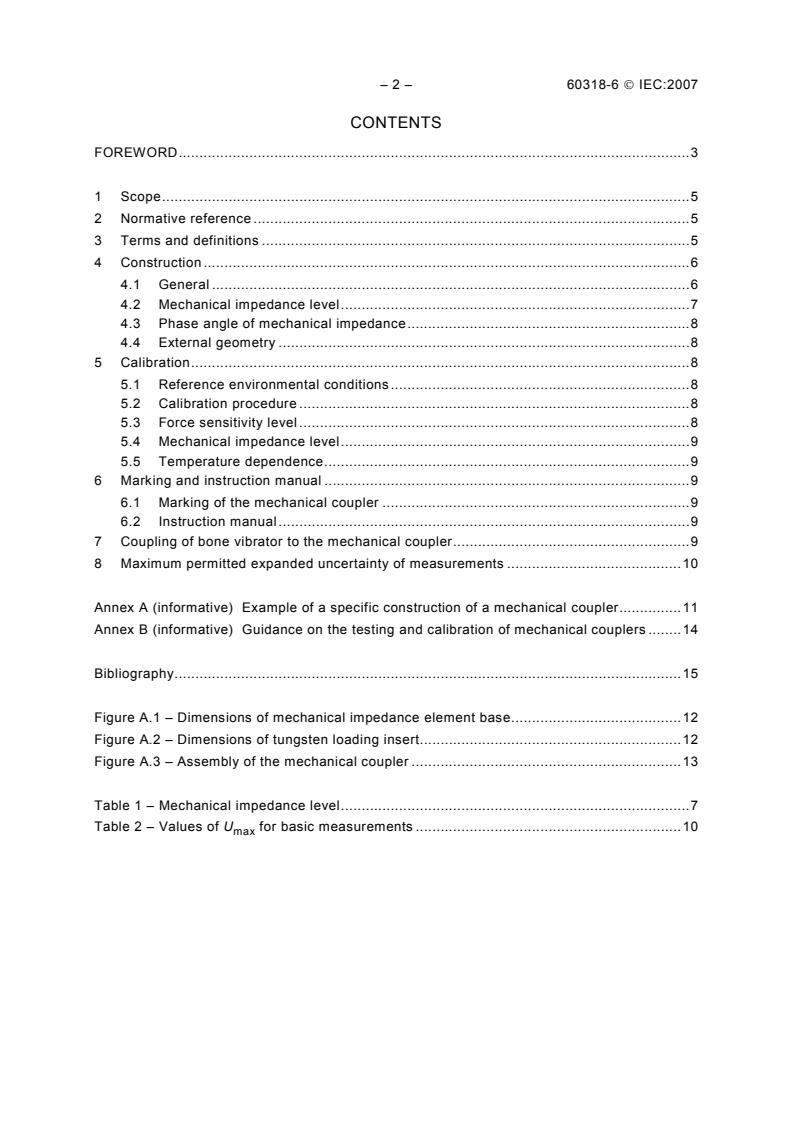
– 2 – 60318-6 © IEC:2007
CONTENTS
FOREWORD.3
1 Scope.5
2 Normative reference .5
3 Terms and definitions .5
4 Construction .6
4.1 General .6
4.2 Mechanical impedance level.7
4.3 Phase angle of mechanical impedance.8
4.4 External geometry .8
5 Calibration.8
5.1 Reference environmental conditions.8
5.2 Calibration procedure .8
5.3 Force sensitivity level .8
5.4 Mechanical impedance level.9
5.5 Temperature dependence.9
6 Marking and instruction manual .9
6.1 Marking of the mechanical coupler .9
6.2 Instruction manual.9
7 Coupling of bone vibrator to the mechanical coupler.9
8 Maximum permitted expanded uncertainty of measurements .10
Annex A (informative) Example of a specific construction of a mechanical coupler.11
Annex B (informative) Guidance on the testing and calibration of mechanical couplers .14
Bibliography.15
Figure A.1 – Dimensions of mechanical impedance element base.12
Figure A.2 – Dimensions of tungsten loading insert.12
Figure A.3 – Assembly of the mechanical coupler .13
Table 1 – Mechanical impedance level.7
Table 2 – Values of U for basic measurements .10
max
60318-6 © IEC:2007 – 3 –
INTERNATIONAL ELECTROTECHNICAL COMMISSION
____________
ELECTROACOUSTICS –
SIMULATORS OF HUMAN HEAD AND EAR –
Part 6: Mechanical coupler for the measurement of bone vibrators
FOREWORD
1) The International Electrotechnical Commission (IEC) is a worldwide organization for standardization comprising
all national electrotechnical committees (IEC National Committees). The object of IEC is to promote
international co-operation on all questions concerning standardization in the electrical and electronic fields. To
this end and in addition to other activities, IEC publishes International Standards, Technical Specifications,
Technical Reports, Publicly Available Specifications (PAS) and Guides (hereafter referred to as “IEC
Publication(s)”). Their preparation is entrusted to technical committees; any IEC National Committee interested
in the subject dealt with may participate in this preparatory work. International, governmental and non-
governmental organizations liaising with the IEC also participate in this preparation. IEC collaborates closely
with the International Organization for Standardization (ISO) in accordance with conditions determined by
agreement between the two organizations.
2) The formal decisions or agreements of IEC on technical matters express, as nearly as possible, an international
consensus of opinion on the relevant subjects since each technical committee has representation from all
interested IEC National Committees.
3) IEC Publications have the form of recommendations for international use and are accepted by IEC National
Committees in that sense. While all reasonable efforts are made to ensure that the technical content of IEC
Publications is accurate, IEC cannot be held responsible for the way in which they are used or for any
misinterpretation by any end user.
4) In order to promote international uniformity, IEC National Committees undertake to apply IEC Publications
transparently to the maximum extent possible in their national and regional publications. Any divergence
between any IEC Publication and the corresponding national or regional publication shall be clearly indicated in
the latter.
5) IEC provides no marking procedure to indicate its approval and cannot be rendered responsible for any
equipment declared to be in conformity with an IEC Publication.
6) All users should ensure that they have the latest edition of this publication.
7) No liability shall attach to IEC or its directors, employees, servants or agents including individual experts and
members of its technical committees and IEC National Committees for any personal injury, property damage or
other damage of any nature whatsoever, whether direct or indirect, or for costs (including legal fees) and
expenses arising out of the publication, use of, or reliance upon, this IEC Publication or any other IEC
Publications.
8) Attention is drawn to the Normative references cited in this publication. Use of the referenced publications is
indispensable for the correct application of this publication.
9) Attention is drawn to the possibility that some of the elements of this IEC Publication may be the subject of
patent rights. IEC shall not be held responsible for identifying any or all such patent rights.
International Standard IEC 60318-6 has been prepared by IEC technical committee 29:
Electroacoustics.
This standard cancels and replaces IEC 60373 published in 1990. This first edition constitutes
a technical revision.
The text of this standard is based on the following documents:
CDV Report on voting
29/615/CDV 29/628A/RVC
Full information on the voting for the approval of this standard can be found in the report on
voting indicated in the above table.
A list of all parts of the IEC 60318 series under the general title: Electroacoustics – Simulators
of human head and ear, can be found on the IEC website.
– 4 – 60318-6 © IEC:2007
This publication has been drafted in accordance with the ISO/IEC Directives, Part 2.
The committee has decided that the contents of this publication will remain unchanged until
the maintenance result date indicated on the IEC web site under "http://webstore.iec.ch" in
the data related to the specific publication. At this date, the publication will be
• reconfirmed,
• withdrawn,
• replaced by a revised edition, or
• amended.
60318-6 © IEC:2007 – 5 –
ELECTROACOUSTICS –
SIMULATORS OF HUMAN HEAD AND EAR –
Part 6: Mechanical coupler for the measurement of bone vibrators
1 Scope
This part of IEC 60318 describes a mechanical coupler for the measurement of the output
force of bone vibrators. The mechanical impedance of the coupler is specified in the
frequency range 125 Hz to 8 000 Hz. The coupler is intended for calibration of audiometers
using bone vibrators having a plane circular tip area of 175 mm² ± 25 mm² and for determining
the performance of bone conduction hearing aids.
The vibratory force developed by a bone vibrator is not, in general, the same on the coupler
as on a person’s mastoid. However, the IEC recommends its use as a means for the
calibration of specified vibrators used in audiometry and for the exchange of specifications
and of data on bone conduction hearing aids.
NOTE Some bone vibrators of hearing aids and some non-standardised bone vibrators still used in audiometry
have a curved surface. Users should be aware that those vibrators in general will not be loaded on the mechanical
coupler with the same mechanical impedance as the one specified in Table 1 of this standard.
2 Normative reference
The following referenced document is indispensable for the application of this document. For
dated references, only the edition cited applies. For undated references, the latest edition of
the referenced document (including any amendments) applies.
BIPM, IEC, ISO, IFCC, IUPAC, IUPAP and OIML:1995, Guide to the expression of uncertainty
in measurement (GUM)
3 Terms and definitions
For the purposes of this document, the following terms and definitions apply.
3.1
bone-conduction vibrator
bone vibrator
electro-mechanical transducer that transforms electric oscillations into mechanical vibrations
and is intended to be coupled to the bony structure of the head, most commonly the mastoid
apophysis
3.2
mechanical coupler
device for calibrating bone-conduction vibrators designed to present a specified mechanical
impedance to a vibrator applied with a specified static force, and equipped with an
electromechanical transducer to enable the vibratory force level at the surface of contact
between vibrator and mechanical coupler to be determined
3.3
alternating force level
ten times the logarithm to the base 10 of the ratio of the squared r.m.s. value of the
alternating force transmitting the vibration to the square of the reference value of one
micronewton
– 6 – 60318-6 © IEC:2007
NOTE 1 The unit of the level re 1μN is decibel (dB).
NOTE 2 The alternating force level is also called force level.
3.4
mechanical impedance
for a sinusoidal signal, the complex quotient of the alternating force transmitting the vibration
by the component of velocity of the object in the direction of the force
NOTE The unit is newton second per meter (N·s/m).
3.5
mechanical impedance level
ten times the logarithm to the base 10 of the ratio of the squared absolute value (modulus) of
the mechanical impedance to the square of the reference value of one newton second per
meter (Ns/m)
NOTE The unit of the level re 1 N·s/m is decibel (dB).
3.6
mechanical resistance
real part of the mechanical impedance
NOTE The unit is newton second per meter (N·s/m).
3.7
mechanical reactance
imaginary part of the mechanical impedance
NOTE The unit is newton second per meter (N·s/m).
3.8
force sensitivity
quotient of output voltage of the mechanical coupler by the applied alternating force
NOTE The unit is volt per newton (V/N).
3.9
force sensitivity level
ten times the logarithm to the base 10 of the ratio of the squared force sensitivity to the
square of the reference force sensitivity of one volt per newton (V/N)
NOTE The unit of the level re 1 V/N is decibel (dB).
4 Construction
4.1 General
The mechanical coupler shall consist of a rigid mass of approximately 3,5 kg containing a
force-sensing element which is surmounted by visco-elastic material having an external profile
as specified in 4.4. The mechanical impedance of the assembly for uniaxial vibration which is
coincident with its major axis of symmetry shall comply with the specifications in 4.2 and 4.3.
The whole assembly shall be supported in such a way as to be capable of sustaining a static
force of up to 6 N (including the weight of the vibrator under test, if mounted on a vertical
axis) with a frequency of natural oscillation on the supports not greater than 12,5 Hz.
NOTE 1 It is recommended to include a temperature-sensing device in intimate contact with the bulk mass of the
mechanical coupler, to permit correct measurement of its temperature during use and calibration (see 5.5).
NOTE 2 An example of a mechanical coupler complying with this part of IEC 60318 is described in Annex A.
60318-6 © IEC:2007 – 7 –
In the following, the specified tolerance shall be reduced by an amount equal to the actual
expanded measurement uncertainty of the test laboratory before deciding if a device conforms
to this specification (see Clause 8).
4.2 Mechanical impedance level
The mechanical coupler shall present a mechanical impedance at a temperature of 23 °C
having the levels specified in Table 1 within the specified tolerances, when driven by a
vibrator having a plane circular tip area of 175 mm and applied with a static force of
5,4 N ± 0,5 N including (when the apparatus is mounted with its axis vertical) the weight of the
vibrator and of any unsupported components of the force-delivery device.
The frequencies shall be equal to the stated values in Table 1 within 1 %.
Table 1 – Mechanical impedance level
Mechanical impedance level
Frequency (reference: 1 N·s/m) Tolerance
Hz dB dB
125 48,9 ± 2,5
160 47,4 ± 2,5
200 45,8 ± 2,5
250 44,3 ± 2,5
315 42,9 ± 2,5
400 41,3 ± 2,5
500 39,9 ± 2,5
630 38,5 ± 2,5
a
750 37,4 ± 2,5
800 37,0 ± 2,5
1 000 35,5 ± 3,2
1 250 34,0 ± 3,2
a
1 500 32,4 ± 3,2
1 600 31,9 ± 3,2
2 000 29,8 ± 3,2
2 500 27,8 ± 3,2
a
3 000 27,2 ± 3,2
3 150 27,3 ± 3,2
4 000 29,5 ± 3,2
5 000 32,6 ± 3,5
a
6 000 34,4 ± 3,5
6 300 34,6 ± 3,5
8 000 35,1 ± 3,5
a
These frequencies are used in audiometry but are not included in the preferred
1)
series specified in ISO 266 [4] .
NOTE 1 Values of the mechanical impedance level and tolerances are derived from experimental data on samples
of mechanical couplers.
Under similar conditions but with the static force reduced to 2,5 N ± 0,5 N, the mechanical
impedance level at 250 Hz shall be 2,0 dB ± 0,9 dB below the value measured with the static
force of 5,4 N.
NOTE 2 This constitutes a performance specification and the lower value of static force is not necessarily
recommended to be used when testing any particular hearing-aid device.
———————
1)
The figures in square brackets refer to the Bibliography.
– 8 – 60318-6 © IEC:2007
4.3 Phase angle of mechanical impedance
The phase angle of the mechanical impedance of the mechanical coupler at a frequency of
250 Hz and a temperature of 23 °C shall be −63,0° ± 6,0°, when driven under the same
conditions as specified in 4.2, with a static force of 5,4 N.
4.4 External geometry
The contact surface of the mechanical coupler, without an applied external static force, shall
be spherical with a nominal radius of 96 mm. The exposed portion of the sphere shall be
circular in shape with a minimum diameter of 35 mm. Within this diameter the surface shall be
smooth and the tolerance on the spherical radius shall be ± 17 mm. Outside this diameter the
external profile of the mechanical coupler shall be such as to avoid interference with any bone
vibrator which it is intended to test.
5 Calibration
5.1 Reference environmental conditions
Reference temperature: 23 °C
Reference relative humidity: 50 %
NOTE The mechanical impedance and the force sensitivity of mechanical couplers designed according to this part
of IEC 60318 do not depend on ambient pressure.
5.2 Calibration procedure
The manufacturer shall describe method(s) for calibrating and determining the overall stability
of the mechanical coupler in an instruction manual.
The calibration shall be performed for the reference environmental conditions given in 5.1 with
the following tolerances:
Temperature: ± 1 °C
Relative humidity: ± 20 %
NOTE For the purpose of calibration and elsewhere in this part of IEC 60318 where temperature is specified, the
stated temperature is that of the mechanical coupler. Due to the large thermal capacity of the mass comprising the
body of the device, it may take several hours to attain thermal equilibrium. It is not adequate to rely on a
measurement of room temperature.
5.3 Force sensitivity level
The mechanical coupler shall be calibrated by the manufacturer in terms of its force sensitivity
level at the frequencies listed in Table 1.
The electrical load conditions shall be stated.
A calibration table or a graph, together with a statement defining the uncertainty, shall be
supplied with each mechanical coupler. The calibration uncertainty shall not exceed 0,4 dB for
frequencies up to and including 800 Hz and 0,5 dB above 800 Hz up to and including 4 kHz
nor shall it exceed 1,0 dB for frequencies up to and including 8 kHz.
NOTE 1 The mechanical impedance of an external surface at a specified location is usually measured by means
of an impedance head. This device consists of an acceleration transducer and a force transducer and is driven by
an external exciter (shaker). It is pressed against the surface under test with a specified static application force.
60318-6 © IEC:2007 – 9 –
NOTE 2 Measurement of the applied alternating force usually requires compensation for the mass of material in
the driving stylus of the impedance head between the calibrated force transducer and the external surface, and the
instructions of the transducer manufacturer should be followed.
5.4 Mechanical impedance level
The manufacturer shall supply a table or a graph with each mechanical coupler giving the
results of measurements of the mechanical impedance level at the frequencies listed in
Table 1 under the conditions specified in 5.2 and 5.3.
5.5 Temperature dependence
In addition, measurements specified in 5.3 and 5.4 shall be carried out over a temperature
range of at least 18 °C to 28 °C at a sufficient number of frequencies to characterise the
temperature dependence of the force sensitivity level and mechanical impedance level. At
each temperature the device shall be allowed to reach thermal equilibrium. The temperature
of the mechanical coupler shall be measured by means of a contact thermometer at the
surface of the coupler body.
NOTE These data are required purely as indicators of temperature dependence. In general, the values for the
temperature dependence cannot be used directly to correct data measured at other temperatures to the reference
temperature of 23 °C, as the effect of the change in mechanical impedance level on the alternating force output of
the bone vibrator under test will not be known.
6 Marking and instruction manual
6.1 Marking of the mechanical coupler
Mechanical couplers complying with this standard shall be marked with the manufacturer's
name or trade mark, a serial number, and reference to this part of IEC 60318 by number.
6.2 Instruction manual
The mechanical coupler shall be provided with an instruction manual which, as a minimum,
shall contain the information required by Clause 5.
Notwithstanding it shall also contain the following:
a) detailed instructions which need to be followed to ensure that in use the coupler meets the
requirements of this part of IEC 60318;
b) details of the recommended calibration procedure(s);
c) the limits of temperature and humidity beyond which permanent damage to the
mechanical coupler may result.
7 Coupling of bone vibrator to the mechanical coupler
Means shall be provided for applying the vibrator under test to the mechanical coupler with
the specified static force (see 5.3). This device shall permit the calibration of vibrators
mounted on a headband or of unmounted vibrators without causing a spurious response of the
vibrator.
NOTE 1 It is recommended that the mechanism for applying the static force (e.g. springs or gravity-loading
mechanism) provided on the mechanical coupler be decoupled from the vibrator under test by means of elastic
bands applied symmetrically to the back of the vibrator, the elastic bands having negligible stiffness in the direction
of the vibration.
NOTE 2 For measurements on headband-mounted vibrators it is recommended that provision be made to open
the headband so as to develop the required static force. The free end of the headband should bear on a resilient
material to reduce spurious resonance effects and the headband should not act in parallel with the springs used to
resiliently mount the mechanical coupler. An example of one form of mounting is shown in Figure A.2 of
IEC 60118-9:1985 [1].
– 10 – 60318-6 © IEC:2007
NOTE 3 Means should be provided for locating the vibrator symmetrically on the mechanical coupler.
8 Maximum permitted expanded uncertainty of measurements
The following table specifies the maximum permitted expanded uncertainty for a probability of
approximately 95 % equivalent to a coverage factor of k = 2, associated with the
measurements undertaken in this part of IEC 60318, see the Guide to the expression of
uncertainty in measurement. One set of values for U is given for basic type approval
max
measurements.
The expanded uncertainties of measurements given in Table 2 are the maximum permitted for
demonstration of conformance to the requirements of this standard. If the actual expanded
uncertainty of a measurement performed by the test laboratory exceeds the maximum
permitted value in Table 2, the measurement shall not be used to demonstrate conformance
to the requirements of this standard.
for basic measurements
Table 2 – Values of U
max
Measured quantity Relevant clause number Basic U (k = 2)
max
Mechanical impedance level 4.2 0,5 dB
125 Hz to 800 Hz
Mechanical impedance level 4.2 0,7 dB
>800 Hz to 4 000 Hz
Mechanical impedance level 4.2 1,0 dB
>4 000 Hz to 8 000 Hz
Mechanical impedance phase 4.3 1,0 °
at 250 Hz
Difference in mechanical impedance 4.2 0,1 dB
level with reduced static force of 2,5 N
Static force 4.2, 5.3 0,25 N
Frequency 4.2 0,5 %
Linear dimensions 4.4 1 mm
Force sensitivity level 5.3 0,4 dB
125 Hz to 800 Hz
Force sensitivity level 5.3 0,5 dB
>800 Hz to 4 000 Hz
Force sensitivity level 5.3 1,0 dB
>4 000 Hz to 8 000 Hz
Temperature 5.2, 5.5 0,3 °C
60318-6 © IEC:2007 – 11 –
Annex A
(informative)
Example of a specific construction of a mechanical coupler
A.1 Mechanical impedance elements
A.1.1 Visco-elastic components
a) Butyl rubber pad
The butyl rubber pad (Figure A.3) is in the form of a flat plate of diameter approximately
40 mm to 50 mm and thickness 3,8 mm.
b) Neoprene rubber pad
The neoprene rubber pad (Figure A.3) is in the form of a flat plate of diameter approximately
40 mm to 50 mm and thickness 3,1 mm.
A.1.2 Metal components
a) Mechanical impedance element base
The base consists of stainless steel to which a rubber part can be adhered (Figure A.1
and lower part of element A in Figure A.3). The upper surface has a spherical radius of
89,0 mm ± 0,5 mm and is free from turning marks or other blemishes.
b) Loading insert
The loading insert is in the form of a frustum of a cone of thickness 2,50 mm ± 0,05 mm,
as shown in Figure A.2. The insert is turned from tungsten alloy of density 17 000 kg/m .
A.1.3 Assembly
To achieve the desired mechanical impedance it is essential that the neoprene rubber pad is
fully adhered to the steel base and in turn that the butyl rubber pad is adhered to the
neoprene rubber pad and tungsten loading insert.
A.2 General assembly
The mechanical impedance element is mounted on the brass body as shown in Figure A.3, a
piezoelectric force-sensing element being clamped between them.
– 12 – 60318-6 © IEC:2007
Dimensions in millimetres
R1,5
R89 ± 0,5
IEC 2298/07
Figure A.1 – Dimensions of mechanical impedance element base
Dimensions in millimetres
34° 12′
2,5 ± 0,05
IEC 2299/07
1 : 1
Figure A.2 – Dimensions of tungsten loading insert
∅44,5
∅8,2 ± 0,1
∅30
60318-6 © IEC:2007 – 13 –
B
D
C
A
E
F
G
H
IEC 2300/07
Key
A Mechanical impedance element (consisting of base and impedance components)
B Tungsten loading insert
C Butyl rubber pad
D Neoprene rubber pad
E Piezoelectric force-sensing element
F Transducer output
G Cylindrical brass body
H Soft suspension
Figure A.3 – Assembly of the mechanical coupler
– 14 – 60318-6 © IEC:2007
Annex B
(informative)
Guidance on the testing and calibration of mechanical couplers
B.1 General
These guidance notes are given in order to reduce as far as possible the measurement
uncertainty of mechanical-impedance tests and force-sensitivity calibrations of mechanical
couplers. These notes do not aim to give a full description of the testing and calibration
methods. A prerequisite is that the accelerometer and force transducer sensitivities of the
impedance head are known [15].
B.2 Preparation for the measurements
Prior to the measurements, the mechanical coupler should be stored for at least 12 hours in
an environment as given in 5.2. At the beginning and at the end of the measurements, the
temperature of the mechanical coupler should be measured.
The impedance head should be attached to the mechanical coupler as close as possible to
the centre of and perpendicular to the visco-elastic layers in the following way: First a spirit
level is used to ensure that the cylindrical brass body of the mechanical coupler is vertically
positioned. Next the impedance head (mounted on the exciter) is positioned vertically in the
centre of the visco-elastic layers using the required static force. The angle of contact is
controlled visually by ensuring that the small opening angles between the curved surface of
the visco-elastic layers and the flat surface of the driving platform of the impedance head are
the same for all viewing angles.
NOTE With some samples the maximum elevation of the visco-elastic layers is not above its centre but several
millimetres off the centre. In this case the cylindrical brass body of the mechanical coupler is slightly tilted by
placing spacers below one or two legs of the mechanical coupler in order to be able to measure still as close as
possible to the centre maintaining a perpendicular alignment.
B.3 Measurements of the mechanical impedance and the force sensitivity of
the mechanical coupler
All measurements should be performed using an excitation signal giving a constant velocity of
1,0 mm/s ± 0,1 mm/s [15]. If the mass compensation is performed at one frequency only, this
should be done at a frequency of 2 000 Hz.
The measurements with a static coupling force of 5,4 N should be performed first, followed by
those with 2,5 N.
The force sensitivity of the mechanical coupler should be determined using a force sensitivity
of the impedance head which is ideally calibrated at each corresponding frequency.
The mechanical impedance, however, should be determined using constant values
(independent of frequency) for the acceleration and force sensitivities of the impedance head.
The respective values at 1 kHz should be used.
NOTE The reason for such a recommendation is that the reference values in Table 1 also have been determined
with constant values for the acceleration and force sensitivities of the impedance head.
60318-6 © IEC:2007 – 15 –
Bibliography
[1] IEC 60118-9:1985, Hearing aids – Part 9: Methods of measurement of characteristics
of hearing aids with bone vibrator output
[2] IEC 60645-1, Electroacoustics – Audiological equipment – Part 1: Pure-tone
audiometers
[3] ISO 389-3, Acoustics – Reference zero for the calibration of audiometric equipment –
Part 3: Reference equivalent threshold force levels for pure tones and bone vibrators
[4] ISO 266, Acoustics – Preferred frequencies
[5] WHITTLE, L.S., ROBINSON, D.W. An artificial mastoid for the calibration of bone
vibrators. Acustica, 1967/68, 19, pp.80- 89
[6] DIRKS, D. D. et al. Towards the specification of normal bone-conduction threshold. J.
Acoust. Soc. Amer, 43, 1968, 6, pp. 1237-1242
[7] STISEN, B., DAHM, M. Sensitivity and mechanical impedance of the artificial mastoid
type 4930. Brüel & Kjaer – Technical Information (1969)
[8] Artificial Mastoid Type 4930, Instructions and applications, Brüel & Kjaer (1970)
[9] RICHTER, U., BRINKMANN, K. Neuere Untersuchungen über die mechanische
Impedanz der Stirn und des Mastoids. 5. Akustische Konferenz, Budapest, Nr. 6.1
(1973)
[10] RICHTER, U., BRINKMANN, K. Messungen an einem künstlichen Mastoid. PTB report
PTB-Ak-5, (1974) and PTB report PTB-Ak-10 (1977), Braunschweig
[11] BRINKMANN, K., RICHTER, U. Measurements on a bone-conduction hearing aid. Z.
Hörgeräte-Akustik/J. Audiological Technique, Heidelberg, 1977, 16, pp. 66-83
[12] FLOTTORP, G., SOLBERG, S. Mechanical impedance of human headbones
(forehead and mastoid portion of temporal bone) measured under ISO/IEC conditions.
J. Acoust. Soc. Amer., 1976, 59, 4, pp. 899-906
[13] RICHTER, U., FRANK, T. Calibration of bone vibrators at high frequencies. Audiol.
Akustik / Audiological Acoustic, Heidelberg, 1985, 24, pp.52-62
[14] FRANK, T., RICHTER, U. Influence of temperature on the output of a mechanical
coupler. Ear and Hearing, 1985, Vol. 6, No. 4, pp. 206-210
[15] RASMUSSEN, K.: Calibration of artificial mastoids and impedance transducers –
EUROMET Project 401. DPLA, Department of Acoustic Technology, DTU, Report
PL-15, (2000), Copenhagen
[16] SHERWOOD, T.: EUROMET Project 401 – Harmonisation of audiometric
measurements within Europe. NPL Report DQL-AC 003, (2004), Teddington
______________
– 16 – 60318-6 © CEI:2007
SOMMAIRE
AVANT-PROPOS.17
1 Domaine d’application .19
2 Référence normative .19
3 Termes et définitions .19
4 Construction .20
4.1 Généralités.20
4.2 Niveau d'impédance mécanique .21
4.3 Argument de l'impédance mécanique .22
4.4 Caractéristiques géométriques externes.22
5 Etalonnage .22
5.1 Conditions d’environnement de référence.22
5.2 Procédure d’étalonnage .22
5.3 Niveau d'efficacité en force .22
5.4 Niveau d'impédance mécanique .23
5.5 Influence de la température.23
6 Marquage et notice d'emploi.23
6.1 Marquage du coupleur mécanique.23
6.2 Notice d'emploi.23
7 Couplage de l’ossivibrateur au coupleur mécanique .23
8 Incertitude de mesures élargie maximale autorisée .24
Annexe A (informative) Exemple d'une réalisation spécifique d'un coupleur mécanique .25
Annexe B (informative) Conseils pour l’essai et l’étalonnage des coupleurs
mécaniques .28
Bibliographie.30
Figure A.1 – Dimensions de la base de l'élément d'impédance mécanique.26
Figure A.2 – Dimensions de la masse de tungstène insérée .26
Figure A.3 – Assemblage du coupleur mécanique.27
Tableau 1 – Niveau d’impédance mécanique .21
Tableau 2 – Valeurs de U pour les mesures de base .24
max
60318-6 © CEI:2007 – 17 –
COMMISSION ÉLECTROTECHNIQUE INTERNATIONALE
____________
ÉLECTROACOUSTIQUE –
SIMULATEURS DE TÊTE ET D'OREILLE HUMAINES –
Partie 6: Coupleur mécanique destiné à la mesure des ossivibrateurs
AVANT-PROPOS
1) La Commission Electrotechnique Internationale (CEI) est une organisation mondiale de normalisation
composée de l'ensemble des comités électrotechniques nationaux (Comités nationaux de la CEI). La CEI a
pour objet de favoriser la coopération internationale pour toutes les questions de normalisation dans les
domaines de l'électricité et de l'électronique. A cet effet, la CEI – entre autres activités – publie des Normes
internationales, des Spécifications techniques, des Rapports techniques, des Spécifications accessibles au
public (PAS) et des Guides (ci-après dénommés "Publication(s) de la CEI"). Leur élaboration est confiée à des
comités d'études, aux travaux desquels tout Comité national intéressé par le sujet traité peut participer. Les
organisations internationales, gouvernementales et non gouvernementales, en liaison avec la CEI, participent
également aux travaux. La CEI collabore étroitement avec l'Organisation Internationale de Normalisation (ISO),
selon des conditions fixées par accord entre les deux organisations.
2) Les décisions ou accords officiels de la CEI concernant les questions techniques représentent, dans la mesure
du possible, un accord international sur les sujets étudiés, étant donné que les Comités nationaux de la CEI
intéressés sont représentés dans chaque comité d’études.
3) Les Publications de la CEI se présentent sous la forme de recommandations internationales et sont agréées
comme telles par les Comités nationaux de la CEI. Tous les efforts raisonnables sont entrepris afin que la CEI
s'assure de l'exactitude du contenu technique de ses publications; la CEI ne peut pas être tenue responsable
de l'éventuelle mauvaise utilisation ou interprétation qui en est faite par un quelconque utilisateur final.
4) Dans le but d'encourager l'uniformité internationale, les Comités nationaux de la CEI s'engagent, dans toute la
mesure possible, à appliquer de façon transparente les Publications de la CEI dans leurs publications
nationales et régionales. Toutes divergences entre toutes Publications de la CEI et toutes publications
nationales ou régionales correspondantes doivent être indiquées en termes clairs dans ces dernières.
5) La CEI n’a prévu aucune procédure de marquage valant indication d’approbation et n'engage pas sa
responsabilité pour les équipements déclarés conformes à une de ses Publications.
6) Tous les utilisateurs doivent s'assurer qu'ils sont en possession de la dernière édition de cette publication.
7) Aucune responsabilité ne doit être imputée à la CEI, à ses administrateurs, employés, auxiliaires ou
mandataires, y compris ses experts particuliers et les membres de ses comités d'études et des Comités
nationaux de la CEI, pour tout préjudice causé en cas de dommages corporels et matériels, ou de tout autre
dommage de quelque nature que ce soit, directe ou indirecte, ou pour supporter les coûts (y compris les frais
de justice) et les dépenses découlant de la publication ou de l'utilisation de cette Publication de la CEI ou de
toute autre Publication de la CEI, ou au crédit qui lui est accordé.
8) L'attention est attirée sur les références normatives citées dans cette publication. L'utilisation de publications
référencées est obligatoire pour une application correcte de la présente publication.
9) L’attention est attirée sur le fait que certains des éléments de la présente Publication de la CEI peuvent faire
l’objet de droits de propriété intellectuelle ou de droits analogues. La CEI ne saurait être tenue pour
responsable de ne pas avoir identifié de tels droits de propriété et de ne pas avoir signalé leur existence.
La norme internationale CEI 60318-6 et a été établie par le comité d’études 29 de la CEI:
Electroacoustique.
La présente norme annule et remplace la CEI 60373 parue en 1990. Cette première édition
constitue une révision technique.
Le texte de cette norme est issu des documents suivants:
CDV Rapport de vote
29/615/CDV 29/628A/RVC
Le rapport de vote indiqué dans le tableau ci-dessus donne toute information sur le vote ayant
abouti à l'approbation de cette norme.
– 18 – 60318-6 © CEI:2007
Une liste de toutes les parties de la série CEI 60318, présentées sous le titre général
Electroacoustique – Simulateurs de tête et d'oreille humaines, peut être consultée sur le site
web de la CEI.
Cette publication a été rédigée selon les Directives ISO/CEI, Partie 2.
Le comité a décidé que le contenu de cette publication ne sera pas modifié avant la date de
maintenance indiquée sur le site web de la CEI sous "http://webstore.iec.ch" dans les
données relatives à la publication recherchée. A cette date, la publication sera
• reconduite,
• supprimée,
• remplacée par une édition révisée, ou
• amendée.
60318-6 © CEI:2007 – 19 –
ÉLECTROACOUSTIQUE –
SIMULATEURS DE TÊTE ET D'OREILLE HUMAINES –
...