

IEC 61000-3-12:2011
(Main)Electromagnetic compatibility (EMC) - Part 3-12: Limits - Limits for harmonic currents produced by equipment connected to public low-voltage systems with input current >16 A and ≤ 75 A per phase
General Information
- Abstract
IEC 61000-3-12:2011 deals with the limitation of harmonic currents injected into the public supply system. The limits given in this International Standard are applicable to electrical and electronic equipment with a rated input current exceeding 16 A and up to and including 75 A per phase, intended to be connected to public low-voltage a.c. distribution systems of the following types:
- nominal voltage up to 240 V, single-phase, two or three wires;
- nominal voltage up to 690 V, three-phase, three or four wires;
- nominal frequency 50 Hz or 60 Hz. Other distribution systems are excluded. The limits given in this edition apply to equipment when connected to 230/400 V, 50 Hz systems. This standard applies to equipment intended to be connected to low-voltage systems interfacing with the public supply at the low-voltage level. It does not apply to equipment intended to be connected only to private low-voltage systems interfacing with the public supply only at the medium- or high-voltage level. This standard defines:
a) requirements and emission limits for equipment;
b) methods for type tests and simulations. Tests according to this International Standard are type tests of complete pieces of equipment. Conformity with this standard can also be determined by validated simulations. This second edition cancels and replaces the first edition published in 2004 and constitutes a technical revision. The significant technical changes with respect to the previous edition are:
- the replacement of the reference fundamental current I1 by the reference current Iref for the calculation of emission limits;
- a new added table of current emission limits (Table 5);
- a new added annex (Annex A) to define test conditions for some types of equipment;
- Deletion of the former Annexes B (Approximate interpolation formulas) and D (Information on the PWHD factor).
- Status
- Published
- Publication Date
- 03-Jun-2021
- Technical Committee
- SC 77A - EMC - Low frequency phenomena
- Drafting Committee
- WG 1 - TC 77/SC 77A/WG 1
- Current Stage
- PPUB - Publication issued
- Start Date
- 12-May-2011
- Completion Date
- 31-May-2011
Buy Documents
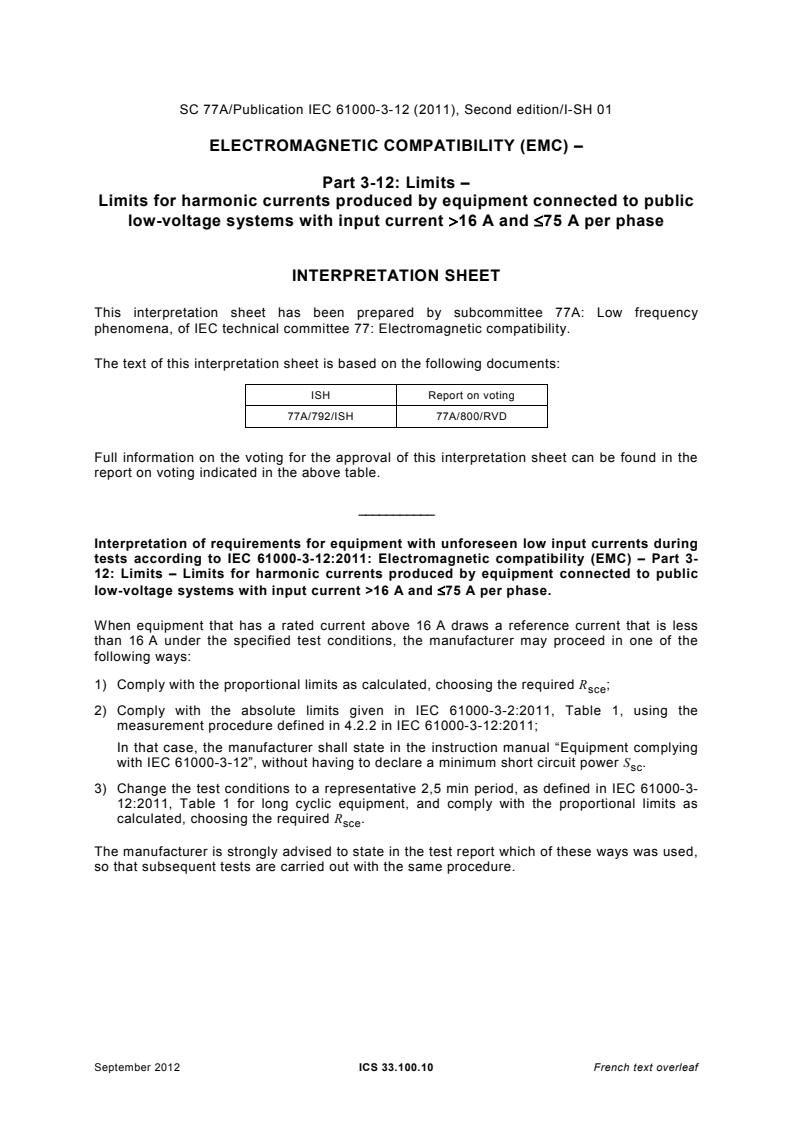
IEC 61000-3-12:2011 - Electromagnetic compatibility (EMC) - Part 3-12: Limits - Limits for harmonic currents produced by equipment connected to public low-voltage systems with input current >16 A and ? 75 A per phase Released:5/12/2011

IEC 61000-3-12:2011+AMD1:2021 CSV - Electromagnetic compatibility (EMC) - Part 3-12: Limits - Limits for harmonic currents produced by equipment connected to public low-voltage systems with input current >16 A and ? 75 A per phase Released:6/4/2021
Overview
IEC 61000-3-12:2011 is an international standard developed by the International Electrotechnical Commission (IEC) that addresses electromagnetic compatibility (EMC) concerns specifically related to harmonic currents. It defines limits for harmonic currents produced by electrical and electronic equipment connected to public low-voltage AC distribution systems with input current ratings greater than 16 A and up to 75 A per phase.
This standard applies to equipment connected to low-voltage public systems with nominal voltages:
- Up to 240 V for single-phase (two or three-wire systems)
- Up to 690 V for three-phase (three or four-wire systems)
- Operating at nominal frequencies of 50 Hz or 60 Hz
IEC 61000-3-12:2011 includes updated requirements, emission limits, and testing methods essential for manufacturers and compliance engineers to ensure devices do not inject disruptive harmonic currents into the public power grid, which can lead to power quality issues and equipment malfunctions.
Key Topics
Scope and Applicability: Targets equipment with input currents >16 A and ≤75 A per phase connected to specified low-voltage public systems. It excludes equipment connected only to private systems interfacing at medium- or high-voltage levels.
Emission Limits:
- Specifies harmonic current emission limits.
- Uses a reference current (I_ref) concept for limit calculations.
- Provides separate limits for balanced and unbalanced three-phase equipment.
- Includes a newly added Table 5 offering detailed emission limits for certain equipment categories.
Testing and Measurement Methods:
- Defines procedures for type testing of complete equipment.
- Supports validated simulation methods as an alternative to physical tests.
- Details conditions for harmonic current measurements and observation periods.
Technical Revisions from Previous Edition:
- Replacement of fundamental reference current I1 with I_ref.
- Addition of Table 5 and Annex A for specific equipment test conditions.
- Removal of outdated annexes covering interpolation formulas and PWHD factors.
Conformity and Product Documentation: Manufacturers must demonstrate compliance using defined test methods or validated simulations and document test conditions and procedures clearly in product manuals.
Applications
IEC 61000-3-12 is particularly relevant for:
Manufacturers of Electrical and Electronic Equipment: Ensuring their products meet harmonic emission requirements before release to market.
Compliance Testing Laboratories: Performing type tests and harmonic current analysis for certification and quality control.
Power Utilities and Grid Operators: Understanding limits on harmonic distortion from equipment connected to public low-voltage networks to maintain grid stability and power quality.
Design Engineers: Developing equipment and systems with minimized harmonic emissions, improving compatibility with power distribution systems.
Consultants and Regulatory Authorities: Establishing guidelines and regulatory frameworks based on recognized international EMC standards.
Related Standards
IEC 61000-3-12:2011 is part of the IEC 61000 series covering electromagnetic compatibility, with direct relevance to other parts such as:
IEC 61000-3-2: Limits for harmonic current emissions for equipment with input current less than or equal to 16 A per phase, often used as a reference for smaller load equipment.
IEC 61000-3-6: Limits for harmonic currents emitted by equipment connected to HV systems, applicable to medium- and high-voltage connections.
IEC 61000-4-x Series: Test methods for EMC including harmonic measurements and emission testing procedures.
Adherence to IEC 61000-3-12 complements these standards for comprehensive EMC compliance and power quality maintenance in various electrical environments.
By following IEC 61000-3-12:2011, manufacturers and engineers can ensure that equipment connected to public low-voltage distribution systems with higher input currents operate within established harmonic current limits. This helps maintain the electromagnetic compatibility of electrical infrastructure and supports sustainable, high-quality power delivery.
Relations
- Effective Date
- 05-Sep-2023
- Effective Date
- 05-Sep-2023
- Effective Date
- 05-Sep-2023
Buy Documents
IEC 61000-3-12:2011 - Electromagnetic compatibility (EMC) - Part 3-12: Limits - Limits for harmonic currents produced by equipment connected to public low-voltage systems with input current >16 A and ? 75 A per phase Released:5/12/2011
IEC 61000-3-12:2011+AMD1:2021 CSV - Electromagnetic compatibility (EMC) - Part 3-12: Limits - Limits for harmonic currents produced by equipment connected to public low-voltage systems with input current >16 A and ? 75 A per phase Released:6/4/2021
Get Certified
Connect with accredited certification bodies for this standard

ANCE
Mexican certification and testing association.

Intertek Slovenia
Intertek testing, inspection, and certification services in Slovenia.

LNE (Laboratoire National de Métrologie et d'Essais)
French national laboratory for metrology and testing.
Sponsored listings
Frequently Asked Questions
IEC 61000-3-12:2011 is a standard published by the International Electrotechnical Commission (IEC). Its full title is "Electromagnetic compatibility (EMC) - Part 3-12: Limits - Limits for harmonic currents produced by equipment connected to public low-voltage systems with input current >16 A and ≤ 75 A per phase". This standard covers: IEC 61000-3-12:2011 deals with the limitation of harmonic currents injected into the public supply system. The limits given in this International Standard are applicable to electrical and electronic equipment with a rated input current exceeding 16 A and up to and including 75 A per phase, intended to be connected to public low-voltage a.c. distribution systems of the following types: - nominal voltage up to 240 V, single-phase, two or three wires; - nominal voltage up to 690 V, three-phase, three or four wires; - nominal frequency 50 Hz or 60 Hz. Other distribution systems are excluded. The limits given in this edition apply to equipment when connected to 230/400 V, 50 Hz systems. This standard applies to equipment intended to be connected to low-voltage systems interfacing with the public supply at the low-voltage level. It does not apply to equipment intended to be connected only to private low-voltage systems interfacing with the public supply only at the medium- or high-voltage level. This standard defines: a) requirements and emission limits for equipment; b) methods for type tests and simulations. Tests according to this International Standard are type tests of complete pieces of equipment. Conformity with this standard can also be determined by validated simulations. This second edition cancels and replaces the first edition published in 2004 and constitutes a technical revision. The significant technical changes with respect to the previous edition are: - the replacement of the reference fundamental current I1 by the reference current Iref for the calculation of emission limits; - a new added table of current emission limits (Table 5); - a new added annex (Annex A) to define test conditions for some types of equipment; - Deletion of the former Annexes B (Approximate interpolation formulas) and D (Information on the PWHD factor).
IEC 61000-3-12:2011 deals with the limitation of harmonic currents injected into the public supply system. The limits given in this International Standard are applicable to electrical and electronic equipment with a rated input current exceeding 16 A and up to and including 75 A per phase, intended to be connected to public low-voltage a.c. distribution systems of the following types: - nominal voltage up to 240 V, single-phase, two or three wires; - nominal voltage up to 690 V, three-phase, three or four wires; - nominal frequency 50 Hz or 60 Hz. Other distribution systems are excluded. The limits given in this edition apply to equipment when connected to 230/400 V, 50 Hz systems. This standard applies to equipment intended to be connected to low-voltage systems interfacing with the public supply at the low-voltage level. It does not apply to equipment intended to be connected only to private low-voltage systems interfacing with the public supply only at the medium- or high-voltage level. This standard defines: a) requirements and emission limits for equipment; b) methods for type tests and simulations. Tests according to this International Standard are type tests of complete pieces of equipment. Conformity with this standard can also be determined by validated simulations. This second edition cancels and replaces the first edition published in 2004 and constitutes a technical revision. The significant technical changes with respect to the previous edition are: - the replacement of the reference fundamental current I1 by the reference current Iref for the calculation of emission limits; - a new added table of current emission limits (Table 5); - a new added annex (Annex A) to define test conditions for some types of equipment; - Deletion of the former Annexes B (Approximate interpolation formulas) and D (Information on the PWHD factor).
IEC 61000-3-12:2011 is classified under the following ICS (International Classification for Standards) categories: 33.100.10 - Emission. The ICS classification helps identify the subject area and facilitates finding related standards.
IEC 61000-3-12:2011 has the following relationships with other standards: It is inter standard links to IEC 61000-3-12:2011/AMD1:2021, IEC 61000-3-12:2004, IEC 61000-3-12:2011/ISH1:2012. Understanding these relationships helps ensure you are using the most current and applicable version of the standard.
IEC 61000-3-12:2011 is available in PDF format for immediate download after purchase. The document can be added to your cart and obtained through the secure checkout process. Digital delivery ensures instant access to the complete standard document.
Standards Content (Sample)
IEC 61000-3-12 ®
Edition 2.0 2011-05
INTERNATIONAL
STANDARD
NORME
INTERNATIONALE
Electromagnetic compatibility (EMC) –
Part 3-12: Limits – Limits for harmonic currents produced by equipment
connected to public low-voltage systems with input current >16 A and ≤75 A per
phase
Compatibilité électromagnétique (CEM) –
Partie 3-12: Limites – Limites pour les courants harmoniques produits par les
appareils connectés aux réseaux publics basse tension ayant un courant
appelé >16 A et ≤75 A par phase
All rights reserved. Unless otherwise specified, no part of this publication may be reproduced or utilized in any form or by
any means, electronic or mechanical, including photocopying and microfilm, without permission in writing from either IEC or
IEC's member National Committee in the country of the requester.
If you have any questions about IEC copyright or have an enquiry about obtaining additional rights to this publication,
please contact the address below or your local IEC member National Committee for further information.
Droits de reproduction réservés. Sauf indication contraire, aucune partie de cette publication ne peut être reproduite
ni utilisée sous quelque forme que ce soit et par aucun procédé, électronique ou mécanique, y compris la photocopie
et les microfilms, sans l'accord écrit de la CEI ou du Comité national de la CEI du pays du demandeur.
Si vous avez des questions sur le copyright de la CEI ou si vous désirez obtenir des droits supplémentaires sur cette
publication, utilisez les coordonnées ci-après ou contactez le Comité national de la CEI de votre pays de résidence.
IEC Central Office
3, rue de Varembé
CH-1211 Geneva 20
Switzerland
Email: inmail@iec.ch
Web: www.iec.ch
About the IEC
The International Electrotechnical Commission (IEC) is the leading global organization that prepares and publishes
International Standards for all electrical, electronic and related technologies.
About IEC publications
The technical content of IEC publications is kept under constant review by the IEC. Please make sure that you have the
latest edition, a corrigenda or an amendment might have been published.
Catalogue of IEC publications: www.iec.ch/searchpub
The IEC on-line Catalogue enables you to search by a variety of criteria (reference number, text, technical committee,…).
It also gives information on projects, withdrawn and replaced publications.
IEC Just Published: www.iec.ch/online_news/justpub
Stay up to date on all new IEC publications. Just Published details twice a month all new publications released. Available
on-line and also by email.
Electropedia: www.electropedia.org
The world's leading online dictionary of electronic and electrical terms containing more than 20 000 terms and definitions
in English and French, with equivalent terms in additional languages. Also known as the International Electrotechnical
Vocabulary online.
Customer Service Centre: www.iec.ch/webstore/custserv
If you wish to give us your feedback on this publication or need further assistance, please visit the Customer Service
Centre FAQ or contact us:
Email: csc@iec.ch
Tel.: +41 22 919 02 11
Fax: +41 22 919 03 00
A propos de la CEI
La Commission Electrotechnique Internationale (CEI) est la première organisation mondiale qui élabore et publie des
normes internationales pour tout ce qui a trait à l'électricité, à l'électronique et aux technologies apparentées.
A propos des publications CEI
Le contenu technique des publications de la CEI est constamment revu. Veuillez vous assurer que vous possédez
l’édition la plus récente, un corrigendum ou amendement peut avoir été publié.
Catalogue des publications de la CEI: www.iec.ch/searchpub/cur_fut-f.htm
Le Catalogue en-ligne de la CEI vous permet d’effectuer des recherches en utilisant différents critères (numéro de référence,
texte, comité d’études,…). Il donne aussi des informations sur les projets et les publications retirées ou remplacées.
Just Published CEI: www.iec.ch/online_news/justpub
Restez informé sur les nouvelles publications de la CEI. Just Published détaille deux fois par mois les nouvelles
publications parues. Disponible en-ligne et aussi par email.
Electropedia: www.electropedia.org
Le premier dictionnaire en ligne au monde de termes électroniques et électriques. Il contient plus de 20 000 termes et
définitions en anglais et en français, ainsi que les termes équivalents dans les langues additionnelles. Egalement appelé
Vocabulaire Electrotechnique International en ligne.
Service Clients: www.iec.ch/webstore/custserv/custserv_entry-f.htm
Si vous désirez nous donner des commentaires sur cette publication ou si vous avez des questions, visitez le FAQ du
Service clients ou contactez-nous:
Email: csc@iec.ch
Tél.: +41 22 919 02 11
Fax: +41 22 919 03 00
IEC 61000-3-12 ®
Edition 2.0 2011-05
INTERNATIONAL
STANDARD
NORME
INTERNATIONALE
Electromagnetic compatibility (EMC) –
Part 3-12: Limits – Limits for harmonic currents produced by equipment
connected to public low-voltage systems with input current >16 A and ≤75 A per
phase
Compatibilité électromagnétique (CEM) –
Partie 3-12: Limites – Limites pour les courants harmoniques produits par les
appareils connectés aux réseaux publics basse tension ayant un courant
appelé >16 A et ≤75 A par phase
INTERNATIONAL
ELECTROTECHNICAL
COMMISSION
COMMISSION
ELECTROTECHNIQUE
PRICE CODE
INTERNATIONALE
CODE PRIX U
ICS 33.100.10 ISBN 978-2-88912-486-2
SC 77A/Publication IEC 61000-3-12 (2011), Second edition/I-SH 01
ELECTROMAGNETIC COMPATIBILITY (EMC) –
Part 3-12: Limits –
Limits for harmonic currents produced by equipment connected to public
low-voltage systems with input current >16 A and ≤75 A per phase
INTERPRETATION SHEET
This interpretation sheet has been prepared by subcommittee 77A: Low frequency
phenomena, of IEC technical committee 77: Electromagnetic compatibility.
The text of this interpretation sheet is based on the following documents:
ISH Report on voting
77A/792/ISH 77A/800/RVD
Full information on the voting for the approval of this interpretation sheet can be found in the
report on voting indicated in the above table.
___________
Interpretation of requirements for equipment with unforeseen low input currents during
tests according to IEC 61000-3-12:2011: Electromagnetic compatibility (EMC) – Part 3-
12: Limits – Limits for harmonic currents produced by equipment connected to public
low-voltage systems with input current >16 A and ≤75 A per phase.
When equipment that has a rated current above 16 A draws a reference current that is less
than 16 A under the specified test conditions, the manufacturer may proceed in one of the
following ways:
1) Comply with the proportional limits as calculated, choosing the required R ;
sce
2) Comply with the absolute limits given in IEC 61000-3-2:2011, Table 1, using the
measurement procedure defined in 4.2.2 in IEC 61000-3-12:2011;
In that case, the manufacturer shall state in the instruction manual “Equipment complying
with IEC 61000-3-12”, without having to declare a minimum short circuit power S .
sc
3) Change the test conditions to a representative 2,5 min period, as defined in IEC 61000-3-
12:2011, Table 1 for long cyclic equipment, and comply with the proportional limits as
calculated, choosing the required R .
sce
The manufacturer is strongly advised to state in the test report which of these ways was used,
so that subsequent tests are carried out with the same procedure.
September 2012 ICS 33.100.10 French text overleaf
– 2 – 61000-3-12 IEC:2011
CONTENTS
FOREWORD . 3
INTRODUCTION . 5
1 Scope . 6
2 Normative references. 7
3 Terms and definitions . 7
4 Measurement conditions . 11
4.1 Determination of the reference current . 11
4.2 Harmonic current measurement . 11
4.2.1 General . 11
4.2.2 Measurement procedure . 11
4.2.3 Repeatability . 11
4.2.4 Starting and stopping . 12
4.2.5 Application of limits . 12
4.2.6 Test report . 12
4.2.7 Test observation period. 12
4.3 Equipment consisting of several self-contained items . 12
5 Requirements and limits for equipment . 13
5.1 Control methods . 13
5.2 Limits for emission . 13
6 Product documentation . 17
7 Test and simulation conditions . 17
7.1 General . 17
7.2 Requirements for direct measurement . 17
7.3 Requirements for simulation . 18
7.4 General conditions for test and simulation . 19
Annex A (normative) Type test conditions . 21
Annex B (informative) Illustration of limits for harmonic currents . 23
Annex C (informative) Equipment not complying with the requirements and limits of this
standard . 24
Bibliography . 25
th
Figure 1 – Definition of the 5 harmonic current phase angle (I leads U , α > 0) . 10
5 p1 5
th
Figure 2 – Definition of the 5 harmonic current phase angle (I lags U , α < 0) . 10
5 p1 5
Figure 3 – Flowchart of the application procedure . 16
th
Figure B.1 – Limits of the 5 harmonic current as functions of R . 23
sce
Table 1 – Values of the observation period . 12
Table 2 – Current emission limits for equipment other than balanced three-phase
equipment . 15
Table 3 – Current emission limits for balanced three-phase equipment . 15
Table 4 – Current emission limits for balanced three-phase equipment under specified
conditions (a, b, c) . 15
Table 5 – Current emission limits for balanced three-phase equipment under specified
conditions (d, e, f) . 16
61000-3-12 IEC:2011 – 3 –
INTERNATIONAL ELECTROTECHNICAL COMMISSION
____________
ELECTROMAGNETIC COMPATIBILITY (EMC) –
Part 3-12: Limits –
Limits for harmonic currents produced
by equipment connected to public low-voltage systems
with input current >16 A and ≤75 A per phase
FOREWORD
1) The International Electrotechnical Commission (IEC) is a worldwide organization for standardization comprising
all national electrotechnical committees (IEC National Committees). The object of IEC is to promote
international co-operation on all questions concerning standardization in the electrical and electronic fields. To
this end and in addition to other activities, IEC publishes International Standards, Technical Specifications,
Technical Reports, Publicly Available Specifications (PAS) and Guides (hereafter referred to as “IEC
Publication(s)”). Their preparation is entrusted to technical committees; any IEC National Committee interested
in the subject dealt with may participate in this preparatory work. International, governmental and non-
governmental organizations liaising with the IEC also participate in this preparation. IEC collaborates closely
with the International Organization for Standardization (ISO) in accordance with conditions determined by
agreement between the two organizations.
2) The formal decisions or agreements of IEC on technical matters express, as nearly as possible, an international
consensus of opinion on the relevant subjects since each technical committee has representation from all
interested IEC National Committees.
3) IEC Publications have the form of recommendations for international use and are accepted by IEC National
Committees in that sense. While all reasonable efforts are made to ensure that the technical content of IEC
Publications is accurate, IEC cannot be held responsible for the way in which they are used or for any
misinterpretation by any end user.
4) In order to promote international uniformity, IEC National Committees undertake to apply IEC Publications
transparently to the maximum extent possible in their national and regional publications. Any divergence
between any IEC Publication and the corresponding national or regional publication shall be clearly indicated in
the latter.
5) IEC itself does not provide any attestation of conformity. Independent certification bodies provide conformity
assessment services and, in some areas, access to IEC marks of conformity. IEC is not responsible for any
services carried out by independent certification bodies.
6) All users should ensure that they have the latest edition of this publication.
7) No liability shall attach to IEC or its directors, employees, servants or agents including individual experts and
members of its technical committees and IEC National Committees for any personal injury, property damage or
other damage of any nature whatsoever, whether direct or indirect, or for costs (including legal fees) and
expenses arising out of the publication, use of, or reliance upon, this IEC Publication or any other IEC
Publications.
8) Attention is drawn to the Normative references cited in this publication. Use of the referenced publications is
indispensable for the correct application of this publication.
9) Attention is drawn to the possibility that some of the elements of this IEC Publication may be the subject of
patent rights. IEC shall not be held responsible for identifying any or all such patent rights.
International Standard IEC 61000-3-12 has been prepared by subcommittee 77A: Low
frequency phenomena, of IEC technical committee 77: Electromagnetic compatibility.
This second edition cancels and replaces the first edition published in 2004 and constitutes a
technical revision.
The significant technical changes with respect to the previous edition are listed below:
– the reference fundamental current I is replaced by the reference current I for the
1 ref
calculation of emission limits;
– a new table of current emission limits (Table 5) is added;
– a new annex (Annex A) is added to define test conditions for some types of equipment;
– 4 – 61000-3-12 © IEC:2011
• former Annexes B (Approximate interpolation formulas) and D (Information on the PWHD
factor) are deleted.
The text of this standard is based on the following documents:
FDIS Report on voting
77A/740/FDIS 77A/747/RVD
Full information on the voting for the approval of this standard can be found in the report on
voting indicated in the above table.
This publication has been drafted in accordance with the ISO/IEC Directives, Part 2.
A list of all parts of the IEC 61000 series, published under the general title Electromagnetic
compatibility (EMC), can be found on the IEC website.
The committee has decided that the contents of this publication will remain unchanged until the
stability date indicated on the IEC web site under "http://webstore.iec.ch" in the data related to
the specific publication. At this date, the publication will be
• reconfirmed,
• withdrawn,
• replaced by a revised edition, or
• amended.
The contents of the interpretation sheet 1 of September 2012 have been included in this copy.
61000-3-12 IEC:2011 – 5 –
INTRODUCTION
IEC 61000 is published in separate parts according to the following structure:
Part 1: General
General considerations (introduction, fundamental principles)
Definitions, terminology
Part 2: Environment
Description of the environment
Classification of the environment
Compatibility levels
Part 3: Limits
Emission limits
Immunity limits
(in so far as they do not fall under the responsibility of the product committees)
Part 4: Testing and measurement techniques
Measurement techniques
Testing techniques
Part 5: Installation and mitigation guidelines
Installation guidelines
Mitigation methods and devices
Part 6: Generic standards
Part 9: Miscellaneous
Each part is further subdivided into several parts, published either as International Standards
or as technical specifications or technical reports, some of which have already been published
as sections. Others will be published with the part number followed by a dash and a second
number identifying the subdivision (example: IEC 61000-6-1).
This International Standard is a Product Family Standard.
– 6 – 61000-3-12 IEC:2011
ELECTROMAGNETIC COMPATIBILITY (EMC) –
Part 3-12: Limits –
Limits for harmonic currents produced
by equipment connected to public low-voltage systems
with input current >16 A and ≤75 A per phase
1 Scope
This part of IEC 61000 deals with the limitation of harmonic currents injected into the public
supply system. The limits given in this International Standard are applicable to electrical and
electronic equipment with a rated input current exceeding 16 A and up to and including 75 A
per phase, intended to be connected to public low-voltage a.c. distribution systems of the
following types:
• nominal voltage up to 240 V, single-phase, two or three wires;
• nominal voltage up to 690 V, three-phase, three or four wires;
• nominal frequency 50 Hz or 60 Hz.
Other distribution systems are excluded. The limits given in this edition apply to equipment
when connected to 230/400 V, 50 Hz systems. See also Clause 5.
NOTE 1 The limits for the other systems will be added in a future edition of this standard.
NOTE 2 Equipment with a rated input current exceeding 75 A per phase should be considered in the harmonic
current requirements for installations. See IEC/TR 61000-3-6 and future IEC/TR 61000-3-14.
This standard applies to equipment intended to be connected to low-voltage systems
interfacing with the public supply at the low-voltage level. It does not apply to equipment
intended to be connected only to private low-voltage systems interfacing with the public supply
only at the medium- or high-voltage level.
NOTE 3 The scope of this standard is limited to equipment connected to public low voltage systems because
emissions from equipment installed in private low voltage systems can be controlled in aggregate at the MV point of
common coupling using procedures defined in IEC/TR 61000-3-6 and/or by means of contractual agreements
between the distribution network operator and the customer. It is expected that operators of private systems will
manage the EMC environment in a manner that ensures compliance with the provisions given in IEC/TR 61000-3-6
and/or the contractual agreements.
NOTE 4 If the equipment is intended to be connected only to private systems, the manufacturer should make this
very clear in the product documentation.
NOTE 5 Professional equipment with input current ≤16 A per phase and that does not comply with the
requirements and limits of standard IEC 61000-3-2 may be permitted to be connected to certain types of low voltage
supplies, in the same way as equipment with input current >16 A per phase and that does not comply with the
requirements and limits of the present standard (see Annex C).
NOTE 6 The limits in this standard are not applicable to stand-alone harmonic filters.
This standard defines:
a) requirements and emission limits for equipment;
b) methods for type tests and simulations.
Tests according to this International Standard are type tests of complete pieces of equipment.
Conformity with this standard can also be determined by validated simulations.
61000-3-12 IEC:2011 – 7 –
2 Normative references
The following referenced documents are indispensable for the application of this document. For
dated references, only the edition cited applies. For undated references, the latest edition of
the referenced document (including any amendments) applies.
IEC 60038, IEC standard voltages
IEC 60050(161):1990, International Electrotechnical Vocabulary – Chapter 161: Electro-
magnetic compatibility
Amendment 1 (1997)
Amendment 2 (1998)
IEC 61000-2-2, Electromagnetic compatibility (EMC) – Part 2-2: Environment – Compatibility
levels for low-frequency conducted disturbances and signalling in public low-voltage power
supply systems
IEC 61000-2-4, Electromagnetic compatibility (EMC) – Part 2-4: Environment – Compatibility
levels in industrial plants for low-frequency conducted disturbances
IEC 61000-3-2, Electromagnetic compatibility (EMC) – Part 3-2: Limits – Limits for harmonic
current emissions (equipment input current ≤16 A per phase)
IEC 61000-4-7, Electromagnetic compatibility (EMC) – Part 4-7: Testing and measurement
techniques – General guide on harmonics and interharmonics measurements and
instrumentation, for power supply systems and equipment connected thereto
3 Terms and definitions
For the purposes of this document, the definitions given in IEC 60050(161) and the following
definitions apply.
3.1
total harmonic current
THC
total r.m.s. value of the harmonic current components of orders 2 to 40
THC= I
h
∑
h=2
3.2
partial weighted harmonic current
PWHC
total r.m.s. value of a selected group of higher order harmonic current components (in this
International Standard from order 14 to order 40), weighted with the harmonic order h
PWHC= h⋅ I
∑ h
h=14
NOTE The partial weighted harmonic current is employed in order to ensure that the effects of the higher order
harmonic currents on the results are reduced sufficiently and individual limits need not be specified.
– 8 – 61000-3-12 IEC:2011
3.3
point of common coupling
PCC
point in the public system which is closest to the customer concerned and to which other
customers are or may be connected
3.4
single-phase equipment
equipment connected between one line conductor and the neutral conductor
NOTE This includes equipment in which separate loads are connected from one or more line conductors to the
neutral conductor
3.5
interphase equipment
equipment connected between two line conductors (phases)
NOTE The neutral conductor is not used as a current-carrying conductor under normal operating conditions.
3.6
three-phase equipment
equipment connected to the three line conductors
NOTE 1 The neutral conductor is not used as a current-carrying conductor under normal operating conditions.
NOTE 2 Equipment intended to be connected to all three phases and to the neutral and where the neutral
conductor is used as a current-carrying conductor, is considered as three separate single-phase items.
3.7
balanced three-phase equipment
three-phase equipment connected to the three line conductors of a three-phase supply and in
which the three line or phase currents are designed to be identical in amplitude and wave-
shape, each being displaced from the other two by one-third of a fundamental period
3.8
unbalanced three-phase equipment
three-phase equipment connected to the three line conductors of a three-phase supply and in
which the three line or phase currents are not designed to be identical in amplitude or wave-
shape, or the displacement between any two is other than one-third of a fundamental period
3.9
hybrid equipment
combination of a balanced three-phase load and one or more loads connected between phase
and neutral or between phases
3.10
short-circuit power
S
sc
value of the three-phase short-circuit power calculated from the nominal interphase system
voltage U and the line impedance Z of the system at the PCC:
nominal
S = U / Z
sc nominal
where Z is the system impedance at the power frequency
3.11
rated apparent power of the equipment
S
equ
value calculated from the rated current I of the piece of equipment stated by the
equ
manufacturer and the rated voltage U (single phase) or U (interphase) as follows:
p i
61000-3-12 IEC:2011 – 9 –
a) S = U I for single-phase equipment and the single-phase part of hybrid
equ p equ
equipment;
b) S = U I for interphase equipment;
equ i equ
c) S = 3 U I for balanced three-phase equipment and the three-phase part of
equ i equ
hybrid equipment;
d) S = 3 U I for unbalanced three-phase equipment, where I is the
equ i equ max equ max
maximum of the r.m.s. currents flowing in any one of the three
phases
NOTE In the case of a voltage range, U or U is a nominal system voltage according to IEC 60038 (for example:
p i
120 V or 230 V for single-phase or 400 V line-to-line for three-phase).
3.12
reference current
I
ref
value of the r.m.s. input current of the equipment determined according to 4.1 and used to
establish emission limits
3.13
rated current of the equipment
I
equ
input current of the piece of equipment as declared by the manufacturer and marked as such
on the rating plate of the piece of equipment or stated in the product documents
3.14
short-circuit ratio
R
sce
characteristic value of a piece of equipment defined as follows:
a) R = S / (3 S ) for single-phase equipment and the single-phase part of hybrid
sce sc equ
equipment;
b) R = S / (2 S ) for interphase equipment;
sce sc equ
c) R = S / S for all three-phase equipment and the three-phase part of hybrid
sce sc equ
equipment
NOTE 1 R may be related directly to basic known quantities by means of the equations:
sce
R = U/(√3 × Z × I ) for single-phase equipment and the single phase part of hybrid equipment;
sce equ
R = U/(2 × Z × I ) for interphase equipment;
sce equ
R = U/(√3 × Z × I ) for balanced three-phase equipment and the three-phase part of hybrid equipment;
sce equ
R = U/(√3 × Z × I ) for unbalanced three-phase equipment
sce equ max
where U = U , and is assumed to be equal to U or √3 × U , whichever is relevant.
nominal i p
NOTE 2 R is not the same as R , as defined in IEC 61000-2-6.
sce sc
NOTE 3 For hybrid equipment, the method of calculating a single R value is given in 5.2.
sce
3.15
stand-by mode
non-operational, low power consumption mode (usually indicated in some way on the
equipment) that can persist for an indefinite time
NOTE This mode is sometimes termed sleep mode.
– 10 – 61000-3-12 IEC:2011
3.16
phase angle of I related to the fundamental phase-to-neutral voltage U
5 p1
th
phase angle of the 5 harmonic current determined as described in Figures 1 and 2
3.17
professional equipment
equipment for use in trades, professions, or industries and which is not intended for sale to the
general public
NOTE The designation is specified by the manufacturer.
U
P1
I
α
+180°
IEC 1007/11
th
Figure 1 – Definition of the 5 harmonic current phase angle
(I leads U , α > 0)
5 p1 5
U
p1
I
α
−180°
IEC 1008/11
th
Figure 2 – Definition of the 5 harmonic current phase angle
(I lags U , α < 0)
5 p1 5
61000-3-12 IEC:2011 – 11 –
4 Measurement conditions
4.1 Determination of the reference current
The average r.m.s. input current shall be measured using the averaging method defined in
4.2.2 for harmonic currents. Except for dimmers, the measurement shall be made under the
conditions specified in 7.4. For dimmers, the average r.m.s. input current shall be determined
with the dimmer set to its maximum conduction angle.
The manufacturer may specify any value of r.m.s. current which is within ± 10 % of the actual
measured value and use it as the reference current for the original manufacturer's conformity
assessment test. The measured and specified values of current, as defined in this clause, shall
be documented in the test report.
For emission tests other than the original manufacturer’s conformity assessment test, the value
of the reference current shall be determined as follows. If the value of the average r.m.s. input
current found by measurement during these emission tests, measured according to the terms
of this clause, is not less than 90 % nor greater than 110 % of the value of current specified by
the manufacturer in the test report (see 4.2.6), the reference current is equal to the specified
value. If the new measured value is outside of this tolerance band around the specified value,
the reference current is equal to the new measured value.
4.2 Harmonic current measurement
4.2.1 General
The harmonic current limits for equipment as specified apply to line currents for all types of
power connections and load.
4.2.2 Measurement procedure
The measurement of harmonic currents shall be performed as follows:
• for each harmonic order, measure the 1,5 s smoothed r.m.s. harmonic current in each
Discrete Fourier Transform (DFT) time window as defined in IEC 61000-4-7;
• for each harmonic order, calculate the arithmetic average of the measured values from the
DFT time windows, over the entire test observation period as defined in 4.2.7.
Test conditions for the measurement or calculation of harmonic currents are given in Clause 7.
4.2.3 Repeatability
The repeatability of the average value for the individual harmonic currents over the entire test
observation period shall be better than ± 5 % of the applicable limit, when the following
conditions are met:
• the same equipment under test (EUT) (not another of the same type, however similar);
• identical test conditions;
• the same test system;
• identical climatic conditions, if relevant.
NOTE This repeatability requirement serves the purpose of defining the necessary test observation period,
see 4.2.7. It is not intended to serve as a pass/fail criterion for the assessment of compliance with the requirements
of this standard.
– 12 – 61000-3-12 IEC:2011
4.2.4 Starting and stopping
When a piece of equipment is brought into operation or is taken out of operation, manually or
automatically, harmonic currents are not taken into account for the first 10 s, or until the
equipment is fully in or out of operation, whichever is longer, following the switching event.
The equipment under test shall not be in stand-by mode (see 3.15) for more than 10 % of any
observation period.
4.2.5 Application of limits
The average value for the individual harmonic currents, taken over the entire test observation
period shall be less than or equal to the applicable limits in Tables 2 to 5.
For each harmonic order, all 1,5 s smoothed r.m.s. harmonic current values, as defined in
4.2.2, shall be less than or equal to 150 % of the applicable limits.
For the calculation of THC and PWHC, individual harmonic currents below 1 % of the reference
current are disregarded.
4.2.6 Test report
The test report may be based on information supplied by the manufacturer to a testing facility,
or be a document recording details of the manufacturer’s own tests. It shall include all relevant
information for the test conditions, the test observation period and the determination of the
reference current showing compliance with the present standard.
The test report shall include:
• the values of the input current measured and specified by the manufacturer for the
determination of the reference current I , according to 4.1;
ref
• the short circuit ratio used for calculation or test;
• the required minimum short circuit ratio;
• and a statement about the table applied (i.e. about the type of equipment).
4.2.7 Test observation period
Observation periods (T ) for four different types of equipment behavior are considered and
obs
described in Table 1.
Table 1 – Values of the observation period
Type of equipment behavior Observation period
Quasi-stationary T of sufficient duration to meet the requirements for repeatability in 4.2.3.
obs
Short cyclic (T ≤ 2,5 min) T ≥ 10 cycles (reference method) or T of sufficient duration or synchronization
cycle obs obs
a
to meet the requirements for repeatability in 4.2.3.
Random T of sufficient duration to meet the requirements for repeatability in 4.2.3.
obs
Full equipment program cycle (reference method) or a representative 2,5 min period
Long cyclic (T > 2,5 min)
cycle
considered by the manufacturer as the operating period with the highest THC.
a
By synchronization is meant that the total observation period is sufficiently close to including an exact integral
number of equipment cycles in such a way that the requirements for repeatability in 4.2.3 are met.
4.3 Equipment consisting of several self-contained items
Where individual self-contained items of equipment (possibly, but not necessarily, of different
manufacture) are assembled in a rack or case, compliance with the present standard shall be
61000-3-12 IEC:2011 – 13 –
achieved either for the system as a whole or for each individual self-contained item at the
manufacturer’s discretion.
5 Requirements and limits for equipment
5.1 Control methods
Only symmetrical control methods (see IEC 60050:1990, 161-07-11) are allowed under normal
operating conditions.
Symmetrical control methods which are not multicycle control (see IEC 60050:1990, 161-07-05)
and which are used for the control of the power supplied to heating elements are only allowed
for professional equipment whose primary purpose considered as a whole is not for heating. In
addition, all the three following conditions apply:
a) the relevant limits are not exceeded when tested at the supply input terminals;
b) it is necessary to control precisely the temperature of a heater whose thermal time
constant is less than 2 s;
c) there is no other technique economically available.
NOTE For the purposes of this standard, burst firing is deemed to be symmetrical multicycle control.
5.2 Limits for emission
The limits given apply to 230/400 V, 50 Hz systems. The limits for the other systems will be
added in a future edition of this standard.
NOTE 1 In some non-European countries, the proposed methodology cannot be applied because the short-circuit
power data is not always available.
The harmonic current limits specified in the tables apply to each of the line currents and not to
current in the neutral conductor.
For equipment with multiple rated currents, an assessment is made for each current.
As an example (for the same equipment):
Rated voltage: 230 V single phase, rated current: x A per phase, assessment and test at 230 V.
Rated voltage: 400 V three phase, rated current: y A per phase, assessment and test at 400 V.
The harmonic current limits are specified in Tables 2 to 5.
Equipment complying with the harmonic current emission limits corresponding to R = 33 is
sce
suitable for connection at any point of the supply system.
NOTE 2 Values are based on a minimum value of R = 33. Short-circuit ratios less than 33 are not considered.
sce
NOTE 3 In order to reduce the depth of commutation notches of converters, a short-circuit ratio higher than 33
may be necessary.
For equipment not complying with the harmonic current emission limits corresponding to
R = 33, higher emission values are allowed, under the assumption that the short-circuit ratio
sce
R is greater than 33. It is expected that this will apply to the majority of equipment with input
sce
current above 16 A per phase. See requirement for product documentation in Clause 6.
Table 2 is applied to equipment other than balanced three-phase equipment and Tables 3, 4
and 5 are applied to balanced three-phase equipment.
Table 3 may be used for any balanced three-phase piece of equipment.
– 14 – 61000-3-12 IEC:2011
Table 4 may be used with balanced three-phase equipment if any one of these conditions is
met.
th th
a) The 5 and 7 harmonic currents are each less than 5 % of the reference current during
the whole test observation period.
NOTE This condition is normally fulfilled by 12 pulse pieces of equipment.
th
b) The design of the piece of equipment is such that the phase angle of the 5 harmonic
current has no preferential value over time and can take any value in the whole interval
[0 °, 360 °].
NOTE This condition is normally fulfilled by converters with fully controlled thyristor bridges.
th
c) The phase angle of the 5 harmonic current related to the fundamental phase-to-neutral
voltage (see 3.16) is in the range of 90 ° to 150 ° during the whole test observation period.
NOTE This condition is normally fulfilled by equipment with an uncontrolled rectifier bridge and capacitive
filter, including a 3 % a.c. or 4 % d.c. reactor.
Table 5 may be used with balanced three-phase equipment if any one of these conditions is
met:
th th
d) The 5 and 7 harmonic currents are each less than 3 % of the reference current during
the whole test observation period.
th
e) The design of the piece of equipment is such that the phase angle of the 5 harmonic
current has no preferential value over time and can take any value in the whole interval
[0 °, 360 °].
th
f) The phase angle of the 5 harmonic current related to the fundamental phase-to-neutral
voltage (see 3.16) is in the range of 150 ° to 210 ° during the whole test observation period.
NOTE This condition is normally fulfilled by a 6 pulse converter with a small d.c. link capacitance, operating
as a load.
Table 3, Table 4 or Table 5 can be applied to hybrid equipment in one of the following
circumstances:
rd
a) hybrid equipment having a maximum 3 harmonic current of less than 5 % of the reference
current, or
b) there is provision in the construction of hybrid equipment to separate the balanced three-
phase and the single-phase or interphase loads for the measurement of supply currents,
and when the current is being measured, the part of the equipment being measured draws
the same current as under normal operating conditions. In that case, the relevant limits
shall be applied separately to the single-phase or interphase part and to the balanced
three-phase part. Table 3, Table 4 or Table 5 applies to the current of the balanced three-
phase part, even if the rated current of the balanced three-phase part is less than or equal
to 16 A per phase. Table 2 applies to the current of the single-phase or interphase part, but
if the rated current of the single-phase or interphase part is less than or equal to 16 A, the
manufacturer may apply the relevant limits of IEC 61000-3-2 to the single-phase or
interphase part instead of the limits stated in Table 2.
For verification purposes, when circumstance b) above applies, the manufacturer shall state in
the product documentation the rated current and give in the test report the measured and
specified values of the input current as defined in 4.1, for each separate load. The value of
R for this type of hybrid equipment is determined as follows:
sce
• the minimum R value is first determined for each of the two loads, using the
sce
reference current of the considered part for the calculation of the harmonic current
emissions to be compared to the limit values given in Tables 2 to 5; in case
IEC 61000-3-2 is applied to the single-phase or interphase part instead of Table 2 limits,
the minimum R value for this part is deemed to be equal to 33;
sce
• then, for each of the two parts, the minimum value of S is calculated from its minimum
sc
R value and its rated current (see 3.11 and 3.14);
sce
61000-3-12 IEC:2011 – 15 –
• finally, the value of R for the hybrid equipment is determined from the highest of both
sce
minimum values of S and the rated apparent power of the whole hybrid equipment.
sc
Table 2 – Current emission limits for equipment
other than balanced three-phase equipment
Admissible individual Admissible harmonic
a
Minimum R harmonic current I /I parameters
h
sce ref
% %
I I I I I I THC/ I PWHC / I
3 5 7 9 11 13 ref ref
33 21,6 10,7 7,2 3,8 3,1 2 23 23
66 24 13 8 5 4 3 26 26
120 27 15 10 6 5 4 30 30
250 35 20 13 9 8 6 40 40
41 24 15 12 10 8 47 47
≥350
The relative values of even harmonics up to order 12 shall not exceed 16/h %. Even harmonics above
order 12 are taken into account in THC and PWHC in the same way as odd order harmonics.
Linear interpolation between successive R values is permitted.
sce
a
I = reference current; I = harmonic current component.
ref h
Table 3 – Current emission limits for balanced three-phase equipment
Admissible individual Admissible harmonic
a
Minimum R harmonic current I /I parameters
sce h ref
% %
I I I I THC/I PWHC/I
ref ref
5 7 11 13
33 10,7 7,2 3,1 2 13 22
66 14 9 5 3 16 25
120 19 12 7 4 22 28
250 31 20 12 7 37 38
40 25 15 10 48 46
≥350
The relative values of even harmonics up to order 12 shall not exceed 16/h %. Even harmonics
above order 12 are taken into account in THC and PWHC in the same way as odd order harmonics.
Linear interpolation between successive R values is permitted.
sce
a
I = reference current; I = harmonic current component.
ref h
Table 4 – Current emission limits for balanced three-phase equipment
under specified conditions (a, b, c)
Admissible individual Admissible harmonic
a
Minimum R harmonic current I /I parameters
sce h ref
% %
I I I I THC / I PWHC/ I
ref ref
5 7 11 13
33 10,7 7,2 3,1 2 13 22
40 25 15 10 48 46
≥120
The relative values of even harmonics up to order 12 shall not exceed 16/h %. Even harmonics above
order 12 are taken into account
...
IEC 61000-3-12 ®
Edition 2.1 2021-06
CONSOLIDATED VERSION
INTERNATIONAL
STANDARD
NORME
INTERNATIONALE
colour
inside
Electromagnetic compatibility (EMC) –
Part 3-12: Limits – Limits for harmonic currents produced by equipment
connected to public low-voltage systems with input current >16 A and ≤ 75 A
per phase
Compatibilité électromagnétique (CEM) –
Partie 3-12: Limites – Limites pour les courants harmoniques produits par
les appareils connectés aux réseaux publics basse tension ayant un courant
appelé >16 A et ≤75 A par phase
All rights reserved. Unless otherwise specified, no part of this publication may be reproduced or utilized in any form
or by any means, electronic or mechanical, including photocopying and microfilm, without permission in writing from
either IEC or IEC's member National Committee in the country of the requester. If you have any questions about IEC
copyright or have an enquiry about obtaining additional rights to this publication, please contact the address below or
your local IEC member National Committee for further information.
Droits de reproduction réservés. Sauf indication contraire, aucune partie de cette publication ne peut être reproduite
ni utilisée sous quelque forme que ce soit et par aucun procédé, électronique ou mécanique, y compris la photocopie
et les microfilms, sans l'accord écrit de l'IEC ou du Comité national de l'IEC du pays du demandeur. Si vous avez des
questions sur le copyright de l'IEC ou si vous désirez obtenir des droits supplémentaires sur cette publication, utilisez
les coordonnées ci-après ou contactez le Comité national de l'IEC de votre pays de résidence.
IEC Central Office Tel.: +41 22 919 02 11
3, rue de Varembé info@iec.ch
CH-1211 Geneva 20 www.iec.ch
Switzerland
About the IEC
The International Electrotechnical Commission (IEC) is the leading global organization that prepares and publishes
International Standards for all electrical, electronic and related technologies.
About IEC publications
The technical content of IEC publications is kept under constant review by the IEC. Please make sure that you have the
latest edition, a corrigendum or an amendment might have been published.
IEC publications search - webstore.iec.ch/advsearchform IEC online collection - oc.iec.ch
The advanced search enables to find IEC publications by a Discover our powerful search engine and read freely all the
variety of criteria (reference number, text, technical publications previews. With a subscription you will always
committee, …). It also gives information on projects, replaced have access to up to date content tailored to your needs.
and withdrawn publications.
Electropedia - www.electropedia.org
IEC Just Published - webstore.iec.ch/justpublished
The world's leading online dictionary on electrotechnology,
Stay up to date on all new IEC publications. Just Published
containing more than 22 000 terminological entries in English
details all new publications released. Available online and
and French, with equivalent terms in 18 additional languages.
once a month by email.
Also known as the International Electrotechnical Vocabulary
(IEV) online.
IEC Customer Service Centre - webstore.iec.ch/csc
If you wish to give us your feedback on this publication or
need further assistance, please contact the Customer Service
Centre: sales@iec.ch.
A propos de l'IEC
La Commission Electrotechnique Internationale (IEC) est la première organisation mondiale qui élabore et publie des
Normes internationales pour tout ce qui a trait à l'électricité, à l'électronique et aux technologies apparentées.
A propos des publications IEC
Le contenu technique des publications IEC est constamment revu. Veuillez vous assurer que vous possédez l’édition la
plus récente, un corrigendum ou amendement peut avoir été publié.
Recherche de publications IEC - IEC online collection - oc.iec.ch
webstore.iec.ch/advsearchform Découvrez notre puissant moteur de recherche et consultez
La recherche avancée permet de trouver des publications IEC gratuitement tous les aperçus des publications. Avec un
en utilisant différents critères (numéro de référence, texte, abonnement, vous aurez toujours accès à un contenu à jour
comité d’études, …). Elle donne aussi des informations sur adapté à vos besoins.
les projets et les publications remplacées ou retirées.
Electropedia - www.electropedia.org
IEC Just Published - webstore.iec.ch/justpublished
Le premier dictionnaire d'électrotechnologie en ligne au
Restez informé sur les nouvelles publications IEC. Just
monde, avec plus de 22 000 articles terminologiques en
Published détaille les nouvelles publications parues.
anglais et en français, ainsi que les termes équivalents dans
Disponible en ligne et une fois par mois par email.
16 langues additionnelles. Egalement appelé Vocabulaire
Electrotechnique International (IEV) en ligne.
Service Clients - webstore.iec.ch/csc
Si vous désirez nous donner des commentaires sur cette
publication ou si vous avez des questions contactez-nous:
sales@iec.ch.
IEC 61000-3-12 ®
Edition 2.1 2021-06
CONSOLIDATED VERSION
INTERNATIONAL
STANDARD
NORME
INTERNATIONALE
colour
inside
Electromagnetic compatibility (EMC) –
Part 3-12: Limits – Limits for harmonic currents produced by equipment
connected to public low-voltage systems with input current >16 A and ≤ 75 A
per phase
Compatibilité électromagnétique (CEM) –
Partie 3-12: Limites – Limites pour les courants harmoniques produits par
les appareils connectés aux réseaux publics basse tension ayant un courant
appelé >16 A et ≤75 A par phase
INTERNATIONAL
ELECTROTECHNICAL
COMMISSION
COMMISSION
ELECTROTECHNIQUE
INTERNATIONALE
ICS 33.100.10 ISBN 978-2-8322-9869-5
IEC 61000-3-12 ®
Edition 2.1 2021-06
CONSOLIDATED VERSION
REDLINE VERSION
VERSION REDLINE
colour
inside
Electromagnetic compatibility (EMC) –
Part 3-12: Limits – Limits for harmonic currents produced by equipment
connected to public low-voltage systems with input current >16 A and ≤ 75 A
per phase
Compatibilité électromagnétique (CEM) –
Partie 3-12: Limites – Limites pour les courants harmoniques produits par
les appareils connectés aux réseaux publics basse tension ayant un courant
appelé >16 A et ≤75 A par phase
SC 77A/Publication IEC 61000-3-12 (2011), Second edition/I-SH 01
ELECTROMAGNETIC COMPATIBILITY (EMC) –
Part 3-12: Limits –
Limits for harmonic currents produced by equipment connected to public
low-voltage systems with input current >16 A and ≤75 A per phase
INTERPRETATION SHEET
This interpretation sheet has been prepared by subcommittee 77A: Low frequency
phenomena, of IEC technical committee 77: Electromagnetic compatibility.
The text of this interpretation sheet is based on the following documents:
ISH Report on voting
77A/792/ISH 77A/800/RVD
Full information on the voting for the approval of this interpretation sheet can be found in the
report on voting indicated in the above table.
___________
Interpretation of requirements for equipment with unforeseen low input currents during
tests according to IEC 61000-3-12:2011: Electromagnetic compatibility (EMC) – Part 3-
12: Limits – Limits for harmonic currents produced by equipment connected to public
low-voltage systems with input current >16 A and ≤75 A per phase.
When equipment that has a rated current above 16 A draws a reference current that is less
than 16 A under the specified test conditions, the manufacturer may proceed in one of the
following ways:
1) Comply with the proportional limits as calculated, choosing the required R ;
sce
2) Comply with the absolute limits given in IEC 61000-3-2:2011, Table 1, using the
measurement procedure defined in 4.2.2 in IEC 61000-3-12:2011;
In that case, the manufacturer shall state in the instruction manual “Equipment complying
with IEC 61000-3-12”, without having to declare a minimum short circuit power S .
sc
3) Change the test conditions to a representative 2,5 min period, as defined in IEC 61000-3-
12:2011, Table 1 for long cyclic equipment, and comply with the proportional limits as
calculated, choosing the required R .
sce
The manufacturer is strongly advised to state in the test report which of these ways was used,
so that subsequent tests are carried out with the same procedure.
September 2012 ICS 33.100.10 French text overleaf
– 2 – IEC 61000-3-12:2011+AMD1:2021 CSV
IEC 2021
CONTENTS
FOREWORD . 4
INTRODUCTION . 6
1 Scope . 7
2 Normative references . 8
3 Terms and definitions . 8
4 Measurement conditions . 12
4.1 Determination of the reference current . 12
4.2 Harmonic current measurement . 12
4.2.1 General . 12
4.2.2 Measurement procedure . 12
4.2.3 Repeatability . 13
4.2.4 Starting and stopping . 13
4.2.5 Application of limits . 13
4.2.6 Test report . 13
4.2.7 Test observation period . 13
4.3 Equipment consisting of several self-contained items. 14
5 Requirements and limits for equipment . 14
5.1 Control methods . 14
5.2 Limits for emission . 14
5.3 Procedure if the reference current is less than 16 A . 18
6 Product documentation . 19
7 Test and simulation conditions . 20
7.1 General . 20
7.2 Requirements for direct measurement . 20
7.3 Requirements for simulation. 21
7.4 General conditions for test and simulation. 22
Annex A (normative) Type test conditions . 23
Annex B (informative) Illustration of limits for harmonic currents . 25
Annex C (informative) Equipment not complying with the requirements and limits of
this standard . 26
Bibliography . 27
th
Figure 1 – Definition of the 5 harmonic current phase angle (I leads U , α > 0) . 11
5 p1 5
th
Figure 2 – Definition of the 5 harmonic current phase angle (I lags U , α < 0) . 12
5 p1 5
Figure 3 – Flowchart of the application procedure . 18
th
Figure B.1 – Limits of the 5 harmonic current as functions of R . 25
sce
Table 1 – Values of the observation period . 14
Table 2 – Current emission limits for equipment other than balanced three-phase
equipment . 16
Table 3 – Current emission limits for balanced three-phase equipment . 17
Table 4 – Current emission limits for balanced three-phase equipment under specified
conditions (a, b, c) . 17
IEC 2021
Table 5 – Current emission limits for balanced three-phase equipment under specified
conditions (d, e, f) . 17
– 4 – IEC 61000-3-12:2011+AMD1:2021 CSV
IEC 2021
INTERNATIONAL ELECTROTECHNICAL COMMISSION
____________
ELECTROMAGNETIC COMPATIBILITY (EMC) –
Part 3-12: Limits –
Limits for harmonic currents produced
by equipment connected to public low-voltage systems
with input current >16 A and ≤75 A per phase
FOREWORD
1) The International Electrotechnical Commission (IEC) is a worldwide organization for standardization comprising
all national electrotechnical committees (IEC National Committees). The object of IEC is to promote
international co-operation on all questions concerning standardization in the electrical and electronic fields. To
this end and in addition to other activities, IEC publishes International Standards, Technical Specifications,
Technical Reports, Publicly Available Specifications (PAS) and Guides (hereafter referred to as “IEC
Publication(s)”). Their preparation is entrusted to technical committees; any IEC National Committee interested
in the subject dealt with may participate in this preparatory work. International, governmental and non-
governmental organizations liaising with the IEC also participate in this preparation. IEC collaborates closely
with the International Organization for Standardization (ISO) in accordance with conditions determined by
agreement between the two organizations.
2) The formal decisions or agreements of IEC on technical matters express, as nearly as possible, an international
consensus of opinion on the relevant subjects since each technical committee has representation from all
interested IEC National Committees.
3) IEC Publications have the form of recommendations for international use and are accepted by IEC National
Committees in that sense. While all reasonable efforts are made to ensure that the technical content of IEC
Publications is accurate, IEC cannot be held responsible for the way in which they are used or for any
misinterpretation by any end user.
4) In order to promote international uniformity, IEC National Committees undertake to apply IEC Publications
transparently to the maximum extent possible in their national and regional publications. Any divergence
between any IEC Publication and the corresponding national or regional publication shall be clearly indicated in
the latter.
5) IEC itself does not provide any attestation of conformity. Independent certification bodies provide conformity
assessment services and, in some areas, access to IEC marks of conformity. IEC is not responsible for any
services carried out by independent certification bodies.
6) All users should ensure that they have the latest edition of this publication.
7) No liability shall attach to IEC or its directors, employees, servants or agents including individual experts and
members of its technical committees and IEC National Committees for any personal injury, property damage or
other damage of any nature whatsoever, whether direct or indirect, or for costs (including legal fees) and
expenses arising out of the publication, use of, or reliance upon, this IEC Publication or any other IEC
Publications.
8) Attention is drawn to the Normative references cited in this publication. Use of the referenced publications is
indispensable for the correct application of this publication.
9) Attention is drawn to the possibility that some of the elements of this IEC Publication may be the subject of
patent rights. IEC shall not be held responsible for identifying any or all such patent rights.
This consolidated version of the official IEC Standard and its amendment has been
prepared for user convenience.
IEC 61000-3-12 edition 2.1 contains the second edition (2011-05) [documents
77A/740/FDIS and 77A/747/RVD], its interpretation sheet 1 (2012-09) and its amendment
1 (2021-06) [documents 77A/1042/CDV and 77A/1074/RVC].
In this Redline version, a vertical line in the margin shows where the technical content
is modified by amendment 1. Additions are in green text, deletions are in strikethrough
red text. A separate Final version with all changes accepted is available in this
publication.
IEC 2021
International Standard IEC 61000-3-12 has been prepared by subcommittee 77A: Low
frequency phenomena, of IEC technical committee 77: Electromagnetic compatibility.
This second edition constitutes a technical revision.
The significant technical changes with respect to the previous edition are listed below:
– the reference fundamental current I is replaced by the reference current I for the
1 ref
calculation of emission limits;
– a new table of current emission limits (Table 5) is added;
– a new annex (Annex A) is added to define test conditions for some types of equipment;
– former Annexes B (Approximate interpolation formulas) and D (Information on the PWHD
factor) are deleted.
This publication has been drafted in accordance with the ISO/IEC Directives, Part 2.
A list of all parts of the IEC 61000 series, published under the general title Electromagnetic
compatibility (EMC), can be found on the IEC website.
The committee has decided that the contents of the base publication and its amendment will
remain unchanged until the stability date indicated on the IEC web site under
"http://webstore.iec.ch" in the data related to the specific publication. At this date, the
publication will be
• reconfirmed,
• withdrawn,
• replaced by a revised edition, or
• amended.
IMPORTANT – The 'colour inside' logo on the cover page of this publication indicates
that it contains colours which are considered to be useful for the correct
understanding of its contents. Users should therefore print this document using a
colour printer.
– 6 – IEC 61000-3-12:2011+AMD1:2021 CSV
IEC 2021
INTRODUCTION
IEC 61000 is published in separate parts according to the following structure:
Part 1: General
General considerations (introduction, fundamental principles)
Definitions, terminology
Part 2: Environment
Description of the environment
Classification of the environment
Compatibility levels
Part 3: Limits
Emission limits
Immunity limits
(in so far as they do not fall under the responsibility of the product committees)
Part 4: Testing and measurement techniques
Measurement techniques
Testing techniques
Part 5: Installation and mitigation guidelines
Installation guidelines
Mitigation methods and devices
Part 6: Generic standards
Part 9: Miscellaneous
Each part is further subdivided into several parts, published either as International Standards
or as technical specifications or technical reports, some of which have already been published
as sections. Others will be published with the part number followed by a dash and a second
number identifying the subdivision (example: IEC 61000-6-1).
This International Standard is a Product Family Standard.
IEC 2021
ELECTROMAGNETIC COMPATIBILITY (EMC) –
Part 3-12: Limits –
Limits for harmonic currents produced
by equipment connected to public low-voltage systems
with input current >16 A and ≤75 A per phase
1 Scope
This part of IEC 61000 deals with the limitation of harmonic currents injected into the public
supply system. The limits given in this International Standard are applicable to electrical and
electronic equipment with a rated input current exceeding 16 A and up to and including 75 A
per phase, intended to be connected to public low-voltage a.c. AC distribution systems of the
following types:
• nominal voltage up to 240 V, single-phase, two or three wires;
• nominal voltage up to 690 V, three-phase, three or four wires;
• nominal frequency 50 Hz or 60 Hz.
Other distribution systems are excluded. The limits given in this edition apply to equipment
when connected to 230/400 V, 50 Hz systems. See also Clause 5.
NOTE 1 The limits for the other systems will be added in a future edition of this standard.
NOTE 2 Equipment with a rated input current exceeding 75 A per phase should be considered in the harmonic
current requirements for installations. See IEC/TR 61000-3-6 and future IEC/TR 61000-3-14.
This standard applies to equipment intended to be connected to low-voltage systems
interfacing with the public supply at the low-voltage level. It does not apply to equipment
intended to be connected only to private low-voltage systems interfacing with the public
supply only at the medium- or high-voltage level.
NOTE 3 The scope of this standard is limited to equipment connected to public low voltage systems because
emissions from equipment installed in private low voltage systems can be controlled in aggregate at the MV point
of common coupling using procedures defined in IEC/TR 61000-3-6 and/or by means of contractual agreements
between the distribution network operator and the customer. It is expected that operators of private systems will
manage the EMC environment in a manner that ensures compliance with the provisions given in IEC/TR 61000-3-6
and/or the contractual agreements.
NOTE 4 If the equipment is intended to be connected only to private systems, the manufacturer should make this
very clear in the product documentation.
NOTE 5 Professional equipment with input current ≤16 A per phase and that does not comply with the
requirements and limits of standard IEC 61000-3-2 may be permitted to be connected to certain types of low
voltage supplies, in the same way as equipment with input current >16 A per phase and that does not comply with
the requirements and limits of the present standard (see Annex C).
NOTE 6 The limits in this standard are not applicable to stand-alone harmonic filters.
This standard defines:
a) requirements and emission limits for equipment;
b) methods for type tests and simulations.
Tests according to this International Standard are type tests of complete pieces of equipment.
Conformity with this standard can also be determined by validated simulations.
– 8 – IEC 61000-3-12:2011+AMD1:2021 CSV
IEC 2021
2 Normative references
The following referenced documents are indispensable for the application of this document.
For dated references, only the edition cited applies. For undated references, the latest edition
of the referenced document (including any amendments) applies.
IEC 60038, IEC standard voltages
IEC 60050(161):1990, International Electrotechnical Vocabulary – Chapter 161: Electro-
magnetic compatibility
Amendment 1 (1997)
Amendment 2 (1998)
IEC 61000-2-2, Electromagnetic compatibility (EMC) – Part 2-2: Environment – Compatibility
levels for low-frequency conducted disturbances and signalling in public low-voltage power
supply systems
IEC 61000-2-4, Electromagnetic compatibility (EMC) – Part 2-4: Environment – Compatibility
levels in industrial plants for low-frequency conducted disturbances
IEC 61000-3-2:2018, Electromagnetic compatibility (EMC) – Part 3-2: Limits – Limits for
harmonic current emissions (equipment input current ≤16 A per phase)
IEC 61000-3-2:2018/AMD1:2020
IEC 61000-4-7, Electromagnetic compatibility (EMC) – Part 4-7: Testing and measurement
techniques – General guide on harmonics and interharmonics measurements and
instrumentation, for power supply systems and equipment connected thereto
3 Terms and definitions
For the purposes of this document, the definitions given in IEC 60050(-161) and the following
definitions apply.
ISO and IEC maintain terminological databases for use in standardization at the following
addresses:
• IEC Electropedia: available at http://www.electropedia.org/
• ISO Online browsing platform: available at http://www.iso.org/obp
3.1
total harmonic current
THC
total r.m.s. value of the harmonic current components of orders 2 to 40
THC= I
h
∑
h=2
3.2
partial weighted harmonic current
PWHC
total r.m.s. value of a selected group of higher order harmonic current components (in this
International Standard from order 14 to order 40), weighted with the harmonic order h
IEC 2021
PWHC= h⋅ I
h
∑
h=14
NOTE The partial weighted harmonic current is employed in order to ensure that the effects of the higher order
harmonic currents on the results are reduced sufficiently and individual limits need not be specified.
3.3
point of common coupling
PCC
point in the public system which is closest to the customer concerned and to which other
customers are or may be connected
3.4
single-phase equipment
equipment connected between one line conductor and the neutral conductor
NOTE This includes equipment in which separate loads are connected from one or more line conductors to the
neutral conductor
3.5
interphase equipment
equipment connected between two line conductors (phases)
NOTE The neutral conductor is not used as a current-carrying conductor under normal operating conditions.
3.6
three-phase equipment
equipment connected to the three line conductors
NOTE 1 The neutral conductor is not used as a current-carrying conductor under normal operating conditions.
NOTE 2 Equipment intended to be connected to all three phases and to the neutral and where the neutral
conductor is used as a current-carrying conductor, is considered as three separate single-phase items or as hybrid
equipment.
3.7
balanced three-phase equipment
three-phase equipment connected to the three line conductors of a three-phase supply and in
which the three line or phase currents are designed to be identical in amplitude and wave-
shape, each being displaced from the other two by one-third of a fundamental period
3.8
unbalanced three-phase equipment
three-phase equipment connected to the three line conductors of a three-phase supply and in
which the three line or phase currents are not designed to be identical in amplitude or wave-
shape, or the displacement between any two is other than one-third of a fundamental period
3.9
hybrid equipment
combination of a balanced three-phase load and one or more loads connected between phase
and neutral or between phases
3.10
short-circuit power
S
sc
value of the three-phase short-circuit power calculated from the nominal interphase system
voltage U and the line impedance Z of the system at the PCC:
nominal
S = U / Z
sc nominal
– 10 – IEC 61000-3-12:2011+AMD1:2021 CSV
IEC 2021
where Z is the system impedance at the power frequency
3.11
rated apparent power of the equipment
S
equ
value calculated from the rated current I of the piece of equipment stated by the
equ
manufacturer and the rated voltage U (single phase) or U (interphase) as follows:
p i
a) S = U I for single-phase equipment and the single-phase part of hybrid
equ p equ
equipment;
b) S = U I for interphase equipment;
equ i equ
c) S = 3 U I for balanced three-phase equipment and the three-phase part of
equ i equ
hybrid equipment;
d) S = 3 U I for unbalanced three-phase equipment, where I is the
equ i equ max equ max
maximum of the r.m.s. currents flowing in any one of the three
phases
NOTE In the case of a voltage range, U or U is a nominal system voltage according to IEC 60038 (for example:
p i
120 V or 230 V for single-phase or 400 V line-to-line for three-phase).
3.12
reference current
I
ref
value of the r.m.s. input current of the equipment determined according to 4.1 and used to
establish emission limits
3.13
rated current of the equipment
I
equ
input current of the piece of equipment as declared by the manufacturer and marked as such
on the rating plate of the piece of equipment or stated in the product documents
3.14
short-circuit ratio
R
sce
characteristic value of a piece of equipment defined as follows:
a) R = S / (3 S ) for single-phase equipment and the single-phase part of hybrid
sce sc equ
equipment;
b) R = S / (2 S ) for interphase equipment;
sce sc equ
= S / S for all three-phase equipment and the three-phase part of hybrid
c) R
sce sc equ
equipment
NOTE 1 R may be related directly to basic known quantities by means of the equations:
sce
R = U/(√3 × Z × I ) for single-phase equipment and the single phase part of hybrid equipment;
sce equ
R = U/(2 × Z × I ) for interphase equipment;
sce equ
R = U/(√3 × Z × I ) for balanced three-phase equipment and the three-phase part of hybrid equipment;
sce equ
R = U/(√3 × Z × I ) for unbalanced three-phase equipment
sce equ max
where U = U , and is assumed to be equal to U or √3 × U , whichever is relevant.
nominal i p
NOTE 2 R is not the same as R , as defined in IEC 61000-2-6.
sce sc
NOTE 3 For hybrid equipment, the method of calculating a single R value is given in 5.2.
sce
IEC 2021
3.15
stand-by mode
non-operational, low power consumption mode (usually indicated in some way on the
equipment) that can persist for an indefinite time
NOTE This mode is sometimes termed sleep mode.
3.16
phase angle of I related to the fundamental phase-to-neutral voltage U
5 p1
th
phase angle of the 5 harmonic current determined as described in Figures 1 and 2
3.17
professional equipment
equipment for use in trades, professions, or industries and which is not intended for sale to
the general public
NOTE The designation is specified by the manufacturer.
U
P1
I
α
+180°
IEC 1007/11
th
Figure 1 – Definition of the 5 harmonic current phase angle
(I leads U , α > 0)
5 p1 5
– 12 – IEC 61000-3-12:2011+AMD1:2021 CSV
IEC 2021
U
p1
I
α
−180°
IEC 1008/11
th
Figure 2 – Definition of the 5 harmonic current phase angle
(I lags U , α < 0)
5 p1 5
4 Measurement conditions
4.1 Determination of the reference current
The average r.m.s. input current shall be measured using the averaging method defined in
4.2.2 for harmonic currents. Except for dimmers, the measurement shall be made under the
conditions specified in 7.4. For dimmers, the average r.m.s. input current shall be determined
with the dimmer set to its maximum conduction angle.
The manufacturer may specify any value of r.m.s. current which is within ± 10 % of the actual
measured value and use it as the reference current for the original manufacturer's conformity
assessment test. The measured and specified values of current, as defined in this clause,
shall be documented in the test report.
For emission tests other than the original manufacturer’s conformity assessment test, the
value of the reference current shall be determined as follows. If the value of the average
r.m.s. input current found by measurement during these emission tests, measured according
to the terms of this clause, is not less than 90 % nor greater than 110 % of the value of
current specified by the manufacturer in the test report (see 4.2.6), the reference current is
equal to the specified value. If the new measured value is outside of this tolerance band
around the specified value, the reference current is equal to the new measured value.
4.2 Harmonic current measurement
4.2.1 General
The harmonic current limits for equipment as specified apply to line currents for all types of
power connections and load.
4.2.2 Measurement procedure
The measurement of harmonic currents shall be performed as follows:
• for each harmonic order, measure the 1,5 s smoothed r.m.s. harmonic current in each
Discrete Fourier Transform (DFT) time window as defined in IEC 61000-4-7;
• for each harmonic order, calculate the arithmetic average of the measured values from the
DFT time windows, over the entire test observation period as defined in 4.2.7.
IEC 2021
Test conditions for the measurement or calculation of harmonic currents are given in
Clause 7.
4.2.3 Repeatability
The repeatability of the average value for the individual harmonic currents over the entire test
observation period shall be better than ± 5 % of the applicable limit, when the following
conditions are met:
• the same equipment under test (EUT) (not another of the same type, however similar);
• identical test conditions;
• the same test system;
• identical climatic conditions, if relevant.
NOTE This repeatability requirement serves the purpose of defining the necessary test observation period,
see 4.2.7. It is not intended to serve as a pass/fail criterion for the assessment of compliance with the
requirements of this standard.
4.2.4 Starting and stopping
When a piece of equipment is brought into operation or is taken out of operation, manually or
automatically, harmonic currents are not taken into account for the first 10 s, or until the
equipment is fully in or out of operation, whichever is longer, following the switching event.
The equipment under test shall not be in stand-by mode (see 3.15) for more than 10 % of any
observation period.
4.2.5 Application of limits
The average value for the individual harmonic currents, taken over the entire test observation
period shall be less than or equal to the applicable limits in Tables 2 to 5.
For each harmonic order, all 1,5 s smoothed r.m.s. harmonic current values, as defined in
4.2.2, shall be less than or equal to 150 % of the applicable limits.
For the calculation of THC and PWHC, individual harmonic currents below 1 % of the
reference current are disregarded.
4.2.6 Test report
The test report may be based on information supplied by the manufacturer to a testing facility,
or be a document recording details of the manufacturer’s own tests. It shall include all
relevant information for the test conditions, the test observation period and the determination
of the reference current showing compliance with the present standard.
The test report shall include:
• the values of the input current measured and specified by the manufacturer for the
determination of the reference current I , according to 4.1;
ref
• the short circuit ratio used for calculation or test;
• the required minimum short circuit ratio;
• and a statement about the table applied (i.e. about the type of equipment).
4.2.7 Test observation period
Observation periods (T ) for four different types of equipment behavior are considered and
obs
described in Table 1.
– 14 – IEC 61000-3-12:2011+AMD1:2021 CSV
IEC 2021
Table 1 – Values of the observation period
Type of equipment behavior Observation period
Quasi-stationary T of sufficient duration to meet the requirements for repeatability in 4.2.3.
obs
Short cyclic (T ≤ 2,5 min) T ≥ 10 cycles (reference method) or T of sufficient duration or synchronization
cycle obs obs
a
to meet the requirements for repeatability in 4.2.3.
Random T of sufficient duration to meet the requirements for repeatability in 4.2.3.
obs
Long cyclic (T > 2,5 min) Full equipment program cycle (reference method) or a representative 2,5 min period
cycle
considered by the manufacturer as the operating period with the highest THC.
a
By synchronization is meant that the total observation period is sufficiently close to including an exact integral
number of equipment cycles in such a way that the requirements for repeatability in 4.2.3 are met.
4.3 Equipment consisting of several self-contained items
Where individual self-contained items of equipment (possibly, but not necessarily, of different
manufacture) are assembled in a rack or case, compliance with the present standard shall be
achieved either for the system as a whole or for each individual self-contained item at the
manufacturer’s discretion.
5 Requirements and limits for equipment
5.1 Control methods
Only symmetrical control methods (see IEC 60050:1990, 161-07-11) are allowed under
normal operating conditions.
Symmetrical control methods which are not multicycle control (see IEC 60050:1990, 161-07-
05) and which are used for the control of the power supplied to heating elements are only
allowed for professional equipment whose primary purpose considered as a whole is not for
heating. In addition, all the three following conditions apply:
a) the relevant limits are not exceeded when tested at the supply input terminals;
b) it is necessary to control precisely the temperature of a heater whose thermal time
constant is less than 2 s;
c) there is no other technique economically available.
NOTE For the purposes of this standard, burst firing is deemed to be symmetrical multicycle control.
5.2 Limits for emission
The limits given apply to 230/400 V, 50 Hz systems. The limits for the other systems will be
added in a future edition of this standard.
NOTE 1 In some non-European countries, the proposed methodology cannot be applied because the short-circuit
power data is not always available.
The harmonic current limits specified in the tables apply to each of the line currents and not to
current in the neutral conductor.
For equipment with multiple rated currents, an assessment is made for each current.
As an example (for the same equipment):
Rated voltage: 230 V single phase, rated current: x A per phase, assessment and test at 230 V.
Rated voltage: 400 V three phase, rated current: y A per phase, assessment and test at 400 V.
The harmonic current limits are specified in Tables 2 to 5.
IEC 2021
Equipment complying with the harmonic current emission limits corresponding to R = 33 is
sce
suitable for connection at any point of the supply system.
NOTE 2 Values are based on a minimum value of R = 33. Short-circuit ratios less than 33 are not considered.
sce
NOTE 3 In order to reduce the depth of commutation notches of converters, a short-circuit ratio higher than 33
may be necessary.
For equipment not complying with the harmonic current emission limits corresponding to
R = 33, higher emission values are allowed, under the assumption that the short-circuit
sce
ratio R is greater than 33. It is expected that this will apply to the majority of equipment
sce
with input current above 16 A per phase. See requirement for product documentation in
Clause 6.
Table 2 is applied to equipment other than balanced three-phase equipment and Tables 3, 4
and 5 are applied to balanced three-phase equipment.
Table 3 may be used for any balanced three-phase piece of equipment.
Table 4 may be used with balanced three-phase equipment if any one of these the following
conditions is met.:
th th
a) The 5 and 7 harmonic currents are each less than 5 % of the reference current during
the whole test observation period.
NOTE 4 This condition is normally fulfilled by 12-pulse pieces of equipment.
th
b) The design of the piece of equipment is such that the phase angle of the 5 harmonic
current has no preferential value over time during normal operation and can take any
value in the whole interval [0 °, 360 °] from 0° to 360°.
NOTE 5 This condition is normally fulfilled by converters with fully controlled thyristor bridges.
th
c) Among all the 5 harmonic current values measured in each DFT time window as defined
th
in IEC 61000-4-7 over the entire test observation period, the phase angle of the 5
harmonic current related to the fundamental phase-to-neutral voltage (see 3.16) is in the
range of 90° to 150 ° during the whole test observation period for at least 99 % of the
harmonic current values that have an RMS value higher than 10,7 % of the reference
current.
NOTE 6 This condition is normally fulfilled by equipment with an uncontrolled rectifier bridge and capacitive
filter, including a 3 % a.c. AC or 4 % d.c. DC reactor.
Table 5 may be used with balanced three-phase equipment if any one of these the following
conditions is met:
th th
d) The 5 and 7 harmonic currents are each less than 3 % of the reference current during
the whole test observation period.
NOTE 7 This condition is normally fulfilled by 12-pulse pieces of equipment.
th
e) The design of the piece of equipment is such that the phase angle of the 5 harmonic
current has no preferential value over time during normal operation and can take any
value in the whole interval [0 °, 360 °] from 0° to 360°.
NOTE 8 This condition is normally fulfilled by converters with fully controlled thyristor bridges.
th
f) Among all the 5 harmonic current values measured in each DFT time window as defined
th
in IEC 61000-4-7 over the entire test observation period, the phase angle of the 5
harmonic current related to the fundamental phase-to-neutral voltage (see 3.16) is in the
range of 150° to 210° during the whole test observation period for at least 99 % of the
harmonic current values that have an RMS value higher than 10,7 % of the reference
current.
NOTE 9 This condition is normally fulfilled by a 6-pulse converter with a small d.c. DC link capacitance,
operating as a load.
– 16 – IEC 61000-3-12:2011+AMD1:2021 CSV
IEC 2021
Table 3, Table 4 or Table 5 can be applied to hybrid equipment in one of the following
circumstances:
rd
a) hybrid equipment having a maximum 3 harmonic current of less than 5 % of the
reference current, or
b) there is provision in the construction of hybrid equipment to separate the balanced three-
phase and the single-phase or interphase loads for the measurement of supply currents,
and when the current is being measured, the part of the equipment being measured draws
the same current as under normal operating conditions. In that case, the relevant limits
shall be applied separately to the single-phase or interphase part
...