

IEC 62561-3:2017
(Main)Lightning protection system components (LPSC) - Part 3: Requirements for isolating spark gaps (ISG)
General Information
- Abstract
IEC 62561-3:2017 specifies the requirements and tests for isolating spark gaps (ISG) for lightning protection systems.
ISGs can be used to indirectly bond a lightning protection system to other nearby metalwork where a direct bond is not permissible for functional reasons.
This bilingual version (2018-11) corresponds to the monolingual English version, published in 2017-06.
This second edition cancels and replaces the first edition, published in 2012. This edition constitutes a technical revision.
This edition includes the following significant technical changes with respect to the previous edition.
- a new classification has been added related to ISGs location installation;
- an updated flow chart of tests has been developed.
The French version of this document has not been voted upon.
- Status
- Published
- Publication Date
- 14-Jun-2017
- Technical Committee
- TC 81 - Lightning protection
- Drafting Committee
- MT 14 - TC 81/MT 14
- Current Stage
- DELPUB - Deleted Publication
- Start Date
- 05-Jul-2023
- Completion Date
- 30-Jul-2021
Buy Documents
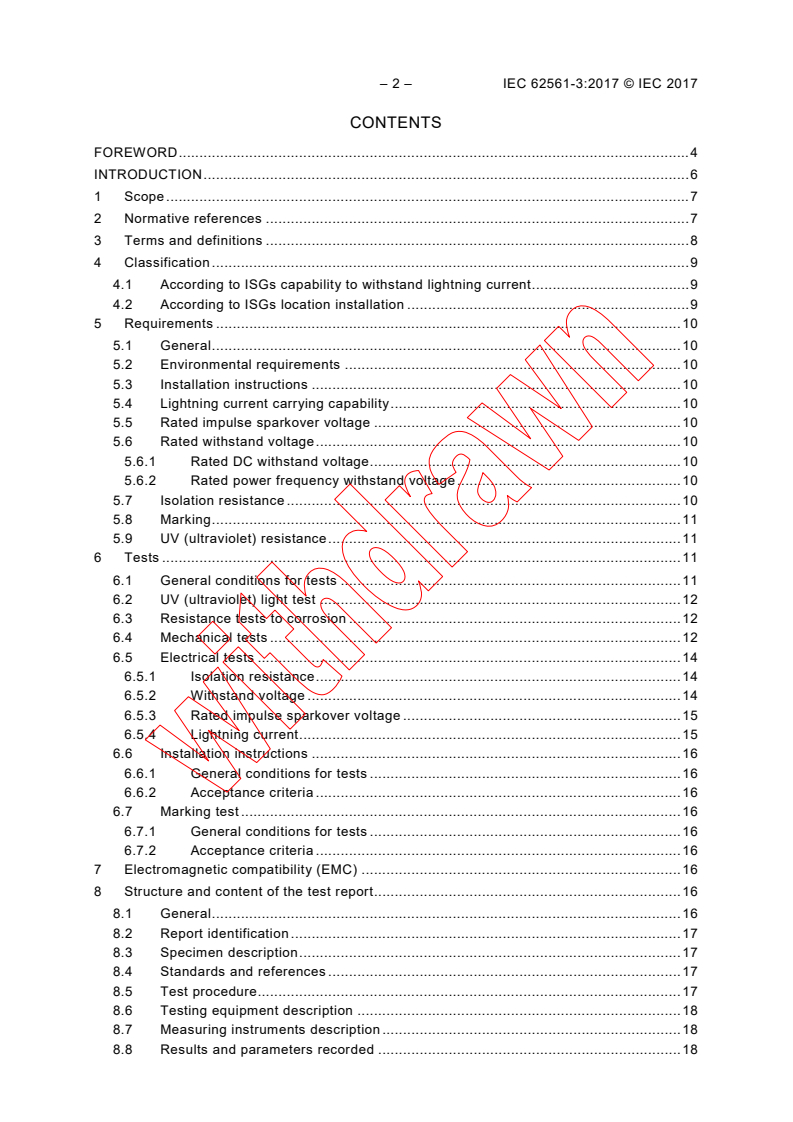
IEC 62561-3:2017 - Lightning protection system components (LPSC) - Part 3: Requirements for isolating spark gaps (ISG) Released:6/15/2017
IEC 62561-3:2017 - Lightning protection system components (LPSC) - Part 3: Requirements for isolating spark gaps (ISG) Released:11/13/2018
Overview
IEC 62561-3:2017 - part of the Lightning Protection System Components (LPSC) series - specifies the requirements and test procedures for isolating spark gaps (ISG) used in lightning protection systems (LPS). ISGs provide a controlled, indirect bond between an LPS and nearby metalwork where a direct electrical connection is not permissible for functional reasons. This second edition (2017) updates the first edition (2012) and introduces a new classification for ISG installation location plus an updated flow chart of tests.
Keywords: IEC 62561-3, isolating spark gaps, ISG requirements, lightning protection, LPSC, lightning protection standard.
Key topics and technical requirements
The standard defines performance, testing and documentation expectations for ISGs, including:
- Scope and intended use - typical applications such as earth-termination systems (power and telecom), rail earth electrodes, laboratory measuring earths, cathodic protection systems, service entry masts, and bypassing insulated flanges/couplings.
- Classification - by lightning-current carrying capability and by installation location (new in this edition).
- Environmental requirements and tests - resistance to salt mist, humid sulphurous and ammonia atmospheres, and ultraviolet (UV) exposure for outdoor ISGs.
- Mechanical tests - impact and hammer tests to verify physical robustness.
- Electrical tests - isolation resistance, rated DC and power-frequency withstand voltage, rated impulse sparkover voltage and lightning current withstand tests.
- Marking, installation instructions and EMC - required identification, packaging and guidance for correct field use; electromagnetic compatibility considerations.
- Test reporting - required structure and content of laboratory test reports; normative flow chart of test sequences is included.
Practical applications and who uses this standard
IEC 62561-3 is practical and directly applicable for:
- Manufacturers of isolating spark gaps and lightning protection components - design, type testing and compliance.
- Test labs and certification bodies - to conduct the environmental, mechanical and electrical tests and produce compliant test reports.
- Designers and consultants of lightning protection systems - specifying suitable ISGs for installations where direct bonding is not allowed.
- Installers and facility engineers - understanding installation classes, marking and performance limits to ensure safe, compliant bonding arrangements.
- Industry sectors - power utilities, telecommunications, railways, petrochemical and pipeline operators, laboratories and any facility using cathodic protection or insulated pipeline couplings.
Related standards
- IEC 62561-1 (LPSC Part 1: connection components)
- IEC 62305 series (LPS design and protection principles)
- Environmental and materials test references cited (e.g., IEC 60068-2-52, IEC 60068-2-75, ISO 4892 series)
Using IEC 62561-3 helps ensure ISGs meet internationally recognized safety, performance and testing criteria for reliable lightning protection and compliant indirect bonding.
Relations
- Effective Date
- 05-Sep-2023
- Effective Date
- 05-Sep-2023
Buy Documents
IEC 62561-3:2017 - Lightning protection system components (LPSC) - Part 3: Requirements for isolating spark gaps (ISG) Released:6/15/2017
IEC 62561-3:2017 - Lightning protection system components (LPSC) - Part 3: Requirements for isolating spark gaps (ISG) Released:11/13/2018
Get Certified
Connect with accredited certification bodies for this standard

DIBt (Deutsches Institut für Bautechnik)
German Institute for Building Technology.
DIN CERTCO
DIN Group product certification.

Aboma Certification B.V.
Specialized in construction, metal, and transport sectors.
Sponsored listings
Frequently Asked Questions
IEC 62561-3:2017 is a standard published by the International Electrotechnical Commission (IEC). Its full title is "Lightning protection system components (LPSC) - Part 3: Requirements for isolating spark gaps (ISG)". This standard covers: IEC 62561-3:2017 specifies the requirements and tests for isolating spark gaps (ISG) for lightning protection systems. ISGs can be used to indirectly bond a lightning protection system to other nearby metalwork where a direct bond is not permissible for functional reasons. This bilingual version (2018-11) corresponds to the monolingual English version, published in 2017-06. This second edition cancels and replaces the first edition, published in 2012. This edition constitutes a technical revision. This edition includes the following significant technical changes with respect to the previous edition. - a new classification has been added related to ISGs location installation; - an updated flow chart of tests has been developed. The French version of this document has not been voted upon.
IEC 62561-3:2017 specifies the requirements and tests for isolating spark gaps (ISG) for lightning protection systems. ISGs can be used to indirectly bond a lightning protection system to other nearby metalwork where a direct bond is not permissible for functional reasons. This bilingual version (2018-11) corresponds to the monolingual English version, published in 2017-06. This second edition cancels and replaces the first edition, published in 2012. This edition constitutes a technical revision. This edition includes the following significant technical changes with respect to the previous edition. - a new classification has been added related to ISGs location installation; - an updated flow chart of tests has been developed. The French version of this document has not been voted upon.
IEC 62561-3:2017 is classified under the following ICS (International Classification for Standards) categories: 91.120.40 - Lightning protection. The ICS classification helps identify the subject area and facilitates finding related standards.
IEC 62561-3:2017 has the following relationships with other standards: It is inter standard links to IEC 62561-3:2023, IEC 62561-3:2012. Understanding these relationships helps ensure you are using the most current and applicable version of the standard.
IEC 62561-3:2017 is available in PDF format for immediate download after purchase. The document can be added to your cart and obtained through the secure checkout process. Digital delivery ensures instant access to the complete standard document.
Standards Content (Sample)
IEC 62561-3 ®
Edition 2.0 2017-06
INTERNATIONAL
STANDARD
Lightning protection system components (LPSC) –
Part 3: Requirements for isolating spark gaps (ISG)
All rights reserved. Unless otherwise specified, no part of this publication may be reproduced or utilized in any form
or by any means, electronic or mechanical, including photocopying and microfilm, without permission in writing from
either IEC or IEC's member National Committee in the country of the requester. If you have any questions about IEC
copyright or have an enquiry about obtaining additional rights to this publication, please contact the address below or
your local IEC member National Committee for further information.
IEC Central Office Tel.: +41 22 919 02 11
3, rue de Varembé Fax: +41 22 919 03 00
CH-1211 Geneva 20 info@iec.ch
Switzerland www.iec.ch
About the IEC
The International Electrotechnical Commission (IEC) is the leading global organization that prepares and publishes
International Standards for all electrical, electronic and related technologies.
About IEC publications
The technical content of IEC publications is kept under constant review by the IEC. Please make sure that you have the
latest edition, a corrigenda or an amendment might have been published.
IEC Catalogue - webstore.iec.ch/catalogue Electropedia - www.electropedia.org
The stand-alone application for consulting the entire The world's leading online dictionary of electronic and
bibliographical information on IEC International Standards, electrical terms containing 20 000 terms and definitions in
Technical Specifications, Technical Reports and other English and French, with equivalent terms in 16 additional
documents. Available for PC, Mac OS, Android Tablets and languages. Also known as the International Electrotechnical
iPad. Vocabulary (IEV) online.
IEC publications search - www.iec.ch/searchpub IEC Glossary - std.iec.ch/glossary
The advanced search enables to find IEC publications by a 65 000 electrotechnical terminology entries in English and
variety of criteria (reference number, text, technical French extracted from the Terms and Definitions clause of
committee,…). It also gives information on projects, replaced IEC publications issued since 2002. Some entries have been
and withdrawn publications. collected from earlier publications of IEC TC 37, 77, 86 and
CISPR.
IEC Just Published - webstore.iec.ch/justpublished
Stay up to date on all new IEC publications. Just Published IEC Customer Service Centre - webstore.iec.ch/csc
details all new publications released. Available online and If you wish to give us your feedback on this publication or
also once a month by email. need further assistance, please contact the Customer Service
Centre: csc@iec.ch.
IEC 62561-3 ®
Edition 2.0 2017-06
INTERNATIONAL
STANDARD
Lightning protection system components (LPSC) –
Part 3: Requirements for isolating spark gaps (ISG)
INTERNATIONAL
ELECTROTECHNICAL
COMMISSION
ICS 91.120.40 ISBN 978-2-8322-4455-5
– 2 – IEC 62561-3:2017 © IEC 2017
CONTENTS
FOREWORD . 4
INTRODUCTION . 6
1 Scope . 7
2 Normative references . 7
3 Terms and definitions . 8
4 Classification . 9
4.1 According to ISGs capability to withstand lightning current . 9
4.2 According to ISGs location installation . 9
5 Requirements . 10
5.1 General . 10
5.2 Environmental requirements . 10
5.3 Installation instructions . 10
5.4 Lightning current carrying capability . 10
5.5 Rated impulse sparkover voltage . 10
5.6 Rated withstand voltage . 10
5.6.1 Rated DC withstand voltage . 10
5.6.2 Rated power frequency withstand voltage . 10
5.7 Isolation resistance . 10
5.8 Marking . 11
5.9 UV (ultraviolet) resistance . 11
6 Tests . 11
6.1 General conditions for tests . 11
6.2 UV (ultraviolet) light test . 12
6.3 Resistance tests to corrosion . 12
6.4 Mechanical tests . 12
6.5 Electrical tests . 14
6.5.1 Isolation resistance . 14
6.5.2 Withstand voltage . 14
6.5.3 Rated impulse sparkover voltage . 15
6.5.4 Lightning current . 15
6.6 Installation instructions . 16
6.6.1 General conditions for tests . 16
6.6.2 Acceptance criteria . 16
6.7 Marking test . 16
6.7.1 General conditions for tests . 16
6.7.2 Acceptance criteria . 16
7 Electromagnetic compatibility (EMC) . 16
8 Structure and content of the test report . 16
8.1 General . 16
8.2 Report identification . 17
8.3 Specimen description . 17
8.4 Standards and references . 17
8.5 Test procedure . 17
8.6 Testing equipment description . 18
8.7 Measuring instruments description . 18
8.8 Results and parameters recorded . 18
8.9 Statement of pass/fail . 18
Annex A (normative) Flow chart of tests . 19
Annex B (normative) Environmental test for isolating spark gaps . 21
B.1 General . 21
B.2 Salt mist treatment . 21
B.3 Humid sulphurous atmosphere treatment . 21
B.4 Ammonia atmosphere treatment. 21
Annex C (normative) Environmental test for outdoor isolating spark gaps –
Resistance to ultraviolet light . 22
C.1 General . 22
C.2 The tests . 22
C.3 First alternative test to C.2 . 22
C.4 Second alternative test to C.2 . 22
Bibliography . 23
Figure 1 – Pendulum hammer test apparatus . 13
Figure A.1 – Flow chart of the sequence of tests for ISGs . 20
Table 1 – Lightning impulse current (I ) parameters . 15
imp
– 4 – IEC 62561-3:2017 © IEC 2017
INTERNATIONAL ELECTROTECHNICAL COMMISSION
____________
LIGHTNING PROTECTION SYSTEM COMPONENTS (LPSC) –
Part 3: Requirements for isolating spark gaps (ISG)
FOREWORD
1) The International Electrotechnical Commission (IEC) is a worldwide organization for standardization comprising
all national electrotechnical committees (IEC National Committees). The object of IEC is to promote
international co-operation on all questions concerning standardization in the electrical and electronic fields. To
this end and in addition to other activities, IEC publishes International Standards, Technical Specifications,
Technical Reports, Publicly Available Specifications (PAS) and Guides (hereafter referred to as “IEC
Publication(s)”). Their preparation is entrusted to technical committees; any IEC National Committee interested
in the subject dealt with may participate in this preparatory work. International, governmental and non-
governmental organizations liaising with the IEC also participate in this preparation. IEC collaborates closely
with the International Organization for Standardization (ISO) in accordance with conditions determined by
agreement between the two organizations.
2) The formal decisions or agreements of IEC on technical matters express, as nearly as possible, an international
consensus of opinion on the relevant subjects since each technical committee has representation from all
interested IEC National Committees.
3) IEC Publications have the form of recommendations for international use and are accepted by IEC National
Committees in that sense. While all reasonable efforts are made to ensure that the technical content of IEC
Publications is accurate, IEC cannot be held responsible for the way in which they are used or for any
misinterpretation by any end user.
4) In order to promote international uniformity, IEC National Committees undertake to apply IEC Publications
transparently to the maximum extent possible in their national and regional publications. Any divergence
between any IEC Publication and the corresponding national or regional publication shall be clearly indicated in
the latter.
5) IEC itself does not provide any attestation of conformity. Independent certification bodies provide conformity
assessment services and, in some areas, access to IEC marks of conformity. IEC is not responsible for any
services carried out by independent certification bodies.
6) All users should ensure that they have the latest edition of this publication.
7) No liability shall attach to IEC or its directors, employees, servants or agents including individual experts and
members of its technical committees and IEC National Committees for any personal injury, property damage or
other damage of any nature whatsoever, whether direct or indirect, or for costs (including legal fees) and
expenses arising out of the publication, use of, or reliance upon, this IEC Publication or any other IEC
Publications.
8) Attention is drawn to the Normative references cited in this publication. Use of the referenced publications is
indispensable for the correct application of this publication.
9) Attention is drawn to the possibility that some of the elements of this IEC Publication may be the subject of
patent rights. IEC shall not be held responsible for identifying any or all such patent rights.
International Standard IEC 62561-3 has been prepared by IEC technical committee 81:
Lightning protection.
This second edition cancels and replaces the first edition, published in 2012. This edition
constitutes a technical revision.
This edition includes the following significant technical changes with respect to the previous
edition.
a) a new classification has been added related to ISGs location installation;
b) an updated flow chart of tests has been developed.
The text of this International Standard is based on the following documents:
FDIS Report on voting
81/561/FDIS 81/566/RVD
Full information on the voting for the approval of this International Standard can be found in
the report on voting indicated in the above table.
This document has been drafted in accordance with the ISO/IEC Directives, Part 2.
A list of all parts in the IEC 62561 series, published under the general title Lightning
protection system components (LPSC), can be found on the IEC website.
The committee has decided that the contents of this document will remain unchanged until the
stability date indicated on the IEC website under "http://webstore.iec.ch" in the data related to
the specific document. At this date, the document will be
• reconfirmed,
• withdrawn,
• replaced by a revised edition, or
• amended.
A bilingual version of this publication may be issued at a later date.
– 6 – IEC 62561-3:2017 © IEC 2017
INTRODUCTION
This part of IEC 62561 deals with the requirements and tests for lightning protection system
components (LPSC), specifically isolating spark gaps (ISG) used for the installation of a
lightning protection system (LPS) designed and implemented according to the IEC 62305
series.
LIGHTNING PROTECTION SYSTEM COMPONENTS (LPSC) –
Part 3: Requirements for isolating spark gaps (ISG)
1 Scope
This part of IEC 62561 specifies the requirements and tests for isolating spark gaps (ISG) for
lightning protection systems.
ISGs can be used to indirectly bond a lightning protection system to other nearby metalwork
where a direct bond is not permissible for functional reasons.
Typical applications include the connection to
• earth-termination systems of power installations,
• earth-termination systems of telecommunication systems,
• auxiliary earth electrodes of voltage-operated, earth fault circuit breakers,
• rail earth electrode of power and DC railways,
• measuring earth electrodes for laboratories,
• installations with cathodic protection and stray current systems,
• service entry masts for low-voltage overhead cables,
• bypassing insulated flanges and insulated couplings of pipelines.
This does not cover applications where follow currents occur.
NOTE Lightning protection system components (LPSC) can also be suitable for use in hazardous conditions such
as fire and explosive atmosphere. Due regard will be taken of the extra requirements necessary for the
components to be installed in such conditions.
2 Normative references
The following documents are referred to in the text in such a way that some or all of their
content constitutes requirements of this document. For dated references, only the edition
cited applies. For undated references, the latest edition of the referenced document (including
any amendments) applies.
IEC 60068-2-52:1996, Environmental testing – Part 2-52: Tests – Test Kb: Salt mist, cyclic
(sodium chloride solution)
IEC 60068-2-75:1997, Environmental testing – Part 2-75: Tests – Test Eh: Hammer tests
_____________
nd rd
2 edition (1996). A 3 edition IEC 60068-2-52: Environmental testing – Part 2-52: Tests – Test Kb: Salt mist,
cyclic (sodium chloride solution) is under preparation. Stage at the time of publication:
IEC PRVC 60068-2-52:2017.
st
st nd
1 edition (1997). This 1 edition was replaced in 2014 by a 2 edition IEC 60068-2-75:2014, Environmental
testing – Part 2-75: Tests – Test Eh: Hammer tests.
– 8 – IEC 62561-3:2017 © IEC 2017
ISO 4892-2:2006, Plastics – Methods of exposure to laboratory light sources – Part 2: Xenon-
arc lamps
IEC 62561-1, Lightning protection system components (LPSC) – Part 1: Requirements for
connection components
ISO 4892-3:2006, Plastics – Methods of exposure to laboratory light sources – Part 3:
Fluorescent UV lamps
ISO 4892-4, Plastics – Methods of exposure to laboratory light sources – Part 4: Open-flame
carbon-arc lamps
ISO 6957:1988, Copper alloys – Ammonia test for stress corrosion resistance
ISO 6988:1985, Metallic and other non-organic coatings – Sulphur dioxide test with general
condensation of moisture
3 Terms and definitions
For the purposes of this document, the following terms and definitions apply.
ISO and IEC maintain terminological databases for use in standardization at the following
addresses:
• IEC Electropedia: available at http://www.electropedia.org/
• ISO Online browsing platform: available at http://www.iso.org/obp
3.1
isolating spark gap
ISG
component with discharge distance for isolating electrically conductive installation sections
Note 1 to entry: In the event of a lightning strike, the isolated sections are temporarily connected conductively as
the result of response to the discharge.
3.2
sparkover voltage
maximum voltage value before disruptive discharge between the electrodes of the ISG
3.3
withstand voltage
value of the test voltage to be applied under specified conditions in a withstand test, during
which a specified number of disruptive discharges is tolerated
3.4
power frequency withstand voltage
r.m.s value of a sinusoidal power frequency voltage that the ISG can withstand
3.5
DC withstand voltage
value of a DC voltage that the ISG can withstand
_____________
nd nd rd
edition (2006). This 2 edition was replaced in 2013 by a 3 edition ISO 4892-2:2013, Plastics – Methods
of exposure to laboratory light sources – Part 2: Xenon-arc lamps.
nd rd
nd
2 edition (2006). This 2 edition was replaced in 2016 by a 3 edition: ISO 4892-3: 2016, Plastics – Methods
of exposure to laboratory light sources – Part 3: Fluorescent UV lamps.
3.6
rated withstand voltage
value of a withstand voltage declared by the manufacturer to characterize the isolating
behavior of an ISG
3.7
rated power frequency withstand voltage
U
W AC
value of a power frequency withstand voltage declared by the manufacturer to characterize
the isolating behavior of an ISG
3.8
rated DC withstand voltage
U
W DC
value of a DC withstand voltage declared by the manufacturer to characterize the isolating
behavior of an ISG
3.9
impulse sparkover voltage
impulse voltage of the waveshape 1,2/50 to classify the sparkover behavior of the ISG
3.10
rated impulse sparkover voltage
U
imp
manufacturer’s declaration of the ISG sparkover voltage
3.11
isolation resistance
ohmic resistance of the ISG between the active parts
3.12
lightning impulse current
I
imp
impulse current that classifies an ISG
Note 1 to entry: Five parameters are to be considered: the peak value, the charge, the duration, the specific
energy and the rate of rise of the impulse current.
4 Classification
4.1 According to ISGs capability to withstand lightning current
The following classes apply, as per Table 1:
a) class H for heavy duty;
b) class N for normal duty;
c) class 1L for light duty;
d) class 2L for light duty;
e) class 3L for light duty.
4.2 According to ISGs location installation
The following classes apply:
a) indoor installation;
b) outdoor installation.
– 10 – IEC 62561-3:2017 © IEC 2017
5 Requirements
5.1 General
ISGs shall be designed in such a manner that when they are installed in accordance with the
manufacturer’s instructions, their performance shall be reliable, stable and safe to persons
and surrounding equipment.
5.2 Environmental requirements
ISGs shall be designed in such way that they operate satisfactorily under the environmental
conditions given by the normal service conditions. Outdoor ISGs shall be contained in a
weather shield of glass-glazed ceramic, or other acceptable material, that is resistant to UV
(ultraviolet) light, corrosion and erosion.
Compliance is checked by testing. In accordance with 6.2 and 6.3.
5.3 Installation instructions
The manufacturer of the ISG shall provide adequate instructions in their literature to ensure
that the installer of the ISG can select and install them in a suitable and safe manner.
Compliance is checked by review as per 6.6.
5.4 Lightning current carrying capability
ISGs shall have sufficient lightning current carrying capability.
Compliance is checked in accordance with Clause 6 following the manufacturer’s declaration
for the class of the ISG in accordance with Clause 4.
5.5 Rated impulse sparkover voltage
The ISG shall always spark over at this value during the tests.
The ISG may e
...
IEC 62561-3 ®
Edition 2.0 2017-06
INTERNATIONAL
STANDARD
NORME
INTERNATIONALE
Lightning protection system components (LPSC) –
Part 3: Requirements for isolating spark gaps (ISG)
Composants des systèmes de protection contre la foudre (CSPF) –
Partie 3: Exigences pour les éclateurs d'isolement
All rights reserved. Unless otherwise specified, no part of this publication may be reproduced or utilized in any form
or by any means, electronic or mechanical, including photocopying and microfilm, without permission in writing from
either IEC or IEC's member National Committee in the country of the requester. If you have any questions about IEC
copyright or have an enquiry about obtaining additional rights to this publication, please contact the address below or
your local IEC member National Committee for further information.
Droits de reproduction réservés. Sauf indication contraire, aucune partie de cette publication ne peut être reproduite
ni utilisée sous quelque forme que ce soit et par aucun procédé, électronique ou mécanique, y compris la photocopie
et les microfilms, sans l'accord écrit de l'IEC ou du Comité national de l'IEC du pays du demandeur. Si vous avez des
questions sur le copyright de l'IEC ou si vous désirez obtenir des droits supplémentaires sur cette publication, utilisez
les coordonnées ci-après ou contactez le Comité national de l'IEC de votre pays de résidence.
IEC Central Office Tel.: +41 22 919 02 11
3, rue de Varembé info@iec.ch
CH-1211 Geneva 20 www.iec.ch
Switzerland
About the IEC
The International Electrotechnical Commission (IEC) is the leading global organization that prepares and publishes
International Standards for all electrical, electronic and related technologies.
About IEC publications
The technical content of IEC publications is kept under constant review by the IEC. Please make sure that you have the
latest edition, a corrigenda or an amendment might have been published.
IEC Catalogue - webstore.iec.ch/catalogue Electropedia - www.electropedia.org
The stand-alone application for consulting the entire The world's leading online dictionary of electronic and
bibliographical information on IEC International Standards, electrical terms containing 21 000 terms and definitions in
Technical Specifications, Technical Reports and other English and French, with equivalent terms in 16 additional
documents. Available for PC, Mac OS, Android Tablets and languages. Also known as the International Electrotechnical
iPad. Vocabulary (IEV) online.
IEC publications search - webstore.iec.ch/advsearchform IEC Glossary - std.iec.ch/glossary
The advanced search enables to find IEC publications by a 67 000 electrotechnical terminology entries in English and
variety of criteria (reference number, text, technical French extracted from the Terms and Definitions clause of
committee,…). It also gives information on projects, replaced IEC publications issued since 2002. Some entries have been
and withdrawn publications. collected from earlier publications of IEC TC 37, 77, 86 and
CISPR.
IEC Just Published - webstore.iec.ch/justpublished
Stay up to date on all new IEC publications. Just Published IEC Customer Service Centre - webstore.iec.ch/csc
details all new publications released. Available online and If you wish to give us your feedback on this publication or
also once a month by email. need further assistance, please contact the Customer Service
Centre: sales@iec.ch.
A propos de l'IEC
La Commission Electrotechnique Internationale (IEC) est la première organisation mondiale qui élabore et publie des
Normes internationales pour tout ce qui a trait à l'électricité, à l'électronique et aux technologies apparentées.
A propos des publications IEC
Le contenu technique des publications IEC est constamment revu. Veuillez vous assurer que vous possédez l’édition la
plus récente, un corrigendum ou amendement peut avoir été publié.
Catalogue IEC - webstore.iec.ch/catalogue Electropedia - www.electropedia.org
Application autonome pour consulter tous les renseignements
Le premier dictionnaire en ligne de termes électroniques et
bibliographiques sur les Normes internationales,
électriques. Il contient 21 000 termes et définitions en anglais
Spécifications techniques, Rapports techniques et autres
et en français, ainsi que les termes équivalents dans 16
documents de l'IEC. Disponible pour PC, Mac OS, tablettes
langues additionnelles. Egalement appelé Vocabulaire
Android et iPad.
Electrotechnique International (IEV) en ligne.
Recherche de publications IEC -
Glossaire IEC - std.iec.ch/glossary
webstore.iec.ch/advsearchform
67 000 entrées terminologiques électrotechniques, en anglais
La recherche avancée permet de trouver des publications IEC et en français, extraites des articles Termes et Définitions des
en utilisant différents critères (numéro de référence, texte, publications IEC parues depuis 2002. Plus certaines entrées
comité d’études,…). Elle donne aussi des informations sur les antérieures extraites des publications des CE 37, 77, 86 et
projets et les publications remplacées ou retirées. CISPR de l'IEC.
IEC Just Published - webstore.iec.ch/justpublished Service Clients - webstore.iec.ch/csc
Restez informé sur les nouvelles publications IEC. Just Si vous désirez nous donner des commentaires sur cette
Published détaille les nouvelles publications parues. publication ou si vous avez des questions contactez-nous:
Disponible en ligne et aussi une fois par mois par email. sales@iec.ch.
IEC 62561-3 ®
Edition 2.0 2017-06
INTERNATIONAL
STANDARD
NORME
INTERNATIONALE
Lightning protection system components (LPSC) –
Part 3: Requirements for isolating spark gaps (ISG)
Composants des systèmes de protection contre la foudre (CSPF) –
Partie 3: Exigences pour les éclateurs d'isolement
INTERNATIONAL
ELECTROTECHNICAL
COMMISSION
COMMISSION
ELECTROTECHNIQUE
INTERNATIONALE
ICS 91.120.40 ISBN 978-2-8322-6202-3
– 2 – IEC 62561-3:2017 © IEC 2017
CONTENTS
CONTENTS . 2
FOREWORD . 4
INTRODUCTION . 6
1 Scope . 7
2 Normative references . 7
3 Terms and definitions . 8
4 Classification . 9
4.1 According to ISGs capability to withstand lightning current . 9
4.2 According to ISGs location installation . 9
5 Requirements . 10
5.1 General . 10
5.2 Environmental requirements . 10
5.3 Installation instructions . 10
5.4 Lightning current carrying capability . 10
5.5 Rated impulse sparkover voltage . 10
5.6 Rated withstand voltage . 10
5.6.1 Rated DC withstand voltage . 10
5.6.2 Rated power frequency withstand voltage . 10
5.7 Isolation resistance . 10
5.8 Marking . 11
5.9 UV (ultraviolet) resistance . 11
6 Tests . 11
6.1 General conditions for tests . 11
6.2 UV (ultraviolet) light test . 12
6.3 Resistance tests to corrosion . 12
6.4 Mechanical tests . 12
6.5 Electrical tests . 14
6.5.1 Isolation resistance . 14
6.5.2 Withstand voltage . 14
6.5.3 Rated impulse sparkover voltage . 15
6.5.4 Lightning current . 15
6.6 Installation instructions . 16
6.6.1 General conditions for tests . 16
6.6.2 Acceptance criteria . 16
6.7 Marking test . 16
6.7.1 General conditions for tests . 16
6.7.2 Acceptance criteria . 16
7 Electromagnetic compatibility (EMC) . 16
8 Structure and content of the test report . 16
8.1 General . 16
8.2 Report identification . 17
8.3 Specimen description . 17
8.4 Standards and references . 17
8.5 Test procedure . 17
8.6 Testing equipment description . 18
8.7 Measuring instruments description . 18
8.8 Results and parameters recorded . 18
8.9 Statement of pass/fail . 18
Annex A (normative) Flow chart of tests . 19
Annex B (normative) Environmental test for isolating spark gaps . 21
B.1 General . 21
B.2 Salt mist treatment . 21
B.3 Humid sulphurous atmosphere treatment . 21
B.4 Ammonia atmosphere treatment. 21
Annex C (normative) Environmental test for outdoor isolating spark gaps –
Resistance to ultraviolet light . 22
C.1 General . 22
C.2 The tests . 22
C.3 First alternative test to C.2 . 22
C.4 Second alternative test to C.2 . 22
Bibliography . 23
Figure 1 – Pendulum hammer test apparatus . 13
Figure A.1 – Flow chart of the sequence of tests for ISGs . 20
Table 1 – Lightning impulse current (I ) parameters . 15
imp
– 4 – IEC 62561-3:2017 © IEC 2017
INTERNATIONAL ELECTROTECHNICAL COMMISSION
____________
LIGHTNING PROTECTION SYSTEM COMPONENTS (LPSC) –
Part 3: Requirements for isolating spark gaps (ISG)
FOREWORD
1) The International Electrotechnical Commission (IEC) is a worldwide organization for standardization comprising
all national electrotechnical committees (IEC National Committees). The object of IEC is to promote
international co-operation on all questions concerning standardization in the electrical and electronic fields. To
this end and in addition to other activities, IEC publishes International Standards, Technical Specifications,
Technical Reports, Publicly Available Specifications (PAS) and Guides (hereafter referred to as “IEC
Publication(s)”). Their preparation is entrusted to technical committees; any IEC National Committee interested
in the subject dealt with may participate in this preparatory work. International, governmental and non-
governmental organizations liaising with the IEC also participate in this preparation. IEC collaborates closely
with the International Organization for Standardization (ISO) in accordance with conditions determined by
agreement between the two organizations.
2) The formal decisions or agreements of IEC on technical matters express, as nearly as possible, an international
consensus of opinion on the relevant subjects since each technical committee has representation from all
interested IEC National Committees.
3) IEC Publications have the form of recommendations for international use and are accepted by IEC National
Committees in that sense. While all reasonable efforts are made to ensure that the technical content of IEC
Publications is accurate, IEC cannot be held responsible for the way in which they are used or for any
misinterpretation by any end user.
4) In order to promote international uniformity, IEC National Committees undertake to apply IEC Publications
transparently to the maximum extent possible in their national and regional publications. Any divergence
between any IEC Publication and the corresponding national or regional publication shall be clearly indicated in
the latter.
5) IEC itself does not provide any attestation of conformity. Independent certification bodies provide conformity
assessment services and, in some areas, access to IEC marks of conformity. IEC is not responsible for any
services carried out by independent certification bodies.
6) All users should ensure that they have the latest edition of this publication.
7) No liability shall attach to IEC or its directors, employees, servants or agents including individual experts and
members of its technical committees and IEC National Committees for any personal injury, property damage or
other damage of any nature whatsoever, whether direct or indirect, or for costs (including legal fees) and
expenses arising out of the publication, use of, or reliance upon, this IEC Publication or any other IEC
Publications.
8) Attention is drawn to the Normative references cited in this publication. Use of the referenced publications is
indispensable for the correct application of this publication.
9) Attention is drawn to the possibility that some of the elements of this IEC Publication may be the subject of
patent rights. IEC shall not be held responsible for identifying any or all such patent rights.
International Standard IEC 62561-3 has been prepared by IEC technical committee 81:
Lightning protection.
This bilingual version (2018-11) corresponds to the monolingual English version, published in
2017-06.
This second edition cancels and replaces the first edition, published in 2012. This edition
constitutes a technical revision.
This edition includes the following significant technical changes with respect to the previous
edition.
a) a new classification has been added related to ISGs location installation;
b) an updated flow chart of tests has been developed.
The text of this International Standard is based on the following documents:
FDIS Report on voting
81/561/FDIS 81/566/RVD
Full information on the voting for the approval of this International Standard can be found in
the report on voting indicated in the above table.
The French version of this document has not been voted upon.
This document has been drafted in accordance with the ISO/IEC Directives, Part 2.
A list of all parts in the IEC 62561 series, published under the general title Lightning
protection system components (LPSC), can be found on the IEC website.
The committee has decided that the contents of this document will remain unchanged until the
stability date indicated on the IEC website under "http://webstore.iec.ch" in the data related to
the specific document. At this date, the document will be
• reconfirmed,
• withdrawn,
• replaced by a revised edition, or
• amended.
– 6 – IEC 62561-3:2017 © IEC 2017
INTRODUCTION
This part of IEC 62561 deals with the requirements and tests for lightning protection system
components (LPSC), specifically isolating spark gaps (ISG) used for the installation of a
lightning protection system (LPS) designed and implemented according to the IEC 62305
series.
LIGHTNING PROTECTION SYSTEM COMPONENTS (LPSC) –
Part 3: Requirements for isolating spark gaps (ISG)
1 Scope
This part of IEC 62561 specifies the requirements and tests for isolating spark gaps (ISG) for
lightning protection systems.
ISGs can be used to indirectly bond a lightning protection system to other nearby metalwork
where a direct bond is not permissible for functional reasons.
Typical applications include the connection to
• earth-termination systems of power installations,
• earth-termination systems of telecommunication systems,
• auxiliary earth electrodes of voltage-operated, earth fault circuit breakers,
• rail earth electrode of power and DC railways,
• measuring earth electrodes for laboratories,
• installations with cathodic protection and stray current systems,
• service entry masts for low-voltage overhead cables,
• bypassing insulated flanges and insulated couplings of pipelines.
This does not cover applications where follow currents occur.
NOTE Lightning protection system components (LPSC) can also be suitable for use in hazardous conditions such
as fire and explosive atmosphere. Due regard will be taken of the extra requirements necessary for the
components to be installed in such conditions.
2 Normative references
The following documents are referred to in the text in such a way that some or all of their
content constitutes requirements of this document. For dated references, only the edition
cited applies. For undated references, the latest edition of the referenced document (including
any amendments) applies.
IEC 60068-2-52:1996, Environmental testing – Part 2-52: Tests – Test Kb: Salt mist, cyclic
(sodium chloride solution)
IEC 60068-2-75:1997, Environmental testing – Part 2-75: Tests – Test Eh: Hammer tests
_____________
nd rd
2 edition (1996). A 3 edition IEC 60068-2-52: Environmental testing – Part 2-52: Tests – Test Kb: Salt mist,
cyclic (sodium chloride solution) is under preparation. Stage at the time of publication:
IEC PRVC 60068-2-52:2017.
st st nd
1 edition (1997). This 1 edition was replaced in 2014 by a 2 edition IEC 60068-2-75:2014, Environmental
testing – Part 2-75: Tests – Test Eh: Hammer tests.
– 8 – IEC 62561-3:2017 © IEC 2017
ISO 4892-2:2006, Plastics – Methods of exposure to laboratory light sources – Part 2: Xenon-
arc lamps
IEC 62561-1, Lightning protection system components (LPSC) – Part 1: Requirements for
connection components
ISO 4892-3:2006, Plastics – Methods of exposure to laboratory light sources – Part 3:
Fluorescent UV lamps
ISO 4892-4, Plastics – Methods of exposure to laboratory light sources – Part 4: Open-flame
carbon-arc lamps
ISO 6957:1988, Copper alloys – Ammonia test for stress corrosion resistance
ISO 6988:1985, Metallic and other non-organic coatings – Sulphur dioxide test with general
condensation of moisture
3 Terms and definitions
For the purposes of this document, the following terms and definitions apply.
ISO and IEC maintain terminological databases for use in standardization at the following
addresses:
• IEC Electropedia: available at http://www.electropedia.org/
• ISO Online browsing platform: available at http://www.iso.org/obp
3.1
isolating spark gap
ISG
component with discharge distance for isolating electrically conductive installation sections
Note 1 to entry: In the event of a lightning strike, the isolated sections are temporarily connected conductively as
the result of response to the discharge.
3.2
sparkover voltage
maximum voltage value before disruptive discharge between the electrodes of the ISG
3.3
withstand voltage
value of the test voltage to be applied under specified conditions in a withstand test, during
which a specified number of disruptive discharges is tolerated
3.4
power frequency withstand voltage
r.m.s value of a sinusoidal power frequency voltage that the ISG can withstand
3.5
DC withstand voltage
value of a DC voltage that the ISG can withstand
_____________
nd nd rd
2 edition (2006). This 2 edition was replaced in 2013 by a 3 edition ISO 4892-2:2013, Plastics – Methods
of exposure to laboratory light sources – Part 2: Xenon-arc lamps.
nd nd rd
2 edition (2006). This 2 edition was replaced in 2016 by a 3 edition: ISO 4892-3: 2016, Plastics – Methods
of exposure to laboratory light sources – Part 3: Fluorescent UV lamps.
3.6
rated withstand voltage
value of a withstand voltage declared by the manufacturer to characterize the isolating
behavior of an ISG
3.7
rated power frequency withstand voltage
U
W AC
value of a power frequency withstand voltage declared by the manufacturer to characterize
the isolating behavior of an ISG
3.8
rated DC withstand voltage
U
W DC
value of a DC withstand voltage declared by the manufacturer to characterize the isolating
behavior of an ISG
3.9
impulse sparkover voltage
impulse voltage of the waveshape 1,2/50 to classify the sparkover behavior of the ISG
3.10
rated impulse sparkover voltage
U
imp
manufacturer’s declaration of the ISG sparkover voltage
3.11
isolation resistance
ohmic resistance of the ISG between the active parts
3.12
lightning impulse current
I
imp
impulse current that classifies an ISG
Note 1 to entry: Five parameters are to be considered: the peak value, the charge, the duration, the specific
energy and the rate of rise of the impulse current.
4 Classification
4.1 According to ISGs capability to withstand lightning current
The following classes apply, as per Table 1:
a) class H for heavy duty;
b) class N for normal duty;
c) class 1L for light duty;
d) class 2L for light duty;
e) class 3L for light duty.
4.2 According to ISGs location installation
The following classes apply:
a) indoor installation;
b) outdoor installation.
– 10 – IEC 62561-3:2017 © IEC 2017
5 Requirements
5.1 General
ISGs shall be designed in such a manner that when they are installed in accordance with the
manufacturer’s instructions, their performance shall be reliable, stable and safe to persons
and surrounding equipment.
5.2 Environmental requirements
ISGs shall be designed in such way that they operate satisfactorily under the environmental
conditions given by the normal service conditions. Outdoor ISGs shall be contained in a
weather shield of glass-glazed ceramic, or other acceptable material, that is resistant to UV
(ultraviolet) light, corrosion and erosion.
Compliance is checked by testing. In accordance with 6.2 and 6.3.
5.3 Installation instructions
The manufacturer of the ISG shall provide adequate instructions in their literature to ensure
that the installer of the ISG can select and install them in a suitable and safe manner.
Compliance is checked by review as per 6.6.
5.4 Lightning current carrying capability
ISGs shall have sufficient lightning current carrying capability.
Compliance is checked in accordance with Clause 6 following the manufacturer’s declaration
for the class of the ISG in accordance with Clause 4.
5.5 Rated impulse sparkover voltage
The ISG shall always spark over at this value during the tests.
The ISG may experience some variation of sparkover characteristics before and after the
lightning current test. This shall be included in the rated impulse sparkover voltage defined by
the manufacturer.
5.6 Rated withstand voltage
5.6.1 Rated DC withstand voltage
The ISG shall never spark over at this value during the tests even after performing the
lightning current test.
5.6.2 Rated power frequency withstand voltage
The ISG shall never spark over at this value during the tests even after performing the
lightning current test.
5.7 Isolation resistance
Before the lightning current test the isolation resistance shall be higher than 500 kΩ and after
the lightning current test isolation resistance shall not be lower than 500 kΩ.
Compliance is checked in accordance with 6.5.1.
5.8 Marking
All products complying with this document shall be marked at least with the following:
a) manufacturer’s or responsible vendor’s name or trade mark or identifying symbol;
b) part number;
c) the classification in accordance with Clause 4.
If the marking in accordance with b) is not practical it may be given on the smallest packaging
unit. The marking shall be durable and legible.
Compliance is checked in accordance with 6.7.
NOTE Marking can be applied for example by moulding, pressing, engraving, printing adhesive labels or water
slide transfers.
5.9 UV (ultraviolet) resistance
ISG housings for outdoor installation shall be made of UV resistant material.
Compliance is checked by tests as per 6.2.
6 Tests
6.1 General conditions for tests
The tests in accordance with this document are type tests and performed in a sequence
according to Annex A.
These tests are of such a nature that, after they have been performed, they need not be
repeated unless changes are made to the materials, design or type of manufacturing process,
which might change the performance characteristics of the product.
a) Unless otherwise specified, tests are carried out with the specimens assembled and
installed as in normal use according to the manufacturer's or supplier's instructions.
b) Unless otherwise specified, three specimens are subjected to the tests and the
requirements are satisfied if all the tests are met.
c) If only one of the specimens does not satisfy a test due to an assembly or a manufacturing
fault, that test and any preceding one which may have influenced the results of the test
shall be repeated and also the tests which follow shall be carried out in the required
sequence on another full set of specimens, all of which shall comply with the
requirements.
d) If the ISG has an integral connection component part with its design, it shall be subjected
to the testing regime of IEC 62561-1 using the appropriate lightning current given in
Table 1 of this document.
The applicant, when submitting a set of specimens, may also submit an additional set of
specimens which may be necessary should one specimen fail. The testing laboratory will
then, without further request, test the additional set of specimens and will reject the sets only
if a further failure occurs. If the additional set of specimens is not submitted at the same time,
the failure of one specimen will entail rejection.
Prior to the testing of the ISG and clamp assembly, suitable protection measures should be
employed to ensure that the housing is not exposed to the conditioning treatment.
– 12 – IEC 62561-3:2017 © IEC 2017
6.2 UV (ultraviolet) light test
This test is necessary for ISGs designed to be installed outdoors or in specific environments.
ISG housings for outdoor application shall withstand UV light effects.
One set of three new specimens shall be assembled and mounted rigidly on an insulating
plate (e.g. brick, polytetrafluoroethylene (PTFE)) in accordance with the manufacturer’s
installation instructions.
The specimens shall be subjected to an environmental test consisting of an ultraviolet light
test as specified in Annex C.
The specimens are deemed to have passed this part of the test if there are no signs of
disintegration and no cracks visible to normal or corrected vision.
Ensure that the surface of the mounting plate is suitable to resist UV radiation.
6.3 Resistance tests to corrosion
This test is necessary for ISGs having metallic parts designed to be installed outdoors or in
specific environments.
The specimens used in and complying with the test in 6.2, shall be subjected to corrosion
tests as per Annex B.
After the parts have been dried during 10 min in a drying oven at a temperature of
100 ºC ± 5 ºC, they shall not present any trace of rust on surfaces.
Traces of rust on the edges or a yellowish stain removed by rubbing are not taken into
account. White rust, patina and other surface oxidations are not considered as corrosive
deterioration.
6.4 Mechanical tests
All specimens complying with 6.2 and 6.3 shall be stressed three times by mechanical
impacts.
The impacts are carried out on the accessible parts of the ISG, which may be mechanically
stressed accidentally.
The specimens are assembled under their normal operating conditions specified in the
manufacturer’s documentation.
The ISG is mounted on a pendulum hammer test apparatus according to
IEC 60068-2-75:1997, Clause 4, as shown in Figure 1. The striking element material shall be
polyamide as per IEC 60068-2-75:1997, Table 1, and its mass shall be 200 g as per
IEC 60068-2-75:1997, Table 2.
Dimensions in millimetres
IEC
Key
1 pendulum
2 frame
3 height of fall
4 specimen
5 mounting fixture
Figure 1 – Pendulum hammer test apparatus
The hammer shall fall from a height of 200 mm so that one impact on each side is applied, as
far as possible perpendicular to the length of the arrangement. The drop height is the vertical
distance between the position of the point of control, when the pendulum is released, and the
position of this point at the time of the impact.
The point of control is located on the surface of the striking part where the line passing
through the point of intersection of the axes of the steel tube of the pendulum and the part of
striking, perpendicular to the plane crossing the two axes, comes into contact with the
surface.
The impacts are not applied to the connectors.
NOTE In theory, the centre of gravity of the striking part should be the point of control. As, in practice, it is
difficult to determine the centre of gravity, the point of control has been chosen as described above.
– 14 – IEC 62561-3:2017 © IEC 2017
After the test, the ISG shall show no cracks or similar damage visible to normal or corrected
vision without magnification and shall not present damage which can potentially affect its later
use.
6.5 Electrical tests
6.5.1 Isolation resistance
The test is conducted with a DC voltage of 0,5 times the rated withstand voltage up to a
maximum of 500 V.
The resistance shall be measured after 30 s of applying the test voltage.
The specimen is deemed to have passed the test if the resistance is equal or greater than
500 kΩ.
6.5.2 Withstand voltage
6.5.2.1 General
The rated withstand voltages shall be tested according to the value declared by the
manufacturer in accordance with 5.3.
6.5.2.2 Power frequency withstand voltage
6.5.2.2.1 General conditions for tests
The rated power frequency withstand voltage is tested by applying an AC voltage at the
terminals of the ISG. The voltage is increased continuously at a rate of 100 V/s with a nominal
frequency of 50 Hz or 60 Hz until the r.m.s. value as declared by the manufacturer is reached
and this is maintained for a time of 60 s ± 1 s.
The prospective short-circuit current of the source may be limited to a minimum value of
5 mA.
6.5.2.2.2 Acceptance criteria
The specimens are deemed to have passed the test if during the application of the test
voltage the ISG does not spark over, or conduct a leakage current exceeding 1 mA.
6.5.2.3 DC withstand voltage
6.5.2.3.1 General conditions for tests
The rated DC withstand voltage shall be tested by applying a DC voltage at the terminals of
the ISG. The voltage shall be increased continuously at a rate of 100 V/s until the value as
declared by the manufacturer is reached and this is maintained for a time of 60 s ± 1 s.
The prospective short circuit current of the source may be limited to a minimum value of
5 mA.
6.5.2.3.2 Acceptance criteria
The specimens are deemed to have passed the test if during the application of the test
voltage the ISG does not spark over, or conduct a leakage current exceeding 1 mA.
6.5.3 Rated impulse sparkover voltage
6.5.3.1 General conditions for tests
An impulse voltage 1,2/50 μs with a peak value of the declared impulse sparkover voltage
shall be applied at the terminals of the ISG. The test is performed with five surges of positive
and negative polarity and the ISG has to spark over at each test impulse.
6.5.3.2 Acceptance criteria
The specimens are deemed to have passed the test if they have operated at each test
impulse and no signs of cracks or punctures appear on the enclosures.
6.5.4 Lightning current
6.5.4.1 General conditions for tests
After 6.5.3 and the conditioning according to Annex B, the specimens shall be pre-stressed
with a test current of 0,5 I , followed by a second test current of I after the ISG has
imp imp
cooled down close to ambient temperature.
The impulse discharge current passing through the device under test is defined by the crest
value I , the charge Q and the specific energy W/R. The impulse current shall show no
imp
reversal and reach I within 50 µs. The transfer of the charge Q shall occur within 5 ms and
imp
the specific energy W/R shall be dissipated within 5 ms.
All the parameters are given in Table 1.
a
Table 1 – Lightning impulse current (I ) parameters
imp
I Q W/R
imp
ISG classification
kA ± 10 %
+20 +45
As % kJ/Ω %
−10 −10
H 100 2 500
N 50 625
12,5
1L 25 156
2L 10 25
2.5
3L 5 6,25
a rd
The parameters are derived from the 3 edition of IEC 62305-1 which is under preparation.
NOTE When a lightning current flows in an arc, a shock wave is produced. The severity of the shock is dependent
upon the peak current and the rate of rise of the current. The shorter the rise time, the greater the severity. In
general, the acoustic shock wave can cause damage to the surrounding components, such as the enclosure of the
ISG.
6.5.4.2 Acceptance criteria
The specimens are deemed to have passed the test if no signs of cracks or punctures appear
on the enclosures.
After the current test, the tests according to 6.5.1, 6.5.2 and 6.5.3 shall be carried out.
– 16 – IEC 62561-3:2017 © IEC 2017
6.6 Installation instructions
6.6.1 General conditions for tests
The content of the installation instructions is checked as per its completeness by review.
6.6.2 Acceptance criteria
Installation instructions are deemed to have passed the test if they contain at least the
following:
a) classification and lightning current capability (I );
imp
b) rated withstand voltage;
c) rated power frequency withstand voltage (U );
W AC
d) rated DC withstand voltage (U );
W DC
e) assembly instructions with installation location (if crucial to the function);
f) appropriate connection components for the installation if not part of the ISG.
6.7 Marking test
6.7.1 General conditions for tests
The marking is checked by inspection and by rubbing it by hand for 15 s with a piece of cloth
soaked with water and again for 15 s with a piece of cloth soaked with white spirit/mineral
spirit.
Marking made by moulding, pressing or engraving is not subjected to this test.
6.7.2 Acceptance criteria
The specimen is deemed to have passed the test if the marking remains legible.
7 Electromagnetic compatibility (EMC)
Products covered by this document are, in normal use, passive in respect of electromagnetic
influences (emission and immunity).
8 Structure and content of the test report
8.1 General
The purpose of Clause 8 is to provide general requirements for laboratory test reports. It is
intended to promote clear, complete reporting procedures for laboratories submitting test
reports.
The results of each test carried out by the testing laboratory shall be reported accurately,
clearly, unambiguously and objectively, in accordance with any instructions in the test
methods. The results shall be reported in a test report and shall include all the information
necessary for the interpretation of the test results and all information required by the method
used.
Particular care and attention shall be paid to the arrangement of the report, especially with
regard to presentation of the test data and ease of assimilation by the reader. The format
shall be carefully and specifically designed for each type of test carried out, but the headings
shall be standardized as indicated below.
The structure of each report shall include at least information specified in 8.2 to 8.9.
8.2 Report identification
The following information shall be included :
a) A title or subject of the report.
b) Name and email address or telephone number of the testing laboratory.
c) Name, address and telephone number of the sub-testing laboratory where the test
was carried out, if different from the company which has been assigned to perform
the test.
d) Unique identification number (or serial number) of the test report.
e) Name and address of the vendor.
f) Report shall be paginated and the total number of pages indicated on each page,
including appendices or annexes.
g) Date of issue of the report.
h) Date(s) test(s) was (were) performed.
i) Signature and title, or an equivalent identification of the person(s) authorized to
sign by the testing laboratory for the content of the report.
j) Signature and title of person(s) conducting the test(s).
8.3 Specimen description
a) Sample description.
b) Detailed description and unambiguous identification of the test sample and/or test
assembly, for example part number, type, classification, material, dimensions.
c) Characterization and condition of the test sample and/or test assembly.
d) Sampling procedure, where relevant.
e) Date of receipt of test samples.
f) Photographs, drawings or any other visual documentation, if available.
8.4 Standards and references
a) Identification of the test standard used and the date of issue of the standard.
b) Reference to this document may only be made if the full set of tests is performed
and reported, except where the deviations are clearly justified in 8.5 b).
c) Other relevant documentation with the documentation date.
8.5 Test procedure
a) Description of the test procedure.
b) Justification for any deviations from, additions to or exclusions from the referenced
standard.
c) Any other information relevant to a specific test such as environmental conditions.
d) Configuration of testing assembly and measuring set up.
e) Location of the arrangement in the testing area and measuring techniques.
_____________
It is suggested to insert in the test report a specific declaration to avoid its misuse. A declaration example is:
“This type test report may not be reproduced other than in full, except with the prior written approval of the
issuing testing laboratory. This type test report only covers the samples submitted for test and does not
produce evidence of the quality for series production.”
– 18 – IEC 62561-3:2017 © IEC 2017
8.6 Testing equipment description
Description of equipment used for every test conducted, for example generators,
conditioning/ageing devices.
8.7 Measuring instruments description
Characteristics and calibration dates of all instruments used for measuring the values
specified in this document, for example shunts, oscilloscopes, ohmmeters, torque meters.
8.8 Results and parameters recorded
a) The required passing criteria for each test, defined in the standard.
b) The measured, observed or derived results shall be clearly identified at least for:
• isolation resistance,
• withstand voltage (power frequency withstand voltage, DC withstand voltage),
• rated spark over voltage,
• lightning current carrying capability (current, charge, specific energy, duration),
• connection component test results as per 6.1 d) (ohmic resistance, tightening and
loosening torques),
• marking,
• statement of UV resistance.
The above shall be presented by means of tables, graphs, drawings, photographs or other
documentation of visual observations as appropriate.
8.9 Statement of pass/fail
A statement of pass/fail is necessary, identifying the part of the test for which the specimen
has faile
...