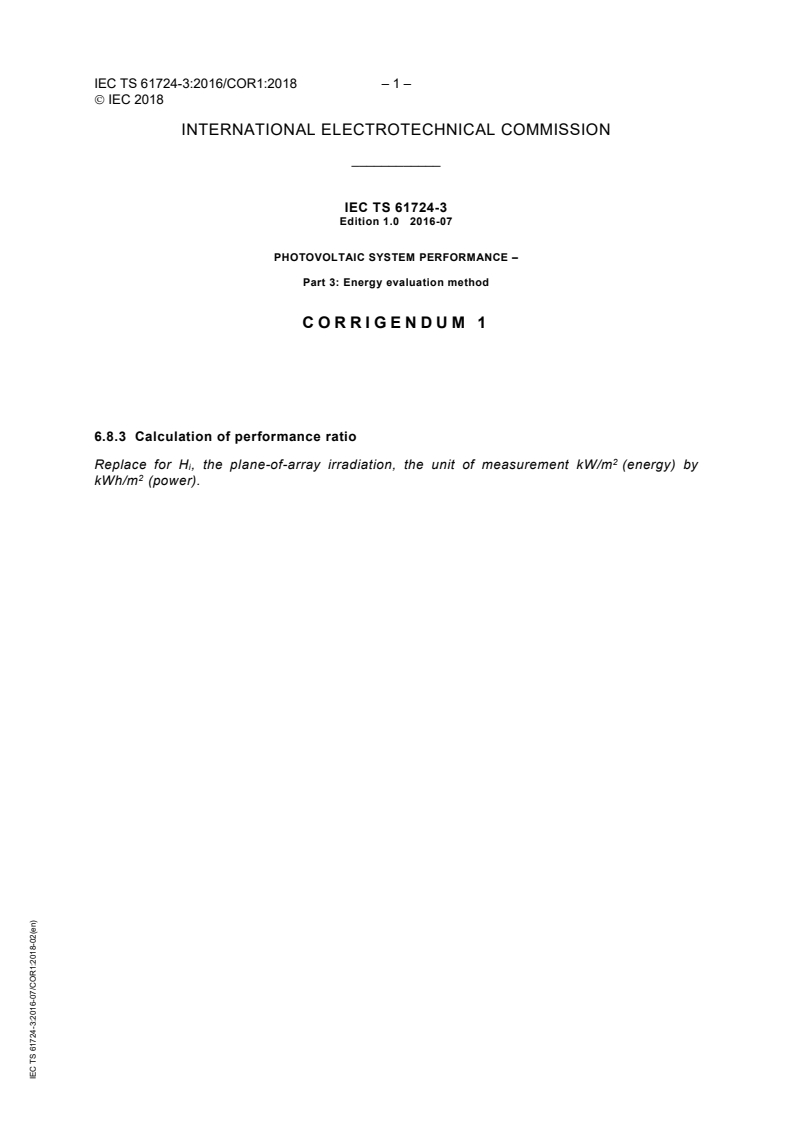
IEC TS 61724-3:2016/COR1:2018
(Corrigendum)Corrigendum 1 - Photovoltaic system performance - Part 3: Energy evaluation method
Corrigendum 1 - Photovoltaic system performance - Part 3: Energy evaluation method
General Information
Relations
Standards Content (Sample)
IEC 2018
INTERNATIONAL ELECTROTECHNICAL COMMISSION
____________
IEC TS 61724-3
Edition 1.0 2016-07
PHOTOVOLTAIC SYSTEM PERFORMANCE –
Part 3: Energy evaluation method
CO RRI G E NDUM 1
6.
...
This May Also Interest You
IEC 62548-1:2023 sets out design requirements for photovoltaic (PV) arrays including DC array wiring, electrical protection devices, switching and earthing provisions. The scope includes all parts of the PV array and final power conversion equipment (PCE), but not including energy storage devices, loads or AC or DC distribution network supplying loads. The object of this document is to address the design safety requirements arising from the particular characteristics of photovoltaic systems. This document also includes extra protection requirements of PV arrays when they are directly connected with batteries at the DC level.
This first edition cancels and replaces IEC 62548 published in 2016. This edition includes the following significant technical changes with respect to the previous edition:
a) Revised provisions for systems including DC to DC conditioning units.
b) Revision of mounting structure requirements.
c) Revised cable requirements.
d) Revision of Clause 6 on safety issues which includes provisions for protection against electric shock including array insulation monitoring and earth fault detection.
e) Revision of 7.2.7 and 7.3 with respect to isolation means.
f) Provisions for use of bifacial modules and modules mounted in non-optimal orientations.
g) New Annex F containing: KI factor calculations for bifacial and non-optimally oriented systems; anti-PID equipment and arc flash.
- Standard104 pagesEnglish languagesale 15% off
- Standard213 pagesEnglish languagesale 15% off
- Standard11 pagesEnglish languagesale 15% off
IEC TS 62257-350:2025 specifies the criteria for selecting and sizing inverters suitable for different off-grid applications integrating solar as an energy source. As well as off-grid systems, this document can also apply to inverters where a utility grid connection is available as a backup for charging batteries, but it is not intended to cover applications in which inverters synchronize and inject energy back into a utility grid, even though this capability can incidentally be a part of the functionality of the inverters. Single and multi-phase applications are included.
- Technical specification21 pagesEnglish languagesale 15% off
IEC 63349-1:2025 establishes control functions and operational performance requirements for photovoltaic direct-driven appliance (PVDDA) controllers.
PVDDA controllers are devices used for controlling power among power sources (such as a PV array, grid, energy storage, etc.) and appliances (such as an air-conditioner, refrigerator, water pump, etc.).
The requirements for PVDDA controllers are applicable to systems with voltages not higher than 1 500V DC or 1 000V AC. Safety and EMC requirements for the PVDDA controllers are under consideration and not covered by this document. Safety requirements for power converters connected to a PVDDA controller are listed as follows:
- for converter connected to PV array, IEC 62109‑1 and IEC 62109‑2 are applicable;
- for bi-directional converter connected to grid, IEC 62909‑1 and IEC 62909‑2 are applicable;
- for converter connected to energy storage, IEC 62477‑1 and IEC 62509 are applicable;
- for variable frequency drive, IEC 61800-5-1 is applicable.
Performance requirements for each individual power converter connected to a PVDDA controller refer to IEC 62093.
- Standard31 pagesEnglish languagesale 15% off
- Standard32 pagesFrench languagesale 15% off
- Standard63 pagesEnglish and French languagesale 15% off
IEC 63409-3:2025 specifies test procedures for confirming the basic operational characteristics of power conversion equipment (PCE) for use in photovoltaic (PV) power systems with or without energy storage. The basic operational characteristics are the capability of the PCE before any limitations due to internal settings are applied to the PCE to meet specific grid support functions or specific behaviours against abnormal changes.
This document covers the testing of the following items:
a) Steady state characteristics
Test procedures to confirm operable range of PCE at steady state condition are described. The operable ranges in apparent power, active power, reactive power, power factor, grid voltage and grid frequency are confirmed according to the test procedures.
b) Transient-response characteristics
Test procedures to confirm PCE’s response against a change of operational condition are described.
This document only considers the changes within normal (continuous) operable ranges. Therefore, the behaviours against abnormal changes and grid support functions are out of the scope and are covered in other parts of this series.
- Standard68 pagesEnglish languagesale 15% off
- Standard71 pagesFrench languagesale 15% off
- Standard139 pagesEnglish and French languagesale 15% off
IEC TS 61836:2025 covers solar photovoltaic (PV) terminology, definitions and symbols used in IEC TC 82 international standards.
- Technical specification22 pagesEnglish languagesale 15% off
IEC TS 63392:2025 specifies a test method for evaluating the basic fire behaviour of modules used in concentrating systems with a maximum DC system voltage of 1 500 V or less. Since the concentrator module may be exposed to flames due to flying embers or fire may be caused by the module itself due to hot spots or arching (internal fire), the tests outlined in this document are conducted in these two modes.
Applicable fire testing may be required by local codes but are not covered in this document.
CPV system or CPV modules mounted in or on buildings, shall fulfil national building and construction codes, regulations, and requirements and are not covered by this Technical Specification. If national or local codes define fire test requirements, they should be followed. If such requirements are not available, the following international and national standards give information for tests, which could be used: ISO 5657, ENV 1187-1 to -4, ANSI/UL 790, EN 13501-1.
- Technical specification15 pagesEnglish languagesale 15% off
IEC TS 63126:2025 defines additional testing requirements for photovoltaic (PV) modules deployed under conditions leading to higher module temperature which are beyond the scope of IEC 61215-1 and IEC 61730‑1 and the relevant component standards, IEC 62788‑1‑7, IEC 62788‑2‑1, IEC 62790 and IEC 62852. The testing conditions specified in IEC 61215-2 and IEC 61730-2 (and the relevant component standards IEC 62788‑1‑7, IEC 62788‑2‑1, IEC 62790 and IEC 62852) assumed that these standards are applicable for module deployment where the 98th percentile temperature (T98), that is the temperature that a module would be expected to exceed for 175,2 h per year, is less than 70 °C. This document defines two temperature regimes, temperature Level 1 and temperature Level 2, which were designed considering deployment in environments with mounting configurations such that the T98 is less than or equal to 80 °C for temperature Level 1, and less than or equal to 90 °C for temperature Level 2. This document provides recommended additional testing conditions within the IEC 61215 series, IEC 61730 series, IEC 62788‑1‑7, IEC 62788‑2‑1, IEC 62790 and IEC 62852 for module operation in temperature Levels 1 and 2. Successfully passing a higher Level for a test, sequence of tests, or complete testing for a higher Level is an implied passing of the relevant lower‑Level testing. For example, passing 200 thermal cycles for Level 2 is considered passing Level 0 and Level 1 for 200 thermal cycles.
- Technical specification70 pagesEnglish languagesale 15% off
IEC TS 61724-2:2025 applies to grid-connected PV systems comprising at least one inverter.
The test evaluates the PV system only in conditions where output is unconstrained by limitations in AC power output from the inverters. This document defines a test of a PV system's power performance index (PPI). PPI, defined in IEC 61724‑1, is the ratio of a system's measured power output under test conditions to its expected output at those conditions based on the system's design.
The test is intended to be performed over a short period of typically three to five days and is typically used to satisfy a contractual performance guarantee as part of the final completion of a PV power plant. This second edition cancels and replaces the first edition published in 2016. This edition includes the following significant technical changes with respect to the previous edition:
a) Adapting the document for bifacial PV systems, in accordance with the latest edition of IEC 61724‑1 and current industry practices.
b) Adapting the test procedure to account for the limited times of unconstrained system operation which are now common because of high DC-to-AC ratios (clipping) and interconnection limits (curtailment).
c) Adapting the test procedure to achieve a test that can be performed in a short time of three to five days during favourable conditions.
d) Focusing the document more heavily on the use of modern PV system modelling software to obtain the expected performance of the system under test.
e) Simplifying the mathematical procedure for calculating the test results.
f) Clearly identifying test elections (optional choices to be made in conducting the test) and providing a template for documenting these elections.
g) Clarifying the discussion of the test boundary that separates tested variables from untested variables.
h) Expanding and clarifying the discussion of data filtering.
- Technical specification26 pagesEnglish languagesale 15% off
IEC TS 62257-301:2025 specifies the design and implementation of hybrid off-grid solar systems, where solar energy provides energy to a load in conjunction with other sources of energy. Such systems can either include or not include an energy storage system. There are a variety of different system architectures and applications, and many ways in which these energy sources can be combined. This document distinguishes between different sorts of hybrid system applications and gives guidance on the design and integration of these systems.
It applies to single-phase and three-phase applications, and it covers situations where grid is available as an additional source of power for charging batteries and maintaining system reliability, but this document does not cover situations in which energy is fed back into a utility grid, although such systems can incidentally possess this function.
- Technical specification18 pagesEnglish languagesale 15% off


Questions, Comments and Discussion
Ask us and Technical Secretary will try to provide an answer. You can facilitate discussion about the standard in here.
Loading comments...