

IEC 61196-1-119:2020
(Main)Coaxial communication cables - Part 1-119: Electrical test methods - RF average power rating
General Information
- Abstract
IEC 61196-1-119:2020 defines the requirements to determine the average power handling capability of a coaxial cable at specified frequencies at ambient temperatures. This second edition cancels and replaces the first edition, published in 2012. This edition includes the following significant technical changes with respect to the previous edition:
- title was changed from: RF power rating to: RF average power rating;
- a test method to determine sufficient duration is included as annex
- the equations used for calculating cable coefficients and RF average power rating are corrected;
- the clauses and subclauses are rearranged.
- Status
- Published
- Publication Date
- 11-May-2020
- Technical Committee
- SC 46A - Coaxial cables
- Drafting Committee
- WG 3 - TC 46/SC 46A/WG 3
- Current Stage
- DELPUB - Deleted Publication
- Start Date
- 27-Jul-2023
- Completion Date
- 12-Jul-2021
Buy Documents
IEC 61196-1-119:2020 - Coaxial communication cables - Part 1-119: Electrical test methods - RF average power rating Released:5/12/2020
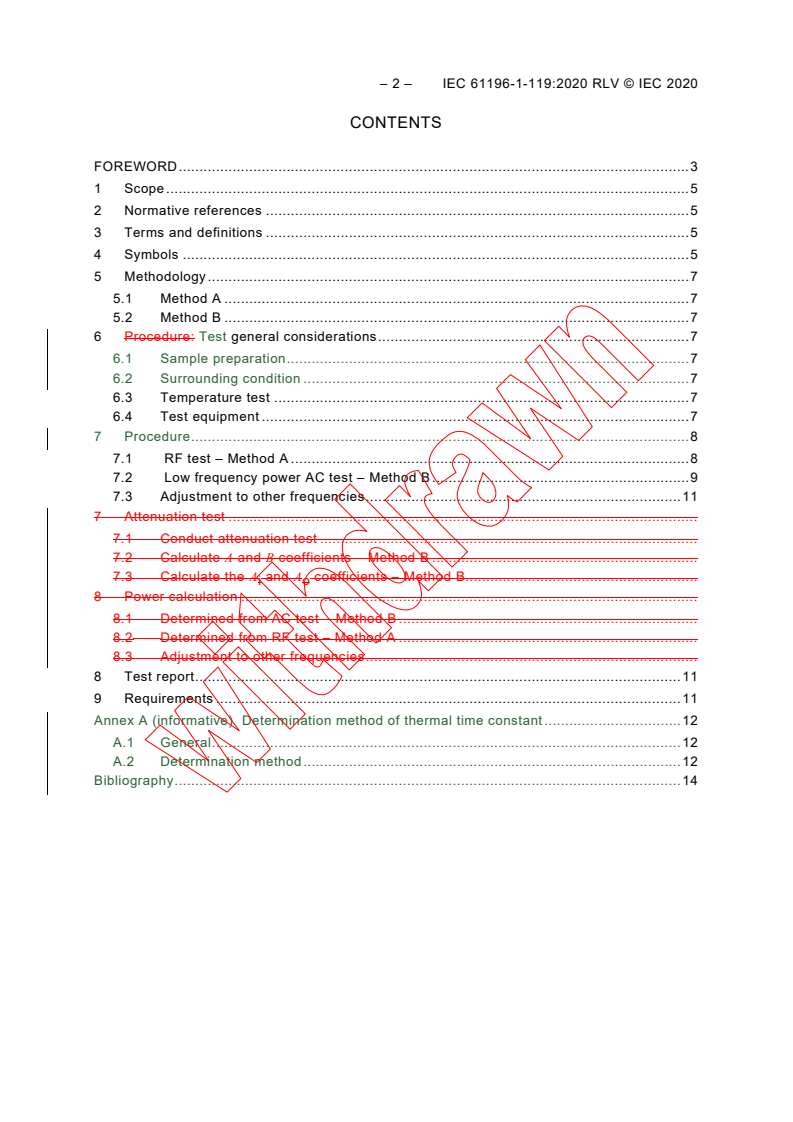
IEC 61196-1-119:2020 RLV - Coaxial communication cables - Part 1-119: Electrical test methods - RF average power rating Released:5/12/2020
Overview
IEC 61196-1-119:2020 - "Coaxial communication cables - Part 1-119: Electrical test methods - RF average power rating" specifies how to determine the RF average power rating (maximum continuous average input power) of coaxial communication cables at specified frequencies and ambient temperatures (reference usually 40 °C). This second edition (2020) revises the 2012 version: the title was clarified, a test method to determine sufficient test duration was added (Annex A), key calculation equations were corrected, and clauses were reorganized.
Key topics and requirements
- Definition of RF average power rating: power that causes conductor temperatures to reach allowable material limits when cable is terminated in its characteristic impedance.
- Two measurement methodologies:
- Method A (RF test): direct RF power application using an RF source, power meter, coupler and load. Temperatures are measured (recommended with a fibre‑optic thermocouple placed near the inner conductor) and input power increased in stages until conductor temperatures stabilize at limits.
- Method B (Low‑frequency AC method): uses 50 Hz or 60 Hz AC to derive thermal constants (Ki, Ko) for insulation and sheath. These frequency‑independent thermal parameters are then combined with RF attenuation data to calculate RF average power rating - useful when high RF power sources are unavailable.
- Test setup and measurement points:
- Use a cable length long enough to avoid end heat‑sinking effects.
- Temperature measurements at the cable center and at ±0.5 m from center; for RF tests measure at current antinode.
- Ensure natural air circulation around the cable.
- Thermal time constant and duration: Annex A provides a method to determine how long tests must run for temperatures to reach steady state.
- Adjustment to reference ambient: measured results are adjusted to a reference ambient temperature (typically 40 °C).
- Required reporting: procedures, equipment, measured temperatures, attenuation data and the calculated RF average power rating must be documented.
Applications and users
This standard is practical for:
- Cable manufacturers specifying or verifying power handling capability of coaxial cables.
- Test laboratories performing cable qualification and type approvals.
- RF system designers, installers and procurement engineers selecting cables for telecom, broadcast, satellite, radar and microwave links.
- Certification bodies and quality assurance teams ensuring cables meet thermal and power ratings.
Keywords: IEC 61196-1-119:2020, coaxial communication cables, RF average power rating, electrical test methods, power handling capability, thermal constants, Method A, Method B.
Related standards
- IEC 61196-1 - Generic specification for coaxial communication cables.
- IEC 61196-1-113 - Electrical test methods - Test for attenuation constant.
Relations
- Effective Date
- 05-Sep-2023
- Effective Date
- 05-Sep-2023
Buy Documents
IEC 61196-1-119:2020 - Coaxial communication cables - Part 1-119: Electrical test methods - RF average power rating Released:5/12/2020
IEC 61196-1-119:2020 RLV - Coaxial communication cables - Part 1-119: Electrical test methods - RF average power rating Released:5/12/2020
Get Certified
Connect with accredited certification bodies for this standard

ANCE
Mexican certification and testing association.

Intertek Slovenia
Intertek testing, inspection, and certification services in Slovenia.

LNE (Laboratoire National de Métrologie et d'Essais)
French national laboratory for metrology and testing.
Sponsored listings
Frequently Asked Questions
IEC 61196-1-119:2020 is a standard published by the International Electrotechnical Commission (IEC). Its full title is "Coaxial communication cables - Part 1-119: Electrical test methods - RF average power rating". This standard covers: IEC 61196-1-119:2020 defines the requirements to determine the average power handling capability of a coaxial cable at specified frequencies at ambient temperatures. This second edition cancels and replaces the first edition, published in 2012. This edition includes the following significant technical changes with respect to the previous edition: - title was changed from: RF power rating to: RF average power rating; - a test method to determine sufficient duration is included as annex - the equations used for calculating cable coefficients and RF average power rating are corrected; - the clauses and subclauses are rearranged.
IEC 61196-1-119:2020 defines the requirements to determine the average power handling capability of a coaxial cable at specified frequencies at ambient temperatures. This second edition cancels and replaces the first edition, published in 2012. This edition includes the following significant technical changes with respect to the previous edition: - title was changed from: RF power rating to: RF average power rating; - a test method to determine sufficient duration is included as annex - the equations used for calculating cable coefficients and RF average power rating are corrected; - the clauses and subclauses are rearranged.
IEC 61196-1-119:2020 is classified under the following ICS (International Classification for Standards) categories: 33.120.10 - Coaxial cables. Waveguides. The ICS classification helps identify the subject area and facilitates finding related standards.
IEC 61196-1-119:2020 has the following relationships with other standards: It is inter standard links to IEC 61196-1-119:2023, IEC 61196-1-119:2012. Understanding these relationships helps ensure you are using the most current and applicable version of the standard.
IEC 61196-1-119:2020 is available in PDF format for immediate download after purchase. The document can be added to your cart and obtained through the secure checkout process. Digital delivery ensures instant access to the complete standard document.
Standards Content (Sample)
IEC 61196-1-119 ®
Edition 2.0 2020-05
INTERNATIONAL
STANDARD
Coaxial communication cables –
Part 1-119: Electrical test methods – RF average power rating
All rights reserved. Unless otherwise specified, no part of this publication may be reproduced or utilized in any form
or by any means, electronic or mechanical, including photocopying and microfilm, without permission in writing from
either IEC or IEC's member National Committee in the country of the requester. If you have any questions about IEC
copyright or have an enquiry about obtaining additional rights to this publication, please contact the address below or
your local IEC member National Committee for further information.
IEC Central Office Tel.: +41 22 919 02 11
3, rue de Varembé info@iec.ch
CH-1211 Geneva 20 www.iec.ch
Switzerland
About the IEC
The International Electrotechnical Commission (IEC) is the leading global organization that prepares and publishes
International Standards for all electrical, electronic and related technologies.
About IEC publications
The technical content of IEC publications is kept under constant review by the IEC. Please make sure that you have the
latest edition, a corrigendum or an amendment might have been published.
IEC publications search - webstore.iec.ch/advsearchform Electropedia - www.electropedia.org
The advanced search enables to find IEC publications by a The world's leading online dictionary on electrotechnology,
variety of criteria (reference number, text, technical containing more than 22 000 terminological entries in English
committee,…). It also gives information on projects, replaced and French, with equivalent terms in 16 additional languages.
and withdrawn publications. Also known as the International Electrotechnical Vocabulary
(IEV) online.
IEC Just Published - webstore.iec.ch/justpublished
Stay up to date on all new IEC publications. Just Published IEC Glossary - std.iec.ch/glossary
details all new publications released. Available online and 67 000 electrotechnical terminology entries in English and
once a month by email. French extracted from the Terms and Definitions clause of
IEC publications issued since 2002. Some entries have been
IEC Customer Service Centre - webstore.iec.ch/csc collected from earlier publications of IEC TC 37, 77, 86 and
If you wish to give us your feedback on this publication or CISPR.
need further assistance, please contact the Customer Service
Centre: sales@iec.ch.
IEC 61196-1-119 ®
Edition 2.0 2020-05
INTERNATIONAL
STANDARD
Coaxial communication cables –
Part 1-119: Electrical test methods – RF average power rating
INTERNATIONAL
ELECTROTECHNICAL
COMMISSION
ICS 33.120.10 ISBN 978-2-8322-8067-6
– 2 – IEC 61196-1-119:2020 © IEC 2020
CONTENTS
FOREWORD . 3
1 Scope . 5
2 Normative references . 5
3 Terms and definitions . 5
4 Symbols . 5
5 Methodology . 7
5.1 Method A . 7
5.2 Method B . 7
6 Test general considerations . 7
6.1 Sample preparation . 7
6.2 Surrounding condition . 7
6.3 Temperature test . 7
6.4 Test equipment . 7
7 Procedure . 8
7.1 RF test – Method A . 8
7.2 Low frequency power AC test – Method B . 9
7.3 Adjustment to other frequencies . 10
8 Test report . 11
9 Requirements . 11
Annex A (informative) Determination method of thermal time constant . 12
A.1 General . 12
A.2 Determination method . 12
Bibliography . 14
INTERNATIONAL ELECTROTECHNICAL COMMISSION
____________
COAXIAL COMMUNICATION CABLES –
Part 1-119: Electrical test methods – RF average power rating
FOREWORD
1) The International Electrotechnical Commission (IEC) is a worldwide organization for standardization comprising
all national electrotechnical committees (IEC National Committees). The object of IEC is to promote
international co-operation on all questions concerning standardization in the electrical and electronic fields. To
this end and in addition to other activities, IEC publishes International Standards, Technical Specifications,
Technical Reports, Publicly Available Specifications (PAS) and Guides (hereafter referred to as “IEC
Publication(s)”). Their preparation is entrusted to technical committees; any IEC National Committee interested
in the subject dealt with may participate in this preparatory work. International, governmental and non-
governmental organizations liaising with the IEC also participate in this preparation. IEC collaborates closely
with the International Organization for Standardization (ISO) in accordance with conditions determined by
agreement between the two organizations.
2) The formal decisions or agreements of IEC on technical matters express, as nearly as possible, an international
consensus of opinion on the relevant subjects since each technical committee has representation from all
interested IEC National Committees.
3) IEC Publications have the form of recommendations for international use and are accepted by IEC National
Committees in that sense. While all reasonable efforts are made to ensure that the technical content of IEC
Publications is accurate, IEC cannot be held responsible for the way in which they are used or for any
misinterpretation by any end user.
4) In order to promote international uniformity, IEC National Committees undertake to apply IEC Publications
transparently to the maximum extent possible in their national and regional publications. Any divergence
between any IEC Publication and the corresponding national or regional publication shall be clearly indicated in
the latter.
5) IEC itself does not provide any attestation of conformity. Independent certification bodies provide conformity
assessment services and, in some areas, access to IEC marks of conformity. IEC is not responsible for any
services carried out by independent certification bodies.
6) All users should ensure that they have the latest edition of this publication.
7) No liability shall attach to IEC or its directors, employees, servants or agents including individual experts and
members of its technical committees and IEC National Committees for any personal injury, property damage or
other damage of any nature whatsoever, whether direct or indirect, or for costs (including legal fees) and
expenses arising out of the publication, use of, or reliance upon, this IEC Publication or any other IEC
Publications.
8) Attention is drawn to the Normative references cited in this publication. Use of the referenced publications is
indispensable for the correct application of this publication.
9) Attention is drawn to the possibility that some of the elements of this IEC Publication may be the subject of
patent rights. IEC shall not be held responsible for identifying any or all such patent rights.
International Standard IEC 61196-1-119 has been prepared by subcommittee 46A: Coaxial
cables, of IEC technical committee 46: Cables, wires, waveguides, RF connectors, RF and
microwave passive components and accessories.
This second edition cancels and replaces the first edition, published in 2012. This edition
constitutes a technical revision.
This edition includes the following significant technical changes with respect to the previous
edition:
a) title was changed from: RF power rating to: RF average power rating;
b) a test method to determine sufficient duration is included as Annex A;
c) the equations used for calculating cable coefficients and RF average power rating are
corrected;
d) the clauses and subclauses are rearranged.
– 4 – IEC 61196-1-119:2020 © IEC 2020
The text of this International Standard is based on the following documents:
FDIS Report on voting
46A/1401/FDIS 46A/1408/RVD
Full information on the voting for the approval of this International Standard can be found in
the report on voting indicated in the above table.
This document has been drafted in accordance with the ISO/IEC Directives, Part 2.
A list of all the parts in the IEC 61196 series published under the general title Coaxial
communication cables can be found on the IEC website.
The committee has decided that the contents of this document will remain unchanged until the
stability date indicated on the IEC website under "http://webstore.iec.ch" in the data related to
the specific document. At this date, the document will be
• reconfirmed,
• withdrawn,
• replaced by a revised edition, or
• amended.
COAXIAL COMMUNICATION CABLES –
Part 1-119: Electrical test methods – RF average power rating
1 Scope
This part of IEC 61196 defines the requirements to determine the average power handling
capability of a coaxial cable at specified frequencies at ambient temperatures.
2 Normative references
The following documents are referred to in the text in such a way that some or all of their
content constitutes requirements of this document. For dated references, only the edition
cited applies. For undated references, the latest edition of the referenced document (including
any amendments) applies.
IEC 61196-1, Coaxial communication cables – Part 1: Generic specification – General,
definitions and requirements
IEC 61196-1-113, Coaxial communication cables – Part 1-113: Electrical test methods – Test
for attenuation constant
3 Terms and definitions
For the purposes of this document, the terms and definitions given in IEC 61196-1 and the
following apply.
ISO and IEC maintain terminological databases for use in standardization at the following
addresses:
• IEC Electropedia: available at http://www.electropedia.org/
• ISO Online browsing platform: available at http://www.iso.org/obp
3.1
RF average power rating
maximum average input power that a cable can continuously handle when terminated in its
characteristic impedance at a reference ambient temperature (usually 40 °C) and RF
frequency
Note 1 to entry: RF average power rating is determined by the power level at which the temperature at any
location in the cable does not exceed the allowable maximum temperature rating of the materials used in the
cable’s construction.
Note 2 to entry: Typically, the inner conductor temperature determines the maximum operating temperature.
Note 3 to entry: The test RF signal is a pure sinusoidal, without any modulation.
4 Symbols
For the purposes of this document, the following symbols apply.
K thermal constant of the insulation (W/(°C·m))
i
K thermal constant of outer sheath (W/(°C·m))
o
– 6 – IEC 61196-1-119:2020 © IEC 2020
dB
attenuation constant associated with the conductors
A
m⋅ MHz
dB
attenuation constant of inner conductor
A
i
m⋅ MHz
dB
attenuati
...
IEC 61196-1-119 ®
Edition 2.0 2020-05
REDLINE VERSION
INTERNATIONAL
STANDARD
colour
inside
Coaxial communication cables –
Part 1-119: Electrical test methods – RF average power rating
All rights reserved. Unless otherwise specified, no part of this publication may be reproduced or utilized in any form
or by any means, electronic or mechanical, including photocopying and microfilm, without permission in writing from
either IEC or IEC's member National Committee in the country of the requester. If you have any questions about IEC
copyright or have an enquiry about obtaining additional rights to this publication, please contact the address below or
your local IEC member National Committee for further information.
IEC Central Office Tel.: +41 22 919 02 11
3, rue de Varembé info@iec.ch
CH-1211 Geneva 20 www.iec.ch
Switzerland
About the IEC
The International Electrotechnical Commission (IEC) is the leading global organization that prepares and publishes
International Standards for all electrical, electronic and related technologies.
About IEC publications
The technical content of IEC publications is kept under constant review by the IEC. Please make sure that you have the
latest edition, a corrigendum or an amendment might have been published.
IEC publications search - webstore.iec.ch/advsearchform Electropedia - www.electropedia.org
The advanced search enables to find IEC publications by a The world's leading online dictionary on electrotechnology,
variety of criteria (reference number, text, technical containing more than 22 000 terminological entries in English
committee,…). It also gives information on projects, replaced and French, with equivalent terms in 16 additional languages.
and withdrawn publications. Also known as the International Electrotechnical Vocabulary
(IEV) online.
IEC Just Published - webstore.iec.ch/justpublished
Stay up to date on all new IEC publications. Just Published IEC Glossary - std.iec.ch/glossary
details all new publications released. Available online and 67 000 electrotechnical terminology entries in English and
once a month by email. French extracted from the Terms and Definitions clause of
IEC publications issued since 2002. Some entries have been
IEC Customer Service Centre - webstore.iec.ch/csc collected from earlier publications of IEC TC 37, 77, 86 and
If you wish to give us your feedback on this publication or CISPR.
need further assistance, please contact the Customer Service
Centre: sales@iec.ch.
IEC 61196-1-119 ®
Edition 2.0 2020-05
REDLINE VERSION
INTERNATIONAL
STANDARD
colour
inside
Coaxial communication cables –
Part 1-119: Electrical test methods – RF average power rating
INTERNATIONAL
ELECTROTECHNICAL
COMMISSION
ICS 33.120.10 ISBN 978-2-8322-8356-1
– 2 – IEC 61196-1-119:2020 RLV © IEC 2020
CONTENTS
FOREWORD . 3
1 Scope . 5
2 Normative references . 5
3 Terms and definitions . 5
4 Symbols . 5
5 Methodology . 7
5.1 Method A . 7
5.2 Method B . 7
6 Procedure: Test general considerations . 7
6.1 Sample preparation . 7
6.2 Surrounding condition . 7
6.3 Temperature test . 7
6.4 Test equipment . 7
7 Procedure . 8
7.1 RF test – Method A . 8
7.2 Low frequency power AC test – Method B . 9
7.3 Adjustment to other frequencies . 11
7 Attenuation test .
7.1 Conduct attenuation test .
7.2 Calculate A and B coefficients – Method B .
7.3 Calculate the A and A coefficients – Method B.
i o
8 Power calculation .
8.1 Determined from AC test – Method B .
8.2 Determined from RF test – Method A .
8.3 Adjustment to other frequencies .
8 Test report . 11
9 Requirements . 11
Annex A (informative) Determination method of thermal time constant . 12
A.1 General . 12
A.2 Determination method . 12
Bibliography . 14
INTERNATIONAL ELECTROTECHNICAL COMMISSION
____________
COAXIAL COMMUNICATION CABLES –
Part 1-119: Electrical test methods – RF average power rating
FOREWORD
1) The International Electrotechnical Commission (IEC) is a worldwide organization for standardization comprising
all national electrotechnical committees (IEC National Committees). The object of IEC is to promote
international co-operation on all questions concerning standardization in the electrical and electronic fields. To
this end and in addition to other activities, IEC publishes International Standards, Technical Specifications,
Technical Reports, Publicly Available Specifications (PAS) and Guides (hereafter referred to as “IEC
Publication(s)”). Their preparation is entrusted to technical committees; any IEC National Committee interested
in the subject dealt with may participate in this preparatory work. International, governmental and non-
governmental organizations liaising with the IEC also participate in this preparation. IEC collaborates closely
with the International Organization for Standardization (ISO) in accordance with conditions determined by
agreement between the two organizations.
2) The formal decisions or agreements of IEC on technical matters express, as nearly as possible, an international
consensus of opinion on the relevant subjects since each technical committee has representation from all
interested IEC National Committees.
3) IEC Publications have the form of recommendations for international use and are accepted by IEC National
Committees in that sense. While all reasonable efforts are made to ensure that the technical content of IEC
Publications is accurate, IEC cannot be held responsible for the way in which they are used or for any
misinterpretation by any end user.
4) In order to promote international uniformity, IEC National Committees undertake to apply IEC Publications
transparently to the maximum extent possible in their national and regional publications. Any divergence
between any IEC Publication and the corresponding national or regional publication shall be clearly indicated in
the latter.
5) IEC itself does not provide any attestation of conformity. Independent certification bodies provide conformity
assessment services and, in some areas, access to IEC marks of conformity. IEC is not responsible for any
services carried out by independent certification bodies.
6) All users should ensure that they have the latest edition of this publication.
7) No liability shall attach to IEC or its directors, employees, servants or agents including individual experts and
members of its technical committees and IEC National Committees for any personal injury, property damage or
other damage of any nature whatsoever, whether direct or indirect, or for costs (including legal fees) and
expenses arising out of the publication, use of, or reliance upon, this IEC Publication or any other IEC
Publications.
8) Attention is drawn to the Normative references cited in this publication. Use of the referenced publications is
indispensable for the correct application of this publication.
9) Attention is drawn to the possibility that some of the elements of this IEC Publication may be the subject of
patent rights. IEC shall not be held responsible for identifying any or all such patent rights.
This redline version of the official IEC Standard allows the user to identify the changes
made to the previous edition. A vertical bar appears in the margin wherever a change
has been made. Additions are in green text, deletions are in strikethrough red text.
– 4 – IEC 61196-1-119:2020 RLV © IEC 2020
International Standard IEC 61196-1-119 has been prepared by subcommittee 46A: Coaxial
cables, of IEC technical committee 46: Cables, wires, waveguides, RF connectors, RF and
microwave passive components and accessories.
This second edition cancels and replaces the first edition, published in 2012. This edition
constitutes a technical revision.
This edition includes the following significant technical changes with respect to the previous
edition:
a) title was changed from: RF power rating to: RF average power rating;
b) a test method to determine sufficient duration is included as Annex A;
c) the equations used for calculating cable coefficients and RF average power rating are
corrected;
d) the clauses and subclauses are rearranged.
The text of this International Standard is based on the following documents:
FDIS Report on voting
46A/1401/FDIS 46A/1408/RVD
Full information on the voting for the approval of this International Standard can be found in
the report on voting indicated in the above table.
This document has been drafted in accordance with the ISO/IEC Directives, Part 2.
A list of all the parts in the IEC 61196 series published under the general title Coaxial
communication cables can be found on the IEC website.
The committee has decided that the contents of this document will remain unchanged until the
stability date indicated on the IEC website under "http://webstore.iec.ch" in the data related to
the specific document. At this date, the document will be
• reconfirmed,
• withdrawn,
• replaced by a revised edition, or
• amended.
IMPORTANT – The 'colour inside' logo on the cover page of this publication indicates
that it contains colours which are considered to be useful for the correct
understanding of its contents. Users should therefore print this document using a
colour printer.
COAXIAL COMMUNICATION CABLES –
Part 1-119: Electrical test methods – RF average power rating
1 Scope
This part of IEC 61196 defines the requirements to determine the average power handling
capability of a coaxial cable at specified frequencies at ambient temperatures.
2 Normative references
The following documents are referred to in the text in such a way that some or all of their
content constitutes requirements of this document. For dated references, only the edition
cited applies. For undated references, the latest edition of the referenced document (including
any amendments) applies.
IEC 61196-1, Coaxial communication cables – Part 1: Generic specification – General,
definitions and requirements
IEC 61196-1-113, Coaxial communication cables – Part 1-113: Electrical test methods – Test
for attenuation constant
3 Terms and definitions
For the purposes of this document, the terms and definitions given in IEC 61196-1 and the
following apply.
ISO and IEC maintain terminological databases for use in standardization at the following
addresses:
• IEC Electropedia: available at http://www.electropedia.org/
• ISO Online browsing platform: available at http://www.iso.org/obp
3.1
RF average power rating
maximum average input power that a cable can continuously handle when terminated in its
characteristic impedance at a reference ambient temperature (usually 40 °C) and RF
frequency
Note 1 to entry: RF average power rating is determined by the power level at which the temperature at any
location in the cable does not exceed the allowable maximum temperature rating of the materials used in the
cable’s construction.
Note 2 to entry: Typically, the inner conductor temperature determines the maximum operating temperature.
Note 3 to entry: The test RF signal is a pure sinusoidal, without any modulation.
4 Symbols
For the purposes of this document, the following symbols apply.
K thermal constant of the insulation (W/(°C·m))
i
K thermal constant of outer sheath (W/(°C·m))
o
– 6 – IEC 61196-1-119:2020 RLV © IEC 2020
dB
attenuation constant associated with the conductors
A
m ⋅ MHz
dB
attenuation constant of inner conductor
A
i
m ⋅ MHz
dB
attenuation constant of outer conductor
A
o
m ⋅ MHz
dB
attenuation constant for the dielectric material
B
m ⋅MHz
a mean outer diameter of inner conductor (mm)
Sine shape corrugated: Mean = (peak + root)/2
Other shape corrugated: Mean shall be specified by the manufacturer.
Smooth wall = (max + min)/2 outer diameter
Wire = outer diameter
b mean inner diameter of outer conductor (mm)
Sine shape corrugated: Mean = (peak + root)/2
Other shape corrugated: Mean shall be specified by the manufacturer.
Smooth wall = (max + min)/2 inner diameter
C corrugation factor of inner conductor:
i
Ratio of the distance that compares the non-corrugated (conversion of corrugated
length to an equivalent smooth wall length) to the cable corrugated length.
C > 1 for corrugated cable
i
C = 1 for smooth wall or wire
i
C corrugation factor of outer conductor
o
Ratio of the distance that compares the non-corrugated (conversion of corrugated
length to an equivalent smooth wall length) to the cable corrugated length.
C > 1 for corrugated cable
o
C = 1 for smooth wall
o
P RF input power (W)
in
P rated RF average power (W) at frequency f
r
P rated RF average power (W) at frequency f
rf1 1
P rated RF average power (W) at frequency f
rf2 2
P power dissipated in inner conductor (W/m)
i
P power dissipated in outer conductor (W/m)
o
σ conductivity of inner conductor (relative to copper)
i
σ conductivity of outer conductor (relative to copper)
o
γ temperature coefficient of resistance for inner conductor
i
γ temperature coefficient of resistance for outer conductor
o
α attenuation of cable, at frequency f (dB/100 m)
c
α attenuation of cable, at frequency f (dB/100 m)
f1 1
α attenuation of cable, at frequency f (dB/100 m)
f2 2
α attenuation of inner conductor, at frequency f (dB/100 m)
i
α attenuation of outer conductor, at frequency f (dB/100 m)
o
T inner conductor temperature (°C)
i
T outer conductor temperature (°C)
o
T test ambient temperature (°C)
a
T inner conductor temperature rise (°C)
ri
T outer conductor temperature rise (°C)
ro
R maximum rated ambient temperature (°C)
T
5 Methodology
5.1 Method A
If a suitable RF power source is available, it is possible to determine the input power required
for a conductor temperature to reach its limiting value (i.e. the RF average power rating), per
7.1. This provides measurements at one frequency and generally needs to be adjusted to
other frequencies by knowing the RF cable attenuation.
5.2 Method B
Cables of large diameter, however, have high RF average power ratings, and a suitable RF
source may not be available for such direct test. The following methodology allows the RF
average power rating to be determined by using low frequency (50 Hz or 60 Hz) AC power to
determine the required cable thermal characteristics first (i.e. the thermal constants K and K ).
i o
The low As these parameters are independent with frequency AC data needs to, it can be
combined with RF data for RF average power rating calculation. This is because the relative
conductor power dissipations are different. Also, there is no dissipation in the dielectric in the
low frequency case, but at RF frequencies it becomes significant.
6 Procedure: Test general considerations
6.1 Sample preparation
A cable of sufficient length shall be used so that the temperatures measured at the centre of
the cable are not influenced by heat sinking effects at the ends of the cable.
6.2 Surrounding condition
There shall be sufficient air space around the cable under test to allow natural air circulation.
6.3 Temperature test
Temperature measurements on the inner and outer conductors shall be made at the centre of
the cable length and 0,5 m away from both sides of the centre point. For RF test – method A,
the temperature should be measured at the cable’s current antinode.
Sufficient power should be applied for a conductor temperature to reach its maximum value,
determined by the materials used in the cable construction.
The thermocouples should be chosen and sized to eliminate the possibility of heat sinking
effects, particularly with thin walled cables.
The test is conducted for sufficient duration for the conductors to reach constant temperatures.
A test method to determine sufficient duration is included as Annex A.
6.4 Test equipment
For method A, the RF power source, power meter, temperature tester, coupler and absorbing
load are needed.
– 8 – IEC 61196-1-119:2020 RLV © IEC 2020
For method B, the AC power source, multimeter and temperature tester are needed.
No matter which method is used, the sufficient power should be applied for a conductor
temperature to reach its maximum value, and be determined by the materials used in the
cable construction.
The measured results and determination of the average power rating are adjusted for an
ambient temperature of 40 °C (or other specified ambient temperature).
7 Procedure
7.1 Procedure: RF test – Method A
The input of the cable shall be connected to the RF power source capable of delivering the
specified power at the specified test frequency at the load.
The load side of the cable shall be terminated in its characteristic impedance that is capable of
handling the power.
The input power, P , at the test frequency shall be monitored.
in
It is recommended to drill a small hole into the cable just above the inner conductor. A fibre
optic thermocouple should be placed within 1 mm above the surface of the inner conductor to
measure the temperature.
The input power, at room temperature (T ), shall be increased in stages until maximum
a
component temperature ratings are reached. The conductor temperatures are allowed to
stabilize at each stage and then recorded.
Each conductor temperature rise (T and T ) at each stage above the room temperature (T )
ri ro a
is determined for each input power level by subtracting the T from the measured conductors
a
(T or T ) temperature.
i o
For each stage, T and T shall be determined for R by adding T and T to R .
i o T ri ro T
Compare the recalculated T and T at R to the maximum temperature ratings of the cable
i o T
components. The power rating is the level that does not exceed the maximum temperature
ratings of the cable components.
The increase in conductor temperature above ambient temperature is determined for each
input power level. The average power rating (P ) is that power which will cause an increase in
r
conductor temperature above ambient equal to the difference between the maximum
conductor temperature and the reference ambient (usually 40 °C).
The measurement error of P should be taken into account when the load is mismatched.
r
1+ s
( )
e =100×−1 (1)
max
where
is the measurement error of P ;
e
max r
s is the SWR of the DUT.
7.2 Procedure: Low frequency power AC test – Method B
The input of the cable shall be connected to a 50 Hz or 60 Hz source capable of delivering
sufficient current carrying capacity.
The opposite cable end shall be short circuited by connecting the inner conductor to the outer
conductor.
Adjust the current levels to within 15 % of the maximum temperature ratings of the cable
components heat the cable until the cable inner conductor’s temperature approaches the
maximum insulation operating temperature.
The current, the voltages across both inner and outer conductors and the conductor
temperatures (when they have stabilized) shall be measured and recorded. From the voltage
and current values, the dissipated powers in the inner and outer conductors (P and P ) are
i o
determined.
The thermal constants K and K are derived from the following equations:
i o
P= K×()TT−
(2)
i i io
PP+= K×()T−T (3)
i o o oa
7 Attenuation test
7.1 Conduct attenuation test
An attenuation test shall be conducted in accordance with IEC 61196-1-113 to determine the
attenuation at a test ambient at several frequencies over the operating band of the cable. This
attenuation response will be used to determine the coefficient for the conductors and
dielectric which will then be used in the RF average power calculations at specified frequency
or used in determining RF power at other frequencies.
7.2 Calculate A and B coefficients – Method B
The A and B coefficients in Formula (4) are calculated by performing a least squares analysis,
which is a fit of the measured attenuation and frequency data:
α = A× f + B × f (dB/100 m) (4)
c
where
A is the coefficient for the conductors;
B is the coefficient for the dielectric;
f is the frequency in MHz.
The A and B coefficients are calculated from the attenuation test from the following formulas:
– 10 – IEC 61196-1-119:2020 RLV © IEC 2020
nn n n
α
i
ff× −× α
∑∑i ∑ ii∑
f
i 11i i 1 i 1
i
A = (5)
nn
nf× − f
∑∑i i
i 11i
n n n
α
i
nf×−α ×
∑ ∑ ∑
i i
f
i 11i i 1
i
B = (6)
nn
nf× − f
∑∑
i i
i 11i
7.3 Calculate the A and A coefficients – Method B
i o
The A coefficient represents the contribution of the inner and outer conductors. To calculate
the power, the conductor inner and outer conductor coefficients (A and A ) are needed and
i o
are determined from the conductivity of the inner and outer conductor. It is determined as
follows:
C
i
a × σ
i
A = A× (7)
i
C C
i o
+
a × σ b × σ
i o
C
o
b× σ
o
A = A× (8)
o
C C
i o
+
ab××σσ
io
8 Power calculation
8.1 Determined from AC test – Method B
Now, the maximum RF average power rating (P ) can be determined by solving the following
r
equations numerically (e.g. by using a suitable spreadsheet) for any given frequency and
ambient temperature and some limiting value for either inner or outer conductor temperature.
f
P= PA× × 1+ γ× T− 20× (9)
( )
i ri i i
4,343
f
P= PA× × 1+ γ× T− 20× (10)
( )
o r o o o
4,343
B
P= P× f× (11)
dr
4,343
==
===
==
= = ==
P
d
P+ =×−K ()TT (12)
i i io
PP++ P= K×()T−T (13)
i o d o oa
8.2 Determined from RF test – Method A
This is determined directly from the test at the test frequency (see 6.2).
7.3 Adjustment to other frequencies
The following formulas can be used to solve for the average power for either the AC or RF
methods.
α ××P = α P (14)
ffrr
21f f
or
α
f
PP× (15)
rr
ff
α
f
2
8 Test report
The test report shall include the following:
– method used,
– test conditions,
– test temperature,
– maximum rated operating temperature,
– average power rating determined at specified RF frequencies.
9 Requirements
The measured or calculated temperatures shall not exceed the specified temperature ratings
of the materials.
=
– 12 – IEC 61196-1-119:2020 RLV © IEC 2020
Annex A
(informative)
Determination method of thermal time constant
A.1 General
From Definition 3.1, the RF average power rating depends on the maximum operating
temperature (the heat generation and dissipation getting in balance) of the cable allowed.
Typically, the inner conductor temperature determines the maximum operating temperature,
because it always has the highest temperature in the cable construction.
When the power is fed to the cable, due to the influence of the thermal resistance, the cable
temperature will not reach steady state immediately. This temperature increase period can be
...