

IEC 60721-2-2:2012
(Main)Classification of environmental conditions - Part 2-2: Environmental conditions appearing in nature - Precipitation and wind
General Information
- Abstract
IEC 60721-2-2:2012 presents fundamental properties, quantities for characterization, and a classification of environmental conditions dependent on precipitation and wind relevant for electrotechnical products. This second edition cancels and replaces the first edition, published in 1988, and constitutes a technical revision. The main changes with regard to the previous edition are as follows:
- subclause Precipitation: simplified;
- data not possible to validate are removed;
- subclause Wind: text rewritten;
- Table 1 simplified and aligned with definition used by [1];
- subclause Hail: data added;
- formula changed;
- formula for impact energy added;
- subclause Snow: text changed and aligned with definitions used by [1];
- Table 3 removed;
- subclause Normal rain: text has been modified and numeric values removed;
- subclause Driving rain: text has been modified and numeric values removed;
- subclause Formation of ice: text has been modified and numeric values removed;
- subclause Drifting snow: text added;
- subclause Wind force: formula changed;
- Figure 1 to 5 removed.
- Status
- Published
- Publication Date
- 12-Dec-2012
- Technical Committee
- TC 104 - Environmental conditions, classification and methods of test
- Drafting Committee
- MT 16 - TC 104/MT 16
- Current Stage
- DELPUB - Deleted Publication
- Start Date
- 25-Oct-2024
- Completion Date
- 17-Feb-2023
Overview
IEC 60721-2-2:2012 is an international standard published by the International Electrotechnical Commission (IEC) that classifies environmental conditions related to precipitation and wind. Specifically designed for electrotechnical products, this standard presents fundamental properties, key parameters for characterization, and a systematic classification of natural environmental conditions involving rain, hail, snow, and wind. It assists manufacturers and engineers in selecting appropriate environmental severities when designing and testing electrotechnical equipment to ensure durability and reliability under varied weather conditions.
The 2012 edition is a technical revision of the 1988 version, featuring simplified and updated content to reflect validated data and modern terminologies. It enhances clarity on precipitation mechanisms and wind forces, aligning definitions with recognized meteorological sources.
Key Topics
Precipitation Classification
Covers types of precipitation including normal rain, driving rain, hail, snow, and formation of ice (air hoar, rime, clear ice, glaze ice). The standard details the physical characteristics such as rain intensity, drop size distribution, falling velocity, and typical temperatures associated with rain and other hydrometeors.Wind Characteristics
Describes wind as the horizontal movement of the atmosphere, influenced by pressure gradients and the Earth's rotation (Coriolis force). The standard distinguishes between various wind phenomena from breezes and gales to hurricanes, emphasizing their impact on electrotechnical product environments.Environmental Parameter Severities
Provides a basis for understanding relevant severities in precipitation and wind parameters, aiding users in applying the appropriate class when specifying product requirements in accordance with IEC 60721-1.Updated Formulations and Data
Introduces new formulas for impact energy relating to hail and revised classification criteria for wind force, driving rain, and snow, ensuring harmonization with international meteorological datasets.
Applications
Product Design and Testing
Engineers use IEC 60721-2-2 to determine environmental stressors from precipitation and wind that electrotechnical products will encounter. These conditions influence materials selection, protective coatings, sealing requirements, and mechanical reinforcement.Environmental Risk Assessment
Enables manufacturers to assess exposure risks in different geographic locations and climates, including regions prone to heavy snowfall, intense hailstorms, or strong prevailing winds, ensuring compliance with safety standards.Standards Compliance and Certification
Serves as a reference for certification bodies and testing laboratories gauging product performance limits against classified environmental conditions, forming part of conformity assessment procedures.Infrastructure and Outdoor Equipment
Influences design standards for outdoor electrical installations, transmission equipment, street lighting, and renewable energy systems exposed to precipitation and wind, ensuring operational stability and longevity.
Related Standards
IEC 60721-1: Classification of Environmental Conditions – Part 1
Defines environmental parameters and their severities, providing complementary guidance for selecting appropriate classes of environmental influence for product testing.IEC 60068 Series: Environmental Testing
Contains methods for testing electrotechnical products against various environmental stresses, including those related to moisture, temperature, and mechanical forces, building upon the classifications given in IEC 60721.ISO Meteorological Standards
Many of the definitions and parameters in IEC 60721-2-2 align with ISO climate-related standards and international meteorological datasets to ensure global relevance and applicability.
Keywords: IEC 60721-2-2, environmental classification, precipitation classification, wind classification, electrotechnical product standards, rain intensity, hail impact energy, snow load, driving rain, wind force, environmental conditions standard, IEC environmental testing.
Relations
- Effective Date
- 03-Jun-2026
- Effective Date
- 05-Sep-2023
Get Certified
Connect with accredited certification bodies for this standard

IMP NDT d.o.o.
Non-destructive testing services. Radiography, ultrasonic, magnetic particle, penetrant, visual inspection.
Inštitut za kovinske materiale in tehnologije
Institute of Metals and Technology. Materials testing, metallurgical analysis, NDT.
Q Techna d.o.o.
NDT and quality assurance specialist. 30+ years experience. NDT personnel certification per ISO 9712, nuclear and thermal power plant inspections, QA/
Sponsored listings
Frequently Asked Questions
IEC 60721-2-2:2012 is a standard published by the International Electrotechnical Commission (IEC). Its full title is "Classification of environmental conditions - Part 2-2: Environmental conditions appearing in nature - Precipitation and wind". This standard covers: IEC 60721-2-2:2012 presents fundamental properties, quantities for characterization, and a classification of environmental conditions dependent on precipitation and wind relevant for electrotechnical products. This second edition cancels and replaces the first edition, published in 1988, and constitutes a technical revision. The main changes with regard to the previous edition are as follows: - subclause Precipitation: simplified; - data not possible to validate are removed; - subclause Wind: text rewritten; - Table 1 simplified and aligned with definition used by [1]; - subclause Hail: data added; - formula changed; - formula for impact energy added; - subclause Snow: text changed and aligned with definitions used by [1]; - Table 3 removed; - subclause Normal rain: text has been modified and numeric values removed; - subclause Driving rain: text has been modified and numeric values removed; - subclause Formation of ice: text has been modified and numeric values removed; - subclause Drifting snow: text added; - subclause Wind force: formula changed; - Figure 1 to 5 removed.
IEC 60721-2-2:2012 presents fundamental properties, quantities for characterization, and a classification of environmental conditions dependent on precipitation and wind relevant for electrotechnical products. This second edition cancels and replaces the first edition, published in 1988, and constitutes a technical revision. The main changes with regard to the previous edition are as follows: - subclause Precipitation: simplified; - data not possible to validate are removed; - subclause Wind: text rewritten; - Table 1 simplified and aligned with definition used by [1]; - subclause Hail: data added; - formula changed; - formula for impact energy added; - subclause Snow: text changed and aligned with definitions used by [1]; - Table 3 removed; - subclause Normal rain: text has been modified and numeric values removed; - subclause Driving rain: text has been modified and numeric values removed; - subclause Formation of ice: text has been modified and numeric values removed; - subclause Drifting snow: text added; - subclause Wind force: formula changed; - Figure 1 to 5 removed.
IEC 60721-2-2:2012 is classified under the following ICS (International Classification for Standards) categories: 19.040 - Environmental testing. The ICS classification helps identify the subject area and facilitates finding related standards.
IEC 60721-2-2:2012 has the following relationships with other standards: It is inter standard links to EN ISO 10140-1:2010/A2:2014, IEC 60721-2-2:2024. Understanding these relationships helps ensure you are using the most current and applicable version of the standard.
IEC 60721-2-2:2012 is available in PDF format for immediate download after purchase. The document can be added to your cart and obtained through the secure checkout process. Digital delivery ensures instant access to the complete standard document.
Standards Content (Sample)
IEC 60721-2-2 ®
Edition 2.0 2012-12
INTERNATIONAL
STANDARD
NORME
INTERNATIONALE
Classification of environmental conditions –
Part 2-2: Environmental conditions appearing in nature – Precipitation and wind
Classification des conditions d'environnement –
Partie 2-2: Conditions d'environnement présentes dans la nature – Précipitations
et vent
All rights reserved. Unless otherwise specified, no part of this publication may be reproduced or utilized in any form
or by any means, electronic or mechanical, including photocopying and microfilm, without permission in writing from
either IEC or IEC's member National Committee in the country of the requester.
If you have any questions about IEC copyright or have an enquiry about obtaining additional rights to this publication,
please contact the address below or your local IEC member National Committee for further information.
Droits de reproduction réservés. Sauf indication contraire, aucune partie de cette publication ne peut être reproduite ni
utilisée sous quelque forme que ce soit et par aucun procédé, électronique ou mécanique, y compris la photocopie et les
microfilms, sans l'accord écrit de la CEI ou du Comité national de la CEI du pays du demandeur.
Si vous avez des questions sur le copyright de la CEI ou si vous désirez obtenir des droits supplémentaires sur cette
publication, utilisez les coordonnées ci-après ou contactez le Comité national de la CEI de votre pays de résidence.
IEC Central Office Tel.: +41 22 919 02 11
3, rue de Varembé Fax: +41 22 919 03 00
CH-1211 Geneva 20 info@iec.ch
Switzerland www.iec.ch
About the IEC
The International Electrotechnical Commission (IEC) is the leading global organization that prepares and publishes
International Standards for all electrical, electronic and related technologies.
About IEC publications
The technical content of IEC publications is kept under constant review by the IEC. Please make sure that you have the
latest edition, a corrigenda or an amendment might have been published.
Useful links:
IEC publications search - www.iec.ch/searchpub Electropedia - www.electropedia.org
The advanced search enables you to find IEC publications The world's leading online dictionary of electronic and
by a variety of criteria (reference number, text, technical electrical terms containing more than 30 000 terms and
committee,…). definitions in English and French, with equivalent terms in
It also gives information on projects, replaced and additional languages. Also known as the International
withdrawn publications. Electrotechnical Vocabulary (IEV) on-line.
IEC Just Published - webstore.iec.ch/justpublished Customer Service Centre - webstore.iec.ch/csc
Stay up to date on all new IEC publications. Just Published If you wish to give us your feedback on this publication
details all new publications released. Available on-line and or need further assistance, please contact the
also once a month by email. Customer Service Centre: csc@iec.ch.
A propos de la CEI
La Commission Electrotechnique Internationale (CEI) est la première organisation mondiale qui élabore et publie des
Normes internationales pour tout ce qui a trait à l'électricité, à l'électronique et aux technologies apparentées.
A propos des publications CEI
Le contenu technique des publications de la CEI est constamment revu. Veuillez vous assurer que vous possédez
l’édition la plus récente, un corrigendum ou amendement peut avoir été publié.
Liens utiles:
Recherche de publications CEI - www.iec.ch/searchpub Electropedia - www.electropedia.org
La recherche avancée vous permet de trouver des Le premier dictionnaire en ligne au monde de termes
publications CEI en utilisant différents critères (numéro de électroniques et électriques. Il contient plus de 30 000
référence, texte, comité d’études,…). termes et définitions en anglais et en français, ainsi que
Elle donne aussi des informations sur les projets et les les termes équivalents dans les langues additionnelles.
publications remplacées ou retirées. Egalement appelé Vocabulaire Electrotechnique
International (VEI) en ligne.
Just Published CEI - webstore.iec.ch/justpublished
Service Clients - webstore.iec.ch/csc
Restez informé sur les nouvelles publications de la CEI.
Just Published détaille les nouvelles publications parues. Si vous désirez nous donner des commentaires sur
Disponible en ligne et aussi une fois par mois par email. cette publication ou si vous avez des questions
contactez-nous: csc@iec.ch.
IEC 60721-2-2 ®
Edition 2.0 2012-12
INTERNATIONAL
STANDARD
NORME
INTERNATIONALE
Classification of environmental conditions –
Part 2-2: Environmental conditions appearing in nature – Precipitation and wind
Classification des conditions d'environnement –
Partie 2-2: Conditions d'environnement présentes dans la nature – Précipitations
et vent
INTERNATIONAL
ELECTROTECHNICAL
COMMISSION
COMMISSION
ELECTROTECHNIQUE
PRICE CODE
INTERNATIONALE
CODE PRIX M
ICS 19.040 ISBN 978-2-83220-570-9
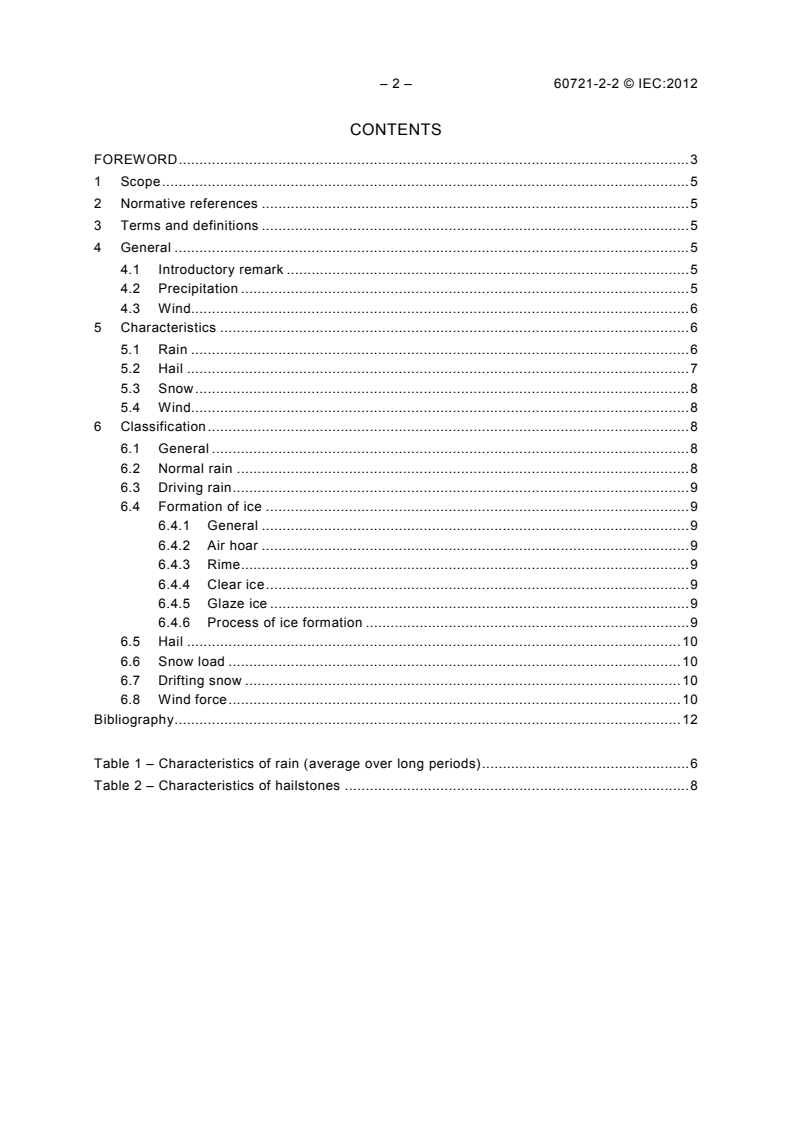
– 2 – 60721-2-2 © IEC:2012
CONTENTS
FOREWORD . 3
1 Scope . 5
2 Normative references . 5
3 Terms and definitions . 5
4 General . 5
4.1 Introductory remark . 5
4.2 Precipitation . 5
4.3 Wind . 6
5 Characteristics . 6
5.1 Rain . 6
5.2 Hail . 7
5.3 Snow . 8
5.4 Wind . 8
6 Classification . 8
6.1 General . 8
6.2 Normal rain . 8
6.3 Driving rain . 9
6.4 Formation of ice . 9
6.4.1 General . 9
6.4.2 Air hoar . 9
6.4.3 Rime . 9
6.4.4 Clear ice . 9
6.4.5 Glaze ice . 9
6.4.6 Process of ice formation . 9
6.5 Hail . 10
6.6 Snow load . 10
6.7 Drifting snow . 10
6.8 Wind force . 10
Bibliography . 12
Table 1 – Characteristics of rain (average over long periods) . 6
Table 2 – Characteristics of hailstones . 8
60721-2-2 © IEC:2012 – 3 –
INTERNATIONAL ELECTROTECHNICAL COMMISSION
____________
CLASSIFICATION OF ENVIRONMENTAL CONDITIONS –
Part 2-2: Environmental conditions appearing in nature –
Precipitation and wind
FOREWORD
1) The International Electrotechnical Commission (IEC) is a worldwide organization for standardization comprising
all national electrotechnical committees (IEC National Committees). The object of IEC is to promote
international co-operation on all questions concerning standardization in the electrical and electronic fields. To
this end and in addition to other activities, IEC publishes International Standards, Technical Specifications,
Technical Reports, Publicly Available Specifications (PAS) and Guides (hereafter referred to as “IEC
Publication(s)”). Their preparation is entrusted to technical committees; any IEC National Committee interested
in the subject dealt with may participate in this preparatory work. International, governmental and non-
governmental organizations liaising with the IEC also participate in this preparation. IEC collaborates closely
with the International Organization for Standardization (ISO) in accordance with conditions determined by
agreement between the two organizations.
2) The formal decisions or agreements of IEC on technical matters express, as nearly as possible, an international
consensus of opinion on the relevant subjects since each technical committee has representation from all
interested IEC National Committees.
3) IEC Publications have the form of recommendations for international use and are accepted by IEC National
Committees in that sense. While all reasonable efforts are made to ensure that the technical content of IEC
Publications is accurate, IEC cannot be held responsible for the way in which they are used or for any
misinterpretation by any end user.
4) In order to promote international uniformity, IEC National Committees undertake to apply IEC Publications
transparently to the maximum extent possible in their national and regional publications. Any divergence
between any IEC Publication and the corresponding national or regional publication shall be clearly indicated in
the latter.
5) IEC itself does not provide any attestation of conformity. Independent certification bodies provide conformity
assessment services and, in some areas, access to IEC marks of conformity. IEC is not responsible for any
services carried out by independent certification bodies.
6) All users should ensure that they have the latest edition of this publication.
7) No liability shall attach to IEC or its directors, employees, servants or agents including individual experts and
members of its technical committees and IEC National Committees for any personal injury, property damage or
other damage of any nature whatsoever, whether direct or indirect, or for costs (including legal fees) and
expenses arising out of the publication, use of, or reliance upon, this IEC Publication or any other IEC
Publications.
8) Attention is drawn to the Normative references cited in this publication. Use of the referenced publications is
indispensable for the correct application of this publication.
9) Attention is drawn to the possibility that some of the elements of this IEC Publication may be the subject of
patent rights. IEC shall not be held responsible for identifying any or all such patent rights.
International Standard IEC 60721-2-2 has been prepared by IEC technical committee 104:
Environmental conditions, classification and methods of test.
This second edition cancels and replaces the first edition, published in 1988, and constitutes
a technical revision.
The main changes with regard to the previous edition are as follows:
– subclause Precipitation: simplified; data not possible to validate are removed;
– subclause Wind: text rewritten;
– Table 1 simplified and aligned with definition used by [1] ;
– subclause Hail: data added; formula changed; formula for impact energy added;
———————
References in square brackets refer to the Bibliography.
– 4 – 60721-2-2 © IEC:2012
– subclause Snow: text changed and aligned with definitions used by [1];
– Table 3 removed;
– subclause Normal rain: text has been modified and numeric values removed;
– subclause Driving rain: text has been modified and numeric values removed;
– subclause Formation of ice: text has been modified and numeric values removed;
– subclause Drifting snow: text added;
– subclause Wind force: formula changed;
– Figure 1 to 5 removed.
The text of this standard is based on the following documents:
FDIS Report on voting
104/583/FDIS 104/596/RVD
Full information on the voting for the approval of this standard can be found in the report on
voting indicated in the above table.
This publication has been drafted in accordance with the ISO/IEC Directives, Part 2.
A list of all parts in the IEC 60068 series, under the general title Classification of
environmental conditions, can be found on the IEC website.
The committee has decided that the contents of this publication will remain unchanged until
the stability date indicated on the IEC web site under "http://webstore.iec.ch" in the data
related to the specific publication. At this date, the publication will be
• reconfirmed,
• withdrawn,
• replaced by a revised edition, or
• amended.
60721-2-2 © IEC:2012 – 5 –
CLASSIFICATION OF ENVIRONMENTAL CONDITIONS –
Part 2-2: Environmental conditions appearing in nature –
Precipitation and wind
1 Scope
This part of IEC 60721 presents fundamental properties, quantities for characterization, and a
classification of environmental conditions dependent on precipitation and wind relevant for
electrotechnical products.
It is intended to be used as background material when selecting appropriate severities of
parameters related to precipitation and wind for product applications.
When selecting severities of parameters related to precipitation and wind for product
application, the values given in IEC 60721-1 should be applied.
2 Normative references
The following documents, in whole or in part, are normatively referenced in this document and
are indispensable for its application. For dated references, only the edition cited applies. For
undated references, the latest edition of the referenced document (including any
amendments) applies.
IEC 60721-1, Classification of environmental conditions – Part 1: Environmental parameters
and their severities.
3 Terms and definitions
Terms and definitions are defined, in context, throughout the present standard.
4 General
4.1 Introductory remark
The atmosphere of the Earth is in permanent motion. It is locally heated, cooled and
moistened. The resulting gradients in density create high and low pressure areas. The
equalizing winds do not blow directly from high to low pressure areas, but are deflected by
Coriolis force due to the rotation of the Earth.
The continuous horizontal movement may cause slow upward motion over wide areas, or
surface heating may give more localized updrafts in thermals. The air cannot maintain its
water content in vaporous form if the reduction of pressure and temperature is sufficient, and
precipitation may form. As an example, an air mass at +20 °C temperature is able to contain
water in a quantity of 17,3 g/m in vaporous form. If it cools to 0 °C the maximum water
content is only 4,8 g/m .
4.2 Precipitation
The specific kind of precipitation (rain, hail or snow) is a result of complicated processes in
the clouds.
– 6 – 60721-2-2 © IEC:2012
Formation of raindrops or ice crystals depends on various conditions, for instance vertical air
currents, temperature distribution, and the resulting course of droplets or ice crystals within
the cloud.
4.3 Wind
Wind is defined as lateral movement of the Earth's atmosphere from high-pressure areas to
low-pressure areas.
Winds are often referred to by their strength and the direction from which the wind is blowing.
Gusts are short bursts of high speed wind. Winds of long duration have various names
associated with their average strength, such as breeze, gale, storm, hurricane and typhoon.
Wind occurs on a scale ranging from thunderstorm flows, lasting tens of minutes, through
local breezes generated by heating of land surfaces and lasting a few hours, to global winds
resulting from the difference in absorption of solar energy between the climate zones on
Earth. The two main causes of large scale atmospheric circulation are the differential heating
between the equator and the poles and the rotation of the planet.
5 Characteristics
5.1 Rain
Rain is characterized by the following physical parameters:
– rain intensity measured in millimetres per hour (as the height accumulated on a horizontal
surface without drain);
– drop size distribution; typical 1 mm to 2 mm in diameter, in thunderstorms the size could
be up to 5 mm to 8 mm;
– falling velocity distribution; typical 2 m/s to 12 m/s;
– raindrop temperature.
Other parameters such as dissolved impurities due to air pollution, sea salts, etc., are not
considered here, even though they may have important effects on products.
A survey of characteristic parameters for different types of rain is given in Table 1 below, in
accordance with [1].
Table 1 – Characteristics of rain (average over long periods)
Type of rain Rain intensity
upper limit
mm/h
Very light rain 0,25
Light rain 1,0
Moderate rain 4,0
Heavy rain 16
Very heavy rain 50
Extreme rain >50
The raindrop temperature will normally be the same as the wet bulb temperate of an aspirated
psychrometer but deviations may occur, for instance in a rain established from ice crystals or
at the beginning of a period of rainfall.
60721-2-2 © IEC:2012 – 7 –
5.2 Hail
Hail is characterized by the following physical parameters of the hailstones:
– diameter; typical 5 mm to 15 mm;
3 3
– density; typical large hail greater than 800 kg/m and small hail less than 800 kg/m ;
– falling velocity;
– impact energy;
– typical drag coefficient (C ) is 0,6 but depends on hail size, irregularities in shape and in
d
surface roughness [2].
Only stones of larger diameter are considered here because of their damaging effect but
stones of smaller diameter are by far the most frequent [1].
The falling velocity is determined by the formula:
2×W
v=
C ×ρ ×A
d 0
where
ν is the falling velocity in metres per second;
W is the weight (mass∙acceleration);
C is the drag coefficient;
d
ρ is the atmospheric density in kg per cubic metres;
A is the frontal area in square metres.
ρ = 1,225 kg/m (standard atmosphere for dry air at sea level and at +15 °C).
The impact energy is then calculated from the mass (diameter, density) and the falling
velocity.
The impact energy is determined by the formula:
m× v
E=
where
E is the impact energy in Joules;
m is the mass of the hail in kg;
ν is the falling velocity in metres per second.
Table 2 gives the characteristics of hailstones with diameters from 20 mm upwards.
– 8 – 60721-2-2 © IEC:2012
Table 2 – Characteristics of hailstones
Diameter Mass Falling velocity Impact energy
mm g m/s J
20 4 18 1
50 59 28 24
60 102 31 49
70 162 34 91
80 241 36 155
90 344 38 248
100 471 40 378
NOTE Values are in round figures.
The following values are used in Table 2:
C = 0,6;
d
ρ = 900 kg/m (for hailstones).
5.3 Snow
Snow is generated as snow crystals are formed by freezing water droplets. If blown by strong
winds, however, snow crystals are broken and abraded into small particles. Freshly fallen
3 3
snow has a density ranging from 70 kg/m to 150 kg/m whereas the density of old snow
3 3 3
could be in a range of 400 kg/m to 500 kg/m , even up to 910 kg/m . If the density exceeds
3 3
910 kg/m , snow is considered as ice. Firm snow will normally have a density of 600 kg/m .
Wind exposure will often increase the density by breaking the snow flakes; temperature will
also increase the density. Density will also increase over time due to settling [1].
5.4 Wind
Wind speed is greatly influenced by details of the local landscape and height above the
ground. The greater the roughness of the ground surface, the more the wind speed close to
this surface is reduced; thus there may be considerable differences between wind speeds
near the ground surface and those at greater heights above the ground surface.
6 Classification
6.1 General
Rain, hail, snow and wind may have various effects on products, either separately, mutually
combined or in combination with other environmental parameters.
Some examples of single and combined parameters are given below.
6.2 Normal rain
Rain occurs with very different intensities which vary considerably with latitude, climate and
season. Generally, the highest rates occur in tropical thunderstorms and in hurricane-type
storms.
Normal rain consists of drops of different sizes and velocities. The characteristics of the drops
depend mainly on the temperature and the moisture content in the atmosphere. These
atmospheric features result in partial or complete vaporization of the falling drops. In general,
higher ground temperatures and higher relative humidity give greater median drop size.
60721-2-2 © IEC:2012 – 9 –
Consequently, tropical rain generally consists of drops larger than those of rain in, for
example, a north European location.
6.3 Driving rain
Driving rain is a combination of rain and wind. The wind adds a horizontal velocity component
to the falling velocity, and may further create underpressure in an encapsulation. The rain
itself may also create such underpressure by cooling due to low rain temperature.
6.4 Formation of ice
6.4.1 General
Formation of ice occurs as a combination of rain falling on a surface cooled below 0 °C (for
example, due to radiation towards a clear night sky), or by super-cooled raindrops freezing at
impact.
6.4.2 Air hoar
Air hoar is formed when moist air contacts a surface cooled below 0 °C and sublimes on it. Air
hoar usually forms when wind velocity is low. It consists of needle-like crystals and its
adhesion to the surface is weak.
6.4.3 Rime
Rime is formed as a result of repeated impinging and freezing of super-cooled water droplets
carried by the wind against an object. It has a very characteristic appearance of "shrimp tails"
because the points where it attaches to an object are small and grow windwards. Its color is
white and it has a granular structure. Rime can occur simultaneously with snow causing a
huge covering of snow on a suitable object.
6.4.4 Clear ice
Clear ice is formed when supercooled raindrops freeze on a surface. It is hard and either
opaque or transparent. It can form a layer-like structure of opaque and transparent layers with
small air bubbles inside the structure. Clear ice has no particular visible structure. It is
compact, its density is high and its adhesion force is strong. Clear ice is formed when the
temperature is low and wind velocity is high.
6.4.5 Glaze ice
Glaze ice is formed when supercooled raindrops fall on a surface and a waterfilm is formed
before freezing. Its density is high as well as its adhesion, and it has no air bubbles.
6.4.6 Process of ice formation
The type of formation of ice depends on
– air temperature,
– wind velocity,
– diameter of supercooled water droplets,
– liquid water content.
The formation of ice on a cylinder-shaped surface depends on
– the radius of the cylinder,
– wind velocity,
– water drop size.
– 10 – 60721-2-2 © IEC:2012
6.5 Hail
In most parts of the world hailstones with diameters up to 20 mm are typical diameters over
50 mm have a low probability of occurrence.
6.6 Snow load
Maximum snow load is generally encountered in the southern part of areas having cold
winters (for the northern hemisphere, and vice versa for the southern), and particularly in
parts of these areas dominated by a maritime climate. A snow load of 2 kPa corresponding to
a depth of 2 m fresh snow or 0,7 m old snow, is to be expected in these parts. In mountainous
areas it may be up to ten times greater.
6.7 Drifting snow
Drifting snow is a combination of snow and wind. Under these conditions, the snow may
contain very small particles that are able to penetrate minute slots and joints in products. The
horizontal mass flux diminishes rapidly with the distance above ground. On the lee side of an
object the snow drift will build up. One way to avoid the snow drift is to build a snow fence.
The effectiveness of the snow fence depends on the height of the fence and the distance to
the object that the fence is protecting.
6.8 Wind force
The wind exerts a force on structures which is a function of average wind speed and the size
and shape of the object. The force is given by the formula:
C ×ρ × v × A
d 0
F=
where
F is the force in Newton;
C is the drag coefficient;
d
ρ is the density of air in kg per cubic metres;
ν is the average wind speed in metres per second;
A is the object area in square metres.
C depends on the shape of the object and the surface, e.g. for a cube the C value is
d d
approximately 1,05 and for wires and cables it is 1,0 – 1,3.
ρ is for air at normal air pressure; at +20 °C it is 1,204 1 kg/m .
Wind gusts cause short force impulses which in some cases may be periodic and cause large
vibration amplitudes if in resonance with the natural response frequency of the structure. The
frequency of these gusts is generally below
...