

CISPR 12:2025
(Main)Vehicles, boats and devices with internal combustion engines or traction batteries – Radio disturbance characteristics – Limits and methods of measurement for the protection of off-board receivers
General Information
- Abstract
CISPR 12:2025 The limits in this document are designed to provide protection in the frequency range of 30 MHz to 1 000 MHz for off-board receivers. Compliance with this document does not guarantee adequate protection for receivers nearer than 10 m to the vehicle, boat or device. This document applies to the emission of electromagnetic energy that can cause interference to radio reception and which is emitted from:
1) vehicles propelled by an internal combustion engine (ICE), electrical means or both (see 3.1.34);
2) boats propelled by an ICE, electrical means or both (see 3.1.4). Boats are tested in the same manner as vehicles except where they have unique characteristics as explicitly stated in this document;
3) devices equipped with ICE (see 3.1.9). In the case of hybrid devices (e.g. equipped with both ICE and traction batteries), only the ICE mode is included in this document;
4) inboard and outboard boat engines and motors [i.e. equipped with ICE, electric motor (EM), or both], when marketed independently.
See Annex D for a flow chart and a list of examples to help determine the applicability of CISPR 12.
This document does not apply to aircraft, household appliances, medical devices, traction systems (railway engine or locomotive, streetcar or tram and electric trolley bus), vehicle, boat and device off-board chargers or to incomplete vehicles, boats and devices. In the case of a dual-mode trolley bus (e.g. propelled by power from either AC/DC mains or an ICE), the ICE propulsion system is included, but the EM propulsion portion of the vehicle is excluded from this document. In addition, domestic helper robots, such as household cleaning robots, hotel service robots and personal safety robots are also excluded from the scope of this document.
NOTE 1 Other than inboard or outboard boat engines and motors that are marketed independently, this document does not apply to components or incomplete products, such as an ICE, an incomplete vehicle or boat that has not yet been fitted with an ICE or EM, or spare parts. This document only applies to the final product, which is equipped with all applicable parts and components to be able to function as intended.
NOTE 2 Appliances without ICE for typical housekeeping and service functions in the household and similar environment are covered by the requirements of CISPR 14-1[1].
NOTE 3 Protection of receivers used on board the same vehicle as the disturbance source(s) are covered by CISPR 25[2].
This document does not prescribe measurement methods or limits for conducted disturbances, for the charging mode of operation, where the (electric or hybrid) vehicle or boat is connected to power mains, either directly (i.e. plug-in vehicle or boat) or indirectly (i.e. wireless power charging). The user is referred to appropriate IEC and CISPR standards, which define measurement techniques and limits for this condition.
NOTE 4 See IEC 61851-21-1[3] for road vehicles and IEC 61000-6-3[4], IEC 61000-6-4[5] and IEC 61000-6-8[6] for other types of vehicles or boats.
The emission requirements in this document are not applicable to the intentional transmissions from a radio transmitter, as defined by the ITU-R, including its spurious emissions.
Equipment that is covered by other CISPR product and product family emission standards are excluded from the scope of this document, except where they include ICE(s). In the latter case, the equipment complies with this document in all modes of operation where the ICE(s) is(are) active.
NOTE 5 The other CISPR product or product family emission standard can also apply to the equipment for those modes of operation where the ICE(s) is (are) not active. In case the ICE(s) is (are) always in operation, the other CISPR product or product family emission standard can still apply, for verifying the emissions from the other components and circuitry of the equipment.
Annex B and Annex C contain methods to evaluate the disturbance characteristics of high
- Status
- Published
- Publication Date
- 17-Jul-2025
- Current Stage
- PPUB - Publication issued
- Start Date
- 18-Jul-2025
- Completion Date
- 25-Jul-2025
Buy Documents
CISPR 12:2025 - Vehicles, boats and devices with internal combustion engines or traction batteries – Radio disturbance characteristics – Limits and methods of measurement for the protection of off-board receivers Released:7/18/2025

CISPR 12:2025 - Véhicules, bateaux et engins a moteurs a combustion interne ou batteries de traction – Caractéristiques de perturbation radioélectrique – Limites et méthodes de mesure pour la protection des récepteurs extérieurs Released:7/18/2025
CISPR 12:2025 - Vehicles, boats and devices with internal combustion engines or traction batteries – Radio disturbance characteristics – Limits and methods of measurement for the protection of off-board receivers Released:7/18/2025
Overview
CISPR 12:2025 (IEC) specifies radio disturbance characteristics, limits and methods of measurement for the protection of off‑board receivers from emissions of vehicles, boats and devices equipped with internal combustion engines (ICE) or traction batteries. The standard covers radiated emissions in the 30 MHz to 1 000 MHz range and is intended to protect off‑board radio reception. It applies to complete products (vehicles, boats, devices and separately marketed inboard/outboard engines/motors) and includes notes and flow charts (Annex D) to determine applicability. Compliance is referenced at typical measurement distances (e.g., 10 m); closer receivers may require additional assessment.
Key topics and technical requirements
- Scope & exclusions: Applies to ICE-propelled, electrically propelled or hybrid products (ICE mode for hybrids). Excludes aircraft, household appliances, medical devices, traction systems (rail), off‑board chargers, incomplete products and certain domestic robots.
- Frequency band: Limits and measurement methods apply from 30 MHz to 1 000 MHz for protection of off‑board receivers.
- Measurement methods: Defines radiated measurement procedures including use of measuring receivers, antenna types, and Outdoor Test Site (OTS) and alternative site requirements. Figures illustrate typical 10 m test set‑ups.
- Detectors & limits: Specifies peak, quasi‑peak and average detector approaches and how to apply limit curves for conformance assessment.
- Charging and conducted disturbances: Measurement methods/limits for charging mode (vehicle connected to mains or wireless charging) are not prescribed; users are referred to other IEC/CISPR standards (e.g., IEC 61851‑21‑1, IEC 61000‑6 series).
- Supportive annexes: Annexes include procedures for ignition noise suppressor evaluation (B, C), applicability guidance and examples (D), artificial networks for charging tests (E), measurement uncertainty and uncertainty budgets (F, G), and rationale for EV limits (H).
Practical applications - who uses CISPR 12
- Vehicle, boat and device manufacturers designing to meet electromagnetic compatibility (EMC) requirements
- EMC test laboratories performing radiated emission testing (30 MHz–1 000 MHz)
- Regulatory authorities and certification bodies assessing compliance for off‑board radio protection
- Component suppliers (engines, inboard/outboard motors) and system integrators validating final product emissions
- Design engineers implementing suppression, filtering and layout changes to achieve conformity
Related standards
- IEC 61851‑21‑1 (charging systems - road vehicles)
- IEC 61000‑6‑3 / 6‑4 / 6‑8 (EMC standards for various environments)
- CISPR 14‑1, CISPR 25 (on‑board receiver protection and product families)
CISPR 12 is essential for ensuring that vehicles, boats and related devices meet radiated emission limits to protect off‑board radio services and for guiding test labs and manufacturers in standardized measurement and compliance practices.
Relations
- Effective Date
- 08-Jul-2024
- Effective Date
- 16-Feb-2024
Buy Documents
CISPR 12:2025 - Vehicles, boats and devices with internal combustion engines or traction batteries – Radio disturbance characteristics – Limits and methods of measurement for the protection of off-board receivers Released:7/18/2025
CISPR 12:2025 - Véhicules, bateaux et engins a moteurs a combustion interne ou batteries de traction – Caractéristiques de perturbation radioélectrique – Limites et méthodes de mesure pour la protection des récepteurs extérieurs Released:7/18/2025
CISPR 12:2025 - Vehicles, boats and devices with internal combustion engines or traction batteries – Radio disturbance characteristics – Limits and methods of measurement for the protection of off-board receivers Released:7/18/2025
Get Certified
Connect with accredited certification bodies for this standard

DNV
DNV is an independent assurance and risk management provider.

Lloyd's Register
Lloyd's Register is a global professional services organisation specialising in engineering and technology.
DNV Energy Systems
Energy and renewable energy certification.
Sponsored listings
Frequently Asked Questions
CISPR 12:2025 is a standard published by the International Electrotechnical Commission (IEC). Its full title is "Vehicles, boats and devices with internal combustion engines or traction batteries – Radio disturbance characteristics – Limits and methods of measurement for the protection of off-board receivers". This standard covers: CISPR 12:2025 The limits in this document are designed to provide protection in the frequency range of 30 MHz to 1 000 MHz for off-board receivers. Compliance with this document does not guarantee adequate protection for receivers nearer than 10 m to the vehicle, boat or device. This document applies to the emission of electromagnetic energy that can cause interference to radio reception and which is emitted from: 1) vehicles propelled by an internal combustion engine (ICE), electrical means or both (see 3.1.34); 2) boats propelled by an ICE, electrical means or both (see 3.1.4). Boats are tested in the same manner as vehicles except where they have unique characteristics as explicitly stated in this document; 3) devices equipped with ICE (see 3.1.9). In the case of hybrid devices (e.g. equipped with both ICE and traction batteries), only the ICE mode is included in this document; 4) inboard and outboard boat engines and motors [i.e. equipped with ICE, electric motor (EM), or both], when marketed independently. See Annex D for a flow chart and a list of examples to help determine the applicability of CISPR 12. This document does not apply to aircraft, household appliances, medical devices, traction systems (railway engine or locomotive, streetcar or tram and electric trolley bus), vehicle, boat and device off-board chargers or to incomplete vehicles, boats and devices. In the case of a dual-mode trolley bus (e.g. propelled by power from either AC/DC mains or an ICE), the ICE propulsion system is included, but the EM propulsion portion of the vehicle is excluded from this document. In addition, domestic helper robots, such as household cleaning robots, hotel service robots and personal safety robots are also excluded from the scope of this document. NOTE 1 Other than inboard or outboard boat engines and motors that are marketed independently, this document does not apply to components or incomplete products, such as an ICE, an incomplete vehicle or boat that has not yet been fitted with an ICE or EM, or spare parts. This document only applies to the final product, which is equipped with all applicable parts and components to be able to function as intended. NOTE 2 Appliances without ICE for typical housekeeping and service functions in the household and similar environment are covered by the requirements of CISPR 14-1[1]. NOTE 3 Protection of receivers used on board the same vehicle as the disturbance source(s) are covered by CISPR 25[2]. This document does not prescribe measurement methods or limits for conducted disturbances, for the charging mode of operation, where the (electric or hybrid) vehicle or boat is connected to power mains, either directly (i.e. plug-in vehicle or boat) or indirectly (i.e. wireless power charging). The user is referred to appropriate IEC and CISPR standards, which define measurement techniques and limits for this condition. NOTE 4 See IEC 61851-21-1[3] for road vehicles and IEC 61000-6-3[4], IEC 61000-6-4[5] and IEC 61000-6-8[6] for other types of vehicles or boats. The emission requirements in this document are not applicable to the intentional transmissions from a radio transmitter, as defined by the ITU-R, including its spurious emissions. Equipment that is covered by other CISPR product and product family emission standards are excluded from the scope of this document, except where they include ICE(s). In the latter case, the equipment complies with this document in all modes of operation where the ICE(s) is(are) active. NOTE 5 The other CISPR product or product family emission standard can also apply to the equipment for those modes of operation where the ICE(s) is (are) not active. In case the ICE(s) is (are) always in operation, the other CISPR product or product family emission standard can still apply, for verifying the emissions from the other components and circuitry of the equipment. Annex B and Annex C contain methods to evaluate the disturbance characteristics of high
CISPR 12:2025 The limits in this document are designed to provide protection in the frequency range of 30 MHz to 1 000 MHz for off-board receivers. Compliance with this document does not guarantee adequate protection for receivers nearer than 10 m to the vehicle, boat or device. This document applies to the emission of electromagnetic energy that can cause interference to radio reception and which is emitted from: 1) vehicles propelled by an internal combustion engine (ICE), electrical means or both (see 3.1.34); 2) boats propelled by an ICE, electrical means or both (see 3.1.4). Boats are tested in the same manner as vehicles except where they have unique characteristics as explicitly stated in this document; 3) devices equipped with ICE (see 3.1.9). In the case of hybrid devices (e.g. equipped with both ICE and traction batteries), only the ICE mode is included in this document; 4) inboard and outboard boat engines and motors [i.e. equipped with ICE, electric motor (EM), or both], when marketed independently. See Annex D for a flow chart and a list of examples to help determine the applicability of CISPR 12. This document does not apply to aircraft, household appliances, medical devices, traction systems (railway engine or locomotive, streetcar or tram and electric trolley bus), vehicle, boat and device off-board chargers or to incomplete vehicles, boats and devices. In the case of a dual-mode trolley bus (e.g. propelled by power from either AC/DC mains or an ICE), the ICE propulsion system is included, but the EM propulsion portion of the vehicle is excluded from this document. In addition, domestic helper robots, such as household cleaning robots, hotel service robots and personal safety robots are also excluded from the scope of this document. NOTE 1 Other than inboard or outboard boat engines and motors that are marketed independently, this document does not apply to components or incomplete products, such as an ICE, an incomplete vehicle or boat that has not yet been fitted with an ICE or EM, or spare parts. This document only applies to the final product, which is equipped with all applicable parts and components to be able to function as intended. NOTE 2 Appliances without ICE for typical housekeeping and service functions in the household and similar environment are covered by the requirements of CISPR 14-1[1]. NOTE 3 Protection of receivers used on board the same vehicle as the disturbance source(s) are covered by CISPR 25[2]. This document does not prescribe measurement methods or limits for conducted disturbances, for the charging mode of operation, where the (electric or hybrid) vehicle or boat is connected to power mains, either directly (i.e. plug-in vehicle or boat) or indirectly (i.e. wireless power charging). The user is referred to appropriate IEC and CISPR standards, which define measurement techniques and limits for this condition. NOTE 4 See IEC 61851-21-1[3] for road vehicles and IEC 61000-6-3[4], IEC 61000-6-4[5] and IEC 61000-6-8[6] for other types of vehicles or boats. The emission requirements in this document are not applicable to the intentional transmissions from a radio transmitter, as defined by the ITU-R, including its spurious emissions. Equipment that is covered by other CISPR product and product family emission standards are excluded from the scope of this document, except where they include ICE(s). In the latter case, the equipment complies with this document in all modes of operation where the ICE(s) is(are) active. NOTE 5 The other CISPR product or product family emission standard can also apply to the equipment for those modes of operation where the ICE(s) is (are) not active. In case the ICE(s) is (are) always in operation, the other CISPR product or product family emission standard can still apply, for verifying the emissions from the other components and circuitry of the equipment. Annex B and Annex C contain methods to evaluate the disturbance characteristics of high
CISPR 12:2025 is classified under the following ICS (International Classification for Standards) categories: 27.020 - Internal combustion engines; 33.100.10 - Emission. The ICS classification helps identify the subject area and facilitates finding related standards.
CISPR 12:2025 has the following relationships with other standards: It is inter standard links to CISPR 12:2007/AMD1:2009, CISPR 12:2007. Understanding these relationships helps ensure you are using the most current and applicable version of the standard.
CISPR 12:2025 is available in PDF format for immediate download after purchase. The document can be added to your cart and obtained through the secure checkout process. Digital delivery ensures instant access to the complete standard document.
Standards Content (Sample)
CISPR 12 ®
Edition 7.0 2025-07
INTERNATIONAL
STANDARD
INTERNATIONAL SPECIAL COMMITTEE ON RADIO INTERFERENCE
Vehicles, boats and devices with internal combustion engines or traction
batteries – Radio disturbance characteristics – Limits and methods of
measurement for the protection of off-board receivers
ICS 27.020; 33.100.10 ISBN 978-2-8327-0553-7
All rights reserved. Unless otherwise specified, no part of this publication may be reproduced or utilized in any form or
by any means, electronic or mechanical, including photocopying and microfilm, without permission in writing from either
IEC or IEC's member National Committee in the country of the requester. If you have any questions about IEC copyright
or have an enquiry about obtaining additional rights to this publication, please contact the address below or your local
IEC member National Committee for further information.
IEC Secretariat Tel.: +41 22 919 02 11
3, rue de Varembé info@iec.ch
CH-1211 Geneva 20 www.iec.ch
Switzerland
About the IEC
The International Electrotechnical Commission (IEC) is the leading global organization that prepares and publishes
International Standards for all electrical, electronic and related technologies.
About IEC publications
The technical content of IEC publications is kept under constant review by the IEC. Please make sure that you have the
latest edition, a corrigendum or an amendment might have been published.
IEC publications search - IEC Products & Services Portal - products.iec.ch
webstore.iec.ch/advsearchform Discover our powerful search engine and read freely all the
publications previews, graphical symbols and the glossary.
The advanced search enables to find IEC publications by a
variety of criteria (reference number, text, technical With a subscription you will always have access to up to date
committee, …). It also gives information on projects, content tailored to your needs.
replaced and withdrawn publications.
Electropedia - www.electropedia.org
The world's leading online dictionary on electrotechnology,
IEC Just Published - webstore.iec.ch/justpublished
Stay up to date on all new IEC publications. Just Published containing more than 22 500 terminological entries in English
details all new publications released. Available online and and French, with equivalent terms in 25 additional languages.
once a month by email. Also known as the International Electrotechnical Vocabulary
(IEV) online.
IEC Customer Service Centre - webstore.iec.ch/csc
If you wish to give us your feedback on this publication or
need further assistance, please contact the Customer
Service Centre: sales@iec.ch.
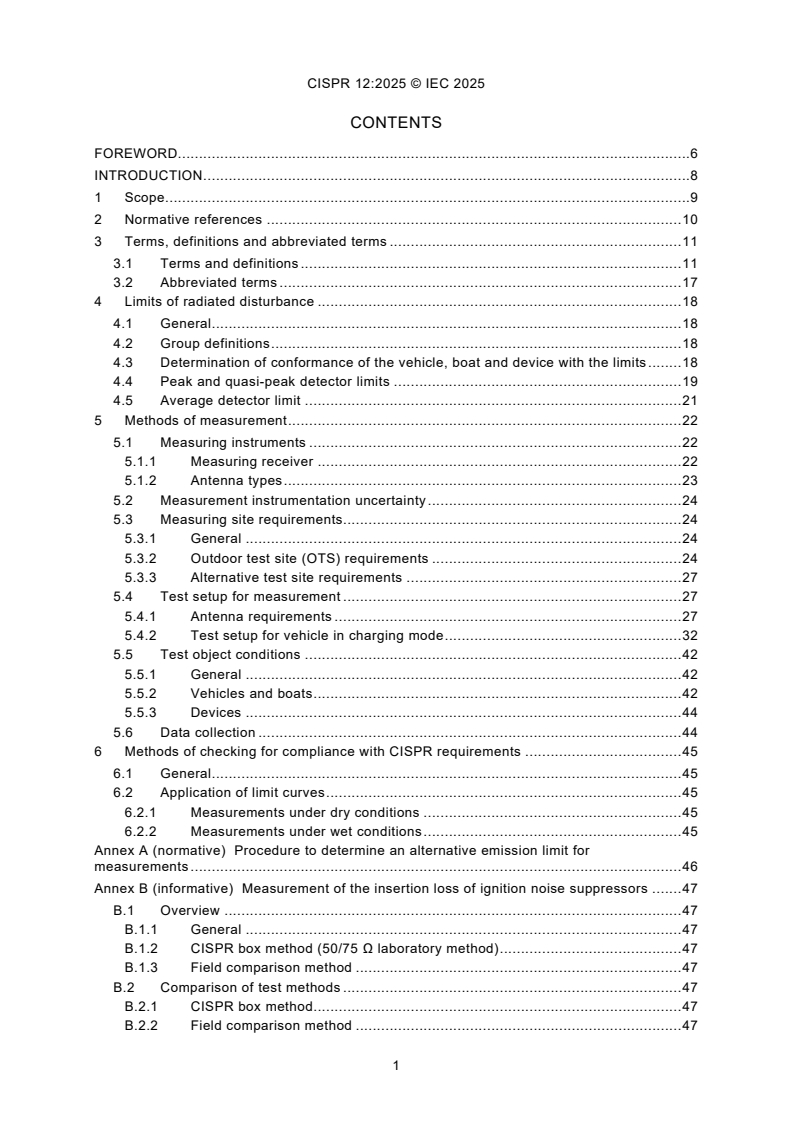
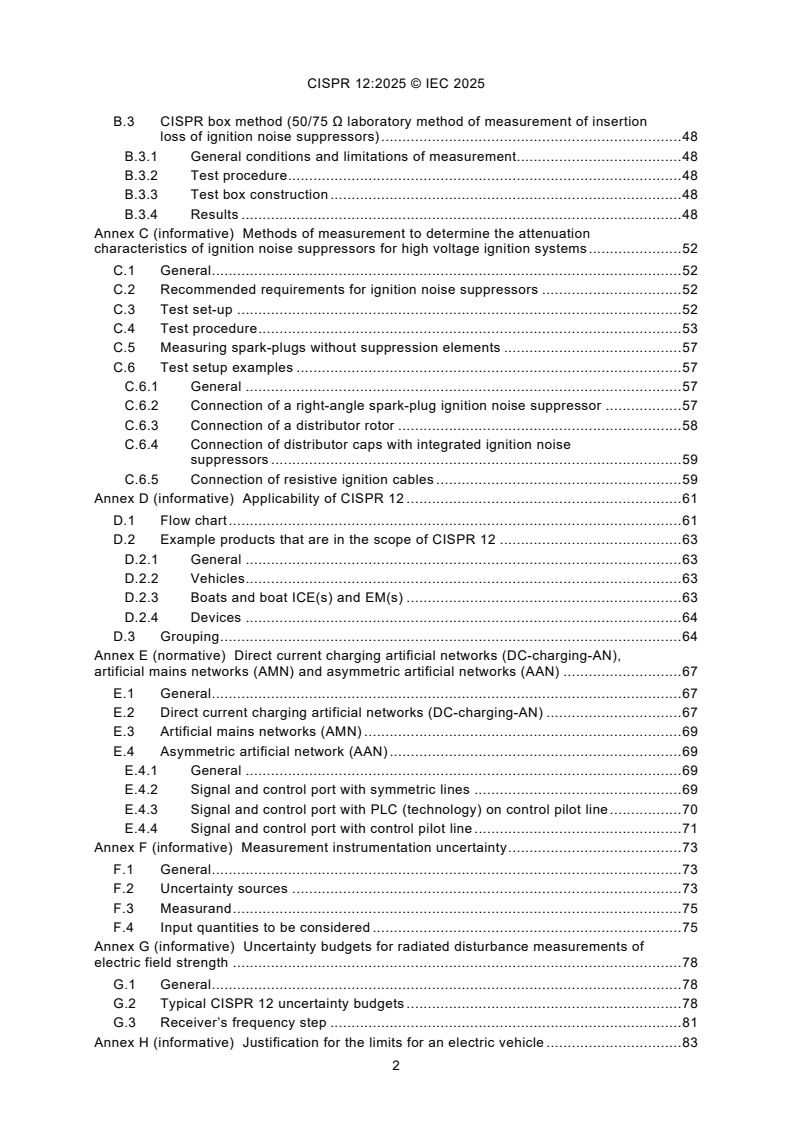
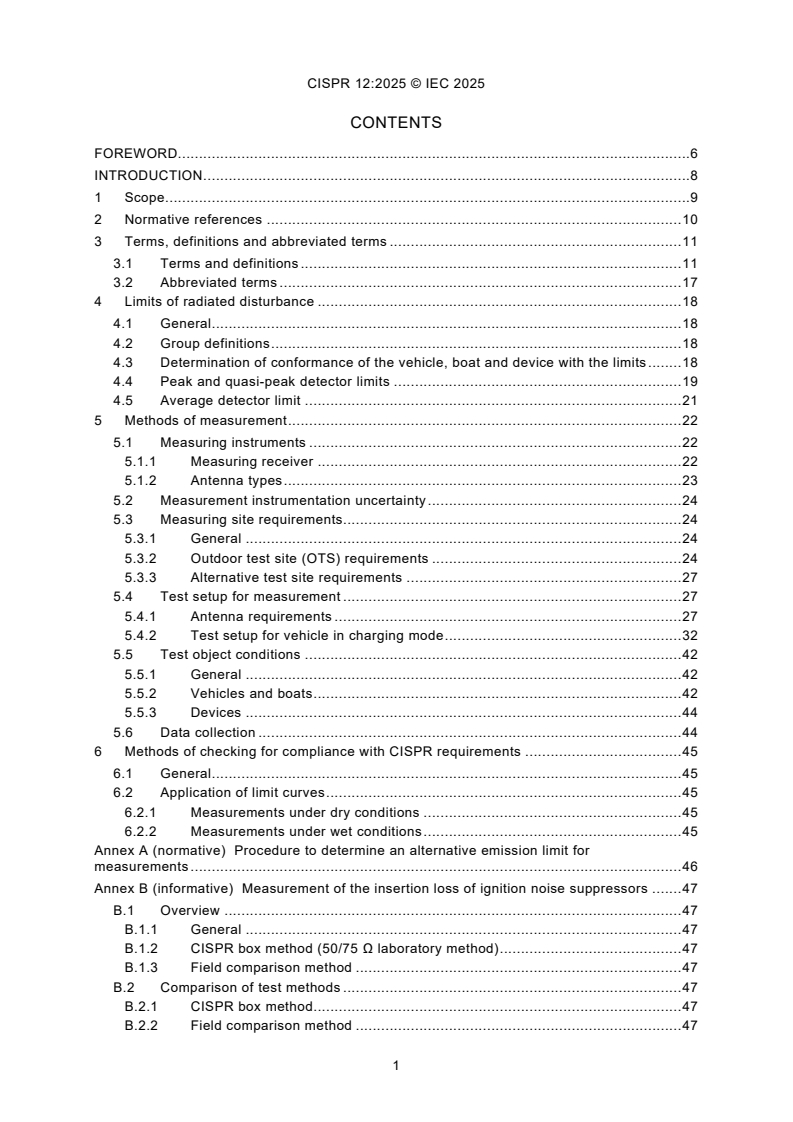
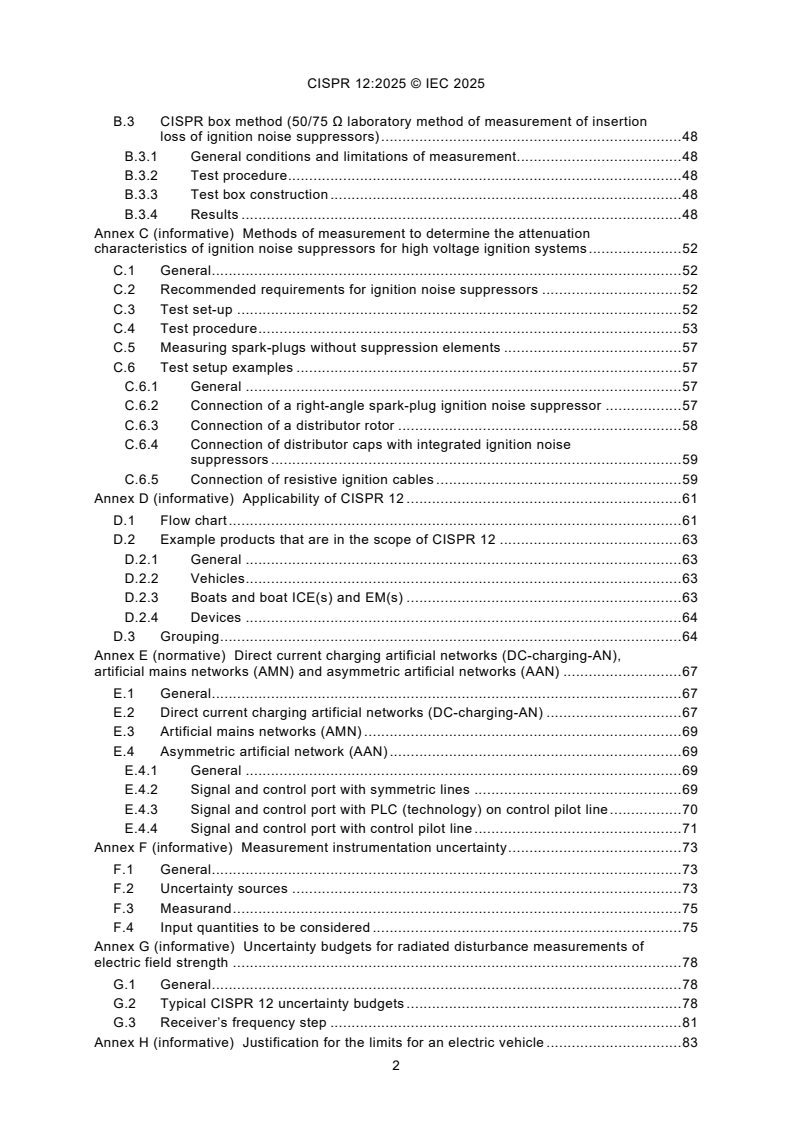
CONTENTS
FOREWORD. 6
INTRODUCTION . 8
1 Scope . 9
2 Normative references . 10
3 Terms, definitions and abbreviated terms . 11
3.1 Terms and definitions . 11
3.2 Abbreviated terms . 17
4 Limits of radiated disturbance . 18
4.1 General . 18
4.2 Group definitions . 18
4.3 Determination of conformance of the vehicle, boat and device with the limits . 18
4.4 Peak and quasi-peak detector limits . 19
4.5 Average detector limit . 21
5 Methods of measurement . 22
5.1 Measuring instruments . 22
5.1.1 Measuring receiver . 22
5.1.2 Antenna types . 23
5.2 Measurement instrumentation uncertainty . 24
5.3 Measuring site requirements . 24
5.3.1 General . 24
5.3.2 Outdoor test site (OTS) requirements . 24
5.3.3 Alternative test site requirements . 27
5.4 Test setup for measurement . 27
5.4.1 Antenna requirements . 27
5.4.2 Test setup for vehicle in charging mode . 32
5.5 Test object conditions . 42
5.5.1 General . 42
5.5.2 Vehicles and boats . 42
5.5.3 Devices . 44
5.6 Data collection . 44
6 Methods of checking for compliance with CISPR requirements . 45
6.1 General . 45
6.2 Application of limit curves . 45
6.2.1 Measurements under dry conditions . 45
6.2.2 Measurements under wet conditions . 45
Annex A (normative) Procedure to determine an alternative emission limit for
measurements . 46
Annex B (informative) Measurement of the insertion loss of ignition noise suppressors . 47
B.1 Overview . 47
B.1.1 General . 47
B.1.2 CISPR box method (50/75 Ω laboratory method) . 47
B.1.3 Field comparison method . 47
B.2 Comparison of test methods . 47
B.2.1 CISPR box method . 47
B.2.2 Field comparison method . 47
B.3 CISPR box method (50/75 Ω laboratory method of measurement of insertion
loss of ignition noise suppressors) . 48
B.3.1 General conditions and limitations of measurement . 48
B.3.2 Test procedure . 48
B.3.3 Test box construction . 48
B.3.4 Results . 48
Annex C (informative) Methods of measurement to determine the attenuation
characteristics of ignition noise suppressors for high voltage ignition systems . 52
C.1 General . 52
C.2 Recommended requirements for ignition noise suppressors . 52
C.3 Test set-up . 52
C.4 Test procedure . 53
C.5 Measuring spark-plugs without suppression elements . 57
C.6 Test setup examples . 57
C.6.1 General . 57
C.6.2 Connection of a right-angle spark-plug ignition noise suppressor . 57
C.6.3 Connection of a distributor rotor . 58
C.6.4 Connection of distributor caps with integrated ignition noise
suppressors . 59
C.6.5 Connection of resistive ignition cables . 59
Annex D (informative) Applicability of CISPR 12 . 61
D.1 Flow chart . 61
D.2 Example products that are in the scope of CISPR 12 . 63
D.2.1 General . 63
D.2.2 Vehicles . 63
D.2.3 Boats and boat ICE(s) and EM(s) . 63
D.2.4 Devices . 64
D.3 Grouping . 64
Annex E (normative) Direct current charging artificial networks (DC-charging-AN),
artificial mains networks (AMN) and asymmetric artificial networks (AAN) . 67
E.1 General . 67
E.2 Direct current charging artificial networks (DC-charging-AN) . 67
E.3 Artificial mains networks (AMN) . 69
E.4 Asymmetric artificial network (AAN) . 69
E.4.1 General . 69
E.4.2 Signal and control port with symmetric lines . 69
E.4.3 Signal and control port with PLC (technology) on control pilot line . 70
E.4.4 Signal and control port with control pilot line . 71
Annex F (informative) Measurement instrumentation uncertainty . 73
F.1 General . 73
F.2 Uncertainty sources . 73
F.3 Measurand . 75
F.4 Input quantities to be considered . 75
Annex G (informative) Uncertainty budgets for radiated disturbance measurements of
electric field strength . 78
G.1 General . 78
G.2 Typical CISPR 12 uncertainty budgets . 78
G.3 Receiver’s frequency step . 81
Annex H (informative) Justification for the limits for an electric vehicle . 83
H.1 General . 83
H.2 Background . 83
H.3 Consideration on the effect of radio receivers . 83
H.4 Calculation of limits . 84
H.4.1 General . 84
H.4.2 Electric vehicles in a driven mode . 84
H.4.3 Electric vehicles in a charging mode . 85
H.5 Conclusion . 87
Annex I (informative) Items under consideration . 88
I.1 General . 88
I.2 Frequency range . 88
I.2.1 General considerations . 88
I.2.2 Testing between 1 GHz to 6 GHz . 88
I.3 Correlation between OTS, ALSE and OATS measurements . 88
I.4 Calibration of antennas . 88
I.5 Charging mode for boats . 88
I.6 Necessity for the use of artificial networks in the test setups . 88
I.7 Electric vehicle limits . 88
I.7.1 Charging . 88
I.7.2 Driven mode . 88
I.8 Dynamic test modes . 89
Bibliography . 90
Figure 1 – Method of determination of conformance . 19
Figure 2 – Quasi-peak limits at 10 m antenna distance . 20
Figure 3 – Peak limits at 10 m antenna distance . 21
Figure 4 – Average limits at 10 m antenna distance . 21
Figure 5 – Measuring site (OTS) for vehicles, boats and devices. 25
Figure 6 – Measuring site (OTS) for boats . 26
Figure 7 – Antenna height to measure emissions – Elevation view (vertical polarization
shown) . 28
Figure 8 – Antenna distance to measure emissions – Plan view (horizontal polarization
shown) . 29
Figure 9 – Antenna position for N = 1 (one antenna position to be used) – Horizontal
polarization shown . 31
Figure 10 – Example antenna positions for N = 2 (multiple antenna positions to be
used) – Horizontal polarization shown . 31
Figure 11 – Example of test setup for vehicle with vehicle inlet located on vehicle side
(charging mode 1 or 2, AC powered, without communication) . 34
Figure 12 – Example of test setup for vehicle with vehicle inlet located front or rear of
vehicle (charging mode 1 or 2, AC powered, without communication) . 35
Figure 13 – Example of test setup for vehicle with vehicle inlet located on vehicle side
(charging mode 3 or mode 4, AC/DC powered, with communication) . 38
Figure 14 – Example of test setup for vehicle with vehicle inlet located front or rear of
vehicle (charging mode 3 or mode 4, AC/DC powered, with communication) . 39
Figure 15 – Example of test setup for vehicle in charging mode through wireless power
transfer . 41
Figure A.1 – Calculation of the resulting gain reduction X . 46
dB
Figure B.1 – Test circuit . 49
Figure B.2 – General arrangement of the test box . 49
Figure B.3 – Details of the test box lid . 50
Figure B.4 – Details of the test box . 50
Figure B.5 – Straight spark-plug ignition noise suppressor (screened or unscreened) . 50
Figure B.6 – Right-angle spark-plug ignition noise suppressor (screened or
unscreened) . 50
Figure B.7 – Noise suppression spark-plug . 51
Figure B.8 – Resistive distributor brush . 51
Figure B.9 – Noise suppressor in distributor cap . 51
Figure B.10 – Noise suppression distributor rotor . 51
Figure B.11 – Noise suppression ignition cable (resistive or reactive). 51
Figure C.1 – Test set-up, side view . 54
Figure C.2 – Test set-up, top view . 55
Figure C.3 – Pressure chamber with ventilation . 56
Figure C.4 – Top view of the set-up of a right-angle ignition noise suppressor for
distributors . 57
Figure C.5 – Location of high voltage ignition components . 58
Figure C.6 – Top view of the test set-up for distributor rotors . 59
Figure C.7 – Side view of the test set-up for ready-to-use resistive ignition cables . 60
Figure D.1 – Flowchart for the applicability of CISPR 12 . 62
Figure E.1 – Example of 5 µH / 50 Ω DC-charging-AN schematic . 67
Figure E.2 – Characteristics of the DC-charging-AN impedance . 68
Figure E.3 – Example of an AAN for signal and control port with symmetric lines (e.g.
CAN) . 70
Figure E.4 – Example of AAN circuit for signal and control port with PLC (technology)
on control pilot . 71
Figure E.5 – Example of AAN circuit for pilot line . 72
Figure F.1 – Typical sources of measurement instrumentation uncertainty . 74
Figure G.1 – Example of measurement for frequency step uncertainty evaluation for
120 kHz bandwidth . 82
Figure H.1 – Histogram – Peak to quasi-peak delta, EV driving mode . 85
Figure H.2 – Histogram – Peak to quasi-peak delta, vehicle in AC or DC charging
mode . 86
Figure H.3 – Degradation to 12 dB SINAD (LO-VHF) from Mode 3 charging vs. CW
noise . 87
Table 1 – Detection limits . 18
Table 2 – Quasi-peak limits at 10 m antenna distance . 20
Table 3 – Peak limits at 10 m antenna distance . 20
Table 4 – Spectrum analyser parameters . 23
Table 5 – Scanning receiver parameters . 23
Table 6 – ICE operating speeds . 43
Table C.1 – Limits . 52
Table D.1 – Examples of products in the scope of CISPR 12 with their assignment to
the groups . 65
Table E.1 – Magnitude of the DC-charging-AN impedance Z . 68
PB
Table F.1 – Input quantities to be considered for radiated disturbance measurements . 75
Table G.1 – Typical uncertainty budget – 3 m/10 m distance – Biconical antenna . 78
Table G.2 – Typical uncertainty budget – 3 m/10 m distance – Log-periodic antenna . 80
INTERNATIONAL ELECTROTECHNICAL COMMISSION
INTERNATIONAL SPECIAL COMMITTEE ON RADIO INTERFERENCE
____________
Vehicles, boats and devices with internal combustion engines or traction
batteries - Radio disturbance characteristics - Limits and methods of
measurement for the protection of off-board receivers
FOREWORD
1) The International Electrotechnical Commission (IEC) is a worldwide organization for standardization comprising
all national electrotechnical committees (IEC National Committees). The object of IEC is to promote international
co-operation on all questions concerning standardization in the electrical and electronic fields. To this end and
in addition to other activities, IEC publishes International Standards, Technical Specifications, Technical Reports,
Publicly Available Specifications (PAS) and Guides (hereafter referred to as “IEC Publication(s)”). Their
preparation is entrusted to technical committees; any IEC National Committee interested in the subject dealt with
may participate in this preparatory work. International, governmental and non-governmental organizations liaising
with the IEC also participate in this preparation. IEC collaborates closely with the International Organization for
Standardization (ISO) in accordance with conditions determined by agreement between the two organizations.
2) The formal decisions or agreements of IEC on technical matters express, as nearly as possible, an international
consensus of opinion on the relevant subjects since each technical committee has representation from all
interested IEC National Committees.
3) IEC Publications have the form of recommendations for international use and are accepted by IEC National
Committees in that sense. While all reasonable efforts are made to ensure that the technical content of IEC
Publications is accurate, IEC cannot be held responsible for the way in which they are used or for any
misinterpretation by any end user.
4) In order to promote international uniformity, IEC National Committees undertake to apply IEC Publications
transparently to the maximum extent possible in their national and regional publications. Any divergence between
any IEC Publication and the corresponding national or regional publication shall be clearly indicated in the latter.
5) IEC itself does not provide any attestation of conformity. Independent certification bodies provide conformity
assessment services and, in some areas, access to IEC marks of conformity. IEC is not responsible for any
services carried out by independent certification bodies.
6) All users should ensure that they have the latest edition of this publication.
7) No liability shall attach to IEC or its directors, employees, servants or agents including individual experts and
members of its technical committees and IEC National Committees for any personal injury, property damage or
other damage of any nature whatsoever, whether direct or indirect, or for costs (including legal fees) and
expenses arising out of the publication, use of, or reliance upon, this IEC Publication or any other IEC
Publications.
8) Attention is drawn to the Normative references cited in this publication. Use of the referenced publications is
indispensable for the correct application of this publication.
9) IEC draws attention to the possibility that the implementation of this document may involve the use of (a)
patent(s). IEC takes no position concerning the evidence, validity or applicability of any claimed patent rights in
respect thereof. As of the date of publication of this document, IEC had not received notice of (a) patent(s), which
may be required to implement this document. However, implementers are cautioned that this may not represent
the latest information, which may be obtained from the patent database available at https://patents.iec.ch. IEC
shall not be held responsible for identifying any or all such patent rights.
International Standard CISPR 12 has been prepared by CISPR subcommittee D:
Electromagnetic disturbances related to electric/electronic equipment on vehicles and internal
combustion engine powered devices.
This seventh edition cancels and replaces the sixth edition published in 2007 and its
Amendment 1 (2009). This edition constitutes a technical revision.
This edition includes the following significant technical changes with respect to the previous
edition:
a) test setups and requirements for electric vehicles and hybrid electric vehicles in charging
mode were added,
b) antenna positions relative to the vehicle were defined,
c) some statements dealing with series surveillance and type approval were deleted,
d) annexes for measurement instrumentation uncertainty were added,
e) the vehicles, boats and devices subject to this document are separated into three groups
with corresponding limits applied accordingly,
f) an annex describing networks to be used for the charging mode was added,
g) an annex describing justification for the limits of an electric vehicle was added, and
h) general improvements were made.
The text of this International Standard is based on the following documents:
Draft Report on voting
CIS/D/507/FDIS CIS/D/509/RVD
Full information on the voting for its approval can be found in the report on voting indicated in
the above table.
The language used for the development of this International Standard is English.
This document was drafted in accordance with ISO/IEC Directives, Part 2, and developed in
accordance with ISO/IEC Directives, Part 1 and ISO/IEC Directives, IEC Supplement, available
at www.iec.ch/members_experts/refdocs. The main document types developed by IEC are
described in greater detail at www.iec.ch/publications.
The committee has decided that the contents of this document will remain unchanged until the
stability date indicated on the IEC website under webstore.iec.ch in the data related to the
specific document. At this date, the document will be
• reconfirmed,
• withdrawn, or
• revised.
INTRODUCTION
There is a specific need for standards to define acceptable radio frequency performances of all
electrical and electronic products. CISPR 12 has been developed to serve the vehicles, boats,
devices with internal combustion engines and related industries with test methods and limits
that provide satisfactory protection for radio reception.
CISPR 12 has been used for many years as a regulatory requirement in numerous countries,
to provide protection for radio receivers at a 10 m distance. It has been effective in protecting
the radio environment outside the vehicle.
1 Scope
The limits in this document are designed to provide protection in the frequency range of 30 MHz
to 1 000 MHz for off-board receivers. Compliance with this document does not guarantee
adequate protection for receivers nearer than 10 m to the vehicle, boat or device.
This document applies to the emission of electromagnetic energy that can cause interference
to radio reception and which is emitted from:
1) vehicles propelled by an internal combustion engine (ICE), electrical means or both (see
3.1.34);
2) boats propelled by an ICE, electrical means or both (see 3.1.4). Boats are tested in the
same manner as vehicles except where they have unique characteristics as explicitly stated
in this document;
3) devices equipped with ICE (see 3.1.9). In the case of hybrid devices (e.g. equipped with
both ICE and traction batteries), only the ICE mode is included in this document;
4) inboard and outboard boat engines and motors [i.e. equipped with ICE, electric motor (EM),
or both], when marketed independently.
See Annex D for a flow chart and a list of examples to help determine the applicability of
CISPR 12.
This document does not apply to aircraft, household appliances, medical devices, traction
systems (railway engine or locomotive, streetcar or tram and electric trolley bus), vehicle,
boat and device off-board chargers or to incomplete vehicles, boats and devices. In the case of
a dual-mode trolley bus (e.g. propelled by power from either AC/DC mains or an ICE), the ICE
propulsion system is included, but the EM propulsion portion of the vehicle is excluded from
this document. In addition, domestic helper robots, such as household cleaning robots, hotel
service robots and personal safety robots are also excluded from the scope of this document.
NOTE 1 Other than inboard or outboard boat engines and motors that are marketed independently, this document
does not apply to components or incomplete products, such as an ICE, an incomplete vehicle or boat that has not
yet been fitted with an ICE or EM, or spare parts. This document only applies to the final product, which is equipped
with all applicable parts and components to be able to function as intended.
NOTE 2 Appliances without ICE for typical housekeeping and service functions in the household and similar
environment are covered by the requirements of CISPR 14-1[1].
NOTE 3 Protection of receivers used on board the same vehicle as the disturbance source(s) are covered by
CISPR 25[2].
This document does not prescribe measurement methods or limits for conducted disturbances,
for the charging mode of operation, where the (electric or hybrid) vehicle or boat is connected
to power mains, either directly (i.e. plug-in vehicle or boat) or indirectly (i.e. wireless power
charging). The user is referred to appropriate IEC and CISPR standards, which define
measurement techniques and limits for this condition.
NOTE 4 See IEC 61851-21-1[3] for road vehicles and IEC 61000-6-3[4], IEC 61000-6-4[5] and IEC 61000-6-8[6] for
other types of vehicles or boats.
The emission requirements in this document are not applicable to the intentional transmissions
from a radio transmitter, as defined by the ITU-R, including its spurious emissions.
Equipment that is covered by other CISPR product and product family emission standards are
excluded from the scope of this document, except where they include ICE(s). In the latter case,
the equipment complies with this document in all modes of operation where the ICE(s) is(are)
active.
NOTE 5 The other CISPR product or product family emission standard can also apply to the equipment for those
modes of operation where the ICE(s) is (are) not active. In case the ICE(s) is (are) always in operation, the other
CISPR product or product family emission standard can still apply, for verifying the emissions from the other
components and circuitry of the equipment.
Annex B and Annex C contain methods to evaluate the disturbance characteristics of high
voltage ignition systems.
Annex H contains a justification for the limits for an electric vehicle.
Annex I lists work being considered for future revisions.
2 Normative references
The following documents are referred to in the text in such a way that some or all of their content
constitutes requirements of this document. For dated references, only the edition cited applies.
For undated references, the latest edition of the referenced document (including any
amendments) applies.
IEC 61851-1:2017, Electric vehicle conductive charging system - Part 1: General requirements
CISPR 16-1-1:2019, Specification for radio disturbance and immunity measuring apparatus and
methods - Part 1-1: Radio disturbance and immunity measuring apparatus - Measuring
apparatus
CISPR 16-1-2:2014, Specification for radio disturbance and immunity measuring apparatus and
methods - Part 1-2: Radio disturbance and immunity measurement apparatus - Coupling
devices for conducted disturbance measurements
CISPR 16-1-2:2014/AMD1:2017
CISPR 16-1-3:2004, Specification for radio disturbance and immunity measuring apparatus and
methods - Part 1-3: Radio disturbance and immunity measuring apparatus - Ancillary equipment
- Disturbance power
CISPR 16-1-3:2004/AMD1:2016
CISPR 16-1-3:2004/AMD2:2020
CISPR 16-1-4:2019, Specification for radio disturbance and immunity measuring apparatus and
methods - Part 1-4: Radio disturbance and immunity measuring apparatus - Antennas and test
sites for radiated disturbance measurements
CISPR 16-1-4:2019/AMD1:2020
CISPR 16-1-4:2019/AMD2:2023
CISPR 16-1-6:2014, Specification for radio disturbance and immunity measuring apparatus and
methods - Part 1-6: Radio disturbance and immunity measuring apparatus - EMC antenna
calibration
CISPR 16-1-6:2014/AMD1:2017
CISPR 16-1-6:2014/AMD2:2022
CISPR 16-2-1:2014, Specification for radio disturbance and immunity measuring apparatus and
methods - Part 2-1: Methods of measurement of disturbances and immunity - Conducted
disturbance measurements
CISPR 16-2-1:2014/AMD1:2017
ANSI C63.5:2017, American National Standard for Electromagnetic Compatibility - Radiated
Emission Measurements in Electromagnetic Interference (EMI) Control - Calibration and
Qualification of Antennas (9 kHz to 40 GHz)
Corrigendum 1:2018
3 Terms, definitions and abbreviated terms
3.1 Terms and definitions
For the purposes of this document, the following terms and definitions apply.
ISO and IEC maintain terminological databases for use in standardization at the following
addresses:
• IEC Electropedia: available at http://www.electropedia.org/
• ISO Online browsing platform: available at http://www.iso.org/obp
3.1.1
absorber lined shielded enclosure
ALSE
shielded enclosure or screened room with radio frequency absorbing material on its internal
ceiling and walls
3.1.2
artificial mains network
AMN
network that provides a defined impedance to the EUT at radio frequencies, couples the
disturbance voltage to the measuring receiver, and decouples the test circuit from the supply
mains
Note 1 to entry: There are two basic types of this network, the V-network (V-AMN), which couples the unsymmetric
voltages, and the delta-network (Δ-AMN), which couples symmetric (DM) and asymmetric (CM) voltages separately.
Note 2 to entry: The coupling feature of the AMN is not used for CISPR 12 testing. The coaxial port (“receiver port”)
of the AMN is equipped with a 50 Ω termination for all measurements according to this document.
[SOURCE: CISPR 16-1-2:2014 and CISPR 16-1-2:2014/AMD1:2017, 3.1.6, modified – added
Note 2 to entry]
3.1.3
asymmetric artificial network
AAN
network used to measure (or inject) asymmetric (common mode) voltages on unshielded
symmetric signal (e.g., telecommunication) lines while rejecting the symmetric (differential
mode) signal
Note 1 to entry: The term “Y-network” is a synonym for AAN.
Note 2 to entry: The coupling feature of the AAN is not used for CISPR 12 testing. The coaxial port of the AAN is
equipped with a 50 Ω termination for all measurements according to this document.
[SOURCE: CISPR 16-1-2:2014, 3.1.7 modified – added Note 2 to entry]
3.1.4
boat
vessel intended to be used on the surface of water, its length being no greater than 15 m,
intended to carry persons or goods and equipped with inboard or outboard boat
engine(s)/motor(s)
3.1.5
bond, verb
connect to ground using a ground connection complying with 5.3 of CISPR 16-2-1:2014 and
CISPR 16-2-1:2014/AMD1:2017, with a DC resistance not exceeding 2,5 mΩ
Note 1 to entry: A low current (≤ 100 mA) 4-wire milliohm meter is recommended for these measurements.
3.1.6
broadband emission
emission which has a bandwidth greater than that of a particular measuring apparatus or
receiver
Note 1 to entry: An emission which has a pulse repetition rate (in Hz) less than the bandwidth of a particular
measuring instrument can also be considered as a broadband emission.
3.1.7
charging mode
mode of operation intended for charging the rechargeable energy storage system (REESS)
3.1.7.1
charging mode 1
charging mode as defined in 6.2.1 of IEC 61851-1:2017, where the vehicle is connected to a
standard socket-outlet of an AC supply network, utilizing a cable and plug, both of which are
not fitted with any supplementary pilot or auxiliary contacts
Note 1 to entry: In some countries, mode 1 charging can be prohibited or requires special precautions.
3.1.7.2
charging mode 2
charging mode as defined in 6.2.2 of IEC 61851-1:2017, where the vehicle is connected to AC
mains using a charging cable, which has an electric vehicle supply equipment (EVSE) box in-
line (e.g. in-cable control box / in-cable control and protection device), providing control pilot
signalling between the vehicle and the EVSE box and personal protection against electric shock
Note 1 to entry: In some countries, special restrictions are applied for mode 2 charging.
Note 2 to entry: There is no communication between the vehicle and the charging infrastructure.
3.1.7.3
charging mode 3
charging mode as defined in 6.2.3 of IEC 61851-1:2017, where the vehicle is connected to a
fixed installation (EVSE; e.g. AC charging station, AC wallbox) providing AC power to the
vehicle, with communication between the vehicle and the EVSE (either through the signal and
control lines, through the wired network lines, or both)
3.1.7.4
charging mode 4
charging mode as defined in 6.2.4 of IEC 61851-1:2017, where the vehicle is connected to a
fixed installation (EVSE; e.g. DC charging station), providing DC power to the vehicle (with an
off-board charger), with communication between the vehicle and the EVSE (either through the
signal and control lines, through the wired network lines, or both)
3.1.8
controller area network
CAN
network specified in ISO 11898-1[7] that connects devices, sensors and actuators in systems
3.1.9
device
machine, equipped with an ICE, which is not primarily intended to carry persons or goods
Note 1 to entry: Devices include, but are not limited to: chainsaws, irrigation pumps, snow blowers, air compressors,
landscaping equipment and power generators.
3.1.9.1
small device
device that is handheld or has a footprint that fits within a circle not larger than 1,5 m in
diameter, regardless of orientation, without considering passive elements
Note 1 to entry: Examples include chainsaws, irrigation pumps, push-type snow blowers, air compressors, grass
trimmer (regardless of the length of its handle).
3.1.9.2
large device
device that exceeds the dimensions of a small device
Note 1 to entry: Examples include power generators and large landscaping equipment.
3.1.10
direct current charging artificial network
DC-charging-AN
network inserted in the high-voltage (HV) DC lead of the vehicle in charging mode, which
provides, in a given frequency range, a specified load impedance and which can isolate the
vehicle from the HV DC charging station in that frequency range
Note 1 to entry: The coupling feature of the DC-charging-AN is not used for CISPR 12 testing. The coaxial port
(“receiver port”) of the AMN is equipped with a 50 Ω termination for all measurements according to this document.
3.1.11
electric motor
EM
electrical machine converting electrical energy to mechanical energy and supplying mechanical
power through a rotating shaft
3.1.12
electric vehicle
EV
vehicle propelled exclusively by electric motor(s) powered by onboard traction battery or
batter
...
CISPR 12 ®
Edition 7.0 2025-07
NORME
INTERNATIONALE
COMITÉ INTERNATIONAL SPÉCIAL DES PERTURBATIONS RADIOÉLECTRIQUES
Véhicules, bateaux et engins à moteurs à combustion interne ou batteries de
traction - Caractéristiques de perturbation radioélectrique - Limites et méthodes
de mesure pour la protection des récepteurs extérieurs
ICS 27.020; 33.100.10 ISBN 978-2-8327-0553-7
Droits de reproduction réservés. Sauf indication contraire, aucune partie de cette publication ne peut être reproduite ni
utilisée sous quelque forme que ce soit et par aucun procédé, électronique ou mécanique, y compris la photocopie et
les microfilms, sans l'accord écrit de l'IEC ou du Comité national de l'IEC du pays du demandeur. Si vous avez des
questions sur le copyright de l'IEC ou si vous désirez obtenir des droits supplémentaires sur cette publication, utilisez
les coordonnées ci-après ou contactez le Comité national de l'IEC de votre pays de résidence.
IEC Secretariat Tel.: +41 22 919 02 11
3, rue de Varembé info@iec.ch
CH-1211 Geneva 20 www.iec.ch
Switzerland
A propos de l'IEC
La Commission Electrotechnique Internationale (IEC) est la première organisation mondiale qui élabore et publie des
Normes internationales pour tout ce qui a trait à l'électricité, à l'électronique et aux technologies apparentées.
A propos des publications IEC
Le contenu technique des publications IEC est constamment revu. Veuillez vous assurer que vous possédez l’édition la
plus récente, un corrigendum ou amendement peut avoir été publié.
Recherche de publications IEC - IEC Products & Services Portal - products.iec.ch
webstore.iec.ch/advsearchform Découvrez notre puissant moteur de recherche et consultez
La recherche avancée permet de trouver des publications gratuitement tous les aperçus des publications, symboles
IEC en utilisant différents critères (numéro de référence, graphiques et le glossaire. Avec un abonnement, vous aurez
texte, comité d’études, …). Elle donne aussi des toujours accès à un contenu à jour adapté à vos besoins.
informations sur les projets et les publications remplacées
ou retirées. Electropedia - www.electropedia.org
Le premier dictionnaire d'électrotechnologie en ligne au
IEC Just Published - webstore.iec.ch/justpublished monde, avec plus de 22 500 articles terminologiques en
Restez informé sur les nouvelles publications IEC. Just anglais et en français, ainsi que les termes équivalents
dans 25 langues additionnelles. Egalement appelé
Published détaille les nouvelles publications parues.
Disponible en ligne et une fois par mois par email. Vocabulaire Electrotechnique International (IEV) en ligne.
Service Clients - webstore.iec.ch/csc
Si vous désirez nous donner des commentaires sur cette
publication ou si vous avez des questions contactez-
nous: sales@iec.ch.
SOMMAIRE
AVANT-PROPOS . 6
INTRODUCTION . 8
1 Domaine d'application . 9
2 Références normatives . 10
3 Termes, définitions et abréviations . 11
3.1 Termes et définitions . 11
3.2 Abréviations . 19
4 Limites des perturbations rayonnées . 19
4.1 Généralités . 19
4.2 Définition des groupes . 19
4.3 Détermination de la conformité du véhicule, du bateau et de l'engin aux
limites . 20
4.4 Limites du détecteur de crête et de quasi-crête . 21
4.5 Limite du détecteur de valeur moyenne . 23
5 Méthodes de mesure . 24
5.1 Appareils de mesure . 24
5.1.1 Récepteur de mesure . 24
5.1.2 Types d'antennes . 26
5.2 Incertitude des instruments de mesure . 27
5.3 Exigences relatives à l'emplacement de mesure . 27
5.3.1 Généralités . 27
5.3.2 Exigences relatives à l'emplacement d'essai en extérieur (OTS) . 27
5.3.3 Exigences relatives aux autres emplacements d'essai . 30
5.4 Montage d'essai pour le mesurage . 30
5.4.1 Exigences relatives à l'antenne. 30
5.4.2 Montage d'essai pour le véhicule en mode de charge . 35
5.5 Conditions pour l'objet en essai . 46
5.5.1 Généralités . 46
5.5.2 Véhicules et bateaux . 46
5.5.3 Engins . 49
5.6 Collecte de données . 49
6 Méthodes de vérification de la conformité aux exigences du CISPR . 49
6.1 Généralités . 49
6.2 Application des courbes limites . 49
6.2.1 Mesurages dans des conditions sèches . 49
6.2.2 Mesurages dans des conditions humides . 49
Annexe A (normative) Mode opératoire de détermination d'une limite d'émission
alternative pour les mesurages . 50
Annexe B (informative) Mesurage de l'affaiblissement d'insertion de dispositifs
d'antiparasitage d'allumage. 51
B.1 Vue d'ensemble . 51
B.1.1 Généralités . 51
B.1.2 Méthode de la boîte d'essai du CISPR (méthode de laboratoire à
50/75 Ω) . 51
B.1.3 Méthode de comparaison du champ . 51
B.2 Comparaison des méthodes d'essai . 51
B.2.1 Méthode de la boîte d'essai du CISPR . 51
B.2.2 Méthode de comparaison du champ . 52
B.3 Méthode de la boîte d'essai CISPR (méthode de laboratoire à 50/75 Ω pour
le mesurage de l'affaiblissement d'insertion des dispositifs d'antiparasitage
d'allumage) . 52
B.3.1 Conditions générales et limitations du mesurage . 52
B.3.2 Mode opératoire d'essai. 52
B.3.3 Construction de la boîte d'essai . 52
B.3.4 Résultats . 53
Annexe C (informative) Méthodes de mesure des caractéristiques d'affaiblissement
des dispositifs d'antiparasitage d'allumage pour les systèmes d'allumage haute tension . 57
C.1 Généralités . 57
C.2 Exigences recommandées pour les dispositifs d'antiparasitage d'allumage . 57
C.3 Montage d'essai . 57
C.4 Mode opératoire d'essai . 58
C.5 Bougies d'allumage de mesure sans éléments d'antiparasitage . 62
C.6 Exemples de montages d'essai . 62
C.6.1 Généralités . 62
C.6.2 Connexion à angle droit d'un dispositif d'antiparasitage pour bougie
d'allumage . 62
C.6.3 Connexion d'un rotor d'allumage . 63
C.6.4 Connexion des embouts d'allumage avec dispositifs d'antiparasitage
d'allumage intégrés . 64
C.6.5 Connexion des câbles d'allumage résistifs . 64
Annexe D (informative) Applicabilité de la CISPR 12 . 66
D.1 Organigramme . 66
D.2 Exemple de produits qui relèvent du domaine d'application de la CISPR 12 . 68
D.2.1 Généralités . 68
D.2.2 Véhicules . 68
D.2.3 Bateaux et ICE et EM de bateaux . 69
D.2.4 Engins . 69
D.3 Regroupement . 69
Annexe E (normative) Réseaux fictifs de charge en courant continu (AN de charge en
courant continu), réseaux fictifs d'alimentation (AMN) et réseaux fictifs asymétriques
(AAN) . 72
E.1 Généralités . 72
E.2 Réseaux fictifs de charge en courant continu (AN de charge en courant
continu) . 72
E.3 Réseaux fictifs d'alimentation (AMN) . 74
E.4 Réseaux fictifs asymétriques . 74
E.4.1 Généralités . 74
E.4.2 Accès de signalisation et de commande avec lignes symétriques . 75
E.4.3 Accès de signalisation et de commande avec (technologie) CPL sur la
ligne pilote de commande . 76
E.4.4 Accès de signalisation et de commande avec ligne pilote de commande . 77
Annexe F (informative) Incertitude des instruments de mesure . 79
F.1 Généralités . 79
F.2 Sources d'incertitude . 79
F.3 Mesurande . 81
F.4 Grandeurs d'entrée à prendre en compte . 81
Annexe G (informative) Bilans d'incertitude pour les mesurages de perturbations
rayonnées du champ électrique . 85
G.1 Généralités . 85
G.2 Bilans d'incertitude types de la CISPR 12 . 85
G.3 Pas de fréquence du récepteur . 91
Annexe H (informative) Justification des limites pour un véhicule électrique . 92
H.1 Généralités . 92
H.2 Contexte . 92
H.3 Considérations relatives aux effets des récepteurs radioélectriques . 92
H.4 Calcul des limites . 93
H.4.1 Généralités . 93
H.4.2 Véhicules électriques en mode conduite . 94
H.4.3 Véhicules électriques en mode de charge . 95
H.5 Conclusion . 98
Annexe I (informative) Éléments à l'étude . 99
I.1 Généralités . 99
I.2 Plage de fréquences . 99
I.2.1 Généralités . 99
I.2.2 Essai entre 1 GHz et 6 GHz . 99
I.3 Corrélation entre les mesurages OTS, ALSE et OATS . 99
I.4 Étalonnage des antennes . 99
I.5 Mode de charge pour les bateaux . 99
I.6 Nécessité d'utiliser des réseaux fictifs dans les montages d'essai . 99
I.7 Limites applicables aux véhicules électriques . 99
I.7.1 Charge . 99
I.7.2 Mode conduite . 100
I.8 Modes d'essai dynamique . 100
Bibliographie . 101
Figure 1 – Méthode de détermination de la conformité . 21
Figure 2 – Limites de quasi-crête avec une antenne placée à 10 m . 22
Figure 3 – Limites de crête avec une antenne placée à 10 m . 23
Figure 4 – Limites moyenne avec une antenne placée à 10 m . 24
Figure 5 – Emplacement de mesure en extérieur pour les véhicules, les bateaux et les
engins . 28
Figure 6 – Emplacement de mesure en extérieur pour les bateaux . 29
Figure 7 – Hauteur d'antenne pour le mesurage des émissions – Vue de face
(polarisation verticale représentée) . 31
Figure 8 – Distance d'antenne pour le mesurage des émissions – Vue en plan
(polarisation horizontale représentée) . 32
Figure 9 – Position de l'antenne pour N = 1 (une seule position d'antenne à utiliser) –
Polarisation horizontale représentée . 34
Figure 10 – Exemples de positions de l'antenne pour N = 2 (plusieurs positions
d'antenne à utiliser) – Polarisation horizontale représentée . 34
Figure 11 – Exemple de montage d'essai pour un véhicule dont le socle de connecteur
de véhicule est situé sur le côté du véhicule (mode de charge 1 ou 2, alimenté en
courant alternatif, sans communication) . 37
Figure 12 – Exemple de montage d'essai pour un véhicule dont le socle de connecteur
de véhicule est situé à l'avant ou à l'arrière du véhicule (mode de charge 1 ou 2,
alimenté en courant alternatif, sans communication) . 38
Figure 13 – Exemple de montage d'essai pour un véhicule dont le socle de connecteur
de véhicule est situé sur le côté du véhicule (mode de charge 3 ou 4, alimenté en
courant alternatif/courant continu, avec communication) . 42
Figure 14 – Exemple de montage d'essai pour un véhicule dont le socle de connecteur
de véhicule est situé à l'avant ou à l'arrière du véhicule (mode de charge 3 ou 4,
alimenté en courant alternatif/courant continu, avec communication) . 43
Figure 15 – Exemple de montage d'essai pour un véhicule en mode de charge par
transfert de puissance sans fil . 45
Figure A.1 – Calcul de la réduction de gain résultante X . 50
dB
Figure B.1 – Circuit d'essai . 53
Figure B.2 – Disposition générale de la boîte d'essai . 54
Figure B.3 – Détails du couvercle de la boîte d'essai . 54
Figure B.4 – Détails de la boîte d'essai . 55
Figure B.5 – Embout droit d'antiparasitage pour bougie d'allumage (avec ou sans
blindage) . 55
Figure B.6 – Embout à angle droit d'antiparasitage pour bougie d'allumage (avec ou
sans blindage) . 55
Figure B.7 – Bougie d'antiparasitage . 56
Figure B.8 – Balai résistant de distributeur . 56
Figure B.9 – Élément d'antiparasitage incorporé dans les sorties de la tête du
distributeur . 56
Figure B.10 – Rotor à élément d'antiparasitage incorporé . 56
Figure B.11 – Câble d'allumage d'antiparasitage (résistant ou réactif) . 56
Figure C.1 – Montage d'essai, vue de côté . 59
Figure C.2 – Montage d'essai, vue de dessus . 60
Figure C.3 – Chambre de compression avec ventilation . 61
Figure C.4 – Vue de dessus du montage à angle droit d'un élément d'antiparasitage
pour les distributeurs . 62
Figure C.5 – Emplacement des composants d'allumage haute tension . 63
Figure C.6 – Vue de dessus du montage d'essai pour rotors d'allumage . 64
Figure C.7 – Vue de côté du montage d'essai pour câbles d'allumage résistifs prêts à
l'emploi . 65
Figure D.1 – Organigramme pour l'applicabilité de la CISPR 12 . 67
Figure E.1 – Exemple de schéma d'un AN de charge en courant continu de 5 µH/50 Ω . 73
Figure E.2 – Caractéristiques de l'impédance d'un AN de charge en courant continu . 73
Figure E.3 – Exemple d'AAN pour l'accès de signalisation et de commande avec des
lignes symétriques (CAN, par exemple) . 75
Figure E.4 – Exemple de circuit AAN pour l'accès de signalisation et de commande
avec (technologie) CPL sur le pilote de commande . 77
Figure E.5 – Exemple de circuit AAN pour la ligne pilote . 78
Figure F.1 – Sources types d'incertitude des instruments de mesure . 80
Figure G.1 – Exemple de mesurage pour l'évaluation de l'incertitude sur le pas de
fréquence pour une largeur de bande de 120 kHz . 91
Figure H.1 – Histogramme – Delta entre crête et quasi-crête, mode conduite du VE . 94
Figure H.2 – Histogramme – Delta entre crête et quasi-crête, véhicule en mode de
charge en courant alternatif ou en courant continu . 95
Figure H.3 – Dégradation du SINAD de 12 dB (LO-VHF) due au mode de charge 3 et
au bruit CW . 97
Tableau 1 – Limites de détection . 20
Tableau 2 – Limites de quasi-crête avec une antenne placée à 10 m . 22
Tableau 3 – Limites de crête avec une antenne placée à 10 m . 22
Tableau 4 – Paramètres de l'analyseur de spectre . 25
Tableau 5 – Paramètres du récepteur à balayage . 26
Tableau 6 – Vitesses de fonctionnement de l'ICE . 47
Tableau C.1 – Limites . 57
Tableau D.1 – Exemples de produits relevant du domaine d'application de la CISPR 12
avec leur affectation à des groupes . 70
Tableau E.1 – Ampleur de l'impédance Z d'un AN de charge en courant continu . 74
PB
Tableau F.1 – Grandeurs d'entrée à prendre en compte pour les mesurages des
perturbations rayonnées . 81
Tableau G.1 – Bilan d'incertitude type – Distance de 3 m/10 m – Antenne biconique . 85
Tableau G.2 – Bilan d'incertitude type – Distance de 3 m/10 m – Antenne log-
périodique. 88
COMMISSION ÉLECTROTECHNIQUE INTERNATIONALE
COMITÉ INTERNATIONAL SPÉCIAL DES PERTURBATIONS RADIOÉLECTRIQUES
____________
Véhicules, bateaux et engins à moteurs à combustion interne ou batteries
de traction - Caractéristiques de perturbation radioélectrique - Limites et
méthodes de mesure pour la protection des récepteurs extérieurs
AVANT-PROPOS
1) La Commission Électrotechnique Internationale (IEC) est une organisation mondiale de normalisation composée
de l'ensemble des comités électrotechniques nationaux (Comités nationaux de l'IEC). L'IEC a pour objet de
favoriser la coopération internationale pour toutes les questions de normalisation dans les domaines de
l'électricité et de l'électronique. À cet effet, l'IEC – entre autres activités – publie des Normes internationales,
des Spécifications techniques, des Rapports techniques, des Spécifications accessibles au public (PAS) et des
Guides (ci-après dénommés "Publication(s) de l'IEC"). Leur élaboration est confiée à des comités d'études, aux
travaux desquels tout Comité national intéressé par le sujet traité peut participer. Les organisations
internationales, gouvernementales et non gouvernementales, en liaison avec l'IEC, participent également aux
travaux. L'IEC collabore étroitement avec l'Organisation Internationale de Normalisation (ISO), selon des
conditions fixées par accord entre les deux organisations.
2) Les décisions ou accords officiels de l'IEC concernant les questions techniques représentent, dans la mesure du
possible, un accord international sur les sujets étudiés, étant donné que les Comités nationaux de l'IEC intéressés
sont représentés dans chaque comité d'études.
3) Les Publications de l'IEC se présentent sous la forme de recommandations internationales et sont agréées
comme telles par les Comités nationaux de l'IEC. Tous les efforts raisonnables sont entrepris afin que l'IEC
s'assure de l'exactitude du contenu technique de ses publications; l'IEC ne peut pas être tenue responsable de
l'éventuelle mauvaise utilisation ou interprétation qui en est faite par un quelconque utilisateur final.
4) Dans le but d'encourager l'uniformité internationale, les Comités nationaux de l'IEC s'engagent, dans toute la
mesure possible, à appliquer de façon transparente les Publications de l'IEC dans leurs publications nationales
et régionales. Toutes divergences entre toutes Publications de l'IEC et toutes publications nationales ou
régionales correspondantes doivent être indiquées en termes clairs dans ces dernières.
5) L'IEC elle-même ne fournit aucune attestation de conformité. Des organismes de certification indépendants
fournissent des services d'évaluation de conformité et, dans certains secteurs, accèdent aux marques de
conformité de l'IEC. L'IEC n'est responsable d'aucun des services effectués par les organismes de certification
indépendants.
6) Tous les utilisateurs doivent s'assurer qu'ils sont en possession de la dernière édition de cette publication.
7) Aucune responsabilité ne doit être imputée à l'IEC, à ses administrateurs, employés, auxiliaires ou mandataires,
y compris ses experts particuliers et les membres de ses comités d'études et des Comités nationaux de l'IEC,
pour tout préjudice causé en cas de dommages corporels et matériels, ou de tout autre dommage de quelque
nature que ce soit, directe ou indirecte, ou pour supporter les coûts (y compris les frais de justice) et les dépenses
découlant de la publication ou de l'utilisation de cette Publication de l'IEC ou de toute autre Publication de l'IEC,
ou au crédit qui lui est accordé.
8) L'attention est attirée sur les références normatives citées dans cette publication. L'utilisation de publications
référencées est obligatoire pour une application correcte de la présente publication.
9) L'IEC attire l'attention sur le fait que la mise en application du présent document peut entraîner l'utilisation d'un
ou de plusieurs brevets. L'IEC ne prend pas position quant à la preuve, à la validité et à l'applicabilité de tout
droit de brevet revendiqué à cet égard. À la date de publication du présent document, l'IEC n'avait pas reçu
notification qu'un ou plusieurs brevets pouvaient être nécessaires à sa mise en application. Toutefois, il y a lieu
d'avertir les responsables de la mise en application du présent document que des informations plus récentes
sont susceptibles de figurer dans la base de données de brevets, disponible à l'adresse https://patents.iec.ch.
L'IEC ne saurait être tenue pour responsable de ne pas avoir identifié de tels droits de brevets.
La Norme internationale CISPR 12 a été établie par le sous-comité D du CISPR: Perturbations
électromagnétiques relatives aux appareils électriques ou électroniques embarqués sur les
véhicules et aux moteurs à combustion interne.
Cette septième édition annule et remplace la sixième édition parue en 2007 et son
Amendement 1 (2009). Cette édition constitue une révision technique.
Cette édition inclut les modifications techniques majeures suivantes par rapport à l'édition
précédente:
a) des montages d'essai et des exigences pour les véhicules électriques et les véhicules
électriques hybrides en mode de charge ont été ajoutés;
b) les positions de l'antenne par rapport au véhicule ont été définies;
c) certaines déclarations relatives à la surveillance de la production en série et à
l'homologation ont été supprimées;
d) des annexes relatives à l'incertitude des instruments de mesure ont été ajoutées;
e) les véhicules, bateaux et engins soumis au présent document sont séparés en trois groupes,
les limites correspondantes étant appliquées en conséquence;
f) une annexe décrivant les réseaux à utiliser pour le mode de charge a été ajoutée;
g) une annexe décrivant la justification des limites d'un véhicule électrique a été ajoutée, et
h) des améliorations générales ont été apportées;
Le texte de cette Norme internationale est issu des documents suivants:
Projet Rapport de vote
CIS/D/507/FDIS CIS/D/509/RVD
Le rapport de vote indiqué dans le tableau ci-dessus donne toute information sur le vote ayant
abouti à son approbation.
La langue employée pour l'élaboration de cette Norme internationale est l'anglais.
Ce document a été rédigé selon les Directives ISO/IEC, Partie 2, il a été développé selon les
Directives ISO/IEC, Partie 1 et les Directives ISO/IEC, Supplément IEC, disponibles sous
www.iec.ch/members_experts/refdocs. Les principaux types de documents développés par
l'IEC sont décrits plus en détail sous www.iec.ch/publications.
Le comité a décidé que le contenu de ce document ne sera pas modifié avant la date de stabilité
indiquée sur le site web de l'IEC sous webstore.iec.ch dans les données relatives au document
recherché. À cette date, le document sera
• reconduit,
• supprimé, ou
• révisé.
INTRODUCTION
Il est nécessaire que les normes définissent les performances radioélectriques acceptables de
tous les appareils électriques et électroniques. La CISPR 12 a été élaborée pour donner aux
véhicules, aux bateaux, aux engins à moteurs à combustion interne et aux industries liées des
méthodes d'essai et des limites qui procurent une protection satisfaisante pour la réception des
radiocommunications.
La CISPR 12 est utilisée depuis de nombreuses années comme une exigence réglementaire
dans de nombreux pays, afin de fournir une protection pour les récepteurs radioélectriques à
10 m de distance. Cela a été efficace dans la protection de l'environnement radioélectrique à
l'extérieur du véhicule.
1 Domaine d'application
Les limites données dans le présent document sont prévues pour procurer la protection des
récepteurs extérieurs dans la plage de fréquences de 30 MHz à 1 000 MHz. La conformité au
présent document n'assure pas une protection adéquate pour les récepteurs situés à moins de
10 m du véhicule, du bateau ou de l'engin.
Le présent document concerne le rayonnement d'énergie électromagnétique pouvant brouiller
la réception des radiocommunications et qui est produit par:
1) des véhicules entraînés par un moteur à combustion interne (ICE, Internal Combustion
Engine), par des moyens électriques, ou par les deux (voir 3.1.34);
2) des bateaux entraînés par un ICE, par des moyens électriques, ou par les deux (voir 3.1.4).
Les bateaux sont soumis à l'essai de la même manière que les véhicules, excepté lorsqu'ils
ont des caractéristiques particulières telles qu'elles sont explicitement fixées dans le
présent document;
3) des engins équipés d'un ICE (voir 3.1.9). Dans le cas d'engins hybrides (par exemple,
équipés à la fois d'un ICE et de batteries de traction), seul le mode ICE est inclus dans le
présent document;
4) des moteurs intérieurs et extérieurs [c'est-à-dire équipés d'un ICE, d'un moteur électrique
(EM, Electric Motor) ou des deux], lorsqu'ils sont commercialisés indépendamment.
Voir l'Annexe D pour un organigramme et une liste d'exemples permettant de déterminer
l'applicabilité de la CISPR 12.
Le présent document ne s'applique pas aux aéronefs, aux appareils électrodomestiques, aux
dispositifs médicaux, aux systèmes de traction (moteurs de chemin de fer ou locomotives,
tramway et trolleybus électrique), aux chargeurs extérieurs de véhicules, de bateaux et d'engins
ou aux véhicules, bateaux et engins incomplets. Dans le cas d'un trolleybus bi-mode (par
exemple, entraîné par une alimentation provenant soit d'un réseau en courant alternatif/continu
soit d'un ICE), le système de propulsion ICE est inclus, mais la partie propulsion EM du véhicule
est exclue du présent document. De plus, les robots d'aide domestique, tels que les robots de
nettoyage domestique, les robots de service hôtelier et les robots de sécurité personnelle, sont
également exclus du domaine d'application du présent document.
NOTE 1 Outre les moteurs de bateau intérieurs ou extérieurs qui sont commercialisés indépendamment, le présent
document ne s'applique ni aux composants ou produits incomplets, tels qu'un ICE, un véhicule ou un bateau
incomplet qui n'a pas encore été équipé d'un ICE ou d'un EM, ni aux pièces de rechange. Le présent document ne
s'applique qu'au produit fini, équipé de toutes les pièces et de tous les composants applicables pour pouvoir
fonctionner comme prévu.
NOTE 2 Les appareils sans ICE destinés à des fonctions d'entretien ménager et de service types dans les
environnements domestiques et analogues sont traités par les exigences de la CISPR 14-1[1].
NOTE 3 Pour la protection des récepteurs installés dans un véhicule contre les perturbations issues du même
véhicule, la CISPR 25[2] s'applique.
Le présent document ne spécifie ni méthodes de mesure ni limites pour les perturbations
conduites, pour le mode de charge, lorsque le véhicule ou le bateau (électrique ou hybride) est
raccordé au réseau d'alimentation secteur, directement (c'est-à-dire par le branchement du
véhicule ou du bateau) ou indirectement (c'est-à-dire par une charge d'alimentation sans fil).
L'utilisateur est invité à consulter les normes IEC et CISPR adéquates qui définissent les
méthodes de mesure et les limites pour ce cas.
NOTE 4 Voir l'IEC 61851-21-1[3] pour les véhicules routiers et l'IEC 61000-6-3[4], l'IEC 61000-6-4[5] et
l'IEC 61000-6-8[6] pour les autres types de véhicules ou de bateaux.
Les exigences d'émissions spécifiées dans le présent document ne s'appliquent ni aux
transmissions intentionnelles issues d'un émetteur radioélectrique définies par l'UIT-R ni à aux
rayonnements non essentiels de ce dernier.
Les matériels couverts par d'autres normes d'émission de produits et de familles de produits
du CISPR sont exclus du domaine d'application du présent document, sauf s'ils comprennent
un ou plusieurs ICE. Dans ce dernier cas, le matériel est conforme au présent document dans
tous les modes de fonctionnement où l'ICE ou les ICE sont actifs.
NOTE 5 L'autre norme d'émission de produits ou de familles de produits du CISPR peut également s'appliquer au
matériel pour les modes de fonctionnement où l'ICE ou les ICE ne sont pas actifs. Si l'ICE ou les ICE sont toujours
en fonctionnement, l'autre norme d'émission de produits ou de familles de produits du CISPR peut encore s'appliquer
pour vérifier les émissions des autres composants et circuits du matériel.
L'Annexe B et l'Annexe C contiennent des méthodes d'évaluation des caractéristiques de
perturbation des systèmes d'allumage à haute tension.
L'Annexe H contient une justification des limites pour un véhicule électrique.
L'Annexe I énumère les travaux considérés pour des révisions futures.
2 Références normatives
Les documents suivants sont cités dans le texte de sorte qu'ils constituent, pour tout ou partie
de leur contenu, des exigences du présent document. Pour les références datées, seule
l'édition citée s'applique. Pour les références non datées, la dernière édition du document de
référence s'applique (y compris les éventuels amendements).
IEC 61851-1:2017, Système de charge conductive pour véhicules électriques - Partie 1:
Exigences générales
CISPR 16-1-1:2019, Spécifications des méthodes et des appareils de mesure des perturbations
radioélectriques et de l'immunité aux perturbations radioélectriques - Partie 1-1: Appareils de
mesure des perturbations radioélectriques et de l'immunité aux perturbations radioélectriques -
Appareils de mesure
CISPR 16-1-2:2014, Spécifications des méthodes et des appareils de mesure des perturbations
radioélectriques et de l'immunité aux perturbations radioélectriques - Partie 1-2: Appareils de
mesure des perturbations radioélectriques et de l'immunité aux perturbations radioélectriques -
Antennes et emplacements d'essai pour les mesures des perturbations rayonnées
CISPR 16-1-2:2014/AMD1:2017
CISPR 16-1-3:2004, Spécifications des méthodes et des appareils de mesure des perturbations
radioélectriques et de l'immunité aux perturbations radioélectriques - Partie 1-3: Appareils de
mesure des perturbations radioélectriques et de l'immunité aux perturbations radioélectriques -
Matériels auxiliaires - Puissance perturbatrice
CISPR 16-1-3:2004/AMD1:2016
CISPR 16-1-3:2004/AMD2:2020
CISPR 16-1-4:2019, Spécifications des méthodes et des appareils de mesure des perturbations
radioélectriques et de l'immunité aux perturbations radioélectriques - Partie 1-4: Appareils de
mesure des perturbations radioélectriques et de l'immunité aux perturbations radioélectriques -
Antennes et emplacements d'essai pour les mesures des perturbations rayonnées
CISPR 16-1-4:2019/AMD1:2020
CISPR 16-1-4:2019/AMD2:2023
CISPR 16-1-6:2014, Spécifications des méthodes et des appareils de mesure des perturbations
radioélectriques et de l'immunité aux perturbations radioélectriques - Partie 1-6: Appareils de
mesure des perturbations radioélectriques et de l'immunité aux perturbations radioélectriques -
Étalonnage des antennes CEM
CISPR 16-1-6:2014/AMD1:2017
CISPR 16-1-6:2014/AMD2:2022
CISPR 16-2-1:2014, Spécifications des méthodes et des appareils de mesure des perturbations
radioélectriques et de l'immunité aux perturbations radioélectriques - Partie 2-1: Méthodes de
mesure des perturbations et de l'immunité - Mesurages des perturbations conduites
CISPR 16-2-1:2014/AMD1:2017
ANSI C63.5:2017, American National Standard for Electromagnetic Compatibility - Radiated
Emission Measurements in Electromagnetic Interference (EMI) Control - Calibration and
Qualification of Antennas (9 kHz to 40 GHz)
Corrigendum 1:2018
3 Termes, définitions et abréviations
3.1 Termes et définitions
Pour les besoins du présent document, les termes et définitions suivants s'appliquent.
L'ISO et l'IEC tiennent à jour des bases de données terminologiques destinées à être utilisées
en normalisation, consultables aux adresses suivantes:
• IEC Electropedia: disponible à l'adresse http://www.electropedia.org/
• ISO Online browsing platform: disponible à l'adresse http://www.iso.org/obp
3.1.1
chambre blindée équipée d'absorbants
ALSE
chambre blindée ou local blindé qui dispose sur son plafond et ses parois internes d'un matériau
absorbant les fréquences radiofréquences
Note 1 à l'article: L'abréviation "ALSE" est dérivée du terme anglais développé correspondant "absorber lined
shielded enclosure".
3.1.2
réseau fictif d'alimentation
AMN
réseau permettant d'envoyer une impédance RF définie à l'EUT, de délivrer la tension
perturbatrice au récepteur de mesure et de découpler le circuit d'essai du secteur
Note 1 à l'article: Il existe deux principaux types de réseaux fictifs: le réseau en V (AMN en V), qui délivre les
tensions dissymétriques, et le réseau en delta (AMN en Δ), qui délivre les tensions symétriques (en mode différentiel)
et asymétriques (en mode commun) séparément.
Note 2 à l'article: La fonction de couplage de l'AMN n'est pas utilisée pour les essais de la CISPR 12. L'accès
coaxial ("accès récepteur") de l'AMN est équipé d'une terminaison de 50 Ω pour tous les mesurages conformément
au présent document.
Note 3 à l'article: L'abréviation "AMN" est dérivée du terme anglais développé correspondant "artificial mains
network".
[SOURCE: CISPR 16-1-2:2014 et CISPR 16-1-2:2014/AMD1:2017, 3.1.6, modifié – Les Notes 2
et 3 à l'article ont été ajoutées.]
3.1.3
réseau fictif asymétrique
AAN
réseau utilisé pour mesurer (ou injecter) des tensions asymétriques (en mode commun) sur des
lignes de signaux symétriques non blindées (par exemple, de télécommunication) tout en
rejetant le signal symétrique (en mode différentiel)
Note 1 à l'article: Le terme "réseau en Y" est synonyme d'AAN.
Note 2 à l'article: La fonction de couplage de l'AAN n'est pas utilisée pour les essais de la CISPR 12. L'accès
...
CISPR 12 ®
Edition 7.0 2025-07
INTERNATIONAL
STANDARD
NORME
INTERNATIONALE
INTERNATIONAL SPECIAL COMMITTEE ON RADIO INTERFERENCE
COMITÉ INTERNATIONAL SPÉCIAL DES PERTURBATIONS RADIOÉLECTRIQUES
Vehicles, boats and devices with internal combustion engines or traction
batteries - Radio disturbance characteristics - Limits and methods of
measurement for the protection of off-board receivers
Véhicules, bateaux et engins à moteurs à combustion interne ou batteries de
traction - Caractéristiques de perturbation radioélectrique - Limites et méthodes
de mesure pour la protection des récepteurs extérieurs
ICS 27.020, 33.100.10 ISBN 978-2-8327-0553-7
All rights reserved. Unless otherwise specified, no part of this publication may be reproduced or utilized in any form or
by any means, electronic or mechanical, including photocopying and microfilm, without permission in writing from either
IEC or IEC's member National Committee in the country of the requester. If you have any questions about IEC copyright
or have an enquiry about obtaining additional rights to this publication, please contact the address below or your local
IEC member National Committee for further information.
Droits de reproduction réservés. Sauf indication contraire, aucune partie de cette publication ne peut être reproduite ni
utilisée sous quelque forme que ce soit et par aucun procédé, électronique ou mécanique, y compris la photocopie et
les microfilms, sans l'accord écrit de l'IEC ou du Comité national de l'IEC du pays du demandeur. Si vous avez des
questions sur le copyright de l'IEC ou si vous désirez obtenir des droits supplémentaires sur cette publication, utilisez
les coordonnées ci-après ou contactez le Comité national de l'IEC de votre pays de résidence.
IEC Secretariat Tel.: +41 22 919 02 11
3, rue de Varembé info@iec.ch
CH-1211 Geneva 20 www.iec.ch
Switzerland
About the IEC
The International Electrotechnical Commission (IEC) is the leading global organization that prepares and publishes
International Standards for all electrical, electronic and related technologies.
About IEC publications
The technical content of IEC publications is kept under constant review by the IEC. Please make sure that you have the
latest edition, a corrigendum or an amendment might have been published.
IEC publications search - IEC Products & Services Portal - products.iec.ch
webstore.iec.ch/advsearchform Discover our powerful search engine and read freely all the
The advanced search enables to find IEC publications by a publications previews, graphical symbols and the glossary.
variety of criteria (reference number, text, technical With a subscription you will always have access to up to date
committee, …). It also gives information on projects, content tailored to your needs.
replaced and withdrawn publications.
Electropedia - www.electropedia.org
IEC Just Published - webstore.iec.ch/justpublished The world's leading online dictionary on electrotechnology,
Stay up to date on all new IEC publications. Just Published containing more than 22 500 terminological entries in English
details all new publications released. Available online and and French, with equivalent terms in 25 additional languages.
once a month by email. Also known as the International Electrotechnical Vocabulary
(IEV) online.
IEC Customer Service Centre - webstore.iec.ch/csc
If you wish to give us your feedback on this publication or
need further assistance, please contact the Customer
Service Centre: sales@iec.ch.
A propos de l'IEC
La Commission Electrotechnique Internationale (IEC) est la première organisation mondiale qui élabore et publie des
Normes internationales pour tout ce qui a trait à l'électricité, à l'électronique et aux technologies apparentées.
A propos des publications IEC
Le contenu technique des publications IEC est constamment revu. Veuillez vous assurer que vous possédez l’édition la
plus récente, un corrigendum ou amendement peut avoir été publié.
Recherche de publications IEC - IEC Products & Services Portal - products.iec.ch
webstore.iec.ch/advsearchform Découvrez notre puissant moteur de recherche et consultez
La recherche avancée permet de trouver des publications gratuitement tous les aperçus des publications, symboles
IEC en utilisant différents critères (numéro de référence, graphiques et le glossaire. Avec un abonnement, vous aurez
texte, comité d’études, …). Elle donne aussi des toujours accès à un contenu à jour adapté à vos besoins.
informations sur les projets et les publications remplacées
ou retirées. Electropedia - www.electropedia.org
Le premier dictionnaire d'électrotechnologie en ligne au
IEC Just Published - webstore.iec.ch/justpublished monde, avec plus de 22 500 articles terminologiques en
Restez informé sur les nouvelles publications IEC. Just anglais et en français, ainsi que les termes équivalents
Published détaille les nouvelles publications parues. dans 25 langues additionnelles. Egalement appelé
Disponible en ligne et une fois par mois par email. Vocabulaire Electrotechnique International (IEV) en ligne.
Service Clients - webstore.iec.ch/csc
Si vous désirez nous donner des commentaires sur cette
publication ou si vous avez des questions contactez-
nous: sales@iec.ch.
CONTENTS
FOREWORD. 6
INTRODUCTION . 8
1 Scope . 9
2 Normative references . 10
3 Terms, definitions and abbreviated terms . 11
3.1 Terms and definitions . 11
3.2 Abbreviated terms . 17
4 Limits of radiated disturbance . 18
4.1 General . 18
4.2 Group definitions . 18
4.3 Determination of conformance of the vehicle, boat and device with the limits . 18
4.4 Peak and quasi-peak detector limits . 19
4.5 Average detector limit . 21
5 Methods of measurement . 22
5.1 Measuring instruments . 22
5.1.1 Measuring receiver . 22
5.1.2 Antenna types . 23
5.2 Measurement instrumentation uncertainty . 24
5.3 Measuring site requirements . 24
5.3.1 General . 24
5.3.2 Outdoor test site (OTS) requirements . 24
5.3.3 Alternative test site requirements . 27
5.4 Test setup for measurement . 27
5.4.1 Antenna requirements . 27
5.4.2 Test setup for vehicle in charging mode . 32
5.5 Test object conditions . 42
5.5.1 General . 42
5.5.2 Vehicles and boats . 42
5.5.3 Devices . 44
5.6 Data collection . 44
6 Methods of checking for compliance with CISPR requirements . 45
6.1 General . 45
6.2 Application of limit curves . 45
6.2.1 Measurements under dry conditions . 45
6.2.2 Measurements under wet conditions . 45
Annex A (normative) Procedure to determine an alternative emission limit for
measurements . 46
Annex B (informative) Measurement of the insertion loss of ignition noise suppressors . 47
B.1 Overview . 47
B.1.1 General . 47
B.1.2 CISPR box method (50/75 Ω laboratory method) . 47
B.1.3 Field comparison method . 47
B.2 Comparison of test methods . 47
B.2.1 CISPR box method . 47
B.2.2 Field comparison method . 47
B.3 CISPR box method (50/75 Ω laboratory method of measurement of insertion
loss of ignition noise suppressors) . 48
B.3.1 General conditions and limitations of measurement . 48
B.3.2 Test procedure . 48
B.3.3 Test box construction . 48
B.3.4 Results . 48
Annex C (informative) Methods of measurement to determine the attenuation
characteristics of ignition noise suppressors for high voltage ignition systems . 52
C.1 General . 52
C.2 Recommended requirements for ignition noise suppressors . 52
C.3 Test set-up . 52
C.4 Test procedure . 53
C.5 Measuring spark-plugs without suppression elements . 57
C.6 Test setup examples . 57
C.6.1 General . 57
C.6.2 Connection of a right-angle spark-plug ignition noise suppressor . 57
C.6.3 Connection of a distributor rotor . 58
C.6.4 Connection of distributor caps with integrated ignition noise
suppressors . 59
C.6.5 Connection of resistive ignition cables . 59
Annex D (informative) Applicability of CISPR 12 . 61
D.1 Flow chart . 61
D.2 Example products that are in the scope of CISPR 12 . 63
D.2.1 General . 63
D.2.2 Vehicles . 63
D.2.3 Boats and boat ICE(s) and EM(s) . 63
D.2.4 Devices . 64
D.3 Grouping . 64
Annex E (normative) Direct current charging artificial networks (DC-charging-AN),
artificial mains networks (AMN) and asymmetric artificial networks (AAN) . 67
E.1 General . 67
E.2 Direct current charging artificial networks (DC-charging-AN) . 67
E.3 Artificial mains networks (AMN) . 69
E.4 Asymmetric artificial network (AAN) . 69
E.4.1 General . 69
E.4.2 Signal and control port with symmetric lines . 69
E.4.3 Signal and control port with PLC (technology) on control pilot line . 70
E.4.4 Signal and control port with control pilot line . 71
Annex F (informative) Measurement instrumentation uncertainty . 73
F.1 General . 73
F.2 Uncertainty sources . 73
F.3 Measurand . 75
F.4 Input quantities to be considered . 75
Annex G (informative) Uncertainty budgets for radiated disturbance measurements of
electric field strength . 78
G.1 General . 78
G.2 Typical CISPR 12 uncertainty budgets . 78
G.3 Receiver’s frequency step . 81
Annex H (informative) Justification for the limits for an electric vehicle . 83
H.1 General . 83
H.2 Background . 83
H.3 Consideration on the effect of radio receivers . 83
H.4 Calculation of limits . 84
H.4.1 General . 84
H.4.2 Electric vehicles in a driven mode . 84
H.4.3 Electric vehicles in a charging mode . 85
H.5 Conclusion . 87
Annex I (informative) Items under consideration . 88
I.1 General . 88
I.2 Frequency range . 88
I.2.1 General considerations . 88
I.2.2 Testing between 1 GHz to 6 GHz . 88
I.3 Correlation between OTS, ALSE and OATS measurements . 88
I.4 Calibration of antennas . 88
I.5 Charging mode for boats . 88
I.6 Necessity for the use of artificial networks in the test setups . 88
I.7 Electric vehicle limits . 88
I.7.1 Charging . 88
I.7.2 Driven mode . 88
I.8 Dynamic test modes . 89
Bibliography . 90
Figure 1 – Method of determination of conformance . 19
Figure 2 – Quasi-peak limits at 10 m antenna distance . 20
Figure 3 – Peak limits at 10 m antenna distance . 21
Figure 4 – Average limits at 10 m antenna distance . 21
Figure 5 – Measuring site (OTS) for vehicles, boats and devices. 25
Figure 6 – Measuring site (OTS) for boats . 26
Figure 7 – Antenna height to measure emissions – Elevation view (vertical polarization
shown) . 28
Figure 8 – Antenna distance to measure emissions – Plan view (horizontal polarization
shown) . 29
Figure 9 – Antenna position for N = 1 (one antenna position to be used) – Horizontal
polarization shown . 31
Figure 10 – Example antenna positions for N = 2 (multiple antenna positions to be
used) – Horizontal polarization shown . 31
Figure 11 – Example of test setup for vehicle with vehicle inlet located on vehicle side
(charging mode 1 or 2, AC powered, without communication) . 34
Figure 12 – Example of test setup for vehicle with vehicle inlet located front or rear of
vehicle (charging mode 1 or 2, AC powered, without communication) . 35
Figure 13 – Example of test setup for vehicle with vehicle inlet located on vehicle side
(charging mode 3 or mode 4, AC/DC powered, with communication) . 38
Figure 14 – Example of test setup for vehicle with vehicle inlet located front or rear of
vehicle (charging mode 3 or mode 4, AC/DC powered, with communication) . 39
Figure 15 – Example of test setup for vehicle in charging mode through wireless power
transfer . 41
Figure A.1 – Calculation of the resulting gain reduction X . 46
dB
Figure B.1 – Test circuit . 49
Figure B.2 – General arrangement of the test box . 49
Figure B.3 – Details of the test box lid . 50
Figure B.4 – Details of the test box . 50
Figure B.5 – Straight spark-plug ignition noise suppressor (screened or unscreened) . 50
Figure B.6 – Right-angle spark-plug ignition noise suppressor (screened or
unscreened) . 50
Figure B.7 – Noise suppression spark-plug . 51
Figure B.8 – Resistive distributor brush . 51
Figure B.9 – Noise suppressor in distributor cap . 51
Figure B.10 – Noise suppression distributor rotor . 51
Figure B.11 – Noise suppression ignition cable (resistive or reactive). 51
Figure C.1 – Test set-up, side view . 54
Figure C.2 – Test set-up, top view . 55
Figure C.3 – Pressure chamber with ventilation . 56
Figure C.4 – Top view of the set-up of a right-angle ignition noise suppressor for
distributors . 57
Figure C.5 – Location of high voltage ignition components . 58
Figure C.6 – Top view of the test set-up for distributor rotors . 59
Figure C.7 – Side view of the test set-up for ready-to-use resistive ignition cables . 60
Figure D.1 – Flowchart for the applicability of CISPR 12 . 62
Figure E.1 – Example of 5 µH / 50 Ω DC-charging-AN schematic . 67
Figure E.2 – Characteristics of the DC-charging-AN impedance . 68
Figure E.3 – Example of an AAN for signal and control port with symmetric lines (e.g.
CAN) . 70
Figure E.4 – Example of AAN circuit for signal and control port with PLC (technology)
on control pilot . 71
Figure E.5 – Example of AAN circuit for pilot line . 72
Figure F.1 – Typical sources of measurement instrumentation uncertainty . 74
Figure G.1 – Example of measurement for frequency step uncertainty evaluation for
120 kHz bandwidth . 82
Figure H.1 – Histogram – Peak to quasi-peak delta, EV driving mode . 85
Figure H.2 – Histogram – Peak to quasi-peak delta, vehicle in AC or DC charging
mode . 86
Figure H.3 – Degradation to 12 dB SINAD (LO-VHF) from Mode 3 charging vs. CW
noise . 87
Table 1 – Detection limits . 18
Table 2 – Quasi-peak limits at 10 m antenna distance . 20
Table 3 – Peak limits at 10 m antenna distance . 20
Table 4 – Spectrum analyser parameters . 23
Table 5 – Scanning receiver parameters . 23
Table 6 – ICE operating speeds . 43
Table C.1 – Limits . 52
Table D.1 – Examples of products in the scope of CISPR 12 with their assignment to
the groups . 65
Table E.1 – Magnitude of the DC-charging-AN impedance Z . 68
PB
Table F.1 – Input quantities to be considered for radiated disturbance measurements . 75
Table G.1 – Typical uncertainty budget – 3 m/10 m distance – Biconical antenna . 78
Table G.2 – Typical uncertainty budget – 3 m/10 m distance – Log-periodic antenna . 80
INTERNATIONAL ELECTROTECHNICAL COMMISSION
INTERNATIONAL SPECIAL COMMITTEE ON RADIO INTERFERENCE
____________
Vehicles, boats and devices with internal combustion engines or traction
batteries - Radio disturbance characteristics - Limits and methods of
measurement for the protection of off-board receivers
FOREWORD
1) The International Electrotechnical Commission (IEC) is a worldwide organization for standardization comprising
all national electrotechnical committees (IEC National Committees). The object of IEC is to promote international
co-operation on all questions concerning standardization in the electrical and electronic fields. To this end and
in addition to other activities, IEC publishes International Standards, Technical Specifications, Technical Reports,
Publicly Available Specifications (PAS) and Guides (hereafter referred to as “IEC Publication(s)”). Their
preparation is entrusted to technical committees; any IEC National Committee interested in the subject dealt with
may participate in this preparatory work. International, governmental and non-governmental organizations liaising
with the IEC also participate in this preparation. IEC collaborates closely with the International Organization for
Standardization (ISO) in accordance with conditions determined by agreement between the two organizations.
2) The formal decisions or agreements of IEC on technical matters express, as nearly as possible, an international
consensus of opinion on the relevant subjects since each technical committee has representation from all
interested IEC National Committees.
3) IEC Publications have the form of recommendations for international use and are accepted by IEC National
Committees in that sense. While all reasonable efforts are made to ensure that the technical content of IEC
Publications is accurate, IEC cannot be held responsible for the way in which they are used or for any
misinterpretation by any end user.
4) In order to promote international uniformity, IEC National Committees undertake to apply IEC Publications
transparently to the maximum extent possible in their national and regional publications. Any divergence between
any IEC Publication and the corresponding national or regional publication shall be clearly indicated in the latter.
5) IEC itself does not provide any attestation of conformity. Independent certification bodies provide conformity
assessment services and, in some areas, access to IEC marks of conformity. IEC is not responsible for any
services carried out by independent certification bodies.
6) All users should ensure that they have the latest edition of this publication.
7) No liability shall attach to IEC or its directors, employees, servants or agents including individual experts and
members of its technical committees and IEC National Committees for any personal injury, property damage or
other damage of any nature whatsoever, whether direct or indirect, or for costs (including legal fees) and
expenses arising out of the publication, use of, or reliance upon, this IEC Publication or any other IEC
Publications.
8) Attention is drawn to the Normative references cited in this publication. Use of the referenced publications is
indispensable for the correct application of this publication.
9) IEC draws attention to the possibility that the implementation of this document may involve the use of (a)
patent(s). IEC takes no position concerning the evidence, validity or applicability of any claimed patent rights in
respect thereof. As of the date of publication of this document, IEC had not received notice of (a) patent(s), which
may be required to implement this document. However, implementers are cautioned that this may not represent
the latest information, which may be obtained from the patent database available at https://patents.iec.ch. IEC
shall not be held responsible for identifying any or all such patent rights.
International Standard CISPR 12 has been prepared by CISPR subcommittee D:
Electromagnetic disturbances related to electric/electronic equipment on vehicles and internal
combustion engine powered devices.
This seventh edition cancels and replaces the sixth edition published in 2007 and its
Amendment 1 (2009). This edition constitutes a technical revision.
This edition includes the following significant technical changes with respect to the previous
edition:
a) test setups and requirements for electric vehicles and hybrid electric vehicles in charging
mode were added,
b) antenna positions relative to the vehicle were defined,
c) some statements dealing with series surveillance and type approval were deleted,
d) annexes for measurement instrumentation uncertainty were added,
e) the vehicles, boats and devices subject to this document are separated into three groups
with corresponding limits applied accordingly,
f) an annex describing networks to be used for the charging mode was added,
g) an annex describing justification for the limits of an electric vehicle was added, and
h) general improvements were made.
The text of this International Standard is based on the following documents:
Draft Report on voting
CIS/D/507/FDIS CIS/D/509/RVD
Full information on the voting for its approval can be found in the report on voting indicated in
the above table.
The language used for the development of this International Standard is English.
This document was drafted in accordance with ISO/IEC Directives, Part 2, and developed in
accordance with ISO/IEC Directives, Part 1 and ISO/IEC Directives, IEC Supplement, available
at www.iec.ch/members_experts/refdocs. The main document types developed by IEC are
described in greater detail at www.iec.ch/publications.
The committee has decided that the contents of this document will remain unchanged until the
stability date indicated on the IEC website under webstore.iec.ch in the data related to the
specific document. At this date, the document will be
• reconfirmed,
• withdrawn, or
• revised.
INTRODUCTION
There is a specific need for standards to define acceptable radio frequency performances of all
electrical and electronic products. CISPR 12 has been developed to serve the vehicles, boats,
devices with internal combustion engines and related industries with test methods and limits
that provide satisfactory protection for radio reception.
CISPR 12 has been used for many years as a regulatory requirement in numerous countries,
to provide protection for radio receivers at a 10 m distance. It has been effective in protecting
the radio environment outside the vehicle.
1 Scope
The limits in this document are designed to provide protection in the frequency range of 30 MHz
to 1 000 MHz for off-board receivers. Compliance with this document does not guarantee
adequate protection for receivers nearer than 10 m to the vehicle, boat or device.
This document applies to the emission of electromagnetic energy that can cause interference
to radio reception and which is emitted from:
1) vehicles propelled by an internal combustion engine (ICE), electrical means or both (see
3.1.34);
2) boats propelled by an ICE, electrical means or both (see 3.1.4). Boats are tested in the
same manner as vehicles except where they have unique characteristics as explicitly stated
in this document;
3) devices equipped with ICE (see 3.1.9). In the case of hybrid devices (e.g. equipped with
both ICE and traction batteries), only the ICE mode is included in this document;
4) inboard and outboard boat engines and motors [i.e. equipped with ICE, electric motor (EM),
or both], when marketed independently.
See Annex D for a flow chart and a list of examples to help determine the applicability of
CISPR 12.
This document does not apply to aircraft, household appliances, medical devices, traction
systems (railway engine or locomotive, streetcar or tram and electric trolley bus), vehicle,
boat and device off-board chargers or to incomplete vehicles, boats and devices. In the case of
a dual-mode trolley bus (e.g. propelled by power from either AC/DC mains or an ICE), the ICE
propulsion system is included, but the EM propulsion portion of the vehicle is excluded from
this document. In addition, domestic helper robots, such as household cleaning robots, hotel
service robots and personal safety robots are also excluded from the scope of this document.
NOTE 1 Other than inboard or outboard boat engines and motors that are marketed independently, this document
does not apply to components or incomplete products, such as an ICE, an incomplete vehicle or boat that has not
yet been fitted with an ICE or EM, or spare parts. This document only applies to the final product, which is equipped
with all applicable parts and components to be able to function as intended.
NOTE 2 Appliances without ICE for typical housekeeping and service functions in the household and similar
environment are covered by the requirements of CISPR 14-1[1].
NOTE 3 Protection of receivers used on board the same vehicle as the disturbance source(s) are covered by
CISPR 25[2].
This document does not prescribe measurement methods or limits for conducted disturbances,
for the charging mode of operation, where the (electric or hybrid) vehicle or boat is connected
to power mains, either directly (i.e. plug-in vehicle or boat) or indirectly (i.e. wireless power
charging). The user is referred to appropriate IEC and CISPR standards, which define
measurement techniques and limits for this condition.
NOTE 4 See IEC 61851-21-1[3] for road vehicles and IEC 61000-6-3[4], IEC 61000-6-4[5] and IEC 61000-6-8[6] for
other types of vehicles or boats.
The emission requirements in this document are not applicable to the intentional transmissions
from a radio transmitter, as defined by the ITU-R, including its spurious emissions.
Equipment that is covered by other CISPR product and product family emission standards are
excluded from the scope of this document, except where they include ICE(s). In the latter case,
the equipment complies with this document in all modes of operation where the ICE(s) is(are)
active.
NOTE 5 The other CISPR product or product family emission standard can also apply to the equipment for those
modes of operation where the ICE(s) is (are) not active. In case the ICE(s) is (are) always in operation, the other
CISPR product or product family emission standard can still apply, for verifying the emissions from the other
components and circuitry of the equipment.
Annex B and Annex C contain methods to evaluate the disturbance characteristics of high
voltage ignition systems.
Annex H contains a justification for the limits for an electric vehicle.
Annex I lists work being considered for future revisions.
2 Normative references
The following documents are referred to in the text in such a way that some or all of their content
constitutes requirements of this document. For dated references, only the edition cited applies.
For undated references, the latest edition of the referenced document (including any
amendments) applies.
IEC 61851-1:2017, Electric vehicle conductive charging system - Part 1: General requirements
CISPR 16-1-1:2019, Specification for radio disturbance and immunity measuring apparatus and
methods - Part 1-1: Radio disturbance and immunity measuring apparatus - Measuring
apparatus
CISPR 16-1-2:2014, Specification for radio disturbance and immunity measuring apparatus and
methods - Part 1-2: Radio disturbance and immunity measurement apparatus - Coupling
devices for conducted disturbance measurements
CISPR 16-1-2:2014/AMD1:2017
CISPR 16-1-3:2004, Specification for radio disturbance and immunity measuring apparatus and
methods - Part 1-3: Radio disturbance and immunity measuring apparatus - Ancillary equipment
- Disturbance power
CISPR 16-1-3:2004/AMD1:2016
CISPR 16-1-3:2004/AMD2:2020
CISPR 16-1-4:2019, Specification for radio disturbance and immunity measuring apparatus and
methods - Part 1-4: Radio disturbance and immunity measuring apparatus - Antennas and test
sites for radiated disturbance measurements
CISPR 16-1-4:2019/AMD1:2020
CISPR 16-1-4:2019/AMD2:2023
CISPR 16-1-6:2014, Specification for radio disturbance and immunity measuring apparatus and
methods - Part 1-6: Radio disturbance and immunity measuring apparatus - EMC antenna
calibration
CISPR 16-1-6:2014/AMD1:2017
CISPR 16-1-6:2014/AMD2:2022
CISPR 16-2-1:2014, Specification for radio disturbance and immunity measuring apparatus and
methods - Part 2-1: Methods of measurement of disturbances and immunity - Conducted
disturbance measurements
CISPR 16-2-1:2014/AMD1:2017
ANSI C63.5:2017, American National Standard for Electromagnetic Compatibility - Radiated
Emission Measurements in Electromagnetic Interference (EMI) Control - Calibration and
Qualification of Antennas (9 kHz to 40 GHz)
Corrigendum 1:2018
3 Terms, definitions and abbreviated terms
3.1 Terms and definitions
For the purposes of this document, the following terms and definitions apply.
ISO and IEC maintain terminological databases for use in standardization at the following
addresses:
• IEC Electropedia: available at http://www.electropedia.org/
• ISO Online browsing platform: available at http://www.iso.org/obp
3.1.1
absorber lined shielded enclosure
ALSE
shielded enclosure or screened room with radio frequency absorbing material on its internal
ceiling and walls
3.1.2
artificial mains network
AMN
network that provides a defined impedance to the EUT at radio frequencies, couples the
disturbance voltage to the measuring receiver, and decouples the test circuit from the supply
mains
Note 1 to entry: There are two basic types of this network, the V-network (V-AMN), which couples the unsymmetric
voltages, and the delta-network (Δ-AMN), which couples symmetric (DM) and asymmetric (CM) voltages separately.
Note 2 to entry: The coupling feature of the AMN is not used for CISPR 12 testing. The coaxial port (“receiver port”)
of the AMN is equipped with a 50 Ω termination for all measurements according to this document.
[SOURCE: CISPR 16-1-2:2014 and CISPR 16-1-2:2014/AMD1:2017, 3.1.6, modified – added
Note 2 to entry]
3.1.3
asymmetric artificial network
AAN
network used to measure (or inject) asymmetric (common mode) voltages on unshielded
symmetric signal (e.g., telecommunication) lines while rejecting the symmetric (differential
mode) signal
Note 1 to entry: The term “Y-network” is a synonym for AAN.
Note 2 to entry: The coupling feature of the AAN is not used for CISPR 12 testing. The coaxial port of the AAN is
equipped with a 50 Ω termination for all measurements according to this document.
[SOURCE: CISPR 16-1-2:2014, 3.1.7 modified – added Note 2 to entry]
3.1.4
boat
vessel intended to be used on the surface of water, its length being no greater than 15 m,
intended to carry persons or goods and equipped with inboard or outboard boat
engine(s)/motor(s)
3.1.5
bond, verb
connect to ground using a ground connection complying with 5.3 of CISPR 16-2-1:2014 and
CISPR 16-2-1:2014/AMD1:2017, with a DC resistance not exceeding 2,5 mΩ
Note 1 to entry: A low current (≤ 100 mA) 4-wire milliohm meter is recommended for these measurements.
3.1.6
broadband emission
emission which has a bandwidth greater than that of a particular measuring apparatus or
receiver
Note 1 to entry: An emission which has a pulse repetition rate (in Hz) less than the bandwidth of a particular
measuring instrument can also be considered as a broadband emission.
3.1.7
charging mode
mode of operation intended for charging the rechargeable energy storage system (REESS)
3.1.7.1
charging mode 1
charging mode as defined in 6.2.1 of IEC 61851-1:2017, where the vehicle is connected to a
standard socket-outlet of an AC supply network, utilizing a cable and plug, both of which are
not fitted with any supplementary pilot or auxiliary contacts
Note 1 to entry: In some countries, mode 1 charging can be prohibited or requires special precautions.
3.1.7.2
charging mode 2
charging mode as defined in 6.2.2 of IEC 61851-1:2017, where the vehicle is connected to AC
mains using a charging cable, which has an electric vehicle supply equipment (EVSE) box in-
line (e.g. in-cable control box / in-cable control and protection device), providing control pilot
signalling between the vehicle and the EVSE box and personal protection against electric shock
Note 1 to entry:
...