

IEC 62148-2:2003
(Main)Fibre optic active components and devices - Package and interface standards - Part 2: SFF MT-RJ 10-pin transceivers
General Information
- Abstract
Provides the physical interface specifications for the SFF MT-RJ 10-pin fibre optic transceiver module family. The physical requirements of an optical transceiver that will enable mechanical interchangeability of transcivers complying with this standard both at the printed circuit wiring board and for any panel-mounting requirements are specified. The contents of the corrigendum of May 2003 have been included in this copy.
- Status
- Published
- Publication Date
- 09-Feb-2003
- Technical Committee
- SC 86C - Fibre optic systems, sensing and active devices
- Current Stage
- DELPUB - Deleted Publication
- Start Date
- 15-Dec-2010
- Completion Date
- 28-Aug-2026
Overview
The IEC 62148-2:2003 standard, titled Fibre Optic Active Components and Devices – Package and Interface Standards – Part 2: SFF MT-RJ 10-pin Transceivers, provides comprehensive physical interface specifications for the Small Form Factor (SFF) MT-RJ 10-pin fiber optic transceiver module family. Published by the International Electrotechnical Commission (IEC), this standard ensures mechanical interchangeability of optical transceivers that comply with its guidelines, addressing both printed circuit board (PCB) mounting and panel-mounting requirements. It incorporates corrections from the May 2003 corrigendum, ensuring aligned and up-to-date technical specifications.
This document is part of the IEC 62148 series, which focuses on standardized package and interface requirements for various fiber optic active components, facilitating industry-wide compatibility and interoperability.
Key Topics
Physical Interface Specifications: Defines precise mechanical dimensions and outline drawings for SFF MT-RJ 10-pin transceiver modules to guarantee compatibility and interchangeability.
Electrical Interface and Pin Assignments: Details the electrical terminal numbering and pin-function assignments for both transmitter and receiver sides, ensuring standardized connectivity for electrical signals.
Mechanical Outline and Footprint: Includes detailed drawings on case outlines, footprints for PCB layouts, and optical receptacle specifications for the MT-RJ style to support design and manufacturing consistency.
Module Classification and Definitions: Presents clear definitions and abbreviations related to SFF MT-RJ 10-pin transceivers along with classification criteria to aid understanding and implementation.
Interoperability Emphasis: Focuses on mechanical and electrical characteristics enabling seamless integration of conforming transceiver modules from different manufacturers into networking equipment.
Reference to Corrections: Integrates the May 2003 corrigendum, reflecting updates and clarifications that maintain the reliability and accuracy of the standard.
Applications
The IEC 62148-2:2003 standard is essential for:
Telecommunications: Standardizing SFF MT-RJ 10-pin transceivers used in fiber optic communication links, enabling reliable data transmission and network expansion.
Data Centers and Networking Equipment: Guiding manufacturers and system integrators in producing and utilizing compatible transceiver modules for high-speed fiber connections.
Optical Transceiver Manufacturing: Assisting module designers and producers with the precise dimensions, pin assignments, and mechanical attributes to ensure consistent product interchangeability.
System-Level Integration: Facilitating the design of PCB layouts and panel assemblies for network devices, leveraging standardized footprints and interfaces.
Quality Assurance and Compliance: Providing testing and validation criteria to confirm products meet international mechanical and electrical standards, enhancing global market acceptance.
Related Standards
IEC 62148-2 is part of the broader IEC 62148 series addressing fiber optic active components packaging and interfaces:
IEC 62148-1: General and guidance requirements applying across different transceiver families.
IEC 62148-3: SFF MT-RJ 20-pin transceivers, offering enhanced interface specifications for higher functionality.
IEC 62148-4: Plastic optical fiber PN 1x9 transceivers, detailing mechanical and interface standards for plastic fiber modules.
IEC 62148-5: SC 1x9 fiber optic modules standardizing package and interface for SC-style connectors.
Additional parts cover various transceiver types, including ATM-PON, SFF LC, and SFF MU duplex transceivers, each addressing specific optical and electrical interface needs.
Keywords: IEC 62148-2, SFF MT-RJ transceiver, fiber optic transceiver standards, 10-pin optical module, physical interface specifications, optical transceiver mechanical standards, fiber optic active components, optical transceiver interchangeability, fiber optic packaging standards, telecommunications transceiver modules.
Relations
- Effective Date
- 05-Sep-2023
- Effective Date
- 05-Sep-2023
Get Certified
Connect with accredited certification bodies for this standard

ANCE
Mexican certification and testing association.

Intertek Slovenia
Intertek testing, inspection, and certification services in Slovenia.

LNE (Laboratoire National de Métrologie et d'Essais)
French national laboratory for metrology and testing.
Sponsored listings
Frequently Asked Questions
IEC 62148-2:2003 is a standard published by the International Electrotechnical Commission (IEC). Its full title is "Fibre optic active components and devices - Package and interface standards - Part 2: SFF MT-RJ 10-pin transceivers". This standard covers: Provides the physical interface specifications for the SFF MT-RJ 10-pin fibre optic transceiver module family. The physical requirements of an optical transceiver that will enable mechanical interchangeability of transcivers complying with this standard both at the printed circuit wiring board and for any panel-mounting requirements are specified. The contents of the corrigendum of May 2003 have been included in this copy.
Provides the physical interface specifications for the SFF MT-RJ 10-pin fibre optic transceiver module family. The physical requirements of an optical transceiver that will enable mechanical interchangeability of transcivers complying with this standard both at the printed circuit wiring board and for any panel-mounting requirements are specified. The contents of the corrigendum of May 2003 have been included in this copy.
IEC 62148-2:2003 is classified under the following ICS (International Classification for Standards) categories: 33.180.01 - Fibre optic systems in general. The ICS classification helps identify the subject area and facilitates finding related standards.
IEC 62148-2:2003 has the following relationships with other standards: It is inter standard links to IEC 62148-2:2003/COR1:2003, IEC 62148-2:2010. Understanding these relationships helps ensure you are using the most current and applicable version of the standard.
IEC 62148-2:2003 is available in PDF format for immediate download after purchase. The document can be added to your cart and obtained through the secure checkout process. Digital delivery ensures instant access to the complete standard document.
Standards Content (Sample)
NORME CEI
INTERNATIONALE IEC
62148-2
INTERNATIONAL
Première édition
STANDARD
First edition
2003-02
Composants et dispositifs actifs
en fibres optiques –
Normes de boîtier et d'interface –
Partie 2:
Emetteurs-récepteurs SFF MT-RJ à 10 broches
Fibre optic active components and devices –
Package and interface standards –
Part 2:
SFF MT-RJ 10-pin transceivers
Numéro de référence
Reference number
CEI/IEC 62148-2:2003
Numérotation des publications Publication numbering
Depuis le 1er janvier 1997, les publications de la CEI As from 1 January 1997 all IEC publications are
sont numérotées à partir de 60000. Ainsi, la CEI 34-1 issued with a designation in the 60000 series. For
devient la CEI 60034-1. example, IEC 34-1 is now referred to as IEC 60034-1.
Editions consolidées Consolidated editions
Les versions consolidées de certaines publications de la The IEC is now publishing consolidated versions of its
CEI incorporant les amendements sont disponibles. Par publications. For example, edition numbers 1.0, 1.1
exemple, les numéros d’édition 1.0, 1.1 et 1.2 indiquent and 1.2 refer, respectively, to the base publication,
respectivement la publication de base, la publication de the base publication incorporating amendment 1 and
base incorporant l’amendement 1, et la publication de the base publication incorporating amendments 1
base incorporant les amendements 1 et 2. and 2.
Informations supplémentaires Further information on IEC publications
sur les publications de la CEI
Le contenu technique des publications de la CEI est The technical content of IEC publications is kept
constamment revu par la CEI afin qu'il reflète l'état under constant review by the IEC, thus ensuring that
actuel de la technique. Des renseignements relatifs à the content reflects current technology. Information
cette publication, y compris sa validité, sont dispo- relating to this publication, including its validity, is
nibles dans le Catalogue des publications de la CEI available in the IEC Catalogue of publications
(voir ci-dessous) en plus des nouvelles éditions, (see below) in addition to new editions, amendments
amendements et corrigenda. Des informations sur les and corrigenda. Information on the subjects under
sujets à l’étude et l’avancement des travaux entrepris consideration and work in progress undertaken by the
par le comité d’études qui a élaboré cette publication, technical committee which has prepared this
ainsi que la liste des publications parues, sont publication, as well as the list of publications issued,
également disponibles par l’intermédiaire de: is also available from the following:
• Site web de la CEI (www.iec.ch) • IEC Web Site (www.iec.ch)
• Catalogue des publications de la CEI • Catalogue of IEC publications
Le catalogue en ligne sur le site web de la CEI The on-line catalogue on the IEC web site
(http://www.iec.ch/searchpub/cur_fut.htm) vous permet (http://www.iec.ch/searchpub/cur_fut.htm) enables
de faire des recherches en utilisant de nombreux you to search by a variety of criteria including text
critères, comprenant des recherches textuelles, par searches, technical committees and date of
comité d’études ou date de publication. Des publication. On-line information is also available
informations en ligne sont également disponibles sur on recently issued publications, withdrawn and
les nouvelles publications, les publications rempla- replaced publications, as well as corrigenda.
cées ou retirées, ainsi que sur les corrigenda.
• IEC Just Published • IEC Just Published
Ce résumé des dernières publications parues This summary of recently issued publications
(http://www.iec.ch/online_news/justpub/jp_entry.htm) (http://www.iec.ch/online_news/justpub/jp_entry.htm)
est aussi disponible par courrier électronique. is also available by email. Please contact the
Veuillez prendre contact avec le Service client Customer Service Centre (see below) for further
(voir ci-dessous) pour plus d’informations. information.
• Service clients • Customer Service Centre
Si vous avez des questions au sujet de cette If you have any questions regarding this
publication ou avez besoin de renseignements publication or need further assistance, please
supplémentaires, prenez contact avec le Service contact the Customer Service Centre:
clients:
Email: custserv@iec.ch Email: custserv@iec.ch
Tél: +41 22 919 02 11 Tel: +41 22 919 02 11
Fax: +41 22 919 03 00 Fax: +41 22 919 03 00
.
NORME CEI
INTERNATIONALE IEC
62148-2
INTERNATIONAL
Première édition
STANDARD
First edition
2003-02
Composants et dispositifs actifs
en fibres optiques –
Normes de boîtier et d'interface –
Partie 2:
Emetteurs-récepteurs SFF MT-RJ à 10 broches
Fibre optic active components and devices –
Package and interface standards –
Part 2:
SFF MT-RJ 10-pin transceivers
IEC 2003 Droits de reproduction réservés Copyright - all rights reserved
Aucune partie de cette publication ne peut être reproduite ni No part of this publication may be reproduced or utilized in any
utilisée sous quelque forme que ce soit et par aucun procédé, form or by any means, electronic or mechanical, including
électronique ou mécanique, y compris la photocopie et les photocopying and microfilm, without permission in writing from
microfilms, sans l'accord écrit de l'éditeur. the publisher.
International Electrotechnical Commission, 3, rue de Varembé, PO Box 131, CH-1211 Geneva 20, Switzerland
Telephone: +41 22 919 02 11 Telefax: +41 22 919 03 00 E-mail: inmail@iec.ch Web: www.iec.ch
CODE PRIX
L
Commission Electrotechnique Internationale PRICE CODE
International Electrotechnical Commission
Международная Электротехническая Комиссия
Pour prix, voir catalogue en vigueur
For price, see current catalogue
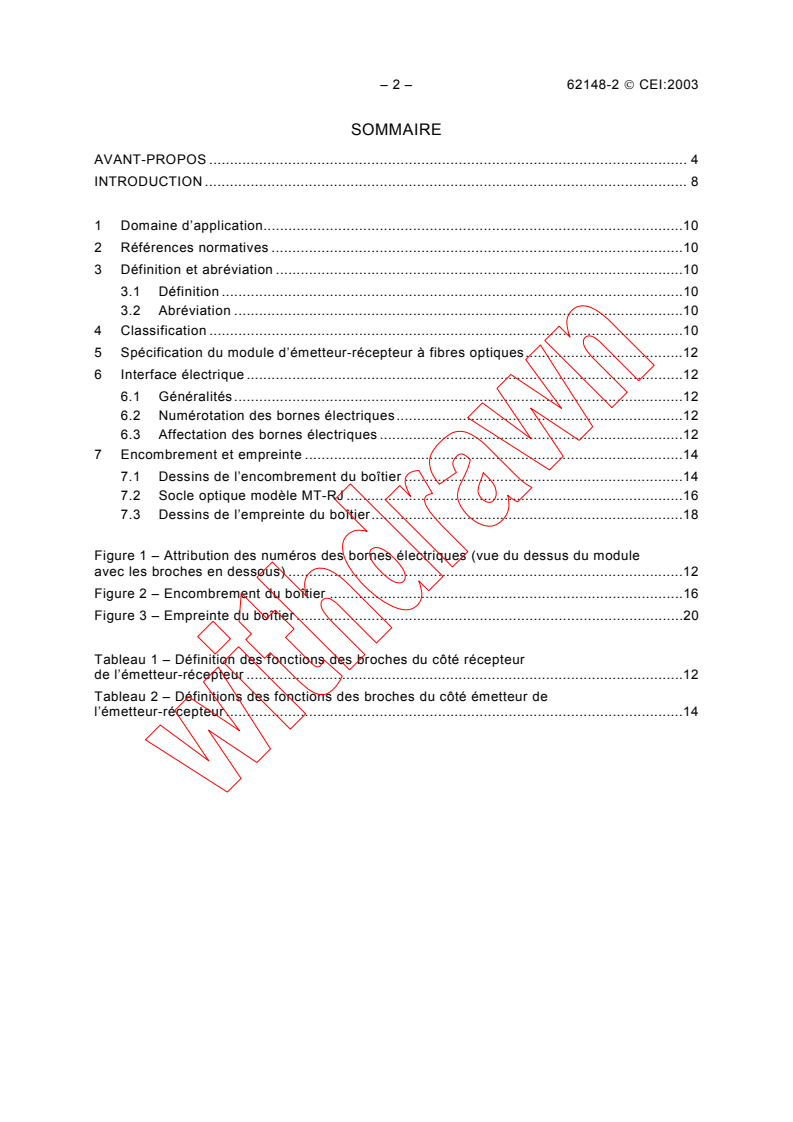
– 2 – 62148-2 CEI:2003
SOMMAIRE
AVANT-PROPOS . 4
INTRODUCTION .8
1 Domaine d’application.10
2 Références normatives .10
3 Définition et abréviation .10
3.1 Définition .10
3.2 Abréviation .10
4 Classification .10
5 Spécification du module d’émetteur-récepteur à fibres optiques.12
6 Interface électrique .12
6.1 Généralités.12
6.2 Numérotation des bornes électriques.12
6.3 Affectation des bornes électriques .12
7 Encombrement et empreinte .14
7.1 Dessins de l’encombrement du boîtier .14
7.2 Socle optique modèle MT-RJ .16
7.3 Dessins de l’empreinte du boîtier.18
Figure 1 – Attribution des numéros des bornes électriques (vue du dessus du module
avec les broches en dessous) .12
Figure 2 – Encombrement du boîtier .16
Figure 3 – Empreinte du boîtier .20
Tableau 1 – Définition des fonctions des broches du côté récepteur
de l’émetteur-récepteur .12
Tableau 2 – Définitions des fonctions des broches du côté émetteur de
l’émetteur-récepteur .14
62148-2 IEC:2003 – 3 –
CONTENTS
FOREWORD . 5
INTRODUCTION .9
1 Scope .11
2 Normative references.11
3 Definitions and abbreviations.11
3.1 Definition .11
3.2 Abbreviation .11
4 Classification .11
5 Specification of fibre optic transceiver modules.13
6 Electrical interface .13
6.1 General .13
6.2 Numbering of electrical terminals.13
6.3 Electrical terminal assignment .13
7 Outline and footprint .15
7.1 Drawings of case outline.15
7.2 Optical receptacle MT-RJ style .17
7.3 Drawings of case footprint .19
Figure 1 – Electrical terminal numbering assignments (viewed from above with pins
underneath) .13
Figure 2 – Case outline .17
Figure 3 – Case footprint.21
Table 1 – Transceiver receiver pin-function definitions .13
Table 2 – Transceiver transmitter pin-function definitions .15
– 4 – 62148-2 CEI:2003
COMMISSION ÉLECTROTECHNIQUE INTERNATIONALE
____________
COMPOSANTS ET DISPOSITIFS ACTIFS EN FIBRES OPTIQUES –
NORMES DE BOÎTIER ET D’INTERFACE –
Partie 2: Emetteurs-récepteurs SFF MT-RJ à 10 broches
AVANT-PROPOS
1) La CEI (Commission Électrotechnique Internationale) est une organisation mondiale de normalisation
composée de l'ensemble des comités électrotechniques nationaux (Comités nationaux de la CEI). La CEI a
pour objet de favoriser la coopération internationale pour toutes les questions de normalisation dans les
domaines de l'électricité et de l'électronique. A cet effet, la CEI, entre autres activités, publie des Normes
internationales. Leur élaboration est confiée à des comités d'études, aux travaux desquels tout Comité national
intéressé par le sujet traité peut participer. Les organisations internationales, gouvernementales et non
gouvernementales, en liaison avec la CEI, participent également aux travaux. La CEI collabore étroitement
avec l'Organisation Internationale de Normalisation (ISO), selon des conditions fixées par accord entre les
deux organisations.
2) Les décisions ou accords officiels de la CEI concernant les questions techniques représentent, dans la mesure
du possible, un accord international sur les sujets étudiés, étant donné que les Comités nationaux intéressés
sont représentés dans chaque comité d’études.
3) Les documents produits se présentent sous la forme de recommandations internationales. Ils sont publiés
comme normes, spécifications techniques, rapports techniques ou guides et agréés comme tels par les
Comités nationaux.
4) Dans le but d'encourager l'unification internationale, les Comités nationaux de la CEI s'engagent à appliquer de
façon transparente, dans toute la mesure possible, les Normes internationales de la CEI dans leurs normes
nationales et régionales. Toute divergence entre la norme de la CEI et la norme nationale ou régionale
correspondante doit être indiquée en termes clairs dans cette dernière.
5) La CEI n’a fixé aucune procédure concernant le marquage comme indication d’approbation et sa responsabilité
n’est pas engagée quand un matériel est déclaré conforme à l’une de ses normes.
6) L’attention est attirée sur le fait que certains des éléments de la présente Norme internationale peuvent faire
l’objet de droits de propriété intellectuelle ou de droits analogues. La CEI ne saurait être tenue pour
responsable de ne pas avoir identifié de tels droits de propriété et de ne pas avoir signalé leur existence.
La Norme internationale CEI 62148-2 a été établie par le sous-comité 86C: Systèmes et
dispositifs actifs à fibres optiques, du comité d'études 86 de la CEI: Fibres optiques.
Le texte de cette norme est issu des documents suivants:
FDIS Rapport de vote
86C/487/FDIS 86C/506/RVD
Le rapport de vote indiqué dans le tableau ci-dessus donne toute information sur le vote ayant
abouti à l'approbation de cette norme.
Cette publication a été rédigée selon les Directives ISO/CEI, Partie 2.
La présente norme constitue la Partie 2 de la série CEI 62148, publiée sous le titre général
Composants et dispositifs actifs en fibres optiques – Normes de boîtier et d’interface. Cette
série se compose de la Partie 1, consacrée aux généralités, et d’un certain nombre de parties
spécifiques à diverses familles de modules:
Partie 1: Généralités et lignes directrices
Partie 2: Emetteurs-récepteurs SFF MT-RJ à 10 broches
Partie 3: Emetteurs-récepteurs SFF MT-RJ à 20 broches
Partie 4: Emetteurs-récepteurs à fibres optiques en plastique PN 1x9
Partie 5: Modules à fibres optiques SC 1x9
62148-2 IEC:2003 – 5 –
INTERNATIONAL ELECTROTECHNICAL COMMISSION
____________
FIBRE OPTIC ACTIVE COMPONENTS AND DEVICES –
PACKAGE AND INTERFACE STANDARDS –
Part 2: SFF MT-RJ 10-pin transceivers
FOREWORD
1) The IEC (International Electrotechnical Commission) is a worldwide organization for standardization comprising
all national electrotechnical committees (IEC National Committees). The object of the IEC is to promote
international co-operation on all questions concerning standardization in the electrical and electronic fields. To
this end and in addition to other activities, the IEC publishes International Standards. Their preparation is
entrusted to technical committees; any IEC National Committee interested in the subject dealt with may
participate in this preparatory work. International, governmental and non-governmental organizations liaising
with the IEC also participate in this preparation. The IEC collaborates closely with the International
Organization for Standardization (ISO) in accordance with conditions determined by agreement between the
two organizations.
2) The formal decisions or agreements of the IEC on technical matters express, as nearly as possible, an
international consensus of opinion on the relevant subjects since each technical committee has representation
from all interested National Committees.
3) The documents produced have the form of recommendations for international use and are published in the form
of standards, technical specifications, technical reports or guides and they are accepted by the National
Committees in that sense.
4) In order to promote international unification, IEC National Committees undertake to apply IEC International
Standards transparently to the maximum extent possible in their national and regional standards. Any
divergence between the IEC Standard and the corresponding national or regional standard shall be clearly
indicated in the latter.
5) The IEC provides no marking procedure to indicate its approval and cannot be rendered responsible for any
equipment declared to be in conformity with one of its standards.
6) Attention is drawn to the possibility that some of the elements of this International Standard may be the subject
of patent rights. The IEC shall not be held responsible for identifying any or all such patent rights.
International Standard IEC 62148-2 has been prepared by subcommittee 86C: Fibre optic
systems and active devices, of IEC technical committee 86: Fibre optics.
The text of this standard is based on the following documents:
FDIS Report on voting
86C/487/FDIS 86C/506/RVD
Full information on the voting for the approval of this standard
...