

IEC 62561-1:2012
(Main)Lightning protection system components (LPSC) - Part 1: Requirements for connection components
General Information
- Abstract
IEC 62561-1:2012 specifies the requirements and tests for metallic connection components that form part of a lightning protection system (LPS). Typically, these can be connectors, bonding and bridging components, expansion pieces and test joints. Testing of components for an explosive atmosphere is not covered by this standard.
- Status
- Published
- Publication Date
- 09-Feb-2012
- Technical Committee
- TC 81 - Lightning protection
- Drafting Committee
- WG 11 - TC 81/WG 11
- Current Stage
- DELPUB - Deleted Publication
- Start Date
- 09-Mar-2017
- Completion Date
- 28-Aug-2026
Buy Documents
IEC 62561-1:2012 - Lightning protection system components (LPSC) - Part 1: Requirements for connection components Released:2/10/2012
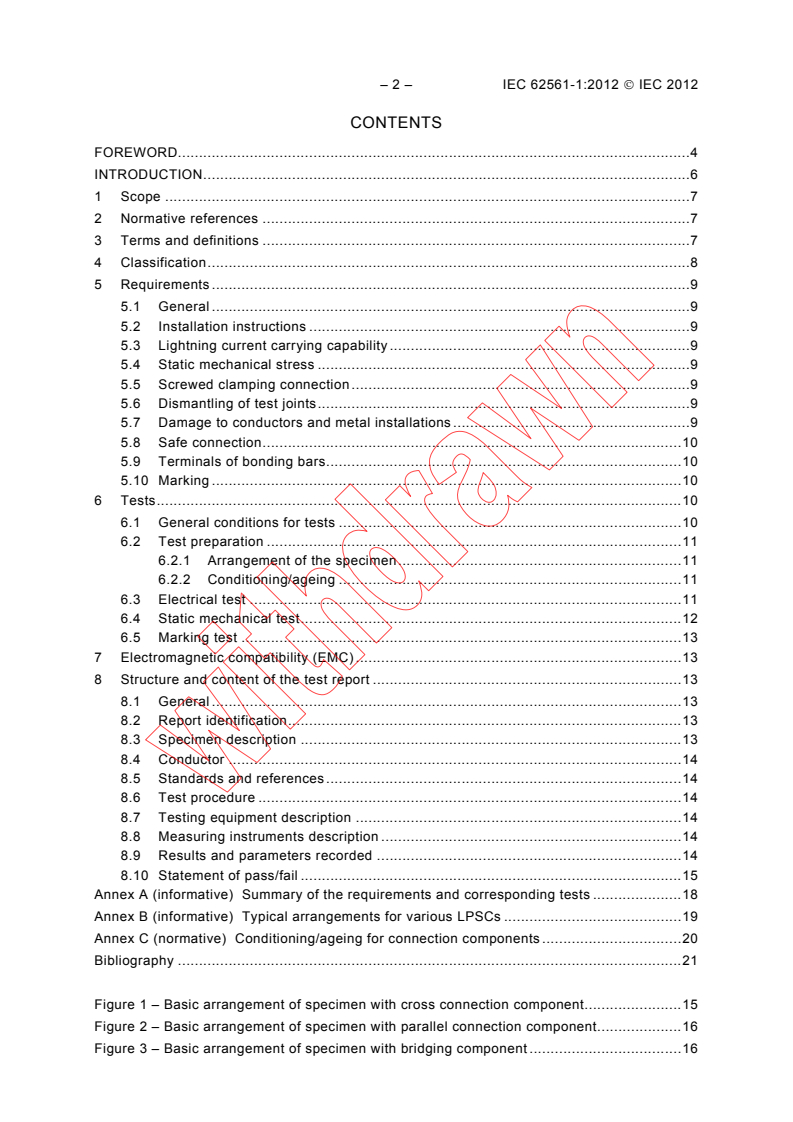
IEC 62561-1:2012 - Lightning protection system components (LPSC) - Part 1: Requirements for connection components Released:2/10/2012
Overview
IEC 62561-1:2012 - "Lightning protection system components (LPSC) - Part 1: Requirements for connection components" is an International Electrotechnical Commission standard that specifies requirements and tests for metallic connection components used in external lightning protection systems (LPS). Typical LPSC covered include connectors, clamps, bonding and bridging components, expansion pieces and test joints. The standard defines how these parts must perform under lightning current stress, mechanical load and environmental conditioning. Note: testing for explosive atmospheres is explicitly excluded.
Key topics and technical requirements
- Scope and component types: Covers metallic connection components of an LPS (connectors, clamps, pipe clamps, bonding bars, expansion pieces, test joints).
- Classification: Components are classified by lightning current withstand capability into Class H (heavy duty) and Class N (normal duty); classification also distinguishes components embedded in concrete vs not embedded.
- Manufacturer information: Required installation instructions must include classification, recommended tightening torque, conductor size/material ranges and connection configuration.
- Electrical performance: Lightning current carrying capability must be verified (see electrical tests in Clause 6 and lightning impulse parameters in Table 1).
- Mechanical performance: Static mechanical stress and durability (including dismantling after lightning stress for test joints) are specified and verified by tests.
- Design safety: Components must avoid undue damage to conductors or metal installations and ensure secure screwed/clamped connections.
- Marking, EMC and reporting: Requirements cover marking, electromagnetic compatibility (EMC) aspects, conditioning/ageing procedures and detailed structure/content for test reports.
- Testing framework: Includes test preparation, conditioning (ageing), electrical tests (lightning impulse), static mechanical tests, and marking tests.
Practical applications - who uses IEC 62561-1
- Manufacturers of lightning connectors, clamps, bonding bars and test joints use this standard to design and type-test products for commercial supply.
- Testing and certification laboratories follow the test methods and reporting structure to certify compliance.
- LPS designers and specifiers use the classification (H/N) and installation requirements to select appropriate connection components for building protection systems designed to IEC 62305.
- Installers and asset owners rely on manufacturer instructions and markings required by the standard to install and maintain LPS connections safely and reliably.
Related standards
- IEC 62305 series - Protection against lightning (system design principles)
- IEC 62561-2 - Requirements for conductors and earth electrodes
- IEC 60068-2-52, ISO 6957, ISO 6988 - referenced environmental and corrosion tests
- Note: IEC 62561-1 text is based on EN 50164-1.
IEC 62561-1 is essential for ensuring connection components in lightning protection systems are safe, durable and tested to withstand specified lightning currents and environmental stresses. Keywords: IEC 62561-1, lightning protection, LPSC, connection components, connectors, bonding bar, test joints, lightning current testing.
Relations
- Effective Date
- 05-Sep-2023
Buy Documents
IEC 62561-1:2012 - Lightning protection system components (LPSC) - Part 1: Requirements for connection components Released:2/10/2012
IEC 62561-1:2012 - Lightning protection system components (LPSC) - Part 1: Requirements for connection components Released:2/10/2012
Get Certified
Connect with accredited certification bodies for this standard

DIBt (Deutsches Institut für Bautechnik)
German Institute for Building Technology.
DIN CERTCO
DIN Group product certification.

IMQ S.p.A. (Certification)
Italian electrical product certification.
Sponsored listings
Frequently Asked Questions
IEC 62561-1:2012 is a standard published by the International Electrotechnical Commission (IEC). Its full title is "Lightning protection system components (LPSC) - Part 1: Requirements for connection components". This standard covers: IEC 62561-1:2012 specifies the requirements and tests for metallic connection components that form part of a lightning protection system (LPS). Typically, these can be connectors, bonding and bridging components, expansion pieces and test joints. Testing of components for an explosive atmosphere is not covered by this standard.
IEC 62561-1:2012 specifies the requirements and tests for metallic connection components that form part of a lightning protection system (LPS). Typically, these can be connectors, bonding and bridging components, expansion pieces and test joints. Testing of components for an explosive atmosphere is not covered by this standard.
IEC 62561-1:2012 is classified under the following ICS (International Classification for Standards) categories: 29.020 - Electrical engineering in general; 91.120.40 - Lightning protection. The ICS classification helps identify the subject area and facilitates finding related standards.
IEC 62561-1:2012 has the following relationships with other standards: It is inter standard links to IEC 62561-1:2017. Understanding these relationships helps ensure you are using the most current and applicable version of the standard.
IEC 62561-1:2012 is available in PDF format for immediate download after purchase. The document can be added to your cart and obtained through the secure checkout process. Digital delivery ensures instant access to the complete standard document.
Standards Content (Sample)
IEC 62561-1 ®
Edition 1.0 2012-02
INTERNATIONAL
STANDARD
Lightning protection system components (LPSC) –
Part 1: Requirements for connection components
All rights reserved. Unless otherwise specified, no part of this publication may be reproduced or utilized in any form
or by any means, electronic or mechanical, including photocopying and microfilm, without permission in writing from
either IEC or IEC's member National Committee in the country of the requester.
If you have any questions about IEC copyright or have an enquiry about obtaining additional rights to this publication,
please contact the address below or your local IEC member National Committee for further information.
IEC Central Office Tel.: +41 22 919 02 11
3, rue de Varembé Fax: +41 22 919 03 00
CH-1211 Geneva 20 info@iec.ch
Switzerland www.iec.ch
About the IEC
The International Electrotechnical Commission (IEC) is the leading global organization that prepares and publishes
International Standards for all electrical, electronic and related technologies.
About IEC publications
The technical content of IEC publications is kept under constant review by the IEC. Please make sure that you have the
latest edition, a corrigenda or an amendment might have been published.
Useful links:
IEC publications search - www.iec.ch/searchpub Electropedia - www.electropedia.org
The advanced search enables you to find IEC publications The world's leading online dictionary of electronic and
by a variety of criteria (reference number, text, technical electrical terms containing more than 30 000 terms and
committee,…). definitions in English and French, with equivalent terms in
It also gives information on projects, replaced and additional languages. Also known as the International
withdrawn publications. Electrotechnical Vocabulary (IEV) on-line.
IEC Just Published - webstore.iec.ch/justpublished Customer Service Centre - webstore.iec.ch/csc
Stay up to date on all new IEC publications. Just Published If you wish to give us your feedback on this publication
details all new publications released. Available on-line and or need further assistance, please contact the
also once a month by email. Customer Service Centre: csc@iec.ch.
IEC 62561-1 ®
Edition 1.0 2012-02
INTERNATIONAL
STANDARD
Lightning protection system components (LPSC) –
Part 1: Requirements for connection components
INTERNATIONAL
ELECTROTECHNICAL
COMMISSION
PRICE CODE
S
ICS 29.020; 91.120.40 ISBN 978-2-88912-925-6
– 2 – 62561-1 © IEC:2012(E)
CONTENTS
FOREWORD . 4
INTRODUCTION . 6
1 Scope . 7
2 Normative references . 7
3 Terms and definitions . 7
4 Classification . 8
5 Requirements . 9
5.1 General . 9
5.2 Installation instructions . 9
5.3 Lightning current carrying capability . 9
5.4 Static mechnical stress . 9
5.5 Screwed clamping connection . 9
5.6 Dismantling of test joints . 9
5.7 Damage to conductors and metal installations . 9
5.8 Safe connection . 10
5.9 Terminals of bonding bars . 10
5.10 Marking . 10
6 Tests . 10
6.1 General conditions for tests . 10
6.2 Test preparation . 11
6.2.1 Arrangement of the specimen . 11
6.2.2 Conditioning/ageing . 11
6.3 Electrical test . 11
6.4 Static mechanical test . 12
6.5 Marking test . 13
7 Electromagnetic compatibility (EMC) . 13
8 Structure and content of the test report . 13
8.1 General . 13
8.2 Report identification . 13
8.3 Specimen description . 13
8.4 Conductor . 14
8.5 Standards and references . 14
8.6 Test procedure . 14
8.7 Testing equipment description . 14
8.8 Measuring instruments description . 14
8.9 Results and parameters recorded . 14
8.10 Statement of pass/fail . 15
Annex A (informative) Summary of the requirements and corresponding tests . 18
Annex B (informative) Typical arrangements for various LPSCs . 19
Annex C (normative) Conditioning/ageing for connection components . 20
Bibliography . 21
Figure 1 – Basic arrangement of specimen with cross connection component . 15
Figure 2 – Basic arrangement of specimen with parallel connection component . 16
Figure 3 – Basic arrangement of specimen with bridging component . 16
62561-1 © IEC:2012(E) – 3 –
Figure 4 – Basic arrangement of specimen with equipotential bonding bar . 17
Figure 5 – Basic arrangement for contact measurement of expansion piece . 17
Table 1 – Lightning impulse current (I ) parameters . 12
imp
Table A.1 – Requirements and corresponding tests . 18
– 4 – 62561-1 © IEC:2012(E)
INTERNATIONAL ELECTROTECHNICAL COMMISSION
____________
LIGHTNING PROTECTION SYSTEM COMPONENTS (LPSC) –
Part 1: Requirements for connection components
FOREWORD
1) The International Electrotechnical Commission (IEC) is a worldwide organization for standardization comprising
all national electrotechnical committees (IEC National Committees). The object of IEC is to promote
international co-operation on all questions concerning standardization in the electrical and electronic fields. To
this end and in addition to other activities, IEC publishes International Standards, Technical Specifications,
Technical Reports, Publicly Available Specifications (PAS) and Guides (hereafter referred to as “IEC
Publication(s)”). Their preparation is entrusted to technical committees; any IEC National Committee interested
in the subject dealt with may participate in this preparatory work. International, governmental and non-
governmental organizations liaising with the IEC also participate in this preparation. IEC collaborates closely
with the International Organization for Standardization (ISO) in accordance with conditions determined by
agreement between the two organizations.
2) The formal decisions or agreements of IEC on technical matters express, as nearly as possible, an international
consensus of opinion on the relevant subjects since each technical committee has representation from all
interested IEC National Committees.
3) IEC Publications have the form of recommendations for international use and are accepted by IEC National
Committees in that sense. While all reasonable efforts are made to ensure that the technical content of IEC
Publications is accurate, IEC cannot be held responsible for the way in which they are used or for any
misinterpretation by any end user.
4) In order to promote international uniformity, IEC National Committees undertake to apply IEC Publications
transparently to the maximum extent possible in their national and regional publications. Any divergence
between any IEC Publication and the corresponding national or regional publication shall be clearly indicated in
the latter.
5) IEC itself does not provide any attestation of conformity. Independent certification bodies provide conformity
assessment services and, in some areas, access to IEC marks of conformity. IEC is not responsible for any
services carried out by independent certification bodies.
6) All users should ensure that they have the latest edition of this publication.
7) No liability shall attach to IEC or its directors, employees, servants or agents including individual experts and
members of its technical committees and IEC National Committees for any personal injury, property damage or
other damage of any nature whatsoever, whether direct or indirect, or for costs (including legal fees) and
expenses arising out of the publication, use of, or reliance upon, this IEC Publication or any other IEC
Publications.
8) Attention is drawn to the Normative references cited in this publication. Use of the referenced publications is
indispensable for the correct application of this publication.
9) Attention is drawn to the possibility that some of the elements of this IEC Publication may be the subject of
patent rights. IEC shall not be held responsible for identifying any or all such patent rights.
International Standard IEC 62561-1 has been prepared by IEC technical committee 81:
Lightning protection.
The text of this standard is based on the following documents:
FDIS Report on voting
81/416/FDIS 81/422A/RVD
Full information on the voting for the approval of this standard can be found in the report on
voting indicated in the above table.
This publication has been drafted in accordance with the ISO/IEC Directives, Part 2.
The content of this part of IEC 62561 is taken from European Standard EN 50164-1.
62561-1 © IEC:2012(E) – 5 –
A list of all the parts in the IEC 62561 series, published under the general title Lightning
protection system components (LPSC), can be found on the IEC website.
The committee has decided that the contents of this publication will remain unchanged until
the stability date indicated on the IEC web site under "http://webstore.iec.ch" in the data
related to the specific publication. At this date, the publication will be
• reconfirmed,
• withdrawn,
• replaced by a revised edition, or
• amended.
A bilingual version of this publication may be issued at a later date.
– 6 – 62561-1 © IEC:2012(E)
INTRODUCTION
This part of IEC 62561 deals with the requirements and tests for lightning protection system
components (LPSC) used for the installation of a lightning protection system (LPS) designed
and implemented according to the IEC 62305 series of standards.
62561-1 © IEC:2012(E) – 7 –
LIGHTNING PROTECTION SYSTEM COMPONENTS (LPSC) –
Part 1: Requirements for connection components
1 Scope
This part of IEC 62561 specifies the requirements and tests for metallic connection
components that form part of a lightning protection system (LPS). Typically, these can be
connectors, bonding and bridging components, expansion pieces and test joints.
Testing of components for an explosive atmosphere is not covered by this standard.
2 Normative references
The following documents, in whole or in part, are normatively referenced in this document and
are indispensable for its application. For dated references, only the edition cited applies. For
undated references, the latest edition of the referenced document (including any
amendments) applies.
IEC 60068-2-52:1996, Environmental testing – Part 2-52: Tests – Test Kb: Salt mist, cyclic
(sodium chloride solution)
IEC 62305-1, Protection against lightning – Part 1: General principles
IEC 62561-2, Lightning protection system components (LPSC) – Part 2: Requirements for
conductors and earth electrodes
ISO 6957:1988, Copper alloys – Ammonia test for stress corrosion resistance
ISO 6988:1985, Metallic and other non-organic coatings – Sulfur dioxide test with general
condensation of moisture
3 Terms and definitions
For the purpose of this document, the following terms and definitions apply.
3.1
connection component
part of an external LPS which is used for the connection of conductors to each other or to
metallic installations
Note 1 to entry Connection component includes connectors, clamps, bridging component and expansion piece.
3.2
metal installation
extended metal items in the structure to be protected which may form a path for lightning
current, such as pipes, staircases, elevator guide rails, ventilation, heating and air
conditioning ducts, and interconnected reinforcing steel
3.3
bridging component
connection component for the connection of metal installations
– 8 – 62561-1 © IEC:2012(E)
3.4
expansion piece
connection component designed to compensate for changes in length in conductors and/or
metal installations caused by temperature changes
3.5
connector
connection component to interconnect two or more conductors
3.6
clamp
connection component for the connection of conductors to metal installations
3.7
pipe clamp
clamp for the connection of conductors to metal pipes
3.8
test joint
joint designed to facilitate electrical testing and measurement of LPS components
3.9
connection range
minimum to maximum range for which a specific connection component is designed to be
used
3.10
bonding bar
metal bar on which metal installations, external conductive parts, electric power and
telecommunication lines and other cables can be connected to an LPS
3.11
type test
test required to be made before supplying a type of material covered by this standard on a
general commercial basis, in order to demonstrate satisfactory performance characteristics to
meet the intended application
Note 1 to entry These tests are of such a nature that, after they have been carried out, they need not be repeated
unless changes are made to the accessory materials, design or type of manufacturing process which might change
the performance characteristics.
4 Classification
4.1 Classification of components depends on the withstand lightning current as follows:
a) class H for heavy duty;
b) class N for normal duty.
The selection of classes H and N should be performed by the manufacturer in accordance
with the test parameters identified in Table 1.
4.2 Classification is also made according to the installation of connection components:
a) embedded in concrete;
b) not embedded in concrete.
62561-1 © IEC:2012(E) – 9 –
5 Requirements
5.1 General
Connection components shall be designed in such a manner that when they are installed in
accordance with the manufacturer’s instructions their performance shall be reliable, stable
and safe for persons and surrounding equipment.
NOTE A summary of the requirements and their corresponding tests is given in Annex A.
5.2 Installation instructions
The manufacturer of the connection components shall provide at least the following
information:
– the classification of the component;
– the recommended tightening torque;
– the range of conductor sizes and materials;
– the connection configuration.
Compliance is checked by inspection.
5.3 Lightning current carrying capability
Connection components shall have sufficient lightning current carrying capability.
Compliance is checked in accordance with 6.3 following the manufacturer’s declaration for the
class (H or N)
...
IEC 62561-1 ®
Edition 1.0 2012-02
INTERNATIONAL
STANDARD
NORME
INTERNATIONALE
Lightning protection system components (LPSC) –
Part 1: Requirements for connection components
Composants des systèmes de protection contre la foudre (CSPF) –
Partie 1: Exigences pour les composants de connexion
All rights reserved. Unless otherwise specified, no part of this publication may be reproduced or utilized in any form
or by any means, electronic or mechanical, including photocopying and microfilm, without permission in writing from
either IEC or IEC's member National Committee in the country of the requester. If you have any questions about IEC
copyright or have an enquiry about obtaining additional rights to this publication, please contact the address below or
your local IEC member National Committee for further information.
Droits de reproduction réservés. Sauf indication contraire, aucune partie de cette publication ne peut être reproduite
ni utilisée sous quelque forme que ce soit et par aucun procédé, électronique ou mécanique, y compris la photocopie
et les microfilms, sans l'accord écrit de l'IEC ou du Comité national de l'IEC du pays du demandeur. Si vous avez des
questions sur le copyright de l'IEC ou si vous désirez obtenir des droits supplémentaires sur cette publication, utilisez
les coordonnées ci-après ou contactez le Comité national de l'IEC de votre pays de résidence.
IEC Central Office Tel.: +41 22 919 02 11
3, rue de Varembé Fax: +41 22 919 03 00
CH-1211 Geneva 20 info@iec.ch
Switzerland www.iec.ch
About the IEC
The International Electrotechnical Commission (IEC) is the leading global organization that prepares and publishes
International Standards for all electrical, electronic and related technologies.
About IEC publications
The technical content of IEC publications is kept under constant review by the IEC. Please make sure that you have the
latest edition, a corrigenda or an amendment might have been published.
IEC Catalogue - webstore.iec.ch/catalogue Electropedia - www.electropedia.org
The stand-alone application for consulting the entire The world's leading online dictionary of electronic and
bibliographical information on IEC International Standards, electrical terms containing more than 30 000 terms and
Technical Specifications, Technical Reports and other definitions in English and French, with equivalent terms in 15
documents. Available for PC, Mac OS, Android Tablets and additional languages. Also known as the International
iPad. Electrotechnical Vocabulary (IEV) online.
IEC publications search - www.iec.ch/searchpub IEC Glossary - std.iec.ch/glossary
The advanced search enables to find IEC publications by a More than 60 000 electrotechnical terminology entries in
variety of criteria (reference number, text, technical English and French extracted from the Terms and Definitions
committee,…). It also gives information on projects, replaced clause of IEC publications issued since 2002. Some entries
and withdrawn publications. have been collected from earlier publications of IEC TC 37,
77, 86 and CISPR.
IEC Just Published - webstore.iec.ch/justpublished
Stay up to date on all new IEC publications. Just Published IEC Customer Service Centre - webstore.iec.ch/csc
details all new publications released. Available online and If you wish to give us your feedback on this publication or
also once a month by email. need further assistance, please contact the Customer Service
Centre: csc@iec.ch.
A propos de l'IEC
La Commission Electrotechnique Internationale (IEC) est la première organisation mondiale qui élabore et publie des
Normes internationales pour tout ce qui a trait à l'électricité, à l'électronique et aux technologies apparentées.
A propos des publications IEC
Le contenu technique des publications IEC est constamment revu. Veuillez vous assurer que vous possédez l’édition la
plus récente, un corrigendum ou amendement peut avoir été publié.
Catalogue IEC - webstore.iec.ch/catalogue Electropedia - www.electropedia.org
Application autonome pour consulter tous les renseignements
Le premier dictionnaire en ligne de termes électroniques et
bibliographiques sur les Normes internationales,
électriques. Il contient plus de 30 000 termes et définitions en
Spécifications techniques, Rapports techniques et autres
anglais et en français, ainsi que les termes équivalents dans
documents de l'IEC. Disponible pour PC, Mac OS, tablettes
15 langues additionnelles. Egalement appelé Vocabulaire
Android et iPad.
Electrotechnique International (IEV) en ligne.
Recherche de publications IEC - www.iec.ch/searchpub
Glossaire IEC - std.iec.ch/glossary
La recherche avancée permet de trouver des publications IEC Plus de 60 000 entrées terminologiques électrotechniques, en
en utilisant différents critères (numéro de référence, texte, anglais et en français, extraites des articles Termes et
comité d’études,…). Elle donne aussi des informations sur les Définitions des publications IEC parues depuis 2002. Plus
projets et les publications remplacées ou retirées. certaines entrées antérieures extraites des publications des
CE 37, 77, 86 et CISPR de l'IEC.
IEC Just Published - webstore.iec.ch/justpublished
Service Clients - webstore.iec.ch/csc
Restez informé sur les nouvelles publications IEC. Just
Published détaille les nouvelles publications parues. Si vous désirez nous donner des commentaires sur cette
Disponible en ligne et aussi une fois par mois par email. publication ou si vous avez des questions contactez-nous:
csc@iec.ch.
IEC 62561-1 ®
Edition 1.0 2012-02
INTERNATIONAL
STANDARD
NORME
INTERNATIONALE
Lightning protection system components (LPSC) –
Part 1: Requirements for connection components
Composants des systèmes de protection contre la foudre (CSPF) –
Partie 1: Exigences pour les composants de connexion
INTERNATIONAL
ELECTROTECHNICAL
COMMISSION
COMMISSION
ELECTROTECHNIQUE
INTERNATIONALE
ICS 29.020; 91.120.40 ISBN 978-2-8322-2980-4
– 2 – IEC 62561-1:2012 IEC 2012
CONTENTS
FOREWORD. 4
INTRODUCTION . 6
1 Scope . 7
2 Normative references . 7
3 Terms and definitions . 7
4 Classification . 8
5 Requirements . 9
5.1 General . 9
5.2 Installation instructions . 9
5.3 Lightning current carrying capability . 9
5.4 Static mechanical stress . 9
5.5 Screwed clamping connection . 9
5.6 Dismantling of test joints . 9
5.7 Damage to conductors and metal installations . 9
5.8 Safe connection . 10
5.9 Terminals of bonding bars . 10
5.10 Marking . 10
6 Tests . 10
6.1 General conditions for tests . 10
6.2 Test preparation . 11
6.2.1 Arrangement of the specimen . 11
6.2.2 Conditioning/ageing . 11
6.3 Electrical test . 11
6.4 Static mechanical test . 12
6.5 Marking test . 13
7 Electromagnetic compatibility (EMC) . 13
8 Structure and content of the test report . 13
8.1 General . 13
8.2 Report identification . 13
8.3 Specimen description . 13
8.4 Conductor . 14
8.5 Standards and references . 14
8.6 Test procedure . 14
8.7 Testing equipment description . 14
8.8 Measuring instruments description . 14
8.9 Results and parameters recorded . 14
8.10 Statement of pass/fail . 15
Annex A (informative) Summary of the requirements and corresponding tests . 18
Annex B (informative) Typical arrangements for various LPSCs . 19
Annex C (normative) Conditioning/ageing for connection components . 20
Bibliography . 21
Figure 1 – Basic arrangement of specimen with cross connection component . 15
Figure 2 – Basic arrangement of specimen with parallel connection component . 16
Figure 3 – Basic arrangement of specimen with bridging component . 16
Figure 4 – Basic arrangement of specimen with equipotential bonding bar . 17
Figure 5 – Basic arrangement for contact measurement of expansion piece . 17
Table 1 – Lightning impulse current (I ) parameters . 12
imp
Table A.1 – Requirements and corresponding tests . 18
– 4 – IEC 62561-1:2012 IEC 2012
INTERNATIONAL ELECTROTECHNICAL COMMISSION
____________
LIGHTNING PROTECTION SYSTEM COMPONENTS (LPSC) –
Part 1: Requirements for connection components
FOREWORD
1) The International Electrotechnical Commission (IEC) is a worldwide organization for standardization comprising
all national electrotechnical committees (IEC National Committees). The object of IEC is to promote
international co-operation on all questions concerning standardization in the electrical and electronic fields. To
this end and in addition to other activities, IEC publishes International Standards, Technical Specifications,
Technical Reports, Publicly Available Specifications (PAS) and Guides (hereafter referred to as “IEC
Publication(s)”). Their preparation is entrusted to technical committees; any IEC National Committee interested
in the subject dealt with may participate in this preparatory work. International, governmental and non-
governmental organizations liaising with the IEC also participate in this preparation. IEC collaborates closely
with the International Organization for Standardization (ISO) in accordance with conditions determined by
agreement between the two organizations.
2) The formal decisions or agreements of IEC on technical matters express, as nearly as possible, an international
consensus of opinion on the relevant subjects since each technical committee has representation from all
interested IEC National Committees.
3) IEC Publications have the form of recommendations for international use and are accepted by IEC National
Committees in that sense. While all reasonable efforts are made to ensure that the technical content of IEC
Publications is accurate, IEC cannot be held responsible for the way in which they are used or for any
misinterpretation by any end user.
4) In order to promote international uniformity, IEC National Committees undertake to apply IEC Publications
transparently to the maximum extent possible in their national and regional publications. Any divergence
between any IEC Publication and the corresponding national or regional publication shall be clearly indicated in
the latter.
5) IEC itself does not provide any attestation of conformity. Independent certification bodies provide conformity
assessment services and, in some areas, access to IEC marks of conformity. IEC is not responsible for any
services carried out by independent certification bodies.
6) All users should ensure that they have the latest edition of this publication.
7) No liability shall attach to IEC or its directors, employees, servants or agents including individual experts and
members of its technical committees and IEC National Committees for any personal injury, property damage or
other damage of any nature whatsoever, whether direct or indirect, or for costs (including legal fees) and
expenses arising out of the publication, use of, or reliance upon, this IEC Publication or any other IEC
Publications.
8) Attention is drawn to the Normative references cited in this publication. Use of the referenced publications is
indispensable for the correct application of this publication.
9) Attention is drawn to the possibility that some of the elements of this IEC Publication may be the subject of
patent rights. IEC shall not be held responsible for identifying any or all such patent rights.
International Standard IEC 62561-1 has been prepared by IEC technical committee 81:
Lightning protection.
This bilingual version (2015-10) corresponds to the English version, published in 2012-02.
The text of this standard is based on the following documents:
FDIS Report on voting
81/416/FDIS 81/422A/RVD
Full information on the voting for the approval of this standard can be found in the report on
voting indicated in the above table.
The French version of this standard has not been voted upon.
This publication has been drafted in accordance with the ISO/IEC Directives, Part 2.
The content of this part of IEC 62561 is taken from European Standard EN 50164-1.
A list of all the parts in the IEC 62561 series, published under the general title Lightning
protection system components (LPSC), can be found on the IEC website.
The committee has decided that the contents of this publication will remain unchanged until
the stability date indicated on the IEC web site under "http://webstore.iec.ch" in the data
related to the specific publication. At this date, the publication will be
• reconfirmed,
• withdrawn,
• replaced by a revised edition, or
• amended.
– 6 – IEC 62561-1:2012 IEC 2012
INTRODUCTION
This part of IEC 62561 deals with the requirements and tests for lightning protection system
components (LPSC) used for the installation of a lightning protection system (LPS) designed
and implemented according to the IEC 62305 series of standards.
LIGHTNING PROTECTION SYSTEM COMPONENTS (LPSC) –
Part 1: Requirements for connection components
1 Scope
This part of IEC 62561 specifies the requirements and tests for metallic connection
components that form part of a lightning protection system (LPS). Typically, these can be
connectors, bonding and bridging components, expansion pieces and test joints.
Testing of components for an explosive atmosphere is not covered by this standard.
2 Normative references
The following documents, in whole or in part, are normatively referenced in this document and
are indispensable for its application. For dated references, only the edition cited applies. For
undated references, the latest edition of the referenced document (including any
amendments) applies.
IEC 60068-2-52:1996, Environmental testing – Part 2-52: Tests – Test Kb: Salt mist, cyclic
(sodium chloride solution)
IEC 62305-1, Protection against lightning – Part 1: General principles
IEC 62561-2, Lightning protection system components (LPSC) – Part 2: Requirements for
conductors and earth electrodes
ISO 6957:1988, Copper alloys – Ammonia test for stress corrosion resistance
ISO 6988:1985, Metallic and other non-organic coatings – Sulfur dioxide test with general
condensation of moisture
3 Terms and definitions
For the purpose of this document, the following terms and definitions apply.
3.1
connection component
part of an external LPS which is used for the connection of conductors to each other or to
metallic installations
Note 1 to entry Connection component includes connectors, clamps, bridging component and expansion piece.
3.2
metal installation
extended metal items in the structure to be protected which may form a path for lightning
current, such as pipes, staircases, elevator guide rails, ventilation, heating and air
conditioning ducts, and interconnected reinforcing steel
3.3
bridging component
connection component for the connection of metal installations
– 8 – IEC 62561-1:2012 IEC 2012
3.4
expansion piece
connection component designed to compensate for changes in length in conductors and/or
metal installations caused by temperature changes
3.5
connector
connection component to interconnect two or more conductors
3.6
clamp
connection component for the connection of conductors to metal installations
3.7
pipe clamp
clamp for the connection of conductors to metal pipes
3.8
test joint
joint designed to facilitate electrical testing and measurement of LPS components
3.9
connection range
minimum to maximum range for which a specific connection component is designed to be
used
3.10
bonding bar
metal bar on which metal installations, external conductive parts, electric power and
telecommunication lines and other cables can be connected to an LPS
3.11
type test
test required to be made before supplying a type of material covered by this standard on a
general commercial basis, in order to demonstrate satisfactory performance characteristics to
meet the intended application
Note 1 to entry These tests are of such a nature that, after they have been carried out, they need not be repeated
unless changes are made to the accessory materials, design or type of manufacturing process which might change
the performance characteristics.
4 Classification
4.1 Classification of components depends on the withstand lightning current as follows:
a) class H for heavy duty;
b) class N for normal duty.
The selection of classes H and N should be performed by the manufacturer in accordance
with the test parameters identified in Table 1.
4.2 Classification is also made according to the installation of connection components:
a) embedded in concrete;
b) not embedded in concrete.
5 Requirements
5.1 General
Connection components shall be designed in such a manner that when they are installed in
accordance with the manufacturer’s instructions their performance shall be reliable, stable
and safe for persons and surrounding equipment.
NOTE A summary of the requirements and their corresponding tests is given in Annex A.
5.2 Installation instructions
The manufacturer of the connection components shall provide at least the following
information:
– the classification of the component;
– the recommended tightening torque;
– the range of conductor sizes and materials;
– the connection configuration.
Compliance is checked by inspection.
5.3 Lightning current carrying capability
Connection components shall have sufficient lightning current carrying capability.
Compliance is checked in accordance with 6.3 following the manufacturer’s declaration for the
class (H or N) of the connection components in accordance with 4.1.
5.4 Static mechanical stress
Connection components shall have a sufficient withstand capability against static mechanical
stresses.
Equipotential bonding bars are excluded from this requirement.
Compliance is checked in accordance with 6.4.
5.5 Screwed clamping connection
Where screws and/or nuts are used as the clamping connection, the design shall be such that
the conductor and/or the metal installation is always securely fastened by the screw and/or
nut application.
Compliance is checked by inspection and in accordance with 6.3.
5.6 Dismantling of test joints
It shall be possible to dismantle the test joints after lightning current stress.
Compliance is checked in accordance with 6.3.
5.7 Damage to conductors and metal installations
Connection components shall be so designed that they connect the conductors and/or the
metal installations without undue damage to the conductors, the metal installations and/or the
connection components.
– 10 – IEC 62561-1:2012 IEC 2012
Compliance is checked by inspection.
5.8 Safe connection
Connection components shall guarantee safe connection within the connection range declared
by the manufacturer.
Compliance is checked in accordance with 6.3.
5.9 Terminals of bonding bars
The input terminals of bonding bars used for lightning protection installations shall have a
diameter of connection equal to or greater than 6 mm.
5.10 Marking
The connection components shall be marked at least with the following:
a) manufacturer’s or responsible vendor’s name or trade mark;
b) identifying symbol (picture, product number etc.);
c) classification, i.e. class N or H.
Where this proves to be impractical, the marking in accordance with b) and c) may be given
on the smallest packing unit.
The marking shall be durable and legible.
NOTE Marking can be applied for example by moulding, pressing, engraving, printing adhesive labels or water
slide transfers.
Compliance is checked in accordance with 6.5.
6 Tests
6.1 General conditions for tests
The tests in accordance with this standard are type tests.
• Unless otherwise specified, tests are carried out with the specimens assembled and
installed as in normal use according to the manufacturer's or supplier's installation
instructions with the recommended conductor materials, sizes and tightening torques. If
the connection component is suitable for various conductors’ materials, then it shall be
tested on each material combination.
• All tests are carried out on new specimens.
• Unless otherwise specified, three specimens are subjected to the tests and the
requirements are satisfied if all the tests are met.
• If only one of the specimens does not satisfy a test due to an assembly or a manufacturing
fault, that test and any preceding one which may have influenced the results of the test
shall be repeated. The tests which follow shall also be carried out in the required
sequence on another full set of specimens, all of which shall comply with the
requirements.
• The electrical test shall be carried out in the order given after conditioning/ageing of the
arrangement of the specimen in accordance with 6.2.2.
The applicant, when submitting the sets of specimens, may also submit an additional set of
specimens which may be necessary should one specimen fail. The testing station will then,
without further request, test the additional set of specimens and will reject only if a further
failure occurs. If the additional set of specimens is not submitted at the same time, the failure
of one specimen will entail rejection.
6.2 Test preparation
6.2.1 Arrangement of the specimen
If not otherwise specified by the manufacturer, the conductors and the specimens shall be
cleaned by using a suitable degreasing agent followed by cleaning in demineralizing water
and drying. They shall then be assembled in accordance with the manufacturer’s instructions,
e.g. with the recommended conductors and tightening torques.
The connection component shall be tested in all the connection configurations declared by the
manufacturer in Annex B.
Any connection components accommodating a range of conductors with a variation on any
dimension equal to or less than 2 mm shall be tested using the minimum conductor size
recommended. If the range of conductor sizes is greater than 2 mm, it shall be tested using
the minimum and maximum size of conductors recommended.
The basic arrangement of the specimen with cross connection component, parallel connection
component, bridging component and equipotential bonding bar is shown in Figures 1, 2, 3 and
4, respectively. Terminals of bonding bars are only tested if the connection size is equal to or
greater than 16 mm . The test is carried out using the smallest conductor size within the
range of the terminal with a minimum of 16 mm conductor. Typical arrangements for various
LPSCs are shown in Annex B.
6.2.2 Conditioning/ageing
Following the manufacturer’s declaration for the location of the connection components in
accordance with 4.2, the arrangement of the specimen shall be subjected to a
conditioning/ageing, as per Annex C, consisting of a salt mist treatment as specified in C.1
followed by a humid sulphurous atmosphere treatment as specified in C.2, and an additional
ammonia atmosphere treatment for specimens made of copper alloy with copper content less
than 80 % as specified in C.3.
After the treatment, the arrangement is fixed on an insulated plate, taking care to avoid any
damage to the specimen due to handling.
This treatment is not necessary for connection components designed to be completely
embedded in concrete. Connection components designed to be partially embedded in
concrete shall be subjected to the conditioning/ageing as per this clause.
Bonding bars destined for indoor applications only are tested without conditioning/ageing.
6.3 Electrical test
After 6.2.2 and without cleaning the arrangement, the specimen shall be stressed three times
by a test current as given in Table 1. The time interval between individual shots shall allow
the arrangement of the specimen to cool down to approximately ambient temperature.
The impulse discharge current passing through the device under test is defined by the crest
value I , and the specific energy W/R The impulse current shall show no reversal and reach
imp .
I within 50 µs. The transfer of the specific energy W/R shall be dissipated within 5 ms.
imp
– 12 – IEC 62561-1:2012 IEC 2012
Table 1 – Lightning impulse current (I ) parameters
imp
Classification I W/R
imp
kA ± 10 % kJ/Ω ± 35 %
H 100 2 500
N 50 625
NOTE The parameters specified in Table 1 can typically be achieved by
an exponential decaying current in the range of 350 μs according to
IEC 62305-1.
The connection component is deemed to have passed the test if:
a) the contact resistance, measured with a source of at least 10 A as close as possible to the
connection component is equal to or less than 1 mΩ. In the case where the connection
component or the conductor(s) are of stainless steel, a value of 2,5 mΩ is allowed;
b) it does not exhibit any crack to normal or corrected vision without magnification nor does it
have any loose parts or deformation impairing its normal use;
c) for screwed clamping connections the loosening torque is greater than 0,25 and less than
1,5 times the tightening torque. In the case of connectors with more than one screw, only
the loosening torque of the first screw is relevant to this test;
d) the 20 mm length of conductor from the connector (see Figures 1, 2 and 4), prior to the
test is not less than 3 mm after completion of the test. For examples B3, B4, B6 and B8 as
shown in Annex B, the requirement of not less than 3 mm is not applicable;
e) the measurement of the contact resistance of the expansion components (E) and the
connected conductors (F) is performed between the clamped ends A-B and C-D, as close
as possible to the expansion component (see Figure 5);
f) the expansion conductor (E, see Figure 5) shall be tested according to IEC 62561-2 and
shall fulfill the requirements for air termination conductors;
g) for screw-less components, such as compressed connection components, each conductor
of the specimen assemblies shall be subjected independently to a mechanical tensile force
of 900 N ± 20 N, for 1 min. Each conductor shall be tested independently for multiple
conductor connectors. The connection component is deemed to have passed the test if
there is less than 1 mm movement of the conductor during the test and no damage on the
connector or conductor.
6.4 Static mechanical test
A second set of three new specimens shall be arranged according to the manufacturer’s or
supplier’s installation instructions with the recommended conductor materials, sizes and
tightening torques.
Each conductor of the specimen assemblies shall be subjected independently to a mechanical
tensile force of 900 N ± 20 N for 1 min. Each conductor shall be tested independently for
multiple conductor connectors.
The connection component is deemed to have passed the test if there is less than 1 mm
movement of the conductor during the test and no damage on the connector or conductor.
—————————
To be published.
6.5 Marking test
The marking is checked by inspection and by rubbing it by hand for 15 s with a piece of cloth
soaked with water and again for 15 s with a piece of cloth soaked with white spirit/mineral
spirit.
NOTE Markings made by moulding, pressing or engraving are not subjected to this test.
The specimen is deemed to have passed the test if the marking remains legible.
7 Electromagnetic compatibility (EMC)
Products covered by this standard are, in normal use, passive in respect of electromagnetic
influences (emission and immunity).
8 Structure and content of the test report
8.1 General
The purpose of this clause is to provide general requirements for laboratory test reports. It is
intended to promote clear, complete reporting procedures for laboratories submitting test
reports.
The results of each test carried out by the laboratory shall be reported accurately, clearly,
unambiguously and objectively, in accordance with any instructions in the test methods. The
results shall be reported in a test report and shall include all the information necessary for the
interpretation of the test results and all information required by the method used.
Particular care and attention shall be paid to the arrangement of the report, especially with
regard to presentation of the test data and ease of assimilation by the reader. The format
shall be carefully and specifically designed for each type of test carried out, but the headings
shall be standardized as indicated below.
The structure of each report shall include at least the following information contained in 8.2 to
8.10.
8.2 Report identification
a) A title or subject of the report;
b) Name, address and email or telephone number of the test laboratory;
c) Name, address and email or telephone number of the sub test laboratory where the test
was carried out if different from the company which has been assigned to perform the test;
d) Unique identification number (or serial number) of the test report;
e) Name and address of the vendor;
f) Report shall be paginated and the total number of pages indicated;
g) Date of issue of report;
h) Date(s) of performance of test(s);
i) Signature and title, or an equivalent identification of the person(s) authorized to sign for
the testing laboratory for the content of the report;
j) Signature and title of person(s) conducting the test.
8.3 Specimen description
a) Sample description;
– 14 – IEC 62561-1:2012 IEC 2012
b) Detailed description and unambiguous identification of the test sample and/or test
assembly;
c) Characterization and condition of the test sample and/or test assembly;
d) Sampling procedure, where relevant;
e) Date of receipt of test items;
f) Photographs, drawings or any other visual documentation, if available.
8.4 Conductor
a) Conductor material;
b) Nominal cross-section area, dimensions and shape. It is recommended that the actual
cross-sectional area should also be given.
8.5 Standards and references
a) Identification of the test standard used and the date of issue of the standard;
b) Other relevant documentation with the documentation date.
8.6 Test procedure
a) Description of the test procedure;
b) Justification for any deviations from, additions to or exclusions from the referenced
standard;
c) Any other information relevant to a specific test such as environmental conditions;
d) Configuration of testing assembly;
e) Location of the arrangement in the testing area and measuring techniques.
8.7 Testing equipment description
Description of equipment used for every test conducted, i.e. generator, conditioning/ageing
device.
8.8 Measuring instruments description
Characteristics and calibration date of all instruments used for measuring the values specified
in the standard i.e. radius gauge, shunts, tensile testing machine, extensometer, ohmmeter,
torque meter, thickness caliper gauge, etc.
8.9 Results and parameters recorded
The measured, observed or derived results shall be clearly identified at least for:
a) Current;
b) charge;
c) specific energy;
d) front time of the impulse;
e) duration of the impulse;
f) ohmic resistance;
g) tightening torque;
h) loosening torque.
The above shall be presented in tables, graphs, drawings, photographs or other
documentation of visual observations as appropriate.
8.10 Statement of pass/fail
A statement that the specimen passed or failed the tests shall be reported. If the specimen
has failed a description of failure is necessary.
Dimensions in millimetres
IEC 178/12
Key
1 cross connection component
2 plate made of insulating material
3 rigid fastener
4 conductor and/or metal installation as per Annex B
Figure 1 – Basic arrangement of specimen with cross connection component
– 16 – IEC 62561-1:2012 IEC 2012
Dimensions in millimetres
IEC 179/12
Key
1 parallel connection component
2 plate made of insulating material
3 rigid fastener
4 conductor and/or metal installation as per Annex B
Figure 2 – Basic arrangement of specimen with parallel connection component
Dimensions in millimetres
Key
IEC 180/12
1 bridging component
2 plate made of insulating material
3 rigid fastener
4 metal installation as per Annex B
Figure 3 – Basic arrangement of specimen with bridging component
Dimensions in millimetres
IEC 181/12
Key
1 equipotential bonding bar
2 plate made of insulating material
3 rigid fastener
4 conductor
5 fixing points of equipotential bonding bar
6 connection to be tested
Figure 4 – Basic arrangement of specimen with equipotential bonding bar
IEC 182/12
Key
A-B, C-D measuring points to verify the clamp contact resistances
E solid material or stranded material according to IEC 62561-2
F lightning protection system conductor according to IEC 62561-2
Figure 5 – Basic arrangement for contact measurement of expansion piece
– 18 – IEC 62561-1:2012 IEC 2012
Annex A
(informative)
Summary of the requirements and corresponding tests
Table A.1 – Requirements and corresponding tests
Test Requirements Requirements in Compliance is
sequence accordance with checked by
1 Installation instructions 5.2 Inspection
Lightning current carrying
2 5.3 6.3
capability
3 Static mechanical test 5.4 6.4
4 Screwed clamping connection 5.5 Inspection and 6.3
5 Dismantling of test joints 5.6 6.3
Damage to conductors and
6 5.7 Inspection
metal installation
7 Safe connection 5.8 6.3
8 Marking 5.10 Inspection and 6.5
Annex B
(informative)
Typical arrangements for various LPSCs
IEC 183/12
NOTE 1 B1, B4, B6 and B8: for more information, see Figure 1.
NOTE 2 B2, B3, B5 and B7: for more information, see Figure 2.
NOTE 3 B9: for more information, see Figure 3.
NOTE 4 B10: for more information, see Figure 4.
– 20 – IEC 62561-1:2012 IEC 2012
Annex C
(normative)
Conditioning/ageing for connection components
C.1 Salt mist treatment
Salt mist treatment shall be in accordance with IEC 60068-2-52:1996, except for Clauses 7,
10 and 11 which are not applicable. The test is carried out using severity (2).
If the salt mist chamber can maintain the temperature conditions as specified in 9.3 of
IEC 60068-2-52:1996 and a relative humidity of not less than 90 %, then the specimen may
remain in it for the humidity storage period.
C.2 Humid sulphurous atmosphere treatment
Humid sulphurous atmosphere treatment shall be in accordance with ISO 6988:1985 with
–6 –6
seven cycles with a concentration of sulphur dioxide of 667 × 10 (in volume) ± 25 × 10 ,
except for Clauses 9 and 10 which are not applicable.
Each cycle which has duration of 24 h is composed of a heating period of 8 h at a
temperature of 40 °C ± 3 °C in the humid saturated atmosphere which is followed by a rest
period of 16 h. After that, the humid sulphurous atmosphere is replaced.
If the test chamber maintains the temperature conditions as specified in 6.5.2 of
ISO 6988:1985 then the specimen may remain in it for the storage period.
C.3 Ammonia atmosphere treatment
Ammonia atmosphere treatment shall be in accordance with ISO 6957:1988 for a moderate
atmosphere with the pH value 10 except for 8.4 and Clause 9, which are not applicable.
Bibliography
IEC 62305 (all parts), Protection against lightning
European Standard EN 50164-1:2008, Lightning Protection Components (LPC) – Part 1:
Requirements for connection components
____________
– 22 – IEC 62561-1:2012 IEC 2012
SOMMAIRE
AVANT-PROPOS . 24
INTRODUCTION . 26
1 Domaine d'application . 27
2 Références normatives . 27
3 Termes et définitions . 27
4 Classification . 28
5 Exigences . 29
5.1 Généralités . 29
5.2 Instructions d’installation . 29
5.3 Capacité de tenue au courant de foudre . 29
5.4 Contrainte statique . 29
5.5 Connexion avec collier de serrage à vis . 29
5.6 Démontage des joints de contrôle . 30
5.7 Dommages subis par les conducteurs et les installations métalliques . 30
5.8 Connexion sûre . 30
5.9 Bornes des barres d’équipotentialité . 30
5.10 Marquage . 30
6 Essais . 30
6.1 Conditions générales d’essais . 30
6.2 Préparation des essais . 31
6.2.1 Préparation de l’échantillon . 31
6.2.2 Conditionnement/vieillissement . 31
6.3 Essais électriques . 32
6.4 Essai mécanique statique . 33
6.5 Essai du marquage . 33
7 Compatibilité électromagnétique (CEM) . 33
8 Structure et contenu du rapport d’essai . 33
8.1 Généralités . 33
8.2 Ident
...