

IEC 62093:2022
(Main)Photovoltaic system power conversion equipment - Design qualification and type approval
General Information
- Abstract
IEC 62093:2022 lays down IEC requirements for the design qualification of power conversion equipment (PCE) suitable for long-term operation in terrestrial photovoltaic (PV) systems.
This document covers electronic power conversion equipment intended for use in terrestrial PV applications. The term PCE refers to equipment and components for electronic power conversion of electric power into another kind of electric power with respect to voltage, current, and frequency. This document is suitable for PCE for use in both indoor and outdoor climates as defined in IEC 60721-3-3 and IEC 60721-3-4. Such equipment may include, but is not limited to, grid-tied and off-grid DC-to-AC PCEs, DC-to-DC converters, battery charger converters, and battery charge controllers. This document covers PCE that is connected to PV arrays that do not nominally exceed a maximum circuit voltage of 1 500 V DC.
This second edition cancels and replaces the first edition published in 2005. This edition includes the following significant technical changes with respect to the previous edition:
a. Title modified.
b. This edition focusses on the design qualification of power conversion electronics (PCE), and eliminates the clauses associated with qualification testing of other balance of system components.
c. While many clause titles remain the same as the first edition, substantial changes have been made.
d. Whereas the first edition establishes requirements for the design qualification of balance-of-system components used in terrestrial photovoltaic (PV) systems, this edition is limited to power conversion equipment.
e. The test protocols have been changed.
- Status
- Published
- Publication Date
- 09-Jan-2022
- Technical Committee
- TC 82 - Solar photovoltaic energy systems
- Drafting Committee
- WG 6 - TC 82/WG 6
- Current Stage
- PPUB - Publication issued
- Start Date
- 10-Jan-2022
- Completion Date
- 21-Jan-2022
Overview
IEC 62093:2022 is an international standard developed by the International Electrotechnical Commission (IEC) that specifies the design qualification and type approval requirements for power conversion equipment (PCE) used in terrestrial photovoltaic (PV) systems. This second edition replaces the original 2005 version, focusing exclusively on power conversion electronics, such as grid-tied and off-grid DC-to-AC inverters, DC-to-DC converters, battery chargers, and charge controllers, supporting PV arrays up to a nominal maximum circuit voltage of 1500 V DC. The standard applies to PCE intended for both indoor and outdoor environments according to IEC 60721 classifications.
By defining rigorous testing protocols and performance criteria, IEC 62093:2022 ensures the reliability, durability, and safety of photovoltaic system power conversion equipment-key components in efficient and sustainable solar power generation.
Key Topics
Scope and Applicability
Covers electronic power conversion equipment in terrestrial PV systems, excluding balance of system components addressed in earlier editions.Environmental Service Conditions
Classification of PCE performance requirements based on climatic exposure including outdoor, indoor unconditioned, and indoor conditioned environments.Testing Requirements and Procedures
Includes detailed test sequences to evaluate:- Visual inspection and operating performance characterization
- Functional testing under typical operating conditions
- Dielectric strength (voltage) testing
- Thermal testing of bus link capacitors and power transistor modules
- Environmental stress tests such as humidity freeze, thermal cycling, damp heat, dry heat, and UV weathering
These ensure PCE can withstand long-term terrestrial environmental effects.
Pass Criteria and Documentation
Specifies criteria to verify that equipment meets or exceeds functional and durability requirements for certification.Optional Environmental Tests
Includes rain intrusion, wind-driven rain, and dust ingress tests for enhanced qualification depending on deployment scenarios.
Applications
IEC 62093:2022 is essential for manufacturers, testing labs, and certification bodies involved in the development, verification, and approval of power conversion equipment within photovoltaic systems. Practical applications include:
Grid-Tied and Off-Grid PV Systems
Ensuring components reliably convert solar-generated DC power to usable AC or controlled DC voltages suitable for grids or standalone applications.Battery Charging and Control Systems
Qualification of converters used to manage energy storage solutions integrated with PV installations.Outdoor and Indoor Installations
Verifying PCE performance in diverse environmental conditions, ensuring resilience against climate challenges like temperature extremes, humidity, UV exposure, and dust.Quality Assurance and Product Certification
Providing industry benchmarks for product design validation and regulatory compliance, critical for commercial deployment and market acceptance.
Related Standards
- IEC 60721 Series – Environmental conditions for equipment, serving as reference for climatic categories applicable in IEC 62093.
- IEC 62109 – Safety of power converters used in photovoltaic systems, complementing qualification with safety requirements.
- IEC 61727 – Photovoltaic systems - Characteristics of the utility interface, related to electrical performance.
- IEC 62548 – Design requirements for photovoltaic arrays, supporting system integration considerations.
By adhering to the IEC 62093:2022 standard, stakeholders in the photovoltaic industry gain confidence in the reliability and durability of power conversion equipment, promoting the wider adoption of high-quality solar energy solutions globally.
Relations
- Effective Date
- 05-Sep-2023
Get Certified
Connect with accredited certification bodies for this standard

DNV
DNV is an independent assurance and risk management provider.

Lloyd's Register
Lloyd's Register is a global professional services organisation specialising in engineering and technology.
DNV Energy Systems
Energy and renewable energy certification.
Sponsored listings
Frequently Asked Questions
IEC 62093:2022 is a standard published by the International Electrotechnical Commission (IEC). Its full title is "Photovoltaic system power conversion equipment - Design qualification and type approval". This standard covers: IEC 62093:2022 lays down IEC requirements for the design qualification of power conversion equipment (PCE) suitable for long-term operation in terrestrial photovoltaic (PV) systems. This document covers electronic power conversion equipment intended for use in terrestrial PV applications. The term PCE refers to equipment and components for electronic power conversion of electric power into another kind of electric power with respect to voltage, current, and frequency. This document is suitable for PCE for use in both indoor and outdoor climates as defined in IEC 60721-3-3 and IEC 60721-3-4. Such equipment may include, but is not limited to, grid-tied and off-grid DC-to-AC PCEs, DC-to-DC converters, battery charger converters, and battery charge controllers. This document covers PCE that is connected to PV arrays that do not nominally exceed a maximum circuit voltage of 1 500 V DC. This second edition cancels and replaces the first edition published in 2005. This edition includes the following significant technical changes with respect to the previous edition: a. Title modified. b. This edition focusses on the design qualification of power conversion electronics (PCE), and eliminates the clauses associated with qualification testing of other balance of system components. c. While many clause titles remain the same as the first edition, substantial changes have been made. d. Whereas the first edition establishes requirements for the design qualification of balance-of-system components used in terrestrial photovoltaic (PV) systems, this edition is limited to power conversion equipment. e. The test protocols have been changed.
IEC 62093:2022 lays down IEC requirements for the design qualification of power conversion equipment (PCE) suitable for long-term operation in terrestrial photovoltaic (PV) systems. This document covers electronic power conversion equipment intended for use in terrestrial PV applications. The term PCE refers to equipment and components for electronic power conversion of electric power into another kind of electric power with respect to voltage, current, and frequency. This document is suitable for PCE for use in both indoor and outdoor climates as defined in IEC 60721-3-3 and IEC 60721-3-4. Such equipment may include, but is not limited to, grid-tied and off-grid DC-to-AC PCEs, DC-to-DC converters, battery charger converters, and battery charge controllers. This document covers PCE that is connected to PV arrays that do not nominally exceed a maximum circuit voltage of 1 500 V DC. This second edition cancels and replaces the first edition published in 2005. This edition includes the following significant technical changes with respect to the previous edition: a. Title modified. b. This edition focusses on the design qualification of power conversion electronics (PCE), and eliminates the clauses associated with qualification testing of other balance of system components. c. While many clause titles remain the same as the first edition, substantial changes have been made. d. Whereas the first edition establishes requirements for the design qualification of balance-of-system components used in terrestrial photovoltaic (PV) systems, this edition is limited to power conversion equipment. e. The test protocols have been changed.
IEC 62093:2022 is classified under the following ICS (International Classification for Standards) categories: 27.160 - Solar energy engineering. The ICS classification helps identify the subject area and facilitates finding related standards.
IEC 62093:2022 has the following relationships with other standards: It is inter standard links to IEC 62093:2005. Understanding these relationships helps ensure you are using the most current and applicable version of the standard.
IEC 62093:2022 is available in PDF format for immediate download after purchase. The document can be added to your cart and obtained through the secure checkout process. Digital delivery ensures instant access to the complete standard document.
Standards Content (Sample)
IEC 62093 ®
Edition 2.0 2022-01
INTERNATIONAL
STANDARD
NORME
INTERNATIONALE
colour
inside
Photovoltaic system power conversion equipment – Design qualification and
type approval
Matériel de conversion de puissance des systèmes photovoltaïques –
Qualification de la conception et approbation de type
All rights reserved. Unless otherwise specified, no part of this publication may be reproduced or utilized in any form
or by any means, electronic or mechanical, including photocopying and microfilm, without permission in writing from
either IEC or IEC's member National Committee in the country of the requester. If you have any questions about IEC
copyright or have an enquiry about obtaining additional rights to this publication, please contact the address below or
your local IEC member National Committee for further information.
Droits de reproduction réservés. Sauf indication contraire, aucune partie de cette publication ne peut être reproduite
ni utilisée sous quelque forme que ce soit et par aucun procédé, électronique ou mécanique, y compris la photocopie
et les microfilms, sans l'accord écrit de l'IEC ou du Comité national de l'IEC du pays du demandeur. Si vous avez des
questions sur le copyright de l'IEC ou si vous désirez obtenir des droits supplémentaires sur cette publication, utilisez
les coordonnées ci-après ou contactez le Comité national de l'IEC de votre pays de résidence.
IEC Secretariat Tel.: +41 22 919 02 11
3, rue de Varembé info@iec.ch
CH-1211 Geneva 20 www.iec.ch
Switzerland
About the IEC
The International Electrotechnical Commission (IEC) is the leading global organization that prepares and publishes
International Standards for all electrical, electronic and related technologies.
About IEC publications
The technical content of IEC publications is kept under constant review by the IEC. Please make sure that you have the
latest edition, a corrigendum or an amendment might have been published.
IEC publications search - webstore.iec.ch/advsearchform IEC Products & Services Portal - products.iec.ch
The advanced search enables to find IEC publications by a Discover our powerful search engine and read freely all the
variety of criteria (reference number, text, technical publications previews. With a subscription you will always
committee, …). It also gives information on projects, replaced have access to up to date content tailored to your needs.
and withdrawn publications.
Electropedia - www.electropedia.org
IEC Just Published - webstore.iec.ch/justpublished
The world's leading online dictionary on electrotechnology,
Stay up to date on all new IEC publications. Just Published
containing more than 22 300 terminological entries in English
details all new publications released. Available online and
and French, with equivalent terms in 19 additional languages.
once a month by email.
Also known as the International Electrotechnical Vocabulary
(IEV) online.
IEC Customer Service Centre - webstore.iec.ch/csc
If you wish to give us your feedback on this publication or
need further assistance, please contact the Customer Service
Centre: sales@iec.ch.
A propos de l'IEC
La Commission Electrotechnique Internationale (IEC) est la première organisation mondiale qui élabore et publie des
Normes internationales pour tout ce qui a trait à l'électricité, à l'électronique et aux technologies apparentées.
A propos des publications IEC
Le contenu technique des publications IEC est constamment revu. Veuillez vous assurer que vous possédez l’édition la
plus récente, un corrigendum ou amendement peut avoir été publié.
Recherche de publications IEC - IEC Products & Services Portal - products.iec.ch
webstore.iec.ch/advsearchform Découvrez notre puissant moteur de recherche et consultez
La recherche avancée permet de trouver des publications IEC gratuitement tous les aperçus des publications. Avec un
en utilisant différents critères (numéro de référence, texte, abonnement, vous aurez toujours accès à un contenu à jour
comité d’études, …). Elle donne aussi des informations sur adapté à vos besoins.
les projets et les publications remplacées ou retirées.
Electropedia - www.electropedia.org
IEC Just Published - webstore.iec.ch/justpublished
Le premier dictionnaire d'électrotechnologie en ligne au
Restez informé sur les nouvelles publications IEC. Just
monde, avec plus de 22 300 articles terminologiques en
Published détaille les nouvelles publications parues.
anglais et en français, ainsi que les termes équivalents dans
Disponible en ligne et une fois par mois par email.
19 langues additionnelles. Egalement appelé Vocabulaire
Electrotechnique International (IEV) en ligne.
Service Clients - webstore.iec.ch/csc
Si vous désirez nous donner des commentaires sur cette
publication ou si vous avez des questions contactez-nous:
sales@iec.ch.
IEC 62093 ®
Edition 2.0 2022-01
INTERNATIONAL
STANDARD
NORME
INTERNATIONALE
colour
inside
Photovoltaic system power conversion equipment – Design qualification and
type approval
Matériel de conversion de puissance des systèmes photovoltaïques –
Qualification de la conception et approbation de type
INTERNATIONAL
ELECTROTECHNICAL
COMMISSION
COMMISSION
ELECTROTECHNIQUE
INTERNATIONALE
ICS 27.160 ISBN 978-2-8322-1064-7
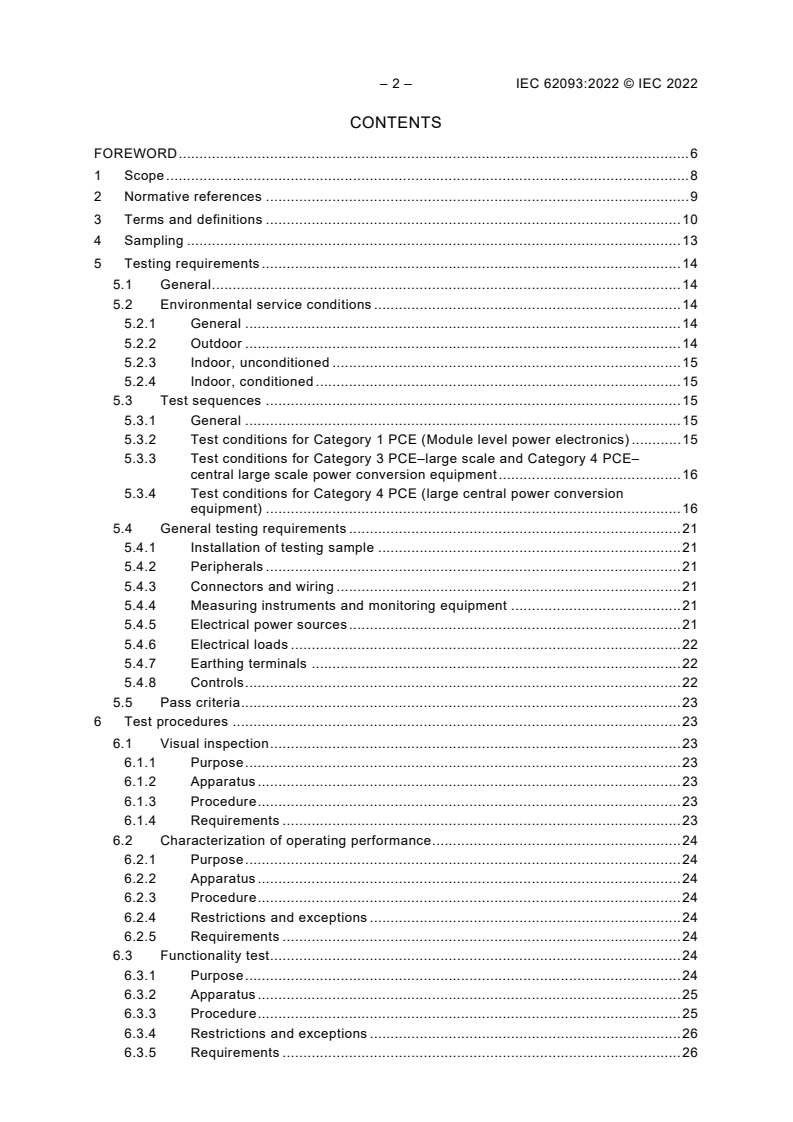
– 2 – IEC 62093:2022 © IEC 2022
CONTENTS
FOREWORD . 6
1 Scope . 8
2 Normative references . 9
3 Terms and definitions . 10
4 Sampling . 13
5 Testing requirements . 14
5.1 General . 14
5.2 Environmental service conditions . 14
5.2.1 General . 14
5.2.2 Outdoor . 14
5.2.3 Indoor, unconditioned . 15
5.2.4 Indoor, conditioned . 15
5.3 Test sequences . 15
5.3.1 General . 15
5.3.2 Test conditions for Category 1 PCE (Module level power electronics) . 15
5.3.3 Test conditions for Category 3 PCE–large scale and Category 4 PCE–
central large scale power conversion equipment . 16
5.3.4 Test conditions for Category 4 PCE (large central power conversion
equipment) . 16
5.4 General testing requirements . 21
5.4.1 Installation of testing sample . 21
5.4.2 Peripherals . 21
5.4.3 Connectors and wiring . 21
5.4.4 Measuring instruments and monitoring equipment . 21
5.4.5 Electrical power sources . 21
5.4.6 Electrical loads . 22
5.4.7 Earthing terminals . 22
5.4.8 Controls . 22
5.5 Pass criteria . 23
6 Test procedures . 23
6.1 Visual inspection . 23
6.1.1 Purpose . 23
6.1.2 Apparatus . 23
6.1.3 Procedure . 23
6.1.4 Requirements . 23
6.2 Characterization of operating performance . 24
6.2.1 Purpose . 24
6.2.2 Apparatus . 24
6.2.3 Procedure . 24
6.2.4 Restrictions and exceptions . 24
6.2.5 Requirements . 24
6.3 Functionality test . 24
6.3.1 Purpose . 24
6.3.2 Apparatus . 25
6.3.3 Procedure . 25
6.3.4 Restrictions and exceptions . 26
6.3.5 Requirements . 26
6.4 Voltage (dielectric strength) test . 26
6.4.1 Purpose . 26
6.4.2 Apparatus . 26
6.4.3 Procedure . 27
6.5 Bus link capacitor thermal test . 27
6.5.1 Purpose . 27
6.5.2 Apparatus . 27
6.5.3 Procedure . 27
6.5.4 Restrictions and exceptions . 29
6.5.5 Requirements . 29
6.6 Power transistor module thermal test . 30
6.6.1 Purpose . 30
6.6.2 Apparatus . 30
6.6.3 Procedure . 30
6.6.4 Restrictions and exceptions . 30
6.6.5 Requirements . 31
6.7 Humidity freeze test . 31
6.7.1 Purpose . 31
6.7.2 Apparatus . 31
6.7.3 Procedure . 32
6.7.4 Restrictions and exceptions . 33
6.7.5 Final measurements . 33
6.7.6 Requirements . 33
6.8 Thermal cycling test . 34
6.8.1 Purpose . 34
6.8.2 Apparatus . 34
6.8.3 Procedure . 35
6.8.4 Restrictions and exceptions . 37
6.8.5 Final measurements . 37
6.8.6 Requirements . 37
6.9 Damp heat test . 37
6.9.1 Purpose . 37
6.9.2 Apparatus . 38
6.9.3 Procedure . 38
6.9.4 Restrictions and exceptions . 40
6.9.5 Final measurements . 40
6.9.6 Requirements . 40
6.10 Dry heat test . 40
6.10.1 Purpose . 40
6.10.2 Apparatus . 40
6.10.3 Procedure . 41
6.10.4 Restrictions and exceptions . 42
6.10.5 Final measurements . 42
6.10.6 Requirements . 42
6.11 UV weathering test. 43
6.11.1 Purpose . 43
6.11.2 Apparatus . 43
6.11.3 Procedure . 43
6.11.4 Restrictions and exceptions . 43
– 4 – IEC 62093:2022 © IEC 2022
6.11.5 Requirements . 43
7 Optional tests . 44
7.1 General . 44
7.2 Rain intrusion test . 44
7.2.1 Purpose . 44
7.2.2 Apparatus . 44
7.2.3 Procedure . 44
7.2.4 Restrictions and exceptions . 45
7.2.5 Final measurements . 45
7.2.6 Requirements . 45
7.3 Wind driven rain test . 46
7.3.1 Purpose . 46
7.3.2 Apparatus . 46
7.3.3 Procedure . 46
7.3.4 Restrictions and exceptions . 47
7.3.5 Final measurements . 47
7.3.6 Requirements . 47
7.4 Dust test . 47
7.4.1 Purpose . 47
7.4.2 Apparatus . 48
7.4.3 Procedure . 48
7.4.4 Exceptions and restrictions . 48
7.4.5 Requirements . 48
7.5 Shipping vibration test . 49
7.5.1 Purpose . 49
7.5.2 Apparatus . 49
7.5.3 Procedure . 50
7.5.4 Restrictions and exceptions . 50
7.5.5 Final measurements . 50
7.5.6 Requirements . 50
7.6 Shock test . 50
7.6.1 Purpose . 50
7.6.2 Apparatus . 50
7.6.3 Procedure . 50
7.6.4 Restrictions and exceptions . 51
7.6.5 Final measurements . 51
7.6.6 Requirements . 51
7.7 Salt mist test . 51
7.7.1 Purpose . 51
7.7.2 Apparatus . 51
7.7.3 Procedure . 51
7.7.4 Restrictions and exceptions . 52
7.7.5 Final measurements . 52
7.7.6 Requirements . 52
7.8 Mixed gas corrosion test . 52
7.8.1 General . 52
7.8.2 Apparatus . 52
7.8.3 Procedure . 52
7.8.4 Restrictions and exceptions . 52
7.8.5 Final measurements . 52
7.8.6 Requirements . 52
7.9 Ammonia corrosion test . 53
7.9.1 Purpose . 53
7.9.2 Apparatus . 53
7.9.3 Procedure . 53
7.9.4 Final measurements . 53
7.9.5 Requirements . 53
8 Report . 53
Annex A (normative) Specification of tests performed for reporting . 55
Bibliography . 56
Figure 1 – Test sequence for PCEs of Categories 1 to 4 . 17
Figure 2 – Alternative test sequence for Category 3 PCE . 18
Figure 3 – Chamber temperature/humidity profile and power for humidity freeze test . 32
Figure 4 – Thermal cycling test – Temperature and output power profile . 35
Figure 5 – Damp heat test profile . 39
Figure 6 – Dry heat test – Temperature and input voltage profile . 41
Figure 7 – Reference for dust accumulation evaluation level . 49
Table 1 – Testing sample quantity . 14
Table 2 – Environmental condition classifications . 15
Table 3 – Summary of test levels (main test sequence) . 19
Table 4 – Summary of test levels (optional tests) . 20
Table 5 – Temperature and humidity limits for humidity freeze test . 33
Table 6 – Upper and lower temperature limits for thermal cycling test . 36
Table 7 – Temperature and humidity limits for damp heat test. 39
Table 8 – Temperature limits for dry heat test . 42
– 6 – IEC 62093:2022 © IEC 2022
INTERNATIONAL ELECTROTECHNICAL COMMISSION
____________
PHOTOVOLTAIC SYSTEM POWER CONVERSION EQUIPMENT –
DESIGN QUALIFICATION AND TYPE APPROVAL
FOREWORD
1) The International Electrotechnical Commission (IEC) is a worldwide organization for standardization comprising
all national electrotechnical committees (IEC National Committees). The object of IEC is to promote international
co-operation on all questions concerning standardization in the electrical and electronic fields. To this end and
in addition to other activities, IEC publishes International Standards, Technical Specifications, Technical Reports,
Publicly Available Specifications (PAS) and Guides (hereafter referred to as “IEC Publication(s)”). Their
preparation is entrusted to technical committees; any IEC National Committee interested in the subject dealt with
may participate in this preparatory work. International, governmental and non-governmental organizations liaising
with the IEC also participate in this preparation. IEC collaborates closely with the International Organization for
Standardization (ISO) in accordance with conditions determined by agreement between the two organizations.
2) The formal decisions or agreements of IEC on technical matters express, as nearly as possible, an international
consensus of opinion on the relevant subjects since each technical committee has representation from all
interested IEC National Committees.
3) IEC Publications have the form of recommendations for international use and are accepted by IEC National
Committees in that sense. While all reasonable efforts are made to ensure that the technical content of IEC
Publications is accurate, IEC cannot be held responsible for the way in which they are used or for any
misinterpretation by any end user.
4) In order to promote international uniformity, IEC National Committees undertake to apply IEC Publications
transparently to the maximum extent possible in their national and regional publications. Any divergence between
any IEC Publication and the corresponding national or regional publication shall be clearly indicated in the latter.
5) IEC itself does not provide any attestation of conformity. Independent certification bodies provide conformity
assessment services and, in some areas, access to IEC marks of conformity. IEC is not responsible for any
services carried out by independent certification bodies.
6) All users should ensure that they have the latest edition of this publication.
7) No liability shall attach to IEC or its directors, employees, servants or agents including individual experts and
members of its technical committees and IEC National Committees for any personal injury, property damage or
other damage of any nature whatsoever, whether direct or indirect, or for costs (including legal fees) and
expenses arising out of the publication, use of, or reliance upon, this IEC Publication or any other IEC
Publications.
8) Attention is drawn to the Normative references cited in this publication. Use of the referenced publications is
indispensable for the correct application of this publication.
9) Attention is drawn to the possibility that some of the elements of this IEC Publication may be the subject of patent
rights. IEC shall not be held responsible for identifying any or all such patent rights.
IEC 62093 has been prepared by IEC technical committee 82: Solar photovoltaic energy
systems. It is an International Standard.
This second edition cancels and replaces the first edition published in 2005. This edition
constitutes a technical revision.
This edition includes the following significant technical changes with respect to the previous
edition:
a) Title modified.
b) This edition focusses on the design qualification of power conversion electronics (PCE), and
eliminates the clauses associated with qualification testing of other balance of system
components.
c) While many clause titles remain the same as the first edition, substantial changes have been
made.
d) Whereas the first edition establishes requirements for the design qualification of balance-
of-system components used in terrestrial photovoltaic (PV) systems, this edition is limited
to power conversion equipment.
e) The test protocols have been changed.
The text of this International Standard is based on the following documents:
Draft Report on voting
82/1963/FDIS 82/1983/RVD
Full information on the voting for its approval can be found in the report on voting indicated in
the above table.
The language used for the development of this International Standard is English.
This document was drafted in accordance with ISO/IEC Directives, Part 2, and developed in
accordance with ISO/IEC Directives, Part 1 and ISO/IEC Directives, IEC Supplement, available
at www.iec.ch/members_experts/refdocs. The main document types developed by IEC are
described in greater detail at www.iec.ch/standardsdev/publications.
The committee has decided that the contents of this document will remain unchanged until the
stability date indicated on the IEC website under webstore.iec.ch in the data related to the
specific document. At this date, the document will be
• reconfirmed,
• withdrawn,
• replaced by a revised edition, or
• amended.
IMPORTANT – The "colour inside" logo on the cover page of this document indicates
that it contains colours which are considered to be useful for the correct understanding
of its contents. Users should therefore print this document using a colour printer.
– 8 – IEC 62093:2022 © IEC 2022
PHOTOVOLTAIC SYSTEM POWER CONVERSION EQUIPMENT –
DESIGN QUALIFICATION AND TYPE APPROVAL
1 Scope
This document lays down IEC requirements for the design qualification of power conversion
equipment (PCE) suitable for long-term operation in terrestrial photovoltaic (PV) systems.
This document covers electronic power conversion equipment intended for use in terrestrial PV
applications. The term PCE refers to equipment and components for electronic power
conversion of electric power into another kind of electric power with respect to voltage, current,
and frequency. This document is suitable for PCE for use in both indoor and outdoor climates
as defined in IEC 60721-3-3 and IEC 60721-3-4. Such equipment may include, but is not limited
to, grid-tied and off-grid DC-to-AC PCEs, DC-to-DC converters, battery charger converters, and
battery charge controllers.
This document covers PCE that is connected to PV arrays that do not nominally exceed a
maximum circuit voltage of 1 500 V DC. The equipment may also be connected to systems not
exceeding 1 000 V AC at the AC mains circuits, non-main AC load circuits, and to other DC
source or load circuits such as batteries. If particular ancillary parts whereby manufacturers
and models are specified in the manual for use with the PCE, then those parts are tested with
the PCE.
Exceptions:
a) This document does not address characteristics of power sources other than PV systems,
such as wind turbines, fuel cells, rotating machine sources, etc.
b) This document does not address the characteristics of power electronic conversion
equipment fully integrated into photovoltaic modules. Separate standards exist or are in
development for those types of devices. It is, however, applicable to devices where the
manufacturer explicitly specifies the capability of full detachment from and subsequent
reattachment to the PV module or if the input and output terminals can be accessed and a
specification sheet for the PCE is available. Devices meeting these requirements may be
tested as individual samples independent from the PV module.
c) This document does not apply to power conversion equipment with integrated (built-in)
electrochemical energy storage (e.g. lead acid or lithium-ion). It is, however, applicable to
equipment where the manufacturer specifies and permits complete removal of the
electrochemical energy storage from the PCE so that stand-alone assessment of the PCE
with the storage removed becomes possible.
The object of the test sequences contained herein is to establish a basic level of durability and
to show, as far as it is possible within reasonable constraints of cost and time, that the PCE is
capable of maintaining its performance after prolonged exposure to the simulated environmental
stresses described herein that are based on the intended use conditions specified by the
manufacturer. Optional tests contained herein may be selected depending on the intended
installation, market, or special environmental conditions that the PCE is anticipated to
experience. The categorization imposes differentiated test sequences and test severity levels
reflecting the different requirements of mechanical and electrical components in different
environments.
PCEs are grouped into categories based on size and installation environment.
The actual life expectancy of components so qualified depends on their design, their
environment, and the conditions under which they are operated. Estimation of a lifetime and
wear out is not generally covered by this document.
2 Normative references
The following documents are referred to in the text in such a way that some or all of their content
constitutes requirements of this document. For dated references, only the edition cited applies.
For undated references, the latest edition of the referenced document (including any
amendments) applies.
IEC 60068-2-2:2007, Environmental testing – Part 2-2: Tests – Test B: Dry heat
IEC 60068-2-6, Environmental testing – Part 2-6: Tests – Test Fc: Vibration (sinusoidal)
IEC 60068-2-14, Environmental testing – Part 2-14: Tests – Test N: Change of temperature
IEC 60068-2-27, Environmental testing – Part 2-27: Tests – Test Ea and guidance: Shock
IEC 60068-2-52, Environmental testing – Part 2-52: Tests – Test Kb: Salt mist, cyclic (sodium,
chloride solution)
IEC 60068-2-60:2015, Environmental testing – Part 2-60: Tests – Test Ke: Flowing mixed gas
corrosion test
IEC 60068-2-68, Environmental testing – Part 2-68: Tests – Test L: Dust and sand
IEC 60068-2-78, Environmental testing – Part 2-78: Tests – Test Cab: Damp heat, steady state
IEC 60068-3-5:2018, Environmental testing – Part 3-5: Supporting documentation and guidance
– Confirmation of the performance of temperature chambers
IEC 60068-3-6, Environmental testing – Part 3-6: Supporting documentation and guidance –
Confirmation of the performance of temperature/ humidity chambers
IEC 60529:1989, Degrees of protection provided by enclosures (IP Code)
IEC 60529:1989/AMD1:1999
IEC 60529:1989/AMD2:2013
IEC 60721-3-3, Classification of environmental conditions – Part 3-3: Classification of groups
of environmental parameters and their severities – Stationary use at weather protected
locations
IEC 60721-3-4, Classification of environmental conditions – Part 3-4: Classification of groups
of environmental parameters and their severities – Stationary use at non-weather protected
locations
IEC 61000-3-2, Electromagnetic compatibility (EMC) – Part 3-2: Limits – Limits for harmonic
current emissions (equipment input current ≤16 A per phase)
IEC 61000-3-12, Electromagnetic compatibility (EMC) – Part 3-12: Limits – Limits for harmonic
currents produced by equipment connected to public low-voltage systems with input current >16
A and ≤75 A per phase
IEC TR 61000-3-14, Electromagnetic compatibility (EMC) – Part 3-14: Assessment of emission
limits for harmonics, interharmonics, voltage fluctuations and unbalance for the connection of
disturbing installations to LV power systems
IEC 61180, High-voltage test techniques for low-voltage equipment – Definitions, test and
procedure requirements, test equipment
– 10 – IEC 62093:2022 © IEC 2022
IEC 61557-1, Electrical safety in low voltage distribution systems up to 1 000 V AC and
1 500 V DC – Equipment for testing, measuring or monitoring of protective measures – Part 1:
General requirements
IEC TS 61836, Solar photovoltaic energy systems – Terms, definitions and symbols
IEC 62109-1:2010, Safety of power converters for use in photovoltaic power systems – Part 1:
General requirements
IEC 62116:2014, Utility-interconnected photovoltaic inverters – Test procedure of islanding
prevention measures
IEC 62477-1:2012, Safety requirements for power electronic converter systems and equipment
– Part 1: General
IEC 62477-1:2012/AMD1:2016
IEC 62716:2013, Photovoltaic (PV) modules – Ammonia corrosion testing
IEC 62852, Connectors for DC-application in photovoltaic systems – Safety requirements and
tests
IEC 62894:2014, Photovoltaic inverters – Data sheet and name plate
IEC 62894:2014/AMD1:2016
IEC TS 63106-2, Basic requirements for simulator used for testing of photovoltaic power
conversion equipment – Part 2: DC power simulator
ISO 4892-2, Plastics – Methods of exposure to laboratory light sources – Part 2: Xenon-arc
lamps
ISO 12103-1:2016, Road vehicles – Test contaminants for filter evaluation – Part 1: Arizona
test dust
ISO 22479:2019, Corrosion of metals and alloys – Sulfur dioxide test in a humid atmosphere
(fixed gas method)
3 Terms and definitions
For the purposes of this document, the terms and definitions given in IEC TS 61836 and the
following apply.
ISO and IEC maintain terminological databases for use in standardization at the following
addresses:
• IEC Electropedia: available at http://www.electropedia.org/
• ISO Online platform: available at http://www.iso.org/obp
NOTE Symbols and variable names for PCE input and output values follow the terminology of IEC 62894.
3.1
power conversion equipment
PCE
electrical device converting one kind of electrical power from a voltage or current source into
another kind of electrical power with respect to voltage, current and frequency
Note 1 to entry: Examples include AC-DC converters, DC-AC inverters, DC-DC charge controllers, frequency
converters, etc.
3.2
module-level power electronics: Category 1 PCE
MLPE
referring to PCE that is specified by the manufacturer to operate on a PV module basis,
interfacing with up to four individual PV modules
3.3
string-level power electronics: Category 2 PCE
category comprising PCE that is designed to interface more than four series- and/or parallel-
connected PV modules and not meeting the conversion power of the Category 3 PCE or
Category 4 PCE definition
3.4
large-scale power electronics: Category 3 PCE
category comprising PCE predominantly in a single unit capable of power conversion equal to
or greater than 100 kVA and less than 1 000 kVA
Note 1 to entry: This class of PCE may have multiple power conversion units built into the larger containing unit.
3.5
central large-scale power electronics: Category 4 PCE
category comprising PCE predominantly in a single enclosure capable of power conversion
equal to or greater than 1 000 kVA
Note 1 to entry: This class of PCE may have multiple power conversion units built into the larger containing unit.
3.6
derating temperature
ambient temperature limit at which the PCE starts to actively curtail its input and output power
to maintain a certain maximum operating temperature
Note 1 to entry: This temperature may also depend on input power and other electrical parameters, and thus may
not be unique.
3.7
electrically independent inputs
ports for input of power to the PCE that are not ohmically connected to one another internally
but serve to supply power to the PCE at different operating points of current and voltage at the
same time provided by, for example, a boost converter stage in the PCE for each such
electrically independent input
3.8
enclosure
part of the equipment which surrounds internal parts, intended to provide protection against
external influences, against the spread of fire, or against access to hazards
Note 1 to entry: Enclosures may be free standing, wall, rack, ceiling, frame or skid mounted.
3.9
maximum total PV array short circuit current
I
sc max
absolute maximum total PV array short circuit current (DC) that the PCE is rated to have
connected to its PV input, under most severe-case conditions of ambient temperature,
irradiance, etc.
Note 1 to entry: This rating of the PCE refers to the absolute maximum current the PV input to the PCE is designed
for under conditions of expected use. This differs from the simple sum of the marked I ratings of the connected PV
sc
modules, since those markings are based on short-circuit conditions under standard test conditions, and may be
exceeded at high temperatures or with irradiance above the standard level.
– 12 – IEC 62093:2022 © IEC 2022
3.10
rated
value assigned, generally by a manufacturer, to a specified operating condition of a component,
device or equipment
3.11
rated input voltage
V
dc,r
rated input voltage specified by the manufacturer, or if not specified, the midpoint of the
maximum power point (MPP) input voltage range of the PCE
3.12
rated power
P
r
maximum active power the PCE can deliver in continuous operation
3.13
maximum power point voltage
maximum MPP voltage
V
mpp max
maximum voltage at the DC input port at which the inverter can deliver its rated power
continuously without power curtailing
3.14
minimum MPP voltage
V
mpp min
minimum voltage at the DC input port at w
...