


IEC TS 62548:2013
(Main)Photovoltaic (PV) arrays - Design requirements
General Information
- Abstract
IEC/TS 62548:2013(E) sets out design requirements for photovoltaic (PV) arrays including d.c. array wiring, electrical protection devices, switching and earthing provisions. The scope includes all parts of the PV array up to but not including energy storage devices, power conversion equipment or loads. The object of this Technical Specification is to address the design safety requirements arising from the particular characteristics of photovoltaic systems. Attention is drawn to a project in the IEC 60364 series under joint development between IEC TCs 64 and 82, which will, when published, cancel and replace the present technical specification.
- Status
- Replaced
- Publication Date
- 25-Jul-2013
- Technical Committee
- TC 82 - Solar photovoltaic energy systems
- Drafting Committee
- WG 3 - TC 82/WG 3
- Current Stage
- DELPUB - Deleted Publication
- Start Date
- 28-Sep-2016
- Completion Date
- 28-Aug-2026
Relations
- Effective Date
- 05-Sep-2023
- Effective Date
- 10-Feb-2026
- Effective Date
- 10-Feb-2026
- Referred By
EN 62253:2011 - Photovoltaic pumping systems - Design qualification and performance measurements - Effective Date
- 10-Feb-2026
- Effective Date
- 10-Feb-2026
Get Certified
Connect with accredited certification bodies for this standard

DNV
DNV is an independent assurance and risk management provider.

Lloyd's Register
Lloyd's Register is a global professional services organisation specialising in engineering and technology.
DNV Energy Systems
Energy and renewable energy certification.
Sponsored listings
Frequently Asked Questions
IEC TS 62548:2013 is a technical specification published by the International Electrotechnical Commission (IEC). Its full title is "Photovoltaic (PV) arrays - Design requirements". This standard covers: IEC/TS 62548:2013(E) sets out design requirements for photovoltaic (PV) arrays including d.c. array wiring, electrical protection devices, switching and earthing provisions. The scope includes all parts of the PV array up to but not including energy storage devices, power conversion equipment or loads. The object of this Technical Specification is to address the design safety requirements arising from the particular characteristics of photovoltaic systems. Attention is drawn to a project in the IEC 60364 series under joint development between IEC TCs 64 and 82, which will, when published, cancel and replace the present technical specification.
IEC/TS 62548:2013(E) sets out design requirements for photovoltaic (PV) arrays including d.c. array wiring, electrical protection devices, switching and earthing provisions. The scope includes all parts of the PV array up to but not including energy storage devices, power conversion equipment or loads. The object of this Technical Specification is to address the design safety requirements arising from the particular characteristics of photovoltaic systems. Attention is drawn to a project in the IEC 60364 series under joint development between IEC TCs 64 and 82, which will, when published, cancel and replace the present technical specification.
IEC TS 62548:2013 is classified under the following ICS (International Classification for Standards) categories: 27.160 - Solar energy engineering. The ICS classification helps identify the subject area and facilitates finding related standards.
IEC TS 62548:2013 has the following relationships with other standards: It is inter standard links to IEC 62548:2016, EN 62446-1:2016, EN 62852:2015/A1:2020, EN 62253:2011, EN 62852:2015. Understanding these relationships helps ensure you are using the most current and applicable version of the standard.
IEC TS 62548:2013 is available in PDF format for immediate download after purchase. The document can be added to your cart and obtained through the secure checkout process. Digital delivery ensures instant access to the complete standard document.
Standards Content (Sample)
IEC/TS 62548 ®
Edition 1.0 2013-07
TECHNICAL
SPECIFICATION
colour
inside
Photovoltaic (PV) arrays – Design requirements
IEC/TS 62548:2013(E)
All rights reserved. Unless otherwise specified, no part of this publication may be reproduced or utilized in any form
or by any means, electronic or mechanical, including photocopying and microfilm, without permission in writing from
either IEC or IEC's member National Committee in the country of the requester.
If you have any questions about IEC copyright or have an enquiry about obtaining additional rights to this publication,
please contact the address below or your local IEC member National Committee for further information.
IEC Central Office Tel.: +41 22 919 02 11
3, rue de Varembé Fax: +41 22 919 03 00
CH-1211 Geneva 20 info@iec.ch
Switzerland www.iec.ch
About the IEC
The International Electrotechnical Commission (IEC) is the leading global organization that prepares and publishes
International Standards for all electrical, electronic and related technologies.
About IEC publications
The technical content of IEC publications is kept under constant review by the IEC. Please make sure that you have the
latest edition, a corrigenda or an amendment might have been published.
Useful links:
IEC publications search - www.iec.ch/searchpub Electropedia - www.electropedia.org
The advanced search enables you to find IEC publications The world's leading online dictionary of electronic and
by a variety of criteria (reference number, text, technical electrical terms containing more than 30 000 terms and
committee,…). definitions in English and French, with equivalent terms in
It also gives information on projects, replaced and additional languages. Also known as the International
withdrawn publications. Electrotechnical Vocabulary (IEV) on-line.
IEC Just Published - webstore.iec.ch/justpublished Customer Service Centre - webstore.iec.ch/csc
Stay up to date on all new IEC publications. Just Published If you wish to give us your feedback on this publication
details all new publications released. Available on-line and or need further assistance, please contact the
also once a month by email. Customer Service Centre: csc@iec.ch.
IEC/TS 62548 ®
Edition 1.0 2013-07
TECHNICAL
SPECIFICATION
colour
inside
Photovoltaic (PV) arrays – Design requirements
INTERNATIONAL
ELECTROTECHNICAL
COMMISSION
PRICE CODE
XA
ICS 27.160 ISBN 978-2-8322-1006-2
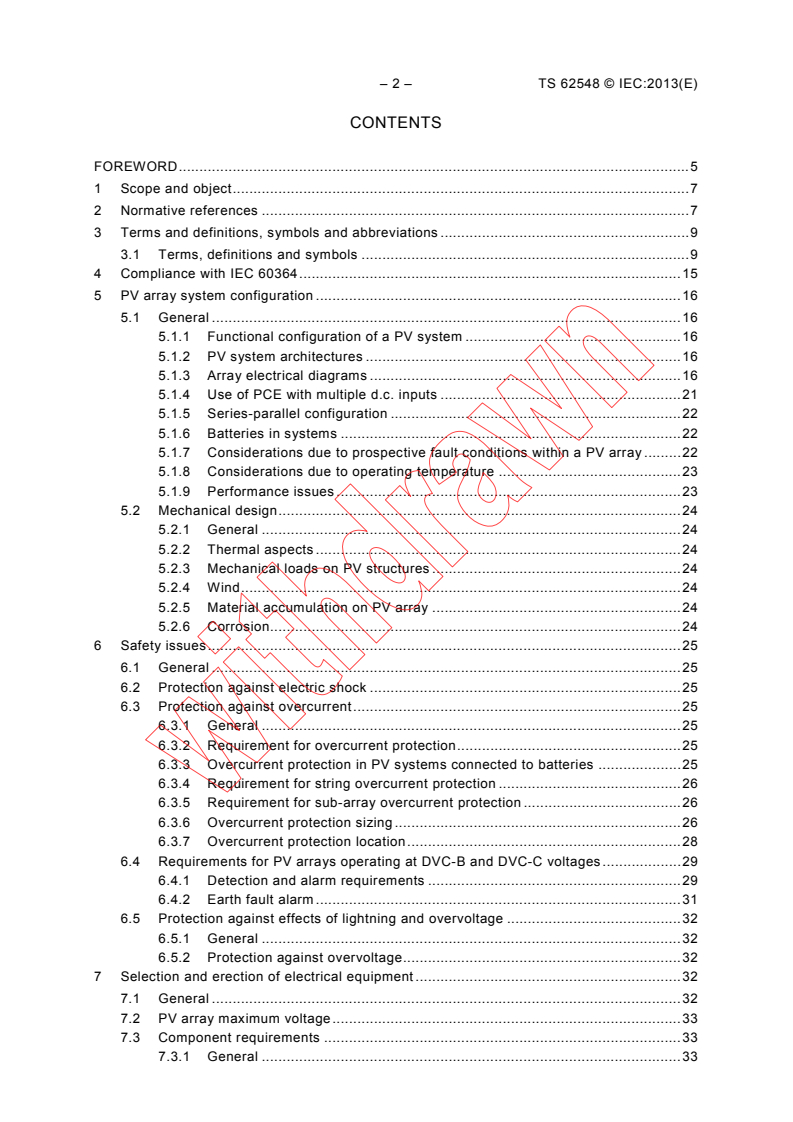
– 2 – TS 62548 © IEC:2013(E)
CONTENTS
FOREWORD . 5
1 Scope and object . 7
2 Normative references . 7
3 Terms and definitions, symbols and abbreviations . 9
3.1 Terms, definitions and symbols . 9
4 Compliance with IEC 60364 . 15
5 PV array system configuration . 16
5.1 General . 16
5.1.1 Functional configuration of a PV system . 16
5.1.2 PV system architectures . 16
5.1.3 Array electrical diagrams . 16
5.1.4 Use of PCE with multiple d.c. inputs . 21
5.1.5 Series-parallel configuration . 22
5.1.6 Batteries in systems . 22
5.1.7 Considerations due to prospective fault conditions within a PV array . 22
5.1.8 Considerations due to operating temperature . 23
5.1.9 Performance issues . 23
5.2 Mechanical design . 24
5.2.1 General . 24
5.2.2 Thermal aspects . 24
5.2.3 Mechanical loads on PV structures . 24
5.2.4 Wind . 24
5.2.5 Material accumulation on PV array . 24
5.2.6 Corrosion. 24
6 Safety issues . 25
6.1 General . 25
6.2 Protection against electric shock . 25
6.3 Protection against overcurrent . 25
6.3.1 General . 25
6.3.2 Requirement for overcurrent protection . 25
6.3.3 Overcurrent protection in PV systems connected to batteries . 25
6.3.4 Requirement for string overcurrent protection . 26
6.3.5 Requirement for sub-array overcurrent protection . 26
6.3.6 Overcurrent protection sizing . 26
6.3.7 Overcurrent protection location . 28
6.4 Requirements for PV arrays operating at DVC-B and DVC-C voltages . 29
6.4.1 Detection and alarm requirements . 29
6.4.2 Earth fault alarm . 31
6.5 Protection against effects of lightning and overvoltage . 32
6.5.1 General . 32
6.5.2 Protection against overvoltage . 32
7 Selection and erection of electrical equipment . 32
7.1 General . 32
7.2 PV array maximum voltage . 33
7.3 Component requirements . 33
7.3.1 General . 33
TS 62548 © IEC:2013(E) – 3 –
7.3.2 PV modules . 34
7.3.3 PV array and PV string combiner boxes . 34
7.3.4 Circuit breakers . 34
7.3.5 Disconnectors and switch-disconnectors. 35
7.3.6 Cables . 35
7.3.7 Segregation of a.c. and d.c. circuits . 38
7.3.8 Plugs, sockets and connectors . 38
7.3.9 Wiring in combiner boxes . 39
7.3.10 Fuses . 39
7.3.11 Bypass diodes . 39
7.3.12 Blocking diodes . 39
7.4 Location and installation requirements. 40
7.4.1 Disconnecting means . 40
7.4.2 Earthing and bonding arrangements . 42
7.4.3 Wiring system . 46
8 Acceptance . 47
9 Operation/maintenance . 47
10 Marking and documentation . 48
10.1 Equipment marking . 48
10.2 Requirements for signs . 48
10.3 Identification of a PV installation . 48
10.4 Labelling of PV array and PV string combiner boxes . 48
10.5 Labelling of disconnection devices . 48
10.5.1 General . 48
10.5.2 PV array disconnecting device . 48
10.6 Documentation . 49
Annex A (informative) Examples of signs . 50
Annex B (informative) Examples of system functional earthing configurations in PV
arrays . 51
Annex C (informative) Blocking diode . 53
Annex D (informative) Arc fault detection and interruption in PV arrays . 57
Annex E (informative) DVC limits . 59
Bibliography . 60
Figure 1 – General functional configuration of a PV powered system . 16
Figure 2 – PV array diagram – single string case . 17
Figure 3 – PV array diagram – multiple parallel string case . 18
Figure 4 – PV array diagram – multiple parallel string case with array divided into sub-
arrays . 19
Figure 5 – PV array using a PCE with multiple MPPT d.c. inputs . 20
Figure 6 – PV array using a PCE with multiple d.c. inputs internally connected to a
common d.c. bus . 21
Figure 7 – Example of a PV array diagram where strings are grouped under one over-
current protection device per group . 27
Figure 8 – Reinforced protection of wiring . 38
Figure 9 – PV array exposed-conductive parts functional earthing/bonding decision tree . 43
Figure 10 – Exposed conductive parts earthing in a PV array . 44
– 4 – TS 62548 © IEC:2013(E)
Figure 11 – PV string wiring with minimum loop area . 46
Figure A.1 – Example of sign required on PV array combiner boxes (10.4) . 50
Figure A.2 – Example of switchboard sign for identification of PV on a building . 50
Figure B.1 – System functional earthing/grounding . 51
Figure B.2 – Examples different PV configurations in common use . 52
Figure C.1 – Effect of blocking diode at short circuit in PV string . 54
Figure C.2 – Effect of blocking diode where there is an earth fault on a system with
earthing on the minus side . 54
Figure C.3 – Effect of blocking diode where there is an earth fault on a system with
positive side earthing . 55
Figure D.1 – Examples of types of arcs in PV arrays . 57
Table 1 – Nominal overcurrent rating of functional earth fault interrupter . 28
Table 2 – Requirements for different system types based on PCE isolation and PV
array functional earthing . 29
Table 3 – Minimum insulation resistance thresholds for detection of failure of
insulation to earth . 30
Table 4 – Response time limits for sudden changes in residual current . 31
Table 5 – Voltage correction factors for crystalline and multi-crystalline silicon PV
modules . 33
Table 6 – Minimum current rating of circuits . 36
Table 7 – Disconnection device requirements in PV array installations . 41
Table E.1 – Summary of the limits of the decisive voltage classes . 59
TS 62548 © IEC:2013(E) – 5 –
INTERNATIONAL ELECTROTECHNICAL COMMISSION
____________
PHOTOVOLTAIC (PV) ARRAYS –
DESIGN REQUIREMENTS
FOREWORD
1) The International Electrotechnical Commission (IEC) is a worldwide organization for standardization comprising
all national electrotechnical committees (IEC National Committees). The object of IEC is to promote
international co-operation on all questions concerning standardization in the electrical and electronic fields. To
this end and in addition to other activities, IEC publishes International Standards, Technical Specifications,
Technical Reports, Publicly Available Specifications (PAS) and Guides (hereafter referred to as “IEC
Publication(s)”). Their preparation is entrusted to technical committees; any IEC National Committee interested
in the subject dealt with may participate in this preparatory work. International, governmental and non-
governmental organizations liaising with the IEC also participate in this preparation. IEC collaborates closely
with the International Organization for Standardization (ISO) in accordance with conditions determined by
agreement between the two organizations.
2) The formal decisions or agreements of IEC on technical matters express, as nearly as possible, an international
consensus of opinion on the relevant subjects since each technical committee has representation from all
interested IEC National Committees.
3) IEC Publications have the form of recommendations for international use and are accepted by IEC National
Committees in that sense. While all reasonable efforts are made to ensure that the technical content of IEC
Publications is accurate, IEC cannot be held responsible for the way in which they are used or for any
misinterpretation by any end user.
4) In order to promote international uniformity, IEC National Committees undertake to apply IEC Publications
transparently to the maximum extent possible in their national and regional publications. Any divergence
between any IEC Publication and the corresponding national or regional publication shall be clearly indicated in
the latter.
5) IEC itself does not provide any attestation of conformity. Independent certification bodies provide conformity
assessment services and, in some areas, access to IEC marks of conformity. IEC is not responsible for any
services carried out by independent certification bodies.
6) All users should ensure that they have the latest edition of this publication.
7) No liability shall attach to IEC or its directors, employees, servants or agents including individual experts and
members of its technical committees and IEC National Committees for any personal injury, property damage or
other damage of any nature whatsoever, whether direct or indirect, or for costs (including legal fees) and
expenses arising out of the publication, use of, or reliance upon, this IEC Publication or any other IEC
Publications.
8) Attention is drawn to the Normative references cited in this publication. Use of the referenced publications is
indispensable for the correct application of this publication.
9) Attention is drawn to the possibility that some of the elements of this IEC Publication may be the subject of
patent rights. IEC shall not be held responsible for identifying any or all such patent rights.
The main task of IEC technical committees is to prepare International Standards. In
exceptional circumstances, a technical committee may propose the publication of a technical
specification when
• the required support cannot be obtained for the publication of an International Standard,
despite repeated efforts, or
• the subject is still under technical development or where, for any other reason, there is the
future but no immediate possibility of an agreement on an International Standard.
Technical specifications are subject to review within three years of publication to decide
whether they can be transformed into International Standards.
IEC 62548, which is a technical specification, has been prepared by IEC technical committee
82: Solar photovoltaic energy systems.
– 6 – TS 62548 © IEC:2013(E)
The present Technical Specification is intended to be withdrawn as soon as an International
Standard in the IEC 60364 series, under joint development by IEC technical committees 64
and 82, will be published.
The text of this technical specification is based on the following documents:
Enquiry draft Report on voting
82/746/DTS 82/765A/RVC
Full information on the voting for the approval of this technical specification can be found in
the report on voting indicated in the above table.
This publication has been drafted in accordance with the ISO/IEC Directives, Part 2.
The committee has decided that the contents of this publication will remain unchanged until
the stability date indicated on the IEC web site under "http://webstore.iec.ch" in the data
related to the specific publication. At this date, the publication will be
• transformed into an International Standard,
• reconfirmed,
• withdrawn,
• replaced by a revised edition, or
• amended.
A bilingual version of this publication may be issued at a later date.
IMPORTANT – The 'colour inside' logo on the cover page of this publication indicates
that it contains colours which are considered to be useful for the correct
understanding of its contents. Users should therefore print this document using a
colour printer.
TS 62548 © IEC:2013(E) – 7 –
PHOTOVOLTAIC (PV) ARRAYS –
DESIGN REQUIREMENTS
1 Scope and object
This Technical Specification sets out design requirements for photovoltaic (PV) arrays
including d.c. array wiring, electrical protection devices, switching and earthing provisions.
The scope includes all parts of the PV array up to but not including energy storage devices,
power conversion equipment or loads.
The object of this Technical Specification is to address the design safety requirements arising
from the particular characteristics of photovoltaic systems. Direct current systems, and PV
arrays in particular, pose some hazards in addition to those derived from conventional a.c.
power systems, including the ability to produce and sustain electrical arcs with currents that
are not greater than normal operating currents.
In grid connected systems the safety requirements of this Technical Specification are however
critically dependent on the inverters associated with PV arrays complying with the
requirements of IEC 62109-1 and IEC 62109-2.
Installation requirements are also critically dependent on compliance with IEC 60364 series
(see Clause 4).
PV arrays of less than 100 W and less than 35 V d.c. open circuit voltage at STC are not
covered by this Technical Specification.
Attention is drawn to Annex D describing arc fault detection and interruption in PV arrays. It is
expected that requirements for the use of this type of equipment will be included in this
Technical Specification when reliable commercial equipment for detection of arcs in PV
systems is available.
NOTE 1 This Technical Specification covers the protection requirements of PV arrays which develop as a result of
the use of batteries in PV systems.
NOTE 2 Additional requirements may be needed for more specialized installations e.g. concentrating systems,
tracking systems or building integrated PV.
2 Normative references
The following documents, in whole or in part, are normatively referenced in this document and
are indispensable for its application. For dated references, only the edition cited applies. For
undated references, the latest edition of the referenced document (including any
amendments) applies.
IEC 60228:2004, Conductors of insulated cables
IEC 60269-6, Low-voltage fuses – Part 6: Supplementary requirements for fuse-links for the
protection of solar photovoltaic energy systems
IEC 60287 (all parts), Electric cables – Calculation of the current rating
IEC 60332-1-2:2004, Tests on electric and optical fibre cables under fire conditions – Part 1-
2: Test for vertical flame propagation for a single insulated wire or cable – Procedure for 1 kW
pre-mixed flame
– 8 – TS 62548 © IEC:2013(E)
IEC 60364 (all parts), Low-voltage electrical installations
IEC 60364-4-41:2005, Low-voltage electrical installations – Part 4-41: Protection for safety –
Protection against electric shock
IEC 60364-5-54:2011, Low-voltage electrical installations – Part 5-54: Selection and erection
of electrical equipment – Earthing arrangements and protective conductors
IEC 60364-7-712:2002, Electrical installations of buildings – Part 7-712: Requirements for
special installations or locations – Solar photovoltaic (PV) power supply systems
IEC 60529, Degrees of protection provided by enclosures (IP Code)
IEC 60898-2, Circuit-breakers for overcurrent protection for household and similar
installations – Part 2: Circuit-breakers for a.c. and d.c. operation
IEC 60947-1, Low-voltage switchgear and controlgear – Part 1: General rules
IEC 60947-2, Low-voltage switchgear and controlgear – Part 2: Circuit breakers
IEC 60947-3, Low-voltage switchgear and controlgear – Part 3: Switches, disconnectors,
switch-disconnectors and fuse-combination units
IEC 61215:2005, Crystalline silicon terrestrial photovoltaic (PV) modules − Design
qualification and type approval
IEC 61646, Thin-film terrestrial photovoltaic (PV) modules − Design qualification and type
approval
IEC 61730-1:2004, Photovoltaic (PV) module safety qualification − Part 1: Requirements for
construction
IEC 61730-2:2004, Photovoltaic (PV) module safety qualification − Part 2: Requirements for
testing
IEC 62109-1:2010, Safety of power converters for use in photovoltaic power systems – Part 1:
General requirements
IEC 62109-2, Safety of power converters for use in photovoltaic power systems – Part 2:
Particular requirements for inverters
IEC 62305-2, Protection against lightning – Part 2: Risk management
IEC 62305-3, Protection against lightning – Part 3: Physical damage to structures and life
hazard
IEC 62305-4, Protection against lightning – Part 4: Electrical and electronic systems within
structures
IEC 62446, Grid connected photovoltaic systems – Minimum requirements for system
documentation, commissioning tests and inspection
EN 50521, Connectors for photovoltaic systems – Safety requirements and tests
TS 62548 © IEC:2013(E) – 9 –
3 Terms and definitions, symbols and abbreviations
3.1 Terms, definitions and symbols
For the purposes of this document, the following terms and definitions apply.
3.1.1
blocking diode
diode connected in series with module(s), panel(s), sub-arrays and array(s) to block reverse
current into such module(s), panel(s), sub-array(s) and array(s)
3.1.2
bonding conductor
conductor provided for functional or protective equipotential bonding
3.1.3
bypass diode
diode connected across one or more cells in the forward current direction to allow the module
current to bypass shaded or broken cells to prevent hot spot or hot cell damage resulting from
the reverse voltage biasing from the other cells in that module
3.1.4
cable
assembly of one or more conductors and/or optical fibres, with a protective covering and
possibly filling, insulating and protective material
[SOURCE: IEC 60050-151:2001,151-12-38]
3.1.5
cable core
the conductor with its insulation but not including any mechanical protective covering
3.1.6
Class A: General access, hazardous voltage, hazardous power applications
modules rated for use in this application class may be used in systems operating at greater
than 50 V d.c. or 240 W, where general contact access is anticipated. Modules qualified for
safety through IEC 61730-1 and IEC 61730-2 within this application class are considered to
meet the requirements for safety class II.
[SOURCE: IEC 61730-1:2004]
3.1.7
Class B: Restricted access, hazardous voltage, hazardous power applications
modules rated for use in this application class are restricted to systems protected from public
access by fences, location, etc. Modules evaluated within this application class provide
protection by basic insulation, are considered to meet the requirements for safety class 0.
[SOURCE: IEC 61730-1:2004]
3.1.8
Class C: Limited voltage, limited power applications
modules rated for use in this application class are restricted to systems operating at less than
50 V d.c. and 240 W, where general contact access is anticipated. Modules qualified for
safety through IEC 61730-1 and IEC 61730-2 within this application class are considered to
meet the requirements for safety class III.
Note 1 to entry: Safety classes are defined in IEC 61140.
– 10 – TS 62548 © IEC:2013(E)
[SOURCE: IEC 61730-1:2004]
3.1.9
competent person
a person, who has acquired, through training, qualification or experience or a combination of
these, the knowledge and skill enabling that person to perform the required task correctly
3.1.10
disconnector
mechanical switching device which provides, in the open position, an isolating distance in
accordance with specified requirements.
Note 1 to entry: A disconnector is capable of opening and closing a circuit when either negligible current is
broken or made, or when no significant change in the voltage across the terminals of each of the poles of the
disconnector occurs. It is also capable of carrying currents under normal circuit conditions and carrying currents for
a specified time under abnormal conditions such as those of short circuit. Refer also to switch-disconnector.
3.1.11
double insulation
insulation comprising both basic insulation and supplementary insulation
[SOURCE: IEC 60050-195:1998, 195-06-08]
3.1.12
extraneous conductive part
a conductive part liable to introduce a potential, generally earth potential, and not forming part
of the electrical installation
3.1.13
functionally earthed PV array
a PV array that has one conductor intentionally connected to earth for purposes other than
safety, by means not complying with the requirements for protective bonding
Note 1 to entry: Such a system is not considered to be an earthed array.
Note 2 to entry: Examples of functional array earthing include earthing one conductor through an impedance, or
only temporarily earthing the array for functional or performance reasons.
Note 3 to entry: In an inverter intended for an array not connected to a functional earth that uses a resistive
measurement network to measure the array impedance to earth, that measurement network is not considered a
form of functional earth.
3.1.14
independent manual operation
independent manual operation of a mechanical switching device
switching action using stored energy operation where the energy originates from manual
power, stored and released in one continuous operation (e.g. spring release), such that the
speed and force of the operation are independent of the action of the operator
[SOURCE: IEC 60050-441:1984, 441-16-16, modified]
3.1.15
irradiance
G (Unit: W/m )
electromagnetic radiated solar power per unit of area
[SOURCE: IEC 61836:2007, modified]
TS 62548 © IEC:2013(E) – 11 –
3.1.16
I
MOD_MAX_OCPR
the PV module maximum overcurrent protection rating determined by IEC 61730-2
Note 1 to entry: This is often specified by module manufacturers as the maximum series fuse rating.
3.1.17
I
n
the nominal rating of an overcurrent protection device
3.1.18
I
SC ARRAY
the short circuit current of the PV array at Standard Test Conditions (STC), and is equal to:
I = I × S
SC ARRAY SC MOD A
where S is the total number of parallel-connected PV strings in the PV array
A
3.1.19
I
SC MOD
the short circuit current of a PV module or PV string at Standard Test Conditions (STC), as
specified by the manufacturer in the product specification plate
Note 1 to entry: As PV strings are a group of PV modules connected in series, the short circuit current of a string
is equal to I .
SC MOD
3.1.20
I
SC S-ARRAY
the short circuit current of a PV sub-array at Standard Test Conditions (STC), and equal to:
I = I × S
SC S-ARRAY SC MOD SA
where S is the number of parallel-connected PV strings in the PV sub-array
SA
3.1.21
isolated PCE
a PCE with at least simple separation between the main power output circuits and PV circuits
and having leakage currents less than the limits required to be classified as an isolated PCE.
Note 1 to entry: Inverter requirements are as set out in IEC 62109-2. The separation/isolation may be either
integral to the PCE or provided externally e.g. an inverter with an external isolation transformer. If the isolation is
provided externally there must be no other equipment connected to the same circuit as the PCE.
Note 2 to entry: In a PCE with more than two external circuits, there may be isolation between some pairs of
circuits and no isolation between others. For example, an inverter with PV, battery, and mains circuits may provide
isolation between the mains circuit and the PV circuit, but no isolation between the PV and battery circuits. In this
Technical Specification, the term isolated PCE is used as defined above in general – referring to isolation between
the main power output circuit and the PV circuits.
Note 3 to entry: For a PCE that does not have internal isolation between the main power output circuit and PV
circuits, but is required to be used with a dedicated isolation means, with no other equipment connected to the PCE
side of that isolation means, the combination may be treated as an isolated PCE.
Note 4 to entry: In the case of an inverter required to be used with a dedicated external isolation transformer, the
requirement to have no other equipment connected between the inverter and the inverter-side winding allows
designs having more than one inverter connected to the same transformer, as long as each inverter is connected to
a separate transformer winding. If more than one inverter is intended to be connected to a single winding, the
inverters must be treated as non-isolated inverters.
3.1.22
junction box
closed or protected connecting device allowing making of one or several junctions
[SOURCE: IEC 60050-442:1998, 442-08-03]
– 12 – TS 62548 © IEC:2013(E)
3.1.23
live part
conductor or conductive part intended to be energized in normal operation, including a neutral
conductor, but by convention not a PEN conductor or PEM conductor or PEL conductor
Note 1 to entry: This concept does not necessarily imply a risk of electric shock.
3.1.24
low voltage
voltage exceeding DVC-A, but not exceeding 1 000 V a.c. or 1 500 V d.c.
3.1.25
main earthing terminal
the terminal or bar provided for the connection of the main protective earthing conductor,
bonding conductors and, if provided, the conductor for functional earthing
3.1.26
maximum power point tracking
MPPT
control strategy whereby PV array operation is always at or near the point on a PV device's
current-voltage characteristic where the product of electric current and voltage yields the
maximum electrical power under specified operating conditions
3.1.27
non-isolated PCE
a PCE without the minimum separation between the main power output and PV circuits or with
leakage currents greater than the requirements for an isolated PCE
3.1.28
PEL conductor
conductor combining the functions of both a protective earthing conductor and a line
conductor
[SOURCE: IEC 60050-195:1998,195-02-14]
3.1.29
PEM conductor
conductor combining the functions of both a protective earthing conductor and a midpoint
conductor
[SOURCE: IEC 60050-195:1998, 195-02-13]
3.1.30
PEN conductor
conductor combining the functions of both a protective earthing conductor and a neutral
conductor
[SOURCE: IEC 60050-195:1998, 195-02-12]
3.1.31
power conversion equipment
PCE
a system that converts the electrical power delivered by the PV array into the appropriate
frequency and/or voltage values to be delivered to the load, or stored in a battery or injected
into the electricity grid (see Figure 2 to Figure 4)
TS 62548 © IEC:2013(E) – 13 –
3.1.32
protective earthing
earthing of a point in an equipment or in a system for safety reasons
3.1.33
PV array
assembly of electrically interconnected PV modules, PV strings or PV sub-arrays.
Note 1 to entry: For the purposes of this Technical Specification a PV array is all components up to the d.c. input
terminals of the inverter or other power conversion equipment or d.c. loads.
A PV array does not include its foundation, tracking apparatus, thermal control, and other such components.
Note 2 to entry: A PV array may consist of a single PV module, a single PV string, or several parallel-connected
strings, or several parallel-connected PV sub-arrays and their associated electrical components (see Figure 2 to
Figure 4). For the purposes of this Technical Specification the boundary of a PV array is the output side of the PV
array disconnecting device.
3.1.34
PV array cable
the output cable of a PV array that carries the total output current of the array
3.1.35
PV cell
the most elementary device that exhibits the photovoltaic effect, i.e the direct non-thermal
conversion of radiant energy into electrical energy
Note 1 to entry: The preferred term is "solar photovoltaic cell" or "photovoltaic cell", colloquially referred to as a
"solar cell".
[SOURCE: IEC 61836:2007, 3.1.43, modified]
3.1.36
PV array combiner box
a junction box where PV sub-arrays are connected and which may also contain overcurrent
protection and/or switch-disconnection devices
Note 1 to entry: Small arrays generally do not contain sub-arrays but are simply made up of strings whereas large
arrays are generally made up of multiple sub-arrays.
3.1.37
PV array maximum voltage
V corrected for the worst-case conditions of ambient temperature. Refer to 7.2.
OC ARRAY
3.1.38
PV module
the smallest complete environmentally protected assembly of interconnected cells
[SOURCE: IEC 60904-3:2008]
3.1.39
PV string
a circuit of one or more series-connected modules
[SOURCE: IEC 61836:2007]
3.1.40
PV string cable
a cable interconnecting the modules in a PV string, or connecting the string to a, combiner
box, PCE or other d.c. loads (see Figure 2 to Figure 4)
– 14 – TS 62548 © IEC:2013(E)
3.1.41
PV string combiner box
a junction box where PV strings are connected which may also contain overcurrent protection
devices and/or switch-disconnectors (see Figure 4)
Note 1 to entry: PV string combiner boxes are only relevant for PV arrays that are divided into sub-arrays.
3.1.42
PV sub-array
an electrical subset of a PV array formed of parallel connected PV strings
3.1.43
PV sub-array cable
the output cable of a PV sub-array that carries the output current of its associated sub-array
Note 1 to entry: PV sub-array cables are only relevant for PV arrays that are divided into sub-arrays (see Figure 4
for clarification).
3.1.44
reinforced insulation
insulation of hazardous-live-parts which provides a degree of protection against electric shock
equivalent to double insulation
Note 1 to entry: Reinforced insulation may comprise several layers which cannot be tested singly as basic
insulation or supplementary insulation.
[SOURCE: IEC 60050-195:1998,195-06-09]
3.1.45
residual current monitor
RCM
device or association of devices which monitors the residual current in an electrical
installation, and which indicates a fault when the residual current exceeds the operating value
of the device or when a defined step change is detected
3.1.46
S
A
total number of parallel connected strings in a PV array
3.1.47
shield
shield of a cable
a surrounding earthed metallic layer to confine the electric field within the cable and/or to
protect the cable from external electrical influence
Note 1 to entry: Metallic sheaths, armour and earthed concentric conductors may also serve as shields.
[SOURCE: IEC 60050-461:1984, 461-03-04]
3.1.48
simple separation
separation between circuits or between a circuit and earth by means of basic insulation
3.1.49
simultaneously accessible parts
conductors or conductive parts which can be touched simultaneously by a person or persons
Note 1 to entry: Simultaneously accessible parts may be: live parts, exposed conductive parts, extraneous
conductive parts, protective conductors or earth electrodes.
TS 62548 © IEC:2013(E) – 15 –
3.1.50
standard test conditions
STC
a standard set of reference conditions used for the testing and rating of photovoltaic cells and
modules. The standard test conditions are:
a) PV cell temperature of 25 °C;
b) Irradiance in the plane of the PV cell or module of 1 000 W/m ;
c) Light spectrum corresponding to an atmospheric air mass of 1,5.
[SOURCE: IEC 61215:2005 ]
3.1.51
supplementary insulation
independent insulation applied in addition to basic insulation, for fault protection
[SOURCE:IEC 60050-195:1998, 195-06-07]
3.1.52
switch-disconnector
mechanical switching device capable of making, carrying and breaking currents in normal
circuit conditions and, when specified, in given operating overload conditions. In addition, it is
able to carry, for a specified time, currents under specified abnormal circuit conditions, such
as short-circuit conditions. Moreover, it complies with the requirements for a disconnector.
Note 1 to entry: Switch-disconnectors provide a load break isolation function. In this Technical Specification these
switches will be identified on warning signs and labels as “Isolators” for simplicity in interpretation by the public.
3.1.53
V
OC ARRAY
the open circuit voltage at standard test conditions of a PV array, and is equal to:
V = V × M
OC ARRAY OC MOD
where M is the number of series-connected PV modules in any PV string of the PV array.
Note 1 to entry: This Technical Specification assumes that all strings within a PV array are connected in parallel;
hence the open circuit voltage of PV sub-arrays and PV strings is equal to V .
OC ARRAY
3.1.54
V
OC MOD
the open circuit voltage of a PV module at standard test conditions, as specified by the
manufacturer in the product specification
3.2 Abbreviations
DVC-A decisive voltage classification, type A as defined in IEC 62109-1. See also
Annex E.
DVC-B decisive voltage classification, type B as defined in IEC 62109-1
DVC-C decisive voltage classification, type C as defined in IEC 62109-1
4 Compliance with IEC 60364
The design, erection and verification of the PV system shall comply with the requirements of
IEC 60364, including IEC 60364-7-712. IEC 60364-7-712 contains requirements which
supplement, modify or replace certain of the requirements of the general parts of IEC 60364.
NOTE In IEC 60364-7-712, the absence of a reference to the exclusion of a part, a chapter or a clause of a
general part of IEC 60364 means that the corresponding clauses of the general part are applicable.
– 16 – TS 62548 © IEC:2013(E)
5 PV array system configuration
5.1 General
5.1.1 Functional configuration of a PV system
PV arrays are used to supply power to an application circuit.
Figure 1 illustrates the general functional configuration of a PV powered system.
Application
PV
circuit
array
Array
circuit
IEC 2338/06
Figure 1 – General functional configuration of a PV powered system
Three kinds of application circuit are considered:
– PV array is connected to d.c. loads;
– PV array is connected to a.c. system via conversion equipment which includes at least
simple separation;
– PV array is connected to a.c. system via conversion equipment which does not include
simple separation.
5.1.2 PV system architectures
The relation of a PV array to earth is determined by whether any earthing of the array for
functional reason
...