


IEC 61810-1:2003
(Main)Electromechanical elementary relays - Part 1: General and safety requirements
Electromechanical elementary relays - Part 1: General and safety requirements
Applies to electromechanical elementary relays (non-specified time all-or-nothing relays) and defines the basic safety-related and functional requirements for applications in all areas of electrical engineering or electronics.
Relais électromécaniques élémentaires - Partie 1: Exigences générales et de sécurité
S'applique aux relais électromécaniques élémentaires (relais de tout-ou-rien à temps non spécifié) et définit les exigences fondamentales liées à la sécurité et les exigences fonctionnelles destinées à être appliquées dans tous les domaines de l'électrotechnique ou de l'électronique.
General Information
- Status
- Published
- Publication Date
- 25-Aug-2003
- Technical Committee
- TC 94 - Electrical relays
- Drafting Committee
- WG 3 - TC 94/WG 3
- Current Stage
- DELPUB - Deleted Publication
- Start Date
- 27-Feb-2008
- Completion Date
- 26-Oct-2025
Relations
- Effective Date
- 05-Sep-2023
- Effective Date
- 05-Sep-2023
- Effective Date
- 05-Sep-2023
- Effective Date
- 05-Sep-2023
Overview
IEC 61810-1:2003 - Electromechanical elementary relays, Part 1: General and safety requirements is the international type‑test standard that defines basic safety, functional and insulation coordination requirements for electromechanical elementary relays (non‑specified time, all‑or‑nothing relays) intended for incorporation into equipment. This second edition (2003) is a stand‑alone document that consolidates earlier material (including aspects of IEC 61810‑5:1998) and establishes the tests and documentation needed to verify compliance across a wide range of electrical and electronic applications.
Key Topics
The standard covers essential technical and test topics for relay design, manufacture and verification, including:
- Scope and definitions for relay types, operating values and contact terminology.
- Influence quantities and rated values (coil voltage ranges, operative ranges, release/reset criteria, duty factor).
- Type testing procedures for: electrical and mechanical endurance, heating, insulation resistance and dielectric strength.
- Insulation coordination - clearances, creepage distances, solid insulation and relation to overvoltage categories.
- Contact performance - recommended electrical endurance cycles, contact loads and inductive load considerations.
- Terminations and sealing - screw, solder, quick‑connect, sockets and SMD terminations plus sealing requirements.
- Fire and heat resistance tests - including glow‑wire, proof tracking and ball pressure tests (annexes cover test arrangements and measurement methods).
- Documentation and marking - required data and symbols for product information and compliance.
These topics are supported by normative and informative annexes (e.g., heating test arrangement, needle‑flame, measurement of clearances).
Applications
IEC 61810‑1 is applicable to relays used in:
- Industrial control and automation
- Building automation and electrical installation equipment
- Household appliances and consumer electronics
- Information technology and telecommunications equipment
- Medical devices, vehicles and transportation systems
Who uses this standard:
- Relay manufacturers - to design and type‑test products for market access.
- Test laboratories and certification bodies - to perform standardized type tests and verify safety/insulation requirements.
- Product designers and compliance engineers - to select relays that meet safety, endurance and insulation criteria for specific applications.
- Regulatory and quality teams - to document conformance and marking requirements.
Related Standards
IEC 61810‑1 references and interacts with other IEC documents such as IEC 60664‑1 (insulation coordination) and standard voltages (IEC 60038). For application‑specific requirements, relays may also be assessed in accordance with IEC 60730‑1, IEC 60335‑1, IEC 60950‑1, etc.
Keywords: IEC 61810-1, electromechanical elementary relays, relay safety requirements, type testing, insulation coordination, clearances creepage, electrical endurance, relay terminals.
IEC 61810-1:2003 - Electromechanical elementary relays - Part 1: General and safety requirements Released:8/26/2003 Isbn:2831871751
IEC 61810-1:2003 - Electromechanical elementary relays - Part 1: General and safety requirements Released:8/26/2003 Isbn:2831877628
Frequently Asked Questions
IEC 61810-1:2003 is a standard published by the International Electrotechnical Commission (IEC). Its full title is "Electromechanical elementary relays - Part 1: General and safety requirements". This standard covers: Applies to electromechanical elementary relays (non-specified time all-or-nothing relays) and defines the basic safety-related and functional requirements for applications in all areas of electrical engineering or electronics.
Applies to electromechanical elementary relays (non-specified time all-or-nothing relays) and defines the basic safety-related and functional requirements for applications in all areas of electrical engineering or electronics.
IEC 61810-1:2003 is classified under the following ICS (International Classification for Standards) categories: 29.120.70 - Relays. The ICS classification helps identify the subject area and facilitates finding related standards.
IEC 61810-1:2003 has the following relationships with other standards: It is inter standard links to IEC 61810-5:1998, IEC 61810-1:2003/COR1:2004, IEC 61810-1:1998, IEC 61810-1:2008. Understanding these relationships helps ensure you are using the most current and applicable version of the standard.
IEC 61810-1:2003 is available in PDF format for immediate download after purchase. The document can be added to your cart and obtained through the secure checkout process. Digital delivery ensures instant access to the complete standard document.
Standards Content (Sample)
INTERNATIONAL IEC
STANDARD
61810-1
Second edition
2003-08
Electromechanical elementary relays –
Part 1:
General and safety requirements
Relais électromécaniques élémentaires –
Partie 1:
Exigences générales et de sécurité
Reference number
Publication numbering
As from 1 January 1997 all IEC publications are issued with a designation in the
60000 series. For example, IEC 34-1 is now referred to as IEC 60034-1.
Consolidated editions
The IEC is now publishing consolidated versions of its publications. For example,
edition numbers 1.0, 1.1 and 1.2 refer, respectively, to the base publication, the
base publication incorporating amendment 1 and the base publication incorporating
amendments 1 and 2.
Further information on IEC publications
The technical content of IEC publications is kept under constant review by the IEC,
thus ensuring that the content reflects current technology. Information relating to
this publication, including its validity, is available in the IEC Catalogue of
publications (see below) in addition to new editions, amendments and corrigenda.
Information on the subjects under consideration and work in progress undertaken
by the technical committee which has prepared this publication, as well as the list
of publications issued, is also available from the following:
• IEC Web Site (www.iec.ch)
• Catalogue of IEC publications
The on-line catalogue on the IEC web site (http://www.iec.ch/searchpub/cur_fut.htm)
enables you to search by a variety of criteria including text searches, technical
committees and date of publication. On-line information is also available on
recently issued publications, withdrawn and replaced publications, as well as
corrigenda.
• IEC Just Published
This summary of recently issued publications (http://www.iec.ch/online_news/
justpub/jp_entry.htm) is also available by email. Please contact the Customer
Service Centre (see below) for further information.
• Customer Service Centre
If you have any questions regarding this publication or need further assistance,
please contact the Customer Service Centre:
Email: custserv@iec.ch
Tel: +41 22 919 02 11
Fax: +41 22 919 03 00
INTERNATIONAL IEC
STANDARD
61810-1
Second edition
2003-08
Electromechanical elementary relays –
Part 1:
General and safety requirements
Relais électromécaniques élémentaires –
Partie 1:
Exigences générales et de sécurité
IEC 2003 Copyright - all rights reserved
No part of this publication may be reproduced or utilized in any form or by any means, electronic or
mechanical, including photocopying and microfilm, without permission in writing from the publisher.
International Electrotechnical Commission, 3, rue de Varembé, PO Box 131, CH-1211 Geneva 20, Switzerland
Telephone: +41 22 919 02 11 Telefax: +41 22 919 03 00 E-mail: inmail@iec.ch Web: www.iec.ch
PRICE CODE
Commission Electrotechnique Internationale
XB
International Electrotechnical Commission
Международная Электротехническая Комиссия
For price, see current catalogue
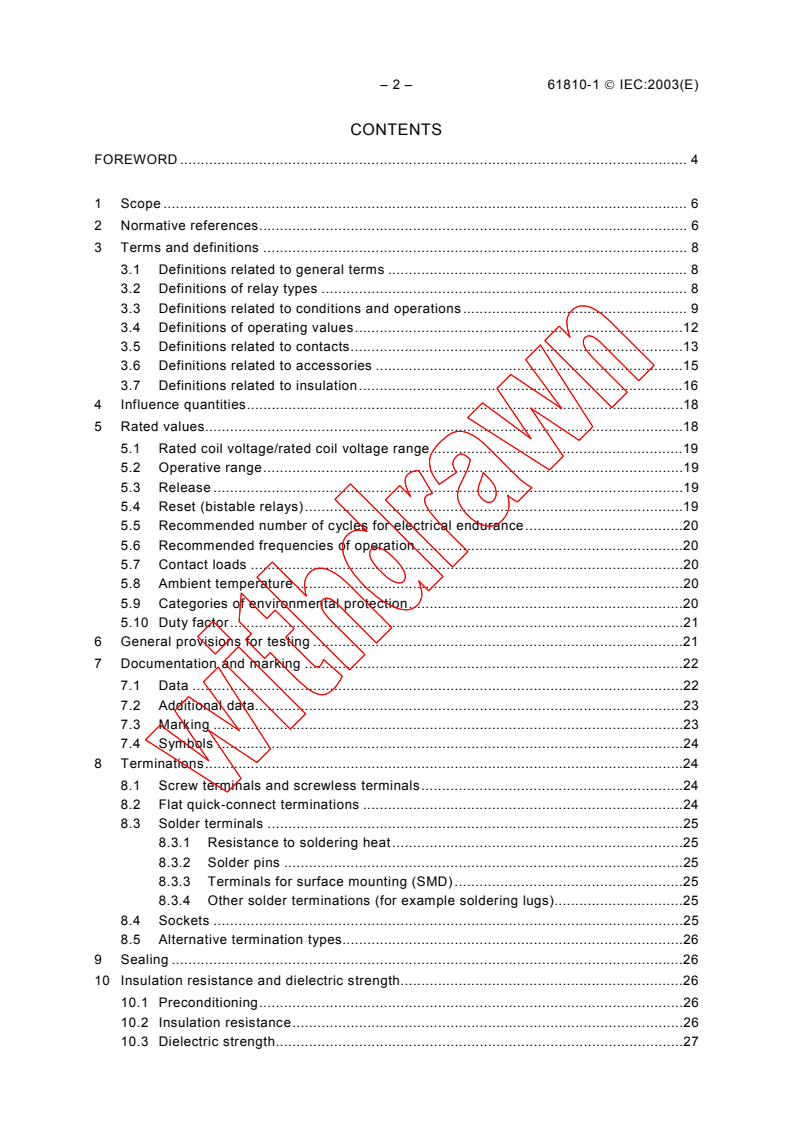
– 2 – 61810-1 IEC:2003(E)
CONTENTS
FOREWORD . 4
1 Scope . 6
2 Normative references. 6
3 Terms and definitions . 8
3.1 Definitions related to general terms . 8
3.2 Definitions of relay types . 8
3.3 Definitions related to conditions and operations. 9
3.4 Definitions of operating values.12
3.5 Definitions related to contacts.13
3.6 Definitions related to accessories .15
3.7 Definitions related to insulation.16
4 Influence quantities.18
5 Rated values.18
5.1 Rated coil voltage/rated coil voltage range .19
5.2 Operative range.19
5.3 Release .19
5.4 Reset (bistable relays).19
5.5 Recommended number of cycles for electrical endurance.20
5.6 Recommended frequencies of operation .20
5.7 Contact loads .20
5.8 Ambient temperature .20
5.9 Categories of environmental protection.20
5.10 Duty factor.21
6 General provisions for testing .21
7 Documentation and marking .22
7.1 Data .22
7.2 Additional data.23
7.3 Marking .23
7.4 Symbols .24
8 Terminations.24
8.1 Screw terminals and screwless terminals.24
8.2 Flat quick-connect terminations .24
8.3 Solder terminals .25
8.3.1 Resistance to soldering heat.25
8.3.2 Solder pins .25
8.3.3 Terminals for surface mounting (SMD) .25
8.3.4 Other solder terminations (for example soldering lugs).25
8.4 Sockets .25
8.5 Alternative termination types.26
9 Sealing .26
10 Insulation resistance and dielectric strength.26
10.1 Preconditioning.26
10.2 Insulation resistance.26
10.3 Dielectric strength.27
61810-1 IEC:2003(E) – 3 –
11 Heating.29
11.1 Requirements .29
11.2 Test procedure .29
11.3 Terminals .30
11.3.1 General test conditions .30
11.3.2 Solder terminals.30
11.3.3 Flat quick-connect terminations.31
11.3.4 Screw and screwless type terminals.31
11.3.5 Alternative termination types.31
12 Basic operating function .32
12.1 General test conditions .32
12.2 Operate (monostable relays).32
12.3 Release (monostable relays) .32
12.4 Operate/reset (bistable relays).32
13 Heat and fire resistance.33
14 Electrical endurance .33
15 Mechanical endurance .35
16 Clearances, creepage distances and solid insulation .35
16.1 Clearances and creepage distances .35
16.2 Solid insulation .39
16.3 Accessible surfaces .40
Annex A (normative) Explanations regarding relays.41
Annex B (normative) Heating test arrangement .44
Annex C (informative) Schematic diagram of families of terminations .45
Annex D (normative) Glow-wire test .46
Annex E (normative) Proof tracking test .49
Annex F (normative) Ball pressure test.51
Annex G (informative) Needle flame test .52
Annex H (normative) Measurement of clearances and creepage distances.54
Annex I (normative) Relation between rated impulse withstand voltage, rated voltage
and overvoltage category .59
Annex J (normative) Pollution degrees .60
Annex K (normative) Inductive contact loads .61
– 4 – 61810-1 IEC:2003(E)
INTERNATIONAL ELECTROTECHNICAL COMMISSION
____________
ELECTROMECHANICAL ELEMENTARY RELAYS –
Part 1: General and safety requirements
FOREWORD
1) The International Electrotechnical Commission (IEC) is a worldwide organization for standardization comprising
all national electrotechnical committees (IEC National Committees). The object of IEC is to promote
international co-operation on all questions concerning standardization in the electrical and electronic fields. To
this end and in addition to other activities, IEC publishes International Standards, Technical Specifications,
Technical Reports, and Guides (hereafter referred to as “IEC Publication(s)”). Their preparation is entrusted to
technical committees; any IEC National Committee interested in the subject dealt with may participate in this
preparatory work. International, governmental and non-governmental organizations liaising with the IEC also
participate in this preparation. IEC collaborates closely with the International Organization for Standardization
(ISO) in accordance with conditions determined by agreement between the two organizations.
2) The formal decisions or agreements of IEC on technical matters express, as nearly as possible, an international
consensus of opinion on the relevant subjects since each technical committee has representation from all
interested IEC National Committees.
3) IEC Publications have the form of recommendations for international use and are accepted by IEC National
Committees in that sense. While all reasonable efforts are made to ensure that the technical content of IEC
Publications is accurate, IEC cannot be held responsible for the way in which they are used or for any
misinterpretation by any end user.
4) In order to promote international uniformity, IEC National Committees undertake to apply IEC Publications
transparently to the maximum extent possible in their national and regional publications. Any divergence
between any IEC Publication and the corresponding national or regional publication shall be clearly indicated in
the latter.
5) IEC provides no marking procedure to indicate its approval and cannot be rendered responsible for any
equipment declared to be in conformity with an IEC Publication.
6) All users should ensure that they have the latest edition of this publication.
7) No liability shall attach to IEC or its directors, employees, servants or agents including individual experts and
members of its technical committees and IEC National Committees for any personal injury, property damage or
other damage of any nature whatsoever, whether direct or indirect, or for costs (including legal fees) and
expenses arising out of the publication, use of, or reliance upon, this IEC Publication or any other IEC
Publications.
8) Attention is drawn to the Normative references cited in this publication. Use of the referenced publications is
indispensable for the correct application of this publication.
9) Attention is drawn to the possibility that some of the elements of this IEC Publication may be the subject of
patent rights. IEC shall not be held responsible for identifying any or all such patent rights.
International Standard IEC 61810-1 has been prepared by IEC technical committee 94: All-or-
nothing electrical relays.
This second edition cancels and replaces the first edition published in 1998 and IEC 61810-5,
published in 1998. This edition constitutes a technical revision.
The text of this standard is based on the following documents:
FDIS Report on voting
94/182/FDIS 94/186/RVD
Full information on the voting for the approval of this standard can be found in the report on
voting indicated in the above table.
This publication has been drafted in accordance with the ISO/IEC Directives, Part 2.
A bilingual version of this document may be issued at a later date.
61810-1 IEC:2003(E) – 5 –
This new edition has been completely revised in order to
– establish a stand-alone standard for the type testing of electromechanical elementary
relays,
– incorporate and update the requirements and tests with regard to insulation coordination
as contained in former IEC 61810-5:1998,
– improve the structure of the standard to achieve better readability,
– update various requirements and tests.
The committee has decided that the contents of this publication will remain unchanged until
2005. At this date, the publication will be
• reconfirmed;
• withdrawn;
• replaced by a revised edition, or
• amended.
The contents of the corrigendum of October 2004 have been included in this copy.
– 6 – 61810-1 IEC:2003(E)
ELECTROMECHANICAL ELEMENTARY RELAYS –
Part 1: General and safety requirements
1 Scope
This part of IEC 61810 applies to electromechanical elementary relays (non-specified time all-
or-nothing relays) for incorporation. It defines the basic safety-related and functional
requirements for applications in all areas of electrical engineering or electronics, such as:
• general industrial equipment,
• electrical facilities,
• electrical machines,
• electrical appliances for household and similar use,
• information technology and business equipment,
• building automation equipment,
• automation equipment,
• electrical installation equipment,
• medical equipment,
• control equipment,
• telecommunications,
• vehicles,
• transportation,
• etc.
Compliance with the requirements of this standard is verified by the type tests indicated.
In case the application of a relay determines additional requirements exceeding those
specified in this standard, the relay should be assessed in line with this application in
accordance with the relevant IEC standard(s) (for example IEC 60730-1, IEC 60335-1,
IEC 60950-1).
2 Normative references
The following referenced documents are indispensable for the application of this document.
For dated references, only the edition cited applies. For undated references, the latest edition
of the referenced document (including any amendments) applies.
IEC 60038:1983, IEC standard voltages
Amendment 1 (1994)
Amendment 2 (1997)
IEC 60050: International Electrotechnical Vocabulary
IEC 60068-2-17:1994, Basic environmental testing procedures – Part 2: Tests – Test Q:
Sealing
61810-1 IEC:2003(E) – 7 –
IEC 60068-2-20:1979, Basic environmental testing procedures – Part 2: Tests – Test T:
Soldering
Amendment 2 (1987)
IEC 60085:1984, Thermal evaluation and classification of electrical insulation
IEC 60112:2003, Method for the determination of the proof and the comparative tracking
indices of solid insulating materials
IEC 60364-4-44:2001, Electrical installations of buildings – Part 4-44: Protection for safety –
Protection against voltage disturbances and electromagnetic disturbances
IEC 60417-DB:2002, Graphical symbols for use on equipment
IEC 60664-1:1992, Insulation coordination for equipment within low-voltage systems – Part 1:
Principles, requirements and tests
Amendment 1 (2000)
Amendment 2 (2002)
IEC 60695-2-2:1991, Fire hazard testing – Part 2: Test methods – Section 2: Needle flame test
Amendment 1 (1994)
IEC 60695-2-10:2000, Fire hazard testing – Part 2-10: Glowing/hot-wire based test methods –
Glow-wire apparatus and common test procedure
IEC 60695-10-2:1995, Fire hazard testing – Part 10-2: Guidance and test methods for the
minimization of the effects of abnormal heat on electrotechnical products involved in fires –
Method for testing products made from non-metallic materials for resistance to heat using the
ball pressure test
Amendment 1 (2001)
IEC 60721-3-3:1994, Classification of environmental conditions – Part 3-3: Classification of
groups of environmental parameters and their severities – Stationary use at weatherprotected
locations
Amendment 1 (1995)
Amendment 2 (1996)
IEC 60730-1:1999, Automatic electrical controls for household and similar use – Part 1:
General requirements
IEC 60947-5-1:1997, Low-voltage switchgear and controlgear – Part 5-1: Control circuit
devices and switching elements – Electromechanical control circuit devices
Amendment 1 (1999)
Amendment 2 (1999)
IEC 60950-1:2001, Information technology equipment – Safety – Part 1: General requirements
IEC 60999-1:1999, Connecting devices – Electrical copper conductors – Safety requirements
for screw-type and screwless-type clamping units – Part 1: General requirements and
2 2
particular requirements for clamping units for conductors from 0,2 mm up to 35 mm
(included)
IEC 61210:1993, Connecting devices – Flat quick-connect terminations for electrical copper
conductors – Safety requirements
———————
"DB" refers to the IEC on-line database.
– 8 – 61810-1 IEC:2003(E)
IEC 61760-1:1998, Surface mounting technology – Part 1: Standard method for the specifica-
tion of surface mounting components (SMDs)
IEC 61984:2001, Connectors – Safety requirements and tests
3 Terms and definitions
For the purpose of this part of IEC 61810, the following terms and definitions apply.
NOTE 1 Definitions of terms not stipulated in this standard are given in IEC 60050, in particular in
IEC 60050(444).
NOTE 2 Some definitions taken from IEC 60050(444) have been modified for the application to this standard.
NOTE 3 In the text of this standard, the term relay is used instead of elementary relay to improve the readability.
3.1 Definitions related to general terms
3.1.1
marking
identification of a relay which, when completely given to the manufacturer of this relay, allows
the unambiguous indication of its electrical, mechanical, dimensional and functional
parameters
EXAMPLE Through the indication of the trade mark and the type designation on the relay, all relay-specific data
can be derived from the type code.
3.1.2
intended use
use of a relay for the purpose for which it was made, and in the manner intended by the
manufacturer
3.1.3
relay technology categories
categorization of relays, based upon environmental protection
[IEV 444-01-11, modified]
NOTE Six categories are in use (RT 0 to RT V).
3.2 Definitions of relay types
3.2.1
electrical relay
device designed to produce sudden and predetermined changes in one or more output circuits
when certain conditions are fulfilled in the electric input circuits controlling the device
[IEV 444-01-01]
NOTE 1 For the purpose of this standard, output circuits are contact circuits.
NOTE 2 For the purpose of this standard, the term “coil” is used to denote “input circuit”, although other types of
input circuits are possible.
3.2.2
all-or-nothing relay
electrical relay, which is intended to be energized by a quantity, the value of which is either
within its operative range or effectively zero
[IEV 444-01-02]
NOTE "All-or-nothing relays" include both "elementary relays" and "time relays".
61810-1 IEC:2003(E) – 9 –
3.2.3
elementary relay
all-or-nothing relay which operates and releases without any intentional time delay
[IEV 444-01-03]
3.2.4
electromechanical relay
electrical relay in which the intended response results mainly from the movement of
mechanical elements
[IEV 444-01-04]
3.2.5
electromagnetic relay
electromechanical relay in which the designed response is produced by means of electro-
magnetic forces
[IEV 444-01-05]
3.2.6
monostable relay
electrical relay which, having responded to an energizing quantity and having changed its
condition, returns to its previous condition when that quantity is removed
[IEV 444-01-07]
3.2.7
bistable relay
electrical relay which, having responded to an energizing quantity and having changed its
condition, remains in that condition after the quantity has been removed; a further appropriate
energization is required to make it change its condition
[IEV 444-01-08]
NOTE Bistable relays are also called latching relays.
3.2.8
polarized relay
electrical relay, the change of condition of which depends upon the polarity of its DC
energizing quantity
[IEV 444-01-09]
3.2.9
non-polarized relay
electrical relay, the change of condition of which does not depend upon the polarity of its
energizing quantity
[IEV 444-01-10]
3.3 Definitions related to conditions and operations
3.3.1
release condition
for a monostable relay, specified condition of the relay when it is not energized; for a bistable
relay, one of the specified conditions, as declared by the manufacturer
[IEV 444-02-01]
NOTE See Figure A.1.
– 10 – 61810-1 IEC:2003(E)
3.3.2
operate condition
for a monostable relay, specified condition of the relay when it is energized by the specified
energizing quantity and has responded to that quantity; for a bistable relay, the condition
other than the release condition as declared by the manufacturer
[IEV 444-02-02]
NOTE See Figure A.1.
3.3.3
operate (verb)
change from the release condition to the operate condition
[IEV 444-02-04]
NOTE See Figure A.1.
3.3.4
release (verb)
for a monostable relay, change from the operate condition to the release condition
[IEV 444-02-05]
NOTE See Figure A.1.
3.3.5
reset (verb)
for a bistable relay, change from the operate condition to the release condition
[IEV 444-02-06]
3.3.6
cycle
operation and subsequent release/reset
[IEV 444-02-11]
3.3.7
frequency of operation
number of cycles per unit of time
[IEV 444-02-12]
3.3.8
continuous duty
duty in which the relay remains energized for a period long enough to reach thermal
equilibrium
[IEV 444-02-13]
3.3.9
intermittent duty
duty in which the relay performs a series of identical cycles, the durations in the energized
and unenergized conditions being specified; the duration of energization of the relay is such
as will not permit the relay to reach thermal equilibrium
[IEV 444-02-14, modified]
61810-1 IEC:2003(E) – 11 –
3.3.10
temporary duty
duty in which the relay remains energized for insufficient duration to reach thermal
equilibrium, the time intervals of energization being separated by unenergized time intervals
of duration sufficient to restore equality of temperature between the relay and the surrounding
medium
[IEV 444-02-16]
3.3.11
duty factor
ratio of the duration of energization to the total period in which intermittent or continuous or
temporary duty takes place
[IEV 444-02-15]
NOTE The duty factor can be expressed as a percentage of the total period.
3.3.12
thermal resistance (of the coil)
quotient of the temperature rise of the relay coil by the input power, measured after a period
long enough to reach thermal equilibrium
[IEV 444-02-17]
NOTE The thermal resistance usually is given in K/W.
3.3.13
ambient temperature
temperature(s) prescribed for the air surrounding the relay under certain conditions, when the
relay is mounted as indicated by the manufacturer
3.3.14
limiting continuous thermal withstand power
highest steady state value of the applied electric power that a relay can withstand
continuously, and under specified conditions, while satisfying specified temperature rise
requirements
[IEV 444-03-18, modified]
NOTE Comprises both the applied power at the coil(s) and the contact(s).
3.3.15
thermal equilibrium
steady state condition of the relay when the temperature does not change by more than ± 2 K
within 10 minutes
3.3.16
rated value
value of a quantity used for specification purposes, established for a specific set of operating
conditions
[IEV 444-02-18, modified]
3.3.17
test value
value of a quantity for which the relay shall comply with a specified action during a test
[IEV 444-02-20]
– 12 – 61810-1 IEC:2003(E)
3.3.18
actual value
value of a quantity determined by measurement on a specific relay, during performance of a
specified function
[IEV 444-02-21]
3.3.19
mechanical endurance
number of cycles under specified conditions with unloaded contact(s)
[IEV 444-07-10, modified]
3.4 Definitions of operating values
3.4.1
energizing quantity
electrical quantity which, when applied to the coil(s) of a relay under specified conditions,
enables it to fulfill its purpose
[IEV 444-03-01, modified]
NOTE For relays, the energizing quantity is usually a voltage. Therefore, the input voltage as energizing quantity
is used in the definitions given in 3.4. Where a relay is energized by a given current instead, the respective terms
and definitions apply with "current" used instead of "voltage".
3.4.2
operate voltage
set voltage (for bistable relays only)
value of the coil voltage at which a relay operates
[IEV 444-03-06, modified]
3.4.3
operate voltage
U
value of the coil voltage at which a relay operates, having previously been energized at that
same voltage
NOTE Thermal equilibrium has to be achieved.
3.4.4
limiting voltage
U
value of the coil voltage, taking into account the effect of heating due to the power dissipated
by the coil(s), which when exceeded may result in a relay failure caused by thermal overload
NOTE Thermal equilibrium has to be achieved.
3.4.5
operative range
range of values of coil voltage for which a relay is able to perform its specified function
[IEV 444-03-05, modified]
3.4.6
release voltage
value of the coil voltage at which a monostable relay releases
[IEV 444-03-08, modified]
61810-1 IEC:2003(E) – 13 –
3.4.7
reset voltage
value of the coil voltage at which a bistable relay resets
[IEV 444-03-10, modified]
3.5 Definitions related to contacts
For AC, r.m.s. values for voltage and current are specified, unless otherwise indicated.
3.5.1
contact
arrangement of contact members, with their insulation, which close or open their contact
circuit by their relative movement (see Figure A.2)
[IEV 444-04-03]
3.5.2
contact set
combination of contacts within a relay, separated by their insulation (see Figure A.2)
[IEV 444-04-04]
3.5.3
contact gap
gap between the contact points when the contact circuit is open
[IEV 444-04-09]
3.5.4
make contact
contact which is closed when the relay is in its operate condition and which is open when the
relay is in its release condition
[IEV 444-04-17]
3.5.5
break contact
contact which is open when the relay is in its operate condition and which is closed when the
relay is in its release condition
[IEV 444-04-18]
3.5.6
change-over contact
combination of two contact circuits with three contact members, one of which is common to
the two contact circuits; such that when one of these contact circuits is open, the other is
closed
[IEV 444-04-19]
3.5.7
switching power
power which a relay contact makes and/or breaks
[IEV 444-04-24]
NOTE The switching power is usually specified in W for DC and in VA for AC.
– 14 – 61810-1 IEC:2003(E)
3.5.8
switching voltage
voltage between the contact members before closing or after opening of a relay contact
NOTE The term “contact voltage” (see IEV 444-04-25) has been replaced by “switching voltage”. The definition
remains unchanged, however.
3.5.9
contact current
electric current which a relay contact carries before opening or after closing
[IEV 444-04-26]
3.5.10
switching current
electric current which a relay contact makes and/or breaks
[IEV 444-04-27]
3.5.11
limiting continuous current
greatest value of electric current which a closed contact is capable of carrying continuously
under specified conditions
[IEV 444-04-28, modified]
3.5.12
limiting short-time current
greatest value of electric current which a closed contact is capable of carrying for a specified
short period under specified conditions
[IEV 444-04-29, modified]
3.5.13
limiting making capacity
greatest value of electric current which a contact is capable of making under specified
conditions such as switching voltage, number of makes, power factor, time constant
[IEV 444-04-30, modified]
3.5.14
limiting breaking capacity
greatest value of electric current which a contact is capable of breaking under specified
conditions such as switching voltage, number of breaks, power factor, time constant
[IEV 444-04-31, modified]
3.5.15
limiting cycling capacity
greatest value of electric current which a contact is capable of making and breaking
successively under specified conditions such as switching voltage, number of breaks, power
factor, time constant
[IEV 444-04-32, modified]
61810-1 IEC:2003(E) – 15 –
3.5.16
micro-interruption
interruption of a circuit by contact separation which does not provide full-disconnection or
micro-disconnection
[IEC 60730-1, 2.4.4, modified]
NOTE There are no dielectric strength or dimensional requirements for the contact gap.
3.5.17
micro-disconnection
adequate contact separation in at least one contact so as to provide functional security
[IEC 60730-1, 2.4.3, modified]
NOTE There is a requirement for the dielectric strength of the contact gap but no dimensional requirement.
3.5.18
full-disconnection
contact separation for the disconnection of conductors so as to provide the equivalent of basic
insulation between those parts intended to be disconnected
[IEC 60730-1, 2.4.2, modified]
NOTE There are dielectric strength and dimensional requirements.
3.5.19
all-pole disconnection
full-disconnection of all conductors by a single switching action
3.5.20
failure
termination of the ability of an item to perform a required function
[IEV 191-04-01]
NOTE For the purpose of this standard, items are elementary relays.
3.5.21
malfunction
single event when an item does not perform a required function
3.5.22
contact failure
occurrence of break and/or make malfunctions of a contact under test, exceeding a specified
number
3.5.23
electrical endurance
number of cycles without contact failure under specified conditions, with loaded contacts
3.6 Definitions related to accessories
3.6.1
manual operation
manual movement of the actuating member of the relay
3.6.2
actuating member
part which is pulled, pushed, turned or otherwise operated in order to initiate a function
– 16 – 61810-1 IEC:2003(E)
3.6.3
switching position indicator
device of a relay for visual indication of the switching position
3.7 Definitions related to insulation
3.7.1
functional insulation
insulation between conductive parts which is necessary only for the proper functioning of the
relay
[IEC 60664-1, 1.3.17.1, modified]
3.7.2
basic insulation
insulation applied to live parts to provide basic protection against electric shock
[IEC 60664-1, 1.3.17.2]
NOTE Basic insulation does not necessarily include insulation used exclusively for functional purposes.
3.7.3
supplementary insulation
independent insulation applied in addition to basic insulation, in order to provide protection
against electric shock in the event of a failure of basic insulation
[IEC 60664-1, 1.3.17.3]
3.7.4
double insulation
insulation comprising both basic insulation and supplementary insulation
[IEC 60664-1, 1.3.17.4]
3.7.5
reinforced insulation
a single insulation system applied to live parts, which provides a degree of protection against
electric shock equivalent to double insulation
[IEC 60664-1, 1.3.17.5, modified]
3.7.6
conductive part
part suitable to conduct electric current, which is, however, not necessarily used for this
purpose
3.7.7
live part
conductor or conductive part intended to be energized in normal operation, including a neutral
conductor, but by convention not a PEN conductor
[IEV 195-02-19, modified]
NOTE A PEN conductor combines the functions of both a protective earthing conductor and a neutral conductor.
61810-1 IEC:2003(E) – 17 –
3.7.8
clearance
shortest distance in air between two conductive parts, or between a conductive part and the
accessible surface of a relay
[IEC 60664-1, 1.3.2, modified]
NOTE An example for an accessible surface is the actuating member of a relay used for manual operation.
3.7.9
solid insulation
solid insulating material interposed between two conductive parts
[IEC 60664-1, 1.3.4]
3.7.10
supporting material
solid insulating material keeping live parts in their position
3.7.11
creepage distance
shortest distance along the surface of the insulating material between two conductive parts
[IEC 60664-1, 1.3.3]
3.7.12
tracking
progressive degradation of a solid insulating material by local discharges to form conducting
or partially conducting paths
[IEV 212-01-42, modified]
NOTE Tracking usually occurs due to surface contamination.
3.7.13
proof tracking index
PTI
numerical value of the proof voltage expressed in volts which a material can withstand without
tracking under specified test conditions
[IEV 212-01-45, modified]
3.7.14
comparative tracking index
CTI
numerical value of the maximum voltage expressed in volts which a material can withstand
without tracking under specified test conditions
[IEV 212-01-44]
3.7.15
pollution
any addition of foreign matter, solid, liquid, or gaseous that can result in a reduction of
electric strength or surface resistivity of the insulation
[IEC 60664-1, 1.3.11]
3.7.16
pollution degree
number characterizing the expected pollution of the micro-environment
– 18 – 61810-1 IEC:2003(E)
[IEC 60664-1, 1.3.13, modified]
NOTE Pollution degrees 1, 2 and 3 are used, see Annex J.
3.7.17
micro-environment
the immediate environment of the insulation which particularly influences the dimensioning of
the creepage distances
[IEC 60664-1, 1.3.12.2]
4 Influence quantities
The specified performance of a relay shall be given with respect to the reference conditions,
i.e. the set of reference values of all influence quantities.
Unless otherwise explicitly stated by the manufacturer, the reference values and tolerance
ranges listed in Table 1 apply.
Table 1 – Reference values of influence quantities
Tolerance range and conditions
Influence quantity Reference value
1)
for testing
Ambient temperature 23 °C +5 K
Atmospheric pressure 96 kPa 86 kPa to 106 kPa
Relative humidity 50 % 25 % to 75 %
–4
External magnetic induction 0 0 ± 5 x 10 T in any direction
Position As indicated by the manufacturer According to 11.2 a)
Voltage/current (for coil and load) As indicated by the manufacturer ±5 % for steady-state conditions
Frequency 16 / Hz or Same as reference value with tolerance
50 Hz or 60 Hz or 400 Hz ±2 %
2)
Waveform Sinusoidal Sinusoidal; max. Distortion factor 5 %
3)
Alternating component in d.c. (ripple) 0 Max. 6 %
Direct component in a.c. 0 Max. 2 % of peak value
Shock and vibration 0 Max. 1 m/s²
Industrial and other atmospheres Clean air Clean air (pollution not exceeding class
3C2 of IEC 60721-3-3)
1) The test may be carried out with other values of the influence quantities, provided the quantitative relationship
between one or more influence quantities and the value of the considered characteristic is known.
2) Distortion factor: ratio of the harmonic content obtained by subtracting the fundamental wave from a non-
sinusoidal harmonic quantity and the r.m.s. value of the non-sinusoidal quantity. It is usually expressed as a
percentage.
3) The alternating component (ripple content) of a d.c. supply, expressed as a percentage, is defined as follows:
maximum value – minimum value
x 100
d.c. component
5 Rated values
The recommended values listed below do not comprise all technical possibilities and other
values may be adopted according to conditions of operation and use.
61810-1 IEC:2003(E) – 19 –
5.1 Rated coil voltage/rated coil voltage range
a) AC voltage, recommended r.m.s. values:
6 V; 12 V; 24 V; 48 V; 100 3 V; 110 3 V; 120 3 V; 100 V; 110 V; 115 V; 120 V;
127 V; 200 V; 230 V; 277 V; 400 V; 480 V; 500 V.
b) DC voltage, recommended values:
1,5 V; 3 V; 4,5 V; 5 V; 9 V; 12 V; 24 V; 28 V; 48 V; 60 V; 110 V; 125 V; 220 V; 250 V;
440 V; 500 V.
c) Rated voltage range (for example 220 V to 240 V) and corresponding frequencies (for
example 50 Hz/60 Hz) shall be specified by the manufacturer.
5.2 Operative range
The operative range of a relay coil can be specified either according to 5.2.1 or 5.2.2.
5.2.1 The recommended operative range is to be specified according to one of two classes:
• Class 1: 80 % to 110 % of the rated coil voltage (or range).
• Class 2: 85 % to 110 % of the rated coil voltage (or range).
NOTE Where a rated coil voltage range applies, the operative range is from 80 % (or 85 %) of the lower limit to
110 % of the upper limit of the rated coil voltage range.
The above values apply over the full ambient temperature range as declared by the
manufacturer.
Where the manufacturer deviates from the recommended classes, he shall specify both the
rated coil voltage (or range) and the corresponding operative range, see Figure A.3.
5.2.2 As an alternative to the operative range specified in 5.2.1, the manufacturer may
graphically represent the operative range against ambient temperature. This is achieved by
describing the upper limit (U = limiting coil voltage) and the lower limit (U = operate voltage)
2 1
of the operative range, as illustrated by Figure A.3.
5.3 Release
The release values indicated below apply over the full ambient temperature range as declared
by the manufacturer.
a) DC relay
Where the operative range is specified according to 5.2.1, the release voltage of
monostable relays shall be not lower than 5 % of the rated coil voltage (or the upper limit
of the rated coil voltage range), see Figure A.3.
Where the operative range is specified according to 5.2.2, the release voltage of
monostable relays shall be not lower than 10 % of the lower limit U of the operative range,
see Figure A.3.
b) AC relay
The same conditions as for DC relays apply, except that a value of 15 % shall be used in
place of 5 % or 10 %, respectively.
5.4 Reset (bistable relays)
The recommended values shall be the same as those specified in 5.2, unless otherwise
specified by the manufacturer.
– 20 – 61810-1 IEC:2003(E)
5.5 Recommended number of cycles for electrical endurance
5 000; 10 000; 20 000; 30 000; 50 000; 100 000; 200 000; 300 000; 500 000; etc.
5.6 Recommended frequencies of operation
360/h; 720/h; 900/h and multiples thereof.
0,1 Hz; 0,2 Hz; 0,5 Hz and multiples thereof.
5.7 Contact loads
a) Resistive loads, recommended values
Current: 0,1 A; 0,5 A; 1 A; 2 A; 3 A; 5 A; 6 A; 8 A; 10 A; 12 A; 16 A; 25 A; 35 A; 60 A;
100 A.
Voltage: 4,5 V; 5 V; 12 V; 24 V; 36 V; 42 V; 48 V; 110 V; 125 V; 230 V; 250 V; 400 V
(AC/DC).
b) Recommended inductive loads, for example AC-15, DC-13 in accordance with
IEC 60947-5-1: see Annex K of this standard.
5.8 Ambient temperature
Unless otherwise stated, the preferred ambient temperature range is –10 °C to +55 °C for the
operation of relays.
Other recommended values for the upper limit are:
+200 °C +175 °C +155 °C +125 °C +100 °C +85 °C
+70 °C +40 °C +30 °C
Other recommended values for the lower limit are:
–65 °C –55 °C –40 °C –25 °C –5 °C +5 °C
5.9 Categories of environmental protection
The relay technology categories describing the degree of sealing of the relay case or its
contact unit are given in Table 2 below.
Table 2 – Categor
...
NORME CEI
INTERNATIONALE
IEC
61810-1
INTERNATIONAL
Deuxième édition
STANDARD
Second edition
2003-08
Relais électromécaniques élémentaires –
Partie 1:
Exigences générales et de sécurité
Electromechanical elementary relays –
Part 1:
General and safety requirements
Numéro de référence
Reference number
CEI/IEC 61810-1:2004
Numérotation des publications Publication numbering
Depuis le 1er janvier 1997, les publications de la CEI As from 1 January 1997 all IEC publications are
sont numérotées à partir de 60000. Ainsi, la CEI 34-1 issued with a designation in the 60000 series. For
devient la CEI 60034-1. example, IEC 34-1 is now referred to as IEC 60034-1.
Editions consolidées Consolidated editions
Les versions consolidées de certaines publications de la The IEC is now publishing consolidated versions of its
CEI incorporant les amendements sont disponibles. Par publications. For example, edition numbers 1.0, 1.1
exemple, les numéros d’édition 1.0, 1.1 et 1.2 indiquent and 1.2 refer, respectively, to the base publication,
respectivement la publication de base, la publication de the base publication incorporating amendment 1 and
base incorporant l’amendement 1, et la publication de the base publication incorporating amendments 1
base incorporant les amendements 1 et 2. and 2.
Informations supplémentaires Further information on IEC publications
sur les publications de la CEI
Le contenu technique des publications de la CEI est The technical content of IEC publications is kept
constamment revu par la CEI afin qu'il reflète l'état under constant review by the IEC, thus ensuring that
actuel de la technique. Des renseignements relatifs à the content reflects current technology. Information
cette publication, y compris sa validité, sont dispo- relating to this publication, including its validity, is
nibles dans le Catalogue des publications de la CEI available in the IEC Catalogue of publications
(voir ci-dessous) en plus des nouvelles éditions, (see below) in addition to new editions, amendments
amendements et corrigenda. Des informations sur les and corrigenda. Information on the subjects under
sujets à l’étude et l’avancement des travaux entrepris consideration and work in progress undertaken by the
par le comité d’études qui a élaboré cette publication, technical committee which has prepared this
ainsi que la liste des publications parues, sont publication, as well as the list of publications issued,
également disponibles par l’intermédiaire de: is also available from the following:
• Site web de la CEI (www.iec.ch) • IEC Web Site (www.iec.ch)
• Catalogue des publications de la CEI • Catalogue of IEC publications
Le catalogue en ligne sur le site web de la CEI The on-line catalogue on the IEC web site
(www.iec.ch/searchpub) vous permet de faire des (www.iec.ch/searchpub) enables you to search by a
recherches en utilisant de nombreux critères, variety of criteria including text searches,
comprenant des recherches textuelles, par comité technical committees and date of publication. On-
d’études ou date de publication. Des informations en line information is also available on recently
ligne sont également disponibles sur les nouvelles issued publications, withdrawn and replaced
publications, les publications remplacées ou retirées, publications, as well as corrigenda.
ainsi que sur les corrigenda.
• IEC Just Published • IEC Just Published
Ce résumé des dernières publications parues This summary of recently issued publications
(www.iec.ch/online_news/justpub) est aussi dispo- (www.iec.ch/online_news/justpub) is also available
nible par courrier électronique. Veuillez prendre by email. Please contact the Customer Service
contact avec le Service client (voir ci-dessous) Centre (see below) for further information.
pour plus d’informations.
• Service clients • Customer Service Centre
Si vous avez des questions au sujet de cette If you have any questions regarding this
publication ou avez besoin de renseignements publication or need further assistance, please
supplémentaires, prenez contact avec le Service contact the Customer Service Centre:
clients:
Email: custserv@iec.ch Email: custserv@iec.ch
Tél: +41 22 919 02 11 Tel: +41 22 919 02 11
Fax: +41 22 919 03 00 Fax: +41 22 919 03 00
.
NORME CEI
INTERNATIONALE
IEC
61810-1
INTERNATIONAL
Deuxième édition
STANDARD
Second edition
2003-08
Relais électromécaniques élémentaires –
Partie 1:
Exigences générales et de sécurité
Electromechanical elementary relays –
Part 1:
General and safety requirements
IEC 2004 Droits de reproduction réservés Copyright - all rights reserved
Aucune partie de cette publication ne peut être reproduite ni No part of this publication may be reproduced or utilized in any
utilisée sous quelque forme que ce soit et par aucun procédé, form or by any means, electronic or mechanical, including
électronique ou mécanique, y compris la photocopie et les photocopying and microfilm, without permission in writing from
microfilms, sans l'accord écrit de l'éditeur. the publisher.
International Electrotechnical Commission, 3, rue de Varembé, PO Box 131, CH-1211 Geneva 20, Switzerland
Telephone: +41 22 919 02 11 Telefax: +41 22 919 03 00 E-mail: inmail@iec.ch Web: www.iec.ch
CODE PRIX
XB
PRICE CODE
Commission Electrotechnique Internationale
International Electrotechnical Commission
МеждународнаяЭлектротехническаяКомиссия
Pour prix, voir catalogue en vigueur
For price, see current catalogue
– 2 – 61810-1 CEI:2004
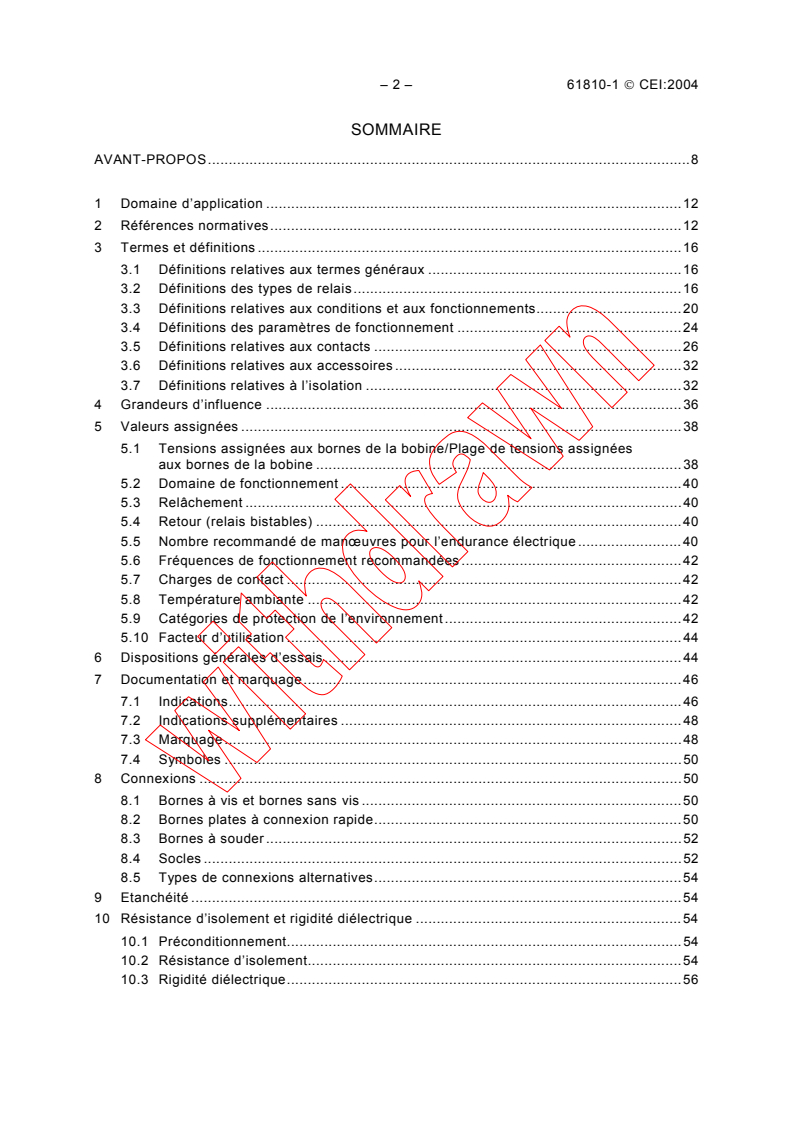
SOMMAIRE
AVANT-PROPOS.8
1 Domaine d’application .12
2 Références normatives.12
3 Termes et définitions .16
3.1 Définitions relatives aux termes généraux .16
3.2 Définitions des types de relais.16
3.3 Définitions relatives aux conditions et aux fonctionnements.20
3.4 Définitions des paramètres de fonctionnement .24
3.5 Définitions relatives aux contacts .26
3.6 Définitions relatives aux accessoires .32
3.7 Définitions relatives à l’isolation .32
4 Grandeurs d’influence .36
5 Valeurs assignées .38
5.1 Tensions assignées aux bornes de la bobine/Plage de tensions assignées
aux bornes de la bobine .38
5.2 Domaine de fonctionnement .40
5.3 Relâchement .40
5.4 Retour (relais bistables) .40
5.5 Nombre recommandé de manœuvres pour l’endurance électrique .40
5.6 Fréquences de fonctionnement recommandées .42
5.7 Charges de contact .42
5.8 Température ambiante .42
5.9 Catégories de protection de l’environnement .42
5.10 Facteur d’utilisation .44
6 Dispositions générales d’essais.44
7 Documentation et marquage.46
7.1 Indications.46
7.2 Indications supplémentaires .48
7.3 Marquage.48
7.4 Symboles .50
8 Connexions .50
8.1 Bornes à vis et bornes sans vis .50
8.2 Bornes plates à connexion rapide.50
8.3 Bornes à souder .52
8.4 Socles .52
8.5 Types de connexions alternatives.54
9 Etanchéité .54
10 Résistance d’isolement et rigidité diélectrique .54
10.1 Préconditionnement.54
10.2 Résistance d’isolement.54
10.3 Rigidité diélectrique.56
61810-1 IEC:2004 – 3 –
CONTENTS
FOREWORD.9
1 Scope.13
2 Normative references.13
3 Terms and definitions .17
3.1 Definitions related to general terms .17
3.2 Definitions of relay types .17
3.3 Definitions related to conditions and operations.21
3.4 Definitions of operating values .25
3.5 Definitions related to contacts .27
3.6 Definitions related to accessories .33
3.7 Definitions related to insulation .33
4 Influence quantities.37
5 Rated values.39
5.1 Rated coil voltage/rated coil voltage range .39
5.2 Operative range.41
5.3 Release.41
5.4 Reset (bistable relays) .41
5.5 Recommended number of cycles for electrical endurance .41
5.6 Recommended frequencies of operation.43
5.7 Contact loads.43
5.8 Ambient temperature.43
5.9 Categories of environmental protection .43
5.10 Duty factor.45
6 General provisions for testing .45
7 Documentation and marking.47
7.1 Data.47
7.2 Additional data.49
7.3 Marking.49
7.4 Symbols.51
8 Terminations.51
8.1 Screw terminals and screwless terminals .51
8.2 Flat quick-connect terminations .51
8.3 Solder terminals.53
8.4 Sockets.53
8.5 Alternative termination types.55
9 Sealing.55
10 Insulation resistance and dielectric strength .55
10.1 Preconditioning .55
10.2 Insulation resistance.55
10.3 Dielectric strength.57
– 4 – 61810-1 CEI:2004
11 Echauffements .60
11.1 Exigences .60
11.2 Procédure d’essai .60
11.3 Bornes .62
12 Fonction d’exploitation de base .66
12.1 Conditions générales d’essais .66
12.2 Fonctionnement (relais monostables) .66
12.3 Relâchement (relais monostables).66
12.4 Fonctionnement/retour (relais bistables).66
13 Résistance à la chaleur et au feu.68
14 Endurance électrique.68
15 Endurance mécanique .72
16 Distances d’isolement, lignes de fuite et isolation solide.72
16.1 Distances d’isolement et lignes de fuite.72
16.2 Isolation solide .80
16.3 Surfaces accessibles.82
Annexe A (normative) Explications concernant les relais .84
Annexe B (normative) Montage de l’essai d’échauffement .92
Annexe C (informative) Schéma des familles de connexions.94
Annexe D (normative) Essai au fil incandescent.96
Annexe E (normative) Essai de tenue au cheminement.102
Annexe F (normative) Essai à la bille.106
Annexe G (informative) Essai au brûleur-aiguille.108
Annexe H (normative) Mesure des distances d’isolement et des lignes de fuite .112
Annexe I (normative) Relation entre la tension assignée de tenue aux chocs, la
tension assignée et la catégorie de surtension.122
Annexe J (normative) Degrés de pollution.124
Annexe K (normative) Charges de contact inductives.126
Figure A.1 – Diagramme expliquant les termes relatifs aux relais monostables .84
Figure A.2 – Exemple expliquant les termes relatifs aux contacts .86
Figure A.3 – Explications concernant le domaine de fonctionnement de la tension aux
bornes de la bobine .88
Figure A.4 – Explication concernant le préconditionnement et les essais de la tension
de fonctionnement conformément à 5.2.1 (classe 1) et 12.2.90
Figure A.5 – Explication concernant le préconditionnement et les essais de la tension
de fonctionnement conformément à 5.2.2 et 12.2.90
Figure B.1 – Montage d'essai.92
Figure C.1 – Schéma des familles de connexions .94
Figure D.1 – Fil incandescent et position du thermocouple.98
Figure D.2 – Appareillage de l’essai au fil incandescent (exemple) .100
Figure E.1 – Appareillage de l’essai de tenue au cheminement.104
Figure F.1 – Appareillage de l'essai à la bille .106
Figure G.1 – Détails de l’essai au brûleur-aiguille .110
61810-1 IEC:2004 – 5 –
11 Heating.61
11.1 Requirements.61
11.2 Test procedure.61
11.3 Terminals.63
12 Basic operating function.67
12.1 General test conditions.67
12.2 Operate (monostable relays) .67
12.3 Release (monostable relays) .67
12.4 Operate/reset (bistable relays) .67
13 Heat and fire resistance.69
14 Electrical endurance.69
15 Mechanical endurance.73
16 Clearances, creepage distances and solid insulation .73
16.1 Clearances and creepage distances .73
16.2 Solid insulation.81
16.3 Accessible surfaces.83
Annex A (normative) Explanations regarding relays .85
Annex B (normative) Heating test arrangement.93
Annex C (informative) Schematic diagram of families of terminations.95
Annex D (normative) Glow-wire test.97
Annex E (normative) Proof tracking test.103
Annex F (normative) Ball pressure test .107
Annex G (informative) Needle flame test.109
Annex H (normative) Measurement of clearances and creepage distances .113
Annex I (normative) Relation between rated impulse withstand voltage, rated voltage
and overvoltage category .123
Annex J (normative) Pollution degrees.125
Annex K (normative) Inductive contact loads.127
Figure A.1 – Diagram explaining terms related to monostable relays .85
Figure A.2 – Example explaining terms relating to contacts.87
Figure A.3 – Explanations regarding the operative range of the coil voltage.89
Figure A.4 – Explanation regarding the preconditioning and testing of the operate
voltage according to 5.2.1 (class 1) and 12.2 .91
Figure A.5 – Explanation regarding the preconditioning and testing of the operate
voltage according to 5.2.2 and 12.2 .91
Figure B.1 – Test arrangement .93
Figure C.1 – Schematic diagram of families of terminations .95
Figure D.1 – Glow-wire and position of the thermocouple.99
Figure D.2 – Glow-wire test apparatus (example).101
Figure E.1 – Proof-tracking test apparatus.105
Figure F.1 – Ball pressure test apparatus .107
Figure G.1 – Needle flame test details .111
– 6 – 61810-1 CEI:2004
Tableau 1 – Valeurs de référence des grandeurs d’influence .38
Tableau 2 – Catégories de protection .42
Tableau 3 – Essais de type.44
Tableau 4 – Indications requises sur les relais.46
Tableau 5 – Symboles .50
Tableau 6 – Exemples pour l’indication des valeurs assignées .50
Tableau 7 – Conditions d’essai pour l’essai Tb .52
Tableau 8 – Valeurs minimales de la résistance d’isolement .54
Tableau 9 – Rigidité diélectrique – Courant alternatif .56
Tableau 10 – Rigidité diélectrique – Courant continu .58
Tableau 11 – Classification thermique .60
Tableau 12 – Surfaces des sections transversales et longueurs des conducteurs en
fonction du courant parcourant la borne.64
Tableau 13 – Schémas pour le chargement des contacts.70
Tableau 14 – Dispositions pour le dimensionnement des distances d’isolement et des
lignes de fuite .74
Tableau 15 – Distances d’isolement minimales dans l’air pour la coordination de
l’isolement .76
Tableau 16 – Groupes de matériaux .78
Tableau 17 – Lignes de fuite minimales pour l’appareil soumis à des contraintes à
long terme .78
Tableau 18 – Tension d’isolement assignée conformément à la tension d’alimentation
du système .80
Tableau I.1 – Tension assignée de tenue aux chocs pour les équipements alimentés
directement à partir du réseau à basse tension.122
Tableau K.1 – Vérification du pouvoir de fermeture et de coupure pour un courant
alternatif de 15 / un courant continu de 13 (conditions normales).126
Tableau K.2 – Pouvoir de fermeture et de coupure pour l’essai d’endurance électrique .128
61810-1 IEC:2004 – 7 –
Table 1 – Reference values of influence quantities .39
Table 2 – Categories of protection .43
Table 3 – Type testing .45
Table 4 – Required relay data.47
Table 5 – Symbols .51
Table 6 – Examples for indication of rated values .51
Table 7 – Test conditions for test Tb .53
Table 8 – Minimum values of insulation resistance.55
Table 9 – Dielectric strength – AC.57
Table 10 – Dielectric strength – DC .59
Table 11 – Thermal classification.61
Table 12 – Cross-sectional areas and lengths of conductors dependent on the current
carried by the terminal .65
Table 13 – Schematics for contact loading.71
Table 14 – Provisions for the dimensioning of clearances and creepage distances .75
Table 15 – Minimum clearances in air for insulation coordination .77
Table 16 – Material groups .79
Table 17 – Minimum creepage distances for equipment subject to long-term stresses .79
Table 18 – Rated insulation voltage according to supply system voltage.81
Table I.1 – Rated impulse withstand voltage for equipment energized directly from the
low-voltage mains .123
Table K.1 – Verification of the making and breaking capacity for AC-15 / DC-13
(normal conditions) .127
Table K.2 – Making and breaking capacity for electrical endurance test.129
– 8 – 61810-1 CEI:2004
COMMISSION ÉLECTROTECHNIQUE INTERNATIONALE
____________
RELAIS ÉLECTROMÉCANIQUES ÉLÉMENTAIRES –
Partie 1: Exigences générales et de sécurité
AVANT-PROPOS
1) La Commission Electrotechnique Internationale (CEI) est une organisation mondiale de normalisation
composée de l'ensemble des comités électrotechniques nationaux (Comités nationaux de la CEI). La CEI a
pour objet de favoriser la coopération internationale pour toutes les questions de normalisation dans les
domaines de l'électricité et de l'électronique. A cet effet, la CEI – entre autres activités – publie des Normes
internationales, des Spécifications techniques, des Rapports techniques, des Spécifications accessibles au
public (PAS) et des Guides (ci-après dénommés "Publication(s) de la CEI"). Leur élaboration est confiée à des
comités d'études, aux travaux desquels tout Comité national intéressé par le sujet traité peut participer. Les
organisations internationales, gouvernementales et non gouvernementales, en liaison avec la CEI, participent
également aux travaux. La CEI collabore étroitement avec l'Organisation Internationale de Normalisation (ISO),
selon des conditions fixées par accord entre les deux organisations.
2) Les décisions ou accords officiels de la CEI concernant les questions techniques représentent, dans la mesure
du possible, un accord international sur les sujets étudiés, étant donné que les Comités nationaux de la CEI
intéressés sont représentés dans chaque comité d’études.
3) Les Publications de la CEI se présentent sous la forme de recommandations internationales et sont agréées
comme telles par les Comités nationaux de la CEI. Tous les efforts raisonnables sont entrepris afin que la CEI
s'assure de l'exactitude du contenu technique de ses publications; la CEI ne peut pas être tenue responsable
de l'éventuelle mauvaise utilisation ou interprétation qui en est faite par un quelconque utilisateur final.
4) Dans le but d'encourager l'uniformité internationale, les Comités nationaux de la CEI s'engagent, dans toute la
mesure possible, à appliquer de façon transparente les Publications de la CEI dans leurs publications
nationales et régionales. Toutes divergences entre toutes Publications de la CEI et toutes publications
nationales ou régionales correspondantes doivent être indiquées en termes clairs dans ces dernières.
5) La CEI n’a prévu aucune procédure de marquage valant indication d’approbation et n'engage pas sa
responsabilité pour les équipements déclarés conformes à une de ses Publications.
6) Tous les utilisateurs doivent s'assurer qu'ils sont en possession de la dernière édition de cette publication.
7) Aucune responsabilité ne doit être imputée à la CEI, à ses administrateurs, employés, auxiliaires ou
mandataires, y compris ses experts particuliers et les membres de ses comités d'études et des Comités
nationaux de la CEI, pour tout préjudice causé en cas de dommages corporels et matériels, ou de tout autre
dommage de quelque nature que ce soit, directe ou indirecte, ou pour supporter les coûts (y compris les frais
de justice) et les dépenses découlant de la publication ou de l'utilisation de cette Publication de la CEI ou de
toute autre Publication de la CEI, ou au crédit qui lui est accordé.
8) L'attention est attirée sur les références normatives citées dans cette publication. L'utilisation de publications
référencées est obligatoire pour une application correcte de la présente publication.
9) L’attention est attirée sur le fait que certains des éléments de la présente Publication de la CEI peuvent faire
l’objet de droits de propriété intellectuelle ou de droits analogues. La CEI ne saurait être tenue pour
responsable de ne pas avoir identifié de tels droits de propriété et de ne pas avoir signalé leur existence.
La Norme internationale CEI 61810-1 a été établie par le comité d’études 94 de la CEI: Relais
électriques de tout-ou-rien.
Cette deuxième édition annule et remplace la première édition publiée en 1998 et la
CEI 61810-5 publiée en 1998, dont elle constitue une révision technique.
Cette version bilingue (2004-11) remplace la version monolingue anglaise.
Le texte anglais de la présente norme est issu des documents 94/182/FDIS et 94/186/RVD.
Le rapport de vote 94/186/RVD donne toute information sur le vote ayant abouti à
l'approbation de cette norme.
La version française de cette norme n'a pas été soumise au vote.
61810-1 © IEC:2004 – 9 –
INTERNATIONAL ELECTROTECHNICAL COMMISSION
____________
ELECTROMECHANICAL ELEMENTARY RELAYS –
Part 1: General and safety requirements
FOREWORD
1) The International Electrotechnical Commission (IEC) is a worldwide organization for standardization comprising
all national electrotechnical committees (IEC National Committees). The object of IEC is to promote
international co-operation on all questions concerning standardization in the electrical and electronic fields. To
this end and in addition to other activities, IEC publishes International Standards, Technical Specifications,
Technical Reports, Publicly Available Specifications (PAS) and Guides (hereafter referred to as “IEC
Publication(s)”). Their preparation is entrusted to technical committees; any IEC National Committee interested
in the subject dealt with may participate in this preparatory work. International, governmental and non-
governmental organizations liaising with the IEC also participate in this preparation. IEC collaborates closely
with the International Organization for Standardization (ISO) in accordance with conditions determined by
agreement between the two organizations.
2) The formal decisions or agreements of IEC on technical matters express, as nearly as possible, an international
consensus of opinion on the relevant subjects since each technical committee has representation from all
interested IEC National Committees.
3) IEC Publications have the form of recommendations for international use and are accepted by IEC National
Committees in that sense. While all reasonable efforts are made to ensure that the technical content of IEC
Publications is accurate, IEC cannot be held responsible for the way in which they are used or for any
misinterpretation by any end user.
4) In order to promote international uniformity, IEC National Committees undertake to apply IEC Publications
transparently to the maximum extent possible in their national and regional publications. Any divergence
between any IEC Publication and the corresponding national or regional publication shall be clearly indicated in
the latter.
5) IEC provides no marking procedure to indicate its approval and cannot be rendered responsible for any
equipment declared to be in conformity with an IEC Publication.
6) All users should ensure that they have the latest edition of this publication.
7) No liability shall attach to IEC or its directors, employees, servants or agents including individual experts and
members of its technical committees and IEC National Committees for any personal injury, property damage or
other damage of any nature whatsoever, whether direct or indirect, or for costs (including legal fees) and
expenses arising out of the publication, use of, or reliance upon, this IEC Publication or any other IEC
Publications.
8) Attention is drawn to the Normative references cited in this publication. Use of the referenced publications is
indispensable for the correct application of this publication.
9) Attention is drawn to the possibility that some of the elements of this IEC Publication may be the subject of
patent rights. IEC shall not be held responsible for identifying any or all such patent rights.
International Standard IEC 61810-1 has been prepared by IEC technical committee 94: All-or-
nothing electrical relays.
This second edition cancels and replaces the first edition published in 1998 and IEC 61810-5,
published in 1998. This edition constitutes a technical revision.
This bilingual version (2004-11) replaces the English version.
The text of this standard is based on the following documents:
FDIS Report on voting
94/182/FDIS 94/186/RVD
Full information on the voting for the approval of this standard can be found in the report on
voting indicated in the above table.
The French version of this standard has not been voted upon.
– 10 – 61810-1 CEI:2004
Cette publication a été rédigée selon les Directives ISO/CEI, Partie 2.
Cette nouvelle édition a été entièrement révisée afin
– d’établir une norme indépendante pour les essais de type des relais électromécaniques
élémentaires,
– d’incorporer et de mettre à jour les exigences et les essais concernant la coordination de
l’isolement contenus dans la CEI 61810-5:1998 précédente,
– d’améliorer la structure de la norme pour obtenir une meilleure lisibilité,
– de mettre à jour les exigences et les essais divers.
La CEI 61810 comprend plusieurs parties, publiées sous le titre général Relais électro-
mécaniques élémentaires
Partie1: Exigences générales et de sécurité
Partie 2: Fiabilité
Partie 7: Méthodes d'essai et de mesure
Le comité a décidé que le contenu de cette publication ne sera pas modifié avant la date de
maintenance indiquée sur le site web de la CEI sous «http://webstore.iec.ch» dans les
données relatives à la publication recherchée. A cette date, la publication sera
• reconduite;
• supprimée;
• remplacée par une édition révisée, ou
• amendée.
61810-1 IEC:2004 – 11 –
This publication has been drafted in accordance with the ISO/IEC Directives, Part 2.
This new edition has been completely revised in order to
– establish a stand-alone standard for the type testing of electromechanical elementary
relays,
– incorporate and update the requirements and tests with regard to insulation coordination
as contained in former IEC 61810-5:1998,
– improve the structure of the standard to achieve better readability,
– update various requirements and tests.
IEC 61810 consists of the following parts, under the general title Electromechanical
elementary relays
Part 1: General and safety requirements
Part 2: Reliability
Part 7: Test and measurement procedures
The committee has decided that the contents of this publication will remain unchanged until
the maintenance result date indicated on the IEC web site under "http://webstore.iec.ch" in
the data related to the specific publication. At this date, the publication will be
• reconfirmed;
• withdrawn;
• replaced by a revised edition, or
• amended.
– 12 – 61810-1 CEI:2004
RELAIS ÉLECTROMÉCANIQUES ÉLÉMENTAIRES –
Partie 1: Exigences générales et de sécurité
1 Domaine d’application
La présente partie de la CEI 61810 s’applique aux relais électromécaniques élémentaires
(relais de tout ou rien à temps non spécifié) destinés à être incorporés. Elle définit les
exigences fondamentales liées à la sécurité et les exigences fonctionnelles destinées à être
appliquées dans tous les domaines de l’électrotechnique ou de l’électronique, tels que:
• l’équipement industriel général,
• les installations électriques,
• les machines électriques,
• les appareils électriques pour usages domestiques et analogues,
• les matériels de traitement de l’information et les matériels de bureau,
• les appareils immotiques,
• les appareils automatiques,
• les appareils pour installations électriques,
• les appareils médicaux,
• le matériel de contrôle,
• les télécommunications,
• les véhicules,
• le transport,
• etc.
La conformité aux exigences de la présente norme est vérifiée par les essais de type
indiqués.
Au cas où l’application d’un relais détermine des exigences supplémentaires dépassant celles
spécifiées dans la présente norme, il convient que le relais soit évalué par rapport à cette
application, conformément à la ou aux normes CEI correspondantes (par exemple,
CEI 60730-1, CEI 60335-1, CEI 60950-1).
2 Références normatives
Les documents référencés ci-après sont indispensables pour l'application de ce document.
Pour les références datées, seule l'édition citée s'applique. Pour les références non datées,
c’est l’édition la plus récente du document référencé (y compris tous ses amendements) qui
s’applique.
CEI 60038:1983, Tensions normales de la CEI
Amendement 1 (1994)
Amendement 2 (1997)
CEI 60050: Vocabulaire Electrotechnique International
61810-1
...
Questions, Comments and Discussion
Ask us and Technical Secretary will try to provide an answer. You can facilitate discussion about the standard in here.
Loading comments...