


IEC 60034-5:2000/COR1:2001
(Corrigendum)Corrigendum 1 - Rotating electrical machines - Part 5: Degrees of protection provided by the integral design of rotating electrical machines (IP code) - Classification
Corrigendum 1 - Rotating electrical machines - Part 5: Degrees of protection provided by the integral design of rotating electrical machines (IP code) - Classification
Corrigendum 1 - Machines électriques tournantes - Partie 5: Degrés de protection procurés par la conception intégrale des machines électriques tournantes (code IP) - Classification
General Information
- Status
- Published
- Publication Date
- 10-Jun-2001
- Technical Committee
- TC 2 - Rotating machinery
- Current Stage
- DELPUB - Deleted Publication
- Start Date
- 29-Apr-2020
- Completion Date
- 13-Feb-2026
Relations
- Effective Date
- 05-Sep-2023
- Effective Date
- 05-Sep-2023


Get Certified
Connect with accredited certification bodies for this standard

Intertek Testing Services NA Inc.
Intertek certification services in North America.

UL Solutions
Global safety science company with testing, inspection and certification.

ANCE
Mexican certification and testing association.
Sponsored listings
Frequently Asked Questions
IEC 60034-5:2000/COR1:2001 is a standard published by the International Electrotechnical Commission (IEC). Its full title is "Corrigendum 1 - Rotating electrical machines - Part 5: Degrees of protection provided by the integral design of rotating electrical machines (IP code) - Classification". This standard covers: Corrigendum 1 - Rotating electrical machines - Part 5: Degrees of protection provided by the integral design of rotating electrical machines (IP code) - Classification
Corrigendum 1 - Rotating electrical machines - Part 5: Degrees of protection provided by the integral design of rotating electrical machines (IP code) - Classification
IEC 60034-5:2000/COR1:2001 is classified under the following ICS (International Classification for Standards) categories: 29.160.01 - Rotating machinery in general. The ICS classification helps identify the subject area and facilitates finding related standards.
IEC 60034-5:2000/COR1:2001 has the following relationships with other standards: It is inter standard links to IEC 60034-5:2000, IEC 60034-5:2020. Understanding these relationships helps ensure you are using the most current and applicable version of the standard.
IEC 60034-5:2000/COR1:2001 is available in PDF format for immediate download after purchase. The document can be added to your cart and obtained through the secure checkout process. Digital delivery ensures instant access to the complete standard document.
Standards Content (Sample)
∅15
75,5
CEI 60034-5
(Quatrième édition – 2000)
Machines électriques tournantes –
Partie 5: Degrés de protection procurés par la conception intégrale des machines électriques
tournantes (code IP) – Classification
CORRIGENDUM 1
Page 38
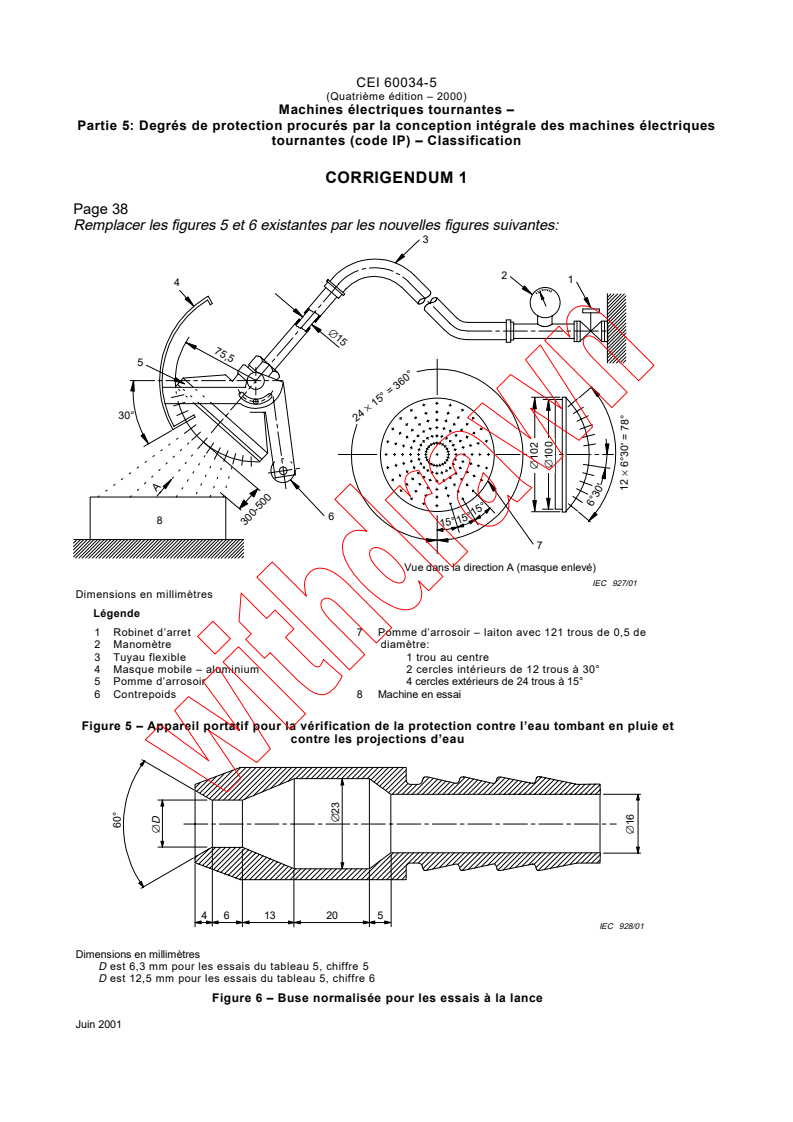
Remplacer les figures 5 et 6 existantes par les nouvelles figures suivantes:
30°
Vue dans la direction A (masque enlevé)
IEC 927/01
Dimensions en millimètres
Légende
1 Robinet d’arret 7 Pomme d’arrosoir – laiton avec 121 trous de 0,5 de
2 Manomètre diamètre:
3 Tuyau flexible 1 trou au centre
4 Masque mobile – aluminium 2 cercles intérieurs de 12 trous à 30°
5 Pomme d’arrosoir 4 cercles extérieurs de 24 trous à 15°
6 Contrepoids 8 Machine en essai
Figure 5 – Appareil portatif pour la vérification de la protection contre l’eau tombant en pluie et
contre les projections d’eau
4 6 13 20 5
IEC 928/01
Dimensions en millimètres
D est 6,3 mm pour les essais du tableau 5, chiffre 5
D est 12,5 mm pour les essais du tableau 5, chiffre 6
Figure 6 – Buse normalisée pour les essais à la lance
Juin 2001
15°
15°
15°
×
24 15° = 360°
A
300-500
6°30'
12 ×
6°30' = 78°
60°
∅
D
∅23
∅102
∅100
∅1
...
Questions, Comments and Discussion
Ask us and Technical Secretary will try to provide an answer. You can facilitate discussion about the standard in here.
Loading comments...