

IEC 60034-30-1:2025
(Main)Rotating electrical machines - Part 30-1: Efficiency classes of line operated AC motors (IE code)
General Information
- Abstract
IEC 60034-30-1:2025 specifies efficiency classes for single-speed electric motors that are rated in accordance with IEC 60034‑1 or IEC 60079‑0 and are rated for operation on a sinusoidal either 50 Hz or 60 Hz, or both voltage supply.
The motors within this document:
- have a rated power PN from 0,12 kW to 1 000 kW;
- have a rated voltage UN from 50 V up to and including 1 000 V;
- have 2, 4, 6 or 8 poles;
- are capable of continuous operation at their rated power with a temperature rise within the specified insulation temperature class;
NOTE 1 Most motors covered by this document are rated for duty type S1 (continuous duty). However, some motors that are rated for other duty cycles are still capable of continuous operation at their rated power, and these motors are also covered by this document.
- are marked with any ambient temperature within the range of –30 °C to +60 °C;
NOTE 2 The rated efficiency and efficiency classes are based on 25 °C ambient temperature in accordance with IEC 60034‑2‑1.
NOTE 3 Motors exclusively rated for temperatures outside the range – 30 °C and +60 °C are considered to be of special construction and are consequently excluded from this document.
NOTE 4 Smoke extraction motors with a temperature class of up to and including 400 °C are covered by this document.
- are marked with an altitude up to 4 000 m above sea level.
NOTE 5 The rated efficiency and efficiency class are based on a rating for altitudes up to 1 000 m above sea level.
This document establishes a set of nominal efficiency values based on supply frequency, number of poles and motor output power. No distinction is made between motor technologies, supply voltage or motors with increased insulation designed specifically for converter operation even though not all motor technologies are capable of reaching the higher efficiency classes (see Table 1). This makes different motor technologies fully comparable with respect to their energy efficiency potential.
The efficiency of power-drive systems is not covered by this document. Motor losses due to harmonic content of the supply voltage, losses in cables, filters and frequency-converters, are not covered.
Motors with flanges, feet or shafts with mechanical dimensions different from IEC 60072‑1 are covered by this document.
Geared motors are covered by this document including those incorporating non-standard shafts and flanges.
This document does not apply to the following:
- Single-speed motors with 10 or more poles or multi-speed motors.
- Motors with mechanical commutators (such as DC motors).
- Motors completely integrated into a machine (for example pump, fan and compressor) that cannot be practically tested separately from the machine even with provision of a temporary end-shield and drive-end bearing. This means the motor: a) shares common components (apart from connectors such as bolts) with the driven unit (for example, a shaft or housing) and b) is not designed in such a way as to enable the motor to be separated from the driven unit as an entire motor that can operate independently of the driven unit. That is, for a motor to be excluded from this document, the process of separation shall render the motor inoperative.
- Totally enclosed air-over machines (TEAO, IC418), i.e. totally enclosed frame-surface cooled machines intended for exterior cooling by a ventilating means external to the machine. Efficiency testing of such motors can be performed with the fan removed and the cooling provided by an external blower with a similar airflow rate as the original fan.
- Motors with integrated frequency converters (compact drives) when the motor cannot be tested separately from the converter. Energy efficiency classification of compact drives is based on the complete product (PDS, ie. Power Drive System) and is defined in IEC 61800‑9‑2.
NOTE 6 A motor is not excluded when the motor and frequency-converter can be separated, and the motor can be tested independently of th
- Status
- Published
- Publication Date
- 30-Nov-2025
- Technical Committee
- TC 2 - Rotating machinery
- Drafting Committee
- WG 31 - TC 2/WG 31
- Current Stage
- PPUB - Publication issued
- Start Date
- 01-Dec-2025
- Completion Date
- 05-Dec-2025
Buy Documents
IEC 60034-30-1:2025 - Rotating electrical machines - Part 30-1: Efficiency classes of line operated AC motors (IE code)/1/2025
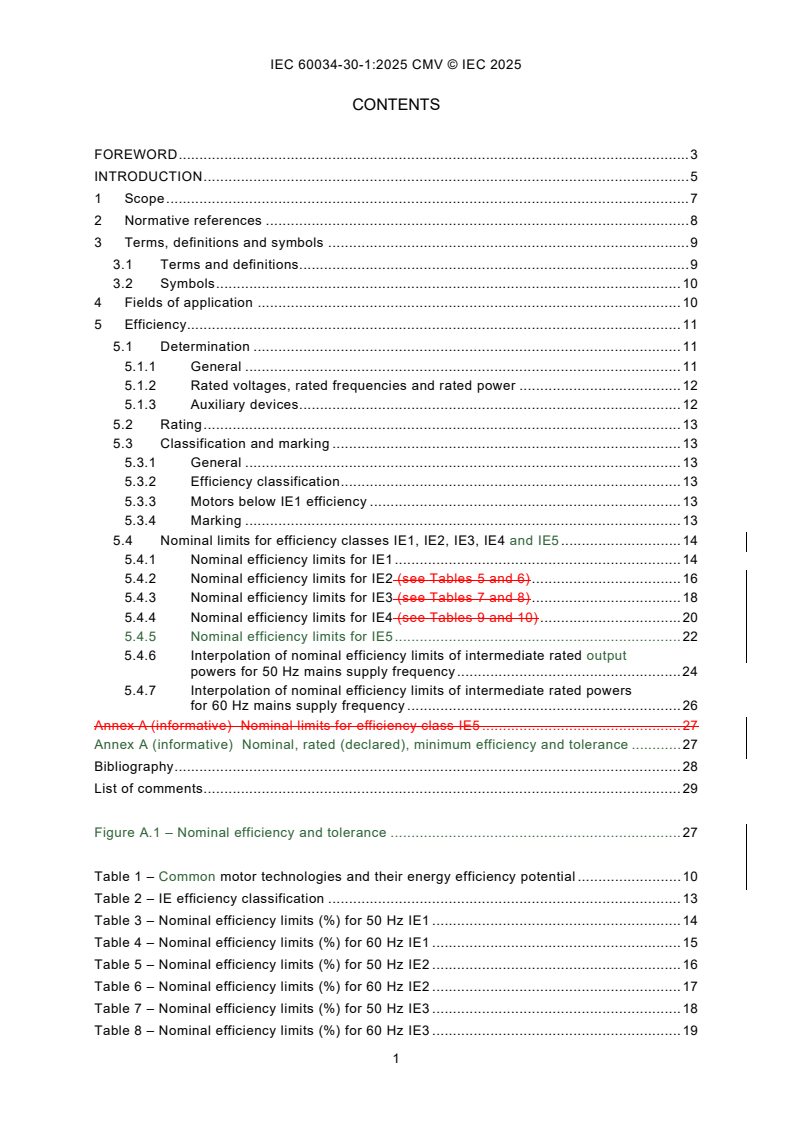
REDLINE IEC 60034-30-1:2025 CMV - Rotating electrical machines - Part 30-1: Efficiency classes of line operated AC motors (IE code) Released:12/1/2025
IEC 60034-30-1:2025 - Machines électriques tournantes - Partie 30-1: Classes de rendement pour les moteurs à courant alternatif alimentés par le réseau (code IE)/1/2025
IEC 60034-30-1:2025 - Rotating electrical machines - Part 30-1: Efficiency classes of line operated AC motors (IE code)/1/2025
Overview
IEC 60034-30-1:2025 (Edition 2.0) is the international standard that defines efficiency classes (IE code) for single‑speed, line‑operated AC motors. It provides a harmonized, practical framework for classifying motor energy performance across a wide product range so different motor technologies can be compared on efficiency potential.
Key scope points:
- Applicable to motors rated per IEC 60034‑1 or IEC 60079‑0 for operation on sinusoidal 50 Hz and/or 60 Hz supplies.
- Covers single‑speed motors with PN from 0.12 kW to 1 000 kW, rated voltage 50 V to 1 000 V, and 2, 4, 6 or 8 poles.
- Ambient rating range –30 °C to +60 °C (efficiency based on 25 °C) and altitude rating up to 4 000 m (efficiency based on ≤1 000 m).
- Introduces and provides nominal limits for efficiency classes IE1, IE2, IE3, IE4 and the newly introduced IE5.
Key topics and requirements
- Nominal efficiency tables: The standard establishes nominal efficiency limits by supply frequency, number of poles and rated power so motors are consistently classed (IE1–IE5).
- Measurement and rating references: Determination and rating of efficiency align with referenced test standards (e.g., IEC 60034‑2‑1 for efficiency measurement conditions).
- Interpolation rules: Provides interpolation coefficients and methods for intermediate rated powers to derive nominal limits between tabulated points.
- Scope boundaries and exclusions: Does not cover multi‑speed motors with ≥10 poles, mechanically commutated (DC) motors, motors that cannot be practically tested separately from an integrated machine, TEAO machines (with special testing notes), nor energy efficiency of complete power‑drive systems (converter/cable losses, harmonics, filters).
- Technology‑neutral classification: No distinction is made by motor technology or supply voltage to enable direct efficiency comparison across technologies; however, not all technologies can reach the highest IE classes.
Applications and users
This standard is essential for:
- Motor manufacturers - classification, design targets and product labelling.
- OEMs and system designers - specifying motors for energy-sensitive applications.
- Procurement and facility managers - selecting motors for lifecycle energy savings and regulatory compliance.
- Test laboratories and certification bodies - validating declared efficiencies and issuing conformity assessments.
- Policy makers and utilities - defining minimum efficiency requirements or incentive schemes.
Practical uses include product specification, tender documents, energy audits, and harmonized procurement policies targeting lower operating costs and reduced energy consumption.
Related standards
- IEC 60034‑1 (motor ratings and performance)
- IEC 60034‑2‑1 (efficiency measurement)
- IEC 60079‑0 (motors for explosive atmospheres, where applicable)
- IEC 61800‑9‑2 (energy efficiency of power drive systems / compact drives)
Keywords: IEC 60034-30-1:2025, IE code, motor efficiency classes, electric motor efficiency standard, IE1 IE2 IE3 IE4 IE5, line-operated AC motors, energy-efficient motors.
Relations
- Effective Date
- 26-Jan-2024
Buy Documents
IEC 60034-30-1:2025 - Rotating electrical machines - Part 30-1: Efficiency classes of line operated AC motors (IE code)/1/2025
REDLINE IEC 60034-30-1:2025 CMV - Rotating electrical machines - Part 30-1: Efficiency classes of line operated AC motors (IE code) Released:12/1/2025
IEC 60034-30-1:2025 - Machines électriques tournantes - Partie 30-1: Classes de rendement pour les moteurs à courant alternatif alimentés par le réseau (code IE)/1/2025
IEC 60034-30-1:2025 - Rotating electrical machines - Part 30-1: Efficiency classes of line operated AC motors (IE code)/1/2025
Get Certified
Connect with accredited certification bodies for this standard

IMQ S.p.A. (Certification)
Italian electrical product certification.

SLG Prüf- und Zertifizierungs GmbH
German testing and certification body.

UL Solutions
Global safety science company with testing, inspection and certification.
Sponsored listings
Frequently Asked Questions
IEC 60034-30-1:2025 is a standard published by the International Electrotechnical Commission (IEC). Its full title is "Rotating electrical machines - Part 30-1: Efficiency classes of line operated AC motors (IE code)". This standard covers: IEC 60034-30-1:2025 specifies efficiency classes for single-speed electric motors that are rated in accordance with IEC 60034‑1 or IEC 60079‑0 and are rated for operation on a sinusoidal either 50 Hz or 60 Hz, or both voltage supply. The motors within this document: - have a rated power PN from 0,12 kW to 1 000 kW; - have a rated voltage UN from 50 V up to and including 1 000 V; - have 2, 4, 6 or 8 poles; - are capable of continuous operation at their rated power with a temperature rise within the specified insulation temperature class; NOTE 1 Most motors covered by this document are rated for duty type S1 (continuous duty). However, some motors that are rated for other duty cycles are still capable of continuous operation at their rated power, and these motors are also covered by this document. - are marked with any ambient temperature within the range of –30 °C to +60 °C; NOTE 2 The rated efficiency and efficiency classes are based on 25 °C ambient temperature in accordance with IEC 60034‑2‑1. NOTE 3 Motors exclusively rated for temperatures outside the range – 30 °C and +60 °C are considered to be of special construction and are consequently excluded from this document. NOTE 4 Smoke extraction motors with a temperature class of up to and including 400 °C are covered by this document. - are marked with an altitude up to 4 000 m above sea level. NOTE 5 The rated efficiency and efficiency class are based on a rating for altitudes up to 1 000 m above sea level. This document establishes a set of nominal efficiency values based on supply frequency, number of poles and motor output power. No distinction is made between motor technologies, supply voltage or motors with increased insulation designed specifically for converter operation even though not all motor technologies are capable of reaching the higher efficiency classes (see Table 1). This makes different motor technologies fully comparable with respect to their energy efficiency potential. The efficiency of power-drive systems is not covered by this document. Motor losses due to harmonic content of the supply voltage, losses in cables, filters and frequency-converters, are not covered. Motors with flanges, feet or shafts with mechanical dimensions different from IEC 60072‑1 are covered by this document. Geared motors are covered by this document including those incorporating non-standard shafts and flanges. This document does not apply to the following: - Single-speed motors with 10 or more poles or multi-speed motors. - Motors with mechanical commutators (such as DC motors). - Motors completely integrated into a machine (for example pump, fan and compressor) that cannot be practically tested separately from the machine even with provision of a temporary end-shield and drive-end bearing. This means the motor: a) shares common components (apart from connectors such as bolts) with the driven unit (for example, a shaft or housing) and b) is not designed in such a way as to enable the motor to be separated from the driven unit as an entire motor that can operate independently of the driven unit. That is, for a motor to be excluded from this document, the process of separation shall render the motor inoperative. - Totally enclosed air-over machines (TEAO, IC418), i.e. totally enclosed frame-surface cooled machines intended for exterior cooling by a ventilating means external to the machine. Efficiency testing of such motors can be performed with the fan removed and the cooling provided by an external blower with a similar airflow rate as the original fan. - Motors with integrated frequency converters (compact drives) when the motor cannot be tested separately from the converter. Energy efficiency classification of compact drives is based on the complete product (PDS, ie. Power Drive System) and is defined in IEC 61800‑9‑2. NOTE 6 A motor is not excluded when the motor and frequency-converter can be separated, and the motor can be tested independently of th
IEC 60034-30-1:2025 specifies efficiency classes for single-speed electric motors that are rated in accordance with IEC 60034‑1 or IEC 60079‑0 and are rated for operation on a sinusoidal either 50 Hz or 60 Hz, or both voltage supply. The motors within this document: - have a rated power PN from 0,12 kW to 1 000 kW; - have a rated voltage UN from 50 V up to and including 1 000 V; - have 2, 4, 6 or 8 poles; - are capable of continuous operation at their rated power with a temperature rise within the specified insulation temperature class; NOTE 1 Most motors covered by this document are rated for duty type S1 (continuous duty). However, some motors that are rated for other duty cycles are still capable of continuous operation at their rated power, and these motors are also covered by this document. - are marked with any ambient temperature within the range of –30 °C to +60 °C; NOTE 2 The rated efficiency and efficiency classes are based on 25 °C ambient temperature in accordance with IEC 60034‑2‑1. NOTE 3 Motors exclusively rated for temperatures outside the range – 30 °C and +60 °C are considered to be of special construction and are consequently excluded from this document. NOTE 4 Smoke extraction motors with a temperature class of up to and including 400 °C are covered by this document. - are marked with an altitude up to 4 000 m above sea level. NOTE 5 The rated efficiency and efficiency class are based on a rating for altitudes up to 1 000 m above sea level. This document establishes a set of nominal efficiency values based on supply frequency, number of poles and motor output power. No distinction is made between motor technologies, supply voltage or motors with increased insulation designed specifically for converter operation even though not all motor technologies are capable of reaching the higher efficiency classes (see Table 1). This makes different motor technologies fully comparable with respect to their energy efficiency potential. The efficiency of power-drive systems is not covered by this document. Motor losses due to harmonic content of the supply voltage, losses in cables, filters and frequency-converters, are not covered. Motors with flanges, feet or shafts with mechanical dimensions different from IEC 60072‑1 are covered by this document. Geared motors are covered by this document including those incorporating non-standard shafts and flanges. This document does not apply to the following: - Single-speed motors with 10 or more poles or multi-speed motors. - Motors with mechanical commutators (such as DC motors). - Motors completely integrated into a machine (for example pump, fan and compressor) that cannot be practically tested separately from the machine even with provision of a temporary end-shield and drive-end bearing. This means the motor: a) shares common components (apart from connectors such as bolts) with the driven unit (for example, a shaft or housing) and b) is not designed in such a way as to enable the motor to be separated from the driven unit as an entire motor that can operate independently of the driven unit. That is, for a motor to be excluded from this document, the process of separation shall render the motor inoperative. - Totally enclosed air-over machines (TEAO, IC418), i.e. totally enclosed frame-surface cooled machines intended for exterior cooling by a ventilating means external to the machine. Efficiency testing of such motors can be performed with the fan removed and the cooling provided by an external blower with a similar airflow rate as the original fan. - Motors with integrated frequency converters (compact drives) when the motor cannot be tested separately from the converter. Energy efficiency classification of compact drives is based on the complete product (PDS, ie. Power Drive System) and is defined in IEC 61800‑9‑2. NOTE 6 A motor is not excluded when the motor and frequency-converter can be separated, and the motor can be tested independently of th
IEC 60034-30-1:2025 is classified under the following ICS (International Classification for Standards) categories: 29.160.01 - Rotating machinery in general. The ICS classification helps identify the subject area and facilitates finding related standards.
IEC 60034-30-1:2025 has the following relationships with other standards: It is inter standard links to IEC 60034-30-1:2014. Understanding these relationships helps ensure you are using the most current and applicable version of the standard.
IEC 60034-30-1:2025 is available in PDF format for immediate download after purchase. The document can be added to your cart and obtained through the secure checkout process. Digital delivery ensures instant access to the complete standard document.
Standards Content (Sample)
IEC 60034-30-1 ®
Edition 2.0 2025-12
INTERNATIONAL
STANDARD
Rotating electrical machines -
Part 30-1: Efficiency classes of line operated AC motors (IE code)
ICS 29.160.01 ISBN 978-2-8327-0823-1
All rights reserved. Unless otherwise specified, no part of this publication may be reproduced or utilized in any form or
by any means, electronic or mechanical, including photocopying and microfilm, without permission in writing from either
IEC or IEC's member National Committee in the country of the requester. If you have any questions about IEC copyright
or have an enquiry about obtaining additional rights to this publication, please contact the address below or your local
IEC member National Committee for further information.
IEC Secretariat Tel.: +41 22 919 02 11
3, rue de Varembé info@iec.ch
CH-1211 Geneva 20 www.iec.ch
Switzerland
About the IEC
The International Electrotechnical Commission (IEC) is the leading global organization that prepares and publishes
International Standards for all electrical, electronic and related technologies.
About IEC publications
The technical content of IEC publications is kept under constant review by the IEC. Please make sure that you have the
latest edition, a corrigendum or an amendment might have been published.
IEC publications search - IEC Products & Services Portal - products.iec.ch
webstore.iec.ch/advsearchform Discover our powerful search engine and read freely all the
The advanced search enables to find IEC publications by a
publications previews, graphical symbols and the glossary.
variety of criteria (reference number, text, technical With a subscription you will always have access to up to date
committee, …). It also gives information on projects, content tailored to your needs.
replaced and withdrawn publications.
Electropedia - www.electropedia.org
IEC Just Published - webstore.iec.ch/justpublished The world's leading online dictionary on electrotechnology,
Stay up to date on all new IEC publications. Just Published containing more than 22 500 terminological entries in English
details all new publications released. Available online and and French, with equivalent terms in 25 additional languages.
once a month by email. Also known as the International Electrotechnical Vocabulary
(IEV) online.
IEC Customer Service Centre - webstore.iec.ch/csc
If you wish to give us your feedback on this publication or
need further assistance, please contact the Customer
Service Centre: sales@iec.ch.
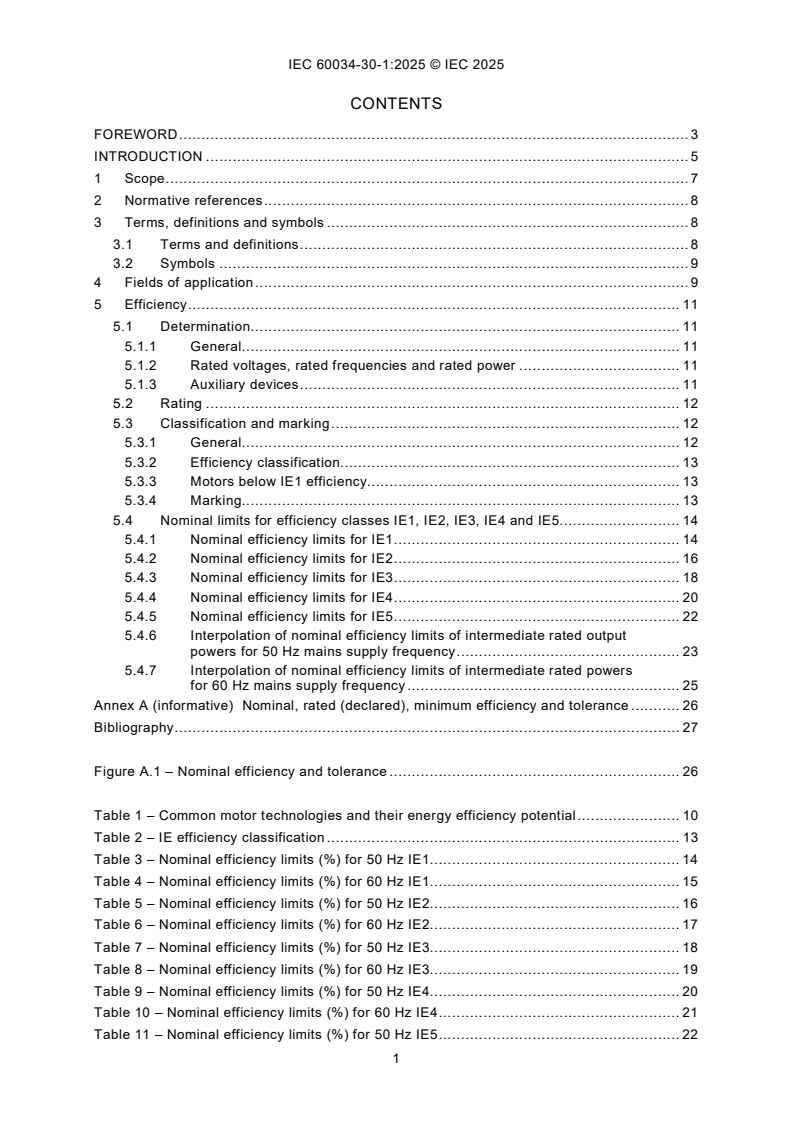
CONTENTS
FOREWORD . 3
INTRODUCTION . 5
1 Scope . 7
2 Normative references . 8
3 Terms, definitions and symbols . 8
3.1 Terms and definitions . 8
3.2 Symbols . 9
4 Fields of application . 9
5 Efficiency . 11
5.1 Determination . 11
5.1.1 General. 11
5.1.2 Rated voltages, rated frequencies and rated power . 11
5.1.3 Auxiliary devices . 11
5.2 Rating . 12
5.3 Classification and marking . 12
5.3.1 General. 12
5.3.2 Efficiency classification. 13
5.3.3 Motors below IE1 efficiency. 13
5.3.4 Marking. 13
5.4 Nominal limits for efficiency classes IE1, IE2, IE3, IE4 and IE5. 14
5.4.1 Nominal efficiency limits for IE1 . 14
5.4.2 Nominal efficiency limits for IE2 . 16
5.4.3 Nominal efficiency limits for IE3 . 18
5.4.4 Nominal efficiency limits for IE4 . 20
5.4.5 Nominal efficiency limits for IE5 . 22
5.4.6 Interpolation of nominal efficiency limits of intermediate rated output
powers for 50 Hz mains supply frequency . 23
5.4.7 Interpolation of nominal efficiency limits of intermediate rated powers
for 60 Hz mains supply frequency . 25
Annex A (informative) Nominal, rated (declared), minimum efficiency and tolerance . 26
Bibliography . 27
Figure A.1 – Nominal efficiency and tolerance . 26
Table 1 – Common motor technologies and their energy efficiency potential . 10
Table 2 – IE efficiency classification . 13
Table 3 – Nominal efficiency limits (%) for 50 Hz IE1. 14
Table 4 – Nominal efficiency limits (%) for 60 Hz IE1. 15
Table 5 – Nominal efficiency limits (%) for 50 Hz IE2. 16
Table 6 – Nominal efficiency limits (%) for 60 Hz IE2. 17
Table 7 – Nominal efficiency limits (%) for 50 Hz IE3. 18
Table 8 – Nominal efficiency limits (%) for 60 Hz IE3. 19
Table 9 – Nominal efficiency limits (%) for 50 Hz IE4. 20
Table 10 – Nominal efficiency limits (%) for 60 Hz IE4 . 21
Table 11 – Nominal efficiency limits (%) for 50 Hz IE5 . 22
Table 12 – Nominal efficiency limits (%) for 60 Hz IE5 . 23
Table 13 – Interpolation coefficients for 0,12 kW up to 0,55 kW . 24
Table 14 – Interpolation coefficients for 0,75 kW up to 200 kW . 25
INTERNATIONAL ELECTROTECHNICAL COMMISSION
____________
Rotating electrical machines -
Part 30-1: Efficiency classes of line operated AC motors (IE code)
FOREWORD
1) The International Electrotechnical Commission (IEC) is a worldwide organization for standardization comprising
all national electrotechnical committees (IEC National Committees). The object of IEC is to promote international
co-operation on all questions concerning standardization in the electrical and electronic fields. To this end and
in addition to other activities, IEC publishes International Standards, Technical Specifications, Technical Reports,
Publicly Available Specifications (PAS) and Guides (hereafter referred to as "IEC Publication(s)"). Their
preparation is entrusted to technical committees; any IEC National Committee interested in the subject dealt with
may participate in this preparatory work. International, governmental and non-governmental organizations liaising
with the IEC also participate in this preparation. IEC collaborates closely with the International Organization for
Standardization (ISO) in accordance with conditions determined by agreement between the two organizations.
2) The formal decisions or agreements of IEC on technical matters express, as nearly as possible, an international
consensus of opinion on the relevant subjects since each technical committee has representation from all
interested IEC National Committees.
3) IEC Publications have the form of recommendations for international use and are accepted by IEC National
Committees in that sense. While all reasonable efforts are made to ensure that the technical content of IEC
Publications is accurate, IEC cannot be held responsible for the way in which they are used or for any
misinterpretation by any end user.
4) In order to promote international uniformity, IEC National Committees undertake to apply IEC Publications
transparently to the maximum extent possible in their national and regional publications. Any divergence between
any IEC Publication and the corresponding national or regional publication shall be clearly indicated in the latter.
5) IEC itself does not provide any attestation of conformity. Independent certification bodies provide conformity
assessment services and, in some areas, access to IEC marks of conformity. IEC is not responsible for any
services carried out by independent certification bodies.
6) All users should ensure that they have the latest edition of this publication.
7) No liability shall attach to IEC or its directors, employees, servants or agents including individual experts and
members of its technical committees and IEC National Committees for any personal injury, property damage or
other damage of any nature whatsoever, whether direct or indirect, or for costs (including legal fees) and
expenses arising out of the publication, use of, or reliance upon, this IEC Publication or any other IEC
Publications.
8) Attention is drawn to the Normative references cited in this publication. Use of the referenced publications is
indispensable for the correct application of this publication.
9) IEC draws attention to the possibility that the implementation of this document may involve the use of (a)
patent(s). IEC takes no position concerning the evidence, validity or applicability of any claimed patent rights in
respect thereof. As of the date of publication of this document, IEC had not received notice of (a) patent(s), which
may be required to implement this document. However, implementers are cautioned that this may not represent
the latest information, which may be obtained from the patent database available at https://patents.iec.ch. IEC
shall not be held responsible for identifying any or all such patent rights.
IEC 60034-30-1 has been prepared by IEC Technical Committee 2: Rotating machinery. It is an
International Standard.
This second edition of IEC 60034-30-1 cancels and replaces the first edition of IEC 60034-30-1
published in 2014. This edition constitutes a technical revision.
This edition includes the following significant technical changes with respect to the previous
edition:
a) Table 1 in Clause 4 revised and IE5 efficiency introduced.
b) New efficiency tables (Table 11 and Table 12) added for IE5 nominal efficiency limits.
c) Table 13 for interpolation coefficients revised based on IE5 limits and the coefficients limited
from 0,12 kW to 0,75 kW 0,12 kW to 0,55 kW. A linear interpolation shall be applied to obtain
minimum efficiency between 0,55 kW and 0,75 kW.
d) Annex A revised and added Figure A.1 showing nominal, rated, minimum efficiency and
tolerance.
The text of this International Standard is based on the following documents:
Draft Report on voting
2/2235/FDIS 2/2279/RVD
Full information on the voting for its approval can be found in the report on voting indicated in
the above table.
The language used for the development of this International Standard are English and French.
This document was drafted in accordance with ISO/IEC Directives, Part 2, and developed in
accordance with ISO/IEC Directives, Part 1 and ISO/IEC Directives, IEC Supplement, available
at www.iec.ch/members_experts/refdocs. The main document types developed by IEC are
described in greater detail at www.iec.ch/publications.
NOTE A table of cross-references of all IEC TC 2 publications can be found on the IEC TC 2 dashboard on the IEC
website.
The committee has decided that the contents of this document will remain unchanged until the
stability date indicated on the IEC website under webstore.iec.ch in the data related to the
specific document. At this date, the document will be
– reconfirmed,
– withdrawn, or
– revised.
INTRODUCTION
This first part of the IEC 60034-30 series, IEC 60034-30-1, provides for the global
harmonization of energy efficiency classes of electric motors. It deals with all kinds of electric
motors that are rated for line operation (including starting at reduced voltage). This includes
either 50 Hz or 60 Hz, or both single- and three-phase low voltage induction motors, regardless
of their rated voltage, as well as line-start synchronous motors.
The second part of this standard series (IEC 60034-30-2) is prepared for motors rated for
variable voltage and frequency supply.
This second edition of IEC 60034-30-1 introduces a new efficiency class, IE5. It is important to
note that International Energy efficiency (IE) class definition is generally independent of the
output power – frame size assignment. As standardized dimensions and outputs in the
IEC 60072 series are based on today's technology (up to IE4), it can be challenging to
implement highest IE classes according to existing frame sizes.
It is possible that motors, especially those with lower output power ratings, are designed and
manufactured in one frame size bigger than frame size assigned in IEC 60072-1 to reach IE4
and IE5 efficiency levels.
For a given power and frame size it is generally easier to achieve a higher motor efficiency
when the motor is designed for and operated directly on-line with a 60 Hz supply frequency
rather than on 50 Hz as explained in Note 1.
NOTE 1 As the utilization and size of motors are related to torque rather than power the theoretical power of single-
speed motors increases linearly with supply frequency (and hence with speed), i.e. by 20 % from 50 Hz to 60 Hz.
I R winding-losses are dominant especially in small and medium sized induction motors. They basically remain
constant at 50 Hz and 60 Hz as long as the torque is kept constant. Although windage, friction and iron losses
increase with frequency, they play a minor role especially in motors with a number of poles of four and higher.
Therefore, at 60 Hz, the losses increase less than the 20 % power increase when compared to 50 Hz and
consequently, the efficiency is improved.
In practice, both 60 Hz and 50 Hz power designations of single-speed motors usually conform to standard power
levels in accordance with IEC 60072-1. Therefore, an increased rating of motor power by 20 % is not always possible.
However, the general advantage of 60 Hz still applies when the motor design is optimized for the respective supply
frequency rather than just re-rated.
The difference in efficiency between 50 Hz and 60 Hz varies with the number of poles and the size of the motor. In
general, the 60 Hz efficiency of three-phase, cage-induction motors in the power range from 0,75 kW up to 375 kW
is between 2,5 percentage points to less than 0,5 percentage points greater when compared to the 50 Hz efficiency.
Only large 2-pole motors can experience a reduced efficiency at 60 Hz due to their high share of iron, windage and
friction losses.
It is not expected that all manufacturers will produce motors for all efficiency classes, nor all
ratings of a given class.
Users should dimension motors to be suitable for the intended applications based on the load
profile, operating hours in order to maximize energy savings considering most energy efficient
solutions in addition that all other requirements set by the application are covered. It is possible
that selecting motors of a high efficiency class for intermittent or short time duty due to
increased inertia and start-up losses is not energy efficient.
NOTE 2 The application guide IEC TS 60034-31 gives further information on useful applications of high-efficient
electric motors.
In order to achieve a significant market share it is essential for high-efficiency motors to meet
national or regional standards for assigned powers in relation to mechanical dimensions (such
as frame-size, flanges). IEC 60072-1 defines the relationship between mechanical dimensions
and rated output as well. There are several national or regional frame assignment standards
(JIS C 4212, NBR 17094, NEMA MG13, SANS 1804 and others). As this document
(IEC 60034-30-1) defines energy efficiency classes independent of dimensional constraints, it
is possible that producing motors with higher efficiency classes, whilst maintaining the
mechanical dimensions of national or regional standards, will not be feasible in all markets.
To meet the demands of higher energy efficiency classes, the designs of components and
equipment and the selection of efficient materials should not be overlooked. There can be a
need to use more materials such as electrical steel, copper and aluminium to enable the design
of high efficiency motors. Consequently, the develop IE5 class motors using the same frames
sizes as IE4 class motors is not always possible. The higher efficiency class motors are likely
to be heavier. This will drive the need to re-design the application of the high efficiency motor.
IE codes are not limited only to motors and are used to classify other components such as
frequency converters (IEC 61800-9-2). The same standard defines also IES classes to
combinations of components (such as power drive systems).
However, it is anticipated that other components are rated with a comparable system: IE1
meaning low efficiency up to IE5 meaning the highest efficiency.
The efficiency levels in this document for 50 Hz and 60 Hz are not always entirely consistent
across all numbers of poles and over the whole power range.
NOTE 3 The efficiency levels for 60 Hz motors were assigned for compatibility with U.S. and North American legal
requirements.
1 Scope
This part of IEC 60034 specifies efficiency classes for single-speed electric motors that are
rated in accordance with IEC 60034-1 or IEC 60079-0 and are rated for operation on a
sinusoidal either 50 Hz or 60 Hz, or both voltage supply.
The motors within this document:
from 0,12 kW to 1 000 kW;
– have a rated power P
N
– have a rated voltage U from 50 V up to and including 1 000 V;
N
– have 2, 4, 6 or 8 poles;
– are capable of continuous operation at their rated power with a temperature rise within the
specified insulation temperature class;
NOTE 1 Most motors covered by this document are rated for duty type S1 (continuous duty). However, some
motors that are rated for other duty cycles are still capable of continuous operation at their rated power, and
these motors are also covered by this document.
– are marked with any ambient temperature within the range of –30 °C to +60 °C;
NOTE 2 The rated efficiency and efficiency classes are based on 25 °C ambient temperature in accordance
with IEC 60034-2-1.
NOTE 3 Motors exclusively rated for temperatures outside the range –30 °C and +60 °C are considered to be
of special construction and are consequently excluded from this document.
NOTE 4 Smoke extraction motors with a temperature class of up to and including 400 °C are covered by this
document.
– are marked with an altitude up to 4 000 m above sea level.
NOTE 5 The rated efficiency and efficiency class are based on a rating for altitudes up to 1 000 m above sea
level.
This document establishes a set of nominal efficiency values based on supply frequency,
number of poles and motor output power. No distinction is made between motor technologies,
supply voltage or motors with increased insulation designed specifically for converter operation
even though not all motor technologies are capable of reaching the higher efficiency classes
(see Table 1). This makes different motor technologies fully comparable with respect to their
energy efficiency potential.
The efficiency of power-drive systems is not covered by this document. Motor losses due to
harmonic content of the supply voltage, losses in cables, filters and frequency-converters, are
not covered.
Motors with flanges, feet or shafts with mechanical dimensions different from IEC 60072-1 are
covered by this document.
Geared motors are covered by this document including those incorporating non-standard shafts
and flanges.
Totally enclosed air-over machines (TEAO, IC418), i.e. totally enclosed frame-surface cooled
machines intended for exterior cooling by a ventilating means external to the machine, are
covered by this document. Efficiency testing of such motors can be performed with the fan
removed and the cooling provided by an external blower with a similar airflow rate as the original
fan.
This document does not apply to the following:
– Single-speed motors with 10 or more poles or multi-speed motors.
– Motors with mechanical commutators (such as DC motors).
– Motors completely integrated into a machine (for example pump, fan and compressor) that
cannot be practically tested separately from the machine even with provision of a temporary
end-shield and drive-end bearing. This means the motor: a) shares common components
(apart from connectors such as bolts) with the driven unit (for example, a shaft or housing)
and b) is not designed in such a way as to enable the motor to be separated from the driven
unit as an entire motor that can operate independently of the driven unit. That is, for a motor
to be excluded from this document, the process of separation shall render the motor
inoperative.
– Motors with integrated frequency converters (compact drives) when the motor cannot be
tested separately from the converter. Energy efficiency classification of compact drives is
based on the complete product (PDS, ie. Power Drive System) and is defined in
IEC 61800-9-2.
NOTE 6 A motor is not excluded when the motor and frequency-converter can be separated, and the motor can
be tested independently of the converter.
– Brake motors when the brake is an integral part of the inner motor construction and can
neither be removed nor supplied by a separate power source during the testing of motor
efficiency.
NOTE 7 Brake motors with a brake coil that is integrated into the flange of the motor are covered as long as it
is possible to test motor efficiency without the losses of the brake (for example by dismantling the brake or by
energizing the brake coil from a separate power source).
When the manufacturer offers a motor of the same design with and without a brake the test
of motor efficiency can be done on a motor without the brake. The determined efficiency
may then be used as the rating for a motor with or without the brake.
– Submersible motors specifically designed to operate wholly immersed in a liquid.
– Smoke extraction motors with a temperature class above 400 °C.
2 Normative references
The following documents are referred to in the text in such a way that some or all their content
constitutes requirements of this document. For dated references, only the edition cited applies.
For undated references, the latest edition of the referenced document (including any
amendments) applies.
IEC 60034-1, Rotating electrical machines - Part 1: Rating and performance
IEC 60034-2-1, Rotating electrical machines - Part 2-1: Standard methods for determining
losses and efficiency from tests (excluding machines for traction vehicles)
3 Terms, definitions and symbols
3.1 Terms and definitions
For the purposes of this document, the terms and definitions given in IEC 60034-1 and the
following apply.
ISO and IEC maintain terminology databases for use in standardization at the following
addresses:
– IEC Electropedia: available at https://www.electropedia.org/
– ISO Online browsing platform: available at https://www.iso.org/obp
3.1.1
single-speed motor
motor rated either 50 Hz or 60 Hz, or both for direct-on-line operation
Note 1 to entry: Single-speed motors may be capable of frequency converter operation with variable speed.
3.1.2
multi-speed motor
motor rated either 50 Hz or 60 Hz, or both for direct-on-line operation that has multiple windings
or a switchable winding to provide two or more different number of poles with different
synchronous speeds
3.1.3
brake motor
motor equipped with an electro-mechanical brake unit operating directly on the motor shaft
without couplings
3.1.4
geared motor
motor equipped with an integral gearbox without couplings (i.e. the first gear wheel is fixed to
the motor shaft)
3.1.5
nominal efficiency
minimum rated efficiency value required to meet a certain efficiency class according to the
efficiency tables in this document
3.1
...
IEC 60034-30-1 ®
Edition 2.0 2025-12
INTERNATIONAL
STANDARD
COMMENTED VERSION
Rotating electrical machines -
Part 30-1: Efficiency classes of line operated AC motors (IE code)
ICS 29.160.01 ISBN 978-2-8327-0920-7
All rights reserved. Unless otherwise specified, no part of this publication may be reproduced or utilized in any form or
by any means, electronic or mechanical, including photocopying and microfilm, without permission in writing from either
IEC or IEC's member National Committee in the country of the requester. If you have any questions about IEC copyright
or have an enquiry about obtaining additional rights to this publication, please contact the address below or your local
IEC member National Committee for further information.
IEC Secretariat Tel.: +41 22 919 02 11
3, rue de Varembé info@iec.ch
CH-1211 Geneva 20 www.iec.ch
Switzerland
About the IEC
The International Electrotechnical Commission (IEC) is the leading global organization that prepares and publishes
International Standards for all electrical, electronic and related technologies.
About IEC publications
The technical content of IEC publications is kept under constant review by the IEC. Please make sure that you have the
latest edition, a corrigendum or an amendment might have been published.
IEC publications search - IEC Products & Services Portal - products.iec.ch
webstore.iec.ch/advsearchform Discover our powerful search engine and read freely all the
The advanced search enables to find IEC publications by a publications previews, graphical symbols and the glossary.
variety of criteria (reference number, text, technical With a subscription you will always have access to up to date
committee, …). It also gives information on projects, content tailored to your needs.
replaced and withdrawn publications.
Electropedia - www.electropedia.org
The world's leading online dictionary on electrotechnology,
IEC Just Published - webstore.iec.ch/justpublished
Stay up to date on all new IEC publications. Just Published containing more than 22 500 terminological entries in English
details all new publications released. Available online and and French, with equivalent terms in 25 additional languages.
once a month by email. Also known as the International Electrotechnical Vocabulary
(IEV) online.
IEC Customer Service Centre - webstore.iec.ch/csc
If you wish to give us your feedback on this publication or
need further assistance, please contact the Customer
Service Centre: sales@iec.ch.
CONTENTS
FOREWORD . 3
INTRODUCTION . 5
1 Scope . 7
2 Normative references . 8
3 Terms, definitions and symbols . 9
3.1 Terms and definitions. 9
3.2 Symbols . 10
4 Fields of application . 10
5 Efficiency. 11
5.1 Determination . 11
5.1.1 General . 11
5.1.2 Rated voltages, rated frequencies and rated power . 12
5.1.3 Auxiliary devices . 12
5.2 Rating . 13
5.3 Classification and marking . 13
5.3.1 General . 13
5.3.2 Efficiency classification . 13
5.3.3 Motors below IE1 efficiency . 13
5.3.4 Marking . 13
5.4 Nominal limits for efficiency classes IE1, IE2, IE3, IE4 and IE5 . 14
5.4.1 Nominal efficiency limits for IE1 . 14
5.4.2 Nominal efficiency limits for IE2 (see Tables 5 and 6) . 16
5.4.3 Nominal efficiency limits for IE3 (see Tables 7 and 8) . 18
5.4.4 Nominal efficiency limits for IE4 (see Tables 9 and 10) . 20
5.4.5 Nominal efficiency limits for IE5 . 22
5.4.6 Interpolation of nominal efficiency limits of intermediate rated output
powers for 50 Hz mains supply frequency . 24
5.4.7 Interpolation of nominal efficiency limits of intermediate rated powers
for 60 Hz mains supply frequency . 26
Annex A (informative) Nominal limits for efficiency class IE5 . 27
Annex A (informative) Nominal, rated (declared), minimum efficiency and tolerance . 27
Bibliography . 28
List of comments. 29
Figure A.1 – Nominal efficiency and tolerance . 27
Table 1 – Common motor technologies and their energy efficiency potential . 10
Table 2 – IE efficiency classification . 13
Table 3 – Nominal efficiency limits (%) for 50 Hz IE1 . 14
Table 4 – Nominal efficiency limits (%) for 60 Hz IE1 . 15
Table 5 – Nominal efficiency limits (%) for 50 Hz IE2 . 16
Table 6 – Nominal efficiency limits (%) for 60 Hz IE2 . 17
Table 7 – Nominal efficiency limits (%) for 50 Hz IE3 . 18
Table 8 – Nominal efficiency limits (%) for 60 Hz IE3 . 19
Table 9 – Nominal efficiency limits (%) for 50 Hz IE4 . 20
Table 10 – Nominal efficiency limits (%) for 60 Hz IE4 . 21
Table 11 – Nominal efficiency limits (%) for 50 Hz IE5 . 22
Table 12 – Nominal efficiency limits (%) for 60 Hz IE5 . 23
Table 13 – Interpolation coefficients for 0,12 kW to 0,74 0,55 kW . 24
Table 14 – Interpolation coefficients for 0,75 kW up to 200 kW . 25
INTERNATIONAL ELECTROTECHNICAL COMMISSION
____________
Rotating electrical machines -
Part 30-1: Efficiency classes of line operated AC motors (IE code)
FOREWORD
1) The International Electrotechnical Commission (IEC) is a worldwide organization for standardization comprising
all national electrotechnical committees (IEC National Committees). The object of IEC is to promote international
co-operation on all questions concerning standardization in the electrical and electronic fields. To this end and
in addition to other activities, IEC publishes International Standards, Technical Specifications, Technical Reports,
Publicly Available Specifications (PAS) and Guides (hereafter referred to as "IEC Publication(s)"). Their
preparation is entrusted to technical committees; any IEC National Committee interested in the subject dealt with
may participate in this preparatory work. International, governmental and non-governmental organizations liaising
with the IEC also participate in this preparation. IEC collaborates closely with the International Organization for
Standardization (ISO) in accordance with conditions determined by agreement between the two organizations.
2) The formal decisions or agreements of IEC on technical matters express, as nearly as possible, an international
consensus of opinion on the relevant subjects since each technical committee has representation from all
interested IEC National Committees.
3) IEC Publications have the form of recommendations for international use and are accepted by IEC National
Committees in that sense. While all reasonable efforts are made to ensure that the technical content of IEC
Publications is accurate, IEC cannot be held responsible for the way in which they are used or for any
misinterpretation by any end user.
4) In order to promote international uniformity, IEC National Committees undertake to apply IEC Publications
transparently to the maximum extent possible in their national and regional publications. Any divergence between
any IEC Publication and the corresponding national or regional publication shall be clearly indicated in the latter.
5) IEC itself does not provide any attestation of conformity. Independent certification bodies provide conformity
assessment services and, in some areas, access to IEC marks of conformity. IEC is not responsible for any
services carried out by independent certification bodies.
6) All users should ensure that they have the latest edition of this publication.
7) No liability shall attach to IEC or its directors, employees, servants or agents including individual experts and
members of its technical committees and IEC National Committees for any personal injury, property damage or
other damage of any nature whatsoever, whether direct or indirect, or for costs (including legal fees) and
expenses arising out of the publication, use of, or reliance upon, this IEC Publication or any other IEC
Publications.
8) Attention is drawn to the Normative references cited in this publication. Use of the referenced publications is
indispensable for the correct application of this publication.
9) IEC draws attention to the possibility that the implementation of this document may involve the use of (a)
patent(s). IEC takes no position concerning the evidence, validity or applicability of any claimed patent rights in
respect thereof. As of the date of publication of this document, IEC had not received notice of (a) patent(s), which
may be required to implement this document. However, implementers are cautioned that this may not represent
the latest information, which may be obtained from the patent database available at https://patents.iec.ch. IEC
shall not be held responsible for identifying any or all such patent rights.
This commented version (CMV) of the official standard IEC 60034-30-1:2025 edition 2.0 allows
the user to identify the changes made to the previous IEC 60034-30-1:2014 edition 1.0.
Furthermore, comments from IEC TC 2 experts are provided to explain the reasons of the most
relevant changes, or to clarify any part of the content.
A vertical bar appears in the margin wherever a change has been made. Additions are in green
text, deletions are in strikethrough red text. Experts' comments are identified by a blue-
background number. Mouse over a number to display a pop-up note with the comment.
This publication contains the CMV and the official standard. The full list of comments is available
at the end of the CMV.
IEC 60034-30-1 has been prepared by IEC Technical Committee 2: Rotating machinery. It is an
International Standard.
This second edition of IEC 60034-30-1 cancels and replaces the first edition of IEC 60034-30-1
published in 2014. This edition constitutes a technical revision.
This edition includes the following significant technical changes with respect to the previous
edition:
a) Table 1 in Clause 4 revised and IE5 efficiency introduced.
b) New efficiency tables (Table 11 and Table 12) added for IE5 nominal efficiency limits.
c) Table 13 for interpolation coefficients revised based on IE5 limits and the coefficients limited
from 0,12 kW to 0,75 kW 0,12 kW to 0,55 kW. A linear interpolation shall be applied to obtain
minimum efficiency between 0,55 kW and 0,75 kW.
d) Annex A revised and added Figure A.1 showing nominal, rated, minimum efficiency and
tolerance.
The text of this International Standard is based on the following documents:
Draft Report on voting
2/2235/FDIS 2/2279/RVD
Full information on the voting for its approval can be found in the report on voting indicated in
the above table.
The language used for the development of this International Standard are English and French.
This document was drafted in accordance with ISO/IEC Directives, Part 2, and developed in
accordance with ISO/IEC Directives, Part 1 and ISO/IEC Directives, IEC Supplement, available
at www.iec.ch/members_experts/refdocs. The main document types developed by IEC are
described in greater detail at www.iec.ch/publications.
NOTE A table of cross-references of all IEC TC 2 publications can be found on the IEC TC 2 dashboard on the IEC
website.
The committee has decided that the contents of this document will remain unchanged until the
stability date indicated on the IEC website under webstore.iec.ch in the data related to the
specific document. At this date, the document will be
– reconfirmed,
– withdrawn, or
– revised.
INTRODUCTION
This first part of the IEC 60034-30 series, IEC 60034-30-1, provides for the global harmonization
of energy efficiency classes of electric motors. It deals with all kinds of electric motors that are
rated for line operation (including starting at reduced voltage). This includes all either 50 Hz or
60 Hz, or both single- and three-phase low voltage induction motors, regardless of their rated
voltage and frequency, as well as line-start permanent-magnet synchronous motors.
The second part of this standard series (IEC 60034-30-2) will be is prepared for motors rated
for variable voltage and frequency supply, such as synchronous motors. The second part will
also provide for harmonic voltage losses in motors capable of line operation when fed by
frequency converters.
IEC 60034-30-1 widens the product range covered in the first edition of IEC 60034-30
significantly. The power range has been expanded (starting at 0,12 kW and ending at 1 000
kW). All technical constructions of electric motors are covered as long as they are rated for on-
line operation and not just three-phase, cage-induction motors as in the first edition.
The IE4 class is newly included in this standard. The informative definition of IE4, which was
previously included in IEC/TS 60034-31:2010, is therefore outdated.
The new class IE5 is not yet defined in detail but is envisaged for potential products in a future
edition of the standard.
This second edition of IEC 60034-30-1 introduces a new efficiency class, IE5. It is important to
note that International Energy efficiency (IE) class definition is generally independent of the
output power – frame size assignment. As standardized dimensions and outputs in the
IEC 60072 series are based on today's technology (up to IE4), it can be challenging to
implement highest IE classes according to existing frame sizes.
It is possible that motors, especially those with lower output power ratings, are designed and
manufactured in one frame size bigger than frame size assigned in IEC 60072-1 to reach IE4
and IE5 efficiency levels. 1
For a given power and frame size it is generally easier to achieve a higher motor efficiency
when the motor is designed for and operated directly on-line with a 60 Hz supply frequency
rather than on 50 Hz as explained in Note 1.
NOTE 1 As the utilization and size of motors are related to torque rather than power the theoretical power of single-
speed motors increases linearly with supply frequency (and hence with speed), i.e. by 20 % from 50 Hz to 60 Hz.
I R winding-losses are dominant especially in small and medium sized induction motors. They basically remain
constant at 50 Hz and 60 Hz as long as the torque is kept constant. Although windage, friction and iron losses
increase with frequency, they play a minor role especially in motors with a number of poles of four and higher.
Therefore, at 60 Hz, the losses increase less than the 20 % power increase when compared to 50 Hz and
consequently, the efficiency is improved.
In practice, both 60 Hz and 50 Hz power designations of single-speed motors have to usually conform to standard
power levels in accordance with IEC 60072-1 and local standards such as EN 50347. Therefore, an increased rating
of motor power by 20 % is not always possible. However, the general advantage of 60 Hz still applies when the motor
design is optimized for the respective supply frequency rather than just re-rated.
The difference in efficiency between 50 Hz and 60 Hz varies with the number of poles and the size of the motor. In
general, the 60 Hz efficiency of three-phase, cage-induction motors in the power range from 0,75 kW up to 375 kW
is between 2,5 percentage points to less than 0,5 percentage points greater when compared to the 50 Hz efficiency.
Only large 2-pole motors may can experience a reduced efficiency at 60 Hz due to their high share of iron, windage
and friction losses.
It is not expected that all manufacturers will produce motors for all efficiency classes, nor all
ratings of a given class.
Users should select the efficiency class in accordance with a given application depending on
the actual operating hours. It may not be energy efficient to select motors of a high efficiency
class for intermittent or short time duty due to increased inertia and start-up losses.
Users should dimension motors to be suitable for the intended applications based on the load
profile, operating hours in order to maximize energy savings considering most energy efficient
solutions in addition that all other requirements set by the application are covered. It is possible
that selecting motors of a high efficiency class for intermittent or short time duty due to
increased inertia and start-up losses is not energy efficient. 2
NOTE 2 The application guide IEC TS 60034-31:2010 gives further information on useful applications of
high-efficient electric motors.
In order to achieve a significant market share it is essential for high-efficiency motors to meet
national or regional standards for assigned powers in relation to mechanical dimensions (such
as frame-size, flanges). IEC 60072-1 defines the relationship between mechanical dimensions
and rated output as well. There are a number of several national or regional frame assignment
standards (EN 50347, JIS C 4212, NBR 17094, NEMA MG13, SANS 1804 and others) but there
is no IEC standard). As this document (IEC 60034-30-1) defines energy efficiency classes
independent of dimensional constraints, it may not be is possible in all markets to produce it is
possible that producing motors with higher efficiency classes, whilst maintaining the mechanical
dimensions of national or regional standards, will not be feasible in all markets.
To meet the demands of higher energy efficiency classes, the designs of components and
equipment and the selection of efficient materials should not be overlooked. There can be a
need to use more materials such as electrical steel, copper and aluminium to enable the design
of high efficiency motors. Consequently, the develop IE5 class motors using the same frames
sizes as IE4 class motors is not always possible. The higher efficiency class motors are likely
to be heavier. This will drive the need to re-design the application of the high efficiency motor. 3
IE codes are not limited only to motors but may be and are used to classify other components
such as frequency converters and gearboxes (IEC 61800-9-2). The same standard defines also
IES classes to combinations of components (such as power drive systems).
However, it is anticipated that other components are rated with a comparable system: IE1
meaning low efficiency up to IE5 meaning the highest efficiency.
Combinations of components (such as power drive systems) will need a combined efficiency
rating. That rating should not be an IE code in order to avoid confusion. It will be defined in
other IEC standards.
The efficiency levels in this document for 50 Hz and 60 Hz are not always entirely consistent
across all numbers of poles and over the whole power range.
NOTE 3 The efficiency levels for 60 Hz motors were assigned for compatibility with U.S. and North American legal
requirements.
NOTE 4 The efficiency levels for 50 Hz motors between 0,75 kW and 375 kW remain unchanged for compatibility
with European legal requirements. 4
1 Scope
This part of IEC 60034 specifies efficiency classes for single-speed electric motors that are
rated in accordance with IEC 60034-1 or IEC 60079-0 and are rated for operation on a
sinusoidal either 50 Hz or 60 Hz, or both voltage supply.
The motors within this document:
from 0,12 kW to 1 000 kW;
– have a rated power P
N
– have a rated voltage U above from 50 V up to and including 1 000 V;
N
– have 2, 4, 6 or 8 poles;
– are capable of continuous operation at their rated power with a temperature rise within the
specified insulation temperature class;
NOTE 1 Most motors covered by this document are rated for duty type S1 (continuous duty). However, some
motors that are rated for other duty cycles are still capable of continuous operation at their rated power, and
these motors are also covered by this document.
– are marked with any ambient temperature within the range of –20 –30 °C 5 to +60 °C;
NOTE 2 The rated efficiency and efficiency classes are based on 25 °C ambient temperature in accordance
with IEC 60034-2-1.
NOTE 3 Motors exclusively rated for temperatures outside the range – 20 –30 °C and +60 °C are considered
to be of special construction and are consequently excluded from this document.
NOTE 4 Smoke extraction motors with a temperature class of up to and including 400 °C are covered by this
document.
– are marked with an altitude up to 4 000 m above sea level.
NOTE 5 The rated efficiency and efficiency class are based on a rating for altitudes up to 1 000 m above sea
level.
This document establishes a set of limit nominal efficiency values based on supply frequency,
number of poles and motor output power. No distinction is made between motor technologies,
supply voltage or motors with increased insulation designed specifically for converter operation
even though these not all motor technologies may not all be are capable of reaching the higher
efficiency classes (see Table 1). This makes different motor technologies fully comparable with
respect to their energy efficiency potential.
NOTE 6 Regulators should consider the above constraints when assigning national minimum energy-efficiency
performance standards (MEPS) with respect to any particular type of motor. 6
The efficiency of power-drive systems is not covered by this document. In particular, Motor
losses due to harmonic content of the supply voltage, losses in cables, filters and frequency-
converters, are not covered.
Motors with flanges, feet and/or shafts with mechanical dimensions different from IEC 60072-1
are covered by this document.
Geared motors are covered by this document including those incorporating non-standard shafts
and flanges.
Totally enclosed air-over machines (TEAO, IC418), i.e. totally enclosed frame-surface cooled
machines intended for exterior cooling by a ventilating means external to the machine, are
covered by this document. Efficiency testing of such motors may can be performed with the fan
removed and the cooling provided by an external blower with a similar airflow rate as the original
fan.
This document does not apply to the following:
– Single-speed motors with 10 or more poles or multi-speed motors.
– Motors with mechanical commutators (such as DC motors).
– Motors completely integrated into a machine (for example pump, fan and compressor) that
cannot be practically tested separately from the machine even with provision of a temporary
end-shield and drive-end bearing. This means the motor shall: a) shares common
components (apart from connectors such as bolts) with the driven unit (for example, a shaft
or housing) and b) is not be designed in such a way as to enable the motor to be separated
from the driven unit as an entire motor that can operate independently of the driven unit.
That is, for a motor to be excluded from this document, the process of separation shall
render the motor inoperative.
– Motors with integrated frequency converters (compact drives) when the motor cannot be
tested separately from the converter. Energy efficiency classification of compact drives shall
be is based on the complete product (PDS, ie. Power Drive System) and will be is defined
in a separate standard IEC 61800-9-2.
NOTE 6 A motor is not excluded when the motor and frequency-converter can be separated, and the motor can
be tested independently of the converter.
– Brake motors when the brake is an integral part of the inner motor construction and can
neither be removed nor supplied by a separate power source during the testing of motor
efficiency.
NOTE 7 Brake motors with a brake coil that is integrated into the flange of the motor are covered as long as it
is possible to test motor efficiency without the losses of the brake (for example by dismantling the brake or by
energizing the brake coil from a separate power source).
When the manufacturer offers a motor of the same design with and without a brake the test
of motor efficiency may can be done on a motor without the brake. The determined efficiency
may then be used as the rating of both motor and brake motor for a motor with or without
the brake.
– Submersible motors specifically designed to operate wholly immersed in a liquid.
– Smoke extraction motors with a temperature class above 400 °C.
2 Normative references
The following documents are referred to in the text in such a way that some or all their content
constitutes requirements of this document. For dated references, only the edition cited applies.
For undated references, the latest edition of the referenced document (including any
amendments) applies.
IEC 60034-1, Rotating electrical machines - Part 1: Rating and performance
IEC 60034-2-1, Rotating electrical machines - Part 2-1: Standard methods for determining
losses and efficiency from tests (excluding machines for traction vehicles)
IEC/TS 60034-2-3, Rotating electrical machines – Part 2-3: Specific test methods for
determining losses and efficiency of converter-fed AC induction motors
IEC 60034-6, Rotating electrical machines – Part 6: Methods of cooling (IC Code)
IEC/TS 60034-25, Rotating electrical machines – Part 25: Guidance for the design and
performance of a.c. motors specifically designed for converter supply
IEC 60038, IEC standard voltages
IEC 60079-0, Explosive atmospheres – Part 0: Equipment – General requirements 7
3 Terms, definitions and symbols
3.1 Terms and definitions
For the purposes of this document, the terms and definitions given in IEC 60034-1 and the
following apply.
ISO and IEC maintain terminology databases for use in standardization at the following
addresses:
– IEC Electropedia: available at https://www.electropedia.org/
– ISO Online browsing platform: available at https://www.iso.org/obp
3.1.1
single-speed motor
motor rated either 50 Hz or 60 Hz, or both for direct-on-line operation
Note 1 to entry: Single-speed motors may be capable of frequency converter operation with variable speed.
3.1.2
multi-speed motor
motor rated either 50 Hz or 60 Hz, or both for direct-on-line operation that has multiple windings
or a switchable winding to provide two or more different number of poles with different
synchronous speeds
3.1.3
variable speed motor 8
motor rated for a speed range and supplied by voltage of variable amplitude and frequency
3.1.3
brake motor
motor equipped with an electro-mechanical brake unit operating directly on the motor shaft
without couplings
3.1.4
geared motor
motor equipped with an integral gearbox without couplings (i.e. the first gear wheel is fixed to
the motor shaft)
3.1.6
pump motor 9
motor directly attached to a pump without couplings (i.e. the impeller is fixed to the motor shaft)
3.1.7
average efficiency 10
average efficiency value for a motor population of the same design and rating
3.1.5
nominal efficiency
minimum rated 11 efficiency value required to meet a certain efficiency class according to the
efficiency tables in this document
3.1.6
rated efficiency
efficiency value assigned by the manufacturer, equal to the nominal efficiency value or higher
3.2 Symbols
η is the nominal efficiency, %
n
η is the rated efficiency, %
N
f is the rated frequency, Hz
N
–1
n is the rated speed, min
N
P is the rated power, kW
N
T is the rated torque, Nm
N
U is the rated voltage, V
N
4 Fields of application
Table 1 gives information on line-start and energy efficiency potential of various commonly used
motor technologies for motors in direct-on-line start and operation.
Not all motor technologies are able to reach all efficiency classes nor can motors for all
efficiency classes or sizes be produced or operated in an economically feasible way. Therefore,
regulators are asked to consider the following constraints when assigning minimum energy
efficiency performance standards (MEPS).
are considered to be state of present technology and are
Motors marked with "Yes" in Table 1
consequently suitable for consideration in mandatory requirements in legislation state-of-the-
art based on present technology and availability of materials for industrial products and can be
subject to regulatory requirements.
Table 1 – Common motor technologies and their energy efficiency potential
Motor type IE1 IE2 IE3 IE4 IE5
Three-phase cage- Random wound Yes No
Yes Yes Yes
rotor induction windings (all Difficult Very
a
motors (ASM) enclosures, all
Difficult
ratings)
Form wound Yes Yes Difficult No No
windings; IP2x
(open motors)
Form wound Yes Yes Yes Difficult No
windings; IP4x and
above
Three-phase wound-rotor induction motors Yes Yes Yes Difficult No
Single-phase Start capacitor Difficult No No No No
induction motors
Run capacitor Yes Difficult No No No
Start and run
Yes Difficult No No No
capacitor
Split-phase Difficult No No No No
Synchronous motors Line-start Yes Yes Yes Difficult No
permanent-magnet Very
a
Difficult
(LSPM )
b
synchronous
a
It is possible that the design and frame size can be different for IE5 motors, especially for smaller size of
motors, in comparison with existing designs with lower efficiency (IE2, IE3 and IE4) levels.
ab
Line-start permanent-magnet synchronous motors have limitations on their line-start capabilities with respect
to torque and external inertia and may not be are not suitable for all types of applications.
Motor type IE1 IE2 IE3 IE4 IE5
NOTE 1 With regard to the IE levels, "Yes" means the efficiency class is achievable with present technology
(although in some cases it may not be is not economical); "No" means the efficiency class is not generally
achievable with present technology; "Difficult" means that the energy efficiency level may can be achieved with
present technology for some but not all power ratings and the standardized frame size may can be exceeded.
"Line-start" means the capability of the motor to start direct on-line (Design N of IEC 60034-12 for single-speed,
three-phase cage induction motors) without the need for a frequency converter.
NOTE 2 It may can be difficult to develop motors for efficiency classes IE3 IE4 and above within the local
power/frame size standards (such as NBR 17094-1 or EN 50347).
NOTE 3 It is expected that motors for efficiency class IE5 will be covered in part 2 of this standard.
NOTE 4 The energy efficiency potential of motor technologies regarding IE5 classification will be revised after
the IE5 classification has been defined.
Motors covered by this document may be used in variable-speed drive applications (see IEC/TS
60034-25). In such applications the actual efficiency of the motor is lower than the rated
efficiency due to increased losses from the harmonic-voltage content of the power supply. For
efficiency testing see IEC/TS 60034-2-3.
The energy efficiency classification of motors in this document is related to the losses at
sinusoidal power supply only.
It is possible that the following motors may not be are not able to reach the higherst efficiency
classes specifications (IE3 and above):
– motors with cooling methods other than IC0Ax, IC1Ax, IC2Ax, IC3Ax or IC4Ax according to
IEC 60034-6;
– motors built for a restricted space (high-output design, i.e. smaller frame sizes than usual
in national standards);
– motors specifically built for operation in explosive environments according to IEC 60079-0
(due to safety requirements and possible design constraints of explosion proof motors such
as increased air gap, reduced starting current, enhanced sealing);
– motors for special requirements of the driven machine beyond the requirements of the
IEC 60034 series of standards (such as motors for heavy starting duty, special torque
stiffness and/or breakdown torque characteristics, large number of start/stop cycles, very
low rotor inertia);
– motors for special characteristics of the grid supply beyond the requirements of the
IEC 60034 series of standards (such as motors with limited starting current, increased
tolerances of either the voltage and/or frequency, or both of them);
– motors with liquid cooling on account of their higher power density compared with air cooled
motors of the same frame size;
– smoke extraction motors with a temperature class higher than 300 °C.
5 Efficiency
5.1 Determination
5.1.1 General
This document deals with single-speed motors operated on-line. Motors operated by frequency-
converters may have higher losses as compared to on-line (sinusoidal) power supply due to the
harmonic voltage content (for details see IEC/TS 60034-25). They are covered in part two of
this standard series.
To make efficiency class ratings comparable between different motor technologies according
to this document, all tests shall be performed on sinusoidal voltage.
Efficiency and losses shall be tested in accordance with the preferred method of the individual
motor type as given in IEC 60034-2-1 and corrected to the ambient temperature of 25 °C. 12
5.1.2 Rated voltages, rated frequencies and rated power
The rated efficiency shall be determined at rated power P , rated voltage U and rated
N N
frequency f .
N
Motors rated for an extended voltage tolerance (for example 400 V ± 10 % according to
IEC 60038) shall be assigned a single rated efficiency, i.e. the extended tolerance shall be
disregarded.
Motors rated for an extended voltage range (for example 380 V – 440 V) shall fulfil the assigned
rated efficiency in the whole voltage range 13. Motors with rated voltage/frequency
combinations of the same magnetic flux and power, for example 230 V/400 V (delta/star) or
230 V/460 V (double-star/star or double-delta/delta), shall have only one rated efficiency and
efficiency class (IE code) per voltage/frequency combination of same flux and power.
Motors with more than one rated voltage/frequency/power combination should shall be assigned
a rated efficiency and a rated efficiency class (IE code) for each rated voltage/frequency/power
combination.
However, as a minimum the lowest efficiency value and the associated IE code (of all rated
voltage/frequency/power combinations) for both 50 Hz and 60 Hz ratings shall always be
printed on the rating plate.
All efficiency values and IE codes shall be available in the product documentation (catalogue
or operating instructions).
NOTE For example, in Japan the rating combination "200 V/50 Hz – 200 V/60 Hz – 220 V/60 Hz" is commonly used
for single-speed motors and in Europe the rating combination "380 V/50 Hz – 400 V/50 Hz – 415 V/50 Hz –
460 V/60 Hz" is sometimes used. For these examples there will be three or four efficiency ratings and there may can
be several different IE codes.
5.1.3 Auxiliary devices
Some electric motors covered by this document may be equipped with auxiliary devices such
as shaft seals, external fans, mechanical brakes, back-stops and unidirectional bearings, speed
sensors, tacho-generators in various combinations.
However, as long as if these auxiliary devices are not an integral part of the basic motor design,
the determination of efficiency in all possible combinations is not practical. Tests for efficiency
of such modified standard motors shall be performed on basic motors with original cooling
without auxiliary devices installed.
The losses of a separately driven fan are to be included in the efficiency determination
procedure when the external fan is an integral part of the basic motor construction. When the
external fan is just an optional add-on to a mass-produced motor, which normally carries a
shaft-mounted fan, the losses of the basic motor (with the shaft-mounted fan) can be used.
Angular-contact bearings (thrust bearings) for vertical mounted motors may be replaced by
standard bearings during efficiency testing. Such motors may be tested horizontally.
Some types of motors (such as geared motors, pump motors and others) Most motors are
equipped with shaft seals to prevent ingress of oil or water into the motor. External seals shall
be removed for efficiency testing. This applies only to seals that are accessible from the outside
without dismantling of the motor (dismantling of the fan cover and the fan is accepted).
Electro-mechanical brakes shall be removed during testing of motor efficiency. When the motor
construction prohibits a removal of the brake, the brake-coil shall be energized from a separate
power source and the energy consumption of the brake-coil shall be disregarded in the
calculation of motor efficiency.
5.2 Rating
The efficiency declared by the manufacturer on the rating plate (rated efficiency) shall be
greater or equal to the nominal efficiency as defined in this document according to the efficiency
class (IE code) on the rating plate.
The full-load efficiency of any motor, when tested at rated voltage and rated frequency shall not
be less than the rated-/classification efficiency minus the tolerance of the total losses in
accordance with IEC 60034-1.
It is recommended to report efficiencies at 50 %, 75 % and full load 100 % power in the product
documentation. For the purpose of this document only the efficiency at rated power applies.
Variations in materials, manufacturing processes and testing result in motor-to-motor efficiency
variations for a given motor design. The full-load efficiency for a large population of motors of
a single design is not a unique value but rather a band of efficiency. Therefore, the energy
efficiency limits given in this document are nominal.
See Figure A.1 in Annex A for the clarification of tolerances and rated (declared), nominal and
minimum allowed (guaranteed) efficiency. 14
5.3 Classification and marking
5.3.1 General
The designation of the energy efficiency class consists of the letters "IE" (short for International
Energy efficiency class), directly followed by a numeral representing the classification according
to Table 2.
5.3.2 Efficiency classification
Table 2 – IE efficiency classification
Designation Definition
IE1 Motors with a rated full-load efficiency equal to or exceeding the limits listed in 5.4.1.
IE2 Motors with a rated full-load efficiency equal to or exceeding the limits listed in 5.4.2.
IE3 Motors with a rated full-load efficiency equal to or exceeding the limits listed in 5.4.3
IE4 Motors with a rated full-load efficiency equal to or exceeding the limits listed in 5.4.4.
IE5 Envisaged for a future edition of this standard. See Annex A.
Motors with a rated full-load efficiency equal to or exceeding the limits listed in 5.4.5. 15
5.3.3 Motors below IE1 efficiency
Some motors have rated efficiencies below the limits given in Table 3 and Table 4. No efficiency
marking of these such motors below IE1 efficiencies shall be are required.
5.3.4 Marking
The rated efficiency and the IE code shall be durably marked on the rating plate, for example
"IE2 – 84,0 %".
5.4 Nominal limits for efficiency classes IE1, IE2, IE3, IE4 and IE5
NOTE Shaded areas in the tables indicate changes compared to the previous edition of this standard.
5.4.1 Nominal efficiency limits for IE1
Table 3 and Table 4 show the nominal efficiency limits for IE1.
Table 3 – Nominal efficiency limits (%) for 50 Hz IE1
Number of poles/synchronous speed
P
N
–1
min
kW
2/3000 4/1500 6/1000 8/750
0,12 45,0 50,0 38,3 31,0
0,18 52,8 57,0 45,5 38,0
0,20 54,6 58,5 47,6 39,7
0,25 58,2 61,5 52,1 43,4
0,37 63,9 66,0 59,7 49,7
0,40 64,9 66,8 61,1 50,9
0,55 69,0 70,0 65,8 56,1
0,75 72,1 72,1 70,0 61,2
1,1 75,0 75,0 72,9 66,5
1,5 77,2 77,2 75,2 70,2
2,2 79,7 79,7 77,7 74,2
3 81,5 81,5 79,7 77,0
4 83,1 83,1 81,4 79,2
5,5 84,7 84,7 83,1 81,4
7,5 86,0 86,0 84,7 83,1
11 87,6 87,6 86,4 85,0
15 88,7 88,7 87,7 86,2
18,5 89,3 89,3 88,6 86,9
22 89,9 89,9 89,2 87,4
30 90,7 90,7 90,2 88,3
37 91,2 91,2 90,8 88,8
45 91,7 91,7 91,4 89,2
55 92,1 92,1 91,9 89,7
75 92,7 92,7 92,6 90,3
90 93,0 93,0 92,9 90,7
110 93,3 93,3 93,3 91,1
132 93,5 93,5 93,5 91,5
160 93,8 93,8 93,8 91,9
200 up to 1 000 94,0 94,0 94,0 92,5
Number of poles/synchronous speed
P
N
–1
min
kW
2/3000 4/1500 6/1000 8/75
...
IEC 60034-30-1 ®
Edition 2.0 2025-12
NORME
INTERNATIONALE
Machines électriques tournantes -
Partie 30-1: Classes de rendement pour les moteurs à courant alternatif
alimentés par le réseau (code IE)
ICS 29.160.01 ISBN 978-2-8327-0823-1
Droits de reproduction réservés. Sauf indication contraire, aucune partie de cette publication ne peut être reproduite ni
utilisée sous quelque forme que ce soit et par aucun procédé, électronique ou mécanique, y compris la photocopie et
les microfilms, sans l'accord écrit de l'IEC ou du Comité national de l'IEC du pays du demandeur. Si vous avez des
questions sur le copyright de l'IEC ou si vous désirez obtenir des droits supplémentaires sur cette publication, utilisez
les coordonnées ci-après ou contactez le Comité national de l'IEC de votre pays de résidence.
IEC Secretariat Tel.: +41 22 919 02 11
3, rue de Varembé info@iec.ch
CH-1211 Geneva 20 www.iec.ch
Switzerland
A propos de l'IEC
La Commission Electrotechnique Internationale (IEC) est la première organisation mondiale qui élabore et publie des
Normes internationales pour tout ce qui a trait à l'électricité, à l'électronique et aux technologies apparentées.
A propos des publications IEC
Le contenu technique des publications IEC est constamment revu. Veuillez vous assurer que vous possédez l’édition la
plus récente, un corrigendum ou amendement peut avoir été publié.
Recherche de publications IEC - IEC Products & Services Portal - products.iec.ch
webstore.iec.ch/advsearchform Découvrez notre puissant moteur de recherche et consultez
La recherche avancée permet de trouver des publications gratuitement tous les aperçus des publications, symboles
IEC en utilisant différents critères (numéro de référence, graphiques et le glossaire. Avec un abonnement, vous aurez
texte, comité d’études, …). Elle donne aussi des toujours accès à un contenu à jour adapté à vos besoins.
informations sur les projets et les publications remplacées
ou retirées. Electropedia - www.electropedia.org
Le premier dictionnaire d'électrotechnologie en ligne au
IEC Just Published - webstore.iec.ch/justpublished monde, avec plus de 22 500 articles terminologiques en
Restez informé sur les nouvelles publications IEC. Just anglais et en français, ainsi que les termes équivalents
Published détaille les nouvelles publications parues. dans 25 langues additionnelles. Egalement appelé
Disponible en ligne et une fois par mois par email. Vocabulaire Electrotechnique International (IEV) en ligne.
Service Clients - webstore.iec.ch/csc
Si vous désirez nous donner des commentaires sur cette
publication ou si vous avez des questions contactez-
nous: sales@iec.ch.
SOMMAIRE
AVANT-PROPOS . 3
INTRODUCTION . 5
1 Domaine d'application . 7
2 Références normatives . 8
3 Termes, définitions et symboles . 9
3.1 Termes et définitions. 9
3.2 Symboles . 9
4 Champs d'application . 10
5 Rendement . 11
5.1 Détermination . 11
5.1.1 Généralités . 11
5.1.2 Tensions assignées, fréquences assignées et puissances assignées . 11
5.1.3 Équipements auxiliaires . 12
5.2 Caractéristiques assignées . 13
5.3 Classification et marquage. 13
5.3.1 Généralités . 13
5.3.2 Classification du rendement . 13
5.3.3 Moteurs de rendement inférieur à IE1 . 13
5.3.4 Marquage . 13
5.4 Limites nominales pour les classes de rendement IE1, IE2, IE3, IE4 et IE5 . 14
5.4.1 Limites de rendement nominal pour IE1 . 14
5.4.2 Limites de rendement nominal pour IE2 . 16
5.4.3 Limites de rendement nominal pour IE3 . 18
5.4.4 Limites de rendement nominal pour IE4 . 20
5.4.5 Limites de rendement nominal pour IE5 . 22
5.4.6 Interpolation des limites de rendement nominal des puissances de
sortie assignées intermédiaires pour une fréquence du réseau
électrique de 50 Hz . 23
5.4.7 Interpolation des limites de rendement nominal des puissances
assignées intermédiaires pour une fréquence du réseau électrique de
60 Hz . 25
Annexe A (informative) Rendement nominal, assigné (déclaré), minimal et tolérances . 26
Bibliographie . 27
Figure A.1 – Rendement nominal et tolérances . 26
Tableau 1 – Technologies de moteur courantes et leur potentiel de rendement
énergétique . 10
Tableau 2 – Classification IE du rendement. 13
Tableau 3 – Limites de rendement nominal (%) pour IE1, 50 Hz . 14
Tableau 4 – Limites de rendement nominal (%) pour IE1, 60 Hz . 15
Tableau 5 – Limites de rendement nominal (%) pour IE2, 50 Hz . 16
Tableau 6 – Limites de rendement nominal (%) pour IE2, 60 Hz . 17
Tableau 7 – Limites de rendement nominal (%) pour IE3, 50 Hz . 18
Tableau 8 – Limites de rendement nominal (%) pour IE3, 60 Hz . 19
Tableau 9 – Limites de rendement nominal (%) pour IE4, 50 Hz . 20
Tableau 10 – Limites de rendement nominal (%) pour IE4, 60 Hz . 21
Tableau 11 – Limites de rendement nominal (%) pour IE5, 50 Hz . 22
Tableau 12 – Limites de rendement nominal (%) pour IE5, 60 Hz . 23
Tableau 13 – Coefficients d'interpolation pour 0,12 kW jusqu'à 0,55 kW . 24
Tableau 14 – Coefficients d'interpolation pour 0,75 kW jusqu'à 200 kW . 25
COMMISSION ÉLECTROTECHNIQUE INTERNATIONALE
____________
Machines électriques tournantes -
Partie 30-1: Classes de rendement pour les moteurs à courant alternatif
alimentés par le réseau (code IE)
AVANT-PROPOS
1) La Commission Électrotechnique Internationale (IEC) est une organisation mondiale de normalisation composée
de l'ensemble des comités électrotechniques nationaux (Comités nationaux de l'IEC). L'IEC a pour objet de
favoriser la coopération internationale pour toutes les questions de normalisation dans les domaines de
l'électricité et de l'électronique. À cet effet, l'IEC – entre autres activités – publie des Normes internationales,
des Spécifications techniques, des Rapports techniques, des Spécifications accessibles au public (PAS) et des
Guides (ci-après dénommés "Publication(s) de l'IEC"). Leur élaboration est confiée à des comités d'études, aux
travaux desquels tout Comité national intéressé par le sujet traité peut participer. Les organisations
internationales, gouvernementales et non gouvernementales, en liaison avec l'IEC, participent également aux
travaux. L'IEC collabore étroitement avec l'Organisation Internationale de Normalisation (ISO), selon des
conditions fixées par accord entre les deux organisations.
2) Les décisions ou accords officiels de l'IEC concernant les questions techniques représentent, dans la mesure du
possible, un accord international sur les sujets étudiés, étant donné que les Comités nationaux de l'IEC intéressés
sont représentés dans chaque comité d'études.
3) Les Publications de l'IEC se présentent sous la forme de recommandations internationales et sont agréées
comme telles par les Comités nationaux de l'IEC. Tous les efforts raisonnables sont entrepris afin que l'IEC
s'assure de l'exactitude du contenu technique de ses publications; l'IEC ne peut pas être tenue responsable de
l'éventuelle mauvaise utilisation ou interprétation qui en est faite par un quelconque utilisateur final.
4) Dans le but d'encourager l'uniformité internationale, les Comités nationaux de l'IEC s'engagent, dans toute la
mesure possible, à appliquer de façon transparente les Publications de l'IEC dans leurs publications nationales
et régionales. Toutes divergences entre toutes Publications de l'IEC et toutes publications nationales ou
régionales correspondantes doivent être indiquées en termes clairs dans ces dernières.
5) L'IEC elle-même ne fournit aucune attestation de conformité. Des organismes de certification indépendants
fournissent des services d'évaluation de conformité et, dans certains secteurs, accèdent aux marques de
conformité de l'IEC. L'IEC n'est responsable d'aucun des services effectués par les organismes de certification
indépendants.
6) Tous les utilisateurs doivent s'assurer qu'ils sont en possession de la dernière édition de cette publication.
7) Aucune responsabilité ne doit être imputée à l'IEC, à ses administrateurs, employés, auxiliaires ou mandataires,
y compris ses experts particuliers et les membres de ses comités d'études et des Comités nationaux de l'IEC,
pour tout préjudice causé en cas de dommages corporels et matériels, ou de tout autre dommage de quelque
nature que ce soit, directe ou indirecte, ou pour supporter les coûts (y compris les frais de justice) et les dépenses
découlant de la publication ou de l'utilisation de cette Publication de l'IEC ou de toute autre Publication de l'IEC,
ou au crédit qui lui est accordé.
8) L'attention est attirée sur les références normatives citées dans cette publication. L'utilisation de publications
référencées est obligatoire pour une application correcte de la présente publication.
9) L'IEC attire l'attention sur le fait que la mise en application du présent document peut entraîner l'utilisation d'un
ou de plusieurs brevets. L'IEC ne prend pas position quant à la preuve, à la validité et à l'applicabilité de tout
droit de brevet revendiqué à cet égard. À la date de publication du présent document, l'IEC n'a pas reçu
notification qu'un ou plusieurs brevets pouvaient être nécessaires à sa mise en application. Toutefois, il y a lieu
d'avertir les responsables de la mise en application du présent document que des informations plus récentes
sont susceptibles de figurer dans la base de données de brevets, disponible à l'adresse https://patents.iec.ch.
L'IEC ne saurait être tenue pour responsable de ne pas avoir identifié de tels droits de brevet.
L'IEC 60034-30-1 a été établie par le comité d'études 2 de l'IEC: Machines tournantes. Il s'agit
d'une Norme internationale.
Cette deuxième édition de l'IEC 60034-30-1 annule et remplace la première édition de
l'IEC 60034-30-1 parue en 2014. Cette édition constitue une révision technique.
Cette édition inclut les modifications techniques majeures suivantes par rapport à l'édition
précédente:
a) révision du Tableau 1 à l'Article 4 et introduction du rendement IE5;
b) ajout de nouveaux tableaux de rendement (Tableau 11 et Tableau 12) concernant les limites
de rendement nominal IE5;
c) révision du Tableau 13 concernant les coefficients d'interpolation sur la base des limites IE5
et les coefficients limités de 0,12 kW à 0,75 kW 0,12 kW à 0,55 kW. Une interpolation
linéaire doit être appliquée pour obtenir un rendement minimal compris entre 0,55 kW
et 0,75 kW;
d) révision de l'Annexe A et ajout de la Figure A.1 présentant le rendement nominal, assigné,
minimal et les tolérances.
Le texte de cette Norme internationale est issu des documents suivants:
Projet Rapport de vote
2/2235/FDIS 2/2279/RVD
Le rapport de vote indiqué dans le tableau ci-dessus donne toute information sur le vote ayant
abouti à son approbation.
Les langues employées pour l'élaboration de cette Norme internationale sont l'anglais et le
français.
Ce document a été rédigé selon les Directives ISO/IEC, Partie 2, il a été développé selon les
Directives ISO/IEC, Partie 1 et les Directives ISO/IEC, Supplément IEC, disponibles sous
www.iec.ch/members_experts/refdocs. Les principaux types de documents développés par
l'IEC sont décrits plus en détail sous www.iec.ch/publications.
NOTE Un tableau des correspondances de toutes les publications du CE 2 de l'IEC se trouve sur le site web de
l'IEC, à la page d'accueil du comité.
Le comité a décidé que le contenu de ce document ne sera pas modifié avant la date de stabilité
indiquée sur le site web de l'IEC sous webstore.iec.ch dans les données relatives au document
recherché. À cette date, le document sera
– reconduit,
– supprimé, ou
– révisé.
INTRODUCTION
Cette première partie de la série IEC 60034-30, l'IEC 60034-30-1, apporte une harmonisation
globale des classes de rendement énergétique des moteurs électriques. Elle traite tous les
types de moteurs électriques alimentés par le réseau (incluant le démarrage à tension réduite).
Ceux-ci comportent soit les moteurs à 50 Hz ou 60 Hz, soit les moteurs à induction basse
tension monophasés et triphasés, quelle que soit leur tension assignée, ainsi que les moteurs
synchrones à démarrage en ligne.
La deuxième partie de cette série de normes (IEC 60034-30-2) est élaborée pour les moteurs
à tension et fréquence variables.
Cette deuxième édition de l'IEC 60034-30-1 introduit une nouvelle classe de rendement, IE5.
Il est important de noter que la définition de la classe internationale de rendement énergétique
(IE, International Energy) est généralement indépendante de l'assignation de la puissance de
sortie en fonction des dimensions de carcasse. Comme les dimensions et les puissances
normalisées indiquées dans la série IEC 60072 sont fondées sur la technologie actuelle (jusqu'à
IE4), il peut être complexe de mettre en œuvre les classes IE les plus élevées en fonction des
dimensions de carcasse existantes.
Il est possible que les moteurs, en particulier ceux avec des puissances de sortie assignées
inférieures, soient conçus et fabriqués dans des dimensions de carcasse supérieures à celles
assignées dans l'IEC 60072-1 pour atteindre les niveaux de rendement IE4 et IE5.
Pour une puissance et des dimensions de carcasse données, il est généralement plus aisé
d'obtenir un rendement supérieur du moteur lorsque le moteur est conçu pour être alimenté
directement par le réseau à une fréquence de 60 Hz plutôt qu'à 50 Hz, comme expliqué dans
la Note 1.
NOTE 1 Puisque l'utilisation et les dimensions d'un moteur sont liées au couple plutôt qu'à la puissance, la
puissance de sortie théorique des moteurs à une seule vitesse augmente linéairement avec la fréquence
d'alimentation (et donc avec la vitesse), c'est-à-dire de 20 % entre 50 Hz et 60 Hz.
Les pertes par effet Joule dans les bobinages sont dominantes, particulièrement dans les moteurs à induction de
petites et moyennes dimensions. Fondamentalement, elles restent constantes pour 50 Hz et 60 Hz tant que le couple
est maintenu constant. Bien que les pertes de ventilation, de frottement et dans le fer augmentent avec la fréquence,
elles jouent un rôle mineur, en particulier dans les moteurs à quatre pôles et plus. Ainsi, à 60 Hz, les pertes
augmentent moins que les 20 % d'augmentation de puissance par rapport à 50 Hz et de ce fait, le rendement est
amélioré.
En pratique, les désignations de puissance de sortie à 60 Hz et à 50 Hz des moteurs à une seule vitesse sont
généralement conformes aux niveaux de puissance normalisés, conformément à l'IEC 60072-1. Par conséquent, une
augmentation de 20 % de la puissance du moteur n'est pas toujours possible. Toutefois, l'avantage général d'une
fréquence de 60 Hz reste applicable lorsque la conception du moteur est optimisée pour la fréquence d'alimentation
respective plutôt que simplement réassignée.
La différence de rendement entre 50 Hz et 60 Hz varie avec le nombre de pôles et les dimensions du moteur.
En général, le rendement à 60 Hz des moteurs à induction à cage triphasés dans la gamme de puissances de
0,75 kW à 375 kW se situe entre 2,5 % à moins de 0,5 % plus élevé que par rapport au rendement à 50 Hz. Seuls
les gros moteurs 2 pôles peuvent voir leur rendement à 60 Hz réduit du fait de la forte proportion des pertes dans le
fer, de ventilation et de frottement.
Il n'est pas envisagé que tous les constructeurs produisent des moteurs pour toutes les classes
de rendement, ni pour toutes les caractéristiques assignées d'une classe donnée.
Il convient que les utilisateurs dimensionnent les moteurs pour qu'ils soient adaptés aux
applications prévues en fonction du profil de charge, des durées de fonctionnement, afin de
maximiser les économies d'énergie en envisageant les solutions les plus efficaces sur le plan
énergétique, tout en veillant à ce que toutes les autres exigences fixées par l'application soient
couvertes. Il est possible que la sélection de moteurs d'une classe de haut rendement pour des
durées de fonctionnement en régimes intermittents ou faibles, en raison de pertes d'inertie et
de démarrage renforcées, ne soit pas efficace d'un point de vue énergétique.
NOTE 2 Le guide d'application IEC/TS 60034-31 donne d'autres informations relatives aux applications utiles des
moteurs électriques de haut rendement.
Afin d'atteindre une part de marché significative, il est essentiel que les moteurs de haut
rendement répondent aux normes nationales ou régionales qui régissent les puissances
assignées en fonction des dimensions mécaniques (telles que les dimensions de carcasse, les
brides). L'IEC 60072-1 définit la relation entre les dimensions mécaniques et la puissance de
sortie assignée. Il existe également plusieurs réglementations nationales ou régionales qui
fixent les dimensions des carcasses (JIS C 4212, NBR 17094, NEMA MG13, SANS 1804 et
autres). Dans la mesure où le présent document (IEC 60034-30-1) définit les classes de
rendement énergétique indépendamment des contraintes dimensionnelles, il est possible que
le fait de produire des moteurs avec des classes de rendement énergétique supérieures, ne
soit pas réalisable dans tous les marchés, tout en respectant les dimensions mécaniques fixées
par les normes nationales ou régionales.
Pour répondre aux exigences de classes de rendement énergétique plus élevées, il convient
de ne pas négliger la conception des composants et des équipements et la sélection de
matériaux efficaces. Il peut être nécessaire d'utiliser davantage de matériaux tels que l'acier
électrique, le cuivre et l'aluminium pour permettre la conception de moteurs de haut rendement.
Par conséquent, il n'est pas toujours possible de concevoir des moteurs de classe IE5 utilisant
des dimensions de carcasse identiques à celles des moteurs de classe IE4. Les moteurs de
classe de rendement énergétique plus élevée sont susceptibles d'être plus lourds. Ceci
conduira à la nécessité de revoir la conception de l'application du moteur à haut rendement.
Les codes IE ne sont pas limités uniquement aux moteurs et ils sont utilisés pour classer
d'autres composants, tels que les convertisseurs de fréquence (IEC 61800-9-2). La même
norme définit également des classes IES pour les combinaisons de composants (tels que les
systèmes d'entraînement mécanique).
Il est toutefois prévu que les autres composants soient classés au moyen d'un système
comparable: IE1 signifiant un faible rendement jusqu'à IE5 signifiant le rendement le plus élevé.
Les niveaux de rendement du présent document pour 50 Hz et 60 Hz ne sont pas toujours
parfaitement cohérents pour tous les nombres de pôles et sur toute la gamme de puissances.
NOTE 3 Les niveaux de rendement pour les moteurs à 60 Hz ont été assignés afin d'assurer la compatibilité avec
les exigences réglementaires aux États-Unis d'Amérique et en Amérique du Nord.
1 Domaine d'application
La présente partie de l'IEC 60034 spécifie les classes de rendement pour les moteurs
électriques à une seule vitesse qui sont classés conformément à l'IEC 60034-1 ou à
l'IEC 60079-0. Ces moteurs sont assignés pour fonctionner soit avec une tension d'alimentation
sinusoïdale de 50 Hz ou 60 Hz, soit avec ces deux valeurs de tension.
Les moteurs traités dans le présent document:
– ont une puissance assignée P de 0,12 kW à 1 000 kW;
N
– ont une tension assignée U de 50 V jusqu'à 1 000 V inclus;
N
– ont 2, 4, 6 ou 8 pôles;
– peuvent fonctionner en continu à leur puissance assignée avec un échauffement ne
dépassant pas la classe de température d'isolation spécifiée;
NOTE 1 La plupart des moteurs couverts par le présent document sont assignés pour un type de régime S1
(régime continu). Toutefois, certains moteurs assignés pour d'autres cycles de service peuvent encore
fonctionner en continu à leur puissance assignée et ces moteurs sont également couverts par le présent
document.
– sont marqués pour toute température ambiante dans la gamme de –30 °C à +60 °C;
NOTE 2 Le rendement assigné et les classes de rendement sont fondés sur une température ambiante de
25 °C, conformément à l'IEC 60034-2-1.
NOTE 3 On considère que les moteurs exclusivement assignés pour des températures extérieures à la gamme
de –30 °C à +60 °C sont d'une construction particulière et ils sont en conséquence exclus du présent document.
NOTE 4 Les moteurs pour extraction de fumée d'une classe de température allant jusqu'à 400 °C inclus sont
couverts par le présent document.
– sont marqués pour une altitude allant jusqu'à 4 000 m au-dessus du niveau de la mer.
NOTE 5 Le rendement assigné et la classe de rendement sont fondés sur des altitudes allant jusqu'à 1 000 m
au-dessus du niveau de la mer.
Le présent document définit un ensemble de valeurs nominales de rendement en se fondant
sur la fréquence d'alimentation, le nombre de pôles et la puissance de sortie du moteur. Aucune
distinction n'est établie entre les technologies de moteur, la tension d'alimentation ou les
moteurs ayant une isolation renforcée, conçus en particulier pour le fonctionnement des
convertisseurs, même si ces technologies de moteur peuvent ne pas être toutes en mesure
d'atteindre les classes de rendement supérieures (voir le Tableau 1). Ceci permet de comparer
entièrement des technologies de moteur différentes en fonction de leur potentiel de rendement
énergétique.
Le rendement des systèmes d'entraînement mécanique n'est pas couvert par le présent
document. Les pertes dans les moteurs dues à la teneur en harmoniques de la tension
d'alimentation, les pertes dans les câbles, les filtres et les convertisseurs de fréquence, ne sont
pas couvertes.
Les moteurs avec brides, à pattes ou avec arbres ayant des dimensions mécaniques différentes
de celles fixées par l'IEC 60072-1 sont couverts par le présent document.
Les moteurs avec réducteur sont couverts par le présent document, ce qui inclut les moteurs
comportant des arbres et des brides non normalisés.
Les machines entièrement fermées et autoventilées (TEAO, IC418), c'est-à-dire les machines
refroidies par une surface de carcasse entièrement fermée prévue pour un refroidissement
extérieur par un moyen de ventilation externe à la machine, sont couvertes par le présent
document. L'essai de rendement de ces moteurs peut être effectué en retirant la ventilation et
le refroidissement assuré par une soufflerie externe avec un débit d'air similaire à celui de la
ventilation d'origine.
Le présent document ne s'applique pas aux éléments suivants:
– les moteurs à une seule vitesse avec 10 pôles ou plus ou les moteurs à plusieurs vitesses;
– les moteurs avec commutateurs mécaniques (tels que les moteurs à courant continu);
– les moteurs complètement intégrés dans une machine (par exemple pompe, ventilateur,
compresseur) qui ne peuvent pas faire l'objet d'essais séparément de la machine, même en
prévoyant un blindage d'extrémité temporaire et un palier d'extrémité d'entraînement. Ceci
signifie que le moteur: a) partage des composants communs (hormis les connecteurs tels
que les boulons) avec l'unité entraînée (par exemple, un arbre ou un carter) et b) n'est pas
conçu de telle manière à permettre la séparation du moteur de l'unité entraînée comme un
moteur complet qui peut fonctionner indépendamment de l'unité entraînée. C'est-à-dire que
pour qu'un moteur soit exclu du présent document, le processus de séparation doit rendre
le moteur inopérant;
– les moteurs avec convertisseurs de fréquence intégrés (entraînements compacts) lorsque
le moteur ne peut pas être soumis à l'essai séparément du convertisseur. La classification
par rendement énergétique des entraînements compacts est fondée sur le produit complet
(PDS: Power Drive System (Système d'entraînement mécanique)) et elle est définie dans
l'IEC 61800-9-2.
NOTE 6 Un moteur n'est pas exclu lorsque le moteur et le convertisseur de fréquence peuvent être séparés et
que le moteur peut être soumis à l'essai indépendamment du convertisseur.
– les moteurs frein, lorsque le frein fait partie intégrante de la construction interne du moteur
et ne peut être ni enlevé, ni alimenté par une source d'énergie séparée pendant l'essai du
rendement du moteur.
NOTE 7 Les moteurs frein avec une bobine de frein intégrée dans la bride du moteur sont couverts dans la
mesure où il est possible d'effectuer l'essai de rendement du moteur sans les pertes du frein (par exemple, en
démontant le frein ou en excitant la bobine de frein à partir d'une source d'alimentation séparée).
Lorsque le constructeur propose un moteur de même conception avec ou sans frein, l'essai
de rendement du moteur peut être effectué sur un moteur sans frein. Le rendement
déterminé peut alors être utilisé pour classer un moteur avec ou sans frein;
– les moteurs submersibles spécialement conçus pour fonctionner entièrement plongés dans
un liquide;
– les moteurs pour extraction de fumée d'une classe de température supérieure à 400 °C.
2 Références normatives
Les documents suivants sont cités dans le texte de sorte qu'ils constituent, pour tout ou partie
de leur contenu, des exigences du présent document. Pour les références datées, seule
l'édition citée s'applique. Pour les références non datées, la dernière édition du document de
référence s'applique (y compris les éventuels amendements).
IEC 60034-1, Machines électriques tournantes - Partie 1: Caractéristiques assignées et
caractéristiques de fonctionnement
IEC 60034-2-1, Machines électriques tournantes - Partie 2-1: Méthodes normalisées pour la
détermination des pertes et du rendement à partir d'essais (à l'exclusion des machines pour
véhicules de traction)
3 Termes, définitions et symboles
3.1 Termes et définitions
Pour les besoins du présent document, les termes et définitions de l'IEC 60034-1 ainsi que les
suivants s'appliquent.
L'ISO et l'IEC tiennent à jour des bases de données terminologiques destinées à être utilisées
en normalisation, consultables aux adresses suivantes:
– IEC Electropedia : disponible à l'adresse https://www.electropedia.org/
– ISO Online browsing platform: disponible à l'adresse https://www.iso.org/obp
3.1.1
moteur à une seule vitesse
moteur assigné soit à 50 Hz ou 60 Hz, soit aux deux valeurs, pour être alimenté directement
par le réseau
Note 1 à l'article: Les moteurs à une seule vitesse peuvent fonctionner en convertisseur de fréquence à vitesse
variable.
3.1.2
moteur à plusieurs vitesses
moteur assigné soit à 50 Hz ou 60 Hz, soit aux deux valeurs, pour être alimenté directement
par le réseau, comportant plusieurs enroulements ou un enroulement commutable pour fournir
deux pôles ou un nombre de pôles différents avec des vitesses synchrones différentes
3.1.3
moteur frein
moteur équipé d'un frein électromécan
...
IEC 60034-30-1 ®
Edition 2.0 2025-12
INTERNATIONAL
STANDARD
NORME
INTERNATIONALE
Rotating electrical machines -
Part 30-1: Efficiency classes of line operated AC motors (IE code)
Machines électriques tournantes -
Partie 30-1: Classes de rendement pour les moteurs à courant alternatif
alimentés par le réseau (code IE)
ICS 29.160.01 ISBN 978-2-8327-0823-1
All rights reserved. Unless otherwise specified, no part of this publication may be reproduced or utilized in any form or
by any means, electronic or mechanical, including photocopying and microfilm, without permission in writing from either
IEC or IEC's member National Committee in the country of the requester. If you have any questions about IEC copyright
or have an enquiry about obtaining additional rights to this publication, please contact the address below or your local
IEC member National Committee for further information.
Droits de reproduction réservés. Sauf indication contraire, aucune partie de cette publication ne peut être reproduite ni
utilisée sous quelque forme que ce soit et par aucun procédé, électronique ou mécanique, y compris la photocopie et
les microfilms, sans l'accord écrit de l'IEC ou du Comité national de l'IEC du pays du demandeur. Si vous avez des
questions sur le copyright de l'IEC ou si vous désirez obtenir des droits supplémentaires sur cette publication, utilisez
les coordonnées ci-après ou contactez le Comité national de l'IEC de votre pays de résidence.
IEC Secretariat Tel.: +41 22 919 02 11
3, rue de Varembé info@iec.ch
CH-1211 Geneva 20 www.iec.ch
Switzerland
About the IEC
The International Electrotechnical Commission (IEC) is the leading global organization that prepares and publishes
International Standards for all electrical, electronic and related technologies.
About IEC publications
The technical content of IEC publications is kept under constant review by the IEC. Please make sure that you have the
latest edition, a corrigendum or an amendment might have been published.
IEC publications search - IEC Products & Services Portal - products.iec.ch
webstore.iec.ch/advsearchform Discover our powerful search engine and read freely all the
The advanced search enables to find IEC publications by a publications previews, graphical symbols and the glossary.
variety of criteria (reference number, text, technical With a subscription you will always have access to up to date
committee, …). It also gives information on projects, content tailored to your needs.
replaced and withdrawn publications.
Electropedia - www.electropedia.org
IEC Just Published - webstore.iec.ch/justpublished The world's leading online dictionary on electrotechnology,
Stay up to date on all new IEC publications. Just Published containing more than 22 500 terminological entries in English
details all new publications released. Available online and and French, with equivalent terms in 25 additional languages.
once a month by email. Also known as the International Electrotechnical Vocabulary
(IEV) online.
IEC Customer Service Centre - webstore.iec.ch/csc
If you wish to give us your feedback on this publication or
need further assistance, please contact the Customer
Service Centre: sales@iec.ch.
A propos de l'IEC
La Commission Electrotechnique Internationale (IEC) est la première organisation mondiale qui élabore et publie des
Normes internationales pour tout ce qui a trait à l'électricité, à l'électronique et aux technologies apparentées.
A propos des publications IEC
Le contenu technique des publications IEC est constamment revu. Veuillez vous assurer que vous possédez l’édition la
plus récente, un corrigendum ou amendement peut avoir été publié.
Recherche de publications IEC - IEC Products & Services Portal - products.iec.ch
webstore.iec.ch/advsearchform Découvrez notre puissant moteur de recherche et consultez
La recherche avancée permet de trouver des publications gratuitement tous les aperçus des publications, symboles
IEC en utilisant différents critères (numéro de référence, graphiques et le glossaire. Avec un abonnement, vous aurez
texte, comité d’études, …). Elle donne aussi des toujours accès à un contenu à jour adapté à vos besoins.
informations sur les projets et les publications remplacées
ou retirées. Electropedia - www.electropedia.org
Le premier dictionnaire d'électrotechnologie en ligne au
IEC Just Published - webstore.iec.ch/justpublished monde, avec plus de 22 500 articles terminologiques en
Restez informé sur les nouvelles publications IEC. Just anglais et en français, ainsi que les termes équivalents
Published détaille les nouvelles publications parues. dans 25 langues additionnelles. Egalement appelé
Disponible en ligne et une fois par mois par email. Vocabulaire Electrotechnique International (IEV) en ligne.
Service Clients - webstore.iec.ch/csc
Si vous désirez nous donner des commentaires sur cette
publication ou si vous avez des questions contactez-
nous: sales@iec.ch.
CONTENTS
FOREWORD . 3
INTRODUCTION . 5
1 Scope . 7
2 Normative references . 8
3 Terms, definitions and symbols . 8
3.1 Terms and definitions . 8
3.2 Symbols . 9
4 Fields of application . 9
5 Efficiency . 11
5.1 Determination . 11
5.1.1 General. 11
5.1.2 Rated voltages, rated frequencies and rated power . 11
5.1.3 Auxiliary devices . 11
5.2 Rating . 12
5.3 Classification and marking . 12
5.3.1 General. 12
5.3.2 Efficiency classification. 13
5.3.3 Motors below IE1 efficiency. 13
5.3.4 Marking. 13
5.4 Nominal limits for efficiency classes IE1, IE2, IE3, IE4 and IE5. 14
5.4.1 Nominal efficiency limits for IE1 . 14
5.4.2 Nominal efficiency limits for IE2 . 16
5.4.3 Nominal efficiency limits for IE3 . 18
5.4.4 Nominal efficiency limits for IE4 . 20
5.4.5 Nominal efficiency limits for IE5 . 22
5.4.6 Interpolation of nominal efficiency limits of intermediate rated output
powers for 50 Hz mains supply frequency . 23
5.4.7 Interpolation of nominal efficiency limits of intermediate rated powers
for 60 Hz mains supply frequency . 25
Annex A (informative) Nominal, rated (declared), minimum efficiency and tolerance . 26
Bibliography . 27
Figure A.1 – Nominal efficiency and tolerance . 26
Table 1 – Common motor technologies and their energy efficiency potential . 10
Table 2 – IE efficiency classification . 13
Table 3 – Nominal efficiency limits (%) for 50 Hz IE1. 14
Table 4 – Nominal efficiency limits (%) for 60 Hz IE1. 15
Table 5 – Nominal efficiency limits (%) for 50 Hz IE2. 16
Table 6 – Nominal efficiency limits (%) for 60 Hz IE2. 17
Table 7 – Nominal efficiency limits (%) for 50 Hz IE3. 18
Table 8 – Nominal efficiency limits (%) for 60 Hz IE3. 19
Table 9 – Nominal efficiency limits (%) for 50 Hz IE4. 20
Table 10 – Nominal efficiency limits (%) for 60 Hz IE4 . 21
Table 11 – Nominal efficiency limits (%) for 50 Hz IE5 . 22
Table 12 – Nominal efficiency limits (%) for 60 Hz IE5 . 23
Table 13 – Interpolation coefficients for 0,12 kW up to 0,55 kW . 24
Table 14 – Interpolation coefficients for 0,75 kW up to 200 kW . 25
INTERNATIONAL ELECTROTECHNICAL COMMISSION
____________
Rotating electrical machines -
Part 30-1: Efficiency classes of line operated AC motors (IE code)
FOREWORD
1) The International Electrotechnical Commission (IEC) is a worldwide organization for standardization comprising
all national electrotechnical committees (IEC National Committees). The object of IEC is to promote international
co-operation on all questions concerning standardization in the electrical and electronic fields. To this end and
in addition to other activities, IEC publishes International Standards, Technical Specifications, Technical Reports,
Publicly Available Specifications (PAS) and Guides (hereafter referred to as "IEC Publication(s)"). Their
preparation is entrusted to technical committees; any IEC National Committee interested in the subject dealt with
may participate in this preparatory work. International, governmental and non-governmental organizations liaising
with the IEC also participate in this preparation. IEC collaborates closely with the International Organization for
Standardization (ISO) in accordance with conditions determined by agreement between the two organizations.
2) The formal decisions or agreements of IEC on technical matters express, as nearly as possible, an international
consensus of opinion on the relevant subjects since each technical committee has representation from all
interested IEC National Committees.
3) IEC Publications have the form of recommendations for international use and are accepted by IEC National
Committees in that sense. While all reasonable efforts are made to ensure that the technical content of IEC
Publications is accurate, IEC cannot be held responsible for the way in which they are used or for any
misinterpretation by any end user.
4) In order to promote international uniformity, IEC National Committees undertake to apply IEC Publications
transparently to the maximum extent possible in their national and regional publications. Any divergence between
any IEC Publication and the corresponding national or regional publication shall be clearly indicated in the latter.
5) IEC itself does not provide any attestation of conformity. Independent certification bodies provide conformity
assessment services and, in some areas, access to IEC marks of conformity. IEC is not responsible for any
services carried out by independent certification bodies.
6) All users should ensure that they have the latest edition of this publication.
7) No liability shall attach to IEC or its directors, employees, servants or agents including individual experts and
members of its technical committees and IEC National Committees for any personal injury, property damage or
other damage of any nature whatsoever, whether direct or indirect, or for costs (including legal fees) and
expenses arising out of the publication, use of, or reliance upon, this IEC Publication or any other IEC
Publications.
8) Attention is drawn to the Normative references cited in this publication. Use of the referenced publications is
indispensable for the correct application of this publication.
9) IEC draws attention to the possibility that the implementation of this document may involve the use of (a)
patent(s). IEC takes no position concerning the evidence, validity or applicability of any claimed patent rights in
respect thereof. As of the date of publication of this document, IEC had not received notice of (a) patent(s), which
may be required to implement this document. However, implementers are cautioned that this may not represent
the latest information, which may be obtained from the patent database available at https://patents.iec.ch. IEC
shall not be held responsible for identifying any or all such patent rights.
IEC 60034-30-1 has been prepared by IEC Technical Committee 2: Rotating machinery. It is an
International Standard.
This second edition of IEC 60034-30-1 cancels and replaces the first edition of IEC 60034-30-1
published in 2014. This edition constitutes a technical revision.
This edition includes the following significant technical changes with respect to the previous
edition:
a) Table 1 in Clause 4 revised and IE5 efficiency introduced.
b) New efficiency tables (Table 11 and Table 12) added for IE5 nominal efficiency limits.
c) Table 13 for interpolation coefficients revised based on IE5 limits and the coefficients limited
from 0,12 kW to 0,75 kW 0,12 kW to 0,55 kW. A linear interpolation shall be applied to obtain
minimum efficiency between 0,55 kW and 0,75 kW.
d) Annex A revised and added Figure A.1 showing nominal, rated, minimum efficiency and
tolerance.
The text of this International Standard is based on the following documents:
Draft Report on voting
2/2235/FDIS 2/2279/RVD
Full information on the voting for its approval can be found in the report on voting indicated in
the above table.
The language used for the development of this International Standard are English and French.
This document was drafted in accordance with ISO/IEC Directives, Part 2, and developed in
accordance with ISO/IEC Directives, Part 1 and ISO/IEC Directives, IEC Supplement, available
at www.iec.ch/members_experts/refdocs. The main document types developed by IEC are
described in greater detail at www.iec.ch/publications.
NOTE A table of cross-references of all IEC TC 2 publications can be found on the IEC TC 2 dashboard on the IEC
website.
The committee has decided that the contents of this document will remain unchanged until the
stability date indicated on the IEC website under webstore.iec.ch in the data related to the
specific document. At this date, the document will be
– reconfirmed,
– withdrawn, or
– revised.
INTRODUCTION
This first part of the IEC 60034-30 series, IEC 60034-30-1, provides for the global
harmonization of energy efficiency classes of electric motors. It deals with all kinds of electric
motors that are rated for line operation (including starting at reduced voltage). This includes
either 50 Hz or 60 Hz, or both single- and three-phase low voltage induction motors, regardless
of their rated voltage, as well as line-start synchronous motors.
The second part of this standard series (IEC 60034-30-2) is prepared for motors rated for
variable voltage and frequency supply.
This second edition of IEC 60034-30-1 introduces a new efficiency class, IE5. It is important to
note that International Energy efficiency (IE) class definition is generally independent of the
output power – frame size assignment. As standardized dimensions and outputs in the
IEC 60072 series are based on today's technology (up to IE4), it can be challenging to
implement highest IE classes according to existing frame sizes.
It is possible that motors, especially those with lower output power ratings, are designed and
manufactured in one frame size bigger than frame size assigned in IEC 60072-1 to reach IE4
and IE5 efficiency levels.
For a given power and frame size it is generally easier to achieve a higher motor efficiency
when the motor is designed for and operated directly on-line with a 60 Hz supply frequency
rather than on 50 Hz as explained in Note 1.
NOTE 1 As the utilization and size of motors are related to torque rather than power the theoretical power of single-
speed motors increases linearly with supply frequency (and hence with speed), i.e. by 20 % from 50 Hz to 60 Hz.
I R winding-losses are dominant especially in small and medium sized induction motors. They basically remain
constant at 50 Hz and 60 Hz as long as the torque is kept constant. Although windage, friction and iron losses
increase with frequency, they play a minor role especially in motors with a number of poles of four and higher.
Therefore, at 60 Hz, the losses increase less than the 20 % power increase when compared to 50 Hz and
consequently, the efficiency is improved.
In practice, both 60 Hz and 50 Hz power designations of single-speed motors usually conform to standard power
levels in accordance with IEC 60072-1. Therefore, an increased rating of motor power by 20 % is not always possible.
However, the general advantage of 60 Hz still applies when the motor design is optimized for the respective supply
frequency rather than just re-rated.
The difference in efficiency between 50 Hz and 60 Hz varies with the number of poles and the size of the motor. In
general, the 60 Hz efficiency of three-phase, cage-induction motors in the power range from 0,75 kW up to 375 kW
is between 2,5 percentage points to less than 0,5 percentage points greater when compared to the 50 Hz efficiency.
Only large 2-pole motors can experience a reduced efficiency at 60 Hz due to their high share of iron, windage and
friction losses.
It is not expected that all manufacturers will produce motors for all efficiency classes, nor all
ratings of a given class.
Users should dimension motors to be suitable for the intended applications based on the load
profile, operating hours in order to maximize energy savings considering most energy efficient
solutions in addition that all other requirements set by the application are covered. It is possible
that selecting motors of a high efficiency class for intermittent or short time duty due to
increased inertia and start-up losses is not energy efficient.
NOTE 2 The application guide IEC TS 60034-31 gives further information on useful applications of high-efficient
electric motors.
In order to achieve a significant market share it is essential for high-efficiency motors to meet
national or regional standards for assigned powers in relation to mechanical dimensions (such
as frame-size, flanges). IEC 60072-1 defines the relationship between mechanical dimensions
and rated output as well. There are several national or regional frame assignment standards
(JIS C 4212, NBR 17094, NEMA MG13, SANS 1804 and others). As this document
(IEC 60034-30-1) defines energy efficiency classes independent of dimensional constraints, it
is possible that producing motors with higher efficiency classes, whilst maintaining the
mechanical dimensions of national or regional standards, will not be feasible in all markets.
To meet the demands of higher energy efficiency classes, the designs of components and
equipment and the selection of efficient materials should not be overlooked. There can be a
need to use more materials such as electrical steel, copper and aluminium to enable the design
of high efficiency motors. Consequently, the develop IE5 class motors using the same frames
sizes as IE4 class motors is not always possible. The higher efficiency class motors are likely
to be heavier. This will drive the need to re-design the application of the high efficiency motor.
IE codes are not limited only to motors and are used to classify other components such as
frequency converters (IEC 61800-9-2). The same standard defines also IES classes to
combinations of components (such as power drive systems).
However, it is anticipated that other components are rated with a comparable system: IE1
meaning low efficiency up to IE5 meaning the highest efficiency.
The efficiency levels in this document for 50 Hz and 60 Hz are not always entirely consistent
across all numbers of poles and over the whole power range.
NOTE 3 The efficiency levels for 60 Hz motors were assigned for compatibility with U.S. and North American legal
requirements.
1 Scope
This part of IEC 60034 specifies efficiency classes for single-speed electric motors that are
rated in accordance with IEC 60034-1 or IEC 60079-0 and are rated for operation on a
sinusoidal either 50 Hz or 60 Hz, or both voltage supply.
The motors within this document:
from 0,12 kW to 1 000 kW;
– have a rated power P
N
– have a rated voltage U from 50 V up to and including 1 000 V;
N
– have 2, 4, 6 or 8 poles;
– are capable of continuous operation at their rated power with a temperature rise within the
specified insulation temperature class;
NOTE 1 Most motors covered by this document are rated for duty type S1 (continuous duty). However, some
motors that are rated for other duty cycles are still capable of continuous operation at their rated power, and
these motors are also covered by this document.
– are marked with any ambient temperature within the range of –30 °C to +60 °C;
NOTE 2 The rated efficiency and efficiency classes are based on 25 °C ambient temperature in accordance
with IEC 60034-2-1.
NOTE 3 Motors exclusively rated for temperatures outside the range –30 °C and +60 °C are considered to be
of special construction and are consequently excluded from this document.
NOTE 4 Smoke extraction motors with a temperature class of up to and including 400 °C are covered by this
document.
– are marked with an altitude up to 4 000 m above sea level.
NOTE 5 The rated efficiency and efficiency class are based on a rating for altitudes up to 1 000 m above sea
level.
This document establishes a set of nominal efficiency values based on supply frequency,
number of poles and motor output power. No distinction is made between motor technologies,
supply voltage or motors with increased insulation designed specifically for converter operation
even though not all motor technologies are capable of reaching the higher efficiency classes
(see Table 1). This makes different motor technologies fully comparable with respect to their
energy efficiency potential.
The efficiency of power-drive systems is not covered by this document. Motor losses due to
harmonic content of the supply voltage, losses in cables, filters and frequency-converters, are
not covered.
Motors with flanges, feet or shafts with mechanical dimensions different from IEC 60072-1 are
covered by this document.
Geared motors are covered by this document including those incorporating non-standard shafts
and flanges.
Totally enclosed air-over machines (TEAO, IC418), i.e. totally enclosed frame-surface cooled
machines intended for exterior cooling by a ventilating means external to the machine, are
covered by this document. Efficiency testing of such motors can be performed with the fan
removed and the cooling provided by an external blower with a similar airflow rate as the original
fan.
This document does not apply to the following:
– Single-speed motors with 10 or more poles or multi-speed motors.
– Motors with mechanical commutators (such as DC motors).
– Motors completely integrated into a machine (for example pump, fan and compressor) that
cannot be practically tested separately from the machine even with provision of a temporary
end-shield and drive-end bearing. This means the motor: a) shares common components
(apart from connectors such as bolts) with the driven unit (for example, a shaft or housing)
and b) is not designed in such a way as to enable the motor to be separated from the driven
unit as an entire motor that can operate independently of the driven unit. That is, for a motor
to be excluded from this document, the process of separation shall render the motor
inoperative.
– Motors with integrated frequency converters (compact drives) when the motor cannot be
tested separately from the converter. Energy efficiency classification of compact drives is
based on the complete product (PDS, ie. Power Drive System) and is defined in
IEC 61800-9-2.
NOTE 6 A motor is not excluded when the motor and frequency-converter can be separated, and the motor can
be tested independently of the converter.
– Brake motors when the brake is an integral part of the inner motor construction and can
neither be removed nor supplied by a separate power source during the testing of motor
efficiency.
NOTE 7 Brake motors with a brake coil that is integrated into the flange of the motor are covered as long as it
is possible to test motor efficiency without the losses of the brake (for example by dismantling the brake or by
energizing the brake coil from a separate power source).
When the manufacturer offers a motor of the same design with and without a brake the test
of motor efficiency can be done on a motor without the brake. The determined efficiency
may then be used as the rating for a motor with or without the brake.
– Submersible motors specifically designed to operate wholly immersed in a liquid.
– Smoke extraction motors with a temperature class above 400 °C.
2 Normative references
The following documents are referred to in the text in such a way that some or all their content
constitutes requirements of this document. For dated references, only the edition cited applies.
For undated references, the latest edition of the referenced document (including any
amendments) applies.
IEC 60034-1, Rotating electrical machines - Part 1: Rating and performance
IEC 60034-2-1, Rotating electrical machines - Part 2-1: Standard methods for determining
losses and efficiency from tests (excluding machines for traction vehicles)
3 Terms, definitions and symbols
3.1 Terms and definitions
For the purposes of this document, the terms and definitions given in IEC 60034-1 and the
following apply.
ISO and IEC maintain terminology databases for use in standardization at the following
addresses:
– IEC Electropedia: available at https://www.electropedia.org/
– ISO Online browsing platform: available at https://www.iso.org/obp
3.1.1
single-speed motor
motor rated either 50 Hz or 60 Hz, or both for direct-on-line operation
Note 1 to entry: Single-speed motors may be capable of frequency converter operation with variable speed.
3.1.2
multi-speed motor
motor rated either 50 Hz or 60 Hz, or both for direct-on-line operation that has multiple windings
or a switchable winding to provide two or more different number of poles with different
synchronous speeds
3.1.3
brake motor
motor equipped with an electro-mechanical brake unit operating directly on the motor shaft
without couplings
3.1.4
geared motor
motor equipped with an integral gearbox without couplings (i.e. the first gear wheel is fixed to
the motor shaft)
3.1.5
nominal efficiency
minimum rated efficiency value required to meet a certain efficiency class according to the
efficiency tables in this document
3.1.6
rated efficiency
efficiency value assigned by the manufacturer, equal to the nominal efficiency value or higher
3.2 Symbols
η is the nominal efficiency, %
n
η is the rated efficiency, %
N
is the rated frequency, Hz
f
N
–1
n is the rated speed, min
N
P is the rated power, kW
N
T is the rated torque, Nm
N
U is the rated voltage, V
N
4 Fields of application
Table 1 gives information on energy efficiency potential of various commonly used technologies
for motors in direct-on-line start and operation.
Not all motor technologies are able to reach all efficiency classes nor can motors for all
efficiency classes or sizes be produced or operated in an economically feasible way. Therefore,
regulators are asked to consider the following constraints when assigning minimum energy
efficiency performance standards (MEPS).
Motors marked with "Yes" in Table 1 are considered to be state-of-the-art based on present
technology and availability of materials for industrial products and can be subject to regulatory
requirements.
Table 1 – Common motor technologies and their energy efficiency potential
Motor type IE1 IE2 IE3 IE4 IE5
Three-phase cage- Random wound Yes Yes Yes Yes Very
a
rotor induction windings (all Difficult
Difficult
motors (ASM) enclosures, all
ratings)
Form wound Yes Yes Difficult No No
windings; IP2x
(open motors)
Form wound Yes Yes Yes Difficult No
windings; IP4x and
above
Three-phase wound-rotor induction motors Yes Yes Yes Difficult No
Single-phase Start capacitor Difficult No No No No
induction motors
Run capacitor Yes Difficult No No No
Start and run
Yes Difficult No No No
capacitor
Split-phase Difficult No No No No
Synchronous motors Line-start Yes Yes Yes Difficult Very
b
Difficult
synchronous
a
It is possible that the design and frame size can be different for IE5 motors, especially for smaller size of
motors, in comparison with existing designs with lower efficiency (IE2, IE3 and IE4) levels.
b
Line-start synchronous motors have limitations on their line-start capabilities with respect to torque and
external inertia and are not suitable for all types of applications.
NOTE 1 With regard to the IE levels, "Yes" means the efficiency class is achievable with present technology
(although in some cases it is not economical); "No" means the efficiency class is not generally achievable with
present technology; "Difficult" means that the energy efficiency level can be achieved with present technology for
some but not all power ratings and the standardized frame size can be exceeded. "Line-start" means the capability
of the motor to start direct on-line (Design N of IEC 60034-12 for single-speed, three-phase cage induction motors)
without the need for a frequency converter.
NOTE 2 It can be difficult to develop motors for efficiency classes IE4 and above within the local power/frame
size standards (such as NBR 17094-1).
Motors covered by this document may be used in variable-speed drive applications. In such
applications the actual efficiency of the motor is lower than the rated efficiency due to increased
losses from the harmonic-voltage content of the power supply.
The energy efficiency classification of motors in this document is related to the losses at
sinusoidal power supply only.
It is possible that the following motors are not able to reach the highest efficiency classes
specifications (IE3 and above):
– motors with cooling methods other than IC0Ax, IC1Ax, IC2Ax, IC3Ax or IC4Ax according to
IEC 60034-6;
– motors built for a restricted space (high-output design, i.e. smaller frame sizes than usual
in national standards);
– motors specifically built for operation in explosive environments according to IEC 60079-0
(due to safety requirements and possible design constraints of explosion proof motors such
as increased air gap, reduced starting current, enhanced sealing);
– motors for special requirements of the driven machine beyond the requirements of the
IEC 60034 series of standards (such as motors for heavy starting duty, special torque
stiffness or breakdown torque characteristics, large number of start/stop cycles, very low
rotor inertia);
– motors for special characteristics of the grid supply beyond the requirements of the
IEC 60034 series (such as motors with limited starting current, increased tolerances of
either the voltage or frequency, or both of them);
– motors with liquid cooling on account of their higher power density compared with air cooled
motors of the same frame size;
– smoke extraction motors with a temperature class higher than 300 °C.
5 Efficiency
5.1 Determination
5.1.1 General
This document deals with single-speed motors operated on-line.
To make efficiency class ratings comparable between different motor technologies according
to this document, all tests shall be performed on sinusoidal voltage.
Efficiency and losses shall be tested in accordance with the preferred method of the individual
motor type as given in IEC 60034-2-1 and corrected to the ambient temperature of 25 °C.
5.1.2 Rated voltages, rated frequencies and rated power
The rated efficiency shall be determined at rated power P , rated voltage U and rated
N N
frequency f .
N
Motors rated for an extended voltage tolerance (for example 400 V ± 10 % according to
IEC 60038) shall be assigned a single rated efficiency, i.e. the extended tolerance shall be
disregarded.
Motors rated for an extended voltage range (for example 380 V – 440 V) shall fulfil the assigned
rated efficiency in the whole voltage range. Motors with rated voltage/frequency combinations
of the same magnetic flux and power, for example 230 V/400 V (delta/star) or 230 V/460 V
(double-star/star or double-delta/delta), shall have only one rated efficiency and efficiency class
(IE code) per voltage/frequency combination of same flux and power.
Motors with more than one rated voltage/frequency/power combination shall be assigned a
rated efficiency and a rated efficiency class (IE code) for each rated voltage/frequency/power
combination.
However, as a minimum the lowest efficiency value and the associated IE code (of all rated
voltage/frequency/power combinations) for both 50 Hz and 60 Hz ratings shall always be
printed on the rating plate.
All efficiency values and IE codes shall be available in the product documentation (catalogue
or operating instructions).
NOTE For example, in Japan the rating combination "200 V/50 Hz – 200 V/60 Hz – 220 V/60 Hz" is commonly used
for single-speed motors and in Europe the rating combination "380 V/50 Hz – 400 V/50 Hz – 415 V/50 Hz –
460 V/60 Hz" is sometimes used. For these examples there will be three or four efficiency ratings and there can be
several different IE codes.
5.1.3 Auxiliary devices
Some electric motors covered by this document may be equipped with auxiliary devices such
as shaft seals, external fans, mechanical brakes, back-stops and unidirectional bearings, speed
sensors, tacho-generators in various combinations.
However, if these auxiliary devices are not an integral part of the basic motor design, the
determination of efficiency in all possible combinations is not practical. Tests for efficiency of
such modified standard motors shall be performed on basic motors with original cooling without
auxiliary devices installed.
The losses of a separately driven fan are to be included in the efficiency determination
procedure when the external fan is an integral part of the basic motor construction. When the
external fan is just an optional add-on to a mass-produced motor, which normally carries a
shaft-mounted fan, the losses of the basic motor (with the shaft-mounted fan) can be used.
Angular-contact bearings (thrust bearings) for vertical mounted motors may be replaced by
standard bearings during efficiency testing. Such motors may be tested horizontally.
Most motors are equipped with shaft seals to prevent ingress of oil or water into the motor.
External seals shall be removed for efficiency testing. This applies only to seals that are
accessible from the outside without dismantling of the motor (dismantling of the fan cover and
the fan is accepted).
Electro-mechanical brakes shall be removed during testing of motor efficiency. When the motor
construction prohibits a removal of the brake, the brake-coil shall be energized from a separate
power source and the energy consumption of the brake-coil shall be disregarded in the
calculation of motor efficiency.
5.2 Rating
The efficiency declared by the manufacturer on the rating plate (rated efficiency) shall be
greater or equal to the nominal efficiency as defined in this document according to the efficiency
class (IE code) on the rating plate.
The full-load efficiency of any motor, when tested at rated voltage and rated frequency shall not
be less than the rated efficiency minus the tolerance of the total losses in accordance with
IEC 60034-1.
It is recommended to report efficiencies at 50 %, 75 % and 100 % power in the product
documentation. For this document only the efficiency at rated power applies.
Variations in materials, manufacturing processes and testing result in motor-to-motor efficiency
variations for a given motor design. The full-load efficiency for a large population of motors of
a single design is not a unique value but rather a band of efficiency. Therefore, the energy
efficiency limits given in this document are nominal.
See Figure A.1 in Annex A for the clarification of tolerances and rated (declared), nominal and
minimum allowed (guaranteed) efficiency.
5.3 Classification and marking
5.3.1 General
The designation of the energy efficiency class consists of the letters "IE" (short for International
Energy efficiency class), directly followed by a numeral representing the classification according
to Table 2.
5.3.2 Efficiency classification
Table 2 – IE efficiency classification
Designation Definition
IE1 Motors with a rated full-load efficiency equal to or exceeding the limits listed in 5.4.1.
IE2 Motors with a rated full-load efficiency equal to or exceeding the limits listed in 5.4.2.
IE3 Motors with a rated full-load efficiency equal to or exceeding the limits listed in 5.4.3
IE4 Motors with a rated full-load efficiency equal to or exceeding the limits listed in 5.4.4.
IE5 Motors with a rated full-load efficiency equal to or exceeding the limits listed in 5.4.5.
5.3.3 Motors below IE1 efficiency
Some motors have rated efficiencies below the limits given in Table 3 and Table 4. No efficiency
marking of such motors below IE1 efficiencies are required.
5.3.4 Marking
The rated efficiency and the IE code shall be durably marked on the rating plate, for example
"IE2 – 84,0 %".
5.4 Nominal limits for efficiency classes IE1, IE2, IE3, IE4 and IE5
5.4.1 Nominal efficiency limits for IE1
Table 3 and Table 4 show the nominal efficiency limits for IE1.
Table 3 – Nominal efficiency limits (%) for 50 Hz IE1
Number of poles/synchronous speed
P
N
–1
min
kW
2/3000 4/1500 6/1000 8/750
0,12 45,0 50,0 38,3 31,0
0,18 52,8 57,0 45,5 38,0
0,20 54,6 58,5 47,6 39,7
0,25 58,2 61,5 52,1 43,4
0,37 63,9 66,0 59,7 49,7
0,40 64,9 66,8 61,1 50,9
0,55 69,0 70,0 65,8 56,1
0,75 72,1 72,1 70,0 61,2
1,1 75,0 75,0 72,9 66,5
1,5 77,2 77,2 75,2 70,2
2,2 79,7 79,7 77,7 74,2
3 81,5 81,5 79,7 77,0
4 83,1 83,1 81,4 79,2
5,5 84,7 84,7 83,1 81,4
7,5 86,0 86,0 84,7 83,1
11 87,6 87,6 86,4 85,0
15 88,7 88,7 87,7 86,2
18,5 89,3 89,3 88,6 86,9
22 89,9 89,9 89,2 87,4
30 90,7 90,7 90,2 88,3
37 91,2 91,2 90,8 88,8
45 91,7 91,7 91,4 89,2
55 92,1 92,1 91,9 89,7
75 92,7 92,7 92,6 90,3
90 93,0 93,0 92,9 90,7
110 93,3 93,3 93,3 91,1
132 93,5 93,5 93,5 91,5
160 93,8 93,8 93,8 91,9
200 up to 1 000 94,0 94,0 94,0 92,5
Table 4 – Nominal efficiency limits (%) for 60 Hz IE1
Number of poles/synchronous speed
P
N
–1
min
kW
2/3600 4/1800 6/1200 8/900
0,12 57,5 62,0 48,0 36,0
0,18 62,0 66,0 52,5 40,0
0,25 64,0 68,0 57,5 50,5
0,37 70,0 70,0 62,0 57,5
0,55 72,0 74,0 66,0 59,5
0,75 74,0 77,0 72,0 64,0
1,1 78,5 79,0 75,0 73,5
1,5 81,0 81,5 77,0 77,0
2,2 81,5 83,0 78,5 78,0
3,7 84,5 85,0 83,5 80,0
5,5 86,0 87,0 85,0 84,0
7,5 87,5 87,5 86,0 85,0
11 87,5 88,5 89,0 87,5
15 88,5 89,5 89,5 88,5
18,5 89,5 90,5 90,2 88,5
22 89,5 91,0 91,0 90,2
30 90,2 91,7 91,7 90,2
37 91,5 92,4 91,7 91,0
45 91,7 93,0 91,7 91,0
55 92,4 93,0 92,1 91,5
75 93,0 93,2 93,0 92,0
90 93,0 93,2 93,0 92,5
110 93,0 93,5 94,1 92,5
150 up to 1 000 94,1 94,5 94,1 92,5
5.4.2 Nominal efficiency limits for IE2
Table 5 and Table 6 show the nominal efficiency limits for IE2.
Table 5 – Nominal efficiency limits (%) for 50 Hz IE2
Number of poles/synchronous speed
P
N
–1
min
kW
2/3000 4/1500 6/1000 8/750
0,12 53,6 59,1 50,6 39,8
0,18 60,4 64,7 56,6 45,9
0,20 61,9 65,9 58,2 47,4
0,25 64,8 68,5 61,6 50,6
0,37 69,5 72,7 67,6 56,1
0,40 70,4 73,5 68,8 57,2
0,55 74,1 77,1 73,1 61,7
0,75 77,4 79,6 75,9 66,2
1,1 79,6 81,4 78,1 70,8
1,5 81,3 82,8 79,8 74,1
2,2 83,2 84,3 81,8 77,6
3 84,6 85,5 83,3 80,0
4 85,8 86,6 84,6 81,9
5,5 87,0 87,7 86,0 83,8
7,5 88,1 88,7 87,2 85,3
11 89,4 89,8 88,7 86,9
15 90,3 90,6 89,7 88,0
18,5 90,9 91,2 90,4 88,6
22 91,3 91,6 90,9 89,1
30 92,0 92,3 91,7 89,8
37 92,5 92,7 92,2 90,3
45 92,9 93,1 92,7 90,7
55 93,2 93,5 93,1 91,0
75 93,8 94,0 93,7 91,6
90 94,1 94,2 94,0 91,9
110 94,3 94,5 94,3 92,3
132 94,6 94,7 94,6 92,6
160 94,8 94,9 94,8 93,0
200 up to 1 000 95,0 95,1 95,0 93,5
Table 6 – Nominal efficiency limits (%) for 60 Hz IE2
Number of poles/synchronous speed
P
N
–1
min
kW
2/3600 4/1800 6/1200 8/900
0,12 59,5 64,0 50,5 40,0
0,18 64,0 68,0 55,0 46,0
0,25 68,0 70,0 59,5 52,0
0,37 72,0 72,0 64,0 58,0
0,55 74,0 75,5 68,0 62,0
0,75 75,5 78,0 73,0 66,0
1,1 82,5 84,0 85,5 75,5
1,5 84,0 84,0 86,5 82,5
2,2 85,5 87,5 87,5 84,0
3,7 87,5 87,5 87,5 85,5
5,5 88,5 89,5 89,5 85,5
7,5 89,5 89,5 89,5 88,5
11 90,2 91,0 90,2 88,5
15 90,2 91,0 90,2 89,5
18,5 91,0 92,4 91,7 89,5
22 91,0 92,4 91,7 91,0
30 91,7 93,0 93,0 91,0
37 92,4 93,0 93,0 91,7
45 93,0 93,6 93,6 91,7
55 93,0 94,1 93,6 93,0
75 93,6 94,5 94,1 93,0
90 94,5 94,5 94,1 93,6
110 94,5 95,0 95,0 93,6
150 95,0 95,0 95,0 93,6
185 95,4 95,0 95,0 93,6
220 up to 335 95,4 95,4 95,0 93,6
375 up to 1 000 95,4 95,8 95,0 94,1
5.4.3 Nominal efficiency limits fo
...