


IEC TR 61010-3-020:1999
(Main)Safety requirements for electrical equipment for measurement, control, and laboratory use - Part 3-020: Conformity verification report for IEC 61010-2-020:1992 Particular requirements for laboratory centrifuges
General Information
- Abstract
A technical report for use by test houses and other users. It assists them with determining and recording verification of conformity of the equipment under test with the requirements of IEC 61010-2-020 (1992) plus Amendment 1 (1996). If the paper version of the report is ordered, a diskette is provided with fill-in tables for recording the test results. If the report is downloaded directly from the web, it consists of two files: the technical report as a ZIP file and the fill-in tables as a WORD file.
- Status
- Withdrawn
- Publication Date
- 29-Apr-1999
- Withdrawal Date
- 30-Mar-2008
- Technical Committee
- TC 66 - Safety of measuring, control and laboratory equipment
- Drafting Committee
- WG 11 - TC 66/WG 11
- Current Stage
- WPUB - Publication withdrawn
- Start Date
- 31-Mar-2008
- Completion Date
- 28-Aug-2026
Buy Documents
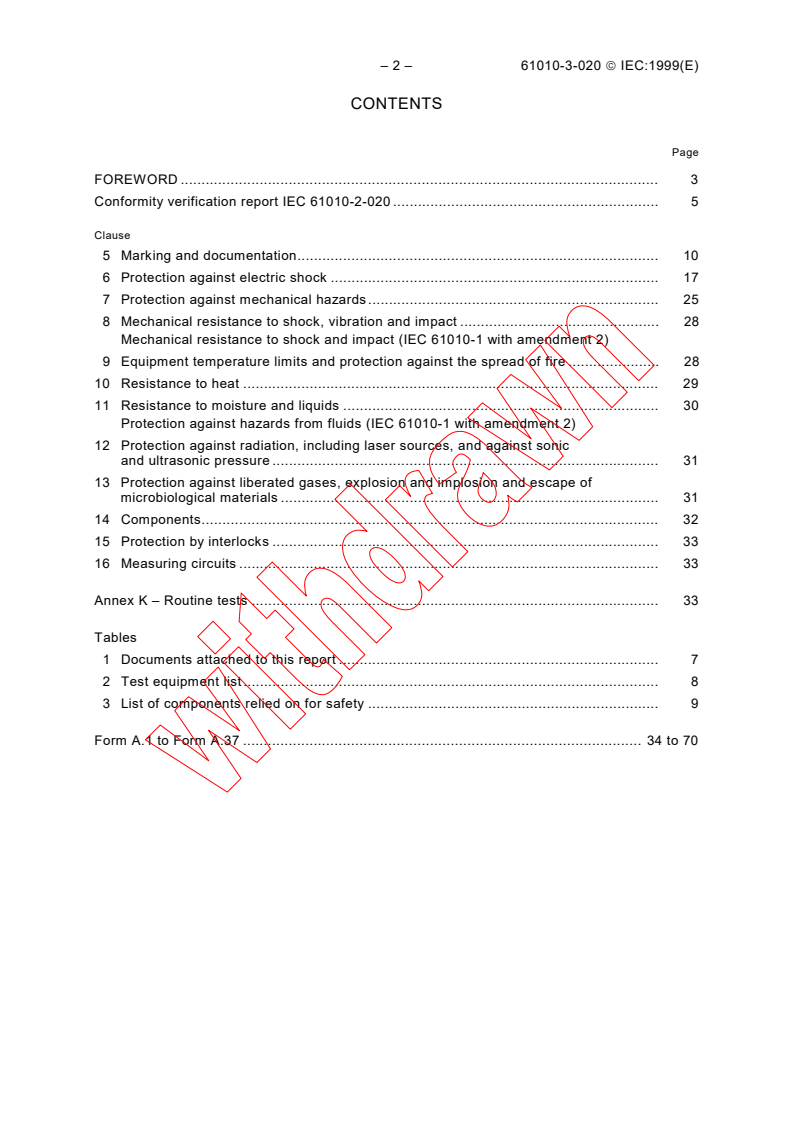
iec61010-3-020{ed1.0}en - IEC TR 61010-3-020:1999 - Safety requirements for electrical equipment for measurement, control, and laboratory use - Part 3-020: Conformity verification report for IEC 61010-2-020:1992 Particular requirements for laboratory centrifuges Released:4/30/1999
Buy Documents
iec61010-3-020{ed1.0}en - IEC TR 61010-3-020:1999 - Safety requirements for electrical equipment for measurement, control, and laboratory use - Part 3-020: Conformity verification report for IEC 61010-2-020:1992 Particular requirements for laboratory centrifuges Released:4/30/1999
Get Certified
Connect with accredited certification bodies for this standard

ECOCERT
Organic and sustainability certification.

Eurofins Food Testing Global
Global leader in food, environment, and pharmaceutical product testing.

IMP NDT d.o.o.
Non-destructive testing services. Radiography, ultrasonic, magnetic particle, penetrant, visual inspection.
Sponsored listings
Frequently Asked Questions
IEC TR 61010-3-020:1999 is a technical report published by the International Electrotechnical Commission (IEC). Its full title is "Safety requirements for electrical equipment for measurement, control, and laboratory use - Part 3-020: Conformity verification report for IEC 61010-2-020:1992 Particular requirements for laboratory centrifuges". This standard covers: A technical report for use by test houses and other users. It assists them with determining and recording verification of conformity of the equipment under test with the requirements of IEC 61010-2-020 (1992) plus Amendment 1 (1996). If the paper version of the report is ordered, a diskette is provided with fill-in tables for recording the test results. If the report is downloaded directly from the web, it consists of two files: the technical report as a ZIP file and the fill-in tables as a WORD file.
A technical report for use by test houses and other users. It assists them with determining and recording verification of conformity of the equipment under test with the requirements of IEC 61010-2-020 (1992) plus Amendment 1 (1996). If the paper version of the report is ordered, a diskette is provided with fill-in tables for recording the test results. If the report is downloaded directly from the web, it consists of two files: the technical report as a ZIP file and the fill-in tables as a WORD file.
IEC TR 61010-3-020:1999 is classified under the following ICS (International Classification for Standards) categories: 19.080 - Electrical and electronic testing; 71.040.10 - Chemical laboratories. Laboratory equipment. The ICS classification helps identify the subject area and facilitates finding related standards.
IEC TR 61010-3-020:1999 is available in PDF format for immediate download after purchase. The document can be added to your cart and obtained through the secure checkout process. Digital delivery ensures instant access to the complete standard document.
Standards Content (Sample)
TECHNICAL IEC
REPORT
61010-3-020
First edition
1999-04
Safety requirements for electrical equipment
for measurement, control, and laboratory use –
Part 3-020:
Conformity verification report for IEC 61010-2-020:1992
Particular requirements for laboratory centrifuges
Règles de sécurité pour appareils électriques
de mesurage, de régulation et de laboratoire –
Partie 3-020:
Rapport de vérification de la conformité de la CEI 61010-2-020:1992
Prescriptions particulières pour centrifugeuses de laboratoire
Reference number
IEC 61010-3-020:1999(E)
Numbering
As from 1 January 1997 all IEC publications are issued with a designation in the
60000 series.
Consolidated publications
Consolidated versions of some IEC publications including amendments are
available. For example, edition numbers 1.0, 1.1 and 1.2 refer, respectively, to the
base publication, the base publication incorporating amendment 1 and the base
publication incorporating amendments 1 and 2.
Validity of this publication
The technical content of IEC publications is kept under constant review by the IEC,
thus ensuring that the content reflects current technology.
Information relating to the date of the reconfirmation of the publication is available
in the IEC catalogue.
Information on the subjects under consideration and work in progress undertaken
by the technical committee which has prepared this publication, as well as the list
of publications issued, is to be found at the following IEC sources:
• IEC web site*
•
Catalogue of IEC publications
Published yearly with regular updates
(On-line catalogue)*
• IEC Bulletin
Available both at the IEC web site* and as a printed periodical
Terminology, graphical and letter symbols
For general terminology, readers are referred to IEC 60050: International
Electrotechnical Vocabulary (IEV).
For graphical symbols, and letter symbols and signs approved by the IEC for
general use, readers are referred to publications IEC 60027: Letter symbols to be
used in electrical technology, IEC 60417: Graphical symbols for use on equipment.
Index, survey and compilation of the single sheets and IEC 60617: Graphical symbols
for diagrams.
* See web site address on title page.
TECHNICAL IEC
REPORT
61010-3-020
First edition
1999-04
Safety requirements for electrical equipment
for measurement, control, and laboratory use –
Part 3-020:
Conformity verification report for IEC 61010-2-020:1992
Particular requirements for laboratory centrifuges
Règles de sécurité pour appareils électriques
de mesurage, de régulation et de laboratoire –
Partie 3-020:
Rapport de vérification de la conformité de la CEI 61010-2-020:1992
Prescriptions particulières pour centrifugeuses de laboratoire
IEC 1999 Copyright - all rights reserved
No part of this publication may be reproduced or utilized in any form or by any means, electronic or
mechanical, including photocopying and microfilm, without permission in writing from the publisher.
International Electrotechnical Commission 3, rue de Varembé Geneva, Switzerland
Telefax: +41 22 919 0300 e-mail: inmail@iec.ch IEC web site http://www.iec.ch
Commission Electrotechnique Internationale
PRICE CODE
XB
International Electrotechnical Commission
For price, see current catalogue
– 2 – 61010-3-020 IEC:1999(E)
CONTENTS
Page
FOREWORD . 3
Conformity verification report IEC 61010-2-020 . 5
Clause
5 Marking and documentation. 10
6 Protection against electric shock . 17
7 Protection against mechanical hazards. 25
8 Mechanical resistance to shock, vibration and impact . 28
Mechanical resistance to shock and impact (IEC 61010-1 with amendment 2)
9 Equipment temperature limits and protection against the spread of fire . 28
10 Resistance to heat . 29
11 Resistance to moisture and liquids . 30
Protection against hazards from fluids (IEC 61010-1 with amendment 2)
12 Protection against radiation, including laser sources, and against sonic
and ultrasonic pressure . 31
13 Protection against liberated gases, explosion and implosion and escape of
microbiological materials . 31
14 Components. 32
15 Protection by interlocks . 33
16 Measuring circuits . 33
Annex K – Routine tests . 33
Tables
1 Documents attached to this report . 7
2 Test equipment list. 8
3 List of components relied on for safety . 9
Form A.1 to Form A.37 . 34 to 70
61010-3-020 IEC:1999(E) – 3 –
INTERNATIONAL ELECTROTECHNICAL COMMISSION
____________
SAFETY REQUIREMENTS FOR ELECTRICAL EQUIPMENT
FOR MEASUREMENT, CONTROL, AND LABORATORY USE –
Part 3-020: Conformity verification report for IEC 61010-2-020:1992,
Particular requirements for laboratory centrifuges
FOREWORD
1) The IEC (International Electrotechnical Commission) is a worldwide organization for standardization comprising
all national electrotechnical committees (IEC National Committees). The object of the IEC is to promote
international co-operation on all questions concerning standardization in the electrical and electronic fields. To
this end and in addition to other activities, the IEC publishes International Standards. Their preparation is
entrusted to technical committees; any IEC National Committee interested in the subject dealt with may
participate in this preparatory work. International, governmental and non-governmental organizations liaising
with the IEC also participate in this preparation. The IEC collaborates closely with the International Organization
for Standardization (ISO) in accordance with conditions determined by agreement between the two
organizations.
2) The formal decisions or agreements of the IEC on technical matters express, as nearly as possible, an
international consensus of opinion on the relevant subjects since each technical committee has representation
from all interested National Committees.
3) The documents produced have the form of recommendations for international use and are published in the form
of standards, technical specifications, technical reports or guides and they are accepted by the National
Committees in that sense.
4) In order to promote international unification, IEC National Committees undertake to apply IEC International
Standards transparently to the maximum extent possible in their national and regional standards. Any
divergence between the IEC Standard and the corresponding national or regional standard shall be clearly
indicated in the latter.
5) The IEC provides no marking procedure to indicate its approval and cannot be rendered responsible for any
equipment declared to be in conformity with one of its standards.
6) Attention is drawn to the possibility that some of the elements of this technical report may be the subject of
patent rights. The IEC shall not be held responsible for identifying any or all such patent rights.
The main task of IEC technical committees is to prepare International Standards. However, a
technical committee may propose the publication of a technical report when it has collected
data of a different kind from that which is normally published as an International Standard, for
example "state of the art".
Technical reports do not necessarily have to be reviewed until the data they provide are
considered to be no longer valid or useful.
IEC 61010-3-020, which is a technical report, has been prepared by IEC technical
committee 66: Safety of measuring, control and laboratory equipment.
The text of this technical report is based on the following documents:
Enquiry draft Report on voting
66/187/CDV 66/211/RVC
Full information on the voting for the approval of this technical report can be found in the report
on voting indicated in the above table.
– 4 – 61010-3-020 IEC:1999(E)
This report is a Technical Report and is of a purely informative nature and is therefore by itself
not to be regarded as an International Standard. It is for use by testhouses and other users to
assist them with determining and recording verification of conformity of the equipment under
test with the requirements of:
IEC 61010-2-020:1992 + amendment 1:1996
The protocol for completion of this report is contained in publication IEC 61010-3:1997.
The IEC sells read-only PDF files as a general rule. In the present instance, and quite
exceptionally, to enable the user to fill in the forms, a revisable file is included in a pocket
affixed to the back cover of this publication.
This publication can also be downloaded from the Web as a PDF file. There is, however, at the
end of the document, a revisable file containing the forms. Please use the zip/unzip function.
61010-3-020 IEC:1999(E) – 5 –
Conformity Verification Report
IEC 61010-2-020
Safety requirements for electrical equipment for measurement, control and laboratory use:
Part 2-020: Particular requirements for laboratory centrifuges
(including amendment 1:1996)
Report reference No .:
Compiled by (+ signature).:
Approved by (+ signature).:
Date of issue.:
Testing organization.:
Address.:
Testing location.:
Applicant .:
Address.:
Standard .: IEC 61010-1:1990 + amendment 1:1992 + amendment 2:1995
IEC 61010-2-020:1993 + amendment 1:1996
Copyright blank test report.: This report has been prepared by IEC TC 66, which retains
responsibility for any changes or corrections required.
Test procedure.:
Procedure deviation.:
Non-standard test method .:
Type of item tested .: Laboratory
Trademark.:
Model/type reference .:
Manufacturer.:
Rating.:
Copy of rating plate:
– 6 – 61010-3-020 IEC:1999(E)
Description of equipment function:
INSTALLATION/OVERVOLTAGE CATEGORY:
POLLUTION DEGREE:
Environmental rating: � Standard � Other (specify):
Equipment mobility: � Portable � Floorstanding � Fixed
� Built in � Benchmounted � Other (specify):
Connection to mains supply: � Permanent � Detachable � Non detachable � None
Operating conditions: � Continuous � Short-time � Intermittent
Overall size of the equipment (Length × Width × Height):
Mass of the equipment (kg):
Marked degree of protection to IEC 60529: IP___ ___
Accessories and detachable parts included in the evaluation:
Options:
NOTE – "(see form A.X)" refers to a form appended to the report.
61010-3-020 IEC:1999(E) – 7 –
Table 1 – Documents attached to this report
Number
Document No. Document description
of pages
– 8 – 61010-3-020 IEC:1999(E)
Table 2 – Test equipment list
Calibration date
Equipment
Item Type Comments
No.
1)
Last Due
1)
or interval between calibrations.
Table 3 – List of components relied on for safety
Unique component reference Licence number,
or location Manufacturer and part number RATING file number or other
Application/Function
(including drawing reference documentary evidence
(note 1) (note 2)
if required) of acceptance
NOTE 1 – List all manufacturers concerned.
NOTE 2 – Electrical, mechanical, flammability, etc.
– 10 – 61010-3-020 IEC:1999(E)
Clause
Requirement Result Comments
Subclause
5 Marking and documentation
5.1.1 General
Required equipment markings are:
a) visible:
– from the exterior
or
– after removing a cover
or
– opening a door
or
– after removal from a rack or panel
b) not put on parts which can be removed by an
OPERATOR
c) letter symbols (IEC 60027) used
d) graphic symbols used
(IEC 61010-1, Table 1)
5.1.2 Identification
Equipment is identified by:
– manufacturer's name or registered trade mark
– unique production batch identification
5.1.3 Mains supply
Equipment is marked as follows:
a) nature of supply:
–a.c. RATED mains frequency or range of
frequencies
– d.c. with symbol 1
b) RATED supply voltage(s) or range
c) – maximum RATED power (W or VA)
or input current
If more than one voltage range:
– separate values marked
or
– values differ by less than 20 %
(see Form A.3)
F
Result: P = Pass F = Fail NA = Not Applicable
61010-3-020 IEC:1999(E) – 11 –
Clause
Requirement Result Comments
Subclause
d) OPERATOR – set for different RATED supply
voltages:
– indicates the equipment set voltage
– PORTABLE EQUIPMENT indication is visible
from the exterior
– changing the setting changes the indication
e) Accessory mains socket-outlets accepting
standard mains plugs are marked:
– with the voltage if it is different from the
mains supply voltage
– for use only with specific equipment
If not marked for specific equipment it is marked
with:
– the maximum RATED current or power, and
maximum permitted leakage current
or
– symbol 14 with full details in the
documentation
F The measured value not more than 110 %
(see Form A.3)
Fuses
5.1.4
OPERATOR replaceable fuse marking
(see also 5.4.5)
5.1.5 Measuring circuit TERMINALS
RATED maximum working voltage or current marked
Unless clear indication that below limits:
RATED
– maximum voltage to earth is marked
or
– for specific connection only, and means for
identifying provided
TERMINALS
– is adjacent to
or
– if insufficient space:
– on the RATING plate or scale plate
or
– if the TERMINAL is marked with symbol 14
Result: P = Pass F = Fail NA = Not Applicable
– 12 – 61010-3-020 IEC:1999(E)
Clause
Requirement Result Comments
Subclause
INSTALLATION CATEGORY marked
TERMINALS
permanently connected and not
ACCESSIBLE
TERMINALS and operating devices
5.1.6
Where necessary for safety, indication of purpose
of TERMINALS, connectors, controls and indicators
Mains supply TERMINALS identified
Power supply switch on or off position marked if
used as disconnecting device
TERMINAL marking:
a) FUNCTIONAL EARTH TERMINALS
PROTECTIVE CONDUCTOR TERMINALS
b) :
– symbol 6 is placed close to or on the
TERMINAL
or
– part of the appliance inlet
c) TERMINALS of measuring and control circuits
d) TERMINALS supplied from the interior
e) ACCESSIBLE FUNCTIONAL EARTH TERMINALS
5.1.7 Equipment protected by DOUBLE INSULATION or
REINFORCED INSULATION
Protected throughout (symbol 11 used)
Only partially protected (symbol 11 not used)
5.1.8 Battery charging
Equipment with means to charge rechargeable
batteries is marked:
– to warn against the charging of non-
rechargeable batteries
– to indicate the type of rechargeable battery
used
5.1.101 ROTORS and accessories
OPERATOR ROTORS
replaceable and (their)
subassemblies are marked with:
– manufacturer’s identification
– part identification
Result: P = Pass F = Fail NA = Not Applicable
61010-3-020 IEC:1999(E) – 13 –
Clause
Requirement Result Comments
Subclause
5.2 Warning markings
– visible when ready for NORMAL USE
– if necessary marked with symbol 14
– are near or on applicable parts
– statement to isolate or disconnect
– advice how to avoid contact with ACCESSIBLE
HAZARDOUS LIVE parts
– TERMINAL voltage exceeding 1 kV (symbol 12)
– easily touched high temperature parts
(symbol 13)
5.3 Durability of markings
The required markings remain clear and legible in
NORMAL USE
(see Form A.4)
F
5.4 Documentation
5.4.1 General
Equipment is accompanied by documentation
which includes:
– technical specification
– instructions for use
– name and address of manufacturer or supplier
Definition of INSTALLATION CATEGORY
Warning statements and a clear explanation of
warning symbols:
– provided in the documentation
or
– information is marked on the equipment
5.4.2 Equipment RATINGS
Documentation includes:
– supply voltage or voltage range
– frequency or frequency range
– power or current RATING
Result: P = Pass F = Fail NA = Not Applicable
– 14 – 61010-3-020 IEC:1999(E)
Clause
Requirement Result Comments
Subclause
– a description of all input and output
connections
– RATING of insulation of external circuits, when
such circuits are nowhere ACCESSIBLE
– statement of the range of environmental
conditions
– list of ROTORS and accessories
– rotational frequencies
– restriction markings
– density, volume limits and derating
5.4.3 Equipment installation
Documentation includes instructions for:
– assembly, location and mounting
– CLEARANCE ENVELOPE area
– total weight
– site preparation
– levelling
– means of securing
– protective earthing
– connections to supply
– ventilation requirements
– special services
– maximum sound power level
– instructions about sound pressure
– emergency switch
Additional for permanently connected equipment:
– supply wiring
– any external switch or circuit-breaker
(including location)
– any external overcurrent protection
Result: P = Pass F = Fail NA = Not Applicable
61010-3-020 IEC:1999(E) – 15 –
Clause
Requirement Result Comments
Subclause
5.4.4 Equipment operation
Instructions for use include:
– identification of operating controls
– positioning for disconnection
– interconnection
– specification of intermittent operation limits
– explanation of symbols used
– replacement of consumable materials
– loading and balancing
– ROTOR changing procedure
– requirement for an OPERATOR to be present
– necessary safeguards for personnel
– instructions for use of BIOSEALS, etc.
A warning against use in a manner not specified by
the manufacturer
5.4.4.101 Hazardous substances
Precautions to be observed:
– toxic materials
– radioactive materials
– micro-organism contamination
– containers
– multiple protection levels
Materials prohibited:
– flammable or explosive
– materials which chemically react vigorously
Result: P = Pass F = Fail NA = Not Applicable
– 16 – 61010-3-020 IEC:1999(E)
Clause
Requirement Result Comments
Subclause
5.4.5 Equipment maintenance
Instructions include:
– sufficient preventive maintenance and
inspection information
– replacement of hoses, etc.
– Includes:
a) inspection:
– fixing means
– mounting surfaces
b) safeguards during cleaning
c) inspection of the PROTECTIVE CASING
d) ROTOR ASSEMBLY:
– inspection
– safety considerations
e) continuity of the protective earth
f) inspection of BIOSEALS and other biosafety
components:
– importance of regular maintenance of
BIOSEALS
, etc.
– specific battery type
– any manufacturer specified parts
– RATING and characteristics of fuses
5.4.5.101 Cleaning and decontamination
Documentation indicates:
– user responsibility for decontamination
– recommendations for cleaning and
decontamination/generic names
Withstands steam sterilization
See Table 1A of IEC 61010-2-020
Wording in quotes appears in the documentation
Result: P = Pass F = Fail NA = Not Applicable
61010-3-020 IEC:1999(E) – 17 –
Clause
Requirement Result Comments
Subclause
5.4.101 Not used
5.4.102 Not used
5.4.103 Effects of chemicals and environmental
influences
Documentation identifies damage
6 Protection against electric shock
(see Form A.5)
F
6.1 General
Conformity is checked by the determination of 6.2
and 6.3 followed by the tests of 6.4 to 6.12
6.1.1 Exceptions
F Capacitance test
(see Forms A.6 and A.7)
6.2 Determination of ACCESSIBLE parts
(see Form A.6)
F
6.3 Permissible limits for ACCESSIBLE parts
6.3.1 Values in NORMAL CONDITION
F (see Form A.7)
6.3.2 Values in SINGLE FAULT CONDITION
F (see Form A.8)
6.4 Protection in NORMAL CONDITION
(see 6.8 and 8.1)
6.5 Protection in SINGLE FAULT CONDITION
Additional protection is provided by:
– one or more of 6.5.1 to 6.5.3
or
– automatic disconnection of the supply
6.5.1 Protective earthing
ACCESSIBLE
conductive parts:
– bonded to the protective conductor terminal
or
BARRIER
– separated by screen or from parts
which are HAZARDOUS LIVE
(For indirect bonding of measurement and test
equipment see 6.5.1.4)
Result: P = Pass F = Fail NA = Not Applicable
– 18 – 61010-3-020 IEC:1999(E)
Clause
Requirement Result Comments
Subclause
6.5.1.1 PROTECTIVE BONDING
PROTECTIVE BONDING consists of directly connected
structural parts or discrete conductors or both; and
withstands thermal and dynamic stresses
6.5.1.2 Bonding impedance of plug-connected equipment
(see Form A.9)
F
Bonding impedance of PERMANENTLY CONNECTED
6.5.1.3
EQUIPMENT
(see Form A.9)
F
Indirect bonding for measuring and test equipment
6.5.1.4
(see Form A.9)
F
6.5.2 DOUBLE INSULATION AND REINFORCED INSULATION
(see 6.7, 6.8 and 6.9.2)
6.5.3 PROTECTIVE IMPEDANCE
F (see Form A.10)
Components wires and connections are RATED as
required
6.5.4 Built-in panel meters
If after building-in, the requirements of 6.5.1 to
6.5.3 are not met:
– panel meter:
ACCESSIBLE
– has no conductive parts
– has BASIC INSULATION of ACCESSIBLE surfaces
– has DOUBLE/REINFORCED INSULATION of
ACCESSIBLE
surface of parts intended to be
grasped
6.6 External circuits
6.6.1 Separation of internal circuits
F (see lists in Forms A.1 and A.5)
If the other internal circuit exceeds the values of
6.3.2 in NORMAL CONDITION and only BASIC
INSULATION:
a) short-circuit could not make external circuit
HAZARDOUS LIVE
Result: P = Pass F = Fail NA = Not Applicable
61010-3-020 IEC:1999(E) – 19 –
Clause
Requirement Result Comments
Subclause
b) manufacturer's instructions include:
TERMINAL
– a statement that the for external
circuits is for use only with equipment which
has no live parts which are ACCESSIBLE
– the RATING of the insulation required for
external circuits
– the connection to be used at the remote
end of external circuits
– the type of equipment which may be
connected to the TERMINAL
6.6.2 TERMINALS for external circuits
ACCESSIBLE TERMINALS are not HAZARDOUS LIVE
except as permitted by 6.1.1
The following TERMINALS are not HAZARDOUS LIVE:
– PROTECTIVE CONDUCTOR TERMINALS
FUNCTIONAL EARTH TERMINALS
–
– headphone TERMINALS
TERMINALS which receive a charge from an internal
F capacitor (see Form A.7)
TERMINALS
High-voltage energized from the interior
are:
– not accessible
or
–marked
6.6.3 Circuits with TERMINALS which are HAZARDOUS LIVE
These circuits:
– are not connected to ACCESSIBLE conductive
parts
or
– are connected to ACCESSIBLE conductive parts,
but are not mains circuits and have one
TERMINAL contact at earth potential
No ACCESSIBLE conductive parts are HAZARDOUS LIVE
6.7 CLEARANCES and CREEPAGE DISTANCES
F (see annex D of IEC 61010-1 and Form A.11)
Result: P = Pass F = Fail NA = Not Applicable
– 20 – 61010-3-020 IEC:1999(E)
Clause
Requirement Result Comments
Subclause
6.8 Dielectric strength tests
F (see annex E of IEC 61010-1 and Form A.12)
Protection against the spread of fire (see 9.1)
6.9 Constructional requirements for protection
against electric shock
6.9.1 General
In circuits exceeding the values of 6.3.2:
– security of wiring connections
– screws securing removable covers
– accidental loosening
6.9.2 ENCLOSURES of equipment with DOUBLE INSULATION
or REINFORCED INSULATION
ENCLOSURE
surrounds all metal parts except for
small metal parts which are separated
ENCLOSURES or parts made of insulating material
ENCLOSURES
Protection for metal or parts by:
– PROTECTIVE IMPEDANCE
or
– an insulating coating or BARRIER on the inside
or
– CLEARANCES and CREEPAGE DISTANCES cannot be
reduced by loosening of parts or wires
6.9.3 Equipment using PROTECTIVE BONDING
a) OPERATOR removable parts
b) Movable conductive connections
c) Exterior metal braids of cables
d) Mains passed through the equipment
e) Protective earthing conductors green/yellow
Exceptions:
– earthing braids
– internal protective conductors
PROTECTIVE BONDING
f) Equipment using
Result: P = Pass F = Fail NA = Not Applicable
61010-3-020 IEC:1999(E) – 21 –
Clause
Requirement Result Comments
Subclause
6.9.4 Over-range indication
Unambiguous
6.10 Connection to mains supply source and
connections between parts of equipment
6.10.1 Mains supply cords
RATED for maximum equipment current
(see 5.1.3 c))
Cable conforms to IEC 60227, or IEC 60245 or is a
certified cord
Heat resistant if likely to contact hot parts
RATING
Temperature (cord and inlet)
Green/yellow used only for connection to
PROTECTIVE CONDUCTOR TERMINALS
Detachable cords with IEC 60320 mains
connectors:
– conform to IEC 60799
or
RATING
– have the current of the mains connector
6.10.2 Fitting of non-detachable mains supply cords
6.10.2.1 Cord entry
Non-detachable cord protection:
– inlet smoothly rounded with radius �1,5 D
or
– insulated cord guard protruding �5 D
6.10.2.2 Cord anchorage
The protective earth conductor is the last to take
the strain
Cord anchorages:
– the cord is not clamped by direct pressure from
a screw
– knots are not used
Result: P = Pass F = Fail NA = Not Applicable
– 22 – 61010-3-020 IEC:1999(E)
Clause
Requirement Result Comments
Subclause
– cannot push the cord into the equipment to
cause a hazard
– no failure of cord insulation in anchorage with
metal parts
– compression bushing:
a) clamps all types and sizes of mains cords
and
b) is suitable:
i) for connection to TERMINALS provided
or
ii) it is designed for screened mains cord
– cord replacement does not cause a hazard and
method of strain relief is clear
F Push-pull test (see Form A.13)
6.10.3 Plugs and connectors
a) Mains supply plugs, connectors etc. conform to
relevant specifications
b) If equipment supplied at voltages below those
given in 6.3.2.1:
– plugs of mains supply cords do not fit mains
sockets above RATED supply voltage
– mains type plugs used only for connection
to mains supply
c) Plug pins which receive a charge from an
internal capacitor (see Form A.7)
F
d) Accessory mains socket outlets:
– if a standard mains plug is accepted, there
is a marking (see 5.1.3 e))
– input has a protective earth conductor if
outlet has earth TERMINAL contact
6.11 TERMINALS
6.11.1 ACCESSIBLE TERMINALS
a) No risk of accidental contact (see also 5.1.6 c))
b) Will not work loose
Result: P = Pass F = Fail NA = Not Applicable
61010-3-020 IEC:1999(E) – 23 –
Clause
Requirement Result Comments
Subclause
6.11.2 PROTECTIVE CONDUCTOR TERMINAL
a) Appliance inlet (no requirement)
b) For rewirable cords and permanently
connected equipment, protective conductor
terminal is close to mains supply terminals
c) If no mains supply is required, any PROTECTIVE
CONDUCTOR TERMINAL
:
– is near TERMINALS of circuit for which
protective earthing is necessary
TERMINALS
– external if other external
d) Equivalent current-carrying capacity to mains
supply TERMINALS
e) – Soldered connections:
i) independently secured
ii) not used for other purposes
– Screw connections are secured
f) Contact surfaces are metal
g) If plug-in, makes first and breaks last
h) Protective conductor of measuring circuit:
– current RATING
– protective bonding:
i) not interrupted
or
ii) indirect bonding
6.11.3 FUNCTIONAL EARTH TERMINALS
Independent connection
6.12 Disconnection from supply source
6.12.1 General
Disconnection device provided
6.12.1.1 Exception to 6.12.1
Short-circuit or overload cannot cause a hazard
Result: P = Pass F = Fail NA = Not Applicable
– 24 – 61010-3-020 IEC:1999(E)
Clause
Requirement Result Comments
Subclause
6.12.2 Requirements according to type of equipment
6.12.2.1 PERMANENTLY CONNECTED EQUIPMENT
– switch or circuit-breaker is part of the
equipment
or
– documentation specifies switch location and
marking
6.12.2.2 Single-phase cord-connected equipment
– switch or circuit-breakers
or
– appliance coupler (disconnectable without
TOOL)
or
– separable plug (without locking device)
6.12.2.3 Hazards arising from function
Emergency switch
Emergency switch �1 m from the moving part
6.12.3 Disconnecting devices
Electrically close to the supply
6.12.3.1 Switches and circuit-breakers
When used as a disconnection device:
– meets IEC 60947-1 and IEC 60947-3
– contact separation
– contact position evident in off position
– marked to indication function
– not incorporated in mains cord
– does not interrupt protection earth conductor
– if has other contacts, meets separation
requirements of 6.6 and 6.7
6.12.3.2 Appliance couplers and plugs
Where an appliance coupler or separable plug is
used as the disconnecting device (see 6.12.2.2):
– readily identifiable and easily reached by the
OPERATOR
Result: P = Pass F = Fail NA = Not Applicable
61010-3-020 IEC:1999(E) – 25 –
Clause
Requirement Result Comments
Subclause
– single-phase PORTABLE EQUIPMENT cord length
�3 m
Protective earth conductor connected first and
disconnected last
7 Protection against mechanical hazards
7.1 General
Conformity is checked by 7.2 to 7.5
7.2 Moving parts
F Easily touched moving parts (see Form A.30)
Moving parts not able to crush, etc.
(see also 6.12.2.3)
If OPERATOR access permitted:
TOOL
a) access requires
b) statement about training
c) warning markings or symbol 14
7.2.101 LID
LID locked closed (2 m/s)
Power failure:
– LID does not release
– release requires TOOL
LID held closed with sufficient strength
(see 7.5.103)
Fragments contained (see 7.5.103)
CENTRIFUGE-ROTOR COMBINATION evaluation
information recorded:
– mechanical abuse
– mismatching
– misalignment
– corrosion
– material defects
Result: P = Pass F = Fail NA = Not Applicable
– 26 – 61010-3-020 IEC:1999(E)
Clause
Requirement Result Comments
Subclause
–vibration
– cleaning and decontamination
– environmental influences
– other considerations appropriate for the design
If motor power interruption device instead of
interlock, the following are satisfied:
– a device holds the LID closed
– drive motor cannot be energized unless the LID
is closed
– rotational frequency does not exceed
3 600 r.p.m.
– energy does not exceed 1 kJ
– centrifugal force does not exceed 2 000 g
– ROTOR dia does not exceed 250 mm
– disconnection switch is independent of LID
position
– rotation is observable with LID closed
– all ROTOR ASSEMBLIES used conform to 7.2 of
Part 1
– if access is possible at over 2 m/s, a warning
label is provided
7.2.102 ROTOR ASSEMBLIES requiring access during
rotation
Override control:
a) – motor energized only by special key
or
– limited access to ROTOR ASSEMBLY
b) means to cancel override function automatically
7.3 Stability
Marking of non-automatic means
No visible displacement during NORMAL USE
Result: P = Pass F = Fail NA = Not Applicable
61010-3-020 IEC:1999(E) – 27 –
Clause
Requirement Result Comments
Subclause
Conformity tests:
– 10 tilt test
– multi-directional force test
– downward force test
7.3.101 CENTRIFUGE movement during malfunction
(see Form A.31)
F
7.4 Provisions for lifting and carrying
Handles or grips withstand four times mass
Equipment �18 kg:
– has means for lifting or carrying
or
– directions in documentation
7.5 Protection against expelled parts or projected
parts
(see Forms A.33 and A.34)
– no part completely penetrates the PROTECTIVE
CASING
– LID fastening not loosened or distorted
– outside body of centrifuge intact
7.5.101 Information for MCA considerations
F (see Form A.32)
7.5.102 Factors to be considered for determining the
F worst-case conditions (see Form A.33)
7.5.103 Testing the PROTECTIVE CASING
Parts expelled
(see Forms A.34 and A.35)
F
7.5.104 Small particles in air exhaust streams
No particles greater than 1,5 mm outside the
clearance envelope (see Form A.35)
F
7.5.105 High energy chemical reaction after DISRUPTION
Parts expelled (see Form A.36)
F
Result: P = Pass F = Fail NA = Not Applicable
– 28 – 61010-3-020 IEC:1999(E)
Clause
Requirement Result Comments
Subclause
8 Mechanical resistance to shock, vibration and
impact
After the tests of 8.1 to 8.4
(see Form A.11):
F
– voltage tests (see Form A.12)
F
– inspection, equipment meets the following
requirements:
a) hazardous live parts not accessible
b) ENCLOSURE shows no cracks (hazard)
CLEARANCES
c) not less than their permitted
F values (see Form A.11)
– BARRIERS not damaged or loosened
– no moving parts exposed, except as permitted
by 7.2
– no damage which could cause spread of fire
9 Equipment temperature limits and protection
against the spread of fire
9.1 General
Conformity is checked by:
– 9.2 and fault tests of 4.4
(see Forms A.1, A.2 and A.18)
F
or
– measurement of CREEPAGE DISTANCE and
CLEARANCE and the voltage tests of annex G
F (see Form A.14)
or
– method of annex F
(see Forms A.15, A.16 and A.17)
F
9.2 Temperature tests
9.3 Guards
Surfaces liable to exceed 100 °C (see Form A.18):
F
– protected by guards
or
–marked
or
– intended to be hot (see 9.1)
TOOL
Guards not removable without
Result: P = Pass F = Fail NA = Not Applicable
61010-3-020 IEC:1999(E) – 29 –
Clause
Requirement Result Comments
Subclause
9.4 Field-wiring TERMINAL boxes
Temperature RATING of the cable is:
F – marked (see Form A.18)
and
TERMINALS
– adjacent to field-wiring
or
– visible during and after installation
9.5 Overtemperature protection devices
– fitted, to operate in SINGLE FAULT CONDITION
F (see Form A.1)
– meets 14.3
– does not operate in NORMAL USE (see 3.5.6)
– if self-resetting, can only be set to operate in
SINGLE FAULT CONDITION
9.6 Overcurrent protection
9.6.1 PERMANENTLY CONNECTED EQUIPMENT
Device:
– fitted within the equipment
or
– specified in manufacturer's instructions
9.6.2 Other equipment
Protection within the equipment
Devices not in the protective conductor
Fuses or single pole circuit-breakers not fitted in
neutral (multi-phase)
10 Resistance to heat
10.1 Integrity of CLEARANCES and CREEPAGE DISTANCES
F (see Form A.11)
10.2 Resistance to heat of non-metallic ENCLOSURES
F (see Form A.19)
10.3 Resistance to heat of insulating material
Parts supporting:
– parts connected to mains supply
– TERMINALS carrying >0,5 A
Result: P = Pass F = Fail NA = Not Applicable
– 30 – 61010-3-020 IEC:1999(E)
Clause
Requirement Result Comments
Subclause
11 Protection against hazards from fluids
11.1 General
11.2 Cleaning
Cleaned ”20 times” (see Form A.20)
F
11.3 F Spillage (see Form A.20)
11.4 F Overflow (see Form A.20)
11.5 Battery electrolyte
Battery electrolyte leakage presents no hazard
11.6 Specially protected equipment
(see Form A.20)
F
11.7 Fluid pressure and leakage
Maximum pressure not exceeded
11.7.1
Leakage and rupture at high pressure
11.7.2
(see Form A.21)
F
Test to IEC 60335 (refrigeration only)
11.7.3 Leakage from low-pressure parts
(see Form A.21)
F
11.7.4 Overpressure safety device
– shall not operate in NORMAL USE
and
– shall conform to the following:
– positioned close to parts intended to be
protected
– access for inspection, maintenance and
repair
– adjustment only with TOOL
– no discharge to person
– no hazard from discharge
– sufficient discharge capacity
– no shut-off valve between protective device
and protected parts
Result: P = Pass F = Fail NA = Not Applicable
61010-3-020 IEC:1999(E) – 31 –
Clause
Requirement Result Comments
Subclause
12 Protection against radiation, including laser
sources, and against sonic and ultrasonic
pressure
12.1 General
12.2 Equipment producing ionizing radiation
12.2.1 F Ionizing radiation (see Form A.22)
12.2.2 Accelerated electrons
12.3 Ultra-violet radiation (Conformity test under consideration)
12.4 Micro-wave radiation (Conformity test and limit of 10 W/m
are under consideration)
12.5 Sonic and ultrasonic pressure
12.5.1 F Sound level (see Form A.23)
12.5.2 F Ultrasonic pressure (see Form A.23)
12.6 Laser sources (IEC 60825)
13 Protection against liberated gases, explosion
and implosion and escape of microbiological
materials
13.1 Poisonous and injurious gases
Attach any data/test reports used to demonstrate
conformity
13.2 Explosion and implosion
13.2.1 Components
Components liable to explode:
– pressure release device
or
– the apparatus incorporates OPERATOR
protection (see also 7.5)
Pressure release device:
– discharge without danger
– not obstructable
13.2.2 Batteries
Explosion or fire hazard:
– protection incorporated in the equipment
or
Result: P = Pass F = Fail NA = Not Applicable
– 32 – 61010-3-020 IEC:1999(E)
Clause
Requirement Result Comments
Subclause
– instructions specify batteries
and
– single component cannot cause hazard
(short circuit and open circuit)
F (see Form A.24, including circuit diagram)
– warning marking or symbol 14
Battery compartment design
Polarity reversal test
13.3 Implosion of high-vacuum devices
High-vacuum devices:
– intrinsically protected and correctly mounted
or
– ENCLOSURE provides protection:
– screen not removable without TOOL
– if glass screen, not in contact
13.101 F Microbiological materials (see Form A.37)
14 Components
14.1 General
Where safety is involved, components meet
relevant requirements (see Table 3 of this report
and Figure 5 of IEC 61010-1)
14.2 Motors
14.2.1 Motor temperatures
F (see Form A.25)
14.2.2 Series excitation motors
14.3 Overtemperature protection devices
Devices operating in a SINGLE FAULT CONDITION
(see Form A.26)
F
and have/are:
– reliable function
– RATED to interrupt maximum voltage and current
of circuit
– RATED for maximum surface temperature of
4.4.4.2
Result: P = Pass F = Fail NA = Not Applicable
61010-3-020 IEC:1999(E) – 33 –
Clause
Requirement Result Comments
Subclause
– RATED for maximum temperature of 9.2 for parts
in contact with flammable liquid
– not self-resetting unless protected part cannot
function
14.4 Fuse holders
No access to HAZARDOUS LIVE parts
14.5 Mains voltage selecting devices
Accidental change not possible
14.6 HIGH INTEGRITY components
Used in applicable positions (see Table 3)
Conforms to IEC publications
Not a single electronic device
14.7 Mains transformers
14.7.1 Short-circuit tests
Transformers meet 4.4.4.1 to 4.4.4.3.
F (see Form A.27)
14.7.2 Overload tests
Transformer:
– has overtemperature protection meeting 14.3
or
– meets 4.4.4.1 to 4.4.4.3
F (see Form A.28)
14.8 Overpressure safety devices
Meets ISO 4126
15 Protection by interlocks
15.1 General
Interlocks are designed to remove a hazard before
OPERATOR exposed
15.2 Prevention of reactivation
15.3 Reliability
16 Measuring circuits
16.1 Current measuring circuits
(see Form A.29)
F
Annex K Routine tests
Manufacturer’s declaration
Result: P = Pass F = Fail NA = Not Applicable
– 34 – 61010-3-020 IEC:1999(E)
Form A.1
Summary of SINGLE FAULT CONDITIONS applied (4.4.2)
(see Form A.2 for details of tests)
Does
Sub- Carried
Title not Comments
clause out
apply
4.4.2.1 PROTECTIVE IMPEDANCE
4.4.2.2 Protective conductor
4.4.2.3 Equipment or parts for short-term or intermittent
operation
4.4.2.4 Motors
4.4.2.5 Capacitors
4.4.2.6 Mains transformers
Attach drawing of mains Txs showing all
protective devices (see Forms A.27 and A.28)
4.4.2.7 Outputs
4.4.2.8 Equipment for more than one supply
4.4.2.9 Cooling
– air holes closed
– fans stopped
– coolant stopped
4.4.2.10 Heating devices
– timer overridden
– temperature controller overridden
– loss of cooling liquid
4.4.2.11 Insulation between circuits and parts
4.4.2.12 Interlocks
List below all SINGLE FAULT CONDITIONS not covered by
4.4.2.1 to 4.4.2.12
Form A.2
4.4 Testing in – Results
SINGLE FAULT CONDITION
Td
Test Fault How was test terminated Meets
Fault description 4.4.3
subclause No. Comments 4.4.4
(note)
NOTE – Td = Test duration in h:min:s
Record dielectric strength test on form A.12 and temperature tests on form A.18.
Record in the comments column for each test whether carried out during or after SINGLE FAULT CONDITION.
Tested by:____________________Date:______________Test equipment No. (Table 2)____________________________
– 36 – 61010-3-020 IEC:1999(E)
Form A.3
5.1.3.c Mains supply
Marked RATING _______________________________
NOTE – Measurements are only re-
quired for marked RATINGS
_____________________Phase
_____________________Hz
_____________________A
_____________________W
_____________________VA
Voltage Frequency Current Power in Power in
Test No. Comments
V Hz I W VA
General comments:
Tested by:____________________Date:______________Test equipment No. (Table 2)____________________________
61010-3-020 IEC:1999(E) – 37 –
Form A.4
5.3 Durability of markings
Table A.4.1 – Marking method (note) Table A.4.2 – Agent
A (specify agent)
B (specify agent)
C Water
D Isopropyl alcohol
NOTE – Where applicable include print method, label
material, ink or paint type, fixi
...