


IEC 62341-1-2:2007
(Main)Organic light emitting diode displays - Part 1-2: Terminology and letter symbols
General Information
- Abstract
Gives preferred terms, their definitions and symbols for organic light emitting diode (OLED) displays; with the object of using the same terminology when publications are prepared in different countries.
- Status
- Published
- Publication Date
- 26-Nov-2007
- Technical Committee
- TC 110 - Electronic displays
- Drafting Committee
- WG 5 - TC 110/WG 5
- Current Stage
- DELPUB - Deleted Publication
- Start Date
- 24-Apr-2014
- Completion Date
- 28-Aug-2026
Overview
IEC 62341-1-2:2007 is an International Electrotechnical Commission (IEC) standard focused on organic light emitting diode (OLED) displays. This part 1-2 of the IEC 62341 series establishes standardized terminology and letter symbols associated with OLED displays. The standard aims to harmonize terms, definitions, and symbols used internationally, facilitating uniformity across publications, technical documentation, and product specifications related to OLED display technology.
By defining preferred terms and their precise meanings, IEC 62341-1-2 supports clear communication among designers, manufacturers, researchers, and regulatory bodies worldwide. This uniform vocabulary is essential to advance the development, testing, and commercialization of OLED displays, which have become increasingly important in consumer electronics, lighting, and flexible display technologies.
Key Topics
The standard classifies terms and symbols into distinct categories, enabling comprehensive coverage of OLED display technology terminology:
Fundamental Terms
These include essential concepts such as active matrix driving, addressing methods, bottom and top emission structures, flexible displays, full-color and monochrome displays, organic electroluminescence, and OLED display modules. Examples:- Active matrix (addressed) driving: a method where each pixel has an active switching element.
- Organic electroluminescence (OEL): light emission from organic materials when electrically biased.
- Flexible display: a mechanically flexible OLED display.
Physical Properties
Terms defining material and device characteristics related to OLED performance such as charge carrier density, electroluminescence spectrum, electron affinity, and external quantum efficiency.Constructive Elements
Definitions linked to the structural components of OLED panels and their configurations.Performance and Specifications
Terms detailing display efficiencies, brightness, color gamut, driving methods like constant-current or multiplex driving, and test conditions.Production Process
Vocabulary relevant to manufacturing techniques and processes used in OLED display fabrication, including doping methods and atmospheric reference conditions.Letter Symbols
Standardized symbols for quantities and units related to OLED displays, ensuring consistency in technical documents and product datasheets.
Applications
Implementing IEC 62341-1-2 terminology benefits a wide range of stakeholders involved with OLED technology:
Display Manufacturers
Use standardized terms in datasheets and specifications to ensure global interoperability and accurate communication of product features.Research and Development
Facilitates clear description of research outcomes in publications, patents, and reports by providing agreed-upon definitions.Quality Control and Testing
Adoption of common terms enables consistent test protocols and measurement references, improving product quality assurance.Technical Documentation and Training
Ensures that manuals, user guides, and training materials employ uniform language, reducing ambiguity.Standards Development and Regulatory Compliance
Promotes alignment with other international standards and national guidelines, aiding compliance and certification processes.
Related Standards
IEC 62341-1-2 is part of a broader IEC 62341 series dedicated to OLED displays. Related documents include:
IEC 62341-1-x
Other parts focusing on specifications, measurement methods, and performance requirements for OLED displays.IEC 60050 (International Electrotechnical Vocabulary)
Provides additional electrical and electronic terminologies referenced within IEC 62341-1-2.ISO/IEC Directives Part 2
Governs the drafting and structure of IEC standards ensuring formal consistency.
By aligning with these and other international standards, IEC 62341-1-2 supports seamless integration of OLED technologies into global markets.
Keywords: IEC 62341-1-2, OLED displays, organic light emitting diode, terminology, letter symbols, international standard, active matrix, electroluminescence, flexible display, display specifications, OLED terminology, technical standards, display technology standardization.
Relations
- Effective Date
- 05-Sep-2023
Frequently Asked Questions
IEC 62341-1-2:2007 is a standard published by the International Electrotechnical Commission (IEC). Its full title is "Organic light emitting diode displays - Part 1-2: Terminology and letter symbols". This standard covers: Gives preferred terms, their definitions and symbols for organic light emitting diode (OLED) displays; with the object of using the same terminology when publications are prepared in different countries.
Gives preferred terms, their definitions and symbols for organic light emitting diode (OLED) displays; with the object of using the same terminology when publications are prepared in different countries.
IEC 62341-1-2:2007 is classified under the following ICS (International Classification for Standards) categories: 31.260 - Optoelectronics. Laser equipment. The ICS classification helps identify the subject area and facilitates finding related standards.
IEC 62341-1-2:2007 has the following relationships with other standards: It is inter standard links to IEC 62341-1-2:2014. Understanding these relationships helps ensure you are using the most current and applicable version of the standard.
IEC 62341-1-2:2007 is available in PDF format for immediate download after purchase. The document can be added to your cart and obtained through the secure checkout process. Digital delivery ensures instant access to the complete standard document.
Standards Content (Sample)
IEC 62341-1-2
Edition 1.0 2007-11
INTERNATIONAL
STANDARD
NORME
INTERNATIONALE
Organic light emitting diode displays –
Part 1-2: Terminology and letter symbols
Afficheurs à diodes électroluminescentes organiques –
Partie 1-2: Terminologie et symboles littéraux
All rights reserved. Unless otherwise specified, no part of this publication may be reproduced or utilized in any form or by
any means, electronic or mechanical, including photocopying and microfilm, without permission in writing from either IEC or
IEC's member National Committee in the country of the requester.
If you have any questions about IEC copyright or have an enquiry about obtaining additional rights to this publication,
please contact the address below or your local IEC member National Committee for further information.
Droits de reproduction réservés. Sauf indication contraire, aucune partie de cette publication ne peut être reproduite
ni utilisée sous quelque forme que ce soit et par aucun procédé, électronique ou mécanique, y compris la photocopie
et les microfilms, sans l'accord écrit de la CEI ou du Comité national de la CEI du pays du demandeur.
Si vous avez des questions sur le copyright de la CEI ou si vous désirez obtenir des droits supplémentaires sur cette
publication, utilisez les coordonnées ci-après ou contactez le Comité national de la CEI de votre pays de résidence.
IEC Central Office
3, rue de Varembé
CH-1211 Geneva 20
Switzerland
Email: inmail@iec.ch
Web: www.iec.ch
About the IEC
The International Electrotechnical Commission (IEC) is the leading global organization that prepares and publishes
International Standards for all electrical, electronic and related technologies.
About IEC publications
The technical content of IEC publications is kept under constant review by the IEC. Please make sure that you have the
latest edition, a corrigenda or an amendment might have been published.
ƒ Catalogue of IEC publications: www.iec.ch/searchpub
The IEC on-line Catalogue enables you to search by a variety of criteria (reference number, text, technical committee,…).
It also gives information on projects, withdrawn and replaced publications.
ƒ IEC Just Published: www.iec.ch/online_news/justpub
Stay up to date on all new IEC publications. Just Published details twice a month all new publications released. Available
on-line and also by email.
ƒ Electropedia: www.electropedia.org
The world's leading online dictionary of electronic and electrical terms containing more than 20 000 terms and definitions
in English and French, with equivalent terms in additional languages. Also known as the International Electrotechnical
Vocabulary online.
ƒ Customer Service Centre: www.iec.ch/webstore/custserv
If you wish to give us your feedback on this publication or need further assistance, please visit the Customer Service
Centre FAQ or contact us:
Email: csc@iec.ch
Tel.: +41 22 919 02 11
Fax: +41 22 919 03 00
A propos de la CEI
La Commission Electrotechnique Internationale (CEI) est la première organisation mondiale qui élabore et publie des
normes internationales pour tout ce qui a trait à l'électricité, à l'électronique et aux technologies apparentées.
A propos des publications CEI
Le contenu technique des publications de la CEI est constamment revu. Veuillez vous assurer que vous possédez
l’édition la plus récente, un corrigendum ou amendement peut avoir été publié.
ƒ Catalogue des publications de la CEI: www.iec.ch/searchpub/cur_fut-f.htm
Le Catalogue en-ligne de la CEI vous permet d’effectuer des recherches en utilisant différents critères (numéro de référence,
texte, comité d’études,…). Il donne aussi des informations sur les projets et les publications retirées ou remplacées.
ƒ Just Published CEI: www.iec.ch/online_news/justpub
Restez informé sur les nouvelles publications de la CEI. Just Published détaille deux fois par mois les nouvelles
publications parues. Disponible en-ligne et aussi par email.
ƒ Electropedia: www.electropedia.org
Le premier dictionnaire en ligne au monde de termes électroniques et électriques. Il contient plus de 20 000 termes et
définitions en anglais et en français, ainsi que les termes équivalents dans les langues additionnelles. Egalement appelé
Vocabulaire Electrotechnique International en ligne.
ƒ Service Clients: www.iec.ch/webstore/custserv/custserv_entry-f.htm
Si vous désirez nous donner des commentaires sur cette publication ou si vous avez des questions, visitez le FAQ du
Service clients ou contactez-nous:
Email: csc@iec.ch
Tél.: +41 22 919 02 11
Fax: +41 22 919 03 00
IEC 62341-1-2
Edition 1.0 2007-11
INTERNATIONAL
STANDARD
NORME
INTERNATIONALE
Organic light emitting diode displays –
Part 1-2: Terminology and letter symbols
Afficheurs à diodes électroluminescentes organiques –
Partie 1-2: Terminologie et symboles littéraux
INTERNATIONAL
ELECTROTECHNICAL
COMMISSION
COMMISSION
ELECTROTECHNIQUE
PRICE CODE
INTERNATIONALE
U
CODE PRIX
ICS 31.260 ISBN 2-8318-9433-6
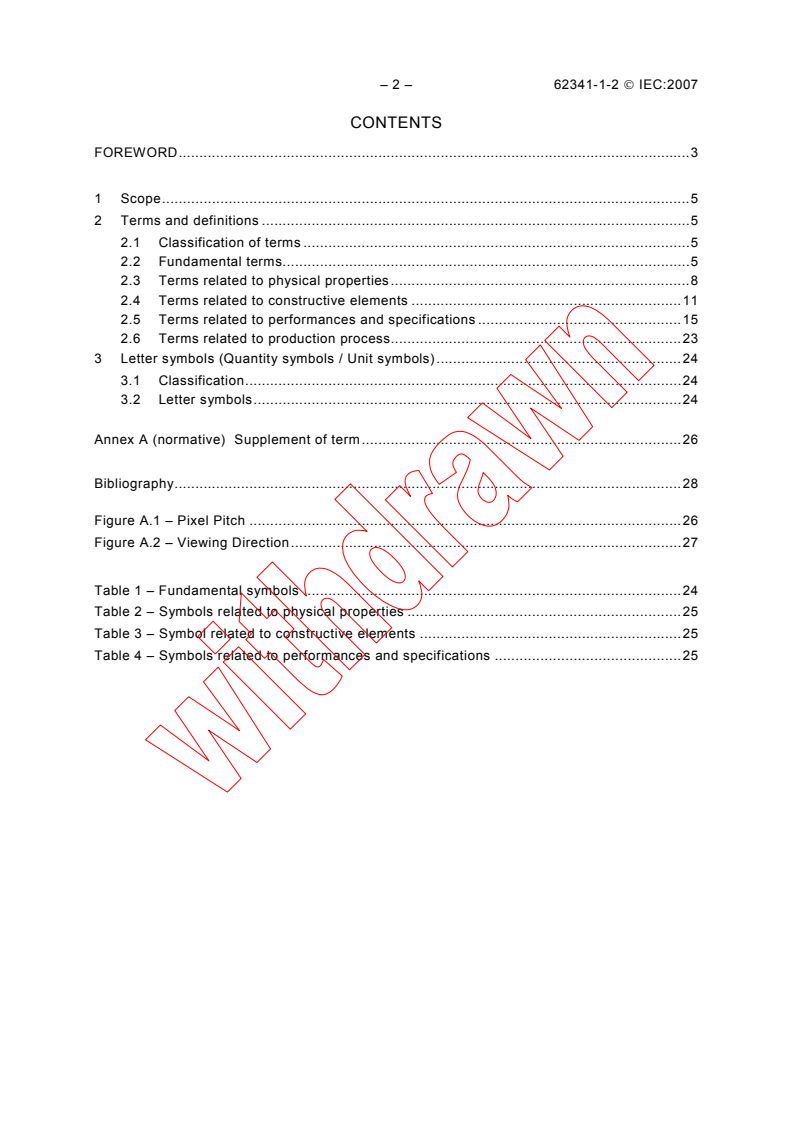
– 2 – 62341-1-2 © IEC:2007
CONTENTS
FOREWORD.3
1 Scope.5
2 Terms and definitions .5
2.1 Classification of terms .5
2.2 Fundamental terms.5
2.3 Terms related to physical properties.8
2.4 Terms related to constructive elements .11
2.5 Terms related to performances and specifications .15
2.6 Terms related to production process.23
3 Letter symbols (Quantity symbols / Unit symbols).24
3.1 Classification.24
3.2 Letter symbols.24
Annex A (normative) Supplement of term.26
Bibliography.28
Figure A.1 – Pixel Pitch .26
Figure A.2 – Viewing Direction.27
Table 1 – Fundamental symbols .24
Table 2 – Symbols related to physical properties .25
Table 3 – Symbol related to constructive elements .25
Table 4 – Symbols related to performances and specifications .25
62341-1-2 © IEC:2007 – 3 –
INTERNATIONAL ELECTROTECHNICAL COMMISSION
___________
ORGANIC LIGHT EMITTING DIODE DISPLAYS –
Part 1-2: Terminology and letter symbols
FOREWORD
1) The International Electrotechnical Commission (IEC) is a worldwide organization for standardization comprising
all national electrotechnical committees (IEC National Committees). The object of IEC is to promote
international co-operation on all questions concerning standardization in the electrical and electronic fields. To
this end and in addition to other activities, IEC publishes International Standards, Technical Specifications,
Technical Reports, Publicly Available Specifications (PAS) and Guides (hereafter referred to as “IEC
Publication(s)”). Their preparation is entrusted to technical committees; any IEC National Committee interested
in the subject dealt with may participate in this preparatory work. International, governmental and non-
governmental organizations liaising with the IEC also participate in this preparation. IEC collaborates closely
with the International Organization for Standardization (ISO) in accordance with conditions determined by
agreement between the two organizations.
2) The formal decisions or agreements of IEC on technical matters express, as nearly as possible, an international
consensus of opinion on the relevant subjects since each technical committee has representation from all
interested IEC National Committees.
3) IEC Publications have the form of recommendations for international use and are accepted by IEC National
Committees in that sense. While all reasonable efforts are made to ensure that the technical content of IEC
Publications is accurate, IEC cannot be held responsible for the way in which they are used or for any
misinterpretation by any end user.
4) In order to promote international uniformity, IEC National Committees undertake to apply IEC Publications
transparently to the maximum extent possible in their national and regional publications. Any divergence
between any IEC Publication and the corresponding national or regional publication shall be clearly indicated in
the latter.
5) IEC provides no marking procedure to indicate its approval and cannot be rendered responsible for any
equipment declared to be in conformity with an IEC Publication.
6) All users should ensure that they have the latest edition of this publication.
7) No liability shall attach to IEC or its directors, employees, servants or agents including individual experts and
members of its technical committees and IEC National Committees for any personal injury, property damage or
other damage of any nature whatsoever, whether direct or indirect, or for costs (including legal fees) and
expenses arising out of the publication, use of, or reliance upon, this IEC Publication or any other IEC
Publications.
8) Attention is drawn to the Normative references cited in this publication. Use of the referenced publications is
indispensable for the correct application of this publication.
9) Attention is drawn to the possibility that some of the elements of this IEC Publication may be the subject of
patent rights. IEC shall not be held responsible for identifying any or all such patent rights.
International Standard IEC 62341-1-2 has been prepared by IEC technical committee 110:
Flat panel display devices.
The text of this standard is based on the following documents:
FDIS Report on voting
110/125/FDIS 110/132/RVD
Full information on the voting for the approval on this standard can be found in the report on
voting indicated in the above table.
This publication has been drafted in accordance with the ISO/IEC Directives, Part 2.
– 4 – 62341-1-2 © IEC:2007
A list of all the parts in the IEC 62341 series, under the general title Organic light emitting
diode displays, can be found on the IEC website.
The committee has decided that the contents of this publication will remain unchanged until
the maintenance result date indicated on the IEC web site under "http://webstore.iec.ch" in
the data related to the specific publication. At this date, the publication will be
• reconfirmed;
• withdrawn;
• replaced by a revised edition, or
• amended.
62341-1-2 © IEC:2007 – 5 –
ORGANIC LIGHT EMITTING DIODE DISPLAYS –
Part 1-2: Terminology and letter symbols
1 Scope
This part of IEC 62341 gives preferred terms, their definitions and symbols for organic light
emitting diode (OLED) displays; with the object of using the same terminology when
publications are prepared in different countries.
2 Terms and definitions
For purposes of this document, the following terms and definitions apply.
2.1 Classification of terms
Terms for organic light emitting diode (OLED) displays are classified as follows.
a) Fundamental terms
b) Terms related to physical properties
c) Terms related to constructive elements
d) Terms related to performances and specifications
e) Terms related to production process
2.2 Fundamental terms
2.2.1
active matrix (addressed) driving
matrix driving method in which each pixel or subpixel has at least one active switching (e.g.
diode or transistor) and storage element
2.2.2
addressing method
method of selecting each pixel or subpixel for activation
2.2.3
alphanumeric display
display that is able to show a limited set of characters comprising at least letters and Arabic
numerals
2.2.4
area-colour display
display in which the display panel is partitioned into several parts, each one shows a colour
different from each other
2.2.5
bottom emission
device structure, in which almost all light emitted passes through a substrate on which organic
electroluminescent layers are made
– 6 – 62341-1-2 © IEC:2007
2.2.6
bottom emission display
display using bottom emission structure
2.2.7
constant-current driving
driving method where a constant current is applied to each pixel or subpixel
2.2.8
constant-voltage driving
driving method where a constant voltage is applied to each pixel or subpixel
2.2.9
display with a bright background
display showing dark images on a bright background
2.2.10
display with a dark background
display showing bright images on a dark background
2.2.11
doping method
method of adding a small quantity of different material to host material
NOTE This method is used in order to improve device characteristics or to change the emission spectrum.
2.2.12
driving method
specific method for activating each pixel or subpixel
2.2.13
dual emission display
display in which light is emitted from both sides (top and bottom) of a substrate on which
organic electroluminescent layers are made
2.2.14
emissive display
display with pixels or subpixels that emit light
2.2.15
flexible display
display that is mechanically flexible
2.2.16
full-colour display
display capable of showing at least 3 primary colours, the colour gamut of which includes a
white area (e.g. containing D50, D65, D75) and having at least 64 grey scale per primary
2.2.17
matrix display
display consisting of regularly arranged pixels and/or subpixels, e.g. arranged in rows and
columns
2.2.18
molecular organic light emitting diode display
organic light emitting diode display composed of organic (small) molecules
62341-1-2 © IEC:2007 – 7 –
2.2.19
monochrome display
display capable of reproducing only one colour
2.2.20
multi-colour display
display other than monochrome display and full-colour display
2.2.21
multiplex driving
driving method of time-share driving in which one common electrode is addressed to more
than two pixels or subpixels
2.2.22
organic electroluminescence
OEL
emission from organic materials by recombination of negatively and positively charged
carriers when forward electric bias is applied
2.2.23
organic electroluminescent display
OEL display
display showing visual information using organic electroluminescence
2.2.24
organic light emitting diode
OLED
light emitting diode in which light is emitted from organic materials
2.2.25
organic light emitting diode display
OLED display
display incorporating organic light emitting diodes
2.2.26
organic light emitting diode display module
organic light emitting diode display panel, its driving electronics and optical films if used in the
device design
2.2.27
organic light emitting diode (display) panel
display panel of an organic light emitting diode display without external drivers
2.2.28
passive matrix addressing
matrix driving method in which each pixel or subpixel is addressed directly by applied signals
on the addressing and data lines
2.2.29
polymer organic light emitting diode
light emitting diode in which light is emitted from polymeric materials
NOTE The term “polymer light emitting diode” is sometimes used.
2.2.30
segment display
display with symbols built-up by fixed patterns and segments
– 8 – 62341-1-2 © IEC:2007
2.2.31
standard atmospheric condition
standard conditions of atmosphere for tests and measurements
NOTE Generic term of "standard reference atmosphere", "standard atmospheres for referee" and "standard
atmospheric conditions for measurements and tests".
2.2.32
standard light source
light source that approximates a defined illuminant, such as CIE illuminant A and D65
2.2.33
standard reference atmosphere
reference atmospheric conditions used for standardizing the data measured under different
atmospheric conditions
2.2.34
standard test condition
all of conditions of the environment for tests and measurements
2.2.35
static driving
method of driving in which all pixels are activated simultaneously and constantly
2.2.36
top emission
device structure, in which almost all light emitted (toward) outside from a (top) side, where
OLED device is formed on, of a substrate
2.2.37
top emission display
display using top emission structure
2.2.38
transparent display
display in which the display area is visibly transparent
2.2.39
zone-colour display
NOTE See area-colour display.
2.3 Terms related to physical properties
2.3.1
charge carrier density
density of mobile electrons and/or holes in a material
-3
NOTE Expressed in cm .
2.3.2
crystallization temperature
temperature at which material changes into crystalline state when it is cooled from liquid state,
molten state or solution form
NOTE In case of amorphous material, the temperature at which material changes into partly or wholly crystalline
state.
2.3.3
electroluminescence spectrum
spectral distribution of the light emitted by the process of electroluminescence
62341-1-2 © IEC:2007 – 9 –
2.3.4
electron affinity
energy between the vacuum level and the bottom of the conduction band
NOTE Expressed in eV.
2.3.5
energy level
discrete energy state of the atom or the molecule or the exciton
2.3.6
external quantum efficiency
ratio of the number of the photons emitted from an organic light emitting diode divided by the
number of the injected electrons or holes
NOTE An external quantum efficiency is indicated as a product of an internal quantum efficiency and an external
light out-coupling efficiency.
2.3.7
fluorescence yield (efficiency)
ratio of the number of fluorescent photons divided by the number of photons absorbed into the
material
2.3.8
fluorescence
emission of light from an excited singlet state of materials
2.3.9
glass transition temperature
temperature at which an amorphous material freezes when cooled rapidly to become a
solidified supercooled liquid
NOTE This temperature depends on the cooling rate and is characterized by a change in the expansion
coefficient.
2.3.10
highest occupied molecular orbitals
HOMO
highest molecular orbitals occupied by electrons
2.3.11
injection barrier
energy barrier of the carrier injection at the interface of organic layer and organic layer or at
the interface of organic layer and electrode
2.3.12
internal quantum efficiency
ratio of the number of the photons produced from the electric charges injected from the
electrode divided by the number of the injected electrons or holes
NOTE An internal quantum efficiency is indicated as a product of a recombination probability of electrons and
holes, an efficiency of exciton generation through carrier recombination and an efficiency of photon generation
from exciton.
2.3.13
ionization potential
minimum energy required to remove an electron from a specified atom or molecule to such a
distance that there is no electrostatic interaction between ion and electron
NOTE Expressed in eV.
– 10 – 62341-1-2 © IEC:2007
2.3.14
lowest unoccupied molecular orbitals
LUMO
lowest molecular orbitals unoccupied by electrons
2.3.15
material purity
amount of the desired substance within a material product
NOTE Expressed in wt%.
2.3.16
melting point
temperature at which the solid state material maintains equilibrium between liquid state and
solid state at a certain pressure
NOTE Usually at 1013 hPa.
2.3.17
mobility
proportionality factor between electron (or hole) drift velocity and electric field
-1 -1
NOTE Expressed in cm V s .
2.3.18
optical axis
distinguished direction in optically anisotropic materials and elements, e.g. polarizers, wave
plates and retarders
2.3.19
phosphorescence yield (efficiency)
ratio of the number of phosphorescent photons divided by the number of photons absorbed
into the material
2.3.20
phosphorescence
emission of light from an excited triplet state of materials
2.3.21
photoluminescence spectrum
spectral distribution of the light emitted from materials excited by light of wavelengths shorter
than that of the photoluminescent emission
2.3.22
polarization axis
direction of electrical field vector of polarized light
2.3.23
quantum efficiency
ratio of the number of generated photons divided by the number of input photons or injected
electric charges
2.3.24
quantum yield
NOTE See quantum efficiency.
2.3.25
sheet resistance
electrical resistance of a conductive thin film with a square shape; measured from one side of
the square to the opposite side
62341-1-2 © IEC:2007 – 11 –
NOTE Defined as Rs=ρ/d, where ρ: resistivity coefficient, d: thickness.
2.3.26
square resistance
NOTE See sheet resistance.
2.3.27
surface roughness
degree of roughness of surface or interface
NOTE Usually, expressed in mean square deviation per cm of surface height measured by AFM or similar
method.
2.3.28
work function
minimum energy required to remove an electron from the Fermi level of a material into the
vacuum level
NOTE Expressed in eV.
2.4 Terms related to constructive elements
2.4.1
amorphous silicon
solid-state silicon without distinct crystalline structure
NOTE Carrier mobility is rather low compared with polycrystalline silicon.
2.4.2
anode
electrode, which supplies holes to an organic light emitting diode display panel
2.4.3
anode separator
rib to electrically separate each anode from the adjacent anode in a passive matrix organic
light emitting diode display panel
2.4.4
bank
raised elevation that is fabricated around each pixel or subpixel
NOTE Generally, it is used to prevent overflowing of coated solution.
2.4.5
black matrix
film-like structure that absorbs ambient or internally scattered light
2.4.6
buffer layer
general term used to describe a layer inserted in the device structure which may be used, for
example, to improve current injection or reduce surface roughness
2.4.7
cathode
electrode, which supplies electrons to an organic light emitting diode display panel
2.4.8
cathode separator
rib to electrically separate each cathode from the adjacent cathode in a passive matrix
organic light emitting diode display panel
– 12 – 62341-1-2 © IEC:2007
2.4.9
circular polarizer
optical component consisting of a linear polarizer and 1/4-wavelength retarder plate which
transforms the component of incoming light parallel to the polarizer, into circularly polarized
light
2.4.10
colour changing medium
medium containing fluorescent dyes that absorb emission energy of organic electro-
luminescence and re-emit photons with longer wavelength than the absorbed photons
2.4.11
colour filter
material that selectively absorbs, reflects, and transmits light of specific wavelength ranges
NOTE Generally, it is used as 3-primary colour (red, green, blue) filters with white organic light emitting diode for
colour image display or as a filter to improve the colour saturation of an organic light emitting diode.
2.4.12
common electrode
a) electrode connected to all segments in a segment display
b) row- or column scanning electrode in a passive matrix display
c) electrode connecting all pixels in a row and/or a column in an active matrix display
2.4.13
data electrode
electrode driven by the data signal voltage or current synchronized with the scanning signals
in a multiplexed display
2.4.14
dopant
different materials added to host material in small quantity to improve device characteristics
such as enhancement of luminous efficacy, spectrum change of emission, and decreasing of
resistance
2.4.15
dot electrode
discrete electrode for each pixel or subpixel in an active matrix display, which is separated
from the signal electrode line by a switching device such as TFT
2.4.16
driver
circuits that supply signal- and scanning voltages and/or currents to a display panel
NOTE There are two types of drivers, a scanning electrode (row electrode) driver and a signal electrode (column
electrode) driver, in a matrix display.
2.4.17
electron blocking layer
organic layer that blocks the flow of electrons in an organic light emitting diode with multilayer
structure; usually an organic material with smaller electron affinity than the electron
transporting layer
2.4.18
electron injection layer
layer inserted between a cathode and an electron transport layer to efficiently inject electrons
from the cathode into the organic layer in an organic light emitting diode
62341-1-2 © IEC:2007 – 13 –
2.4.19
electron transport layer
layer that efficiently transports electrons injected from a cathode into a light emitting layer in
an organic light emitting diode
2.4.20
encapsulation
enclosing device/structure to protect the organic layers and the electrodes from humidity
and/or oxygen
2.4.21
encapsulation/cover glass
glass to protect the organic layer and the electrodes from humidity and/or oxygen
2.4.22
exciton blocking layer
organic layer with a wide energy band gap that blocks exciton diffusion, usually incorporated
in an organic light emitting diode for confining triplet excitons in a light emitting layer
2.4.23
gate electrode
electrode which controls or connects with a gate terminal of a transistor in an active matrix
display
2.4.24
getter
material that helps maintain vacuum by chemically adsorbing gases outgassing from the
surfaces in vacuum
2.4.25
hole blocking layer
layer inserted between an emitting layer and an electron transport layer to increase
probability of recombination of electrons and holes in the emitting layer
2.4.26
hole injection layer
layer inserted between an anode and a hole transport layer to efficiently inject holes from the
anode into the organic layer in an organic light emitting diode
2.4.27
hole transport layer
layer that efficiently transports holes injected from an anode into a light emitting layer in an
organic light emitting diode
2.4.28
host material
material that provides a mechanical/electrical matrix for the dopants
2.4.29
insulating layer
insulator formed below the cathode separator to prevent electrical short between anodes and
cathodes
2.4.30
light emitting layer
layer that emits light by recombination of electrons and holes
– 14 – 62341-1-2 © IEC:2007
2.4.31
low temperature polysilicon
poly-crystalline silicon fabricated at substrate temperature below 450 °C
2.4.32
microlens (array)
optical lenses fabricated close to pixels in order to enhance the out-coupling efficiency of
emission
2.4.33
molecular material
organic materials used for an organic light emitting diode, often indicates organic materials
with molecular weight of less than 2 000
NOTE Different molecular materials are used for carrier injection, carrier transport, and emission in a multilayer
form.
2.4.34
multi-layer organic structure
structure that has multiple organic layers to improve emission efficiency
NOTE Each layer has one or more functions, such as electron transport, emission or hole transport.
2.4.35
OLED controller
electric device that supplies control signal voltages, e.g. timing signals, to operate driving ICs
NOTE It may process display signals such as analogue to digital (A/D) and/or digital to analogue (D/A) signal
conversion and an IC for controller is called controller-IC.
2.4.36
panel substrate
supporting material, generally transparent, made of e.g. glass or plastic sheet on which the
electrodes, wiring, and organic layers of an organic light emitting diode display panel are
formed
2.4.37
passivation
method to protect the organic layers and the electrodes from humidity and/or oxygen
2.4.38
polymer material
organic materials used for an organic light emitting diode, this term often indicates organic
materials with molecular weight of higher than 10 000
NOTE Different polymer materials are used for carrier injection, carrier transport, and emission in a multiplayer
form.
2.4.39
protection sheet
plastic sheet that protects a display panel surface from mechanical harm during fabricating
and/or shipping an organic light emitting diode display
2.4.40
scanning electrode
electrode connected to the scanning signal in a matrix display
2.4.41
sealant
adhesive for encapsulation
62341-1-2 © IEC:2007 – 15 –
2.4.42
segment electrode
a) electrode forming a part of alphanumeric characters and/or fixed patterns in a segment
display
b) data or signal electrode in a passive matrix display
2.4.43
single layer structure
structure of an organic light emitting diode, that has single organic layer
NOTE The single layer has all functions like electron transport, emission or hole transport.
2.4.44
source electrode
electrode which connects with a source terminal of a transistor in an active matrix display
2.4.45
storage capacitor
capacitor to keep a gate voltage of driving TFT to maintain a certain luminance of each pixel
or subpixel in an active matrix display
2.4.46
substrate
bare sheet material used as the base structural element to make organic light emitting diode
display
NOTE Commonly this is glass material but Si wafer or plastics are also used.
2.4.47
thin film diode
TFD
diode formed on the surface of a substrate as a thin film
2.4.48
thin film transistor
TFT
transistor formed on the surface of a substrate as a thin film
2.4.49
transparent conductive layer
layer that has both electric conductivity and transmission of light
NOTE A typical material is ITO (indium tin oxide).
2.4.50
transparent electrode
electrode that has both electric conductivity and transmission of light
NOTE A typical material is ITO (indium tin oxide).
2.5 Terms related to performances and specifications
2.5.1
acceleration coefficient
ratio of the lifetime of an organic light emitting diode under normal use and lifetime under
accelerated conditions
2.5.2
accelerated test
test under accelerating conditions to estimate the operational lifetime within a short time
– 16 – 62341-1-2 © IEC:2007
2.5.3
active area
area that has a display function on the substrate of an organic light emitting diode display
2.5.4
addressability
number of pixels in the horizontal and vertical directions, that can have their luminance and
chromaticity changed
NOTE Usually expressed in the number of horizontal pixels by the number of vertical pixels. This term is not
synonymous with resolution.
2.5.5
afterimage
phenomenon in which an image of the previous display persists for a short time after display
switching
2.5.6
amplitude modulation
method for generating grey scale by modulation of the amplitude of the driving voltage/current
at constant pulse width
2.5.7
anti-glare (treatment)
treatment performed on a flat-panel surface to reduce glare by forming micro-structure on its
top surface layer to induce scattering
2.5.8
anti-reflection
treatment performed on a surface to eliminate reflected light from an interface multiple layers
by coating of film having different refractive indexes
2.5.9
aperture ratio
ratio of the pixel area available for light modulation or light emission to the total geometrical
pixel area
NOTE Fill factor has the same meaning.
2.5.10
aspect ratio
ratio of active area width to active area height, for example 4:3 or 16:9
2.5.11
bezel opening area
all the area surrounded by a bezel that can be recognized in an organic light emitting diode
display
2.5.12
bright failure
defective dot brighter than the specified display luminance
2.5.13
bright spot
local area brighter than the specified display luminance
62341-1-2 © IEC:2007 – 17 –
2.5.14
bubble
bubble-shape defect consisting of a cavity in sealing material or paste of a protective film or a
polarizer
2.5.15
chromaticity
property of a colour stimulus defined by its chromaticity coordinate, or by its dominant or
complementary wavelength and purity taken together
2.5.16
close dot failure
dot failures within a specified distance of each other
2.5.17
colour gamut
NOTE See colour reproduction range.
2.5.18
colour non-uniformity
phenomenon in which luminance or chromaticity differ from one part of a screen to another
NOTE Colour non-uniformity refers in particular to differences in chromaticity.
2.5.19
colour reproduction range
range of colours that can be reproduced by an organic light emitting diode display panel
NOTE Typically, the area on CIE 1976 UCS chromaticity diagram within the triangle formed by the primary colour
points.
2.5.20
contrast ratio
ratio of white luminance to black luminance of the image, including light reflected from the
display
NOTE This ratio is strongly dependent on the ambient light.
2.5.21
correlated colour temperature
temperature of the Planckian radiator whose perceived colour most closely resembles that of
a given stimulus at the same brightness and under specified viewing conditions
NOTE The recommended method of calculating the correlated colour temperature of a stimulus is to determine on
a chromaticity diagram the temperature corresponding to the point on Planckian locus that is intersected by the
agreed isotemperature line containing the point representing the stimulus.
2.5.22
cross-talk
unwanted luminance on a part of a display area produced by an image displayed on another
part of the display
2.5.23
current modulation
method for variation of the intensity of emission in organic light emitting diode displays by
variation of the amplitude of the driving current
2.5.24
dark failure
defective dot darker than the specified display luminance or non-emissive
– 18 – 62341-1-2 © IEC:2007
2.5.25
dark spot
local non-emissive area in an emissive area
2.5.26
delay time
time interval from switching the display from OFF state to ON state or from ON state to OFF
state till the instant at which luminance changes by 10 % of difference in ON and OFF
luminance levels
2.5.27
diagonal size
length of display diagonal
2.5.28
diffuse reflectance
ratio of the diffusely reflected part of the (whole) reflected flux, to the incident flux
2.5.29
dot
each individually addressable element of a display
NOTE In a colour display dot is equal to subpixel, in a monochromatic display dot is equal to pixel.
2.5.30
dot failure
generic term for defect or failure
2.5.31
duty ratio
fraction of pixel ON time while scan signal is selected in one frame in a multiplex driving
scheme, such as in a passive matrix display
2.5.32
fall time
time interval between the instants at which the luminance is 90 % and 10 % of the level
between the luminance of the ON and OFF states
2.5.33
flexibility
mechanical pliancy of a panel to an external mechanical or thermal stress
2.5.34
flicker
unintended but perceptible periodic fluctuation in luminance
2.5.35
frame frequency
number of image frames per second
2.5.36
frame rate control
method for realizing grey scale that makes use of the temporal integration of the human visual
system
NOTE Different optical levels in different frames will be averaged over time to provide the sensation of a certain
grey scale.
62341-1-2 © IEC:2007 – 19 –
2.5.37
grey scale
range of luminance levels between maximum luminance and minimum luminance
2.5.38
greyshade
NOTE See grey scale.
2.5.39
half luminance lifetime
time period before the luminance decreases to 50 % of the initial luminance in operation
NOTE Initial luminance is defined as the luminance after factory ageing.
2.5.40
image persistence
NOTE See image sticking.
2.5.41
image retention
NOTE See afterimage.
2.5.42
image sticking
general term that refers to a burned-in image or a permanent image caused by long time
static operation
NOTE The image sticking does not disappear in a short time.
2.5.43
line failure
display defect whereby many pixels or subpixels failures occur along a line
2.5.44
line-at-a-time scanning
in time-division driving, a scanning system that selects scan lines sequentially and
synchronously inputs a signal to the signal electrode
2.5.45
linked dot failure
sequence of connected dot failures
2.5.46
logic voltage
voltage applied to operate the logic circuitry in an organic light emitting diode display module
2.5.47
luminance
quantitative measure of the CIE tristimulus component Y
NOTE Expressed in cd/m .
2.5.48
luminance lifetime
elapsed time required for the luminance to decrease to a specified fraction of the initial
luminance in operation
NOTE Initial luminance is defined as the luminance after factory ageing.
– 20 – 62341-1-2 © IEC:2007
2.5.49
luminance uniformity
deviation of luminance produced by different areas of the organic light emitting diode display
2.5.50
luminous current efficiency
luminance (front luminance) divided by the applied current per unit area
NOTE Expressed in cd/A.
2.5.51
luminous efficacy
total luminous flux from the display divided by the applied electric power
NOTE Expressed in lm/W, often misapplied to luminous power efficiency.
2.5.52
maximum luminance
maximum value of luminance that can be displayed
2.5.53
mura
visual imperfection in luminance or colour
2.5.54
number of colours
quantity of colours that can be distinguishable by an organic light emitting diode display
module
NOTE If the pixels consist of red, green and blue sub-pixels, the number of colours can be calculated by
multiplication of the number of grey scale levels of each primary colour.
2.5.55
number of pixels
quantity of pixels in the active (display) area
2.5.56
operating lifetime
time period during which a device meets its specifications under nominal operating conditions
2.5.57
operating temperature (range)
range of temperatures at which an organic light emitting diode display will function while
maintaining its performance
2.5.58
out-coupling efficiency
ratio of luminous flux out of a panel to luminous flux emitted in a light emitting layer
2.5.59
pinhole
small defect in electroluminescence film, electrode film, protective film, etc.
2.5.60
pixel
in a matrix display, minimum display unit that can perform full display functions
NOTE For example, in a colour display based on RGB vertical stripes, three consecutive RGB elements constitute
one pixel.
62341-1-2 © IEC:2007 – 21 –
2.5.61
pixel pitch
distance between corresponding points on adjacent pixels, both horizontally and vertically
(See Annex A, Figure A.1.)
2.5.62
point-at-a-time scanning
in time-division driving, a scanning method that selects a pixel or a subpixel at a time
sequentially
2.5.63
power consumption
electric power that an organic light emitting diode display consumes while operated
2.5.64
precharge
operation to charge the organic light emitting diode before emission
2.5.65
pulse width modulation
method of grey scale modulation using constant pulse amplitude while varying the pulse width
according to the level of the input signal
2.5.66
recombination efficiency
ratio of recombination of injected electrons and holes in a light emitting layer
2.5.67
resolution
ability of the display to reproduce objects that are close together and which remain
distinguishable
NOTE Often confused with addressability.
2.5.68
response time
generic term for “turn-on time” and “turn-off time”
2.5.69
rise time
time interval at which luminance changes from 10 % to 90 % after switching organic light
emitting diode display driving voltage from OFF state to ON state
2.5.70
scratch defect
defect by scratching glass or polarizer surface
2.5.71
shelf life time
time period during which a device meets specifications under unstressed storage condition
2.5.72
specular reflectance
ratio of the regularly reflected part of the (whole) reflected flux, to the incident flux
2.5.73
stain
display defect having an area larger than a pixel and unclear boundaries
– 22 – 62341-1-2 © IEC:2007
2.5.74
storage temperature (range)
temperature (range) in which a panel or a module can be stored without operation
2.5.75
subframe modulation
method for generating grey scale, that controls multiple subframes with different periods
NOTE Specifically, a drive system in which one frame consists of multiple subframes having different periods that
are turned ON and OFF to reproduce grey scale.
2.5.76
subpixel
each individually addressable element of a matrix display, which makes up one pixel
NOTE For example, each R, G, or B element in a colour display based on RGB is a subpixel.
2.5.77
subpixel arrangement
arrangement of subpixels making up a pixel, e.g. stripe or delta-arrangements
NOTE ”RGB” is an example of primaries. There are pixels with other subpixels, for example RGBW or RGBC.
2.5.78
supply current
current provided by a power supply for normal operation of an organic light emitting diode
display module
2.5.79
transmittance
ratio of the transmitted radiant or luminous flux to the incident flux in the given condition
2.5.80
turn off time
sum of delay and fall times
2.5.81
turn on time
sum of delay and rise times
2.5.82
turn on voltage
voltage at which luminance is 1 cd/m
2.5.83
threshold voltage
NOTE See turn on voltage.
2.5.84
viewing angle range
range of viewing angle over which the visual specification is satisfied
2.5.85
viewing area
active area plus any contiguous areas that display permanent visual information or a display
background
62341-1-2 © IEC:2007 – 23 –
2.5.86
viewing direction
direction or angle for viewing an organic light emitting diode display which is defined by the
inclination angle θ and the azi
...