

IEC 60633:1998
(Main)Terminology for high-voltage direct current (HVDC) transmission
General Information
- Abstract
Applies to terminology for high-voltage direct current (HVDC) systems and especially to HVDC converter substations where electronic converters are used for the conversion from a.c. to d.c. or vice versa.
- Status
- Published
- Publication Date
- 28-Jul-2015
- Drafting Committee
- MT 13 - TC 22/SC 22F/MT 13
- Current Stage
- DELPUB - Deleted Publication
- Start Date
- 25-Apr-2019
- Completion Date
- 30-Jun-2017
Buy Documents
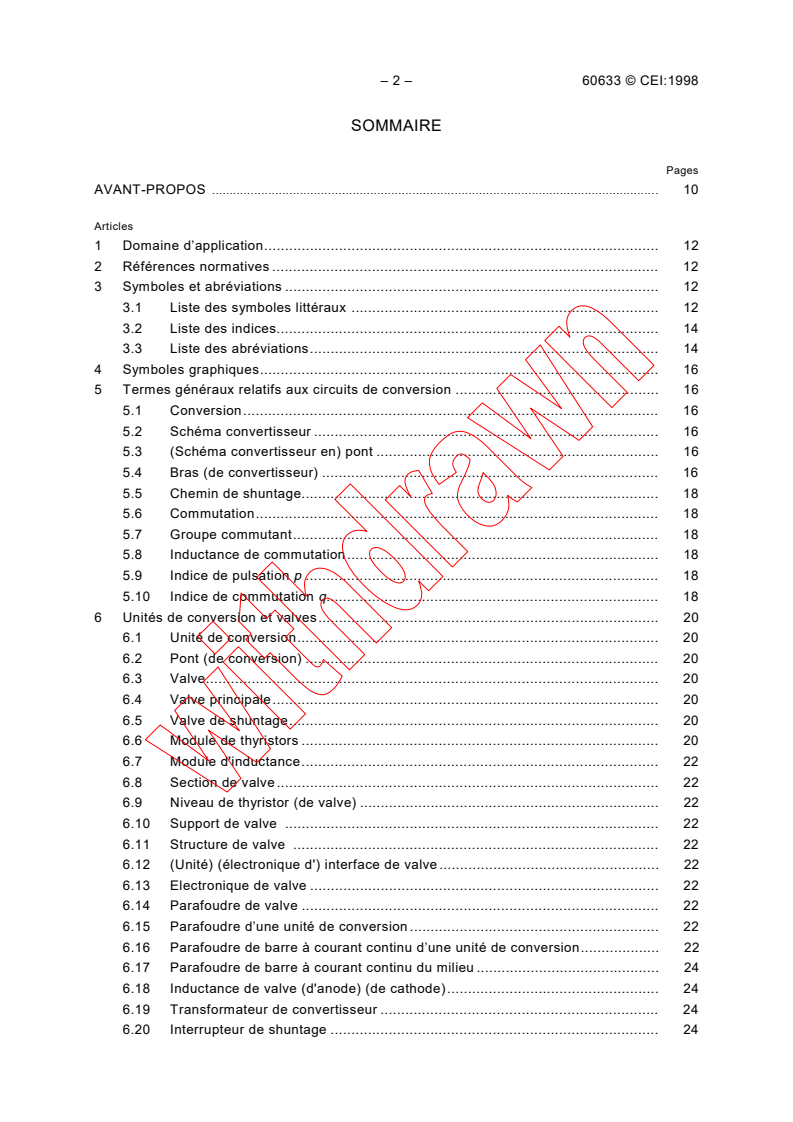
IEC 60633:1998 - Terminology for high-voltage direct current (HVDC) transmission Released:12/21/1998
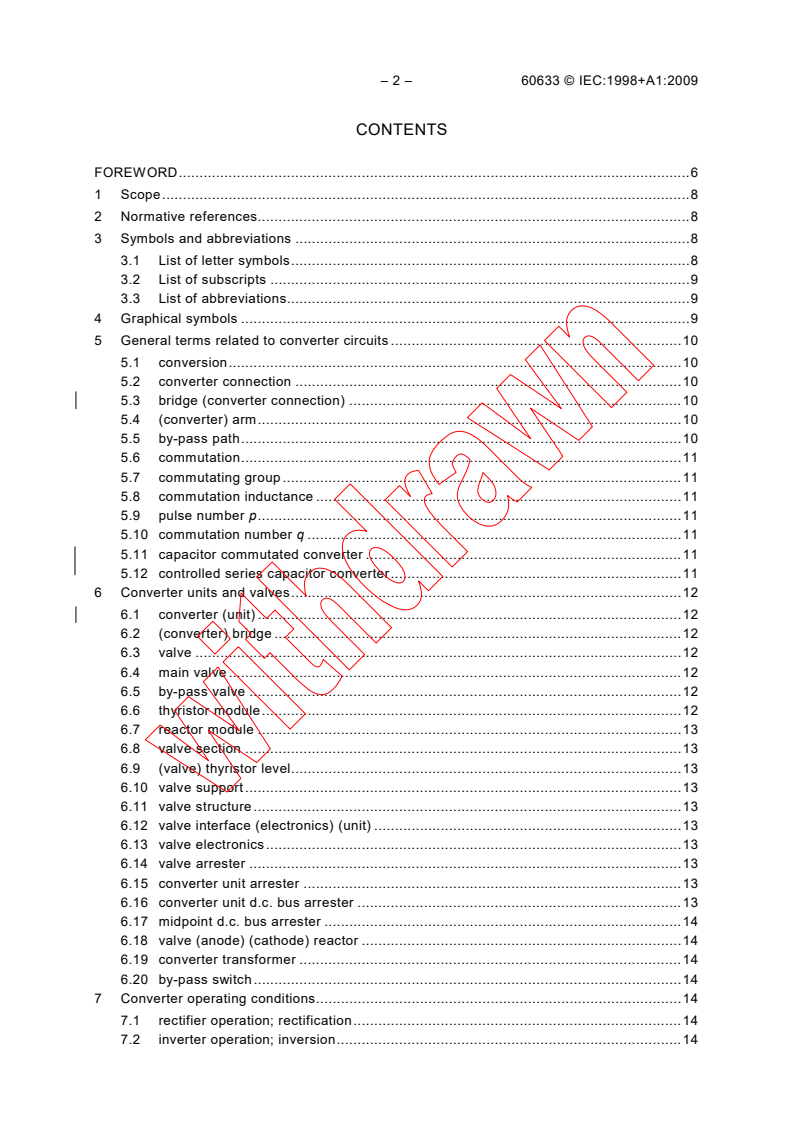
IEC 60633:1998+AMD1:2009 CSV - Terminology for high-voltage direct current (HVDC) transmission Released:7/30/2009

IEC 60633:1998+AMD1:2009+AMD2:2015 CSV - Terminology for high-voltage direct current (HVDC) transmission Released:7/29/2015
Overview
IEC 60633:1998, titled Terminology for High-Voltage Direct Current (HVDC) Transmission, is an international standard developed by the International Electrotechnical Commission (IEC). This standard specifically applies to terminology related to HVDC systems, focusing particularly on HVDC converter substations where electronic converters perform the conversion between alternating current (AC) and direct current (DC).
HVDC transmission systems are critical for efficient long-distance electric power transfer, enabling reduced transmission losses, improved grid stability, and enhanced control capabilities. Clear and consistent terminology is essential for engineers, operators, and stakeholders working with HVDC technology to ensure effective communication, system design, and maintenance.
Key Topics
IEC 60633:1998 covers a comprehensive range of terms and definitions that span key aspects of HVDC technology:
Converter Circuits and Components
- Types of converter connections such as bridges and arms
- Converter units and valves including thyristor modules, valve sections, and reactor modules
- Converter transformer and valve interface electronics
Operating Conditions and Modes
- Rectifier and inverter operations
- Valve conduction states, including forward and reverse directions
- Parameters such as firing angles, conduction intervals, and valve voltage drops
- Control pulses and firing sequences for valves to manage power flow
HVDC Systems and Substations
- Definitions of unidirectional, reversible, monopolar, bipolar, and bipole HVDC systems
- Components of substations including filter circuits, smoothing reactors, arrester devices, and earth electrodes
- Operational elements like line poles and substation earth systems
Control and Protection
- Various control modes including voltage, current, power, reactive power, frequency, and damping
- Terminology related to control systems and switching devices for HVDC networks
Graphical Symbols and Abbreviations Included
- The standard provides graphical symbols and widely accepted abbreviations to facilitate standardized documentation and communication in the field
Applications
IEC 60633:1998 is indispensable for professionals involved in the design, operation, and maintenance of HVDC transmission systems. Practical applications include:
- Engineering Design - Clarifies terminology for HVDC system components and operational principles, aiding precise design and specification.
- Technical Documentation - Ensures uniform language in manuals, technical reports, and procurement documents.
- Training and Education - Supports training materials for engineers and technicians new to HVDC technology.
- System Operation and Maintenance - Facilitates accurate communication among operators managing converter stations and field equipment.
- Standardization Efforts - Helps manufacturers, utilities, and regulatory bodies align on terminology for interoperability and compliance.
Standardized terminology assists in reducing errors, improving safety protocols, and fostering global cooperation in deploying HVDC infrastructure.
Related Standards
Professionals using IEC 60633:1998 will find it complementary to other IEC standards related to HVDC and power transmission technologies, such as:
- IEC 60071 - Insulation coordination for power systems
- IEC 61000 - Electromagnetic compatibility (EMC) standards relevant to HVDC equipment
- IEC 61975 - Test specifications for HVDC converter stations
- IEC 62271 - High-voltage switchgear and controlgear, important for HVDC substation components
Leveraging IEC 60633 in conjunction with these related standards enhances the technical consistency and quality of HVDC projects across various electrical engineering domains.
Keywords: IEC 60633, HVDC terminology, high-voltage direct current, HVDC converter substations, electrical standards, electrical transmission terminology, HVDC systems, valve operation, converter circuits, power transmission standards, IEC standards for HVDC
Relations
- Effective Date
- 05-Sep-2023
- Effective Date
- 05-Sep-2023
- Effective Date
- 05-Sep-2023
Buy Documents
IEC 60633:1998 - Terminology for high-voltage direct current (HVDC) transmission Released:12/21/1998
IEC 60633:1998+AMD1:2009 CSV - Terminology for high-voltage direct current (HVDC) transmission Released:7/30/2009
IEC 60633:1998+AMD1:2009+AMD2:2015 CSV - Terminology for high-voltage direct current (HVDC) transmission Released:7/29/2015
Get Certified
Connect with accredited certification bodies for this standard

IMQ S.p.A. (Certification)
Italian electrical product certification.

SLG Prüf- und Zertifizierungs GmbH
German testing and certification body.

UL Solutions
Global safety science company with testing, inspection and certification.
Sponsored listings
Frequently Asked Questions
IEC 60633:1998 is a standard published by the International Electrotechnical Commission (IEC). Its full title is "Terminology for high-voltage direct current (HVDC) transmission". This standard covers: Applies to terminology for high-voltage direct current (HVDC) systems and especially to HVDC converter substations where electronic converters are used for the conversion from a.c. to d.c. or vice versa.
Applies to terminology for high-voltage direct current (HVDC) systems and especially to HVDC converter substations where electronic converters are used for the conversion from a.c. to d.c. or vice versa.
IEC 60633:1998 is classified under the following ICS (International Classification for Standards) categories: 29.200 - Rectifiers. Convertors. Stabilized power supply. The ICS classification helps identify the subject area and facilitates finding related standards.
IEC 60633:1998 has the following relationships with other standards: It is inter standard links to IEC 60633:1998/AMD2:2015, IEC 60633:1998/AMD1:2009, IEC 60633:2019. Understanding these relationships helps ensure you are using the most current and applicable version of the standard.
IEC 60633:1998 is available in PDF format for immediate download after purchase. The document can be added to your cart and obtained through the secure checkout process. Digital delivery ensures instant access to the complete standard document.
Standards Content (Sample)
NORME
CEI
INTERNATIONALE
IEC
INTERNATIONAL
Deuxième édition
STANDARD
Second edition
1998-12
Terminologie pour le transport d'énergie
en courant continu à haute tension (CCHT)
Terminology for high-voltage
direct current (HVDC) transmission
Numéro de référence
Reference number
CEI/IEC 60633:1998
Numéros des publications Numbering
Depuis le 1er janvier 1997, les publications de la CEI As from 1 January 1997 all IEC publications are
sont numérotées à partir de 60 000. issued with a designation in the 60 000 series.
Publications consolidées Consolidated publications
Les versions consolidées de certaines publications de Consolidated versions of some IEC publications
la CEI incorporant les amendements sont disponibles. including amendments are available. For example,
Par exemple, les numéros d’édition 1.0, 1.1 et 1.2 edition numbers 1.0, 1.1 and 1.2 refer, respectively, to
indiquent respectivement la publication de base, la the base publication, the base publication incor-
publication de base incorporant l’amendement 1, et porating amendment 1 and the base publication
la publication de base incorporant les amendements 1 incorporating amendments 1 and 2.
et 2.
Validité de la présente publication Validity of this publication
Le contenu technique des publications de la CEI est The technical content of IEC publications is kept under
constamment revu par la CEI afin qu'il reflète l'état constant review by the IEC, thus ensuring that the
actuel de la technique. content reflects current technology.
Des renseignements relatifs à la date de reconfir- Information relating to the date of the reconfirmation of
mation de la publication sont disponibles dans le the publication is available in the IEC catalogue.
Catalogue de la CEI.
Les renseignements relatifs à des questions à l’étude et Information on the subjects under consideration and
des travaux en cours entrepris par le comité technique work in progress undertaken by the technical
qui a établi cette publication, ainsi que la liste des committee which has prepared this publication, as well
publications établies, se trouvent dans les documents ci- as the list of publications issued, is to be found at the
dessous: following IEC sources:
• «Site web» de la CEI* • IEC web site*
• Catalogue des publications de la CEI • Catalogue of IEC publications
Publié annuellement et mis à jour régulièrement Published yearly with regular updates
(Catalogue en ligne)* (On-line catalogue)*
• Bulletin de la CEI • IEC Bulletin
Disponible à la fois au «site web» de la CEI* Available both at the IEC web site* and
et comme périodique imprimé as a printed periodical
Terminologie, symboles graphiques Terminology, graphical and letter
et littéraux symbols
En ce qui concerne la terminologie générale, le lecteur For general terminology, readers are referred to
se reportera à la CEI 60050: Vocabulaire Electro- IEC 60 050: International Electrotechnical Vocabulary
technique International (VEI). (IEV).
Pour les symboles graphiques, les symboles littéraux For graphical symbols, and letter symbols and signs
et les signes d'usage général approuvés par la CEI, le approved by the IEC for general use, readers are
lecteur consultera la CEI 60027: Symboles littéraux à referred to publications IEC 60027: Letter symbols to
utiliser en électrotechnique, la CEI 60417: Symboles be used in electrical technology, IEC 60417: Graphical
graphiques utilisables sur le matériel. Index, relevé et symbols for use on equipment. Index, survey and
compilation des feuilles individuelles, et la CEI 60 617: compilation of the single sheets and IEC 60617:
Symboles graphiques pour schémas. Graphical symbols for diagrams.
* Voir adresse «site web» sur la page de titre. * See web site address on title page.
NORME
CEI
INTERNATIONALE
IEC
INTERNATIONAL
Deuxième édition
STANDARD
Second edition
1998-12
Terminologie pour le transport d'énergie
en courant continu à haute tension (CCHT)
Terminology for high-voltage
direct current (HVDC) transmission
IEC 1998 Droits de reproduction réservés Copyright - all rights reserved
Aucune partie de cette publication ne peut être reproduite ni No part of this publication may be reproduced or utilized in
utilisée sous quelque forme que ce soit et par aucun any form or by any means, electronic or mechanical,
procédé, électronique ou mécanique, y compris la photo- including photocopying and microfilm, without permission in
copie et les microfilms, sans l'accord écrit de l'éditeur. writing from the publisher.
International Electrotechnical Commission 3, rue de Varembé Geneva, Switzerland
Telefax: +41 22 919 0300 e-mail: inmail@iec.ch IEC web site http://www.iec.ch
CODE PRIX
Commission Electrotechnique Internationale
PRICE CODE V
International Electrotechnical Commission
Pour prix, voir catalogue en vigueur
For price, see current catalogue
– 2 – 60633 © CEI:1998
SOMMAIRE
Pages
AVANT-PROPOS . 10
Articles
1 Domaine d’application. 12
2 Références normatives. 12
3 Symboles et abréviations . 12
3.1 Liste des symboles littéraux . 12
3.2 Liste des indices. 14
3.3 Liste des abréviations. 14
4 Symboles graphiques. 16
5 Termes généraux relatifs aux circuits de conversion . 16
5.1 Conversion. 16
5.2 Schéma convertisseur . 16
5.3 (Schéma convertisseur en) pont . 16
5.4 Bras (de convertisseur) . 16
5.5 Chemin de shuntage. 18
5.6 Commutation. 18
5.7 Groupe commutant. 18
5.8 Inductance de commutation. 18
5.9 Indice de pulsation p . 18
5.10 Indice de commutation q. 18
6 Unités de conversion et valves. 20
6.1 Unité de conversion. 20
6.2 Pont (de conversion) . 20
6.3 Valve. 20
6.4 Valve principale. 20
6.5 Valve de shuntage. 20
6.6 Module de thyristors . 20
6.7 Module d'inductance. 22
6.8 Section de valve. 22
6.9 Niveau de thyristor (de valve) . 22
6.10 Support de valve . 22
6.11 Structure de valve . 22
6.12 (Unité) (électronique d') interface de valve. 22
6.13 Electronique de valve . 22
6.14 Parafoudre de valve . 22
6.15 Parafoudre d’une unité de conversion . 22
6.16 Parafoudre de barre à courant continu d’une unité de conversion. 22
6.17 Parafoudre de barre à courant continu du milieu . 24
6.18 Inductance de valve (d'anode) (de cathode). 24
6.19 Transformateur de convertisseur . 24
6.20 Interrupteur de shuntage . 24
60633 © IEC:1998 – 3 –
CONTENTS
Page
FOREWORD . 11
Clause
1 Scope. 13
2 Normative references. 13
3 Symbols and abbreviations . 13
3.1 List of letter symbols. 13
3.2 List of subscripts . 15
3.3 List of abbreviations. 15
4 Graphical symbols . 17
5 General terms related to converter circuits . 17
5.1 Conversion . 17
5.2 Converter connection. 17
5.3 Bridge (converter connection) . 17
5.4 (Converter) arm . 17
5.5 By-pass path . 19
5.6 Commutation . 19
5.7 Commutating group . 19
5.8 Commutation inductance . 19
5.9 Pulse number p . 19
5.10 Commutation number q. 19
6 Converter units and valves. 21
6.1 Converter unit. 21
6.2 (Converter) bridge . 21
6.3 Valve . 21
6.4 Main valve . 21
6.5 By-pass valve . 21
6.6 Thyristor module. 21
6.7 Reactor module . 23
6.8 Valve section . 23
6.9 (Valve) thyristor level . 23
6.10 Valve support . 23
6.11 Valve structure . 23
6.12 Valve interface (electronics) (unit). 23
6.13 Valve electronics . 23
6.14 Valve arrester . 23
6.15 Converter unit arrester. 23
6.16 Converter unit d.c. bus arrester. 23
6.17 Midpoint d.c. bus arrester . 25
6.18 Valve (anode) (cathode) reactor. 25
6.19 Converter transformer. 25
6.20 By-pass switch. 25
– 4 – 60633 © CEI:1998
Articles Pages
7 Conditions de fonctionnement du convertisseur. 24
7.1 Fonctionnement en redresseur; redressement . 24
7.2 Fonctionnement en onduleur; renvoi au réseau. 24
7.3 Sens direct. 24
7.4 Sens inverse. 24
7.5 Courant direct. 26
7.6 Courant inverse. 26
7.7 Tension directe. 26
7.8 Tension inverse. 26
7.9 Etat conducteur. 26
7.10 Chute de tension de valve . 26
7.11 Etat non conducteur; état bloqué . 26
7.12 Allumage. 26
7.13 Impulsion de commande (de valve). 26
7.14 Impulsion d'allumage (de valve). 26
7.15 Blocage d'un convertisseur. 28
7.16 Déblocage d'un convertisseur . 28
7.17 Blocage d'une valve. 28
7.18 Déblocage d'une valve. 28
7.19 Réglage de phase . 28
7.20 Angle de retard (de l’ordre d'amorçage) α. 28
7.21 Angle d'avance (de l’ordre d'amorçage) β . 28
7.22 Angle d'empiétement μ . 28
7.23 Angle d'extinction γ. 28
7.24 Intervalle de retenue. 28
7.25 Intervalle de conduction. 30
7.26 Intervalle de blocage; intervalle de repos . 30
7.27 Intervalle de blocage direct. 30
7.28 Intervalle de blocage inverse . 30
7.29 Allumage intempestif. 30
7.30 Défaut d'allumage. 30
7.31 Raté de commutation . 30
7.32 Rapport de court-circuit (RCC) . 30
7.33 Rapport de court-circuit efficace (RCCE) . 30
8 Systèmes et postes CCHT . 30
8.1 Système CCHT. 30
8.2 Système de transport CCHT . 32
8.3 Système CCHT unidirectionnel . 32
8.4 Système CCHT réversible. 32
8.5 Pôle (de système) (CCHT). 32
8.6 Bipôle (de système) (CCHT) . 32
8.7 Système (CCHT) bipolaire . 32
8.8 Système (CCHT) monopolaire . 34
8.9 Poste CCHT. 34
60633 © IEC:1998 – 5 –
Clause Page
7 Converter operating conditions. 25
7.1 Rectifier operation; rectification. 25
7.2 Inverter operation; inversion. 25
7.3 Forward direction. 25
7.4 Reverse direction. 25
7.5 Forward current . 27
7.6 Reverse current. 27
7.7 Forward voltage. 27
7.8 Reverse voltage. 27
7.9 Conducting state. 27
7.10 Valve voltage drop . 27
7.11 Non-conducting state; blocking state. 27
7.12 Firing . 27
7.13 (Valve) control pulse. 27
7.14 (Valve) firing pulse. 27
7.15 Converter blocking. 29
7.16 Converter deblocking. 29
7.17 Valve blocking . 29
7.18 Valve deblocking . 29
7.19 Phase control . 29
7.20 (Trigger) delay angle α . 29
7.21 (Trigger) advance angle β . 29
7.22 Overlap angle μ . 29
7.23 Extinction angle γ. 29
7.24 Hold-off interval . 29
7.25 Conduction interval . 31
7.26 Blocking interval; idle interval. 31
7.27 Forward blocking interval . 31
7.28 Reverse blocking interval. 31
7.29 False firing . 31
7.30 Firing failure . 31
7.31 Commutation failure. 31
7.32 Short-circuit ratio (SCR). 31
7.33 Effective short-circuit ratio (ESCR). 31
8 HVDC systems and substations . 31
8.1 HVDC system . 31
8.2 HVDC transmission system. 33
8.3 Unidirectional HVDC system . 33
8.4 Reversible HVDC system . 33
8.5 (HVDC) (system) pole. 33
8.6 (HVDC) (system) bipole . 33
8.7 Bipolar (HVDC) system . 33
8.8 Monopolar (HVDC) system. 35
8.9 HVDC substation . 35
– 6 – 60633 © CEI:1998
Articles Pages
8.10 Bipôle de poste (CCHT). 34
8.11 Pôle de poste (CCHT) . 34
8.12 Ligne de transport CCHT . 34
8.13 Pôle de ligne de transport CCHT . 34
8.14 Electrode de terre. 34
8.15 Ligne de terre. 34
9 Equipements des postes CCHT. 36
9.1 Filtre (côté courant) alternatif. 36
9.2 Inductance (de lissage) côté courant continu . 36
9.3 Parafoudre d’inductance de lissage . 36
9.4 Filtre (côté courant) continu. 36
9.5 Circuit d'amortissement côté courant continu . 36
9.6 Condensateur d'étouffement côté courant continu. 36
9.7 Parafoudre de barre à courant continu. 36
9.8 Parafoudre de ligne à courant continu. 36
9.9 Terre du poste CCHT . 36
9.10 Condensateur de neutre (côté courant continu). 36
9.11 Parafoudre de neutre (côté courant continu) . 38
9.12 Disjoncteur de transfert du retour métallique (DTRM). 38
9.13 Disjoncteur de transfert du retour par la terre (DTRT) . 38
10 Modes de réglage . 38
10.1 Mode de réglage . 38
10.2 Mode de réglage de la tension. 38
10.3 Mode de réglage du courant . 38
10.4 Mode de réglage de la puissance. 38
10.5 Mode de réglage de la puissance réactive . 38
10.6 Mode de réglage de la fréquence. 38
10.7 Mode de réglage de l'amortissement. 38
11 Systèmes de commande. 40
11.1 Système de commande (CCHT) . 40
11.2 Commande d'un système CCHT . 40
11.3 Commande d'ensemble (de système CCHT). 40
11.4 Commande de bipôle de système CCHT. 40
11.5 Commande de pôle de système CCHT . 40
11.6 Commande de poste CCHT . 40
11.7 Commande d'une unité de conversion . 40
11.8 Commande de valve. 42
12 Fonctions de commande . 42
12.1 Réglage avec angles de retard égaux; réglage à déphasage individuel. 42
12.2 Réglage avec allumage équidistant. 44
12.3 Réglage d'angle α . 44
12.4 Réglage d'angle α minimum . 44
12.5 Réglage d'angle γ . 44
12.6 Réglage d'angle γ minimum . 44
60633 © IEC:1998 – 7 –
Clause Page
8.10 (HVDC) substation bipole. 35
8.11 (HVDC) substation pole . 35
8.12 HVDC transmission line . 35
8.13 HVDC transmission line pole. 35
8.14 Earth electrode . 35
8.15 Earth electrode line. 35
9 HVDC substation equipment . 37
9.1 AC filter . 37
9.2 DC (smoothing) reactor. 37
9.3 DC reactor arrester. 37
9.4 DC filter. 37
9.5 DC damping circuit . 37
9.6 DC surge capacitor . 37
9.7 DC bus arrester . 37
9.8 DC line arrester . 37
9.9 HVDC substation earth . 37
9.10 (DC) neutral bus capacitor . 37
9.11 (DC) neutral bus arrester . 39
9.12 Metallic return transfer breaker (MRTB) . 39
9.13 Earth return transfer breaker (ERTB) . 39
10 Modes of control . 39
10.1 Control mode. 39
10.2 Voltage control mode. 39
10.3 Current control mode . 39
10.4 Power control mode. 39
10.5 Reactive power control mode . 39
10.6 Frequency control mode . 39
10.7 Damping control mode. 39
11 Control systems. 41
11.1 (HVDC) Control system. 41
11.2 HVDC system control. 41
11.3 (HVDC) master control. 41
11.4 (HVDC system) bipole control . 41
11.5 (HVDC system) pole control. 41
11.6 (HVDC) substation control . 41
11.7 Converter unit control . 41
11.8 Valve control . 43
12 Control functions. 43
12.1 Equal delay angle control; individual phase control. 43
12.2 Equidistant firing control . 45
12.3 α control . 45
12.4 Minimum α control . 45
12.5 γ control. 45
12.6 Minimum γ control. 45
– 8 – 60633 © CEI:1998
Articles Pages
12.7 Consigne de réglage . 44
12.8 Marge de courant . 44
12.9 Limitation de la consigne de courant dépendant de la tension (LCCDT). 44
12.10 Equilibrage des (courants de) pôles. 44
Figures. 46
1 Symboles graphiques . 46
2 Schéma convertisseur en pont . 46
3 Exemple d’une unité de conversion . 48
4 Commutation pendant le fonctionnement en redresseur et en onduleur . 50
5 Illustrations de la commutation pendant le fonctionnement en onduleur . 52
6 Courbes caractéristiques de tension aux bornes d’une valve . 54
7 Exemple d’un poste à CCHT . 56
8 Exemple d’un système de transport CCHT à deux extrémités . 58
9 Exemple d’un système de transport CCHT à extrémités multiples avec les postes
connectés en parallèle . 58
10 Exemple d’un système de transport CCHT à extrémités multiples avec les postes
connectés en série . 60
11 Caractéristique courant-tension simplifiée en régime permanent d’un système CCHT
à deux extrémités . 60
12 Structure hiérarchique d’un système de commande CCHT . 62
Bibliographie . .64
60633 © IEC:1998 – 9 –
Clause Page
12.7 Control order . 45
12.8 Current margin . 45
12.9 Voltage dependent current order limit (VDCOL). 45
12.10 Pole (current) balancing. 45
Figures. 47
1 Graphical symbols . 47
2 Bridge converter connection. 47
3 Example of a converter unit . 49
4 Commutation process at rectifier and inverter modes of operation . 51
5 Illustrations of commutation in inverter operation. 53
6 Typical valve voltage waveforms . 55
7 Example of an HVDC substation . 57
8 Example of a bipolar two-terminal HVDC transmission system. 59
9 Example of a multiterminal bipolar HVDC transmission system with parallel connected
HVDC substations . 59
10 Example of a multiterminal bipolar HVDC transmission system with series connected
HVDC substations . 61
11 A simplified steady-state voltage-current characteristic of an HVDC system. 61
12 Hierarchical structure of an HVDC control system . 63
Bibliography .65
– 10 – 60633 © CEI:1998
COMMISSION ÉLECTROTECHNIQUE INTERNATIONALE
___________
TERMINOLOGIE POUR LE TRANSPORT D'ÉNERGIE
EN COURANT CONTINU À HAUTE TENSION (CCHT)
AVANT-PROPOS
1) La CEI (Commission Electrotechnique Internationale) est une organisation mondiale de normalisation composée
de l'ensemble des comités électrotechniques nationaux (Comités nationaux de la CEI). La CEI a pour objet de
favoriser la coopération internationale pour toutes les questions de normalisation dans les domaines de
l'électricité et de l'électronique. A cet effet, la CEI, entre autres activités, publie des Normes Internationales.
Leur élaboration est confiée à des comités d'études, aux travaux desquels tout Comité national intéressé par le
sujet traité peut participer. Les organisations internationales, gouvernementales et non gouvernementales, en
liaison avec la CEI, participent également aux travaux. La CEI collabore étroitement avec l'Organisation
Internationale de Normalisation (ISO), selon des conditions fixées par accord entre les deux organisations.
2) Les décisions ou accords officiels de la CEI concernant les questions techniques, représentent, dans la mesure
du possible un accord international sur les sujets étudiés, étant donné que les Comités nationaux intéressés
sont représentés dans chaque comité d’études.
3) Les documents produits se présentent sous la forme de recommandations internationales. Ils sont publiés
comme normes, rapports techniques ou guides et agréés comme tels par les Comités nationaux.
4) Dans le but d'encourager l'unification internationale, les Comités nationaux de la CEI s'engagent à appliquer de
façon transparente, dans toute la mesure possible, les Normes internationales de la CEI dans leurs normes
nationales et régionales. Toute divergence entre la norme de la CEI et la norme nationale ou régionale
correspondante doit être indiquée en termes clairs dans cette dernière.
5) La CEI n’a fixé aucune procédure concernant le marquage comme indication d’approbation et sa responsabilité
n’est pas engagée quand un matériel est déclaré conforme à l’une de ses normes.
6) L’attention est attirée sur le fait que certains des éléments de la présente Norme internationale peuvent faire
l’objet de droits de propriété intellectuelle ou de droits analogues. La CEI ne saurait être tenue pour
responsable de ne pas avoir identifié de tels droits de propriété et de ne pas avoir signalé leur existence.
La Norme internationale CEI 60633 a été établie par le sous-comité 22F: Electronique de
puissance pour les réseaux électriques de transport et de distribution, du comité d’études 22
de la CEI: Electronique de puissance.
Cette deuxième édition annule et remplace la première édition parue en 1978. Cette édition
constitue une révision technique.
Le texte de cette norme est issu des documents suivants:
FDIS Rapport de vote
22F/49/FDIS 22F/53/RVD
Le rapport de vote indiqué dans le tableau ci-dessus donne toute information sur le vote ayant
abouti à l'approbation de cette norme.
60633 © IEC:1998 – 11 –
INTERNATIONAL ELECTROTECHNICAL COMMISSION
___________
TERMINOLOGY FOR HIGH-VOLTAGE DIRECT CURRENT (HVDC)
TRANSMISSION
FOREWORD
1) The IEC (International Electrotechnical Commission) is a worldwide organization for standardization comprising
all national electrotechnical committees (IEC National Committees). The object of the IEC is to promote
international co-operation on all questions concerning standardization in the electrical and electronic fields. To
this end and in addition to other activities, the IEC publishes International Standards. Their preparation is
entrusted to technical committees; any IEC National Committee interested in the subject dealt with may
participate in this preparatory work. International, governmental and non-governmental organizations liaising
with the IEC also participate in this preparation. The IEC collaborates closely with the International Organization
for Standardization (ISO) in accordance with conditions determined by agreement between the two
organizations.
2) The formal decisions or agreements of the IEC on technical matters express, as nearly as possible, an
international consensus of opinion on the relevant subjects since each technical committee has representation
from all interested National Committees.
3) The documents produced have the form of recommendations for international use and are published in the form
of standards, technical reports or guides and they are accepted by the National Committees in that sense.
4) In order to promote international unification, IEC National Committees undertake to apply IEC International
Standards transparently to the maximum extent possible in their national and regional standards. Any
divergence between the IEC Standard and the corresponding national or regional standard shall be clearly
indicated in the latter.
5) The IEC provides no marking procedure to indicate its approval and cannot be rendered responsible for any
equipment declared to be in conformity with one of its standards.
6) Attention is drawn to
...
IEC 60633 ®
Edition 2.1 2009-07
INTERNATIONAL
STANDARD
NORME
INTERNATIONALE
Terminology for high-voltage direct current (HVDC) transmission
Terminologie pour le transport d'énergie en courant continu à haute tension
(CCHT)
All rights reserved. Unless otherwise specified, no part of this publication may be reproduced or utilized in any form or by
any means, electronic or mechanical, including photocopying and microfilm, without permission in writing from either IEC or
IEC's member National Committee in the country of the requester.
If you have any questions about IEC copyright or have an enquiry about obtaining additional rights to this publication,
please contact the address below or your local IEC member National Committee for further information.
Droits de reproduction réservés. Sauf indication contraire, aucune partie de cette publication ne peut être reproduite
ni utilisée sous quelque forme que ce soit et par aucun procédé, électronique ou mécanique, y compris la photocopie
et les microfilms, sans l'accord écrit de la CEI ou du Comité national de la CEI du pays du demandeur.
Si vous avez des questions sur le copyright de la CEI ou si vous désirez obtenir des droits supplémentaires sur cette
publication, utilisez les coordonnées ci-après ou contactez le Comité national de la CEI de votre pays de résidence.
IEC Central Office
3, rue de Varembé
CH-1211 Geneva 20
Switzerland
Email: inmail@iec.ch
Web: www.iec.ch
About the IEC
The International Electrotechnical Commission (IEC) is the leading global organization that prepares and publishes
International Standards for all electrical, electronic and related technologies.
About IEC publications
The technical content of IEC publications is kept under constant review by the IEC. Please make sure that you have the
latest edition, a corrigenda or an amendment might have been published.
ƒ Catalogue of IEC publications: www.iec.ch/searchpub
The IEC on-line Catalogue enables you to search by a variety of criteria (reference number, text, technical committee,…).
It also gives information on projects, withdrawn and replaced publications.
ƒ IEC Just Published: www.iec.ch/online_news/justpub
Stay up to date on all new IEC publications. Just Published details twice a month all new publications released. Available
on-line and also by email.
ƒ Electropedia: www.electropedia.org
The world's leading online dictionary of electronic and electrical terms containing more than 20 000 terms and definitions
in English and French, with equivalent terms in additional languages. Also known as the International Electrotechnical
Vocabulary online.
ƒ Customer Service Centre: www.iec.ch/webstore/custserv
If you wish to give us your feedback on this publication or need further assistance, please visit the Customer Service
Centre FAQ or contact us:
Email: csc@iec.ch
Tel.: +41 22 919 02 11
Fax: +41 22 919 03 00
A propos de la CEI
La Commission Electrotechnique Internationale (CEI) est la première organisation mondiale qui élabore et publie des
normes internationales pour tout ce qui a trait à l'électricité, à l'électronique et aux technologies apparentées.
A propos des publications CEI
Le contenu technique des publications de la CEI est constamment revu. Veuillez vous assurer que vous possédez
l’édition la plus récente, un corrigendum ou amendement peut avoir été publié.
ƒ Catalogue des publications de la CEI: www.iec.ch/searchpub/cur_fut-f.htm
Le Catalogue en-ligne de la CEI vous permet d’effectuer des recherches en utilisant différents critères (numéro de référence,
texte, comité d’études,…). Il donne aussi des informations sur les projets et les publications retirées ou remplacées.
ƒ Just Published CEI: www.iec.ch/online_news/justpub
Restez informé sur les nouvelles publications de la CEI. Just Published détaille deux fois par mois les nouvelles
publications parues. Disponible en-ligne et aussi par email.
ƒ Electropedia: www.electropedia.org
Le premier dictionnaire en ligne au monde de termes électroniques et électriques. Il contient plus de 20 000 termes et
définitions en anglais et en français, ainsi que les termes équivalents dans les langues additionnelles. Egalement appelé
Vocabulaire Electrotechnique International en ligne.
ƒ Service Clients: www.iec.ch/webstore/custserv/custserv_entry-f.htm
Si vous désirez nous donner des commentaires sur cette publication ou si vous avez des questions, visitez le FAQ du
Service clients ou contactez-nous:
Email: csc@iec.ch
Tél.: +41 22 919 02 11
Fax: +41 22 919 03 00
IEC 60633 ®
Edition 2.1 2009-07
INTERNATIONAL
STANDARD
NORME
INTERNATIONALE
Terminology for high-voltage direct current (HVDC) transmission
Terminologie pour le transport d'énergie en courant continu à haute tension
(CCHT)
INTERNATIONAL
ELECTROTECHNICAL
COMMISSION
COMMISSION
ELECTROTECHNIQUE
PRICE CODE
INTERNATIONALE
CL
CODE PRIX
ICS 29.200 ISBN 978-2-88910-240-2
– 2 – 60633 © IEC:1998+A1:2009
CONTENTS
FOREWORD.6
1 Scope.8
2 Normative references.8
3 Symbols and abbreviations .8
3.1 List of letter symbols.8
3.2 List of subscripts .9
3.3 List of abbreviations.9
4 Graphical symbols .9
5 General terms related to converter circuits .10
5.1 conversion.10
5.2 converter connection.10
5.3 bridge (converter connection) .10
5.4 (converter) arm.10
5.5 by-pass path.10
5.6 commutation.11
5.7 commutating group.11
5.8 commutation inductance.11
5.9 pulse number p.11
5.10 commutation number q .11
5.11 capacitor commutated converter .11
5.12 controlled series capacitor converter.11
6 Converter units and valves.12
6.1 converter (unit) .12
6.2 (converter) bridge.12
6.3 valve.12
6.4 main valve .12
6.5 by-pass valve .12
6.6 thyristor module.12
6.7 reactor module.13
6.8 valve section .13
6.9 (valve) thyristor level.13
6.10 valve support.13
6.11 valve structure.13
6.12 valve interface (electronics) (unit) .13
6.13 valve electronics.13
6.14 valve arrester .13
6.15 converter unit arrester .13
6.16 converter unit d.c. bus arrester .13
6.17 midpoint d.c. bus arrester .14
6.18 valve (anode) (cathode) reactor .14
6.19 converter transformer.14
6.20 by-pass switch.14
7 Converter operating conditions.14
7.1 rectifier operation; rectification.14
7.2 inverter operation; inversion.14
60633 © IEC:1998+A1:2009 – 3 –
7.3 forward direction; conducting direction (of a valve) .14
7.4 reverse direction; non-conducting direction (of a valve) .14
7.5 forward current.15
7.6 reverse current.15
7.7 forward voltage.15
7.8 reverse voltage.15
7.9 conducting state; on-state.15
7.10 valve voltage drop .15
7.11 non-conducting state; blocking state .15
7.12 firing.15
7.13 (valve) control pulse .15
7.14 (valve) firing pulse .15
7.15 converter blocking.16
7.16 converter deblocking.16
7.17 valve blocking.16
7.18 valve deblocking .16
7.19 phase control.16
7.20 (trigger) delay angle α (firing) delay angle α .16
7.21 (trigger) advance angle β (firing) advance angle β.16
7.22 overlap angle μ.16
7.23 extinction angle γ .16
7.24 hold-off interval.16
7.25 conduction interval.17
7.26 blocking interval; idle interval .17
7.27 forward blocking interval .17
7.28 reverse blocking interval .17
7.29 false firing .17
7.30 firing failure .17
7.31 commutation failure.17
7.32 short-circuit ratio (SCR) .17
7.33 effective short-circuit ratio (ESCR).17
7.34 triggering; gating.17
8 HVDC systems and substations .18
8.1 HVDC system.18
8.2 HVDC transmission system.18
8.3 unidirectional HVDC system.18
8.4 reversible HVDC system .18
8.5 (HVDC) (system) pole.18
8.6 (HVDC) (system) bipole .18
8.7 bipolar (HVDC) system .18
8.8 monopolar (HVDC) system .19
8.9 HVDC substation HVDC converter station .19
8.10 (HVDC) substation bipole.19
8.11 (HVDC) substation pole .19
8.12 HVDC transmission line .19
8.13 HVDC transmission line pole.19
8.14 earth electrode .19
8.15 earth electrode line .20
– 4 – 60633 © IEC:1998+A1:2009
9 HVDC substation equipment .20
9.1 a.c. filter.20
9.2 d.c. (smoothing) reactor.20
9.3 d.c. reactor arrester .20
9.4 d.c. filter.20
9.5 d.c. damping circuit .20
9.6 d.c. surge capacitor .20
9.7 d.c. bus arrester .20
9.8 d.c. line arrester .20
9.9 HVDC substation earth .20
9.10 (d.c.) neutral bus capacitor .21
9.11 (d.c.) neutral bus arrester .21
9.12 metallic return transfer breaker (MRTB) .21
9.13 earth return transfer breaker (ERTB).21
10 Modes of control .21
10.1 control mode .21
10.2 voltage control mode .21
10.3 current control mode.21
10.4 power control mode .21
10.5 reactive power control mode .21
10.6 frequency control mode .21
10.7 damping control mode .21
11 Control systems.22
11.1 (HVDC) control system .22
11.2 HVDC system control.22
11.3 (HVDC) master control.22
11.4 (HVDC system) bipole control .22
11.5 (HVDC system) pole control.22
11.6 (HVDC) substation control .22
11.7 converter unit control .22
11.8 valve control .23
12 Control functions.23
12.1 equal delay angle control; individual phase control .23
12.2 equidistant firing control.23
12.3 α control .23
12.4 minimum α control .24
12.5 γ control.24
12.6 minimum γ control.24
12.7 control order .24
12.8 current margin.24
12.9 voltage dependent current order limit (VDCOL) .24
12.10 pole (current) balancing .24
BIBLIOGRAPHY.35
Figure 1 – Graphical symbols .25
Figure 2 – Bridge converter connection .25
Figure 3 – Example of a converter unit .26
60633 © IEC:1998+A1:2009 – 5 –
Figure 4 – Commutation process at rectifier and inverter modes of operation.27
Figure 5 – Illustrations of commutation in inverter operation.28
Figure 6 – Typical valve voltage waveforms .29
Figure 7 – Example of an HVDC substation .30
Figure 8 – Example of bipolar two-terminal HVDC transmission system .31
Figure 9 – Example of a multiterminal bipolar HVDC transmission system
with parallel connected HVDC substations.31
Figure 10 – Example of a multiterminal HVDC transmission system
with series connected HVDC substations.32
Figure 11 – A simplified steady-state voltage-current characteristic
of a two-terminal HVDC system .32
Figure 12 – Hierarchical structure of an HVDC control system .33
Figure 13 – Capacitor commutated converter configurations .34
– 6 – 60633 © IEC:1998+A1:2009
INTERNATIONAL ELECTROTECHNICAL COMMISSION
___________
TERMINOLOGY FOR HIGH-VOLTAGE DIRECT CURRENT (HVDC)
TRANSMISSION
FOREWORD
1) The International Electrotechnical Commission (IEC) is a worldwide organization for standardization comprising
all national electrotechnical committees (IEC National Committees). The object of IEC is to promote
international co-operation on all questions concerning standardization in the electrical and electronic fields. To
this end and in addition to other activities, IEC publishes International Standards, Technical Specifications,
Technical Reports, Publicly Available Specifications (PAS) and Guides (hereafter referred to as “IEC
Publication(s)”). Their preparation is entrusted to technical committees; any IEC National Committee interested
in the subject dealt with may participate in this preparatory work. International, governmental and non-
governmental organizations liaising with the IEC also participate in this preparation. IEC collaborates closely
with the International Organization for Standardization (ISO) in accordance with conditions determined by
agreement between the two organizations.
2) The formal decisions or agreements of IEC on technical matters express, as nearly as possible, an international
consensus of opinion on the relevant subjects since each technical committee has representation from all
interested IEC National Committees.
3) IEC Publications have the form of recommendations for international use and are accepted by IEC National
Committees in that sense. While all reasonable efforts are made to ensure that the technical content of IEC
Publications is accurate, IEC cannot be held responsible for the way in which they are used or for any
misinterpretation by any end user.
4) In order to promote international uniformity, IEC National Committees undertake to apply IEC Publications
transparently to the maximum extent possible in their national and regional publications. Any divergence
between any IEC Publication and the corresponding national or regional publication shall be clearly indicated in
the latter.
5) IEC provides no marking procedure to indicate its approval and cannot be rendered responsible for any
equipment declared to be in conformity with an IEC Publication.
6) All users should ensure that they have the latest edition of this publication.
7) No liability shall attach to IEC or its directors, employees, servants or agents including individual experts and
members of its technical committees and IEC National Committees for any personal injury, property damage or
other damage of any nature whatsoever, whether direct or indirect, or for costs (including legal fees) and
expenses arising out of the publication, use of, or reliance upon, this IEC Publication or any other IEC
Publications.
8) Attention is drawn to the Normative references cited in this publication. Use of the referenced publications is
indispensable for the correct application of this publication.
9) Attention is drawn to the possibility that some of the elements of this IEC Publication may be the subject of
patent rights. IEC shall not be held responsible for identifying any or all such patent rights.
International Standard IEC 60633 has been prepared by subcommittee 22F: Power electronics
for electrical transmission and distribution systems, of IEC technical committee 22: Power
electronics.
This consolidated version of IEC 60633 consists of the second edition (1998) [documents
22F/49/FDIS and 22F/53/RVD] and its amendment 1 (2009) [documents 22F/153/CDV and
22F/163/RVC].
The technical content is therefore identical to the base edition and its amendment and has
been prepared for user convenience.
It bears the edition number 2.1.
A vertical line in the margin shows where the base publication has been modified by
amendment 1.
60633 © IEC:1998+A1:2009 – 7 –
The committee has decided that the contents of the base publication and its amendments will
remain unchanged until the maintenance result date indicated on the IEC web site under
"http://webstore.iec.ch" in the data related to the specific publication. At this date,
the publication will be
• reconfirmed,
• withdrawn,
• replaced by a revised edition, or
• amended.
– 8 – 60633 © IEC:1998+A1:2009
TERMINOLOGY FOR HIGH-VOLTAGE DIRECT CURRENT (HVDC)
TRANSMISSION
1 Scope
This International Standard defines terms for high-voltage direct current (HVDC) power
transmission systems and for HVDC substations using electronic power converters for the
conversion from a.c. to d.c. or vice versa.
This standard is applicable to HVDC substations with line commutated converters, most
commonly based on three-phase bridge (double way) connections (see figure 2) in which
unidirectional electronic valves, e.g. semiconductor valves, are used.
2 Normative references
The following referenced documents are indispensable for the application of this document. For
dated references, only the edition cited applies. For undated references, the latest edition of
the referenced document (including any amendments) applies.
IEC 60027 (all parts), Letter symbols to be used in electrical technology
IEC 60050-551:1998, International Electrotechnical Vocabulary – Part 551: Power electronics
IEC 60146-1-1:1991, General requirements and line commutated convertors – Part 1-1:
Specifications of basic requirements
IEC 60617-5:1996, Graphical symbols for diagrams – Part 5: Semiconductors and electron
tubes
IEC 60617-6:1996, Graphical symbols for diagrams – Part 6: Production and conversion of
electrical energy
3 Symbols and abbreviations
The list covers only the most frequently used symbols. For a more complete list of the symbols
which have been adopted for static converters see IEC 60027 and other standards listed in the
normative references and the bibliography.
3.1 List of letter symbols
U direct voltage (any defined value)
d
U
conventional no-load direct voltage
d0
ideal no-load direct voltage
U
di0
U rated direct voltage
dN
U line-to-line voltage on line side of converter transformer, r.m.s. value including
L
harmonics
U U
rated value of
LN L
U no-load phase-to-phase voltage on the valve side of transformer, r.m.s. value
ν0
excluding harmonics
60633 © IEC:1998+A1:2009 – 9 –
I direct current (any defined value)
d
I
rated direct current
dN
I current on line side of converter transformer, r.m.s. value including harmonics
L
I
I rated value of
LN L
I
current on valve side of transformer, r.m.s. value including harmonics
ν
α (trigger) delay angle
β (trigger) advance angle
γ extinction angle
μ overlap angle
p pulse number
q commutation number
3.2 List of subscripts
0 (zero) at no load
N rated value or at rated load
d direct current or voltage
i ideal
L line side of converter transformer
v valve side of converter transformer
max maximum
min minimum
n pertaining to harmonic component of order n
3.3 List of abbreviations
The following abbreviations are always in capital letters and without dots.
HVDC high-voltage direct current
MVU multiple valve (unit) (see 6.3.2)
SCR short-circuit ratio (see 7.32)
ESCR effective short-circuit ratio (see 7.33)
MTDC multiterminal HVDC transmission system (see 8.2.2)
MRTB metallic return transfer breaker (see 9.12)
ERTB earth return transfer breaker (see 9.13)
VDCOL voltage dependent current order limit (see 12.9)
4 Graphical symbols
Figure 1 shows the specific graphical symbols which are defined only for the purposes of this
standard. For a more complete list of the graphical symbols which have been adopted for static
converters, see IEC 60617-5 and IEC 60617-6.
– 10 – 60633 © IEC:1998+A1:2009
5 General terms related to converter circuits
For the purposes of this standard, the following terms and definitions apply.
NOTE For a more complete list of the terms which have been adopted for static converters, see IEC 60050(551)
and IEC 60146-1-1.
5.1
conversion
in the context of HVDC, the transfer of energy from a.c. to d.c. or vice versa, or a combination
of these operations
5.2
converter connection
electrical arrangement of arms and other components necessary for the functioning of the main
power circuit of a converter
5.3
bridge (converter connection)
double-way connection as illustrated on Figure 2, comprising six converter arms such that the
centre terminals are the phase terminals of the a.c. circuit, and that the outer terminals of like
polarity are connected together and are the d.c. terminals
NOTE The term “bridge” may be used to describe either the circuit connection or the equipment implementing that
circuit (see 6.2).
5.3.1
uniform bridge
bridge where all converter arms are either controllable or non-controllable
5.3.2
non-uniform bridge
bridge with both controllable and non-controllable converter arms
5.4
(converter) arm
part of an operative circuit used for conversion which is connected between an a.c. terminal
and a d.c. terminal, with the ability to conduct current in only one direction, defined as the
forward direction (see 7.3)
NOTE The main function of a converter arm is conversion; it may also perform additional functions such as
voltage limiting, damping, etc.
5.4.1
controllable converter arm
converter arm in which the start of forward conduction may be determined by an externally
applied signal
5.4.2
non-controllable converter arm
converter arm in which the start of forward conduction is determined solely by the voltage
applied to its terminals
5.5
by-pass path
low resistance path between the d.c. terminals of one or several bridges excluding the a.c.
circuit
NOTE The by-pass path may either constitute a unidirectional path, e.g. a by-pass arm (see 5.5.1), or a by-pass
pair (see 5.5.2), or it may constitute a bidirectional path, e.g. a by-pass switch (see 6.20).
60633 © IEC:1998+A1:2009 – 11 –
5.5.1
by-pass arm
unidirectionally conducting by-pass path connected only between d.c. terminals, commonly
used with mercury arc valve technology (not shown in figure 2)
5.5.2
by-pass pair
two converter arms of a bridge connected to a common a.c. terminal and forming a by-pass
path (see figure 2)
5.6
commutation
transfer of current between any two paths with both paths carrying current simultaneously
during this process
NOTE Commutation may occur between any two converter arms, including the connected a.c. phases, between a
converter arm and a by-pass arm, or between any two paths in the circuit.
5.6.1
line commutation
method of commutation whereby the commutating voltage is supplied by the a.c. system
5.7
commutating group
group of converter arms which commutate cyclically and independently from other converter
arms, i.e. the commutations are normally not simultaneous (see figure 2)
NOTE In the case of a bridge, a commutating group is composed of the converter arms connected to a common
d.c. terminal. In certain cases, e.g. when large currents and/or large commutation inductances are involved, the
commutation in the two commutating groups belonging to the same bridge need not be independent.
5.8
commutation inductance
total inductance included in the commutation circuit, in series with the commutating voltage
5.9
pulse number p
characteristic of a converter connection expressed as the number of non-simultaneous
symmetrical commutations occurring during one cycle of the a.c. line voltage
NOTE The pulse number of a bridge converter connection defined in 5.3 is always p = 6.
5.10
commutation number q
number of commutations during one cycle of the a.c. line voltage occurring in each commutat-
ing group
NOTE In a bridge converter connection, each commutating group has a commutation number q = 3.
5.11
capacitor commutated converter
converter in which series capacitors are included between the converter transformer and the
valves (see Figure 13a)
5.12
controlled series capacitor converter
converter in which series capacitors are inserted between the a.c. filter bus and the a.c.
network (see Figure 13b)
– 12 – 60633 © IEC:1998+A1:2009
6 Converter units and valves
6.1
converter (unit)
operative unit comprising one or more converter bridges, together with one or more converter
transformers, converter unit control equipment, essential protective and switching devices and
auxiliaries, if any, used for conversion (see figure 3)
NOTE If a converter unit comprises two converter bridges with a phase displacement of 30°, then the converter
unit forms a 12-pulse unit (see figure 7). The term “12-pulse group” is also used.
6.2
(converter) bridge
equipment used to implement the bridge converter connection and the by-pass arm, if used
NOTE The term “bridge” may be used to describe either the circuit connection or the equipment implementing that
circuit (see 5.3).
6.2.1
anode (cathode) valve commutating group
equipment used to implement the converter arms of one commutating group of a bridge with
interconnected anode (cathode) terminals
6.3
valve
complete operative controllable or non-controllable valve device assembly, normally conducting
in only one direction (the forward direction), which can function as a converter arm in a
converter bridge
NOTE An example of a non-controllable valve device assembly is a semiconductor diode valve. An example of a
controllable valve device assembly is a thyristor valve.
6.3.1
single valve (unit)
single structure comprising only one valve
6.3.2
multiple valve (unit) (MVU)
single structure comprising more than one valve
NOTE Examples of multiple valve units are double valves, quadrivalves and octovalves with two, four and eight
series-connected valves respectively.
6.4
main valve
valve in a converter arm
6.5
by-pass valve
valve in a by-pass arm
6.6
thyristor module
part of a valve comprised of a mechanical assembly of thyristors with their immediate
auxiliaries, and reactors, if used
NOTE 1 Thyristor modules may be elements in the construction of a valve, and/or be interchangeable for
maintenance purposes.
NOTE 2 The deprecated term “valve module” has been used with an equivalent meaning.
60633 © IEC:1998+A1:2009 – 13 –
6.7
reactor module
part of a valve, being a mechanical assembly of one or more reactors, used in some valve
designs
NOTE Reactor modules may be elements in the construction of a valve.
6.8
valve section
electrical assembly, comprising a number of thyristors and other components, which exhibits
prorated electrical properties of a complete valve
NOTE This term is mainly used to define a test object for valve testing purposes.
6.9
(valve) thyristor level
part of a valve comprised of a thyristor, or thyristors connected in parallel, together with their
immediate auxiliaries, and reactor, if any
6.10
valve support
that part of the valve which mechanically supports and electrically insulates from earth the
active part of the valve which houses the valve sections
6.11
valve structure
physical structure holding the thyristor levels of a valve which is insulated to the appropriate
voltage above earth potential
6.12
valve interface (electronics) (unit)
electronic unit which provides an interface between the control equipment, at earth potential,
and the valve electronics or valve devices
NOTE 1 Valve interface electronics units, if used, are typically located at earth potential close to the valve(s).
NOTE 2 The term “valve base electronics” (VBE) has also been used for this unit.
6.13
valve electronics
electronic circuits at valve potential(s) which perform control functions
6.14
valve arrester
arrester connected across a valve (see figure 3)
6.15
converter unit arrester
arrester connected across the d.c. terminals of a converter unit (see figure 3)
6.16
converter unit d.c. bus arrester
arrester connected from the high-voltage d.c. bus of the converter unit to substation earth (see
figures 3 and 7)
– 14 – 60633 © IEC:1998+A1:2009
6.17
midpoint d.c. bus arrester
arrester connected between the midpoint of the two 6-pulse bridges of a 12-pulse converter
unit and substation earth (see figure 7)
NOTE In some HVDC substation designs, two twelve-pulse converter units are connected in series. In this case,
the midpoint d.c. bus arrester at the upper twelve-pulse converter unit is not connected to substation earth but to
the high-voltage d.c. bus of the lower twelve-pulse converter unit.
6.18
valve (anode) (cathode) reactor
reactor connected in series with the valve, commonly used with mercury arc technology
6.19
converter transformer
transformer through which energy is transmitted from an a.c. system to one or more converter
bridges or vice versa (see figure 3)
6.19.1
line side windings
converter transformer windings which are connected to the a.c. system
6.19.2
valve side windings
converter transformer windings which are connected to the a.c. terminals of one or more
converter bridges
6.20
by-pass switch
mechanical power switching device connected across the d.c. terminals of one or more
converter bridges to shunt the bridge(s) during the turn-off procedure of the bridge(s) and to
commutate current to the by-pass arm or a by-pass pair during the turn-on procedure of the
bridge(s) (see figure 3)
NOTE A by-pass switch may also be used for prolonged shunting of the bridge(s).
7 Converter operating conditions
7.1
rectifier operation; rectification
mode of operation of a converter or an HVDC substation when energy is transferred from the
a.c. side to the d.c. side
7.2
inverter operation; inversion
mode of operation of a converter or an HVDC substation when energy is transferred from the
d.c. side to the a.c. side
7.3
forward direction; conducting direction (of a valve)
the direction in which a valve is capable of conducting load current
7.4
reverse direction; non-conducting direction (of a valve)
the reverse of the conducting direction
60633 © IEC:1998+A1:2009 – 15 –
7.5
forward current
current which flows through a valve in the forward direction
7.6
reverse current
current which flows through a valve in the reverse direction
7.7
forward voltage
voltage applied between the anode and cathode terminals of a valve or an arm when the anode
is positive with respect to the cathode
7.8
reverse voltage
voltage applied between the anode and cathode terminals of a valve or an arm when the anode
is negative with respect to the cathode
7.9
conducting state; on-state
condition of a valve when the valve exhibits a low resistance (the valve voltage for this
condition is shown in figure 6)
7.10
valve voltage drop
voltage which, during the conducting state, appears across the valve terminals
7.11
non-conducting state; blocking state
condition of a valve when the valve exhibits a high resistance (see figure 6)
7.11.1
forward blocking state; off-state
non-conducting state of a controllable valve when forward voltage is applied between its main
terminals (see figure 6)
7.11.2
reverse blocking state
non-conducting state of a valve when reverse voltage is applied between its main terminals
(see figure 6)
7.12
firing
establishment of current in the forward direction in a valve
7.13
(valve) control pulse
pulse which, during its entire duration, allows the firing of the valve
7.14
(valve) firing pulse
pulse which initiates the firing of the valve, normally derived from the valve control pulse
– 16 – 60633 © IEC:1998+A1:2009
7.15
converter blocking
operation preventing fur
...
IEC 60633 ®
Edition 2.2 2015-07
CONSOLIDATED VERSION
INTERNATIONAL
STANDARD
NORME
INTERNATIONALE
colour
inside
Terminology for high-voltage direct current (HVDC) transmission
Terminologie pour le transport d'énergie en courant continu à haute tension
(CCHT)
All rights reserved. Unless otherwise specified, no part of this publication may be reproduced or utilized in any form
or by any means, electronic or mechanical, including photocopying and microfilm, without permission in writing from
either IEC or IEC's member National Committee in the country of the requester. If you have any questions about IEC
copyright or have an enquiry about obtaining additional rights to this publication, please contact the address below or
your local IEC member National Committee for further information.
Droits de reproduction réservés. Sauf indication contraire, aucune partie de cette publication ne peut être reproduite
ni utilisée sous quelque forme que ce soit et par aucun procédé, électronique ou mécanique, y compris la photocopie
et les microfilms, sans l'accord écrit de l'IEC ou du Comité national de l'IEC du pays du demandeur. Si vous avez des
questions sur le copyright de l'IEC ou si vous désirez obtenir des droits supplémentaires sur cette publication, utilisez
les coordonnées ci-après ou contactez le Comité national de l'IEC de votre pays de résidence.
IEC Central Office Tel.: +41 22 919 02 11
3, rue de Varembé info@iec.ch
CH-1211 Geneva 20 www.iec.ch
Switzerland
About the IEC
The International Electrotechnical Commission (IEC) is the leading global organization that prepares and publishes
International Standards for all electrical, electronic and related technologies.
About IEC publications
The technical content of IEC publications is kept under constant review by the IEC. Please make sure that you have the
latest edition, a corrigendum or an amendment might have been published.
IEC publications search - webstore.iec.ch/advsearchform Electropedia - www.electropedia.org
The advanced search enables to find IEC publications by a The world's leading online dictionary on electrotechnology,
variety of criteria (reference number, text, technical containing more than 22 000 terminological entries in English
committee,…). It also gives information on projects, replaced and French, with equivalent terms in 16 additional languages.
and withdrawn publications. Also known as the International Electrotechnical Vocabulary
(IEV) online.
IEC Just Published - webstore.iec.ch/justpublished
Stay up to date on all new IEC publications. Just Published IEC Glossary - std.iec.ch/glossary
details all new publications released. Available online and 67 000 electrotechnical terminology entries in English and
once a month by email. French extracted from the Terms and Definitions clause of
IEC publications issued since 2002. Some entries have been
IEC Customer Service Centre - webstore.iec.ch/csc collected from earlier publications of IEC TC 37, 77, 86 and
If you wish to give us your feedback on this publication or CISPR.
need further assistance, please contact the Customer Service
Centre: sales@iec.ch.
A propos de l'IEC
La Commission Electrotechnique Internationale (IEC) est la première organisation mondiale qui élabore et publie des
Normes internationales pour tout ce qui a trait à l'électricité, à l'électronique et aux technologies apparentées.
A propos des publications IEC
Le contenu technique des publications IEC est constamment revu. Veuillez vous assurer que vous possédez l’édition la
plus récente, un corrigendum ou amendement peut avoir été publié.
Recherche de publications IEC - Electropedia - www.electropedia.org
webstore.iec.ch/advsearchform Le premier dictionnaire d'électrotechnologie en ligne au
La recherche avancée permet de trouver des publications IEC monde, avec plus de 22 000 articles terminologiques en
en utilisant différents critères (numéro de référence, texte, anglais et en français, ainsi que les termes équivalents dans
comité d’études,…). Elle donne aussi des informations sur les 16 langues additionnelles. Egalement appelé Vocabulaire
projets et les publications remplacées ou retirées. Electrotechnique International (IEV) en ligne.
IEC Just Published - webstore.iec.ch/justpublished Glossaire IEC - std.iec.ch/glossary
Restez informé sur les nouvelles publications IEC. Just 67 000 entrées terminologiques électrotechniques, en anglais
Published détaille les nouvelles publications parues. et en français, extraites des articles Termes et Définitions des
Disponible en ligne et une fois par mois par email. publications IEC parues depuis 2002. Plus certaines entrées
antérieures extraites des publications des CE 37, 77, 86 et
Service Clients - webstore.iec.ch/csc CISPR de l'IEC.
Si vous désirez nous donner des commentaires sur cette
publication ou si vous avez des questions contactez-nous:
sales@iec.ch.
IEC 60633 ®
Edition 2.2 2015-07
CONSOLIDATED VERSION
INTERNATIONAL
STANDARD
NORME
INTERNATIONALE
colour
inside
Terminology for high-voltage direct current (HVDC) transmission
Terminologie pour le transport d'énergie en courant continu à haute tension
(CCHT)
INTERNATIONAL
ELECTROTECHNICAL
COMMISSION
COMMISSION
ELECTROTECHNIQUE
INTERNATIONALE
ICS 29.200 ISBN 978-2-8322-2833-3
IEC 60633 ®
Edition 2.2 2015-07
CONSOLIDATED VERSION
REDLINE VERSION
VERSION REDLINE
colour
inside
Terminology for high-voltage direct current (HVDC) transmission
Terminologie pour le transport d'énergie en courant continu à haute tension
(CCHT)
– 2 – IEC 60633:1998+AMD1:2009
+AMD2:2015 CSV © IEC 2015
CONTENTS
FO REW O RD . 6
1 Scope . 8
2 Normative references. 8
3 Symbols and abbreviations . 8
3.1 List of letter symbols . 8
3.2 List of subscripts . 9
3.3 List of abbreviations . 9
4 Graphical symbols . 9
5 General terms related to converter circuits . 9
5.1 conversion . 10
5.2 converter connection . 10
5.3 bridge (converter connection) . 10
5.4 (converter) arm . 10
5.5 by-pass path . 10
5.6 commutation . 11
5.7 commutating group . 11
5.8 commutation inductance . 11
5.9 pulse number p . 11
5.10 commutation number q . 11
5.11 capacitor commutated converter . 11
5.12 controlled series capacitor converter . 11
5.13 commutating voltage . 12
5.14 controlled capacitor commutated converter . 12
5.15 series capacitor converter . 12
6 Converter units and valves . 12
6.1 converter (unit) . 12
6.2 (converter) bridge . 12
6.3 valve . 12
6.4 main valve . 13
6.5 by-pass valve . 13
6.6 thyristor module . 13
6.7 reactor module . 13
6.8 valve section . 13
6.9 (valve) thyristor level . 13
6.10 valve support . 13
6.11 valve structure . 13
6.12 valve interface (electronics) (unit) valve base electronics (VBE) . 13
6.13 valve electronics . 14
6.14 valve arrester . 14
6.15 converter unit arrester . 14
6.16 converter unit d.c. bus arrester . 14
6.17 midpoint d.c. bus arrester . 14
6.18 valve (anode) (cathode) reactor . 14
6.19 converter transformer . 14
6.20 by-pass switch . 14
6.21 valve module . 15
+AMD2:2015 CSV © IEC 2015
6.22 redundant levels . 15
6.23 valve anode ter m inal . 15
6.24 valve cathode terminal . 15
7 Converter operating conditions . 15
7.1 rectifier operation; rectification . 15
7.2 inverter operation; inve r s ion . 15
7.3 forward direction; conducting direction (of a valve) . 15
7.4 reverse direction; non-conducting direction (of a valve) . 15
7.5 forward current . 15
7.6 reverse current . 15
7.7 forward voltage . 15
7.8 reverse voltage . 16
7.9 conducting state; on-state . 16
7.10 valve voltage drop . 16
7.11 non-conducting state; blocking state . 16
7.12 firing . 16
7.13 (valve) control pulse . 16
7.14 (valve) firing pulse . 16
7.15 converter blocking . 16
7.16 converter deblocking . 16
7.17 valve blocking . 16
7.18 valve deblocking . 17
7.19 phase c ontr o l . 17
7.20 (trigger) delay angle α . 17
7.21 (trigger) advance angle β . 17
7.22 overlap angle μ . 17
7.23 extinction angle γ . 17
7.24 hold-off interval . 17
7.25 conduction interval . 17
7.26 blocking interval; idle interval . 17
7.27 forward blocking interval . 18
7.28 reverse blocking interval . 18
7.29 false firing . 18
7.30 firing failure . 18
7.31 commutation failure . 18
7.32 short-circuit ratio (SCR) . 18
7.33 effective short-circuit ratio (ESCR) . 18
7.34 triggering; gating . 18
7.35 operating state. 18
7.36 blocked state . 18
7.37 valve voltage . 18
8 HVDC systems and substations . 19
8.1 HVDC system . 19
8.2 HVDC transmission system . 19
8.3 unidirectional HVDC system . 19
8.4 reversible bidirectional HVDC system . 19
8.5 (HVDC) (system) pole . 19
8.6 (HVDC) (system) bipole . 19
8.7 bipolar (HVDC) system . 19
– 4 – IEC 60633:1998+AMD1:2009
+AMD2:2015 CSV © IEC 2015
8.8 (asymmetric) monopolar (HVDC) system . 20
8.9 HVDC substation . 20
8.10 (HVDC) substation bipole . 20
8.11 (HVDC) substation pole . 20
8.12 HVDC transmission line . 20
8.13 HVDC transmission line pole . 20
8.14 earth electrode . 21
8.15 earth electrode line . 21
8.16 symmetrical monopole . 21
8.17 rigid DC current bipolar system . 21
8.18 symmetrical monopolar (HVDC) system . 21
8.19 earth return . 21
8.20 metallic return. 21
8.21 series converter configuration . 21
8.22 unitary connection . 21
8.23 isolated generating system . 22
8.24 point of common coupling . 22
8.25 point of common coupling – DC side . 22
9 HVDC substation equipment . 22
9.1 a.c. AC (harmonic) filter . 22
9.2 d.c. (DC) (smoothing) reactor. 22
9.3 d.c. reactor arrester . 22
9.4 d.c. DC harmonic filter . 22
9.5 d.c. damping circuit . 22
9.6 d.c. surge capacitor . 22
9.7 d.c. bus arrester . 22
9.8 d.c. line arrester . 23
9.9 HVDC substation earth . 23
9.10 (d.c.) neutral bus capacitor . 23
9.11 (d.c.) neutral bus arrester . 23
9.12 metallic return transfer breaker (MRTB) . 23
9.13 earth return transfer breaker (ERTB) . 23
9.14 AC high frequency (HF) filter . 23
9.15 DC high frequency (HF) filter . 23
9.16 neutral bus switch (NBS) . 23
9.17 neutral bus grounding switch (NBGS) . 23
10 Modes of control . 24
10.1 control mode . 24
10.2 d.c.voltage control mode . 24
10.3 current control mode . 24
10.4 active power control mode . 24
10.5 reactive power control mode . 24
10.6 frequency control mode . 24
10.7 damping control mode . 24
10.8 AC voltage control mode . 24
10.9 islanded network operation mode . 24
10.10 SSTI damping control mode . 24
11 Control systems . 25
11.1 (HVDC) control system . 25
+AMD2:2015 CSV © IEC 2015
11.2 HVDC system control . 25
11.3 (HVDC) master control. 25
11.4 (HVDC system) bipole control . 25
11.5 (HVDC system) pole control . 25
11.6 (HVDC) substation control . 25
11.7 converter unit control . 25
11.8 valve control unit (VCU) . 26
11.9 integrated AC/DC system control . 26
12 Control functions. 26
12.1 equal delay angle control; individual phase control . 26
12.2 equidistant firing control . 27
12.3 α control . 27
12.4 minimum α control . 27
12.5 γ control. 27
12.6 minimum γ control . 27
12.7 control order . 27
12.8 current margin . 27
12.9 voltage dependent current order limit (VDCOL) . 27
12.10 pole (current) balancing . 27
Bibliography . 38
Figure 1 – Graphical symbols . 28
Figure 2 – Bridge converter connection . 29
Figure 3 – Example of a converter unit . 29
Figure 4 – Commutation process at rectifier and inverter modes of operation . 30
Figure 5 – Illustrations of commutation in inverter operation . 31
Figure 6 – Typical valve voltage waveforms . 32
Figure 7 – Example of an HVDC substation . 33
Figure 8 – Example of bipolar two-terminal HVDC transmission system . 34
Figure 9 – Example of a multiterminal bipolar HVDC transmission system with parallel
connected HVDC substations . 34
Figure 10 – Example of a multiterminal HVDC transmission system with series connected
HVDC substations . 35
Figure 11 – A simplified steady-state voltage-current characteristic of a two-terminal
HVDC system . 35
Figure 12 – Hierarchical structure of an HVDC control system . 36
Figure 13 – Capacitor commutated converter configurations . 37
– 6 – IEC 60633:1998+AMD1:2009
+AMD2:2015 CSV © IEC 2015
INTERNATIONAL ELECTROTECHNICAL COMMISSION
___________
TERMINOLOGY FOR HIGH-VOLTAGE DIRECT CURRENT (HVDC)
TRANSMISSION
FOREWORD
1) The International Electrotechnical Commission (IEC) is a worldwide organization for standardization comprising
all national electrotechnical committees (IEC National Committees). The object of IEC is to promote
international co-operation on all questions concerning standardization in the electrical and electronic fields. To
this end and in addition to other activities, IEC publishes International Standards, Technical Specifications,
Technical Reports, Publicly Available Specifications (PAS) and Guides (hereafter referred to as “IEC
Publication(s)”). Their preparation is entrusted to technical committees; any IEC National Committee interested
in the subject dealt with may participate in this preparatory work. International, governmental and non-
governmental organizations liaising with the IEC also participate in this preparation. IEC collaborates closely
with the International Organization for Standardization (ISO) in accordance with conditions determined by
agreement between the two organizations.
2) The formal decisions or agreements of IEC on technical matters express, as nearly as possible, an international
consensus of opinion on the relevant subjects since each technical committee has representation from all
interested IEC National Committees.
3) IEC Publications have the form of recommendations for international use and are accepted by IEC National
Committees in that sense. While all reasonable efforts are made to ensure that the technical content of IEC
Publications is accurate, IEC cannot be held responsible for the way in which they are used or for any
misinterpretation by any end user.
4) In order to promote international uniformity, IEC National Committees undertake to apply IEC Publications
transparently to the maximum extent possible in their national and regional publications. Any divergence
between any IEC Publication and the corresponding national or regional publication shall be clearly indicated in
the latter.
5) IEC itself does not provide any attestation of conformity. Independent certification bodies provide conformity
assessment services and, in some areas, access to IEC marks of conformity. IEC is not responsible for any
services carried out by independent certification bodies.
6) All users should ensure that they have the latest edition of this publication.
7) No liability shall attach to IEC or its directors, employees, servants or agents including individual experts and
members of its technical committees and IEC National Committees for any personal injury, property damage or
other damage of any nature whatsoever, whether direct or indirect, or for costs (including legal fees) and
expenses arising out of the publication, use of, or reliance upon, this IEC Publication or any other IEC
Publications.
8) Attention is drawn to the Normative references cited in this publication. Use of the referenced publications is
indispensable for the correct application of this publication.
9) Attention is drawn to the possibility that some of the elements of this IEC Publication may be the subject of
patent rights. IEC shall not be held responsible for identifying any or all such patent rights.
This consolidated version of the official IEC Standard and its amendments has been
prepared for user convenience.
IEC 60633 edition 2.2 contains the second edition (1998-12) [documents 22F/49/FDIS and
22F/53/RVD], its amendment 1 (2009-05) [documents 22F/153/CDV and 22F/163/RVC] and
its amendment 2 (2015-07) [documents 22F/340/CDV and 22F/350A/RVC].
In this Redline version, a vertical line in the margin shows where the technical content is
modified by amendments 1 and 2. Additions and deletions are displayed in red, with
deletions being struck through. A separate Final version with all changes accepted is
available in this publication.
+AMD2:2015 CSV © IEC 2015
International Standard IEC 60633 has been prepared by subcommittee 22F: Power electronics
for electrical transmission and distribution systems, of IEC technical committee 22: Power
electronics.
The committee has decided that the contents of the base publication and its amendments will
remain unchanged until the stability date indicated on the IEC web site under
"http://webstore.iec.ch" in the data related to the specific publication. At this date, the
publication will be
• reconfirmed,
• withdrawn,
• replaced by a revised edition, or
• amended.
IMPORTANT – The 'colour inside' logo on the cover page of this publication indicates
that it contains colours which are considered to be useful for the correct understanding
of its contents. Users should therefore print this document using a colour printer.
– 8 – IEC 60633:1998+AMD1:2009
+AMD2:2015 CSV © IEC 2015
TERMINOLOGY FOR HIGH-VOLTAGE DIRECT CURRENT (HVDC)
TRANSMISSION
1 Scope
This International Standard defines terms for high-voltage direct current (HVDC) power
transmission systems and for HVDC substations using electronic power converters for the
conversion from a.c. to d.c. or vice versa.
This standard is applicable to HVDC substations with line commutated converters, most
commonly based on three-phase bridge (double way) connections (see figure 2) in which
unidirectional electronic valves, e.g. semiconductor valves, are used.
2 Normative references
The following documents, in whole or in part, are normatively referenced in this document and
are indispensable for its application. For dated references, only the edition cited applies. For
undated references, the latest edition of the referenced document (including any amendments)
applies.
IEC 60027 (all parts), Letter symbols to be used in electrical technology
IEC 60050-551:1998, International Electrotechnical Vocabulary – Part 551: Power electronics
IEC 60146-1-1:1991, General requirements and line commutated convertors – Part 1-1:
Specifications of basic requirements
IEC 60617-5:1996, Graphical symbols for diagrams – Part 5: Semiconductors and electron
tubes
IEC 60617-6:1996, Graphical symbols for diagrams – Part 6: Production and conversion of
electrical energy
3 Symbols and abbreviations
The list covers only the most frequently used symbols. For a more complete list of the symbols
which have been adopted for static converters see IEC 60027 and other standards listed in the
normative references and the bibliography.
3.1 List of letter symbols
U direct voltage (any defined value)
d
U conventional nominal no-load direct voltage
d0
U ideal no-load direct voltage
di0
U rated direct voltage
dN
U line-to-line voltage on line side of converter transformer, r.m.s. value including
L
harmonics
U U
rated value of
LN L
U r.m.s. value
no-load phase-to-phase voltage on the valve side of transformer,
ν0
excluding harmonics
+AMD2:2015 CSV © IEC 2015
I direct current (any defined value)
d
I
rated direct current
dN
I current on line side of converter transformer, r.m.s. value including harmonics
L
I
I rated value of
LN L
I
current on valve side of transformer, r.m.s. value including harmonics
ν
α (trigger) delay angle
β (trigger) advance angle
γ extinction angle
μ overlap angle
p pulse number
q commutation number
3.2 List of subscripts
0 (zero) at no load
N rated value or at rated load
d direct current or voltage
i ideal
L line side of converter transformer
v valve side of converter transformer
max maximum
min minimum
n pertaining to harmonic component of order n
3.3 List of abbreviations
The following abbreviations are always in capital letters and without dots.
HVDC high-voltage direct current
MVU multiple valve (unit) (see 6.3.2)
SCR short-circuit ratio (see 7.32)
ESCR effective short-circuit ratio (see 7.33)
MTDC multiterminal HVDC transmission system (see 8.2.2)
MRTB metallic return transfer breaker (see 9.12)
ERTB earth return transfer breaker (see 9.13)
VDCOL voltage dependent current order limit (see 12.9)
SSTI sub-synchronous torsional interaction (see 10.10)
4 Graphical symbols
Figure 1 shows the specific graphical symbols which are defined only for the purposes of this
standard. For a more complete list of the graphical symbols which have been adopted for static
converters, see IEC 60617-5 and IEC 60617-6.
5 General terms related to converter circuits
For the purposes of this standard, the following terms and definitions apply.
– 10 – IEC 60633:1998+AMD1:2009
+AMD2:2015 CSV © IEC 2015
NOTE – For a more complete list of the terms which have been adopted for static converters, see IEC 60050(551)
and IEC 60146-1-1.
5.1
conversion
in the context of HVDC, the transfer of energy from a.c. to d.c. or vice versa, or a combination
of these operations
5.2
converter connection
electrical arrangement of arms and other components necessary for the functioning of the main
power circuit of a converter
5.3
bridge (converter connection)
double-way connection, as illustrated in Figure 2, comprising six converter arms which are
connected such that the centre terminals are the phase terminals of the a.c. circuit, and that
the outer terminals of like polarity are connected together and are the d.c. terminals
NOTE – The term “bridge” may be used to describe either the circuit connection or the equipment implementing that
circuit (see 6.2).
5.3.1
uniform bridge
bridge where all converter arms are either controllable or non-controllable
5.3.2
non-uniform bridge
bridge with both controllable and non-controllable converter arms
5.4
(converter) arm
part of an operative circuit used for conversion which is connected between an a.c. terminal and a d.c. terminal,
with the ability to conduct current in only one direction, defined as the forward direction (see 7.3)
NOTE – The main function of a converter arm is conversion; it may also perform additional functions such as
voltage limiting, damping, etc.
part of a bridge connecting two points of different potentials within a bridge, for example,
between an AC terminal and a DC terminal
5.4.1
controllable converter arm
converter arm in which the start of forward conduction may be determined by an externally
applied signal
5.4.2
non-controllable converter arm
converter arm in which the start of forward conduction is determined solely by the voltage
applied to its terminals
5.5
by-pass path
low resistance path between the d.c. terminals of one or several bridges excluding the a.c.
circuit
NOTE – The by-pass path may either constitute a unidirectional path, e.g. a by-pass arm (see 5.5.1), or a by-pass
pair (see 5.5.2), or it may constitute a bidirectional path, e.g. a by-pass switch (see 6.20).
+AMD2:2015 CSV © IEC 2015
5.5.1
by-pass arm
unidirectionally conducting by-pass path connected only between d.c. terminals, commonly
used with mercury arc valve technology (not shown in figure 2)
5.5.2
by-pass pair
two converter arms of a bridge connected to a common a.c. terminal and forming a by-pass
path (see figure 2)
5.6
commutation
transfer of current between any two paths with both paths carrying current simultaneously
during this process
NOTE – Commutation may occur between any two converter arms, including the connected a.c. phases, between a
converter arm and a by-pass arm, or between any two paths in the circuit.
5.6.1
line commutation
method of commutation whereby the commutating voltage is supplied by the a.c. system
5.7
commutating group
group of converter arms which commutate cyclically and independently from other converter
arms, i.e. the commutations are normally not simultaneous (see figure 2)
NOTE – In the case of a bridge, a commutating group is composed of the converter arms connected to a common
d.c. terminal. In certain cases, e.g. when large currents and/or large commutation inductances are involved, the
commutation in the two commutating groups belonging to the same bridge need not be independent.
5.8
commutation inductance
total inductance included in the commutation circuit, in series with the commutating voltage
5.9
pulse number p
characteristic of a converter connection expressed as the number of non-simultaneous
symmetrical commutations occurring during one cycle of the a.c. line voltage
NOTE – The pulse number of a bridge converter connection defined in 5.3 is always p = 6.
5.10
commutation number q
number of commutations during one cycle of the a.c. line voltage occurring in each commutat-
ing group
NOTE – In a bridge converter connection, each commutating group has a commutation number q = 3.
5.11
capacitor commutated converter
converter in which series capacitors are included between the converter transformer and the
valves (see Figure 13a)
5.12
controlled series capacitor converter
converter in which series capacitors are inserted between the a.c. filter bus and the a.c.
network (see Figure 13b)
– 12 – IEC 60633:1998+AMD1:2009
+AMD2:2015 CSV © IEC 2015
5.13
commutating voltage
voltage which causes the current to commutate
[SOURCE: IEC 60500-551:1998, 551-16-02]
5.14
controlled capacitor commutated converter
converter in which controlled series capacitors are included between the converter transformer
and the valves
5.15
series capacitor converter
converter in which fixed series capacitors are inserted between the AC filter bus and the AC
network
6 Converter units and valves
6.1
converter (unit)
indivisible operative unit comprising all equipment between the point of common coupling on
the AC side (see 8.24) and the point of common coupling DC side (see 8.25), essentially one or
more converter bridges, together with one or more converter transformers, converter unit
control equipment, essential protective and switching devices and auxiliaries, if any, used for
conversion (see Figure 3)
NOTE – If a converter unit comprises two converter bridges with a phase displacement of 30°, then the converter
unit forms a 12-pulse unit (see figure 7). The term “12-pulse group” is also used.
6.2
(converter) bridge
equipment used to implement the bridge converter connection and the by-pass arm, if used
NOTE – The term “bridge” may be used to describe either the circuit connection or the equipment implementing that
circuit (see 5.3).
6.2.1
anode (cathode) valve commutating group
equipment used to implement the converter arms of one commutating group of a bridge with
interconnected anode (cathode) terminals
6.3
valve
complete operative controllable or non-controllable valve device assembly, normally conducting
in only one direction (the forward direction), which can function as a converter arm in a
converter bridge
NOTE – An example of a non-controllable valve device assembly is a semiconductor diode valve. An example of a
controllable valve device assembly is a thyristor valve.
6.3.1
single valve (unit)
single structure comprising only one valve
6.3.2
multiple valve (unit) (MVU)
single structure comprising more than one valve
NOTE – Examples of multiple valve units are double valves, quadrivalves and octovalves with two, four and eight
series-connected valves respectively.
+AMD2:2015 CSV © IEC 2015
6.4
main valve
valve in a converter arm
6.5
by-pass valve
valve in a by-pass arm
6.6
thyristor module
part of a valve comprised of comprising a mechanical assembly of thyristors with their
immediate auxiliaries, and reactors, if used but without valve reactors
Note 1 to entry: Thyristor modules may be elements in the construction of a valve, and/or be interchangeable for
maintenance purposes.
NOTE 2 – The deprecated term “valve module” has been used with an equivalent meaning.
6.7
reactor module
part of a valve, being a mechanical assembly of one or more reactors, used in some valve
designs
NOTE – Reacto
...